Every Night at Eight, the Neighborhood Lost Its Signal—and Blamed the Boy Across the Street
Chapter 1: The Signal Died at Exactly Eight
At 8:00 p.m., every phone on Hawthorn Lane lost its signal.
Michael Davis watched the bars vanish from his screen while the router beside his desk continued blinking green.
One light for power. One for the incoming connection. One for wireless activity.
All normal.
His game froze anyway.
From his headset came a burst of static, then the irritated voices of his teammates disappearing one by one. Michael removed the headset and glanced at the digital clock beneath his monitor.
8:00:03.
He wrote the time in the margin of a school notebook.
Fourth night.
Downstairs, his mother called, “Michael?”
“I know.”
The television had stopped streaming. Amy Davis stood in the living room holding the remote as if pressing harder might restore the picture. Her laptop sat open on the coffee table, a spinning circle replacing the payroll portal she had been using.
“Did you restart it?”
“Not yet.”
“Why not?”
“Because the router isn’t the problem.”
Amy looked toward the ceiling, where his bedroom sat above them. “You said that last night.”
“It was true last night.”
He opened the provider’s app on his phone. It could still see the local router but not the outside network. Their house had lost the same service as everyone else.
Across the street, porch lights came on. Doors opened. Neighbors stepped outside holding phones toward the sky as though signal might be falling there.
Jennifer Clark appeared behind the horizontal blinds of her front window.
Michael noticed because he had been watching the street.
She separated two slats with her fingers and stared directly at his bedroom. His computer case glowed blue and purple through the open curtains. From her angle, that was probably all she could see: expensive-looking lights, three monitors, a teenager awake after dark.
Her phone rose beside her face.
A small white flash reflected in the glass.
Michael stepped away from the window.
“What?” Amy asked.
“She took a picture.”
“Who did?”
“Mrs. Clark.”
Amy came to the stairs but did not climb them. “Of you?”
“My window.”
“Maybe she was photographing the street.”
“She pointed it at my room.”
Amy’s expression tightened in the tired way it did when a problem threatened to become expensive. “Don’t go over there.”
“I wasn’t going to.”
“Don’t post anything either.”
“I wasn’t doing that.”
“And don’t message the neighborhood group.”
Michael shut the notebook. “I said I wasn’t.”
The next morning, the Cedar Hollow residents’ page contained thirty-seven comments about the outage.
Some blamed the internet provider. Others blamed the HOA’s shared equipment. One person suggested too many security cameras. Jennifer posted that unusual high-bandwidth activity had been observed near the south end of Hawthorn Lane.
She did not name Michael.
She did not have to.
Her house was across from his. His room faced the street. Everyone knew he built computers and spent evenings gaming.
By noon, one comment asked whether “the young man with the server setup” had been contacted.
Michael read it during lunch at the repair shop where he worked three afternoons a week. His supervisor glanced over from a dismantled laptop.
“You look like somebody insulted your motherboard.”
“The neighborhood thinks my computer shuts off everyone’s internet.”
“Does it?”
Michael looked up.
His supervisor smiled faintly. “That was a joke.”
“Not a good one.”
“No. But if the outage lands at the exact same second every night, it’s scheduled. Or something scheduled is triggering it.”
“I know.”
“Then show them.”
Michael locked his phone. “People who take pictures through blinds aren’t asking for explanations.”
That evening, he ran tests beginning at 7:40.
He disconnected his gaming computer from the network. He turned off the console, tablet, smart speaker, and television. He recorded the router lights with his phone. At 7:59, only Amy’s laptop and his phone remained connected.
Across the street, Jennifer stood on her porch with two neighbors.
At exactly 8:00, Michael heard a clean electronic tone through his open window.
Two notes. High, then low.
His phone lost the internet.
The router stayed green.
He saved the recording.
Amy’s payroll page failed again. She pressed both hands against the edge of the kitchen counter.
“This is the deadline night.”
“Use your phone data.”
“My plan slows after the limit.”
“I’ll turn on mine.”
“You need yours for school.”
“It’s fine.”
There was a knock at the front door before either of them moved.
Jennifer stood outside with a printed page in one hand. She wore the composed expression of someone delivering information she had already decided was true.
“Is your mother home?”
Amy came beside Michael. “I’m right here.”
Jennifer held up the page. “I submitted a request for an emergency equipment inspection. This is affecting the entire lane.”
Michael saw the photograph attached at the bottom. His bright computer case glowed behind his bedroom window.
“You photographed inside our house,” he said.
“I photographed visible exterior conditions.”
“My room is inside.”
“The light was visible from the street.”
Amy stepped partly in front of him. “What exactly are you accusing him of?”
“I’m not accusing anyone. I’m asking that all possible causes be examined.”
“You attached his window.”
Jennifer’s jaw shifted. “Several residents have observed that the outages coincide with peak gaming hours.”
“They happen at eight,” Michael said. “Not when I start playing.”
Jennifer looked at him for the first time. “Large systems can create scheduled loads.”
“That sentence doesn’t mean anything.”
“Michael,” Amy warned.
Jennifer folded the page once. “This is precisely why the board should handle it formally.”
“My router stayed online.”
“Then there should be no objection to inspection.”
Michael nearly told her about the two-note timer sound. He nearly showed her the video with the steady green lights.
Instead, he said, “You already picked your answer.”
Jennifer’s expression cooled. “The board will contact your mother.”
She crossed the street beneath the yellow porch lights. At her front window, the blinds closed one slat at a time.
Amy shut their door.
“You could have shown her the recording.”
“She wouldn’t have listened.”
“You don’t know that.”
“I do.”
“No, you expect it.” Amy rubbed her forehead. “That isn’t always the same thing.”
Before sunrise, someone taped an orange-bordered notice to the Davis front door.
NOTICE OF POSSIBLE COMMUNITY NETWORK INTERFERENCE.
The document ordered them to provide access to any privately operated router, repeater, server, or “high-consumption digital equipment” within forty-eight hours. Failure to cooperate could result in a hearing and assessment of investigation costs.
At the bottom, beneath the property manager’s typed name, was a handwritten note:
Supporting evidence available upon request.
Michael read the line twice.
Then he looked across the street.
Jennifer was already standing behind her blinds.
Chapter 2: The Night the Neighbors Counted Down
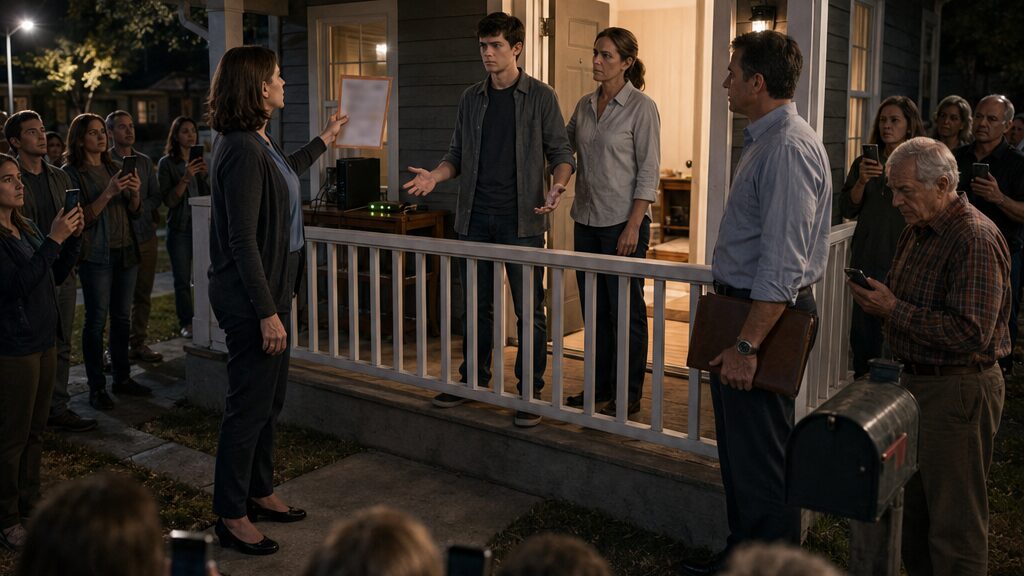
At 7:56 the following evening, Jennifer Clark arrived with the violation notice, six neighbors, and the HOA president.
Brandon King stood one step below her on the Davis porch, wearing a pale dress shirt with the sleeves folded neatly to his elbows. He carried a leather folder under one arm.
“We’re not here to embarrass anyone,” he said.
Michael looked past him at the phones already raised along the walkway.
“Then you brought a strange amount of audience.”
Amy touched Michael’s arm before he could say more.
Jennifer held the original notice against her chest. “Residents deserve to see that the suspected equipment has been disconnected before the outage window.”
“Suspected by you,” Michael said.
“Identified as a reasonable possibility.”
George Hall stood near the mailbox, slightly apart from the others. He was the oldest person in the group and the only one not looking at Michael. His attention stayed on his phone.
Brandon spoke in the measured voice he used at annual meetings. “No finding has been made. We’re conducting a cooperative test.”
“You issued a violation before the test,” Amy said.
“A preliminary notice.”
“It says we may be charged.”
“Only if there is noncompliance.”
Michael opened the door wider. Behind him, his router sat on a small table in the entryway, moved downstairs where everyone could see it. A power strip ran from the living room with his computer tower, monitor, console, and wireless accessories connected.
“I’ll unplug all of it,” he said. “You watch.”
Jennifer glanced at the router. “Including that.”
“No. That stays on.”
“That is the device under question.”
“If I shut it off, you learn nothing. The point is to show whether it loses the outside connection while staying powered.”
One of the neighbors shifted impatiently. “We just need the internet back.”
Michael looked at him. “Then you should want the right answer.”
The digital clock on the microwave read 7:57.
Michael switched off his computer. The colored lights faded from the front windows. He disconnected the Ethernet cable, unplugged the console, then pulled the power strip from the wall.
His bedroom, visible from the street, went dark.
Jennifer checked her phone.
“Gaming system offline,” Brandon said, as though dictating a record.
“Say privately owned devices,” Michael replied. “You don’t know what each one is.”
Brandon opened his folder and made a note.
At 7:58, Michael disconnected the television and smart speaker. Amy switched her laptop to airplane mode and placed it on the entry table.
Only the router remained.
Its three green lights blinked steadily.
“Your phone?” Jennifer asked.
Michael held it up. “Connected to the router. No mobile data.”
“Prove it.”
He opened the settings screen and showed her.
The neighbors crowded closer. Amy stepped between them and the doorway.
“Stay off the threshold,” she said. “This is still our house.”
At 7:59, the street became unnaturally quiet.
No one argued. No one shuffled. They watched their screens and the glowing router as the microwave clock changed digits.
Michael rested both hands on the porch rail.
He could feel Jennifer looking at him, waiting for some last-second trick. He wondered whether she expected him to reach into his pocket and stop whatever she imagined he had started.
The final minute seemed longer because everyone wanted it to prove them right.
Then the two-note tone sounded.
High. Low.
Every phone on the porch changed at once.
Connection lost.
No internet.
Unable to reach network.
A neighbor cursed softly. Another tapped the screen three times.
Inside the doorway, Michael’s router remained green.
He did not move his hands.
For several seconds, no one spoke.
Jennifer stepped past Amy far enough to stare at the lights. “That could be cached.”
“No,” Michael said.
“You could have programmed—”
“Jennifer,” Brandon interrupted.
The word came quietly, but it stopped her.
Amy lifted her own phone. “Mine is down too.”
“So is mine,” Brandon said.
Michael looked along the walkway at the cluster of dead screens. “Everything I own is unplugged.”
George’s phone chimed.
Not the same two-note sound. This was a spoken notification in a synthetic voice.
Smart plug activated.
George froze.
A neighbor turned toward him. “What smart plug?”
George pressed the side button, but the notification had already carried across the porch.
“It’s nothing.”
Michael removed one hand from the rail. “What turns on at eight?”
“Not turns on. Restarts.”
“What restarts?”
George looked at Jennifer, then Brandon.
Jennifer’s face changed first. Not understanding—recognition.
“George,” she said, “is that the extender?”
He slipped the phone into his pocket. “It’s an old unit.”
“What extender?” Amy asked.
George’s gaze remained on the concrete. “The one in my front room.”
Michael glanced toward George’s house, three doors down. “Connected to a timer?”
“A smart plug. It restarts every night. Keeps it from freezing.”
Jennifer descended the porch step. “You said you stopped using that.”
“I said I didn’t rely on it.”
“That isn’t the same thing.”
“No,” Michael said. “It really isn’t.”
George’s cheeks reddened. “The contractor put it there years ago. I didn’t install it.”
Brandon closed his folder. “Let’s not jump to conclusions. An extender in one residence should not affect the entire lane.”
“Correct,” Michael said.
Jennifer turned sharply. “Then how does this clear you?”
Michael looked at the steady green lights behind him.
“It clears what you claimed. My equipment was off. The outage happened anyway.”
“It doesn’t explain the outage.”
“No. It means you accused me before you had an explanation.”
The words settled harder than if he had raised his voice.
Two neighbors lowered their phones.
Brandon stepped between Jennifer and the porch. “We need to inspect George’s device. Tonight, if he consents.”
George rubbed a thumb along the edge of his phone. “It’s behind a cabinet.”
“We can move a cabinet,” Jennifer said.
His head came up. “It isn’t that simple.”
Michael saw something in the older man’s expression that did not fit embarrassment over outdated electronics. It was protective, almost frightened.
Amy noticed it too. Her voice softened.
“What else is back there, George?”
He hesitated before answering.
“The cameras.”
“What cameras?” Brandon asked.
George looked toward his darkened house.
“My wife’s system,” he said. “The extender is the only thing that still connects to it.”
No one spoke for a moment.
George’s wife had died the previous spring. Michael remembered the line of cars, the folded chairs in the driveway, and George standing at the curb after everyone left.
Jennifer recovered first. “The network is still down.”
George nodded without looking at her.
Michael stepped off the porch. “Show me the extender.”
“You?”
“I’m the one you all came to inspect.”
Brandon opened his mouth, but George had already turned toward his house.
“Fine,” the older man said. “But nobody touches anything until I say.”
As the neighbors followed, Michael glanced back at the router glowing steadily in the Davis doorway.
For the first time, everyone else saw what he had seen from the beginning.
The lights had never been the problem.
Chapter 3: The Extender Behind the Cabinet
George blocked the cabinet with both hands.
It was a narrow oak unit pressed against the living-room wall, crowded with framed photographs and a ceramic bowl full of keys. A faint electrical hum came from behind it.
“You can look,” George said, “but don’t unplug anything yet.”
Jennifer stood near the front door with Brandon and two neighbors. Amy remained beside Michael. The rest had stayed outside, where they checked whether service had returned.
Michael crouched near the wall. A thin cable disappeared behind the cabinet.
“What’s connected back there?”
“The extender. The camera hub. A smart plug.”
“Anything else?”
George hesitated. “Maybe another adapter.”
Jennifer exhaled. “George, this isn’t an archaeological dig. Move the cabinet.”
He gripped its top edge. “My wife arranged this room.”
No one answered.
Michael looked at the photographs. George and his wife at a lake. George and his wife beneath a banner at a neighborhood cookout. One photo showed her kneeling beside a small indoor camera, smiling as if installing it had been a private victory.
“Can we slide it without taking anything off?” Michael asked.
George studied him, then nodded.
Together they moved the cabinet six inches.
Behind it was a tangle of cables, a white smart plug, and three separate extenders.
Michael stared at them.
One was yellowed with age. Another was newer and marked with a faded inventory sticker. The third bore a handwritten label: HAWTHORN SOUTH NODE.
Brandon stepped closer. “That shouldn’t be there.”
“You recognize it?” Michael asked.
“It looks like contractor equipment.”
“It looks like HOA equipment.”
Jennifer folded her arms. “The board never approved household nodes.”
Michael pointed to the handwritten label. “Somebody did.”
George leaned against the cabinet. “The installer said they needed better coverage after the clubhouse system changed. He put one here, one in the garage, and one near the upstairs window.”
“Three?” Amy asked.
George nodded. “I thought they were all for the cameras.”
Michael followed the cables. The oldest extender fed George’s private camera hub. The labeled unit connected to the neighborhood mesh. Both passed through the same smart plug.
“At eight, the plug cycles,” Michael said. “Everything connected to it drops and comes back.”
Brandon frowned. “That still shouldn’t bring down the lane.”
“No,” Michael said. “It shouldn’t.”
Jennifer’s impatience returned. “Can we stop theorizing and test it?”
Michael looked at George. “Unplug the smart plug. Leave the private camera hub connected directly to the wall.”
George’s face tightened. “Will I lose the recordings?”
“Maybe for a minute. Not the saved files.”
“You’re sure?”
“No. I’m reasonably sure.”
Jennifer made a small sound of disbelief.
Michael looked at her. “That’s what people say when they don’t have proof.”
Amy touched his shoulder.
George knelt slowly and unplugged the smart device. Michael separated the cables, connected the camera hub directly, and left the HOA-labeled extender disconnected.
Within ninety seconds, phones began chiming.
Service restored.
A neighbor called from the doorway, “Mine’s back.”
Jennifer checked her husband’s monitoring app and stepped into the hall to make a call.
Brandon examined the inventory label without touching it. “We’ll have the property manager contact the contractor.”
“You should withdraw the notice first,” Amy said.
“The immediate issue has been identified.”
“That isn’t what I asked.”
Brandon slipped the folder beneath his arm. “The notice concerns possible interference and failure to cooperate. Your household has now cooperated.”
“After being accused in front of the street.”
“No formal finding was entered.”
Michael stood. “You posted my equipment description in the community portal.”
“An equipment category.”
“With a picture of my room.”
“That attachment came from a resident report.”
Jennifer returned from the hallway. “My husband’s monitor is uploading again.”
Relief loosened her face, but it disappeared when she saw Michael watching her.
“The system is working,” she said. “That is what matters tonight.”
“To you,” Michael replied.
George picked up the disconnected extender. “This caused it?”
“It triggered it,” Michael said. “That isn’t necessarily the same thing.”
Brandon’s expression hardened. “Let the contractor determine that.”
Michael turned the labeled device over. On the back, beneath dust and adhesive residue, was another sticker with a network identification number.
He memorized it before handing the extender to Brandon.
At 8:17, every house on Hawthorn Lane had internet.
The neighborhood group filled with relieved messages. Some thanked Jennifer for organizing the inspection. One neighbor credited Brandon’s quick response. Nobody mentioned the photograph of Michael’s room.
By morning, Brandon had posted a board notice declaring that an obsolete privately powered extender had caused the interruption.
The orange violation remained active.
Amy read the post at the kitchen table.
“They’re calling George’s equipment private.”
“One piece was,” Michael said. “The labeled one wasn’t.”
“You should send that to Brandon.”
“He held it in his hand.”
“Then send it anyway.”
Michael poured cereal and did not answer.
At the repair shop that afternoon, he searched the identification number on a manufacturer database. It was registered as part of a managed mesh system, not a consumer extender.
The owner field was hidden.
The device name was not.
CEDAR-HOLLOW-SOUTH-03.
His supervisor glanced over. “Find something?”
“Maybe.”
“That answer usually means yes.”
Michael closed the tab. “It means I need more than a label.”
That evening, Cedar Hollow remained connected at 7:59.
At 8:00, no two-note tone sounded.
Phones kept working. Porch cameras stayed online. Amy finished payroll without interruption.
For several minutes, Michael allowed himself to believe the problem was over.
Then Brandon’s announcement appeared on the residents’ page.
The board considered the matter resolved. The Davis notice would remain pending until its regular review because Michael’s “unregistered network modifications” had not yet been independently evaluated.
Amy read the sentence over his shoulder.
“You haven’t modified their network.”
“No.”
“Then we fight it.”
Michael looked across the street. Jennifer’s blinds were open now. She stood beside her husband, watching a medical app update on his phone.
For one second, her eyes met Michael’s.
She closed the blinds.
The following night, at exactly 8:00, the two-note timer sound came from somewhere farther down the lane.
Michael’s phone lost its signal.
His router stayed green.
Across Cedar Hollow, porch lights came on again.
George stepped into the street holding the unplugged smart device above his head.
“It isn’t connected!” he shouted.
Michael was already staring at the saved identification number on his screen.
One extender had never been capable of taking down the neighborhood by itself.
Something larger had been built around it.
Chapter 4: The Network That Was Never Approved
The identification number from George’s extender appeared on the repair-shop screen beneath a device Michael had never seen.
CEDAR-HOLLOW-GATEWAY-01.
Below it were seven subordinate nodes, including George’s unit, two addresses on Hawthorn Lane, the clubhouse, and a utility cabinet near the subdivision entrance. All of them had restarted within twelve seconds of one another at 8:00 the previous night.
Michael leaned closer.
The shop was nearly empty. His supervisor had gone into the back room to take a delivery, leaving only the hum of a bench fan and the sharp smell of electrical cleaner. Michael copied the restart times onto a notepad.
8:00:01.
8:00:04.
8:00:07.
8:00:12.
Not separate failures. A chain.
He clicked the device details, but the manufacturer’s public portal showed only registration data. The owner field remained hidden behind a managed-account login.
His supervisor returned carrying a box of used monitors.
“You’ve been staring at that screen like it owes you money.”
“It’s an HOA network.”
“You sure?”
Michael turned the monitor enough for him to see the device names.
His supervisor set down the box. “Those are managed nodes.”
“They said George’s extender was private.”
“That one may be both. Somebody could have adopted consumer hardware into a managed mesh.”
“Is that normal?”
“It’s cheap.”
“That’s not what I asked.”
His supervisor studied the list. “It’s not how I’d build something serving a whole neighborhood.”
Michael pointed at the restart times. “One node cycles and the others follow.”
“Could be a controller forcing reauthentication. Could be a bad topology. Could be somebody configured all the fallback routes through the same devices.”
“Through people’s houses?”
“Wouldn’t be the first shortcut.”
Michael thought of Brandon holding the labeled extender in George’s living room and saying it should not have been there.
He had recognized it.
At home, Amy had printed the HOA’s community network policy. It consisted of two pages about acceptable use, unauthorized equipment, interference, and resident responsibility. Nothing described household nodes, shared extenders, or devices installed inside private homes.
At the bottom was a link to the resident portal.
Michael logged in using Amy’s account. The portal offered dues statements, meeting minutes, violation records, and maintenance notices. The technology section contained a one-paragraph description of “community-supported connectivity infrastructure.”
No equipment map.
No vendor contract.
No network specifications.
He searched the minutes for “Wi-Fi,” “internet,” and “mesh.” Most results concerned the clubhouse. One entry from fourteen months earlier mentioned a motion to maintain service continuity while obtaining infrastructure bids.
The vote passed four to one.
Jennifer Clark moved the motion.
Brandon King seconded it.
The attachment containing the bids was missing.
Michael sat back.
At 7:58, his phone still had service. At 8:00, the two-note tone sounded somewhere beyond the houses. The network failed, recovered, then failed again.
Amy stood in the kitchen doorway.
“Are you recording it?”
“Yes.”
“Are you going to send it?”
“To who?”
“The board. The provider. Anyone.”
“They already know it’s happening.”
“Then send what you found.”
Michael closed the portal window.
“I haven’t found enough.”
“You found that the extender belonged to their system.”
“I found a device name.”
“You always do this.”
He turned. “Do what?”
“Wait until you can prove every inch of something before you tell me any of it.”
“Because half an answer becomes the whole accusation.”
Amy came into the room. “I’m not the board.”
“I know.”
“Then why are you treating me like them?”
Michael looked at the notebook beside his keyboard.
He had been thirteen when he found a security flaw in the school’s student portal. He had reported it to a teacher, then to the office when nothing changed. By the end of the week, the principal was questioning why he had been looking at restricted pages. His account was suspended. The flaw was repaired quietly. His disciplinary note remained for the rest of the year.
Adults praised honesty after they knew it could not inconvenience them.
Before that, honesty was access without permission.
“I need the controller logs,” he said.
Amy folded her arms. “Can you get them legally?”
“The board can.”
“Will they?”
“No.”
“Then request them.”
“They’ll delay.”
“Michael.”
He turned back to the screen. “I’m thinking.”
The HOA portal had a maintenance link at the bottom. Clicking it opened a vendor page with a faded logo and a login box. The username field had been prefilled with CEDARADMIN.
Michael knew what his supervisor would say: close it.
He also knew what Brandon would say if the system failed again: resident equipment remained under investigation.
Michael entered the default installer password printed in a setup manual he found through the manufacturer’s support archive.
The dashboard opened.
For a moment he did nothing.
A network map filled the screen. Cedar Hollow appeared as a web of green lines connecting the entrance cabinet, clubhouse, and private residences. George’s house sat at the center of three routes. So did another residence on the north side.
The board had not merely allowed extenders inside homes.
The network depended on them.
Michael clicked the event logs.
Hundreds of entries appeared. Authentication retries. Node losses. Cascading route changes. Automatic restarts.
Every night at 8:00, George’s smart plug had disconnected two devices. The controller then shifted traffic to a second residential node. That node overloaded, forcing the gateway to rebuild the mesh. For nearly three minutes, the system repeatedly dropped every client on the street.
The later outage had begun from a different node.
George’s extender was not the cause. It was the first domino.
Michael took screenshots.
A banner appeared at the top of the dashboard.
NEW ADMINISTRATIVE SESSION RECORDED.
His stomach tightened.
The system had logged the time, account, and originating address.
He should have closed the page immediately. Instead, he opened the documents tab.
There were installation diagrams, invoices, service notes, and a folder labeled ALTERNATE PROPOSALS. One file name caught his attention.
NETWORK STABILITY WARNING—UPGRADE RECOMMENDED.
He clicked it.
Access denied.
The file permissions were restricted to the primary board account.
Michael tried the documents index instead. A preview pane showed three lines from the report.
The proposed interim configuration relies upon residential power, homeowner-controlled devices, and nonredundant node placement. Scheduled resets or loss of any participating residence may cause widespread service interruption.
Below the preview was a board disposition.
UPGRADE REJECTED—COST EXCEEDS CURRENT RESERVE.
Approved by B. King.
Acknowledged by J. Clark.
Michael saved the visible text.
Then the dashboard refreshed.
SESSION TERMINATED BY ADMINISTRATOR.
The login page returned.
Thirty seconds later, Amy’s phone rang.
She looked at the screen and then at him.
“Brandon King.”
Michael’s browser still displayed the blank login box.
Amy answered without taking her eyes off her son.
“Hello?”
Brandon’s voice was faint but clear in the quiet room.
“We’ve detected unauthorized access to the association’s network system from your property.”
Chapter 5: The Warning Buried Under the Budget
Brandon projected Michael’s login record onto the clubhouse wall before asking him a single question.
The screen showed the date, the time, the administrator account, and the Davis home’s network address. Beneath it, in bold red letters, was a vendor-generated warning:
UNAUTHORIZED ADMINISTRATIVE SESSION.
Residents filled nearly every folding chair. Jennifer sat at the board table with a legal pad, her posture straight and controlled. George occupied a seat near the back, holding his disconnected smart plug in both hands.
Brandon faced the room.
“This is no longer speculation about ordinary household use. We have evidence that restricted infrastructure was accessed from the Davis residence.”
Amy stood beside Michael near the aisle. “You called this an emergency meeting about the outages.”
“It is about the outages.”
“You’re making it about my son.”
Brandon’s expression remained patient. “Your son accessed the system managing them.”
Michael watched Jennifer.
She had not looked at him since he entered.
One of the board members asked, “Did the access happen before or after the renewed outage?”
“After,” Brandon said.
“Then it didn’t cause the earlier incidents,” Amy replied.
“No one has said it did.”
“You put his address in red on the wall.”
Brandon picked up a remote. “We are establishing facts.”
Michael almost laughed. The phrase sounded too much like Jennifer’s claim that she had merely photographed visible conditions.
Brandon advanced the slide. A copy of the community network policy appeared.
“Residents are prohibited from accessing, altering, or interfering with association-managed equipment.”
“I didn’t alter anything,” Michael said.
“You entered an administrative dashboard.”
“The password was still the installer default.”
“That does not grant permission.”
“No,” Michael said. “It shows nobody secured it.”
A murmur moved through the room.
Jennifer finally looked up. “How did you know the username?”
“It was prefilled.”
“And the password?”
“Manufacturer documentation.”
“So you deliberately searched for credentials.”
Michael felt Amy’s attention turn toward him.
“Yes.”
The word landed harder than he expected.
Brandon set down the remote. “Thank you.”
“For what?”
“For clarifying intent.”
Michael clenched his jaw.
This was the part he knew. The moment when explaining more only gave adults cleaner words to use against him.
Jennifer spoke without raising her voice. “Did you download anything?”
“I saved screenshots of the network map and event logs.”
“Confidential infrastructure records.”
“Records showing the outages cascade through HOA nodes installed in private houses.”
Brandon’s hand tightened around the remote.
Several residents began speaking at once.
“You put equipment in our houses?”
“What private houses?”
“Is that why my camera keeps dropping?”
Brandon raised a hand. “The interim network design was approved to prevent a lapse in service. Participating homeowners consented at the time.”
George stood slowly. “I didn’t know my equipment carried the street.”
“You consented to an extender installation.”
“For my wife’s cameras.”
“The installer notes indicate shared coverage.”
George shook his head. “Nobody explained that losing power in my living room could knock out other houses.”
Jennifer’s pen stopped moving.
Michael saw it.
A brief hesitation, nothing more, but it was the first visible crack in her certainty.
Brandon clicked away from the login record. “The infrastructure is being reviewed. That does not excuse unauthorized access.”
“No,” Michael said. “It doesn’t.”
Amy looked at him sharply.
He had not told her everything. She knew Brandon had called. She knew Michael had entered the dashboard. She did not know he had saved files.
The clubhouse clock changed to 7:59.
A few residents checked their phones.
At exactly 8:00, the two-note tone sounded from somewhere in the room. A second later, the projector image pixelated. The meeting livestream failed. Phones displayed connection errors.
The room erupted.
Brandon stared at the frozen warning slide.
Michael’s own phone lost service.
“I’m not touching anything,” he said.
No one needed the reminder. Both his hands were visible at his sides.
Jennifer stood and hurried through a side door.
The signal returned less than a minute later. When she came back, her face had lost its careful color.
Brandon leaned toward her. “What happened?”
“Nothing relevant to this meeting.”
Michael heard the strain beneath the words.
Jennifer sat down, but her phone remained in her hand. A medical application glowed on the screen.
“Mrs. Clark,” Michael said, “what happened?”
Her gaze hardened. “This is not your concern.”
“It became his concern when you used it to accuse him,” Amy said.
Jennifer looked at Brandon, then at the residents watching her.
“My husband’s monitor failed to upload.”
The room quieted.
She pressed her thumb against the edge of the phone. “It has missed two scheduled transmissions this week. His clinic said the device stores the readings and sends them later, but that is not the same as seeing the confirmation when it is supposed to happen.”
Michael remembered her standing beside her husband when service returned, the relief that had crossed her face before she closed the blinds.
“You thought my gaming was blocking it,” he said.
“I thought unusually heavy use was one possibility.”
“You told people you knew who was causing it.”
“I was trying to get action.”
“You got action against us.”
Her eyes flashed. “You think I enjoyed standing in your doorway? I have spent four nights waiting for a green confirmation mark that does not appear. The provider blames the HOA equipment. The HOA contractor says the system is operational. Your room glows like a server rack, and you refused to explain what you were running.”
“Because you had already decided.”
“And now we know you entered the network.”
The truth of that stopped him.
Jennifer had been wrong about the outage. She was not wrong about what he had done afterward.
Brandon used the silence.
“The board has received several upgrade proposals,” he said. “All of them would require a substantial special assessment. The interim arrangement was selected to preserve service without placing an immediate financial burden on homeowners.”
“How substantial?” a resident asked.
“Potentially several thousand dollars per property.”
The room shifted again. Outrage gave way to calculation.
Mortgage payments. Repairs. Medical bills. Fixed incomes.
Brandon saw it and continued.
“We made a practical decision with the information available.”
Michael opened the screenshots on his phone.
“You had a warning.”
Brandon looked at him.
“The contractor said scheduled resets or the loss of any participating residence could interrupt the whole system.”
Jennifer’s face went still.
“You saw a restricted preview,” Brandon said.
“So it exists.”
“A preliminary technical note is not a final conclusion.”
“Then release it.”
“We are not discussing confidential vendor records in an open meeting.”
A neighbor near George turned. “Why not?”
“Because partial documents create misunderstanding.”
Michael felt a bitter smile form. “You mean people might decide what happened before they have all the evidence?”
Jennifer looked away.
After the meeting, Brandon asked Amy and Michael to remain.
The property manager closed the clubhouse doors after the last resident left. Jennifer stayed at the board table.
Brandon placed a single-page agreement before Amy.
The HOA would withdraw the violation and waive investigation costs. In exchange, the Davis household would confirm that no board member had knowingly accused Michael of causing the outages and would not distribute internal network materials.
Amy read it twice.
“This says confidential resolution.”
“It prevents unnecessary escalation,” Brandon said.
“It prevents embarrassment.”
“It protects all parties.”
Michael stood by the window. Through the horizontal blinds, he could see residents lingering in the parking lot, talking in small groups.
Jennifer’s voice was quieter now. “Your son accessed a restricted system. The board could pursue that separately.”
Amy looked at Michael.
He knew what she wanted: tell her there was nothing more. Let her sign. Remove the threat to their house.
Instead, he said, “I downloaded screenshots.”
Her face changed.
“How many?”
“Enough to show the network map and warning preview.”
“You told me you looked.”
“I did more than look.”
Brandon folded his hands. “That is precisely why this agreement is reasonable.”
Amy stared at the signature line.
For one awful second, Michael thought she might sign anyway.
Then she slid the paper back.
“No.”
“Mom—”
She turned on him. “You should have told me.”
“I know.”
“You do not get to decide alone what puts our home at risk.”
“I know.”
“But they do not get to use your mistake to erase theirs.”
Brandon’s patience thinned. “Then the violation remains active.”
Michael stepped to the table.
“Keep it.”
Amy looked at him.
He met her eyes instead of looking away.
“I entered the dashboard,” he said. “I’ll admit it publicly. But I’m not signing something that says they never blamed me.”
The blinds behind him reflected the clubhouse lights, showing only fragments of the people at the table.
Jennifer lowered her pen.
Brandon gathered the agreement.
“Then the next hearing will address both matters.”
Michael nodded, though his stomach had tightened into a hard knot.
For the first time, he had told the whole truth before anyone forced it from him.
It did not make the danger smaller.
It only made it his.
Chapter 6: The Boy Who Chose to Admit It First
Michael began the special meeting by admitting what everyone expected him to deny.
“I entered the HOA network dashboard without permission.”
The room went still.
On the table in front of him sat his green-lit router, George’s white smart plug, and the dust-marked extender labeled HAWTHORN SOUTH NODE. Brandon had arranged the board members across the raised platform. Jennifer sat at the far end, her legal pad closed.
Amy occupied the chair beside Michael.
He continued before Brandon could interrupt.
“The username was prefilled. The password was an installer default that should have been changed. That does not make my access authorized. I saved screenshots of the device map, restart logs, and a preview of a contractor warning.”
Brandon leaned toward his microphone. “For the record, the association has not verified the authenticity or completeness of those materials.”
“They came from your system.”
“That is your assertion.”
Michael connected his laptop to the projector. The first image showed the network map.
Green lines spread from the gateway to the clubhouse, utility cabinet, and homes.
A low murmur passed through the residents.
George’s house appeared near the center.
Michael pointed to it.
“This node disconnected every night when Mr. Hall’s smart plug cycled. The controller moved traffic to another residential node, overloaded it, and rebuilt the network. That is why everyone lost service.”
Brandon shook his head. “You cannot establish causation from screenshots.”
“No. That’s why I asked for the full warning report and a live test.”
Jennifer finally spoke. “Before any test, explain why the system failed after George’s timer was disconnected.”
Michael advanced to the next image.
“Another residential node restarted. The same cascade happened from a different address.”
“Which address?” a resident asked.
Michael hesitated.
He had the number, but not the right to put another household under the kind of suspicion he had endured.
“I’m not naming it publicly.”
Brandon gave a small, humorless smile. “Convenient.”
“No. Consistent.”
Amy looked at him, and he knew she understood.
He was not going to clear himself by offering the crowd someone else.
George rose from the second row.
“There’s something I need to say.”
He carried the smart plug in one hand. His fingers trembled slightly around it.
After the first night at his house, he said, he had left the HOA extender disconnected. But the camera hub stopped reaching two exterior cameras his wife had installed before she became ill. One faced the garden. The other covered the side gate where she used to leave seed for birds.
“I could still see the recordings on the box,” George said, “but not on my phone. It felt like another part of the house had gone dark.”
The room remained silent.
“So I plugged the extender back in the next afternoon.”
Jennifer stared at him. “You told us it was disconnected.”
“It was when I told you.”
“You knew the outage might return.”
“I thought Michael had fixed it.”
“I told you the extender was part of a larger system,” Michael said.
George nodded. “You did. I didn’t want to hear the larger part.”
He placed the plug beside the extender on Michael’s table.
“I turned the timer off, but I restored the device. I should have told everyone.”
The confession changed the room more than the screenshots had.
George was not a saboteur. He was not careless in the easy way people preferred. He had made a selfish choice for a reason many of them understood, then hidden it because he feared what they would take from him.
A woman in the front row asked, “Did reconnecting it cause the second outage?”
Michael answered carefully. “It may have contributed, but the logs show another node initiated that cascade. The problem is the design. Any one of these devices can trigger it.”
Brandon adjusted his microphone. “Again, that is an interpretation by an unlicensed minor who entered a restricted system.”
Amy’s chair scraped as she shifted forward.
Michael touched her wrist.
He wanted to answer with anger. He could feel the words rising: You built it, you hid it, and now my age is the only argument you have left.
Instead, he opened the photograph from the porch test.
His router glowed green inside the doorway. Around it, neighbors held dead phones. Michael stood at the rail with both hands visible.
“You called that a cooperative inspection,” he said. “I unplugged every device you named. The outage still happened. That test cleared my equipment before I ever accessed the dashboard.”
Brandon’s face tightened.
“The dashboard did not create the failure. It showed why your explanation was wrong.”
Jennifer looked at the projected photograph.
She appeared near the edge, holding the violation notice.
For several seconds she said nothing.
Then the timer on George’s smart plug chimed.
High. Low.
The familiar two-note sound passed through the clubhouse.
Several residents flinched.
Michael had programmed it to activate without powering the extender. The device itself remained disconnected on the table.
Phones stayed online.
The projector did not flicker.
George looked at the plug as though hearing the sound for the first time.
Michael said, “The tone was never the danger. It was only the moment a weak system was asked to make the same bad decision again.”
No one laughed. He had not meant it as a line.
Brandon stood.
“If you are so certain, prove the cascade under controlled conditions.”
Jennifer turned toward him. “Brandon.”
“No. He wants the association to release a confidential contractor report based on screenshots obtained improperly. Let him demonstrate his claim.”
Michael looked at the utility diagram on his laptop.
A live test would require access to the entrance cabinet and controller. If he was wrong, the board would say the outages had been coincidence. If he was right, the network might fail in front of everyone.
“How?” a board member asked.
“Tomorrow evening,” Brandon said. “Before the usual outage window. The contractor can attend remotely.”
Michael shook his head. “Not remotely. The connection is what fails.”
“The contractor is out of state.”
“Then record the test locally.”
Brandon spread his hands. “You are setting conditions now?”
“Yes.”
A few residents shifted, surprised less by the answer than by how calmly it came.
Michael closed the photograph and displayed the preview of the warning.
The three visible lines appeared on the wall.
Residential power.
Homeowner-controlled devices.
Widespread service interruption.
“This report predicted the exact problem,” he said. “I will run the test. I’ll show where the cascade starts and how to isolate it.”
Brandon’s jaw worked once.
“But only if the full warning is released to every homeowner before the test.”
“That document includes privileged vendor analysis.”
“It includes what the board knew.”
Jennifer looked down at her closed legal pad.
Michael continued.
“And the violation against my house is suspended during the test. No more claims that my equipment is the cause unless the test shows it.”
Brandon gave a short breath through his nose. “You accessed our system and now you are bargaining.”
“I’m admitting what I did. You can address it after everyone sees what you did.”
The words drew a sharp murmur.
Amy did not stop him.
George remained standing behind them, his empty hands hanging at his sides.
Jennifer opened her legal pad, then closed it again.
“I acknowledged the warning,” she said.
Brandon turned toward her.
The room quieted.
Jennifer’s voice was steady, but she kept her eyes on Michael.
“I read it. I believed the risk was manageable because the alternative required an assessment many residents could not afford.”
“Jennifer,” Brandon said.
“That is what happened.”
She did not apologize. She did not withdraw the accusation. But she had broken the board’s united silence.
Michael felt the balance in the room shift.
Brandon saw it too.
He gathered the papers in front of him and spoke into the microphone.
“The board will provide its decision by noon tomorrow.”
Michael stood.
“No decision, no test.”
He disconnected his laptop, leaving the router, extender, and smart plug arranged on the table beneath the projected warning.
For once, he did not hide any part of what he had done.
Now the board had to decide whether it could say the same.
Chapter 7: The Cost of Keeping Every Light Green
At 7:47 the next evening, thirty-two residents stood inside the clubhouse watching a wall clock and a row of green indicator lights.
The entrance utility cabinet had been opened under the property manager’s supervision. A long Ethernet cable ran across the floor beneath strips of yellow tape, connecting the controller to Michael’s laptop. George’s extender sat on the demonstration table beside a replacement power supply. The internet contractor appeared on a locally recorded video feed that would continue even if the network failed.
Michael had isolated the unstable residential node but had not yet disabled it.
That was the point of the test.
At 7:50, Brandon entered carrying a sealed envelope and a stack of copies.
Conversation stopped.
He placed the envelope in front of the two board members, then handed one copy to Jennifer. She read the first page without sitting down.
Michael could see the title from across the room.
INTERIM MESH CONFIGURATION—RISK AND STABILITY REVIEW.
Brandon approached the microphone.
“The board has voted to release the contractor’s warning to homeowners for the purpose of tonight’s test.”
“Before the test,” Michael said.
Brandon looked at him.
“That was the condition.”
A muscle moved in Brandon’s cheek. Then he nodded to the property manager, who began passing copies down each row.
Paper moved through the room with a dry, restless sound.
Michael received his copy last.
The three lines he had seen in the preview appeared in the middle of the first page. The rest was worse.
The contractor had warned that Cedar Hollow’s reserve network depended on electrical service and equipment inside eleven private residences. It lacked automatic isolation between branches. A reboot, unplugged device, changed password, or homeowner relocation could destabilize service across multiple streets.
The proposed permanent upgrade had been estimated at just under three thousand dollars per property.
At the bottom was a handwritten board note.
Defer pending reserve recovery. Maintain interim system with resident cooperation.
Jennifer’s initials appeared beside Brandon’s.
A resident in the second row raised the document.
“You told us this was temporary clubhouse equipment.”
Brandon remained at the microphone. “The system began as a temporary continuity measure.”
“It says eleven houses.”
“At the time, the board believed the risks could be managed.”
“Without telling us our outlets were carrying neighborhood traffic?”
George stared at his copy.
His thumb rested over the sentence describing resident cooperation.
“Nobody asked me to cooperate,” he said. “They asked whether the installer could improve my cameras.”
Jennifer closed her eyes briefly.
Michael looked at the clock.
7:54.
“We can argue after the test,” he said. “Or we can learn what happens before eight.”
The room quieted enough for the hum of the controller fan to become audible.
Michael displayed the network map on the projector. The isolated node pulsed amber. George’s replacement extender showed green but carried no neighborhood traffic.
“The original design lets the controller treat residential nodes as alternate routes,” Michael said. “When one disappears, the system pushes its clients through another. If that node cannot handle the load, the controller rebuilds the route table. During that process, everyone is forced to reconnect.”
The contractor confirmed the explanation from the recorded feed.
Brandon stood with his arms folded.
“What are you changing?” he asked.
“One setting. I’m separating the unstable branch before the usual reset. It will reduce coverage at two houses, but it should prevent the cascade.”
“And if you’re wrong?”
“Those two houses lose service until we reconnect the branch.”
“And if you are right?”
“The rest of Cedar Hollow stays online.”
A resident near the back said, “Then why didn’t the contractor do that months ago?”
The contractor answered through the speaker.
“Because isolation reduces coverage. The interim design was intended to preserve full signal strength until permanent equipment could be funded.”
Brandon looked toward the room.
“You all wanted uninterrupted coverage without a special assessment.”
“No,” Amy said. “They wanted honest choices.”
Brandon did not answer.
At 7:58, Michael applied the isolation rule.
Two nodes changed from green to amber.
A woman near the aisle raised her phone. “My porch camera just went offline.”
Michael nodded. “Your house is on the isolated branch.”
“So we’re sacrificing her service?” Brandon asked.
“Temporarily. Instead of sacrificing everyone’s.”
The woman looked at her dead camera feed, then at the warning report.
“Continue.”
The clock reached 7:59.
People stopped turning pages.
George stood beside the demonstration table. Jennifer remained at the board table, one hand resting on the warning report. Brandon watched Michael’s screen.
At 8:00, the smart plug sounded.
High. Low.
Every face turned toward a phone.
Michael watched the controller.
The unstable branch attempted to restart. Its icon flashed red. Traffic moved toward the boundary Michael had created and stopped there.
No cascade followed.
The gateway remained green.
The clubhouse projector stayed bright.
Phones continued displaying live connections.
One second passed.
Then five.
Then fifteen.
A resident opened a streaming app. Another refreshed the neighborhood portal. Amy’s phone loaded a video without hesitation.
At 8:01, George’s disconnected camera branch remained red.
Everything else stayed online.
No one cheered.
The silence was heavier than celebration because the proof came with a price printed on every page in the room.
Brandon looked at the clock, then the controller, then the released warning.
“The test establishes a design weakness,” he said.
Michael removed his hands from the keyboard. “It establishes the weakness you were warned about.”
“It also establishes that temporary isolation can maintain broader service.”
“For tonight.”
The contractor’s voice came through the speaker.
“The controller is beyond recommended capacity. The permanent correction is replacement of the residential-node architecture.”
A board member asked, “At the quoted cost?”
“The estimate must be updated. It may be higher.”
Uneasy voices rose throughout the clubhouse.
Several thousand dollars per household was no longer an abstract number. It was a roof repair postponed, a medical payment divided, a month of wages redirected into underground cable and weatherproof equipment.
Michael watched Brandon absorb the shift.
For weeks, he had protected the board’s decision because he believed the alternative would turn homeowners against him. Now the truth had done exactly that.
But it had also shown why the decision had once seemed possible.
Brandon had not invented the lack of money.
He had concealed what the savings required.
Jennifer stood.
“The board should suspend the network violation against the Davis property immediately.”
Brandon looked at her.
“Withdraw it,” Amy said.
Jennifer corrected herself. “Withdraw it.”
One board member seconded the motion. The other did the same after a pause.
Brandon remained still.
Then he said, “The violation is withdrawn, and no investigation costs will be assessed.”
The property manager made a note.
Michael waited.
Nothing followed.
No correction of the resident post. No acknowledgment that Jennifer had photographed his room. No statement that neighbors had been gathered at his door based on an assumption.
Amy stepped forward.
“And the accusation?”
Brandon gathered the warning copies nearest him.
“The technical matter has been resolved for the evening.”
“That wasn’t my question.”
“The board will prepare a written communication after legal review.”
“When?”
“Following consultation with counsel.”
A familiar kind of delay entered the room.
Michael recognized it immediately. The dangerous fact had been handled. The human harm could now be postponed because it did not blink red on a dashboard.
Jennifer looked at him but did not speak.
George picked up the replacement extender.
“I’ll take the cameras offline until this is fixed.”
Michael shook his head. “You don’t have to lose them. I can separate your private hub from the HOA node.”
George’s grip tightened. “After what I did?”
“You reconnected it. You didn’t design the network.”
“I hid it.”
“Yes.”
The directness made George flinch, but Michael continued.
“And you admitted it.”
George looked down at the device.
The board scheduled a membership vote on the permanent upgrade and special assessment. Temporary isolation would remain in place until then. Two households would receive individual hotspots as a stopgap.
Residents left the clubhouse carrying copies of the warning and estimates they had not yet decided whether they could afford.
At 8:23, Michael closed the network dashboard.
The controller lights remained green.
Brandon approached him near the utility cabinet.
“You made your point.”
Michael coiled the Ethernet cable. “The network made it.”
“You understand that your unauthorized access is still a separate issue.”
“Yes.”
Brandon seemed surprised by the answer.
Michael handed the cable to the property manager.
“I admitted it before the test. Put it in the minutes.”
Brandon lowered his voice. “You could have handled this privately.”
“So could you.”
For a moment, neither moved.
Then Brandon left without replying.
Outside, Hawthorn Lane glowed beneath porch lamps and active camera lights. Phones worked. Streams loaded. The exact problem that had begun everything was gone.
Amy stood beside Michael on the clubhouse steps.
“You did it,” she said.
He looked toward Jennifer’s house.
Her blinds were open, but the room beyond them was empty.
“They fixed the notice,” he said.
“Not what they did to you.”
“No.”
Amy slipped her arm through his.
Behind them, the property manager locked the clubhouse doors.
At 8:30, the HOA portal updated.
The violation against the Davis property had been removed.
Below it, a new message appeared:
A statement concerning recent community network events will be issued following board review.
No date was included.
Chapter 8: After Eight, Nobody Looked Away
One month later, the clock on Michael’s desk changed to 8:00 while every green light in Cedar Hollow stayed on.
His router continued blinking. His phone held its signal. Across the street, Jennifer’s porch camera remained connected, and the small status light beside her husband’s monitor did not change.
Then the familiar two-note tone sounded.
High. Low.
Michael looked toward the window.
George stood on his porch holding up his phone. When he saw Michael watching, he pointed toward a pill bottle in his other hand.
Medication reminder.
Michael lifted one hand in acknowledgment.
George smiled, almost embarrassed, and went back inside.
The special assessment had passed by six votes. It was lower than the original estimate because the contractor agreed to credit part of the interim system, but it was still enough to divide the neighborhood. Some residents blamed the board. Some blamed the contractor. A few blamed Michael for forcing the cost into the open.
No one blamed his router anymore.
The permanent equipment would not be installed until fall. Until then, the isolated network ran with reduced coverage and individual hotspots at the affected homes. Michael had helped George separate the camera hub from the HOA node. The garden and side-gate feeds worked again without carrying anyone else’s traffic.
At 8:03, the doorbell rang.
Jennifer stood on the porch alone.
She did not carry a folder. She held the original orange-bordered violation notice inside a clear plastic sleeve.
Amy came from the kitchen but stayed several feet behind Michael.
Jennifer glanced past him at the entry table where the router had sat during the public test.
“May I speak with you?”
“You already are.”
Amy said his name quietly.
Michael opened the door wider but did not invite Jennifer inside.
She accepted the boundary.
“The board issued the community statement this afternoon,” she said.
“I saw it.”
The statement described the outage as the result of an unstable interim network configuration. It acknowledged that resident equipment had been “prematurely identified as a potential cause.” It did not mention photographs, porch witnesses, or Michael by name.
Jennifer looked down at the plastic sleeve.
“I asked them to name your household and state that the accusation was unsupported.”
Michael had not expected that.
“Brandon said counsel advised against identifying a minor.”
“That sounds useful.”
“Yes.”
The answer came without defense.
She handed him the sleeve.
The notice inside had been stamped WITHDRAWN. Beneath the stamp, Jennifer had written in blue ink:
Issued without sufficient evidence. Michael Davis’s equipment did not cause the neighborhood outages.
Her signature appeared below the sentence.
Amy stepped closer.
“Why isn’t that in the official statement?”
Jennifer’s fingers closed after releasing the sleeve.
“Because I agreed to the final wording.”
“Then this is private.”
“It is written.”
“That isn’t the same as public.”
“No,” Jennifer said. “It isn’t.”
The street behind her remained quiet. No neighbors stood at the curb. No phones were raised.
Michael studied the correction.
“You knew the network plan was risky.”
“I knew the contractor preferred the upgrade.”
“That’s not what the warning said.”
“No.”
“Why did you push the other plan?”
Jennifer looked toward her own house. Through the open blinds, her husband sat in a chair beside the monitor.
“The assessment would have come during his treatment. We had already taken money from retirement savings. George was living on one income. Two families were behind on dues. Brandon said the interim design could last a year if residents left the equipment alone.”
“So you decided nobody needed to know.”
“I decided delay was better than forcing people to pay.”
“And when it failed?”
“I needed the failure to be something we could stop without a vote.”
Michael understood the sentence before she finished it.
A gaming computer could be unplugged. A teenager could be pressured. A neighbor could be told to comply.
An infrastructure failure demanded money, records, and responsibility.
“You looked through my window and saw an answer you could afford,” he said.
Jennifer’s face tightened, but she nodded.
“Yes.”
Amy folded her arms. “You owe him an apology.”
“I know.”
Jennifer looked directly at Michael.
“I am sorry I treated suspicion as proof. I am sorry I brought people to your home. I am sorry I let the board’s concern about liability become more important than correcting what I said.”
The words were plain. No polished board language softened them.
Michael waited for relief.
What came instead was a quiet loosening, smaller than forgiveness and more useful than victory.
He slid the corrected notice from the sleeve.
“I’m keeping this.”
“That is why I brought it.”
“It doesn’t fix what happened.”
“I know.”
“And I’m not going to say everything is fine.”
“I didn’t expect you to.”
For the first time since the outages began, Jennifer stood on the porch without trying to control what the moment meant.
Michael placed the notice on the entry table.
“Your husband’s uploads working?”
“Yes. The hotspot handles them separately now.”
“Good.”
Jennifer nodded once. Then she left.
Amy watched her cross the street.
“That was not enough,” she said.
“No.”
“But?”
Michael looked at the handwritten correction.
“But it was true.”
Two days later, Brandon sent Michael an email inviting him to join a new resident technology committee. The message praised his “technical interest” and proposed that he help review future vendor work.
Michael read it twice.
There was no mention of his unauthorized access. No mention of the violation. No acknowledgment that the committee existed only because residents no longer trusted the board to manage the system privately.
Amy leaned against his bedroom door.
“What are you going to say?”
“No.”
She studied him. “Because you don’t want to help?”
“Because they want free work and a teenager they can point to next time.”
“That sounds possible.”
He opened a reply.
Then he stopped.
The network map remained pinned above his desk. Not the restricted screenshot—the contractor had released an updated public version after the vote. Every homeowner could now see which cabinets, nodes, and backup routes served each street.
That had been Michael’s condition during the upgrade discussions.
Open records.
Published warnings.
No equipment inside a residence without written consent.
He deleted the single word no.
His reply was four sentences.
He would participate if the committee meetings were open to residents, all recommendations were published, vendor warnings remained attached to board minutes, and no committee member could be used as a substitute for licensed professional review.
He copied Amy.
Then he sent it.
Brandon accepted the conditions the next morning.
At the first meeting, Michael sat at the end of the clubhouse table rather than beside the board. George attended as a resident representative. Jennifer took minutes but did not edit Michael’s questions into softer language.
At 7:59, several people glanced automatically at the wall clock.
Michael noticed and kept speaking.
When the minute changed, George’s medication reminder sounded from his pocket.
High. Low.
The projector stayed on.
Phones remained connected.
Nobody reached for a router. Nobody looked toward Michael as though he might be hiding something.
For one second, the entire room simply listened to the sound that had once turned fear into certainty.
Then George silenced the reminder, took his medication, and asked the contractor to explain the backup-power plan again.
Michael looked through the clubhouse windows at the houses along Hawthorn Lane. Most of the blinds were open.
The neighborhood had not become kinder because its internet stayed on. The board had not become honest because one report was released. Trust had not returned with the signal.
But the records were open.
The warning was attached.
And when eight o’clock came, no one looked away.
The story has ended.