The Chair at the End of the Driveway Became the Neighborhood’s Most Expensive Argument
Chapter 1: The Green Chair Appeared Before Sunrise
Thomas Harris almost backed over the chair at 6:18 on Monday morning.
His truck’s reverse alarm gave one sharp pulse before he hit the brake. In the pale image on the dashboard camera, a green folding lawn chair stood less than three feet behind his bumper, its metal legs planted squarely across the seam between his driveway and the sidewalk.
Thomas sat gripping the wheel.
The chair had not been there when he took the trash out the night before. He was certain because he had rolled both bins along that exact seam, checked that their wheels cleared the concrete edge, and turned their handles toward the house so the collection arm would not scrape the paint.
He stepped outside.
The chair was old but not broken. The green fabric had faded along the upper edge, and one aluminum arm carried a shallow dent. It had been folded flat, then set upright with almost unnatural precision, as if someone had measured its distance from the curb.
Thomas looked toward the neighboring houses. Curtains were closed. Porch lights glowed over empty steps. A sprinkler clicked somewhere beyond the white fence across the street.
“Very funny,” he said, though no one was there to hear him.
He carried the chair to the narrow strip beside his garage, left it folded against the brick, and drove to work.
At the municipal permitting office, Thomas spent the morning rejecting an application because a contractor had marked a setback line from the fence instead of the recorded property boundary. The contractor argued for ten minutes. Thomas showed him the survey, the ordinance, and the exact measurement.
Rules did not become optional because someone found them inconvenient.
That principle had cost Thomas friends during his divorce. It had also kept him from losing another six feet of backyard when his former neighbor claimed an old hedge was the true line. The survey had proved otherwise, but only after months of letters, attorney fees, and conversations conducted through clenched teeth.
By the time Thomas got home, Rebecca had moved the chair.
“It was blocking the side door,” she said from the kitchen table.
He looked through the window. The chair leaned beside the recycling bin.
“You know whose it is?”
“No.”
“Did anyone come by?”
“I was at school.”
Thomas waited for more. Rebecca kept working on her laptop.
“You could ask the neighbors,” she said.
“I’m not going door to door over a chair.”
“You’re staring at it like it filed a claim.”
Thomas opened the refrigerator harder than necessary.
The next morning, the chair stood at the end of the driveway again.
Not near the same place. In the same place.
Its right leg touched the thin expansion joint. Its back faced the house. Its folded seat pointed toward the sidewalk.
Thomas set down his coffee and walked around it without touching anything. A light layer of dew covered the fabric, except for a dry oval near the upper frame where someone had recently held it.
He photographed the chair from four angles.
Then he carried it behind the garage and laid it flat beneath the eave, out of sight from the street.
At work, he opened the photographs between permit reviews. He enlarged the legs, the sidewalk, the strip of grass beside the curb. Nothing showed a name, sticker, or mark.
During lunch, he sent the clearest photograph to the neighborhood message group.
Does this belong to anyone? It has appeared at the end of my driveway two mornings in a row.
The first response came from a neighbor two houses down.
Not ours.
Another wrote, Maybe bulk pickup?
Thomas answered that bulk pickup was Thursday and the chair had been moved after he removed it.
Then Pamela White replied.
Please do not leave personal items in visible driveway areas. Repeated placement can create maintenance and use questions.
Thomas stared at the wording.
I’m not leaving it there, he typed.
Pamela responded almost immediately.
Understood. Document each occurrence. We should identify whether someone is attempting to establish tolerated use of the area.
Rebecca read the exchange that evening while standing at the kitchen counter.
“Tolerated use?” she said. “It’s a lawn chair.”
“That’s what I said.”
“No, you didn’t.”
Thomas took the phone back.
Pamela arrived before dinner wearing pressed gray slacks and a navy cardigan despite the heat. She carried a narrow clipboard against her chest and stood near the white fence with her arms crossed.
Thomas showed her where the chair had been.
“Right on the seam?” she asked.
“Every time.”
“And facing inward?”
“Toward the house.”
Pamela looked along the sidewalk. “That matters.”
“How?”
“It can suggest the item is associated with your property rather than abandoned on the common path.”
Thomas disliked how quickly the idea settled into place.
“I moved it behind the garage.”
“You should bring it inside. If the same person retrieves and replaces it repeatedly, that establishes a pattern.”
“A pattern of what?”
Pamela lowered her voice, though no neighbors were nearby. “Possibly nothing. But we’ve had boundary complaints before. Informal use becomes difficult once residents start saying it was allowed.”
Thomas looked at the empty seam in the concrete.
A chair was not a fence, a parked trailer, or a shed built over a line. Yet he remembered his former neighbor pointing at the hedge and saying everyone had always understood where the property ended. Thomas had learned how quickly repetition could be turned into proof.
That night he carried the chair into the garage.
He placed it between a ladder and an unopened bag of grass seed, then shut the overhead door.
On Wednesday morning, the chair was back.
Thomas stopped halfway down the front walk.
The garage remained locked. The side gate was latched. Yet the green chair stood at the driveway edge, aligned with the same concrete seam, facing the house.
He checked the garage.
The chair he had stored was gone.
Someone had entered neither the house nor the garage. The side service door showed no damage. Then Thomas noticed the small gap beneath the garage door and remembered that Rebecca had taken out her bicycle after dinner. She sometimes lowered the door without waiting for it to close completely.
That explanation should have eased him.
It did not.
Someone had walked onto his property after dark, reached into his garage, and removed the chair.
Rebecca came outside with her backpack hanging from one shoulder.
“Maybe they thought you stole it,” she said.
“They came into my garage.”
“They reached under a door.”
“That isn’t better.”
She studied the chair. “Are you going to ask who it is now?”
Thomas unfolded his phone instead.
By noon, he had ordered a driveway camera with motion detection, infrared recording, and a field wide enough to capture the sidewalk from the mailbox to the white fence.
The delivery driver dropped it off that afternoon. Thomas installed it above the garage, angled carefully to exclude the neighbor’s windows. He tested the motion zones, timestamp, and night visibility twice.
Before bed, he placed the chair inside the garage again and made certain the door touched the concrete.
At 4:47 Thursday morning, his phone vibrated on the nightstand.
Motion detected.
Thomas opened the alert.
The image was grainy and almost colorless. A figure moved slowly along the sidewalk, partly hidden by the maple tree. One hand held something narrow. The other reached toward Thomas’s driveway.
The recording ended after twelve seconds.
In the final frame, the figure had turned toward his house.
Chapter 2: The Man Who Sat Without Asking
“He’s coming,” Rebecca whispered.
Thomas was already awake, dressed, and standing behind the living room curtain. Still, the words tightened every muscle in his back.
Outside, Sunday morning had not fully arrived. The streetlights remained on, and the houses across the road were dark except for one upstairs window. At the far end of the sidewalk, the figure from the recording moved beneath the maple trees.
Thomas had watched the footage repeatedly over three days. The person appeared before dawn, carried the green chair from somewhere beyond the camera’s range, and placed it at the driveway seam. The darkness hid the face. The slow movement could have been caution.
Now, in the gray light, Thomas saw it was age.
The man wore khaki pants, a light windbreaker, and worn walking shoes. He carried the folded chair under one arm. Each step was careful, the heel placed first, then the rest of the foot, as though the sidewalk might shift beneath him.
Rebecca stood beside Thomas in socks, holding the curtain away from her face.
“You know him?” Thomas asked.
“I’ve seen him walking.”
“Where does he live?”
She pointed past the white fence. “Maybe the next street.”
The man reached the driveway, set down the chair, and unfolded it.
For the first time, Thomas saw the faded green seat stretched open. The man turned the chair toward the road, not the house, and lowered himself into it with both hands braced on the aluminum arms.
Nothing about the movement looked casual.
His knees bent halfway, stopped, and trembled. He shifted his weight, tried again, and dropped the final few inches with a breath Thomas could see in the cool air.
The man leaned forward, eyes closed.
Rebecca let the curtain fall.
“Dad.”
Thomas opened the front door.
The man looked up when Thomas crossed the lawn. Surprise moved across his face, followed by embarrassment.
“Excuse me,” Thomas said.
The man put both hands on the chair arms as if to stand.
“You don’t have to—” Thomas began.
But the man was already pushing. His elbows shook. He rose several inches, lost balance, and sat down again harder than before.
Thomas stopped two steps away.
“My name’s Thomas Harris. This is my driveway.”
“Yes.” The man nodded quickly. “I know. I’m George Miller. I’m over on Willow Bend.”
Thomas had expected denial, irritation, perhaps a claim that the sidewalk belonged to everyone. George offered none of those.
“Is this your chair?”
“Yes.”
“You’ve been leaving it here every morning?”
George looked toward the empty street. “I use it on my way back.”
“Back from where?”
“The path around the retention pond. Doctor says I should walk.” He tapped one knee, then his chest with two fingers. “The first half is easier than the second.”
Thomas glanced at Rebecca, who had come outside but remained near the porch.
“You leave it here all night?”
“I bring it before my walk. Sometimes I leave it folded beside your drive so I don’t carry it the whole way.” George’s hand tightened around the aluminum arm. “I thought it was out of the traffic.”
“You reached into my garage.”
George’s face changed.
“I’m sorry about that. It disappeared. I saw the door wasn’t down all the way.” He swallowed. “I thought someone had put it aside.”
“I put it aside.”
“I understand.”
“Why didn’t you ask me?”
George looked directly at him then. His eyes were tired but not confused.
“I didn’t think anyone would mind.”
The answer was so simple that Thomas could not fit his anger around it.
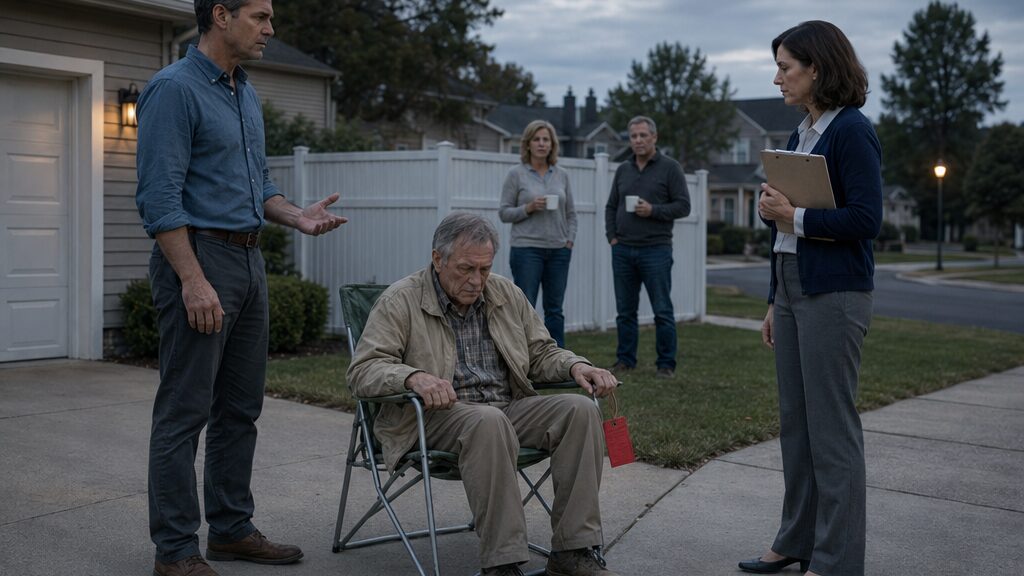
A car turned onto the street and slowed. Pamela White’s silver SUV stopped at the curb.
She stepped out holding a red tag, a clipboard, and a white envelope.
“I came as soon as the inspection window opened,” she said.
Thomas looked at her. “How did you know to come now?”
“The board authorized an observation after your report.”
“I reported an unidentified chair.”
Pamela’s attention moved to George. “Mr. Miller.”
George did not answer.
“You know him?” Thomas asked.
Pamela’s pause lasted less than a second.
“I know most residents.”
She walked to the chair and looped the red tag over its arm. The card hung against the faded green fabric, bright enough to be seen from across the road.
George looked down at it.
Pamela addressed Thomas as if George were not seated between them.
“Repeated placement of a personal object on or adjacent to another lot creates several concerns. Visual standards, unauthorized storage, potential tolerated use, and liability if someone is injured.”
Two neighbors had appeared near the white fence. One held a coffee mug. The other folded his arms.
George reached for the tag.
Pamela lifted a hand. “Please leave the notice attached.”
“He needs the chair to rest,” Thomas said.
“That may be true. It doesn’t change the process.”
George pushed down on the arms again. This time he made it to his feet, but his right leg buckled slightly. Thomas reached forward. George pulled away before he could be touched.
“I’ll take it home,” George said.
Pamela checked a box on her clipboard. “Removing it today does not resolve the documented recurrence.”
Thomas stared at the red tag swinging from the chair arm.
“What exactly did I report?”
Pamela looked at him. “An unknown item repeatedly placed on your property.”
“Read what I wrote.”
“This isn’t the place.”
“You made it the place.”
The neighbor with the coffee mug lowered his cup.
Pamela’s jaw tightened. “Your report prompted a legitimate review.”
“Did I say George was claiming my property?”
“No.”
“Did I ask for a violation?”
“You asked that the matter be addressed.”
“I asked who owned the chair.”
Pamela glanced at the gathering neighbors. “Mr. Harris, tolerated use can become a serious issue. You expressed concern about repeated placement on the boundary.”
Thomas could hear his own earlier fear inside her words. That made them harder to reject.
He reached down and removed the red tag from the chair. He did not tear it. He folded the plastic tie back through its slot and held the notice at his side.
Pamela’s voice sharpened. “That document belongs with the cited object.”
“The object is a chair. He’s sitting because he can’t finish his walk without stopping.”
George had folded the chair again. He stood with one hand on its back, breathing through his nose.
“I’ll go,” he said.
Thomas should have said that the chair could stay. He should have told Pamela there would be no complaint and no inspection. Instead, he thought of the garage, the camera footage, the old boundary dispute, and the possibility that agreeing in front of witnesses would become something he could not later undo.
“You can use it this morning,” he said. “We’ll figure out another arrangement.”
Rebecca closed her eyes briefly.
George looked at Thomas, and the disappointment in his face was quieter than anger.
“Another arrangement,” he repeated.
Pamela removed the white envelope from her clipboard and held it toward him.
“This is notice of a compliance hearing. Seven calendar days. You may submit written materials through the property manager.”
George did not take it.
Pamela placed the envelope on the folded chair.
Thomas felt Rebecca standing behind him. He did not turn around.
George lifted the chair under one arm. The envelope slid but did not fall. He began walking toward the white fence, slower than before.
Pamela made another mark on her clipboard.
“What hearing?” Thomas asked.
“Repeated unauthorized placement, interference with common-area standards, and failure to comply after notice.”
“He was notified thirty seconds ago.”
“The prior placements are documented.”
“By my camera.”
“And by your complaint.”
George stopped at the corner but did not look back.
Pamela closed the clipboard.
“The board will review the matter Thursday evening. Mr. Miller has seven days to respond, though he may attend sooner if he wishes.”
Thomas held the red tag in one hand and watched George carry the chair away with the hearing envelope balanced against its faded green frame.
Chapter 3: The Complaint Thomas Wished He Had Never Filed
The case file identified Thomas as the “originating complainant.”
The words appeared directly beneath a photograph of George’s chair.
Thomas stood at the counter in the HOA office, reading the page through a clear plastic sleeve while the property manager waited on the other side. The photograph had been taken Sunday morning. George sat in the chair with his face turned away, the red violation tag hanging from the arm.
The framing made him look as though he had refused to move.
“That is not what happened,” Thomas said.
The property manager adjusted the stack of forms in front of her. “The photo documents the object in place after notice.”
“He was sitting when Pamela attached the notice.”
“I wasn’t present.”
“I was.”
The file summary described “repeated encroachment by a non-owner upon the Harris lot boundary.” Below that, another line stated that Thomas had expressed concern over possible adverse or tolerated use.
Thomas read it twice.
“I never used the word encroachment.”
“The summary was prepared by the compliance chair.”
“I asked who owned a chair.”
The manager’s expression remained neutral in the practiced way of someone who spent her days receiving complaints from people certain that their case was different.
“You may submit a clarification before the hearing.”
“I want my original message entered into the file.”
“It should already be included.”
“It isn’t.”
She opened the folder, checked behind the summary, and found three printed screenshots from the neighborhood group. The first showed Thomas’s question. The second showed Pamela advising documentation. The third ended before Thomas clarified that the chair had been moved from his garage.
The manager frowned.
“There may be a supplemental page.”
“There isn’t.”
“Then you can provide it.”
Thomas took out his phone and opened the conversation.
The manager printed the full exchange. While the machine worked, Thomas noticed Kevin Mitchell near the small conference room, reviewing a spreadsheet with a calculator beside his hand.
Kevin looked up. “You’re involved in the chair thing?”
“Apparently I started it.”
“You reported it.”
“I asked a question.”
Kevin set down his pen. “Pamela said you were worried about someone establishing use rights.”
“She suggested that.”
“You didn’t disagree.”
Thomas almost answered. Instead, he looked at the photograph again.
George’s hand rested on the dented aluminum arm. His shoulders were rounded. The red tag was visible from several feet away.
“What happens if the board upholds this?” Thomas asked.
“Daily fines after the correction period,” Kevin said. “Removal costs if the item keeps appearing.”
“He already took it home.”
“Pamela says the underlying use remains unresolved.”
“What does that mean?”
Kevin glanced toward the property manager, then lowered his voice. “It means the board doesn’t want to approve an informal resting point.”
Thomas turned to him. “Approve?”
Kevin looked as though he regretted the word.
“There was discussion last year about a bench along that side of the neighborhood.”
“What bench?”
“I don’t remember the details.”
“You remember enough to call it a resting point.”
Kevin closed the spreadsheet. “It didn’t go anywhere. Cost, insurance, maintenance. The usual.”
“Who requested it?”
Kevin rubbed the bridge of his nose. “I shouldn’t talk about another resident’s submission.”
“Pamela put his photograph in a violation file with my name under it.”
“That doesn’t mean—”
“Was it George?”
Kevin did not answer.
The property manager returned with the printed exchange and slid it into the folder.
Thomas pointed to the case summary. “I want that language corrected.”
“The compliance chair has to amend her report.”
“Then call her.”
“She’s unavailable until the hearing.”
Thomas laughed once, without humor.
At the municipal office that afternoon, he tried to work through a stack of applications. Every file he opened contained familiar categories: ownership, responsibility, access, setback, notice. Usually the order of documents brought clarity. This time each page seemed capable of hiding whatever the person preparing it wanted hidden.
He opened the HOA portal and downloaded the case file.
The digital version contained more pages than the printed folder.
Thomas compared them line by line. Inspection notes. Photographs. A copy of the hearing notice. His partial messages. A property map with the chair location marked by a red circle.
One entry appeared in the document index without a corresponding attachment.
Prior related correspondence — accessibility request.
Thomas clicked it.
File unavailable.
At five, he drove to George’s house on Willow Bend. The green chair stood folded beside the porch steps. George was watering a narrow bed of marigolds with a plastic pitcher.
Thomas stopped at the walk.
“I came to apologize.”
George kept pouring until the pitcher was empty.
“For which part?”
Thomas looked at the chair. “I should have told Pamela there was no complaint.”
“You did complain.”
“I asked who owned it.”
“You were worried someone was claiming your driveway.”
Thomas could not deny it.
“I didn’t ask them to fine you.”
George set the pitcher down. “You didn’t ask them not to.”
The porch was small, with two wooden chairs beneath the window. Thomas noticed that both had cushions. Neither looked easy to move.
“I can keep your folding chair at my house,” Thomas said. “Inside the garage. You can use it whenever you walk by. No one can call it abandoned.”
George’s face hardened.
“You want me to ask permission every morning?”
“No. I’m saying it can stay.”
“Hidden.”
“Protected.”
“From who?”
Thomas had no answer that did not include himself.
George picked up the pitcher again. “I carried that chair because there’s nowhere to sit between my house and the pond. I asked for somewhere. They said no.”
Thomas felt the missing attachment like a physical weight.
“You requested the bench.”
George looked toward the street.
“Who told you?”
“No one exactly. I saw a reference in the file.”
“That figures.”
“What did the board say?”
“They said a bench would create maintenance obligations. Then they said people might gather there. Then somebody said a fixed object could become a hazard.” George’s mouth tightened. “By the end, you’d have thought I asked them to build a train station.”
“Do you have the request?”
“I threw my copy away.”
“Why?”
“Because I was tired of looking at it.”
Thomas stepped closer to the porch. “The file is missing.”
George gave him a long look. “Files don’t go missing by themselves.”
Thomas thought of Pamela’s careful voice at the driveway. Tolerated use. Liability. Pattern. Words selected to move a harmless object into the category she needed.
“I’m going to find it.”
George lifted the pitcher.
“That won’t change what you did.”
The sentence struck harder because George did not raise his voice.
Thomas drove home after dark. Rebecca was at the kitchen table, eating cereal from a mixing bowl.
“How did it go?” she asked.
“He doesn’t want the chair in our garage.”
“Of course he doesn’t.”
“I was trying to help.”
“You were trying to make it invisible.”
Thomas set his keys on the counter.
Rebecca looked at him. “Did you tell him you were sorry for staying quiet?”
“Yes.”
“Did you tell him why?”
Thomas opened his mouth, then stopped.
Because I was afraid agreement would cost me control.
Because I believed Pamela’s language before I believed what I saw.
Because once people were watching, I cared more about not looking foolish than about stopping something wrong.
“No,” he said.
Rebecca pushed the cereal bowl away. “Then you didn’t tell him.”
Later, Thomas reopened the digital case file. He checked the metadata, the document index, and the attachment numbering.
The files ran in sequence from A through F.
The accessibility request was labeled H.
Attachment G was also missing.
Thomas clicked the index entry beside it.
Private board correspondence.
Below the blank link was a date from eleven months earlier and a note entered by Pamela White:
Resident advised that approval could make association responsible for consequences of his condition.
Chapter 4: The Bench Request Buried in the File
The missing attachment was not missing from every system.
At nine the next morning, Thomas stood at a public terminal in the county records office, staring at an eleven-month-old email chain filed under a drainage-path maintenance review. The subject line made no mention of George, the HOA, or accessibility.
Pedestrian amenity inquiry — Willow Bend connection.
The first message came from the county accessibility coordinator to the HOA property manager. It referenced a resident request for “a stable rest point along the subdivision’s internal walking route” and asked whether the association intended to install one on private common property.
Attached was a scanned one-page letter.
Thomas opened it.
George had written it by hand.
The lettering was blocky and careful. He explained that he had begun walking the pond route after a hospital stay and could manage the distance if he had somewhere to sit between Willow Bend and the north entrance. He did not ask for a custom structure or a reserved place. He suggested a simple bench near the maple tree, where the walkway widened and did not block driveways.
At the bottom he had added:
I am willing to contribute toward the cost if that helps.
Thomas read the line twice.
The county coordinator’s reply listed general clearance, surface, and anchoring requirements. None appeared difficult. The final message said the matter belonged to the HOA because the proposed location was on association property.
The HOA’s response was absent.
Thomas asked the records clerk whether there were more pages.
“That is the complete county thread,” she said. “Anything after the referral would be held by the association.”
“Can you print the attachment and the clearance requirements?”
The clerk looked toward the printer. “Twenty cents a page.”
Thomas paid for six pages.
He left with them in a manila folder and drove directly to George’s house.
The green chair was not beside the porch.
Thomas found George halfway along the subdivision walkway, standing near the maple tree with one hand pressed against its trunk. The chair had been unfolded on the strip of grass beside him, positioned almost exactly where the letter proposed a bench.
George saw Thomas approaching and sat before Thomas could offer help.
“You found something,” he said.
Thomas held up the folder.
“The county kept your request.”
George’s eyes moved to the pages but not his hands.
“They kept everything except the decision.”
“The county gave clearance requirements. The board had options.”
“They gave me an answer.”
“Do you have it?”
“No.”
Thomas sat on the grass side of the walkway rather than taking the chair’s other arm. “Tell me what happened.”
George looked toward the retention pond. Its fountain rose beyond the houses, catching sunlight before falling back into the same dark water.
“I brought the letter to a board meeting,” he said. “Pamela said they would review it. A month later, she came to my porch.”
“Alone?”
“Yes.”
“What did she say?”
“That a bench could encourage gatherings. That children might climb on it. That if someone fell, the association could be blamed.” George rubbed his thumb along the dented aluminum arm. “Then she asked whether my doctor had ordered the neighborhood to provide a seat.”
Thomas felt heat rise into his face.
“What did you say?”
“I said no.”
“Did she ask about another location?”
“She asked whether my son could walk with me.”
The answer was so quietly delivered that Thomas nearly missed its weight.
George continued. “My son lives three states away. Pamela knew that. She sends the community directory every year.”
Thomas opened the folder and placed the handwritten request on his knee.
“You offered to help pay.”
“I didn’t want anyone saying I expected special treatment.”
“They still said it.”
George looked at him. “People hear special treatment whenever somebody needs something they don’t.”
A landscaping truck passed at the end of the street. The chair trembled slightly in the draft.
Thomas showed him the county clearance sheet. “This location could work. The path is wide enough. A paved pad would need a proper slope, and the bench would have to be anchored outside the utility strip.”
“You planning to build it yourself?”
“I’m saying the reasons they gave you weren’t final reasons.”
“They were final enough.”
Thomas closed the folder.
“Why didn’t you tell me any of this Sunday?”
George’s gaze sharpened. “While the woman who denied it was hanging a red tag from my chair?”
“I could have stopped her.”
“You could have.”
“I didn’t know.”
“You knew I needed to sit.”
Thomas looked down at the concrete path.
George leaned back slowly. “The fine is not the part I keep thinking about.”
Thomas waited.
“You stood there while she talked about me like I was a problem attached to your property. You took the tag off, and for one second I thought you were going to say the chair could stay.” George’s fingers tightened around the armrest. “Then you said we would find another arrangement.”
Thomas heard the sentence as George must have heard it: controlled, reasonable, and designed to end the scene without choosing a side.
“I was afraid that agreeing in front of everyone would create something permanent.”
“It did create something permanent.”
Thomas raised his eyes.
George tapped the chair.
“Just not the thing you were afraid of.”
The words settled between them.
Thomas opened the folder again, though there was nothing left to show. “There’s a reference in the HOA index to private board correspondence. Pamela wrote that you were advised approval could make the association responsible for the consequences of your condition.”
George gave a short, dry laugh.
“That sounds like her.”
“Did she use those words?”
“Not exactly.”
“What did she say?”
George looked toward the pond again. “She said the board could not let my health become the neighborhood’s obligation.”
The fountain continued to rise and fall.
Thomas thought of every permit applicant who had tried to replace a legal question with an emotional one. He had always returned to the written rule. But here the written rule was not the problem. The problem was that someone had turned fear into procedure and procedure into absence.
“Would you come to the hearing?” he asked.
“I was summoned.”
“I mean, would you bring this up?”
George shook his head. “You found the papers. You bring them.”
“They’re your request.”
“And your complaint.”
Thomas flinched.
George saw it and did not soften. “You want to fix this because you finally know more. I needed you to act when you knew enough.”
Thomas stood.
George began folding the chair.
“Let me carry it,” Thomas said.
“No.”
George lifted it under his arm. The movement pulled his shoulder downward, but he adjusted and started toward Willow Bend.
Thomas followed at a distance.
At the intersection, George stopped without turning.
“One more thing,” he said.
Thomas waited.
“When Pamela came to my porch, she told me not to make the board responsible for my condition. Then she said if I kept asking, they might need a formal medical review before allowing any exception.”
George looked back.
“I never asked for an exception.”
He continued home, carrying the chair.
Thomas remained beside the empty place under the maple tree, holding the county pages and wondering what Pamela had been protecting so fiercely that even a bench had become dangerous.
Chapter 5: The Hearing Where Silence Became Evidence
Pamela began the hearing by reading Thomas’s complaint as though it accused George of trespass.
“Mr. Harris reported a recurring unauthorized object placed at the boundary of his lot,” she said, seated at the center of the folding table. “He expressed concern regarding continued use, possible encroachment, and the implications of tolerated access.”
Thomas sat in the second row beside Rebecca. George occupied a chair near the aisle. His green folding chair stood closed beside him, unused, with the red violation tag looped around one aluminum arm.
The clubhouse smelled of burnt coffee and carpet cleaner.
Thomas raised his hand.
Pamela continued reading.
“The association documented repeated placement despite removal and issued notice after confirming the responsible resident.”
“I never used the word encroachment,” Thomas said.
Pamela looked up. “You will have an opportunity to speak.”
“You are reading my complaint now.”
Kevin Mitchell shifted in his seat at the board table. The board secretary stopped typing.
Pamela placed the paper down. “The summary reflects the substance of the concern.”
“No. It reflects what you wanted the concern to become.”
A murmur moved through the room. Only twelve residents had attended, but the folding chairs made every movement sound larger.
Pamela’s expression tightened. “Mr. Harris, please wait until recognized.”
Thomas stood.
Rebecca touched his sleeve but did not pull him back.
“I’m the originating complainant,” Thomas said. “Recognize me.”
Kevin looked at Pamela. “Let him clarify the record.”
Pamela leaned back. “Briefly.”
Thomas walked to the front carrying three items: a printout of his full neighborhood message, the county correspondence, and the red violation tag he had removed Sunday. He placed the tag beside Pamela’s copy of his complaint.
“My message asked whether the chair belonged to anyone. It did not accuse Mr. Miller of trespass. It did not request a fine. It did not ask the board to remove anything.”
Pamela folded her hands. “You also documented repeated placement and expressed concern about entry into your garage.”
“That part is true.”
“And you asked that the matter be addressed.”
“I asked that the owner be identified.”
“The owner was identified.”
“And then you cited him while he was sitting down.”
Pamela glanced toward George. “The timing of notice does not erase the violation.”
George’s face remained still.
Kevin reached for Thomas’s printed messages. “Is this the complete thread?”
“Yes.”
He read silently, then passed it to the board secretary.
Pamela said, “Regardless of wording, the chair was repeatedly stored in a visible area and used at the edge of another owner’s property.”
“It was used because there was nowhere else to sit,” Thomas said.
“That does not authorize it.”
“No. But it explains it.”
“Explanations do not replace standards.”
Thomas looked at the green chair beside George. The red tag hung against the faded fabric exactly as it had that morning.
He took out his phone.
“I also brought the footage.”
Pamela’s eyes narrowed. “The still photographs are already in evidence.”
“The still photographs show the chair in place. The video shows what happened.”
The clubhouse television took several minutes to connect. During the delay, no one spoke. Thomas could hear the refrigerator compressor in the kitchenette and the faint clicking of the board secretary’s pen.
When the image appeared, it showed the end of Thomas’s driveway before dawn.
George entered the frame carrying the folded chair. He set it down, opened it, and lowered himself slowly. For forty-seven seconds he sat with his head bent. Then he stood, folded the chair, and carried it away.
The next clip showed the same thing.
The third showed George stopping sooner, bracing one hand on the chair before sitting.
No clip showed him leaving it as a claim. No clip showed him blocking a vehicle or confronting anyone. The only time the chair remained unattended was when Thomas had removed it.
When the screen went dark, Kevin exhaled.
Pamela spoke first. “The footage confirms repeated use.”
“It confirms repeated need,” Thomas said.
“That distinction does not resolve liability.”
There it was again.
Thomas opened the manila folder and distributed copies of George’s request and the county clearance guidance.
Kevin read the first page, then looked at Pamela.
“This was submitted eleven months ago?”
Pamela did not touch her copy. “A bench proposal was discussed informally.”
“This is a written accessibility request.”
“It was not presented under a formal accommodation policy.”
Kevin’s voice changed. “Did we have one?”
“We had general procedures.”
“That is not what I asked.”
Pamela’s hand moved toward the county letter but stopped before reaching it.
“The board had recently settled an injury claim involving an unofficial fixture near the south entrance,” she said. “A resident placed a decorative seat beside the path. A delivery driver caught his foot on the base and fractured his wrist. Our insurer warned us against allowing unapproved objects or creating new amenities without full review.”
The room quieted.
Thomas had not known about the injury claim.
Pamela looked around the board table. “We faced increased premiums, legal expenses, and pressure to prevent inconsistent exceptions. Mr. Miller’s request arrived while that claim was still open. I was trying to protect the association from another preventable loss.”
For the first time, her fear sounded less like a slogan and more like memory.
Kevin tapped the county guidance. “Then why wasn’t a formal review started?”
“Because the board did not have funds allocated for design, installation, inspection, and maintenance.”
“George offered to contribute,” Thomas said.
Pamela’s gaze moved to him. “Private contributions create ownership questions.”
“So you did nothing.”
“We declined an unstructured proposal.”
“You erased it from the file.”
“I did not erase anything.”
“Then where is the attachment?”
Pamela looked toward the property manager, who sat along the wall.
The manager said carefully, “The current case folder does not contain the earlier request.”
Kevin pushed his chair back. “It needs to.”
George finally stood.
He did not move toward the table. He kept one hand on the back of the clubhouse chair.
“I don’t want a private exception,” he said.
Pamela turned to him. “No final decision has been made.”
“I heard Mr. Harris offer to keep my chair in his garage. I heard you suggest an exception before this meeting. I don’t want either.”
Thomas felt every face shift toward him.
George continued. “If the chair is allowed only because Thomas says I may use his driveway, then the next person still has nowhere to sit. If the board gives me special permission, you still get to call the need a violation first and an exception second.”
Pamela’s voice softened. “Mr. Miller, the board can consider your individual circumstances.”
“My circumstances were clear eleven months ago.”
No one answered.
Thomas looked at the complaint bearing his name.
He had come prepared to prove Pamela had distorted it. That proof was true, but incomplete. Pamela could not have transformed his fear into a case if he had not delivered the fear in writing, documented the chair, and remained silent when the meaning changed in front of him.
He placed both palms on the table.
“I made the first complaint,” he said.
Rebecca’s chair creaked behind him.
“I did not ask for fines. I did not accuse George of claiming my property. But I saw an object I didn’t understand, and instead of speaking to the person using it, I treated it as a boundary problem. Then, on Sunday, I knew why he needed it. I still did not say it could stay.”
Pamela started to speak.
Thomas shook his head. “This part is mine.”
He looked at George.
“I was afraid that if I allowed something once, I would lose control of what happened next. So I chose an arrangement that protected me from uncertainty. That choice gave this process room to keep moving.”
George held his gaze but offered no relief.
Thomas turned back to the board. “I withdraw the complaint.”
The secretary stopped typing.
Pamela said, “Withdrawal does not automatically terminate an enforcement matter once independent violations are documented.”
“Then enter into the record that the originating complainant rejects the way his report was characterized.”
Kevin nodded. “That should be entered.”
“And enter George’s original request,” Thomas said.
Kevin lifted the county pages. “I move that it be included.”
The board secretary looked to Pamela.
Pamela’s shoulders lowered slightly. “Include it.”
It was not surrender. It was the first correction.
The board moved into discussion. Maintenance costs, insurance review, surface requirements, and procedural authority passed back and forth. The language was careful, but now every abstraction had George sitting beneath it.
At last, the property manager raised a hand.
“There is another issue.”
Pamela looked at her.
“If the violation remains open and the chair appears again, removal and hearing costs are charged to the cited owner under the current schedule.”
George frowned. “What costs?”
The manager named the filing fee, inspection fee, certified mailing charge, and contracted removal minimum.
The total was more than the chair had likely cost ten times over.
Thomas looked at the red tag beside his complaint.
Kevin said, “We cannot vote on the bench tonight without insurance review.”
Pamela nodded. “The hearing will be continued.”
“And the charges?” Thomas asked.
“Remain pending,” the manager said.
George gripped the back of his chair.
The board delayed judgment for ten days, but the enforcement clock did not stop. Until the rule changed or the case closed, every place George rested could still become another charge against him.
Chapter 6: The Price of Withdrawing the Complaint
The invoice arrived in Thomas’s mailbox the next morning.
The envelope was addressed to George Miller, care of the Harris property file.
Thomas opened it only because the property manager had emailed permission after realizing the notice had been routed through the originating lot. The total appeared at the bottom in bold: inspection, hearing preparation, certified service, administrative review.
Four hundred eighty-six dollars.
A note beneath the total warned that contracted removal charges could be added if the chair returned before final disposition.
Thomas carried the invoice into the kitchen.
Rebecca read it over his shoulder.
“They’re billing him for the meeting?”
“They’re calling it enforcement cost recovery.”
“Are you going to let them?”
Thomas folded the page along its original crease.
“No.”
Paying it was more complicated than writing a check. The HOA account system linked charges to the cited owner, and the property manager could not transfer responsibility without a board decision. Thomas could reimburse George privately, but that would leave the record unchanged.
He called George anyway.
“I received the invoice.”
“I got one too.”
“I’ll pay it.”
There was a pause.
“That is not the same as fixing it,” George said.
“I know.”
“Do you?”
Thomas looked at the green chair’s empty place beyond the window.
“I’m starting to.”
He spent his lunch break at the municipal office reviewing requirements for a small accessible resting pad. He treated the task as he would any permit: clear route, stable surface, drainage, setbacks, utility clearance, anchoring specifications, maintenance access.
The walkway near the maple tree had enough width if the bench sat on a five-by-eight-foot pad outside the sight triangle. The ground sloped less than two percent toward the curb. No utility line crossed the proposed footing area according to the subdivision plan.
For once, precision did not feel like a wall.
It felt useful.
Thomas drafted a one-page concept and took it to the county accessibility coordinator. She reviewed the dimensions, marked one correction to the turning clearance, and circled the proposed bench height.
“This is workable,” she said. “But the association still needs to approve ownership and maintenance.”
“What about liability?”
“Everything carries liability. Proper design reduces it. Clear inspection procedures reduce it. Doing nothing is still a decision.”
Thomas thought of Pamela’s porch visit to George.
At home that evening, he placed the green chair at the proposed location and measured around it with a steel tape. Rebecca held one end against the walkway while Thomas marked the pad corners with blue painter’s tape.
George approached from Willow Bend without the chair.
He stopped ten feet away.
“What are you doing?”
“Checking clearance.”
“For what?”
“A public bench.”
George looked at the taped rectangle. “The board approved it?”
“Not yet.”
“Then you’re measuring another thing they can deny.”
Thomas stood.
“I found unused landscaping money in the last budget report. Kevin confirmed it was set aside for replacing shrubs near the entrance. The shrubs survived. The money is still there.”
“You talked to Kevin.”
“Yes.”
“And Pamela?”
“Not yet.”
George looked down at the rectangle. “You always need a plan before you speak?”
Thomas considered defending himself.
“Usually.”
“That worked well the first time.”
Rebecca let the tape retract slowly so it would not snap.
Thomas nodded. “I deserved that.”
George’s expression did not change, but he remained.
Thomas showed him the drawing. “The pad belongs to the association. The bench would be available to anyone. It would have a documented inspection schedule and no private ownership issue.”
George studied the page without taking it.
“Would there be a plaque?”
“No.”
“Good.”
Thomas almost smiled. George did not.
The next morning, Thomas met Kevin in the HOA office. The treasurer had printed the landscaping account and highlighted the unused balance.
“It covers materials and installation if we use the standard bench model,” Kevin said. “Not legal review.”
“How much?”
“Depends how frightened Pamela gets.”
Thomas laid the invoice beside the account sheet.
“I’m paying this.”
Kevin leaned back. “You cannot just pay another resident’s assessment through the HOA portal.”
“Then issue it to me.”
“That requires board action.”
“Put it in the motion.”
Kevin looked at him for a long moment. “You understand that accepting responsibility for costs may be treated as admitting your complaint caused the enforcement.”
“It did.”
“Not by itself.”
“No. But without it, there is no file.”
Kevin rubbed his jaw. “Pamela will say the association cannot admit fault. Our insurer may agree.”
“Then do not call it fault. Call it correction.”
“That is the kind of word people use when they want fault without saying it.”
Thomas gathered the papers. “Maybe we should say it.”
Pamela called him that afternoon.
Her voice was controlled, but he heard strain beneath it.
“Kevin says you are preparing a motion.”
“I am.”
“You are not a board member.”
“Residents can submit motions for board consideration.”
“You know most residents do not draft them in ordinance format.”
“I know how to make one reviewable.”
“That does not make it wise.”
Thomas looked through his office window at the permit counter, where a contractor waited with rolled plans beneath one arm.
“What part concerns you?”
“The language stating that the earlier request was improperly omitted.”
“It was omitted.”
“We do not know by whom.”
“You were compliance chair then.”
“And three people handled the files.”
“Then the motion can say the association failed to preserve it.”
Pamela was silent.
Thomas continued. “The motion closes George’s case, removes every charge, pays for a compliant rest point from existing landscaping funds, and creates a written review procedure for future requests.”
“You are asking the board to publish an admission that it mishandled a health-related matter.”
“I’m asking it to publish what happened.”
“You do not understand the exposure.”
“I understand exposure better than I did a week ago.”
“No, Thomas. You understand guilt.”
The words landed cleanly.
Pamela went on. “Guilt makes people volunteer other people’s money. It makes them promise outcomes before insurance review. Then, when something goes wrong, those same people disappear and leave the board responsible.”
Thomas thought of the old injury claim, the fractured wrist, the increased premiums. Pamela had not invented those pressures. She had simply used them to close every door before anyone could test whether it needed to remain closed.
“The motion includes inspection and maintenance,” he said. “It uses approved hardware and county clearance.”
“And an admission.”
“Yes.”
“You could solve this quietly. Close George’s case. Approve a limited resting exception. Install the bench next budget year after full review.”
“George already refused an exception.”
“He may reconsider.”
“You mean he may accept if enough pressure remains.”
Pamela’s breathing changed.
“That is unfair.”
“So was hanging a violation tag from his chair while he was sitting in it.”
“I was enforcing a standard.”
“You were protecting an old decision.”
“I was protecting the association.”
“Those are not always the same thing.”
Pamela ended the call without saying goodbye.
That evening, Thomas revised the motion at the kitchen table. He removed three defensive paragraphs and replaced them with plain sentences.
The association received a written request for a common-area rest point.
The request was not preserved in the current file.
A later complaint regarding a folding chair was characterized more broadly than the complainant intended.
The resulting enforcement imposed costs on the resident whose original request had not received a documented review.
Rebecca read over his shoulder.
“You put your name in it?”
Thomas pointed to the final section.
He had.
He requested that all charges be reassigned to him pending formal waiver, because his complaint initiated the case and his failure to correct the public mischaracterization allowed it to continue.
Rebecca pulled out the chair beside him.
“Are you sure?”
“No.”
“That’s new.”
Thomas signed the motion.
The next morning, he delivered copies to the property manager, Kevin, Pamela, and the board secretary. He also gave one to George.
George read the first page on his porch.
When he reached Thomas’s name beneath the cost provision, his eyes paused.
“This will make people angry with you,” he said.
“They were angry with you because I stayed quiet.”
George folded the motion once.
“That is not forgiveness.”
“I know.”
Thomas left before he could ask for anything more.
By noon, the board secretary posted the revised meeting agenda to the neighborhood portal. The motion appeared in full, including the denied request, the altered complaint summary, and Thomas’s acceptance of costs.
The private clue was no longer private.
Now the board would have to decide whether it wanted only a bench—or a record of why the bench had become neces
Chapter 7: A Place to Rest That Belonged to Everyone
The green chair was gone on the morning the installation crew arrived.
Thomas noticed the empty place before he saw the truck.
For nearly a month, the chair had appeared beside the maple tree every morning, folded neatly at the edge of the proposed pad. George no longer left it at Thomas’s driveway, but he had continued walking, continued carrying it, and continued resting where the bench would eventually stand.
Now there was only a pale rectangle in the grass where the chair’s legs had pressed down the blades.
The crew parked along the curb at seven. Two workers unloaded forms, bags of concrete, and a plain metal bench with curved arms and a slatted back. No plaque. No dedication. No name.
Thomas had insisted on that.
Rebecca came outside wearing an old sweatshirt and work gloves.
“Did George know they were coming today?”
“He received the same notice everyone did.”
“That isn’t what I asked.”
Thomas watched one of the workers measure the taped rectangle he had first marked weeks earlier. “I told him yesterday.”
“What did he say?”
“Nothing.”
Rebecca looked toward Willow Bend. “Maybe he doesn’t want to watch.”
Thomas had considered that. He had also considered the possibility that George had stopped walking entirely.
The board had approved the motion three weeks earlier, but not as Thomas had written it.
The final language acknowledged that George’s original request had not received a documented review and that Thomas’s complaint had been summarized more broadly than intended. The board waived every charge, assigned the administrative costs to a general correction account, and approved the bench from unused landscaping funds.
Thomas still paid the amount privately into that account.
Kevin had told him it was unnecessary after the waiver.
Thomas had replied that unnecessary was not the same as undeserved.
Pamela supported the motion only after adding a formal safety review process: documented clearances, annual inspection, repair deadlines, and a public method for submitting future access requests. Her additions made the policy slower than Thomas preferred, but they also made it harder for any one officer to make a private denial disappear.
At the final vote, Pamela had not apologized to George.
She had said, “The earlier process did not create an adequate record.”
George had looked at her and answered, “No, it did not.”
That was all.
The crew began cutting the grass away from the pad. The square of exposed soil looked larger than it had on Thomas’s drawing.
Pamela arrived shortly after eight carrying a binder. She checked the path clearance, photographed the utility markings, and spoke with the installer about the anchor bolts.
Rebecca watched her from beside Thomas.
“She acts like this was her idea.”
“She acts like she is responsible for it now.”
“Is she?”
“Yes.”
Rebecca pulled on her gloves. “That doesn’t make her right before.”
“No.”
Pamela approached with the binder open.
“The county coordinator approved the final dimensions,” she said. “The annual inspection will be added to the common-area schedule.”
Thomas nodded.
“The public agenda also lists the new request procedure for next month.”
“I saw it.”
Pamela closed the binder. “You understand that procedure will not guarantee approval.”
“It guarantees a review.”
“It guarantees documentation.”
Thomas looked at her. “That would have changed this.”
Pamela’s gaze moved toward the empty place where the chair had been.
“Possibly.”
It was not the word Thomas wanted. It was more than she would have said a month earlier.
A concrete mixer began turning near the curb.
Pamela raised her voice slightly over the noise. “The insurer accepted the design because of the armrests and fixed anchoring.”
“George asked for somewhere to sit. Not a legal precedent.”
“Everything becomes a precedent eventually.”
Thomas almost argued. Then he saw the fear behind the sentence—not only fear of claims, but fear that one admitted mistake could loosen every rule she had trusted to keep the neighborhood manageable.
“You can still choose what kind,” he said.
Pamela looked at him, then walked back toward the crew.
By noon, the pad had been poured and smoothed. The bench would be anchored after the concrete cured. For three days, orange barriers surrounded the site.
The chair did not return.
Thomas called George once. The call went unanswered.
He did not call again.
On the fourth morning, the crew arrived to install the bench. Thomas took a personal day from work. Rebecca had school but delayed leaving until the truck appeared.
“Text me when he comes,” she said.
“I don’t know that he will.”
“Text me anyway.”
The workers drilled the anchors and lowered the bench into place. Its dark slats looked formal against the pale concrete, almost too new for the path.
Pamela inspected the bolts herself. Kevin arrived with the property manager and a folder containing the final completion record.
A few residents gathered at a distance. There was no ceremony, no ribbon, and no speech. The board had deliberately avoided turning the installation into a public performance.
Thomas was grateful.
The last worker packed away his drill. The path was reopened.
Still George did not come.
By ten, the others began leaving. Kevin shook Thomas’s hand and returned to his car. Pamela checked the barrier removal photographs, then closed her binder.
“We should go,” she said to the property manager.
Thomas remained beneath the maple tree.
The bench cast a narrow shadow across the pad. He sat at one end and immediately noticed the height was comfortable, the armrest solid, the view of the pond unobstructed.
Everything worked.
That did not mean George wanted it.
Thomas heard the faint scrape of metal before he saw him.
George came around the bend carrying the green folding chair beneath one arm.
His pace was slower than usual. He stopped twice, once beside a mailbox and once at the white fence, but he did not open the chair.
Thomas stood.
Pamela, halfway to her SUV, turned back.
George approached the new pad and looked at the bench without expression. The green chair hung at his side, its faded fabric nearly the same shade as the grass.
“You missed the inspection,” Thomas said.
George glanced at him. “I’ve had enough inspections.”
Thomas nodded. “Fair.”
George walked around the bench. He pressed one hand against the back, tested the armrest, and looked beneath the seat at the anchors.
Pamela stepped closer but kept several feet between them.
“The county approved the installation,” she said.
George ran his fingers over one of the slats. “Looks sturdy.”
“It has a documented maintenance schedule.”
He looked at her.
Pamela held the binder against her side rather than in front of her chest.
“The board also adopted the review procedure,” she said. “Future requests will receive written decisions.”
George waited.
Pamela took a breath. “Your request should have received one.”
The workers had gone. The remaining residents stood too far away to hear clearly.
George said, “Yes.”
Pamela’s face tightened, but she did not retreat into another explanation.
“I am sorry that it did not.”
George studied her for a moment. “Thank you for saying that.”
He did not say the apology repaired anything. Pamela did not ask him to.
She nodded once and walked toward her car.
George unfolded the green chair.
Thomas thought he might choose it over the bench.
Instead, George placed it beside the new pad, facing the same direction as the metal seat. He smoothed the faded fabric with one palm and left it open.
“You keeping both?” Thomas asked.
“For today.”
George lowered himself onto the bench. The armrests supported his weight. He sat without the tremor Thomas had seen that first Sunday morning.
The bench belonged there. That was the difference.
Thomas remained standing.
George looked toward the empty space beside him, then at Thomas.
“You can sit if you want.”
Thomas sat at the opposite end.
The distance between them was no more than three feet, but it felt carefully chosen.
For several minutes, they watched the fountain rise above the pond.
“I thought you might not come,” Thomas said.
“I thought about it.”
“What changed your mind?”
George looked at the green chair.
“I wanted to see whether they built what they approved.”
Thomas smiled faintly. “And?”
“The concrete is clean.”
“That sounds like a permit answer.”
“I worked in a school for thirty-two years. You learn not to trust anything until children have tried to break it.”
Thomas laughed before he could stop himself.
George’s mouth moved slightly, but the expression did not become a smile.
Thomas folded his hands.
“I don’t expect things to go back to normal.”
“They won’t.”
“I know.”
George looked at him then.
Thomas resisted the urge to fill the silence with another apology. He had apologized in George’s yard, at the hearing, and in the signed motion. Repeating it now would ask George to make him feel forgiven.
So Thomas said nothing.
A moment later, George spoke.
“My son called after somebody sent him the meeting agenda.”
Thomas turned. “I’m sorry.”
“No. We should have talked sooner.” George leaned back against the bench. “He wants me to move closer to him.”
“Will you?”
“I don’t know.”
The answer brought a quiet cost Thomas had not considered. The bench could make the walk possible. It could not restore eleven months of being told that needing help was an obligation imposed on others.
George continued. “I told him the neighborhood finally put in a place to sit.”
“What did he say?”
“He asked why it took so long.”
Thomas watched the fountain collapse into the pond.
“What did you tell him?”
“The truth.”
Thomas nodded.
Across the street, Rebecca appeared at the corner, moving quickly with her backpack bouncing against one shoulder. She had either left school early or persuaded someone to drive her. When she saw George on the bench, she slowed.
She approached without speaking and looked at the green chair.
“Why is that still here?” she asked.
George rested both hands on the metal armrests.
“So people remember the bench did not appear because someone had a good idea.”
Rebecca glanced at Thomas.
He looked away first.
She placed her backpack on the grass and sat in the folding chair. Its aluminum frame creaked beneath her.
For a while, the three of them remained beneath the maple tree: George on the permanent bench, Thomas at the far end, Rebecca in the faded chair that had once seemed like a threat.
Neighbors passed along the path. Some nodded. One older woman stopped to use the open side of the bench before continuing toward the pond.
George shifted slightly to give her room.
The seat worked exactly as it had been intended to work—not as a favor, not as an exception, and not as permission borrowed from Thomas’s property.
When George finally stood, he did not reach for the green chair.
Rebecca did.
“Should I carry it to your house?” she asked.
George considered the offer.
“Leave it here until tomorrow.”
Thomas looked at him. “The rules don’t allow unattended personal items on common property.”
George’s eyebrows lifted.
Thomas let the silence hold for one second.
“Good thing the owner of the neighboring lot doesn’t mind.”
George studied him, weighing whether the joke had earned its place.
Then he nodded toward the chair.
“One night.”
“One night,” Thomas agreed.
George started down the path toward Willow Bend. His steps remained careful, but he did not stop before the corner.
Rebecca stood beside Thomas.
“Are you two friends now?”
“No.”
George was far enough away that he could not have heard, yet Thomas kept his voice low.
“Maybe eventually.”
They left the green chair beside the bench.
The next morning, Thomas saw George approaching before sunrise. He did not open the driveway camera app. He did not check the property seam or calculate how long anything had remained in place.
He walked to the end of the driveway and waited.
George reached the bench, folded the green chair, and rested it against the maple tree.
Then he sat.
Thomas crossed the sidewalk and took the other end, leaving the space between them open for whoever might need it next.
The story has ended.