The Clock They Called an Eyesore Became the Only Place the Neighborhood Still Met
Chapter 1: The Morning Patricia Came for the Clock
The contractor’s removal tag hung from the brass handle of the clock’s lower door, twisting each time the pendulum passed behind the glass.
Daniel Rivera stood on the damp grass with one hand around a mug he had forgotten to drink from. The tag was fluorescent orange, the kind designed to remain visible from a moving truck. Someone had threaded its plastic loop through the handle before sunrise.
AUTHORIZED FOR REMOVAL, it said across the top.
Below that, in smaller print, was the name of the neighborhood management company and a blank line for the removal date.
The clock struck seven.
Its bell carried cleanly across the cul-de-sac: seven measured notes, neither loud enough to wake a house nor soft enough to ignore. A porch light went off across the street. A garage door began to rise two homes down. Somewhere beyond the hedge, a dog barked once.
Daniel counted the final vibration through the clock case, then took the tag between two fingers.
“Removing that would be a mistake.”
Patricia White stood at the edge of his driveway in a cream jacket, narrow black slacks, and shoes too clean for the wet grass. She held a blue HOA folder against her ribs. Her hair was pinned back with the precision of someone who had already completed three tasks before coming to confront him.
Daniel left the tag where it was.
“I wasn’t removing it.”
“You were touching it.”
“It’s attached to my clock.”
“That clock is under architectural review.”
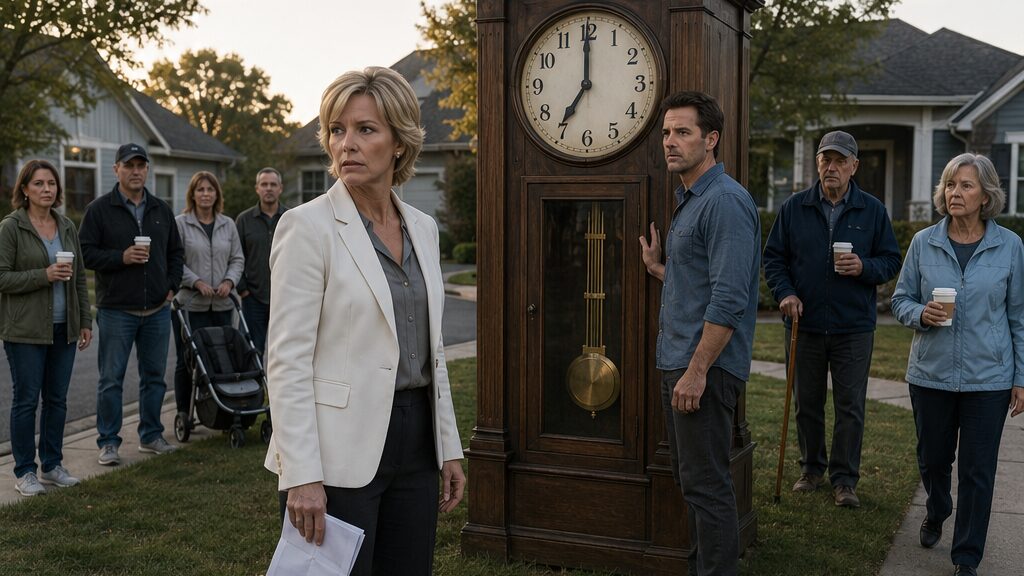
Daniel looked up at the wooden structure towering beside him. It stood nearly nine feet tall, sheltered by a narrow copper cap and sealed in dark walnut-colored marine varnish. Its face was cream, its black hands slim and old-fashioned. Through the long glass panel, the brass pendulum moved with steady indifference.
Under architectural review sounded almost flattering.
Patricia stepped closer but stopped before the lawn softened beneath her heels.
“The association gave you fourteen days to submit a complete response.”
“I submitted one.”
“You submitted photographs and dimensions.”
“That’s generally what an architectural committee asks for.”
“You did not include approval for electrical service, a foundation plan, or an explanation of use.”
“It tells time.”
Her mouth tightened. “You know that isn’t what I mean.”
Daniel took his first sip of coffee. It had gone lukewarm.
Behind Patricia, the street curved past matching mailboxes, trimmed lawns, and brick-front houses painted in approved shades of beige, gray, and soft blue. His clock did not match any of them. That had been the point—not defiance, exactly, but recognition. A person could stand at the far end of Hawthorne Lane and know where to turn.
Patricia opened the folder.
“The governing documents prohibit freestanding ornamental structures exceeding six feet.”
“It isn’t ornamental.”
“It’s a grandfather clock in a front yard.”
“It’s a clock.”
“Daniel.”
“Patricia.”
For a moment, only the pendulum answered.
She drew out a white notice. “The committee voted to begin enforcement. Daily fines start Wednesday. If the violation remains unresolved, contracted removal may begin next Monday.”
Daniel looked at the orange tag again. The blank date no longer seemed blank.
“Seven days,” Patricia said. “That is more time than the rules require.”
“Generous.”
“I’m trying to avoid making this adversarial.”
“You attached a contractor’s tag to my property before breakfast.”
“The contractor placed it.”
“You gave him access.”
“The clock is plainly visible from the street.”
“So is my house. That doesn’t make it yours.”
A curtain shifted in the nearest front window. Patricia noticed it too. Her voice lowered.
“This is why we have procedures. So individual disagreements do not become personal.”
Daniel almost smiled. She had filed the complaint, chaired the committee that reviewed it, and now stood on his lawn explaining impersonality.
He reached past the tag and opened the narrow service door. The smell of oil, brass, and cedar rose from the case. He placed two fingers lightly against the escapement housing, listening.
Patricia watched him. “What are you doing?”
“Checking the beat.”
“The what?”
“The interval between ticks. If the case shifts, the beat goes uneven.”
He adjusted nothing. There was nothing to adjust.
Tick.
Tock.
Tick.
Tock.
“Still exact,” he said.
Patricia glanced at her watch despite herself. The second hand on the clock crossed twelve at precisely the same moment as the one on her wrist.
A small satisfaction passed through Daniel, clean and private.
Then Patricia said, “Accuracy doesn’t make it compliant.”
The satisfaction disappeared.
A gray sedan slowed at the curb. The driver looked toward the clock, lifted two fingers from the steering wheel, and continued. Patricia followed the car with her eyes.
“People stop,” she said.
“Sometimes.”
“That creates another concern.”
“Looking is not an HOA violation yet.”
“Traffic obstruction, congregation, commercial display—”
“It isn’t commercial.”
“Then explain its use.”
Daniel closed the service door.
The answer sat behind his teeth. He could have told her that people began gathering there before the clock case had even been sealed. He could have told her that every weekday morning, just before seven, footsteps appeared from three streets and coffee cups collected along the stone border. He could have said that no one had planned it, not officially.
Instead he said, “The application has everything you need.”
Patricia’s expression changed—not much, but enough. She no longer looked merely irritated. She looked confirmed.
“At ten this morning,” she said, “Cynthia Adams will review your submission with the management office. You may want to ask her whether she agrees.”
“I’ve spoken to Cynthia.”
“Not since the committee vote.”
Daniel looked at the clock’s face. Seven-ten.
By seven-thirty, the street would be empty again.
Patricia put the notice against his chest. He took it before it fell.
“One week,” she said. “I’ll come back next Monday at seven. I hope, for your sake, this is gone.”
She crossed the lawn carefully, refusing to look down at her shoes.
At nine fifty-eight, Daniel called Cynthia from his workshop. The clock’s mechanism sounded faintly through the open garage door.
Cynthia answered on the second ring.
“I was expecting you.”
“I hear my response is incomplete.”
There was a pause filled by keyboard clicks.
“You listed the structure as a privately maintained residential timepiece,” she said.
“That’s what it is.”
“You left the use section blank.”
“It keeps time.”
“Patricia said you gave her the same answer.”
“Then everyone’s well informed.”
Cynthia exhaled. “Daniel, I am not on the architectural committee. I administer what they decide. But if there is regular pedestrian use, electrical access, public invitation, or any function beyond private decoration, it has to be disclosed.”
“People walk past my house.”
“That is not what I asked.”
He looked through the garage opening. The orange tag flashed against the dark wood each time it turned.
“What happens if I amend it?”
“The committee may reconsider. Or the amendment may trigger a safety inspection.”
“And if I don’t?”
“Fines begin Wednesday. Removal authorization becomes available Monday morning.”
Daniel tightened his grip on the phone.
“Available,” he repeated.
“Not mandatory. But Patricia has already asked for contractor scheduling.”
Of course she had.
Cynthia’s voice softened by a fraction. “Help me understand why this object is worth escalating over.”
The question was reasonable. That made it worse.
Daniel saw pencil marks on old paper, a hand drawing an arc beneath a clock face, a sentence written in the margin: Somewhere people can count on.
He turned away from the workbench.
“It keeps perfect time,” he said.
Cynthia was silent.
When she spoke again, her professionalism had returned. “Then I suggest you prepare for Monday.”
The call ended.
Outside, the pendulum continued its measured sweep behind the glass. Daniel stepped onto the lawn and tore the orange tag free at last. He folded it once, then again, and put it in his shirt pocket.
Across the street, Patricia stood beside her mailbox with the blue folder under her arm. She had not left for work. She watched him remove the tag but not the clock.
Daniel raised his mug in acknowledgment.
Patricia did not wave back.
“Seven o’clock next Monday,” she called across the street. “I’ll be here.”
The pendulum moved between them, marking off the week she believed belonged to her.
Chapter 2: At Seven, the Neighbors Started Arriving
“Why is it still standing?”
Patricia’s question reached Daniel before she had closed her car door.
It was six fifty-eight the following Monday. The sky was pale, the street quiet, and the clock rose from Daniel’s lawn exactly as it had seven days earlier. No missing panels. No dismantled hands. No contractor’s straps around its case.
Even the brass pendulum was moving.
Patricia crossed the street holding a violation notice in one hand and her phone in the other. She had worn white this time, a sharp blazer over a gray blouse, as though the formality of her clothes might make the outcome official before anyone else arrived.
Daniel stood beside the clock in a faded blue work shirt with the sleeves rolled to his forearms.
“You said you’d return at seven,” he said.
“I said I expected it removed.”
“I remember.”
“Then what exactly have you been doing for a week?”
“Working.”
“On the clock?”
“Among other things.”
Patricia glanced toward his garage. The door was closed. No tools lay outside. Nothing suggested an attempted removal.
“You were given an opportunity to resolve this voluntarily.”
Daniel looked at the clock face. “You’re early.”
“It is two minutes before seven.”
“That’s early.”
She stepped closer. “The contractor is on standby. Cynthia has the authorization packet. If you force us to proceed, the removal costs can be charged to your account.”
Daniel’s calmness no longer struck her as composure. It felt performative, a way of making her sound unreasonable while he refused every plain question.
“You think this is amusing,” she said.
“No.”
“You smiled last week.”
“I smile sometimes.”
“Usually when someone tells you they intend to enforce a rule?”
His gaze shifted past her shoulder.
Patricia turned. The street behind her was empty except for a delivery van at the far intersection.
“What?”
“Nothing yet.”
The clock’s minute hand moved toward twelve.
Patricia lifted the notice. “Daniel, I am asking you one final time. Why is this structure still here?”
“Because it’s in use.”
She gave a small, incredulous laugh. “By whom?”
The clock began to strike.
One.
The first sound rolled across the roofs.
Two.
A man in a navy windbreaker turned onto Hawthorne Lane carrying a stainless-steel travel cup.
Three.
Two women appeared behind him, one adjusting the strap of a small backpack, the other pushing an empty stroller with a folded blanket in its seat.
Four.
A couple came from the opposite sidewalk. The man raised his cup toward Daniel.
Five.
Patricia lowered the notice.
Six.
Timothy Scott rounded the corner with a wooden walking stick he used more for rhythm than support. He wore a faded school district cap and carried a paper tray with three coffees.
Seven.
By the final note, nine people were moving toward the clock.
They did not arrive like an audience. No one hurried. No one looked surprised to see Daniel. They gathered with the ordinary familiarity of people following a routine repeated often enough to require no announcement.
“Morning,” Timothy said.
Daniel nodded. “Morning.”
One of the women checked the clock rather than her phone. “Right on time.”
Patricia looked from face to face. “What is this?”
Timothy offered a coffee to the man in the windbreaker. “Monday.”
“I mean why are you all here?”
The neighbor with the stroller adjusted one wheel away from the curb. “We meet here.”
“For what?”
“Our walk,” Timothy said.
Patricia’s eyes returned to Daniel. “You organized this?”
“No.”
“He didn’t have to,” Timothy said. “We started meeting here after the clock went up.”
Patricia held the violation notice against her thigh. “This is private property.”
“We stay along the sidewalk edge,” the stroller neighbor said.
“That is not the point.”
“It’s a useful place to meet,” another walker said. “Everyone knows where it is.”
Daniel remained beside the case, one hand resting on the narrow service ledge. He had not defended himself. He had simply waited.
Patricia felt heat rise beneath the collar of her blouse. She understood, suddenly, what his smile had meant the week before. Not victory exactly. Knowledge.
He had known she would arrive alone.
The walkers formed a loose semicircle. Coffee lids clicked. Someone laughed quietly at something Patricia could not hear.
Then Timothy looked back down the street.
“We’re missing one.”
A woman in a light blue jacket approached from the corner, moving carefully but without assistance. Her gray hair was cut at the jaw. She used no cane, though one hand hovered near the low garden walls as she passed them.
Patricia stopped breathing for half a second.
“Mom?”
Catherine Lee looked up.
Her expression held the same surprise, then quickly changed into annoyance.
“Patricia. What are you doing here?”
“What are you doing here?”
“Walking.”
“With them?”
Catherine joined the group beside Timothy. He handed her the third coffee.
“Decaf,” he said.
“You remembered.”
Patricia stared at the cup, then at her mother. “How long has this been going on?”
Catherine peeled back the drinking tab. “Long enough that you should stop looking at me as if I escaped somewhere.”
“You never said you were coming here.”
“You never asked where I walked.”
“You told me you were taking short walks.”
“These are short if Timothy stops pretending every cul-de-sac is scenic.”
A few people smiled. Timothy looked offended for form’s sake.
Patricia did not.
“You meet beside an unapproved structure in someone’s yard?”
Catherine’s eyes narrowed. “I meet my neighbors beside a clock.”
“The base may not be permitted. There may be electrical exposure. People are standing close to the street.”
Daniel finally spoke. “The power line is in sealed conduit.”
“That is not an inspection.”
“No.”
“And this group use was not disclosed.”
“No.”
Patricia turned fully toward him. “So you deliberately withheld relevant information.”
“I didn’t invite them.”
“You allowed it.”
“They’re adults.”
Catherine took a careful sip. “That condition applies to me too.”
“This is not about whether you’re an adult.”
“It usually becomes about that when you start speaking slowly.”
The group went quiet.
Patricia glanced toward the curb. Two walkers had drifted partly into the gutter to let the stroller pass. A pickup truck entered the street and slowed, though there was plenty of room. One of the neighbors stepped back onto the grass, close enough to the clock’s base to brush it with a shoe.
The sight tightened something in Patricia’s chest.
“Everyone needs to move away from the roadway,” she said.
“We’re leaving now,” Timothy replied.
“This many people gathering here creates a hazard.”
“Most mornings there are five,” he said. “More came because Monday’s the longer loop.”
“You knew I was coming,” Patricia said to Daniel.
“Yes.”
“And you arranged this display.”
“No.”
“Then why are there twice as many people?”
Daniel’s face remained composed, but Timothy answered before he could.
“Because people heard you wanted the clock removed.”
A murmur of agreement moved through the walkers.
Patricia felt the confrontation slipping into a shape she had not chosen: one woman with paperwork against a group holding coffee, her own mother among them.
“This is not a vote on whether people find it charming,” she said. “The association has safety obligations.”
No one laughed now.
Catherine set her cup on the stone border. “Then inspect it.”
Patricia looked at her.
“If it’s dangerous, prove it,” Catherine continued. “If it isn’t, stop using me as a reason to make decisions I didn’t ask you to make.”
“I did not mention you.”
“You didn’t have to.”
Daniel’s attention sharpened, though he said nothing.
Patricia folded the notice once along its existing crease. She could withdraw, accept the embarrassment, and allow the morning to become the story everyone repeated. Or she could do what she had claimed she came to do: apply the rules without regard to popularity.
She opened her phone and called Cynthia.
The property manager answered with a cautious, “Good morning.”
“I’m at the Rivera property,” Patricia said. “There is regular group use that was not disclosed. Approximately ten residents are congregating at the sidewalk and curb.”
Daniel’s jaw shifted.
“I want an immediate safety inspection,” Patricia continued. “Foundation, electrical service, setback, and pedestrian exposure.”
Cynthia paused. “Is there an active hazard?”
“There is an undocumented public-use pattern.”
“That is not the same thing.”
“It is enough to review.”
Patricia watched Catherine pick up her coffee again.
“Schedule it,” Patricia said.
When she ended the call, the walkers were no longer looking at her with embarrassment on her behalf. Their faces had hardened.
Daniel stepped away from the clock.
“You wanted to know who used it,” he said. “Now you do.”
Patricia looked at the people gathered beneath the moving pendulum, then at the narrow curb, the uneven grass, and her mother’s careful stance.
“Yes,” she said. “And now I know what has to be inspected.”
Chapter 3: The Inspection Found More Than Sentiment
“Stop the mechanism.”
The municipal inspector had not yet set down his tool case.
Daniel stood beside the open clock door while the pendulum swept behind the glass. “You haven’t looked at it.”
“I need it still before I examine the anchoring.”
“The pendulum doesn’t affect the foundation.”
“It affects me putting my hands inside the case.”
Daniel could have argued that the access compartment was separated from the movement by a steel guard. He could have explained that he had serviced public clocks for nineteen years without catching so much as a sleeve.
Instead, he reached inside and lifted the stop lever.
The pendulum slowed.
Its arc narrowed by degrees until the brass disk hung motionless at the center of the case.
The silence felt larger than it should have.
The inspector crouched at the base. Cynthia Adams stood several feet away with a tablet tucked against her forearm. Patricia had arrived before both of them but remained near the sidewalk, saying little.
Two days had passed since the walking group confronted her. No one had gathered at the clock that morning. Timothy had moved the meeting point temporarily to the community mailbox cluster.
Daniel had told himself the empty lawn made the inspection easier.
He had not expected it to make the house feel abandoned.
“Foundation drawings?” the inspector asked.
Daniel handed him a clear sleeve containing a plan.
The inspector studied it. “This shows four anchor points.”
“There are four.”
“Depth?”
“Thirty inches.”
“Verified?”
“I poured them.”
“That isn’t what I asked.”
Daniel looked toward Cynthia.
She said, “He needs inspection verification or installation photographs.”
“I have photographs.”
“Of the excavation?”
Daniel did not answer quickly enough.
The inspector set the plan on his case. “Let’s see the service.”
Daniel opened the lower panel. Inside, the wiring ran through gray waterproof conduit to a compact breaker housing. Every junction was labeled. Every line was clipped cleanly against the interior frame.
The inspector’s posture changed.
“You built this?”
“Yes.”
“Licensed electrical work?”
“The feed from the house was installed by a licensed electrician. I wired the internal low-voltage systems.”
The inspector traced the conduit without touching it. “Weather seals are good. Ground-fault protection?”
Daniel pressed the test button. The interior light went dark.
“Reset it.”
He did. The light returned.
The inspector checked the bell housing, the service clearance, the door latch, and the glass retaining clips. With each satisfactory detail, Daniel felt his shoulders loosen.
Patricia watched from the sidewalk with her arms folded. She did not look disappointed. If anything, she looked relieved.
The inspector stood. “Mechanically, this is better built than most commercial display clocks.”
Daniel allowed himself a glance at Patricia.
Accuracy doesn’t make it compliant, she had said.
For one moment, workmanship seemed capable of answering what he would not.
Then the inspector pointed to the left rear corner.
“What’s behind that trim?”
“Secondary brace.”
“I need it open.”
“It isn’t part of the service access.”
“It supports the case.”
Daniel’s hand remained on the door.
Cynthia looked up from her tablet. “Daniel.”
He went to the garage for a screwdriver.
The trim panel had been fitted to disappear. Daniel removed six countersunk screws and eased it away. Behind it, a diagonal steel brace ran from the clock frame toward the concrete base.
It stopped three inches short.
At the lower end, two empty bolt holes faced a mounting plate that had never been drilled.
The inspector did not speak immediately.
Patricia unfolded her arms.
Cynthia stepped closer. “Is that unfinished?”
“The other three braces are secured.”
“Is that one?”
“No.”
The word landed with less dignity than Daniel expected.
The inspector crouched again. “Why wasn’t it completed?”
“The drill bit snapped.”
“And then?”
“I had to seal the case before rain.”
“And after the rain?”
Daniel looked at the clean edge of the unused mounting plate.
After the rain, the walking group had begun appearing. After the rain, Catherine had stood under the copper cap while Timothy adjusted the pace for her. After the rain, Daniel had found reasons to service the chime, polish the hands, repaint the minute markers, and postpone reopening the side he had already sealed.
“I didn’t return to it,” he said.
The inspector placed both hands against the clock case and pushed. The structure barely moved, but the unfinished corner gave a small metallic click.
Patricia heard it.
“So it can shift,” she said.
“Anything can shift,” Daniel replied.
The inspector rose. “This shouldn’t be occupied around until the brace is completed and the anchors are verified.”
“No one occupies it.”
“People gather around it,” Patricia said.
Daniel turned toward her. “You made sure everyone in the county knew that.”
“I requested an inspection because people gather here.”
“And now you’re pleased you found something.”
Her expression sharpened. “I am not pleased.”
“You’ve been trying to remove it for weeks.”
“I have been trying to determine whether it is safe.”
“You called it ridiculous before you asked a single technical question.”
Cynthia stepped between the direction of their voices, though not physically between them.
“This inspection is not a referendum on anyone’s motives,” she said. “We have an incomplete structural brace and no verified footing record. What is the setback measurement?”
The inspector retrieved a tape measure. From the clock’s nearest projection to the sidewalk edge, the distance was thirty-eight inches.
Cynthia checked the site plan. “Required clear landscaped setback is forty-eight.”
“The clock doesn’t block the sidewalk,” Daniel said.
“No,” she replied. “But during group use, the remaining space may push people toward the curb.”
Patricia’s gaze moved to the patch of grass where her mother had stood.
Daniel saw it and resented her for making concern look credible.
The inspector photographed the brace, the base, and the measurement. “The mechanism itself can remain if access is restricted. No gatherings. No chime operation until the support issue is corrected.”
“The chime doesn’t affect support.”
“It attracts people.”
“That isn’t a structural finding.”
“It is a risk-control recommendation.”
Daniel looked at the silent pendulum.
Cynthia’s phone rang. She stepped toward the driveway and answered. Her responses were brief.
“Yes, I’m on site.”
“Yes, the regular use has been confirmed.”
“No, not public in the municipal sense.”
She listened for nearly a minute, then ended the call without saying goodbye.
“That was the association’s insurance representative,” she said. “They reviewed Patricia’s report and the photographs submitted Monday.”
Daniel glanced at Patricia. “Photographs?”
“Of the gathering,” she said.
“You photographed my neighbors?”
“I documented the use.”
Cynthia continued before he could respond. “The carrier will issue a reservation notice. If organized gatherings continue around an unapproved structure with identified defects, the association may lose liability coverage for incidents connected to this location.”
The inspector began returning tools to his case.
Daniel felt the argument change shape. A complaint could be challenged. A fine could be appealed. Insurance language spread responsibility until every board member imagined a lawsuit with their name attached.
“How long do I have to complete the brace?” he asked.
“That alone may not resolve the setback or group-use issue,” Cynthia said.
“I can finish it today.”
“The footing verification still requires evidence or excavation.”
“I’ll excavate.”
“And the location remains noncompliant.”
Daniel looked from Cynthia to the clock, calculating angles, depth, labor, what could be moved without dismantling the case.
Patricia said, more quietly, “This is what I was trying to prevent.”
He faced her. “No. This is what you were trying to find.”
She flinched, but she did not step back.
The inspector handed Cynthia a preliminary form. “Until engineering verification, I recommend restricted access and deactivation.”
Cynthia read the page.
Daniel reached for the stop lever. “The mechanism is already deactivated.”
“The clock itself must be secured against congregation,” she said.
“Put up a temporary barrier.”
“That may be sufficient for the city. It may not be sufficient for the association or carrier.”
She turned the tablet toward him. A new notice filled the screen, already prepared except for the inspection findings.
TEMPORARY EMERGENCY REMOVAL AUTHORIZATION.
Daniel read the heading twice.
“This was drafted before the inspection.”
“It was drafted as a contingency.”
“By whom?”
Cynthia’s silence answered before Patricia did.
“I requested that the paperwork be ready,” Patricia said. “Ready is not the same as approved.”
Daniel looked at the unfinished brace exposed behind the trim. His own omission sat there in plain metal, giving weight to every word she had used against him.
Cynthia signed the digital form.
“Removal is stayed for forty-eight hours while management reviews corrective options,” she said. “After that, the association may secure or remove the structure if no acceptable plan is submitted.”
The clock face showed eight fourteen.
Its second hand had stopped where Daniel had arrested the mechanism, suspended between marks.
He had built it to give the street a dependable place in time.
Now, for the first time since he raised it, the clock could not tell anyone what came next.
Chapter 4: The Promise Hidden Inside the Clock Case
Timothy found the initials beneath the unfinished brace.
They were small enough to miss unless the trim panel had already been removed: two letters pressed into the cedar with the tip of a drafting pencil, followed by a date nearly three years old.
M.R.
Daniel stood behind him in the garage workshop, holding the inspection light. The pendulum lay on a padded bench nearby, its brass disk wrapped in an old cotton towel. Without it, the open clock case looked hollowed out rather than repaired.
Timothy touched the initials with one finger.
“She marked everything,” he said.
Daniel lowered the light. “That panel needs to go back on.”
“Not yet.”
“The association gave me forty-eight hours.”
“And you’re spending the first one pretending this is only about a brace.”
Daniel set the light on the bench harder than necessary. Its beam rolled across the tools, then settled on a stack of drawings bound with a black clip.
Timothy had arrived after sunset carrying two coffees and a paper bag of sandwiches. Neither man had touched the food. The emergency-removal notice rested on the workbench beside the clock plans, its red heading visible beneath a dusting of cedar shavings.
“Patricia already has what she needs,” Daniel said. “A defect. A setback issue. Insurance language.”
“She doesn’t have the truth.”
“She doesn’t need it.”
“You keep saying that as if it’s working.”
Daniel picked up the trim panel.
Timothy blocked the opening with his walking stick.
“Move.”
“No.”
“Timothy.”
“You built a nine-foot clock in your front yard and let half the neighborhood arrange their mornings around it. Then you filed paperwork calling it a private timepiece. You don’t get to act surprised that nobody understands what it is.”
Daniel’s fingers tightened around the panel edge.
“They understand enough.”
“Do they?”
The question lingered in the workshop.
On the bench, the stopped pendulum reflected the overhead light in a warped circle. Daniel saw himself in it—shoulders bent, face stretched by the curved brass.
Timothy pulled the clipped drawings toward him.
“Don’t.”
But the older man had already turned the first sheet.
The top drawing showed the clock face and copper cap in Daniel’s precise block lines. Beneath it lay older pages on thinner paper, crowded with arrows, margin notes, and measurements written in a slanted hand.
Timothy recognized the writing.
“She drew the first version.”
Daniel did not answer.
A line ran from the proposed clock toward a cluster of small figures beside the sidewalk. At the bottom of the page, the same hand had written: Not a monument. Somewhere people can count on.
Timothy read it silently.
“She didn’t want a memorial,” he said.
“No.”
“But you made one.”
Daniel turned away and opened a drawer he did not need.
Behind him, paper shifted.
“She started these before she got sick?”
“Before we knew how sick.”
“She showed me a sketch once. I thought it was a joke.”
“She showed everyone sketches.”
“She never said you were going to build it.”
“I wasn’t.”
Timothy waited.
Daniel closed the drawer.
The house beyond the workshop wall was dark. He had stopped turning on the kitchen light after dinner because it made the empty chairs too visible from outside. In the garage, there were enough tools and unfinished jobs to give silence a purpose.
“She wanted a place people would recognize,” Daniel said. “Not a pavilion. Not a sign-up sheet. Just one thing that was always there at the same time.”
Timothy glanced at the clock plans. “Because she kept finding people alone.”
Daniel nodded once.
His wife had walked every morning before work, first for exercise, then because she discovered who else was awake. A new father pacing with an infant. A widow who pretended to check her mailbox at six forty-five. A teenager waiting for the school bus long before anyone else came outside. She remembered names, coffee orders, which knees hurt, whose dog hated bicycles.
When treatment made walking difficult, she moved more slowly but still left the house.
“She said neighborhoods were full of people waiting for permission to know each other,” Daniel said.
Timothy’s expression softened. “That sounds like her.”
“She asked me to finish the plans.”
“And you promised.”
Daniel looked at the unfinished brace.
“Yes.”
The word came out flat.
Timothy took one of the coffees from the tray and held it toward him. Daniel did not take it.
“When did you pour the base?” Timothy asked.
“Last spring.”
“And when did you finish the case?”
“September.”
“Why the rush at the end?”
Daniel’s gaze moved to the dark clock face leaning against the far wall. “The anniversary was October third.”
Timothy understood before Daniel finished.
“You wanted it running by then.”
“I wanted one thing done when I said it would be.”
“So you sealed the case with the brace unfinished.”
“The other three were secure.”
“That isn’t an answer.”
“The weather changed. I had work backed up. The electrician had already scheduled the feed.”
“And you wanted it standing on the date.”
Daniel picked up the cold coffee at last but did not drink.
“Yes.”
Timothy leaned against the bench. “You could tell the board that.”
“No.”
“Why?”
“Because grief is not a building permit.”
“It explains why you made the mistake.”
“It invites them to forgive it.”
“That would be terrible?”
“I don’t want forgiveness for bad work.”
Timothy’s voice sharpened. “Then fix the work. But stop acting like the reason has no value because it won’t pass inspection.”
Daniel stared at him.
For months, Timothy had protected him with silence. When walkers asked who designed the clock, Timothy said Daniel had. When someone suggested a plaque, Timothy discouraged it. When Patricia first complained, Timothy told the group not to turn Daniel’s loss into a neighborhood argument.
Now the older man pushed the drawings across the bench.
“Catherine started walking with us in January,” he said.
Daniel frowned. “I know.”
“You know she comes. You don’t know why.”
“She wanted exercise.”
“She barely left her house for four months.”
Daniel looked up.
Timothy continued. “After her fall, Patricia started doing everything for her. Groceries. Appointments. Mail. Catherine stopped needing to go outside, so she stopped going.”
“I didn’t know it was that bad.”
“She came to the clock one morning because she heard the chime. Stood ten feet away and told me she was only checking whether it was too loud.”
Despite himself, Daniel almost smiled.
“Next day she came back with coffee,” Timothy said. “Week after that, she walked to the corner. Now she makes the short loop.”
Daniel glanced toward the closed garage door, as if Catherine might be standing outside it.
“Patricia knows?” he asked.
Timothy did not answer immediately.
That was answer enough.
“How long?”
“She picked Catherine up here twice.”
Daniel felt the room narrow.
Patricia had stood on his lawn and asked who used the clock. She had watched her mother emerge with the walkers as though the sight were unexpected.
“She knew Catherine came here.”
“She knew Catherine walked,” Timothy said. “I don’t know what she understood about the group.”
“She photographed us.”
“She was documenting.”
“She filed the removal request before the inspection.”
“And you hid a brace.”
Daniel turned on him.
Timothy held his ground. “That’s the problem. Both of you keep reaching for the part that makes the other person wrong.”
The stopped pendulum lay between them.
Daniel removed the towel and lifted the brass disk. It was heavier than it looked. On the rod above it, beneath the adjustment nut, were tiny pencil marks indicating measured lengths.
His wife’s handwriting ran beside them.
Shorten two millimeters if losing time.
He rubbed his thumb over the note.
Timothy watched him. “Tell the board what it is.”
Daniel lowered the pendulum back onto the towel.
“I’ll tell them what I did wrong.”
“That isn’t the same thing.”
“It’s what they need.”
“And Patricia?”
Daniel looked toward the emergency notice.
“If she knew her mother depended on the group,” he said, “then I need to know why she tried to remove the one thing bringing her here.”
Chapter 5: Patricia Was Afraid of Another Fall
Catherine removed the violation notice from beneath Patricia’s hand and folded it in half.
They were sitting at the small dining table in Catherine’s house. The paper had been placed between them like an exhibit, its red heading aligned toward Patricia. Catherine turned it facedown and slid it beside the salt shaker.
“I don’t want that on my table.”
“It concerns you.”
“No. It concerns Daniel.”
“It concerns anyone gathering there.”
Catherine leaned back. A plain wall clock hung above the doorway to the kitchen. Its battery had died weeks earlier, leaving both hands fixed at eleven sixteen. Patricia had offered twice to replace it.
Her mother had said she was not late for anything important.
“You told the insurance representative I was part of the risk,” Catherine said.
“I said residents with varying mobility levels use the location.”
“You meant me.”
“I did not name you.”
“You never have to name me. You describe me.”
Patricia kept her hands flat on the table. She had spent the drive over preparing phrases that would sound factual rather than defensive. None survived her mother’s first sentence.
“The base is incomplete,” she said. “The structure is too close to the sidewalk. The association could lose coverage if someone is hurt.”
“Then require Daniel to repair it.”
“That may not be enough.”
“Because you don’t like it.”
“Because the rules matter.”
Catherine’s mouth tightened. “You didn’t start with the rules. You started by calling it ridiculous.”
Patricia looked at the dead wall clock.
“That was unprofessional.”
“It was honest.”
“Yes.”
The admission appeared to unsettle Catherine more than an argument would have.
Patricia picked at the edge of a paper napkin. “I thought it was an oversized decoration. I thought Daniel had put it there because he liked making a point.”
“And after you knew people used it?”
“That made the liability worse.”
“It also made the clock useful.”
“Useful things can still be unsafe.”
Catherine pushed her chair back slightly. One leg caught on the rug, and her hand went to the table.
Patricia rose at once.
“I’m fine.”
“You caught your foot.”
“I caught the rug.”
“I told you this rug needed a pad.”
Catherine’s eyes flashed. “Sit down.”
Patricia remained standing for a moment, then lowered herself.
The movement had been small. Still, her pulse had accelerated before she could stop it.
Catherine saw.
“That is what this is about,” she said.
Patricia looked toward the kitchen.
“Patricia.”
“It isn’t only that.”
“But it is that.”
The room remained still around the dead clock.
Nine months earlier, Catherine had fallen outside a pharmacy while stepping off a curb. No broken hip, no dramatic ambulance scene. A fractured wrist, bruised ribs, and a cut above one eyebrow that bled enough to make Patricia believe, for several minutes, that the injury was worse.
What stayed with her was not the blood. It was the phone call from a stranger.
Your mother fell.
As though falling had become a category of person Catherine could enter without warning.
Afterward, Patricia began driving her to appointments, carrying laundry, ordering groceries, checking railings and rugs. Each task felt temporary until it became routine.
“I wasn’t there,” Patricia said.
Catherine’s expression softened but did not release her.
“You were at work.”
“I had told you I would pick up the prescription.”
“And I decided I could do it myself.”
“You shouldn’t have had to.”
“I wanted to.”
“You fell.”
“Yes.”
Patricia looked down at her hands. “When I saw you beside that clock, people were standing near the curb. Someone backed into the street to make room for the stroller. The base hadn’t been inspected. Daniel had not disclosed the gathering.”
“So you decided to stop me.”
“I decided to stop the risk.”
“You photographed me without asking.”
“I photographed the site.”
“I was in the site.”
Patricia’s jaw tightened. “Do you want me to ignore everything because the group makes you happy?”
“No. I want you to stop pretending fear is the same as authority.”
The words struck cleanly.
Catherine reached for the violation notice and tapped it once against the table.
“When did you ask for the removal contractor?”
Patricia did not answer.
“Before or after the inspection?”
“Before.”
Catherine’s fingers went still.
“As a contingency,” Patricia added. “The committee had already voted to enforce. Cynthia needed documents ready if the structure was unsafe.”
“Did the full board approve emergency removal?”
“Not yet.”
“But you scheduled the option.”
“I requested availability.”
“Before anyone examined it.”
Patricia heard how it sounded. She had heard it in Daniel’s voice too, standing beside the exposed brace.
“You think I wanted the inspector to find something,” she said.
“Did you?”
“No.”
The answer came quickly because it was true.
She had wanted the clock gone before something happened. She had wanted removal to make the worry disappear. Finding the unfinished brace had not pleased her; it had frightened her with the force of confirmation.
Catherine watched her carefully.
“Then why didn’t you tell the committee I walked there?”
Patricia looked up.
“You knew before Monday,” Catherine said. “You picked me up there in March. You asked who the people were.”
“I said the location was attracting residents.”
“You did not say one of them was your mother.”
“That would have made it personal.”
“It was personal.”
“I was trying not to use you to influence the committee.”
“So instead you used me to frighten yourself.”
Patricia pushed her chair back.
Catherine’s voice stopped her. “Sit.”
“I have another meeting.”
“No, you have another place where the papers are easier than the people.”
Patricia remained standing.
The wall clock held at eleven sixteen.
Catherine folded the violation notice again, reducing the red heading to a narrow strip.
“I will speak at the hearing,” she said.
Patricia stared at her. “There may not be a hearing if Daniel fails to submit a corrective plan.”
“Then I’ll speak before removal.”
“You cannot simply interrupt a board process.”
“I live here. I can attend.”
“As a resident, yes.”
“As myself,” Catherine said. “Not as your example of a person who might fall.”
Patricia looked toward the rug, the chair leg, the corners of the table. Hazards presented themselves everywhere once fear taught the eye what to seek.
Her phone vibrated.
Cynthia’s name appeared on the screen.
Patricia answered.
“I’m with my mother.”
“I’ll be brief,” Cynthia said. “The carrier sent its written position. The board president wants the emergency authorization held until Daniel has one final chance to provide a compliant alternative.”
“How long?”
“Forty-eight hours.”
“That is not enough for stamped engineering.”
“He can provide a concept plan, proposed relocation, responsibility structure, and evidence that formal review is underway.”
“And if he doesn’t?”
“Removal proceeds under the existing authorization.”
Patricia turned away from Catherine.
“Has he been informed?”
“I’m sending the notice now.”
Patricia hesitated. “Cynthia, include the full board hearing option.”
“That depends on whether he submits anything worth hearing.”
The call ended.
Catherine had risen from the table without Patricia noticing. She stood beside the dead wall clock, reaching toward its plastic rim.
“What are you doing?”
“Taking it down.”
“You’ll need the step stool.”
“I can reach.”
“Mom.”
Catherine stopped, hand still raised.
Patricia crossed the room, lifted the clock from its hook, and set it on the table.
For once, Catherine allowed the help without comment.
Patricia removed the battery cover. The battery had leaked slightly at one end, leaving a chalky white crust.
“See?” she said. “You should have let me replace this.”
Catherine looked at her for a long moment.
“Not everything that stops needs to be thrown away.”
Patricia cleaned the contact with a folded napkin. “Sometimes replacement is safer.”
“And sometimes repair is the point.”
The phone vibrated again.
This time it was a copy of Cynthia’s notice to Daniel.
FORTY-EIGHT-HOUR CORRECTIVE SUBMISSION DEADLINE.
Patricia read the final line twice.
Absent an acceptable submission, contracted removal shall proceed.
Across the table, Catherine inserted a fresh battery into the wall clock. The second hand jerked, then began to move.
“I’ll be at the hearing,” she said.
Patricia watched the hand advance past the minute where it had been trapped.
For the first time since filing the complaint, she did not know whether she wanted Daniel to miss the deadline.
Chapter 6: Daniel Finally Asked the Neighborhood for Help
At six the next morning, Daniel unlocked his workshop and raised the garage door all the way.
The walking group stood in the driveway.
Timothy was first, holding a cardboard tray of coffee. Catherine stood beside him in her light blue jacket. Behind them waited the neighbor with the stroller, the man in the navy windbreaker, and four others Daniel knew by face, morning pace, or preferred route but not always by last name.
No one stepped inside.
They had never been invited before.
Daniel looked at the tools lining the walls, the clock plans spread across the workbench, and the brass pendulum resting on its towel.
“Come in,” he said.
The words felt larger than opening the door.
Timothy passed him a coffee. “You have a plan?”
“A possibility.”
Daniel unrolled a site drawing across the central bench. He had worked through the night, measuring property lines, the utility strip, the landscaped common edge near the sidewalk, and the distance from the curb.
A rectangular outline in red showed the clock’s current position.
A second outline, six feet to the east and three feet closer to the common mailbox path, was marked in blue.
“The permit clerk confirmed this strip can qualify as a common-edge easement,” Daniel said. “Not automatically. The association would have to approve the use.”
The stroller neighbor leaned over the drawing. “Would it still be on your property?”
“Partly. The base would cross into maintained common landscape.”
Timothy frowned. “That sounds complicated.”
“It is.”
“What does it solve?”
“The sidewalk clearance. The setback. Some of the insurance concern, if the gathering is treated as an approved resident activity rather than something happening around a private structure.”
“And the foundation?” Catherine asked.
“New base. Verified depth. Four anchors, four complete braces.”
No one mentioned the unfinished one.
Daniel pointed to a series of notes. “The clock would have to come apart. Case panels, movement, face, bell, pendulum. The old base stays until the new one passes inspection.”
The man in the windbreaker studied the dimensions. “How much?”
“For materials?”
“For all of it.”
Daniel had written the number on a separate page and turned that page facedown.
“I can cover the structural work.”
“That wasn’t the question.”
“It’s my clock.”
Timothy set down his coffee. “That sentence is why we’re here.”
Daniel met his eyes.
Catherine moved closer to the bench. “If it remains only yours, Patricia will argue the association cannot be responsible for people using it.”
“She’s right about that.”
Several walkers shifted.
Daniel continued before they mistook the admission for surrender. “A resident committee could take responsibility for the meeting activity. Scheduled maintenance, clear walking routes, no crowding at the curb. The clock mechanism stays under qualified care.”
“Yours,” Timothy said.
“At first.”
“And later?”
Daniel looked toward the pendulum.
The question had followed him through the night. He knew how to prepare a transfer schedule for mechanical maintenance. He knew how to document lubrication points, chime settings, winter seals, and emergency shutdown. He did not know how to imagine someone else opening the service door after he was gone.
“If the board approves it,” he said, “someone else has to learn.”
The neighbor with the stroller pulled a pen from her bag. “Put my name down for the committee.”
The man beside her said, “Mine too.”
“What does it involve?” another walker asked.
“Monthly site checks. Reporting damage. Keeping the path clear. No one touches the mechanism without training.”
Timothy lifted his cup. “I can tell people not to touch things. Thirty-two years in a middle school.”
A small laugh moved through the garage.
Daniel did not join it, but something in his chest loosened.
He turned the site plan over. On the reverse side was a draft responsibility agreement, rough and incomplete.
“We need at least five resident signatures,” he said. “And a maintenance reserve.”
“How much?” the man in the windbreaker asked again.
Daniel named the amount.
No one spoke for a moment.
Then the stroller neighbor said, “Divide it.”
“I said I can cover—”
“You also said it can’t stay only yours.”
Catherine opened her purse and took out a checkbook.
Daniel shook his head. “No.”
She looked at him over the top of her glasses. “Do not make me argue with two controlling neighbors in the same month.”
Timothy coughed into his fist to hide a smile.
Daniel rested both hands on the bench.
There was one more page beneath the agreement. He had kept it there since three in the morning, unsure whether to use it. A copy of the original sketch, its margins filled with his wife’s notes.
He could submit the plan without showing anyone. The board needed dimensions, signatures, liability structure. Not history.
But the people in his workshop were being asked to pay for, maintain, and defend something he had never fully explained.
He slid the sketch into view.
“This wasn’t my idea,” he said.
The room quieted.
Daniel kept his eyes on the paper.
“My wife drew the first version. She walked these streets every morning. She kept finding people who were outside at the same time but never together.”
Timothy did not move.
“She thought a neighborhood needed one place that was dependable,” Daniel continued. “Not an event. Not a committee. Just a place and a time.”
Catherine traced the handwritten note with one finger without touching the ink.
“Somewhere people can count on,” she read.
Daniel nodded.
“She asked me to finish it.”
The neighbor with the stroller looked toward the open garage door, where the silent clock stood visible across the lawn.
“Did she see it completed?”
“No.”
That was all he could say for several seconds.
“I built it because I promised,” he continued. “Then I treated the promise like it belonged only to me. I filed it as a private timepiece. I didn’t disclose the gatherings. I installed it before the foundation was fully finished because I wanted it running by a date that mattered to me.”
No one rushed to comfort him. Daniel was grateful.
He turned the sketch toward them.
“If this plan goes forward, the clock will not be solely mine. The committee will have authority over the site. Maintenance records will be shared. If I fail to do the work, someone else steps in.”
Timothy asked, “Can you live with that?”
Daniel looked at the pendulum on the bench.
“I don’t know,” he said. “But I know what happens if I can’t.”
The answer was enough.
For the next four hours, the garage became something Daniel had never allowed it to become: crowded.
Residents measured the proposed site. Timothy drafted a walking-route diagram. Catherine called two absent members and explained the maintenance committee in terms sharper than Daniel would have used. The stroller neighbor prepared a rotating schedule for keeping the path clear.
Coffee cups accumulated along the back ledge.
At ten fifteen, Patricia appeared at the driveway.
Conversation stopped.
She did not enter.
“I heard there was a meeting,” she said.
“It’s a work session,” Timothy replied.
Patricia’s eyes moved over the plans, signatures, and exposed clock components. She noticed Catherine at the center of the bench.
“What are you proposing?” she asked.
Daniel carried the site drawing to her.
She studied it without taking the page from his hand.
“A common-edge easement?”
“The permit clerk confirmed it is eligible for review.”
“Eligible is not approved.”
“No.”
“Who assumes liability?”
“The association maintains the landscape. A resident committee assumes activity management. I remain responsible for the mechanism until another technician is trained.”
Patricia read the signatures.
“Informal volunteers stop volunteering,” she said.
The stroller neighbor answered from inside the garage. “Then the agreement names replacements.”
“Agreements do not guarantee follow-through.”
“Neither do titles,” Catherine said.
Patricia looked toward her mother but did not respond.
Daniel held out the draft maintenance schedule. “Quarterly inspection. Annual structural review. Weather shutdown procedure. No gathering outside designated hours.”
Patricia finally took the papers.
Her eyes paused on the original sketch.
“You included this?”
“Not as evidence.”
“Then why is it here?”
“So they know what they’re taking responsibility for.”
Patricia read the handwritten line. Her expression shifted, then closed again.
“Sentiment will not cure the defect.”
“No,” Daniel said. “Work will.”
“And if the board rejects relocation?”
“I dismantle it before the contractor does.”
The walkers turned toward him.
Patricia looked surprised too.
Daniel continued. “But I will not let the association haul it away as debris.”
For the first time, Patricia’s voice lost its formal edge. “You would take it down yourself?”
“If there is no compliant path.”
She handed back the sketch but kept the technical plan.
“I’ll review this before the hearing request,” she said.
“You don’t control whether it reaches the board.”
“No. Cynthia does.”
“Then send it to her.”
Patricia looked at Catherine.
“You signed?”
“Yes.”
“You understand this may require physical access, inspections, meetings—”
“I understand what I signed.”
Patricia pressed the pages against her jacket. “The board will ask whether this committee can outlast the current enthusiasm.”
Daniel said, “So will I.”
She left without promising support.
By afternoon, the plan had engineering notes from the inspector, seven resident signatures, and a written acknowledgment from the permit clerk that the proposed site could be reviewed under the common-use provision.
At four forty-three, Cynthia emailed asking for clarification on maintenance authority.
At five twelve, Daniel sent the revision.
At five thirty-one, she requested proof of reserve funding.
The group had already deposited enough commitments to meet the minimum.
At five fifty-six, Daniel stood alone at his workbench with the final packet open on his laptop. The deadline was six.
The submission included every detail he had omitted the first time: community use, expected attendance, electrical responsibility, inspection schedule, relocation plan, funding, and the unfinished brace.
At the bottom of the form was a question he had avoided before.
Purpose of structure.
Daniel typed: Residential timepiece and designated neighborhood walking-group meeting point.
He hesitated, then added one more sentence.
Created from an unfinished community-gathering design by the late Mrs. Rivera and transferred into shared resident stewardship.
The clock outside remained silent.
At five fifty-eight, Daniel pressed Submit.
A confirmation number appeared.
At six exactly, another email arrived from Cynthia.
Corrective submission accepted for emergency review. Removal stayed pending board hearing.
Daniel let out a breath.
Then he opened the attached hearing notice.
Patricia White was listed among the voting architectural representatives.
Daniel looked through the garage door toward her house. A light came on behind an upstairs window.
He had surrendered the clock’s privacy, admitted his fault, and placed its future in the hands of the neighborhood.
Now Patricia would have to decide whether the rules she had invoked could protect anything except their own authority.
Chapter 7: The Board Had to Choose What Rules Protected
Cynthia read the emergency-removal authorization before anyone was allowed to speak.
Her voice remained even as the words filled the community meeting room: structural uncertainty, noncompliant setback, undocumented group use, potential loss of insurance coverage. The document made the clock sound less like a neighborhood landmark than an abandoned machine attracting pedestrians toward danger.
Daniel sat in the first row with the brass pendulum across his knees.
He had wrapped it in cloth for transport, but Cynthia had asked that all physical materials be placed on the evidence table. Now it lay uncovered between the red violation notice and his redesigned foundation plans, perfectly still beneath the fluorescent lights.
Patricia sat with the architectural representatives at the folding tables in front. She had arranged her papers into three squared stacks. She did not look toward Daniel.
The walking group filled most of the chairs behind him. Timothy sat at the end of the front row. Catherine had chosen a seat across the aisle from her daughter.
When Cynthia finished reading, one board member adjusted his glasses.
“The emergency order remains active,” he said. “Tonight’s question is whether the corrective proposal provides enough basis to stay removal and begin formal variance review.”
“Not whether the clock is popular,” Patricia added.
A murmur moved through the room.
Cynthia raised one hand. “Public comment will follow the technical review.”
The inspector’s written findings came first. The internal electrical work was sound. The mechanism was professionally constructed. The incomplete brace and unverified footing were unacceptable, but correctable. The present location failed the landscaped setback by ten inches.
Daniel listened without protest.
Every accurate criticism was easier to hear now that he had stopped pretending accuracy was the same as hostility.
Cynthia displayed the relocation plan on a screen. The proposed site crossed Daniel’s property line into a narrow common-maintenance strip near the mailbox path. The new concrete base would be inspected before the clock was reassembled. A resident committee would manage gathering times, pedestrian clearance, reserve funding, and incident reporting.
One representative tapped the agreement.
“What happens when these volunteers lose interest?”
Timothy raised his hand from the audience.
“You’ll have a comment period,” Patricia said.
Timothy lowered it, though not before giving her a look perfected over decades of supervising school cafeterias.
Daniel answered instead. “The agreement requires five active members. If membership drops below that for thirty days, group use is suspended.”
“And the clock?”
“It can remain as a timepiece if maintenance continues.”
“Who controls the mechanism?”
“I do initially. The plan requires me to train a second qualified caretaker within one year.”
The representative looked over his glasses. “You are willing to give another person access?”
Daniel glanced at the pendulum.
“Yes.”
The answer sounded firmer than it felt.
Patricia opened the top folder in her stack. “The proposal still changes private landscaping into a resident activity site. Approval may establish precedent for other structures.”
“It may,” Cynthia said. “That is why the variance is conditional and use-specific.”
“Every exception is called specific until the next applicant cites it.”
Daniel looked at Patricia. “Then cite the safety requirements too.”
Her eyes met his.
“I’m not asking the board to ignore the rules,” he continued. “I’m asking it to apply the ones that solve the problem.”
One of the representatives leaned forward. “Mr. Rivera, your first submission did not disclose group use. Why should the board trust the new filing?”
The room quieted.
Daniel could have said the gatherings were informal. He could have argued that no sign invited the public and no schedule had been posted. Each statement would have been true enough to hide behind.
He placed both hands on the table.
“You shouldn’t trust the first filing,” he said. “It was incomplete.”
Patricia’s pen stopped.
“I called the clock private because I wanted control over what it meant. I left out the gatherings because I didn’t organize them and because I knew disclosure would complicate approval. I also installed the case before completing one brace.”
A coffee cup shifted behind him.
“I wanted it operating by a date that mattered to me,” Daniel continued. “That was not a technical reason. It was a personal one, and I let it affect the work.”
The board member looked at the original sketch included in the packet. “This was your wife’s design?”
“The first version.”
“Was the clock intended as a memorial?”
“No.”
Daniel looked at the handwritten note reproduced at the bottom of the page.
“She wanted a place where neighbors could find one another without having to be invited. I finished it after she died. Then I treated the promise as though sharing the reason would damage it.”
His throat tightened, but he kept his voice level.
“That secrecy helped create this problem. I am responsible for the incomplete filing, the unfinished brace, and the confusion over ownership. The new plan makes those responsibilities visible.”
No one applauded. Daniel was relieved.
Cynthia turned to Patricia. “The original committee record states the structure had no demonstrated neighborhood function. Your Monday report confirms regular use. When did you first know residents gathered there?”
Patricia looked down at her papers.
“Before the report.”
“How long before?”
“Several months.”
The room changed.
Daniel heard someone behind him whisper, “Months?”
Patricia’s shoulders straightened. “I knew some residents met near the clock. I did not know the gathering was organized or regular.”
Catherine spoke from across the aisle.
“You picked me up there twice.”
Patricia turned. “Mom, the public comment period—”
“I am not your procedural problem.”
Cynthia did not interrupt.
Catherine stood slowly. “You knew I walked with them. You knew the clock was where we met. You may not have known every detail, but you knew enough that the committee should not have been told no one used it.”
Patricia rose halfway from her chair. “I was trying not to use your involvement to influence the review.”
“You used my safety to justify removal.”
“I did not name you.”
“You keep saying that as though it means you did not make decisions for me.”
Patricia’s face lost color.
Catherine held the back of her chair but did not sit.
“I fell once,” she said. “I was frightened. So were you. But you turned that fear into a rule for where I could stand and who I could walk with.”
“I was trying to keep you safe.”
“You were trying to keep yourself from receiving another phone call.”
Patricia looked away.
The surprise in the room was not that she had been dishonest. It was that her certainty had always contained panic.
Cynthia spoke gently. “Mrs. Lee, please sit if you need to.”
“I will sit when I choose.”
She remained standing another second, then lowered herself.
Patricia returned to her chair.
The board member nearest her folded his hands. “Ms. White, did you request contractor availability before the inspection?”
“Yes.”
“Did the full architectural committee authorize that request?”
“No. I requested contingency scheduling in my role as chair.”
“Was the walking-group history included in that request?”
“No.”
Patricia’s responsibility now sat beside Daniel’s, different in form but equally visible.
Cynthia displayed the proposed conditions.
Relocation by licensed contractor. Inspected foundation. Shared reserve. Restricted gathering area. Annual review. Transferable maintenance plan. Automatic suspension if committee membership failed.
“The association’s carrier has indicated these measures would preserve coverage during the variance period,” she said.
That was the first unmistakable opening.
Then she added, “However, the clock would no longer be treated solely as Mr. Rivera’s private improvement. The easement license and maintenance authority would be shared.”
Daniel looked at the pendulum.
Patricia finally faced him. “You understand what that means?”
“Yes.”
“You could be overruled on access hours.”
“Yes.”
“The committee could select another caretaker.”
“Yes.”
“You would not have unilateral authority to move or modify it.”
Daniel’s hand moved toward the brass disk, then stopped short.
For three years, he had believed keeping the promise meant preventing anyone from changing it. Yet the clock had acquired meaning precisely because people used it in ways he had not planned.
He looked at Timothy, at Catherine, at the residents who had signed their names beside maintenance shifts and reserve payments.
“I accept the conditions,” he said.
The board member blinked. “We have not voted.”
“I know.”
“You may wish to hear whether the committee would approve a narrower private-use option.”
“No.”
Daniel lifted the pendulum and placed it at the center of the evidence table.
“If it stays, it stays for what it became. Not only for what I built.”
Cynthia asked each voting representative for a response.
The first supported formal variance review.
The second supported it with a six-month compliance check.
The third hesitated, then agreed.
Patricia’s vote came last.
She looked at Catherine, but Catherine did not signal what she wanted.
Patricia then studied the red violation notice, the corrected plans, and the pendulum between them.
“I support the conditional variance,” she said. “With every listed inspection and suspension requirement enforced.”
Her voice held no apology and no invitation to forgive her.
It was still enough to stop the contractor.
Cynthia entered the vote and closed the emergency order.
Daniel gathered the approved conditions. The pendulum was the last object left on the table.
When he lifted it, it no longer felt like the part of the clock that belonged most completely to him.
Chapter 8: The Pendulum Moved and Nobody Stood Alone
At seven o’clock, the rebuilt clock remained silent.
The walking group stood around the new site near the sidewalk easement, their coffee steaming in the cool morning air. The copper cap caught the first clean light above the rooftops. Fresh grass had been pressed around the inspected concrete base, and a curved stone border marked where residents could gather without spilling toward the curb.
The hour hand touched seven.
No bell sounded.
No pendulum moved behind the glass.
Daniel stood with the service door open and one hand near the release lever.
“Something wrong?” Timothy asked.
“No.”
“You’ve checked it six times.”
“Seven.”
“That explains the improvement.”
Daniel ignored him.
The clock had been rebuilt over six weeks. Every anchor was photographed before the concrete pour. The conduit passed inspection. The setback markers had been measured twice by the contractor and once by Patricia. The resident committee’s maintenance schedule was laminated inside the lower door.
Daniel had trained Timothy to perform an emergency shutdown, though Timothy had described the procedure as “pull the lever Daniel labeled in letters large enough for a tired custodian.”
Everything was ready.
Daniel simply had not started it.
Catherine stood nearest the service opening. She wore the same light blue jacket she had worn the morning Patricia discovered the group.
“Are we waiting for another inspection?” she asked.
“No.”
“A speech?”
“Definitely not.”
“Then move your hand.”
Daniel looked at the lever.
The polished brass pendulum hung at the center of the case. During reassembly, he had cleaned away the faint pencil marks on the rod except for one. Shorten two millimeters if losing time remained visible beneath the adjustment nut.
He had told himself he left it there for technical reference.
Catherine followed his gaze.
“Let someone else start it,” she said.
Daniel looked at her. “You know how?”
“You showed Timothy.”
“I showed him the stop procedure.”
“Then show me the start procedure.”
A quiet expectation moved through the group.
Daniel’s first impulse was refusal. The mechanism had been balanced during installation. The release needed a light hand. Too much force could widen the first swing and disturb the beat.
Then he heard how many reasons he was preparing to keep one small action for himself.
He stepped aside.
Catherine moved in front of the open door. Patricia watched from several feet away, holding a travel cup with both hands.
Daniel pointed to the lever. “Lift until you feel resistance. Don’t force it.”
Catherine touched it.
“Now ease it down.”
The escapement released with a soft metallic click.
“Move the pendulum a few inches to the left,” Daniel said.
“How many inches?”
“Four.”
“You measured my hand?”
“Approximately.”
She gave him a look, then guided the brass disk aside.
“Let go.”
Catherine released it.
The pendulum crossed the center line.
Tick.
It returned.
Tock.
The second swing was smaller, then steady.
Tick.
Tock.
The sound reached beyond the open case. The walkers became quiet, not ceremonially, but because they had spent six weeks meeting beside a missing rhythm.
Daniel listened for imbalance.
There was none.
Catherine closed the service door. “Now the bell?”
“It missed the hour. It will sound at eight.”
Timothy groaned. “We came for nothing.”
“You came to walk.”
“I was promised mechanical drama.”
The group began to laugh and rearrange itself into the familiar loose circle. Coffee cups settled along the stone border, no longer scattered across Daniel’s lawn. The neighbor with the stroller locked the wheels inside the designated space while she tightened a shoelace.
The new location worked.
People could pass on the sidewalk without stepping into the street. The clock stood farther from Daniel’s house, close enough to see from his workshop but no longer appearing to guard his front door.
It belonged visually to the bend in the street now.
Patricia approached with a clipboard.
Daniel glanced at it. “Inspection?”
“Maintenance roster.”
“This morning?”
“The agreement says weekly site checks for the first two months.”
“It says the committee conducts them.”
“I am on the committee.”
Daniel looked at her.
She turned the clipboard so he could see the signatures. Her name appeared in the Thursday inspection slot between Timothy’s and the stroller neighbor’s.
“When did that happen?”
“Last week.”
“Why?”
“The reserve requires an architectural liaison.”
“Cynthia could have assigned someone else.”
“She did not.”
Patricia checked the border stones, the pathway clearance, and the locked electrical panel. Her movements were as exact as they had been when she came to demand removal.
The difference was what the exactness served.
“You missed a leaf,” Daniel said.
She looked at him.
“Inside the boundary,” he added. “Potential hazard.”
Patricia followed his gaze to a single dry leaf beside the concrete base.
“That is not funny.”
“Timothy thought it might be.”
“Timothy thinks warning labels are a form of personal criticism.”
From nearby, Timothy said, “I can hear both of you.”
Patricia made a check beside Path Clear.
She then handed Daniel a folded page.
He opened it.
It was a signed commitment to cover Catherine’s former place in the maintenance reserve if Catherine ever wished to leave the committee. There was no note, no explanation, and no apology.
“You don’t have to do this,” Daniel said.
“Yes, I do.”
“Because of the board?”
“No.”
She watched Catherine speaking with the neighbor in the navy windbreaker.
“I still believe you should have completed the brace,” Patricia said.
“I agree.”
“And disclosed the use.”
“I agree.”
“And asked before placing a structure that large in the yard.”
“That one is less clear.”
Her mouth moved as though suppressing a response.
Daniel folded the page.
“You should have told the committee people used it,” he said.
“I know.”
“You should not have scheduled removal before inspection.”
“I know.”
It was not the apology he might once have demanded. It did not erase the photographs, the notice, or the way she had turned fear into authority.
But it did not defend them either.
Patricia looked through the glass at the moving pendulum.
“My mother was angry when I signed up.”
“Why?”
“She thought I was watching her.”
“Were you?”
“At first.”
Daniel waited.
“Now I check the base,” she said. “She walks.”
Catherine called from the group, “Patricia, are you joining us or auditing the sidewalk?”
Patricia closed the clipboard.
“I have work.”
“You always have work.”
“I’m wearing the wrong shoes.”
“That has never stopped you from crossing Daniel’s lawn.”
A few walkers laughed.
Patricia looked down at her clean flats, then toward the street.
“One short loop,” she said.
Catherine did not smile broadly or celebrate. She simply moved aside to make space.
Timothy checked the clock face. “We’re already four minutes late.”
“The clock was stopped,” Daniel said.
“The group was not.”
They began moving down Hawthorne Lane in pairs and uneven clusters. Catherine walked beside Patricia. The stroller rolled along the inside edge of the sidewalk. Timothy waited near the back, turning his walking stick against his palm.
Daniel remained beside the clock.
It was what he had always done.
He listened to the beat through the glass and checked the second hand against his watch. The mechanism was losing nothing. The case was level. The bell would strike correctly at eight.
Ahead, the group reached the corner.
Timothy stopped and looked back.
“You coming?”
Daniel glanced toward his house, then toward the workshop. There were tools to put away, service notes to complete, and a clock that had just been restarted by someone else.
The pendulum continued without him.
Tick.
Tock.
Daniel locked the service door and placed the key in his pocket.
He crossed the gathering space, stepped onto the sidewalk, and joined Timothy at the rear of the group.
Behind them, the clock kept time for an empty corner.
Ahead, no one walked alone.
The story has ended.