The Map Karen Tried to Erase Became the One Thing Holding the Neighborhood Together
Chapter 1: The Complaint Arrived Before the Garage Door Closed
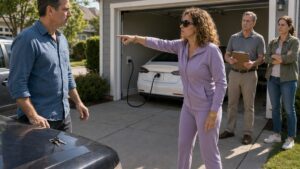
Karen Wright took the photograph before Robert Hall could lower the garage door another foot.
The flash struck the clear plastic sheet covering the far wall and threw a hard white glare across the map beneath it. Robert stopped with one hand on the wall switch. The door hung halfway down, framing Karen from the shoulders up as she stood on his driveway with her phone raised.
“Did you just photograph the inside of my garage?”
Karen lowered the phone but did not put it away. “I photographed what is visible from the street.”
Behind Robert, the map covered nearly the entire wall above his workbench. Blue lines curved between ponds and playgrounds. Red lines cut across green spaces. Small circles marked benches, drinking fountains, steep slopes, and places where sidewalks narrowed. Clear vinyl protected the paper from sawdust and damp air, its edges secured with narrow wooden strips.
Karen leaned to see beneath the door.
“That is exactly the problem,” she said.
Robert pressed the switch again. The door stopped moving.
“The problem is a map?”
“The problem is an enormous display visible from a common roadway. It makes the garage look like a commercial planning office.”
“It’s inside.”
“It’s visible.”
“So is my lawn mower.”
Her mouth tightened. Karen chaired the architectural committee with the solemnity of someone entrusted with a border crossing. She was not loud. She did not need to be. She preferred the measured voice of a person already preparing minutes for a meeting.
“The association has appearance standards,” she said.
Robert glanced at the phone in her hand. “Do those standards authorize you to take pictures through half-closed doors?”
“They authorize documentation.”
“Of exterior conditions.”
“Robert, I’m trying to handle this informally.”
He looked past her toward the sidewalk. Two neighbors had slowed without quite stopping. Across the street, a man unloading groceries kept turning his head toward them.
Karen pointed through the opening. “That thing is distracting, oversized, and completely out of character with the neighborhood.”
Robert felt the familiar pressure gather behind his ribs. He could have explained that the map was not decorative. He could have pulled back the clear cover and shown her the date codes, the elevation notes, the old municipal trail numbers written in pencil. He could have told her why one faded blue loop had been drawn, erased, and drawn again until the paper had worn thin.
Instead, he said, “It’s staying.”
Karen’s eyebrows rose. “Not if I can help it.”
She walked away before he could answer.
Robert lowered the door the rest of the way. The moment the bottom seal touched concrete, the garage became quiet except for the faint hum of the refrigerator in the corner.
He faced the map.
A small yellow note remained beneath the clear cover near the northern pond. The handwriting had faded, but he could still read it without stepping closer.
Too steep after rain.
He turned away.
An hour later, the complaint arrived by email.
The subject line read: NOTICE OF POTENTIAL ARCHITECTURAL VIOLATION.
Robert stood at the kitchen counter while the message loaded on his phone. The notice described an “oversized graphic installation visible from the street” and cited Section 8.4 of the community standards: Exterior ornamentation, advertising, or displays inconsistent with residential character.
He read the sentence twice.
Exterior.
The map was mounted to an interior wall. Nothing in the notice acknowledged that.
The email gave him forty-eight hours to respond before the property manager scheduled an inspection.
Robert opened the association handbook from the drawer where he kept appliance warranties and tax receipts. The binding cracked when he flattened it on the counter. Section 8.4 referred to signs, banners, commercial displays, seasonal decorations, and objects fixed to the exterior of a dwelling.
It said nothing about interior garage walls.
His first response was three sentences long.
The map is located inside my garage. It is not advertising. Please identify the provision governing interior wall coverings.
He stared at the screen, then deleted the second sentence because it sounded defensive. He deleted the third because it sounded like a challenge. What remained looked weak.
The map is located inside my garage.
He sent it.
Karen replied eleven minutes later, copying the property manager and two committee members.
Visibility from a common roadway may bring an installation within architectural review regardless of mounting location. An inspection will determine applicability.
Robert set down the phone.
The careful language bothered him more than open hostility would have. “May bring.” “Determine applicability.” Each phrase widened the rule while pretending not to.
He returned to the garage and switched on the overhead lights. Beneath the clear cover, the map looked less like an enormous object than a collection of decisions no one else could see.
He ran one finger along a green route between the clubhouse and the east entrance. Karen had once called that trail useless because it curved away from the shortest path. She had said the bend made no sense.
Robert lifted the bottom edge of the cover and traced the route with a pencil.
The direct sidewalk climbed at nearly nine percent beside the retention pond. The curved trail held below four. It was longer by three hundred yards and easier for a walker, a stroller, or anyone who could not manage the slope.
The bend was not an error. It was the reason for the route.
His phone sounded from the workbench.
The property manager had scheduled the inspection for Friday at four.
Robert read the message, then looked at the map’s northern edge, where one red line disappeared beneath a folded overlay. He had not opened that section in almost two years.
The next morning, he found a paper notice wedged beneath his front door.
Across the top, in red capital letters, someone had stamped two words that did not appear in the email.
REMOVAL REVIEW.
Chapter 2: The Rule Karen Quoted Was Missing Half Its Meaning
The municipal planning clerk recognized Robert’s notation before she recognized him.
She had unfolded only the first transparent overlay when she tapped a cluster of tiny diagonal marks beside the east pond.
“Nineteen ninety-eight field standard,” she said. “Nobody uses this anymore.”
Robert stood across the records counter with both hands on the cardboard tube that held the remaining overlays.
“Most people never used it correctly.”
The clerk looked up. “Robert Hall?”
He gave a small nod.
“I thought you retired.”
“I did.”
“That usually means people stop bringing work into this building.”
“This isn’t work.”
She glanced at the overlay again. “Looks like work.”
Two days had passed since Karen’s photograph. Robert had spent most of the first day reading association rules and most of the second discovering how little his own files could prove.
The map on his garage wall had grown over years. Some lines came from public trail plans. Others came from utility easement maps, drainage plans, old developer sketches, and measurements he had taken on foot. He knew which sources supported each route, but knowing was not the same as documenting.
The clerk carried the overlay to a light table.
“This blue loop is current,” she said. “Clubhouse path, pond walk, north playground connection.”
“And the red line?”
She followed it with one finger toward a narrow strip behind six homes.
“That depends which year you ask.”
Robert said nothing.
She opened a digital parcel map on her computer. “The original development plan shows a pedestrian access corridor. The recorded plat shows a drainage easement. Later landscaping documents call it a maintenance path.”
“Was public access ever revoked?”
“I can’t answer that from this.”
“Can anyone?”
“County records might have an amendment. Or the association.”
Robert almost laughed.
The association was the reason he was standing there.
The clerk printed three pages. Most of his routes matched current public records. The pond loop, the school connector, the low-grade path near the clubhouse—all confirmed. The paperwork should have steadied him.
Instead, his attention remained on the red line.
It began near the community garden, crossed behind the row of homes, and joined a shaded path near an old bench. It avoided the steep sidewalk along the southern hill. For years, residents had used it without thinking about what kind of access it legally represented.
Robert knew why he had drawn it.
He did not know whether he could prove it belonged on a public walking map.
At the HOA office that afternoon, the property manager accepted the printed records without enthusiasm.
“We’re reviewing the display, not certifying trails,” she said.
“The complaint calls it a decorative installation. It isn’t.”
Karen sat at the end of the conference table with a yellow legal pad aligned precisely before her. “Its informational purpose does not exempt it from appearance standards.”
“Neither does informational purpose make an interior wall exterior ornamentation.”
Karen opened the handbook to Section 8.4. A paper clip marked the page.
“Visible displays may be reviewed when they alter the residential appearance of the property.”
Robert leaned forward. “Where does it say that?”
Karen placed one finger on a paragraph concerning signs placed in windows.
“That refers to commercial signs.”
“It establishes that visibility matters.”
“It establishes that signs matter.”
The property manager lifted a hand. “This is why we’re inspecting.”
Robert looked from her to Karen. “Then why is the notice stamped removal review?”
The manager’s expression changed by less than an inch, but it changed.
Karen answered first. “That is an internal classification.”
“It was under my door.”
“A committee member may have used the wrong form.”
“Which committee member?”
“We’re not discussing administrative handling.”
Robert understood then that the question had already shifted. They were no longer deciding whether a rule applied. They were deciding how to defend the decision to apply it.
He slid the municipal records across the table. “The map shows actual neighborhood routes. It has no advertising. It has no political message. It isn’t illuminated. It isn’t attached to the exterior.”
Karen looked at the documents but did not touch them.
“Some of these routes may direct residents across areas not designated for public use.”
The red line seemed to rise from the page between them.
Robert kept his voice level. “The complaint wasn’t about routes.”
“It is now part of the review.”
“You called it ridiculous before you knew what it was.”
Karen’s pen stopped.
The property manager looked down.
For one second, Robert considered explaining everything: the slope measurements, the rest points, the route tests, the reason the red line mattered more than any other mark on the wall. But the conference room’s fluorescent lights flattened every object beneath them. He imagined private handwriting enlarged on a screen, discussed in meeting minutes, reduced to justification.
He gathered the records instead.
On his way out, the property manager followed him into the hall.
“Robert.”
He stopped.
She lowered her voice. “Most of the interior-display issue is arguable. But if the map is presented as a neighborhood guide, the route accuracy becomes relevant.”
“It has been accurate for years.”
“Most of it.”
He looked at her.
She glanced toward the closed conference-room door. “Karen requested expedited enforcement this morning.”
“Before seeing my documents?”
The manager did not answer directly. “You should receive the committee’s determination by tomorrow.”
When Robert returned home, he removed the folded route overlays from beneath the wall map. Dust had settled along their creases. He placed them on the workbench in order, weighting each corner with a small metal washer.
The oldest overlay showed the neighborhood before the southern hill had been fully developed. The red route was there in pencil, lighter than the others. Beside it was a small circle where a bench had once stood.
Under the circle, in handwriting that was not his, were three words.
Good place to stop.
Robert covered the note with his palm.
A delivery notification sounded from the front porch.
The association had not waited until tomorrow. A certified envelope lay against the doormat. Inside was a formal correction order giving him seven days to remove or permanently conceal the map from street view.
Attached to the order was a route-risk memorandum.
The red path had been circled twice.
Chapter 3: When Robert Said Finished, Everyone Heard Removed
Karen arrived at four o’clock expecting to see a blank garage wall.
Robert could tell by the way she stepped onto the driveway without looking through the open door. She carried a slim folder against her chest, and the property manager walked beside her with a tablet. Two architectural committee members stayed near the sidewalk.
“It appears you met the deadline,” Karen said.
The garage wall was hidden behind a gray canvas drop cloth stretched from ceiling to workbench.
Robert stood beside the wall switch. “The project is finished.”
Karen’s shoulders loosened.
“Finished,” she repeated, as though confirming a notation for the record.
Across the street, a garage door opened. Tyler Lee came out holding his phone. Angela Carter approached from the corner, walking slowly beside her father. Behind them came several residents Robert had expected and three he had not.
Karen finally noticed the gathering.
“What is this?”
Robert did not answer. He pressed the wall switch.
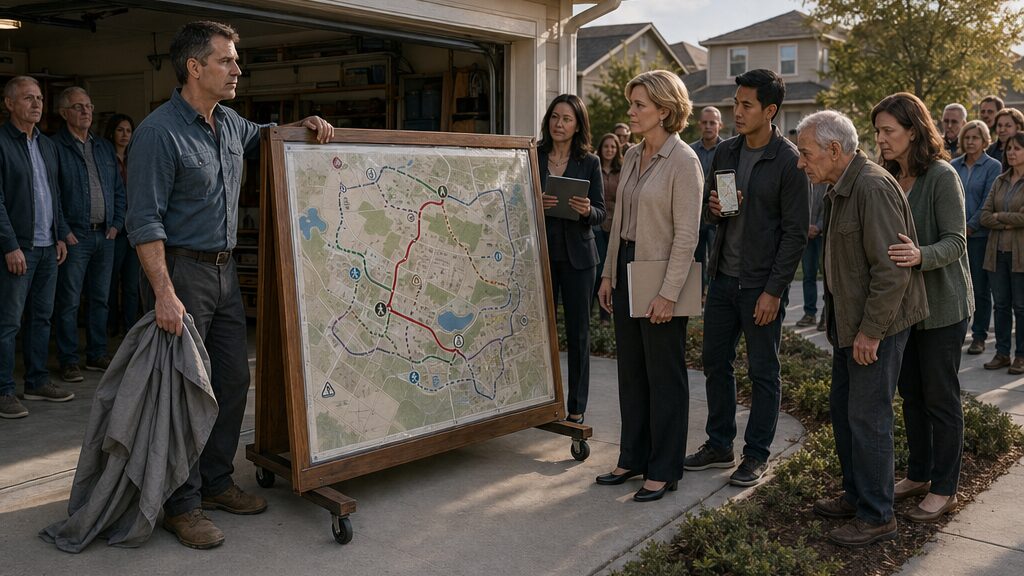
The garage door rose fully, exposing not an empty wall but the lower edge of a wooden frame on casters. It stood beneath the gray cloth, nearly six feet wide, with a sloped top and a clear weather cover fitted over its face.
Karen looked at the property manager. “Was a demonstration approved?”
“No demonstration was requested.”
Robert released the brakes on the casters and pulled the frame forward. The wheels crossed the garage threshold with two dull knocks. He guided it to the edge of the driveway, where the late-afternoon light struck the clear cover.
The neighbors drew closer.
Karen stepped in front of him. “Robert, if this is another display—”
He removed the cloth.
For several seconds, no one spoke.
The map beneath the cover was smaller than the one on his wall but more precise. Colored loops began at the clubhouse and spread through the neighborhood. Each route showed distance, estimated walking time, slope changes, shaded sections, rest points, curb cuts, narrow sidewalks, and places where pavement became uneven.
A legend in the lower corner identified three route types: standard, low-grade, and assisted.
Angela’s father leaned toward it.
“You marked the benches,” he said.
Robert nodded.
“And the hill behind the pond.”
“Yes.”
The older man followed a green line with his finger without touching the cover. “This one stays level?”
“Mostly. There’s a short rise near the mailboxes. Four percent.”
Angela looked at Robert. “That’s the route we’ve been using.”
Karen turned sharply. “Using how?”
Tyler raised his phone. “The map links to a mobile version.”
He opened a simple page showing the same colored routes. Each could be enlarged, and each included notes about surface conditions and resting places.
“I helped him put the data into a browser map,” Tyler said. “Nothing tracks users. It just shows the routes.”
Karen stared at the phone. “You distributed an unapproved neighborhood guide?”
“Four people tested it,” Robert said.
“Without association authorization.”
“With their consent.”
“That is not the same thing.”
A woman near the sidewalk pointed toward a blue loop. “Does that connect to the school path?”
“It does,” Robert said. “But the crossing at Meadow Lane has no marked signal, so it’s listed as caution.”
Another resident asked about strollers. Someone else asked which route had the most shade. The questions came carefully at first, then overlapped.
Robert answered each one in the same tone he had used during municipal field reviews. Distance. Grade. Surface. Known obstruction. Seasonal issue.
For the first time since the complaint began, the map was being discussed as a map.
Karen opened her folder. “This does not resolve the violation.”
“No,” Robert said. “It resolves your claim that it’s ridiculous.”
A murmur moved through the group. He immediately regretted the sentence. It sounded too much like victory.
Karen’s face changed, not with embarrassment but with renewed control.
“The original order concerns visibility from the street,” she said. “You have now placed a larger display outside the garage.”
“It’s portable.”
“It is still a display.”
“It’s on my driveway.”
The property manager looked down at her tablet. “The property line ends approximately eighteen inches behind the sidewalk edge.”
Robert knew that.
He also knew the driveway apron widened near the garage. When he had rolled the board out, one caster had crossed onto the narrow landscaped strip beside the sidewalk.
Common property.
Karen saw him look down.
“There,” she said. “Document that position.”
The manager hesitated.
“Please document it,” Karen repeated.
The tablet’s camera clicked.
The sound cut through the neighbors’ questions.
Angela moved closer to the board. “You’re going to remove this because one wheel is on the grass?”
Karen turned to her. “The issue is not one wheel. The issue is that residents are being directed through the community by an unreviewed source. Some of these routes may cross maintenance areas or private boundaries.”
“They’re walking paths,” Tyler said.
“According to whom?”
“According to municipal records,” Robert said.
“Most of them,” Karen replied.
The red route ran across the lower third of the board.
Robert had considered omitting it. Without that line, the prototype would have been easier to defend. It would also have forced anyone avoiding the southern hill onto a longer sidewalk with no shade and no place to rest.
Angela’s father pointed toward the red route.
“That’s the good one,” he said. “Behind the garden.”
Karen stepped closer to the board. “That path is not confirmed public access.”
“It has been used for years,” Robert said.
“Use does not establish authorization.”
The property manager enlarged the photograph she had taken. “Karen is correct about one thing. If the board recommends a route over an uncertain easement, the association has a liability concern.”
The excitement around the map thinned.
Robert looked at the residents who had gathered. A few still studied the routes, but others had stepped back. The change was subtle and immediate: the board was no longer only useful. It had become evidence.
Karen closed her folder.
“The removal order remains in effect,” she said. “And this installation creates a separate common-area violation.”
Robert rested one hand on the wooden frame. Beneath the clear cover, a small circle marked the old bench behind the garden. The symbol was not part of any current municipal standard.
Angela noticed it.
“Why is that bench still on the map?” she asked.
Robert’s hand tightened against the frame.
The bench had been removed six years ago.
Before he could answer, Karen addressed the property manager.
“Photograph every side of the installation,” she said. “Including the route legend and the red path.”
The camera clicked again.
This time, Robert understood that proving the map was useful would not be enough to save it.
Chapter 4: The Useful Map Crossed a Line No One Could See
The barrier appeared before breakfast.
Two orange posts had been driven into the ground behind the community garden, with a length of yellow plastic chain stretched between them. A laminated notice hung at the center.
ACCESS SUSPENDED PENDING EASEMENT REVIEW.
Robert stood on the paved path with the folded route-risk memorandum in his jacket pocket. Beyond the chain, the red route continued beneath mature trees, level and shaded, toward the place where the old bench had once stood.
Someone had gone to trouble to make the path look forbidden.
Angela approached from behind him, pushing her father’s empty transport chair with one hand. Her father walked beside her using a cane, his steps careful on the uneven pavement.
“They put it up last night,” she said.
Robert examined the posts. They were temporary maintenance markers, not boundary stakes. The chain could be lifted away in seconds.
“Who did?”
“The property manager said the maintenance contractor was told to restrict access.”
“By the board?”
“She said pending review.”
That phrase again. Pending review meant someone had acted before deciding who possessed the authority to act.
Angela’s father stopped several feet from the chain. He looked toward the shaded path, then toward the southern sidewalk rising beside the retention pond.
“I can’t take the hill today,” he said.
Angela touched his elbow. “We’ll turn back.”
He shook his head with quiet annoyance. “I came to walk.”
Robert looked at the red route on the folded copy in his pocket. The path beyond the chain was three hundred yards shorter than the alternative and stayed nearly level until the garden entrance. He had measured every rise himself.
“We can use the clubhouse loop,” Robert said.
“That adds almost half a mile,” Angela replied.
Her father gave a dry laugh. “Everyone keeps adding distance for people who have less of it.”
The sentence stayed with Robert as they returned toward the clubhouse.
At the hearing that evening, the orange barrier appeared on the screen behind Karen.
The HOA meeting room held twenty folding chairs, though only eight were occupied. Robert sat at the front table with his municipal records stacked beside the correction order. Karen sat opposite him. Larry Nelson had taken a place near the property manager, his calculator and budget folder closed for once.
Karen pointed to the projected photograph.
“The concern is not whether residents enjoy the route,” she said. “The concern is whether the association has encouraged use of an area that may be limited to drainage and maintenance access.”
Robert opened the recorded development plan. “The original drawing labels it as a pedestrian corridor.”
“The later plat does not.”
“It doesn’t revoke it.”
“It doesn’t confirm it either.”
The property manager shifted to the next image: the red route as shown on Robert’s board.
“This is where the prototype creates risk,” she said. “A resident may reasonably assume every route displayed has been approved.”
Robert looked at the phrase beneath the map legend: Neighborhood Walking Guide.
He had chosen it because it sounded simple.
He had not written Draft.
He had not written Use at Your Own Risk.
He had not asked anyone’s permission.
“The route has been used for more than twenty years,” he said.
Karen folded her hands. “And if one homeowner objects tomorrow?”
“Has one objected?”
“That is not the standard.”
Larry finally spoke. “Do we know who maintains that strip?”
The property manager consulted her notes. “The association trims vegetation near the entrance. The drainage channel itself may fall under a municipal easement.”
“May?” Larry asked.
Karen looked toward him. “That uncertainty is exactly why access was suspended.”
Robert had expected to be angry. Instead, he felt something less comfortable.
Karen was not wrong about the uncertainty.
She had exaggerated the garage rule and pushed the review before understanding the map, but the red path was not as simple as he had allowed himself to believe. Years of ordinary use had made it feel public. Familiarity had become proof in his mind because he needed it to be proof.
Angela rose from the second row.
“My father has used that path three mornings a week since winter,” she said. “The hill route is too steep for him. Robert’s map is the first thing that showed us a safer loop.”
Karen’s expression softened, though her voice did not. “I understand that it is useful.”
“Then why did you close it?”
“Because usefulness does not eliminate liability.”
Angela looked at Robert. “Did you know the access status was uncertain?”
Every face in the room turned toward him.
Robert could have said no. The records contradicted one another. No single page settled the issue.
But he had known enough to hesitate.
“I knew the documentation was incomplete,” he said.
Angela’s mouth tightened. “And you still put it on the public board.”
“It has been used safely for years.”
“That wasn’t my question.”
Robert looked down at the red line on his paper copy.
“No,” he said. “It wasn’t.”
The room changed after that. Karen no longer needed to portray him as reckless; he had supplied the fact himself.
The committee voted to suspend the prototype pending full route verification. The wall map inside his garage would remain under separate review, but the outdoor board had to be removed from view and secured on his property.
Robert rolled it back into the garage that night. The casters crossed the threshold with the same two dull knocks as before, but no neighbors gathered to watch.
Angela followed him inside while her father waited in the car.
She stood before the original wall map, studying the faded symbols beneath the clear cover. Her anger had cooled into something more searching.
“You marked the old bench on both versions,” she said.
Robert released the caster brakes.
“It helped identify the route.”
“The bench has been gone for years.”
“It was a reference point.”
Angela stepped closer. Beside the small circle were two handwritten words, almost hidden beneath the glare.
Ten minutes.
She looked at the symbol, then at Robert.
“That isn’t a municipal notation,” she said. “And it isn’t a trail time.”
Robert reached for the edge of the clear cover, but Angela placed her hand against it first.
“Who needed ten minutes at that bench?”
Chapter 5: The Names Beneath the Clear Cover Were Never for the Board
Angela returned after dark carrying a thermos and a folder of her father’s medical appointment schedules.
Robert almost did not open the garage door.
He had spent the afternoon removing the public board’s route sheet and covering the wooden frame with the gray canvas. The original wall map remained exposed beneath its clear vinyl, but he had switched off the lights above it, leaving only the workbench lamp on.
Angela stood in the driveway.
“I’m not here for the association,” she said.
“You already asked your question.”
“You didn’t answer it.”
Robert looked past her toward the street. No one else was there.
He raised the door.
Angela entered and placed the thermos on the workbench. She did not mention the covered prototype. She went directly to the wall map and pointed to the old bench symbol.
“This mark,” she said. “There are six more like it.”
Robert remained near the door.
The circles appeared at irregular intervals: near the pond, beside the playground fence, under the sycamores behind the clubhouse, and at the edge of the garden. Each had a small handwritten time beside it.
Eight minutes.
Twelve minutes.
Good shade after four.
Angela studied them one by one.
“My father tracks his breaks like this,” she said. “Not distance. How long until he needs to sit.”
Robert said nothing.
She opened her folder. Inside were printed route notes she had made for her father—parking locations, restroom access, places with railings, steep curbs. The pages were practical and plain.
“I thought your map was built for the neighborhood,” she said.
“It can be used by the neighborhood.”
“That isn’t the same answer.”
The workbench lamp reflected from the clear cover. Robert could see his own shape in it, laid over the routes like another layer he had failed to remove.
Angela touched the vinyl near a faded yellow note.
Too steep after rain.
“Whose handwriting is this?”
He reached up and released the wooden strip holding the lower edge of the cover. The vinyl lifted with a soft crackle.
For years, the map had remained protected from dust, humidity, and hands. Beneath it, the paper smelled faintly of old adhesive.
“My wife’s,” he said.
Angela lowered her hand.
Robert peeled the cover back far enough to expose the northern section. The yellow note had been written in a narrow, slanted script. Several pencil marks nearby were lighter versions of the same hand.
“She started having trouble with balance,” he said. “At first only on slopes. Then on uneven pavement. She didn’t want people deciding where she could go, so we started recording routes.”
Angela did not interrupt.
“We walked every loop. Sometimes twice. She marked where she needed to stop. I measured grade and distance. She measured whether a route still felt like going somewhere.”
His thumb rested beside the old bench.
“That one was ten minutes from our house on a good day.”
“And on a bad day?”
Robert looked toward the covered prototype.
“We turned around before we reached it.”
The garage refrigerator hummed in the corner. Outside, a car passed slowly, its headlights sliding beneath the door.
Angela unfolded one of her father’s schedules. “How long ago did she die?”
“Three years.”
“You kept working on the map.”
“For a while.”
“What stopped you?”
He could have answered with the ordinary facts. Hospital equipment removed. Clothes donated. Medical bills filed. The house made quiet again.
Instead, he said, “The notes stopped changing.”
Angela looked back at the map.
The routes were full of his measurements, but the small practical judgments belonged to someone who no longer tested them. Good shade. No curb cut. Loud dogs. Better in morning. The words made the map useful because they were not technical.
“I thought if I finished it,” Robert said, “I would be deciding the last thing for her.”
“You promised her you would?”
He nodded.
The promise had not been dramatic. They had been sitting at the kitchen table after a difficult walk, her shoes still wet from the path near the pond. She had tapped the unfinished map and said, You know this could help people who don’t know which way is possible.
Robert had answered, I’ll finish it.
He had meant soon.
Angela’s voice softened. “Then why didn’t you tell the board?”
“Because it is a compliance hearing, not a memorial service.”
“You could have explained the accessibility purpose.”
“They would have asked who tested it. They would have asked why these notes were here. They would have turned her into supporting documentation.”
Angela absorbed that without flinching.
“And now they may destroy the whole project because you gave them nothing.”
“They won’t destroy it.”
“They can make it unusable.”
Robert lowered the clear cover.
Angela caught the edge before it settled.
“My father can help test the revisions,” she said. “So can other residents. We can mark the routes that are actually accessible now.”
“No.”
The answer came too quickly.
Angela released the cover.
“You said it was for people like him.”
“I said people could use it.”
“You want them to use it without changing it.”
“The routes need technical control.”
“And the notes?”
“I’ll handle them.”
She looked toward the covered public board. “You already handled one uncertain route by putting it on a guide.”
Robert’s jaw tightened. “I admitted that.”
“You admitted the fact. You haven’t admitted why you did it.”
He knew why. The red route had been one of the last paths his wife could complete without assistance. Omitting it felt like erasing a truth the current records did not recognize.
Angela took her thermos from the bench.
“You’re angry at Karen for treating the map like an object,” she said. “But you’re doing the same thing in reverse. She thinks rules are the only thing that can protect the neighborhood. You think your hands are the only thing that can protect this.”
Robert stared at her.
The sentence was unfair.
That did not make it false.
After Angela left, he stood alone before the map. The clear cover hung partly open, exposing one corner of the paper to the air.
He reached to close it, then stopped.
His phone vibrated.
Tyler had sent a screenshot of an email from the property manager. The board was willing to consider a revised map as an official community resource, subject to legal review, route verification, and shared maintenance.
A second message followed.
There’s a condition.
Robert called him.
Tyler answered immediately. “They don’t want one person controlling updates.”
“It’s my work.”
“I know.”
“Do they?”
“They know you made it. They won’t approve it if only you can alter it.”
Robert looked at the faded handwriting beneath the lifted cover.
Tyler continued, more carefully now.
“They want the files held by the association, route changes reviewed by a small volunteer group, and the physical board treated as community property.”
Robert said nothing.
“If you refuse,” Tyler added, “they’ll let you keep the original inside the garage as long as it stays concealed. But the public version is done.”
The clear cover slipped from Robert’s hand and settled over the map.
For the first time, protecting it and finishing it had become opposite choices.
Chapter 6: Karen’s Strongest Argument Was the One Robert Could Not Dismiss
Karen offered Robert a way to end the dispute before he had taken off his coat.
Her home office was smaller than he expected. No framed certificates, no photographs of committee events, no wall of rulebooks. Just a desk, two chairs, a printer, and three banker’s boxes labeled by year.
She closed the door behind him.
“Withdraw the public-map request,” she said. “Keep the garage door closed when the map is uncovered, and I’ll recommend no fine.”
Robert remained standing. “Why meet here?”
“Because the hearing room makes every sentence permanent.”
“That hasn’t bothered you so far.”
Karen accepted the remark without reacting. “I’m giving you an off-ramp.”
“And the route project?”
“Ends.”
He looked at the banker’s boxes. One lid had warped under the weight of the files inside.
“You called it ridiculous before you knew what it was.”
“I did.”
“You filed before checking whether the rule applied.”
“I believed it applied.”
“And now?”
Karen moved behind the desk and opened a folder. A reduced photocopy of his map lay on top, the colored routes rendered in shades of gray.
“Now I believe the public version creates a different problem.”
“That isn’t what I asked.”
She looked at him.
“The interior-garage language is ambiguous,” she said.
“Ambiguous enough that you left it out of the packet?”
Her gaze sharpened. “Who told you that?”
“No one had to. The handbook section about visible window signs includes an exemption for noncommercial interior displays. It wasn’t attached to the committee summary.”
Karen closed the folder.
For several seconds, only the printer’s cooling fan moved air through the room.
“I did not include it because I did not believe it controlled,” she said.
“You included every sentence that supported removal.”
“I included what I considered relevant.”
“That is not review. That is construction.”
Color rose along her neck, but her voice stayed measured.
“Three years ago, a homeowner built an enclosed patio without approval. The committee delayed because the language was unclear and no one wanted a confrontation. Then two neighbors demanded the same exception. Water drainage changed. One foundation was damaged. The association spent eighteen months in mediation and nearly emptied the reserve account.”
Robert had heard fragments of that dispute. He had not known the cost.
Karen opened one of the banker’s boxes and removed a thick file.
“I was not chair then,” she said. “But I was the person residents called after every meeting. They wanted to know why rules existed if no one would apply them until damage was visible.”
“So now you apply them before authority is visible.”
“I decide before delay becomes permission.”
The answer was not an excuse. It was worse than an excuse because it contained a logic Robert understood.
He had done the same thing with the red route. Years of use had become permission because questioning it threatened something he valued.
Karen placed the file back in the box.
“Your map may be beneficial,” she said. “But benefit cannot be the test. Everyone believes their exception is beneficial.”
“Then review it honestly.”
“I am.”
“No. You are protecting the decision you made on my driveway.”
Her face hardened.
“And you installed a public guide without route verification because one path mattered to you personally.”
The sentence landed cleanly.
Robert did not ask how she knew. Angela might have spoken to the property manager. Tyler might have explained the old annotations. Or Karen might simply have seen what he had refused to admit: his technical judgment had bent around grief.
“I was wrong to include an unconfirmed route,” he said.
Karen seemed surprised by the admission.
“But you were wrong before that,” he continued. “You decided the map was a nuisance, then built a process that would prove it.”
She looked down at the photocopy.
“I am still offering no fine.”
“In exchange for silence.”
“In exchange for closure.”
Robert buttoned his coat. “Those are not the same thing.”
The formal meeting began an hour later at the community room. Larry Nelson arrived carrying two versions of the committee packet.
He placed them side by side.
“One contains the interior-display exemption,” he said. “One does not.”
Karen sat very still.
The property manager examined both copies. “The shorter packet was distributed to the architectural committee.”
“By whom?” Larry asked.
Karen answered. “I prepared the relevant excerpts.”
Larry removed his glasses.
“I supported expedited enforcement based on this packet.”
“The omitted language does not settle the matter.”
“Maybe not. But we were entitled to see it.”
One committee member turned toward Karen. The other looked at the table.
The power in the room shifted without anyone raising a voice.
Larry opened the association bylaws.
“I move that the prior determination be suspended,” he said, “and that a full rehearing be scheduled with complete rule language, route documentation, liability review, and a proposed compliant location.”
Karen’s expression did not collapse. She simply wrote the motion down.
The vote passed three to one.
Afterward, as chairs scraped across the floor, Larry approached Robert.
“This does not mean the map is approved,” he said.
“I know.”
“And it does not excuse the common-area installation.”
“I know that too.”
Larry held out a blank architectural request form.
“The board wants an alternative, not another argument. Approved location. Ownership structure. Maintenance. Route verification. Everything.”
Robert took the form.
Across the room, Karen was placing both versions of the packet into the official file. She did not look at him.
Larry tapped the blank page.
“If you come back only to prove your garage wall is yours, you may win that point and lose the map.”
Robert looked at the line labeled Applicant.
For three years, he had believed completing the promise meant preserving every decision he and his wife had made.
Now the association was asking him to submit a version that other people could revise, maintain, and eventually outlive.
Larry capped his pen.
“The rehearing is next Thursday,” he said. “Bring us something lawful enough to keep and useful enough to justify keeping.”
Robert folded the application once, then opened it again before the crease could set.
Chapter 7: The Map Could Survive Only If Robert Let It Change
Robert entered the rehearing carrying the original northern panel of the map against his chest.
The clear cover was still fastened over it. Beneath the vinyl, faded route notes, pencil corrections, and one small yellow slip remained exactly where they had been for years.
The room quieted as he set the panel on an easel beside a newly printed map mounted on foam board.
Karen looked from one to the other.
The original was crowded with history. The revision was cleaner. Its route lines stopped at confirmed boundaries. Uncertain access points were marked for review rather than presented as established paths. A proposed location near the clubhouse appeared in the lower corner, beyond the drainage corridor and fully inside association-owned common space.
Larry studied the application packet in front of him.
“Who prepared the revision?” he asked.
“I did the base work,” Robert said. “Tyler converted the route data. Angela reviewed the accessibility notes with her father.”
“And ownership?”
Robert’s fingers tightened around the edge of the easel.
“The association would own the public board and the digital files.”
The words seemed to remain in the room after he spoke them.
Tyler sat in the second row, holding a laptop closed on his knees. Angela was beside him. Neither looked relieved.
Karen opened the revised maintenance plan. “Updates require committee approval?”
“Route changes require verification,” Robert said. “Maintenance notes can be added by the volunteer group. Temporary closures can be posted by the property manager.”
“Who has final editorial control?”
“No one person.”
Karen looked at him directly. “Including you.”
“Including me.”
The property manager turned to the section on liability. “The disputed red route has been removed.”
“From the approved guide,” Robert said.
“Do you still believe it should be public?”
“I believe its status should be resolved. Until then, it should not be presented as approved access.”
The answer cost him more than he expected.
On the original panel, the red line still curved behind the garden toward the vanished bench. It remained visible under the cover, untouched by the revision.
Larry adjusted his glasses. “Before we discuss approval, there is still the matter of the prototype installation.”
Robert nodded.
The room waited.
He had rehearsed explanations all week. The driveway was his property except for the narrow common strip. The casters had crossed it briefly. The prototype had been portable. No permanent anchors had been installed.
Every argument was accurate.
None was enough.
“I placed the board partly on common property without approval,” he said. “I also distributed route information before confirming every access condition.”
Karen’s pen stopped above her notes.
Robert continued.
“I believed the map’s usefulness justified moving quickly. It did not justify skipping the process.”
One of the architectural committee members shifted in her chair. The property manager looked up from the tablet.
Robert rested his hand against the original panel.
“I also withheld information during the first review because I did not want the association discussing why the map existed.”
Karen’s posture changed slightly.
Robert had not planned to say more. The application did not require it. The board could approve the kiosk without knowing whose handwriting marked the old benches.
But the clean revision beside him looked incomplete in a way no legend could repair.
“My wife and I began the map when walking became difficult for her,” he said. “She tested the routes. She noted where the slope changed, where shade lasted, where a person could stop without feeling stranded.”
Angela lowered her eyes.
“We intended to finish a guide other people could use. After she died, I continued the measurements, but I kept the work under my control. I told myself I was protecting its accuracy.”
His hand moved over the clear cover. The vinyl was cool beneath his palm.
“I was also protecting it from becoming anything she had not personally approved.”
No one interrupted.
“That made the map safe from change,” he said. “It also kept it unfinished.”
Tyler looked at him then.
Robert turned toward the board members.
“I am asking you to approve a public version that other people can correct. I am not asking you to treat my reasons as an exemption. I am asking you to apply the complete rules, including the ones that protect residents from selective enforcement.”
Karen’s jaw tightened, but she did not object.
Larry leaned back.
“What happens to the original?”
“It stays in my garage.”
“Visible from the street?”
“When the door is open, yes.”
The property manager looked toward Karen.
Karen opened the full handbook, not the shortened packet.
“The interior-display exemption applies if the item is noncommercial, not illuminated, and not installed for public advertising,” she said. “The original map appears to meet those conditions.”
The room remained still.
It was not an apology. It was an accurate reading entered into the record.
Larry nodded once. “Then the original complaint should be closed without violation.”
Karen’s pen moved across the page.
“I want my objection to the public installation preserved,” she said. “The prototype was unauthorized, and one route was not verified.”
“It will be preserved,” Larry replied.
“And the approval should not establish a general exception for unreviewed common-area displays.”
“It will not.”
Robert met Karen’s eyes. Her expression held no warmth, but neither did it hold triumph. She had lost control of the first process and was trying to prevent the correction from becoming another form of disorder.
He understood that.
He did not forgive the omission.
The board discussed material standards, repair costs, update intervals, and whether the kiosk should include a disclaimer. Tyler opened the digital version and demonstrated how route closures could be marked without deleting historical information. Angela proposed a small accessibility review group rather than assigning all responsibility to Robert.
Each suggestion altered the work.
Robert felt every alteration.
The public map would no longer use his exact legend. The symbols for rest points would be standardized. Seasonal notes would carry dates and sources. The association would archive previous versions. His name would appear only in a small development credit, alongside Tyler’s and Angela’s, not as owner.
Larry called the vote.
The six-month trial installation passed four to one.
Karen voted no.
After the meeting, the property manager handed Robert the signed approval.
“Community asset,” she said, pointing to the ownership line.
He read it twice.
The phrase looked impersonal. It was meant to.
Karen approached while the others packed their files.
“My objection is not to your wife,” she said quietly.
“I know.”
“And it was not only to the map.”
“I know that too.”
She glanced at the original panel. “You should have applied before putting it outside.”
“Yes.”
“You should have told us the route data was incomplete.”
“Yes.”
Her expression tightened, as if his agreement left her without the argument she had prepared.
Robert folded the approval letter.
“You should have given the committee the complete rule,” he said.
Karen looked toward the table where both versions of the packet remained in the official file.
“Yes,” she said.
It was the closest they came to reconciliation.
Larry called Robert back before he reached the door.
“One more condition,” he said.
Robert turned.
“The trial approval requires independent updates. You cannot be listed as sole administrator, owner, or final reviewer.”
“I understand.”
“Understanding it in the room is different from living with it.”
Larry slid the final signature page across the table.
Robert looked at the blank line beneath Community Map Stewardship Group.
Then he signed where his name appeared beside Tyler’s and Angela’s, one among three.
Chapter 8: The First New Line Was Drawn by Someone Robert Had Never Met
The new route line was already on the kiosk when Robert arrived.
It curved in green from the clubhouse loop toward the northern pond, crossed a newly painted curb ramp, and ended beside a bench symbol that had not existed on any version he had made.
Robert stopped several feet away.
The kiosk stood beneath a shallow cedar roof near the clubhouse path. Its clear front panel reflected trees and passing clouds, but the map beneath was easy to read. A small approved plaque occupied the lower corner. Beside it, a dated update card identified the new route as a trial accessible loop submitted through resident feedback.
Robert leaned closer.
The line was technically sound. It avoided the broken sidewalk near the mailboxes and used a short connector he had dismissed years earlier because it ended at an empty patch of grass.
The grass was empty no longer.
Beyond the pond, a new bench faced the water.
Angela approached with her father, who walked beside her without the transport chair.
“You found it,” she said.
“Who submitted the route?”
“A resident from the west entrance. She walks with her mother in the evenings.”
Robert followed the line again.
He had never met either of them.
“The connector grade?” he asked.
“Three-point-eight percent at the steepest section,” Angela said. “Tyler checked it twice.”
“Surface?”
“Concrete except for twelve feet of packed fines near the bench. The maintenance contractor is replacing that section during the trial.”
Robert nodded.
The information was good.
That did not stop the first tightness in his chest.
Someone had added a line to the map without asking him. The old instinct rose quickly: inspect the source, challenge the symbol, protect the system from careless hands.
Then Angela’s father began walking toward the pond.
At the new bench, he sat without being helped. He rested both hands on his cane and looked across the water.
“Ten minutes from the clubhouse,” he said.
Robert looked at Angela.
She smiled faintly. “On a good day.”
The phrase reached him with the force of recognition rather than grief.
The kiosk did not contain his wife’s handwriting. It did not need to. The purpose had survived the handwriting.
Tyler arrived carrying a small weatherproof envelope of update cards.
“I was going to call you,” he said.
“You did not.”
“You told me not to call every time someone submitted a correction.”
“I said not every time.”
“This was one time.”
Robert looked at him.
Tyler held up both hands. “Angela approved the accessibility notes. The property manager approved the temporary route designation. I updated the digital map.”
“You archived the previous version?”
“Yes.”
“The connector measurement file?”
“In the shared folder.”
Robert searched for another objection and found only habit.
Near the clubhouse, Karen stood with the property manager examining the kiosk plaque. She carried a clipboard and checked the mounting height, weather seal, and approval number. When she reached the update card, she read it for several seconds.
Then she looked toward Robert.
He expected her to question the route.
Instead, she pointed to the plaque. “The installation date is missing the year.”
The property manager checked it. “You’re right.”
Tyler muttered, “Of course she found that.”
Robert almost smiled.
Karen walked over.
“The documentation should be corrected before the inspection closes,” she said.
“It will be,” Tyler replied.
She glanced at the new green line. “This route was approved through the update process?”
Angela answered. “For the trial period.”
Karen nodded and wrote something on her clipboard.
No apology. No praise. No new complaint.
The process held because she followed it too.
Six weeks earlier, that would not have satisfied Robert. He would have wanted acknowledgment that the original map had value before Karen photographed it, before the complaint, before anyone else gathered around it.
Now the kiosk stood where people could reach it without entering his driveway. A parent traced the school loop with one finger. Two older residents compared shaded routes. A child pressed close to the clear panel while an adult read the distance markers aloud.
The map no longer depended on anyone understanding Robert.
That was what made it useful.
Later that afternoon, he returned to his garage.
The original wall map remained beneath its clear cover. Sunlight entered through the open door and illuminated the old notes: steep after rain, loud dogs, good shade after four.
The red route behind the garden was still there.
Its legal status remained unresolved, and the yellow chain still blocked the entrance. Robert had stopped treating that uncertainty as an insult. Tyler had created a research file for it. Larry had requested a formal easement review for the next budget cycle.
The route might return to the public map one day.
It might not.
Robert released the bottom strip of the clear cover.
Tyler stood at the workbench with a printed update overlay.
“You sure?” he asked.
“No.”
“That wasn’t the question.”
Robert looked at the empty space on the original map where the new pond loop would fit.
Tyler held the overlay without moving.
Robert lifted the vinyl higher.
“Put it there,” he said.
Tyler aligned the new route against the existing grid. His first attempt sat slightly crooked.
Robert reached forward, then stopped his own hand.
“Top edge needs to move left,” he said.
Tyler adjusted it.
“Too far.”
“You want to do this?”
“No.”
Tyler moved it back half an inch.
Robert studied the line. It was not drawn in his style. The curve was smoother, the symbols newer, the lettering produced by a printer rather than a pencil.
It belonged.
Outside, the garage door remained fully open.
A woman walking past slowed when she saw the map. She did not photograph it. She simply looked from the wall to the kiosk visible near the clubhouse path, then continued walking.
Tyler secured the overlay with two removable tabs.
Robert lowered the clear cover but did not fasten the wooden strip.
The vinyl remained open along the bottom, loose enough for the next correction.
The story has ended.