When the HOA Cut Down His Sons’ Basketball Hoop, They Forgot Who Controlled the Water
Chapter 1: The Morning They Cut Through the Pole
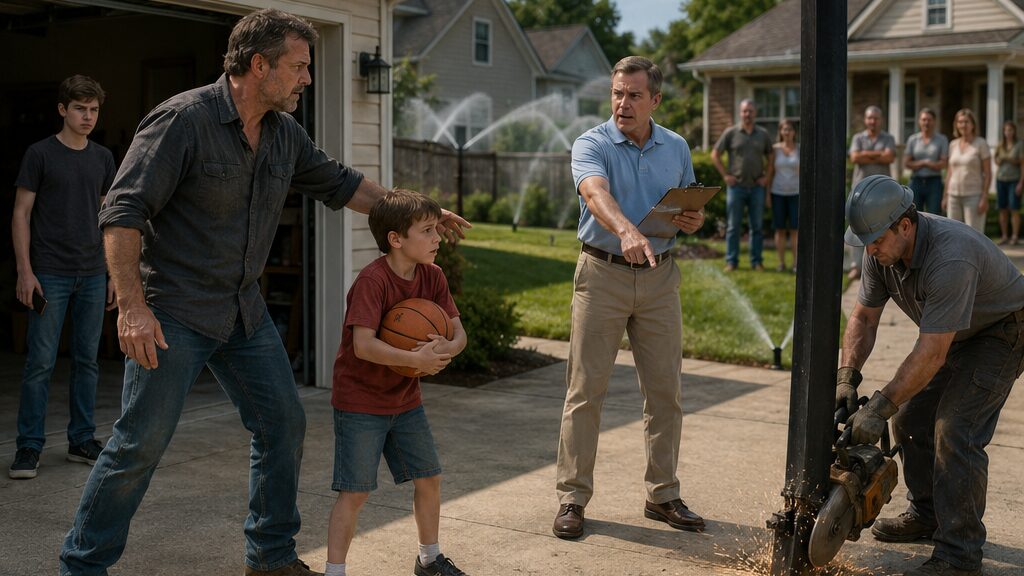
The saw touched the black steel pole while David still held the basketball against his chest.
For one suspended second, no one moved. The construction worker had both hands on the tool, its blade whining just above the concrete sleeve. Dennis Wright stood beside him in a pale blue HOA polo, one finger pointed toward the base as though directing a landscaping crew toward a dead shrub.
Thomas Carter stepped off the porch.
“Stop.”
The worker lifted the saw half an inch but did not shut it off. The motor screamed between them.
Dennis glanced at a clipboard. “The removal order is active.”
“My son is standing six feet away.”
“Then you should bring him inside.”
David looked up at Thomas. At nine, he still believed adults became reasonable once his father arrived. Benjamin, fourteen, stood near the garage with his jaw tight and his phone lowered at his side.
Thomas crossed the driveway slowly. The worker’s shoulders loosened as if he expected Thomas to take the saw from him. Dennis shifted one foot backward.
Thomas stopped beside David and took the ball.
“Go stand with your brother.”
David hesitated. “Dad—”
“Now.”
Only after both boys had moved did Thomas look at Dennis.
The notice had arrived eleven days earlier in an envelope marked ARCHITECTURAL COMPLIANCE. It claimed the hoop encroached on a utility easement and violated the neighborhood’s appearance standards. Thomas had read it at the kitchen counter, seen Dennis’s stamped signature, and dropped it in the recycling bin.
The pole had stood there for seven years.
Previous boards had seen it. County crews had seen it. Utility locators had sprayed orange and blue lines around it twice without objecting. Thomas had poured the footing himself after checking the recorded plat.
He had assumed the notice was what most HOA notices were: a demand designed to become serious only if the homeowner agreed to take it seriously.
Dennis held out the clipboard. “You failed to respond within the stated period.”
“The stated period was thirty days.”
“The board waived the appeal period under emergency enforcement authority.”
Thomas looked at him. “What emergency?”
Dennis pointed toward the pole. “Obstruction of a recorded access corridor.”
“For what utility?”
“That isn’t relevant.”
“It’s the only relevant question.”
Curtains shifted in the house across the street. A garage door stood open two properties down, its owner pretending to reorganize shelves. Behind the back fences, irrigation heads rose in neat rows. Water hissed over clipped lawns, catching the morning light.
Dennis lowered his voice. “Thomas, don’t make this uglier than it has to be.”
Thomas almost laughed. Instead, he looked at the worker.
“Did they show you a survey?”
The worker glanced at Dennis.
“You were hired for removal,” Dennis said. “Not legal interpretation.”
“So no survey,” Thomas said.
Dennis’s face tightened. “The association attorney approved the action.”
“Did the attorney read every agreement attached to the original subdivision plat?”
The saw continued idling. Its pitch changed when the worker relaxed his grip.
For the first time that morning, Dennis did not answer immediately.
Thomas saw it—a brief vacancy behind the man’s eyes, followed by calculation. Dennis looked past him toward the green strip behind the homes, where a low rise concealed the main irrigation line.
“I don’t know what you think that has to do with this,” Dennis said.
“That wasn’t my question.”
Benjamin stepped forward. “Dad, make them leave.”
Thomas heard the strain in his son’s voice. Benjamin had been the one who practiced after dark, bouncing the ball under the garage light until Thomas called him in. David mostly chased rebounds and announced scores no one else recognized.
Dennis checked his watch. “Proceed.”
The worker looked at Thomas.
Thomas could stop it physically. He could stand against the pole. He could call the sheriff and force Dennis to defend the order in front of a deputy. For one hot moment, he wanted the scene—the flashing lights, the neighbors gathering, Dennis explaining why a child’s hoop required emergency action.
Then Thomas saw David watching him.
He stepped back.
The blade met steel.
Sparks sprayed across the driveway. David flinched. Benjamin raised his phone at last, but Thomas reached out and lowered it.
“Let him finish,” Thomas said.
The words tasted wrong. Dennis heard surrender in them and straightened.
The worker cut halfway through, repositioned, and leaned into the pole. The backboard trembled. One final metallic crack passed through the frame, and the hoop tipped into the waiting hands of a second crewman.
The net swung once.
Dennis signed the work sheet against the hood of his vehicle.
“You’ll receive an invoice for removal and disposal,” he said.
Thomas walked to the fallen assembly and gripped the rim. “You’re not disposing of it.”
“It’s association policy.”
“It’s my property.”
“It was situated in violation.”
“Then you removed the alleged obstruction. The rest stays.”
Dennis seemed ready to argue, but several neighbors were openly watching now. He gestured to the workers.
“Leave it.”
Thomas carried the rim and backboard toward the garage. The severed pole dragged behind him, scraping a bright line across the concrete.
David followed. “Can you put it back?”
“Not today.”
“Tomorrow?”
Thomas set the assembly against the garage wall. A gray burr of cut metal caught on his palm. He pulled his hand away before the boys could see the blood.
Benjamin stared past him at Dennis. “He can’t just do that.”
“He did.”
“So do something.”
Thomas turned toward his older son. “Doing something and doing the right thing aren’t always the same.”
Benjamin looked at the ruined hoop. “That sounds like something people say when they’re not going to fight.”
The words landed harder than Dennis’s threats.
Outside, the crew loaded its saws. Dennis stood near the curb speaking with a board member who had arrived late. He glanced once toward Thomas’s garage, then toward the sprinklers pulsing behind the houses.
Thomas closed the garage door.
For several minutes he remained in the dimness, listening to the metal panels rattle into place. The old filing cabinet stood beneath a shelf of pipe fittings and rusted gauges. He had not opened its bottom drawer since clearing out the business records after Janet died.
On the workbench lay the HOA notice, rescued from the recycling bin the previous evening after Benjamin had asked whether Dennis could really remove the hoop.
Thomas unfolded it now.
The notice cited the recorded easement by number.
He read the number twice.
Then he crossed to the filing cabinet, knelt, and pulled open the bottom drawer. Behind a stack of pump warranties was a small brass key on a faded plastic tag.
PUMP HOUSE.
Thomas closed his fingers around it.
Chapter 2: The Agreement No One Had Renewed
Janet’s handwriting waited beside the expiration clause as though she had written it that morning.
DO NOT ALLOW ASSUMED RENEWAL. REVIEW ACCESS, COSTS, AND SAFETY EVERY FIVE YEARS.
The ink had faded from blue to gray. A crescent of grease marked the edge of the page where her thumb had rested.
Thomas sat at the garage desk with the agreement spread beneath the task lamp. Outside, David bounced a different ball against the closed garage door—soft, irregular impacts that stopped whenever Thomas shifted his chair.
The document was twenty-seven pages long, signed when the development had consisted of forty-six completed houses and three muddy streets. Thomas and Janet had owned the adjoining parcel, the well, the pump house, and the transmission pipe. The developer had needed irrigation before the municipal extension could support outdoor demand. Janet had drafted a temporary license. Thomas had built the system.
Temporary had become ordinary.
Ordinary had become invisible.
Thomas ran his finger beneath the term provision.
The current five-year period had expired on March thirty-first.
No renewal signature followed it. No amendment. No payment schedule. Nothing.
He checked the attached correspondence. The board secretary from five years earlier had requested an updated maintenance estimate. Janet had prepared one. Thomas found her calculations in a separate folder, every replacement valve and inspection hour listed in her compact block lettering.
No signed acceptance.
His pulse quickened.
He opened the service ledger.
For years, the HOA had paid quarterly maintenance without complaint. Then the amounts became smaller. One invoice was marked PARTIAL. The next carried a handwritten promise from a former treasurer. After Janet’s death, the entries stopped altogether.
Thomas counted backward.
Twenty-two months without payment.
He leaned against the chair and let out a breath that sounded almost like a laugh.
Dennis wanted rules.
Here was a rule.
Here were dates, signatures, unpaid invoices, notice requirements, and ownership descriptions. No emotion. No neighborhood politics. No man in a blue polo deciding which deadline mattered.
Thomas pictured Dennis standing beside the saw.
The satisfaction came quickly and cleanly.
Then Thomas turned the page.
A safety addendum had been clipped behind the maintenance schedule. He recognized Janet’s drafting before he reached her initials.
The private system supplied landscape irrigation, common-area hydrants, and reserve replenishment for the neighborhood’s wildfire-suppression tank. The primary fire supply came from the county line, but during low-pressure events the reserve could matter.
Termination of landscape service required written notice. Emergency reserve access could not be obstructed without inspection and alternate certification.
Thomas read the paragraph again.
The valve could not simply be closed.
Not all the way.
He took the brass key and drove to the pump house.
The structure sat beyond a row of pines on his parcel, a low concrete building with a metal roof and a door Janet had once painted green. The paint had peeled in long strips. Kudzu pressed against one wall. Inside, the air smelled of iron, dust, and old water.
The master valve stood waist-high where the transmission pipe rose through the floor. Its red wheel was flaked with rust but clean along the outer rim where Thomas had tested it each spring.
He fitted the key into the control cabinet.
The pump meter flickered awake. Pressure steady. Reserve tank level acceptable. Irrigation demand high.
On the inside of the cabinet door, beneath a laminated system diagram, Janet had written another note in permanent marker.
GREEN ZONES FIRST TO LIMIT. RED LINE MUST REMAIN OPEN.
A smear of grease crossed the word OPEN.
Thomas rested his hand on the valve wheel.
One turn would not stop the water. It would only prove the valve still moved.
He pulled.
The wheel resisted, then shifted with a low metallic groan. The pressure needle trembled. Somewhere beyond the trees, sprinkler heads would have shortened their arcs for a second.
Thomas released it.
The wheel settled back.
He imagined every lawn in the subdivision turning brown under the July sun. Dennis answering calls. Dennis explaining that the man whose property he had entered without a proper survey also happened to own the system keeping the development green.
The image pleased him more than it should have.
His phone buzzed.
A photograph from Benjamin filled the screen. David stood beside the severed pole in the garage, holding the rim upright. Beneath it Benjamin had typed:
He keeps asking when you’re fixing it.
Thomas locked the screen.
He spent the afternoon separating the system into zones on Janet’s diagram. Residential irrigation. Common entrances. Median beds. Reserve replenishment. The layout had changed since the agreement was written, and several later modifications had been made without his approval. He could restrict broad irrigation while preserving the red emergency line, but he could not be certain every undocumented branch was harmless.
The safe course was an inspection, legal review, and negotiation.
The fast course required only notice.
By evening, he had drafted a letter.
NOTICE OF TERMINATION OF EXPIRED IRRIGATION LICENSE.
He cited the March expiration, unpaid maintenance, unauthorized modifications, and the HOA’s failure to renew. He granted the minimum notice period stated in the original agreement. Nonessential irrigation access would end at six in the morning on July third unless a temporary operating agreement was signed.
He did not mention the hoop.
That omission made the letter feel professional.
It also made it dishonest.
Thomas read it at the kitchen table while Benjamin heated frozen pizza and David drew a basketball court on the back of the HOA notice.
“You sending that to him?” Benjamin asked.
“To the board.”
“What does it do?”
“It requires them to deal with an expired agreement.”
Benjamin studied him. “Does it hurt Dennis?”
“It makes him pay attention.”
“That wasn’t what I asked.”
Thomas folded the letter. “You don’t need to be part of this.”
Benjamin’s mouth hardened. “I was standing there.”
David looked up from his drawing. “Will the water stop?”
Thomas glanced at the child’s uneven blue lines. “Not the water in the houses.”
“The sprinklers?”
“Maybe.”
David considered that. “Mr. Wright likes his grass.”
Benjamin laughed once.
Thomas did not.
After the boys went upstairs, he returned to the garage and printed copies for certified delivery. He included the board, its attorney, the management company, and the county utilities office. He attached the agreement but not the full service ledger.
At midnight, the letters lay in four neat envelopes.
The effective date sat at the center of every page: July 3, 6:00 a.m.
Forecasts already warned that temperatures could reach the upper nineties during the holiday week.
Thomas knew that.
He sealed the final envelope anyway.
Chapter 3: The Board Meeting Behind Closed Doors
Thomas’s name had been removed from the agenda with a strip of white correction tape.
He found the meeting packet on a folding chair outside the clubhouse doors. Under Homeowner Comments, the printed line that had once read THOMAS CARTER—IRRIGATION LICENSE now showed a pale rectangle.
Inside, voices stopped as he entered.
Dennis sat at the center of the board table beneath a framed photograph of the subdivision entrance. Kathleen Rivera, the treasurer, occupied the far end with two binders open before her. Twenty residents filled the first rows. More stood along the wall.
Thomas held up the packet. “Why am I off the agenda?”
Dennis tapped his gavel once, though the meeting had not begun. “Legal counsel advised that the matter should be handled in executive session.”
“You scheduled my property for discussion in public.”
“The board will determine the proper format.”
“You already determined it. You just didn’t tell me.”
Murmurs passed through the chairs.
Dennis folded his hands. “You sent a threat to discontinue a community service three days before a federal holiday.”
“I sent notice that an expired private license will not continue without terms.”
“The association disputes your characterization.”
Thomas placed a copy of the agreement on the table. “Then show me the renewal.”
Dennis did not touch it.
The board secretary called the meeting to order. For twenty minutes they moved through landscaping bids, parking complaints, and late assessments while Thomas sat in the front row. Dennis spoke in the polished tone he used at property showings, calm enough to make disagreement sound disorderly.
When they reached new business, Dennis displayed a photograph on the clubhouse screen.
The pump house.
Then a closer image of the master valve.
“This infrastructure,” Dennis said, “has served the community continuously for more than two decades. The association’s position is that uninterrupted use, member assessments, and maintenance expenditures establish equitable ownership rights.”
Thomas stood. “That’s on my deeded parcel.”
Dennis looked toward the board secretary. “Mr. Carter has not been recognized.”
Kathleen closed one of her binders. “Recognize him.”
Dennis’s eyes moved to her. “We agreed this would go to counsel.”
“No,” Kathleen said. “You told us counsel preferred that. You didn’t circulate an opinion.”
The room changed by a degree. People leaned forward.
Dennis forced a small smile. “Kathleen, procedural disputes can wait.”
“Payments can’t.” She slid a ledger sheet into the center of the table. “Thomas attached unpaid invoices to his notice.”
Thomas had not attached them all. Only the oldest and newest.
Dennis glanced at the page. “Those charges are contested.”
“Since when?”
“The amounts exceeded historical costs.”
“Then why are they not recorded as disputed liabilities?”
Dennis’s jaw shifted.
Kathleen turned toward Thomas. “How long has the association been using the system without paying maintenance?”
“Twenty-two months.”
A resident near the aisle said, “We pay irrigation assessments.”
Several others answered at once.
Dennis struck the gavel. “Order.”
Thomas waited until the noise thinned.
“The assessments go to the association,” he said. “The well, pump house, transmission pipe, and master controls are privately owned. The license expired March thirty-first.”
A man in the second row frowned. “You mean Dennis doesn’t own that valve?”
“The HOA never owned it.”
Dennis stood. “No one has claimed personal ownership. The association has longstanding usage rights.”
“Usage rights under an agreement you didn’t renew.”
“The board was engaged in active review.”
Thomas looked at Kathleen.
She did not look away, but color rose along her neck.
“You knew,” he said.
“I knew renewal had been delayed.”
“How long?”
“Since February.”
“And you said nothing?”
“I was told counsel was handling it.”
Dennis cut in. “Because counsel was handling it.”
Thomas felt the controlled part of him begin to narrow. “Was counsel also handling the hoop?”
“That is a separate compliance matter.”
“You waived my appeal based on a utility easement tied to a system you don’t own, under an agreement you knew had expired.”
The room broke open.
Residents demanded copies. Someone asked whether irrigation would actually stop. Another wanted to know why no special assessment had been announced. Dennis kept striking the gavel until the sound became absurd.
The HOA attorney rose from a chair near the wall.
“We should be careful,” the attorney said. “Mr. Carter’s authority to interrupt service is not unlimited. There are emergency-access provisions, potential easement claims, and public-safety considerations.”
Thomas nodded. “I know.”
Dennis seized on it. “Then you acknowledge the termination notice is reckless.”
“I acknowledge the agreement has conditions. That doesn’t renew it.”
The attorney asked whether Thomas would consent to a thirty-day extension while the parties negotiated.
Thomas thought of the saw touching the pole. David clutching the ball. Benjamin accusing him of refusing to fight.
“Restore the appeal period,” Thomas said. “Pay the verified maintenance balance. Sign a temporary operating agreement with an inspection schedule.”
Dennis answered before anyone else could. “We will not allow a homeowner to extort the association because he dislikes an enforcement decision.”
There it was: not uncertainty, not legal caution, but contempt.
Thomas gathered his papers. “Then you have until the date in the notice.”
Dennis announced that the HOA would seek an emergency injunction the next morning. A few residents applauded. Others stared at the photograph of the valve as if seeing the hidden machinery beneath their neighborhood for the first time.
Outside, Thomas crossed the dark parking lot alone.
Dennis caught up near Thomas’s truck.
“You enjoy this?” Dennis asked.
Thomas turned. “Enjoy what?”
“Making two hundred families wonder whether their yards will die because you lost an argument.”
“You cut down my sons’ hoop before the appeal period ended.”
“It was over the line.”
“You never confirmed the line.”
Dennis lowered his voice. “I had buyers threatening to walk from three listings because they thought the board had stopped enforcing standards. Boats in driveways. Commercial vans. Unapproved structures. Every exception becomes evidence for the next one.”
“A basketball hoop became your proof of leadership.”
“It became visible.”
“So did your mistake.”
Dennis looked back toward the clubhouse. Through the windows, Kathleen was surrounded by residents demanding answers.
Then he said, “The renewal wasn’t delayed by accident.”
Thomas said nothing.
Dennis’s expression hardened, but his voice dropped further.
“I knew it expired. I knew before I signed the removal order.”
Thomas gripped the truck door handle.
“Why?”
Dennis glanced once more toward the meeting room.
“Because renewing it would have required showing them where the irrigation money went.”
Then he walked away.
Chapter 4: Nine Days Without Green Lawns
At six o’clock on July third, every sprinkler in the neighborhood stopped within the same minute.
Thomas stood inside the pump house with one hand on the master valve and watched the pressure needle descend. He had already isolated the red emergency line and left reserve replenishment open. What he restricted was the green network: front lawns, common medians, ornamental beds, the wide entrance island where Dennis had recently installed summer flowers.
The valve resisted halfway through the turn.
Thomas leaned harder.
Metal groaned through the concrete room. The needle settled at restricted flow. Outside, the pump changed pitch, no longer carrying the steady demand of more than two hundred irrigation zones.
His phone began ringing before he removed his hand.
Dennis.
Thomas let it ring.
A second call arrived from the management company, then a third from the HOA attorney. He silenced the phone and checked the control panel again. Red line open. Reserve tank holding. No pressure alarm.
He had followed the written notice.
That fact steadied him as he locked the pump house.
By seven, the neighborhood’s message board had filled with photographs of dry sprinkler heads. Some residents blamed a county outage. Others posted that their indoor water still worked. Dennis added a brief announcement claiming the board was responding to an “unauthorized disruption by a private party.”
Thomas read it from the kitchen while David ate cereal.
“Is that you?” David asked.
Thomas put down the phone. “The outdoor system is mine.”
“Did you turn it off?”
“I restricted it.”
David considered the distinction. “Does Mr. Wright know?”
“He knows now.”
Benjamin entered, read the announcement over Thomas’s shoulder, and smiled.
“So he’s panicking.”
Thomas poured coffee. “He’s working.”
“Same thing for him.”
The first two days changed little. Lawns remained green from recent rain, and residents treated the shutoff as an inconvenience. Dennis sent an attorney’s demand accusing Thomas of interfering with established easement rights. Thomas answered with the expired agreement, proof of delivery, and pressure readings showing the emergency line remained available.
On July fifth, the temperature reached ninety-six.
By evening, grass along the southern streets had begun to dull. The entrance flowers sagged despite residents carrying buckets from their homes. Portable sprinklers appeared, connected to household taps, but county restrictions limited outdoor use during peak hours.
Thomas drove through the neighborhood slowly, telling himself he was inspecting visible leaks.
The real reason was harder to admit.
He wanted to see Dennis’s lawn.
It had already browned near the curb.
Dennis stood in the driveway arguing into his phone, one hand pressed against his waist. When he saw Thomas’s truck, he stopped talking.
Thomas did not slow down.
The satisfaction stayed with him for half a block.
On the fourth day, the elderly neighbor appeared at his front door carrying a wilted branch.
Thomas recognized her from the street behind the clubhouse, though they had rarely spoken. She held the branch carefully, as if it had broken from something fragile.
“My garden is dying,” she said.
Thomas looked at the curled leaves. “Residential irrigation is restricted. Household water is still available.”
“I know where my faucets are.”
He waited.
“My husband planted those roses after his surgery,” she said. “He died in February. I’m trying to keep one thing alive that he touched.”
Thomas glanced past her toward the street. Her car sat at the curb with two empty watering cans in the trunk.
“I’m sorry,” he said.
“That doesn’t water them.”
“The HOA had months to renew the agreement.”
“I’m not on the board.”
“No. But the board acts for the neighborhood.”
She studied him for several seconds. “And you decided the neighborhood should answer for the board.”
Thomas felt his shoulders stiffen. “They destroyed my sons’ property.”
“I saw.”
“Then you know why this happened.”
“I know why you’re angry.”
She held out the branch.
“That isn’t the same as knowing why my roses should die.”
Thomas did not take it.
The woman lowered her hand and left.
That afternoon, the county utilities inspector met Thomas at the pump house. The inspector carried printed maps and spent forty minutes checking pressure, branch isolation, and reserve capacity.
“You’ve left the red line open,” the inspector said.
“I know the system.”
“You knew it when these modifications were made?”
Thomas looked at the laterals added after Janet’s death. “Not all of them.”
The inspector tapped one line on the map.
“This branch feeds common-area irrigation, but it also tops off the suppression tank when county pressure drops. If you restrict another quarter-turn, you could delay reserve recovery.”
“I’m not planning another turn.”
“Good. Because the county can’t order you to provide landscape irrigation under an expired private agreement. But we can act if public safety is impaired.”
Thomas folded his arms. “Dennis asked you to come?”
“The attorney did.”
“Did he tell you the HOA hasn’t paid maintenance in twenty-two months?”
“No.”
“Did he tell you the contract expired?”
“No.”
The inspector met his eyes. “I’m not here to decide who deserves what.”
Thomas heard the old accusation in the words even though the inspector had not made one.
“Neither am I.”
The inspector looked toward the valve.
“Aren’t you?”
By the seventh day, lawns had turned in patches—green under shade trees, straw-colored along driveways, gray where sod had shallow roots. Residents lined up at the clubhouse meeting room, demanding emergency action. Dennis issued daily updates blaming Thomas but never mentioned the unpaid invoices or expired license.
Kathleen sent Thomas a message asking to meet.
He did not answer.
On the ninth evening, Benjamin found him in the garage cleaning rust from the severed basketball pole.
“You saw the entrance?” Benjamin asked.
“Yes.”
“All the flowers are dead.”
“They can be replanted.”
Benjamin leaned against the workbench. “Dennis is getting destroyed online.”
Thomas kept sanding.
“People are calling him a thief,” Benjamin continued. “Somebody posted the video of them cutting the hoop.”
Thomas stopped. “You posted it?”
“No.”
“Then who did?”
“A neighbor copied it from somebody else.”
Thomas set down the sandpaper. “Take yours off your phone.”
“Why?”
“Because this isn’t entertainment.”
Benjamin stared at him. “You wanted people to know.”
“I wanted the board to answer.”
“They are answering.”
“No. They’re choosing sides.”
Benjamin looked toward the cut pole.
“At first I thought this was good,” he said. “I thought Dennis would feel stupid and we’d win.”
Thomas waited.
“But those dead lawns don’t feel like getting the hoop back.”
“The lawns recover.”
“That woman’s garden might not.”
Thomas’s face tightened. “You talked to her?”
“She asked if we had spare buckets.”
The garage seemed suddenly smaller, crowded by the broken hoop, Janet’s files, and the brass pump-house key lying beside Thomas’s hand.
Benjamin stepped away from the bench.
“You said doing something and doing the right thing weren’t always the same.”
Thomas looked at him.
Benjamin’s voice stayed quiet.
“Did that only apply when you wanted me to stay calm?”
Chapter 5: The Price Hidden in the Budget
Kathleen arrived before breakfast carrying a banker’s box Dennis had ordered destroyed.
The bottom sagged beneath the weight of old ledgers. She held it against her hip while Thomas opened the door, her hair pulled back and her face bare of the careful composure she wore at board meetings.
“He told the secretary these were duplicate records,” she said.
Thomas looked at the box. “Are they?”
“No.”
He let her inside.
Benjamin and David had already gone upstairs. The kitchen still smelled of toast. Kathleen set the box on the table and removed the lid.
Invoices filled the first folder—pump inspections, replacement seals, electrical work, chemical treatment, and pressure testing. Thomas recognized his own company letterhead from years earlier and Janet’s signature on several service reports.
Most recent invoices bore red stamps.
UNPAID.
Kathleen sat across from him. “Dennis moved irrigation collections into the general operating account.”
“How much?”
“Enough to cover other shortfalls for a while.”
“That isn’t an answer.”
“Forty-eight thousand dollars over two years.”
Thomas leaned back.
“Where did it go?”
“Legal fees. Entrance improvements. Deferred assessment collections. And some emergency landscaping Dennis approved before three houses he listed went on the market.”
Thomas looked at her.
“He sold homes while using maintenance money to improve the neighborhood entrance?”
“He says curb appeal benefits everyone.”
“And hiding the expired license benefits everyone too?”
Kathleen’s fingers tightened around the folder. “Renewing would have required a maintenance audit. The board would have had to disclose the shortage and probably impose a special assessment.”
“So he buried it.”
“He delayed it.”
Thomas gave her a flat look.
She closed her eyes briefly. “He buried it.”
The admission did not bring the satisfaction Thomas expected. It made the whole thing smaller and uglier. Dennis had not hidden some elaborate scheme. He had moved money to solve visible problems, then concealed the consequences because admitting them would damage his authority and his business.
Kathleen pushed another folder toward Thomas.
“I stayed quiet because I thought we could correct it before renewal came due. Then Janet died, and you stopped sending inspection reminders. Dennis kept saying there was time.”
Thomas opened the folder.
Inside was a copy of Janet’s last annual system report. Her notes ran along the margins.
RESERVE TANK RECOVERY SLOWER THAN DESIGN.
UNAUTHORIZED LATERAL CONNECTIONS MUST BE MAPPED.
DEFERRED SERVICE RISKS PUMP FAILURE DURING PEAK DEMAND.
The final line had been underlined twice.
Thomas stared at it.
“What?” Kathleen asked.
“I never saw this.”
“It was mailed to the board and copied to your business address.”
“The business closed after Janet died.”
“You still owned the system.”
He looked at her sharply.
Kathleen did not retreat.
“You want Dennis to answer for every deadline he ignored,” she said. “When was your last full inspection?”
Thomas knew the date without checking.
“Twenty months ago.”
“Before or after her death?”
“Before.”
The silence between them lengthened.
He had kept the pump running. He had checked pressure each spring, cleared vegetation, tested the main valve. He had called that maintenance because it allowed him to avoid the rest—the maps Janet updated, the detailed inspections she scheduled, the conversations with a board that now treated the system as permanent.
He had preserved the machinery without fulfilling the responsibility attached to it.
Kathleen folded her hands.
“Restore full irrigation,” she said. “Then we release the records together.”
“No.”
“If you expose Dennis while the lawns are dying, half the neighborhood will think you engineered the crisis for leverage.”
“I gave notice.”
“You gave the minimum notice during a heat wave.”
“The contract allowed it.”
“The contract also assumed active inspection.”
Thomas stood. “Don’t confuse my failure to volunteer free work with Dennis taking money meant for maintenance.”
“I’m not confusing them.”
“It sounds like you are.”
“I’m telling you both things can be true.”
He walked to the sink and looked through the window. Across the street, a young couple had stretched a garden hose toward a narrow strip of sod while their child moved a plastic sprinkler by hand.
Kathleen joined him at the counter.
“Dennis did this,” she said. “He authorized the removal. He hid the expiration. He moved the money. But you chose the broadest restriction available.”
Thomas said nothing.
“You could have limited common areas first.”
“I didn’t know every branch.”
“You knew enough to keep the red line open.”
He turned toward her.
“That’s what this is about, then? You came here to threaten me with my own records?”
“I came because the board has one day before the attorney files for emergency relief. If a judge sees the inspection gap and the heat-wave timing, you may lose control of the system before anyone looks closely at Dennis.”
Thomas returned to the table and examined the ledgers. Several checks had been authorized by Dennis alone. Others carried Kathleen’s countersignature.
“You signed some of these.”
“Yes.”
“Why?”
“Because vendors were threatening collections and residents were already behind on assessments.”
“You helped him.”
“I helped keep the association operating.”
“With my maintenance money.”
“With money that should have been held for your system.”
Thomas looked at her.
Kathleen’s voice lowered.
“I told myself we would replace it the next month. Then the next quarter. Then renewal came, and admitting the truth would have meant telling everyone I had watched it happen.”
There was no defense in her face now. Only exhaustion.
Thomas closed the ledger.
They drove to the county records office before noon. The clerk pulled subdivision plats, easement supplements, and permit amendments. Thomas traced the later connections Janet had warned about. The system had become more entangled than the original license described. Common-area lines crossed private parcels. Reserve replenishment shared controls with two landscape zones. A total separation would require new valves and certified mapping.
The clerk brought one final file.
A maintenance acknowledgment form, unsigned.
Janet had prepared it six months before her death. At the bottom she had written:
If neither side wants responsibility, transfer system after fair valuation. Shared dependence should not rely on memory.
Thomas read the sentence twice.
His phone rang.
The number belonged to the local newspaper.
He stepped into the hallway to answer.
A reporter introduced herself and said she was preparing a story about the shutoff, the destroyed hoop, and the HOA finances.
“I’m not commenting until the records are reviewed,” Thomas said.
“I have one question about the timing.”
Thomas looked through the glass at Kathleen, who was still reading Janet’s form.
“What timing?”
“We received an email showing you began drafting the termination notice before the certified notices were delivered. It includes the July third shutoff date.”
Thomas gripped the phone.
“That isn’t unusual.”
“The sender says it proves you planned to create maximum damage during the holiday heat.”
“Who sent it?”
“I can’t disclose that.”
Thomas knew the answer anyway.
Dennis had seen the draft during the attorney exchange, or Kathleen’s board account had captured it. The technical distinction between planning and notice would sound thin in print.
The reporter continued.
“Mr. Carter, were you trying to protect your property rights, or were you trying to punish the neighborhood?”
Through the glass, Kathleen looked up.
Thomas did not answer.
Chapter 6: The Story Everyone Wanted to Simplify
The newspaper headline filled half the front page.
THE MAN WHO DRIED OUT 214 HOMES
Thomas stood at the kitchen counter reading the article while his coffee went cold. Beneath the headline, a photograph showed him leaving the pump house with the brass key in his hand. Another showed David beside the severed basketball pole.
The article called him a grieving father, a former contractor, a property owner, and the architect of a neighborhood-wide irrigation shutdown. It described Dennis as an embattled HOA president facing questions over missing maintenance funds.
Neither label was false.
Together, they were incomplete.
Benjamin entered and stopped when he saw the paper.
“They made you look crazy.”
“They made me look angry.”
“You were angry.”
Thomas folded the front page.
“That doesn’t mean they understood it.”
His phone showed thirty-one missed calls. Residents had left messages ranging from support to threats of lawsuits. One offered to pay him personally if he restored that homeowner’s zone. Another accused him of endangering children. The HOA attorney had filed for temporary emergency relief, attaching Thomas’s draft notice as evidence of retaliatory intent.
At noon, Dennis announced an emergency community meeting.
By six, the clubhouse parking lot overflowed.
Thomas entered through the side door carrying the valve key, Janet’s report, and copies of Kathleen’s financial records. No one stopped talking when he arrived. Conversations sharpened instead.
Dennis sat at the board table with the HOA attorney. Kathleen occupied her usual seat, but a stack of copied ledgers stood before her.
The board secretary called the meeting to order.
Dennis began with a prepared statement.
“This community has been placed under extraordinary pressure by one individual’s decision to weaponize essential infrastructure.”
Thomas watched him read.
Dennis’s voice was steady, but the hand holding the paper trembled slightly.
“We acknowledge administrative delays in renewing the irrigation agreement. We do not acknowledge any homeowner’s right to impose collective punishment.”
Several residents applauded.
Others shouted about the missing money.
Dennis raised the gavel. “The board is pursuing immediate judicial relief.”
Thomas stood.
A man near the aisle called, “Turn the water back on.”
Another shouted, “Tell us where the assessments went.”
The room split along the line the newspaper had drawn: Thomas or Dennis, victim or aggressor, private rights or community harm.
Thomas walked to the board table and placed the brass key in front of him.
The small sound of metal striking wood quieted the nearest rows.
“I could have restricted fewer zones,” he said.
Kathleen looked at him.
Dennis stopped moving.
Thomas faced the residents.
“The agreement had expired. The maintenance invoices were unpaid. The board knew both things. I had the right to restrict nonessential irrigation after notice.”
A woman from the back called, “Then why didn’t you start with the entrance?”
“Because I wanted the board to feel it.”
The room went still.
Thomas heard Benjamin’s words in the silence.
Those dead lawns don’t feel like getting the hoop back.
“I told myself broad restriction was the only reliable option because the system had been modified without proper mapping. That was partly true. It was also the option that created the most pressure.”
Dennis leaned toward the microphone. “So you admit retaliation.”
Thomas looked at him. “Yes.”
A murmur moved through the room.
The HOA attorney began writing.
Thomas continued before fear could pull him back into silence.
“I did not shut off household water. I preserved the emergency line and reserve replenishment. But I chose the minimum notice during a heat wave. I knew what would happen to the lawns.”
A resident stood. “Then why should anyone trust you with that valve?”
“They shouldn’t have to.”
Thomas slid Janet’s report across the table.
“That system has depended too long on informal trust—mine, the board’s, everyone’s. That is why we are here.”
Kathleen opened the first ledger.
“The irrigation maintenance account was underfunded by forty-eight thousand dollars,” she said. “Funds collected for system obligations were used for other operating expenses and entrance improvements.”
The noise returned, louder than before.
Dennis struck the gavel.
Kathleen raised her voice without shouting.
“I authorized some transfers. I believed they would be repaid. They were not.”
Someone demanded her resignation.
Another asked whether Dennis’s real-estate listings benefited from the improvements.
Kathleen answered, “Three homes represented by his brokerage were listed during that period.”
Dennis stood.
“The improvements benefited the entire development. Delinquent assessments had created a cash-flow crisis. No funds were taken for personal use.”
Thomas believed him.
That was what made it worse. Dennis had convinced himself that visible order justified hidden shortcuts, just as Thomas had convinced himself that legal leverage justified broad harm.
The board secretary distributed copies of the invoices and expired agreement. Residents bent over the pages. The room’s anger changed direction—not away from Thomas, but outward, widening to include the board.
Dennis spoke again.
“I am prepared to resign as president in the interest of restoring stability.”
The announcement drew no applause.
“However,” he continued, “the association must indemnify board officers for legal costs incurred while acting in their official capacity.”
Kathleen stared at him. “You want homeowners to pay your defense.”
“I want the bylaws honored.”
“You concealed the expiration.”
“I managed a financial emergency.”
“You ordered those records destroyed.”
“I ordered duplicate files disposed of according to retention policy.”
Thomas watched Dennis cling to procedure even as the room withdrew from him.
The HOA attorney whispered something. Dennis’s face changed.
At the rear doors, the newspaper reporter had entered. Beside her stood a representative from the management company and two residents carrying recall petitions.
A woman near the front asked Thomas, “What do you want?”
The question traveled through the room until everyone seemed to be waiting for his answer.
Thomas looked at the key on the table.
A week earlier, he would have said payment. Reinstatement of the hoop. Dennis removed. A public admission.
Those things still mattered.
But the key had become heavier than revenge.
He picked it up.
“I will restore full irrigation tonight under three immediate conditions.”
Dennis opened his mouth, but Thomas continued.
“First, the board signs a temporary operating agreement acknowledging private ownership and preserving emergency access. Second, all financial and maintenance records are released to homeowners and an independent auditor. Third, the board suspends enforcement fines and removal actions until every appeal procedure is reviewed—including the order used against my family.”
A resident called, “What about the money?”
“Verified maintenance gets repaid under a schedule the community can see. No hidden assessment. No private settlement.”
“And the hoop?”
Thomas looked toward Benjamin and David, who stood near the side wall.
“The board pays for what it destroyed. What replaces it will go through the same lawful process every homeowner should have received.”
Kathleen nodded once.
The HOA attorney asked for a recess.
Dennis remained standing, both hands flat on the table.
“You think confession makes you reasonable,” he said quietly.
Thomas met his eyes.
“No. I think it means I don’t get to hide behind the part where I was right.”
Thomas placed the key back on the table between them.
The room now had a choice that would deny both men complete victory. Whether the community would accept it depended on what they valued more: punishment, pride, or water returning under rules no one could quietly bend again.
Chapter 7: The Valve Opened Under New Terms
Dennis refused to sign the recall papers until the licensing investigator entered the mediation room.
He had been sitting at the end of the long table with his arms folded, his attorney’s folder closed in front of him. The recall petition lay two feet away, already signed by enough homeowners to remove him from the presidency once the board certified the count.
Kathleen had asked him three times to acknowledge receipt.
Each time, Dennis had answered with some version of the same sentence.
“My legal position has not been resolved.”
Then the door opened.
The investigator wore no uniform and carried no dramatic badge, only a state identification card and a thin gray file. She introduced herself, asked Dennis to confirm his brokerage license number, and requested a private interview regarding the use of association funds during active home listings.
Dennis looked at Thomas as if Thomas had arranged the timing.
Thomas had not.
That no longer mattered.
Dennis signed the receipt.
His handwriting pressed deeply enough to mark the pages beneath it.
Two weeks had passed since the emergency meeting. Full irrigation had not yet returned, but Thomas had increased flow enough to prevent further damage while attorneys drafted a temporary agreement. Residents watered by schedule. The county monitored the reserve tank. The lawns remained scarred, green returning unevenly through fields of brown.
The neighborhood looked less ruined than exposed.
At the mediation table, every hidden dependency had become a line item.
Private ownership of the well and pump house.
Emergency access.
Unpaid maintenance.
Unauthorized connections.
Inspection failures.
The destroyed basketball hoop.
Board liability.
Thomas’s retaliatory timing.
No one had been allowed to call the situation simple.
The mediator slid a proposed settlement toward Thomas.
The offer included full repayment of maintenance, compensation for the hoop, attorney fees, and an additional payment for transferring the irrigation system to the association.
Thomas read the total twice.
It was far higher than the valuation Janet had prepared.
“Where does the additional amount come from?” he asked.
The HOA attorney adjusted his glasses. “It reflects the value of resolving disputed claims without further litigation.”
“Who pays it?”
“The association.”
“That means the homeowners.”
“It would likely require a special assessment.”
Thomas looked down the table. Kathleen’s mouth tightened. Dennis watched without expression.
The offer would clear Thomas’s debts, replace the hoop several times over, and leave money for Benjamin’s college. He could surrender the valve and walk away with a document declaring him right enough to be paid.
He thought of the elderly neighbor carrying the wilted rose branch.
“No.”
His attorney leaned closer. “Thomas.”
“No inflated settlement.”
The HOA attorney frowned. “The figure is intended to account for uncertainty.”
“It accounts for silence.” Thomas pushed the document back. “I don’t want people assessed to buy my cooperation after they were already charged for maintenance that wasn’t done.”
Dennis gave a quiet, humorless laugh. “Now you’re protecting them?”
Thomas looked at him. “I should have sooner.”
The room stilled.
Thomas opened Janet’s final file. He had found the original beneath a stack of obsolete pump specifications, folded around a valuation worksheet. Her last design note was written on yellow engineering paper.
TRANSFER AFTER FAIR COMPENSATION IF COMMUNITY CAN FUND INDEPENDENT OVERSIGHT. SHARED DEPENDENCE SHOULD HAVE SHARED RESPONSIBILITY.
The wording was practical. Janet had never trusted sentimental promises when a numbered clause would do.
Thomas placed the page before the mediator.
“Use this valuation method,” he said. “Update the equipment values. Subtract the inspections I failed to complete. Add verified unpaid maintenance and the cost of restoring the hoop. No penalty payment.”
Kathleen studied the note. “You would transfer ownership?”
“Not to the existing board structure.”
“What structure?”
“An independent utility committee. Open records. Annual inspection. County review of the emergency line. No board president gets unilateral control.”
Dennis leaned back. “But you did.”
“Yes.”
The answer removed the fight from his face.
Thomas continued.
“And that was the problem.”
The final negotiation took six hours.
The association agreed to repay verified costs over three years, avoiding an immediate special assessment. The temporary operating agreement became a permanent transfer plan contingent on an engineering survey and reserve funding. Kathleen agreed to remain only until an interim board could be elected, then submit herself to the same review as everyone who had authorized transfers.
Dennis resigned without indemnification for conduct outside the board’s approved procedures. The licensing investigation would proceed separately. He did not apologize for the hoop, the money, or the concealment.
Thomas had stopped expecting him to.
Near sunset, they met at the pump house to restore full pressure.
The county utilities inspector watched the gauges. Kathleen stood beside the new control cabinet with two interim board members. Benjamin and David waited near the doorway.
Thomas inserted the brass key.
For years, the valve had belonged to the part of his life he had refused to finish. Janet’s handwriting remained inside the cabinet. Her system diagrams still carried grease from their hands. Keeping sole control had felt like preserving what they built.
Now he understood that he had also been preserving the last place where no one could overrule him.
He turned the wheel.
The pipe shuddered under the floor. Pressure rose through the system in controlled stages. Beyond the trees, sprinkler heads lifted across the neighborhood. Water struck dry soil with a faint, distant hiss.
Thomas watched the needle stabilize.
Kathleen held out her hand.
A duplicate key rested in Thomas’s palm. He had made it that morning.
He gave it to her.
For an instant, loss moved through him—not regret exactly, but the hollow sensation of setting down a weight he had carried so long that his body had shaped itself around it.
Then the alarm panel remained quiet.
The system worked without needing him to possess it alone.
Dennis had not come to the pump house. Thomas saw his vehicle parked outside his home as they drove back through the neighborhood. A FOR SALE sign stood in the yard, one of his own brokerage signs turned blank-side toward the street.
David noticed it too.
“Is he moving?”
“Maybe,” Thomas said.
“Did we win?”
Thomas looked through the windshield at the uneven lawns. Some residents waved. Others did not.
“We fixed part of it.”
David seemed dissatisfied with the answer, but Benjamin nodded.
By early autumn, the entrance grass had recovered. The elderly neighbor’s roses had not all survived. Thomas replaced two bushes, but she made him plant them himself and did not thank him until the work was finished.
The new board approved a small recreation court on common land beside the clubhouse. Residents voted on the design, the budget, and the hours. The process took longer than Thomas thought necessary.
He attended every meeting.
The severed basketball pole could not safely support another backboard, but Benjamin suggested using sections of it for the court’s low boundary rail. Thomas cut away the damaged metal, ground the sharp edges smooth, and sealed the remaining pieces against rust.
On opening afternoon, no ribbon was stretched across the court. No reporter came. Kathleen stood near the fence holding the new operating report. The county inspector had signed the reserve certification that morning.
Thomas mounted the old rim on the new pole.
David waited at the free-throw line with the same basketball he had held when the saw first touched the steel.
Benjamin passed it to him.
David bounced once, bent his knees, and threw.
The ball struck the backboard, touched the front of the rim, and rolled around the iron.
Everyone watched.
It dropped through the net.
David shouted and ran beneath the basket to retrieve it. Benjamin laughed. Kathleen clapped once before catching herself and smiling.
Thomas rested one hand on the boundary rail made from the cut pole.
Water moved unseen beneath the neighborhood, no longer his weapon and no longer the board’s assumption. Behind the clubhouse, sprinklers began their scheduled cycle, each zone opening in turn under rules everyone could read.
The story has ended.