The HOA Ordered Carol to Move Her Family’s Graves—Then She Opened the Deed They Never Read
Chapter 1: The Notice Was Nailed Beside Her Ancestors
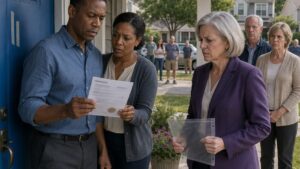
The certified notice had been fastened to the cemetery gate with a roofing nail.
Carol Martin saw the white envelope before she saw the orange survey flag planted beside her great-great-grandfather’s marble cross. The paper lifted and snapped in the morning breeze, clean and bright against the gray wood, as though somebody had dressed an insult in office stationery.
She set down the basket of folded quilts she had been carrying from the house to the shop.
The gate stood behind Martin Quilts and Gifts, at the end of a narrow gravel lane shaded by oak and tulip poplar. Beyond it, nineteen visible markers rose from the leaves. Some were proper headstones. Others were fieldstone slabs with names carved by hands that had not expected the letters to survive two centuries.
Carol pulled the envelope free. The nail resisted before tearing through one corner.
NOTICE OF NONCOMPLIANCE AND EMERGENCY ACCESS CORRECTION.
She read the first paragraph twice.
The Briar Ridge Homeowners Association had determined that the gravel lane adjoining her property constituted an obstructed common-access corridor. Vegetation, stone features, fencing, and “unregistered private memorial objects” interfered with drainage maintenance and emergency access. Corrective grading would begin Wednesday at seven in the morning.
Forty-eight hours.
Carol looked through the gate.
The nearest “memorial object” bore the name Margaret Martin, 1908–1987. Carol had held Margaret’s hand when cancer made the fingers feel lighter than clothespins.
A second page listed possible fines for interference.
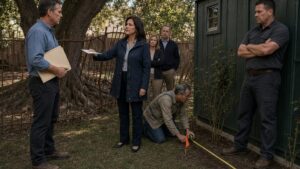
She folded the notice along its existing crease and walked toward the oldest part of the cemetery. Her shoes pressed damp leaves into the earth. Near the back boundary, an orange plastic flag leaned beside the narrow marble cross of Elijah Martin, born 1812, died 1871.
The townhouse roofs beyond the trees had not been there five years ago. Neither had the retention pond, the vinyl fences, or the neat row of mailboxes. Before construction, the land had been pasture and pine scrub owned by a family that had eventually sold to a developer. The Martins had retained the shop parcel, the cemetery, and a way to reach both.
At least that was what Carol had always understood.
She pulled the survey flag from the ground.
A voice behind her said, “You shouldn’t remove those.”
Jonathan Campbell stood outside the gate in polished brown shoes unsuited to gravel. He wore a pale blue shirt with the sleeves rolled precisely twice and carried a black portfolio under one arm.
Carol kept the flag in her hand. “You shouldn’t plant them among graves.”
“They mark the preliminary work limits.”
“They mark Elijah Martin.”
Jonathan glanced toward the cross without stepping through the gate. “The association’s engineer found no current cemetery plat attached to the county parcel map.”
“That doesn’t make him less dead.”
His mouth tightened. “Nobody is disputing that your family used this area for burials.”
“Used?”
“I’m choosing neutral language.”
“Then choose accurate language.”
A pickup slowed on the road beyond the shop. The driver looked toward them before continuing. Carol imagined the neighborhood email chain already moving faster than the truck.
Jonathan opened his portfolio. “Three homes on Hawthorn Court took water into their garages during the last storm. The insurer has requested corrective action. The fire marshal also raised questions about vehicle access along this side.”
“No fire truck is going through there.”
“That is the problem.”
“That is a cemetery.”
“The recorded documents identify a maintenance corridor.”
Carol felt the folded notice inside her palm, its edge pressing into her skin. “Show me the document that lets you grade through graves.”
“I’m not the title attorney.”
“Then don’t arrive speaking like one.”
His expression shifted, not quite anger. More like the discomfort of a man discovering that a meeting would not follow the agenda he had written.
“If you can provide a modern recorded survey establishing the protected boundary,” he said, “I’ll submit it for review.”
“The stones establish the boundary.”
“Not for an insurer.”
“Not everything belongs to an insurer.”
“Thirty-eight households do.”
The number hung between them.
Carol looked past Jonathan toward the townhouse roofs. She knew some of the residents by sight. Young parents walking strollers. Retired couples who bought quilted table runners at Christmas. A nurse who parked at odd hours. They were not an invading army. But they had formed a board, hired a management company, and begun sending letters about weeds, runoff, parking, and now the dead.
“When was this decision made?” she asked.
“Last Thursday.”
“I received notice today.”
“Certified mail was sent Friday.”
“You nailed a copy to a cemetery gate.”
“We needed to ensure delivery.”
Carol handed him the orange flag.
He did not take it.
She let it drop at his feet.
Inside the quilt shop, the first customer arrived at nine fifteen and asked about a blue star pattern in the window. Carol answered questions, measured fabric, and wrapped two placemats in tissue paper while the notice sat beneath the counter.
At ten, a second customer mentioned the orange stakes.
“They putting in a sidewalk?” she asked.
“No.”
Carol said nothing more.
By eleven, she could no longer see the pattern beneath her needle. She switched off the sewing machine and crossed to the rolltop desk in the back room.
The desk had belonged to her grandfather. Its cubbyholes held tax receipts, supplier invoices, funeral cards, and the accumulated paper of people who had believed nothing was official until it could be touched.
Carol unlocked the lower drawer.
The yellowed folder lay beneath a stack of quilt templates. PROPERTY—CEMETERY ACCESS had been written across the tab in her late husband’s blocky handwriting.
She carried it to the cutting table and opened it.
The first document was a copy of an 1894 deed reservation. It granted descendants of the Martin family perpetual access to the burial ground “for visitation, maintenance, and interment.” A later page described the cemetery as existing before a division of the surrounding farm.
There were handwritten measurements tied to an oak tree that no longer stood. A sketched line ran from the old wagon road to the westernmost stone.
Carol felt her breathing settle.
She called Jonathan.
“I have the reservation,” she said when he answered.
“A current recorded survey?”
“A deed older than your entire subdivision.”
“That isn’t what I asked.”
“It protects access and burials.”
“I’m willing to look at it.”
“You’ll stop the grading first.”
“I cannot suspend emergency work based on an unverified copy.”
“Then verify it.”
“Our counsel needs a mapped boundary.”
Carol looked toward the cemetery through the back window. From here, the white markers appeared between branches like bits of cloth caught in shadow.
“There wasn’t any confusion before Briar Ridge was built,” she said.
“There is confusion now.”
He spoke more quietly when he added, “Mrs. Martin, if the work is delayed and another storm floods those homes, the association could lose coverage. I cannot ignore that because your records were never updated.”
The words struck where she did not want them to.
Your records.
Never updated.
She ended the call without saying goodbye.
At noon, Carol closed the shop early. She carried the folder back to the desk and began sorting every page. Beneath an old tax map, she found a sealed inner pocket made from folded brown paper.
Her fingers stopped.
She remembered the pocket. She remembered placing something inside it years ago, after the developer’s representative had sat at her kitchen table and promised that nothing would interfere with the cemetery.
Carol opened the fold.
The document was newer than the rest. The paper had not yellowed, though the edges had softened. At the top were the words PERPETUAL MAINTENANCE AND UTILITY EASEMENT.
She read the legal description, following each line with one finger.
The easement permitted access for drainage, utilities, grading, repair, and emergency purposes across a strip of land running beside the shop and toward what the document called the rear boundary.
There was no cemetery drawn on the attached exhibit.
At the bottom, beneath the notary seal, was a signature she recognized before she admitted it was hers.
Carol Martin.
Chapter 2: The Signature She Never Told Deborah About
“Successors and assigns.”
Carol read the phrase aloud because it seemed worse when spoken.
The easement did not belong only to the developer who had brought papers to her kitchen seventeen years earlier. It extended to whoever came after: property owners, management companies, the HOA, perhaps every person Jonathan represented when he stood outside the cemetery gate.
The document trembled slightly in her hand.
She remembered the man who had explained it. He had worn a tan suit and called the strip a maintenance lane. Her husband had been alive then but recovering from surgery, tired easily, and impatient with paperwork. The developer needed permission to install drainage beyond the shop. In exchange, Carol would retain uninterrupted customer access during construction, and the cemetery would be left alone.
Nothing near the graves, she had said.
Of course, the man had answered.
The promise was not written anywhere she could see.
Carol slid the easement beneath the older deed as if order could weaken it.
At the county records office, the security guard nodded her through. She knew the building well enough to avoid the public terminals and head toward the rear counter where Deborah worked beneath fluorescent lights.
Her daughter looked up from a stack of scanned plats.
“You closed the shop?”
“I need a record pulled.”
Deborah studied her face. “What happened?”
Carol placed the old burial reservation on the counter, keeping the newer easement inside the folder.
“The HOA says it can grade the cemetery lane.”
Deborah’s chair rolled back. “Grade how close?”
“They’ve staked beside Elijah’s stone.”
“Did you call the sheriff?”
“It’s a property dispute until someone crosses a line.”
“Then call an attorney.”
“I’m asking you to find the cemetery record.”
“I’m not your attorney either.”
“No, but you know where records disappear when the computer says they don’t exist.”
Deborah exhaled through her nose. She was forty, with Carol’s dark eyes and her father’s impatience. “Give me the parcel number.”
For twenty minutes she searched indexed deeds, subdivision plats, easement books, and scanned microfilm. Carol stood at the counter while people came and went around her carrying marriage licenses and permit applications.
Deborah found the 1894 reservation first.
“It’s recorded,” she said. “Book forty-two, page three sixteen.”
“I knew it was.”
“But the description uses trees and fence lines. That old white oak is gone.”
“The stones are not.”
“The law likes measurements.”
“The dead don’t move because a tree falls.”
Deborah looked at her. “Mother, what else is in the folder?”
“Old maps.”
“You’re holding it shut.”
Carol rested both hands on the cover.
Deborah reached across the counter, not touching the folder. “Let me see.”
“There’s nothing you need.”
“That usually means there is.”
Carol opened it only enough to remove the sketch attached to the burial reservation. The easement slipped sideways. Its notary seal appeared beneath the edge.
Deborah’s eyes dropped to it.
“What is that?”
“Nothing that changes the graves.”
“Let me read it.”
“I said it doesn’t change them.”
“Then why hide it?”
The question carried farther than Deborah intended. A clerk at the next station glanced over.
Carol removed the document and laid it flat.
Deborah read the first page quickly, then slowed at the legal description. When she reached the signature block, she stopped.
“You signed this.”
“Yes.”
“It gives them grading access.”
“It gave the developer maintenance access.”
“It says successors and assigns.”
“I can read.”
“Did Dad know?”
Carol looked toward the row of public terminals. “He was there.”
“That’s not what I asked.”
“He knew they needed a lane.”
Deborah turned to the exhibit. “There’s no cemetery marked.”
“They promised to stay clear.”
“Who promised?”
“The development representative.”
“Is it written?”
“No.”
Deborah closed her eyes briefly. When she opened them, anger had sharpened her face. “You have spent years telling me nobody else could be trusted with those graves, and you signed an easement that doesn’t even show them.”
“It does not permit relocation.”
“It may permit work through the lane.”
“Not through human remains.”
“No, probably not. But you made this harder.”
Carol took the paper back. “I did what was necessary to keep the shop open.”
“You did what you always do. You decided alone and called it protecting everybody.”
The fluorescent lights hummed above them.
Carol lowered her voice. “I didn’t come here to discuss the family.”
“You came here because the family is buried behind your store.”
Deborah returned to the computer. Her hands moved hard over the keyboard.
A few minutes later, she printed a plat from the original subdivision filing. It showed the townhouse lots, stormwater basin, utility corridors, and a narrow strip labeled EXISTING ACCESS RESERVATION. Near its northern end was a blank irregular shape.
“There,” Deborah said.
Carol leaned closer.
“The developer acknowledged an existing reservation. They just didn’t map the burial area.”
“Then the HOA cannot pretend it never existed.”
“No. But this plat was recorded before your easement.”
Carol understood the significance.
The older reservation protected burial access. The later easement granted broad maintenance rights over part of the same ground. Neither document clearly showed where one ended and the other began.
“Can you print the title chain?” Carol asked.
“I can request it. It may take until tomorrow.”
“They start Wednesday.”
Deborah glanced at the wall calendar. “That’s two days.”
“Jonathan may move it earlier.”
“Why would he?”
“Because he thinks delay makes him look weak.”
Deborah’s expression shifted. She had met Jonathan at county meetings. “Have you shown him the easement?”
“No.”
“Mother.”
“I showed him the reservation.”
“That is not the same as showing him the whole file.”
“He nailed a threat to the cemetery gate.”
“And you are answering with half the truth.”
Carol put the documents back into the folder. “The easement does not give him the graves.”
“Then disclose it and argue the boundary.”
“Once I give it to them, they’ll use every word against me.”
“They will find it. It is recorded.”
“Not if they haven’t yet.”
Deborah stared at her as though Carol had stepped into a shape she had feared all along.
“You’re not protecting yourself by hiding it,” she said. “You’re giving Jonathan the chance to reveal it for you.”
Carol drove home without stopping for lunch.
The shop remained closed. She spread the papers across the cutting table and tried to reconstruct the land from descriptions written by people long dead: forty-two rods from a stone pile, westward to an oak, south along the wagon road.
She laid a transparent quilting ruler across the old sketch. On the worktable beside it rested a half-finished quilt made from cream and dark green strips. Every seam had a place. Every corner met because Carol trimmed what wandered.
Land did not behave that way. Memory did not either.
At four seventeen, her phone rang.
Heather Lewis introduced herself as the community manager for Briar Ridge, though Carol had received enough letters with Heather’s name to recognize it.
“I’m calling to confirm access for tomorrow morning,” Heather said.
“Tomorrow?”
“The contractor had a cancellation. Given the insurance timeline, the board approved moving the work forward.”
“The notice said Wednesday.”
“The notice reserved the right to accelerate emergency correction.”
“No machinery enters that cemetery.”
“The work order concerns the maintenance corridor.”
“You don’t know where that corridor ends.”
There was a pause.
“The board provided the recorded easement,” Heather said.
Carol’s grip tightened around the phone. “Which easement?”
“The one executed by you in 2009.”
So they had found it.
Heather continued, “The contractor is scheduled for seven a.m. A board representative will be present. Please remove your vehicle and any personal property from the lane before then.”
“The headstones are not personal property.”
“I’m not qualified to interpret cemetery law.”
“Yet you’re sending an excavator.”
“I’m communicating the board’s decision.”
Carol looked at the yellow folder open on the table. The old reservation lay on one side. Her signature lay on the other.
“Tell Jonathan the title is disputed.”
“I already did.”
“And?”
“He said the work will proceed.”
The email arrived before the call ended.
EMERGENCY CORRECTIVE WORK—ACCESS REQUIRED.
Seven o’clock Tuesday morning.
Chapter 3: She Stood Where the Excavator Had to Stop
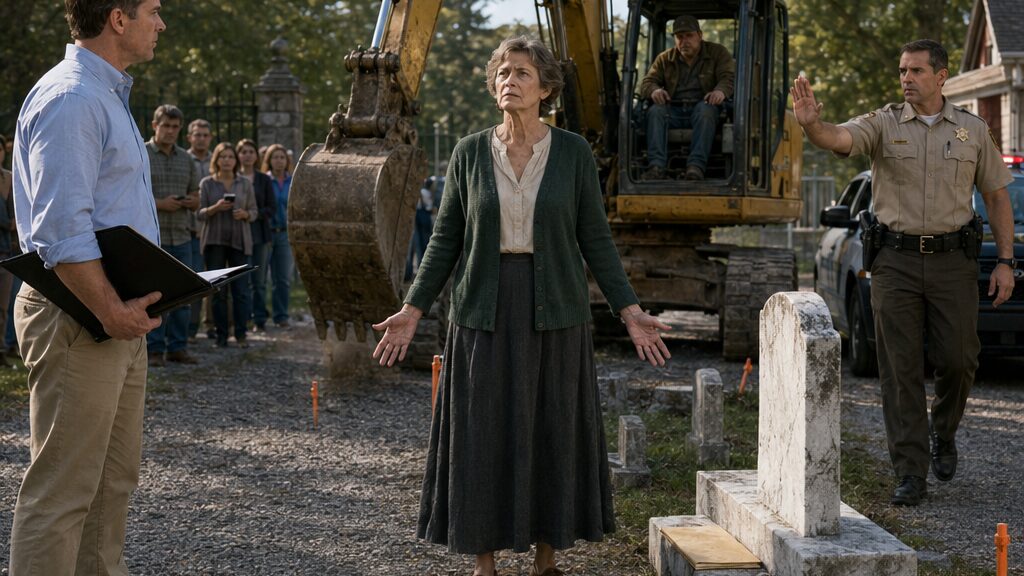
The excavator blade was already lowering when Carol reached the cemetery gate.
She had heard the diesel engine from her bedroom at six forty-eight, a deep mechanical pulse moving through the floorboards. By the time she crossed behind the quilt shop, the yellow machine had turned into the gravel lane. Its steel tracks crushed the edges of the grass. Timothy Green sat inside the cab with one hand on the controls.
Jonathan stood near the gate beside Heather Lewis.
“Stop!” Carol called.
Timothy looked toward her but did not raise the blade.
Carol stepped through the gate and moved into the lane.
“Mrs. Martin,” Jonathan said, “clear the work area.”
“You said seven.”
“It is seven.”
Her watch showed six fifty-six.
Timothy eased the machine forward half a track length.
Carol felt the movement in the ground before she saw it. Behind her stood Margaret Martin’s marker. To her left, the orange stakes ran toward Elijah’s cross.
She held the yellow folder against her chest. “Turn it off.”
Timothy opened the cab door but kept the engine running. “Ma’am, I’ve got an authorized work order.”
“You’ve got graves in front of you.”
“I was told they’re outside the cut.”
“By whom?”
He glanced at Jonathan.
Jonathan stepped closer. “The easement corridor has been confirmed.”
“No, it has not.”
“We have the recorded document.”
“You have words without a boundary.”
“And we have an engineer’s field marks.”
Carol pointed to the nearest stake. “That one is eight inches from a headstone.”
“The marked work line does not require removing the stone.”
“You don’t know what lies beneath it.”
A few residents had gathered near the end of the lane. One held a phone at chest height. Another stood in bedroom slippers beneath a raincoat, though the sky was clear.
Heather approached with a clipboard. “Mrs. Martin, the association is asking you to step aside voluntarily.”
“Put that in your notes,” Carol said. “You asked me to step aside so an excavator could enter a family cemetery before the title review was complete.”
Heather’s pen stopped.
Jonathan said, “The title review is sufficient for maintenance access.”
“Is it complete?”
He did not answer immediately.
That was answer enough.
Carol walked to her grandmother’s marker and placed the yellow folder on the white marble base. The folder looked almost gold in the early light.
She faced Timothy.
“Read the name,” she said.
He leaned slightly from the cab. “What?”
“The stone beside your right track. Read the name.”
His jaw worked. “Margaret Martin.”
“And the date.”
“Ma’am—”
“Read it.”
“1908 to 1987.”
“She taught me to sew a straight seam by making me pull out every crooked stitch. There are more people under this ground than there are stones above it. Your field marks do not tell you where their graves end.”
Timothy looked toward Jonathan again. “They told me the cemetery was contained behind the fence.”
“You are inside the fence.”
“The lane cuts through.”
“The lane existed so the family could reach the graves.”
Jonathan raised his voice just enough for the residents to hear. “Mrs. Martin, nobody is proposing to remove marked graves today. The work is limited to drainage grading within an easement you signed.”
A murmur moved through the people at the road.
Carol kept her eyes on him. “You knew the title review was unfinished.”
“We received counsel’s preliminary assessment.”
“Preliminary.”
“We also received an insurance deadline.”
“That is not a boundary.”
“It is a real obligation to the families whose homes flooded.”
Carol saw, then, that he was not pretending about everything. His face held strain rather than triumph. A woman in the crowd called out that she had spent six thousand dollars replacing drywall. A man beside her said water had reached his electrical panel.
Jonathan turned slightly toward them. “This is exactly why the board cannot keep postponing.”
Carol heard the shift. She was no longer only an older woman protecting graves. In the residents’ eyes, she was also the owner of a strip of land standing between them and dry homes.
She picked up the folder.
“I have called the sheriff’s office,” she said. “I have also called the county preservation officer. Until they arrive, I will remain here.”
Timothy lowered the cab door halfway. “I’ve got another job after this.”
“You may still have one if you stop.”
“That a threat?”
“No. It is a fact you ought to consider.”
Jonathan moved closer, stopping several feet from her. “Carol, this does not need to become a spectacle.”
“Then send the machine away.”
“I cannot do that.”
“You can. You won’t.”
His face reddened. “You signed the easement.”
Carol felt every person at the road waiting for her answer.
“I signed maintenance access,” she said. “I did not sign away the dead.”
“Then show everyone the document.”
The engine idled. A faint vibration passed through the marble beneath Carol’s hand.
She opened the folder and removed the 1894 reservation.
“This grants perpetual cemetery access and protects family burials.”
Jonathan did not take it. “And the later instrument?”
Carol held the old deed between them.
“The graves came first.”
“That was not my question.”
Timothy called from the cab, “Are we working or not?”
Jonathan looked at him. “Proceed to the first cut. Stay inside the stakes.”
Timothy pulled the door shut.
Carol stepped into the center of the lane.
The excavator advanced.
Only a few feet, slow enough to appear cautious, but the movement transformed every promise into noise and weight. Carol could see mud dried in the grooves of the steel tracks. The blade hovered at knee height.
She kept her arms at her sides and her hands open.
“Timothy,” she called over the engine, “if you cannot tell where the graves end, you cannot tell me you are not entering one.”
He stopped.
Jonathan walked toward the cab. “You’re clear to the first stake.”
Timothy’s voice came through the open side window. “She’s in the work zone.”
“Mrs. Martin has been instructed to move.”
Carol heard the choice being passed from man to man until each could claim it belonged to someone else.
The excavator lurched forward another foot.
A shout came from the road.
Then a sheriff’s cruiser turned into the shop lot with its lights flashing but no siren. The deputy stepped out and surveyed the machine, Carol, the stones, and the small crowd.
“Shut it down,” he ordered.
Timothy killed the engine.
The sudden silence rang in Carol’s ears.
The deputy walked into the lane. “Nobody moves equipment until I understand what’s disputed.”
Jonathan introduced himself and began explaining the easement, the emergency drainage order, and the residents’ flooded homes.
Carol handed the deputy the old reservation.
He read the first page, then looked toward the headstones. “Has the cemetery boundary been surveyed?”
“Not recently,” Carol said.
Jonathan opened his portfolio. “The recorded easement authorizes grading. Mrs. Martin executed it herself.”
He removed a clean county copy and held it so the people near the road could see the signature page.
Carol recognized the blue recording stamp. Jonathan had not merely found the easement. He had prepared it for this moment.
The deputy looked from the document to her. “Is this your signature?”
Carol could have said the language was misleading. She could have described the kitchen-table promise, her husband’s surgery, the developer’s assurances, the missing cemetery on the exhibit.
None of those things changed the ink.
“Yes,” she said.
The crowd went still.
Deborah’s car pulled into the lot. She got out before fully closing the door and saw the easement in Jonathan’s hand.
Jonathan spoke carefully, almost gently now. “The association has tried to resolve this through notice and documented authority. Mrs. Martin has withheld a controlling record while accusing us of unlawful conduct.”
Carol felt the moral certainty beneath her feet give way. The graves had not changed. The machine was still too close. But now everyone could see that she had not brought the whole truth into the lane.
The deputy raised one hand. “The equipment remains stopped until the county reviews the documents. This is temporary.”
Jonathan slid the easement back into his portfolio.
“Then we will hold an emergency board hearing tonight,” he said. “Seven p.m. at the clubhouse. All documents will be entered into the record, including the one Mrs. Martin chose not to disclose.”
Deborah stood at the edge of the lane, looking not at Jonathan or the excavator, but at Carol.
Carol picked up the yellow folder from her grandmother’s marker.
For the first time, it felt heavier than the stone beneath it.
Chapter 4: The Board Meeting Turned Her Silence Against Her
The first image on the clubhouse screen showed a child’s red bicycle standing in six inches of brown water.
Jonathan had begun the meeting before Carol reached the front row.
A second photograph replaced it: drywall cut away from the bottom of a garage wall, insulation hanging in wet clumps. Then came a damaged freezer, warped cabinets, and a dark waterline across a row of cardboard boxes.
“These were taken on Hawthorn Court after the storm three weeks ago,” Jonathan said. “Three households reported structural or electrical damage. The association’s insurer has required corrective work before the next major rainfall.”
Carol stood at the back with the yellow folder against her ribs.
Nearly every folding chair was occupied. Some residents turned when she entered; others kept their attention on the photographs. Deborah sat alone near the aisle, her purse on the empty chair beside her. She did not move it.
Heather Lewis occupied a small table near the wall, typing minutes into a laptop. Timothy was absent. A man introduced only as the HOA attorney sat beside Jonathan with a legal pad and a glass of water.
Jonathan clicked to an aerial diagram. A red line ran behind Carol’s shop and through the lane beside the cemetery.
“The proposed drainage correction follows the recorded maintenance easement,” he said. “Work was temporarily suspended this morning because Mrs. Martin disputed the cemetery boundary.”
“Because the cemetery boundary was never established,” a resident called.
Another voice answered, “That isn’t our fault.”
Jonathan held up one hand. “Everyone will have an opportunity to speak.”
Carol took the seat beside Deborah.
“You brought it?” Deborah asked without looking at her.
Carol understood what she meant. “Yes.”
“All of it?”
Carol placed the folder on her lap.
Deborah finally turned. “That is not an answer.”
At the front, Jonathan described the morning confrontation as though reading from an incident report. He said Carol had entered an active work zone, refused repeated requests to clear the easement, and withheld a recorded instrument relevant to the dispute.
He did not say the excavator had arrived four minutes early. He did not say the blade had been lowered before anyone showed Carol a marked boundary. He did say the machine had remained outside all known grave locations.
“Known by whom?” Carol asked.
The room shifted toward her.
Jonathan’s gaze settled on her. “You will have time to respond.”
“You have shown flooded garages. Show the survey that proves your red line misses the graves.”
The HOA attorney leaned toward his microphone. “Mrs. Martin, no party has claimed that a final cemetery boundary survey exists.”
“Then nobody can claim the work stays outside it.”
A man in the second row raised his hand without waiting to be recognized. “My wife and I had water come within two inches of our breaker panel. Are you saying we should wait another year because your family never filed the right paperwork?”
Carol looked at him. He appeared younger than Deborah, tired around the eyes.
“No,” she said. “I’m saying you cannot solve one danger by guessing where people are buried.”
The woman beside him folded her arms. “The headstones are inside the fence.”
“Some graves were never marked. Some markers were moved when the old fence fell.”
That produced a murmur.
Jonathan turned to the attorney, then back to Carol. “Is there documentation of unmarked burials?”
“There are family records.”
“Recorded with the county?”
“No.”
“So the board is being asked to treat an undefined area as protected while thirty-eight homeowners remain exposed.”
“The board is being asked not to dig until the area is defined.”
“And who pays for that delay?” someone asked.
Carol had expected anger directed at Jonathan. She had imagined the photographs of the excavator beside the stones would make the room understand immediately. Instead, every wet garage on the screen had made the lane look less like family ground and more like a blockage.
The HOA attorney requested the documents.
Carol walked to the front and removed the burial reservation. She placed it beside the attorney’s legal pad.
“This predates every house in Briar Ridge,” she said. “It grants perpetual access to the cemetery and recognizes the burials.”
The attorney read silently. “It does establish a family burial ground and continuing access rights.”
A small pressure released in Carol’s chest.
Then he added, “It does not provide a usable modern boundary.”
Jonathan placed a copy of the 2009 easement beside it.
“And this later instrument,” the attorney continued, “grants maintenance, grading, drainage, utility, and emergency access across a described corridor.”
“It does not grant permission to disturb graves,” Carol said.
“No,” he replied. “It does not.”
The room quieted.
That was the first clean point anyone had given her.
“But,” he said, “if the easement corridor can be used without disturbing human remains, the association may possess the right to maintain it. The immediate problem is determining whether those rights can coexist.”
“They cannot coexist under an excavator before a survey,” Carol said.
The man with the flooded garage spoke again. “Then survey it. Why wasn’t that done years ago?”
Carol returned to her chair.
Jonathan brought up a proposed motion: authorize counsel to seek a court declaration establishing the HOA’s access rights and the limits of the cemetery reservation. The board would also request authority for emergency work if another storm threatened the community.
Deborah stared at the screen. “That will cost you.”
“I know.”
“No, I mean personally. Lawyers, surveyors, closing the shop to attend hearings. You could lose the lane even if the graves stay.”
Carol’s voice came out sharper than she intended. “You suggested moving them yesterday.”
“I suggested you consider every outcome before you stood in front of a machine.”
“They are not furniture.”
“I know that.”
“Do you?”
Deborah faced her fully. “Why did you hide the easement from me?”
Several nearby residents heard. Carol could tell by the way their bodies stilled.
“Not here,” she said.
“Where, then? At the records office, you told me it meant nothing. This morning, Jonathan used it in front of everyone because you would not.”
“I signed for maintenance access. That is all.”
“You signed something you never finished defining.”
Carol’s face warmed. “I was protecting the shop.”
“From what?”
“From losing customer access during construction. From having your father dragged through another dispute while he was sick. From people who kept telling us they would take care of details if we would only cooperate.”
Deborah’s anger faltered, but did not disappear. “And after Dad recovered?”
Carol looked toward the closed folder on her lap.
She did not answer.
Jonathan called for public comment. Residents spoke about mold, property values, insurance letters, and the fear that emergency vehicles could not reach the rear units. One older woman said she respected the cemetery but did not understand why Carol had never registered a proper map. Another resident accused the board of treating excavation as a substitute for due diligence.
The conflict no longer divided neatly between Carol and the HOA. It moved chair by chair, carrying different costs with it.
When Carol’s turn came, she stood without the folder.
“The graves stay,” she said. “That is not negotiable.”
A few people shifted impatiently.
“But the water is real,” she continued. “I saw the photographs. I believe the families who say their homes were damaged.”
Jonathan watched her carefully.
“You need drainage,” Carol said. “You do not need permission to gamble with a burial ground. Those are separate things, and the board made them one because it was faster.”
The HOA attorney asked, “Will you participate in an expedited survey and title review?”
“Yes.”
“Will you grant access if a safe route exists?”
Carol hesitated.
Every instinct told her not to promise anything in that room. Promises had created the document now being used against her.
“I will review a route that does not cross graves,” she said.
It was not enough for Jonathan.
He called the motion.
Four board members voted to authorize the court filing. One voted against it. Jonathan did not smile when the result was announced.
“The association will seek an expedited declaration,” he said. “Until then, the temporary equipment pause remains in effect, subject to emergency conditions.”
The meeting broke into clusters of low conversation. Deborah gathered her purse.
“You finally admitted they have a problem,” she said.
“That doesn’t excuse what Jonathan did.”
“No. It doesn’t excuse what you did either.”
She left before Carol could reply.
Carol remained until most of the room had emptied. She was putting the deed folder into her canvas bag when Heather approached.
The community manager kept her voice low. “Do you have somewhere private we can speak?”
“My shop.”
“Not tonight.”
Heather glanced toward Jonathan, who was speaking with the attorney.
She slid a business card across the table. A handwritten time appeared beneath her printed number: 8:00 a.m.
“I have emails you should see,” Heather said.
“What kind of emails?”
“The kind showing the title review was not simply incomplete.”
Carol looked at her.
Heather closed Carol’s fingers around the card.
“Jonathan was told not to excavate,” she whispered. “He moved the work forward anyway.”
Chapter 5: The Emails Proved Pressure, Not Innocence
The first email began with four words that changed the shape of the previous morning.
TITLE REVIEW PENDING—DO NOT EXCAVATE.
Carol read the sentence on Heather’s tablet at the cutting table inside the quilt shop. The message had been sent by the HOA attorney six days before Timothy brought the excavator into the lane.
Below it, the attorney warned that the recorded easement overlapped an inadequately mapped burial reservation. No ground disturbance should occur until a qualified surveyor and cemetery specialist identified the protected area.
Jonathan’s reply had arrived eleven minutes later.
The insurer’s deadline cannot accommodate another open-ended review. Proceed with noninvasive preparation while counsel completes its work.
A later message from Heather asked whether “noninvasive preparation” included grading.
Jonathan answered: Contractor has been advised that approval is complete for the marked corridor.
Carol looked up. “Was he advised?”
Heather folded her hands. “Timothy was sent a work order stating the corridor had been cleared.”
“And you sent it.”
“Yes.”
“Knowing it had not.”
Heather’s mouth tightened. “I raised the issue twice.”
“But you sent it.”
“I manage seven communities. Board presidents make decisions. My company implements them.”
“Paper does not become innocent because somebody else signs first.”
Heather absorbed that without arguing.
The shop was still closed. Morning light lay across bolts of fabric and the half-finished green-and-cream quilt. Carol had placed the yellow folder beside the tablet but had not opened it.
“Why bring this to me?” she asked.
“Because the board’s attorney will obtain the messages during the court process anyway.”
“That is not why.”
Heather looked toward the front windows. “Jonathan has told the board that management failed to communicate the legal warning clearly. If that becomes the official account, my company will terminate me before the association changes course.”
“So you want protection.”
“I want the record to show what happened.”
“That is protection.”
“Yes.”
The answer was quiet and unembellished.
Carol scrolled farther. Messages from residents filled the chain: photographs of flooding, demands for action, threats to withhold dues, questions about whether the board had ignored drainage warnings during construction. An insurance adjuster had given the association thirty days to submit a corrective plan. Coverage would not vanish immediately, but deductibles could rise and future water claims could be limited.
Jonathan’s urgency had not been invented.
He had simply chosen to treat uncertainty as an obstacle rather than a warning.
“I’ll give you copies,” Heather said. “But I will not claim the drainage problem is false.”
“I’m not asking you to.”
“You could use these to make him look reckless and leave out the rest.”
Carol thought of the residents staring at the flooded garages.
“I could,” she said.
Heather studied her, perhaps wondering whether honesty was a promise or a threat.
At the county archive, Deborah met Carol near the map cabinets without greeting her. She had already requested the complete title chain. A county clerk supervisor wheeled out a cart holding bound deed books and a box of older survey material.
They spent the morning comparing descriptions.
The 1894 reservation clearly preserved access and burial use. A 1936 deed referenced “the Martin burying ground” as an excluded parcel, though it gave no dimensions. The subdivision plat acknowledged the existing access reservation but left the cemetery itself as an unmeasured blank.
The 2009 easement crossed the same general area.
“Neither cancels the other,” Deborah said. “That’s the good news.”
“And the bad?”
“They have to be reconciled.”
Carol traced the edge of the blank shape. “The graves control.”
“The graves are protected. The question is where they are.”
A cane tapped once against the archive floor.
Charles Anderson stood behind them in a brown work jacket polished smooth at the elbows. He had surveyed farms, roads, and utility lines for forty years before retiring. He had also sat beside Carol’s husband through enough evenings that his silence felt familiar.
Deborah had called him without telling Carol.
“You still have the field book?” Carol asked.
Charles nodded. “Most of it.”
“Most?”
“The last measurements were never certified.”
Carol felt Deborah watching both of them. “What last measurements?”
Charles removed a small black notebook from his coat. Inside were pencil sketches of the cemetery, angles from old fence posts, and distances to several stones.
“Your husband asked me to prepare a permanent boundary,” he said. “This was after the subdivision grading began.”
“When?”
“Summer of 2010.”
Carol knew exactly which summer. Her husband’s health had improved enough for him to return to the shop two mornings a week. He had begun sorting papers at the rolltop desk, making lists she avoided reading.
“Why wasn’t it recorded?” Deborah asked.
Charles looked at Carol.
She answered for him. “Because I said the old deed was enough.”
“You said the developer had agreed to respect the cemetery,” Charles corrected gently. “You did not want another survey crew upsetting the ground.”
“And you let it go.”
“I did.”
The admission carried no defense.
Charles opened the field book to a page marked with a folded corner. “I can help a licensed surveyor find the control points. But I cannot certify this. Too much has changed.”
He indicated a line that skirted the western edge of the graves.
“The likely cemetery boundary extends farther into the access lane than Jonathan’s engineer marked,” he said. “Not across the entire lane. But enough that the original grading plan is unsafe.”
Relief rose in Carol before she could stop it.
“Then we can block the work.”
Charles turned the page.
“There may be another route.”
The sketch showed a drainage line curving away from the graves and crossing the rear corner of Carol’s parking area.
“That would remove six spaces,” she said.
“Five, perhaps six. It would also require trenching near the delivery entrance.”
“My customers use that side.”
“So do your fabric trucks.”
Deborah leaned over the drawing. “But it avoids the cemetery.”
Carol closed the field book.
For two days she had demanded that the HOA separate drainage from graves. Now the safest separation passed through something she used every day.
By late afternoon, the three of them stood behind the quilt shop with measuring tape, marking paint, and Charles’s notebook. He identified the remains of an old iron pin near the property line. Deborah held the tape while Carol followed the possible drainage route across the parking area.
It cut through the place where customers loaded sewing machines and large purchases. During holiday markets, every space filled.
Jonathan’s plan endangered the graves.
The alternative endangered part of her livelihood.
Neither truth erased the other.
Back inside, Carol arranged the documents on the cutting table in chronological order. For years, she had kept the oldest papers on top because they supported the story she preferred: the family came first, therefore everything later must yield.
Now the 2009 easement sat where it belonged in time. So did the attorney’s warning, Jonathan’s emails, the flood photographs, and Charles’s unfinished survey.
The folder no longer contained a weapon. It contained a sequence of failures, including hers.
Deborah went to the house to search for her father’s remaining papers. Carol stayed in the shop, drafting a list of questions for the surveyor.
An hour later, Deborah returned carrying a thin envelope.
She did not sit down.
“I found this in Dad’s lockbox.”
Carol recognized her husband’s handwriting before Deborah placed the pages on the table.
MARTIN FAMILY CEMETERY PRESERVATION TRUST—DRAFT.
The document named Carol as initial steward. Beneath her name appeared two proposed successors: Deborah and the county preservation office.
At the bottom, the signature lines were blank.
Deborah looked at her mother across the spread of records.
“He had already prepared the way to protect it,” she said. “Why didn’t you let him finish?”
Chapter 6: Her Husband Had Already Drawn the Way Forward
“Upon the death, incapacity, or resignation of the initial steward, authority shall pass jointly to Deborah Walker and the designated county preservation representative.”
Deborah read the sentence at Carol’s kitchen table, each word placed carefully between them.
The unfinished trust lay beside Charles’s field sketch and the modern drainage map. Carol had spent the night remembering the document without remembering where she had hidden it.
“I would not have owned it,” she said.
“You would have been the steward.”
“Until somebody decided I was incapable.”
“That is not what it says.”
“It says authority passes.”
“Eventually. That is what succession means.”
Carol stood and carried two untouched coffee cups to the sink. “Your father liked structures.”
“He liked making sure things survived him.”
The sentence landed harder because Deborah did not raise her voice.
Carol looked through the window toward the shop roof. Beyond it, the cemetery trees moved slightly in the morning wind. Her husband had drafted the trust during the year when every medical appointment came with a new conditional phrase. If the scan was clear. If the medication worked. If strength returned.
He had wanted signatures, witnesses, named successors.
Carol had wanted him to stop speaking as though he were leaving.
“He brought it to me after supper,” she said. “He said the county could help maintain the records and that you should be included.”
“And you refused.”
“I said we would discuss it when he was stronger.”
“Were you afraid I would sell the land?”
Carol turned. “You had already moved away.”
“I lived thirty minutes away.”
“You said the shop smelled like dust. You said the cemetery was a burden nobody had asked for.”
“I was twenty-seven.”
“You meant it.”
“I meant I did not want my entire life decided by people who died before I was born.”
Carol’s hand rested on the sink edge.
Deborah looked down at the draft. “I thought you chose them every time you chose not to call me.”
“That is not fair.”
“No. It isn’t. Neither was learning in front of the HOA that you had signed an easement and never told me.”
Carol returned to the table.
The blank signature lines waited beneath her husband’s typed plan.
“I put the draft away after he died,” she said. “At first because I could not bear to see his name on something unfinished. Later because finishing it meant admitting the cemetery would belong to a system. The county. Attorneys. Successors.”
“It would still belong to the family.”
“It would not be mine to guard alone.”
Deborah’s expression softened, though the hurt remained. “That was the point.”
At ten, they met Charles and a licensed surveyor in the cemetery. The county preservation officer walked the ground with them, noting depressions, stone fragments, and changes in vegetation that might indicate unmarked graves.
Small blue flags replaced Jonathan’s orange ones.
The surveyor established a provisional protected perimeter wider than the visible stones. At the western edge, it overlapped the HOA’s proposed excavation by nearly eleven feet.
“The original route should not proceed,” the preservation officer said. “Not without subsurface review and additional authorization.”
Carol felt the words settle into certainty.
The graves were not merely sentimental obstacles. The danger had been real.
Then the surveyor marked the alternate drainage route.
It ran behind the shop, crossed the outer parking spaces, and rejoined the HOA system near the retention pond. No graves. No uncertain ground. The grade was workable.
Carol stood where one trench line passed through a painted parking stripe.
“How long would this side be closed?” she asked.
“Two weeks if conditions cooperate,” the surveyor said. “Possibly longer.”
“And afterward?”
“You would lose several spaces permanently to a drainage swale and maintenance strip.”
Charles watched her without comment.
The answer she had demanded from Jonathan existed. It simply required her to give up something visible and useful.
At the attorney’s office that afternoon, Jonathan sat opposite Carol and Deborah. Heather attended by video. The HOA attorney placed a draft standstill agreement on the table.
Jonathan looked tired. The precision had left his rolled sleeves; one was higher than the other.
“The board will suspend court action for forty-eight hours,” he said. “In return, Mrs. Martin must agree to an expedited survey and provide a defined alternative drainage easement if feasible.”
Carol set the unfinished trust beside the map.
“The original route is not feasible,” she said. “The county agrees.”
The attorney reviewed the preservation officer’s preliminary note. “This materially changes the risk.”
Jonathan rubbed one thumb along the edge of his legal pad. “The alternate route crosses private commercial property.”
“My property,” Carol said.
“Yes.”
“You sound surprised.”
“I am surprised you are considering it.”
She almost answered with anger. Instead she opened the yellow folder and removed the 2009 easement.
“I signed this because I believed a spoken promise would protect the cemetery. Then I hid it because I knew the document did not say what I wanted it to say.”
Jonathan’s eyes moved to the paper.
Carol continued, “You received a written warning and proceeded because you wanted the work completed before the insurance deadline. We both treated missing clarity as somebody else’s problem.”
Jonathan’s face hardened. “My decision affected thirty-eight households.”
“It also put a blade beside my grandmother.”
The attorney intervened. “We are here to identify terms.”
Jonathan looked at the map. “If the route crosses the parking lot, the association will require permanent maintenance access.”
“Defined access,” Carol said. “Measured, recorded, and limited to the drainage line.”
“And construction access.”
“During agreed hours. No storage. No staging near the cemetery.”
“The board will also need protection against future obstruction.”
Carol tapped the trust draft. “The cemetery will be placed into a preservation trust with a recorded survey. Deborah and the county will serve as successor stewards.”
Deborah’s hand shifted beside hers but did not pull away.
Jonathan studied Carol. “That gives the county a continuing role.”
“Yes.”
“You objected to institutional control.”
“I objected to control without responsibility.”
The room went quiet.
The HOA attorney began listing unresolved terms: construction cost, business interruption, insurance liability, ongoing maintenance, and the board’s authority to approve the agreement. Jonathan said some residents would oppose paying more for a route across Carol’s property.
“They’ll say the cemetery caused the expense,” he said.
“The unfinished title work caused part of it,” Deborah replied. “The rushed excavation caused the rest.”
Jonathan glanced toward the video screen, where Heather remained silent.
Carol looked at the map again. Six parking spaces. The delivery entrance narrowed. Holiday customers inconvenienced. Income lost during construction.
Not the cemetery.
For years she had believed protecting the graves meant yielding nothing. But that belief had preserved neither certainty nor peace. It had left her husband’s trust unsigned, Deborah outside the responsibility, and a boundary drawn mostly in memory.
“What exactly do you need from me before the board meets?” Carol asked.
The attorney slid a blank term sheet forward.
“A concrete offer.”
Carol took his pen.
She drew a line along the rear edge of her shop parking area, following the surveyor’s alternate route. At the delivery entrance, she adjusted it by several feet to preserve truck access.
Then she wrote beneath it:
Carol Martin will grant a defined drainage and maintenance easement along this route, contingent upon permanent legal protection of the full cemetery boundary, restoration of disturbed property, shared construction costs, and no relocation of human remains.
She signed her initials beside the line and pushed the sheet toward Jonathan.
“The graves stay,” she said. “The water gets another way through.”
Jonathan read the offer twice.
Outside the office windows, the late light caught the map’s fresh blue boundary marks.
For the first time, Carol had protected the cemetery by drawing a line across something that belonged only to her.
Chapter 7: The Boundary Was Saved Because She Finally Shared It
Carol began the settlement meeting by handing Jonathan the easement she had once hidden.
Not a copy. The original.
The paper lay between them on the clubhouse table, its edges softened by years inside the yellow folder. Her signature remained dark at the bottom, beside the notary seal and the legal description that had caused nearly as much damage through what it failed to say as through what it permitted.
Jonathan did not reach for it immediately.
The HOA attorney sat at one end of the table with a revised agreement open on his laptop. Deborah sat beside Carol. Heather attended in person this time, a binder of printed emails in front of her. Across the room, three board members and several residents occupied folding chairs reserved for observers.
Carol placed the yellow folder beside the easement and opened it flat.
“This belongs in the record,” she said. “All of it.”
Jonathan looked at her. “You understand that submitting the original does not change its legal effect.”
“No. It changes mine.”
Deborah’s hand rested near the folder but not on it.
Carol continued. “I signed access rights without requiring a complete cemetery map. I relied on a promise that was never written down. Then I kept the document to myself when the dispute started because I thought the older deed would protect the graves if nobody looked too closely at the newer one.”
A resident shifted in the second row.
Carol did not turn toward the sound.
“That was wrong,” she said. “It does not make the excavation right. Both things belong in the record.”
The HOA attorney accepted the easement and placed it beneath the old burial reservation.
Jonathan’s face was tired but controlled. “The association also acknowledges that counsel advised against excavation before the title and cemetery reviews were complete.”
One of the board members glanced sharply at him.
Jonathan kept going.
“I authorized the contractor to proceed with the marked corridor because the insurance deadline was approaching and several residents had already sustained damage. I believed the risk of waiting outweighed the uncertainty.”
“You believed you could manage the uncertainty after the machine arrived,” Heather said.
Jonathan looked at her. “Yes.”
It was not an apology, but it was the first time Carol had heard him name the choice without dressing it as procedure.
The attorney turned to the central issue. A licensed survey had now established a protected cemetery boundary, including the likely locations of unmarked burials. The HOA’s original drainage route crossed that boundary and could not proceed. The alternate route behind Carol’s shop was feasible but more expensive.
He projected the cost estimate onto the wall.
The room reacted at once.
The revised route required excavation, new pipe, a shallow swale, parking-lot restoration, retaining work, and compensation for temporary business interruption. The total exceeded the original plan by nearly forty thousand dollars.
A resident near the back stood. “Why should homeowners pay because private land records were neglected?”
Another answered before the chair recognized him. “Because the board ignored legal advice.”
“The board represents us.”
“That does not mean every mistake becomes Carol’s bill.”
Jonathan raised a hand. “One speaker at a time.”
The woman from Hawthorn Court stepped forward. Carol recognized her from the meeting photographs. “My garage flooded twice,” she said. “I want the drainage fixed. But I do not want to pay for moving graves, and I do not want another machine sent where nobody knows what is underneath.”
Her voice carried neither affection nor anger toward Carol. Only exhaustion.
The attorney outlined the proposed division of costs. The HOA’s insurer would cover part of the emergency redesign. The association would pay for drainage infrastructure and restoration. Carol would grant the permanent defined easement without charging market value and accept temporary loss of parking. The developer’s successor company might be pursued separately for its incomplete plat, though no recovery was guaranteed.
A board member objected. “Mrs. Martin benefits from the drainage too.”
“Then assign me the share that benefits my parcel,” Carol said. “Not the share created by rushing the original work.”
The attorney nodded. “That can be calculated.”
Jonathan studied the map. “The agreement also removes direct project authority from the board president. Construction decisions will require approval from counsel, management, and the preservation officer where work occurs within fifty feet of the cemetery.”
The loss of authority was stated plainly. Jonathan did not resist it.
Carol had expected satisfaction. Instead she felt the thin discomfort of seeing a man accept a limit he should have accepted before anyone had stood in front of an excavator.
The attorney asked Timothy to enter.
He came from the hallway in a clean work shirt, cap in his hands. Without the machine behind him, he looked smaller and older.
He confirmed that the work order had described the corridor as approved. He had been told the visible stones lay outside the excavation zone.
“Did Mrs. Martin tell you there could be unmarked graves?” the attorney asked.
“Yes.”
“Did you continue moving the machine?”
Timothy looked down at his cap. “I moved it forward.”
“Why?”
“I had the client’s authorization. I was already behind on another contract. Stopping a crew costs money.”
Carol watched him rub one thumb along the cap’s brim.
He added, “I figured the property argument belonged to the people who hired me.”
“And the headstones?” Deborah asked.
Timothy looked toward her, then Carol. “Those were in front of me. I knew that.”
No document had forced him to admit the distinction. His work order had been misleading. His choice had still been his.
The attorney recorded his statement and dismissed him.
When the easement terms returned to the table, Jonathan pointed to the construction schedule. “The parking lot will be partially closed for at least fourteen days.”
“Then begin after the fall quilting fair,” Carol said.
“The insurer wants work started sooner.”
“The fair pays my winter expenses.”
Jonathan glanced toward the residents. “Another major storm could come before then.”
Carol looked at the woman from Hawthorn Court.
“How soon can temporary barriers and pumps reduce the risk?” she asked.
The engineer’s recommendation allowed temporary measures within one week, followed by permanent construction immediately after the fair. It cost more than starting at once, but less than closing Carol’s shop during its busiest period.
The room divided again over the expense.
Carol opened the folder and removed a single sheet.
“I will waive half the business-interruption payment if the temporary protection is installed this week and the permanent work begins the morning after the fair.”
Deborah turned toward her. “You do not have to give up compensation.”
“No,” Carol said. “I have to decide what I am willing to carry.”
Jonathan read the offer.
After a long silence, the board voted.
The agreement passed four to one.
No one applauded.
The woman from Hawthorn Court exhaled and sat down. Heather closed her binder. Jonathan signed on behalf of the association, then slid the agreement across the table.
Carol signed beneath him.
Six weeks later, blue survey pins marked the cemetery boundary outside the oldest graves. They sat low in the earth, almost invisible unless a person knew where to look. The new drainage swale curved behind the shop, crossed the former parking spaces, and carried rainwater toward the retention pond without entering the burial ground.
The quilting fair had gone ahead with fewer parking spaces and more hand-painted signs. Several Briar Ridge residents volunteered to direct cars. Deborah ran the register while Carol answered questions about quilts and refused to discuss the lawsuit that never happened.
Jonathan came near closing time and bought a plain green table runner.
He did not mention the board.
Carol did not thank him for coming.
But when he left, she noticed he used the new footpath rather than cutting across the cemetery lane.
The preservation trust was recorded the following Monday. Carol remained the initial steward. Deborah and the county preservation office were named as successors. The corrected survey, burial reservation, maintenance easement, field notes, and final agreement were copied into the county archive.
The original yellow folder returned to the rolltop desk.
That evening, Deborah stood beside the open drawer holding the certified trust copy.
“Do you want this beneath the quilt templates?” she asked.
Carol considered the familiar hiding place.
“No. Put it in the front section.”
Deborah slid the document into the drawer and turned the small brass key.
Carol held out her hand.
Deborah placed the key in her palm.
For a moment Carol closed her fingers around it. Then she set it on the desk between them.
“You should have one too,” she said.
Deborah touched the key but did not pick it up immediately. “Are you sure?”
“No,” Carol said. “That is why we wrote it down.”
Outside, water moved softly through the new drainage channel. Beyond the shop, the graves rested beneath the trees inside a boundary no longer carried by memory alone.
Deborah locked the drawer, then left it open.
Carol did not close it.
The story has ended.