He Inherited Three Cabins, but the HOA Manager Had Already Sold Every Weekend
Chapter 1: The Cabin Guests Who Knew His Property Better
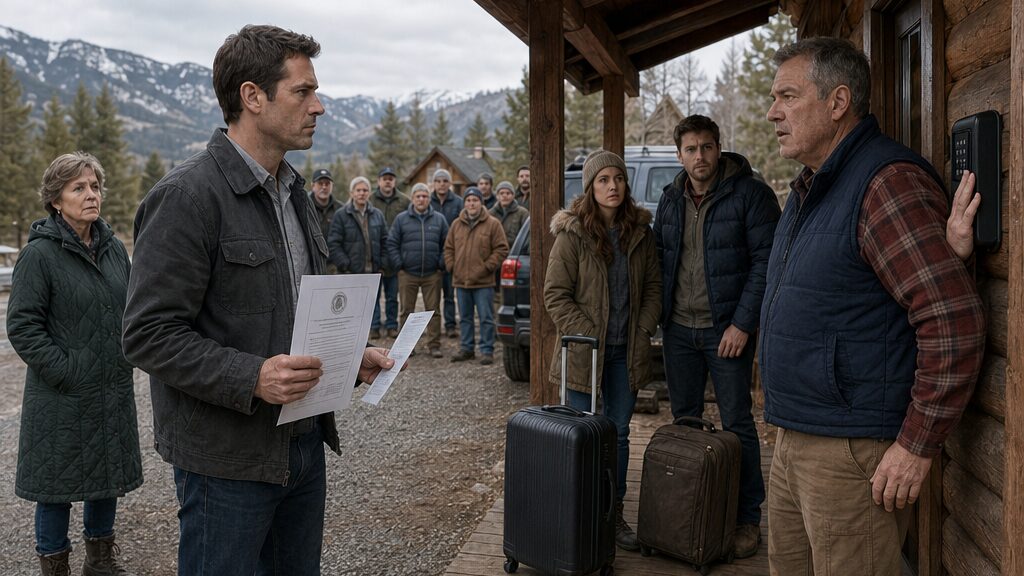
The woman at the cabin door punched four numbers into a black lockbox, removed a key, and smiled at Christopher as though he had been waiting to welcome her.
“Thanks for hosting,” she said.
Her husband was unloading two rolling suitcases from a gray SUV. A girl in a red knit cap stood beside the porch railing, holding a paper bag marked with the logo of a grocery store twenty miles down the mountain.
Christopher looked from the woman to the key in her hand.
“I’m sorry,” he said. “Who told you I was the host?”
The woman’s smile tightened.
“The listing did.”
She turned the key in the deadbolt.
It opened.
Christopher had arrived at High Ridge less than ten minutes earlier.
The deed, probate letter, and death certificate were still inside a folder on the passenger seat of his truck. He had expected to find his uncle’s cedar-sided house, an equipment shed, and three neglected outbuildings described in the estate inventory as seasonal cabins. He had not expected fresh tire tracks, porch lights glowing in daylight, or guests who knew the property better than he did.
The woman held the door partly open. Warm air escaped with the smell of pine cleaner.
“Are you with maintenance?” her husband asked.
Christopher studied the cabin. The railings had been stained recently. A string of small bulbs ran beneath the eaves. Beside the lockbox hung a laminated card asking guests to remove outdoor shoes and observe community quiet hours.
“No,” Christopher said. “I’m Christopher Young. James Young was my uncle.”
Neither guest reacted.
Christopher added, “He owned this property.”
The husband set down a suitcase.
The woman reached for her phone. “The reservation is under High Ridge Retreats.”
Christopher glanced beyond the cabin. Through the lodgepole pines, another roofline appeared where he had expected open ground. Farther downslope, sunlight flashed on a third row of windows.
Three cabins.
All furnished, judging by the curtains and patio chairs. All connected by a gravel spur road that did not appear on the rough estate map he had received.
The girl had stopped moving. Christopher softened his voice.
“I’m not asking you to leave. I just need to find out what’s going on.”
The woman searched her email, then held out the screen without surrendering it.
The reservation page showed professional photographs of the same cabin under snow, at sunset, and with wineglasses arranged beside the fireplace. The property name read Aspen View Cabin. Beneath it appeared the logo for High Ridge Retreats and the words Managed by Paul.
The stay had been booked four months earlier.
Christopher stepped away from the porch and pulled out his own phone. The mountain signal was weak, but the listing loaded.
Aspen View was nearly full through February.
He searched the business name.
Three listings appeared.
Aspen View Cabin.
Creekside Cabin.
Ridge House.
The photographs were polished enough to belong in a real estate brochure. Each listing promised private mountain access, maintained roads, reliable snow removal, and peaceful seclusion within an established residential community. The reviews reached back more than four years.
Christopher opened the calendars.
Nearly every weekend was blocked out. Thanksgiving was sold. Christmas was sold. New Year’s was sold. Spring break dates were disappearing. One cabin already showed bookings through the following summer.
A review from the previous week thanked Paul for replacing a broken heater within an hour. Another praised the easy lockbox check-in. A third said the hosts had been operating in High Ridge for years and knew every trail in the area.
Christopher looked toward his uncle’s house uphill. Its porch sagged on one corner. One gutter had separated from the roof. The contrast felt deliberate, though he knew it could not be.
Someone had maintained the rentals while James’s own home declined.
The guests watched him from the porch.
“Is there a problem?” the husband asked.
Christopher locked his phone.
“I don’t know yet.”
That was the most honest answer he could give.
He walked the gravel spur while the family carried their luggage inside. The second cabin had another black lockbox fixed beside the door. The third did too. Each box was the same model, mounted at the same height, with small white inventory labels beneath it.
HR-1.
HR-2.
HR-3.
The repetition bothered him more than the occupied cabin had. It meant systems, schedules, cleaning crews, replacement codes. This was not a neighbor letting someone stay for the weekend. It was an operation.
At Ridge House, he found a plastic storage bin beneath the porch. Inside were sealed packets of towels, toilet paper, coffee filters, and small bottles of shampoo. A clipboard listed cleaning dates and initials. The most recent entry was that morning.
At the bottom of the sheet, a printed line read: Submit completed logs to HOA office.
Christopher photographed it.
He had spent fifteen years estimating public construction projects. He knew the difference between disorder and an undocumented process. Disorder left mismatched keys and handwritten phone numbers. This had branding, inventory controls, service logs, and future obligations.
He returned to his truck and opened the estate folder.
The legal description included the house parcel and three accessory structures. It named James Young as sole owner. The final probate order transferred the parcel to Christopher.
There was no reference to High Ridge Retreats.
No management company.
No HOA rental program.
He searched the community website. High Ridge Homeowners Association appeared at the top of the results. The board president was listed as Paul Carter. The same number appeared on all three rental listings.
Christopher pressed call.
Paul answered on the third ring.
“High Ridge management.”
“This is Christopher Young.”
A pause followed—not surprise, exactly, but recognition being rearranged.
“James’s nephew,” Paul said.
“I’m standing outside one of the cabins.”
“I figured you’d come up eventually.”
Christopher looked at Aspen View. Through the window, the guests were setting groceries on a kitchen counter that legally belonged to him.
“Why are there renters on my property?”
Paul exhaled, as if Christopher had begun a conversation in the least convenient possible way.
“They aren’t random renters. They’re registered guests.”
“That isn’t what I asked.”
“James knew about every cabin. I managed the bookings. We split the revenue after expenses.”
Christopher kept his voice level. “Send me the agreement.”
“The arrangement predates most of the current board.”
“Then it should be easy to document.”
“It wasn’t that kind of arrangement.”
Christopher stared at the lockbox.
“What kind was it?”
“The kind between two men who trusted each other.”
A truck passed on the shared road. Its driver slowed, looked toward Christopher, then continued uphill.
Paul’s tone grew more patient, which made it worse.
“You inherited functioning properties with income already coming in. The roads are maintained. The guests are screened. The cleaning is handled. There’s no reason to disrupt anything.”
“I didn’t authorize any of it.”
“You just got here.”
“That doesn’t change the deed.”
“No,” Paul said. “But it might help if you understood what James already settled before you start making trouble.”
Chapter 2: The Agreement Nobody Had Ever Written Down
Paul knew the cabins had earned forty-six thousand dollars that year before Christopher knew where one property line ended.
He delivered the figure across a scarred conference table inside the HOA office that evening, without consulting a ledger.
“Gross revenue,” Paul said. “Before cleaning, repairs, platform fees, snow service, and assessments.”
The office occupied the front room of a converted maintenance building. Metal shelves held road salt, old binders, and boxes of architectural applications. A map of High Ridge covered one wall, marked with colored pins. Christopher’s parcel sat near the western edge, larger than most, with the three cabins drawn in neat rectangles.
“You have detailed numbers,” Christopher said. “So show me the contract.”
Paul folded his hands.
He was in his late fifties, broad through the shoulders, with gray beginning at his temples. He wore a dark fleece vest embroidered with the HOA logo. Nothing about him suggested concealment. That irritated Christopher more than defensiveness would have.
“There was no formal contract,” Paul said.
“No lease?”
“No.”
“Management agreement?”
“Not one drafted by an attorney.”
“Recorded access right?”
“James gave me keys.”
“Keys aren’t an easement.”
Paul’s mouth tightened. “That sounds like something you say when you’ve spent one afternoon here.”
Christopher opened the folder he had brought from the house. “It’s something I say because I own the parcel.”
“You own what James left you. You don’t yet understand what it takes to keep it operating.”
Paul pulled a thick binder from the shelf. Tabs divided it by property. When he opened it to the Young parcel, Christopher saw printed reservation calendars, maintenance invoices, guest complaints, and handwritten strings of four-digit numbers.
Lockbox codes.
Some had dates beside them. Others were labeled MASTER or CLEANING. The same master code appeared on pages for all three cabins.
Christopher touched the margin, not the numbers.
“How many people have these?”
“Cleaning crew. Maintenance. Me.”
“Board members?”
“Only when necessary.”
“Former guests?”
“Codes rotate.”
“That wasn’t my question.”
Paul closed the binder.
“You came here assuming somebody stole something from you. James asked for help. I helped.”
“By listing property you don’t own?”
“By keeping him from drowning in bills.”
The sentence landed too cleanly. Christopher waited, but Paul did not explain.
“What bills?”
“You should ask the estate attorney.”
“I’m asking you.”
Paul stood. “And I’m telling you this is bigger than a website listing. If you cancel everything tonight, you won’t just hurt me.”
“Then give me the records.”
“I’ll provide what the board is required to provide.”
Christopher rose as well.
“I’m not a board member.”
“No,” Paul said. “You’re a homeowner. Which means there are rules on both sides.”
The next morning, Christopher drove to the county seat before the recorder’s office opened.
The clerk brought him the parcel history on a computer terminal and a slim paper file containing the most recent plats. The deed was clear. James had held sole title. Probate had transferred the entire parcel to Christopher without reservation.
There was no recorded lease.
No commercial management agreement.
No easement granting the HOA access to the cabins.
Christopher checked twice.
Then he found the notation.
A narrow strip along the eastern edge of the parcel was subject to shared road and utility use. The language was old, created when High Ridge had been subdivided. It allowed residents and service providers to travel across a gravel corridor. It did not mention the cabins, guests, or commercial operations.
Still, the third cabin sat close enough to that corridor to create doubt.
The estate map was too rough to show whether the building crossed the boundary.
The clerk leaned toward the screen. “You’d need a current survey for that.”
Christopher photographed the notation.
“Does any of this give the HOA rental rights?”
The clerk shook her head. “We record documents. We don’t interpret them.”
It was the correct answer, and Christopher respected it.
By noon, he had contacted a surveyor, requested full HOA financial records, and drafted notices to Paul and the rental platform. He worked at James’s kitchen table, surrounded by unopened mail and prescription bottles he had not yet found the nerve to sort.
The notices stated that Christopher had not authorized the listings, that no recorded agreement had been identified, and that future access required his written consent.
He read the language once.
It was precise.
He sent it.
Then he opened the booking platform and used the ownership-dispute form to request suspension of all three listings. He attached the deed, probate order, photographs of the lockboxes, and the county record search.
A reply came within an hour asking whether he wanted current guests removed.
Christopher looked through the window toward Aspen View. The family’s SUV remained outside. The girl had built a line of pinecones along the porch railing.
He selected no.
Future reservations, however, he marked unauthorized.
The platform called shortly after four.
The representative spoke carefully, as if reading from a screen designed to prevent promises.
“We have temporarily restricted new bookings while ownership is reviewed.”
“What about existing reservations?”
“They remain active unless canceled by the listing administrator or invalidated under our property-rights process.”
“I’m the owner.”
“We’re reviewing that.”
“I sent the deed.”
“Yes, sir. But there is an established host account, payment history, guest obligations, and documentation indicating prior owner participation.”
Christopher straightened.
“What documentation?”
“I can’t disclose another user’s submission.”
“Paul sent you something?”
“I can only say the host has disputed your request.”
Christopher looked at the notices on his screen. He had expected resistance. He had not expected Paul to possess evidence within hours.
“How many active reservations are there?”
The representative paused.
“Across the three listings, seventy-two.”
Christopher said nothing.
“Canceling them immediately,” she continued, “could create refund claims, relocation expenses, host penalties, and possibly additional disputes depending on the agreements involved.”
“They’re reservations on property I own.”
“I understand.”
“No,” Christopher said. “You understand there are seventy-two transactions. That isn’t the same thing.”
The representative did not argue.
After the call, Christopher walked to James’s desk and opened drawers until he found a stack of HOA statements. Most showed paid assessments. Several older ones carried late fees. One envelope contained a notice warning that the account could be referred for collection.
Across the top, in James’s handwriting, were three words:
Paul handled this.
Christopher had wanted proof that Paul lacked authority.
Instead, he now had proof that James had relied on him.
His phone buzzed with an email from the platform. The subject line read: Liability Notice Regarding Active Guest Commitments.
Christopher opened it.
The first paragraph warned that ownership alone might not shield him from the consequences of canceling bookings accepted under a prior owner’s authorization.
For the first time since arriving, the deed in his folder felt less like an answer than the beginning of a question.
Chapter 3: The Day the New Owner Changed the Code
Paul was replacing the lockbox when Christopher turned onto the cabin road.
He stood on the porch of Aspen View with a screwdriver in one hand and a new black box braced against the siding. The old lockbox lay open on the railing.
A dark SUV had stopped beside the porch. Two guests waited near the rear hatch with luggage at their feet. Across the road, three neighbors stood together pretending to discuss a drainage ditch.
Christopher parked behind Paul’s truck.
Paul did not look up. “You suspended the listings.”
“I suspended new bookings.”
“You sent notices to cancel the existing ones.”
“I challenged them.”
“You didn’t ask what would happen first.”
Christopher took a certified survey packet from the cab. It was not the completed boundary survey—that would take another week—but a licensed preliminary parcel verification confirming that Aspen View stood entirely within his land.
Paul tightened a screw.
“You’re putting another lock on my cabin,” Christopher said.
“I’m restoring guest access after you interfered with it.”
The woman beside the SUV looked between them. “Are we staying here or not?”
Paul turned with an apologetic smile.
“You are. This is Christopher Young, James’s nephew. There’s been confusion during the estate transition.”
Christopher felt every neighbor on the road waiting to see whether he would shout.
He walked to the porch.
“There’s no confusion about who owns this cabin,” he said. “There is a dispute about who may rent it.”
Paul gave a tired laugh. “That’s what I mean. He’s new to the community.”
The nearest neighbor lowered his eyes.
Christopher handed the guests a copy of the temporary occupancy notice he had prepared that morning.
“Your reservation will be honored through Sunday. I’m not asking you to leave, and I’m not changing your access during your stay.”
The woman read the first lines.
“Then what’s happening?”
“After your checkout, no one enters this building without my written permission until the dispute is resolved.”
Paul set down the screwdriver.
“You can’t obstruct the community rental program.”
Christopher opened the survey packet.
“Parcel 08-417-22. Aspen View and the surrounding improvements sit within the Young property. There is no recorded lease or management agreement. This notice suspends non-owner access after the current guests depart.”
He handed Paul a certified copy.
Paul did not take it.
“You think reading numbers makes you right?”
“No. The deed does that.”
A murmur passed among the neighbors.
Paul’s face changed—not much, but enough. The patience disappeared.
“James gave me that cabin when it was barely usable,” he said. “I replaced the furnace. I arranged the roof. I found cleaners when nobody would drive up here in winter. You didn’t even know the place existed.”
Christopher held out the notice.
Paul glanced toward the guests.
Then he said loudly, “You were gone for nine years.”
The road went still.
Christopher felt the accusation find its mark before anyone else could see it.
Paul continued. “James called you. He talked about you. You came up once for half a day and left before dinner. Now you arrive with a folder and act like the rest of us broke into his house.”
Christopher remembered that visit. James had complained about the driveway, the board, the cost of replacing a water heater. Christopher had spent most of the afternoon answering work emails. When James asked whether he would stay overnight, Christopher said he had an early meeting in Denver.
He had not returned.
“This isn’t about where I was,” Christopher said.
“It is if you’re claiming nobody had permission to help him.”
Paul picked up the new lockbox.
Christopher stepped closer, stopping short of the porch.
“Enter the new code.”
Paul stared at him.
“In front of the guests,” Christopher said. “Then give me the administrator reset sequence and every person authorized to use it.”
“You don’t know how the system works.”
“That’s why I’m asking you to document it.”
“You’re not getting the master code.”
“Then the guests remain under the current code, and when they leave I remove the box with a locksmith and document your refusal.”
Paul looked toward the neighbors. He had expected anger, Christopher realized. Anger would have allowed him to become the calm local man protecting visitors from an unstable heir.
Paperwork gave him nowhere clean to stand.
The woman with the reservation folded the temporary notice.
“We only need to know we can get in tonight,” she said.
“You can,” Christopher told her.
Paul’s jaw moved once.
He entered six digits into the back of the new lockbox, then showed Christopher the reset mechanism. Christopher photographed the serial number and watched Paul set a temporary guest code.
“What’s the master?” Christopher asked.
Paul lowered his voice. “James chose it.”
“Say it.”
Paul’s eyes flicked toward the guests.
“His birthday.”
Christopher knew James’s birthday. He also knew the four numbers Paul entered were not it.
“That isn’t his birthday.”
“It’s the code he used.”
“For what?”
“All three cabins.”
The admission shifted the silence around them. Paul had been insisting on an established program, but a single shared master code tied every door directly to James and to him.
Christopher wrote the number on the access suspension.
“Who else knows it?”
“Maintenance.”
“Names.”
“I’ll send them.”
“Today.”
Paul tore the certified copy from Christopher’s hand.
“Fine.”
For a moment, Christopher felt the clean satisfaction he had expected from taking control. The new lockbox was documented. The current guests could stay. Paul had surrendered the master code before witnesses.
Then Paul reached into his truck and removed a folder.
“You wanted proof.”
He opened it on the hood.
Inside were printed emails.
The first was from James’s account, dated four years earlier.
Paul, go ahead with the Creekside listing. Use the same split as Aspen. Take repairs and dues first.
Another authorized new photographs.
A third approved rate increases during ski season.
Christopher read them twice, searching for hesitation or language that would narrow their meaning. There was none.
“These don’t transfer authority after his death,” Christopher said.
“I never said they did.”
“You kept accepting bookings.”
“Because he told me not to let the income stop.”
Paul pulled out a final email.
It had been sent eight months earlier. The wording was shorter, and several words were misspelled.
Keep bookings going. Need enough to stay out of foreclosure. Chris won’t want this mess.
Christopher’s hand remained on the page.
He had known about the late assessments. He had not known about foreclosure.
The guests carried their luggage inside. The neighbors began to disperse, quietly now, without the satisfaction of having seen either man defeated.
Paul closed the folder.
“You can change every code on the mountain,” he said. “It won’t change why James gave them to me.”
Christopher looked at the cabin door as it shut behind the guests.
He had regained access to the property.
He no longer understood what his uncle had been trying to save.
Chapter 4: The Money That Kept the Mountain Road Open
The snow-removal contractor stopped answering calls three days before the first major storm.
Christopher learned why when he found an orange notice stapled to the HOA office door.
SERVICE SUSPENDED PENDING PAYMENT.
Below it, in smaller print, the contractor had listed two unpaid invoices and a balance large enough to keep every shared road in High Ridge buried until spring.
Paul’s truck was parked nearby, but the office was locked.
Christopher photographed the notice and called the number at the bottom. The contractor answered with an exhausted voice.
“We’ve worked up there twelve years,” he said. “Usually Paul pays by the fifteenth.”
“This month he didn’t?”
“He said the rental account was frozen.”
Christopher looked toward the mountain road. A thin crust of old snow covered the shaded bends. If the forecast held, another eighteen inches would fall by morning.
“The HOA has reserves.”
A silence followed.
“You should ask your board about that.”
“It isn’t my board.”
“You own property there, don’t you?”
The call ended with no promise of service.
By six that evening, every folding chair in the HOA meeting room was occupied. Neighbors stood along the back wall in winter coats, their faces red from the cold. Someone had placed the orange notice on the table in front of Christopher as though it were evidence against him.
Paul sat at the far end with two board members.
“You froze the account,” said a man near the door.
“The platform froze it during an ownership review,” Christopher replied.
“Because you filed the complaint.”
“Yes.”
A woman in the second row leaned forward. “My husband can’t drive that grade if it isn’t plowed.”
Another voice added, “Neither can the propane truck.”
Christopher kept his hands flat on the table. “The HOA should not depend on income from property it doesn’t own.”
“That income paid for the road,” Paul said.
Christopher turned toward him. “Then show everyone the budget.”
Paul’s gaze stayed steady.
“The road fund was short after the washout in June. The cabins covered the difference.”
“And the assessments?”
“Some owners were behind.”
A woman at the back looked down at her gloves.
Christopher noticed.
“How many?”
Paul did not answer.
One of the board members shifted in his chair. “Enough that we had to make choices.”
“What choices?”
“Keep the road open,” Paul said. “Keep the well inspections current. Help people catch up rather than lien their homes.”
Christopher looked around the room. The anger had not disappeared, but its source had changed. These people were not defending Paul because they enjoyed trespassing. They were afraid of losing services they had come to treat as stable.
“What percentage of cabin revenue went to shared expenses?” Christopher asked.
Paul opened a folder but did not push it across the table.
“After direct costs, most of it.”
“Most isn’t an accounting category.”
“No,” Paul said. “It’s what you say when the person asking has already cut off the money.”
A chair scraped.
Linda Wilson rose from the second row. Christopher recognized her from the road outside Aspen View. She was in her sixties, with silver-blond hair cut close around her face. She held a paper cup with both hands.
“James knew,” she said.
Christopher looked at her.
“Knew what?”
“That the money was helping the road. He stood in this room two winters ago and defended the program when some of us wanted higher assessments instead.”
Paul glanced at her, warning or gratitude passing too quickly to separate.
Linda continued. “He said the cabins should carry their own weight. He said if guests wanted the view, they could help pay for the road that reached it.”
“Did he authorize paying other owners’ assessments?”
Her mouth tightened. “Not in those words.”
“But he knew?”
“He knew some families were struggling.”
Christopher thought of the email: Need enough to stay out of foreclosure.
He had imagined James speaking only about himself.
“How much did the cabins cover for him?” Christopher asked.
Paul answered this time.
“Assessments. Medical travel. Furnace replacement. Back taxes one year.”
“And for everyone else?”
“Emergency shortfalls.”
“Names?”
“That’s private.”
“Amounts?”
“Also private.”
“No,” Christopher said. “The names may be private. The totals are HOA records.”
The room hardened again.
Paul leaned back. “You can request them under the bylaws.”
“I did.”
“You’ll receive what you’re entitled to.”
The phrase sounded rehearsed.
Christopher looked at Linda. “Were you on the board?”
“Former treasurer.”
“Then you know whether the rental income was recorded.”
Her fingers pressed into the paper cup.
“Some of it.”
The room went quiet.
Paul spoke before Christopher could.
“This meeting is about snow removal.”
“It’s about why snow removal depends on money nobody can trace,” Christopher said.
A knock struck the office door.
Laura Martin stepped inside carrying a rolled survey and a narrow field case. Snow dusted the shoulders of her coat.
“I’m sorry,” she said. “The road was worse than expected.”
Paul frowned. “Who are you?”
“Licensed surveyor. Hired by Mr. Young.”
Christopher cleared a space on the table.
Laura unrolled a preliminary boundary map and weighted the corners with a stapler and two coffee mugs.
“Aspen View and Creekside are entirely within the Young parcel,” she said. “No ambiguity.”
Paul said nothing.
Laura pointed to the third structure.
“Ridge House is different. The building itself is on the Young parcel, but the eastern deck and utility trench overlap the shared-use corridor.”
A murmur moved through the room.
Paul seized on it. “So the HOA has an interest.”
“In access,” Laura said. “Not ownership.”
“But the corridor supports the cabin.”
“It supports utilities and travel. Commercial use is a separate question.”
Christopher studied the map. A dashed line cut beneath the edge of Ridge House’s deck.
“What does this change?” he asked.
“It means the HOA may have had legitimate access for maintenance,” Laura said. “It does not establish authority to rent the building.”
Paul folded his arms. “That’s what we’ve been saying. We maintained it.”
Laura looked at him. “There’s something else.”
She removed a copy of an older site plan from her case.
“The county file shows Ridge House as a storage structure until six years ago. Then an HOA insurance schedule lists it as a community lodging unit.”
Christopher felt the room narrow around the phrase.
“Community lodging unit?”
Laura nodded. “That classification appears nowhere in the deed history.”
Paul’s chair creaked.
Christopher turned to him. “Who filed it?”
Paul’s face remained still.
Laura rolled the survey halfway closed.
“I can tell you two cabins are clearly Mr. Young’s,” she said. “The third may show that the HOA represented private property as a community asset for years.”
Outside, the first heavy flakes began striking the windows.
No one in the room was talking about snow removal anymore.
Chapter 5: The Ledger with Three Missing Summers
James’s handwriting stopped on the same date Christopher had ignored his final voicemail.
The entry sat halfway down a page in a weathered ledger found beneath a stack of paint cans in the workshop.
October 14.
Replace HR-2 lockbox. Paul has new code. Furnace check Friday.
Below that, the next line began with a date but no words. The pen had dragged a short blue mark across the paper and stopped.
Christopher took out his phone.
The missed voicemail was still saved because he had never listened to it long enough for the system to delete it. The timestamp read October 14, 8:42 p.m.
He pressed play.
James’s voice came through thin and irritated by poor reception.
“Chris, it’s me. Nothing urgent. Just—call when you have a minute.”
A pause.
“You probably don’t.”
Then the message ended.
Christopher set the phone beside the ledger.
Linda stood across the workbench, sorting a box of old HOA statements. She had agreed to help only after Christopher promised not to use her name in a legal complaint without speaking to her first.
“You knew he was getting worse,” Christopher said.
Linda did not look up. “Everyone knew.”
“I didn’t.”
“You didn’t ask.”
The answer was not cruel. That made it harder to resist.
They had spent two hours comparing James’s handwritten records with the financial statements Paul finally released after the meeting. James listed rental deposits by cabin, cleaning costs, repairs, and transfers to the HOA. His numbers were rough but consistent.
The HOA reports were not.
For the first year, they nearly matched.
For the second, several transfers were bundled under maintenance reimbursements.
Then, beginning three summers earlier, whole months disappeared.
Christopher circled the gaps.
“June through August. Three years in a row.”
Linda lowered herself onto a stool.
“Summer was the strongest season.”
“Exactly.”
The official reports showed modest cabin income during those months. James’s ledger showed nearly triple the amount.
“Where did the difference go?”
Linda rubbed one thumb across the cup ring on the workbench.
“Paul said the platform delayed payouts.”
“For three summers?”
“He said there were chargebacks. Repairs. Emergency expenses.”
“And you believed him?”
“I believed the road got fixed.”
Christopher opened another binder. A culvert replacement appeared in both sets of records, but the numbers did not match. The HOA statement claimed the full amount came from the rental program. James’s ledger showed he had paid half personally.
“Did you sign these?” Christopher asked.
Linda looked at the page.
“Yes.”
“You were treasurer.”
“Yes.”
“So you certified numbers you knew were incomplete.”
“I certified what Paul gave me.”
“That isn’t an answer.”
She met his eyes.
“It’s the only one I have.”
Christopher closed the binder harder than he intended.
Linda flinched, then grew still.
“You think silence makes you different from him?” she asked.
Christopher said nothing.
She nodded toward his phone. “James called you. You left the message sitting there. I signed reports I should have questioned. Paul kept moving money because every winter there was another emergency. We all found a version of not looking.”
The workshop heater clicked off. Cold entered quickly through the old wall seams.
Christopher turned another page of the ledger.
The lockbox entries repeated with mechanical regularity.
HR-1 battery replaced.
HR-3 code rotated.
Cleaning code issued.
Master reset after guest complaint.
Every replacement was dated and initialed, except for one reference written in the margin two years earlier:
Secondary master active. Paul says needed for emergency access.
There was no serial number.
No corresponding invoice.
“Did you know about a second master system?” Christopher asked.
Linda shook her head.
Christopher searched the receipts. Hardware-store charges appeared for three standard lockboxes, but nothing for a networked access system or administrator service.
“Paul told me the codes were manual.”
“They used to be.”
Christopher looked up.
Linda’s face had changed.
“What happened?”
She removed her glasses and folded them.
“James fell in the bathroom one winter. Paul found him because he missed a cleaning inspection. After that, Paul installed remote locks on two cabins and a keypad at the main house.”
“Why?”
“So he could check on him.”
Christopher waited.
Linda continued reluctantly. “Paul drove him to appointments. Brought groceries. Cleared the steps. James hated accepting help, but he let Paul do those things.”
The image did not fit the man at the porch changing codes against an owner’s notice.
“Paul told nobody that.”
“He wouldn’t. He wants credit for saving the HOA, not for carrying James out to a truck in his pajamas.”
Christopher looked back at the ledger.
Paul had helped James. That did not explain missing money. It made the missing money worse.
Linda opened a locked cabinet beneath the workbench using a key from James’s ring. Inside were tax folders, medical bills, and a small envelope marked ACCESS.
Christopher opened it.
The envelope contained no code. Only a folded page torn from the ledger.
Paul must return secondary access when I’m no longer able to supervise.
Below that, James had written:
Not for board use. Not for rentals. Personal emergency only.
Christopher read it twice.
“So James limited it,” Linda said.
“He tried to.”
“You don’t know whether Paul saw that.”
“No.”
A second sheet was attached, listing dates when the remote access had been used. Most corresponded to maintenance visits or medical checks.
The last six entries occurred after James had entered assisted care.
Three were late at night.
One matched a date when no guests were booked.
Christopher felt a sharper suspicion rise, then stopped himself. He had mistaken certainty for proof once already.
“What was Paul accessing?” he asked.
Linda glanced toward the office shelves.
“The HOA accounting system used the same administrator vendor.”
Christopher looked at the ledger margin again.
Secondary master active.
Not just doors, perhaps. An account, a portal, or both.
At the bottom of the folded page, nearly hidden beneath the crease, James had added one final line:
Use the code Paul was never meant to keep.
Christopher turned the paper over.
Four numbers had been written there and crossed out so heavily the ink had almost torn through.
Chapter 6: The Board Vote Built on a Dead Man’s Silence
The proposed resolution called Christopher’s cabins “community-controlled lodging assets.”
He read the phrase once, then again, standing at the back of the emergency HOA meeting while neighbors filled the room.
The resolution had been drafted by the HOA attorney and placed at every seat. It argued that years of maintenance, shared-road access, community financing, and prior-owner consent had created an ongoing operational interest that should be formally recognized.
Not ownership.
Not exactly.
Something close enough to keep Paul in control.
Christopher carried three items to the front table: the deed, James’s ledger, and the sheet containing the secondary master code.
Paul watched him arrange them side by side.
“You’re making this personal,” Paul said quietly.
“It was personal before I arrived.”
The meeting began with the attorney explaining that no vote could alter recorded title. The resolution, he said, would merely affirm the HOA’s authority to continue managing rentals while disputes were reviewed.
“Continue for how long?” Christopher asked.
“Until a transition is negotiated.”
“Under whose control?”
The attorney glanced at Paul.
“The existing administrator.”
Christopher looked around the room. Many of the same neighbors from the snow meeting were present. Their fear had become more organized. They had copies of road budgets, reserve projections, and estimated assessment increases if cabin income disappeared.
Paul stood.
“For years, the rentals paid obligations this community could not otherwise meet. James understood that. He approved rates, repairs, and transfers. He benefited personally, and so did every owner here.”
Christopher did not interrupt.
Paul pointed toward the ledger. “That document proves participation.”
“It also proves missing revenue.”
“It proves James tracked things differently.”
“Three summers differently?”
A board member cleared his throat. “We have not completed an audit.”
“Exactly,” Christopher said. “Yet you’re voting to preserve control before you know what happened.”
Paul’s jaw tightened.
“We know what happened. Costs increased. Owners fell behind. The road washed out. The reserve account failed.”
“Then show the transfers.”
“I used funds where they were needed.”
“Without board approval?”
“With board awareness.”
Linda sat in the front row. She lowered her eyes.
Christopher placed the secondary-code sheet on the table.
“This code opened all three cabins after James entered assisted care.”
A murmur rose.
Paul did not move.
Christopher continued. “It also appears in the administrator log for the HOA accounting portal.”
That brought the room to silence.
The information had come from the vendor that morning. The same credential family had been used to reset property access and authorize account changes.
One of the board members turned to Paul. “You said the portal had separate credentials.”
“It does.”
“Then why does this match?”
“Because the vendor migrated the system.”
“Did the board approve that?”
Paul looked tired rather than trapped.
“No.”
The attorney leaned toward him. “You need to answer carefully.”
Paul laughed once, without humor.
“Carefully is how we got here.”
He stood behind his chair, both hands gripping its back.
“The reserve account was almost empty after the washout. Two owners were six months behind. James owed assessments and county taxes. The snow contractor wanted half in advance. The cabins had money coming in, but the platform released it on a schedule that never matched the bills.”
“So you moved it,” Christopher said.
“Yes.”
“Where?”
“Into a holding account.”
“Undisclosed.”
“Yes.”
“How much?”
“I don’t know the exact total.”
“You managed every booking.”
“I managed emergencies.”
Paul’s voice rose for the first time.
“You all wanted the road open. You wanted the roofs insured. You wanted James kept in his house. Nobody asked whether the numbers aligned neatly while the pipes were freezing.”
The room absorbed the accusation because it belonged to more than one person.
Paul looked at Linda.
“You signed the reports.”
Linda nodded once. “I did.”
“You knew the reserve was gone.”
“I knew it was low.”
“You knew what would happen if we raised assessments.”
“I knew,” she said.
Christopher watched Paul’s defiance thin into something closer to fear.
“You hid losses,” Christopher said.
Paul looked at him. “I delayed them.”
“You kept accepting bookings after James could no longer supervise you.”
“I kept his income alive.”
“You kept your authority alive.”
Paul’s hands tightened on the chair.
“For a while those were the same thing.”
The answer was honest enough to make the room uncomfortable.
Christopher could have demanded Paul’s removal then. The attorney had already outlined the process. Several neighbors expected it. He could see the relief they wanted from him: a simple villain, a clean vote, a return to certainty.
Instead, he looked at the figures Laura had helped him prepare.
“If Paul is removed tonight without an audit, nobody knows which obligations are legitimate, which funds are missing, or what the HOA actually owes.”
Paul stared at him.
Christopher continued. “I’m not voting for this resolution. The HOA has no permanent rental right to my property. But I’m also not asking for an immediate disciplinary vote.”
A neighbor near the wall said, “Then what are you asking for?”
“An independent audit. All rental accounts, reserve transfers, guest deposits, road expenses, and access logs. New bookings remain frozen. Existing guests are handled under temporary written agreements. Paul loses unilateral access to the cabins and financial portal during review.”
The attorney began taking notes.
One board member said, “That audit will cost money we don’t have.”
“So will pretending this is settled.”
Paul’s face had gone pale.
“You think an audit saves you?” Christopher asked him.
“No,” Paul said.
The answer surprised everyone.
Paul lowered himself into the chair.
“It tells you what it cost.”
No one spoke for several seconds.
The board president normally voted only to break ties. Paul could not preside over a motion concerning his own authority, so the attorney asked another member to conduct the count.
Two votes favored the audit.
Two opposed it.
The room turned toward Linda.
She sat with her hands folded over the old statements she had signed. Christopher could see the pressure on her face: neighbors who needed the road, Paul who had carried James through winters, and the numbers she had allowed to pass because the alternative felt worse.
The acting chair asked for her vote.
Linda looked first at Paul.
“I should have asked sooner,” she said.
Then she looked at Christopher.
“So should you.”
Christopher accepted it without defense.
Linda raised her hand.
“For the audit.”
The motion passed by one vote.
Paul closed his eyes.
Outside the office, a plow engine started on the road. Christopher had paid the contractor’s minimum deposit that afternoon from his own account, enough to carry the community through the week.
It was not a solution.
It was the first cost of learning what the truth would require.
Chapter 7: What James Wanted Done After the Last Booking
The four numbers James had crossed out were Christopher’s birthday.
He recognized them only after holding the page beneath the kitchen light and tracing the damaged ink with his thumb. Month, day, last two digits of the year. A code James had used when Christopher was ten and too young to remember where he had hidden a spare key.
Christopher entered the numbers into the remote-access archive.
The system accepted them.
A folder appeared beneath the cabin logs, marked OWNER INSTRUCTIONS.
For several seconds, he did not open it.
James had remembered the date. Christopher had spent years believing otherwise because the last birthday card had arrived late and unsigned except for an initial.
He clicked.
The first document was not legal. It was a scanned note in James’s handwriting.
Chris—
If you are reading this, Paul either gave you access or refused long enough for you to find it yourself.
The second possibility sounded so much like James that Christopher almost heard the dry edge in his voice.
The note continued.
The cabins were mine. The help was real. So were the mistakes.
Christopher sat at the kitchen table. The house was warmer now that the furnace had been serviced, but he kept his coat on.
James described the arrangement without apology. Aspen View had been the first rental, opened after medical travel and late assessments left him short. Paul managed photographs, cleaning, guest communication, and repairs. Creekside followed. Ridge House was added later, partly because the road fund failed after the washout.
I agreed to more than I should have because it was easier than asking family for help.
Christopher stopped reading.
His phone lay beside the computer. The saved voicemail was still there.
Nothing urgent.
Just—call when you have a minute.
He read on.
I also let Paul believe that keeping things running gave him the right to decide. It did not. He helped me when I needed it. That does not make the cabins his, and it does not make every choice he made correct.
The next pages were practical.
Honor current reservations if they can be verified.
Stop new bookings once debts are settled.
Audit every transfer.
Repay legitimate road and maintenance expenses.
Do not let the board claim ownership.
Keep one cabin out of the rental program.
Christopher scrolled.
At the bottom of the final page, James had added a separate paragraph.
Do not punish the neighbors for accepting help I offered. Some of them should have asked more questions. So should Paul. So should you and I.
Christopher leaned back.
There was no accusation after that. No account of unanswered calls. No demand that he explain the years between visits. James’s restraint left him nowhere to defend himself.
He drove to the attorney’s office that afternoon with printed copies of the instructions.
The HOA attorney read them slowly, then set them beside the preliminary audit report.
“These are not binding estate directions,” he said.
“I know.”
“They are relevant to intent.”
“I know that too.”
The attorney studied him. “Your original cancellation demand was broader than this.”
Christopher looked at the glass conference-room wall, where the reflection of the documents seemed to float above the table.
“I was trying to prove I owned the cabins.”
“You do.”
“That wasn’t the same as knowing what to do with them.”
The attorney turned to the audit summary. “The platform can preserve existing bookings under temporary owner agreements. Future dates remain frozen. That would reduce guest claims.”
“And the road expenses?”
“Legitimate costs can be reimbursed after verification.”
“From the cabin account?”
“Or from you, if the account is short.”
Christopher nodded.
The attorney waited, perhaps expecting objection.
“There’s something else,” Christopher said. “James wanted one cabin kept for family.”
“Which one?”
“The note doesn’t say.”
That evening, he walked the three properties alone.
Aspen View had the strongest rental history and the most improvements. Creekside sat close enough to the water that spring runoff could be heard from the porch. Ridge House stood nearest the shared road, carrying years of confusion in its deck, utility trench, and false classification.
The third cabin would be the easiest to keep in the program under a corrected shared-access agreement.
Christopher stood outside Creekside.
The lockbox beside the door had been disabled after the audit vote. Its face was dark, no keypad light, no response beneath his fingers.
Through the window he saw an old pine table. James had built it when Christopher was a teenager. He recognized the burn mark near one edge from a camping stove they had used indoors during a power outage.
Creekside would stay out of the rental program.
The choice did not repair anything. It made the loss specific.
Christopher returned to the main house and drafted a transition proposal.
Verified existing reservations would be honored.
No new bookings would be accepted.
Aspen View and Ridge House could operate temporarily under written owner agreements while the audit and boundary corrections continued.
Creekside would close after its last confirmed guest departed.
Paul would lose all unilateral access and financial authority.
The document required him to absorb part of the cost if frozen funds could not cover the road.
He signed it.
Then he wrote an email to Paul.
The first version sounded like a demand.
The second sounded like forgiveness.
He deleted both.
The final message contained only four lines.
The audit transition meeting is Friday at ten.
This is not a disciplinary hearing.
Bring every key, code, account credential, and unpaid invoice.
James left instructions. We need to finish what he did not.
Christopher pressed send.
Paul replied nine minutes later.
I’ll be there.
No defense. No argument.
Christopher looked at the old code written beside James’s note.
For the first time, the numbers did not feel like proof that his uncle had remembered him.
They felt like proof that James had expected him to come back.
Chapter 8: The Door That Opened Only with Permission
Paul arrived carrying the master keys in a clear plastic bag.
He placed them on the HOA table without sitting down.
There were seven metal keys, two remote-lock fobs, three printed code sheets, and a sealed envelope containing passwords. The collection looked smaller than the authority it had represented.
Christopher sat across from him with the attorney, Linda, Laura, and the two board members. The final audit report lay open between them.
Paul glanced at it.
“I’ve read the summary.”
“Then you know what it found,” the attorney said.
Paul nodded.
The audit confirmed unauthorized transfers into an undisclosed holding account. It identified incomplete board reporting, continued bookings after James’s health declined, and the use of the same administrative credentials across property and financial systems.
It did not find evidence that Paul had paid himself beyond documented management fees.
It also found expenses he had never reimbursed.
Fuel for emergency plowing.
A furnace deposit.
Two medical trips for James.
A roof repair charged to Paul’s personal card when the rental account was empty.
The report did not make him innocent.
It made him difficult to reduce.
Christopher pushed the access inventory toward him.
“Is everything here?”
Paul examined the list.
“The old maintenance code for Ridge House is missing.”
“Does it still work?”
“No. I disabled it after the vote.”
“Write it down anyway.”
Paul did.
Linda watched him. Her expression held none of the anger Christopher had expected. Only fatigue.
The attorney reviewed the terms.
Paul would resign as rental administrator and surrender access to the financial portal. The HOA would correct its records, withdraw the claim that the cabins were community-controlled assets, and submit Ridge House’s classification for county review.
No final determination would be made on financial misconduct until the board reviewed the complete audit with counsel.
Existing guest reservations would be honored through temporary written agreements signed by Christopher.
Future reservations would remain closed until he chose otherwise.
Paul listened without interruption.
When the attorney finished, he looked at Christopher.
“You’re not referring the holding account to law enforcement?”
“Not based on this report alone.”
A board member shifted. “That doesn’t mean there were no violations.”
Christopher kept his eyes on Paul.
“It means I’m not going to accuse him of theft when the audit shows mixed use, incomplete records, and money he personally covered.”
Paul’s face tightened.
“And I’m not restoring his authority,” Christopher continued. “He moved funds without approval. He kept control after James could no longer supervise him. He represented private property as if the HOA owned the operation.”
Paul looked down at the keys.
“So that’s the line.”
“It should have been the line years ago.”
The words landed without heat.
Paul nodded once.
The board accepted his resignation from the rental program. He remained an owner in High Ridge but no longer had access to the cabins, booking accounts, or financial portal. A separate vote on his position as board president was postponed until the audit review.
It was not the dramatic removal some neighbors had demanded.
It was not mercy dressed as innocence.
It was a boundary.
By early spring, the temporary agreements were in place.
Christopher honored every reservation that could be verified through the platform records. Guests received new instructions identifying him as owner and the HOA only as the shared-road contact. Refunds were issued for two duplicate bookings Paul had accepted after the dispute began.
Aspen View remained active through the end of ski season.
Ridge House operated under a limited access agreement drafted with Laura’s survey attached. The deck and utility trench would be corrected before any future rental permit was requested.
Creekside took its final guests in March.
Christopher arrived after checkout and found the black lockbox still mounted beside the door.
The cleaning contractor had left folded linens on the bed and three sealed coffee packets on the counter. A note on the table thanked the host for the quiet weekend.
He removed the lockbox himself.
Two old screw holes remained in the cedar siding.
He carried the box to his truck but did not throw it away.
At the HOA office, the financial consequences became visible.
The frozen rental funds did not cover the road deficit, guest refunds, audit costs, and overdue contractor balance. Christopher had expected the shortfall. Seeing the amount printed on one page still made his chest tighten.
He transferred money from his own savings to cover the portion James had intended the cabins to pay.
The payment delayed repairs on his Denver house and consumed most of the emergency reserve he had spent years building.
No one applauded.
The snow contractor deposited the check.
The road stayed open.
At the next HOA meeting, assessments increased modestly. Several neighbors objected. Others approved the change because the new budget showed exactly where every dollar would go.
Linda became interim treasurer again on the condition that another owner review each monthly statement.
“I’m not doing it alone this time,” she said.
“You shouldn’t,” Christopher replied.
Paul attended but sat among the homeowners rather than at the board table.
He spoke only once, to correct the cost of a culvert repair. The figure he gave matched the audit.
After the meeting, he waited beside Christopher’s truck.
“I covered that furnace because James wouldn’t leave the house,” Paul said.
“I know.”
“He told me you’d sell everything.”
Christopher closed the truck door.
“I might have.”
Paul looked toward the cabins through the trees.
“You still might.”
“Aspen View may stay a rental. Ridge House depends on the county correction. Creekside won’t.”
Paul absorbed that.
“He liked Creekside best.”
“I know.”
“No,” Paul said. “You remember liking it with him. That isn’t the same thing.”
Christopher felt the old impulse to answer sharply.
He let it pass.
“You’re right.”
Paul looked at him then, surprised by the lack of defense.
Christopher continued. “You helped him. You also used that help to keep authority he never gave you permanently.”
Paul’s mouth flattened.
“I know.”
It was not an apology.
Christopher did not offer forgiveness.
They stood beside the truck while snowmelt ran through the ditch. The silence between them had changed. It no longer concealed the dispute. It held what neither man could repair for the other.
In April, Laura supervised the installation of new access hardware at Aspen View and Ridge House.
The old boxes came down. Their replacement was not connected to the HOA system. Christopher controlled the administrator account. Cleaning and maintenance codes expired automatically. Every entry appeared in a log visible to the owner.
At Ridge House, the installer pointed to the empty screw holes left by the old lockbox.
“You want these filled?”
Christopher considered them.
“Leave them.”
The new box went beside them.
The first code was issued to the maintenance contractor under a written agreement that stated the purpose, hours, and expiration date. Christopher watched the contractor enter it.
The green light flashed.
The door opened.
Access no longer meant ownership, friendship, debt, or assumed permission. It meant someone had asked, and someone responsible had answered.
That afternoon, Christopher drove to Creekside.
The cabin was no longer listed online. The porch lights were off. No guest car occupied the gravel space. Inside, the pine table remained where it had always been.
Christopher had repaired the burn mark but left a faint dark circle visible beneath the finish.
On the wall beside the door, he installed a simple keypad.
Not for guests.
Not for the HOA.
For family, if family ever came.
The system prompted him to choose an owner code.
He entered the birthday James had used for years, then stopped before confirming it.
That code belonged to the years when James had waited and Christopher had stayed away. Keeping it felt too much like preserving regret as a form of loyalty.
He cleared the numbers.
After a moment, he entered a new code tied to the date he had signed the transition agreements—the day the cabins became his responsibility rather than merely his property.
The keypad accepted it.
Christopher stepped outside and closed the door.
He waited until the lock engaged, then entered the code once more.
The green light appeared.
Inside, afternoon sun lay across James’s table and the empty chair beside it.
Christopher opened the door and went in.
The story has ended.