They Demanded Proof He Belonged, Then Learned Why He Had Hidden His Name
Chapter 1: The Man Beside the Locked Garden
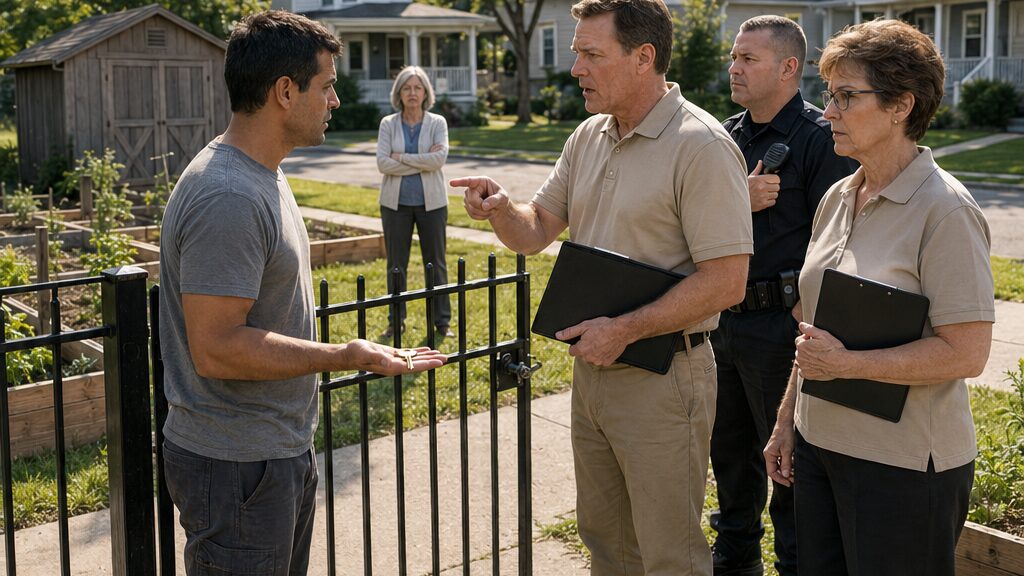
“Sir, take your hand off the gate and show me some identification.”
Eric Rivera kept the brass key between his thumb and forefinger.
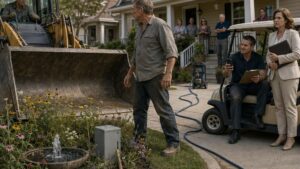
The new community garden stood behind him, unfinished but already alive with possibility: cedar beds filled with dark soil, a rain barrel under the tool shed gutter, and narrow gravel paths Cynthia Taylor had measured three times so wheelchairs could turn without catching a tire. The gate itself was the problem. Its latch had shifted overnight, and Eric had been testing the key when Scott Thompson appeared with a clipboard and a contract security officer.
Across the street, two residents watched from the sidewalk.
Scott pointed toward Eric’s pocket. “Driver’s license is fine.”
Eric looked at him. “Why?”
“We received complaints about an unauthorized person handling the lock.”
“I’m using a key.”
“That doesn’t establish authorization.”
Scott wore the management company’s beige polo, tucked neatly into pressed khakis. The officer beside him rested one hand near his radio but did not speak. Eric noticed the gesture because he noticed such things for work: where people placed their hands, where paths narrowed, where a gate turned access into permission.
He also noticed Ruth Green standing beside another neighbor across the street. Ruth had lived four houses from him for seven years. They had exchanged waves, weather complaints, and one conversation about a leaning maple tree. She would have recognized his face.
Apparently recognition was not the same as belonging.
Scott glanced down at the clipboard. “Several residents say they don’t know you.”
“That isn’t what you said first.”
Scott’s mouth tightened. “They said you didn’t appear to belong in this area.”
The words landed with an old familiarity.
Years earlier, Eric had watched his father stand on a tiled front step while a homeowner asked whether the landscaping crew had permission to use the family entrance. His father had been carrying a birthday cake. He had smiled, corrected the misunderstanding, and never mentioned it again.
Eric had learned from that silence. Or thought he had.
The security officer cleared his throat. “If you’re a resident, this can be settled quickly.”
Eric turned the key once more. The lock caught halfway, exactly where it had before. He withdrew it and closed his fingers around the warm brass.
Scott held out his hand. “Identification.”
A woman approached from the corner carrying another clipboard. Barbara King moved quickly without appearing rushed, her expression composed in the way it became at board meetings when she had already decided which rule mattered.
“Mr. Thompson,” she said, then looked at Eric. No recognition crossed her face. Eric had attended two virtual meetings with her and one closed planning session in the clubhouse, but his camera had been off for most of them.
Barbara assessed his gray T-shirt, worn work shoes, and the small streak of soil on his forearm.
“If you can’t establish that you’re a resident or an authorized contractor,” she said, “you’ll need to leave the common area.”
Eric almost reached for his wallet.
One card would end the humiliation. Another—the temporary board credential Justin had insisted he carry—would change the entire scene.
But he looked at Ruth again. Her arms were folded. She was not frightened. She was waiting to be proven right.
Eric let his hand fall away from his pocket.
“Before I leave,” he said, “may I ask one question?”
Barbara gave a restrained nod. “Go ahead.”
“Who approved the community garden?”
Her eyes moved briefly toward the cedar beds. “The board.”
“Who signed the final authorization?”
Scott shifted his clipboard against his chest.
Barbara answered. “The board president.”
“And who approved the replacement gate lock after the first one was delivered with the wrong cylinder?”
This time no one replied immediately.
The security officer looked from Barbara to Scott, as though the answer might be printed on one of their clipboards.
Eric opened his hand. The brass key lay across his palm.
“I did,” he said. “Eric Rivera. Board president.”
For a moment, the only sound was the soft clicking of the loose gate latch.
Scott’s pointing hand dropped. Barbara’s expression did not collapse, but something behind it changed. She looked at the key, then at Eric’s face, as if trying to connect him to a voice she had heard through laptop speakers.
The security officer spoke first. “Do you have the board credential?”
Eric removed it from his wallet and handed it over.
The officer examined the card, then returned it carefully. “All right.”
Scott stared at the top sheet on his clipboard. “Mr. Rivera, I wasn’t provided with photographs of the new officers.”
“You were provided with their names.”
“You didn’t identify yourself.”
“No,” Eric said. “I asked why I was being challenged.”
Barbara glanced toward the residents across the street. Ruth had unfolded her arms. She said something quietly to the neighbor beside her, but neither of them left.
“This was a misunderstanding,” Barbara said.
Eric looked at the locked gate. “What part?”
Her jaw tightened slightly. “Management responded to a resident complaint. Once your identity was established, the matter was resolved.”
The answer was clean enough to fit meeting minutes.
Eric took back the gate key and pushed it into the lock. It stuck again. He could feel the misalignment through the metal, a small resistance hidden inside something that appeared properly installed.
“The gate needs to be rehung,” he said.
Scott seemed relieved by the change of subject. “I’ll submit a work order.”
“Do that.”
The security officer stepped away. Scott followed him, lowering his voice as they walked toward the management cart.
Barbara remained beside the gate.
“You could have told them immediately,” she said.
“I could have.”
“Then some of this was avoidable.”
Eric met her eyes. “For me.”
Barbara looked toward Ruth, then back at him. “We’ve had thefts. People are nervous.”
“Nervous about what I was doing, or about not recognizing me?”
“That distinction is easier to make afterward.”
Before Eric could answer, Cynthia Taylor hurried along the path from the clubhouse parking lot. She carried a cardboard tray of seedlings against one hip and stopped when she saw Barbara.
“What happened?”
“Nothing that requires concern,” Barbara said.
Cynthia studied Eric’s face. “They questioned you too?”
Eric felt the last trace of satisfaction leave him.
“Too?”
Cynthia set the seedlings on the ground. “Last weekend they stopped the college volunteer who built the compost frames. Then the renter from Willow Court who brought the donated hoses.”
Barbara turned toward her. “Those incidents were addressed.”
“Were they?” Cynthia asked. “Because one of them hasn’t come back.”
Scott’s management cart rolled away at the end of the street. Ruth and the other neighbor began walking in the opposite direction without looking toward the garden.
Eric opened the gate by lifting it slightly as he turned the key. The latch released.
Inside, Cynthia pulled a folded sheet from the pocket of her overalls.
“I wrote the names down,” she said. “After the third time.”
There were three names on the page, each followed by a date and a brief description of what the person had been doing.
Eric read the first line, then the second.
The third entry ended with four words underlined twice:
Asked to prove residency.
Chapter 2: The Complaints No Rule Mentioned
Scott Thompson could not find the rule.
He searched the digital policy folder, then the printed binder, then a second binder whose spine read COMMON AREA PROCEDURES in fading black letters. Each time he turned a page, the brass garden key clicked against the conference table where Eric had set it.
“There has to be guidance somewhere,” Scott said.
Eric sat across from him in the HOA management office. Cynthia’s list lay beside the key. The blinds were half closed against the afternoon glare, striping the walls and Scott’s desk with hard white lines.
“You enforced it this morning,” Eric said. “What did you rely on?”
“A resident complaint and standard safety practice.”
“Show me the standard.”
Scott stopped turning pages. “Not every operational response appears in the covenants.”
“Then show me the board resolution.”
“I’m telling you how these situations are handled.”
“That isn’t the same thing.”
Scott leaned back. His professionalism had returned after the embarrassment at the garden, but it now carried a defensive edge. “Residents expect us to respond when unfamiliar people enter restricted common areas.”
“The garden isn’t restricted.”
“It’s under construction.”
“The beds are open to scheduled volunteers.”
“Scheduled volunteers should have identification.”
“Where is that written?”
Scott looked down at the binder again.
Eric had spent years reviewing municipal plans in which a single vague phrase could decide whether a sidewalk served everyone or only people who could step over a curb. Words mattered most when someone claimed they were obvious.
Scott finally pushed the binder away. “The board asked us to increase vigilance.”
“Which board action?”
“It came through compliance.”
“From Barbara?”
“I don’t recall the exact chain.”
Eric slid Cynthia’s list across the table. “Do you recall these?”
Scott read the first name without expression, then the next two. “I’d need to review the incident files.”
“Do it.”
Scott hesitated. “Those contain resident complaint information.”
“I’m the board president.”
The title sounded different inside the office than it had on the sidewalk. There, it had been a shield. Here, it felt like a weight Eric had picked up only after someone else was struck.
Scott logged into the management system. He searched by date, then opened a report labeled COMMON AREA CONCERN.
The first complaint described a young man near the compost frame as “possibly removing lumber.” The follow-up note said he had been assembling the structure under Cynthia’s instructions.
The second described a woman carrying garden hoses as “unknown female accessing resident property.” She was a renter on Willow Court.
The third report was shorter.
Subject does not look familiar. Asked to establish residency. Subject became upset and departed.
Eric read it twice.
“What behavior created the concern?” he asked.
Scott tapped the screen. “The complainant didn’t specify.”
“Was she damaging anything?”
“No.”
“Trying doors?”
“No.”
“Threatening anyone?”
“Not according to the report.”
“Then what were you responding to?”
Scott’s face hardened. “A resident’s stated concern.”
The office air conditioner shut off, leaving the room abruptly still.
Eric reached for the complaint log and began scanning earlier entries. At first the language varied: person near mailboxes, unknown van, individual walking behind homes. Then the phrases repeated.
Doesn’t live here.
Not dressed like a resident.
Possibly maintenance.
Unfamiliar teenager.
Should be asked why present.
The notes rarely recorded a specific act. They recorded discomfort.
“How many people were asked for identification?” Eric said.
Scott folded his arms. “I can’t give you an exact number without a full review.”
“Start one.”
“That will take staff time.”
“Use it.”
Scott’s eyes moved toward the garden key. “You’re reacting personally.”
“I was challenged personally. I’m reviewing this as president.”
“That distinction may not be as clear as you think.”
The words struck because they were not entirely wrong.
Eric looked again at the reports. He had campaigned on reducing petty enforcement—trash-bin warnings, paint-color disputes, notices over basketball hoops left out after dusk. He had told Justin that a quieter board could correct the culture without turning governance into theater.
He had not asked how quiet practices were being replaced.
He had assumed stopping bad rules was enough.
“Effective immediately,” Eric said, “management staff and contract security are not to demand proof of residency unless a written rule authorizes it or there is a specific safety concern tied to observable conduct.”
Scott stared at him. “You can’t issue that alone.”
“I can suspend an unwritten practice pending board review.”
“You’re changing security procedures after an incident involving yourself.”
“I’m stopping a procedure you cannot show exists.”
Scott stood. “I need to contact our regional supervisor.”
“Contact them.”
The office door opened before Scott reached the phone.
Barbara entered carrying a slim folder. She closed the door behind her and looked from Scott to the complaint logs spread across the table.
“I heard you issued a suspension.”
“I did.”
“You don’t have compliance committee approval.”
“I don’t need committee approval to stop staff from enforcing a rule no one adopted.”
Barbara placed the folder beside Cynthia’s list. “The board directed management to increase access control after the package thefts.”
“Access control is not asking peaceful people to prove they live here.”
“It is when common property is being targeted.”
“Which of these people targeted property?”
Barbara did not inspect the reports. “We cannot know intent before we intervene.”
“That logic turns every unfamiliar face into evidence.”
Her voice remained level. “And your approach asks residents to wait until after something is stolen.”
Scott moved toward the wall, suddenly eager to be outside the argument.
Eric pushed the report containing “does not look familiar” toward Barbara.
“Would you defend that wording in an open meeting?”
“I would defend responding to residents.”
“That wasn’t my question.”
Barbara’s gaze settled on him. “You were elected six weeks ago. Since then, you have declined a newsletter photograph, skipped the welcome reception, and kept every board update under a generic signature. Now you are surprised that staff did not recognize you.”
“Recognition should not determine whether rules apply.”
“No. But leadership might determine whether staff understand what you want.”
The key clicked as Eric closed his hand around it.
Barbara opened her folder and removed a formal meeting notice.
“Emergency board session,” she said. “Monday evening. We will vote on temporary identification procedures for unfinished common areas.”
“You’re proposing to formalize this?”
“I’m proposing that the board decide, rather than one officer acting alone after a personal dispute.”
She placed the notice directly over the complaint log.
Scott read the date. “That gives less than forty-eight hours.”
“Our bylaws permit it for safety matters.”
Eric looked at Barbara. “You knew these reports used appearance instead of conduct.”
“I knew residents were afraid.”
“And you considered that enough.”
“I considered doing nothing unacceptable.”
She turned to leave, then paused with her hand on the door.
“Bring whatever records you think prove your point,” she said. “I’ll bring the reason the policy started.”
When the door closed, Eric lifted the meeting notice.
Beneath it, the complaint line remained visible:
Subject does not look familiar.
Chapter 3: Safety Became Another Word for Suspicion
Barbara King spread six photographs across her dining table before Eric had taken off his coat.
Crushed delivery boxes. A pried-open parcel locker. A porch with a dark smear where a planter had been dragged aside. In the final image, an elderly homeowner sat on a curb with one hand wrapped in gauze.
“You wanted the reason,” Barbara said. “There it is.”
Two days had passed since the garden confrontation. The emergency meeting had been postponed after the management company asked for legal review, but Barbara had insisted Eric see the evidence before asking the board to end heightened reporting.
Her house overlooked the neighborhood walking path. Through the back windows, residents passed in pairs beneath young trees planted at identical intervals. The room was orderly without being warm. Even the stacks of association papers on the sideboard were squared at the corners.
Eric picked up the photograph of the damaged parcel locker.
“When did this happen?”
“Late February.”
“Before the election.”
“During it.”
She pointed to another image. “Three homes in one week. Then someone entered the clubhouse storage room and took power tools belonging to the maintenance contractor.”
“Was anyone identified?”
“A delivery camera caught a vehicle, not a face.”
“So no.”
Barbara’s mouth tightened. “Not being caught does not make the thefts imaginary.”
“I didn’t say they were.”
“You implied the concern was invented to justify profiling.”
“I said the response was based on appearance instead of behavior.”
She tapped the photograph of the elderly homeowner. “He saw someone taking a box from his neighbor’s porch. He followed him to the street. The man shoved past him and he fell.”
Eric studied the bandaged hand, the stunned expression, the open garage behind him.
“How badly was he hurt?”
“Fractured wrist. Bruised hip. He stopped walking alone for almost a month.”
That changed the shape of the story, though not its conclusion.
Eric set the photograph down carefully. “Why wasn’t this in the board transition packet?”
“It was summarized.”
“I saw a line about property incidents.”
“Because the previous board did not want to frighten residents while homes were being listed for spring sales.”
Barbara’s contempt sharpened the sentence. “They wanted reassurance without disclosure. Then, after he was hurt, the homeowner stood at a meeting and asked what we had done to protect him. No one answered.”
“And you decided unfamiliar people should be reported.”
“I told residents to report activity that concerned them.”
“Those are not the same words.”
“They became the same in practice because management needed something actionable.”
Eric looked through the remaining photographs. Fear had a record now: broken packaging, splintered wood, a bandaged wrist. It was easier to reject a policy when its origin was only prejudice. Harder when real harm had opened the door.
Barbara gathered the photos into a straight line.
“I know what happened to you was embarrassing,” she said.
“Embarrassing.”
“You were not detained. You were not removed. The misunderstanding lasted minutes.”
“Because I had a title.”
“You had identification.”
“The renter on Willow Court had identification too. She still left the garden.”
Barbara looked away first.
Eric noticed it.
“You knew about her.”
“I reviewed the complaint.”
“And?”
“She became confrontational.”
“She was asked to prove she lived here while carrying donated hoses to a scheduled volunteer shift.”
“She refused to cooperate.”
“You keep describing resistance as the cause after someone is treated like a suspect.”
Barbara pressed both palms against the table. For the first time, fatigue showed through her control.
“You keep discussing principles as if no one has to answer when something goes wrong. I do. Scott does. The committee does. Residents call at night. They send photographs. They ask whether dues pay for anything besides landscaping and letters.”
“And fear makes every response fair?”
“No. Fear makes delay expensive.”
They stood in silence until Barbara picked up the photograph of the injured homeowner and returned it to the folder.
“Walk with me,” she said.
Outside, the late-afternoon path curved behind a row of detached homes. Barbara moved briskly, greeting two residents by name. Eric recognized both faces but knew neither name.
At the corner, she pointed toward a porch with a low brick step.
“That’s his house.”
The elderly homeowner sat behind the front window. A walker stood folded near the door.
“He blamed the board?” Eric asked.
“He blamed me.”
“Why you?”
“I chaired compliance. He had complained twice about strangers following delivery vehicles. I told him we could not act on vague descriptions.”
Eric glanced at her.
“That was the correct answer.”
“It sounded correct until he was on the ground.”
There it was—not an excuse, exactly, but the wound beneath her certainty.
“You changed the standard because you felt you had failed him,” Eric said.
“I changed the standard because waiting for perfect information failed him.”
“And now residents are reporting anyone who looks unfamiliar.”
“I did not tell them to use those words.”
“But you saw the reports.”
Barbara stopped walking.
A child’s bicycle lay on a lawn nearby, one wheel turning slowly in the breeze. Barbara lowered her voice.
“Yes.”
“And you let it continue.”
“I corrected some entries.”
“Not the practice.”
“No.”
The admission was so quiet that Eric almost missed its weight.
“Why?”
Barbara looked toward the elderly homeowner’s porch. “Because the thefts stopped.”
Eric followed her gaze. “You don’t know that the reporting stopped them.”
“No. I know people felt watched. Sometimes that is enough.”
“For safety?”
“For deterrence.”
“And for belonging?”
She did not answer.
When they reached the garden, the new gate still sagged. Eric took the brass key from his pocket and held it out.
“Cynthia needs another volunteer key. You’re on the garden oversight group.”
Barbara looked at the key but did not take it.
“I’m not joining your demonstration.”
“It’s a key.”
“With you, nothing is only what it is anymore.”
Eric closed his fingers around it.
Barbara studied him for a moment. “Why didn’t you tell people you were president?”
“I told the board.”
“You told us your name. You avoided being seen.”
“I didn’t think the office needed a face.”
“That was convenient.”
“For whom?”
“For you.” Her answer came immediately. “You wanted the power to change things without becoming the person residents blamed when change felt unsafe.”
Eric felt the key’s teeth press into his palm.
Barbara continued, less sharply now. “Scott received three different transition messages. One from you about reducing enforcement. One from me about security. One from the former president telling him to maintain existing practice until contracts were reviewed.”
“I sent a clarification.”
“Did you sign it?”
Eric looked at her.
She reached into her folder and handed him a printed page.
It was his memo. He recognized every sentence: focus on observable violations, reduce unnecessary resident confrontation, prioritize education before penalties. At the bottom, where his name should have been, was only the generic board email address.
No signature. No training schedule. No instruction replacing the informal access practice.
A careful message from a man determined not to become visible.
“Scott asked who had authority to interpret it,” Barbara said. “No one answered him.”
Eric read the page again.
He had believed ambiguity would soften the transition. Instead, it had left space for the loudest fear to become policy.
At the garden gate, he inserted the key and lifted the sagging frame. The lock opened only after he forced the metal into alignment.
Barbara watched him.
“You wanted to know who caused the confusion,” she said. “You should begin with the name missing from the bottom of that page.”
Chapter 4: The President Who Would Not Be Seen
Justin Lee placed the apology on Eric’s kitchen table as if it might break something.
The first sentence called the garden confrontation “an unfortunate misunderstanding.” The second thanked Eric for his patience. The third promised that management would review communication procedures.
No person admitted doing anything wrong.
Eric read it once, then slid it back across the table.
“You wrote this?”
“The management company’s attorney did.”
“And you brought it here because?”
“Because they’ll sign it, Scott will accept a written warning, Barbara will stop pushing the temporary ID rule, and we can move on before this becomes expensive.”
Justin loosened his tie and sat opposite him. He had come directly from work, carrying the smell of office coffee and rain-damp wool. Outside the kitchen window, the evening light had flattened the neighborhood into neat roofs and trimmed hedges.
Eric tapped the final paragraph.
“This says I consider the matter resolved.”
“You would.”
“No.”
Justin exhaled. “Eric, you’re president of an association, not a federal investigator.”
“I’m asking for complaint records.”
“And the management company is saying those records include confidential resident information.”
“They include the people our contractors stopped.”
“They include the people who reported them.”
“Then redact the names.”
Justin leaned forward. “Their regional supervisor called me this afternoon. If we suspend security procedures outside the contract process, they may claim breach.”
“There was no procedure.”
“That is not how they’ll frame it.”
Eric stood, taking the brass garden key from the shallow dish near the door. “Come with me.”
Justin looked toward the darkening window. “Where?”
“The gate.”
The unfinished garden was empty except for plastic sheeting that snapped softly over a stack of lumber. Eric switched on his phone light and fitted the key into the lock.
It turned halfway and stopped.
He lifted the sagging gate with one hand and tried again. Metal scraped inside the cylinder.
“You called me out here to fix a hinge?” Justin asked.
“No.”
Eric pressed harder. The key flexed between his fingers but would not complete the turn.
Justin watched him struggle. “You know forcing it won’t align the frame.”
Eric let go. The gate dropped a fraction, trapping the bolt again.
“That memo Barbara showed me,” he said. “The transition instructions.”
“What about it?”
“I didn’t sign them.”
Justin’s expression changed. “You sent them from the board account.”
“I sent language. I never told Scott who had authority to enforce it.”
“You were president-elect. He knew.”
“He received three different directions.”
“That happens during transitions.”
“I also never scheduled the training.”
Justin was silent.
Eric had drafted the training outline himself: observable conduct, de-escalation, limits on identification demands, treatment of renters and guests. It remained on his laptop under a file name ending in FINAL, though no date had ever been set.
“I thought reducing written violations would change the culture,” Eric said.
“It did. Fines are down.”
“And unwritten enforcement moved into places I wasn’t watching.”
Justin leaned against the gatepost. “You cannot take responsibility for every bad judgment made by a contractor.”
“No. Only for the space I left them.”
The wind lifted one corner of the plastic sheeting, revealing the dark shapes of unused cedar boards. Eric remembered his father on that tiled porch years ago, holding a cake box while a stranger explained which entrance workers were supposed to use.
His father had smiled afterward. Not because it was harmless, but because making the other man comfortable had seemed easier than naming what happened.
Eric had inherited the same instinct and dressed it as restraint.
Justin seemed to read something in his face. “This is about your father.”
“It started there.”
“You never told the board that.”
“It wasn’t relevant.”
“It was relevant to why you ran.”
Eric looked at the key still caught in the lock. “He visited me once when I was renting in a gated development. A resident asked which unit had hired him. He was wearing his good jacket.”
Justin said nothing.
“He laughed it off. Later, he told me not to make trouble with neighbors I had to live beside. I decided people should not need an office, a badge, or a polished answer to be treated as if they belonged.”
“That is exactly why you should have put your photograph in the newsletter.”
Eric turned toward him.
Justin raised both hands. “Hear me out. You decided public visibility was vanity. Barbara decided it was accountability. In this case, she may have been right for the wrong reason.”
The words landed harder than Barbara’s accusation.
A vehicle stopped at the curb. Its headlights swept across the garden beds before shutting off. Scott stepped out carrying a thick envelope.
“I was told both of you might be here,” he said.
He held the envelope toward Eric without entering the gate.
“What is it?” Justin asked.
“Notice from our regional office. If the board suspends any contracted security function without formal review, they reserve all rights under the management agreement.”
Eric took it.
Scott’s eyes moved to the key in the lock. “Still sticking?”
“The frame is misaligned.”
“I submitted the work order.”
“You submitted it after asking me to prove I was authorized to touch it.”
Scott looked away. “I’ve already said I didn’t have the officer list.”
“And I’ve already said that should not have mattered.”
Justin stepped between them before the exchange sharpened. “Scott, are you producing the complaint files?”
“My supervisor wants a written board request and counsel review.”
“You have one board officer asking,” Eric said.
“One officer involved in the incident.”
There it was again: the convenient collapse of two roles whenever it protected someone else.
Eric removed the key by lifting the gate until the pressure eased.
“Tomorrow morning,” he said. “Conference room. Bring every complaint note connected to common-area challenges for the last six months.”
Scott shook his head. “I can’t promise that.”
“Then bring the refusal in writing.”
Scott looked at Justin.
Justin did not rescue him. “Bring the records, Scott.”
After he left, Justin stared at the legal notice in Eric’s hands.
“You’re escalating.”
“I’m stopping the private settlement.”
“That may cost the association.”
“So did the policy.”
“There was no policy. That’s your argument.”
Eric folded the apology letter once, then tore it across the sentence declaring the matter resolved.
“No,” he said. “That was my excuse.”
He handed Justin the unsigned transition memo and the management notice.
“At the meeting, I’m going to say I failed to complete the training.”
Justin’s shoulders lowered. “Barbara will use that against you.”
“She should.”
“And then?”
“Then we decide whether my mistake excuses what happened after it.”
Eric removed his phone and typed a formal board request for the full complaint archive, copying Barbara, Scott, Justin, and the management-company regional supervisor.
Before sending it, he added one sentence:
No private resolution will be accepted in place of a complete review.
He pressed send.
Across the garden, the gate swung inward on its crooked hinge, open now only because no one had locked it again.
Chapter 5: Every Familiar Face Had an Exception
The complaint identified a man who had lived in the neighborhood for eleven years as “possibly maintenance.”
Eric read the phrase aloud.
No one at the conference table corrected him.
The resident had been carrying a toolbox from his garage to his daughter’s house two streets away. A contract officer stopped him beside the clubhouse and asked which company employed him. The follow-up note stated that the man “became sarcastic but eventually confirmed address.”
Scott sat at the far end of the table with two archive boxes and a laptop. He had brought the records, though not willingly. A message from the regional supervisor required him to remain present while they were reviewed.
Justin opened another file.
“Unknown male near pool fence,” he read. “Actually a guest waiting for his host.”
Cynthia sat beside Eric, matching complaint dates to volunteer schedules. Ruth Green had agreed to attend after Eric sent notices to residents whose names appeared in the reports. She remained near the door, her purse held tightly in her lap.
On the table, copied gate keys lay in a plastic evidence bag Scott had found among garden-access materials. No complete distribution list existed. Some keys had numbers scratched into them. Others had nothing.
Eric turned another page.
Unfamiliar young woman carrying tools.
Renter repairing her own patio screen.
Teenager walking behind homes.
Resident taking the drainage path home from school.
The pattern did not announce itself in a single dramatic record. It accumulated through ordinary language, each entry small enough to defend alone.
“How many of these resulted in an actual violation?” Eric asked.
Scott checked a spreadsheet. “Two.”
“Out of?”
“Thirty-one contacts.”
“And those two?”
“One person dumped construction debris in a common-area bin. Another entered the pool after hours.”
“Were either identified because they looked unfamiliar?”
Scott paused. “The reports included observable conduct.”
Eric pushed the spreadsheet toward him. “Then conduct worked.”
Scott’s mouth tightened. “You’re separating these with hindsight.”
“No. I’m separating carrying a toolbox from dumping debris.”
Ruth shifted in her chair.
Eric looked toward her. “You filed the garden complaint.”
“Yes.”
“Why?”
Her chin lifted slightly, the reflex of someone accustomed to controlling a classroom. “I saw a man I didn’t recognize at a locked common facility.”
“You had seen me before.”
“I had seen your face. I did not know your name.”
“Did you see me damage anything?”
“No.”
“Try to force the lock?”
“You were handling it.”
“With a key.”
“I couldn’t tell whether it was yours.”
Cynthia’s pencil stopped moving.
Ruth looked down at her purse. “Barbara told us to report people near unfinished common areas if they didn’t have visible credentials.”
Scott turned toward her. “She told residents that?”
“At the safety forum. Not exactly those words.”
“What words?” Eric asked.
Ruth considered the question carefully.
“She said we knew our own neighborhood better than management did. She said unfamiliar activity should be reported before it became an incident.”
“That isn’t an instruction to challenge people,” Scott said.
“No,” Ruth replied. “But after the thefts, everyone knew what she meant.”
The room went quiet.
Eric expected defensiveness from her. Instead, she appeared embarrassed by the ease with which she had followed an implication.
“I was afraid,” Ruth said. “That doesn’t make the report accurate.”
It was not an apology, but it was more useful than one.
Cynthia resumed writing. “Did you report the other volunteers?”
“No.”
“Did you hear people discussing them?”
Ruth nodded. “The neighborhood message group. Someone said renters were sharing access codes. Someone else said the garden would bring outsiders through the development.”
Cynthia’s face hardened. “The garden is for residents.”
“I know that now.”
“You knew it then.”
Ruth accepted the correction without argument. “I knew the rule. I did not know the people.”
Eric glanced at the copied keys on the table. Access had never been as controlled as the reports implied. The association had handed out duplicates without consistent records, while demanding that people explain themselves for standing near a gate.
Scott closed one archive box.
“I want the record to reflect that management did not create resident bias.”
“No one said it did,” Eric replied.
“You’re building a case that suggests our employees acted independently.”
“You acted on complaints without requiring specific behavior.”
“We were told to increase vigilance.”
“By whom?”
Scott looked at Justin, then Barbara’s empty chair.
“The compliance committee.”
“Through a written directive?”
“No.”
“A meeting?”
“A call.”
“With Barbara?”
“And you.”
Eric stopped.
Scott opened his laptop and searched his calendar.
“February twenty-sixth,” he said. “Transition call. You said residents were frustrated by delayed responses and management should act sooner when safety concerns were reported.”
Eric remembered the call. He had been driving between work sites, speaking through the car system. The election results were not yet certified, but everyone treated the outcome as settled.
“What exactly did I say?”
Scott read from his notes. “‘Err on the side of resident safety while we review enforcement priorities.’”
Justin looked at Eric.
Cynthia set down her pencil.
Eric remembered the sentence now—not as an instruction, but as something he had said to end an argument. Barbara had been pressing him about the thefts. Scott had asked what to do during the transition. Eric, impatient and distracted, had offered language broad enough to satisfy both sides.
A phrase without limits. Another unsigned gate.
“I was referring to reports of conduct,” Eric said.
Scott’s reply was immediate. “You didn’t say that.”
The truth did not need to make Scott innocent to make Eric responsible.
Ruth watched him from across the room. “Did you know people were being asked for identification?”
“No.”
“But you told them to act sooner.”
“Yes.”
The admission altered the room. Eric could feel everyone recalculating where blame belonged.
Cynthia broke the silence. “Then say both things. You gave bad direction. They used it badly.”
Scott bristled. “That is an oversimplification.”
“No,” she said. “It is the first simple thing anyone has said all morning.”
The conference-room door opened.
Barbara entered with a folder tucked beneath her arm. She took in the archive boxes, Ruth, the copied keys, and the complaint summaries spread across the table.
“So,” she said, “you found the call.”
Scott shifted in his chair. “My notes.”
Barbara looked at Eric. “I told you the practice did not appear from nowhere.”
“And I told you it became something else.”
“It became the response residents demanded.”
“You saw these phrases.”
“I saw some.”
“You knew they focused on familiarity.”
“I knew management was trying to distinguish residents from trespassers.”
“By appearance.”
“By context.”
Eric slid the report labeled possibly maintenance toward her.
Barbara read it, and for a moment her certainty faltered.
Then she closed the folder.
“The meeting is tomorrow night,” she said. “I intend to present the full sequence, including your instruction to err on the side of safety.”
Justin stood. “Barbara, this review isn’t complete.”
“It is complete enough to show that Eric did not discover a rogue system. He participated in creating one.”
“I’ll say that myself,” Eric said.
She studied him, perhaps searching for the defensive move he had denied her.
“You’ll admit it?”
“Yes.”
“And still ask the board to suspend the procedure?”
“Yes.”
Barbara placed her folder on the table. “Then the residents should hear your exact words before they hear your revised interpretation.”
She removed a printed copy of Scott’s call notes and set it beside the brass keys.
At the top, one sentence had been highlighted in yellow:
Err on the side of resident safety.
Barbara tapped the page.
“I’ll read this aloud,” she said. “Then we’ll see whether accountability still sounds simple when the name at the bottom is yours.”
Chapter 6: The Meeting Where Blame Changed Hands
“Err on the side of resident safety while we review enforcement priorities.”
Barbara’s voice carried cleanly through the clubhouse.
Every folding chair was occupied. Residents stood along the back wall and near the double doors. On the board table lay the unsigned transition memo, Scott’s call notes, selected complaint reports, and the brass garden key.
Barbara lowered the page.
“Those were President Rivera’s words.”
A low murmur passed through the room.
Eric sat two seats away from her, hands flat on the table. Justin leaned close enough to speak without the microphone.
“We can postpone,” he whispered. “Legal review isn’t finished.”
“No.”
“We do not know what the management company will claim.”
“We know what happened.”
“That isn’t the same question.”
At the lectern, Barbara continued.
“After multiple thefts and an injury to a homeowner, management was instructed to respond more quickly to resident safety concerns. That direction came not only from compliance, but from the incoming president.”
She did not exaggerate. She did not need to.
Scott sat in the first row beside the management-company regional supervisor. Ruth was three seats behind them. Cynthia stood along the wall with two garden volunteers, her arms folded.
Barbara looked toward Eric. “Would you like to dispute the notes?”
Justin touched the agenda packet. A delay motion waited on the page between them.
Eric switched on his microphone.
“No,” he said. “The notes are accurate.”
The murmuring stopped.
Barbara’s expression shifted, just slightly. She had prepared for denial.
Eric looked out at the residents.
“I said those words during the board transition. I did not define what safety concerns required action. I did not distinguish suspicious conduct from unfamiliar appearance. I drafted replacement guidance, but I did not sign it, schedule training, or verify that management understood it.”
A man near the back called out, “So this is your policy.”
“No,” Eric said. “It is my failure.”
The answer quieted the room again.
Barbara placed both hands on the table. “That distinction may matter to you. It did not matter to the staff acting on your direction.”
“It matters because responsibility is not the same as permission.”
He picked up the report marked possibly maintenance.
“This resident was stopped while carrying his own toolbox. Another was questioned while donating hoses. A teenager was approached for walking home on a drainage path. None was reported for theft, forced entry, threats, or damage.”
A woman in the second row raised her hand. “Were there actual trespassers?”
“Yes,” Scott said before being recognized. “Two incidents resulted in confirmed violations.”
Eric turned toward him. “Both were reported for specific actions.”
Scott’s supervisor touched his arm, but he continued.
“One involved dumping debris. One involved entering the pool after closing.”
“Then we agree,” Eric said. “Observable behavior gave management something useful.”
Barbara lifted another report. “And what happens when behavior becomes observable too late? Do we wait until a package is taken?”
“No.”
“Then what do residents report?”
“Location, conduct, direction of movement, attempts to enter restricted property, interference with locks, following delivery vehicles—what they see, not whether someone looks like they belong.”
A resident near the aisle shook his head. “That sounds like lawyer language.”
“It is specific language,” Eric said. “Specific language protects people and improves reports.”
Barbara turned toward the audience.
“The president was not removed from the neighborhood. His identity was verified, and the encounter ended.”
“Because he was president,” Cynthia said from the wall.
Several heads turned.
Barbara’s tone sharpened. “Public comments have a designated period.”
Cynthia did not sit. “The renter who brought the hoses left. She did not have a title that made everyone embarrassed.”
The room stirred again.
Eric reached for the brass key. He had brought it without deciding why. Now he set it on top of his unsigned memo.
“This key opened the garden gate,” he said. “It did not prove I lived here. My title ended the confrontation, but it did not make the demand fair.”
Barbara looked at the key. “And if someone steals a copy?”
“Then we respond to unauthorized entry, damage, or misuse.”
“You keep returning to conduct because it removes judgment from the process.”
“It disciplines judgment.”
“That is a phrase, Eric. People still have to decide when to call.”
“Yes. And we have to tell them what facts matter.”
Justin switched on his microphone. “I move that the board postpone any vote until counsel reviews the proposed reporting standard and management contract.”
The motion landed like a closed door.
Eric turned toward him. “You support postponement?”
“I support not exposing the association to a lawsuit based on a proposal residents received this afternoon.”
Barbara nodded. “Second.”
For a moment, the meeting moved away from fairness and into procedure—the safest place for every unresolved conflict to disappear.
Eric looked at Justin.
“You said we needed a public answer.”
“I said we needed a stable board.”
“Those are not always the same.”
Justin’s face tightened. “And leadership is not forcing a vote because you feel guilty.”
The remark was quiet, but the microphone caught it.
Eric felt heat rise beneath his collar.
There it was: the accusation he feared most because it contained truth. His urgency had changed after the confrontation. His father’s memory had changed its meaning. He could not pretend his position was untouched by personal pain.
But personal pain did not erase the reports on the table.
He faced the room.
“Before we vote on postponement, I want the record to show something.”
Barbara sat back.
Eric continued. “I benefited from the very system we are discussing. Not because it treated me well, but because I had a title that ended the harm quickly. I also helped create the ambiguity management used. Both facts are true.”
Ruth stood from the third row.
“May I speak?”
Barbara glanced at the agenda clock. “Two minutes.”
Ruth approached the public microphone.
“I reported Mr. Rivera,” she said. “I had seen him before. I did not know his name, and after the thefts, we were told unfamiliar activity should be reported.”
Barbara’s eyes fixed on her.
Ruth continued. “I thought I was being responsible. Then I read what I wrote. I did not describe an action. I described my uncertainty and expected someone else to turn it into suspicion.”
No one interrupted.
“I still want security,” she said. “I do not want to pretend fear came from nowhere. But I no longer think not knowing a person’s name is evidence against them.”
She returned to her seat without looking at Eric.
The room remained quiet long enough for the ventilation system to become audible.
Justin withdrew his hand from the agenda packet.
“I withdraw the motion to postpone,” he said.
Barbara looked at him. “You cannot withdraw after a second without consent.”
“I consent,” she said after a pause, though the words seemed to cost her.
Eric opened the proposed standard.
It prohibited demands for residency proof absent a specific rule, emergency, or documented access requirement. It required reports to identify observable conduct. It required de-escalation training, quarterly complaint review, and notice to renters and volunteers equal to notices sent to owners.
Scott’s supervisor raised a hand. “The management company cannot accept contract modifications without negotiation.”
“This is board policy,” Eric said. “Contract terms will be reviewed separately.”
“And if your policy prevents our employees from meeting security obligations?”
“Then document the conflict.”
Barbara gave a short, humorless breath. “More paperwork.”
“Better paperwork,” Eric said.
Some residents smiled, but there was no applause.
Barbara gathered the pages before her.
“You are presenting yourself as accountable,” she said. “But you knew the thefts were serious. You told management to act. Now that the same system embarrassed you, you are calling it discriminatory.”
Eric met her eyes.
“I am calling it undisciplined. I am also saying I should have stopped it before it reached me.”
“And if another homeowner is injured?”
“Then my vote is part of the record.”
The answer removed his last protection. He could no longer hide behind the board, the contract, or a generic signature.
Eric placed the proposed standard beside the key.
“I move that the association adopt the behavior-based reporting policy, suspend informal residency challenges, begin staff training within thirty days, and review the management contract for compliance.”
Justin looked toward him.
Barbara’s gaze did not leave Eric’s face.
A compliance committee member seconded the motion.
Eric added, “The vote will be recorded by name.”
A murmur moved through the audience again, sharper this time.
Barbara leaned toward her microphone. “And if it fails?”
Eric looked at the unsigned memo beneath the key.
“Then I will resign as president after the meeting,” he said. “The community should not be led by someone unwilling to attach his name to the rule he asks others to follow.”
The secretary began calling the roll.
Chapter 7: A Rule That Looked at Behavior
The first vote ended in a tie.
Two members supported the new reporting policy. Two opposed it. Justin abstained, arguing that the management contract still required review.
Every face in the clubhouse turned toward Eric.
As president, he held the deciding vote.
The management-company regional supervisor stood near the front row with her arms folded. Scott stared at the floor. Barbara sat rigidly beside the stack of complaint reports, one hand resting near the brass garden key.
A resident at the back spoke before Eric could.
“He shouldn’t vote. This happened to him.”
Another voice answered, “That’s why he should.”
The room fractured into whispers.
Eric switched off his microphone and looked at Justin. “Why did you abstain?”
“Because the motion combines policy, training, and contract review.”
“You helped draft it.”
“I helped draft something defensible. This vote is now about whether you resign.”
“That was my choice.”
“And it changed the pressure on everyone else.”
Justin’s concern was real. So was the escape it offered. Eric could withdraw the motion, separate the provisions, request legal review, and preserve his office.
He looked at the unsigned memo beneath the key.
That was how the problem had begun: a careful instruction without a name firmly attached to it.
Ruth approached the public microphone again.
Barbara checked the clock. “You already used your comment period.”
“I know.”
“Then please sit down.”
Ruth did not move. “I need to correct something.”
The room quieted.
Barbara’s eyes narrowed. “One minute.”
Ruth gripped the sides of the lectern.
“When I reported Mr. Rivera, I said I thought I was following the board’s expectations. That is true, but it is not complete.”
She glanced at Eric, then toward the residents behind her.
“After the thefts, I started watching people. Not actions. People.”
No one interrupted.
“I watched delivery drivers stay too long at the curb. I watched renters carry furniture after dark. I watched teenagers use the walking path because I did not recognize which houses they belonged to.”
A man in the front row shifted uncomfortably.
Ruth continued. “Nothing happened during most of those moments. But each time I reported someone, I felt useful. I felt as though fear had become responsibility.”
Her voice tightened, though she kept it steady.
“When management responded, it confirmed that I had been right to be suspicious. Even when the person had done nothing.”
Barbara lowered her gaze.
Ruth looked directly at her. “You did not tell me to judge people by appearance. But you made our uncertainty sound like evidence.”
The words moved through the room without volume.
Barbara reached for her microphone.
“Residents were frightened,” she said. “You were frightened.”
“Yes.”
“And there were real thefts.”
“Yes.”
“Then do not speak as though concern itself was invented.”
“I’m not.” Ruth released the lectern. “I’m saying fear changed what I allowed myself to notice.”
She returned to her seat.
Eric watched Barbara fold the edge of a paper between two fingers. For the first time that evening, she appeared less like the person directing the room than someone standing inside it without protection.
Scott leaned toward the regional supervisor and whispered. She shook her head sharply.
Barbara noticed.
“What?” she asked.
Scott looked toward Eric.
The regional supervisor answered instead. “This is not relevant to the motion.”
Barbara’s voice cooled. “Then it should be easy to say.”
Scott swallowed. “There was an incident in March.”
“What incident?”
“A contractor was challenged near the drainage pumps.”
Eric searched the files in front of him. “That report wasn’t included.”
“It was handled informally.”
“By whom?”
Scott hesitated.
Barbara said, “Answer him.”
“You called me after reviewing it.”
Her expression changed.
Scott continued. “You said the officer should not have demanded proof of residency because the contractor had visible equipment and a work order.”
“That was a different circumstance.”
“You also said the complaint relied too heavily on whether he looked familiar.”
The room became completely still.
Eric looked at Barbara. “You recognized the problem.”
“One incident.”
“You warned Scott.”
“I corrected a bad judgment.”
“But you did not change the practice.”
Barbara’s hand left the papers.
“The theft investigation was still open,” she said. “Residents were already saying the board had failed. If I announced that our new reporting approach was flawed, every earlier decision would have been questioned.”
“So you knew.”
“I knew it could be misused.”
“And you kept it.”
Her control finally cracked, not into anger but exhaustion.
“I kept something that appeared to be working.”
No one moved.
Barbara looked toward the elderly homeowner seated near the aisle. His wrist was no longer bandaged, but he held it stiffly against his chest.
“I watched him stand at this microphone and say we had left him alone,” she said. “I had told him his reports were too vague. Two weeks later, he was on the pavement.”
The elderly man lowered his eyes.
Barbara’s voice softened. “After that, the calls increased. The patrols increased. The thefts stopped. I knew some reports were weak. I told myself weak reports were the price of preventing another injury.”
“And when the price was paid by people you didn’t know?” Eric asked.
Barbara looked at the key between them.
“I did not ask that question soon enough.”
It was not absolution. It was the first honest answer she had given in public.
Justin switched on his microphone.
“I am changing my abstention.”
The secretary looked up. “The vote has concluded.”
“Then I move to reconsider.”
A board member seconded.
The regional supervisor stood. “Before another vote, the company objects to any language that suggests management acted outside board direction.”
Eric faced her. “The complaint review will state what the records show.”
“Our staff responded to resident concerns.”
“Without a written standard.”
“Under verbal direction from board officers.”
“Including me,” Eric said. “That will also be stated.”
The supervisor paused, deprived of the denial she expected.
Eric turned toward Justin. “Your vote?”
“In favor.”
The secretary marked the change. The motion now had three votes.
Eric’s vote was no longer needed for passage, but the question remained. Residents were watching to see whether he would use the changed count as another place to disappear.
“I vote in favor,” he said.
The secretary recorded his name.
No one applauded.
The regional supervisor requested that the contract objection be entered into the minutes. Scott asked whether staff training would begin before negotiations. Cynthia asked when volunteers would receive formal access instructions. Residents spoke over one another until Barbara struck the table once with the side of her hand.
“Order.”
The authority in her voice remained. What had changed was its certainty.
She took the brass key from beside Eric’s memo and held it up.
“This was presented tonight as evidence of access,” she said. “But no key log was maintained. Compliance approved copies without establishing who was responsible for them.”
She placed it in front of Eric.
“That was my committee’s failure.”
Eric pushed the key back across the table.
“Then help build the new process.”
Barbara looked at it but did not touch it.
“I am resigning as compliance chair, effective tonight.”
A murmur rose.
Eric kept his voice low. “You don’t have to decide now.”
“I already did.”
“This cannot become a way to avoid the review.”
“It won’t.” Her eyes met his. “I’ll provide every record I have.”
“Then stay through the transition.”
“No.”
The refusal held neither spite nor reconciliation. It was the boundary she could still control.
Barbara stood, gathered only her personal folder, and left the committee binder on the table.
At the door, she stopped.
“I was wrong to let familiarity become a substitute for evidence,” she said without turning around. “I am not yet convinced your rule will keep everyone safe.”
Then she walked out.
The clubhouse remained full, but the space she left felt visible.
Eric looked down at the garden key lying between the abandoned binder and his recorded vote.
The policy had passed.
Trust had not.
Chapter 8: The Gate Opened Without Asking Names
Eric arrived at the garden without a badge.
He carried a clipboard instead.
The public access roster was clipped to the front, followed by volunteer schedules, emergency contacts, and the new reporting guide printed in plain language. The first line read:
Describe what the person is doing, not whether the person looks familiar.
Three weeks had passed since the vote. The management company had not terminated its contract. Its attorneys had added reservations to nearly every training document, but Scott had completed the first de-escalation session with staff and contract security.
The complaint form had changed.
The garden gate had changed too. The contractor rehung it, reset the latch, and replaced the warped section of frame. Now the brass key turned without force.
Cynthia stood inside arranging seed packets on a folding table.
“You’re late,” she said.
“By two minutes.”
“You’re president. That means everyone noticed.”
Eric handed her the clipboard.
“That is why the roster has my name on it.”
She smiled. “Progress.”
Volunteers arrived carrying gloves, watering cans, and trays of seedlings. Some were homeowners. Some were renters. One elderly resident brought a folding chair and announced that supervision counted as labor.
A small ring of newly numbered keys sat in a wooden bowl near the entrance.
Cynthia lifted one. “We have ten copies, ten signatures, and no presidential exception.”
“That sounds pointed.”
“It was meant to.”
Eric had kept the original key in his pocket for three weeks. It had become smooth along one edge from the habit of turning it between his fingers during meetings.
He was about to add it to the bowl when a vehicle stopped across the street.
Barbara stepped out carrying two flats of tomato seedlings.
Conversation near the gate thinned.
She wore no committee badge and carried no folder. The absence made her look less formal and, somehow, more exposed.
Cynthia walked toward her.
“I wasn’t sure you’d come.”
“I said I would donate these.”
“You could have left them at my house.”
“I could have.”
Barbara held out the seedlings. Cynthia accepted one flat and nodded toward the gate.
“We need another regular watering volunteer.”
Barbara looked past her toward Eric.
He did not move to welcome her. He did not move away.
“I am not asking to return to compliance,” she said.
“No one asked you to.”
“That sounded almost friendly.”
“It wasn’t meant to sound unfriendly.”
Cynthia took the second tray from her. “You two can practice later. The tomatoes need shade.”
Inside the garden, Barbara placed the seedlings beneath the tool-shed awning. Eric brought the wooden bowl of keys.
“Volunteers sign here,” he said, indicating the roster. “Keys are returned if the assignment ends.”
Barbara read the form.
“No proof of residency?”
“Volunteer registration was already verified through the garden program.”
“And guests?”
“Must remain with the registered volunteer.”
She examined the numbered key he offered.
“What happens if someone enters without one?”
“If the gate is locked, staff respond to attempted unauthorized entry. If it is open, the garden is treated as an occupied common area.”
“And if a resident says someone looks suspicious?”
“The form asks what they observed.”
Barbara turned the key over in her palm.
“You made it difficult to report a feeling.”
“Yes.”
“Feelings are sometimes warnings.”
“They are also sometimes only feelings.”
She looked at him. “You still speak as though the distinction is easy.”
“No. I speak as though we have to try.”
Barbara signed the roster and placed the key in her pocket.
There was no apology. Eric had stopped expecting one shaped like a complete surrender. Her public admission remained in the meeting minutes. So did his.
They worked in separate beds.
Near noon, a teenage resident entered through the open gate carrying a dark backpack. He paused near the tool shed, glanced around, then reached behind a stack of soil bags.
Ruth, kneeling beside a row of herbs, noticed him.
Her shoulders stiffened.
Eric saw the old instinct cross her face: unfamiliar person, hidden movement, immediate meaning.
She stood.
The teenager pulled out a long-handled shovel.
“Excuse me,” Ruth said.
He turned, startled.
For one second, the garden became silent in the same way the sidewalk had weeks earlier.
Ruth looked at the reporting guide posted beside the gate.
“Are you taking that somewhere,” she asked, “or returning it?”
The teenager pointed toward the far bed. “Cynthia said the volunteers left it behind the soil.”
Cynthia raised a hand from across the garden. “He’s with me. We’re moving compost.”
Ruth nodded. “All right.”
She did not ask his name. She did not ask where he lived. She returned to the herbs.
The teenager carried the shovel away.
The moment was small enough that several people missed it. Eric did not.
Barbara had seen it too.
“That worked because Cynthia was here,” she said.
“Yes.”
“And if she hadn’t been?”
“Ruth could have asked what he was doing. If the answer did not fit the situation, she could have called the garden coordinator or management.”
Barbara considered that.
“No humiliation required.”
“No certainty required either.”
She looked toward Ruth, who was showing the elderly resident how to pinch basil leaves without damaging the stem.
“Do you think people change because a form changes?” Barbara asked.
“No.”
“Then what changed?”
Eric watched the teenager return with an empty wheelbarrow.
“The form interrupted her long enough to choose.”
Barbara said nothing more.
By afternoon, the beds held tomatoes, peppers, herbs, and rows of small handwritten markers. The volunteers gathered near the gate while Cynthia assigned watering days and distributed the remaining keys.
When she reached Eric, she held out the wooden bowl.
“Your copy is not on the list.”
“I know.”
“You planning to keep a special one?”
He removed the original brass key from his pocket.
It was the key Scott had seen in his hand, the key Barbara had refused, the key that had opened the gate only when Eric lifted its weight and forced the frame into place.
He placed it in the bowl.
“Add it to the volunteer ring,” he said.
Cynthia checked the roster. “Who gets it?”
Eric looked around the garden.
Ruth was stacking empty trays. Barbara was watering the newly planted tomatoes. The teenager was locking the tools away while the elderly resident read the number from the inventory sheet.
“Whoever is scheduled,” Eric said.
Cynthia threaded the brass key onto the shared ring beside the numbered copies.
At the gate, Eric paused before leaving. There was no separate key in his pocket now, no credential clipped to his shirt, nothing that could instantly prove his authority.
Barbara approached carrying the empty watering can.
“You’re leaving before cleanup?”
“My name is on tomorrow’s shift.”
She glanced at the clipboard. “It is.”
For the first time, the knowledge did not feel like surveillance.
Cynthia lifted the shared key ring. Several keys struck one another with a light metallic sound.
Then the gate opened, and no one asked who belonged.
The story has ended.