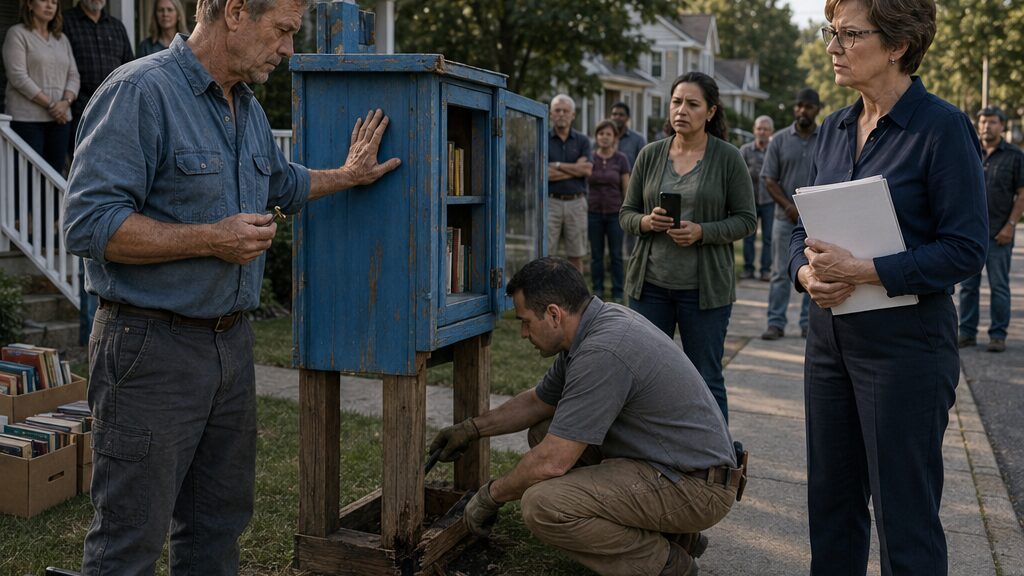
When the HOA Removed His Little Blue Library, the Neighborhood Had to Choose What Belonged
Chapter 1: The Morning They Came for the Blue Door
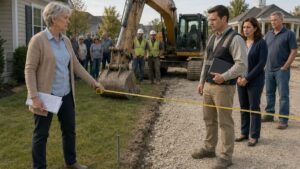
The contractor had already stretched his measuring tape across the little blue library before Jacob Harris finished unlocking it.
The yellow blade ran from one corner of the roof to the opposite post, bright against the faded paint. Jacob stopped with the key still turned halfway in the brass lock.
“You’re early,” he said.
The contractor glanced toward the sidewalk, where Barbara Mitchell stood beside a woman from the management company. Barbara wore pressed navy slacks and held a white folder against her ribs. Nothing about her looked accidental.
“We agreed on an inspection,” Jacob said.
“We agreed you would correct the violation,” Barbara replied. “The inspection is to document that you haven’t.”
Across the street, a sprinkler clicked over a trimmed lawn. The ordinary sound made the three people at Jacob’s curb seem more conspicuous.
Jacob turned the key and opened the blue door.
Inside, the shelves were crowded but orderly. Paperback mysteries leaned against picture books. A gardening guide had been placed sideways to support a row of thin children’s novels. Two folded scraps of notebook paper rested on the bottom shelf.
The contractor reeled in his tape.
“Setback’s short,” he said. “Eight inches from the sidewalk edge.”
“It’s been there six years,” Jacob answered.
Barbara’s expression did not change. “Age does not create approval.”
The management representative opened a tablet. “We have no architectural application on record.”
Jacob ran his thumb along the inside edge of the door. He had planed that edge twice, once after the wet spring and once after the summer heat swelled the cedar. The blue paint had worn thin where hundreds of hands had pulled it open.
“No one asked for an application when it went up.”
Barbara shifted the folder. “The association didn’t know it had been permanently installed.”
“You walked past it every week.”
“That isn’t the same as board approval.”
A child’s bicycle slowed at the corner. The rider looked toward the cabinet, saw the adults, and kept moving.
Jacob removed the two folded notes from the shelf.
One read: More dinosaur books please.
The other said: Do you have the next Moon Harbor book? I finished number three.
He folded them again and put them in his shirt pocket.
Barbara watched him. For a second, something in her face loosened, but the folder remained closed against her side.
“People use it,” Jacob said.
“I know.”
“Then this isn’t about whether it serves anyone.”
“It’s about whether every homeowner gets to build whatever they consider useful on association-controlled frontage.”
“The frontage is beside my property.”
“It is maintained by the association.”
Jacob looked at the grass around the two cedar posts. He had edged it himself every Saturday, though the landscaping fee arrived each month with the rest of his dues.
The contractor placed one hand against the cabinet’s side.
The structure shifted.
Not much. Less than half an inch. But Jacob heard the soft complaint from the lower frame.
The contractor pressed again.
A narrow black line opened where the bottom rail met the left post.
Barbara noticed it.
So did the management representative.
Jacob stepped forward. “Don’t push it.”
The contractor removed his hand. “Base is moving.”
“It needs a brace.”
“It needed one before today,” Barbara said.
Jacob closed the door, more firmly than he intended. The glass rattled.
Barbara opened the folder at last. “This is the final removal authorization. The compliance period ended Friday.”
“I received the notices.”
“You never responded.”
“I read them.”
“That is not a response.”
The words struck harder because they were true. Three envelopes sat unopened only in the technical sense—he had slit them, read every line, then placed them under the old repair estimate in his workshop. He had told himself he needed time to decide how to answer. Then he had told himself Barbara would eventually come speak to him as a neighbor instead of writing to him as a president.
Now she was doing both, and neither helped.
Ashley Rivera appeared at the end of the sidewalk carrying a stainless-steel watering can. She had probably been on her way to the flower bed by the community mailbox, but she stopped when she saw the measuring tape.
“What’s happening?” she asked.
Barbara turned slightly. “A compliance inspection.”
“For the library?”
“The structure.”
Ashley looked from Barbara to Jacob. “It’s a library.”
“It is an unapproved exterior structure.”
“That sounds like the same thing with worse intentions.”
“Ashley,” Jacob said quietly.
She ignored the warning in his voice. “My daughter gets books from here every week.”
Barbara closed the folder. “Then you understand why a loose base is a concern.”
Ashley’s anger faltered. “Loose?”
The contractor crouched near the left post and touched the cracked lower rail. His fingertip came away damp with darkened wood fibers.
“Water intrusion,” he said. “Maybe rot.”
Jacob felt the folded children’s notes against his chest.
“It can be repaired,” he said.
“Then why wasn’t it?” Barbara asked.
Ashley looked at him.
That was worse than Barbara’s question. Ashley’s face held no authority, only surprise.
Jacob bent and pressed his hand against the blue door. Beneath the paint, the wood was still sound. He had built the door first, on a winter afternoon when his wife sat on a stool in the workshop reading possible names from a legal pad. She had rejected every one that sounded too formal.
A door should invite people, she had said. Not make them feel they need permission.
Jacob lifted his hand.
“When?” he asked.
Barbara checked the document. “The contractor can return tomorrow at eight.”
Ashley stepped between the curb and the cabinet. “No. You don’t get to decide that before anyone else knows.”
“The board decided last week.”
“You held the discussion in executive session.”
“Because it involved enforcement.”
“It involved all of us.”
Barbara’s jaw tightened. “It involved one homeowner’s violation.”
Jacob looked at the cabinet again. The split at the base appeared wider now that he knew where to look.
“I’ll empty it,” he said.
Ashley turned. “Jacob.”
“I’ll take the books inside tonight.”
“That’s not what I mean.”
“I know.”
Barbara studied him, perhaps waiting for an argument, perhaps relieved there would not be one.
“The contractor will arrive at eight,” she repeated. “Anything left inside will be removed with the structure.”
Jacob nodded once.
The contractor gathered his measuring tape. The management representative saved her photographs. Barbara placed the authorization against the blue door long enough to apply a strip of clear tape.
The paper covered most of the glass.
Ashley waited until they were halfway down the sidewalk before speaking.
“You can appeal.”
“The deadline passed.”
“We can call a special meeting.”
“Not by tomorrow.”
“We can stand here.”
Jacob looked at the notice trembling against the glass whenever the morning breeze reached it.
“And then what?” he asked.
“Make them stop.”
He unlocked the door again and began stacking books in his arms.
Ashley stared at him as though his calm were a kind of betrayal.
“Why didn’t you tell anyone they were doing this?”
Jacob pulled out a picture book with a torn dust jacket and placed it on top of the stack.
“I didn’t need a crowd.”
“Maybe the library did.”
He carried the books toward his house without answering.
Behind him, the taped authorization fluttered against the little blue door.
The contractor would return at eight the next morning.
Chapter 2: He Took the Books Out Himself
The contractor raised the pry bar toward the blue frame, and Jacob caught his wrist before the metal touched the wood.
“Not like that.”
The contractor froze. He was younger than Jacob had realized the day before, broad-shouldered and uncomfortable beneath the attention gathering along the street.
“I’ve got to separate it from the posts,” he said.
“You’ll split the side panel.”
Barbara stood near the curb with the management representative. Two board members waited several feet behind them. Across the street, Ashley held her phone upright.
Jacob released the contractor’s wrist.
“I’ll take it apart.”
Barbara glanced at the time. “The work order includes labor.”
“Then he can carry it.”
The contractor looked toward Barbara, who gave a reluctant nod.
Jacob returned to the cabinet.
He had emptied the shelves before dawn. The books now filled three boxes inside his front hall, arranged by size because disorder made the room feel smaller. The little blue structure stood bare except for the taped notice on its glass.
Jacob peeled the notice away. The tape pulled a thin fleck of paint from the upper corner.
Ashley’s phone followed the motion.
“Could you put that down?” Jacob asked.
“People need to see this.”
“They’re already watching.”
Several neighbors stood on porches. One man had come out holding a coffee mug. A child in pajamas leaned against a screen door while an adult kept one hand on the child’s shoulder.
Ashley lowered the phone slightly but did not stop recording.
Jacob opened his toolbox on the grass. He chose a narrow punch and a small hammer, then positioned the punch beneath the brass hinge pin.
The first tap rang clearly in the morning air.
He tapped again.
The pin rose a fraction.
Someone across the street said, “This is ridiculous.”
Barbara answered without turning. “Please stay off the work area.”
Jacob continued until the hinge pin lifted high enough to grasp with his fingers. It resisted at the midpoint, where years of weather had roughened the brass. He rotated it slowly, feeling each catch.
When it came free, he placed it in his shirt pocket.
The door sagged against his other hand.
The contractor stepped forward, but Jacob shook his head. He lifted the blue door from the lower hinge and carried it to the porch, where he leaned it against the brick wall with the glass facing inward.
Without the door, the cabinet looked exposed. The empty shelves showed pale rectangles where books had protected the paint from sunlight.
Ashley raised the phone again.
Jacob returned with a cordless drill.
He removed the interior screws in an order no one else could see. Roof brace first. Upper shelf supports. Rear anchors. Each screw went into a divided plastic tray instead of the contractor’s bucket.
“You built it?” the contractor asked.
Jacob nodded.
“How long ago?”
“Six years.”
The contractor ran a hand over the cedar roof edge. “Still square.”
“The top is.”
Jacob crouched at the lower frame.
The damage was worse than it had looked the day before. Moisture had entered around one screw hole and traveled beneath the paint. When he pressed the corner with his thumb, the surface held, but the wood underneath gave like packed soil.
Barbara moved closer.
“That’s the section the inspection photographs showed,” she said.
“No,” Jacob replied. “It wasn’t this open then.”
“You knew there was movement.”
“I knew it needed work.”
Ashley lowered the phone. “How much work?”
Jacob fitted the drill bit into a darkened screw.
“Enough.”
“That isn’t an answer.”
“It’s the one I have.”
He backed the screw out. Its threads emerged coated with black pulp.
The contractor crouched beside him. “This base can’t be reused.”
“I know.”
The words quieted the sidewalk.
Barbara folded her hands over the white folder. Her face showed no satisfaction, only a guarded attention that irritated Jacob more than triumph would have.
Ashley stepped nearer. “You told me it could be repaired.”
“It can.”
“You just said the base can’t be reused.”
“The cabinet can. The base needs rebuilding.”
“Then why didn’t you rebuild it?”
Jacob placed the ruined screw in a separate compartment.
“Move back,” he said. “The weight’s coming off the posts.”
The contractor took one side while Jacob took the other. Together they lifted the cabinet body free. The wood shifted in Jacob’s hands with a familiar balance. He knew where the weight gathered beneath the roof, where the rear panel would flex, where his wife had insisted on a deeper shelf so oversized picture books would not be turned sideways.
For one moment, he considered telling them.
Not everything. Only that she had held the first door in place while he marked the hinges. That the blue came from paint left over after they rebuilt nursery shelves for a community donation room. That she had stocked the cabinet with books before the finish was fully cured because waiting another day seemed wasteful to her.
Instead, he said, “Keep the left side higher.”
The contractor obeyed.
They set the cabinet onto padded moving blankets in the truck bed.
From across the street, the empty posts looked absurdly small.
Ashley’s phone remained pointed at Jacob as he loosened the metal brackets. He could imagine the image without seeing it: an older man in a faded work shirt taking apart his own library while the HOA president watched.
A clean story.
The kind people could understand quickly.
The kind that left out the soft wood under his thumb.
When the final bracket came free, one of the posts tilted. Jacob caught it before it fell.
The child in the doorway called, “Where are the books going?”
Jacob looked over.
“My house for now.”
“Can we still borrow them?”
He saw the adult behind the child begin to pull them inside, embarrassed.
“Yes,” Jacob said. “Knock after four.”
The child nodded solemnly.
That was the only moment the watching neighbors softened.
Then Ashley crossed the grass toward him.
“I can organize a repair fund today.”
“No.”
“A petition, then.”
“No.”
“Why?”
Jacob brushed damp sawdust from his palm. “Because I said no.”
“That library wasn’t only yours.”
The sentence landed precisely where she intended.
Jacob closed the toolbox.
“It was on my property. I built it. I maintained it. I paid for it.”
“And everyone used it.”
“That doesn’t make it theirs.”
Ashley stared at him.
Barbara looked away first.
The contractor secured the cabinet with straps. The management representative wrote something on her tablet and asked Barbara where the structure should be stored.
“The landscaping company’s fenced lot until the board determines disposition,” Barbara said.
Jacob looked up. “Disposition?”
“Return, relocation, repair, or disposal.”
“You said removal. You didn’t say disposal.”
“I said the board would determine what happens next.”
Jacob stepped toward her. The neighbors grew quiet again.
“You don’t dispose of it.”
“Then submit a compliant proposal.”
“You already removed it.”
“Because the existing structure was unsafe.”
“You could have given me another week.”
“You had forty-five days.”
The number hung between them.
Ashley looked at Jacob, and he knew she was counting backward through all the mornings she had waved to him without knowing.
The truck pulled away with the blue cabinet strapped upright behind the cab. Jacob watched until the roof disappeared around the corner.
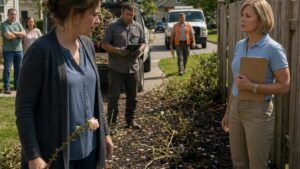
Only two cedar posts remained.
By noon, someone had placed three returned books in a grocery bag between them.
By three, Ashley’s video had spread through the neighborhood message board. The caption said: HOA forces widower to dismantle community library himself.
Jacob saw it because six people sent it to him.
He replied to none of them.
At dusk, he drove to the landscaping company’s lot.
The front gate was chained but not locked. A worker had told him by phone that the library would be stored under the metal awning near the mulch bins.
The awning was empty.
Only the padded blankets remained, folded on a pallet.
Jacob called the number again.
The worker answered after four rings.
“I’m standing where you said it would be.”
A pause followed.
“It was there at lunch.”
“It isn’t now.”
“No one was supposed to move it.”
Jacob touched the brass hinge pin in his pocket.
Behind the fence, the empty awning cast a long rectangular shadow.
The little blue library had disappeared.
Chapter 3: The Empty Posts Divided the Street
At seven Thursday morning, Ashley found twelve books stacked between the empty cedar posts.
They had been arranged carefully: hardcovers on the bottom, paperbacks in the middle, children’s books laid flat on top. A clear plastic sheet covered the stack against dew. On it, someone had placed a handwritten note.
RETURNED. PLEASE REOPEN SOON.
Ashley took a photograph, then stopped herself before posting it.
Across the street, Jacob’s blinds were open. His truck was gone.
Her phone had not stopped vibrating since the video spread. Some messages offered money. Others demanded Barbara’s resignation. One resident from a neighboring subdivision asked whether the library had been removed because it contained “political books.” Another claimed the HOA planned to ban yard decorations next.
The actual facts had become less interesting than the version people preferred.
Ashley carried the books onto Jacob’s porch and rang the bell anyway.
No answer.
She drove to the HOA management office shortly after it opened. Barbara was already there, seated at a conference table with Patrick Campbell and the management representative.
Ashley placed her phone on the table.
“Where is the library?”
Barbara’s eyes narrowed. “Good morning to you too.”
“It disappeared from the storage lot.”
Patrick looked at Barbara. “Disappeared?”
Barbara closed the file in front of her. “I ordered it moved to secure off-site storage after the video identified the location.”
“You moved it without telling Jacob?”
“The association has temporary custody of an abandoned noncompliant structure.”
“It wasn’t abandoned. You took it.”
“Removed under authority.”
“Where is it?”
“In a locked warehouse.”
Ashley laughed once, without humor. “You are hiding a box of children’s books like evidence.”
“The books were not inside.”
“You know what I mean.”
Patrick raised a hand. “The location should have been documented.”
“It is documented,” Barbara said.
“Shared with the treasurer?”
“It was an operational decision.”
Patrick leaned back. He was usually careful to sound neutral, but his silence now had edges.
Ashley looked between them. “Is it being destroyed?”
“No,” Barbara said. “Not at this time.”
“Then return it.”
“The board cannot reinstall a structure after receiving notice from the insurer.”
Ashley paused. “What notice?”
Patrick opened a separate folder. “The association’s carrier reviewed the inspection photographs. The cracked base, sidewalk proximity, and lack of approved anchoring created a premises-liability concern.”
“It stood there six years.”
“That does not make the risk imaginary.”
“It also didn’t fall on anyone.”
Patrick’s mouth tightened. “Last year, a resident tripped over an unapproved stone border near the east entrance. The claim raised our premium for every homeowner.”
Ashley remembered the special assessment notice but not the details. Barbara had described the increase as unavoidable market adjustment.
“You never said it was because of an unapproved structure.”
“It was discussed at the annual meeting,” Barbara replied.
“It was buried in a finance report.”
“The information was available.”
Ashley looked at Patrick. “Could Jacob have repaired the library?”
“Yes,” he said. “With engineering details, relocation to common property, and a maintenance agreement.”
Barbara turned toward him. “That was one possible path.”
“One you didn’t offer at the compliance hearing.”
“He did not attend the hearing.”
“You could still have put it in writing.”
Barbara’s fingers flattened against the closed file. “We sent him three notices requesting an application.”
“That isn’t the same thing.”
“No,” Barbara said. “It is the procedure everyone else follows.”
Ashley heard the exhaustion beneath her precision and disliked it because it made anger harder to keep clean.
She picked up her phone.
“I’m calling a neighborhood vote.”
“There is no resident vote that can override architectural requirements,” Barbara said.
“Not to override them. To replace the library properly.”
Patrick looked interested despite himself. “On common property?”
“Across from Jacob’s house. The green near the mailboxes.”
“That space has irrigation lines.”
“Then we work around them.”
“You need a site plan, accessible approach, maintenance funding, insurance approval—”
“Fine.”
“And board approval,” Barbara added.
Ashley met her eyes. “Then vote no in public.”
By noon, the neighborhood message board had split into camps.
One group wanted Barbara removed immediately. Another insisted the library had become an excuse to ignore rules. Several residents supported a replacement but objected to paying for it. One person suggested a weatherproof bookshelf inside the clubhouse. Another replied that the clubhouse was locked most of the week, which proved the point.
Ashley created a voluntary poll:
Should the neighborhood pursue a larger, permitted lending library on common property, funded by donations and maintained by residents?
By two o’clock, seventy-three households had voted yes.
Eleven voted no.
Twenty-eight did not respond.
Jacob finally returned home shortly before three. Ashley saw his truck and crossed the street before he reached the porch.
“I found out where they took it.”
He unlocked his front door. “I know.”
“You know?”
“Barbara called.”
“She called you?”
“She gave me the warehouse address.”
Ashley followed him inside without being invited.
Three boxes of books lined the hallway. The house smelled faintly of sawdust and coffee. On a small table beside the stairs sat a packet of repair estimates, their corners curled from handling.
Ashley picked up the top page.
Base reconstruction, weatherproofing, post replacement, relocation labor: $3,840.
The estimate was dated two months earlier.
She looked at him. “You knew.”
Jacob removed his keys from his pocket.
“I knew it needed work.”
“You knew before the violation deadline.”
“Yes.”
“Why didn’t you tell me?”
He set the keys down. “Why would I?”
“Because I offered help yesterday.”
“Yesterday was too late.”
“I would have helped two months ago.”
He looked toward the boxes.
“That was not your responsibility.”
Ashley held up the estimate. “Apparently it wasn’t yours either. You didn’t fix it.”
His face changed, not with anger at first, but with something smaller and more tired.
“Put that down.”
“You let everyone think Barbara was lying about the damage.”
“I never said she was lying.”
“You didn’t say she was right.”
“She wasn’t right about everything.”
“That doesn’t answer why you kept this secret.”
Jacob took the estimate from her and placed it beneath the others.
“The library is not a neighborhood campaign.”
“It became one when they took it away.”
“No. You made it one when you posted that video.”
Ashley folded her arms. “People deserved to see what happened.”
“They saw half of it.”
“Then tell them the other half.”
He looked directly at her.
“No.”
The refusal was so calm that she nearly missed its force.
“You would rather let people fight over a lie?”
“I would rather not have my life turned into something strangers pass around for thirty seconds.”
“This isn’t only about you.”
“There it is again.”
“What?”
“Everyone says it belongs to the neighborhood when they want a book. When the paint peels, when the latch freezes, when water gets under the base, it belongs to me.”
Ashley had no answer ready.
A knock sounded at the open door.
A retired woman stood on the porch holding two more books. Behind her, a father waited with a child Ashley recognized from the next street over.
“We heard returns were going here,” the woman said.
Jacob moved the nearest box aside and accepted the books.
The father cleared his throat. “We don’t live in this section, but my son reads the series you keep.”
The child held up a paperback with a spaceship on the cover.
“Number four,” he said. “Do you have five?”
Jacob looked into the second box, found the next book, and handed it over.
The boy smiled.
For a moment, the hallway became the library.
After they left, Ashley opened the poll on her phone and showed Jacob the result.
“Seventy-three yes votes.”
He barely looked.
“For what?”
“A larger library on the common green. Proper foundation. Volunteer maintenance. No charge to the HOA.”
“You started this without asking me.”
“I asked whether you wanted help.”
“That isn’t the same as asking whether you could replace something I built.”
“It wouldn’t replace what you built. It would replace what the neighborhood lost.”
Jacob’s mouth hardened.
Ashley recognized then that the argument was not about size, permits, or money. Not entirely.
She stepped toward the door.
“The vote closes tonight,” she said. “I’m ordering it tomorrow if we meet the donation goal.”
“You don’t even have approval.”
“I have enough people willing to demand it.”
“That is not approval.”
“You sound like Barbara.”
The words struck, and Ashley regretted them before Jacob turned away.
That evening, donations exceeded the cost of the prefabricated structure Ashley had found: cedar siding, double glass doors, accessible shelves, and a peaked roof broad enough to keep rain from the entrance.
She placed the order.
At 9:16 p.m., the confirmation email arrived.
Delivery scheduled: Saturday, 9:00–11:00 a.m.
Ashley stared at the photograph of the new library. It was nearly twice the size of Jacob’s cabinet.
Beneath the image, a warning appeared in smaller print:
Customer is responsible for permits, foundation preparation, unloading access, and installation authorization.
Chapter 4: The Larger Library Could Not Be Installed
The delivery truck turned onto the street at 9:07 Saturday morning carrying a library large enough for a person to stand inside.
Its peaked cedar roof rose above the cab. Double glass doors reflected the houses as the truck rolled past them, and three rows of unfinished shelves were visible through the panes. Neighbors emerged from driveways and porches before the driver reached the common green.
Ashley stood beside the curb with a clipboard, a roll of orange marking flags, and the bright, exhausted look of someone whose plan had finally become real.
Jacob watched from his workshop window.
The old blue door rested on two padded brackets above his bench. Its brass hinge pin lay beside the repair estimate, where he had placed it after returning from the storage warehouse. Barbara had allowed him to collect the door and hardware, but not the cabinet body. The association still held that under lock.
Outside, the truck’s reverse alarm began to beep.
Jacob slipped the hinge pin into his pocket and walked across the street.
Ashley was directing the driver toward the edge of the green.
“Closer to the path,” she called. “We want the doors facing the sidewalk.”
The delivery driver lowered the stabilizers. “Who’s signing for it?”
“I am.”
“And who approved the installation?”
Ashley glanced toward the gathered residents. “The neighborhood voted.”
“That isn’t what he asked,” Jacob said.
She turned. “Good morning.”
“Do you have a permit?”
“We’re not pouring a building foundation. It sits on skids.”
“It weighs twelve hundred pounds.”
“The manufacturer says it can be anchored.”
“To what?”
Ashley pointed toward four orange flags. “We’ll set concrete footings there.”
“You marked over an irrigation line.”
Her expression changed. “How do you know?”
“I repaired that line after the freeze three years ago.”
The driver looked down at the flags. “I can leave it curbside, but I’m not unloading onto an unprepared site.”
A few residents began speaking at once.
“We can move the flags.”
“Set it on blocks for now.”
“The whole point is to get it here before the board interferes.”
Barbara stood at the far side of the green with Patrick and the management representative. She had not approached the truck, but her presence held the edge of the crowd as firmly as a barrier.
Ashley raised her voice. “The board has had two days to respond to the request.”
Patrick called back, “Two days is not an approval period.”
“You found time to remove the old one overnight.”
“It was removed in daylight,” Barbara said.
“That isn’t the point.”
Jacob stepped toward the driver. “Don’t unload it.”
The crowd quieted.
Ashley stared at him. “Excuse me?”
“You heard me.”
“This is for the neighborhood.”
“Then the neighborhood should not start by putting another unapproved structure on common property.”
Someone near the mailboxes muttered, “He’s siding with her now.”
Jacob looked toward the voice but could not tell who had spoken.
Ashley folded the clipboard against her chest. “You said people shouldn’t turn your life into a thirty-second story. Fine. I didn’t post anything else. But seventy-three households voted for this. They paid for it.”
“They paid for a cabinet. Not permission to install it.”
“You knew it was coming.”
“I knew last night.”
“You could have called me.”
“You didn’t call before ordering it.”
The driver climbed down from the truck and opened the equipment compartment beneath the bed. “I need a decision. I’ve got another delivery at noon.”
Ashley lowered her voice. “Jacob, this is the moment everyone has been waiting for.”
“That’s what worries me.”
She looked at the enormous library suspended above the truck bed. Its clean cedar siding glowed pale gold in the sun. The doors had new brass hinges, bright and uniform. There was no blue anywhere.
“You think I did this to embarrass Barbara,” she said.
“I think that helped.”
Her face tightened.
A resident behind her called, “Why should we care if Barbara is embarrassed?”
Jacob turned toward the group.
“Because embarrassment is not a foundation.”
The sentence produced an uneasy silence.
He walked to the truck and placed his hand against one of the cedar skids. The construction was solid, but the underside was raw wood.
“No flashing,” he said.
The driver nodded. “Customer handles site preparation.”
“No ventilation under the base either. Set this on wet soil and you’ll have the same problem in a few years.”
Ashley’s anger gave way to confusion. “The same problem?”
Jacob looked across at Barbara. She remained still.
He had spent two days letting other people tell the clean version. Barbara had removed a harmless library. Jacob had been wronged. Ashley had answered with something bigger.
He pulled the repair estimate from his jacket pocket.
“The old base was rotten,” he said.
Several neighbors shifted.
Ashley looked at him sharply. “They know it was damaged.”
“They don’t know I knew two months ago.”
He unfolded the estimate.
“I asked for a quote. New posts, rebuilt lower frame, waterproofing, relocation. Thirty-eight hundred forty dollars.”
A woman near the sidewalk said, “We would have helped.”
“I know.”
“Then why didn’t you ask?”
Jacob pressed the fold flat against his palm.
“Because I built it. Because I maintained it. Because every time something failed, I fixed it before anyone noticed.”
“That doesn’t answer the question,” Ashley said.
“It does for me.”
The driver checked his watch.
Barbara finally crossed the grass. “There is another issue.”
Ashley gave a bitter laugh. “Of course there is.”
“The green is association common property,” Barbara said. “Any structure placed here becomes an association asset unless a separate ownership and maintenance agreement is approved.”
“So approve one.”
“The board has not reviewed the design, insurance exposure, accessibility, drainage, or landscaping impact.”
“You reviewed Jacob’s cabinet fast enough.”
“We reviewed it after years of neglect.”
Jacob looked at her. “Not neglect.”
Barbara held his gaze. “Deferred repair, then.”
The correction was small, but deliberate.
Patrick opened a folder. “There may be a compliant path. The county treats a structure of this size differently from the original cabinet. We need confirmation on setback and accessible reach ranges. The insurer wants a maintenance schedule and a named responsible entity.”
Ashley looked around at the donors and voters. “We are the responsible entity.”
“No,” Patrick said. “Right now you are a group of residents who bought something together. That is not the same thing.”
The truck’s hydraulic lift whined as the driver tested the controls. The giant library shifted several inches toward the rear.
Excitement moved through the crowd despite the argument.
Jacob saw the old story forming again. A visible object. A public standoff. Someone would film the moment the library touched the grass, and by evening it would become proof that the neighborhood had defeated the HOA.
He reached into his pocket and withdrew the old brass hinge pin.
The metal was dull from years of weather and the pressure of his fingers.
Ashley noticed it. “What is that?”
“From the blue door.”
She looked from the pin to the unfinished replacement. “We can use it.”
“Maybe.”
“Then let them unload.”
“No.”
The driver stopped the lift.
Ashley’s voice dropped. “You would rather send it back?”
“I would rather it come back right.”
A man in the crowd said, “This is unbelievable.”
Another added, “First Barbara takes it. Now Jacob blocks the replacement.”
Jacob let the complaints pass.
“I’m not signing for it,” he told the driver.
Ashley stepped closer. “I am.”
“Then sign for curbside storage, not installation.”
The driver nodded. “I can place it on the paved overflow area for seventy-two hours. After that, storage charges begin.”
Ashley looked toward Barbara. “Will the board meet before then?”
Barbara answered after a pause. “I can call an emergency design review Monday morning. No promise of approval.”
“That’s something,” Patrick said.
“It’s delay,” a resident replied.
“It is also the first legal step anyone has taken,” Jacob said.
The words turned the crowd against him more sharply than anger would have. People began to drift away, some shaking their heads. The victory they had come to witness had become paperwork, responsibility, and an invoice.
The driver unloaded the library onto timber blocks in the paved overflow area. It stood taller than the nearby mailbox shelter and nearly twice as wide as Jacob’s original cabinet. Its glass doors reflected the two empty posts across the street.
When the truck left, Ashley remained beside the structure.
“You could have told me about the estimate,” she said.
“You could have told me you were ordering this.”
“I was trying to help.”
“I know.”
“That doesn’t make it better.”
“No.”
She looked at the hinge pin in his hand. “Was the old library hers?”
Jacob’s fingers closed around the brass.
Before he could answer, Janet Young approached from the sidewalk carrying a cream-colored envelope.
She stopped in front of him.
“I should have given you this before now,” she said.
Jacob recognized his late wife’s handwriting immediately.
On the front, beneath his name, she had written:
For when the library needs more hands.
Chapter 5: The Promise Was Never His Alone
The envelope remained sealed until Jacob placed it beneath the blue door in his workshop.
He stood at the bench with Janet beside him, listening to the muffled voices outside. Residents were still gathering around the oversized library on the overflow pavement. Every few minutes, a car slowed to look.
His wife’s handwriting slanted across the envelope exactly as it had on grocery lists, birthday cards, and the masking-tape labels she used on boxes. The final word—hands—tilted upward as though she had run out of room but refused to make it smaller.
“You had this?” Jacob asked.
Janet lowered herself onto the workshop stool. “She gave it to me.”
“When?”
“Three weeks before she went into hospice.”
The word made the room contract.
Jacob touched the envelope’s edge. “Why didn’t she give it to me?”
“She tried.”
He looked up.
Janet folded her hands over the head of her cane. “You told her you didn’t want plans made around you. You said you could handle the house, the bills, and the library.”
“I don’t remember that.”
“I do.”
The workshop smelled of cedar dust and machine oil. Above them, the blue door hung on its brackets like a removed piece of wall.
Janet continued carefully. “She asked me to keep the envelope until the library needed more hands.”
“It needed them before today.”
“Yes.”
“Then why wait?”
Her eyes sharpened. “Because you asked me to.”
Jacob said nothing.
“After the first violation notice,” Janet said, “I offered to bring it over. You told me Barbara was making noise and you would take care of it.”
“That was not permission to hide my wife’s letter.”
“No. It was cowardice on my part.”
The bluntness stopped him.
Janet looked toward the blue door. “I thought protecting your privacy was kindness. Then I watched you take that cabinet apart in front of half the neighborhood.”
Jacob slid one finger under the envelope flap.
The paper opened with a soft tear.
Inside was a single folded sheet and a small paint sample card. He recognized the blue before he unfolded anything.
The letter was short.
His wife had written that the library should never become another burden Jacob carried alone. She wanted him to form a neighborhood stewardship group after her death: several keyholders, a small repair fund, scheduled checks after storms, and permission to move or rebuild the structure if the original location stopped serving people safely.
Near the bottom, she had added:
You built the first box. That does not mean every box after it has to be yours. Let them change it when they need to. The promise was books within reach, not wood in one shape.
Jacob read the sentence twice.
Janet did not ask what it said.
He set the page down and picked up the paint card.
“Nursery shelves,” she said.
He looked at her.
“The community donation room at the old school. Remember? We painted those shelves and had half a gallon left.”
Jacob remembered the blue on his wife’s wrist. The way she had held up the can and said cheerful colors should not be wasted in storage. He had wanted a dark stain for the library. She had painted one square blue and left it overnight where he would have to look at it.
By morning, he had agreed.
“It wasn’t even chosen for the library,” he said.
“She chose it because children already knew it.”
Outside, someone knocked on the new library’s glass door, testing the sound.
Jacob looked up at the old blue door. He had spent six years preserving the object and telling himself he was preserving the promise. The letter made the distinction plain enough to feel cruel.
“She knew I wouldn’t do it,” he said.
“She knew you might need time.”
“Six years?”
Janet’s face softened. “She knew you.”
He folded the letter along its original crease.
On Sunday, Jacob drove to Janet’s house.
She had arranged three binders across her dining table: school-library records, neighborhood correspondence, and old HOA notices. She had always organized grief by giving it tabs.
Patrick had sent her copies of public board materials after she requested them. Among them was a relocation recommendation dated five weeks earlier.
The proposal allowed Jacob to move the library to the common green, provided he rebuilt the base, transferred maintenance responsibility to a resident committee, and obtained insurance approval.
At the bottom were signature lines for Barbara, Patrick, and one additional board member.
Patrick had signed.
Barbara had not.
“This never went to the full board,” Janet said.
Jacob turned the pages. “Where did you get it?”
“Patrick sent it this morning.”
“Why?”
“Because he thinks Tuesday’s emergency design review is going to become a fight about more than the new cabinet.”
Jacob read Barbara’s handwritten note in the margin:
Delay. Current enforcement matter should be resolved before exceptions are considered.
“An exception,” he said.
“That is how she saw it.”
“She could have offered this before removal.”
“Yes.”
“And I could have answered the notices.”
Janet leaned back. “Both can be true.”
Jacob disliked the sentence because it left him nowhere clean to stand.
On Monday morning, he attended the emergency design review.
The larger library remained on timber blocks outside the clubhouse windows. From the conference room, it looked less triumphant than stranded.
Ashley sat at the far end of the table with donation records, the manufacturer’s specifications, and a list of twenty-one volunteers. She did not greet Jacob.
Barbara opened the meeting by reading the architectural requirements.
The library needed an approved common-property license, accessible placement, drainage clearance, anchors designed for local wind loads, and a maintenance agreement. The insurer would not extend coverage until ownership was resolved.
“We can meet all of that,” Ashley said.
“Not in seventy-two hours,” Barbara replied.
“The delivery company gave us until Tuesday afternoon before fees begin.”
Patrick turned to Jacob. “Do you intend to participate in the maintenance committee?”
Everyone looked at him.
The old answer rose first: he built things; he did not join committees about them.
Then he felt the folded letter inside his jacket.
“Yes,” he said. “But not as owner.”
Ashley’s expression shifted.
Barbara looked down at her notes. “The association would need to accept the asset.”
“Or a resident stewardship group could hold it under license,” Patrick said.
Barbara’s voice cooled. “That structure was discussed but never approved.”
Jacob placed the relocation recommendation on the table.
“Why not?”
No one spoke.
Barbara stared at the document.
Ashley reached for it, but Jacob kept his hand on the page.
“You had a way to move the old library before removing it,” he said.
“It was a preliminary draft.”
“Patrick signed it.”
“It had not been reviewed for legal sufficiency.”
“You wrote ‘delay.’”
Barbara’s eyes lifted to his. “Because your violation was active, and offering a special relocation during enforcement would have looked like preferential treatment.”
“To whom?”
“To every homeowner who has complied without being offered a custom solution.”
Jacob thought of the cracked base, the unopened envelopes, and the estimate hidden under papers in his workshop.
“You were afraid it would look like you had lost control.”
Barbara’s face tightened.
“That is not an appropriate characterization.”
“It is still true.”
Ashley took the document from beneath Jacob’s hand and read it.
“You let them remove it when you already had another option.”
Barbara closed her folder. “The meeting is adjourned until the board can consult counsel.”
“No,” Jacob said.
Barbara looked at him sharply.
“You do not get to move this into another closed discussion.”
“This meeting has a defined purpose.”
“Then I’m defining the next one.”
He took out his wife’s letter, though he did not unfold it.
“I want a special membership meeting. Tuesday evening.”
Barbara gave a short, disbelieving breath. “You cannot unilaterally call one.”
“The bylaws allow a petition from twenty percent of households.”
Ashley’s anger paused long enough for interest to enter.
Jacob turned toward her.
“You have seventy-three votes.”
“For the library.”
“Ask them whether they want a meeting.”
Patrick opened the bylaws binder. “The petition can specify board conduct, common-property approval, and enforcement review.”
Barbara looked from Patrick to Jacob.
“This is becoming a public trial.”
“It does not have to be,” Jacob said.
He gathered the relocation proposal, then left his own repair estimate on the table.
Ashley looked at it.
“What is that?”
“My part.”
He wrote the requested agenda before leaving the room.
The first item named Barbara’s decision to suppress the relocation option.
The second listed the removal procedure and temporary seizure of the original cabinet.
The third named Jacob’s failure to disclose known structural damage and his repeated refusal to respond to compliance notices.
Ashley read the page in silence.
Jacob signed the meeting request at the bottom.
Chapter 6: The Meeting Where No One Was Fully Innocent
“The original library was unsafe,” Jacob said before anyone could demand Barbara’s resignation.
The clubhouse had reached standing-room capacity. Residents lined the back wall and filled folding chairs between the tables. The large replacement library remained outside beneath temporary weather covering, visible through the windows like a witness that could not enter.
Barbara sat at the board table with Patrick and the other board members. A petition bearing eighty-one household signatures lay in front of them.
Ashley occupied the first row. Janet sat beside her with Jacob’s wife’s letter inside a clear sleeve.
Jacob stood at the public-comment microphone.
He removed the brass hinge pin from his pocket and placed it on the table beside the microphone base.
The small piece of metal made almost no sound.
“I had a repair estimate two months before the removal,” he continued. “I knew the base was deteriorating. I did not submit an application, respond to the hearing notice, or ask the neighborhood for help.”
A murmur spread across the room.
Someone near the back said, “That doesn’t excuse what they did.”
“No,” Jacob replied. “It explains part of what happened.”
Barbara’s posture remained rigid, but her attention did not leave him.
Jacob unfolded the estimate.
“I could not afford the repair without using money I had set aside for the house. I told myself I would solve it when I found a less expensive way. The truth is, I did not want anyone else making decisions about the library.”
Ashley looked down.
“I built it with my wife,” Jacob said. “After she died, I treated every change as if it erased something. That was my mistake. People used the library, but I kept its problems private and called that responsibility.”
He placed the estimate beside the hinge pin.
A resident raised a hand. “Are you saying the HOA was right?”
“I am saying a damaged structure should have been repaired or moved.”
Barbara’s shoulders eased almost imperceptibly.
Jacob continued. “I am also saying the board had a relocation proposal and chose not to present it.”
The room changed.
Patrick opened his folder.
Barbara spoke before he could. “The proposal was incomplete.”
“It was incomplete because it was stopped,” Patrick said.
He removed the unsigned recommendation and placed copies before the board members.
“I drafted this after the insurer’s first response,” he said. “It proposed relocation to common property, a rebuilt base, and a resident maintenance group. I signed it. The board president requested that it be held until enforcement was complete.”
Barbara looked at him. “You agreed that unresolved enforcement created complications.”
“I agreed it created complications. I did not agree that removal was the only option.”
The audience began talking over itself.
Ashley stood. “You hid a compromise because you wanted to win.”
Barbara turned toward her. “Sit down until recognized.”
“No.”
“Ashley,” Jacob said.
She looked at him, furious.
“Let her answer,” he said.
Barbara’s fingers closed around a pen.
“The association was facing an insurance renewal,” she began. “Last year, a resident fell over an unapproved stone border near the east entrance. The border had been tolerated for years. No one knew who installed it. No maintenance record existed. The claim was not large, but the insurer concluded that the board had failed to enforce common-area restrictions consistently.”
Patrick added quietly, “Our premium increased twenty-eight percent.”
Barbara continued. “Owners accused the board of hiding the cause. Two directors resigned. I signed the renewal certification stating that we had corrected our enforcement procedures.”
A man in the second row called, “So you made an example of Jacob.”
Barbara’s face tightened. “I enforced a documented violation.”
“You removed it early,” Ashley said.
“The compliance period had expired.”
“You moved it from the storage lot after the video.”
“To prevent damage or unauthorized retrieval.”
“You withheld the relocation plan.”
Barbara paused.
That pause did more damage than any accusation.
“When the proposal reached me,” she said, “I believed offering a custom solution after repeated noncompliance would undermine the enforcement certification and invite challenges from other owners.”
Patrick looked at her. “You also knew the full board might approve it.”
“Yes.”
The room went silent.
Barbara set down the pen.
“I believed that would expose the association to another claim of selective treatment. I also believed it would demonstrate that I no longer had the board’s confidence.”
There it was—not an excuse, but the pressure beneath the rule.
Jacob looked at her across the crowded room. He could see the point at which fear had become choice.
“You protected your position,” he said.
“I protected what I believed was necessary to keep the association insurable.”
“And your position.”
Barbara did not answer.
A resident moved that she be removed immediately as president and from the board. Several voices seconded the motion before Patrick struck the table with the flat of his hand.
“This is not a trial by volume,” he said. “We have bylaws.”
The same people who had mocked procedure three days earlier now demanded that it punish someone quickly.
Jacob picked up the hinge pin.
“What happens to the library if she is removed tonight?”
Ashley turned. “We elect someone else.”
“And the permit?”
“Patrick can handle it.”
Patrick shook his head. “Not alone.”
“The maintenance agreement?”
“We sign it.”
“Who owns the structure?”
“The neighborhood.”
“That is not a legal answer.”
Frustration moved through the room again.
Jacob understood then how easily a crowd could inherit Barbara’s worst habit: treating certainty as authority.
Patrick opened another document.
“The board can conditionally approve the new library tonight,” he said. “But only if ownership transfers either to the association or to a formally recognized stewardship group. The insurer will not cover a privately owned structure on common property.”
Ashley looked at Jacob.
The room followed her gaze.
Patrick continued. “Because the replacement was purchased through resident donations but ordered under Ashley’s name, she must assign the purchase. Jacob must also release any claim that the new structure is a continuation of his personal library. The old cabinet remains his property once storage and inspection costs are resolved.”
Jacob felt the letter in his jacket.
The promise was books within reach, not wood in one shape.
“What does the stewardship agreement require?” he asked.
“Five keyholders. Quarterly inspection. A repair reserve. Written authority to modify, relocate, or replace the structure when safety or access requires it.”
Each condition loosened something he had spent years tightening.
Ashley stood beside him. “I’ll assign the purchase.”
Patrick looked at Jacob. “And you?”
Barbara watched without expression.
Jacob took the transfer document.
The signature line described him as Original Steward and Donor of Reusable Components. Not owner. Not sole builder. Not guardian.
He signed.
Janet released a breath behind him.
The room did not applaud. Some residents were still angry. Others were reading the proposed budget. One person objected to the reserve contribution. Another wanted clarification about donated books and inappropriate material. Practical responsibility entered the space where righteous simplicity had been.
Patrick accepted the signed page.
“The conditional approval passes to the board.”
The vote was four in favor, one abstention. Barbara voted in favor.
Then came the motion concerning her position.
Ashley looked at Jacob. “You should say something.”
“I already did.”
“You started this meeting.”
“I started it to tell the truth.”
“You don’t care whether she stays?”
“I care. I’m not voting.”
“Why?”
“Because I don’t want accountability confused with what I want done to her.”
At the board table, Barbara heard him.
The members voted to remove her as president pending a governance review, but not to remove her from the board. Her authority over compliance matters was suspended. Patrick would serve as acting chair.
The result satisfied almost no one completely.
Barbara closed her folder.
Before leaving, she stopped beside Jacob.
“You could have made tonight easier for yourself,” she said.
“So could you.”
Her eyes moved to the hinge pin in his palm.
“Will that fit the new door?”
“No.”
“Then why keep it?”
Jacob looked through the window at the covered cedar structure outside.
“It may fit somewhere else.”
Barbara nodded once and walked away.
Patrick brought the final stewardship agreement to Jacob. Five blank lines waited for keyholders.
Jacob signed the first line.
Ashley signed the second.
Janet signed the third.
Patrick added his name to the fourth.
The fifth remained empty.
Jacob slid the paper back across the table.
For the first time since the blue cabinet had been removed, the unfinished space did not feel like something stolen from him.
It felt like a place someone else would have to step into.
Chapter 7: More Than One Person Held the Key
Jacob arrived at the common green carrying the old blue door and found three people already holding keys.
Ashley stood beside the new library with a ring of labeled brass tags. Janet had one key looped through a red ribbon around her wrist. Patrick was testing the lockbox mounted beneath the rear eave, reading the combination instructions twice before closing it.
The fifth keyholder line on the stewardship agreement had been filled sometime during the six weeks since the meeting.
Jacob did not ask whose name was there.
He set the blue door carefully on two padded sawhorses.
The new library no longer looked stranded. It rested on a raised concrete pad with a narrow accessible path curving from the sidewalk. The cedar siding had been sealed against rain. Small vents had been cut beneath the roofline, and steel anchors disappeared through the skids into the foundation.
Someone had installed a low return slot within a child’s reach.
Someone else had placed a temporary paper sign inside the glass:
Books coming Saturday.
Ashley noticed Jacob looking at it. “Janet made the sign.”
“I used removable tape,” Janet said.
“That was not what I was checking.”
“I know.”
The exchange drew a small smile from Patrick, who returned to the lockbox.
Jacob opened the tool case at his feet. Inside were chisels, a block plane, a cordless drill, and the old brass hinge pin wrapped in cloth.
Ashley looked at the blue door. “You’re sure about cutting it?”
“No.”
“That isn’t reassuring.”
“It is honest.”
The original door could not fit the new cabinet. It was too narrow, too shallow, and built for hinges that had no place on the thicker frame. For two weeks, Jacob had tried to design a way to mount it inside without making it decorative clutter.
He had finally settled on turning it sideways beneath the lowest bank of shelves. The glass would be removed. The frame would become a blue panel behind the children’s section, with the old brass hinge pin set through a small recessed block along one edge.
Not a working door.
Not a centerpiece.
A piece of the structure.
Ashley rubbed her thumb over one worn corner. “People expected it outside.”
“People expected a lot of things.”
“They donated because of that door.”
“They donated because they wanted a library.”
She watched him mark the first cut.
“That sounds like something you practiced saying.”
“It is something my wife wrote.”
Ashley’s expression softened, but Jacob lowered the saw before sympathy could settle over the work.
The first cut released the dry scent of old cedar.
As he trimmed the upper rail, a landscaping contractor checked the irrigation heads near the pad. Patrick reviewed the maintenance checklist with two unnamed volunteers. Janet sorted donated books into plastic bins beneath the mailbox shelter.
No one waited for Jacob to direct them.
The absence of that need felt wrong before it felt useful.
A child approached the sawhorses and stopped a careful distance away. It was the boy who had borrowed the fifth Moon Harbor book from Jacob’s hallway.
“Is that the old library?” he asked.
“Part of it.”
“Why is it flat?”
“I took the glass out.”
“Why?”
“So no one breaks it with a book.”
The child considered this. “Are you putting it on the front?”
“No.”
“Why not?”
Jacob looked toward the new structure. The unfinished blue panel would sit inside, behind the shortest shelf, visible only when someone opened the glass doors.
“Because the front belongs to the new library.”
The child frowned. “But blue was the important part.”
Jacob rested the block plane against the sawhorse.
“It was important to the old one.”
“Isn’t this the same library?”
Around them, work continued. A drill whirred at the rear vent. Janet called for someone to carry a bin of picture books. Ashley was showing a volunteer how to record damaged covers before discarding them.
Jacob turned the old hinge pin between his fingers.
“It is the same promise,” he said. “Not the same box.”
The child looked unconvinced.
Jacob held up the trimmed blue panel. “See this edge?”
The paint was worn pale where years of hands had opened the old door.
“That part stays.”
“Inside?”
“Inside.”
“Then people won’t see it unless they open the doors.”
“That is how libraries work.”
The child accepted that more readily than Jacob had expected.
By noon, the panel was secured behind the children’s shelves. Jacob fitted the old brass hinge pin into a recessed wooden channel along its left edge. It served no mechanical purpose, but it held the panel exactly where the door’s first hinge had once been.
Ashley stood outside and studied the result through the glass.
“It looks smaller in there.”
“It is smaller in there.”
“I meant emotionally.”
Jacob closed the drill case. “You can still see it.”
“You have to come close.”
“Yes.”
She nodded slowly. “Maybe that’s better.”
The first books went onto the shelves after lunch.
Janet handled the arrangement with the seriousness of a formal opening. Picture books low. Adult fiction higher. Gardening, repair, and cooking on the right. A narrow shelf remained empty for requested titles.
Patrick attached the inspection log inside the maintenance compartment. Each page had spaces for weather damage, loose fasteners, moisture, cleanliness, and follow-up action.
Jacob read the columns.
“No place for ‘still square,’” he said.
Patrick looked at him. “Should there be?”
“No. If it isn’t square, write the measurement.”
Patrick smiled. “I knew inviting a cabinetmaker would complicate the form.”
“You invited yourself.”
“That is also documented.”
Cars slowed along the street. Residents crossed over carrying boxes, tote bags, and paper sacks filled with books. No crowd formed. People came, left donations, asked practical questions, and moved on.
There were no speeches.
Jacob preferred it that way.
Near three o’clock, Barbara appeared at the edge of the green.
She wore jeans and a gray blouse instead of board clothes. She carried a manila folder but no white enforcement binder.
Conversation thinned without stopping.
Barbara approached Patrick first and handed him the folder.
“Final accessibility sign-off,” she said. “The county clerk corrected the site description.”
Patrick opened it. “And the insurance endorsement?”
“Inside.”
Ashley watched from the doors of the library. “You handled that?”
Barbara looked toward her. “I had already started the applications.”
“Before you stepped down?”
“Yes.”
“Why didn’t you say so?”
“There was no approval to announce.”
The answer sounded like the old Barbara, but without the authority that had once sharpened it.
Patrick checked the documents. “Everything is complete.”
Barbara nodded.
She did not ask to be thanked. She did not apologize again. At the governance review, she had admitted withholding the relocation option and accepted removal from the presidency. The board had restricted her from unilateral enforcement decisions for the remainder of her term.
Some residents still wanted her gone.
Others had begun speaking to her again.
Neither result looked like victory.
Barbara moved closer to the library and opened one glass door. The old blue panel appeared behind the children’s books.
“You used it,” she said.
“Part of it,” Jacob replied.
Her eyes found the brass hinge pin.
“That fit somewhere else after all.”
“Yes.”
She closed the door carefully.
Ashley came over carrying the stewardship agreement and a small key ring.
“We still have one issue,” she said.
Patrick joined them. “The fifth keyholder.”
Jacob looked at the signature page.
The final line now read:
Barbara Mitchell — maintenance lockbox access only.
Barbara’s face tightened. “I did not sign that.”
“No,” Patrick said. “The committee nominated you.”
Ashley held out the key. “The lockbox key doesn’t open the library doors. It gives access to inspection forms, sealant, spare screws, and the emergency contact list.”
Barbara did not take it.
“You want me maintaining the thing I removed?”
“I want someone who reads every requirement,” Ashley said. “Even the ones people wish would disappear.”
“That sounds less like trust than supervision.”
“It can be both.”
Barbara looked at Jacob.
He understood what she was asking. Not whether the committee had voted. Not whether the arrangement was legally allowed.
Whether he wanted her hands anywhere near the library.
Six weeks earlier, he would have mistaken refusal for dignity.
Now he took the key from Ashley.
The brass was new, bright, and machine-cut. Nothing like the old hinge pin in the blue panel.
Jacob placed it in Barbara’s palm.
“For the maintenance lockbox,” he said.
She closed her fingers around it.
“I understand.”
“If there is a problem, you write it in the log.”
“I understand.”
“You do not remove anything without a committee vote.”
A faint expression crossed her face—not quite humor, but close enough to recognize.
“I understand that too.”
Behind them, the child who had questioned the blue panel opened the glass door and placed Moon Harbor Book Five onto the lowest shelf.
He looked at Jacob.
“Someone else can have it now.”
Jacob watched the child step aside as another young reader reached for the book.
The blue panel remained behind them, visible through the open door. The old paint was scratched. One corner carried the mark where the enforcement notice had pulled away a flake. The brass pin held fast in its new channel.
Ashley locked the right-hand door.
Janet locked the left.
Patrick placed the maintenance log in the rear compartment.
Barbara slid her new key onto her ring.
Jacob took the final library key from his pocket, but instead of closing his hand around it, he clipped it beside the others on the shared hook inside the cabinet.
Then he stepped back.
The doors opened again before he reached the sidewalk.
The story has ended.