The Morning His Bird Feeder Vanished, the Neighborhood Learned Who Had Been Making the Rules
Chapter 1: The Woman Who Ordered the Birds Away
“You have twenty-four hours to take that down.”
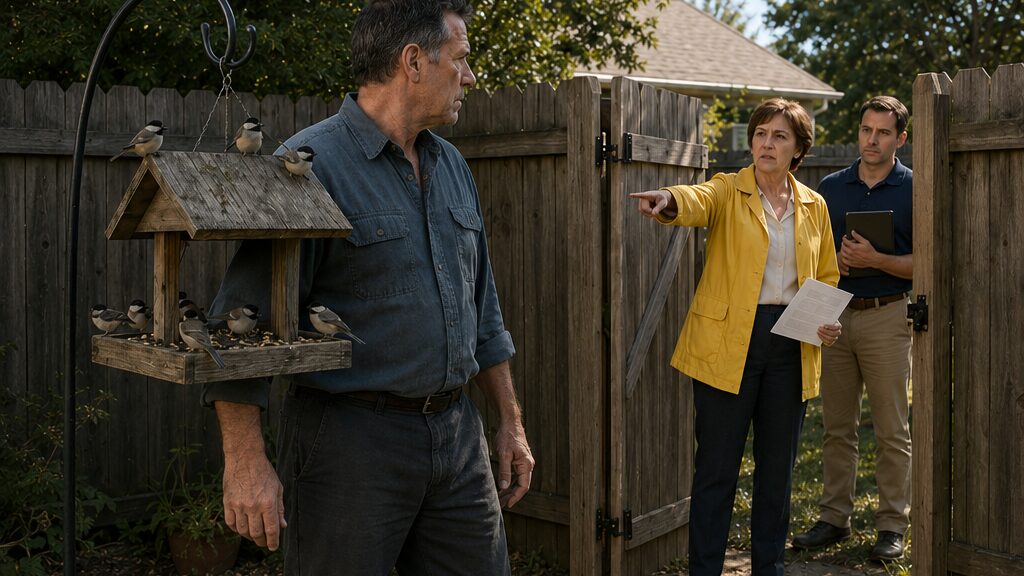
Christine Walker stood beneath the cedar bird feeder with one hand raised toward it as though identifying a structural defect. Her yellow inspection jacket was too bright for Mark Carter’s shaded backyard. Beside her, the HOA property manager held a tablet against his chest and avoided looking directly at Mark.
Above them, three chickadees crowded the feeder’s narrow tray. One flicked a sunflower hull onto Christine’s shoulder.
She brushed it away.
“That,” she said, “is exactly the problem.”
Mark set the garden hose beside the herb bed. “The bird?”
“The feeder. It’s attracting wildlife.”
“It’s a bird feeder.”
Christine’s expression tightened. “We’ve had complaints.”
“From whom?”
“I’m not discussing individual residents.”
Mark glanced toward the side gate. He had left it unlatched because he had been carrying bags of soil from the driveway. Christine had apparently taken that as permission to enter. The property manager remained near the fence, wearing the careful look of someone who had expected a brief inspection and found himself inside an argument.
“What rule am I violating?” Mark asked.
Christine extended a printed notice. “You need to remove it by tomorrow morning.”
He took the page without reading it. “What rule?”
“The association has authority to address conditions that create a safety concern.”
“That isn’t a rule number.”
“Black bears have been sighted less than a mile from here.”
Mark looked at the feeder. It hung from a curved iron hook set in a concrete footing near the kitchen window. The cedar roof had faded silver at the edges, but the shallow repair seam along one side was still darker than the rest. He had replaced that strip two winters earlier, fitting the new piece into the old wood rather than rebuilding the roof.
Christine followed his gaze.
“You can buy another feeder,” she said. “One designed not to spill.”
The words struck harder than they should have. Mark kept his face still.
The property manager cleared his throat. “This may only be temporary while the board reviews wildlife attractants.”
“Then the board can send me the rule after it reviews them,” Mark said.
Christine folded her arms. “This attitude is why informal solutions never work with you.”
Mark looked at her. “What informal solutions?”
For the first time, the property manager shifted his weight.
Christine answered too quickly. “The reminders.”
“I received one email last spring asking residents to secure trash cans.”
“And the note about seed on the ground.”
“You left that note inside my gate.”
“It was visible from the walkway.”
“No,” Mark said. “It wasn’t.”
Silence settled between them. The chickadees hopped across the tray, untroubled by the human voices below.
Christine’s gaze moved toward the kitchen window, then back to him. “I was trying to keep this from becoming formal.”
“You entered my yard.”
“To deliver a courtesy warning.”
“Through a closed gate.”
“It wasn’t locked.”
Mark read the notice.
The page carried the management company’s logo and a bold heading: SAFETY CONDITION—CORRECTIVE ACTION REQUIRED. Beneath it, Christine had written his address, the date, and a description of the feeder. There was no section of the covenants cited. No board vote. No signature from the property manager. Only Christine’s name, followed by the title Compliance Chair.
He held the paper toward the manager. “Did you issue this?”
The man looked at Christine before answering. “Christine prepared it as part of the inspection.”
“That wasn’t my question.”
“We’re all standing here,” Christine said. “You don’t need to turn it into a courtroom.”
Mark handed the notice back to her. “Send me the rule and the board authorization.”
“The deadline remains tomorrow.”
“Not without those.”
A flutter of wings passed above them. One bird landed on the feeder roof, claws ticking faintly against cedar.
Christine stepped closer to the iron hook.
Mark moved between her and the feeder.
He did not touch her. He did not raise his voice. He simply occupied the space she would have needed to reach it.
Her eyes narrowed. “Are you refusing a direct instruction from the compliance chair?”
“I’m refusing to let you touch my property.”
The manager lowered his tablet. “Let’s keep this civil.”
“It is civil,” Mark said.
He walked to the side gate and held it open.
Christine stared at him for a moment, then tucked the notice beneath her arm. “If a bear comes into this yard, the association will have a record that you were warned.”
“If the board warned me, send the record.”
She passed him without replying. The property manager murmured something about follow-up documentation and went after her.
Mark closed the gate.
The latch clicked louder than he expected.
He remained there with one hand on the wood. On the other side, Christine’s voice carried faintly along the path.
“He enjoys making everything difficult.”
The manager answered too softly to hear.
Mark slid the bolt into place.
When he returned to the feeder, the chickadees had scattered. Seed husks lay across the tray and on the ground beneath it. He brushed the loose seed into his palm and carried it to the metal storage tin in the garage.
He could have emptied the feeder then. He knew that.
A bear sighting was not impossible. The woods beyond the subdivision connected to a long green corridor, and residents had posted photographs of overturned trash bins before. But the feeder held less than two cups of seed, and Mark brought it inside most nights during warm months.
Most nights.
He looked toward the kitchen window. From the chair beside it, the feeder sat exactly in the center of the view.
He turned away.
At four that afternoon, an email arrived from Robert Lewis, the HOA president.
Mark,
The board has been advised of a possible wildlife-attractant concern involving your property. Please refrain from altering or escalating the situation while we review the applicable documents. We expect to provide guidance within seventy-two hours.
The message did not order him to remove the feeder. It also did not say Christine lacked authority.
Mark replied with one sentence.
Please provide the rule, the complaint, and the authorization for entry onto my property.
He did not mention the feeder’s construction. He did not mention the initials carved beneath its base, where no one could see them unless the tray was removed. He did not explain why replacing it was not the same as buying another one.
At dusk, he filled the tray with less seed than usual.
A chickadee arrived before he had stepped away. It perched on the repaired roof seam, then dropped lightly to the tray.
Mark stood beneath the hook until the bird flew.
Before going inside, he checked the side gate twice. The bolt was seated. The latch held. The feeder swung gently over its shadow.
At 5:42 the next morning, Mark woke to an unfamiliar brightness at the kitchen window.
For a moment, he could not understand what was wrong.
Then he saw the iron hook.
It was empty.
Chapter 2: Only the Empty Hook Remained
Sunflower seed lay across the grass in a broken trail.
Mark followed it from the base of the iron hook toward the rear fence, barefoot and carrying the flashlight he had grabbed from the kitchen drawer. The feeder was nowhere in the yard. A shallow scrape marked the soil beneath the hook, and one cedar splinter rested near the concrete footing.
He picked it up.
The piece was fresh, pale beneath its weathered surface.
The side gate remained bolted from the inside.
Mark stood still, listening.
A sprinkler clicked two yards away. Somewhere beyond the houses, a delivery truck backed with a sequence of electronic beeps. Nothing moved along his fence.
He checked the gate again. The latch had not been forced. There were no shoe marks in the damp mulch beside it. Whoever had entered would have needed to climb the fence, come through the house, or open the gate from inside.
Unless the feeder had not left through the gate.
He looked up at the hook. The curved metal arm leaned slightly forward, as though something heavy had pulled against it.
By seven, he had searched beneath the shrubs, along the drainage strip, and behind the shared fence line. He found more seed, two broken roof shingles, and a muddy print too broad to belong to a person.
That should have settled something.
It did not.
Laura Green was standing on her back patio with a coffee mug when Mark came through the neighborhood walkway.
“You’re up early,” she said.
“My feeder is gone.”
Laura blinked. “Gone how?”
“Gone.”
She leaned sideways to look past him toward his yard. “Maybe the birds finally organized.”
Mark did not smile.
Her expression changed. “You’re serious.”
“Did you hear anything?”
Laura lowered the mug. “Around five, maybe. Something metallic. A scrape and then a bang. I thought it was a trash cart.”
“Did you see anyone?”
“No.” She hesitated. “You think Christine took it?”
“I asked what you heard.”
“That means yes.”
“It means I’m trying not to accuse anyone without knowing.”
Laura looked toward Christine’s house. The shades were closed over the rear windows. “She was angry yesterday.”
“So was I.”
“You didn’t threaten to remove anything from her property.”
Mark rubbed the cedar splinter between his fingers.
Laura noticed it. “Was that from the feeder?”
He closed his hand. “Probably.”
“For what it’s worth,” she said, “people liked it. My kitchen faces the other way, but I’d see the birds when I walked past. So did the kids at the corner.”
Mark nodded once.
He had not known that. Or perhaps he had known and dismissed it because acknowledging that other people valued the feeder would have required discussing why he did.
Laura lifted her phone. “I can ask in the neighborhood group.”
“Just ask whether anyone saw something.”
“No accusations.”
“Especially no accusations.”
Within ten minutes, her post had collected fourteen replies. Most were jokes about criminal squirrels. One resident reported hearing a dog barking before dawn. Another said a trash bin had been knocked over two streets away.
Christine replied at 7:26.
For clarity, I have not entered Mr. Carter’s property since yesterday’s scheduled inspection. Residents should avoid speculation while the board reviews the wildlife concern.
Mark read the message twice.
Scheduled inspection.
He typed, You entered through an unlatched private gate without confirming access.
Then he deleted it.
Laura watched him from across the patio table. “You’re letting that stand?”
“I asked for information, not a public argument.”
“She just made herself sound official.”
“She is the compliance chair.”
“That doesn’t make yesterday scheduled.”
Mark placed his phone face down.
By nine, he had checked the garage camera. It covered the driveway and front walk, not the backyard. The kitchen camera had stopped recording shortly after midnight because the memory card was full. He had ignored the warning on the app for three days.
His own carelessness irritated him more than Christine’s post.
He returned to the empty hook with a ladder and inspected the arm. Fine black hairs clung to a rough spot near the curve. The muddy print below it had five visible toe marks.
A bear, he thought.
The possibility brought relief so quickly that he distrusted it.
At 9:17, Laura’s phone chimed.
She picked it up, read the screen, and turned it toward him. “Rebecca posted a video.”
The clip came from a camera overlooking the rear corner of a property two lots away. The image was grainy and green-gray, marked 2:11 a.m.
A black bear moved into frame.
It rose beneath a hanging feeder, placed both front paws against the pole, and pulled. The feeder swung violently. Seed poured across the ground. After several attempts, the bear caught the wooden box and twisted it sideways.
The roof flashed pale along one edge.
Mark leaned closer.
The bear dropped to all fours, then rose again. The feeder struck the pole with a sharp metallic bang.
The clip ended.
Comments appeared almost immediately.
Mystery solved.
Christine deserves an apology.
This is why we need rules.
Mark read the last comment and felt heat move up his neck.
Laura muted the phone. “That looks like yours.”
“It might be.”
“You don’t sound convinced.”
“The camera is two lots away.”
“Rebecca said the bear crossed behind her fence.”
Mark replayed the video. The feeder’s shape was right. The roof pitch was right. Even the dark line where he had repaired the cedar seemed visible when it swung.
He thought of Christine’s closed shades and his own certainty that anger had become action. The certainty now felt cheap.
“I should not have assumed,” he said.
“You didn’t accuse her.”
“I assumed.”
Laura studied him. “That isn’t the same thing.”
“It leads to the same place if you keep feeding it.”
The phrase landed between them. Mark looked toward the bare hook.
A new comment appeared from Rebecca Martin.
Mark, call me. I think that is your feeder. The repaired seam matches.
Laura gave him the phone.
Before he could respond, Rebecca added another line.
But the bear did not leave with it.
Chapter 3: The Bear Video Everyone Believed
The bear rose beneath Mark’s feeder at 2:11 a.m., and by noon most of the neighborhood had decided the case was closed.
Laura replayed the clip on her kitchen television while comments multiplied on her phone. The enlarged image made the animal look heavier and nearer than it had on the smaller screen. Its shoulders rolled beneath dark fur as it pulled against the feeder. The iron pole bent. Seed scattered like pale rain.
Mark stood with his arms folded.
Rebecca Martin paused the video at the moment the feeder struck the pole.
“There,” she said.
She had arrived carrying a laptop, a canvas wildlife-rescue bag, and the impatient certainty of someone accustomed to being ignored until an animal caused property damage.
Mark leaned toward the screen.
The feeder hung at an angle. One corner of the roof had split away from the side wall, but the chain still held.
“The bear damaged it,” Rebecca said. “No question.”
Laura pointed at the frozen image. “Then where did it go?”
“That is the question everyone skipped.”
Rebecca advanced the clip frame by frame. The bear pulled again, dropped back, and moved out of view. The feeder remained hanging.
The time stamp jumped from 2:13 to 2:14. Nothing returned.
“The recording ends because the motion stops,” Rebecca said. “It doesn’t show the feeder coming down.”
“Could the bear have come back later?” Laura asked.
“Absolutely.”
Mark looked at Rebecca. “But?”
“But I checked the rest of my camera events.” She opened a list of files. “The bear crossed behind my yard at 2:19, heading toward the drainage corridor. It didn’t have the feeder.”
Laura glanced toward Mark. “So we are back to Christine.”
“No,” Mark said.
Rebecca closed the laptop halfway. “You have another possibility?”
“We are back to not knowing.”
Laura let out a breath. “You work very hard not to say what you think.”
“That saves trouble.”
“Has it?”
Mark ignored the question.
Rebecca reopened the laptop. “There’s another issue. Your feeder schedule.”
“What about it?”
“How often do you bring it inside?”
“Most nights.”
“That isn’t a schedule.”
“In warm weather, usually every night.”
“Usually?”
Mark looked at the television. The bear’s paw was frozen against the cedar roof.
“I forgot last night.”
Rebecca’s tone softened only slightly. “And the night before?”
“It was inside.”
“Seed on the ground?”
“I rake beneath it.”
“How often?”
“Enough.”
“That answer may work with neighbors. It won’t work with a wildlife officer.”
Laura set her coffee down. “Are you saying Christine was right?”
“I’m saying a person can be wrong about authority and right about risk,” Rebecca replied. “Bears do not care who won the argument.”
Mark felt the words settle where his anger had been.
The feeder had been damaged because he had left it out. Whatever happened afterward, that part belonged to him.
His phone vibrated.
An email from Robert Lewis appeared with the subject line Wildlife Incident—Matter Closed.
Mark,
Based on video provided by a resident, the board considers the missing feeder the result of wildlife activity rather than resident misconduct. No further action regarding the disappearance is anticipated.
Separately, the board will review whether additional rules are required concerning outdoor food sources. Until that review is complete, residents are strongly encouraged to remove bird seed, pet food, and unsecured refuse overnight.
Thank you for your cooperation.
Mark read the message aloud.
Laura frowned. “He closed it without asking whether the bear took the feeder.”
“He closed the accusation,” Rebecca said. “Boards like explanations that reduce liability.”
“It also makes Christine look completely right,” Laura said.
Mark placed the phone on the counter. “She was right that the feeder could attract a bear.”
“That is not the same as having permission to enter your yard or issue fake deadlines.”
“I know.”
“Do you?”
Mark looked at her.
Laura lifted both hands. “I’m asking because you sound ready to let all of it go.”
The television still showed the bear leaning against the pole. On the enlarged image, the repaired seam on the roof was unmistakable. Mark remembered fitting that strip into place at his workbench, refusing to replace the entire roof because the old cedar had darkened evenly except where hands had touched it over the years.
Rebecca tapped the screen.
“Your repair held,” she said. “The side wall split first.”
Mark almost smiled. “The roof was overbuilt.”
“Apparently.”
It was a small thing, but it eased something in him. The feeder had not simply broken apart beneath the first pressure. It had resisted.
Laura picked up her phone. “The comments are getting worse.”
Mark did not ask to see them.
She read one anyway. “‘Some people care more about backyard decorations than neighborhood safety.’”
“It is not a decoration,” Mark said.
Both women looked at him.
He regretted the sentence immediately.
Laura’s voice became careful. “Then what is it?”
“A feeder.”
“You just said—”
“I know what I said.”
He took his phone and left before either woman could ask again.
In his yard, the seed trail had begun to disappear beneath foraging sparrows. The empty hook moved slightly in the breeze, making a faint metallic tick at the joint.
Mark stood below it and studied the fence lines.
Rebecca’s footage covered the feeder from the east. His kitchen camera had failed. The garage camera covered only the front. But years earlier, after packages had disappeared from several porches, Mark had installed a small backup camera beneath the eave over his workshop door.
He had never connected it to the newer system.
The camera faced the rear corner of the yard.
He went inside the workshop and found the old receiver in a drawer beneath sanding belts and cabinet hinges. The battery had swollen in its compartment, but the memory card was intact.
His computer took nearly a minute to recognize it.
Most files showed nothing but the fence, the side gate, and changing bands of light. At 2:12 a.m., the image shook as the bear struck the feeder beyond the camera’s edge. At 2:19, a dark shape passed behind the fence toward the drainage strip.
At 5:38, the yard turned gray with morning.
At 5:44, the side gate moved.
Mark leaned closer.
The bolt could not be seen from the camera angle. The gate opened only a few inches, stopped, then widened. A figure entered sideways.
Only an arm and shoulder appeared clearly.
Bright yellow fabric crossed the frame.
The figure moved toward the feeder, out of view.
Thirty seconds later, the gate opened again.
This time, the yellow sleeve was wrapped around something bulky beneath a dark tarp.
Mark froze the image.
Christine’s jacket had not proved what she intended to do. It did not show whether she had found the feeder on the ground, removed it from the hook, or believed she was preventing another animal visit.
But it proved one thing.
While Mark had been asleep, Christine Walker had entered his yard again.
Chapter 4: What Christine Carried Through the Gate
At 7:12 Monday morning, Christine was guiding a dark tarp into her garage when one split cedar corner slipped free.
Mark stopped at the edge of her driveway.
The damaged roof seam showed first. Then the bent chain. Then the shallow tray he had sanded smooth enough that Janet could run her fingertips along it without catching a splinter.
Christine saw him.
For half a second, neither moved.
Then she pulled the tarp higher.
Mark held up his phone. The frozen frame on the screen showed her yellow sleeve crossing his backyard camera.
“I need my feeder,” he said.
Christine glanced toward the open garage. “Lower your voice.”
“No one else is here.”
“You came onto my property before eight in the morning.”
He almost laughed at the choice of words.
“I stayed on the driveway.”
“You’re recording me?”
“No.”
She looked at the phone anyway. “That footage does not show what you think it shows.”
“It shows you entering my yard at five forty-four yesterday.”
“I found the feeder on the ground.”
“Then why didn’t you tell me?”
“It was damaged. There had been a bear. I removed an immediate hazard.”
Mark stepped closer, stopping before the line where the driveway met the garage floor. “You wrapped it in a tarp and kept it overnight.”
“I was taking it to the association office.”
“On Monday.”
“The office was closed Sunday.”
“You had my number.”
Christine’s hands tightened around the tarp. “You were already treating me as though I had stolen it.”
“I had not spoken to you.”
“You didn’t need to. Laura’s post did enough.”
Mark looked at the feeder. One side wall had split along the grain. The roof had twisted but held. Mud darkened the base.
“Give it back.”
Christine’s face changed—not softer, but less certain. “Robert told me to remove attractants if there was an immediate safety concern.”
“Robert told you to take things from private yards?”
“He said we could not wait for another incident.”
“Did he say my feeder?”
“He said to use judgment.”
Mark held out his hand. “Then he can explain that in writing.”
Christine did not move.
From inside the house came the muffled ring of a phone. She flinched toward the sound, then back toward Mark.
“What happened at your daughter’s house?” he asked.
Her eyes sharpened. “That has nothing to do with this.”
“It has everything to do with this.”
“You don’t know what you’re talking about.”
“Then tell me.”
She released the tarp with one hand. “A bear came onto her patio two weeks ago. It pushed against the glass door while my grandson was in the family room.”
Mark said nothing.
“The animal had been in this subdivision before,” Christine continued. “Trash cans. Pet food. Feeders. Everyone keeps acting as though it is harmless until it is looking through a child’s window.”
“That doesn’t give you the right to enter my yard.”
“No. It gives me a reason not to wait while the board writes another email.”
The sentence landed with more force than her earlier orders. Not because it excused her, but because it did not sound invented.
Mark lowered the phone.
Christine noticed. “You left the feeder out.”
“Yes.”
“After I warned you.”
“You gave me an unauthorized deadline.”
“Was the bear unauthorized too?”
Mark’s jaw tightened.
There it was: the part of the argument she had been right about, sharpened into a weapon.
“I should have brought it in,” he said.
Christine looked briefly surprised.
“That does not make this yours,” he added.
He reached for the exposed cedar corner.
She pulled the tarp back. “Don’t.”
The word came out too quickly.
Mark stopped.
Christine looked toward the street, then into the garage. “The base is cracked. There may be contamination from the animal.”
“It is wood, not medical waste.”
“You don’t know what the bear carried.”
“I know what you carried.”
A car turned onto the block. Both of them waited as it passed.
Christine lowered her voice. “If you post that footage, the neighborhood will decide I stole it before anyone hears why I removed it.”
“You let them decide the bear took it.”
“I did not post the video.”
“You commented that people should avoid speculation.”
“That was true.”
“You knew where the feeder was.”
She looked away.
That silence changed the shape of the morning. Until then, Mark had been holding onto the possibility that she had acted badly but honestly—that she had removed the feeder, planned to report it, then become trapped by timing. Now he saw the smaller choice inside the larger one. She had watched the false explanation spread because it protected her.
“Give it back,” he said again.
This time, Christine released the tarp.
Mark lifted the feeder carefully. The chain dragged against the concrete. The cedar was heavier with damp and damage. One side panel shifted under his hand.
He almost dropped it.
Christine reached out, then stopped before touching the roof.
“The bear did that,” she said.
“I know.”
“I did not break it.”
“I know.”
Her shoulders lowered a fraction, as if his acknowledgment had removed one accusation while leaving the rest.
He carried the feeder to his truck and set it on an old moving blanket. The split side exposed a dark interior edge he had not seen in years.
Christine followed him halfway down the drive. “Robert did authorize action.”
“Then he will confirm it.”
“He may not remember the exact wording.”
“That is convenient.”
“It was a phone call.”
Mark closed the tailgate. “I’m going to the HOA office.”
Her face hardened again. “You said you weren’t trying to turn this into public revenge.”
“I never said that.”
“You didn’t have to.”
He met her eyes. “I’m not posting the footage. I’m asking for the record.”
The property manager arrived at the office twenty minutes after Mark did. His tie was crooked, and he carried a paper cup with the lid pressed down too hard on one side.
Mark placed the damaged feeder on the conference table.
The manager stared at it. “You found it.”
“Christine had it.”
Mark showed him the clip.
The manager watched once, then again. “I need to call Robert.”
“Ask whether he authorized removal from my yard.”
The call went to speaker after Robert answered.
“I told Christine we needed to address active hazards,” Robert said. “I did not authorize entry onto private property.”
The manager looked at Mark.
Mark said, “She says you told her to use judgment.”
“I may have used that phrase regarding common areas.”
“Did you tell her to take my feeder?”
“No.”
The answer was immediate.
The manager sat down slowly.
Robert’s voice came through the speaker. “We need to keep this contained until the board can review it.”
Mark looked at the broken feeder between them. “Contained?”
“I mean handled through proper channels.”
“That would be new.”
The manager winced.
Robert continued as if he had not heard. “Do not post the video. Do not confront Christine further. We will meet tonight.”
Mark ended the call before Robert could add another instruction.
The property manager removed his glasses and rubbed the bridge of his nose. “There may be more to review.”
“What more?”
The manager turned to his computer. He searched the association’s records, opening folders marked Compliance, Courtesy Notices, and Resident Concerns.
Three documents appeared with Christine’s signature.
One concerned a basketball hoop. One concerned patio string lights. The third concerned a child’s play tent left overnight.
Each carried the same formal heading as Mark’s notice.
None included a rule citation.
None included a board vote.
The manager stared at the screen.
Mark looked from the documents to the broken feeder.
“How long,” he asked, “has she been making the rules herself?”
Chapter 5: The Rules That Never Reached a Vote
Robert Lewis did not begin Monday night’s meeting by asking why Christine had entered Mark’s yard.
He began by asking why Mark had ignored repeated wildlife warnings.
The broken feeder sat in the center of the conference table beneath fluorescent lights. Its split side had been turned inward, but the damaged roof leaned visibly to one side.
Mark looked at Robert. “Repeated warnings from whom?”
Robert folded his hands. “The distinction may matter procedurally. It does not erase the safety issue.”
Christine sat three chairs away, no longer wearing the yellow jacket. In a gray cardigan, she looked less like an enforcement officer and more like the neighbor Mark had passed at mailboxes for eleven years.
The property manager had printed the three unauthorized notices. They lay in a neat stack beside Robert.
Rebecca sat near the end of the table as the board’s requested wildlife resource. Laura was not present, though Mark knew she was waiting for updates.
“Let’s keep the subjects separate,” Mark said. “One is whether I managed the feeder responsibly. The other is whether Christine had authority to enter my yard and remove it.”
Robert nodded with the patience of someone conceding a technical point. “Fair enough. Did you leave the feeder out overnight?”
“Yes.”
“Despite recent bear reports?”
“Yes.”
“Despite Christine raising concerns?”
“Despite Christine issuing a deadline she could not support.”
“That was not my question.”
“No,” Mark said. “It was the answer.”
One of the board members shifted in her chair.
Christine looked down at the feeder.
Robert slid a printed email across the table. It was the spring reminder about secured trash cans, bird seed, and pet food. Mark had read it months earlier and forgotten most of it.
“You received this,” Robert said.
“I did.”
“And this message two weeks ago?”
Another general advisory. No demand. No notice of violation.
“Yes.”
Robert leaned back. “Then it is inaccurate to say you received no warning.”
Mark felt the old instinct rise—to close the discussion by refusing it. He could have said the advisories were general, that no rule required nightly removal, that Christine had crossed the property line first.
All true.
None answered the bear beneath his feeder.
“I should have brought it inside,” he said.
Rebecca looked at him for the first time since the meeting began.
Robert nodded. “Thank you.”
Mark disliked the satisfaction in his voice.
“Now answer mine,” Mark said.
The property manager placed the unauthorized notices before the board.
Robert’s expression changed as he read the first page. “I have seen this template.”
“The template is approved,” the manager said. “These uses were not.”
Christine lifted her chin. “Residents had complained.”
“Were formal violations opened?” Robert asked.
“No. I resolved them before that became necessary.”
“By issuing documents that appeared formal,” Mark said.
“They were corrective notices.”
“They said corrective action required.”
Robert raised a hand. “Mark.”
“No,” Mark said. “Words matter when someone puts an association logo above them.”
The second board member read the play-tent notice. “There’s no covenant section.”
“The obstruction was obvious,” Christine said.
“In a private backyard?” the member asked.
“It was visible from the greenbelt.”
The property manager opened a binder. “Compliance procedure requires either a cited rule or board direction for uncodified safety conditions.”
Christine’s mouth tightened. “And when the board takes three weeks?”
Robert looked at her. “You bring it to me.”
“I did bring concerns to you.”
Robert did not answer immediately.
That pause drew every eye in the room.
The property manager said, “Robert?”
Robert removed his reading glasses. “Christine has handled preliminary complaints for several years. We have relied on her to filter matters that did not justify management billing.”
There it was—not authorization, but dependence.
Mark looked at the manager. “Billing?”
The manager glanced at Robert before answering. “The association pays per formal inspection beyond the contracted quarterly schedule.”
“And unofficial inspections are free,” Mark said.
“No one called them unofficial,” Robert replied.
“What did you call them?”
Robert’s silence was answer enough.
Christine sat straighter. “I saved this association thousands of dollars and dozens of petty hearings.”
“You also decided which rules existed before they reached a hearing,” Mark said.
“I asked people to correct obvious problems.”
“You entered yards.”
“Not routinely.”
Mark looked at her.
She amended it. “Only when access was open and the condition required documentation.”
The side gate seemed to click again in his memory.
Robert pushed the notices aside. “The board will conduct a full records review. Effective immediately, Christine will perform no inspections or resident contact on behalf of compliance.”
Her face lost color.
One of the board members said, “And Mark’s fine?”
“There is no fine yet,” Robert replied.
“There was a twenty-four-hour corrective deadline,” Mark said.
The property manager turned to him. “That notice is void.”
The words gave him less satisfaction than he had expected.
Robert added, “However, voiding an unauthorized notice does not establish that the feeder was safe.”
Rebecca opened her folder.
Mark knew what was coming before she spoke.
“Bird seed is not a bear’s preferred natural food,” she said, “but concentrated seed is calorie-dense and easy to access. Once a bear associates homes with food, risk increases for residents and for the bear.”
Christine looked at Mark, but there was no triumph in it now.
Rebecca continued. “The footage shows the animal was willing to stand upright, pull against a fixed pole, and remain near the house. That is not a casual pass-through.”
“How much did my feeder contribute?” Mark asked.
“No one can quantify that. But leaving it available overnight increased the opportunity.”
Mark looked at the broken cedar. A thin line of dried mud crossed the tray. He had been so occupied with Christine’s authority that he had treated the risk as though accepting it would surrender the argument.
That was his mistake.
“I understand,” he said.
Robert seemed relieved. “Then perhaps we can agree on temporary removal pending policy review.”
“The feeder is already removed.”
“I mean no replacement.”
Mark’s gaze moved to the split side. “For now.”
Christine finally spoke. “You could have avoided all of this.”
The room went still.
Mark turned toward her. “So could you.”
Her eyes dropped to the feeder’s exposed interior.
The side panel had shifted during transport, revealing two sets of initials carved beneath the tray support. The letters were shallow but visible in the fluorescent light.
M.C. and J.C.
Below them, in smaller writing:
ONE MORE SPRING.
Christine leaned forward.
Her voice, when it came, was quieter than it had been in his yard.
“Who was J.C.?”
Mark reached across the table and turned the feeder so the carving faced away.
No one spoke.
Robert waited.
Rebecca closed her folder.
Mark could feel the question expanding beyond the room, pressing against the explanation he had withheld for years.
He stood and lifted the broken feeder.
“That,” he said, “is not association business.”
He carried it out before anyone could ask again.
Chapter 6: One More Spring Beneath the Cedar Roof
The penciled measurements were still inside the base.
Mark found them Tuesday night after removing the cracked bottom panel in his workshop. Janet’s handwriting ran along the hidden cedar strip in short, careful marks:
Roof overhang—2¼.
Tray lip—¾.
Window sightline—check from chair.
The last note was underlined twice.
He sat on the stool with the panel across his knees.
For years, he had remembered building the feeder as his project. He had cut the cedar, shaped the roof, drilled the drainage holes. But Janet had measured the view from the kitchen chair. She had rejected the first pole location because a maple branch blocked the feeder from the window. She had chosen the roof angle because rain gathered on the shallower prototype.
Her hands were inside the object as surely as his.
Mark ran his thumb above the pencil marks without touching them.
The workshop door opened behind him.
Laura stood on the threshold holding a paper bag. “You ignored three messages.”
“I was working.”
“You were sitting.”
He looked at the bag.
“Dinner,” she said. “Not sympathy.”
“I didn’t ask for either.”
“I know.”
She placed the bag on the workbench and saw the exposed writing. Her expression changed.
Mark turned the panel over.
Laura did not pretend she had not seen it. “Janet?”
He nodded.
“The initials?”
“Yes.”
Laura leaned against the bench. “You never told anyone.”
“It wasn’t anyone’s business.”
“No. But people filled the empty space with other explanations.”
Mark looked toward the feeder parts arranged across the bench.
Laura continued. “Christine said you kept it there to prove she couldn’t make you move it.”
“I kept it there before she cared.”
“I know that now.”
He looked up. “You shared the bear video.”
Her face tightened. “Rebecca posted it. I pushed it to the neighborhood group because I thought it would stop people accusing Christine.”
“You thought public embarrassment was acceptable when it pointed at the bear.”
“That isn’t fair.”
“No.”
She waited.
Mark exhaled. “Neither was what I said.”
Laura folded her arms. “You are very good at admitting the smallest part.”
He almost told her to leave.
Instead, he lifted the hidden panel.
“Janet was sick when we built it,” he said. “She had one winter left, according to every doctor who would give us a number. She wanted to see spring from that chair.”
Laura said nothing.
“So we built something for the window.”
“One more spring,” she said.
“She got two.”
The words remained in the workshop without requiring anything from her. No apology. No softened voice. No hand on his shoulder.
That was why he had managed to say them.
Laura looked at the feeder roof. “Does Christine know?”
“She knows enough to ask.”
“She may ask again.”
“She can ask.”
“That is not the same as answering.”
“No.”
Laura picked up her bag but left the food. “Robert scheduled an open hearing for next week unless you agree to a private resolution.”
“What resolution?”
“You delete the footage. Christine confirms she removed the feeder for safety. The board voids the notice. Everyone agrees not to discuss prior compliance practices until the records review is complete.”
Mark stared at her. “How do you know?”
“I moderate the neighborhood group. Robert asked me to discourage speculation.”
“And did you?”
“I turned off comments.”
He nodded toward the door. “That will solve everything.”
Laura accepted the rebuke. “No. But it slows people down long enough to decide what they are actually angry about.”
After she left, Mark ate standing beside the workbench. The sandwich had gone cool. He could not taste much of it.
Wednesday morning, he carried the damaged feeder to Christine’s porch.
She opened the door but did not invite him inside.
“I am not here to return it,” he said.
Her gaze moved to the cedar roof in his hands. “Then why bring it?”
“You asked about the initials.”
Christine’s posture changed.
“J.C. was my wife,” Mark said. “Janet.”
The name sounded exposed in the open air.
Christine looked toward his kitchen window across the adjoining yards. “I remember her.”
“You waved. You did not know her.”
“No.”
“She was dying when we built this. The feeder was where she could see it from her chair.”
Christine lowered her eyes to the cracked base. “I didn’t know.”
“You weren’t required to.”
“Then why tell me now?”
“Because not telling you became part of the problem.”
She looked at him sharply, perhaps expecting accusation.
Mark continued. “You saw an object I would not move. You decided the reason was defiance. I saw you making rules and decided the reason was control.”
“You think I was not controlling?”
“I think you were afraid.”
The porch went silent.
A vehicle passed beyond the houses. Christine waited until the sound faded.
“My daughter called me at six in the morning,” she said. “She was whispering because the bear was still outside.”
Mark held the feeder against his leg.
“My grandson was on the floor behind the couch. The animal had pushed its nose against the patio glass. There were marks on the door afterward.” She swallowed. “Everyone told her it was probably looking at its reflection. As if that made it less large.”
Mark pictured the night footage: the bear rising, the feeder swinging under its weight.
Christine rubbed one thumb across the edge of her other hand. “Robert said we needed to reduce attractants. He also said the board could not enforce a rule that did not exist.”
“So you enforced one anyway.”
“I asked people to act before something happened.”
“You made requests look like orders.”
“People ignore requests.”
“And you hid my feeder.”
Her hand stopped moving.
“I intended to take it to the office,” she said.
“You let everyone believe the bear carried it away.”
“I did not know what to say without making myself the entire story.”
“You had already made yourself the authority.”
Christine looked toward the feeder. “If I admit I removed it, I will admit that. I will not admit I stole it.”
“I did not ask you to.”
“The settlement says intentional deception.”
“Because you knew the feeder was in your garage.”
“I knew I had removed a damaged attractant after a bear incident.”
“You knew it belonged to me.”
“Yes.”
“You knew I was looking for it.”
Her face tightened. “Yes.”
The admission was barely audible.
Mark shifted the feeder in his hands. “Robert wants me to delete the footage.”
“I know.”
“And you?”
“I want the record to say I acted for safety.”
“That can be true beside the rest.”
She looked at him. “You think people allow two things to be true at once?”
“No,” Mark said. “But the record should.”
Christine stepped back from the doorway. “I will admit I removed it without written authorization. I will admit I should have notified you immediately.”
“And the prior notices?”
Her mouth flattened. “The board relied on me.”
“That was not the question.”
“I will not call years of work misconduct because Robert suddenly prefers distance.”
Mark saw then what she was protecting beyond fear: the belief that the neighborhood had needed her decisiveness, that every shortcut had been service rather than power.
She was not ready to surrender that belief.
Perhaps she never would be.
“If you file the footage,” she said, “I will answer for the feeder. I will not accept language saying I intended to deceive anyone.”
Mark looked down at Janet’s repaired roof seam.
He could accept the private agreement. The feeder would remain his. The notice would disappear. Christine would lose her compliance role during the review without the entire neighborhood seeing the footage.
It would be quiet.
It would also leave the old notices unexplained and Robert’s dependence unexamined. Silence would protect him from pity and Christine from scrutiny for the same reason: neither wanted others to define what their private motives meant.
Mark had mistaken that kind of silence for dignity long enough.
He carried the feeder home, set it on his workshop bench, and opened Robert’s proposed settlement.
At the bottom was a line for his signature.
He closed the document.
Then he opened the formal hearing request, attached the camera file, and signed his name.
Chapter 7: The New Feeder Could Not Hang Where the Old One Did
Mark placed the damaged feeder on the board table beside a black flash drive.
No one spoke while he turned the split cedar side outward.
The open hearing had drawn more residents than the folding chairs could hold. Several stood along the clubhouse wall. Laura sat near the back with her phone face down in her lap. Rebecca had spread a wildlife map across one end of the table. Christine sat beside the property manager, her hands folded so tightly that her knuckles had gone pale.
Robert adjusted his microphone.
“Mr. Carter,” he said, “before we begin, the board has prepared a possible settlement that may avoid unnecessary disclosure of private material.”
A printed document waited at Mark’s place.
He did not sit.
“Does it require me to delete the footage?”
Robert glanced toward the association attorney on the video screen. “It requires both parties to preserve confidentiality regarding the incident.”
“And the prior notices?”
“The records review would continue internally.”
“Would residents who received unauthorized notices be informed?”
Robert’s pause was brief, but long enough.
“Not unless corrective action is required,” he said.
Mark looked at the residents along the wall. Some avoided his eyes. One man held a copy of the basketball-hoop notice the property manager had found.
Mark pushed the settlement back across the table.
“No.”
A murmur moved through the room.
Robert lowered his voice. “You should understand that an open record will include your failure to follow wildlife guidance.”
“I understand.”
“And personal information connected to the feeder may become part of the discussion.”
“That part is mine to decide.”
Christine looked at him then.
Mark inserted the flash drive into the laptop. The screen behind the board lit with a still image of his backyard at 5:44 Sunday morning.
He did not play it yet.
“The feeder attracted a bear,” he said. “I left it outside after receiving general warnings. That was careless.”
Rebecca gave a small nod.
Mark continued. “The bear damaged it at two twelve in the morning. It left the area seven minutes later without carrying the feeder.”
He advanced to Rebecca’s map and camera timeline.
“At five forty-four, Christine entered my yard. She removed the feeder and kept it in her garage until Monday.”
The room shifted. Chairs creaked. Someone whispered, but Robert raised a hand.
Christine leaned toward her microphone.
“I removed a damaged food source after a documented bear incident,” she said. “I believed delay created an immediate safety risk.”
“Were you authorized to enter Mr. Carter’s property?” Robert asked.
“No.”
“Were you authorized to remove his feeder?”
Christine’s eyes remained on the cedar roof.
“No.”
“Did you notify him afterward?”
“No.”
“Did you know residents believed the bear had carried it away?”
“Yes.”
A phone vibrated somewhere near the back wall.
Robert asked, “Why did you not correct that belief?”
Christine took a breath. “Because by then, anything I said would have sounded like an excuse.”
Mark watched her hands unclench.
She continued. “I was afraid of another bear entering the neighborhood. I was also afraid that admitting I had acted without permission would cause every earlier compliance matter to be questioned.”
“That concern was accurate,” one of the board members said.
Christine accepted the remark without answering.
The property manager opened the records summary. Eleven corrective notices had been issued under Christine’s name without formal case numbers. Most involved minor conditions. Two had led residents to spend money. None had reached a board vote.
Robert removed his glasses.
“The board relied too heavily on informal enforcement,” he said. “That was an institutional failure.”
The man holding the basketball-hoop notice spoke from the wall. “You mean you liked not paying the management company.”
Robert looked at him. “Cost was a factor.”
The answer produced no applause, only a low sound of recognition.
Mark preferred that.
No one in the room was being transformed into a hero. No one could pretend the shortcuts had belonged to Christine alone.
Rebecca stood and pointed to the wildlife map.
“The original feeder location is twenty-two feet from the kitchen door and directly beside a travel line between the drainage corridor and the greenbelt,” she said. “Whatever the board decides about enforcement, that location should not be reused.”
Mark looked through the clubhouse windows toward his house beyond the neighboring roofs. He could picture the empty iron hook beside the kitchen window.
Robert asked, “Do you dispute that recommendation?”
A week earlier, Mark would have found a reason to.
“No,” he said.
Christine looked up.
Rebecca slid a revised site plan toward him. “A seasonal feeder could be placed near the central greenbelt, away from homes, with a catch tray and a removal schedule. It would need resident volunteers and immediate suspension during bear activity.”
Robert studied the plan. “Common property would require board approval.”
“That is why it is here,” Mark said.
He placed a second object on the table: a narrow cedar roof panel, cleaned and repaired. The old seam remained visible, but he had reinforced it from beneath.
“I’m not asking to put the old feeder back where it was,” he said. “I’m asking to use part of it in a safer one.”
Laura’s gaze moved from the panel to him.
Robert asked, “Is there personal significance the board needs to consider?”
Mark rested his hand beside the cedar, not on it.
“My wife helped build it during the last year of her life. She wanted to watch the chickadees from our kitchen.”
The room became quiet in a different way.
Mark saw sympathy forming on several faces and continued before it could settle over him.
“That does not make the old location safe. It does not excuse leaving seed out overnight. It explains why I resisted without explaining myself.”
He turned toward Christine.
“And my silence gave other people room to decide what my resistance meant.”
Christine’s mouth tightened.
“My fear does not excuse what I did,” she said.
It was not an apology. It was smaller and more useful.
Robert consulted the other board members.
The decisions came without ceremony.
Mark’s corrective notice was rescinded. All unauthorized notices would be reviewed, and affected residents would receive written findings. Christine would step down from compliance duties. No resident representative would enter private property without explicit permission except during a documented emergency. A temporary wildlife-attractant rule would be drafted with resident input rather than imposed through informal warnings.
The greenbelt feeder proposal passed as a ninety-day trial.
After the meeting, Christine approached Mark while residents folded chairs around them.
“I should have called you,” she said.
“Yes.”
“And returned it immediately.”
“Yes.”
She looked at the repaired cedar panel. “I am sorry for that.”
Mark waited, but she offered nothing broader.
He did not demand it.
“I should have listened before deciding you only wanted control,” he said.
Christine gave a tired, almost humorless smile. “Sometimes I did.”
“So did I.”
They left through different doors.
Three days later, Mark and Rebecca installed the new feeder at the edge of the greenbelt. Its metal pole carried a wide seed-catching tray. A locked storage box held only enough seed for supervised morning use. Laura posted the volunteer schedule without mentioning the hearing.
The old cedar roof panel formed one side of the new shelter. Its repaired seam faced east.
Mark returned home carrying his tools.
The iron hook outside the kitchen window was still empty. He had considered removing it, but the concrete footing would require more work than he wanted to do that afternoon.
From Janet’s chair, the bare curve remained visible against the yard.
It no longer looked like an accusation.
The next morning, Mark walked to the greenbelt before breakfast. Rebecca had filled the tray and stepped away. Laura stood farther down the path with a coffee mug. Christine crossed the common lawn without stopping, though she looked once toward the feeder.
For several minutes, nothing came.
Then a chickadee dropped from the maple branches.
It landed on the repaired cedar roof, directly above the old seam.
Mark kept his hands in his pockets and watched it find the seed.
The story has ended.