The Neighbor Who Wanted Eric’s Old Workshop Demolished Never Asked Why He Kept the Door Locked
Chapter 1: The Pink Notice Nailed Beside the Locked Door
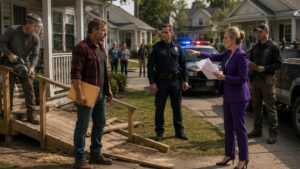
The contractor had already measured half the distance from Eric’s side gate to the workshop before Eric stepped into the backyard.
A yellow tape ran across the grass like a boundary somebody else had drawn. One end rested near the gate. The other stopped at the workshop’s warped front step, where Pamela White stood holding her phone upright.
“Get the width too,” she told the contractor. “They’ll need to know whether equipment can come through.”
Eric closed the back door behind him.
The workshop sat beneath the morning shadow of two trimmed maples, its faded boards silver-gray with age. Ivy clung to one corner. Rust streaked the corrugated roof. A square of bright pink paper had been fastened beside the door, inches from the old brass padlock.
Eric walked past Pamela without greeting her.
He pulled the tape from beneath the contractor’s shoe, let it snap back into its case, and placed the case on the grass.
The contractor glanced at Pamela.
Pamela lowered her sunglasses. “You can’t interfere with an authorized inspection.”
“This isn’t an inspection.”
“It’s a preliminary access assessment.”
“On my property.”
“The association has an obligation to prepare.”
Eric studied the pink notice. The top line read EMERGENCY ARCHITECTURAL ACTION in thick black letters. Below it, smaller print described exterior deterioration, possible structural instability, nuisance conditions, and authorization for further review.
The paper had been nailed into the doorframe.
Not taped. Not clipped.
Nailed.
Eric put his thumb against the brass padlock. Its surface had been worn smooth where his hand had touched it for years.
Pamela aimed her phone toward him. “I’d advise you not to remove that.”
“You’d advise me?”
“It’s official notice.”
Eric reached into the pocket of his work shirt and took out a narrow pair of end-cutting pliers. He caught the nail carefully, rocking it loose without tearing the paper. Then he folded the notice once and put it beneath his arm.
Pamela’s mouth tightened.
“You’ve destroyed posted association material.”
“I removed a nail from my building.”
“The board has documented the condition.”
“So have I.”
That was not entirely true. Eric had photographs, but they were old. He had taken them after replacing the lower sill on the north wall, before the ivy reached the roofline and before the paint peeled down to bare wood. He had meant to take new ones every spring.
He had meant to do many things every spring.
Pamela walked toward the corner nearest her property. “This wall is visibly leaning.”
“It isn’t.”
“You can see it.”
“You can see the siding.”
“The roof is rusted.”
“It’s metal.”
“That doesn’t make rust acceptable.”
The contractor bent to retrieve his tape. Eric moved his shoe onto it.
“Leave,” Eric said.
The man looked at Pamela again, then gathered his clipboard.
Pamela’s voice sharpened. “The board may authorize removal without your consent if the structure is determined to be an immediate hazard.”
Eric looked at her then.
She had made complaints before. Paint. Ivy. The height of the hedge. A wheelbarrow left beside the garage for two days. Most had arrived in cream envelopes and ended after short replies.
This was different.
“You don’t have that determination,” he said.
“We have an inspection scheduled.”
“By whom?”
“The city.”
The word settled between them.
Pamela adjusted her sunglasses. “Wednesday. Two o’clock. A building inspector will assess the structure. You’re required to provide access.”
“To the yard?”
“To the building.”
“No.”
“You don’t get to refuse.”
“It’s locked.”
“Then unlock it.”
Eric’s fingers tightened around the padlock. The brass had warmed beneath his palm.
Behind the door, every tool remained where it had been left. The planes were oiled. The chisels were wrapped. The bandsaw blade had been backed off to relieve tension. The workbench had been swept the last time he entered, three months earlier, though he had not cut a board or sharpened an edge.
Nothing inside was abandoned.
Nothing inside had moved.
Pamela took his silence as uncertainty. “If you’re hiding unsafe equipment or unpermitted electrical work, refusing access will only make this worse.”
“You’ve said what you came to say.”
“I’m trying to avoid an expensive legal process.”
“No. You’re measuring the path for one.”
The contractor was already near the gate. Pamela stayed.
For one moment her expression changed—not softer, exactly, but less certain. She looked past Eric at the roof, at the warped step, at the ivy crossing the corner seam.
“People have been patient,” she said. “You’ve received three notices.”
Eric kept the folded pink paper beneath his arm.
“Four,” he said.
Pamela blinked.
He had not replied to the last two. He had opened them at the kitchen counter, read the deadlines, and placed them in a drawer beneath unopened mail. One had asked for a repair schedule. The other had requested a hearing.
He had attended neither.
“That doesn’t help you,” Pamela said.
“I didn’t say it did.”
A car door closed in the driveway.
Laura came through the side gate carrying a paper grocery bag against her denim jacket. She stopped when she saw Pamela, the contractor leaving, and the empty nail hole beside the workshop door.
“What happened?”
Pamela answered before Eric could. “Your father has a municipal inspection Wednesday. The structure may require removal.”
Laura looked from Pamela to Eric. “Removal?”
“It’s preliminary,” Pamela said. “Unless he continues refusing access.”
“I’m not refusing the yard.”
Pamela lifted her phone. “The inspector needs the interior.”
Laura’s eyes went to the padlock.
Eric saw the question forming and turned away first.
Pamela stepped toward the gate. “Two o’clock Wednesday. I’ll be present on behalf of the architectural committee.”
“You don’t need to be,” Eric said.
“I do.”
“No, you want to be.”
Pamela stopped but did not turn around. “You’ve had years to fix this quietly.”
Then she left.
Laura waited until the gate latched.
“What notices?”
Eric walked toward the house.
She followed him. “She said you got four.”
“They send paper whenever the wind changes.”
“Did you answer them?”
He opened the back door.
“Dad.”
The grocery bag made a soft tearing sound as Laura shifted it against her hip. A loaf of bread pressed against the opening.
Eric took the bag from her and carried it inside.
On the kitchen table, she found the drawer before he could stop her. The first notice lay beneath a utility bill. The second had a yellow deadline box. The third requested a hearing. The fourth warned of possible legal action.
Laura spread them in order.
“You ignored all of these.”
“I read them.”
“That isn’t the same thing.”
“They weren’t asking questions. They were telling me what they’d decided.”
“They asked for a repair plan.”
Eric placed the groceries on the counter one item at a time.
Milk. Coffee. Apples. A box of screws he had not asked for.
Laura lifted the fourth notice. “Why didn’t you call me?”
“To do what?”
“Help.”
“I don’t need help reading mail.”
“You might need help keeping the building.”
He looked through the window toward the workshop. From the kitchen, only the roof and upper half of the door were visible. The empty nail hole was a dark point in the frame.
Laura lowered the papers.
“Does the city know what it is?”
Eric said nothing.
“Does Pamela?”
“No.”
“Then tell them.”
“It isn’t their business.”
“It becomes their business when they can order it torn down.”
“They can’t.”
“You don’t know that.”
Eric picked up the pink notice and smoothed its fold against the table.
Laura watched his hand. “You still have the file, don’t you?”
He slid the notice beneath the others.
“What file?”
Her face changed. Not because she believed him, but because she knew he had chosen the lie.
“Mom’s preservation application,” she said. “Did you ever finish it?”
Chapter 2: The Workshop Everyone Thought Was Empty
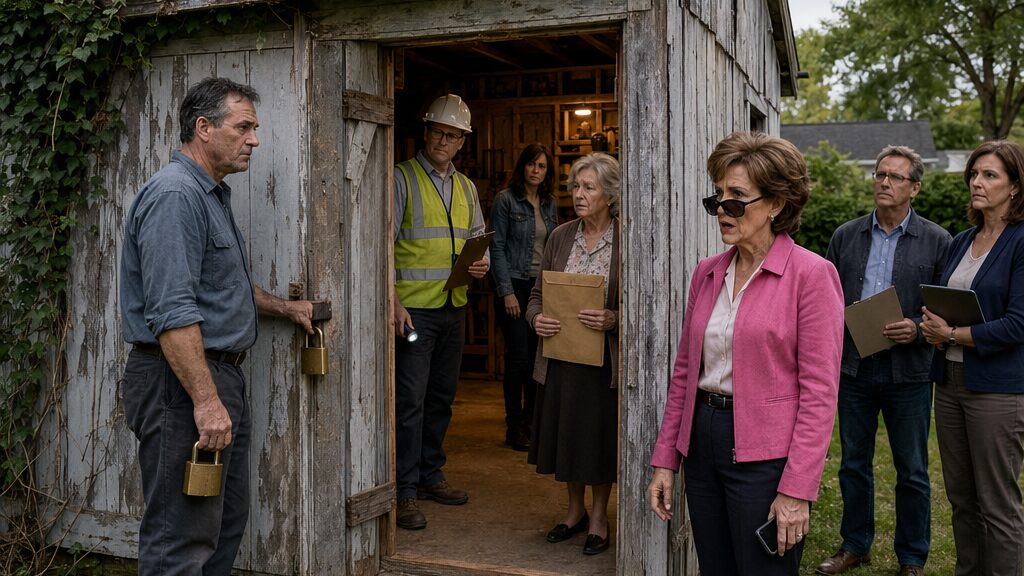
George Wilson arrived at two minutes before two and asked Eric to open the workshop before he had finished introducing himself.
He wore a white hard hat, safety glasses, and a reflective vest over a pale work shirt. A city badge hung from his belt beside a compact flashlight. He did not look toward Pamela until after he had shaken Eric’s hand.
“I’ll need access to all four exterior walls and the interior,” George said. “I’m here for structure, electrical conditions, and occupancy use. I’m not here to enforce HOA appearance standards.”
Pamela stood near the property line with two architectural committee members. One carried a folder. The other held a tablet. Both had positioned themselves where they could see the workshop door.
Pamela said, “We requested documentation because the building appears abandoned.”
George glanced at her. “I read the complaint.”
“I also brought dated photographs.”
“I have them.”
“Some were taken this morning.”
George turned back to Eric. “Mr. Harris, will you open the door?”
Eric’s hand rested on the padlock.
Laura stood on the back step with her arms folded. She had not spoken to him about the preservation application since Monday. She had called twice the night before. He had let both calls ring.
Now she watched the key in his hand.
Pamela raised her phone.
George noticed. “No recording inside unless the property owner permits it.”
“I’m documenting committee business.”
“You can document from outside.”
Pamela lowered the phone a few inches, not enough to suggest agreement.
Eric slid the key into the padlock.
The mechanism resisted. It always resisted after damp weather, though he kept the inner pins oiled. He pressed his thumb against the body, turned the key, and heard the bolt release.
The small sound carried across the yard.
He removed the lock but kept it in his palm.
Pamela pointed at the lower hinge. “You can see the corrosion there.”
Eric opened the door.
The warm interior light came on from a switch just inside, filling the doorway in a soft amber square.
No one spoke.
From the yard, the workshop had looked tired enough to collapse under a heavy branch. Inside, every wall had purpose.
Hand planes rested heel-down on a long shelf, their iron edges wrapped in oiled cloth. Chisels stood in a slotted rack above the scarred maple workbench. Clamps hung by size. The old bandsaw occupied the rear corner, its cast-iron table clean beneath a canvas cover. Half-finished boxes, stools, birdhouses, and small book racks lined the upper shelves.
Each one carried a paper label.
Initials. Dates. Ages.
Laura stepped down from the porch.
George entered first. He stopped just past the threshold and looked from the tool wall to the workbench.
“This is active?”
“No,” Eric said.
George looked at the sharpened pencils in a coffee tin, the swept floor, the unplugged extension reels, and the machine-maintenance log clipped beside the bandsaw.
“Maintained, then.”
“Yes.”
Pamela appeared behind him. “A staged interior doesn’t change the exterior condition.”
Eric turned his head. “Stay outside.”
“As committee chair—”
“As property owner, I’m telling you to stay outside.”
George lifted one hand without looking away from the ceiling joists. “Ms. White, exterior only.”
Pamela’s face colored, but she stepped back.
George moved slowly through the shop. He photographed an outlet beside the workbench, then crouched near the lower wall. He pressed a moisture meter against the sill.
Laura entered and stood beside a shelf of wooden mallets.
Her fingers hovered over one with a red-painted handle.
Before she touched it, a voice came from the yard.
“I knew that book rack.”
Janet Roberts stood at the open gate, holding a thick envelope against her chest. Her gray hair had been pinned up loosely, and one side had come free.
Pamela turned. “This is a restricted inspection.”
“I was invited by Laura.”
Eric looked at his daughter.
Laura did not apologize.
Janet approached the doorway but remained outside. She pointed past George toward a crooked walnut book rack on the upper shelf.
“My son made that in seventh grade,” she said. “He cut the first shelf backward and refused to start over.”
George looked at the label.
“1998,” he read.
“There were twelve children in that session,” Janet said. “Eric taught the tools. His wife handled enrollment and made everyone write their name and the date.”
Eric stared at the brass padlock in his hand.
Janet opened the envelope. “I brought copies of the library newsletters. The workshop program ran for nearly twenty years.”
Pamela stepped closer. “A private hobby class does not make a building historic.”
“No,” George said. “It doesn’t.”
Pamela’s shoulders eased.
Then George added, “But continuous community use, association with a local educational program, and retained original equipment may support a preservation review.”
The committee member with the tablet lowered it.
Laura looked at Eric.
For a brief moment, the pressure in his chest loosened. Pamela’s word—abandoned—no longer belonged in the yard. It had been disproved by the labels, the sharpened tools, the records Janet held.
George removed the canvas from the bandsaw.
The machine’s faded manufacturer plate showed beneath a film of wax. He checked the guard, the switch housing, and the cord.
“You maintained this recently?”
“Every six months.”
“But you don’t operate it?”
“No.”
George studied him, then replaced the cover.
On the workbench lay a row of student pieces Eric had never moved. A dovetail practice board. A walnut box with one corner slightly proud. A small bench hook darkened by years of use.
George’s expression shifted, but only slightly. “This isn’t an empty storage shed.”
Pamela opened her folder. “That still doesn’t establish legal protection.”
“No,” George said again. “It doesn’t.”
The relief left as quickly as it had come.
George pointed his flashlight toward the roofline. “I need the ladder.”
Eric brought it from behind the shop.
For the next twenty minutes, the inspection became quieter and worse.
George found water staining beneath the north roof seam. Two ceiling junction boxes lacked proper covers. The subpanel had been installed under an older permit, but the added circuit feeding the bandsaw did not appear on the city record. At the rear corner, the foundation pier had settled enough to twist the frame.
“Not an immediate collapse,” George said, “but it needs correction.”
Pamela wrote something in her folder.
George stepped outside and examined the ivy-covered wall. “Vegetation has trapped moisture against the siding.”
“I can clear it,” Eric said.
“You’ll need more than clearing.”
“How much more?”
“A structural contractor should assess the pier. Licensed electrician for the circuit. Roof repair before the next wet season.”
Pamela said, “So it is unsafe.”
George faced her. “I didn’t say that.”
“You identified structural and electrical violations.”
“I identified conditions requiring repair. Emergency demolition is a different finding.”
Pamela’s jaw tightened. “Would you certify it for public use?”
“No.”
The word struck Eric harder than unsafe would have.
George continued, “Not in its present condition.”
Laura looked at the labeled projects.
Janet closed her envelope.
Pamela’s expression became controlled again. She had lost the abandoned-building argument, but she had gained something more useful.
George removed a form from his clipboard. “Mr. Harris, I can issue a correction schedule rather than an immediate closure order if the building remains unused and secured.”
“It is secured.”
George looked at the open door, then at the padlock in Eric’s hand.
“You mentioned possible preservation status,” he said. “Do you have a registration number or pending application reference?”
Eric heard Laura inhale behind him.
He could have said the records were inside the house. He could have said the city had misplaced them. He could have asked for time.
Instead he looked past George into the workshop, where warm light fell across the student names.
“No,” he said.
George waited.
Eric closed his fingers around the padlock.
“I don’t have one.”
Chapter 3: The Application That Stopped Mid-Sentence
The envelope was already stamped and addressed to the city preservation office.
Laura found it Thursday evening in the bottom drawer of her father’s kitchen desk, beneath warranty papers for appliances that no longer worked. The stamp was six years old. Her mother’s handwriting crossed the front in neat blue ink.
HISTORIC RESOURCE REVIEW.
DO NOT BEND.
The flap had never been sealed.
Laura stood with the envelope in one hand while Eric watched from the kitchen doorway.
“You said there wasn’t a registration number,” she said.
“There isn’t.”
“You let me think there was no application.”
“There isn’t an application.”
She pulled out the contents.
Photographs slid across the desk: the workshop before the ivy, the original workbench, rows of teenagers holding unfinished projects. In one picture, Eric stood beside the bandsaw with both hands raised, demonstrating where not to place fingers. Her mother was at the edge of the frame, laughing at something outside the camera’s view.
Laura turned the photograph over.
Fall session, 2004. Full enrollment.
“This is an application.”
“It’s paperwork.”
“It has city forms.”
“It was never filed.”
“That doesn’t make it nothing.”
Eric came into the room. “Put it back.”
She ignored him.
The first pages described the building’s construction, original materials, tool collection, and community use. Several sections had been typed. Others were completed in her mother’s handwriting.
Laura read faster.
The workshop had begun as Eric’s private cabinet shop, then expanded into evening classes arranged through the local library. Reduced-fee spaces had been set aside for teenagers referred by school counselors and community programs. The supporting material included attendance lists, photographs, newsletters, and letters from former students.
The final section was incomplete.
Laura placed the pages on the kitchen table.
“Why didn’t you send this?”
Eric reached for the envelope.
She moved it away.
“Laura.”
“Why?”
“The city wasn’t going to approve it as written.”
“You don’t know that.”
“They wanted public access, maintenance schedules, insurance, inspections. It wasn’t just a plaque on a wall.”
“It was supposed to keep the workshop from being torn down.”
“It was supposed to turn it into something else.”
She stared at him. “Something else?”
“A program. Tours. Records. People coming through.”
“That’s what it already was.”
Eric’s eyes moved toward the window.
The workshop door was shut again. The brass padlock hung in place, catching the last light above the grass.
Laura returned to the papers.
A handwritten paragraph began on the final page. Her mother had described the workshop as a place where young people learned patience through physical work—how to measure twice, how to correct an error without hiding it, how to finish something they had once been afraid to begin.
The sentence stopped halfway down the page.
We hope the workshop will remain not as a sealed room from the past, but as—
Nothing followed.
No period. No crossed-out word.
Only the pale impression where the pen had rested.
Laura touched the unfinished line.
“When did she write this?”
Eric pulled out a chair but did not sit. “Near the end.”
“How near?”
He looked at the refrigerator, at the floor, anywhere except the page.
“Two weeks.”
Laura closed her eyes.
Her mother had spent those final weeks at the dining table with blankets over her knees, sorting records into labeled folders. Laura remembered the folders. She had believed they were household papers.
“Did she ask you to finish it?”
Eric’s silence answered too quickly.
Laura folded the page along an existing crease.
“Did she?”
“Yes.”
The word was quiet.
“Then why didn’t you?”
“I said put it back.”
She laughed once, without humor. “That’s your answer to everything.”
“It’s not your decision.”
“It was her decision too.”
“She was sick.”
“She still knew what she wanted.”
“You weren’t here every day.”
Laura went still.
Eric’s face changed as soon as he heard himself, but he did not take the words back.
“No,” she said. “I wasn’t.”
She stacked the photographs carefully. “I was working. I was raising two children. I came every weekend.”
“I know.”
“Do you?”
He rubbed one hand over the back of a chair.
Laura looked again at the unfinished sentence. Anger at Pamela had carried her through the inspection. Anger at the city had followed. Both had been clean, useful kinds of anger.
This was not.
This had nowhere to go.
A notification sounded from her phone.
She glanced at the screen.
The HOA had sent an emergency meeting notice for Friday afternoon. The subject line read PROPOSED LEGAL ACTION—HARRIS PROPERTY. Attached was a summary stating that the workshop had no confirmed historic status and had failed municipal review for unrestricted use.
Pamela had sent it to the full board and every homeowner whose property bordered Eric’s lot.
Laura handed him the phone.
“They’re voting tomorrow.”
Eric read the first paragraph and gave it back.
“You need to answer.”
“I’ll answer when I have the correction report.”
“That isn’t what they’re voting on. They’re voting on whether to start legal action.”
“They can vote.”
“And you can lose.”
He began gathering the application pages.
Laura placed her palm over them.
“What did Mom want the workshop to become?”
“You read it.”
“The sentence stops.”
“She wanted the classes reopened.”
The admission seemed to take something out of him.
Laura looked toward the backyard. “Then why is every project still sitting exactly where it was?”
Eric did not respond.
“Why are the pencils sharpened if nobody is allowed in?”
Nothing.
“Why do you maintain the machines but let the roof leak?”
His jaw tightened.
She understood then—not fully, but enough to make the room feel different.
He had not preserved the workshop because he planned to use it.
He had preserved the final moment before use would have required him to continue without her mother.
Laura removed her hand from the papers.
“I can help with the records,” she said. “Janet has the newsletters. I have some of Mom’s files in my garage.”
Eric looked up sharply. “What files?”
“The student rosters and copies of the insurance estimates.”
“You told me you didn’t have anything.”
“You never asked.”
“You knew I needed them.”
“You told me the workshop was yours to handle.”
“It is.”
“There it is again.”
Laura gathered the photographs and returned them to the envelope, leaving the unfinished page on the table between them.
Outside, the workshop padlock gave a faint metallic tap against the door as the evening breeze moved it.
Eric looked toward the sound.
Laura put on her jacket.
“At the meeting tomorrow, Pamela is going to say you want special treatment for a neglected building. The city is going to say it isn’t registered. The board is going to ask what you plan to do.”
“I know.”
“No. You know what they’re going to ask. You still haven’t decided whether you’ll answer.”
She moved toward the door.
Eric touched the unfinished page but did not pick it up.
Laura stopped with her hand on the knob.
“I won’t help Pamela tear it down,” she said. “But I’m not going to defend a promise you refuse to explain.”
Chapter 4: Pamela’s Rule Was Not Only About Beauty
“Is the workshop actually dangerous?”
The question came from the board president before Pamela had finished arranging her photographs.
The HOA clubhouse smelled faintly of copier toner and reheated coffee. Six committee members sat around two folding tables pushed into a rectangle. Eric’s workshop appeared on the first page of every meeting packet: gray boards, rusted roof, ivy covering the north corner, brass padlock centered in the frame.
Pamela remained standing.
“The city found structural and electrical violations,” she said.
“That wasn’t my question.”
One committee member leaned closer to the photograph. “The inspector said it wasn’t in immediate danger of collapse.”
“He also said it couldn’t be used by the public.”
“It isn’t being used by the public.”
“That we know of.”
Pamela opened her folder. “The issue is broader than one inspection. Mr. Harris ignored four notices, declined a hearing, refused voluntary access, and allowed visible deterioration for years. If we excuse that because the interior contains old tools, every owner will expect an exception.”
The board president tapped a pen against the table. “No one suggested an exception.”
“Then we enforce the rules.”
“We enforce the rules we actually have.”
Pamela felt the room shifting—not toward Eric, exactly, but away from certainty. She had expected the photographs to settle the question. Instead the open workshop door had complicated everything.
The committee member nearest the window lifted another page. It showed the warm interior: planes in their rack, student projects on shelves, workbench beneath amber lights.
“This doesn’t look abandoned.”
Pamela kept her voice even. “Maintenance inside does not excuse failure outside.”
“No,” the board president said. “But it may affect how we proceed.”
Pamela knew that tone. It was the tone people used before delaying action until responsibility dissolved.
She had heard it twelve years earlier from a real-estate agent standing in the kitchen of her previous house.
The buyers love the property, but they’re concerned about the neighboring lot.
The house next door had sagging gutters, blue tarps over part of the roof, and three broken vehicles behind a leaning fence. Pamela had filed complaints. The town had sent notices. The owner promised repairs and then disappeared for weeks at a time.
Her buyers withdrew.
The second offer came in lower. The third demanded a credit. By the time Pamela sold, the difference had consumed most of the money she had planned to put toward her mother’s assisted-living expenses.
No one from the town had reimbursed her for patience.
No one had admitted that waiting carried a price.
She closed the folder carefully. “Visible decline spreads. Buyers don’t separate one structure from the neighborhood around it.”
A committee member frowned. “This isn’t your former neighborhood.”
“No. It’s ours.”
There was silence.
The board president softened slightly. “We understand why consistency matters to you.”
Pamela disliked the sympathy more than the challenge. Sympathy turned standards into personal wounds.
“This is not about me.”
“Then let’s keep it procedural.”
A woman at the far end of the table raised her hand. “Didn’t Janet Roberts request that we pause for a historical review?”
Pamela looked down at the packet.
The request had arrived by email Wednesday evening. Janet had attached library newsletters and a note asking the committee to delay any removal action until the city preservation coordinator examined the materials.
Pamela had not included it.
“She submitted an informal statement,” Pamela said.
“Was it circulated?”
“No.”
“Why not?”
“It did not establish designation.”
“That wasn’t the question.”
Pamela met the woman’s eyes. “Because an unsupported historical claim could distract from current compliance.”
The board president stopped tapping the pen.
“You made that decision alone?”
“As committee chair, I screen submissions for relevance.”
“A request to review possible historical significance is relevant.”
“It does not repair the roof.”
“No,” the president said. “It might change what remedies are appropriate.”
Pamela felt heat beneath the collar of her blouse. “The building has no registration number. The owner admitted that.”
“He also hasn’t presented a repair plan.”
“Because he doesn’t intend to repair it.”
“You don’t know that.”
“He has had years.”
The room went quiet again.
Pamela looked at the photograph of the locked door. She remembered Eric’s hand on the padlock, the way he had removed the pink notice without raising his voice. His calm had made her feel, for one brief moment, like the intruder.
Then she remembered the four unanswered notices.
“I move that we authorize counsel to prepare enforcement action,” she said, “including injunctive relief if Mr. Harris fails to submit an acceptable correction plan.”
The board president leaned back. “That is not the same as emergency removal.”
“No. It preserves the option.”
“Your original request used emergency authority.”
“The city findings changed the procedural route.”
The president studied her. “And the historical material?”
“Can be reviewed while enforcement proceeds.”
The vote was narrow.
Three in favor.
Two opposed.
One abstention.
Pamela wrote the result at the top of her packet. Her hand remained steady.
The board president added a condition: Eric would receive five calendar days to submit a written restoration plan addressing the roof, foundation pier, vegetation, and electrical work. If he failed, counsel would proceed.
Pamela accepted the condition because refusing it would have cost her the motion.
After the meeting, she carried the folders home across the small common parking lot. The sun had dropped behind the houses, leaving the clubhouse windows black.
At her driveway, she found Eric standing on the other side of the property line.
He held the pink notice she had nailed beside the workshop door.
Pamela stopped several feet away.
“The board will send the decision formally,” she said.
“You already know what it says.”
“So do you.”
He held out the notice.
She did not take it.
“You left out Janet’s records,” he said.
“They weren’t proof.”
“They were information.”
“You left out every opportunity to answer us.”
The accuracy of it irritated her.
Eric looked tired rather than angry. “What did the board decide?”
“Five days. A complete restoration plan. If you don’t provide one, counsel begins enforcement.”
“Complete?”
“Scope, schedule, licensed contractors where required, funding, and interim safety measures.”
He glanced toward the workshop. From Pamela’s driveway, the roof looked darker than the evening sky.
“You know that can’t be assembled in five days.”
“You had years before the five days began.”
He looked at her again.
Pamela thought he might argue. Instead, he folded the pink notice along the crease he had already made.
“You’re right about that,” he said.
The words unsettled her more than denial would have.
She opened her garage and carried the folders inside.
Before the door closed, she looked once more across the grass. Eric remained at the property line, the notice in one hand.
At nine that evening, the formal decision went out by email.
Five days to prove the workshop could be restored.
Five days before the association stopped asking.
Chapter 5: The Promise Hidden Beneath the Student Names
Laura found the red-handled mallet before Eric found the courage to open the inventory ledger.
It sat behind a row of bench hooks on the highest shelf, small enough for a child’s hands. The head was maple, dented on one face. The red paint had worn thin where fingers had wrapped around the handle.
A paper label hung from the cord.
LAURA HARRIS
AGE 11
FINAL SUMMER SESSION
She held it toward him.
“You kept this?”
Eric stood just inside the workshop door with the padlock key in his hand.
Saturday morning light reached only partway across the floor. He had removed the padlock but had not yet opened the door fully. It rested against the frame, leaving a narrow passage between the yard and the room.
“You made it,” he said.
“I made a terrible mallet.”
“The wedge held.”
“The handle is crooked.”
“You were eleven.”
Laura turned it over. Her mother’s handwriting covered the label.
The date beneath her name was the same summer the classes stopped.
Eric put the padlock on the workbench. It landed beside the unopened ledger with a heavy brass knock.
“We need a list,” Laura said. “Tools, repairs, records, everything that can support the plan.”
“I know what’s in here.”
“That isn’t the same as putting it on paper.”
He looked at her.
She lifted one eyebrow. “You taught me that.”
They began with the walls.
Laura read aloud while Eric wrote: fourteen hand planes, twenty-three chisels, six brace-and-bit sets, three cabinetmaker saws, two routers, one floor-standing drill press, one bandsaw requiring electrical certification.
The old rhythm returned badly at first. Eric corrected her descriptions. She accused him of making categories no board member would understand. He refused to list replacement values until she placed a contractor’s repair estimate beside the ledger.
The cheapest structural and electrical work cost more than Eric had expected.
The roof added another figure.
Laura circled the total.
“What can you cover?”
He named an amount.
She looked at him. “That’s not enough.”
“I can sell the walnut.”
“What walnut?”
“The boards in the loft.”
“That won’t cover half.”
Eric knew.
He walked to the rear tool cabinet and unlocked it. Inside were instruments he had not included in the first count: two infill planes with rosewood bodies, a matched set of carving gouges, a shoulder plane his wife had bought for him after their first profitable year.
Laura stared at the cabinet.
“No.”
“They’re tools.”
“They’re your tools.”
“Some of them are worth more than I use them.”
“You don’t use any of them.”
The words struck the room cleanly.
Eric shut the cabinet.
Laura set the red-handled mallet beside the ledger. “We need the program records.”
“They’re not necessary for repairs.”
“They’re necessary for preservation review.”
“The board’s deadline is about compliance.”
“And after compliance?”
Eric did not answer.
Laura moved along the upper shelves, reading names from the labels.
Initials and dates filled the room. Children who had built crooked boxes and uneven shelves had grown into adults while the projects remained exactly where they had left them.
“You know Janet still hears from some of them,” Laura said.
“She said.”
“They’d help.”
“I’m not asking people to repair my property.”
“You asked them to trust you with power tools when they were thirteen.”
“That was different.”
“How?”
“They were students.”
“And now?”
Eric opened the ledger.
The first pages listed machine maintenance. The later pages held class schedules in his wife’s handwriting. Each session had columns for attendance, fees, waivers, and project completion.
The final roster ended halfway down the page.
Beside several names, she had written return in fall.
There had been no fall session.
Laura saw where he was looking.
“What happened after she asked you to finish the application?”
Eric turned the page.
“Dad.”
He kept his hand on the paper.
“She was in the hospital by then,” he said. “She wanted me to promise before the doctor came back.”
“To reopen?”
“To finish the application. Repair the roof. Start with one class.”
“And you said yes.”
“Yes.”
The word sounded older than the workshop.
Laura waited.
Eric looked toward the bandsaw. “After she died, Janet called about the fall students. Then the preservation office called. They wanted a meeting about public access and insurance.”
“So you canceled.”
“I postponed.”
“For six years?”
He shut the ledger.
“I couldn’t walk in here with other people.”
“But you walked in alone.”
“That was different.”
“No. It was easier.”
Eric’s jaw tightened.
Laura picked up the mallet. “You kept everything exactly where she left it.”
“I maintained it.”
“You froze it.”
He turned away.
She followed him to the doorway. “You let the roof rot over a room you wouldn’t change.”
“I didn’t let it rot.”
“You ignored four notices.”
“I fixed what I could.”
“Inside.”
He looked at the gray boards visible beyond the open door.
Laura lowered her voice. “You thought if the tools stayed sharp and the labels stayed put, you hadn’t broken the promise.”
Eric gripped the edge of the door.
For years he had believed the locked room proved his loyalty. Every oiled blade, every swept floor, every machine kept ready had been a form of waiting.
But there had been no one to wait for.
“I didn’t know how to teach here without her,” he said.
Laura said nothing.
“She knew every family. She handled the children who were scared. She knew which ones needed more time and which ones needed to be told no. I handled the tools.”
“You could have learned the rest.”
“I could have failed them.”
“So you gave them nothing.”
He closed his eyes.
The words did not feel cruel because they were true.
Laura walked to the workbench and opened the canvas bag she had brought. She removed three binders, a stack of copied rosters, insurance estimates, and a folder of letters.
“I kept these after we cleared Mom’s desk,” she said.
Eric stared at them. “You said you had some files.”
“These are all of them.”
“You had them six years?”
“You told me not to interfere.”
“You knew what they were.”
“Yes.”
“Then why wait until now?”
Her hand rested on the binders. “Because I was angry that the workshop mattered more to you than anyone who was still alive.”
The admission remained between them.
Neither of them had been innocent in the silence.
Eric sat at the workbench.
Laura opened the repair estimates. “The old numbers are useless, but the scope is still helpful. George said he could return Monday if we have a preliminary plan.”
“I haven’t asked him.”
“You can.”
Eric looked at the locked cabinet.
Selling the rare planes would cover the electrical work and most of the foundation repair. The shoulder plane might cover part of the roof.
The thought hurt in a precise place.
His wife had not asked him to preserve every object.
She had asked him to continue the work.
He opened the cabinet again.
Laura watched as he removed the two infill planes and set them on the bench. Then the carving gouges. He left the shoulder plane where it was.
“Those three sets,” he said. “And the walnut.”
“It may still not be enough.”
“I’ll make up the difference.”
“How?”
He looked toward the student records.
“Call Janet. Ask which former students are licensed now. Carpenter, electrician, roofer. I’m not asking for free work. I’m asking whether they’ll price it fairly and supervise volunteers.”
Laura began writing.
Eric picked up his phone and found George’s number on the inspection form.
Before he called, he removed the brass padlock from the workbench and hung it on a peg beside the door.
The door remained closed against the morning wind.
But for the first time in six years, it was not locked.
Chapter 6: Five Minutes Before the Board Voted
Eric entered the clubhouse as the board president began reading the motion authorizing legal action against his property.
Pamela sat at the near end of the table with a petition in front of her. The signature pages extended beneath her folder. Every chair along the wall was occupied.
Laura followed Eric carrying two binders. Janet came behind her with a document box. Eric held only a narrow restoration packet and the brass padlock.
The board president stopped reading.
“Mr. Harris. We were told you might not attend.”
“I said that before I had a plan.”
Pamela glanced at the clock. “The submission deadline was five o’clock.”
“It’s four fifty-five.”
He placed the packet on the table.
Then he placed the padlock beside it.
A faint murmur moved through the room.
Pamela looked at the brass object but said nothing.
The president opened the packet. “Is this complete?”
“It’s complete enough for tonight. George Wilson reviewed the correction sequence this afternoon. Licensed contractors provided preliminary estimates. Final permits depend on board access approval and city review.”
“You have financing?”
“I have funds for the first phase. I’m selling several tools for the rest.”
Janet shifted in her chair.
Eric continued before anyone could turn the sacrifice into sentiment.
“The electrical work begins first. Then the foundation pier. Roof and siding after that. The ivy comes down tomorrow.”
Pamela opened her petition. “And public use?”
“None until the city approves it.”
“So the historical claim remains unverified.”
“Yes.”
The direct answer changed the room.
Pamela had prepared for resistance, not agreement.
Eric looked at the board members. “The workshop is not registered. The application was never filed.”
Laura placed the first binder beside him.
“The records support a preservation review,” Eric said, “but they don’t excuse the present condition.”
Pamela leaned forward. “Then you agree the association was justified.”
“In requiring repairs, yes.”
Several people along the wall turned toward her.
Eric kept his voice level. “Pamela was right that the exterior had been neglected. She was right that I ignored notices. She was right that saying the building mattered didn’t make it safe.”
Pamela’s hand remained on the petition.
“She was not right to call it abandoned,” he continued. “She was not right to pursue emergency removal without an emergency finding. And she was not right to leave relevant historical material out of the committee review.”
The board president looked at Pamela.
She did not deny it.
Eric opened the second binder.
“These are program rosters, library notices, insurance records, and letters from former students. Some of those former students are now licensed tradespeople. They’ve agreed to bid the required work. Others have offered volunteer labor under professional supervision where the city allows it.”
A committee member leafed through the pages. “Why would they do that?”
Eric looked at Janet’s document box, then at Laura.
“Because the workshop mattered to them.”
The answer was not enough. He knew that.
He placed both hands on the table.
“It mattered to my wife too. We ran classes there together. Before she died, I promised I would complete the preservation application and reopen the program.”
The room became still.
Eric had imagined this admission many times during the afternoon. In every imagined version, it sounded either theatrical or weak.
Spoken aloud, it sounded like a fact that had waited too long.
“I didn’t keep that promise,” he said. “I maintained the tools and locked the door. I told myself that meant I was protecting the place. It didn’t. I was protecting myself from having to use it without her.”
Laura lowered her eyes.
Pamela’s expression did not soften, but something in it became less fixed.
Eric slid the restoration schedule toward the president. “I’m not asking the board to waive the rules. I’m asking for a phased compliance agreement: thirty days for electrical and vegetation removal, sixty for foundation correction, ninety for roof and siding. The city preservation coordinator will review the records after the first repairs are documented.”
“And if preservation is denied?” Pamela asked.
“I finish the repairs anyway.”
“And if the program cannot reopen?”
“I stop calling it a program and use it privately. But I maintain it.”
The board president read the first page.
Pamela lifted the petition. “Twenty-six homeowners signed a request for strict enforcement.”
She passed the pages around.
Eric recognized several names. People who waved from driveways. People whose children had once attended the classes. Some had signed because they feared precedent. Others because Pamela’s summary had described the building as a deteriorating accessory structure with unresolved electrical hazards.
The petition was real pressure, not a trick.
Pamela looked at him. “They expect us to apply the same standards to everyone.”
“They should.”
“Then why should you receive ninety days?”
“Because demolition is not the only way to achieve compliance.”
A neighbor along the wall said, “My fence request got denied over six inches.”
The president raised a hand. “Public comment comes later.”
Eric turned toward the speaker. “Then the board should explain that decision too. Mine doesn’t make yours fair.”
The neighbor sat back.
Pamela studied Eric across the table. “You’re asking the association to trust someone who ignored every earlier deadline.”
“No.”
He tapped the packet.
“I’m asking you to use a written agreement with inspections, receipts, and consequences.”
That answer weakened the argument she had prepared. Trust was personal. Verification was procedural.
The board president called for a recess.
Five minutes became fifteen.
Eric waited in the hallway beside the vending machines. Laura stood near him but did not speak. Janet sat on a bench holding the document box in her lap.
Through the closed meeting-room door came muffled voices.
At last Pamela stepped into the hall.
She held the emergency-removal motion in one hand.
“I’ll withdraw this,” she said.
Laura looked up.
Pamela continued before relief could settle. “Not the enforcement case. Only the emergency remedy.”
Eric nodded.
“I want the deadlines binding,” she said. “Miss one without city-approved cause, and the board proceeds without another discretionary extension.”
“Agreed.”
“Monthly exterior photographs.”
“Agreed.”
“Licensed certification for electrical and structural work.”
“That’s already in the plan.”
Pamela’s eyes moved to the padlock still visible through the meeting-room doorway.
“You made us force that door open.”
Eric looked at her. “Yes.”
“And now you want credit for opening it yourself.”
“No.”
The answer stopped her.
“I want time to fix what I should have fixed before you asked.”
Pamela folded the motion once.
“My mother lived with me for eighteen months after I sold my last house,” she said. “I lost enough on that sale that the place she needed was no longer possible.”
Eric waited.
“The house next door looked like yours,” she said. “Every official told us to be patient.”
“That wasn’t my house.”
“I know.”
It was the first time she had said it without argument.
The board president opened the door. “We’re ready.”
The vote approved a ninety-day compliance agreement by four to two.
No one applauded.
The board president signed first. Eric signed beneath him. Pamela signed as architectural chair, then added a handwritten condition beside the deadline clause.
She turned the page toward Eric.
Failure to meet any phase would reactivate legal action.
Eric read it and initialed the line.
When the meeting ended, he gathered the binders. Laura picked up the padlock, but he held out his hand.
She gave it to him.
Outside, the clubhouse lights reflected across the brass.
“Where will you put it?” she asked.
Eric closed his fingers around it.
“Inside,” he said.
Chapter 7: The Door Stayed Open After Sunset
The teenager’s hand was two inches from the bandsaw switch when Eric caught his wrist.
“Stop.”
The word cut through the workshop louder than the machine would have.
Six students froze around the benches. Laura stopped beside the safety cabinet with the attendance ledger open in her hands. Even Janet, arranging copies of old library newsletters beneath a glass display panel, looked up.
The teenager pulled his hand back.
“I wasn’t turning it on,” he said.
“You were reaching across the blade line.”
“The blade isn’t moving.”
“It doesn’t have to be moving for the habit to be wrong.”
Eric released him.
The boy rubbed his wrist, more embarrassed than hurt. Eric saw the other students watching him with the same guarded expressions he remembered from the first classes decades earlier: alert for unfairness, ready to decide whether the adult in the room was teaching or merely controlling.
Eric stepped beside the saw.
“Start again,” he said.
The teenager looked uncertain.
“Tell me what you do before touching the switch.”
“Check the guard.”
“And?”
“Clear the table.”
“And?”
The boy glanced toward Laura.
She did not answer for him.
“Ask permission,” he said.
“Not forever. Today.”
The teenager nodded.
Eric stepped back. “Show me.”
This time the boy checked the blade guard, moved a scrap block off the table, made sure no one stood behind him, and waited.
Eric gave one short nod.
The tension in the room eased, but not completely.
Four months of repair work had made the workshop look familiar without returning it to the exact room Eric had protected. The roof no longer leaked. Fresh cedar siding covered the north wall, its color still too bright beside the older boards. The foundation pier had been replaced. New metal conduit ran cleanly above the workbench, and each machine had a labeled disconnect switch installed by a licensed electrician.
The ivy was gone.
So were three rare planes, the carving gouges, and most of the walnut stored in the loft.
In their place stood two new worktables built from less expensive lumber. Their surfaces were already marked by pencil lines and one shallow accidental cut.
Eric noticed that cut every time he entered.
He had not sanded it out.
On the wall beside the door, the brass padlock hung from a wooden peg. It had not been used since the first contractor arrived.
Laura closed the attendance ledger.
“We should start with the briefing,” she said.
Eric glanced at the students. “I was starting it.”
“You were correcting one person.”
“He reached for the switch.”
“And now everyone knows not to.”
Laura walked to the center of the room. She wore safety glasses pushed onto the top of her head and held a clipboard beneath one arm.
Eric knew what she was asking without her saying it.
The first class was supposed to be shared. He had agreed to that in the written program plan. Laura would handle enrollment, safety records, and family communication. Eric would supervise tools and instruction.
Agreeing on paper had been easier.
She held out her hand for the ledger.
He looked down at it.
For years, the book had belonged to his wife. Then it had belonged to him by default. Every signature, every repair note, every blank page after the final class had carried the weight of ownership.
Laura waited.
Eric gave it to her.
“Everyone at the main bench,” she said.
The students gathered around.
Laura explained the emergency shutoffs, eye protection, dust collection, and the rule that no machine would be used without direct permission during the first four sessions. Her voice was practical, neither warm nor severe. When one student interrupted, she answered without losing her place.
Eric stood near the bandsaw and listened.
She did not sound like her mother.
That surprised him.
For months he had feared that reopening the workshop would fill it with comparisons. Every gesture would be too different or painfully similar. Instead Laura sounded like herself: quicker, less patient with vague answers, more willing to say when she did not know something.
The realization loosened something in him.
A knock sounded against the open doorframe.
Pamela stood outside holding a white envelope.
She had not entered the workshop since the inspection.
Laura finished the sentence she was speaking before turning. “Can we help you?”
Pamela held the envelope toward Eric. “Final exterior-compliance approval.”
He stepped outside to take it.
The backyard no longer looked divided by the workshop’s condition. New trim framed the door. The roof had been coated in a muted charcoal finish approved by the architectural committee. The repaired siding matched as closely as new wood could match boards aged by forty years of sun.
Eric opened the envelope.
The approval confirmed completion of the HOA agreement. A second page noted that future community use remained subject to city occupancy limits and continued maintenance.
“The preservation coordinator signed a conditional eligibility letter too,” Pamela said. “The designation is not final.”
“I know.”
“They’ll review again after twelve months of documented use.”
“I know that too.”
Pamela looked past him into the workshop.
One student was examining a row of chisels. Another had found the old walnut book rack Janet’s son had made and was reading its faded label.
“You met every deadline,” Pamela said.
“Yes.”
It was not gratitude, and she had not offered congratulations. Still, the sentence carried more acknowledgment than Eric expected from her.
He folded the approval and placed it in his shirt pocket.
Pamela glanced toward the new siding. “The color will settle.”
“So everyone keeps telling me.”
“It will.”
For a moment neither spoke.
Then Pamela pointed toward the lower corner of the door. “You may want a clear seal there before winter. The sprinkler reaches farther than it appears.”
Eric followed her gesture.
The advice was practical and probably correct.
“I’ll check it.”
Pamela nodded.
She began walking toward the side gate, then stopped.
“My mother used to repair dining chairs,” she said without turning around. “Not professionally. She just hated throwing out anything made well.”
Eric waited.
“She would have liked the planes.”
“The good ones are gone.”
Pamela looked back at him. “Not all of them.”
“No.”
She left without entering.
Inside, the first exercise had begun. Each student received a rough pine board and a combination square. The task was simple: mark a straight line, measure twice, and cut once with a hand saw.
Within ten minutes, the workshop filled with uneven scraping, nervous questions, and the dry rhythm of teeth moving through wood.
One student marked the wrong side of a measurement. Another clamped a board upside down. The teenager from the bandsaw forced his saw and wandered off the line.
Eric moved between them.
“Let the tool work.”
“Check the face mark.”
“Don’t hide the mistake. Show me where it started.”
The old phrases returned without effort.
At the rear bench, a student split the end of a board. The sound was sharp enough to turn every head.
The student looked stricken. “I ruined it.”
Eric picked up the board.
The split ran three inches along the grain.
Years earlier, he might have replaced it immediately. His wife would have asked the student what could still be made from the remaining length.
Eric set the board back down.
“You changed the project,” he said. “That’s not the same as ruining it.”
“What can I make now?”
Eric looked at the shortened piece.
“A small box instead of a long tray.”
The student considered this, then nodded.
Laura watched from across the room.
Near the end of class, she opened the ledger and asked each student to sign beside the date. The pages after the six-year gap no longer remained blank.
Eric saw the first new line of names forming beneath the old ones.
Janet placed the final newsletter beneath the glass display and closed the case. The small archive occupied one corner, no larger than a kitchen cabinet. It held photographs, class lists, and a short account of the program’s history. Nothing claimed the workshop had been perfect. Nothing suggested its survival had been guaranteed.
The students cleaned the benches before leaving.
The teenager who had reached for the bandsaw switch was last. At the door, he looked at the brass padlock hanging on the peg.
“Do you lock all this up at night?”
Eric followed his gaze.
“Yes.”
The boy nodded as though the answer were obvious.
Eric took the padlock from the peg, feeling its familiar weight. For years it had meant that nothing inside could be touched, moved, damaged, or continued.
He carried it to the tool cabinet and placed it in the bottom drawer.
The teenager waited.
Eric picked up a newer steel lock from the shelf. “The machines get secured. The room doesn’t need to disappear.”
The boy seemed unsure what that meant, but he accepted it.
After he left, Laura checked the windows while Eric swept. Sawdust gathered in light curls beneath the benches. The shallow cut on the new worktable had collected dust along its edge.
“You’re staring at it again,” Laura said.
“It’s deep.”
“It’s barely through the surface.”
“He dropped the saw.”
“He learned not to.”
Eric ran his thumb over the mark.
“Leave it,” Laura said.
He set the broom against the wall.
Outside, the last daylight had faded behind the neighboring roofs. The workshop’s warm interior light stretched across the grass through the open doorway.
Laura stood beside him.
“You should close up.”
“In a minute.”
She looked at the open door, then at him. “I’ll bring the new waiver forms Tuesday.”
“Put them in the ledger pocket.”
“I know where they go.”
Eric almost corrected her. The old pocket had torn during repairs. The forms now belonged in the cabinet drawer.
He let the correction pass.
Laura picked up her jacket and kissed his cheek before leaving. At the gate, she turned.
“You did well today.”
“So did you.”
The words seemed to surprise them both.
After she left, Eric switched off the machines, checked the new panel, and covered the bandsaw. He turned off the rear lights but left the lamp above the workbench burning.
The room no longer looked preserved.
A clamp had been returned to the wrong hook. Pencil shavings remained near the vise. One student’s practice board sat unfinished beside the red-handled mallet Laura had made at eleven.
Eric moved the clamp to its proper place.
Then he stopped.
He put it back where the student had left it.
At the threshold, he looked toward the peg where the brass padlock had hung. The empty wooden hook cast a narrow shadow against the wall.
He stepped into the backyard.
For the first time since his wife’s final class, Eric did not pull the workshop door shut behind him.
He left it open after sunset, warm light falling across the repaired step and onto the grass, while the new names dried in the ledger inside.
The story has ended.