The HOA Ordered Stephen to Remove His Wall, Then the Rain Exposed What Everyone Had Ignored
Chapter 1: The Notice Hidden Between Grocery Flyers
Carol Moore stepped into Stephen Hall’s driveway before he had shut off his truck.
“Check your mailbox,” she said.
Her voice was low enough that it did not carry toward the neighboring porches. She held a canvas tote against her hip and glanced toward the entrance of the subdivision, where the white management-company sedan sometimes appeared without warning.
Stephen kept one hand on the steering wheel. “Why?”
Carol hesitated. “Before tomorrow morning.”
That was all she offered. Then she crossed the street without waiting for another question.
Stephen watched her reach her own walkway. Carol served as the HOA secretary and treated even casual conversations as though someone might later request the minutes. She did not warn people for no reason.
He left his tool bag in the truck and walked to the black cluster mailbox at the corner. The late sun had warmed the metal doors. Inside his compartment sat two grocery flyers, an envelope from his insurance company, and a stiff white notice stamped with the management firm’s logo.
The first line read: NOTICE OF EXTERIOR MODIFICATION VIOLATION.
Stephen read it twice.
The violation concerned the limestone retaining wall along the back edge of his yard. According to the notice, the materials were inconsistent with approved community standards and created a visual condition that did not conform to the neighborhood’s intended aesthetic.
He looked up from the page toward his house.
From the street, the wall could not be seen.
The notice gave him ten days to respond. Failure to correct the condition within thirty days would result in a continuing fine of $150 per week.
Stephen folded the grocery flyers around the notice and carried everything inside.
He laid the envelope on the kitchen counter but did not open the refrigerator or turn on a light. Instead, he walked through the living room and stepped onto the rear deck.
The yard dropped slightly from the house, then leveled before reaching the limestone wall. Beyond it, the neighboring properties rose in staggered grades, each yard a little higher than the one below. The wall ran nearly forty feet across the rear boundary, four courses of pale blocks fitted without mortar, their broad faces roughened to resemble cut fieldstone.
He had placed every base block himself.
At the far end, a shallow drainage channel passed beside the wall and continued behind two neighboring patios before reaching the shared walking path. The stone surfaces were dry now, but a dark horizontal stain marked the lower courses. During heavy rain, water sometimes climbed almost to that line before settling into the channel.
Stephen crouched and pressed his thumb against the stain.
The wall had not shifted in four years.
It had not cracked. It had not bowed. The soil behind it remained compact, and the yard below stayed level. The county inspector had approved the grading after installation. Stephen remembered the inspection because the man had asked why the association had not funded the drainage work itself.
Stephen had answered that he preferred solving problems to discussing them.
At the time, that had felt like pride.
Now it felt like evidence.
A lawn mower started two houses away. Somewhere beyond the fence, a child bounced a basketball against concrete. The ordinary sounds made the notice in his hand seem more invasive, not less.
He returned inside and carried a banker’s box from the hall closet to the dining table. The box contained tax records, closing documents, appliance warranties, and the files from the wall project.
He found the permit beneath the original grading sketch.
COUNTY RESIDENTIAL SITE IMPROVEMENT PERMIT.
Approved.
The date was four years earlier. The description listed a segmental retaining structure, associated drainage stone, and minor grade correction. Attached photographs showed the excavated base, compacted gravel, perforated pipe, and the completed wall before landscaping had softened the edges.
Stephen placed the permit beside the HOA notice.
The two documents did not seem to belong to the same property.
His phone buzzed. Carol had sent a message.
I should not have said anything. Please do not mention me.
Stephen typed, What happened?
Three dots appeared, vanished, then appeared again.
The board received a complaint. Benjamin wants the notice posted to the owner portal tomorrow.
Who complained?
I don’t know.
Stephen looked through the glass doors toward the wall. From Emma Davis’s uphill patio, the top course could be seen through the fence slats. The other rear neighbor had recently installed new white railings. The board had spent the spring sending reminders about visible trash bins, basketball hoops, and unauthorized paint colors.
He took photographs before the light faded: the full wall, the drainage channel, the boundary stakes still visible at both ends, and the dark water line across the stones. He included a measuring tape in two frames and photographed the path below.
Then he opened the HOA’s governing documents on his laptop.
The covenants prohibited unapproved fences, sheds, exterior paint changes, roof materials, and “structures inconsistent with the architectural character of the community.” Retaining walls were not named. Neither were drainage improvements.
The architectural guidelines contained approved colors for siding and front doors. They listed fence heights and mailbox styles. A section on landscaping discouraged bright gravel visible from the street.
Nothing addressed limestone.
Stephen searched every document for wall, grade, drainage, stone, slope, and erosion.
No direct rule appeared.
His irritation settled into something colder.
He drafted an appeal without adjectives. He attached the county permit, photographs, survey, and grading sketch. He stated that the wall lay entirely within his lot, served an active drainage function, and had passed county inspection. He requested the specific covenant provision supporting the alleged violation.
Before sending it, he added one sentence:
Removal may affect slope stability and established runoff patterns serving adjacent properties.
He stared at the sentence.
It was accurate. It was also narrow.
Stephen knew more than it said. He knew where the water collected during sustained storms. He knew the uphill clay softened slowly and failed quickly. He knew the wall had been built higher at the center because the first season’s runoff had pushed a muddy tongue through the unfinished grade.
But a notice was not an engineering report. If the board wanted technical analysis, it could request one.
He sent the appeal.
At eight forty-seven that evening, a calendar invitation arrived from Benjamin King.
ENFORCEMENT HEARING—LOT 47.
Scheduled for Thursday at six.
Stephen checked the time stamp on his appeal. The board had received it seventeen minutes earlier.
The meeting invitation included an attached agenda. Under his address, Benjamin had written: Hearing to proceed regardless of pending owner submission.
Stephen read the line once, then turned his laptop toward the dark glass doors.
Outside, the limestone blocks held the silent weight of three higher yards.
Chapter 2: The Permit Proved Less Than Stephen Expected
Eric Campbell slid the permit back across the county counter without signing Stephen’s letter.
“I can confirm we approved the work,” Eric said. “I can confirm it passed inspection. I cannot write that your HOA has no authority to order its removal.”
Stephen left the letter where it was. “They’re calling it non-compliant.”
“With their rules?”
“With no rule I can find.”
Eric leaned back in his chair. Behind him, rolled drainage maps stood in a metal rack. “County approval means it met county requirements on the inspection date. It doesn’t settle a private covenant dispute.”
“The structure is holding a grade.”
“I know what it’s doing.”
“Then put that in writing.”
Eric’s expression tightened. He and Stephen had crossed paths on job sites for years. They understood each other best when discussing soil, pipe diameter, and water velocity. Today every sentence had to pass through jurisdiction.
“I can write that removal should be evaluated for drainage impact,” Eric said. “I can’t order the association to leave it alone.”
“That’s not what I asked.”
“It’s close enough that their attorney will say it is.”
Stephen folded the unsigned letter. “So the permit proves I built it legally, but not that they have to let it stay.”
“It proves what it proves.”
Outside the county building, Stephen stood beside his truck and read Eric’s shorter statement. It advised that any alteration to the permitted grading should be reviewed to prevent erosion or changes in runoff.
Useful language. Careful language. Language that gave no one an obligation to act.
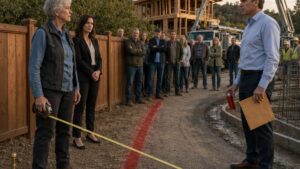
The hearing room that Thursday was the converted sales office near the subdivision entrance. Benjamin sat at the head of a folding table wearing a white dress shirt and an HOA lanyard. Two board members sat beside him. Carol occupied the end seat with a laptop open and her hands resting above the keyboard.
The property-management representative placed a yellow folder in front of Stephen.
Benjamin began before Stephen had fully settled into his chair.
“This is an architectural-compliance hearing, not a county-permit hearing.”
Stephen set out his documents anyway. “Then identify the architectural standard.”
Benjamin nodded toward the representative, who opened the folder and produced a printed page of guidelines. A line had been highlighted beneath a section titled Exterior Improvements.
All visible alterations must maintain compatibility with the established appearance of the community.
Stephen placed the county permit beside it.
“The wall cannot be seen from the street.”
“It can be seen from neighboring lots and the common path.”
“So can every rear fence.”
“This is not about fences.”
“What approved material should I have used?”
Benjamin’s mouth hardened. “The board is not obligated to design a compliant replacement for you.”
Stephen looked toward Carol. She kept her eyes on the screen, but her fingers had stopped moving.
He opened the survey and traced the rear lot line. “The wall is inside my property by fourteen inches at the closest point.”
One board member leaned forward. “Is that verified?”
“The survey was prepared at installation.”
The property-management representative examined the seal. Benjamin did not.
“Location is not the only issue,” he said. “You made an exterior alteration without written architectural approval.”
“There is no retaining-wall application in the records because there was no retaining-wall rule.”
“That is your interpretation.”
“It is the language.”
Benjamin turned a page in his binder. “The association has received complaints that the unfinished stone is inconsistent with surrounding landscaping.”
“Unfinished?”
“The exposed block face.”
“It is limestone.”
“Mr. Hall, we can debate terminology all evening. The board has a duty to enforce community standards consistently.”
Stephen heard the phrase as Benjamin intended it: not as an explanation, but as a boundary.
He passed Eric’s statement across the table. “The county recommends a drainage review before alteration.”
Carol read it first. A faint line formed between her eyebrows.
“I move that we pause enforcement until we obtain an engineering opinion,” she said.
The room went still.
Benjamin looked at her. “You’re recording minutes.”
“I’m also secretary of the board.”
“You are not a voting director.”
“I know. I’m recommending that the board document the risk before requiring removal.”
One of the board members shifted in his chair. The other studied the photographs of the water-stained limestone.
Benjamin closed the folder.
“We are not commissioning an engineer every time an owner disagrees with an architectural determination.”
“This is a grading structure,” Carol said.
“It is an unapproved exterior alteration.”
Stephen watched Benjamin’s hand settle over the highlighted guideline. The man’s confidence did not come from ignorance alone. It came from fear of losing the line once he admitted there could be exceptions.
Benjamin had retired from insurance claims. He had mentioned it at meetings often enough. He believed rules protected institutions because ambiguity invited cost.
Stephen understood that kind of thinking. On construction sites, exceptions caused injuries.
But only when the rule fit the hazard.
The board took a brief recess. Stephen waited in the hallway under framed photographs of the subdivision’s model homes. In each picture, the lawns were flat, the shrubs immature, and no one’s drainage problems existed yet.
Carol came out carrying an empty coffee cup.
“I’m sorry,” she said.
“You warned me.”
“I didn’t know he’d schedule the hearing before reviewing your appeal.”
“You recommended an engineer.”
She glanced toward the closed meeting-room door. “Benjamin thinks delaying enforcement will make the association look inconsistent.”
“Is there something else?”
Carol’s grip tightened around the cup. “The insurer asked for an inventory of structures that don’t have architectural approvals. He’s worried one exception will turn into twenty.”
“My wall is not a pergola.”
“I know.”
“Does he?”
“He knows enough to be careful. Just not in the direction you want.”
The door opened. Benjamin called them back inside.
The decision was unanimous among the voting directors. The appeal was denied. Stephen had thirty days to remove or modify the wall. Fines of $150 per week would begin after the deadline.
Stephen did not react.
He asked for the decision in writing, along with the specific approved replacement materials and the board’s response to the county’s drainage recommendation.
Benjamin nodded to the representative. “The written determination will address the basis.”
“Will it address the drainage?”
“The association is not responsible for private improvements.”
Stephen gathered his documents. The permit lay beneath the highlighted aesthetic checklist, one official page beside another. Together they proved less than either side pretended.
At home, he photographed the wall again, this time as evidence rather than work. Each block became an item in a dispute: dimensions, alignment, distance from the boundary. He included the dark water line because it showed function, though no one on the board seemed willing to read it that way.
The formal denial arrived the next morning.
It cited unapproved exterior alteration and visual incompatibility. It did not identify an approved substitute. It did not mention Eric’s warning.
At the bottom, one sentence had been added in bold:
FULL REMOVAL MUST BE COMPLETED WITHIN THIRTY CALENDAR DAYS.
Stephen printed the notice and carried it outside.
He stood before the wall with the paper in one hand and rested the other on the top course. The limestone held the night’s coolness. Behind it, the uphill soil pressed forward with patient, invisible force.
For four years, Stephen had checked the drainage after every serious storm. He had cleared leaves from the channel, reset two stones, and added gravel where runoff had exposed the pipe. No neighbor had offered money. No board member had asked who maintained it.
Now the association had given him a deadline.
He folded the notice and placed it in his pocket.
For the first time, he stopped thinking about how to save the wall.
He began thinking about how exactly to obey.
Chapter 3: He Removed the Last Stone Without Arguing
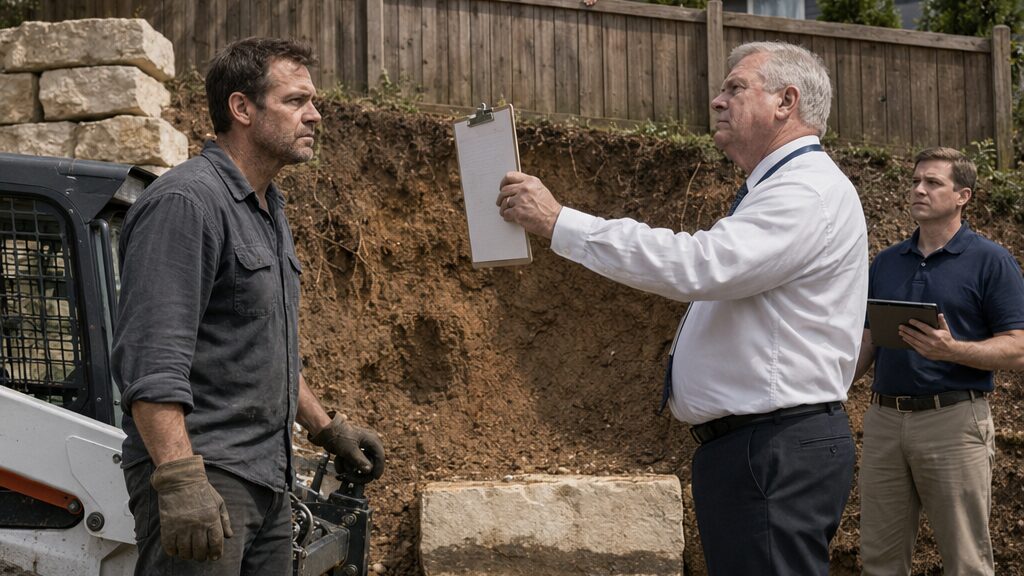
Benjamin arrived at seven twenty in the morning carrying a clipboard.
The compliance deadline did not expire until midnight, but the white management-company sedan pulled up behind him, and the property-management representative stepped out with a tablet before Stephen had finished loading the first limestone block onto a pallet.
“You’re early,” Stephen said.
Benjamin checked his watch. “We agreed on an inspection today.”
“We agreed you could inspect after removal.”
“I wanted to observe the process.”
Stephen looked at the clipboard. “To make sure I don’t leave anything useful?”
Benjamin ignored the remark. “We need to verify full compliance.”
The wall was already half gone. Stephen had started at the far end three days earlier, removing the upper courses in sections so the grade would not release all at once. He used a compact loader to move the larger blocks but lifted the smaller ones by hand, stacking them in precise rows on the lower edge of his yard.
The pale stones looked different off the wall. Without their shared line, they resembled evidence laid out for counting.
Emma Davis stood behind her uphill fence in a sweatshirt, holding a mug with both hands. Her yard rose behind the exposed section, the soil cut nearly vertical where the blocks had been removed.
“Is that safe?” she called.
Benjamin turned before Stephen could answer. “The association is monitoring the work.”
Emma’s eyes moved to Stephen.
He wiped his palms on his jeans. “Don’t put anything heavy near the edge.”
“That wasn’t my question.”
“The ground needs to settle.”
Benjamin marked something on his checklist.
Stephen looked at him. “Write down that I advised against loading the slope.”
“I’ll document observable conditions.”
“Document what I said.”
“This is not an engineering inspection.”
“No. It’s an architectural one.”
The property-management representative lowered his eyes to the tablet.
Stephen returned to the wall.
By late morning, only the lowest course remained through the center section. Those blocks sat deepest in the base and carried the darkest stains. Stephen cleared gravel from the face of one stone and saw the old horizontal water line crossing it three inches below the top.
He remembered the first storm after construction. The wall had not yet reached its final height. Rain had come down for six hours, filling the channel faster than the temporary outlet could release it. Water had risen against the unfinished stones while brown slurry pushed through a gap near the center.
He had worked under floodlights until midnight, adding drainage rock and opening the lower outlet with a shovel.
The next week, an older board president had thanked him for “handling the situation.” The association had never reimbursed him.
Stephen hooked the loader’s forks beneath another block.
As it came free, a ribbon of dry soil slipped from the exposed face. It struck the gravel with a soft hiss.
The property-management representative looked up.
Benjamin stepped closer. “Is that normal?”
“For an unsupported cut?”
“You said the slope needed to settle.”
“It does.”
Another trickle fell, darker this time. Moist soil had been trapped behind the stone.
Emma set down her mug. “Stephen.”
He shut off the loader.
For several seconds no one spoke. The open section of grade stood waist-high, layered with clay and fill. A thin thread of water appeared near the base and ran across the gravel.
It had not rained in five days.
Stephen knew what it meant. Water from irrigation and household drainage was moving through the upper lots, collecting along the old path. The wall had not merely resisted soil. Its stone and gravel had given that water somewhere to spread before entering the channel.
Benjamin approached the exposed cut but stopped short of the wet ground.
“You’ll restore the area when you finish,” he said.
Stephen stared at him. “Restore it with what?”
“Grading and approved landscaping.”
“You ordered the retaining structure removed.”
“We did not order you to create an unsafe condition.”
“You were given a county warning.”
“We were given a recommendation.”
Stephen could feel Emma listening from above. The representative’s tablet remained lifted between them.
He could have stopped.
He could have told Benjamin the center section carried the worst runoff. He could have described the first storm, the emergency trench, and the muddy surge that had crossed the unfinished grade. He could have told Emma to move everything from her lower patio and keep her son away from the rear room during heavy rain.
Instead he said, “I need written confirmation that complete removal remains the board’s instruction.”
Benjamin’s face changed slightly. Not fear. Caution.
“The determination is already in writing.”
“I want today’s inspection sheet signed.”
“That is unnecessary.”
“Then the last course stays until you leave.”
Benjamin looked toward the representative. “Can you note that the owner is refusing full compliance?”
Stephen folded his arms. “I’m asking you to confirm your own order.”
The representative cleared his throat. “A signed field acknowledgment would reduce disagreement later.”
Benjamin took the clipboard, wrote beneath the checklist, and pressed hard enough for the pen to mark the page below.
At association direction, owner completed removal of the unapproved limestone retaining structure.
He signed and dated it.
Stephen read the sentence, then handed the clipboard back.
He restarted the loader.
The remaining blocks came free one by one. Each removal exposed another dark patch in the soil. Water gathered in shallow impressions and ran toward the channel in threads too small to alarm anyone who did not know how quickly clay could soften.
Emma stayed at the fence.
When Stephen reached the final block, he climbed down from the loader and cleared the edges with a hand shovel. The stone sat at the center of the old wall, heavier than the others and wedged into the base. The dark water line crossed its entire face.
Benjamin checked his watch.
Stephen slid a lifting strap around the block.
“Once that’s out, we’re finished?” Benjamin asked.
“With the wall.”
Stephen attached the strap to the loader and raised the forks until the line tightened.
The stone resisted. Then the compacted gravel released with a sharp crunch.
As the block lifted, wet soil folded forward into the empty space. A narrow stream ran out behind it, carrying fine brown sediment across the exposed base.
Emma stepped back from the fence.
The property-management representative filmed several seconds on his tablet.
Benjamin stared at the stream. “You’ll need to address that.”
Stephen lowered the block onto the pallet beside the others. “The structure you ordered removed was addressing it.”
“That is not what the board determined.”
“No,” Stephen said. “It isn’t.”
He did not raise his voice. He did not point toward the water or repeat the county warning. He took the signed sheet from the clipboard, photographed it, and returned the original.
Benjamin adjusted the lanyard at his collar.
“The property is now in compliance,” he said.
Stephen looked at the open slope.
A palm-sized piece of soil broke loose and dropped into the water.
“Put that in the minutes,” he said.
By afternoon, the association portal showed the violation as corrected. The management company sent a confirmation stating that no fines would be assessed.
Stephen printed the message and placed it with the permit, survey, denial letter, county warning, and signed inspection sheet.
The paper trail was complete.
Outside, the limestone blocks stood in three orderly stacks. He covered them with a tarp, though he did not expect rain.
That evening his phone issued a weather alert.
A slow-moving storm system was expected to stall over the county late the following week. Forecast totals had not yet been fixed, but the notice warned of prolonged heavy rainfall and localized flooding.
Stephen opened the hourly projection. The storm was twelve days away.
Through the rear window, he could see the exposed earth where the wall had stood. The last of the daylight caught the wet line at the base.
His thumb hovered over Emma’s contact.
Then he locked the phone and set it facedown beside the signed inspection sheet.
Chapter 4: The Warning He Chose Not to Give
Emma was waiting beside the shared path when Stephen came outside the next morning.
She had one hand resting on the top rail of her fence and the other wrapped around a travel mug. Behind her, the exposed edge of her yard looked sharper than it had the day before. Without the limestone, the difference in elevation was impossible to ignore.
“What’s holding this now?” she asked.
Stephen followed her gaze. The slope was not vertical, but it was close enough that the upper layer of sod seemed to hang over the cut. Small clumps of soil had collected along the gravel below.
“Nothing permanent,” he said.
Emma looked at him. “That isn’t an answer.”
“It’s the condition the board approved.”
“I didn’t ask what the board approved.”
Stephen put on his work gloves. The stacked limestone blocks stood beneath a gray tarp near the side fence. Their shapes pressed against the plastic like covered furniture.
Emma stepped closer to the boundary. “Benjamin sent an email saying the property had been returned to compliance and there was no safety concern.”
“He isn’t qualified to determine that.”
“Are you?”
The question landed harder than she intended. Stephen could see it in the way her shoulders shifted afterward, but she did not take it back.
“I know how the grade behaves,” he said.
“Then tell me.”
He could have taken her down the path and shown her where the runoff from three yards converged. He could have explained how water moved unseen through the clay, how the dark stain on the last block recorded years of pressure, how a long storm could turn compact ground into weight with nowhere to go.
Instead he pointed toward the edge of her lawn.
“Keep your son away from that section. Don’t place furniture or anything heavy near it. If we get significant rain, move anything valuable off the lower patio.”
Emma stared at him over the mug. “How significant?”
“More than a normal shower.”
“Is the patio going to flood?”
“It could see runoff.”
“Runoff means what?”
“Water. Mud, maybe.”
The word sounded small once he said it.
Emma looked down toward her patio. A grill stood near the retaining edge, along with two metal chairs, a storage bench, and several large planters. The glass door beyond them opened into the room her son used for schoolwork and video games.
“If you think mud could come through there,” she said, “why didn’t you say that before you removed the wall?”
Stephen pulled the gloves tighter over his wrists.
“I warned the board in writing.”
“I’m not the board.”
“No.”
The answer hung between them.
Emma’s face changed—not into anger yet, but into the recognition that he had chosen his words carefully.
“How long have you known this slope was a problem?”
“The drainage has always needed maintenance.”
“That isn’t what I asked.”
Stephen looked toward the upper yards. A sprinkler clicked behind the next fence, sending water into a bed of ornamental grass. Some of it disappeared beneath the soil before reaching the property line.
“The wall managed it,” he said.
Emma lowered her mug. “And now the wall is gone.”
“Yes.”
She waited for more.
Stephen gave her none.
By noon, Emma had moved the storage bench inside her garage. Her son carried the electronics from the room near the patio to an upstairs bedroom while pretending not to listen to the adults. The grill remained outside because it was too heavy for the two of them to lift safely.
Stephen saw all of it from his yard.
He told himself she was taking reasonable precautions. He told himself the forecast could change. He told himself that if he described the worst-case failure, Benjamin would claim Stephen had created panic to strengthen his dispute.
At three, the HOA email arrived.
SUBJECT: LOT 47 COMPLIANCE UPDATE.
Benjamin wrote that the limestone structure had been fully removed following standard enforcement procedures. He thanked residents for respecting architectural requirements and stated that the association had observed no immediate threat to neighboring property.
Stephen read the sentence twice.
Then he forwarded the message to Eric Campbell with one line:
Can you confirm whether the county agrees with this assessment?
Eric answered twenty minutes later.
The county has made no such determination. I recommend temporary stabilization before prolonged rain.
Stephen saved the response.
He did not send it to Emma.
That evening, he spread a grading tarp over part of the exposed slope and secured it with stakes. It covered the center section but not the full length. A complete temporary system would require trenching across the lower yard and setting erosion barriers along the path. He had the equipment. He also knew that doing the work himself would blur the line he had spent weeks drawing between private responsibility and shared drainage.
Emma watched through the fence.
“Is that enough?” she asked.
“For a short storm.”
“The alert says it may stall.”
Stephen drove another stake into the ground. “Forecasts change.”
She folded her arms. “You keep saying things that are technically true.”
He stopped.
For a moment he considered telling her everything: the first storm four years earlier, the water behind the unfinished wall, the old board’s relief when he solved the problem without asking for reimbursement.
But he heard Benjamin’s voice from the hearing room.
Private improvement.
Unapproved alteration.
Not association responsibility.
Stephen straightened. “Move the planters before Thursday.”
Emma’s expression hardened.
“Fine,” she said. “But if you know something you aren’t telling me, that’s on you.”
She went inside.
The first rain arrived that night, earlier than forecast. It began lightly, tapping against Stephen’s kitchen windows while he reviewed the correspondence again. The county permit. The violation. The signed inspection sheet. Benjamin’s email declaring no immediate threat.
At eleven thirty, Stephen took a flashlight into the yard.
Water ran beneath the tarp in narrow silver lines. The stakes held. The exposed soil was dark but intact.
Then he heard a faint scraping sound near Emma’s fence.
He crossed the yard and crouched beside the lower rail. Muddy water had appeared beneath it, no wider than two fingers. It slid over the gravel and followed the old course toward the shared path.
Stephen placed his palm against the ground.
The soil trembled slightly as water moved through it.
His phone buzzed with an updated alert.
The storm had slowed over the county. Rainfall totals had been revised upward.
Behind Emma’s fence, a planter tipped with a dull crack.
Stephen stood and reached for the gate latch.
Chapter 5: When the Hillside Crossed Every Property Line
Emma’s patio door would not open.
Stephen could see her through the glass, pulling the handle with both hands while brown water pressed against the bottom frame from outside. Behind her, her son stood barefoot in the hallway, holding a flashlight.
“Go around!” Stephen shouted.
The rain swallowed his voice.
He climbed over the side fence instead of waiting for the gate. Mud covered the patio in a shallow moving sheet. It had already buried the legs of one chair and pushed two planters against the door.
Stephen braced his boots and dragged the nearest planter sideways. Water surged into the space it left. The door shifted half an inch.
“Again,” Emma called through the glass.
He pulled the second planter free, then drove the edge of a shovel beneath the packed mud at the threshold. Emma pushed from inside. The door opened just enough for water to spill into the room.
“Stop,” Stephen said. “Use the front exit.”
“My son’s things—”
“Leave them.”
“They’re upstairs.”
“Then both of you go out front.”
Emma’s face tightened, but she nodded. She turned, grabbed her son by the shoulder, and disappeared into the house.
Stephen stepped back into the rain.
The slope above the patio was moving.
Not collapsing all at once. It shifted in sections. A dark seam opened beneath the sod, then widened as saturated soil folded forward. Water came from three directions: through Emma’s yard, beneath the next fence, and along the old drainage line where the wall had stood.
The tarp Stephen had installed was gone from one side. A loose corner whipped against the mud.
He ran downhill to his yard and started the compact loader. The engine caught on the second try. He drove toward the exposed grade, dropped the bucket, and cut a shallow trench across the lower lawn to redirect water toward the drainage channel.
For a few minutes, it worked.
The muddy flow changed direction and poured into the trench. Water moved away from Emma’s door. Stephen deepened the cut, steering toward the shared path where the existing drain inlet waited below.
Then the trench wall crumbled.
Clay filled the channel almost as quickly as he opened it. The loader’s tires sank several inches. The rear end slewed sideways.
Stephen backed out before the machine became trapped.
A section of slope gave way with a low sound he felt through the ground more than heard. Mud pushed across the place where the limestone wall had stood and spread into his yard, thick enough to carry mulch, broken roots, and a length of plastic edging.
It flowed past the stacked blocks.
The tarp covering them sagged under the rain, but the limestone remained clean beneath it, arranged in straight rows while the soil they had once held crossed every property line.
For one brief, ugly moment, Stephen felt vindicated.
The wall had mattered. Benjamin had been wrong. The signed sheet sat dry inside the house. No one could say Stephen had imagined the risk.
Then a child’s bicycle floated against the shared-path fence.
The feeling disappeared.
Emma and her son came through the side gate wearing rain jackets over sleep clothes. Her son carried a backpack and looked toward the patio with a stunned, fixed expression.
“Is the house moving?” he asked.
“No,” Stephen said. “Stay near the front.”
Emma pointed uphill. “My neighbor’s fence is leaning.”
Stephen followed her hand. One post had pulled free as the soil around it softened. The panel leaned toward the drainage cut.
“Call emergency services and report a slope failure,” he said. “Tell them no one is trapped.”
Emma took out her phone. “What are you doing?”
“Opening the lower inlet.”
The shared drain was already clogged with leaves and mud. Stephen took a long-handled shovel and forced his way down the path. Water covered his boots. Patio cushions, bark, and broken stems moved around his legs.
At the inlet, he cleared the metal grate by hand. The moment the blockage released, water dropped with a hollow roar. The level fell several inches, then stabilized as more mud arrived.
It was not enough.
He dug a second channel toward the inlet while the rain struck the back of his neck and ran inside his jacket. Each shovel cut held for seconds before slumping inward.
Emma joined him with another shovel.
“You should be out front,” he said.
“So should you.”
“Your son—”
“He’s with the neighbor.”
They worked without speaking. Emma did not ask whether Stephen had predicted this. Not yet.
By dawn, the heaviest rain had moved east. The hillside stopped advancing, though water continued to seep through the exposed face. Mud covered two patios and much of the shared path. Emma’s glass door remained intact, but the lower room held an inch of water and a line of brown residue along the baseboards.
The emergency crew placed barriers at both ends of the path. No one had been injured.
Emma’s son stood beside the front curb wrapped in a blanket. When Stephen passed, the boy said, “Mom made me move my computer upstairs because you told her.”
Stephen nodded.
That small fact should have brought relief. Instead it sharpened what he had not told them.
By midmorning, the property-management representative arrived with Benjamin and an insurance adjuster. Benjamin wore a raincoat over his white shirt, but the HOA lanyard was still visible at his collar.
He stopped at the edge of Stephen’s yard.
The mud had reached the first row of stacked limestone blocks and left a brown line across the tarp.
“What happened?” Benjamin asked.
Stephen looked at him.
Emma gave a short laugh with no humor in it.
The adjuster took photographs before speaking. He photographed the exposed slope, the blocked inlet, the damaged patios, the limestone stacks, and the tracks from Stephen’s loader.
“Who altered the grade?” he asked.
“The association ordered removal of the retaining structure,” Stephen said.
Benjamin answered at the same time. “The owner performed the work.”
The adjuster looked between them. “Did either party obtain a stabilization plan?”
Stephen handed him a plastic folder containing copies of the violation, Eric’s recommendation, and Benjamin’s signed inspection sheet.
The adjuster read each page under the shelter of the management sedan’s open hatch.
Benjamin’s jaw tightened when he reached the signed acknowledgment.
“This confirms compliance,” he said. “It does not transfer responsibility for means and methods.”
“It confirms you observed the condition,” Stephen said.
“I am not an engineer.”
“You refused one.”
The adjuster raised a hand. “I’ll need separate statements.”
He turned to Stephen. “Did you understand that removing the wall could cause slope failure?”
The question was direct enough to silence everyone.
Stephen looked toward the dark water line left across the mud. The same height, almost, as the stain on the final limestone block.
“I understood it could affect drainage,” he said.
“That is not what I asked.”
Before Stephen could answer, Emma stepped away from the group and went inside her house. She returned carrying her phone.
“I found something,” she said.
Her screen showed an old message thread between her and Stephen, dated nearly three years earlier. Emma had asked whether she could cut into the lower edge of her yard to widen the patio.
Stephen’s reply was visible beneath it.
Do not disturb that slope without a retaining plan. If it lets go, your patio could be buried.
Emma held the phone toward the adjuster.
Then she looked at Stephen.
“You knew exactly what it could do.”
Chapter 6: The Board Had Quietly Made It His Problem
Carol called Stephen before the insurance adjuster finished his second inspection.
“I found emails that aren’t in your property file,” she said. “You need to see them before tonight.”
Her voice sounded unsteady.
Stephen stood beside the stacked limestone, staring at Emma’s old message on his own phone. The rain had stopped, but water continued dripping from the fences and roof edges.
“What emails?”
“From the board before Benjamin’s term. About your wall.”
Stephen closed his eyes.
“I’ll meet you at the records room.”
The HOA records were kept in a locked storage space behind the community office. Carol had spread several printed emails across a folding table when Stephen arrived. Some pages were yellowed at the edges. Others had been printed that morning from an archived account.
The oldest message was dated four years earlier.
The former board president had written to two directors about repeated runoff complaints behind Lots 45 through 48. A contractor had estimated the cost of installing a shared drainage channel and retaining system along the common path.
Stephen read the amount twice.
The board had rejected it as too expensive.
Another email followed.
Stephen Hall has offered to construct a wall within his lot while completing his own grading. This may reduce the immediate drainage concern without association expense.
Carol pointed to the next page. “Keep reading.”
A director had asked whether the association should contribute materials or maintenance funds.
The former president replied:
Avoid creating a formal obligation. If Hall is willing to handle it as a private improvement, let him. We can revisit a community solution later if necessary.
Stephen placed both hands on the table.
He remembered the conversations, though not the words. The former president had stood in Stephen’s yard and called the wall a practical compromise. He had praised Stephen’s skill, thanked him for being cooperative, and promised the board would “work something out” if maintenance became burdensome.
Nothing had been written into the minutes.
Nothing had been attached to the lot record.
The association had received the benefit and preserved its denial.
Carol sat across from him. “I should have found these before the hearing.”
“Were they hidden?”
“No.” Her answer came too quickly, then softened. “Not exactly. They were in an old mailbox under the former management company. The files were migrated badly.”
“You knew there were older records.”
“I knew there might be.”
“And you let the vote happen.”
Carol looked down at the emails. “I thought asking for an engineering review was enough.”
“It wasn’t.”
“No.”
The admission left no room for Stephen’s anger to expand. She had not come to defend herself.
At the county office, Eric reviewed the archived messages and the storm photographs.
“This explains the arrangement,” he said. “It doesn’t resolve liability.”
“It shows the wall served multiple lots.”
“It shows the old board expected it might reduce a shared drainage problem.”
“They avoided putting that in the record.”
“Yes.”
Stephen leaned over the counter. “And Benjamin ordered it removed.”
“Yes.”
Eric met his eyes. “You also removed it knowing the slope could fail.”
Stephen straightened.
Eric tapped Emma’s old message, which the adjuster had already added to the file. “You wrote this before the dispute.”
“I wrote that cutting into the slope could cause failure.”
“You knew the consequence.”
“I didn’t know the exact storm would come twelve days later.”
“No one is saying you controlled the weather.”
The sentence was quiet, but it struck harder than accusation.
Eric unfolded a temporary stabilization plan. “The county can require emergency erosion control because material reached the shared path. We can approve a repair design. We cannot decide who pays or who was morally entitled to wait.”
Stephen looked at the drawing. It showed a reinforced drainage channel crossing part of his lot, with access needed for equipment.
The association had made the problem his for years.
He had made sure they could no longer ignore it.
Emma and her son had paid the first price.
The emergency board session began at seven. Residents filled the community room and stood along the back wall. Mud-stained photographs had circulated through the neighborhood all day, along with Benjamin’s email claiming there had been no immediate safety concern.
Benjamin sat at the head table with his binder open.
The insurance adjuster occupied a chair near the property-management representative. Carol had placed the archived emails in separate folders for each voting director.
Benjamin began with a prepared statement.
“The board recognizes the seriousness of the incident and is committed to determining responsibility based on governing documents, professional review, and verified facts.”
A resident near the back asked, “Are you saying Stephen caused it?”
Benjamin lifted one hand. “No conclusions have been reached.”
The adjuster spoke without standing. “The association’s exposure may include failure to investigate a known drainage concern before enforcing removal.”
Murmurs moved through the room.
Benjamin’s face tightened. “The board relied on the information available.”
Carol opened her folder. “Not all available information.”
She described the archived emails, the rejected drainage proposal, and the former board’s decision to let Stephen build privately without creating an official association obligation.
One director stared at Benjamin. “Did you know Carol requested an engineering review before we voted?”
Benjamin did not answer immediately.
Stephen watched him measure the room.
“Yes,” Benjamin said.
The murmurs stopped.
“Why did you refuse?” the director asked.
“Because the insurer had already questioned inconsistent architectural records. We had multiple owners claiming prior exceptions. If we suspended enforcement every time someone presented a secondary concern, the standards would become meaningless.”
“The secondary concern buried two patios,” Emma said from the second row.
Benjamin looked toward her but did not argue.
The adjuster wrote something in his notes. “Blocking review after receiving the county recommendation may be significant.”
Benjamin turned to Stephen. “That does not eliminate the owner’s role. Mr. Hall is a grading contractor. He understood the site better than anyone in this room.”
Every face shifted toward Stephen.
For weeks, he had wanted that fact recognized.
Now it felt like weight.
The adjuster asked, “Did you warn the neighboring owners of the potential severity?”
Stephen looked at Emma.
“I told her to move valuables and stay away from the edge.”
“Did you tell her the patio could be buried?”
“No.”
Emma’s jaw tightened, but she remained seated.
“Why not?” Carol asked.
Stephen could have said he feared liability. He could have said Benjamin had declared the slope safe. He could have said the association had spent years benefiting from his unpaid work and then treated it as an eyesore.
All were true.
“I wanted the board to own its decision,” he said.
The room stayed quiet.
“And I believed the signed order protected me.”
The adjuster closed his pen.
“It may protect you from some claims,” he said. “It may not protect you from all of them.”
The board recessed after ten. Residents gathered in small groups in the hallway while the adjuster spoke privately with the directors.
Stephen stood near the empty model-home photographs. Emma passed him without stopping.
Benjamin emerged last.
His lanyard hung crooked against his shirt. He carried a single sheet of paper rather than his binder.
“The insurer is prepared to discuss a settlement,” he said.
Stephen waited.
“The association would fund stabilization and repair to the common path. Your fines remain waived. Your property damage claim would be considered separately.”
“And Emma’s patio?”
“Subject to coverage review.”
“What do you want from me?”
Benjamin looked toward the closed meeting-room door.
“The public record should reflect that the prior board created an informal arrangement without architectural approval. Current enforcement acted on incomplete records.”
“That’s true.”
“It should also state that removal was performed by you as the owner and contractor.”
“That’s also true.”
Benjamin held out the sheet.
The draft statement placed the failure on old recordkeeping, former directors, and Stephen’s chosen removal method. It did not say Benjamin had blocked an engineering review. It did not mention Stephen’s withheld warning.
“You want everyone absent to carry the blame,” Stephen said.
“I want a resolution that preserves coverage.”
“And your position.”
Benjamin’s expression hardened, then sagged.
“If the association’s insurer denies the claim, every homeowner may face a special assessment. Emma included. You think an admission helps her? It may cost her thousands.”
The argument was not empty. That made it worse.
Benjamin placed the paper on the table beside Stephen.
“Sign it, and we can start repairs immediately.”
Stephen looked through the doorway at Emma, who was helping her son collect damp photographs from a cardboard box.
The settlement could protect the neighborhood from the largest financial loss. It could also turn a partial truth into the official one.
Benjamin tapped the signature line.
“This is the cleanest way out.”
Stephen picked up the paper.
For the first time since the notice arrived, he understood that the cleanest version was the one most likely to leave the real damage buried.
Chapter 7: They Rebuilt the Drainage Without Pretending Anyone Was Innocent
Stephen did not sign the settlement.
He carried Benjamin’s paper back into the meeting room and placed it facedown beside the archived emails.
The residents were still talking in low, urgent clusters. Emma stood near the second row with her arms folded. Her son sat beside the damp cardboard box, separating photographs that could be saved from those already fused together.
Benjamin returned to his chair and opened his binder.
“We’ll reconvene,” he said. “The board has prepared a statement regarding the incident and the proposed path forward.”
Stephen remained standing.
Benjamin glanced at him. “Mr. Hall, please take your seat.”
“No.”
The word was not loud, but the room quieted around it.
Benjamin’s expression tightened. “This is a board session.”
“And you’re about to make the same mistake again.”
One of the directors looked from Stephen to the settlement paper. Carol stopped typing.
Benjamin drew a breath. “The association is attempting to protect every homeowner from unnecessary financial exposure.”
“By writing a version where everyone responsible is either absent or unnamed.”
“That is not a fair characterization.”
Stephen turned the paper over.
“The statement says the previous board failed to document an informal arrangement. It says I used my own judgment during removal. It does not say Carol requested an engineering review. It does not say you refused it. It does not say I knew what could happen and chose not to explain it clearly.”
Emma’s eyes lifted.
Several residents began speaking at once. Benjamin raised his hand.
“Let him finish,” Carol said.
The authority in her voice surprised even her. She closed the laptop and pushed it aside.
Stephen looked at Emma rather than the board.
“I warned you to move things,” he said. “I told you to keep your son away from the edge. I knew the drainage could carry mud onto the patio.”
“You knew it could bury it,” Emma said.
“Yes.”
Her face remained still.
“Then why didn’t you say that?”
Stephen could feel every person in the room waiting for an answer that would let them place him cleanly on one side of the dispute.
He could not give them one.
“Because I wanted the board to own the order,” he said. “I wanted the damage, if it came, to prove what the wall had been doing.”
A man near the back muttered something under his breath. Someone else asked whether Stephen was admitting liability.
Stephen kept his attention on Emma.
“I told myself I had warned them in writing. I told myself Benjamin declared the slope safe. I told myself you had enough information to take precautions.”
“You decided what was enough for us,” she said.
“Yes.”
Her son stopped sorting the photographs.
Stephen continued before shame could make him retreat into technical language.
“The board used my work for four years without accepting responsibility for the drainage. Then it called the wall an eyesore. I was angry. I obeyed the order as narrowly as I could because I wanted them trapped by their own paperwork.”
Benjamin shifted in his chair. “That does not excuse—”
“No,” Stephen said. “It doesn’t.”
The interruption silenced him.
Stephen took the archived emails from Carol’s folder and placed them beside the unsigned settlement.
“These show the association knew the wall was reducing a shared drainage problem. The former board avoided a formal obligation because I was willing to handle it. That was wrong.”
He placed Eric’s county recommendation on top.
“This shows the current board was warned not to remove it without review. Benjamin refused that review. That was wrong.”
Then he set Emma’s old message on the table.
“And this shows I knew enough to warn her clearly. I didn’t. That was wrong too.”
No one applauded. No one spoke.
The quiet was more difficult to stand inside than anger.
The insurance adjuster leaned forward. “What are you proposing?”
Stephen unfolded Eric’s stabilization plan.
“A permanent channel designed for all three uphill lots. Reinforced outlet to the common path. Engineered retaining where the grade requires it, not where the board thinks it looks best.”
One director scanned the plan. “What will it cost?”
“More than the wall did. Less than another failure.”
“And who pays?”
“The association funds the shared system.”
A resident near the aisle objected immediately. “So everyone gets assessed for his wall?”
“For the drainage serving the community,” Stephen said. “Not my wall.”
Benjamin shook his head. “The association cannot simply accept full responsibility when the owner contributed to the loss.”
“I’m not asking it to.”
Stephen looked down at the plan.
“I’ll provide equipment and labor for the excavation and placement. No contractor markup. The limestone I removed can be reused where the engineer approves it.”
Emma studied him. “And the patio?”
“The insurance claim should remain separate. I’ll help clear it now, before coverage is decided.”
“That doesn’t repair it.”
“No.”
The answer was not satisfying. It was true.
The adjuster took the plan and read the notes along the drainage route.
“If the association funds materials and professional design, owner-provided labor may reduce the emergency repair expense,” he said. “It would not settle all claims, but it would demonstrate mitigation.”
Benjamin looked toward the residents. “Temporary access would have to cross Mr. Hall’s lot.”
Stephen nodded. “I’ll grant it.”
“For construction and future inspection?”
The old answer rose instinctively in him: Not without compensation.
He looked at the mud still dried along Emma’s shoes.
“Yes. Written access for the drainage system. Limited to maintenance and inspection.”
One board member whispered to the other. Carol reopened her laptop.
Emma remained standing.
“If we approve a shared assessment,” she said, “I’ll support it.”
A few heads turned toward her.
She looked at Stephen. “Not because this makes us even.”
“I know.”
“And not if the board uses your admission to avoid its own.”
“It shouldn’t.”
Benjamin rubbed the bridge of his nose.
For years, he had treated the association’s credibility as something preserved by refusing exceptions. Now every document on the table showed what that refusal had cost.
“I saw Carol’s recommendation,” he said.
The room stilled again.
“I believed delaying enforcement would undermine the board’s position with the insurer and with other owners. I believed Mr. Hall was using technical concerns to preserve an alteration he had never submitted for architectural approval.”
He looked toward the damaged photographs beside Emma’s son.
“I was wrong to refuse the review.”
The words came without drama. They seemed to diminish him and steady him at the same time.
The board voted before midnight.
The association approved emergency funding for the engineered drainage system, subject to final county review. The directors authorized temporary access across Stephen’s property and agreed to place the archived arrangement, the county warning, and the full meeting record in the permanent files.
The special assessment was smaller than residents had feared because Stephen’s labor and equipment reduced the construction cost. It was not popular. Several homeowners objected. One demanded that Benjamin pay personally. Another insisted Stephen should.
No one received the simple answer they wanted.
Work began two weeks later.
Stephen removed mud from Emma’s patio before touching his own yard. Her son helped carry the ruined cardboard boxes to the curb. Emma worked beside them, speaking only when necessary.
The new drainage channel was deeper than the old one and lined with compacted stone. Eric inspected the base before the pipe was covered. A landscaping contractor rebuilt the failed grade under the engineered plan.
When it was time to place the retaining course, Stephen uncovered the limestone stacks.
The blocks still carried traces of dried clay. One by one, he cleaned them and set them along the reinforced channel. They no longer formed a private wall across his yard. They became part of a system extending beyond it.
He saved the final water-stained block for the lowest point.
Emma stood near the fence as he lowered it into place.
“That the one?” she asked.
Stephen nodded.
The old dark line ran across its face.
He adjusted the block until it sat level, then packed stone behind it so water could pass without carrying the slope.
By early autumn, grass had begun growing over the repaired grade. Rain crossed the neighborhood twice without leaving mud on the path. Water entered the new channel behind Emma’s patio, moved past Stephen’s yard, and disappeared through the outlet beneath the common walkway.
The first time it happened, Stephen stood outside and watched until the rain stopped.
At the next board meeting, Benjamin arrived without his lanyard.
He placed a signed repair plan on the table, then set a second sheet beside it.
His resignation was brief. It did not blame the former board, the insurer, Stephen, or the weather.
Carol accepted the document and entered it into the minutes.
Benjamin looked once toward Stephen.
Neither man offered forgiveness.
Benjamin walked out before the vote to appoint an interim president.
Later, Stephen returned to the repaired slope. Emma was on her patio setting two cleaned planters near the door. She left more distance than before between them and the edge.
“You think the channel will hold?” she asked.
“It was designed to.”
She gave him a tired look.
Stephen corrected himself.
“Yes,” he said. “And if I ever think it won’t, I’ll tell you exactly why.”
Emma considered that, then nodded.
Below them, water from a garden hose crossed the stone bed and entered the channel. It touched the stained limestone block, followed the route prepared for it, and continued past the property line without taking anything else along.
The story has ended.