The HOA Fined Her Dog at 6:14 A.M.—Then She Found the Map They Feared
Chapter 1: The Notice Clipped to the Water Bowl
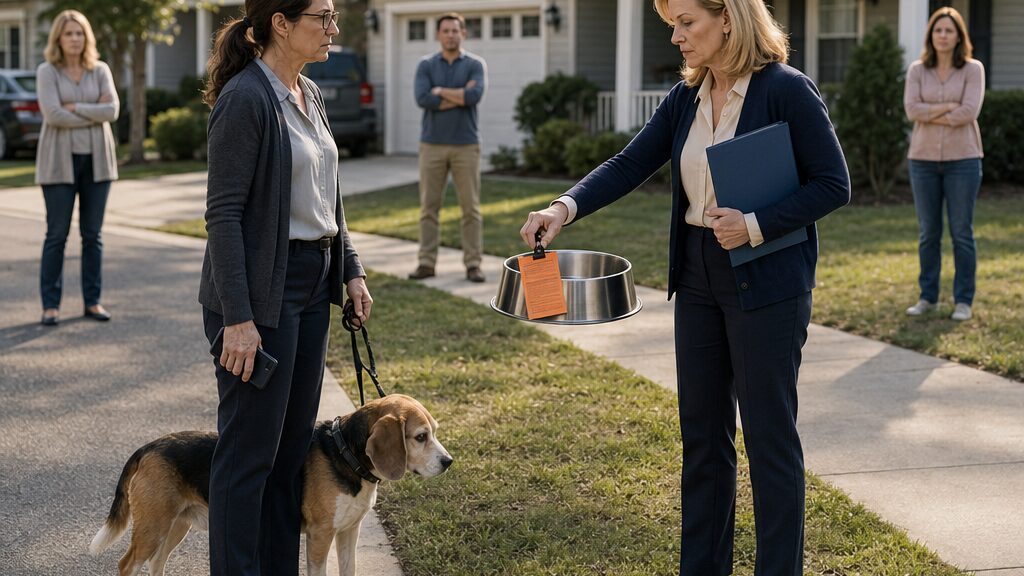
The orange notice was clipped to the rim of Farmer’s water bowl.
Michelle Davis saw it before she saw Debra Roberts.
The paper trembled in the morning breeze, its black print facing the street like a public accusation. Farmer lowered his nose toward the bowl, sniffed once, and backed away as if the paper itself smelled wrong.
Michelle stopped at the edge of her driveway.
“Don’t touch it,” Debra called.
She stood ten feet away on the narrow sidewalk, a blue folder tucked against her ribs. Her pale hair was pulled back neatly, and she wore the expression she used at association meetings when someone had spoken out of turn.
Michelle looked from Debra to the bowl. “I wasn’t planning to.”
Across the street, a garage door had stalled halfway open. A man in running clothes stood beside it, pretending to adjust his watch. Two houses down, a woman had paused with a trash bin in both hands.
Farmer’s leash tightened gently around Michelle’s fingers.
She bent, not to remove the notice, but to read it.
UNAUTHORIZED AMENITY ON ASSOCIATION-MAINTAINED PROPERTY.
Penalty: $400.
The bowl sat on the strip of dry grass between Michelle’s driveway and the sidewalk, where she had placed it every morning for nearly four years. Farmer was twelve now. On warm walks he tired quickly, and the steel bowl gave him one last drink before they went inside.
Michelle straightened.
“What makes the bowl an amenity?”
Debra opened the folder. “Any object placed for recurring use on common property qualifies.”
“It’s there for ten minutes.”
“Recurring use is still recurring use.”
Michelle took out her phone.
Debra’s chin lifted. “You may photograph the notice. You may not photograph me without permission.”
“We’re outside.”
“That doesn’t make it appropriate.”
Michelle crouched again. Farmer watched her, ears drooping. She photographed the notice, the bowl, the edge of the sidewalk, and the seam where her driveway met the disputed grass.
Then she unclipped the paper.
Debra stepped forward. “That must remain attached until service is complete.”
“Service is complete if I received it.”
“It was posted.”
“On my property?”
“On association-maintained property.”
Michelle held the notice between two fingers. “Which parcel?”
Debra blinked.
“The parcel number,” Michelle said. “Which recorded parcel authorizes the association to issue this fine?”
The man across the street had stopped pretending to look at his watch.
Debra closed the folder. “The green strip has been maintained by the association since the subdivision was established.”
“That wasn’t my question.”
“It is common property.”
“Then it has a legal description.”
Debra’s face tightened. “This is exactly the kind of technical intimidation residents have complained about.”
Michelle felt heat climb into her cheeks. She knew that phrase. Technical intimidation. It had appeared in an anonymous workplace complaint seven years earlier after she corrected a supervisor’s filing error in front of two clerks. The complaint had gone nowhere, but the words had stayed.
She could have explained that asking for a parcel number was not intimidation. She could have explained that recorded land had boundaries, legal descriptions, owners, easements, and tax treatment.
Instead she poured Farmer’s water into the dry grass.
The silver bowl rang softly when she set it upside down on the concrete.
“Please state the parcel number,” she said, holding up her phone.
Debra stared at the lens. “The association operates under longstanding practice.”
“Is that your answer?”
“It is the governing answer.”
“It isn’t a parcel number.”
A front door opened somewhere behind them.
Debra lowered her voice. “You work for the county. You know very well most residents don’t carry parcel numbers around in their heads.”
“I’m not asking most residents. I’m asking the person issuing a $400 fine.”
Farmer gave a low, uncertain whine.
Debra glanced at him. “This isn’t your first violation.”
“I know.”
“At 6:14 this morning, your dog barked repeatedly.”
“He barked twice.”
“The duration is not the only factor.”
“How was the time recorded?”
“I heard him.”
“From inside your house?”
“From my property.”
Michelle looked toward Debra’s porch, where a white curtain still hung slightly open.
Debra took a paper from the folder. “The early-noise penalty is $180. That will be issued separately.”
The woman with the trash bin let it drop hard enough for the lid to clap shut.
Michelle kept her face still. “So this is $580 before breakfast.”
“You’ve been warned.”
“For what?”
“Disregard.”
The word landed more sharply than the amounts.
Michelle folded the orange notice once, carefully along the printed line.
Debra pointed at it. “Do not damage association records.”
“It’s my copy.”
“It is evidence of service.”
“Then you should have retained the original.”
For the first time, Debra looked uncertain. Only for a second. Then she stepped back and reopened her folder.
“You have thirty days to pay or request a hearing.”
“I’ll request one.”
“You have requested four reviews in six months.”
“And how many of the notices identified the parcel?”
Debra’s mouth thinned. “Your pattern of resistance is becoming the issue.”
Michelle looked at the people watching from driveways and windows. None of them met her eyes. She understood what they saw: a county employee picking apart language, refusing ordinary rules, using knowledge other people didn’t have.
Farmer nudged her knee.
She clipped his leash shorter and picked up the bowl.
Debra called after her. “For the record, moving the bowl does not cure the violation.”
Michelle turned. “For which property?”
Debra did not answer.
Inside, Farmer went straight to the kitchen mat and lowered himself with a grunt. Michelle filled the bowl at the sink, set it beside him, and placed the orange notice on the counter.
Three older notices waited in a drawer beneath the phone: $180 for barking, $220 for paw prints near the sidewalk, $95 for “unapproved animal activity” on the green strip. She laid them side by side.
Not one included a parcel number.
At 7:42, she logged into the county’s public property portal from her home laptop. She did not use her employee credentials. She entered her street address, then Debra’s, then the HOA’s registered mailing address.
The tax map loaded slowly.
Michelle enlarged the block. Her house appeared as a clean rectangle. Debra’s lot appeared beside it. The green strip showed as a pale shape with no street number.
She clicked it.
No owner appeared.
She searched the association’s name. The results listed the clubhouse lot, a drainage basin, and two landscaped entrances.
No green strip.
Michelle entered the subdivision name and filtered by common ownership.
Still nothing.
Farmer drank behind her, his collar tag tapping the steel bowl.
Michelle opened the $400 notice again and read the phrase association-maintained property.
Maintained.
Not owned.
She searched one final time using the parcel identification printed on the modern neighborhood map.
The system returned a red message:
NO ACTIVE PARCEL FOUND.
Michelle sat back.
For the first time that morning, the fines felt smaller than the question beneath them.
Chapter 2: The Map With the Missing Boundary
The modern tax map ended the green strip at Michelle’s driveway.
The original subdivision plat did not.
Michelle stood at the public research terminal in the county recorder’s office, comparing the two images until the lines blurred. On the current map, the strip was a narrow orphaned shape between private lots. On the scanned 1978 plat, it widened behind six homes and continued toward the drainage channel.
A handwritten note followed the faded boundary:
DEDICATED OPEN SPACE.
Michelle zoomed in.
The words were grainy but readable. A red pencil line, drawn decades earlier, traced the strip from the subdivision entrance to the rear corner of George Mitchell’s lot.
She printed the page.
The machine charged her twenty-five cents and released the paper warm.
“You’re in early.”
Michelle turned.
Samantha Clark stood behind her with a travel mug and a yellow inspection vest folded over one arm. She worked in municipal land use, two floors above Michelle’s records division, though their paths crossed often enough for polite familiarity.
“I’m using the public terminal,” Michelle said.
Samantha looked at the printout. “I didn’t ask which terminal.”
Michelle slid the plat beneath the orange notice she had brought from home.
Samantha’s eyes followed the movement. “Is this about your association?”
“It may be.”
“That answer usually means yes.”
Michelle gathered the pages. “I’m checking a legal description.”
“On your own property?”
“On land beside it.”
Samantha set down her mug. “Michelle.”
The warning in her voice was quiet, which made it more serious.
“I haven’t accessed internal notes,” Michelle said. “I haven’t searched restricted files. Everything I’ve used is available to the public.”
“You know more than the public knows about where to look.”
“That isn’t misconduct.”
“No. But using your position in a private dispute can become misconduct very quickly if someone complains.”
Someone already had, Michelle thought.
She folded the orange notice over the printout so the words dedicated open space disappeared.
Samantha leaned closer. “If you need a formal determination, file a request. Don’t build one yourself from behind the counter.”
“I’m not behind the counter.”
“You know what I mean.”
Michelle did. That was the problem.
By noon, she had returned to her workstation and processed twenty-three routine document requests without opening the plat again. She indexed deeds, corrected a misspelled grantee name, and answered a phone call from a title company seeking an easement from 1996.
The work usually calmed her. Every document had a place. Every recording number led backward or forward to something else.
The green strip did not.
During lunch, she went downstairs to the archives desk and filled out the same request form any resident would use. She paid the copy fee in cash. The archives clerk retrieved the original plat book from climate-controlled storage and placed it beneath a clear protective sheet.
There it was again.
The red pencil line was not part of the recorded ink, but the dedication language was.
Michelle read the certificate twice.
The developer had dedicated streets, utility easements, and identified open-space areas for public use, subject to municipal acceptance. A stamped notation showed acceptance three months later.
She requested certified copies.
“Could take until tomorrow,” the clerk said.
“That’s fine.”
It was not fine. The HOA’s online portal now showed both new penalties as pending. A red banner warned that unpaid balances could incur administrative fees.
Still, the certified copy mattered. Not because it would win the argument, but because no one could say she had altered or selectively printed it.
That evening, Michelle spread the documents across her kitchen table.
Farmer lay beneath her chair, breathing heavily through his nose. The steel bowl stood beside the back door, empty and clean.
The plat looked decisive until she found the maintenance agreement.
It had been recorded in 1998, twenty years after the subdivision opened. The document named the HOA as the party responsible for mowing, irrigation, litter removal, and hazard reporting on designated common-use areas.
Michelle read the phrase three times.
Common-use areas.
The agreement referenced an attached exhibit. The exhibit was missing from the online scan.
She searched by recording number and found a supplementary image filed two days later. It showed the green strip, shaded in gray.
Her stomach dropped.
The HOA had not invented its connection to the land. It had maintained the strip under a recorded agreement for nearly three decades.
But the agreement never said ownership. It never mentioned animal rules, noise enforcement, amenities, fines, or exclusive control.
Michelle put the 1978 plat on the left and the 1998 agreement on the right.
Public dedication.
HOA maintenance.
The two could coexist.
That meant Debra might be wrong without being entirely fraudulent.
Michelle rubbed her eyes.
Her phone buzzed.
A message from the association portal filled the screen.
EMERGENCY COMPLIANCE HEARING SCHEDULED.
Three evenings away.
The notice listed five alleged violations: recurring barking, unauthorized placement of an amenity, damage to maintained turf, unapproved animal congregation, and failure to comply with prior warnings.
The last line was bold.
The board may impose additional sanctions based on repeated or willful conduct.
Michelle looked at the certified-copy receipt in her hand.
She had found enough to challenge Debra.
She had not found enough to know exactly what was true.
Chapter 3: The Hearing Where Silence Looked Guilty
“Six fourteen a.m.,” Debra said into the microphone. “Two documented barks, followed by a third vocalization at six sixteen.”
The folding chairs were still scraping into place.
Michelle stood near the back of the HOA clubhouse with a file box in her arms as residents turned toward her. On the long table at the front, Debra had arranged five orange violation notices in a straight line.
One of them was still creased where Michelle had folded it.
Debra continued reading. “Eight twenty-three a.m., stainless-steel bowl placed on maintained property. Eight twenty-nine a.m., resident removed posted notice before compliance inspection was complete.”
“I received the notice,” Michelle said.
Debra looked over the microphone. “You will have an opportunity to respond.”
Nicholas Hall sat to her right, shoulders hunched over a calculator and a stack of financial reports. Two other board seats were filled by residents who looked as if they regretted volunteering.
Michelle chose a chair in the second row.
George Mitchell sat behind her. He gave her a small nod, then looked away.
Debra finished the list: paw prints, recurring animal traffic, damaged grass, a vehicle notice from the previous month, and the latest $400 penalty.
“The issue before us,” she said, “is not one isolated bowl or one isolated bark. It is a continuing refusal to respect community standards.”
Michelle placed her file box on the floor.
She had brought the certified 1978 plat. She had brought the 1998 maintenance agreement. She had highlighted every section that did not grant enforcement authority.
She had also brought the missing uncertainty.
When Debra opened the floor, Michelle stood.
“I’m requesting dismissal of the fines because the notices do not identify the property being regulated or the authority under which the association claims power to issue them.”
A man near the aisle raised his hand before Debra could answer.
“Is this information from your county job?”
Michelle faced him. “The documents I reviewed are public records.”
“That’s not what I asked.”
Several people shifted in their chairs.
He continued. “You know how to get records other people don’t know exist. You know the terminology. You know who to call.”
“I used the public terminal and paid for certified copies.”
“So you admit you researched the board using county resources.”
“I researched land records.”
“Because you didn’t want to pay a dog fine.”
A murmur passed through the room.
Michelle felt the old instinct rise: slow down, narrow the question, correct the wording. If she could make each sentence exact, perhaps the room would become exact with her.
“It is not improper for a resident to review public records,” she said.
The man sat back with a humorless laugh. “That sounds like a county answer.”
Debra folded her hands. “This is why the board has concerns about intimidation.”
Michelle looked at the orange notices.
“You issued fines against a parcel you have not identified.”
“The association has maintained that area for decades.”
“Maintenance is not necessarily ownership.”
A woman in the front row turned around. “Nobody said ownership.”
“Your notice says association property.”
“It says association-maintained property,” Debra corrected.
The distinction landed harder because Michelle had already discovered it herself.
She opened her file but did not remove the plat.
Debra saw the movement. “Do you have evidence that the association lacks authority?”
Michelle’s fingers rested on the certified copy.
The honest answer was not simple.
The 1978 dedication supported her. The 1998 agreement complicated her. Without the missing exhibits, municipal policies, and legal interpretation, she could not promise the board had no enforcement role at all.
“I have evidence that the authority is unclear,” she said.
Debra leaned back. “Unclear to you.”
“To the recorded documents.”
“Then provide them.”
Michelle hesitated.
The room noticed.
A chair creaked. Someone whispered.
She could show only the plat and let the room believe it settled everything. She could hold back the maintenance agreement until she understood it. But that would be the kind of selective procedure she despised.
“I’m still reviewing the full chain,” she said.
Debra’s expression changed—not triumph exactly, but recognition of an opening.
“So you have no completed determination.”
“I have a recorded public dedication.”
The words escaped before Michelle could decide whether to say them.
The room sharpened.
Nicholas stopped tapping his calculator.
Debra’s voice became careful. “Do you have that document with you?”
Michelle looked down at the file.
“Yes.”
“Then submit it.”
“I also have a later maintenance agreement.”
“What does it say?”
“That the association maintains designated common-use areas.”
Debra spread one hand. “There is your authority.”
“No. There is maintenance responsibility.”
“And what do you think maintenance means when residents damage grass, place objects, create hazards, or allow repeated disturbances?”
“It does not automatically mean the power to fine.”
“Automatically,” Debra repeated. “Again, you are presenting a technical distinction as if it settles a practical problem.”
A woman near the wall raised her own orange notice. “Mine doesn’t list a parcel either.”
Everyone turned.
She held the page higher. “This was for my grandson leaving a soccer goal on that strip last summer.”
Another resident reached into a purse. “I got one for a kiddie pool. Same wording.”
Debra looked toward them. “Those matters are not before the board tonight.”
“They’re the same property,” Michelle said.
“They are separate violations.”
Nicholas picked up one of the copies and scanned the bottom. “There isn’t a parcel reference.”
Debra turned to him. “Our template does not require one.”
“Do our rules identify the area by exhibit?”
“The governing documents define common property.”
“Which document?” Michelle asked.
Debra struck the table lightly with her palm. “This is not a deposition.”
The room went still.
Michelle finally removed the certified plat and placed it on the table.
A few residents stood to see.
The red pencil line ran across the page, but Michelle pointed to the printed dedication language instead.
“This plat identifies the strip as dedicated open space accepted for public use in 1978.”
Someone whispered, “Public?”
Debra took the page without asking. Her eyes moved rapidly across it.
Then Michelle placed the 1998 maintenance agreement beside it.
“And this assigns maintenance duties to the association,” she said. “It does not clearly transfer title. It does not clearly grant rule-enforcement authority. I am requesting that all fines tied to the strip be suspended until the land status and scope of authority are formally reviewed.”
She had said more than she intended. Yet it was still not enough.
Debra read both documents. When she looked up, the uncertainty had vanished from her face.
“The association has maintained that property for twenty-eight years,” she said. “Residents have paid for that maintenance. Our insurer treats it as an association-controlled risk. Until a competent authority rules otherwise, the board will continue enforcing existing standards.”
“That is the question,” Michelle said. “Whether practice became authority simply because no one challenged it.”
Debra called for a board vote.
Nicholas abstained.
The other two members voted to uphold the fines pending further review. Debra voted in favor, making the decision final.
Michelle’s balance remained due.
As chairs scraped back and residents began speaking over one another, she gathered her documents in silence. The woman with the soccer-goal notice touched Michelle’s elbow, then withdrew her hand as if uncertain whether association rules covered that too.
Outside, George waited beneath the clubhouse light.
“You shouldn’t have held the map back until tonight,” he said.
Michelle closed the file box. “I wasn’t sure what it proved.”
“That didn’t stop Debra from deciding what it proved.”
She looked at him. “You recognized it.”
George glanced toward the dark green strip beyond the parking lot.
“I recognized the argument.”
“What argument?”
He pushed both hands into his jacket pockets.
“The board was warned about that boundary before,” he said. “Long before Debra started fining dogs.”
Chapter 4: Eleven Years Hidden Inside One Fee
George Mitchell placed the faded letter on his kitchen table as if it might still accuse him.
The paper had yellowed along the folds. A rusty staple held three pages together, and a brown ring from an old coffee mug obscured part of the date. At the top, beneath the association’s former letterhead, someone had typed:
REQUEST FOR CLARIFICATION OF OPEN-SPACE BOUNDARY AND MAINTENANCE AUTHORITY.
The date was May 14, 2009.
Michelle did not sit.
“You had this at the hearing?”
“No.”
“You knew what I was asking.”
“I knew what you might find.”
“That isn’t the same thing.”
George pulled out the chair opposite him. “Sit down before you decide what kind of coward I am.”
She remained standing.
On the floor near the refrigerator, Farmer sniffed the legs of the table and then lowered himself beside George’s shoes. George reached down automatically, but his hand stopped before touching the dog.
“I wrote that letter,” he said. “The board asked me to look at drainage plans after a storm washed out the back edge of the green. I was still consulting then. I checked the original plat and noticed the dedication language.”
“What happened?”
“The board sent it to the association’s attorney.”
“And?”
“We received a two-paragraph answer saying the maintenance agreement supported continued care of the parcel. It advised against seeking a formal ownership determination unless there was an active dispute.”
Michelle read the second page. The attorney’s answer was attached. It did not say the HOA owned the land. It did not say the HOA could regulate it. It said only that existing maintenance practices were defensible absent a competing claim.
“You accepted this?”
“We were looking at a special assessment of almost nine hundred dollars per household for drainage repairs. If the city said the strip wasn’t ours, people thought the city would stop the project. If the city said it was ours, we might inherit more liability. Nobody wanted the answer badly enough to pay for it.”
“So you stopped asking.”
“We voted not to pursue it.”
“Who knew?”
“Every board member at the time. A few residents who attended the meeting.”
“And for fourteen years, nobody mentioned it.”
George looked at the letter instead of her. “The grass got mowed. The drainage held. People went back to their lives.”
Michelle slid the pages into a plastic sleeve she had brought from work.
“May I copy these?”
“You can keep them.”
“That isn’t what I asked.”
George looked up at last.
“Yes,” he said. “You may copy them.”
At the county archives, Michelle traced the agreement forward through amendments, insurance certificates, and annual association disclosures. Nothing transferred title. Nothing expressly granted the HOA police power over conduct on the green strip.
But the budgets told a more complicated story.
For eleven consecutive years, one line appeared under grounds and common-area expenses:
GREEN SPACE MAINTENANCE AND RISK MANAGEMENT.
The amount changed annually. Some years it covered mowing and irrigation. Other years it included tree removal, drainage clearing, insurance premiums, and legal consultation. Residents had paid for the work whether or not they understood the property’s status.
Michelle built a spreadsheet from public financial statements and documents residents had provided after the hearing. She rejected every amount she could not verify.
The total did not approach the largest rumors already circulating through the neighborhood. One resident claimed the board had taken more than $300,000. Another insisted the money had disappeared.
Michelle’s defensible number was smaller and more troubling.
At least $87,460 had been charged or allocated to the green strip over eleven years.
Not all of it was improper.
That distinction mattered.
It also made the story harder to explain.
When Nicholas Hall agreed to meet her in the HOA finance room, he left the door open.
“I want that noted,” he said. “Door open. No private transfer of records.”
Michelle set her notebook on the table. “I’m not asking you to transfer anything privately.”
“You’re asking for underlying invoices.”
“I’m asking whether the annual category includes expenses unrelated to the strip.”
Nicholas adjusted his glasses and glanced toward the hallway. “Some of it does.”
“How much?”
“I don’t know without reconstructing the ledgers.”
“You’re the treasurer.”
“I inherited accounting software with six different category systems.”
He unlocked a filing cabinet and removed three binders. Old orange violation notices were tucked between invoices, used as dividers where the original tabs had torn loose.
Michelle lifted one.
“Why are these in the budget files?”
“Supporting enforcement expenses. Certified mail, landscaping repair, inspection time.”
“So fines and maintenance costs were tracked together.”
“Sometimes.”
“That makes it difficult to distinguish what residents paid to maintain public-use land from what they paid to enforce private rules on it.”
Nicholas closed the cabinet harder than necessary. “You think I don’t understand that?”
Michelle waited.
His voice dropped. “Two years ago, I asked Debra to authorize a title opinion. She said the previous legal answer was sufficient.”
“Did you tell the board about the 2009 letter?”
“I didn’t know about it.”
“But you knew the status was uncertain.”
“I knew the records were inconsistent.”
“Why didn’t you disclose that?”
Nicholas looked toward the open door.
“Because if we reopened the question, every homeowner could demand an accounting. If even a portion of the assessments was unauthorized, the reserve fund would take the hit. Then we would need a special assessment to repay people.”
“That is not a reason to keep charging them.”
“It is when the alternative is bankrupting the association over grass everyone expected us to mow.”
Michelle studied him. He did not sound greedy. He sounded frightened.
“That still doesn’t explain the fines.”
“No,” Nicholas said. “It doesn’t.”
He opened the first binder and turned it toward her.
The invoices showed real work: irrigation repairs, fallen-branch removal, drainage clearing after storms. Some expenses benefited the entire neighborhood. Others were impossible to isolate from landscaping on property the HOA unquestionably owned.
Michelle’s anger had wanted a clean theft.
The binders offered a mess instead.
She calculated a conservative minimum: charges clearly linked to enforcement administration, legal correspondence, and disputed improvements beyond basic maintenance. It was enough to justify review, but not enough to promise everyone a refund.
She was entering the final figure when her phone buzzed.
A message from Debra waited on the screen.
The board is prepared to resolve your individual account without further escalation. Please contact association counsel today.
Nicholas read her expression.
“What did she offer?”
“Nothing yet.”
“She doesn’t send messages like that unless counsel has drafted something.”
Michelle closed her notebook.
At home that evening, a courier envelope leaned against her front door.
The association attorney’s return address appeared in the corner.
Inside was a settlement agreement.
Every fine against Michelle would be canceled.
All late fees would be removed.
The board would confirm her account in good standing.
In return, she would withdraw her hearing objection, refrain from challenging the association’s authority over the green strip, and keep the terms confidential.
A yellow tab marked the signature line.
Farmer’s first $180 bark notice had been stapled to the back as Exhibit A.
Chapter 5: The Settlement That Would Leave Everyone Else Paying
The agreement erased Michelle’s penalties and preserved everyone else’s.
She read it twice at her kitchen table, then once more with a ruler beneath each line to keep her eyes from skipping ahead.
The release was broad. It covered the $180 bark fine, the $220 paw-print charge, the water-bowl violation, vehicle notices, administrative fees, and any future claim arising from enforcement before the date of signature.
It also required her to acknowledge that the HOA disputed her interpretation of the land records.
Not that the association was correct.
Only that the dispute existed.
The language had been built to sound neutral while closing her mouth.
Farmer lay beneath the table with his chin on her shoe. The steel bowl stood beside him, reflecting the overhead light.
Michelle called the attorney’s office the next morning and accepted the meeting.
Debra was already there when Michelle arrived.
The association attorney sat at the end of a narrow conference table. Debra had chosen the chair nearest the window, a thick folder in front of her. She looked tired in a way Michelle had never seen at board meetings. There was no microphone, no audience, and no blue binder held like a shield.
The attorney began with the settlement terms.
Michelle stopped him after the third paragraph.
“Does this cancel similar fines issued to other residents?”
“No,” he said. “This addresses your account.”
“Does it suspend enforcement on the green strip?”
“No.”
“Does it authorize a title review?”
“That is outside the scope of this agreement.”
“Then this isn’t a resolution.”
“It is a complete resolution of your claims.”
Debra spoke before the attorney could continue. “It gives you everything you originally asked for.”
Michelle turned toward her. “I originally asked which parcel you were regulating.”
“You wanted the fines removed.”
“Yes.”
“And now they will be.”
“Only mine.”
Debra pressed her fingers to the closed folder. “Because you are the person disputing them.”
“Two residents produced notices at the hearing.”
“They have separate facts.”
“The same missing authority.”
The attorney raised one hand. “We’re not going to litigate the broader issue in this room.”
Michelle looked at the signature page. “That is exactly why I won’t sign it in this room.”
Debra’s chair moved back an inch.
“You think exposing uncertainty is harmless,” she said. “It isn’t.”
The attorney glanced at her, but Debra continued.
“People call me because a dog barks. They call me because a teenager leaves a bicycle near the sidewalk. They call me because a branch hangs over a fence or because somebody parks a work truck overnight. They demand enforcement, then accuse the board of overreach when the rule reaches them.”
“That doesn’t create authority where none exists.”
“No. But it creates responsibility.”
Debra opened the folder.
Inside were photographs of the green strip after storms: standing water, a fallen limb, mud across a walkway. Another page showed an insurance claim involving a child who had slipped near the drainage channel.
“The city did not handle these,” Debra said. “The association did. Volunteers handled calls. Residents paid for repairs. When the board asked for help, nobody wanted the seat.”
Michelle studied the photographs.
Debra’s voice tightened. “If that strip becomes unmanaged public space, who takes the complaint when someone is bitten? Who checks the fence? Who pays when the drainage fails? The people shouting about freedom will disappear the first time there is a bill.”
“You could have told them the records were uncertain.”
“And started what? Panic? Refund demands? A lawsuit the reserve fund cannot survive?”
“You blocked a title review.”
Debra’s eyes shifted toward the attorney.
The movement answered before words did.
“Two years ago,” Michelle said, “Nicholas requested one.”
“He requested an expensive opinion on a question prior counsel had already addressed.”
“Prior counsel said not to seek an answer unless there was a dispute.”
“There was no dispute then.”
“There was uncertainty.”
“There is uncertainty everywhere in old subdivision records.”
“And you chose to treat uncertainty as ownership.”
Debra leaned forward. “I chose continuity.”
For a moment, Michelle understood her.
Not agreed. Understood.
Debra had inherited a weak answer and converted it into certainty because certainty made the board function. Each year of mowing, insurance, fines, and silence had made the next year easier to justify. By the time Michelle asked for a parcel number, the practice had become too expensive to question.
The attorney slid the settlement closer.
“This offer expires tomorrow at five.”
“What happens if I reject it?”
“Collection may proceed. The board may record a lien if the balance meets governing thresholds. The association may also notify your employer if it believes public resources were misused.”
Michelle felt her shoulders stiffen.
Debra looked down.
The threat had not surprised her.
“You would contact the county?” Michelle asked.
“The board has an obligation to report ethical concerns,” the attorney said.
“I used public records.”
“That determination would belong to your employer.”
The room became very quiet.
Michelle saw the path they had built for her. Sign, and the fines disappeared. Refuse, and the dispute could follow her to work, attach to her house, and become larger than the green strip.
She thought of the complaint seven years earlier. Technical intimidation. Difficult. Vindictive. Words did not need to be true to slow a career.
Debra spoke softly.
“You do not have to make yourself responsible for everyone.”
Michelle looked at her.
“That’s what you told yourself in 2009?”
Debra flinched. “I wasn’t president in 2009.”
“No. You inherited it.”
“Yes.”
“And then chose not to look.”
Debra’s face closed again.
Michelle stood.
The attorney tapped the signature line. “You should take the day.”
“I’ve taken eleven years that belonged to other people.”
“That is not a legal conclusion.”
“No,” Michelle said. “It’s a personal one.”
At home, she placed the unsigned agreement beside Farmer’s first bark notice. The orange paper looked smaller than it had on the morning she received it.
She opened the city’s public land-status petition form.
The instructions required a claimant’s name, address, factual basis, supporting documents, and a signed declaration that the submission was complete to the best of the claimant’s knowledge.
Michelle attached the 1978 plat.
Then she attached the 1998 maintenance agreement.
She attached the 2009 warning letter, the annual expense summaries, and copies of the notices issued to residents.
She did not omit the evidence that complicated her position.
Before submitting, she typed one final paragraph:
The petitioner does not allege that all maintenance expenditures were improper. The petitioner requests a determination of ownership, public-use status, maintenance obligations, and enforcement authority.
Her finger rested over the button.
Farmer nudged her knee.
Michelle clicked submit.
A confirmation number appeared on the screen under her full name.
Chapter 6: The Stakes Driven Into the Green
The public works truck arrived before the city had announced its decision.
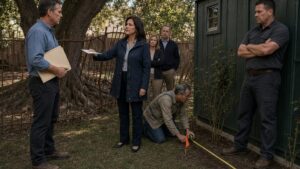
Michelle watched from her driveway as two crew members unloaded survey stakes, fluorescent flags, and a measuring wheel. Farmer stood beside her, his leash loose between them.
Across the street, garage doors opened one after another.
Debra came out of her house without a coat, although the morning was cold. She crossed her lawn and stopped at the curb.
“Who authorized this?”
A crew member checked the work order. “Municipal land-use review.”
“The hearing isn’t until ten.”
“We’re documenting existing monuments before the hearing.”
Debra looked toward Michelle.
Michelle did not move.
One crew member pressed a wooden stake into the ground three feet from where the steel water bowl had once sat. The hammer struck twice. The sound traveled down the street.
By nine thirty, six fluorescent flags traced a boundary that did not follow the mowing line residents had treated as official for decades.
The green strip widened behind Michelle’s property, narrowed near George’s, and crossed an area the HOA had fenced as part of its landscaped common ground.
People began taking pictures.
Michelle carried the empty steel bowl inside before anyone could turn it into a symbol she had not chosen.
The municipal review hearing took place in a room larger than the HOA clubhouse but no less tense. A city council clerk arranged exhibits along one table. Samantha Clark sat near the front in her inspection vest, field notes open. The HOA attorney represented the board. Debra and Nicholas sat behind him, separated by an empty chair.
Michelle sat alone.
Her petition packet had grown to nearly two hundred pages.
When called, Samantha summarized the field review. Original monuments, surviving survey markers, and recorded plats supported the 1978 dedication boundary. The city had accepted the open-space dedication, though later maintenance responsibilities had been delegated through agreement.
The hearing officer looked toward Michelle.
“Your petition argues that the association lacked authority to impose private-use penalties on the dedicated area.”
“Yes.”
“Does your evidence establish that the association had no authority whatsoever over the parcel?”
Every resident in the room seemed to lean forward.
Michelle could have answered narrowly.
She could have said the association did not own it, which was true.
She could have said the notices failed to cite a valid grant of enforcement power, which was also true.
Instead she opened the 1998 agreement.
“No,” she said.
The HOA attorney looked up.
Michelle placed the document on the projector.
“The association had recorded maintenance responsibilities. It was authorized to mow, irrigate, remove hazards, and report dangerous conditions. Some expenses charged to residents appear consistent with those duties.”
A whisper moved through the audience.
Debra’s expression did not change, but Nicholas turned toward Michelle.
The hearing officer asked, “Why are you presenting evidence that limits your own claim?”
“Because it is part of the chain.”
“And your interpretation?”
“Maintenance authority is real. Ownership is not established. Private rule-enforcement authority is not stated.”
The HOA attorney stood.
“The association cannot maintain property without regulating conduct that damages it.”
“That may justify recovering actual damage,” Michelle said. “It does not automatically justify a $400 fine for a water bowl or a $180 penalty for a bark heard from a neighboring house.”
“Noise rules apply throughout the community.”
“Then the notice should cite the noise rule, not claim authority from the green strip.”
The hearing officer raised a hand. “One at a time.”
The attorney sat.
Michelle continued.
“The association’s problem is not that it maintained the land. The problem is that maintenance language was repeatedly presented to residents as ownership and exclusive control. When that assumption was questioned, the board continued enforcement without requesting clarification.”
Debra whispered something to the attorney.
He stood again. “The board relied on prior counsel.”
Michelle projected the 2009 letter.
“Prior counsel advised against seeking a determination unless a dispute arose. The dispute arose. The board still declined review.”
The hearing officer looked at Debra. “Is that correct?”
Debra stood slowly.
“The board believed existing practice was legally defensible.”
“Did the board disclose the uncertainty to homeowners?”
“No.”
“Why not?”
Debra looked around the room. For once, there was no microphone between her and the residents.
“Because every answer had a cost,” she said. “And no one wanted to pay it.”
George rose from the back row.
“I didn’t,” he said.
The hearing officer asked him to identify himself for the record.
George did, then faced the room rather than the panel.
“I wrote the 2009 letter. I agreed not to pursue it after counsel responded. I told myself we were protecting people from an assessment. Mostly, I wanted the problem to belong to a later board.”
No one applauded.
Several residents looked down.
The hearing officer recessed for forty minutes.
Outside, people argued in small groups. Dog owners demanded refunds. Other residents asked whether public access meant anyone from outside the subdivision could use the land. One woman worried about insurance. A man blamed Debra for everything until George told him he had attended the 2009 meeting and said nothing.
Michelle stood apart near the temporary survey stakes.
Samantha joined her.
“You made the city’s job harder,” she said.
“By giving you the maintenance agreement?”
“By making us decide the real question instead of the easy one.”
Michelle watched a fluorescent flag bend in the wind.
“Is that a complaint?”
“No.”
It was the closest Samantha came to praise.
When the hearing resumed, the decision was read in sections.
The city confirmed that the green strip was publicly dedicated open space.
The 1998 agreement gave the HOA limited maintenance responsibilities but did not transfer title.
The city found no recorded basis for the HOA to impose private amenity or animal-use fines solely because conduct occurred on the dedicated parcel.
All disputed green-space penalties were suspended pending review.
The city ordered an independent audit of maintenance charges, enforcement expenses, and related collections.
There would be no immediate refunds.
Lawful maintenance costs had to be separated from unsupported enforcement charges. Insurance and drainage obligations required further analysis. Until a use agreement was adopted, the city would permit public access subject to general municipal rules.
The ruling was neither the complete victory Michelle had once imagined nor the collapse Debra had feared.
It was narrower.
It was slower.
It was true.
Outside, the public works crew returned. One worker drove a permanent marker beside the temporary stake near Michelle’s driveway.
The steel bowl sat upside down on her porch.
The orange notices had been retained as exhibits.
Nicholas approached her first.
“I’m releasing the ledgers to the auditor,” he said.
“That should have happened before.”
“I know.”
Debra came down the steps behind him. She stopped several feet away.
“You think the city will manage that land better?”
“No.”
“Then what did you win?”
Michelle looked toward the residents clustered along the new boundary.
“The right to stop pretending the answer was already decided.”
Debra’s mouth tightened, but she did not reply.
By evening, three residents had asked Michelle to serve on a temporary committee to draft public-use rules. By the next morning, the number was nine.
The final request came from George.
“You understand both sides,” he said.
“That may be the worst reason to put me in charge.”
“I didn’t ask you to be in charge.”
Michelle looked at the blank committee form in his hand.
At the top was a space for the chairperson’s name.
Chapter 7: Forty-Three Dogs and No Victory Speech
Forty-three dogs arrived before the temporary gate was fully open.
Michelle knew the number because the committee had required sign-in sheets for the first public-use morning, and because the woman at the folding table kept calling out totals as if announcing election returns.
“Forty-one.”
A terrier strained toward the gap beneath the gate.
“Forty-two.”
Farmer sat beside Michelle’s left leg, watching a golden retriever splash both front paws into one of the water bowls.
“Forty-three.”
The public works crew had installed waist-high fencing along the drainage edge, but the final latch stuck against the new post. Two residents pulled while George lifted the gate by its corner.
“Not yet,” Michelle said.
The crowd pressed closer anyway. Leashes crossed. A child dropped a tennis ball, and three dogs lunged after it. Someone laughed. Someone else complained that the posted opening time had already passed by four minutes.
Michelle looked at the guidelines fastened to the temporary information board.
Dogs leashed until inside the marked area.
Owners responsible for waste.
No unattended animals.
Quiet-use hours before seven in the morning and after nine at night.
Emergency contact numbers.
A review date printed at the bottom.
No fines. No references to longstanding practice. Every rule identified the city ordinance or temporary committee decision supporting it.
Pinned beside the guidelines was a canceled orange violation notice.
The $400 water-bowl charge.
Michelle had objected when the committee suggested displaying it.
“It makes this look like revenge,” she had said.
George disagreed. “It makes the reason for the review visible.”
Nicholas had proposed placing the audit summary beside it, so no one could mistake cancellation of the fine for proof that every HOA expense had been improper.
The summary was less dramatic than neighborhood rumor.
Disputed animal-use and amenity fines would be canceled.
Late fees tied to those penalties would be reversed.
Residents would receive partial account credits for unsupported enforcement and administrative costs.
Legitimate mowing, drainage, hazard removal, and insurance expenses would remain allocated under the maintenance agreement until a replacement agreement was approved.
The HOA would add independent financial review, conflict-disclosure requirements, and recorded-authority citations to future enforcement notices.
Debra had resigned as president three weeks after the ruling.
She had not apologized.
The gate scraped over the ground and swung inward.
Dogs surged through in a confusion of fur, tags, leashes, and voices. Michelle stepped aside rather than lead them. Farmer waited until the first rush passed, then walked in at her pace.
The green strip no longer looked empty enough to control.
Folding chairs formed an uneven row near the fence. Water bowls sat at intervals along the old assumed boundary. A shallow blue pool had been placed on a rubber mat to protect the grass. Someone had brought waste-bag dispensers. Someone else had brought coffee.
The committee had argued for four meetings about whether coffee counted as a commercial activity.
Michelle had finally asked, “Is anyone selling it?”
No one was.
The issue disappeared.
She had learned that not every uncertainty needed a hearing.
A beagle younger than Farmer approached him, tail circling. Farmer sniffed once and turned toward the shade. Michelle followed, carrying his bowl.
“You put it right on the line,” George said.
He pointed to the survey marker beside the water station.
“That’s where the volunteers set the table.”
“You could move it.”
“It isn’t blocking anything.”
George smiled. “Progress.”
Before Michelle could answer, the voices near the gate changed. They did not grow louder. They thinned.
Debra stood outside the fence.
She wore plain slacks and a gray cardigan instead of the fitted jackets she had worn at board meetings. No folder. No clipboard. Nothing in her hands.
Several residents watched her without greeting.
Michelle set Farmer’s bowl down.
Debra entered through the open gate but stayed near it, as if unwilling to cross too far into the scene.
“You have forty-three dogs,” she said.
“Forty-four if the spaniel comes back from the parking lot.”
“I’m not joking.”
“Neither am I.”
Debra looked toward the drainage fence. “Who inspects that latch?”
“The opening volunteer and closing volunteer sign the checklist.”
“And if they don’t?”
“The committee reviews it.”
“And if someone is bitten?”
“City animal-control rules apply. Owners remain responsible. The insurance rider is posted.”
Debra’s gaze moved to the shallow pool, the bowls, the children, and the dogs pulling across damp grass.
“Do they understand what unmanaged liability costs?”
The nearest conversations stopped.
Michelle could have answered for the audience. She could have reminded Debra that the land was not hers, that the fines had been canceled, that the audit had exposed years of unsupported enforcement.
Instead she said, “Some of them don’t.”
Debra looked surprised.
Michelle continued. “Some think public means no responsibility. Some think canceling the fines means maintenance was free. Some think the city will handle every complaint now.”
“It won’t.”
“No.”
“The first drainage repair will change their minds.”
“Maybe.”
A man beside the coffee table muttered, “Here we go again.”
Michelle turned toward him. “She’s right about the drainage.”
He stared at her.
“She was wrong to hide uncertainty and use maintenance authority as if it were ownership,” Michelle said. “That doesn’t make every risk imaginary.”
Debra’s face tightened, though not with anger this time.
“You make it sound simple,” she said.
“I don’t think it’s simple anymore.”
A dog shook water from its coat, spraying both of them. Debra stepped back. Michelle wiped droplets from her glasses.
For one second, Farmer watched them from beneath the shade table, his expression solemn and tired.
Debra looked at the canceled orange notice on the board.
“You kept it.”
“The committee voted to display it with the audit summary.”
“Of course George did.”
“George voted against displaying it.”
That drew a brief, unwilling smile from Debra.
“Who voted for it?”
“I did.”
The smile disappeared.
Michelle met her eyes. “Not because it proves you were wrong about everything. Because it shows what happens when a rule is issued without anyone being required to name the authority behind it.”
Debra looked away first.
“I won’t apologize for maintaining the neighborhood,” she said.
“I didn’t ask you to.”
“You wanted me removed.”
“I wanted the fines suspended and the land status reviewed.”
“And now you’re chairing a committee.”
“Temporarily.”
“That’s what people always say.”
The remark struck closer than Michelle expected.
Behind them, two residents were arguing over whether a dog had been leashed before entering. A volunteer looked toward Michelle, waiting.
She raised one hand.
“Use the posted process,” she called. “Ask what happened before deciding.”
The volunteer nodded and turned back to the owners.
Debra noticed.
“You enjoy this more than you admit.”
“No,” Michelle said. “I’m less afraid of it than I was.”
Debra stood quietly for another moment.
Then she left without touching the gate.
The morning did not become harmonious after she was gone.
A resident objected to the partial credits because he owned no dog. Another argued that all previous assessments should be refunded. A woman complained that the quiet-use hours were too strict. Someone’s puppy dug beneath the temporary fence, forcing the volunteers to close one section while public works added wire mesh.
Michelle answered questions until her voice roughened.
She did not have every answer.
When she did not know, she said so.
When a decision belonged to the city, she named the office.
When the committee had made a choice, she explained when it would be reviewed and how residents could challenge it.
By noon, the crowd had thinned.
Farmer slept beneath the folding table, his nose near the steel bowl. Muddy paw prints crossed the concrete around him.
No one issued a notice.
George carried the archive box from the information table.
“You ready?”
Michelle looked at the orange paper still pinned beside the guidelines.
The wind had curled one corner outward.
She removed the pin and lifted the notice from the board. The fold she had made on the first morning remained sharp across the center.
She could still remember Debra telling her not to damage association records. She could remember the neighbors watching, and the heat in her face when someone accused her of intimidation. For months, the paper had felt like proof that another person could define her publicly before she found the correct words.
Now it was evidence of something larger and less satisfying.
Debra had caused harm.
The board had concealed uncertainty.
Nicholas had protected the budget.
George had protected himself.
Residents had demanded rules and disowned their consequences.
Michelle had waited for perfect proof while the misunderstanding hardened around her.
She placed the notice inside the archive box with the certified plat, the maintenance agreement, the audit summary, and the committee’s first adopted guidelines.
George closed the lid.
Farmer woke when Michelle lifted his bowl.
She carried it to the long water station along the recorded boundary and set it among the others. A terrier drank from one side while Farmer drank from the other.
At the entrance, the gate had drifted half closed.
Michelle walked back and pushed it fully open.
The story has ended.