He Set the Sprinklers for Six, but the HOA Fine Exposed a Deeper Boundary
Chapter 1: The Blower Started Before the Alarm Again
The engine coughed to life eleven seconds before Patrick Lewis’s alarm.
He knew because the red digits on the clock read 5:59, and because he had begun counting.
One metallic choke. Two failed pulls. A third pull followed by the hard, rising whine of Edward King’s leaf blower outside the bedroom wall.
Patrick opened his eyes before the alarm could sound. The machine climbed toward full speed, dipped, then surged again as Edward squeezed the trigger. The window glass gave a faint vibration.
At 6:00, Patrick’s phone chimed on the nightstand.
He silenced it and entered a new line in the note he had started nine mornings earlier.
Day 10. Start: 5:59:49.
He added the date, saved it, and lay still.
Beyond the blinds, the blower swept from Edward’s driveway toward the narrow strip between their houses. Dry leaves rasped over concrete, struck the wooden fence, and gathered beneath Patrick’s window. The sound came in waves—engine, leaves, engine—each pass close enough that Patrick could predict when Edward would reverse direction.
The first morning, Patrick had assumed someone was clearing storm debris.
The second, he told himself the season would change.
By the fifth, he had moved his pillow to the opposite side of the bed.
By the eighth, he had stopped pretending he would fall back asleep.
His divorce had left the bedroom looking temporary even after two years. One lamp. One nightstand. A clean wall where a framed photograph had once hung. Patrick had repainted the room, replaced the curtains, and reorganized the closet until every shelf belonged to one purpose.
The house was the only part of his life that no longer surprised him.
Until Edward’s blower began arriving before dawn.
Patrick got up, pulled on a sweatshirt, and went downstairs. He made coffee without turning on the kitchen light. Through the glass door, Edward’s orange blower moved along the fence like a warning flare.
Edward wore work pants and a gray jacket despite the mild autumn air. He leaned into the machine with the focus of someone performing necessary labor. Each sweep pushed a ribbon of leaves away from his own garage and toward the shared boundary.
Patrick watched one cluster strike the bottom of the fence. Several leaves slipped through a gap beneath the boards and skittered across his grass.
Then another cluster came through.
Patrick set down his mug.
He stepped outside as the blower noise dropped. Edward had released the trigger to reposition himself.
“Edward.”
Edward looked over, then squeezed the trigger again.
Patrick raised one hand. “Edward.”
The engine faded.
Edward lifted his safety glasses onto his forehead. “Morning.”
“It’s not seven yet.”
“I’m aware of the time.”
Patrick glanced at the blower. “It’s been like this for ten days.”
“Leaves keep falling for more than one day.”
“They’re ending up in my yard.”
Edward looked toward the fence as if Patrick had pointed out something too minor to deserve attention. “Wind does that.”
“You’re blowing them through the gap.”
“I’m blowing them away from my driveway.”
“Into my side yard.”
Edward shifted the blower strap on his shoulder. His face carried no open anger, only the patience of a man explaining work to someone who did not understand it.
“I leave early,” he said. “This is when I can get things done.”
Patrick waited for something after that—an acknowledgment, a compromise, even a reluctant shrug.
Edward lowered his glasses.
“Some of us are morning people.”
He restarted the blower before Patrick answered.
The sound hit at close range, flattening whatever Patrick might have said. Edward turned away and directed the nozzle along the fence. Leaves rose in a brown spiral and slapped against the boards.
Patrick went inside.
At 6:42, the engine stopped.
The silence felt less like relief than an insult delivered on schedule.
That afternoon, Patrick walked the boundary with his phone. The leaves formed a broken line from the front corner of the house to the drainage depression near the back gate. Some were fresh and dry. Others were damp underneath, pressed into the grass by repeated piles.
He photographed the line from three angles.
On the eleventh morning, the blower started at 5:56.
Patrick did not stay in bed. He opened the note and entered the time while standing at the window.
Day 11. Start: 5:56:18.
The pattern now filled the screen:
5:58.
5:57.
5:59.
5:55.
Never later than six.
He scrolled through the entries twice. The numbers steadied him. They turned irritation into something measurable.
After Edward finished, Patrick waited until eight and walked next door.
Edward opened the door wearing a clean button-down shirt, coffee in one hand. Without the jacket and blower, he looked less like a threat and more like the middle-aged homeowner whose garbage cans were always aligned perfectly at the curb.
Patrick kept his voice level.
“I need you to stop running the blower before seven.”
Edward leaned against the doorframe. “You came over to say that again?”
“I came over because you restarted it after I asked you yesterday.”
“You came outside while I was working.”
“You were working beside my bedroom before six.”
Edward took a sip of coffee. “And I told you. I leave early.”
“Then do it after work.”
“It gets dark.”
“Use a rake.”
Edward smiled then—not broadly, but enough to make Patrick feel that the conversation had shifted from disagreement to judgment.
“You moved here two years ago,” Edward said. “I’ve maintained that side every fall since these houses were built.”
“You maintain your yard by sending it into mine?”
“I keep the area clear.”
“That isn’t the same thing.”
Edward’s expression tightened. “You know what the problem is? People buy into a neighborhood with trees and yards, then complain when somebody actually takes care of them.”
“The problem is the hour.”
“The problem is you don’t like how I do things.”
Patrick felt the answer arrive in his throat, sharper than he intended. He swallowed it.
“I’m asking for one reasonable change.”
Edward looked past him toward Patrick’s lawn.
“Some of us like getting things done before the day gets away from us.”
Then he closed the door.
Patrick stood on the porch long enough to hear the deadbolt turn.
Back home, he sat at his desk and opened the HOA website. He had used the portal once before to update his mailing address. The menus were arranged in neat blue tabs: Payments. Documents. Architectural Requests. Violations.
He clicked Violations.
A form appeared.
Property address.
Category.
Date and time.
Description.
Patrick typed Edward’s address into the first field. The system recognized it and completed the rest.
He selected Noise and Nuisance.
The cursor blinked inside the description box.
On the corner of his monitor, the eleven recorded start times waited in a separate window.
Patrick placed his hands flat on the desk.
For the first time since the blower had begun, he had a choice that felt measurable too.
Chapter 2: Every Rule Had a Convenient Blind Side
“The equipment use is prohibited,” the municipal code clerk said. “Enforcement is the difficult part.”
Patrick tightened his grip on the phone.
“So he is violating the ordinance.”
“Power landscaping equipment cannot be operated in a residential zone before seven a.m.”
“And I have eleven documented mornings.”
“I understand.”
“Then what happens?”
The clerk paused with the practiced caution of someone who had answered the question many times.
“You can submit a complaint. An officer may be assigned to observe the property.”
“At six in the morning?”
“Our field hours begin at eight.”
Patrick looked through his home-office window. Edward’s yard was immaculate. Patrick’s side of the fence still held the leaves Edward had sent beneath it.
“The blower is finished by six-forty.”
“You can provide recordings.”
“Will that result in a citation?”
“It may support one.”
“May?”
“It depends on verification.”
Patrick thanked the clerk and ended the call before his voice changed.
He added the ordinance number to his spreadsheet. Eleven rows of dates and times now sat beside links to photographs, short audio clips, and descriptions of where the leaves had collected. He had begun the file as a note. It had become a case.
At 9:17, an email arrived from the HOA management office.
Your concern has been received.
The message explained that municipal noise matters fell primarily under city enforcement. The HOA could review conduct affecting common standards at its next compliance meeting, scheduled in nineteen days.
Nineteen days meant nineteen more mornings.
Patrick replied with the ordinance citation and his photographs. He added a question about debris being transferred across a property line.
The response came from Sandra Davis, the HOA board president.
Mr. Lewis,
Thank you for your documentation. Please avoid direct escalation with your neighbor while this matter is pending. The board will review any applicable community standards at the scheduled meeting.
No promise. No interim instruction. No acknowledgment that Edward had already dismissed a direct request.
Patrick searched the HOA documents himself.
The noise section referred residents to municipal law. The landscaping section, by contrast, contained three pages of requirements governing lawn height, visible weeds, irrigation overspray, dead plant material, and drainage onto adjacent lots.
One clause prohibited depositing yard debris on another property.
Patrick read it twice.
He attached the page to his complaint.
A notification appeared before he could send it.
REMINDER: IRRIGATION COVERAGE REVIEW.
He opened the message.
Three months earlier, during a dry spell, an HOA inspector had photographed a pale strip of grass beside Patrick’s fence. The notice described “uneven irrigation resulting in visible landscape inconsistency.” No fine had been issued, but the file remained open pending seasonal review.
Patrick stared at the photograph. The pale strip sat directly beside the area now buried in Edward’s leaves.
The HOA could not send anyone before dawn to witness a blower, but it had preserved a picture of twelve feet of imperfect grass.
He forwarded the debris clause and the eleven times to Sandra.
Her answer arrived that afternoon.
The board would accept his materials. Until review, he should refrain from any action that might be considered retaliatory or disruptive.
Patrick reread the sentence.
Retaliatory.
It assumed he was the person who needed restraint.
At five the next morning, he was already awake.
The blower started at 5:58.
Patrick recorded thirty seconds of sound from his bedroom. In the video, the blinds trembled faintly. He sent it to the city complaint address and watched the message leave.
At 8:06, he received an automated confirmation.
At 8:12, Edward’s garage door opened. Edward drove away.
By noon, the complaint remained unassigned.
Patrick walked outside with a rake. He gathered the leaves from his side into two large paper bags. Near the back corner, the grass dipped into a shallow channel running between the properties. The soil there was darker than the rest of the yard.
He pushed the rake beneath a damp layer and found water.
Not much. Just enough to coat the tines with mud.
He looked toward Edward’s garage, then back at the fence. The channel curved away beneath a raised landscaping bed near the street. Patrick had never paid attention to it. It looked like a low place where rain collected, nothing more.
He bagged the remaining leaves and returned to his office.
The irrigation application was open on his second monitor.
Patrick had launched it to check the pale strip mentioned in the HOA notice. The side-yard zone appeared as a blue arc. Three scheduled watering days: Monday, Wednesday, Saturday. Start time: 5:30 a.m.
He could move the time to after seven and increase the duration. That would address the dry grass.
Instead, he dragged the zone map slightly toward the fence.
The displayed coverage widened.
Fifteen feet.
He set the start time to 6:00 a.m.
His finger hovered over the weekly schedule.
Three selected days glowed blue.
He selected Sunday.
Tuesday.
Thursday.
Friday.
Seven mornings.
A warning appeared: Increased schedule may create runoff. Confirm local restrictions.
Patrick almost laughed.
Local restrictions existed when water crossed a line clearly enough to photograph. Noise before dawn remained a matter for an officer who began work two hours later.
He pressed Confirm.
The screen displayed the new program.
SIDE YARD.
6:00 A.M.
DAILY.
Patrick leaned back.
He told himself the sprinklers were on his property. He told himself the HOA had already criticized the dry grass. He told himself Edward had chosen the hour and the location.
Each statement was true.
Together, they formed something Patrick did not name.
He opened the complaint spreadsheet and positioned it beside the sprinkler controls. Eleven rows of Edward’s times on the left. One new schedule on the right.
Precision answered precision.
The next morning’s program showed a countdown.
Nine hours, forty-one minutes.
Patrick turned off the monitor, but the blue glow remained in his mind long after the room went dark.
Chapter 3: At Six Sharp, the Fence Line Moved
At 5:59, the sprinkler heads rose from the grass.
Patrick stood behind the kitchen door with his phone in one hand and the irrigation application open. Through the glass, he could see the dark line of the fence, the pale lawn, and three black sprinkler caps lifted into position.
Across the boundary, Edward stepped out of his garage carrying the orange blower.
Patrick’s pulse beat once in his throat.
Edward set the machine on the driveway, adjusted the shoulder strap, and pulled the starter cord.
The engine coughed.
Patrick’s phone changed to 6:00.
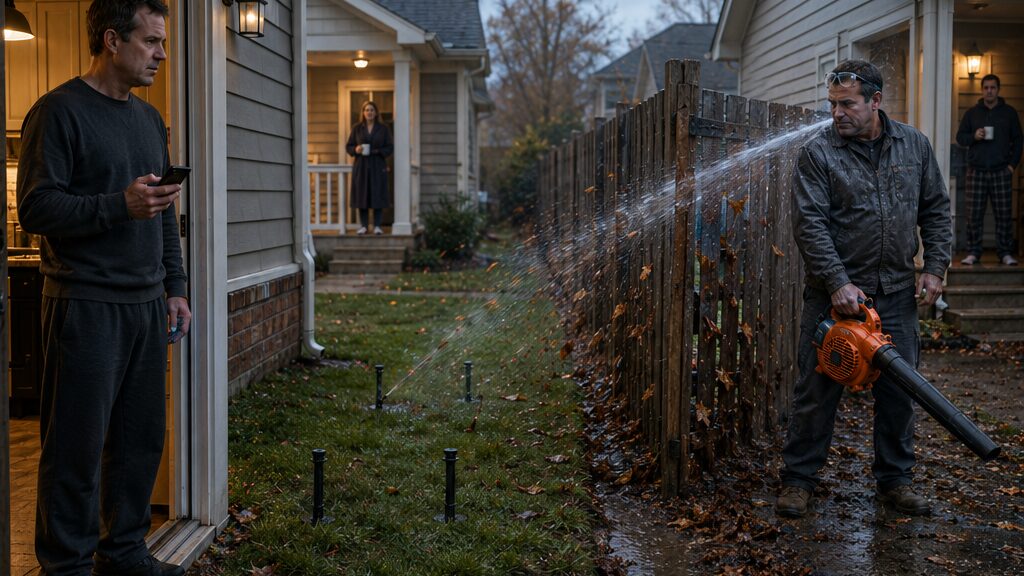
The sprinklers fired.
Water swept across the side yard in three bright fans. The nearest stream struck the fence, broke into spray, and reached through the gaps. Another curved over the grass toward the drainage depression.
Edward jerked back as cold water hit his jacket.
The blower sputtered in his hands. He released the trigger, but the irrigation heads continued their measured rotation, clicking as they turned.
Patrick remained behind the door.
Edward looked toward Patrick’s house.
For one second, Patrick thought he might shut off the system. The control button was beneath his thumb. He could stop the water, step outside, and call the timing accidental.
Instead, he lowered the phone.
Edward tried to move farther down the driveway. The second sprinkler arc found him there. Water struck the side of the blower and darkened his pants from the knee down.
He raised one arm over his face.
“What the hell?”
Patrick heard the words faintly through the glass.
Edward dragged the blower toward the garage. The sprinklers continued their route, precise and indifferent. When the stream moved away, Edward stepped forward as if he meant to cross the grass. Then the head clicked back, and another sheet of water cut between him and the fence.
Patrick felt something loosen inside him.
For eleven mornings, the machine had entered his bedroom without permission. Now Edward could not stand beside the boundary without entering Patrick’s schedule.
Edward abandoned the blower just inside the garage and disappeared into the house.
At 6:04, the side yard was silent except for water striking wood.
Patrick opened the kitchen door.
The air smelled of wet leaves and cold soil. Sprinkler droplets clung to the fence. On Edward’s driveway, the orange blower rested in a shallow trail of water.
Patrick stepped onto the patio.
He had expected triumph to feel louder.
Instead, the quiet seemed enormous.
He walked toward the boundary while the sprinklers rotated. The pale strip of grass darkened quickly. Leaves lifted, turned, and traveled toward the low channel between the houses.
Water collected there.
Patrick stopped.
A thin brown pool had formed along the fence, wider than he had noticed during his inspection. Each sprinkler pass added another layer. The water did not drain toward the street. It gathered against the raised landscaping bed and curled back toward Edward’s garage.
Patrick opened the application.
Six minutes remained in the cycle.
He could stop it.
A window moved in Edward’s house.
Patrick saw Edward behind the glass, holding a phone.
The camera was pointed toward the yard.
Patrick’s thumb hovered over Stop.
Edward lowered the phone and came outside without the blower. His jacket was soaked at the shoulder. He did not look at Patrick first. He looked down at the water.
Then he took three photographs in quick succession: the sprinkler head, the widening pool, the stream reaching the boundary.
“What are you doing?” Patrick called.
Edward looked up.
“What does it look like?”
“You were photographing my yard.”
“I’m photographing water coming onto mine.”
“It’s irrigation.”
“At six in the morning?”
Patrick almost answered with Edward’s own words. Some of us are morning people.
He had rehearsed the line without admitting it to himself.
Edward stepped closer to the channel. “Shut it off.”
“You didn’t shut off the blower when I asked.”
“This isn’t about the blower.”
“That’s exactly what it’s about.”
Edward stared at him, water dripping from the sleeve of his jacket.
“No,” he said. “It isn’t.”
The answer landed without the satisfaction Patrick had expected.
Edward pointed toward the muddy strip. “You see where that’s going?”
Patrick followed the gesture. The water had reached the edge of the concrete beside Edward’s garage.
“It’s a few minutes of runoff.”
“You don’t know what you’re looking at.”
“And you do?”
Edward’s jaw tightened. “Turn it off.”
The sprinkler head clicked and sent another fan across the fence.
Patrick pressed Stop.
The water ceased in stages. One stream weakened. Another collapsed into the grass. The last head hissed, then lowered.
Silence returned.
Edward photographed the remaining pool.
“You could have talked to me,” he said.
Patrick stared at him. “I did.”
Edward looked as though he might answer, but instead he went inside.
At 6:17, Patrick carried his coffee to the bedroom. No blower started again. No leaves scraped beneath the window. He opened his laptop and worked for nearly an hour before realizing he had not checked the clock.
The quiet felt earned.
At eight, he inspected the side yard. Most of the surface water had soaked into the grass, but mud remained in the low strip. A few leaves clung to the fence in dark wet layers.
He took his own photographs.
At 9:30, he received a text from an unknown number.
This is Edward. Your sprinklers are crossing the property line. Do not run them at that setting again.
Patrick typed, Your blower crosses the line every morning.
He deleted it.
He typed, The system is watering my yard.
He sent that instead.
Edward did not reply.
The following morning, Patrick woke at 5:55 and waited.
At 6:00, the sprinklers activated.
Edward did not come outside.
Patrick let the full cycle run.
On the third morning, the blower remained silent again. Patrick began to believe the matter had ended. The grass beside the fence looked darker, and the pile of leaves had stopped growing. He made coffee at 6:10 and stood in the kitchen listening to the small mechanical clicks of the irrigation heads.
At 8:43, the doorbell rang.
Edward stood on the porch. He wore a dry jacket and held no blower.
“Your sprinklers are running too early,” he said.
Patrick rested one hand against the doorframe. “Six is early now?”
Edward’s mouth opened.
Patrick watched recognition pass through his face—not remorse, exactly, but the awareness of a trap built from his own words.
Edward closed his mouth.
For a moment, neither man moved.
Then Edward said, “You’re going to regret treating that drainage like a joke.”
He turned and walked home.
Patrick remained at the door, unsettled by the warning despite himself.
At 11:26, his phone chimed.
The message came from the HOA management portal.
FORMAL NOTICE OF ALLEGED VIOLATION.
Patrick opened it.
The complaint accused him of intentional nuisance irrigation, excessive runoff, and targeted interference with an adjacent homeowner’s lawful property use. Attached were four photographs taken at 6:03 a.m.
One showed the sprinkler arc crossing the fence.
One showed water pooled beside Edward’s garage.
The final image was a screenshot of Patrick’s irrigation schedule.
SIDE YARD.
6:00 A.M.
DAILY.
A hearing had already been set for three days later.
Chapter 4: The First Fine Made the Wrong Man Look Innocent
Patrick’s sprinkler schedule filled the hearing-room monitor before he had taken his seat.
SIDE YARD.
6:00 A.M.
DAILY.
The screenshot was enlarged until each word looked less like a setting and more like an admission.
Sandra Davis stood beside the screen with a slim folder pressed against her waist. The neighborhood common room had been arranged for a routine compliance meeting: folding tables in a shallow U, pitchers of water, a plate of untouched cookies near the door. Two nearby homeowners sat along the back wall, close enough to hear but far enough to pretend they were not involved.
Edward occupied the chair across from Patrick.
His orange blower was nowhere in sight. He wore a navy sweater and had placed both hands calmly on the table.
Sandra began without greeting either man.
“This meeting concerns alleged nuisance irrigation, runoff onto an adjacent lot, and deliberate interference with another resident’s lawful use of his property.”
Patrick looked at her. “You’re starting with my sprinklers?”
“We are starting with the complaint that produced verifiable evidence.”
“I submitted eleven mornings of evidence.”
“And your materials have been added to the record.”
“Three weeks from now.”
Sandra’s expression did not change. “Mr. Lewis, this is not a municipal noise hearing.”
“It became an HOA matter when he filed against me.”
“It became an HOA matter when water crossed a property boundary.”
Patrick glanced toward Edward.
Edward did not smile. That made it worse.
Sandra clicked to the next image. Water curved through the fence slats in a pale arc. The time stamp in the corner read 6:03 a.m.
The next photograph showed brown water gathered beside Edward’s garage.
“The board received these images the morning of the incident,” Sandra said. “The management representative verified that Mr. Lewis’s irrigation schedule had been changed the previous evening.”
Patrick sat straighter. “How did management verify my private sprinkler settings?”
“You previously connected your controller to the association’s water-efficiency portal.”
The reminder about uneven coverage returned to him. He had authorized remote review months ago to prove he was not wasting water during the summer restriction.
Sandra continued. “The system log records configuration changes.”
Edward finally looked at Patrick.
Patrick kept his face still.
“The controller is on my property,” he said. “The sprinklers are on my property. I changed the schedule because the side lawn was dry. Your own inspection notice said so.”
Sandra placed one page on the table.
“Your prior schedule ran three times a week at five-thirty. The evening before the complaint, you changed it to seven days a week at exactly six, widened the side-yard arc, and increased the duration.”
“It was still my irrigation system.”
“That does not answer intent.”
Patrick heard the word like a hinge.
He had prepared for questions about property lines, nozzle angles, and water duration. He had not prepared to describe why he had chosen six without saying Edward’s name.
“My intent was to water the lawn.”
Edward shifted in his chair.
Sandra noticed.
“Mr. King,” she said, “you will have an opportunity.”
Patrick placed his phone on the table and opened his log.
“Eleven mornings,” he said. “Every start time before six or within seconds after it. Forty minutes of equipment beside my bedroom. I asked him directly to stop. He refused.”
Sandra held out her hand for the phone. Patrick passed it to the management representative, who connected it to the monitor.
The sprinkler screenshot disappeared.
In its place appeared Patrick’s spreadsheet.
5:58:14.
5:57:02.
5:59:49.
The rows continued down the screen.
For the first time since entering the room, Patrick felt the balance shift. One of the homeowners at the back leaned forward. Nicole Rivera, seated at Sandra’s right, began making notes.
Sandra examined the times.
“These will be included in the board’s review,” she said.
“Included?” Patrick asked. “They show a repeated violation.”
“They show recorded times.”
“They show a pattern.”
Edward spoke before Sandra could respond.
“They show when I was outside.”
Patrick turned toward him. “With a leaf blower.”
“Yes.”
“Before seven.”
“Yes.”
The simple admission unsettled Patrick more than denial would have.
Sandra looked at Edward. “Why were you operating equipment during restricted hours?”
Edward’s hands tightened together.
“Because the drainage strip clogs overnight.”
Patrick stared at him.
Edward looked toward the monitor rather than at Patrick.
“The leaves settle between the fence and the raised bed near the street. If I leave them there, water backs toward my garage. I’m gone before seven most mornings. So I clear it before work.”
“You were sending them into my yard,” Patrick said.
“I was moving them away from the channel.”
“Through my fence.”
“I was keeping water away from both houses.”
Patrick gave a short laugh. “That’s not what you said at your door.”
“You weren’t asking what I was doing.”
“I asked you to stop.”
“You told me how to maintain a problem you had never bothered to look at.”
Sandra raised one hand.
“This is precisely why residents are advised not to escalate private disputes.”
Patrick turned to her. “He broke the rule first.”
“And you responded by creating runoff.”
“To stop the blower.”
The sentence almost left his mouth.
He changed it at the last instant.
“To correct my lawn coverage.”
Nicole stopped writing.
Sandra looked at the management representative. “Please display the configuration notes.”
A new screen appeared.
ZONE ARC MANUALLY EXPANDED TOWARD EAST BOUNDARY.
START TIME CHANGED TO 6:00 A.M.
FREQUENCY CHANGED TO DAILY.
Patrick felt heat rise under his collar.
Sandra folded her hands.
“Are you asking this board to believe the timing was unrelated to Mr. King’s routine?”
Patrick looked at the two columns of information: Edward’s eleven start times and his own single programmed schedule.
He could still say yes.
The controller had been his. The lawn had been dry. The HOA had documented it. Each piece was defensible if kept separate.
“That was not my only reason,” he said.
It was not a confession, but the room heard the space around it.
Sandra nodded once.
“The preliminary finding remains in place. The board will review penalties after inspection of the drainage area.”
“What about his violations?”
“Those will be referred separately.”
“Separately means later.”
“It means through the proper process.”
Edward leaned back, looking neither victorious nor relieved. That, too, irritated Patrick. Edward had admitted the blower use and still appeared to be the more reasonable man in the room.
Sandra collected the printed photographs.
“Until final review, Mr. Lewis will return the side-yard zone to its previous schedule and prevent overspray across the boundary. Mr. King will refrain from power equipment use before seven. Neither party is to alter the drainage strip.”
Patrick gathered his phone.
Outside the common room, the two homeowners passed him without speaking. Edward left through another door.
Patrick was halfway across the lobby when Nicole called his name.
She waited until Sandra and the management representative had entered the office.
“You said the water pooled against the raised bed?” Nicole asked.
“Yes.”
“And Edward said the strip has always drained toward the street?”
“He said he’s maintained it since the houses were built.”
Nicole glanced back at the closed office door.
“I reviewed the original subdivision landscape plan last year during the reserve study.”
Patrick waited.
“That strip wasn’t on it.”
“What wasn’t?”
“The raised bed. The plan shows an open swale between the lots.”
Patrick pictured the dark water curling back toward Edward’s garage.
“Who changed it?”
Nicole lowered her voice.
“That is what I would ask before the final hearing.”
Chapter 5: The Leaves Were Covering More Than the Grass
The irrigation technician drove a steel probe through the leaf bed and struck water six inches below the surface.
He pulled the tool free. Mud coated the lower half.
“That shouldn’t be sitting here,” he said.
Patrick stood beside the fence with his arms folded. Edward watched from his driveway, far enough away to make it clear he had not invited the inspection but close enough to hear every word.
The technician pushed the probe into a second point near the raised landscaping bed.
Again, water.
“This channel has no outlet,” he said. “Or whatever outlet it had has been blocked.”
Patrick looked toward the street. Decorative shrubs and compacted mulch formed a low mound across the natural slope between the houses. It appeared deliberate, tidy, permanent.
“Could my sprinklers have caused this?” Patrick asked.
“They added water. They didn’t build the obstruction.”
Edward gave a quiet sound that was not quite agreement.
The technician walked toward the garage and studied the concrete. A faint brown stain marked the lower edge of the door frame.
“How high did it get?” he asked.
Edward hesitated.
“Last fall?”
The technician nodded.
“About four inches inside.”
Patrick turned.
Edward kept his eyes on the stain.
“You had water in the garage?” Patrick asked.
Edward’s jaw shifted. “I told you drainage was the issue.”
“You told me after you photographed my sprinklers.”
“You never asked before you programmed them.”
Patrick stepped toward the channel. “You could have said something when I came to your door.”
“And you could have listened before giving me instructions.”
The technician lifted the probe between them.
“This is not going to improve because either of you wins the argument.”
Neither man answered.
He explained that the original grade likely carried runoff through a shallow swale toward the curb. The raised bed had narrowed that path, while the fence trapped leaves along the remaining low point. In heavy rain, water would collect until it found the easiest direction—toward Edward’s garage or back across Patrick’s lawn.
“Leaves make it worse,” he said. “So does concentrated irrigation.”
Patrick glanced at Edward.
“Why didn’t you bag them?”
Edward looked at the fence. “Because the collection truck comes Friday. By then the channel could be blocked for days.”
“You could store the bags.”
“In a garage that already flooded?”
The answer was practical, but the way Edward delivered it carried the old accusation: You do not understand what work requires.
Patrick crouched beside the dark strip. Beneath the top layer, the leaves had compressed into a dense mat. His eleven recorded mornings returned to him in a new order. The worst start times followed windy nights, when the maples along the street dropped heavily.
It did not excuse the noise.
It did explain the urgency.
The technician left them with a written recommendation: remove the raised obstruction, restore the grade, and establish shared maintenance until permanent drainage work could be completed.
Edward picked up the paper.
“The HOA won’t approve that without records,” he said.
“Nicole said the bed wasn’t original.”
Edward looked at Patrick sharply. “Nicole told you that?”
“She told me to ask.”
Edward folded the recommendation once.
“Then ask who approved the landscaping contractor three years ago.”
Patrick followed him toward the side gate. “You knew it had been changed?”
“I knew the flooding started after they redid the common beds.”
“And you reported it?”
“Twice.”
“To Sandra?”
“To management. First time they said it was seasonal runoff. Second time they told me to keep the channel clear.”
Patrick stopped.
“That’s why you were blowing the leaves.”
“That’s why I was clearing them.”
“At 5:55.”
“I leave at six-twenty.”
“You knew the equipment rule.”
Edward faced him.
“Yes.”
The admission came without hesitation.
“And you decided it didn’t apply to you.”
“I decided four inches of water in my garage mattered more than a rule written by people who weren’t going to show up before eight.”
“You pushed the problem onto my property.”
“I pushed leaves away from concrete.”
“Through my fence.”
Edward’s expression hardened. “You want me to say I was wrong? Fine. I should have bagged them. I should have used a rake. I should not have run the blower that early.”
Patrick waited.
“But you did not set those sprinklers to water grass,” Edward continued. “You set them to catch me. Then you watched water back toward a garage you knew nothing about.”
Patrick looked down at the mud on his shoes.
The technician’s truck turned at the end of the street and disappeared.
Edward handed Patrick the folded recommendation.
“We can both be wrong,” he said. “That doesn’t make us equally honest.”
He walked inside.
Patrick spent the afternoon in the HOA management office records room. Nicole had arranged limited access to landscape contracts and maintenance requests, but she remained beside him as he reviewed them.
“I cannot tell you what conclusion to draw,” she said.
“You can tell me whether records are missing.”
“I can tell you what should exist.”
They found the contractor invoice first. Three years earlier, the association had approved “decorative bed enhancement” along the street-facing edge of several properties, including the space between Patrick’s and Edward’s lots.
A work order listed added soil, mulch, and shrubs.
No drainage review was attached.
Patrick found Edward’s first complaint eight months later.
Water accumulation near garage after landscape modification.
The response classified it as homeowner maintenance.
The second complaint contained photographs of standing water and a request for grade inspection. It had been closed with a note stating that the channel must be kept free of organic debris.
Patrick sat back.
“They told him to clear it.”
“They told him to maintain it,” Nicole said carefully.
“Knowing their contractor changed it.”
“I do not know what Sandra knew at the time.”
“Was she president?”
“Yes.”
Nicole removed her glasses and cleaned them with the edge of her sleeve.
“The board was replacing a management company. Records were disorganized. Sandra was trying to keep several projects from becoming special assessments.”
“That doesn’t erase this.”
“No.”
“Then why didn’t you bring it up at the hearing?”
“Because I had not confirmed it.”
“You remembered the original plan.”
“I remembered enough to worry. Not enough to accuse the board in a public meeting.”
Patrick closed the file.
Nicole’s caution frustrated him, but it also exposed the way he had built his own case: every fact sharpened into a weapon before he had understood what it meant.
His phone vibrated.
A new notice from Sandra appeared.
FINAL COMPLIANCE HEARING.
The message stated that the board would consider escalating fines for continued nuisance irrigation and intentional interference. Edward’s equipment use would be addressed through a separate advisory process.
Patrick read that line twice.
Separate advisory process.
His conduct carried fines. Edward’s carried advice.
Attached was an offer: Patrick could submit a written statement denying retaliatory intent and agreeing to permanent controller restrictions.
The hearing was scheduled for Thursday.
Nicole read the screen over his shoulder.
“They want this contained,” she said.
Patrick looked at Edward’s two closed drainage complaints, then at his own sprinkler configuration notes.
He could enter the hearing with the contractor records and make the board’s failure the center of everything.
Or he could tell the one fact those records did not change.
He had waited behind the glass at 6:00 and watched the water hit Edward.
Chapter 6: Patrick Told the Truth That Cost Him the Easy Win
Sandra offered Patrick the compromise before the other board members entered the room.
“Withdraw the complaints against Mr. King,” she said, “accept a reduced administrative fine, and agree to lock the side-yard irrigation zone after seven a.m. The matter can end tonight.”
Patrick stood beside the long table with his folder under one arm. Two printed columns lay inside it: Edward’s blower times and Patrick’s sprinkler schedule.
Edward had not yet arrived.
Nicole sat at the far end of the room, reviewing the contractor records. She did not look up.
“What happens to the drainage issue?” Patrick asked.
“It will be evaluated as a maintenance item.”
“And Edward’s eleven violations?”
Sandra’s tone remained even. “The board is prepared to issue a formal reminder regarding quiet hours and debris transfer.”
“A reminder.”
“This meeting concerns your pending fine.”
Patrick looked at the empty chair across from him.
The offer gave him a path out. A smaller penalty. No public admission. He could let the contractor documents speak for the rest and preserve the argument that his irrigation changes had been legitimate lawn care.
He had spent days arranging that defense.
“What written finding would go into the record?” he asked.
“That the schedule created unintended runoff.”
Unintended.
The word was clean enough to live with.
It was also false.
The door opened. Edward entered, followed by the management representative and the remaining board members. Sandra gathered the compromise papers before anyone saw them.
Patrick took his seat.
The hearing began with the same screenshot from the first meeting. The blue letters glowed on the monitor.
6:00 A.M.
DAILY.
Sandra summarized the complaint and Patrick’s failure to accept the preliminary resolution.
“We will first hear Mr. Lewis’s final statement,” she said.
Patrick opened his folder.
He had written three pages about selective enforcement, the drainage obstruction, and the association’s failure to preserve the original grade. Every sentence was accurate.
He set them aside.
“I changed the sprinkler schedule because of Edward,” he said.
The room became still.
Sandra’s eyes narrowed slightly.
Patrick continued before he could retreat.
“I chose six because that was when he used the blower. I widened the side-yard coverage because I knew he stood near the fence. I told myself I was watering my property. That was true, but it was not the reason I made those changes.”
Edward watched him without expression.
“I wanted him inconvenienced,” Patrick said. “I wanted him to understand what it felt like to have somebody else control the first hour of his day.”
Sandra reached for her pen.
“So you acknowledge intentional nuisance use.”
“I acknowledge retaliation.”
The management representative began typing.
Patrick felt the easy defense closing behind him.
“I also stopped the sprinklers when I saw the water pooling,” he said. “But not immediately. I waited because stopping them would have ended the point I was trying to make.”
Edward looked down at the table.
Patrick placed the first sheet on the document camera. Eleven time stamps appeared on the monitor.
“These are Edward’s blower starts.”
Then he placed a second sheet beside it.
One line: Patrick’s sprinkler program.
6:00.
“The same time became an excuse for both of us. He used it because he had decided his drainage problem mattered more than the quiet-hours rule. I used it because I decided his violation gave me permission to create my own.”
Sandra folded her hands. “Your admission does not remove the association’s authority to fine you.”
“No. But it removes your reason to treat this as a one-person problem.”
He replaced the time sheets with the original landscape plan. The open swale between the properties was clearly marked.
Next came the contractor work order showing the added bed.
Then Edward’s first drainage complaint.
Then the second.
Nicole looked up now.
Patrick kept his voice restrained.
“The association changed the grade. Edward reported flooding after the work. Management instructed him to keep the channel clear instead of investigating the obstruction. He then chose a loud and harmful way to do that. I chose a harmful way to stop him. But the board had notice before either of us escalated.”
Sandra turned toward Nicole.
“Were these records authenticated?”
“Yes,” Nicole said. “They are from the association archive.”
“Why were they not in the initial packet?”
“Because the drainage complaints had been closed as homeowner maintenance.”
Sandra’s composure tightened.
“That classification may have been reasonable based on the information available.”
“The photographs show standing water after the landscape project,” Patrick said.
“And nothing in those records authorizes targeted irrigation.”
“I’m not asking you to authorize what I did.”
That sentence changed the room more than Patrick expected.
One of the board members stopped reading and looked directly at him.
Patrick continued.
“Fine me for what I did if that is the consistent rule. But then cite Edward for operating prohibited equipment and moving debris across the boundary. And address the drainage condition the association helped create.”
Sandra looked at Edward.
“Mr. King, do you dispute the recorded equipment times?”
“No.”
“Do you dispute that leaves crossed onto Mr. Lewis’s lot?”
Edward took a breath.
“No.”
Patrick turned toward him.
Edward stared at the two columns still visible at the edge of the monitor.
“I knew the rule,” he said. “I used the blower anyway.”
Sandra asked, “Why did you not use a rake?”
“Because it took longer.”
“And the debris?”
“I pushed it away from the garage. Some went under the fence.”
“Some?”
Edward looked at Patrick.
“More than some.”
The admission carried no apology. It did carry cost.
Edward rested his forearms on the table.
“The garage flooded after the association put in that bed. I reported it. I was told to keep the strip clear. So I kept it clear. I did not care whether Patrick liked the hour because I thought he was complaining about work he never helped with.”
Patrick felt the old anger rise, then settle into something heavier.
Edward continued.
“When he changed the sprinklers, I filed immediately because I already knew what water did there. I also knew the complaint would make his conduct look simpler than mine.”
Sandra’s pen stopped.
“You used the association process strategically?”
Edward gave a humorless shrug. “So did he.”
No one argued.
The board recessed for twenty minutes.
Patrick waited outside beside a bulletin board covered with pool rules and landscaping reminders. Edward stood at the opposite end of the lobby.
After several minutes, Edward spoke.
“You did not have to admit the timer.”
“Yes, I did.”
“You could have won without it.”
Patrick looked at him. “That would not have been winning.”
Edward considered the answer, then nodded once toward the closed hearing-room door.
“They may fine both of us now.”
“They should do something to both of us.”
“And the board?”
Patrick looked through the narrow window at Sandra arranging papers while Nicole spoke to the other members.
“The board should do the work it kept assigning to everyone else.”
When the doors reopened, Sandra read the interim ruling.
Patrick’s escalating nuisance fine was suspended pending drainage correction. The original administrative charge would be reconsidered in light of his voluntary admission and the association’s prior notice of runoff.
Edward would receive formal violations for quiet-hour equipment use and debris transfer.
The landscape contractor’s work would be independently reviewed. Until repairs were complete, both homeowners would follow a temporary maintenance schedule using hand tools after seven a.m.
Sandra’s voice remained professional, but the decision had moved beyond her control.
“This board will issue a final written determination after the drainage inspection,” she said.
Patrick gathered his papers.
It was not victory. Nothing had been canceled yet. The association had not admitted fault, and Edward had not apologized.
But the record no longer contained one guilty homeowner and one injured neighbor.
It contained two men who had each chosen the rule that protected him and ignored the rule that protected the other.
At the door, Edward paused.
“For the record,” he said, “I did push the leaves across your line.”
Patrick waited.
Edward looked back toward the hearing room.
“And the board knew about the water before either of us started this.”
Sandra heard him.
So did every person still seated at the table.
Chapter 7: Quiet Mornings Came With Work for Everyone
The rain arrived six weeks later, hard enough to erase the curb beneath a moving sheet of water.
Patrick stood at his kitchen window before dawn, watching the repaired channel between the houses take its first real test. The new swale ran where the raised landscaping bed had been removed, shallow and plain, lined with fresh sod and a narrow strip of stone.
Water entered from the back lots, gathered briefly near the fence, then moved toward the street.
It did not turn toward Edward’s garage.
Patrick checked the clock.
5:57.
No blower. No sprinkler heads. Only rain striking the roof and the steady rush of water leaving both properties the way it should have three years earlier.
He pulled on a jacket and stepped outside.
The lawn gave beneath his shoes. Water streamed along the restored grade in a brown ribbon, carrying small leaves without trapping them against the fence. Near the driveway, the new curb opening released the flow into the storm drain.
Edward stood beneath his garage overhang with a flashlight.
For a moment, neither man acknowledged the other. They watched the same water from opposite sides of the boundary.
Edward swept the beam along the concrete threshold. It remained dry.
“Looks like it’s holding,” Patrick called.
Edward lowered the light. “So far.”
The answer sounded cautious rather than dismissive.
A stronger surge came down the channel. It passed between them, bending grass and carrying a red maple leaf toward the curb.
Edward stepped closer to the garage door and checked the lower seal with his boot.
“No seepage,” he said.
Patrick nodded.
The repair had taken longer than the board originally promised. The independent inspector confirmed that the decorative bed had narrowed the original swale and redirected runoff. The HOA then spent two meetings debating whether the work counted as landscaping maintenance, drainage correction, or contractor remediation.
Nicole had insisted the distinction mattered less than fixing it before the next heavy storm.
Sandra eventually signed the work order.
The final determination arrived three days before construction began.
Patrick’s nuisance-irrigation fine was canceled. The board retained a written finding that he had used the system deliberately, but it also acknowledged that the runoff risk had been intensified by an association-approved landscaping change.
Edward received separate violations for power equipment use during quiet hours and repeated debris transfer. His penalties were suspended on the condition that the conduct stop.
The association adopted a new rule requiring power yard equipment to remain off until seven. Debris could not be moved across lot lines, even when clearing shared drainage areas. Until the swale was fully established, Patrick and Edward were jointly responsible for keeping it open with hand tools.
The ruling satisfied no one completely.
That was how Patrick knew it might last.
The rain eased after six. Edward disappeared into his garage and returned carrying a long-handled rake.
Patrick looked at him. “You’re doing that now?”
Edward glanced at the clock mounted above his workbench.
“Rake isn’t powered.”
Patrick almost objected to the hour on principle. Then he saw what Edward was doing.
A branch had fallen across the curb opening.
Patrick went to his shed and brought back a second rake.
They worked from opposite ends without discussing whose responsibility it was. Edward pulled the branch free. Patrick cleared the leaves that had caught behind it. Water accelerated through the opening.
When the channel was clear, Edward leaned on the rake.
“I wrote out a maintenance schedule,” he said.
Patrick waited.
“After storms, I’ll check the garage end before work. You check the curb opening when you’re home. Saturday mornings, after seven, we clear anything left.”
It was the closest Edward had come to offering cooperation.
“You could have emailed it,” Patrick said.
“I did.”
Patrick had seen the message the night before and left it unread.
Edward seemed to know.
“You prefer things documented,” he said.
There was no smile, but the line carried less contempt than it once had.
Patrick wiped rain from his forehead. “Saturday at seven-thirty.”
“Seven-fifteen.”
“Seven-thirty.”
Edward looked toward the channel. “Fine.”
He started back toward his garage.
“Edward.”
Edward stopped.
Patrick could have asked for an apology. He could have given one. Both options felt too large for the wet driveway and the practical agreement lying between them.
“I turned off the six o’clock schedule,” Patrick said.
Edward nodded toward the silent sprinkler heads.
“I noticed.”
“The side yard runs at seven-fifteen now. Three days a week.”
“Coverage still reaches the fence?”
“Not across it.”
Edward gave a short nod and went inside.
By eight, the rain had become a light drizzle. Patrick returned to the kitchen, changed his socks, and opened the unread email.
Edward’s schedule was attached as a one-page table. Dates, tasks, and responsible homeowner. At the bottom, beneath the maintenance plan, Edward had added one sentence.
No power equipment before permitted hours.
Patrick read it twice.
There was no acknowledgment of the eleven mornings, the leaves, or the door closed in his face. There was also no attempt to excuse them.
Patrick replied with one change to the Saturday time and clicked Accept.
Autumn continued.
The trees dropped another heavy layer, but the old routine did not return. Edward stored paper yard bags along the rear wall of his garage. He used the blower after seven or waited until evening. When leaves gathered near the swale before work, he used the rake.
Patrick kept the curb opening clear.
They did not become friends.
They exchanged short greetings. They discussed drainage, collection days, and whether the new sod had rooted. Edward never entered Patrick’s house. Patrick never stood on Edward’s porch again.
Peace arrived through repetition rather than warmth.
One morning, Patrick woke at 6:00.
His body had learned the hour even without the engine. He lay still, waiting for the metallic choke and the first pull of the starter cord.
Nothing came.
Rain tapped softly against the bedroom window. Water moved through the restored channel outside, too low and steady to hear from the bed.
The alarm began to chime.
Patrick reached toward the nightstand, but his hand paused above the phone.
For months, six o’clock had belonged first to Edward, then to Patrick’s answer. It had become evidence, accusation, and schedule. A number both men used to prove the other one unreasonable.
Now it was only the time.
Patrick turned off the alarm.
He did not enter it into a log.
He did not open the irrigation application.
He closed his eyes while rain moved quietly past both houses, crossed the boundary without belonging to either man, and continued toward the street.
The story has ended.