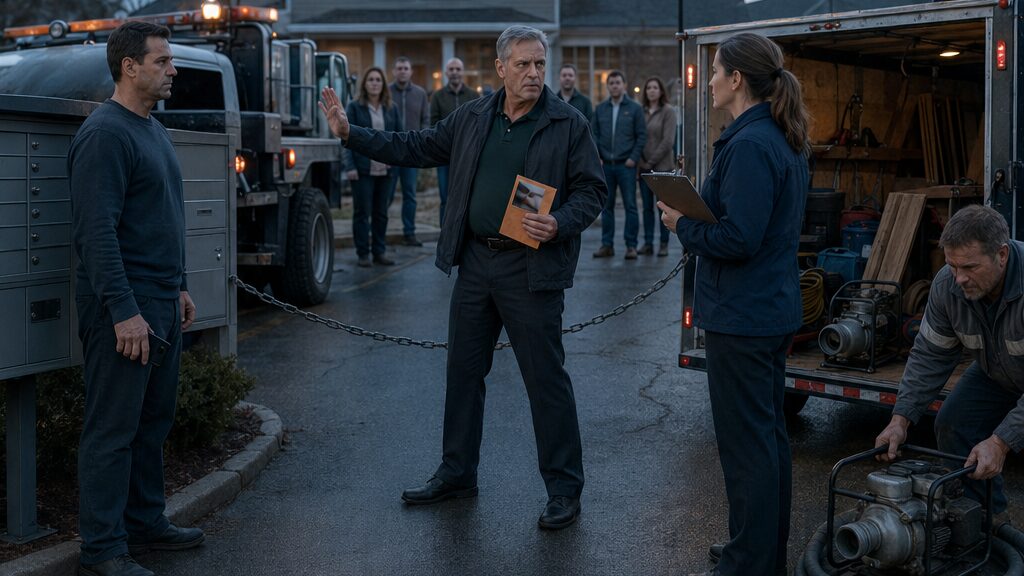
He Enforced Every HOA Rule Until One Homeowner Applied the Same Rule to Him
Chapter 1: The Photograph Beside the Moving Box
The violation notice had been taped directly across the seam of the cardboard box, as if whoever placed it there wanted to make certain Christopher Lopez could not carry the box inside without tearing through the accusation first.
He stopped halfway up the porch steps with another box balanced against his chest. The late-afternoon sun caught the plastic sleeve around the notice and turned it briefly white.
“Christopher?” his spouse called from inside. “Did you find the lamp shades?”
He lowered the box onto the porch.
“No,” he said. “I found something else.”
The moving box beneath the notice contained winter coats, two framed photographs, and a stack of kitchen towels. It had been outside since lunch because the hallway was blocked by a bookcase they had not yet managed to turn through the doorway. Less than seven hours.
The document inside the sleeve was three pages long.
The first page identified the property address and the alleged violation: visible temporary storage on the front elevation beyond the permitted six-hour loading period.
The second page cited Article IV, Section 8 of the neighborhood covenants.
The third page showed a color photograph of the box.
Christopher leaned closer. The image had been taken from the sidewalk at 2:17 p.m. The camera angle included the front steps, half the porch column, and the lower edge of the house number. A red digital timestamp had been printed beneath it.
Fine assessed: $225.
Appeal deadline: ten calendar days.
He read the amount twice, not because it was difficult to understand but because his mind refused to place that number beside a single cardboard box.
His spouse came to the doorway, wiping dust from one hand onto faded jeans.
“What is it?”
He held up the notice.
She read the first page, then looked past him at the box as though it might have changed into something dangerous.
“For that?”
“Apparently.”
“We moved in yesterday.”
“The rules allow six hours.”
“We had furniture blocking the hall.”
“I know.”
She studied his face. “Don’t do that.”
“Do what?”
“That quiet thing where you’re already building a case in your head.”
Christopher slid the pages back into the sleeve. “I’m going to talk to him.”
Richard Hall lived three houses down from the clubhouse in a brick-front home with trimmed hedges and a driveway so clean it looked unused. Christopher found him near the community mailbox kiosk, speaking with the property manager.
Richard wore a dark green polo embroidered with the association’s initials and carried a thin black folder under one arm. He was in his late fifties, silver beginning at his temples, his posture straight without appearing athletic. He looked like a man who had spent years learning how to occupy the center of a small room.
“Richard,” Christopher said.
Richard finished his sentence before turning. “Mr. Lopez.”
“I received a storage violation.”
“That would have come from the compliance review.”
“It came with your signature.”
Richard gave a brief nod. “I chair enforcement.”
Christopher handed him the notice. “We moved in yesterday. The box was outside because the hallway was blocked.”
Richard glanced at the first page but did not take it. “The loading provision gives residents six hours.”
“Six hours and seventeen minutes?”
“The photograph documents the time the violation was observed.”
Christopher felt heat climb into his neck. “You could have knocked.”
“We do not conduct enforcement through informal conversations. That creates inconsistent treatment.”
The property manager shifted her weight and looked toward the road.
Christopher kept his voice even. “I’m asking you to waive the fine.”
“You may submit an appeal.”
“Which the enforcement committee reviews.”
“Yes.”
“And you chair the committee.”
Richard’s expression did not change. “I do not vote alone.”
Before Christopher could answer, a blue recycling bin rolled crookedly from a nearby driveway. Kathleen Moore followed it with one hand pressed to the lid. She was small, gray-haired, and moving carefully, as if one knee had become unreliable.
Richard glanced at the bin.
Kathleen noticed.
“It’s collection day tomorrow,” she said quickly.
“I’m aware.”
She pulled the bin closer to the side of her garage. A folded sheet of paper protruded from the pocket of her cardigan.
Christopher recognized the same plastic sleeve.
“You got one too?” he asked.
Kathleen’s mouth tightened.
Richard said, “Mrs. Moore’s matter is separate.”
Kathleen drew out the notice. “One hundred seventy-five dollars because the bin was visible on Tuesday.”
“It was visible from the street on a noncollection day,” Richard said.
“It was out because my garage door jammed.”
“The standard applies regardless of the reason.”
Kathleen looked at Christopher, not Richard. “He took a picture while I was standing next to it.”
She unfolded the page. The photograph showed her in profile, one hand on the blue lid, her face turned toward the camera. The image made her look as if she had been caught committing something deliberate.
Christopher’s anger sharpened.
Richard closed the folder beneath his arm. “Community standards apply to every property. There are no exceptions.”
The sentence landed with the neatness of something used often.
Christopher looked beyond him toward the clubhouse.
Two enclosed maintenance trailers sat on the gravel strip beside the parking lot. One was white, the other dull gray. Both were hitched to nothing. The white trailer’s rear doors were open, revealing stacked lumber, coiled hoses, plastic bins, and the yellow handle of a machine. A ladder had been strapped along the roof. The gray trailer had a generator chained to its tongue and two buckets beneath the wheel.
They were visible from the main road, the sidewalk, the mailbox kiosk, and nearly every window on the clubhouse’s west side.
“How long have those been there?” Christopher asked.
Richard followed his gaze.
“The association trailers?”
“Yes.”
“They support community maintenance.”
“That wasn’t my question.”
Richard’s jaw tightened slightly. “They are not residential storage.”
“They’re on association property.”
“Correct.”
“They’re visible from the street.”
“The covenants distinguish operational assets from homeowner possessions.”
“Where?”
Richard looked at him then, fully. “You are welcome to review the governing documents.”
Christopher nodded once. “I will.”
Kathleen touched his arm after Richard walked away.
“Don’t make him angry,” she said softly.
“He fined you for a recycling bin.”
“And he can find ten more things if he decides to look.”
Christopher glanced at her garage. A hose reel stood partly behind a shrub. A small ceramic planter had a crack along its side. One shutter hung a fraction lower than the other.
He understood what she meant.
That evening, after the moving box was inside and the hallway cleared, Christopher placed his violation notice on the kitchen table. He studied the photograph again.
The angle was precise. The camera had been held from the sidewalk, slightly left of center, including enough of the property to prove location without showing anything beyond the alleged violation.
He waited until the clubhouse parking lot was empty.
Then he walked to the same public sidewalk, raised his phone, and framed the two maintenance trailers exactly as Richard had framed the moving box.
The photograph captured the open doors, the lumber, the hoses, the generator, and the clubhouse wall behind them.
Christopher checked the time.
8:43 p.m.
He took a second photograph, then a third.
This time, the evidence belonged to him.
Chapter 2: Eleven Nights Inside the Fine Print
One map placed the clubhouse outside the regulated storage boundary.
The other placed it squarely inside.
Christopher stared at both versions on his home-office monitor until the parcel lines seemed to shift whenever he blinked.
The first map came from the association’s current governing packet. Its shaded residential area ended at the clubhouse access road, leaving the clubhouse parcel white.
The second came from the city’s online zoning portal. On that map, the same parcel carried the same residential overlay as every home in the development.
He printed both and laid them beneath the photograph of the trailers.
Eleven nights passed that way—documents spread across his desk after the house grew quiet, tabs open to municipal code sections, county parcel records, board policies, meeting minutes, and scanned covenant amendments.
Each evening he walked past the clubhouse at a different time.
The trailers remained.
He photographed them on Wednesday afternoon with the rear doors open. Thursday morning with lumber leaning against the white trailer. Friday evening with a pressure washer parked between them. Saturday at noon with two orange extension cords running toward the clubhouse.
He created a folder labeled only with the date.
His spouse watched him add the fifth photograph.
“You’ve proved they’re there,” she said.
“I’ve proved duration.”
“You’ve proved you’re thinking about this more than anyone should think about trailers.”
“They fined us $225.”
“I know.”
“And Kathleen $175.”
“I know that too.”
She folded her arms. “What exactly are you trying to do?”
“Find out whether the rule applies equally.”
“And if it does?”
Christopher looked at the screen. “Then it should be enforced equally.”
She waited, but he offered nothing more.
On the sixth day, he visited the municipal records counter during his lunch break. A clerk listened while he explained the conflicting maps, then asked for the parcel number.
Christopher slid his notes beneath the glass.
The clerk entered the number and frowned.
“This one was renumbered,” she said.
“When?”
“Looks like during the clubhouse expansion.”
“Does that change the overlay?”
“Maybe. Depends which legal description carried forward.”
She disappeared through a door and returned ten minutes later with a scanned plat on her monitor. The document was older than the subdivision’s current signage and showed the clubhouse parcel joined to a larger tract.
“There,” the clerk said, pointing. “Original parcel designation.”
Christopher leaned close.
The boundary line did not stop at the access road. It wrapped around the clubhouse, the pool, the maintenance strip, and the two gravel parking bays.
“So the municipal storage section applies?”
“I can’t give you a legal opinion.”
“I’m not asking for one. I’m asking how the city classifies the parcel.”
She reread the record. “Residential planned development.”
“The same as the homes?”
“The same overlay, yes.”
That was the first clean answer he had received.
He left the building with a certified copy of the parcel record and an unfamiliar lightness in his chest.
By then, however, Kathleen had stopped returning his texts.
He found her the next evening watering two pots near her garage. The blue recycling bin was nowhere visible.
“I confirmed the clubhouse parcel is inside the same municipal boundary,” he said.
Kathleen kept watering.
“The trailers may violate the city code even if the HOA claims a covenant exception.”
She turned off the hose. “What do you want from me?”
“A copy of your citation. And a statement about what happened.”
“No.”
He had expected hesitation, not refusal. “Kathleen—”
“I paid it.”
“You shouldn’t have had to.”
“But I did, and it’s finished.”
“It isn’t finished if he keeps doing it.”
She wound the hose slowly around her hand. “Last year he cited the Whitfield family for their hose reel. Three hundred dollars after late charges. When they appealed, someone started photographing their driveway every week.”
“Richard?”
“They never proved who.”
“That’s exactly why—”
“No.” She looked toward the clubhouse before lowering her voice. “You’re new. You still think proving something makes people behave differently.”
Christopher felt the words more than he showed.
Years earlier, at work, he had documented a reporting problem no one wanted named. His facts had been correct. The investigation had agreed with him. Three colleagues had stopped speaking to him before the month ended.
“I’m not asking you to confront him,” he said.
“You’re asking me to put my name on a complaint.”
“I can file without it.”
“Then do that.”
There was disappointment in her face, but also relief.
Christopher went home angry at Richard, frustrated with Kathleen, and privately grateful for the permission to proceed alone.
That gratitude should have warned him.
On the ninth night, he reviewed the municipal storage provision again. It prohibited the prolonged outdoor storage of equipment, building materials, machinery, and nonpassenger trailers on property within the planned residential overlay unless screened, actively used under permit, or placed in an approved service enclosure.
The HOA trailers were unscreened.
No active permit appeared in the city database.
The gravel strip had never been approved as a service enclosure.
He added the covenant section Richard had cited against him, the parcel record, a map, and eleven dated photographs. He included close images of the lumber, hoses, generator, and machinery. He wrote no emotional language. He mentioned no unfairness. He stated only what could be verified.
On the final page, the complaint form asked whether he wished his identity shared with the property owner.
Christopher selected no.
His spouse read the assembled packet.
“You’re filing it anonymously?”
“The city doesn’t need my name to enforce its code.”
“That wasn’t my question.”
“If Richard knows before the inspection, he’ll move them.”
“And if something happens because of this?”
“They’re storage trailers.”
She looked at him for a long moment. “You don’t actually know what they’re for.”
“I know where they’re parked.”
He submitted the complaint through the city portal at 11:38 p.m.
For several seconds, the screen showed a spinning circle.
Then a confirmation page appeared.
COMPLAINT RECEIVED.
INSPECTION NUMBER: 26-0417.
Christopher copied the number into his notes and closed the browser.
Across the neighborhood, the two trailers remained beside the clubhouse, white and gray under the parking-lot lamps.
He had proved where the rule applied.
Now he had to see whether anyone would enforce it before Richard learned the question had been asked.
Chapter 3: By Six O’Clock Both Trailers Were Gone
Metal chains tightened around the first trailer in the dark.
Christopher heard them before he saw the tow truck—a hard clank followed by the hydraulic whine of a steel bed lowering beside the clubhouse.
It was 5:18 a.m.
He had received no message from the city. No update appeared under inspection number 26-0417. He had awakened early, checked the portal, and seen only the word assigned. Then a low engine note had carried through the closed bedroom window.
Now he stood on the sidewalk in a sweatshirt, phone held loosely at his side, watching two workers secure the white trailer.
A city code inspector stood beneath the clubhouse lamp with a clipboard. A bright orange notice had been fastened to the trailer door.
Richard arrived six minutes later.
He came fast across the parking lot without a jacket, green HOA polo visible beneath an unzipped windbreaker.
“You cannot remove association property,” he said.
The inspector did not raise her voice. “The removal was ordered after the correction deadline expired.”
“What correction deadline?”
“The notice was served seventy-two hours ago.”
Richard looked at the orange paper as if it had appeared only that morning.
“No one on the board authorized this.”
“The city does not require board authorization.”
“These are operational assets.”
“That issue was reviewed.”
“By whom?”
The inspector turned one page on her clipboard. “The parcel is classified inside the planned residential overlay. No screening approval or active service permit is on file.”
Richard pointed toward the open rear doors. “Those materials are for community work.”
“Then they must be stored in compliance with the code.”
Residents had begun appearing at windows. A man in running clothes stopped at the corner. Someone across the street lifted a phone.
Christopher remained near the mailbox kiosk.
The tow worker pulled the white trailer forward. Its tires bumped off the gravel strip and onto the pavement.
For one clean moment, satisfaction moved through Christopher without resistance.
The same kind of notice Richard had taped to household objects was now fixed to the HOA’s own property. The same deadline language. The same photograph. The same refusal to consider intention before compliance.
The inspector handed Richard a copy.
Clipped behind the first page was Christopher’s photograph.
Richard looked down at it.
His eyes narrowed.
He lifted the page closer to the parking-lot lamp, studying the image not for the trailers but for the angle.
Then he turned toward the sidewalk.
Christopher lowered his phone, but not quickly enough to look casual.
Their eyes met across the lot.
Richard said nothing.
The second tow truck arrived at 5:42.
By then Robert Martin was there, standing beside the gray trailer with both hands on his hips. He wore work pants, heavy boots, and a faded jacket with reflective tape across one sleeve.
“You’re taking both?” he asked the inspector.
“Both are included.”
Robert looked toward Richard. “You said we had until Monday.”
Richard’s voice hardened. “I said I would resolve it.”
“It is Monday.”
Richard ignored that.
Robert unlocked the gray trailer and began pulling equipment onto the pavement: tool cases, traffic cones, a compact generator, two work lights, a box of electrical parts, a coil of heavy hose.
“Those items cannot remain here either,” the inspector said.
“I know,” Robert replied.
He set down another case harder than necessary.
Christopher walked closer, drawn by the growing pile.
Robert opened a side compartment and removed two portable drainage pumps.
Christopher recognized them from the neighborhood maintenance notice that had arrived the week they moved in. Lower-street drainage improvements. Work delayed due to parts availability.
“You use those here?” Christopher asked.
Robert glanced at him. “That’s generally why I keep equipment near the job.”
Christopher looked at the pumps.
“Which job?”
“The lower drains. Three catch basins need clearing, and one line may be partially collapsed.”
Richard cut in. “This is not the place for operational discussion.”
Robert laughed once without humor. “It became the place when the city put my trailers on trucks.”
The gray trailer’s interior revealed more than supplies. There were replacement light fixtures for the walkway, sections of drainage pipe, bags of concrete patch, a boxed control panel, and several long-handled tools strapped to the wall.
Christopher’s satisfaction thinned.
“Why wasn’t this in approved storage?” he asked.
Richard answered before Robert could. “Because the board has been reviewing alternatives.”
“For how long?”
“That is not relevant.”
Robert shut the side compartment. “Eighteen months.”
Richard’s face changed.
Robert continued, “The rented yard raised its rates. The board cut storage from the budget. I was told to keep the trailers on-site until the reserve position improved.”
“You were not authorized to discuss board finances,” Richard said.
“I’m the one standing in a parking lot at dawn unloading pumps by hand.”
The tow worker called to him. Robert removed one final case, then stepped away.
At 5:57, the gray trailer rolled behind the second truck.
The two gravel spaces beside the clubhouse were empty except for pale tire marks and a rectangle of darker ground where the white trailer had blocked the sun.
A few residents murmured approval.
One of them said, “About time.”
Christopher took a photograph.
The image was nearly perfect: both tow trucks moving toward the exit, Richard holding the city notice, the empty spaces behind him.
It should have felt like proof of something completed.
Instead Christopher’s eye went to the two drainage pumps sitting on the pavement.
Robert began loading equipment into the bed of his pickup. It did not fit. He stacked cases against the cab and tied down the hose with a frayed strap.
“When can you finish the drains?” Christopher asked.
Robert pulled the strap tight. “Not today.”
“Because the trailers are gone?”
“Because half my morning is now moving equipment to a temporary yard twenty-five minutes away. After that, I have to check whether the HOA still intends to pay me.”
Richard folded the notice into his black folder.
“This disruption was created by whoever filed the complaint,” he said.
The statement was aimed generally at the lot, but his gaze remained on Christopher.
Christopher slipped his phone into his pocket.
“You created the violation,” Robert said.
Richard turned on him. “I made a practical decision to preserve essential work with limited funds.”
“And kept sending fines to everybody else,” a resident called from across the street.
Richard’s mouth tightened. “The situations are not comparable.”
“No exceptions,” someone else said.
The phrase moved through the small crowd, quieter than laughter and more cutting.
Christopher should have felt vindicated.
Instead he watched Robert lift one drainage pump alone, strain, set it down, and change his grip.
Christopher stepped forward to help.
Together they raised it into the truck bed.
Robert nodded once, not warmly.
At 6:04, both trailers were gone.
By 6:20, the city inspector had left, the residents had returned indoors, and Richard was inside the clubhouse making calls.
Christopher walked home as the sky brightened behind the roofs.
His spouse stood in the kitchen with her phone in one hand.
“Did you see this?” she asked.
A weather alert filled the screen.
Heavy storms were expected within forty-eight hours. The advisory warned of rapid rainfall and localized street flooding.
Christopher looked through the window toward the lower end of the neighborhood.
Behind him, his phone buzzed with a message from Robert.
The words were brief.
The pumps were in the trailer. The drainage work is now on hold.
Chapter 4: The Victory That Flooded Three Driveways
Kathleen’s blue recycling bin floated past Christopher’s mailbox at 7:12 the next morning.
It moved slowly at first, turning once in the brown water before the current caught it and pushed it toward the lower street. Christopher ran outside without a jacket. Rain struck hard enough to flatten the grass and blur the houses across the road.
At the bottom of the slope, water had already crossed three driveways.
Kathleen stood inside her open garage with both hands pressed against a plastic storage tote. Water curled around her shoes. Behind her, cardboard boxes sagged along the wall.
“Get those higher,” Christopher called.
“They’re too heavy.”
He stepped into the garage. Cold water filled his shoes as he lifted the first box onto a workbench. The bottom split, spilling papers across the wet concrete.
Several pages slid faceup.
Violation photographs.
The blue recycling bin beside Kathleen’s garage. A ceramic planter too close to the sidewalk. A faded patio chair visible through an open gate. Each image carried a date and a printed code reference.
Kathleen snatched at them, but the water had already darkened the ink.
“I kept everything,” she said.
Christopher stacked the wet pages on the workbench. “We need to stop the water first.”
Outside, a pickup truck reversed through the intersection. Robert jumped down carrying a portable pump smaller than the two Christopher had seen beside the trailers.
“Where are the others?” Christopher asked.
“At the temporary yard.”
“Can you get them?”
“The road to it is already flooding.”
Robert dragged the pump toward the deepest driveway. “This one can move some water, not all of it.”
Christopher pulled out his phone. He still had the equipment list Robert had sent after the trailers were removed. Two portable pumps. Fifty feet of discharge hose. Extension cables. Intake screens. Sandbags stored in the gray trailer.
“Where are the hoses?” Christopher asked.
“Clubhouse utility room. Maybe.”
“Maybe?”
“Richard changed the locks last month.”
Christopher looked up the hill toward the clubhouse. The gravel spaces where the trailers had stood were empty, pale rectangles filling with rain.
They reached the clubhouse in Robert’s truck. Richard was already there under the awning with the property manager and two board members. He held an umbrella in one hand and his phone in the other.
Robert pointed toward the locked side door. “I need the hoses.”
Richard did not move. “We are waiting for the emergency vendor.”
“The emergency vendor said ninety minutes.”
“That is the contracted response.”
“Three garages are taking water now.”
Richard’s eyes shifted to Christopher. “This is exactly why operational assets should not be interfered with by people who do not understand their purpose.”
Christopher felt the accusation settle around him, though Richard still had no proof.
“Open the door,” Christopher said.
Richard’s face hardened. “You are not authorized to direct association operations.”
“No. But Robert is your contractor, and he says he needs the hoses.”
The property manager lowered her umbrella and unlocked the side door.
Inside, they found coiled discharge hose, two intake screens, and a box of electrical fittings. No sandbags.
Christopher checked Robert’s list. “The landscape crew has a second utility pump.”
“Across town,” Robert said.
“There are three wet-dry vacuums in the clubhouse maintenance inventory.”
“They’ll burn out in standing water.”
“Not if we use them inside the garages after the pump lowers the street.”
Robert looked at him differently then—not with approval, but calculation.
“Get volunteers,” he said. “And find heavy extension cords.”
For the next hour, Christopher moved between driveways, garages, and the storm drain at the corner. He assigned one neighbor to watch the pump intake for leaves, another to redirect the discharge hose toward the drainage swale, and two others to move boxes and furniture.
Robert pried open the clogged catch basin with a crowbar.
The grate lifted with a sucking sound. Mud, leaves, and construction debris packed the opening beneath it.
“That line should’ve been cleared last month,” Robert said.
Christopher heard what he did not say.
The work had been scheduled. The trailers had held the equipment. Christopher had made the complaint without asking why the equipment was there.
By late morning, the water stopped rising. It did not retreat completely, but the garages were no longer filling.
Kathleen sat on an overturned bucket beneath her garage awning. Her wet violation photographs had been spread across a folding table to dry.
Christopher handed her a cup of coffee.
She accepted it without looking at him.
“You knew where everything was,” she said.
“Robert sent me a list.”
“Why?”
“He wanted me to understand what had been in the trailers.”
Kathleen studied the rain. “Did you?”
Before Christopher answered, every resident’s phone sounded with the same alert.
EMERGENCY BOARD MEETING—6:00 P.M.
The clubhouse meeting room smelled of wet clothes and floor cleaner. More than forty residents filled the chairs. Richard stood behind the folding table at the front with a repair estimate projected on the wall.
$18,760.
“This preliminary figure covers water extraction, electrical inspection, roadway cleanup, and emergency drainage work,” he said. “It does not include private property losses.”
A man near the back asked, “Why weren’t the drains fixed?”
“The maintenance equipment necessary to continue that work was removed following an anonymous municipal complaint.”
Murmurs spread across the room.
Richard clicked to the next slide: a photograph of the empty gravel spaces beside the clubhouse.
“The complaint may have been technically valid,” he continued, “but it was filed without consultation, without notice to the board, and without regard for operational consequences.”
Christopher sat beside Kathleen. Rainwater had dried stiffly on his jeans.
Stephanie Rivera, the board secretary, sat at the far end of Richard’s table with a laptop open. She looked at Richard, then at the repair estimate.
A resident raised her hand. “Are you saying the person who complained caused the flooding?”
“I am saying removal of the trailers delayed our response.”
Robert stood against the side wall. “The drains were already overdue.”
Richard turned toward him. “Because the reserve position limited the scope of work.”
“That wasn’t in the maintenance notices,” another resident said.
Richard’s tone remained controlled. “Financial details are reviewed through the annual budget process.”
Stephanie cleared her throat.
“The reserve fund is below the recommended level,” she said. “If emergency costs exceed available operating funds, the board may need to consider a special assessment.”
The room changed at once.
“How much?”
“For what?”
“We already pay dues.”
Richard raised one hand. “No amount has been determined.”
Kathleen leaned toward Christopher. “So we pay fines, then we pay because they spent the fines wrong.”
Christopher looked at the repair estimate, the empty trailer spaces, and Richard’s careful expression.
The complaint had exposed unequal treatment. That remained true.
But the water in Kathleen’s garage was true too.
After the meeting, residents clustered beneath the clubhouse awning. Richard spoke quietly with the property manager. Robert loaded the small pump into his truck.
Christopher helped Kathleen carry her damp papers home.
Inside her garage, they placed the violation photographs back on the folding table. The image of Kathleen beside the blue bin had warped as it dried, bending her figure toward the edge of the page.
She touched one corner.
“You took pictures of the trailers,” she said.
Christopher did not answer.
Kathleen turned to face him.
“You knew about the code. You knew when the city came. And Robert sent you the equipment list afterward.”
Her voice was not angry. That made it harder.
“Christopher,” she said, “did you file the complaint?”
Chapter 5: The Minutes That Left Out One Warning
The official meeting minutes skipped from item six to item eight.
Christopher noticed the gap because item six concerned landscaping bids, while item eight authorized revised enforcement fees. Between them was a blank half page with no item seven, no notation, and no explanation.
He sat alone in the HOA records room beneath a fluorescent light that flickered every few minutes.
Kathleen’s question had followed him for six days.
He had not lied to her. He had said, “I need to show you why I did it.” She had answered, “That is not the same as saying yes.”
Since then, she had spoken to him only when necessary.
The records request was supposed to explain the missing money, the delayed drainage work, and the trailers. Instead, the property manager had given him three binders, a digital archive, and strict instructions not to photograph confidential homeowner information.
Christopher turned back one page.
The minutes recorded Richard calling the meeting to order. Stephanie Rivera was listed as secretary. Five board members attended. The legal-review section appeared nowhere.
Yet the attachment index included an entry:
7B—COUNSEL MEMORANDUM: STORAGE ENFORCEMENT AND COMMON PROPERTY.
The attachment itself was missing.
Christopher searched the digital folder. File numbers moved from 7A to 8A.
He wrote the reference on a yellow pad.
Stephanie appeared in the doorway carrying a paper cup and a ring of keys.
“You have fifteen minutes,” she said. “The room is reserved at five.”
“Where is attachment 7B?”
She stopped.
Christopher turned the binder so she could see the index.
Stephanie set the cup down. “That file may have been privileged.”
“Then the minutes should still show that legal advice was discussed.”
“Not necessarily in detail.”
“There is no item seven.”
She looked toward the hallway before closing the door.
“You requested violation records,” she said. “Not board legal correspondence.”
“I requested documents relating to storage enforcement and trailer placement.”
“Privileged material is exempt.”
“Was the memorandum about whether the fines were valid?”
Stephanie gathered the keys into her palm. “You should direct legal questions to association counsel.”
“Did Richard receive advice that the rule did not support what he was doing?”
Her expression tightened. “The board received advice.”
“When?”
“Last year.”
Christopher sat back.
Last year meant before his moving-box fine. Before Kathleen paid $175. Before at least some of the photographs in the archive.
“What did it say?”
“I’m not discussing privileged advice.”
“Then tell me why the minutes omit the agenda item.”
Stephanie picked up her coffee but did not drink.
“The board was concerned that a detailed summary could create confusion.”
“Confusion for whom?”
“For homeowners who would treat preliminary advice as a final determination.”
“Was it preliminary?”
She said nothing.
Christopher closed the binder. “Richard kept collecting fines.”
“The policy remained in effect.”
“Because he said it did.”
“Because the board did not vote to change it.”
“And you wrote minutes that hid why a vote might have been necessary.”
Stephanie’s face lost color.
“You should be careful,” she said.
“So should the people signing those notices.”
He expected her to end the meeting. Instead, she pulled out the chair across from him.
“The reserve study came in worse than expected,” she said quietly. “Roof work. Drainage. Pool equipment. Lighting. We were already discussing a dues increase.”
“What does that have to do with storage fines?”
“Nothing formally.”
“But?”
“Richard argued that stronger enforcement would improve compliance and offset administrative costs. He also said making an exception for association property would force us to rent off-site storage we could not afford.”
“So counsel warned him.”
“Counsel said the covenant language was ambiguous and the municipal code likely applied to the clubhouse parcel. They recommended suspending fines until the board revised the policy.”
Christopher looked at the missing line in the binder.
“Why didn’t you?”
Stephanie stared at her coffee.
“Richard said suspending enforcement would invite every homeowner to challenge every rule. Two board members agreed. One wanted another opinion. I wrote draft minutes that included the discussion.”
“What happened to them?”
“He asked for revisions.”
“And you made them.”
Her thumb pressed into the paper cup, denting it.
“I told myself the legal memorandum remained in the board packet. That anyone who needed it could find it.”
“But residents couldn’t.”
“No.”
The admission sat between them.
Christopher thought of his anonymous complaint, selected with one click because he had believed anonymity kept the facts clean.
Silence had felt neutral when it protected him too.
Stephanie unlocked a cabinet beside the wall. From the back of the lowest shelf, she removed a thin folder.
“I cannot release privileged correspondence without board authorization,” she said.
She placed another document on the table instead.
It was a penalty ledger.
Rows of addresses, dates, violation categories, assessments, late fees, appeal outcomes, and payments covered twelve pages. Christopher scanned the totals.
Visible storage: $4,812 collected over fourteen months.
Kathleen Moore—$175.
Christopher Lopez—$225 outstanding.
The Whitfield address—$300 including late charges.
Some fines had been waived. Most had not.
“Richard maintained this?” Christopher asked.
“The property manager entered payments. Richard approved classifications.”
“After the legal warning?”
Stephanie pointed to a date halfway down the fourth page.
“Everything below that line came later.”
There were twenty-three entries.
Christopher looked up. “Why show me this now?”
“Because the board is discussing a special assessment while people are still paying fines we were advised to suspend.”
“That is not the only reason.”
“No.”
Her voice became smaller.
“I signed the final minutes.”
A knock sounded at the door. The property manager reminded them that the room was needed.
Stephanie gathered the documents.
Christopher placed one hand on the ledger. “I need a copy.”
“I cannot release it informally.”
“You just showed it to me.”
“I can support a formal motion to release the enforcement records and commission an independent review.”
“At the special meeting?”
“If someone raises the issue properly.”
“Richard controls the agenda.”
“Not entirely.”
Stephanie opened her laptop and turned it toward him. An agenda-request form filled the screen.
She did not push it across the table yet.
“There is a condition,” she said.
Christopher waited.
“If I release the omitted record, Richard will say the trailer complaint was retaliation built on stolen board information.”
“I filed before I saw any of this.”
“He will also say the complainant concealed himself while the neighborhood absorbed the result.”
Christopher felt Kathleen’s wet garage beneath his shoes again.
Stephanie continued, “I will not expose my part and let you remain anonymous.”
The words were not a threat. They were a boundary.
“You want me to identify myself.”
“I want the whole record corrected.”
Christopher looked at the ledger. Four thousand eight hundred twelve dollars was enough to hurt people individually and too little to repair what the association had neglected. The number explained nothing by itself. It only made every choice more expensive.
“If I admit it,” he said, “Richard will make the flooding my fault.”
“Some of it is your fault.”
The sentence landed cleanly.
Stephanie did not soften it.
“Not the deferred work,” she added. “Not the weak policy. Not the hidden warning. But you acted without asking what the trailers were supporting.”
Christopher closed his eyes briefly.
At his old job, he had believed disclosure meant placing facts into the record and letting them stand. What followed had taught him to keep his name away from the blast.
Now he saw the cost of that lesson in other people’s silence.
He completed the agenda form before leaving the clubhouse.
That evening, he walked to Kathleen’s house with a copy of his submission.
She opened the door but did not invite him inside.
“Yes,” he said before she could ask. “I filed the complaint.”
Kathleen looked at the page.
“I thought so.”
“I was right about the rule.”
“I know.”
“I was wrong not to tell anyone.”
She folded the agenda request once along its center. “What are you going to say at the meeting?”
“The truth.”
“All of it?”
Christopher looked toward the clubhouse, where lights burned behind the blinds.
“Yes.”
The next morning, the special-meeting agenda appeared in every resident’s inbox.
The final item read:
Homeowner disclosure, enforcement records, and proposed corrective action—Christopher Lopez.
Chapter 6: No Exceptions When the Room Went Quiet
Richard began the special meeting by placing the flood-repair estimate on an easel.
The page was enlarged so the total could be read from the back row.
$18,760.
“This,” Richard said, “is the measurable cost of acting without understanding community operations.”
Every chair in the clubhouse meeting room was occupied. Residents stood along the back wall and near the double doors. Christopher sat in the front row with a folder on his knees.
Kathleen had chosen a seat across the aisle.
Stephanie sat at the board table, her laptop closed.
Richard pointed to the estimate. “The anonymous municipal complaint forced the removal of maintenance assets during active drainage work. Equipment access was delayed. Emergency response was compromised.”
Robert, seated near the wall, raised one hand.
“The drains were overdue before the trailers moved.”
Richard looked at him. “Contractor comments will be taken during the designated period.”
Robert lowered his hand slowly.
Richard continued. “We may debate whether the trailers complied with a technical provision. We cannot debate the consequences of bypassing the association.”
Christopher heard the phrase technical provision and thought of Kathleen standing beside her recycling bin while Richard photographed her.
The board moved through the first agenda items. Emergency spending authorization passed. A temporary storage contract passed. Discussion of a special assessment was postponed pending updated figures.
Then Stephanie read the final item.
“Homeowner disclosure, enforcement records, and proposed corrective action.”
Richard leaned back in his chair.
Christopher walked to the front carrying his folder.
He had prepared three pages of notes. When he reached the lectern, he set them facedown.
“My name is Christopher Lopez,” he said. “I filed the municipal complaint that led to the trailers being removed.”
The room did not erupt.
It went quiet.
That was worse.
Someone near the back whispered his name. A chair leg scraped. Kathleen looked down at her hands.
Richard’s expression barely changed, but the tension left his shoulders as if he had finally been handed the shape of the enemy he expected.
“Thank you,” he said. “That confirms the central issue.”
“No,” Christopher replied. “It confirms one issue.”
Richard’s mouth tightened.
Christopher faced the residents.
“I filed anonymously. I did not ask what the trailers contained. I did not speak with the maintenance contractor or the board. I believed that if the rule was unequal, applying it equally would correct the problem.”
He looked toward Robert.
“I was wrong about the correction being complete.”
No one interrupted.
“The complaint did not create eighteen months of deferred drainage work. It did not lower the reserve fund. It did not place those trailers in violation of city code. But it did delay access to equipment, and I made that risk easier because I chose secrecy over consultation.”
Richard folded his arms. “An admission does not restore the damages.”
“No. It doesn’t.”
Christopher opened his folder.
“This is the photograph attached to my moving-box violation.”
He placed an enlarged copy on the table.
The cardboard box sat on his porch beneath the timestamp.
Beside it, he placed Kathleen’s recycling-bin photograph. Kathleen stood with one hand on the blue lid, caught mid-turn.
Finally, he placed the city’s photograph of the two HOA trailers beside the clubhouse.
Three images.
Three visible objects.
Three properties inside the same regulated boundary.
“Richard told me community standards applied to every property and that there were no exceptions,” Christopher said. “The city agreed with the first part.”
A few residents shifted.
Richard leaned toward his microphone. “Association operational assets are not equivalent to household clutter.”
“Then the board should have created a lawful operational exception before issuing fines under an interpretation it did not apply to itself.”
“The covenants authorized enforcement.”
Stephanie opened her laptop.
Christopher turned toward her.
She spoke without looking at Richard. “The board received legal guidance eleven months ago recommending that visible-storage fines be suspended pending policy revision.”
Murmurs rose immediately.
Richard’s hand moved toward his microphone. “That advice was preliminary and privileged.”
“It was discussed under agenda item seven,” Stephanie said. “The final minutes omitted that item.”
“On counsel’s recommendation.”
“No,” she said. “On your requested revision.”
Richard stared at her.
Stephanie’s voice trembled once, then steadied.
“I signed those minutes. That was my decision too.”
She distributed copies of the enforcement ledger to the other board members. The property manager handed additional copies down the rows.
Christopher watched residents find their addresses.
Kathleen turned to the page marked with her name.
“Storage-related penalties collected after the legal warning totaled $4,812,” Stephanie said.
Richard pressed both palms against the table.
“Those funds were lawfully assessed under an active policy.”
“Active is not the same as sound,” Christopher said.
Richard looked at him. “And your complaint was not sound in consequence.”
“No. It wasn’t.”
The answer disrupted whatever argument Richard had prepared.
Christopher continued. “That is why I am not asking this room to pretend I did everything right. I am asking the board to separate three things: the city violation, the delayed maintenance, and the enforcement policy.”
A resident raised a copy of the ledger. “Are we getting this money back?”
Another asked, “From what account?”
Stephanie brought up the reserve summary on the screen.
The available operating balance was lower than most residents expected. Full cash reimbursement, emergency repairs, and compliant equipment storage could not all be paid immediately without raising dues or imposing an assessment.
The room’s anger changed direction but did not disappear.
Richard seized the opening.
“This is the reality I have been managing,” he said. “Residents demand immaculate property, rapid repairs, low dues, and flexible rules. Those demands conflict.”
For the first time, Christopher heard something beneath Richard’s rigidity that was not merely control.
Exhaustion.
Fear too—of being the person who admitted the neighborhood could not afford its own expectations.
Richard looked around the room.
“When standards loosen, complaints increase. When dues increase, homeowners accuse the board of waste. When maintenance is delayed, we are negligent. Someone has to make decisions.”
“You made one after counsel warned you,” Kathleen said.
Her voice was quiet, but the room heard it.
Richard turned toward her.
“You took my picture while I was standing beside that bin,” she continued. “You did not ask why it was there. You did not tell me the rule was under review. You gave me ten days and a dollar amount.”
Richard’s face hardened again. “The board cannot investigate every personal explanation.”
“Then it should not pretend every photograph tells the whole truth.”
Kathleen placed her violation photograph beside the trailer photograph.
The two images lay edge to edge.
That was the moment the room changed.
Not because Richard had been defeated, or because Christopher had been vindicated, but because the same process had exposed both of them. Richard’s photograph showed a violation without context. Christopher’s photograph had done the same.
Stephanie proposed an independent review of all visible-storage penalties assessed after the legal memorandum. Another board member moved to suspend the policy immediately. The motion passed four to one.
Richard cast the only opposing vote.
His authority over individual enforcement decisions was temporarily removed pending review.
No one applauded.
Residents still wanted answers about the flood repairs, reserve fund, and refunds.
Stephanie outlined three possible forms of restitution: immediate cash repayment funded by a special assessment, account credits applied over several quarters, or a mixed plan prioritizing hardship cases.
Each option required someone to bear the cost.
Christopher looked at his own $225 entry on the ledger.
He had begun with that amount because it offended him. Now it seemed small beside the work the community had avoided and the trust it had spent.
He stepped back to the microphone.
“My fine is still unpaid,” he said. “If the review finds it improper, I will waive the refund or credit.”
His spouse looked at him from the second row, surprised but not displeased.
“I want that amount placed into a correction fund,” he continued. “Use it for hardship reimbursements, compliant storage, or drainage work. I will also help review the records and develop a notice process that requires context before a fine.”
Richard gave a short, bitter laugh. “Two hundred twenty-five dollars will not repair this association.”
“No,” Christopher said. “But refusing my own refund means I am not asking everyone else to pay for a victory I claimed privately.”
Kathleen watched him for several seconds.
Then she closed the penalty ledger.
Stephanie called for volunteers to join a temporary compliance and restitution committee.
Hands rose slowly—not many, but enough.
The meeting ended after ten. Residents left carrying copies of the ledger instead of violation notices. Richard remained at the table, the flood estimate before him and the two photographs beside it.
Christopher gathered his papers.
Kathleen approached him near the door.
“I’m still angry,” she said.
“You should be.”
“But now I know what you’re willing to lose.”
She left before he could answer.
Behind him, Stephanie placed the formal review motion into the association record.
For the first time since the box had appeared on his porch, Christopher’s name was attached to the entire decision—not only the part that had worked.
Chapter 7: What Fairness Cost After the Fines Ended
The trailers returned six weeks later, but they did not return to the empty gravel strip beside the clubhouse.
They stood behind a new cedar screen at the far end of the property, inside a permitted service enclosure with a locked gate, drainage beneath the wheels, and a narrow paved access lane. From the main road, only the tops of the white and gray roofs were visible.
Christopher stopped beside the mailbox kiosk and studied the enclosure.
Robert was inside checking the hitch lock on the gray trailer. He noticed Christopher and lifted one hand.
“City signed off yesterday,” he said.
Christopher walked closer. “How much did it cost?”
“Less than the off-site yard. More than if the board had handled it two years ago.”
“That sounds familiar.”
Robert gave him a tired smile. “Most maintenance does.”
The drainage work had resumed the week after the special meeting. The collapsed section of line beneath the lower street had been replaced, two catch basins cleared, and the walkway lights rewired. The flood damage remained visible in small ways: pale watermarks on Kathleen’s garage wall, new plywood beneath one neighbor’s shelves, a strip of dead grass where the discharge hose had run.
The community had not forgotten the storm.
It had also not forgotten the fines.
That evening, residents filled the clubhouse again to vote on the corrective plan. The mood was quieter than during the special meeting, though the stack of documents at each chair was thicker.
Stephanie sat at the center of the board table. Richard occupied the far end, no longer chairing enforcement. He had not resigned from the board, and no one had forced him to. The independent review had found that he exceeded reasonable authority, continued assessments after receiving contrary legal guidance, and failed to disclose the HOA’s own compliance risk.
It had also found no evidence that he had taken the money personally.
That distinction disappointed some residents.
Christopher thought it mattered.
The board called the meeting to order and presented the proposed settlement. Improper visible-storage penalties would be reversed. Residents who had paid could choose an account credit spread across four quarters. Those who demonstrated financial hardship could request immediate repayment from a limited restitution fund.
No one would receive late-fee interest.
No one would receive damages.
The remaining cost would be absorbed through operating reductions and a smaller special assessment than originally projected.
A resident in the second row raised his hand.
“So we were fined incorrectly, and we still have to pay part of the cost of fixing it?”
Stephanie nodded. “The association is all of us. There is no outside account from which to reimburse the association.”
“That sounds convenient.”
“It is not convenient,” she said. “It is the financial consequence.”
Another resident asked why the board could not charge Richard personally.
The association’s attorney, attending by video, explained that poor judgment and policy violations did not automatically create personal liability. The room disliked the answer, but the answer remained.
Richard sat with his hands folded.
When the board opened homeowner comments, he spoke for the first time.
“I do not agree with every finding in the review,” he said. “I do agree that enforcement should have been suspended after counsel raised questions.”
A few heads turned.
Richard kept his eyes on the table.
“I believed visible disorder would increase if the board showed uncertainty. I believed the reserve shortfall required us to avoid additional storage expense. Those beliefs do not excuse the inconsistency.”
His voice sounded flatter without the authority he had once carried.
“I should have brought the full problem to the membership.”
There was no apology to Kathleen by name. No dramatic confession. No request for forgiveness.
Christopher noticed that Kathleen listened anyway.
The vote passed by a clear majority.
Not everyone supported it. Several residents wanted immediate cash refunds. Others objected to any special assessment. One family announced they would consult an attorney.
But most accepted credits and reform over a longer, more expensive fight.
After the vote, Stephanie introduced the revised enforcement policy.
No violation photograph could be used alone. Residents would receive a courtesy notice describing the concern and asking for context. Temporary conditions connected to moving, repairs, medical needs, deliveries, disability access, or emergencies would be reviewed before any fine.
Photographs had to include date, location, and the relevant property boundary.
A three-person committee would review contested cases.
No single officer could classify, assess, and decide an appeal.
Richard’s former authority had been divided into steps.
The room took another vote.
That measure passed almost unanimously.
During the break, Christopher found Kathleen outside near the service enclosure. She held an envelope containing confirmation of her $175 account credit.
“I can pay this back to you now,” he said. “Personally.”
She looked at him over the top of the envelope.
“You already offered once.”
“I meant it.”
“I know.”
“The credit takes a year.”
“I have lived here nineteen years. I can wait four quarters.”
“This wasn’t your mistake.”
“Part of it was yours.”
Christopher accepted the sentence.
Kathleen tucked the envelope into her bag.
“But if I take your money,” she continued, “then you get to make yourself clean with a check.”
He said nothing.
“I don’t need you clean,” she said. “I need you useful.”
She nodded toward the clubhouse, where Stephanie was arranging sign-up sheets.
The temporary compliance committee needed three resident members.
Christopher had avoided the sheet for most of the evening.
“I don’t want to become Richard,” he said.
Kathleen’s mouth moved slightly. “Then remember that you’re afraid of it.”
Inside, Stephanie handed him a pen.
“You understand the records better than anyone,” she said.
“That is not necessarily a recommendation.”
“No. But you also admitted when the record did not contain the whole story.”
Christopher looked toward Richard.
He was stacking unused copies of the old enforcement policy into a cardboard box.
For a moment, the image returned with uncomfortable precision: Christopher’s own moving box on the porch, the violation notice taped across its seam.
The object had not changed. Only the person deciding what it meant.
Christopher signed the committee sheet.
Three days later, the first report arrived.
A resident had submitted a photograph of two large cartons standing beside a garage door. They had remained visible since the previous afternoon. Under the old system, the image would have produced a citation and a deadline.
Christopher drove past the address on his way home.
The cartons were still there.
He parked at the curb and took a photograph from the public sidewalk. The angle captured both boxes, the garage, and the house number. His phone automatically marked the date and time.
His thumb paused over the upload button.
A delivery van turned onto the street.
The driver stopped at the same house and lowered a ramp. A resident opened the garage while another person guided a hospital bed toward the doorway. The two cartons contained rails and support equipment.
Christopher watched them carry the pieces inside.
The resident noticed him near the curb.
“Can I help you?” she asked.
Christopher lowered his phone.
“I’m with the temporary compliance committee,” he said. “We received a report about the boxes.”
Her expression tightened immediately. “My father is coming home from rehabilitation tomorrow. The equipment arrived early.”
“I understand.”
“I can move the cartons tonight.”
“That won’t be necessary.”
Christopher opened the photograph.
For years, a picture had been treated as the end of the inquiry. Proof without conversation. A moment flattened into a violation.
He looked at the boxes again, then at the open garage where the hospital bed waited.
He deleted the image.
Before leaving, he entered a note into the new system: Temporary medical delivery. No enforcement action. Resident contacted and context confirmed.
The screen required a second committee member to review the decision.
It also required his name.
Christopher pressed submit.
The next morning, no violation notice appeared on the cartons.
By afternoon, the boxes were gone.
The story has ended.