My Neighbor Built His Perfect Backyard on My Land, but Moving the Fence Cost Us Both
Chapter 1: The Fence Was Waiting Before the Welcome
The first cedar panel came loose with a dry crack.
Richard Walker stood at the edge of his patio while two workers lifted it free, exposing a raw strip of earth where Gary Campbell’s fence had stood for years. Beyond them, Gary watched with both hands buried in his jacket pockets. He did not look at Richard.
A bright survey stake remained in the ground between them.
Four weeks earlier, Richard had arrived with a rented trailer, six cardboard boxes, and no reason to think the fence would become the first thing in the neighborhood to know his name.
The subdivision looked ordinary enough. Detached houses sat behind trimmed lawns and ornamental trees. Mailboxes matched. Driveways curved in nearly identical arcs. A bronze plaque at the entrance announced Willow Creek Estates above a bed of red mulch.
Richard had carried his second box through the front door when a voice called from the neighboring porch.
“You buy without walking the lines?”
The man speaking was broad through the shoulders, with silver beginning at his temples and a coffee mug balanced against his stomach. A woman stood a few feet behind him, one hand resting on the porch rail.
Richard lowered the box onto the entry floor. “I reviewed the title package.”
The man laughed as though Richard had answered a different question.
“I’m Gary Campbell. That’s Carol.” He nodded toward the woman. “We’ve been here eighteen years.”
Carol gave Richard a small wave. Her expression was polite but guarded.
“Richard Walker.”
Gary looked past him at the trailer. “Previous owner had a survey somewhere. Never seemed too worried about it.”
Richard waited.
Gary smiled wider. “You’ll learn how things work around here.”
Richard had spent enough years in meetings to recognize a sentence designed to sound helpful while establishing rank. He nodded once, picked up the box, and carried it inside.
By late afternoon, the house smelled of dust, cardboard, and the lemon cleaner used by the real estate company. Richard assembled a folding table in the kitchen and ate a sandwich standing up. Through the back window, Gary’s yard looked finished in a way Richard’s did not.
A cedar fence ran along what appeared to be the property boundary. On Gary’s side stood a flagstone patio with a circular fire pit, four dark chairs, and a raised garden bed thick with late-season flowers. Richard’s side was plain grass interrupted by a narrow drainage swale.
Something about the proportions bothered him.
He ignored it until the light began to fade.
Then he went outside.
The survey copy in his closing packet was not a certified boundary survey, only a reduced subdivision plat and legal description. Still, Richard had spent twenty-six years reading grading plans, easement maps, utility drawings, and field changes. Distances behaved a certain way. Corners aligned. Structures left patterns.
The fence did not.
He stood at the rear corner of his house and sighted toward the back lot line. The side setback shown on the plat should have left a broader strip of yard between the foundation and the boundary. Instead, the cedar boards seemed to lean inward toward him, not physically, but geometrically.
Gary appeared on the other side carrying a metal watering can.
“Getting acquainted?” he asked.
Richard pointed toward the fence. “Do you know when this was installed?”
“Seven years ago. Maybe eight.”
“Was there a survey?”
Gary set the watering can beside the raised bed. “HOA approved it.”
“That wasn’t my question.”
Gary’s mouth tightened, though the smile stayed. “The old fence was already there. We replaced it in the same location.”
Richard stepped closer to the boards. “The spacing from my house looks narrow.”
“The previous owner never complained.”
“He may not have measured.”
“He understood how this neighborhood works.”
The words landed more sharply than Gary seemed to intend. Carol, visible through their kitchen window, looked toward them and then away.
Richard felt the familiar urge to ask one more precise question, then another, until every uncertainty had been forced into language. Years earlier, that instinct had made him useful. Later, when a field superintendent persuaded him to approve a drainage change without a signed revision, it had made him cautious enough to be called difficult but not cautious enough to protect himself. When the retaining wall failed, the company had produced the unsigned chain of decisions and left Richard holding the informal promise.
Since then, he preferred documents to memory.
“I’ll check the records,” he said.
Gary chuckled. “You do that.”
Richard went inside before his temper made the conversation less useful.
He found a tape measure in a box marked GARAGE and returned to the yard after dark with a flashlight. He did not measure from the fence first. He measured from the foundation, then from a rear corner reference, then again from the side-yard utility box shown on the plat.
The first result was four feet and two inches.
The second was three feet eleven.
He reset the tape and measured a third time.
Four feet.
Richard crouched in the grass, holding the metal hook against the concrete foundation while the tape stretched toward the cedar boards. It was not enough to prove ownership. It was enough to prove the problem was not visual.
He moved toward the back of the lot, measuring at intervals.
Four feet and one inch.
Three feet ten.
Four feet.
The discrepancy remained nearly constant.
He stood and looked through a gap between the boards. The fence was only the outer edge of the issue. The flagstone patio extended toward the same line. One chair sat almost directly over where the recorded boundary might run. The circular fire pit appeared close enough that part of its stone ring could cross onto his side. The raised garden occupied the rear section, its timber wall aligned neatly with the fence.
If his rough measurements were correct, Gary had not taken a narrow strip of neglected lawn.
He had built an entire edge of his backyard on Richard’s property.
The next morning, Richard brought the deed packet to the folding table. He spread the legal description, tax map, title commitment, and reduced plat beneath the kitchen light. The legal description began at an iron pin near the street, followed bearings and distances along the lot, then returned to the point of beginning.
Richard traced the east boundary with his finger.
He checked the lot width.
Then he checked it again.
The deed and the plat agreed with each other.
Neither agreed with the fence corner visible through his kitchen window.
Richard marked the distance in pencil beside the legal description.
Four feet.
Outside, Gary opened his patio door and stepped into the yard with his coffee.
Richard watched him cross the disputed strip as if it had always belonged to him.
Chapter 2: Four Feet Became an Entire Backyard
On the county plat, the property line passed through the edge of Gary’s fire pit seating area.
Richard held the oversized print flat against the records counter while the clerk anchored one corner with a stapler. The line was thin, black, and indifferent. It ran from the front monument to the rear pin exactly where Richard’s measurements suggested it should.
“That copy is from the recorded subdivision map,” the clerk said. “But it isn’t a field survey.”
“I understand.”
She studied him over the top of her glasses. “Neighbor issue?”
“Possibly.”
“That usually means yes.”
Richard paid for certified copies of the plat and deed. Before leaving, he asked whether any boundary adjustments, lot-line agreements, easements, or quitclaim deeds had been recorded between the two parcels.
The clerk searched both addresses and both current owners.
“Nothing,” she said. “No transfer between them.”
“What about the previous owner?”
“Nothing there either.”
That answer should have felt like relief. Instead, it gave the problem weight.
Back home, Richard carried the copies directly to the yard. He measured from the foundation again, then marked points in a small black notebook.
Four feet at the front fence post.
Four feet near the patio.
Four feet at the garden.
The strip was narrow enough to sound petty and wide enough to contain thousands of dollars in improvements.
Gary came through his gate while Richard was crouched beside the fire pit area on his own side of the fence.
“You planning a highway?” Gary asked.
Richard closed the notebook. “The recorded dimensions put your fence inside my lot.”
Gary’s expression barely changed. “We already discussed this.”
“We discussed whether the fence looked wrong. I checked the county records.”
“And?”
“And the deed dimensions support a four-foot encroachment.”
Gary rested one hand on the fence. “This has been here for years.”
“Time doesn’t move a recorded line.”
“That’s not how property works in the real world.”
Richard stood. “Then explain how it works.”
Gary glanced toward the houses behind them. A neighbor was washing a car two lots away. Another had paused near a trash bin.
“The HOA approved the fence,” Gary said, lowering his voice. “Approved the patio. Approved the garden. I submitted plans, paid fees, hired contractors. Nobody objected.”
“Did the HOA verify the boundary?”
“They approved it.”
“That’s different.”
Gary’s hand tightened around the top rail. “You moved in six days ago.”
“And I own the property now.”
The sentence came out colder than Richard intended.
Gary stepped back. “There it is.”
“What?”
“The new-owner attitude. You see a line on paper and think everybody else has to rearrange their lives.”
Richard looked beyond him at the flagstone. The work was good. The stones had been laid in irregular patterns with tight joints. The fire pit was faced in matching stone. The raised bed held rosemary, flowering sage, and plants he could not identify.
“If it’s on my land,” Richard said, “it already rearranged mine.”
Gary laughed once, without humor. “The previous owner was a decent man. He didn’t come over with a tape measure.”
Richard felt the old memory rise before he could stop it: a superintendent saying they would sign the change order later; a project manager telling him not to slow the schedule; a conference room where the same men described his verbal approval as an engineering failure.
“He should have,” Richard said.
Gary stared at him.
Richard walked back inside.
The county copies remained on his kitchen table for two days. He added notes, calculations, and references to the title policy. At night he compared satellite imagery with the recorded plat, knowing the imagery could not establish a line but using it to trace the history of the improvements. The older images showed a wire fence in roughly the same location. Later images showed the cedar replacement. The patio appeared after that. Then the fire pit. Then the garden.
The occupation of the strip had happened in layers.
On Thursday afternoon, Carol knocked on Richard’s front door holding a covered plate.
“Banana bread,” she said. “The official neighborhood peace offering.”
Richard accepted it. “Thank you.”
She looked past him at the papers on the table.
“Gary says you believe the fence is wrong.”
“I believe the records justify a survey.”
Her shoulders shifted. “We spent a lot on that yard.”
“I can see that.”
“The HOA approved the plans.”
“So Gary told me.”
Carol looked down at the plate still between them. “We thought everything was settled.”
Richard heard the distinction. Not everything was correct. Everything was settled.
“I’m not asking you to accept my measurement,” he said. “I’m arranging for an independent survey.”
Her eyes lifted. “You already called someone?”
“Yes.”
“Did you tell Gary?”
“I told him the fence appears to be over the line.”
“That isn’t what I asked.”
Richard felt irritation move through him, quick and defensive. “I’m not required to get his permission to survey my property.”
“No.” Carol nodded slowly. “I suppose you aren’t.”
She left before he could decide whether he had answered the wrong question.
That evening, an email arrived from Michelle Hernandez, the HOA community manager.
The subject line read: ARCHITECTURAL COMPLIANCE CONCERN—LOT 47.
Richard opened it expecting a routine notice. Instead, the message stated that the association had received a report of planned interference with an approved boundary fence. It reminded him that homeowners could not remove, alter, mark, or attach materials to exterior improvements without architectural authorization. It also warned that unauthorized work could result in fines, restoration charges, and legal action.
Richard read it twice.
Then he replied with copies of the deed and plat.
The response came twenty minutes later.
Mr. Walker,
HOA architectural approval records indicate that the existing fence and landscaping were approved for the neighboring property. Association approval is presumed valid unless formally challenged. Please refrain from disturbing the fence, patio, garden, or related improvements while the matter is under review.
Richard stared at the sentence.
Presumed valid.
He drafted a reply explaining that architectural approval did not convey title. He deleted it. He wrote a second reply requesting the underlying application, site sketch, approval letter, and any survey relied upon by the board.
Before sending it, he paused at Carol’s earlier question.
Did you tell Gary?
Richard had told Gary what he believed. He had not told him when the surveyor would arrive, what Richard intended to do if the line was confirmed, or whether he would seek removal of every structure.
Facts first. Remedy later.
That was how Richard worked now.
He sent the records request and closed the laptop.
A new message appeared almost immediately.
Michelle had attached a formal compliance warning instructing him not to disturb the fence under any circumstances.
At the bottom, copied on the email, was Gary Campbell.
Chapter 3: The Survey Stakes Crossed the Fire Pit
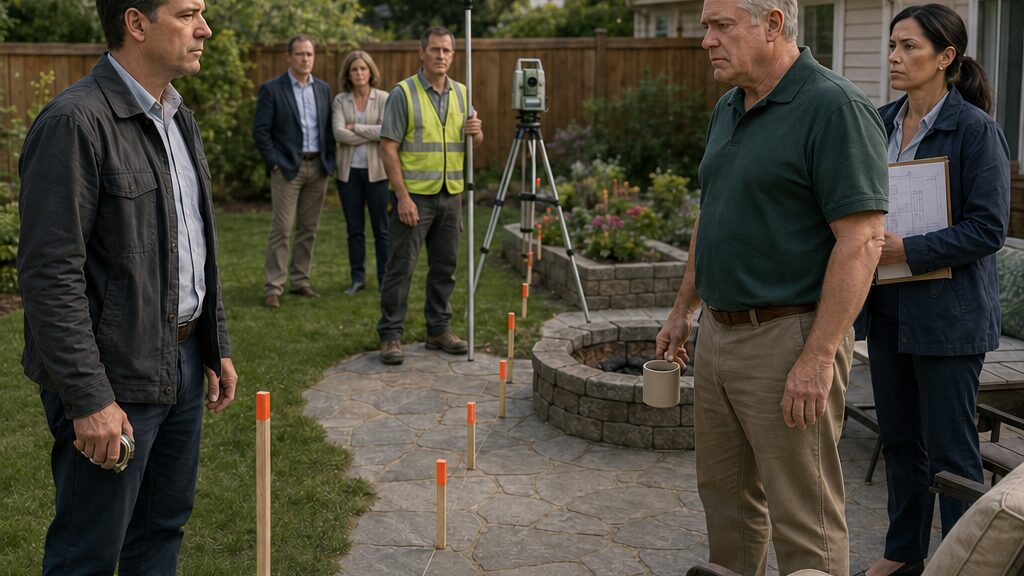
Daniel Roberts drove the first wooden stake into a joint between two flagstones, less than three feet from Gary’s favorite chair.
The hammer strike snapped across both yards.
Gary stood near the patio door holding a coffee mug. Beside him were Michelle Hernandez and two HOA board members Richard recognized from their profile photographs. None of them had been mentioned in Michelle’s email confirming that Richard could conduct a survey so long as the crew did not damage approved improvements.
Daniel adjusted the receiver pole and looked toward the instrument operator.
“Check.”
A crew member called back a number.
Daniel shifted the stake less than an inch and struck it again.
Gary took a drink from his mug. “That supposed to mean something already?”
Daniel did not answer. He had told both homeowners before starting that he would explain his conclusions only after closing the traverse and verifying the recorded monuments.
Richard appreciated that restraint.
Michelle crossed the grass toward him, a leather folder tucked beneath one arm. “Mr. Walker, I need to remind you that any permanent marking or removal requires HOA authorization.”
“These are temporary survey stakes.”
“If they damage the patio—”
“They won’t,” Daniel said without looking up.
Michelle stopped. She was younger than Richard had expected, perhaps early forties, dressed in navy slacks and a pale blouse beneath a lightweight association jacket. Her composure looked practiced rather than natural.
Gary smiled at the interruption. “Whole production for four feet.”
Richard said nothing.
The crew moved toward the rear of the property. One worker set the total station near Richard’s drainage swale while another located the front monument. Daniel checked the county plat, then a digital screen, then the line of sight.
The second stake landed beside the stone ring of the fire pit.
Gary’s smile faded.
“What are you doing?” he asked.
“Marking the calculated boundary,” Daniel said.
“You haven’t finished.”
“That’s correct.”
“Then don’t mark it like you have.”
Daniel met his eyes. “It’s a preliminary point based on the recovered monuments. We’ll verify it.”
One of the board members folded his arms. The other stepped closer to Michelle and whispered something Richard could not hear.
Richard watched the straight line emerging through Gary’s yard. First the chair. Then the fire pit. Then the edge of the flagstone patio.
Four feet was no longer a note in his notebook. It had become visible.
Gary set his mug on the patio table. “The old fence was in that location when we bought the house.”
Carol stood behind the kitchen window, motionless.
Richard wondered whether she could hear.
Daniel’s crew continued toward the garden. A third stake went into the grass just before the raised timber bed. The next point fell inside it.
The crew member hesitated. “You want this marked beside the bed?”
Daniel checked the coordinates. “No. Mark the line through it.”
The worker pressed a narrow pin into the soil between two clumps of flowering sage and tied a bright strip of ribbon around it.
The color looked almost violent against the plants.
Carol came outside.
“Please be careful there,” she said.
The worker stepped back immediately. “Yes, ma’am.”
Gary moved toward the garden. “That cannot be right.”
Daniel walked the line in silence, checking each point. He returned to the instrument, reviewed the readings, and asked the crew to reoccupy the rear monument. Minutes passed in a rhythm of numbers, adjustments, and hammer strikes.
Nobody spoke casually anymore.
A neighbor watched through a gap in a distant fence. Another stood on a deck pretending to shake out a rug.
Richard remained near his patio, hands at his sides. He had imagined this moment during the week: the line confirmed, Gary silenced, the documents aligned with the earth. In that version, certainty had felt clean.
Here, with Carol guarding the garden and Michelle preparing some institutional objection, it felt heavier.
Daniel finally gathered the group near the first stake.
“I’ve closed the survey,” he said. “The recovered monuments are consistent with the recorded subdivision plat and the legal descriptions for both lots.”
Gary’s jaw worked.
Daniel continued. “The existing cedar fence is between three feet ten inches and four feet two inches inside Mr. Walker’s parcel. The patio edge, a portion of the fire pit area, and the raised garden also extend across the recorded line.”
No one reacted for a moment.
Then one of the board members said, “You’re certain?”
Daniel looked at him. “Within professional standards, yes.”
Gary pointed toward the back corner. “The pin could have moved.”
“We recovered multiple controlling points.”
“The county maps are old.”
“The plat remains the recorded plat.”
Gary turned to Richard. “You hired him.”
Richard took the tape measure from his pocket.
It was an unnecessary gesture, and he knew it. Still, he stepped to the nearest stake, hooked the tape against the fence post, and extended it to the marked line.
Four feet and one inch.
He read the number silently, then let the tape retract.
Gary’s face changed. The confidence did not disappear all at once. It broke apart in stages—first the smile, then the lifted chin, then the assumption that everyone present still stood with him.
Richard should have felt vindicated.
Instead, he noticed Carol looking at the stake inside the garden.
Michelle opened her folder.
“There is another issue,” she said.
Daniel gathered his paperwork but did not leave.
Michelle removed a site sketch bearing the HOA logo and an approval stamp dated seven years earlier. She placed it on the patio table beside Gary’s coffee mug.
“The association approved the fence and landscape installation shown here.”
Richard examined the page. It was not a survey. It was a contractor’s drawing, not to scale, showing the fence along a line labeled EXISTING BOUNDARY. The patio, fire pit, and garden were all placed inside it.
Gary stepped beside her. “Exactly.”
Richard pointed to the label. “Who identified that as the boundary?”
“The homeowner’s application did,” Michelle said.
“Based on what?”
“The architectural committee approved the submission.”
“That still isn’t a boundary determination.”
Michelle’s expression tightened. “The HOA relied on the information provided.”
Gary tapped the approval stamp. “You wanted documents. There’s your document.”
Daniel leaned over the sketch. “This doesn’t supersede the recorded plat.”
“No one said it did,” Michelle replied. “But it establishes that the improvements were authorized.”
“Authorized by an association that didn’t verify where the property line was,” Richard said.
One of the board members cleared his throat. “We should avoid conclusions until counsel reviews it.”
Gary picked up his mug again, though he did not drink. “You heard them. This wasn’t some midnight land grab. I submitted plans. The board approved them. The old owner watched the whole thing go in.”
Richard looked at the sketch. For two weeks he had expected the survey to divide the situation into a clean pair of facts: his land, Gary’s structures.
Instead, the bright stakes now crossed two competing records—one legal, one institutional—and every person present seemed ready to choose the one that cost them less.
Daniel handed Richard a preliminary field summary. “My report will show the physical encroachments. Responsibility for the improvements is outside my scope.”
Gary gave a short laugh. Some of his color had returned.
“There you go,” he said. “Your survey tells us where the line is. The approval tells us why the fence is there.”
“It doesn’t give you ownership.”
“No. But it means I’m not paying to fix the HOA’s mistake.”
Michelle closed the folder. “Until the board reviews the records, neither homeowner should alter the site.”
Richard looked from the approval sketch to the stake cutting through the garden.
Gary lifted the page and held it toward him.
“If you want that fence moved,” he said, “you can pay for every inch of it.”
Chapter 4: The Approval File Was Missing One Page
The HOA file jumped from page three to page five.
Richard noticed it before Michelle finished explaining the association’s review process. The packet lay open on a conference table beneath fluorescent lights: application cover sheet, contractor sketch, material samples, committee notes—then a missing number where page four should have been.
He touched the corner of page five. “Where is the boundary acknowledgment?”
Michelle stopped speaking.
Across the small office, framed photographs showed landscaped entrances and summer block parties. A printer hummed behind the receptionist’s empty desk.
“I don’t know what you’re referring to,” she said.
“Most architectural applications require the owner to acknowledge that approval doesn’t confirm setbacks, easements, or property lines.”
“This application was submitted under an older form.”
Richard turned back to page three. At the bottom, beneath Gary’s signature, a line read: Additional conditions attached.
“What conditions?”
Michelle drew the file closer. “The archive may be incomplete.”
“That means the approval may be incomplete.”
“It means the association retained what was scanned.”
Richard had brought Daniel’s preliminary field summary and certified copies of both deeds. He placed them beside the HOA sketch. Three versions of the four-foot strip now occupied the table: the recorded plat showed it as Richard’s land; Gary’s contractor sketch treated it as Gary’s yard; Daniel’s survey placed bright stakes through the middle of the improvements.
Only one of the documents had legal bearings and distances.
Michelle kept looking at the missing page number.
“Did the association ever commission a survey?” Richard asked.
“No.”
“Did anyone from the board visit the property before approval?”
“The architectural committee reviewed the location.”
“From what?”
“The submitted materials.”
“So Gary drew a boundary, and the committee approved structures inside the boundary he drew.”
Michelle’s expression hardened. “You’re making it sound more careless than it was.”
“I’m describing it.”
“You’re also ignoring that the previous owner raised no objection.”
Richard leaned back. “Silence isn’t a conveyance.”
“No, but it affects how people understand a situation.”
The sentence struck too close to Carol’s question on his porch. Richard had not told Gary the survey date. He had not explained what remedy he might accept. He had allowed the equipment and crew to arrive like a verdict.
That did not move the boundary.
It did make the conflict easier for Gary to frame.
Michelle closed the file. “The board’s position is that no work should occur until counsel reviews responsibility.”
“Your warning says I may be fined if I disturb structures on my own land.”
“It says you may be fined for unauthorized exterior work.”
“On my own land.”
“The association governs exterior modifications.”
Richard looked at her. “Are you prepared to put in writing that the HOA claims authority to require an owner to preserve another owner’s encroachment?”
Michelle’s fingers tightened on the folder.
“No,” she said. “I am prepared to say the issue is under review.”
It was the first useful answer she had given him.
Richard requested a digital copy of the complete file, the committee meeting minutes, and all correspondence attached to Gary’s application. Michelle said she would provide what the archive contained. She did not promise that the missing page would be found.
At home, Richard spread the documents across his kitchen table. He built a timeline rather than a theory.
The original wire fence appeared in an old listing photograph.
Gary’s cedar fence application came six years later.
The patio contractor invoiced work three months after approval.
The fire pit followed the next spring.
The raised garden was added two years after that.
Richard found the contractor invoice in a scanned attachment Michelle had sent near the end of the day. Most of it listed ordinary materials: cedar posts, concrete, galvanized fasteners, demolition of existing wire fence. Near the bottom, under site assumptions, one sentence had been typed in smaller text.
Fence alignment based on owner-confirmed boundary.
Richard read it twice.
The contractor had not claimed to verify the line. Gary had confirmed it.
Richard forwarded the invoice to Michelle with one question.
What did Mr. Campbell use to confirm the boundary?
Her reply came an hour later.
The association does not have that information.
At six that evening, Gary posted a message on the HOA’s private homeowner portal. Richard knew because the message was forwarded to him by mistake in a board email chain.
Some residents may have noticed survey activity between Lots 46 and 47. The existing fence and improvements were formally approved years ago and have never previously been disputed. Unfortunately, a new owner is attempting to exploit inconsistencies in old county records and association files. We remain hopeful that reason will prevail before unnecessary destruction affects neighboring property values.
There was no direct accusation, but Richard recognized the construction. Gary had converted a measured encroachment into an attack on stability. He had made Richard the threat.
Responses accumulated beneath it.
One resident asked why anyone would buy a house without resolving the boundary first.
Another wrote that long-established landscaping should count for something.
A board member urged everyone not to speculate, then left Gary’s description uncorrected.
Richard began typing a response. He attached Daniel’s field summary. He quoted the deed. He drafted a paragraph explaining that county records were not “inconsistent” merely because the fence contradicted them.
Then he stopped.
A public argument would satisfy the part of him that wanted the record corrected immediately. It would also turn every neighbor into a jury before the missing documents were found.
He deleted the post.
The next morning, Michelle called.
“I found committee minutes,” she said. “They don’t mention a survey.”
“Do they mention the attachment conditions?”
“No.”
“Then page four mattered.”
“I agree that the file should be complete.”
It was a careful admission, but an admission all the same.
“Will the HOA withdraw the warning?” Richard asked.
“Not yet.”
“Why?”
“Because your contractor has requested access approval for possible fence removal.”
Richard looked toward the backyard. He had asked a fence company for a preliminary estimate after the survey. Nothing more.
“I haven’t authorized work.”
“Gary says you intend to demolish the patio.”
“Gary doesn’t know what I intend.”
Michelle was silent.
Richard heard his own words after he said them. Gary did not know because Richard had made certain he did not.
“Then tell us,” Michelle said. “What are you asking for?”
“The fence moved to the recorded line. The encroaching hardscape removed. Costs assigned after responsibility is established.”
“And the garden?”
Richard looked through the window. Carol was kneeling beside the raised bed, clipping dead stems into a bucket.
“It crosses the line.”
“That wasn’t my question.”
Again, the wrong answer.
Richard ended the call without giving her another one.
That afternoon he went to Gary’s porch with the contractor invoice. Gary opened the door but did not invite him inside.
“You told the fence company where the boundary was,” Richard said.
Gary glanced at the paper. “I told them where the old fence stood.”
“That isn’t what the invoice says.”
“The old fence was the boundary as far as anyone knew.”
“As far as you knew?”
Gary’s eyes narrowed. “You think I forged a survey?”
“I think you confirmed something you hadn’t verified.”
“The HOA approved it.”
“The HOA relied on you.”
“And the previous owner watched us build.”
Richard held the invoice between them. “Did anyone warn you that approval did not establish the property line?”
Gary’s face remained still, but something shifted behind it.
“No,” he said.
The answer came too quickly.
Carol appeared in the hallway. Her gaze moved from Richard to the invoice and settled on Gary.
“Carol?” Gary said.
She did not respond.
Richard folded the paper. “I’ll ask the HOA to locate the missing attachment.”
“You do that.”
Gary closed the door.
Richard had reached the walkway when he heard it open again.
Carol stepped outside alone.
She crossed the porch without a coat, one hand closed around a folded sheet of paper. Gary’s silhouette remained behind the glass door.
Carol held the page toward Richard.
“I printed this years ago,” she said. “I didn’t know if I’d ever need it.”
Richard unfolded it beneath the porch light.
At the top was an email addressed to Gary.
Chapter 5: The Garden Was Never Just Landscaping
The sentence appeared halfway down Gary’s old email.
Association approval does not verify property boundaries and should not be relied upon in place of a licensed survey.
Richard read it once beneath the porch light, then again at his kitchen table.
The message had been sent by a former HOA committee member seven years earlier, three days before the cedar fence was installed. It referred to Gary’s application number and advised him to confirm the line because the submitted sketch was not drawn from a survey.
At the bottom was Gary’s reply.
Understood. Fence follows the existing line accepted by both owners.
Richard set the page flat.
The previous owner’s acceptance had been converted into Gary’s confirmation. The HOA’s warning had become a box checked and ignored. Years of mowing and landscaping had done the rest.
Carol stood near the kitchen doorway, arms folded against the cold she had carried inside.
“Does Gary know you gave me this?”
“Yes.”
Richard looked up.
“He saw me print it,” she said. “He knows I kept it.”
“Why?”
Carol pressed her lips together. “Because he kept saying there had never been a warning. I needed to know I wasn’t remembering it wrong.”
“You let him tell the HOA that anyway.”
“I did.”
The admission held no defense.
Richard waited for one.
Carol looked through the dark window toward the raised bed. “When the old wire fence started falling down, Gary asked the previous owner if he minded replacing it. He said no. Gary asked if the line was right. The man said it had been there since before either of them bought.”
“That wasn’t verification.”
“I know that now.”
“You knew it when the email came.”
Carol’s eyes moved back to him. “I knew someone had written a disclaimer. I didn’t know four feet would become a fire pit and half a garden.”
Richard tapped the page. “Gary did.”
“Yes.”
The quiet answer removed the last uncertainty about his knowledge. It did not simplify Carol.
“Why bring this now?”
“Because he won’t stop.”
“Stop what?”
“Turning it into something that happened to him.”
Richard looked down at the printed email. He understood the impulse too well: choose the portion of the record that protected you and call it the whole truth.
Carol walked to the window.
“The garden is why I waited,” she said.
Richard did not answer.
She pointed toward the rear corner, though only the porch light and the pale top of the cedar fence were visible.
“Our son bought a little house when he was twenty-six. Nothing special. Bad plumbing. Tiny yard.” Her voice remained even. “He planted sage along the steps because he said it survived anything.”
Richard looked toward the dark outline of the raised bed.
“When he died,” Carol continued, “his sister sold the house. I took cuttings before closing. The sage, the rosemary, two of the daylilies. Gary built the raised bed because I couldn’t stand seeing them scattered in pots.”
Richard felt himself become still in the way he did when facts arrived too late to remain only facts.
Carol turned from the window. “That does not make the land ours.”
“No.”
“It does not make Gary right.”
“No.”
“But if you tear the bed out with a machine, some of it won’t survive.”
Richard’s contractor estimate lay beneath the county plat on the table. The proposed scope included removal of fence sections, patio stones, fire-pit edging, and the raised timber bed. Richard had approved the full scope that afternoon, before Carol knocked on his door.
The contractor was waiting only for a start date.
“I already authorized removal,” he said.
Carol closed her eyes briefly.
“When?”
“Tomorrow morning.”
Her head lifted. “Tomorrow?”
“The crew had a cancellation.”
“What time?”
“Seven.”
Carol looked toward the backyard again, as if distance could be measured in hours instead of feet.
Richard felt defensive before she accused him of anything.
“The line has been confirmed,” he said. “Gary has refused every proposal to relocate voluntarily.”
“I’m not asking you to leave it.”
“You’re asking me to treat part of the encroachment differently because it has meaning to you.”
“Yes.”
“That’s how exceptions become disputes.”
Carol studied him. “Is that what happened to you?”
The question entered the room without warning.
Richard’s hand remained on the email. “What do you mean?”
“You talk like every kindness needs a signature because someone once used one against you.”
He stood. “You don’t know anything about me.”
“No.” Carol’s voice stayed quiet. “But I know what it sounds like when a person is more afraid of being fooled than of being cruel.”
Richard looked away first.
On the construction project that ended his last partnership, he had accepted a superintendent’s promise that a revised drainage detail would be documented before closeout. When water undermined a retaining wall, the promise vanished. Richard’s email objecting to the change existed. So did his field note allowing work to proceed temporarily. The company used the note. The superintendent used silence. Richard used the experience afterward to justify never leaving space for trust again.
He had told himself that was discipline.
Carol placed both hands on the back of a kitchen chair.
“I am not asking you to preserve Gary’s lie,” she said. “Move the fence. Remove the stones. Make him pay. But give me enough time to move the plants by hand.”
Richard looked at the email between them.
“Why didn’t you tell the surveyor what the garden was?”
“Because Gary was standing there.”
“And now?”
“Now he knows I gave you the email.”
A car door shut next door. Moments later Gary entered his yard. His porch light came on, throwing his shadow across the disputed strip.
Carol moved toward the front door.
“He’ll say I betrayed him,” she said.
“Did you?”
She considered it.
“I stopped helping him pretend.”
After she left, Richard opened the contractor agreement on his laptop.
The cancellation clause allowed postponement with a mobilization fee. The demolition plan could be revised. He could call before seven.
His cursor hovered over the contractor’s number.
Then an email from Gary arrived.
The subject line read: FINAL NOTICE.
Gary accused Richard of harassing them, interfering with HOA-approved improvements, and coercing Carol while Gary was not present. He warned that any entry onto Gary’s side of the fence would be documented. He copied Michelle and the HOA board.
Richard read the line about coercion twice.
Carol had crossed the porch carrying evidence Gary had concealed. Within minutes, Gary had rewritten her choice as Richard’s pressure.
Richard attached the old email to a response. He included the contractor invoice and Daniel’s survey. He wrote that demolition would proceed on the confirmed encroachment unless a signed corrective agreement was reached.
He paused before sending.
The message was accurate. It was also a weapon.
Richard sent it.
At 10:43 p.m., the fence contractor replied to confirm the crew and equipment for seven the next morning.
Richard looked through the window at the raised garden.
The four-foot strip no longer contained only land Gary had taken. It held a lie, an old warning, Carol’s silence, and plants carried from a dead son’s first home.
At seven, the machines would not know the difference.
Chapter 6: He Could Win Everything by Seven O’Clock
The saw bit into the first cedar post before Richard reached the yard.
Its high mechanical whine cut through the dawn, followed by a shower of pale sawdust. One worker braced the fence panel while another followed a chalk line laid over Daniel’s bright survey stakes.
Richard crossed the grass without a jacket.
“Stop.”
The operator released the trigger. The blade slowed with a metallic sigh.
The fence contractor lowered his safety glasses. “You changing the scope?”
“Part of it.”
Behind the cedar boards, Gary’s patio door flew open.
“What are you doing?” Gary shouted.
He came outside in work pants and an unbuttoned coat. Carol followed more slowly, already wearing gardening gloves.
Richard pointed to the fence. “Remove it to the surveyed line. Lift the encroaching patio stones and fire-pit edge as planned.”
Gary stepped closer. “You don’t have agreement on costs.”
“I have a survey and access through my parcel.”
“You have an HOA order not to alter approved structures.”
“The HOA withdrew that warning at six twelve this morning.”
Michelle’s email had arrived after counsel reviewed Gary’s old message. It did not assign liability, but it acknowledged that the association could not require Richard to preserve verified encroachments.
Gary’s face tightened. “Carol gave you that email.”
“She gave me the truth.”
Carol flinched, not at Richard but at the way the sentence sounded between them.
Richard turned to the contractor. “Do not touch the raised bed.”
The contractor glanced at his printed scope. “It crosses the line.”
“I know.”
Gary looked from Richard to Carol. “What did you ask him for?”
“Time,” Carol said.
“You had no right.”
“To save the plants?”
“To negotiate behind my back.”
Carol pulled one glove tighter over her wrist. “You weren’t negotiating.”
The workers waited beside the half-cut post. Their silence made the argument feel exposed.
Richard took a revised agreement from the folder under his arm. He had written it before dawn, correcting it twice to remove phrases that sounded punitive.
“The fence and hardscape move now,” he said. “The garden stays for thirty days under a temporary access license. Carol can transplant everything to your side. After that, the bed comes out.”
Gary did not take the pages.
“And the money?”
“You pay the fence relocation and seventy-five percent of the hardscape removal. I pay the rest because I ordered the expedited work before responsibility was fully reviewed.”
Gary laughed sharply. “Generous.”
“The HOA waives all related application fees and pays Daniel to prepare the relocation exhibit.”
“You already decided this with Michelle?”
“I proposed it. She agreed to recommend it.”
“So everybody meets before sunrise except me.”
Richard held the document out. “You had the survey report, the invoice, and the email last night.”
Gary looked at Carol. “How long were you saving that?”
“Seven years.”
Something in him sagged before anger restored it.
“You think I did all this for status?” he asked Richard. “You think I stole grass because I wanted a bigger fire pit?”
“You knew the line wasn’t verified.”
“I knew the old owner didn’t care.”
“That isn’t ownership.”
“I maintained it. I replaced the drainage. I paid for the fence. I built that yard because this house was falling apart after our son died and Carol couldn’t stand looking at the back corner.”
Carol’s face changed, but Gary continued.
“I borrowed against my retirement to finish it. The patio, the wall, the garden. I thought if the place looked normal, maybe we could live normally.”
The contractor shifted his weight.
Richard looked at the flagstone, the chairs arranged around the cold fire pit, the raised bed behind them. The yard had always looked like an assertion. Now he could see the labor beneath it and the fear beneath the labor.
None of that moved the line.
But it explained why Gary had defended each foot as if losing it would expose more than a mistake.
“You could have surveyed,” Richard said.
Gary looked away.
“You could have told the truth when I asked.”
“The previous owner accepted it.”
“You keep saying that because it lets you avoid saying you knew.”
Gary’s jaw tightened. “And you keep saying ‘the line’ because it lets you avoid saying you enjoy this.”
Richard felt the accusation land because part of it was true.
He had imagined the fence coming down. He had imagined Gary watching. In those private versions, the removal had not been only corrective. It had been proof that silence and preparation could defeat the kind of man who relied on pressure.
Richard turned toward the workers.
“Continue with the fence,” he said. “Work around the garden.”
The saw started again.
Gary stepped toward him. “You don’t get to destroy half my yard and call yourself reasonable.”
“No,” Richard said. “Reasonable would have been seven years ago.”
The first panel lifted free. Morning light entered through the opening, exposing the survey stake and the narrow strip of soil beneath the fence.
Carol stared at the gap.
Richard placed the agreement on the patio table.
“You have one hour,” he said. “Sign, and the garden gets thirty days. Refuse, and I withdraw the temporary license. The crew removes everything on my side today.”
Gary looked at the pages but did not touch them.
“You’re threatening her plants to make me sign.”
“I’m giving you an option the law doesn’t require me to give.”
“That sounds exactly like a threat.”
Richard heard how easily precision became cruelty when delivered without room.
He lowered his voice.
“I’m not asking you to admit you’re a bad man. I’m asking you to accept that you made a decision you had no right to make. The fence moves. The record gets corrected. You pay for most of what your decision caused. Carol gets time because the garden matters, not because the boundary doesn’t.”
Gary’s eyes moved to the workers. Another post was already loose.
“What happens to the HOA complaint?” he asked.
“It stays.”
“Then no.”
Michelle arrived through Richard’s side gate carrying a folder and a travel mug. She stopped when she saw the missing panels.
“Mr. Campbell,” she said, “the complaint concerns the association’s approval process. It isn’t something Mr. Walker can privately withdraw.”
Gary looked at her. “You told him that?”
“I told both of you in the email.”
“You copied the board.”
“Yes.”
His face reddened. “After years of asking me to keep that committee running, you’re putting this on me.”
Michelle took a breath. “The association failed to preserve a complete file. You confirmed a boundary you had been warned was unverified. Both things can be true.”
For the first time, Gary had no institution left to stand behind.
The contractor checked his watch.
“Forty-eight minutes,” Richard said.
Carol stepped beside the raised bed and began loosening soil around the sage with a hand trowel.
Gary watched her.
“You already decided I’d sign.”
“No,” she said. “I decided the plants shouldn’t wait for you.”
A third fence panel came down.
The open line now ran from Richard’s house to the rear stake, crossing the patio and disappearing into the garden. Without the cedar barrier, the four feet looked both smaller and more undeniable.
Gary walked to the table.
He read the first page standing up. On the second, he stopped at the cost allocation. On the third, he found the temporary access terms.
“You wrote that she can enter through his yard,” he said.
Richard nodded. “The bed is partly on my parcel. The license protects everyone.”
Gary gave him a tired, bitter look. “Even kindness needs paperwork with you.”
Richard met his eyes. “This one does.”
The hour had nearly passed when Gary picked up the pen.
He did not sign immediately.
The workers waited beside the next post. Carol kept digging around the roots of the sage. Michelle stood with the HOA folder pressed against her chest.
Gary looked once toward the garden, then bent over the agreement.
The story has not ended.
Chapter 7: The New Line Left No One Unchanged
Gary signed without looking at Richard.
He pressed the pen hard enough to leave an impression on the pages beneath the agreement, then slid the folder across the patio table toward Michelle. His signature ended in a blunt downward stroke.
“There,” he said.
Carol kept working in the raised bed.
The fence crew resumed cutting before anyone answered. Another cedar panel came loose, revealing more of the disputed strip. The exposed ground looked pale and unfinished beneath the morning light, a narrow band that had carried seven years of assumption.
Michelle checked each signature page. “I’ll circulate the final association acknowledgment this afternoon.”
Gary turned away. “Do whatever you need to do.”
He walked inside and shut the patio door.
No apology came through the glass.
Over the next week, the backyard changed in sections.
The cedar fence disappeared first. Workers removed the posts, broke the concrete collars from the soil, and stacked the panels along Richard’s driveway. The contractor preserved enough usable boards to rebuild most of the fence on the surveyed line. The damaged pieces went into a trailer.
Then the flagstone came up.
Each stone left a dark shape in the base material beneath it. The workers numbered reusable pieces in chalk and set them aside. The fire-pit ring was reduced carefully rather than destroyed. Gary watched some of the work from inside. On other days, he left before the crew arrived.
Richard signed invoices at the folding table in his kitchen. Gary’s share appeared beside Richard’s on every statement, percentages converted into exact amounts. The numbers were clean. The relationship was not.
Carol crossed the temporary opening twice a day with trays, buckets, and hand tools. The thirty-day access license allowed her to enter through Richard’s side yard between eight in the morning and six in the evening. She followed the hours exactly.
The first plants she moved were the daylilies.
Richard saw her kneeling beside them, easing the roots free with a narrow spade. She wrapped each clump in damp burlap and carried it to a new bed Gary had built farther inside their property.
He had placed it well beyond the permanent marker.
On the tenth day, Carol found Richard tightening a loose hinge on his back gate.
“You don’t have to stand here every time,” she said.
“I’m fixing the hinge.”
“You’ve fixed it three times.”
Richard looked at the screwdriver in his hand.
Carol almost smiled. “The sage is taking.”
“I’m glad.”
She glanced toward the new bed. “Gary mixed too much sand into the soil. I told him that before he filled it.”
“Will it hurt the plants?”
“Not if we add compost.”
Richard nodded as though she had given him a site instruction.
Carol wiped soil from her glove. “You know, he still thinks you enjoyed watching the fence come down.”
Richard set the screwdriver on the post cap. “Part of me did.”
Her expression changed, not with surprise but attention.
“I wanted him to see that the line existed whether he respected me or not,” Richard said. “That wasn’t the same as wanting the yard ruined. But it wasn’t entirely different either.”
Carol studied him for a moment.
“He won’t know what to do with that answer.”
“I wasn’t saying it for him.”
“No,” she said. “I suppose you weren’t.”
She returned to the garden carrying a tray of rosemary.
The HOA held its special meeting twelve days after the demolition began.
Richard sat at one end of a long table in the community room. Gary sat across from him with Carol beside him. Michelle stood near a screen displaying revised architectural procedures.
The board’s attorney had reduced the issue to terms everyone could approve without admitting more than necessary.
The association acknowledged that architectural approval did not establish ownership boundaries.
The archive had failed to preserve a complete application record.
Future fence, wall, patio, shed, pool, and major landscape applications within five feet of a presumed property line would require a certified boundary reference or licensed surveyor’s confirmation.
The HOA would reimburse Daniel’s relocation exhibit and waive all fees related to the corrective work.
Gary would remain responsible for the percentage assigned in the private agreement.
One board member called the policy “an unfortunate but useful lesson.”
Gary looked at the table.
Richard said nothing.
Michelle advanced to the next slide. “We also need to correct the online statement regarding inconsistent county records.”
The room became still.
Gary lifted his head. “That post was mine.”
“It was made on an association platform and referenced association approval,” Michelle said. “The correction should state that the recorded plat and field survey were consistent.”
A board member shifted in his chair. “We can remove the original message.”
“Removal isn’t correction,” Richard said.
It was the first time he had spoken.
Gary looked across at him. “You want me to post a confession?”
“No. I want the record to say the county documents were not inconsistent.”
“You need everybody to know you were right.”
Richard felt the familiar answer rise—because I was—but did not use it.
“I need the next owner to find accurate information,” he said. “That is how this started.”
Carol placed one hand flat on the table.
Gary stared at Richard, then at Michelle’s screen.
“Write it,” he said. “I’ll approve the wording.”
It was not an apology. It was more useful than one.
The final corrective statement appeared on the homeowner portal that evening. It contained no blame and no names beyond the lot numbers. It confirmed that the licensed survey matched the recorded plat and that the HOA approval had not verified the property boundary.
Comments were disabled.
Three weeks after the agreement, Carol moved the last plant.
It was the largest clump of sage, wider than the plastic tub she had brought for it. The roots resisted, tangled deep into the soil that lay partly on Richard’s land. She worked around them slowly while Richard stood near the new fence line.
Gary came outside carrying a shovel.
For a moment, neither he nor Carol spoke.
Then he stepped into the bed and pushed the blade under the root mass from his side.
Together they lifted it free.
Soil broke loose between them. Carol steadied the plant while Gary carried most of the weight. They moved it beyond the marker and lowered it into the prepared hole.
Richard watched from four feet away.
When the last roots were covered, Carol pressed the soil with both hands. Gary stood beside her, breathing hard.
“The access period ends tomorrow,” he said without turning.
“I know,” Richard replied.
Gary wiped the shovel blade against the grass.
“The repayment schedule starts next month.”
“I received the first transfer notice.”
Another silence opened between them.
Gary looked toward the rebuilt fence. The new cedar boards followed Daniel’s line exactly. The fire-pit seating area had been reduced, and the patio edge ended in a neat border before reaching the fence. The yard was smaller, but not destroyed.
“You could have made it worse,” Gary said.
Richard understood that this was the closest Gary would come to naming what had been spared.
“You could have made it unnecessary,” he answered.
Gary gave one brief nod.
Then he carried the shovel inside.
The permanent boundary marker arrived the following Monday.
Daniel placed it near the rear corner, a small concrete monument set flush enough not to catch a mower but high enough to remain visible. The fence contractor offered to build the new line directly over it.
Richard declined.
“Leave a gap,” he said.
The contractor measured six inches on either side. “Most people don’t want to see these.”
“I do.”
When the work was complete, Richard stood in his yard and looked through the narrow opening at the marker.
On Gary’s side, the replanted sage moved slightly in the afternoon air. Carol had arranged the daylilies around it, with rosemary along the back. The memorial garden now sat wholly within the Campbells’ legal property.
The four-foot strip on Richard’s side was bare except for new grass seed and the faint outlines where patio stones had once rested. It looked smaller than the conflict had made it and larger than it had looked before anyone measured.
Richard closed the gate and returned his tools to the garage.
He did not cover the marker with soil. He did not hide it behind a shrub or ask the fence contractor to close the gap.
The line remained visible—not as a trophy, and not as a warning, but as something neither household would again be allowed to pretend was somewhere else.
The story has ended.