The Rat Crossed Our Fence, but the Thirty-Fourth Photograph Exposed a Deeper Neighborhood Failure
Chapter 1: The Rat That Crossed in Daylight
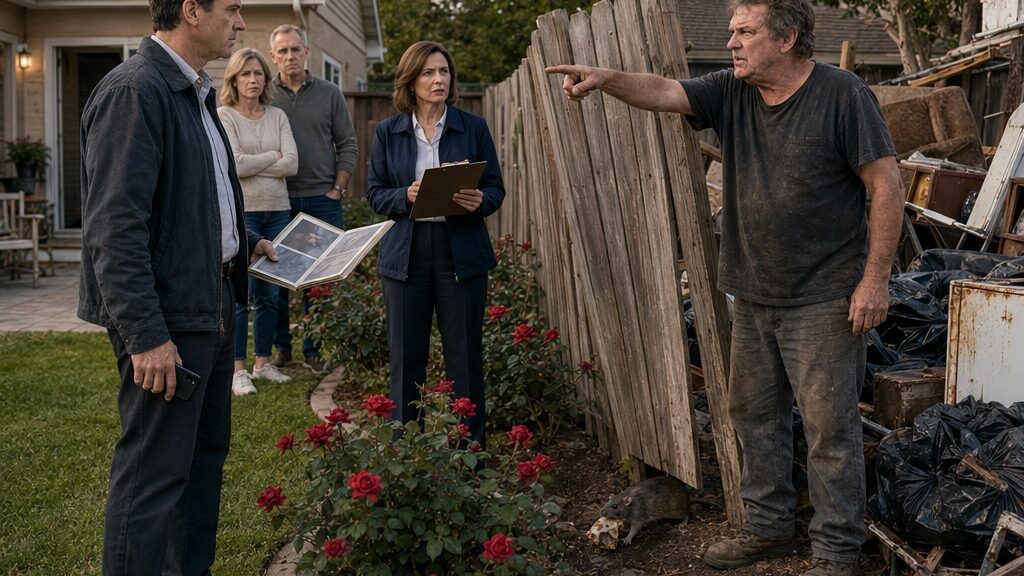
The rat stopped beneath Michael Moore’s rosebush as if it belonged there.
It was not small. Its body was thick through the middle, its gray-brown coat slick along the spine, and its tail lay across the dark mulch like a dropped cord. For one suspended second, it looked toward Michael from less than eight feet away.
Then it dragged a pale strip of plastic between the flowers and disappeared beneath the shared fence.
Michael remained beside the garden hose, the nozzle still hissing against his shoe.
It was nine seventeen on a Monday morning. The sun was already high enough to cast the fence slats in narrow bars across the flower bed. Rats were supposed to move in darkness, close to walls, quick enough to make a person question what he had seen. This one had crossed open ground in daylight.
Michael shut off the water and walked to the place where it had vanished.
The fence separated his backyard from Gary Campbell’s. Eleven years earlier, when Michael bought the house, the boards had stood straight and clean. He had stained his side twice since then. Gary had never touched his. The wood now leaned inward near the corner, where the bottom edge had softened against the soil.
Michael crouched without touching anything.
The strip of plastic remained caught beneath one board. Beyond it, through a thumb-wide gap, he could see black garbage bags pressed into the dirt. One had split along a seam. Damp paper, food packaging, and something fibrous had spilled against the fence.
A smell came through the gap—sweet, sour, and heavy.
Michael stood.
Gary’s yard had been cluttered for years. At first it had been ordinary neglect: a broken lawn chair, two tires, a mower left beneath a tarp. Then an old washing machine appeared beside the shed. A mattress leaned against the rear wall. Bags accumulated near the side gate, disappeared, and returned in greater number.
Michael had told himself it was not his yard.
That sentence had worked until the rat crossed the fence.
He washed the hose nozzle with bleach, then went inside and wrote the time on the back of an unopened utility envelope. He did not yet call anyone. Complaints made in anger often arrived stripped of useful detail. He knew that from twenty-three years in municipal records, where he had watched people enter public offices carrying outrage and leave with nothing because they could not provide a date, a location, or a specific violation.
He also knew what it felt like to wait too long.
Years earlier, in another house, a slow leak behind his washing machine had dampened the wall shared with a neighbor’s garage. Michael had noticed the softness in the baseboard and postponed calling a plumber until after the weekend. By then, the water had stained the neighbor’s drywall and ruined a cabinet filled with tools.
The neighbor had not shouted. He had only asked why Michael had not said something sooner.
Michael still remembered the question.
At eleven, he crossed his driveway and walked to Gary’s blue front door.
Gary opened it halfway. He wore a faded T-shirt and work pants with dust on the knees. His hair was uncombed, and one hand remained braced against the doorframe.
“What’s up?”
“A rat came through the back fence this morning,” Michael said. “From your side.”
Gary blinked once. “You followed it?”
“I saw where it went.”
“Rats are everywhere.”
“This one came through the gap behind the roses.”
Gary leaned farther into the frame, though he did not open the door. “Then patch the gap.”
“There are torn garbage bags against it.”
“They’re waiting to go out.”
“They’ve been there longer than a week.”
Gary’s mouth tightened. “You keeping records on my trash now?”
“No. I’m asking you to move it away from the fence and deal with the bags before this gets worse.”
Gary looked past Michael toward the street. A delivery truck rolled through the intersection at the end of the block.
“You know what you need?” Gary said. “A cat.”
Michael waited, thinking Gary might smile. He did not.
“This isn’t about a cat.”
“It’s wildlife, Michael. You live near a drainage easement. You’ve got birdseed, compost, flowers. Maybe it likes your yard.”
“I don’t keep open food waste.”
“Congratulations.”
The word landed softly, almost lazily, which made it harder to ignore.
Michael kept his voice level. “I came over before contacting the association.”
Gary’s fingers curled against the doorframe. “So that’s what this is. You don’t like the way I keep my property.”
“I don’t care about your lawn.”
“You care enough to stand on my porch.”
“A rat crossed into my garden in daylight.”
“And I’m telling you rats are natural.”
Michael looked at Gary’s face and saw something beyond irritation: a quick tightening around the eyes at the mention of the association. Fear, perhaps, or resentment. It vanished before he could decide.
Gary pulled the door inward.
“My yard is my business,” he said. “You choose roses. I choose not to spend every Saturday making the place look like a catalog. Lifestyle choice.”
The door closed.
Michael stood on the porch for several seconds. His first impulse was to knock again and force Gary to hear the difference between untrimmed grass and decomposing garbage. Instead, he returned home.
By late afternoon, the smell near the roses had strengthened.
Michael put on work gloves and approached the fence from his side. He did not reach through. He moved one rose branch aside and found disturbed soil beneath the lowest board. The gap was newer than he had realized. The earth had been scraped into a shallow tunnel, and small dark droppings lay near the opening.
The pale strip of plastic remained caught there.
He photographed the gap with his phone, then stepped back and photographed the entire section of fence so the location could not be disputed. In the wider frame, the contrast looked almost staged: his trimmed grass and red roses in the foreground, Gary’s split black bag and rusted appliance visible through the leaning boards.
Michael lowered the phone.
He did not like the satisfaction he felt at having captured something clear.
Evidence should prevent arguments, he told himself. It should not become a substitute for them.
Before dusk, he walked the full length of the fence. Near the side gate, a second bag bulged between two boards. Farther back, beside Gary’s shed, a broken wooden cabinet had been pushed close enough that one of its warped drawers touched the fence.
Michael could not see everything, and he did not try. He stayed on his own property and photographed only what was visible.
At his kitchen table, he opened a new ruled notebook.
On the first page, he printed the date. Beneath it, he wrote the time, location, weather, and a plain description without adjectives.
Large rat observed beneath east rosebush. Crossed south through opening under shared fence. Plastic material carried from neighboring side. Torn refuse bag visible beyond opening. Spoke with Gary Campbell at approximately 11:05 a.m. Requested removal of refuse from fence. Request declined.
Michael read the entry twice.
Then he added a heading above it.
Sighting One.
Chapter 2: Thirty-Four Photographs Behind One Fence
The oily liquid appeared beneath the fence three mornings later.
Michael found it before breakfast, a narrow dark ribbon moving through the soil below the same leaning boards. It carried a rainbow sheen where sunlight touched it and ended in the mulch beside his roses.
He photographed it before placing an overturned plastic tub over the spot to keep birds away.
The picture became number seven.
By the end of the week, Michael had developed a routine he disliked for its efficiency. Each morning before work in the garden, he walked the fence with his phone and notebook. He recorded only changes: a newly torn bag, a shifted appliance, fresh droppings, disturbed soil, refuse placed closer to the boards.
He did not photograph Gary through windows or aim over the fence. Every image came from Michael’s property or from the sidewalk where the side yard was openly visible.
That distinction mattered to him.
It did not matter to Gary.
On Friday afternoon, Michael heard wood scrape against wood. He looked up from trimming dead blooms and saw the top of a metal shelving unit rising above the fence. It moved sideways, shuddered, and struck the boards hard enough to shake loose a curl of old stain.
“Gary,” Michael called.
The movement stopped.
A moment later, Gary’s head appeared above the uneven fence line near the gate. “What?”
“You’re stacking more things against it.”
“I’m moving my property.”
“You’re loading weight onto a fence that’s already leaning.”
“My side.”
“The fence serves both lots.”
Gary gave a short laugh. “You got a photograph of that too?”
Michael said nothing.
Gary saw the phone in his hand.
“There it is,” he said. “Neighborhood surveillance.”
“I’m documenting the condition.”
“You’re standing around waiting for something to happen so you can take a picture.”
“A rat already happened.”
“One rat.”
“Two.”
That stopped Gary.
Michael had seen the second one the previous evening near the compost bin. It had run along the fence before slipping beneath the same section. He had not managed a clear photograph, but he had logged the time and direction.
Gary recovered quickly. “Then get traps.”
“I have traps. That doesn’t remove the source.”
“You decided the source.”
“The bags are split open.”
“You don’t know what’s in those bags.”
“I can smell what’s in them.”
Gary disappeared behind the fence. A moment later, the shelving unit struck the boards again. The top edge remained visible, wedged beside the old cabinet.
Michael wrote down the time.
The following Monday, a third rat appeared near the detached garage. It moved from beneath a row of hostas, paused at the concrete slab, and vanished behind a rain barrel. Michael found fresh tracks in damp soil leading back toward the fence.
He added another entry.
Three sightings in eight days.
He printed the photographs at a pharmacy in town, placing four images on each sheet. At the kitchen table, he numbered them in the lower corner and matched each one to an entry in the notebook.
The process steadied him. Dates did not raise their voices. Photographs did not exaggerate. A sequence could show what a single image could not: the bags remained, the refuse grew, and the openings beneath the fence widened.
Still, there were moments when Michael caught himself listening for movement instead of enjoying his yard. The roses became markers in a case file. The fence became a measurement line. Every rustle in the hostas pulled his attention away from whatever he was doing.
By the tenth day, he had thirty-three photographs.
Janet Hill arrived that afternoon for what she called an informal property walkthrough. She wore a navy jacket despite the heat and carried a slim association folder under one arm. Two adjacent homeowners stood near Michael’s patio, not invited by him but drawn by the sight of the HOA manager entering his backyard.
Gary came through his side gate five minutes later.
“You called an audience?” he asked.
“I called the association,” Michael said.
Janet raised one hand. “This isn’t a hearing. I’m here to observe and determine whether there’s an association-level maintenance issue.”
“There isn’t,” Gary said. “There’s a neighbor-level obsession.”
Michael opened his folder. “I have dates, locations, and photographs.”
Gary pointed at it. “That’s exactly what I mean. He’s been photographing my property for over a week.”
“From my own yard,” Michael said.
“He wants everything to look like his side. Straight lines. Flowers. Nothing out of place.”
One of the adjacent homeowners looked toward the fence and then away.
Janet’s expression remained professional. “Gary, the issue described in the complaint is vermin activity, not landscaping preference.”
“There is no issue. He saw wildlife.”
“Three times,” Michael said.
Gary turned toward the others. “He leaves birdseed out. He has compost. Then he sees a rat and decides my yard is a public-health emergency.”
Michael felt the familiar urge to answer every sentence. He tightened his grip on the folder instead.
Gary continued. “For all anyone knows, he staged half those pictures. Put something by the fence, waited for movement, took a close-up.”
The accusation changed the air. One neighbor looked directly at Michael.
Michael opened his mouth.
A board near the roses gave a faint click.
Something gray pushed through the gap.
The rat emerged carrying a wad of greasy paper in its mouth. It crossed the mulch between two red blooms, passed within three feet of Janet’s shoes, and darted beneath the hydrangeas.
One of the neighbors swore and stepped backward.
Gary did not move.
Michael set the folder on the patio table, lifted his phone, and took three photographs toward the hydrangeas. The last image caught the rat at the edge of the frame and, behind it, the torn fence gap with refuse visible on Gary’s side.
He looked at the screen.
“Three forty-two p.m.,” he said.
Janet stared at him.
Michael opened his notebook and wrote the time.
No one spoke until his pen stopped.
Gary’s face had gone pale beneath the flush in his cheeks. “That could’ve come from anywhere.”
“It came through the fence,” one neighbor said quietly.
Gary turned on her. “You saw where it started?”
“I saw what it carried.”
Janet walked to the opening but did not crouch. From where she stood, the black bag and spilled material were clearly visible.
Michael numbered the new image before he could reconsider the gesture.
Thirty-four.
Janet asked to see the full sequence. Michael handed her the folder and watched as she moved through the pages. Her pace slowed at the images showing the shelving unit and cabinet pressed against the boards.
“You said this began ten days ago?” she asked.
“The first rat did. The bags have been there longer.”
Gary folded his arms. “This is harassment dressed up as paperwork.”
Janet did not answer him. She stopped at photograph twelve, then looked toward the fence.
“This section was mentioned before,” she said.
Michael looked at her. “Before when?”
She closed the folder too quickly.
Gary’s expression hardened. “We’re done here.”
“No,” Michael said. “What does ‘before’ mean?”
Janet shifted her grip on the association file. “There was an earlier maintenance concern.”
“Filed by whom?”
“I can’t discuss another resident’s communication in the yard.”
“Was it about rats?”
“I said I can’t discuss it here.”
Gary moved toward the gate. “Because there’s nothing to discuss.”
Janet watched him leave. The gate slammed behind him.
The two neighbors excused themselves within a minute, each suddenly interested in somewhere else they needed to be. Michael remained beside the table with the folder open to photograph thirty-four.
The rat had escaped the frame almost completely. Only its hindquarters and tail were sharp. But the path was unmistakable.
Janet lowered her voice.
“Do not contact the county yet.”
Michael studied her face. “Why?”
“I need forty-eight hours.”
“You already knew there had been a complaint.”
“I knew there had been correspondence.”
“That isn’t an answer.”
“It’s the answer I can give you standing here.”
Michael glanced at the shared fence. On the other side, something heavy shifted, followed by the scrape of metal.
Janet placed his folder back on the table.
“Give me two days,” she said. “Please.”
Chapter 3: The Complaint the Association Never Finished
Janet placed an unsigned warning letter on the conference table.
It was eight months old.
Michael read the first paragraph twice. The notice referred to “exterior storage inconsistent with community standards” and “materials potentially affecting adjacent lots.” It instructed Gary to correct the condition within ten business days.
There was no signature beneath the property manager’s name. No board authorization. No mailing certificate. No record that Gary had received it.
Janet sat across from Michael in the association’s small management office. Behind her, three framed photographs showed landscaped entrances and clean sidewalks beneath mature trees. The room smelled faintly of toner and coffee.
“This was the earlier correspondence,” she said.
“This was never enforceable.”
“No.”
“Was there another complaint?”
Janet slid a second page across the table. It was an internal note, not a resident’s letter. The line identifying the reporting homeowner had been redacted.
Possible refuse accumulation against shared fence. Odor reported. No interior inspection conducted.
Michael looked up. “Eight months.”
“Yes.”
“And nobody followed up?”
“The previous manager believed the letter had been mailed.”
“But it wasn’t.”
“We cannot prove that it was.”
Michael tapped the page. “Then why didn’t you send a proper one when you took over?”
Janet’s expression tightened. “Because by the time I reviewed the file, the board had another problem.”
She opened a thicker folder.
Two years earlier, the association had cited a different homeowner for storing construction materials behind a shed. The notices in that case had also been defective, yet the board had imposed fines. The homeowner challenged them, arguing that enforcement was selective and procedurally invalid. The association settled before the matter reached court.
Michael read enough to understand the fear beneath Janet’s caution.
“If you cite Gary now,” he said, “he can claim you ignored the same conduct before.”
“He can claim we invented a stronger violation because a particular neighbor kept complaining.”
“A rat crossed my garden while you were standing there.”
“I saw it.”
“Then this isn’t about appearance.”
“I agree.”
“Your email called it a maintenance disagreement.”
“My email was written before the walkthrough.”
Michael sat back. “You were trying to keep the issue narrow.”
“I was trying not to create another defective enforcement action.”
“Delay isn’t neutral.”
“No,” Janet said. “It isn’t.”
The admission surprised him more than a defense would have.
Janet removed the photographs Michael had provided and arranged several across the table. The fence appeared again and again: straight in older neighborhood images, leaning in the recent ones, darkened at the base, burdened by objects on Gary’s side.
“We can issue a corrected HOA notice,” she said. “But if we characterize this as a public-health nuisance without proper support, the board risks another challenge.”
“I have support.”
“You have strong evidence of conditions and movement. You do not have a licensed pest report or an inspection inside Gary’s property.”
“I can’t enter his property.”
“I know.”
“Then the association has to.”
“We can request access. We cannot force it without following the governing documents.”
Michael heard the machinery of delay in every careful phrase.
“What are you proposing?”
“Formal mediation first. Gary receives a valid notice. We give him a short period to clear the fence line voluntarily. If he refuses, we schedule an inspection and escalate.”
“He has already refused.”
“To you.”
“He stacked more debris against the fence after I asked him to move it.”
Janet looked at photograph twenty-one, which showed the metal shelf above the boards.
“I’m not defending that.”
“It sounds like you are.”
“It sounds like I’m trying to produce an action that survives contact with an attorney.”
Michael closed the thin folder containing the old warning. “While you do that, rats are entering my property.”
Janet folded her hands. “You can contact the county. I cannot stop you.”
“But you asked me not to.”
“Yes.”
“Why?”
“Because county nuisance enforcement is different from HOA enforcement. If the county finds an immediate health threat, it can order abatement. If Gary fails to comply, the county can contract the work and assess the cost.”
“That is the purpose of enforcement.”
“It can also be far more expensive than private cleanup.”
Michael did not respond.
Janet pulled a county information sheet from the folder. A paragraph near the bottom had been highlighted.
Emergency removal, pest treatment, equipment, labor, disposal fees, administrative charges.
“If the county performs the work,” Janet said, “those costs may be attached to the property.”
“As a lien.”
“Yes.”
“He created the condition.”
“Yes.”
“He refused to fix it.”
“Yes.”
“Then why are you saying this as though the consequence belongs to me?”
“I’m not.”
“You asked me to wait.”
“I’m asking you to understand what the available mechanisms actually do.”
Michael looked again at the unsigned notice. For ten days, he had imagined the problem as a straight line: hazard, evidence, enforcement, correction. Janet had placed a second line beside it—procedure, cost, challenge, lien—and the two did not meet cleanly.
“Does Gary owe the association money?” he asked.
Janet’s eyes shifted.
“You cannot tell me.”
“I cannot discuss his account.”
“But you know whether a lien would matter.”
“A lien matters to most homeowners.”
“That wasn’t my question.”
Janet gathered the settlement documents but left the county sheet on the table.
“Michael, I’m not asking you to accept rats in your garden. I’m asking for enough time to give Gary a lawful chance to comply before the most expensive process begins.”
“He has had eight months.”
“He may not know that.”
“He knows what is in his yard.”
“Yes,” Janet said. “That is not the same as knowing what was done in this office.”
The distinction irritated Michael because it was true.
He returned home with copies of the old warning, the internal note, and the county sheet. The afternoon light fell across his kitchen table, where his own folder lay open beside the notebook.
He added the HOA documents to the back.
For the first time, the file felt less like clarity and more like weight.
At five, he checked the garden. No rat appeared. The dark liquid beneath the fence had dried into a stain. Gary’s yard was quiet, though the metal shelf still rose above the boards.
Michael stood near the roses and remembered the damaged wall in his former house. He had not meant to harm anyone then. He had simply believed one more day would not matter. The repair bill had been manageable. The neighbor’s lost trust had not.
Gary’s situation was not the same. Michael knew that. Gary had been warned directly and had chosen mockery over action.
Still, Michael had not told him what county abatement could trigger.
He had said he might contact the association. He had spoken of rats, garbage, and the fence. He had not said contractors, disposal fees, administrative charges, lien.
The omission had felt reasonable at the time. People did not normally explain every possible consequence before filing a legitimate complaint.
But Michael understood systems. Gary did not.
That evening, Michael opened the county nuisance form online. Most fields were simple: complainant information, property address, type of hazard, dates observed. A checkbox asked whether he had attempted direct resolution.
He selected yes.
Another field asked whether the condition presented an immediate threat to neighboring property.
His cursor hovered over the box.
From the detached garage came a faint scratching sound.
Michael froze.
The sound stopped before he reached the back door.
He stood in the kitchen, listening, while the county form glowed on the screen behind him. On the printed information sheet, the highlighted paragraph remained visible beneath his hand.
Unpaid abatement costs may become a lien against the affected property.
Chapter 4: The Son Who Asked Him to Withdraw
The man in Michael’s driveway held a pair of work gloves in one hand and a certified letter in the other.
The envelope had been stamped RETURN TO SENDER.
“Michael Moore?” he asked.
Michael stood at the open garage door with a flashlight in his hand. He had spent the morning searching behind storage shelves for the source of the scratching he had heard the night before. So far he had found disturbed insulation, three dark droppings, and a paper seed packet chewed open along one edge.
“Yes.”
“I’m Anthony Campbell. Gary’s son.”
Anthony looked younger than Michael expected, perhaps in his late thirties, though fatigue had settled permanently around his eyes. He wore work boots, faded jeans, and a gray shirt with the sleeves pushed above his forearms. The gloves were new. The certified envelope was not.
“My father said you’re trying to get the county involved.”
“I haven’t submitted anything yet.”
Anthony glanced toward the detached garage. “Yet.”
“There are rats crossing the fence.”
“I know what you said.”
“You know what I photographed?”
Anthony’s jaw tightened. “I know you have a folder.”
Michael set the flashlight on a shelf. “If you came to tell me the rats are natural, he already tried that.”
“I came to ask for the weekend.”
“For what?”
“To clear the fence line.”
Michael looked at the unopened gloves. “Why now?”
Anthony turned the returned envelope over. The address window showed Gary’s name, but the postal label covered most of the association’s return address.
“I tried in the spring,” he said. “Rented a trailer. Took two loads to the transfer station.”
“The yard doesn’t look like two loads left.”
“Because we didn’t finish.”
“Why?”
Anthony gave a humorless breath. “You’ve met my father.”
“That explains an argument. It doesn’t explain eight months.”
“I work rotating shifts. I live forty minutes away. The second day, he started pulling things back out of the trailer.”
Michael glanced toward Gary’s blue front door across the property line.
“What things?”
“Tools. Scrap metal. Old cabinets. Anything he thought he could repair or sell.”
“And the garbage?”
“He said he would handle it.”
“He didn’t.”
“No.”
The answer came without defense.
Anthony held out the certified letter. “The association sent this to the wrong mailing address. Dad still has a post-office box because he doesn’t trust the street box. They used the house address, and he never signed.”
“Janet showed me the earlier warning. It wasn’t valid anyway.”
Anthony’s face changed. “There was an earlier warning?”
“Eight months ago.”
“He never told me.”
“He might never have received it.”
Anthony looked toward the house again. “Or he received something and decided it didn’t count.”
That possibility sat between them more honestly than anything Gary had said.
Michael folded his arms. “A delay only matters if something changes.”
“I can get a trailer tomorrow.”
“You had a trailer before.”
“I can get help this time.”
“From whom?”
“Two men from work.”
“And your father will let you remove things?”
Anthony looked down at the gloves.
“That’s what I came to talk to him about.”
Michael almost laughed, but Anthony’s expression stopped him. He looked less like a man bringing a solution than someone arriving for a confrontation he had postponed too often.
“I’m not withdrawing the complaint,” Michael said.
“I’m not asking you to forget it happened.”
“You asked for the weekend.”
“I’m asking you not to file until Monday.”
“Why?”
“Because if the county puts a crew in there, he can’t afford it.”
Michael felt the county information sheet in his memory—the highlighted paragraph, the word lien.
“Does he owe money already?”
Anthony’s gaze sharpened. “Janet told you that?”
“She didn’t tell me anything specific.”
“Then don’t fish.”
“I’m asking because the consequence matters.”
“The rats matter too. I understand that.”
“Your father doesn’t.”
Anthony looked past Michael into the garage. “He understands more than he’ll say.”
A faint sound came from behind the shelving unit.
Both men turned.
It was only a small shift, paper against concrete, but Anthony heard it.
Michael lifted the flashlight and aimed it behind the shelf. The beam found a torn bag of grass seed, shredded cardboard, and a narrow gap beneath the garage wall.
Anthony stared at the droppings.
“That wasn’t there yesterday,” Michael said.
“You sure?”
“I checked.”
Anthony rubbed one glove between his fingers. “Give me until tomorrow evening.”
Michael wanted to say no. He had spent days being told to wait by people who did not have rats entering their property. Gary had waited. The association had waited. Anthony had waited.
But Anthony had come carrying gloves.
“Tomorrow evening,” Michael said. “Not Monday.”
Anthony nodded once. “Fair.”
They crossed the driveway toward Gary’s side gate. Anthony knocked on the blue door first, then tried the bell. No answer.
“He’s home,” Michael said.
Anthony walked around the side of the house. The gate was secured with a loop of wire rather than a lock. He untwisted it and pushed.
For the first time, the boundary opened.
Michael remained on his own side of the property line. Through the gate, the yard was worse than the fence gaps had shown. Bags lay beneath a collapsed patio table. Rusted tools filled plastic bins without lids. A stack of warped plywood leaned against the shed. The old washing machine sat near the rear wall with its door hanging open.
Anthony stopped just inside.
“Dad?”
Something scraped behind the shed.
They moved far enough to see Gary beside a pile of refuse. He was sorting cans into one bucket and broken plastic into another. A flashlight rested on the ground though it was still afternoon.
Gary straightened too quickly.
“What are you doing here?” he demanded.
Anthony lifted the gloves. “What you asked me to do months ago.”
“I didn’t ask you.”
“You said you needed help.”
“I said I needed a truck.”
“You pulled half the load back out.”
“Because you were throwing away tools.”
“Those weren’t tools. They were rust.”
Gary reached for the bucket. His right hand shook visibly before he closed it around the handle. He tucked the hand against his leg as if neither man had seen.
Michael looked away first.
Gary noticed him by the gate. “You brought him onto my property?”
“I came on my own,” Anthony said.
“He doesn’t belong here.”
“I’m not on your property,” Michael said.
“You’re looking into it.”
“The gate is open.”
Gary moved toward them. His steps were stiff, and he favored one knee.
Anthony lowered his voice. “We’re clearing the fence tomorrow.”
“No.”
“There are rats in Michael’s garage.”
Gary’s face hardened. “That doesn’t prove anything.”
“There are nests in this yard. You know there are.”
“You’ve been talking to Janet.”
“I’ve been looking at the ground.”
Gary’s gaze moved between them. “Both of you think I can’t manage my own house.”
Anthony looked at the bucket of cans. “Can you?”
The question landed harder than an accusation.
Gary kicked the flashlight aside. “Get out.”
“Dad—”
“Take him and get out.”
Anthony did not move.
Gary reached for the gate, but his hand shook again. This time he could not hide it. The fingers opened and closed twice before gripping the wood.
Michael saw Anthony see it.
For a moment, the yard became quiet except for flies around one of the torn bags.
Then a metallic snap came from Michael’s garage.
Michael turned and ran back across the driveway.
Inside, a small live-capture trap had closed behind the shelving unit. Something struck its wire sides with frantic force.
The rat inside was larger than the one beneath the roses.
Michael carried the trap into the open, keeping it low. Anthony followed. Gary remained behind the fence.
The rat twisted, revealing a strip of yellow insulation caught around one rear foot—the same material lining the lower wall of Michael’s garage.
Anthony exhaled. “That’s inside the building now.”
Gary said nothing.
Michael looked at him across the open gate. Sympathy did not remove the rat. Shame did not close the hole. Whatever had happened to Gary’s health or finances, the danger had crossed another boundary.
At six thirty that evening, Michael returned to the county form.
He attached the log, the thirty-four photographs, the HOA documents, and a new image of the trapped rat beside the damaged garage insulation.
He checked the box marked immediate threat to neighboring property.
Then he pressed Submit.
Chapter 5: Eighteen Days Before the Orange Notice
The county clerk studied Michael’s photographs and said, “These prove duration. They do not prove ownership of every object shown.”
Michael sat across a counter beneath fluorescent lights, his folder open between them.
“They’re all inside Gary Campbell’s yard.”
“That establishes location. Not necessarily ownership.”
“Does ownership matter if the material is attracting rats?”
“It matters when an abatement order tells someone what must be removed.”
The clerk separated three pages from the packet. “This appliance might belong to a former tenant. The shelving could be association property from a prior project. The bags are simpler, but the county still has to inspect.”
“There has never been a tenant.”
“I’m explaining the standard.”
Michael pressed his thumb against the notebook’s edge. It was the fourth business day since submission. The rat from the garage had been released several miles away according to pest-control guidance, but two traps remained set. Each morning, Michael checked them before entering the garden.
“What happens now?”
“A public-health inspector reviews the file. If the complaint meets the threshold, the department requests access.”
“And if Gary refuses?”
“The inspector can document visible exterior conditions and coordinate with municipal code enforcement. Further access may require an administrative warrant.”
“How long?”
The clerk gave him the expression of someone who had learned not to answer that question.
“We will contact you.”
They contacted him six days later.
The county public-health inspector arrived with a municipal code officer shortly after two on a Thursday afternoon. Janet stood near Michael’s patio with a clipboard. Gary remained behind his gate and refused to open it.
“You can see what you need from there,” he said.
The inspector looked over the fence from Michael’s side. “Mr. Campbell, we need to determine whether there is active nesting and whether refuse is creating harborage.”
“There’s no nesting.”
The code officer pointed to the leaning section. “We also need to inspect the load against the fence.”
“That fence has leaned for years.”
Michael opened his mouth, then stopped. The inspector had his photographs. He did not need to narrate them.
The officer measured the gap beneath the boards. Three inches at the deepest point.
The inspector examined the dried stain near the roses, then asked Michael to show where the rat had entered the garage. Inside, she crouched beside the chewed insulation and photographed the droppings.
“When was pest control here?” she asked.
“Monday.”
“What did they find?”
Michael gave her the technician’s written report. It listed rodent activity, likely exterior entry, and a recommendation to remove food waste and harborage within fifty feet of the affected structure.
The inspector read the page once.
Then something shifted on Gary’s side of the fence.
A loose board moved outward.
The inspector stepped back as a small rat pushed beneath it and ran along Michael’s foundation.
No one spoke until it disappeared behind the garage.
The code officer looked toward Gary’s gate. “Mr. Campbell, open the gate.”
Gary’s voice came from the other side. “You don’t have a warrant.”
“We have an observed active condition.”
“You can observe it from there.”
The inspector walked to the side gate and looked through a gap between the boards. “There is shredded material beneath the refuse pile touching the fence.”
“That’s leaves.”
“It’s nesting material.”
“You don’t know that.”
The code officer lifted his phone and photographed through the opening. “We are documenting refusal of access.”
Gary pulled something against the inside of the gate. The gap closed.
Michael watched Janet write on her clipboard. Her face had gone still in the way it did when she was afraid of making an error.
The inspection continued from Michael’s side and from the public sidewalk. The officials marked the appliance, collapsed furniture, split bags, and refuse pressed directly against the fence. They did not order every visible object removed. Not yet.
The inspector handed Gary a request for voluntary access through the blue front door. He accepted it without signing.
Three days later, Anthony called Michael.
“He won’t let them in,” he said.
“I know.”
“He says the county is trying to take inventory of his property.”
“They’re trying to identify the nesting area.”
“I told him that.”
“What did he say?”
“That I sound like you.”
The words should have pleased Michael. They did not.
Over the next week, the neighborhood learned enough to become unhelpful. One adjacent homeowner asked whether property values would fall if the violation became public. Another asked Michael why he had not handled it privately, though Michael had explained twice that he had tried.
Gary began parking his truck closer to the curb in front of Michael’s house, not blocking the driveway but narrowing the turn. Michael photographed the position once, then deleted the image. It was aggravating, not relevant.
On the eighteenth day after Michael filed, a county vehicle stopped beside the shared fence.
The inspector fastened an orange notice to the post facing the street.
NOTICE OF PUBLIC-HEALTH NUISANCE.
The code officer attached a second sheet inside a clear plastic sleeve. It ordered removal of open refuse, elimination of rodent harborage, professional pest treatment, and repair of access points within ten calendar days.
Michael read it from his side of the fence.
For several seconds, he felt only relief.
The complaint had been verified. The rat beneath the roses had not been dismissed as ordinary wildlife. The thirty-four photographs had created a record no one could erase by moving one bag before an inspection.
Then Janet handed him a preliminary abatement estimate.
The county contractor’s price included protective equipment, machinery, labor, pest treatment, disposal by weight, administrative fees, and fence access. The total exceeded what Michael had expected by several thousand dollars.
“This is only if he fails to comply,” Janet said.
“Can the HOA arrange a cheaper contractor?”
“Possibly, if Gary signs access and indemnity forms.”
“Will he?”
Janet looked toward the blue door. “He has not responded to me.”
Anthony arrived that evening. He stood in Michael’s kitchen and read the estimate with both hands braced on the table.
“He can’t pay this,” he said.
Michael closed the folder. “Then he has ten days to comply privately.”
“With what truck? What crew?”
“You said you could arrange one.”
“For part of it. Not all of this.”
“Then he should have let the inspector separate what needed removal.”
Anthony turned away. “He’s behind on the assessments.”
Michael said nothing.
“Three quarters,” Anthony continued. “Maybe four by now. He stopped opening the association mail after they added late fees.”
“How much?”
“I don’t know exactly.”
“You’re his son.”
“And he doesn’t show me his bills.”
The sharpness in Anthony’s voice faded almost immediately. He sat down.
“His hand started shaking last year,” he said. “Some days it’s barely there. Other days he can’t hold a screwdriver. He won’t see anyone about it.”
“That does not explain the food waste.”
“No.”
“Or lying about rats.”
“No.”
“Or refusing access.”
Anthony looked at the orange notice through the kitchen window. “He thinks if people see the yard up close, they’ll see everything else.”
Michael understood the sentence before he wanted to.
The yard was not merely clutter. It was an account of unfinished tasks, failed plans, objects saved for money that never came, repairs Gary could no longer complete. Opening the gate would make all of that legible to strangers.
But the rats had already translated it for everyone.
At nine fifteen, Michael’s phone rang.
Gary’s name appeared on the screen.
Michael answered.
“You actually called the county,” Gary said.
His voice was low and controlled, which made the accusation more dangerous than shouting.
“I told you I would escalate if the hazard continued.”
“You didn’t tell me they’d send contractors.”
“You had opportunities to cooperate.”
“You knew what they would charge me.”
Michael looked at the estimate on the table.
“I knew there could be costs,” he said.
“That’s not what I asked.”
Michael did not answer quickly enough.
Gary gave a short, bitter laugh.
“You knew,” he said. “And you did it anyway.”
Chapter 6: The Difference Between Refuse and a Life
The proposed removal order classified nearly everything outdoors as disposable.
Michael read the inventory at Gary’s open gate while two waste-removal workers waited beside a truck.
Mixed refuse. Damaged furniture. Scrap lumber. Appliances. Containers. Unsecured tools. Miscellaneous exterior materials.
The final category could swallow the entire yard.
Gary stood on the porch with his arms crossed. He had allowed access only after Janet told him that continued refusal would trigger the county contractor automatically. Even now, he would not come closer.
“No one touches anything until I approve it,” he said.
The municipal code officer shook his head. “That is not how an abatement works.”
“It’s my property.”
“It remains your property. The nuisance conditions must be corrected.”
“And you decide what counts.”
“The order does.”
Michael looked again at the inventory. “The order identifies refuse and rodent harborage. It doesn’t say every exterior item is trash.”
Janet stood beside him with a clipboard. “The contractor needs broad authorization. They cannot pause over every object.”
“Then the authorization is too broad.”
Gary looked at Michael for the first time since the phone call. Suspicion replaced some of the anger in his face.
The inspector motioned toward the yard. “We are conducting a supervised inventory before removal. This is the opportunity to identify exclusions.”
Michael stepped through the gate.
The movement felt wrong. For weeks, he had measured everything from his side of the fence, careful not to cross the property line. Now he stood inside the place his photographs had flattened into evidence.
Up close, the yard resisted simple categories.
The split garbage bags were unmistakable. So were the greasy food containers beneath the collapsed table and the damp cardboard packed against the fence. Flies rose when the inspector disturbed one pile with a metal probe.
But beside the shed stood a cabinet filled with labeled jars of screws. A tarp covered two saws, both old but maintained. Several warped boards were cedar, not random scrap, and had pencil measurements written along their edges. A milk crate held copper fittings sorted by size.
Anthony had been right. Some of it had value.
Not enough to excuse the rest.
Janet read from the contractor’s list. “All lumber in contact with soil.”
Michael opened his folder to photograph nineteen. “The nesting was documented beneath the plywood stack and the bags along the fence. The cedar boards were against the shed in every image. No droppings appear near them.”
The inspector studied the photograph, then looked at the actual boards. “Elevate and cover them. They may remain if no active evidence is found beneath.”
One worker crossed the item from his list.
Gary’s arms slowly lowered.
They moved through the yard section by section. Michael matched photographs to locations. The washing machine had to go; nesting material filled the cavity beneath its loose back panel. The metal shelving unit could stay only if moved away from the fence and cleaned. The broken cabinet against the boards was unsalvageable. The jars inside it were sealed and could be transferred.
The log that Gary had called harassment became a map of what had changed and what had not.
At the rear corner, the inspector lifted part of a torn tarp.
A dense nest of shredded paper and insulation lay beneath it, threaded with food wrappers. The smell rose immediately.
Gary turned his face away.
“This is the primary harborage,” the inspector said.
The code officer marked the location. “Mandatory removal, soil treatment, and monitoring.”
Michael found the corresponding images. Photographs eleven, eighteen, twenty-seven, and thirty-two showed the pile growing over ten days.
“This section,” he said. “And the material touching the fence.”
The inspector nodded. “Agreed.”
Janet looked at him. “Your complaint requested full abatement of accumulated exterior refuse.”
“Refuse,” Michael said. “Not every possession outdoors.”
“The contractor’s authorization needs room to act.”
“It needs limits.”
Gary stepped down from the porch. His right hand trembled against his thigh.
“You don’t get to choose what I keep,” he said to Michael.
“I’m trying to stop them from throwing away what isn’t causing the hazard.”
“You started this.”
“Yes.”
The single word silenced the yard.
Michael closed the folder.
“I started the complaint because rats entered my garden and garage. I would do that again. But I did not file so someone could empty your property without distinguishing garbage from tools.”
Gary’s face tightened. “You think saying that makes you decent?”
“No.”
“What does, then?”
“Nothing said here.”
The inspector moved toward another pile. Gary blocked her path.
“No more.”
“Mr. Campbell—”
“I said no more.”
The code officer stepped forward. “Obstruction will terminate voluntary inventory.”
Anthony came through the gate carrying two plastic storage bins. “Dad.”
Gary did not turn.
Anthony set the bins down. “Let them finish.”
“They’ve already decided.”
“No. You decided when you kept pushing it off.”
Gary’s shoulders rose.
Anthony continued before he could answer. “I left you with half a cleanup and pretended that counted as helping. That part is mine. But you pulled bags back from the curb. You stacked things against the fence after Michael complained. That part is yours.”
Gary looked from his son to Michael, then to the open yard.
For the first time, the defensiveness drained from his face completely. What remained was exhaustion.
“I saw them,” he said.
No one asked what he meant.
“The rats,” Gary continued. “Before he came to the door. I saw one under the washer.”
Anthony closed his eyes.
Gary rubbed his trembling hand with the other. “I put out poison. It disappeared.”
“You told everyone there were no rats,” Michael said.
“I knew what happened if I admitted it.”
“What?”
Gary looked around at the workers, the inspector, Janet, the truck visible beyond the gate.
“This.”
The word was barely audible.
Michael felt anger rise again, cleaner now because it no longer depended on uncertainty.
“You let them cross into my property because you were afraid people would see you had lost control.”
Gary met his eyes.
“Yes.”
It was not an apology. It was worse and better than one: an admission without protection.
The inspector resumed the inventory. Gary no longer blocked her, but he corrected details when she misidentified tools and remained silent when she marked contaminated material for removal.
By late afternoon, the revised list was half the length of the original. It required immediate removal of open refuse, the washing machine, collapsed furniture, contaminated cardboard, and all nesting material. Salvageable tools and lumber could remain if elevated, sealed, and kept away from the fence. Pest treatment would cover both properties, with monitoring traps for thirty days.
Janet handed Michael the authorization form.
“This permits the HOA contractor to begin tomorrow,” she said. “The cost will be assessed to Gary’s account.”
Michael read the estimate attached to the revision. It was lower, but still large enough to deepen the debt Anthony had described.
“What hardship process applies?” he asked.
Janet hesitated. “The board can approve a payment plan.”
“Can.”
“Yes.”
“Before or after the assessment is posted?”
“Usually after.”
“Then there is no guarantee.”
“The health deadline is in forty-eight hours.”
Michael looked at Gary. The man stood beside the fence, staring at the damaged board where the first rat had crossed.
Michael remembered pressing Submit at six thirty. He remembered understanding enough about the system to know there could be a lien, while telling himself that every later consequence belonged only to Gary.
That had been easier than speaking plainly.
He returned the form to Janet.
“I won’t sign this authorization.”
The code officer frowned. “The complainant’s signature is not legally required.”
“No. But the HOA requested it to support entry across the shared fence and cost allocation.”
Janet lowered her clipboard. “Without your agreement, the contractor may need access only through Gary’s side. That will delay mobilization.”
“Then bring the board an alternative tonight.”
“What alternative?”
“Immediate removal of the documented hazards. Anthony provides labor. The association advances only pest control and regulated disposal. Gary pays a structured portion. No blanket assessment until the board reviews hardship.”
Janet stared at him. “That procedure does not exist.”
“Then write one.”
“The deadline—”
“Is why you should have written it eight months ago.”
Her expression hardened, but she did not argue.
Michael placed the unsigned form on the hood of the county vehicle.
“The rats are removed,” he said. “The record stays. The monitoring stays. Gary does not get absolved, and the association does not get to correct its delay by charging the most expensive possible solution.”
Gary looked at him across the open yard.
“You think they’ll agree?” he asked.
Michael met his gaze.
“No,” he said. “I think we’ll have to make them.”
Chapter 7: What Remained on Both Sides of the Fence
The board vote was tied when the county deadline reached its final six hours.
Michael sat at the end of the HOA conference table with his folder closed in front of him. Janet stood beside a portable screen displaying the revised cleanup proposal. Across from them, the board president counted the raised hands again as if a different number might appear.
Two in favor.
Two against.
The fifth seat had been vacant for three months.
“If the motion fails,” Janet said, “the county contractor proceeds tomorrow morning under the existing abatement order.”
One board member leaned back. “Then let the county handle it. We have already spent too much staff time on one yard.”
“The county’s plan includes broader removal and higher administrative charges,” Michael said.
“And none of those charges belong to the association.”
“That is not entirely accurate,” Janet replied. “The contractor requires access along the shared fence. If we refuse coordinated access, the county may order emergency repairs afterward. We would still have to address our defective enforcement history.”
The board president rubbed the bridge of his nose. “Mr. Moore, you filed the complaint. Now you’re asking us to limit the remedy.”
“I’m asking you to remove the hazard that I documented.”
“That is what the county intends to do.”
“No. The county intends to authorize a contractor broadly enough that the crew does not have to distinguish contaminated refuse from stored property.”
A board member tapped the estimate. “Mr. Campbell created this condition.”
“Yes.”
“He refused access.”
“Yes.”
“He allowed rodents to enter your property.”
“Yes.”
“Then why are you protecting him from the cost?”
Michael looked through the glass wall toward the darkened reception area. Gary and Anthony waited outside the conference room. Gary sat with both hands clasped between his knees. Anthony stood near the door, his work clothes still marked with dust.
“I’m not protecting him from cost,” Michael said. “The proposal requires repayment, pest treatment, disposal fees, fence repair, and thirty days of monitoring.”
“Over time.”
“Yes.”
“Which means the association carries the risk.”
“The association already carried the risk when it failed to issue a valid notice eight months ago.”
The room went quiet.
Janet did not look away from the screen. She had written the alternative in less than two days: immediate removal of documented nesting material and open food refuse; treatment by a licensed pest-control company; Anthony’s labor under county supervision; salvageable items elevated and sealed; inspection at seven, fourteen, and thirty days; a capped advance from the association’s emergency maintenance reserve; repayment by Gary through a structured assessment.
It also contained something that had not existed before—a hardship review requiring financial documentation, board findings, and a written payment schedule before additional liens could be imposed.
The board president read the paragraph again.
“This creates precedent.”
“It creates procedure,” Janet said.
“For owners who ignore rules?”
“For owners whose violations create an urgent hazard but whose circumstances affect how compliance can lawfully be achieved.”
One board member frowned. “That sounds like rewarding neglect.”
Janet finally turned from the screen. “We rewarded neglect by doing nothing.”
The sentence carried no anger. That made it harder to dismiss.
Michael opened his folder and removed photograph thirty-four. The rat was barely contained within the frame, its hindquarters blurred between the flowers. Behind it, the torn gap in the fence and the greasy paper in its mouth were clear.
“This is why the complaint cannot be withdrawn,” he said. “The condition was real. Gary denied it, and people were exposed because of that denial.”
He placed a second image beside it: the pile beneath the tarp where inspectors later found the nest.
“This is why the order cannot be vague. My records identify where the active problem developed. They also show which items were never part of it.”
The board president studied the photographs. “And if Mr. Campbell stops cooperating halfway through?”
“The county order resumes.”
“If Anthony misses a scheduled removal day?”
“The contractor can be called for that portion.”
“If another rat appears?”
“Monitoring continues, and the inspector determines whether further removal is required.”
Michael closed the folder again.
“The alternative does not depend on trust,” he said. “It depends on conditions that can be verified.”
Outside the glass wall, Gary lifted his head.
The board member who had opposed the motion looked toward him. “Has Mr. Campbell agreed to all of this?”
Janet opened the conference-room door.
Gary entered slowly, Anthony behind him. He stopped beside the empty chair nearest the door but did not sit.
The board president addressed him. “Mr. Campbell, the proposed agreement requires you to acknowledge responsibility for the nuisance condition. It also requires partial repayment of cleanup costs and continued access for inspection.”
Gary looked at Michael, then at photograph thirty-four.
“I read it,” he said.
“Do you agree?”
“I agree the yard caused the rats.”
The words seemed to take more effort than their volume suggested.
The board member leaned forward. “Do you admit that you received warnings?”
“I received Michael’s.”
“What about the association?”
Gary glanced at Janet. “I got one envelope months ago. It had no signature and no hearing date. I threw it in a drawer.”
Janet’s face tightened, but she nodded once.
The admission did not absolve him. It removed the last uncertainty.
“I told myself it wasn’t official,” Gary continued. “Then I told myself the bags would be gone before anyone came back.”
Anthony looked down.
Gary placed one hand on the chair. The tremor was visible but slight.
“I saw the rats,” he said. “I lied about that. I also pushed the shelving against the fence after Michael complained because I was angry.”
The board president asked, “Why?”
Gary’s mouth moved before any sound came.
“Because he was right,” he said at last.
No one spoke.
Gary turned toward Michael. “I’m not asking you to take back the complaint.”
Michael had expected resistance, bargaining, perhaps another accusation. The absence of all three unsettled him.
Gary faced the board again. “But I won’t accept a full waiver.”
Janet looked at the agreement. “The proposal does not waive all costs.”
“It waives part of the disposal advance if I complete the payment plan.”
“That provision reflects the association’s procedural failure.”
“I still made the mess.”
Anthony stepped closer. “Dad, take the help.”
“I am taking help.”
Gary’s tone sharpened, then softened.
“I’ll repay the pest treatment and half the disposal charge. Anthony’s labor counts for the rest of removal. The association can cover the administrative correction because that part belongs to them.”
Janet looked at Michael.
The structure was imperfect. It asked Gary to carry more than the hardship provision required, and less than the county contractor would have charged. It acknowledged both sources of failure without pretending they were equal.
Michael said, “Add a cap on late fees as long as he makes the scheduled payments.”
The board president looked around the table. “That is an amendment.”
The member who had opposed the first motion raised her hand.
“I’ll support it with the amendment.”
The vote passed three to one.
Cleanup began at seven the next morning.
There was no dramatic gathering. No neighbors lined the sidewalk. The county inspector arrived with a clipboard, the pest-control technician set monitoring stations along both sides of the fence, and Anthony backed a borrowed utility trailer into Gary’s driveway.
Michael opened his gate so the crew could reach the contaminated corner without dragging material through Gary’s house.
The first load contained the split bags, collapsed table, damp cardboard, and nesting material. The washing machine took four people and a hand truck. When the rear panel shifted, shredded insulation spilled onto the tarp beneath it.
Gary watched from beside the shed.
He did not direct every movement, but he identified sealed jars, measured lumber, and tools that could be cleaned. Anthony labeled plastic bins. Michael used the photographs only when there was disagreement.
By noon, the fence line was visible for the first time in years.
The damaged boards leaned more severely without the piles supporting them. One had rotted through at the base. Michael pressed it with two fingers, and the wood flexed.
“This section has to be replaced,” the inspector said.
Gary looked at the gap. “That part’s mine.”
“It’s a shared fence,” Michael said.
“The damage came from my side.”
“You can pay for the board. I’ll help install it.”
Gary studied him as though searching for hidden terms.
“I can do it.”
Anthony looked at his father’s hand.
Gary noticed.
“Fine,” he said. “You can hold it straight.”
A week later, Michael and Gary replaced three boards.
They worked from opposite sides at first. Michael measured and marked the cuts. Gary supplied older cedar from the stack the inspector had permitted him to keep. The boards were weathered but sound once the ends were trimmed.
At the middle board, the drill shook in Gary’s hand. He stopped before the screw stripped.
Michael did not reach for the tool immediately.
“Want me to finish that one?” he asked.
Gary stared at the screw, then handed him the drill.
“Only that one.”
Michael drove it flush.
The new boards looked lighter than the rest of the fence. The difference would fade after stain and weather, but for now the repair remained obvious.
At the fourteen-day inspection, the traps were empty. The county inspector found no new droppings near the garage or garden. Gary’s salvageable lumber stood on concrete blocks beneath a fitted tarp. The tools were sealed in bins. The ground where the nest had been was bare and treated.
Janet arrived with a revised HOA enforcement policy for both men to review. It required signed notices, confirmed delivery, specific correction periods, escalation records, and a documented hardship option when health compliance involved substantial cost.
“You wrote all of this because of one fence?” Gary asked.
Janet looked at the replaced boards.
“Because of what crossed it,” she said.
Thirty days after cleanup began, the pest-control technician removed the final monitoring station from Michael’s garden.
“No activity,” he said.
Michael entered the result in his notebook.
For a moment, his pen hovered beneath the last entry. The pages contained times, smells, measurements, conversations, and the movement of every photographed object. He had begun the log because he did not trust anyone to act without proof.
He still believed proof mattered.
But the notebook had not told him what to do with the truth after he obtained it.
Michael closed it and carried it inside.
That afternoon, he found Gary beside the fence holding the final torn garbage bag from the far corner of the yard. It had been missed beneath a sheet of plywood, dry now but still marked with old stains.
Gary lifted it carefully into a heavy disposal sack.
Michael watched from among the roses.
Gary tied the sack, set it beside the trailer, and looked through the new fence boards.
“I found this behind the cedar,” he said.
“I see that.”
“Inspector doesn’t come again.”
“No.”
Gary nodded. “Still needed to go.”
“Yes.”
The old defensiveness did not return. Neither did an apology.
Michael looked at the rosebush where the first rat had paused. Fresh mulch covered the path beneath it. The fence no longer touched the soil, and sunlight passed through a narrow, even space at the base.
Gary picked up the disposal sack.
“The board took the first payment,” he said.
“Janet told me.”
“I’ll make the next one.”
Michael believed he intended to. He did not yet know whether intention would survive every month ahead.
“I’ll keep the monitoring notes for a year,” Michael said.
Gary gave him a tired look. “Of course you will.”
There was almost humor in it.
He carried the last bag toward the trailer.
Michael remained beside the fence, one hand resting on the new cedar board. It still divided the properties. Gary’s yard was still Gary’s responsibility. The garden was still Michael’s to protect.
But the boundary no longer pretended that consequences stopped at wood.
The story has ended.