The HOA Fenced Off His Daughter’s Childhood Yard, Then Asked Him to Be Flexible
Chapter 1: The Fence That Appeared Before Sunset
A child Benjamin Miller had never seen was sitting on his bench.
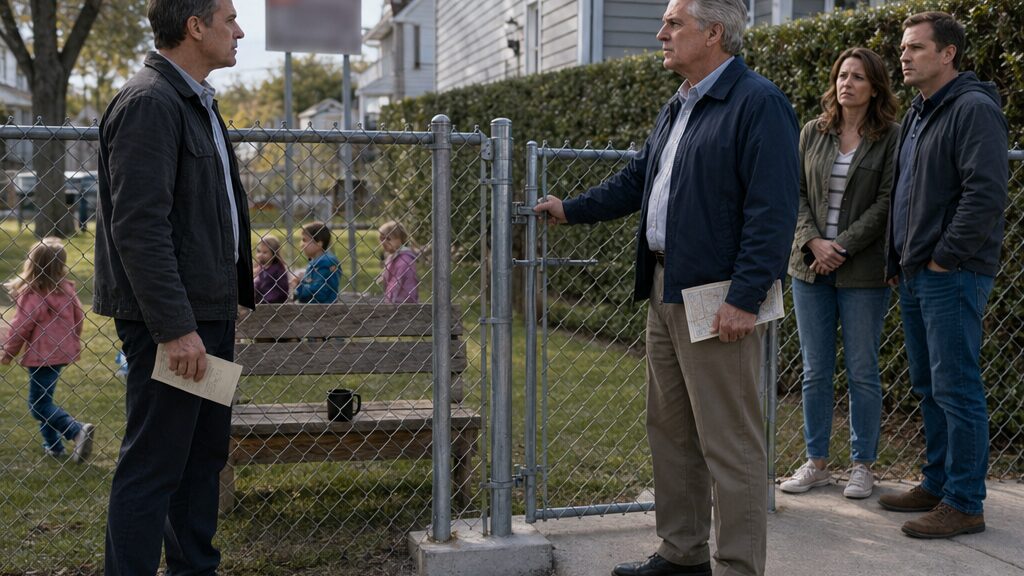
The boy’s sneakers swung above the grass while his mother stood near a new chain-link gate, speaking to another parent as though the narrow yard beside Benjamin’s house had always belonged to everyone. Above them, bolted to the fence, hung a white sign with blue lettering:
COMMUNITY PLAY AREA
WILLOW CREEK HOMEOWNERS ASSOCIATION
Benjamin stopped halfway up his driveway with one hand still around the steering wheel.
That morning, the strip had been open grass running between his house and the hedge. Fourteen feet wide. His mower lines had still been visible from Sunday. The bench had faced east, where Sarah used to sit with her knees pulled up while he drank coffee before work.
Now silver fencing enclosed the entire strip.
A plastic tunnel lay near the back hedge. Two spring animals had been anchored into the soil. Fresh wood chips covered the ground where Sarah once picked dandelions and arranged them in the cup holder of the bench.
The boy noticed Benjamin staring.
“Is this your house?” he asked.
“Yes.”
“My mom said you gave them the yard.”
The mother turned. Her smile faltered, then returned in a thinner form.
“You must be Mr. Miller,” she said. “It looks great, doesn’t it? The board really moved quickly.”
Benjamin put his truck in park and stepped out.
“Who told you I gave them the yard?”
She looked toward the sign as if it might answer for her. “The association email said the new play area was opening today.”
“Did it say I approved it?”
“I assumed—”
“So did they.”
The other parent guided her daughter toward the gate. Neither woman argued. They called the children and left with the careful speed of people who had wandered into a dispute they intended to discuss later.
Benjamin waited until they reached the sidewalk before approaching the fence.
The gate had been installed across the stepping-stone path that connected his driveway to the bench. A combination lock hung from the latch. His rake, watering can, and a small plastic bucket Sarah had left years ago were all inside.
He took out his phone.
First the sign. Then the lock. Then every post.
He photographed the fence where it met the hedge, where it crossed the line of river stones he had placed along the foundation, and where fresh concrete bulged from the soil. He recorded the date and time in a note.
Only after that did he call Richard Clark.
Richard had been HOA president for six years and lived three streets over in a brick colonial with symmetrical shrubs. He answered most neighborhood questions within minutes, especially when they involved trash cans, parking, or the approved shade of exterior paint.
This time the call went to voicemail.
“Richard, this is Benjamin Miller. I came home to find a fence and playground equipment installed on my side yard. I did not authorize this. Call me immediately.”
He kept his voice level. He ended the call before anger could make it less useful.
Inside, he opened the drawer beneath the microwave where he kept association notices. There was a reminder about gutter cleaning, a proxy ballot, and an announcement about mulch delivery. Nothing about a playground.
He checked his email, including spam.
Nothing.
Then he went to the mailbox. The only envelopes were a utility statement and an advertisement from a roofing company.
No notice. No request. No meeting invitation.
Through the kitchen window, the white sign was visible above the fence. The word COMMUNITY faced directly toward his house.
Benjamin had bought the property in 2019, two years after his divorce. Sarah had been eleven. She had disliked the new house because her bedroom was smaller and the street was farther from her school, but she had liked the side yard.
It was private without being hidden. In summer she read there. In autumn she lined acorns across the bench and insisted each one had a name. During the first winter, when Benjamin had been learning how quiet a house could become on the weeks Sarah stayed with her mother, they had brushed snow from the seat and drunk hot chocolate under a blanket.
The bench had weathered gray since then. Sarah was seventeen now and came over less often. School, friends, and a weekend job filled the spaces that used to belong to him.
But the bench remained.
At six thirty, children returned.
Benjamin watched from his kitchen as they ran through the gate. One parent carried folding chairs. Another brought a bag of chalk. No one knocked.
He considered walking outside and telling them to leave. He imagined the immediate scene: crying children, defensive parents, phones appearing in hands. Richard would arrive later and describe Benjamin’s conduct instead of the fence.
So Benjamin stayed inside and wrote down each arrival time.
At eight twelve, his phone showed a missed call and a voicemail from Richard.
Benjamin played it on speaker.
“Ben, it’s Richard. I got your message. The board designated that strip as a community recreation area under the original Willow Creek landscaping plan. We had a grant deadline and needed to complete installation this week. I understand the change may feel sudden, but the neighborhood has needed a safer place for younger children. We appreciate your flexibility while everyone adjusts.”
The message ended.
Benjamin played it again.
Not permission. Not apology.
Flexibility.
He stood at the kitchen counter with both palms resting on the laminate.
A person was flexible when a meeting ran late. Flexible when a delivery arrived on Tuesday instead of Monday. Richard had used the word to describe taking land beside Benjamin’s house, locking his possessions behind a fence, and inviting strangers onto it.
Benjamin called back. Voicemail again.
“This is not a misunderstanding about adjustment,” he said. “You installed permanent structures on property I maintain and believe I own. No one contacted me. I want the gate locked to public use tonight and all board records relating to this project delivered to me tomorrow.”
He paused.
“And do not call this flexibility again.”
He ended the message and retrieved a flashlight from the garage.
The children were gone. The new equipment stood silent under the security light. Benjamin walked along the outside of the fence, keeping his phone camera pointed downward.
Near the driveway, one post had been set directly through the strip of river stones. He moved a loose stone aside with his shoe.
The concrete beneath it was pale and wet-looking around the edges.
Benjamin crouched. The post was not near the line he had always understood as the boundary. It stood well inside the grass he mowed, beyond the downspout extension and inches from the corner of his house.
He checked the next post.
Then the next.
Every footing he could see had been poured inside the same line.
Benjamin raised the flashlight toward the bench. A child’s chalk drawing covered one armrest. Beneath the seat, Sarah’s old yellow bucket remained where she had left it.
He took one final photograph.
The fence was not merely beside his property.
Every fresh circle of concrete appeared to be inside it.
Chapter 2: The Morning He Stood Outside His Own Bench
The first minivan arrived before Benjamin could photograph the yard without anyone in it.
It was eight fifteen on Saturday. He had been outside for less than three minutes, holding his deed in a clear plastic sleeve and a black coffee mug in his other hand, when a woman parked at the curb and released two children from the back seat.
A second vehicle followed.
By eight thirty, six children were inside the fence.
Benjamin stood near the locked gate while parents unfolded chairs on the sidewalk. The children chased each other around the spring animals, sending wood chips against the chain-link. One girl climbed onto his bench and placed a juice pouch beside the chalk marks.
Benjamin’s coffee cooled in his hand.
He had planned to photograph every post, measure approximate distances from the foundation, and leave before anyone arrived. Instead, the yard filled with voices and bright jackets.
A parent he recognized from the next block approached him.
“Richard said there might be some confusion,” she said.
“There is.”
“He said this was always common space.”
Benjamin held up the plastic sleeve. “My deed does not describe it that way.”
She glanced at the document but did not move closer. “I don’t know anything about deeds. I just know we’ve been asking for somewhere safe. A little boy nearly got hit near the entrance last fall.”
Benjamin remembered the incident. A child had chased a ball between parked cars. Afterward, the board had circulated reminders about supervision and speed limits.
“That doesn’t make this land available,” he said.
Her expression changed. Not anger exactly. Disappointment.
“No one is trying to take anything from you.”
Benjamin looked through the fence at his bench.
Richard arrived at eight forty-two carrying a leather folder. He wore a navy windbreaker with the HOA emblem embroidered over the chest. He greeted the parents first, bending briefly to speak to one of the children, then walked toward Benjamin.
“Morning, Ben.”
“Open the gate.”
Richard glanced at the children. “Let’s keep this calm.”
“It can be calm with the gate open.”
“There are kids here.”
“Yes. On my property.”
Several parents stopped talking.
Richard lowered his voice. “This is exactly why I wanted to meet privately.”
“You did not ask to meet privately. You left a voicemail after installing a fence.”
“I offered context.”
“You thanked me for flexibility.”
Richard’s jaw tightened. “Don’t make this ugly in front of children.”
Benjamin felt the sentence land harder than it should have. Richard had placed him outside his own fence, surrounded him with families, and then made his restraint the condition for being treated as reasonable.
Benjamin set his mug on the top rail near the bench. It would not balance, so he reached through the chain-link and placed it on the bench seat instead.
The gesture silenced Richard for half a second.
“That bench is mine,” Benjamin said. “The watering can is mine. The bucket under it belongs to my daughter. Your contractor fenced them in.”
Richard opened his folder and removed a color photocopy. It showed the subdivision from above, with broad green shapes between clusters of houses.
“This is the original Willow Creek landscaping and access plan,” he said. “The strip is marked as shared green space.”
Benjamin studied the page without taking it.
The map was old. The roads were labeled, but individual parcel lines were faint or absent. A pale green band ran along several side yards, including his.
“Where is the recorded easement?” Benjamin asked.
“The board’s counsel reviewed the development materials.”
“That is not what I asked.”
Richard’s eyes moved toward the watching parents.
Benjamin opened the plastic sleeve. “Parcel number 48-219-07. Lot one hundred sixteen. The deed describes the eastern boundary from the rear iron pin to the front survey monument. The strip inside that description is mine.”
One child struck the fence with a plastic shovel. The clang broke the stillness.
Richard tapped the landscaping map. “The developer intended this area to provide shared access and recreation. That intent matters.”
“Recorded ownership matters.”
“We had a grant deadline.”
“You had my phone number.”
“The board believed notice was included in the community update.”
“There was no notice.”
Michelle Anderson arrived carrying a binder against her chest. She looked from Benjamin to Richard, then toward the parents.
“Could we move this conversation?” she asked.
“Open the gate,” Benjamin said again.
Michelle spoke carefully. “The board is prepared to review the parcel documents on Monday. Until then, shutting down the play area creates a different liability problem.”
“You created the liability problem.”
“We understand that you’re upset.”
“No. You understand that I’m standing outside my own bench.”
A phone appeared in one parent’s hand. Benjamin could not tell whether she was recording or reading something.
Richard stepped closer. “Ben, the board is willing to discuss accommodations. But if you frighten families away from a community facility before the documents are reviewed, you will make resolution much harder.”
The warning was wrapped in the tone Richard used at meetings when he wanted minutes to show that everyone had remained cooperative.
Benjamin looked through the fence. A boy had taken his coffee mug and was peering inside it.
“Please put that down,” Benjamin said.
The boy froze. His mother hurried over, apologized, and returned the mug through the gate.
Coffee had spilled across the bench seat.
Benjamin wiped it with his sleeve.
He could cut the lock in less than a minute. The bolt cutters hung in his garage. The image came to him clearly: metal snapping, gate swinging open, Richard’s face losing its certainty.
Then he saw the phones.
He saw children watching.
He saw how easily the story would become a man with tools tearing open a playground.
Benjamin stepped back.
“I will have the property surveyed,” he said. “Until then, my objection is on record. I am not consenting to use, access, installation, maintenance, or possession.”
Richard exhaled, perhaps mistaking restraint for retreat.
“That’s reasonable.”
“No,” Benjamin said. “It’s documented.”
He photographed Richard holding the map. He photographed Michelle’s binder. Then he walked the length of the fence while the parents shifted out of his way.
At the rear corner, he found a small metal tag wired to a post with the installation company’s job number. He photographed that too.
By ten, the neighborhood social page had a new post.
Benjamin saw it while sitting at his kitchen table, searching for licensed surveyors.
The post included a photograph of him standing at the gate with the deed in his hand. The caption read:
LOCAL HOMEOWNER TRYING TO CLOSE NEW CHILDREN’S PLAY AREA OVER PROPERTY-LINE COMPLAINT.
The comments divided quickly.
Some people asked whether the HOA had proof. Others called Benjamin selfish. One wrote that adults should be able to compromise when children’s safety was involved.
Richard did not comment.
Michelle posted that the board was reviewing records.
Benjamin called the first survey company. They could come in three weeks.
The second quoted an emergency rate.
The third transferred him to Joshua Martin, who listened without interrupting.
“You have a deed and a disputed improvement already in place?” Joshua asked.
“Yes.”
“Any survey pins visible?”
“Not that I’ve found.”
“I can be there Monday morning.”
Benjamin booked him.
Then his phone vibrated with a message from Sarah.
He stared at her name before opening it.
Dad, I saw the post. Why are people saying you’re trying to shut down a playground?
Benjamin placed the phone beside the deed.
He knew how to answer Richard. He knew what to ask a surveyor.
He did not know how to explain to his daughter that strangers were sitting on the bench where he still pictured her at eleven years old.
Chapter 3: Four Days of Stakes, Lines, and Silence
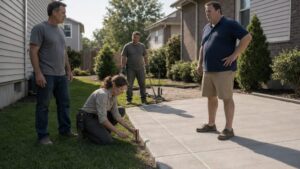
Joshua Martin drove the first survey marker into the soil six inches from the new gate.
The metal rod disappeared with three measured blows. The sound carried through the chain-link and brought Richard’s curtain aside in the house across the corner two streets away, though Benjamin could not know whether Richard had been watching before then.
Joshua checked the instrument mounted on his tripod.
“Don’t read anything into one point,” he said.
“I’m not.”
“You are standing like you’ve already won.”
Benjamin loosened his folded arms.
It was Monday morning. The play area remained locked under a temporary notice stating it was closed for “routine site review.” Richard had not removed the sign or the equipment. Michelle had emailed that the board would suspend public use until the parcel question was resolved.
Benjamin had replied with three words: Receipt acknowledged. No consent.
Sarah’s message from Saturday still sat unanswered beneath newer texts asking whether he was okay.
Joshua moved toward the rear boundary, carrying a detector over the grass. He was in his early forties, compact and deliberate, with mud already darkening the knees of his work pants.
“Deeds tell us what should be here,” he said. “Monuments and records help establish what is here. Sometimes those agree cleanly. Sometimes they don’t.”
“What about landscaping plans?”
“They can matter. They usually don’t convey property by themselves.”
“Usually?”
Joshua looked at him. “You hired me for accuracy, not reassurance.”
By noon, orange flags marked points along the front and rear. A bright survey string ran between them, passing directly beside the gate and continuing along the fence.
At the bench, the string crossed less than a foot from one concrete footing.
Benjamin photographed it.
Joshua lowered his clipboard. “Please don’t post partial work.”
“I’m documenting.”
“You’re also angry. Those are different activities, even when they use the same camera.”
Benjamin put the phone away.
That afternoon, they went to the county records office. The clerk retrieved the plat, the deed history, and recorded easements tied to lot one hundred sixteen.
There was a utility easement along the rear five feet. A drainage easement crossed a corner near the street. Nothing granted the association access through the side yard.
Joshua examined each page twice.
“No recreational easement,” he said. “No pedestrian easement along this strip. No conveyance to the HOA.”
Benjamin felt the first clean relief since Friday.
“So the fence is mine to remove.”
“I didn’t say that. I said I found no recorded easement. Let me finish.”
On Tuesday, Joshua located the original subdivision survey. On Wednesday, he returned with a second crew member and measured each post from two reference points.
The neighborhood watched without pretending not to.
A parent slowed her car beside the curb. Two board members walked past separately, each nodding without stopping. Richard came once, stood on the sidewalk, and asked Joshua whether the HOA could receive a copy.
“My client receives the report,” Joshua said. “You can request it from him.”
Richard looked at Benjamin.
Benjamin said nothing.
That silence pleased him for several seconds. Then he noticed the dark circles beneath Richard’s eyes.
“You know about the map,” Richard said.
“I know you showed me a colored drawing.”
“It came from the developer’s archive.”
“Then the developer can explain why it was never recorded.”
Richard’s mouth tightened. “You think this is simple because you want it to be simple.”
“You installed first.”
“We were trying to keep children away from the street.”
“You could have asked.”
“The grant expired Friday.”
There it was again: the deadline offered as if urgency could alter ownership.
Benjamin stepped closer to the fence. “Did you know there was no easement?”
Richard did not answer directly.
“I knew the board had documents supporting community use.”
“Which documents?”
“You’ll receive everything through counsel.”
He walked away before Benjamin could ask again.
That evening, Sarah called.
Benjamin watched her name flash until the call ended. A minute later, she called again.
He answered.
“Are you okay?” she asked.
“Yes.”
“That’s not what I meant.”
He looked through the kitchen window. The bench sat behind the fence in the dark.
“They put it on my land.”
“I understand that part.”
“Do you?”
“Dad, I’m not saying they should have done it.”
“People online are.”
“I’m not people online.”
Her voice had the careful patience she used when she believed he was missing something obvious.
“Then what are you saying?”
“I’m asking why you didn’t just tell me what happened.”
“I’ve been dealing with it.”
“That’s what you always say.”
Benjamin pressed his thumb against the edge of the counter.
Sarah continued. “Mom saw the post before I did. A girl at school sent it to me. Everyone knew you were fighting about our yard except me.”
“Our yard.”
The words came out before he could soften them.
Sarah was quiet.
“I haven’t called it that in years,” she said.
Benjamin closed his eyes.
He could have told her that he still cleared leaves from the bench before her visits. That he had repaired one slat rather than replacing the whole seat because the scratches on the armrest came from a bracelet she wore in seventh grade. That the yard had remained fixed while everything else about fatherhood seemed to move farther away.
Instead he said, “The survey will be finished tomorrow.”
“All right.”
“I’ll let you know what it says.”
“That wasn’t why I called.”
The line went quiet after she hung up.
On Thursday morning, Joshua placed a sealed report on Benjamin’s kitchen table.
Every fence post was inside Benjamin’s recorded property boundary. The nearest stood eleven inches inside. The farthest stood nearly three feet inside where the fence bent around the bench.
“The installation is an encroachment,” Joshua said. “Based on the records I reviewed, the HOA does not have a recorded right to occupy that strip.”
Benjamin read the conclusion twice.
“And the old map?”
Joshua opened a separate folder. The green-space drawing Richard had shown was real. It had been included in early marketing materials and a preliminary landscaping package. The strip beside Benjamin’s house was shaded like several common areas.
But a later recorded plat had assigned the land to lot one hundred sixteen.
“The map explains the assumption,” Joshua said. “It does not establish ownership.”
“So they were careless.”
“Some of them may have believed the wrong document.”
“Richard?”
“I don’t survey motives.”
Benjamin sent the report to his attorney before Joshua left.
For the first time in four days, he allowed himself to stand inside the fenced yard. The temporary closure notice had given him the lock code. He opened the gate and walked to the bench.
A long scrape now crossed the rear slat where equipment had struck it. Coffee stains darkened the seat. The yellow bucket beneath it was cracked along one side.
Benjamin sat down.
The survey string ran past his shoe, bright and exact.
His attorney called that afternoon.
“The boundary evidence is strong,” she said. “There’s no recorded easement. We can demand removal, restoration, costs, and preservation of all board communications.”
“Do it.”
“There’s something else.”
Benjamin heard paper shifting.
“The developer file Joshua referenced contains an index entry from a title company. It mentions a boundary-use warning issued before the playground vote.”
“What kind of warning?”
“I don’t have the attachment yet. Only the index description.”
“Who received it?”
“The distribution field lists the HOA president and treasurer.”
Benjamin looked toward the fence.
Richard and Michelle had not merely possessed an old map.
At least one of them had received a warning about it before the first post went into the ground.
Chapter 4: The Warning Richard Never Gave the Board
Michelle Anderson noticed the missing attachment because the page numbers jumped from twelve to fourteen.
The board packet lay open beneath the fluorescent lights of the Willow Creek meeting room, each section clipped and labeled. Insurance correspondence. Grant conditions. Installation invoices. Richard’s summary of the disputed landscaping plan.
Page thirteen was absent.
Michelle turned back through the binder, then checked the electronic index on her tablet. The omitted file was listed there:
TITLE REVIEW—BOUNDARY USE LIMITATION.
She looked across the table at Richard.
“Where is the attachment from the title company?”
Richard continued arranging copies as if he had not heard her. “Counsel is gathering the complete record.”
“This packet says complete record.”
“It says relevant record.”
“Those are not the same thing.”
The other board members stopped speaking.
Benjamin sat at the far end beside his attorney, his survey report closed in front of him. He had entered the room prepared to demand removal. Until Michelle spoke, he had assumed the board would spend the evening pretending the map was stronger than the deed.
Richard rested both hands on the table.
“The title company raised a preliminary concern,” he said. “It was not a final legal opinion.”
“Then why isn’t it here?” Michelle asked.
Richard’s eyes moved toward Benjamin’s attorney. “Because counsel advised us not to circulate privileged material.”
Benjamin’s attorney slid a single sheet from her folder.
“The title company sent it before your current counsel was retained. It is not privileged.”
Richard looked at the paper but did not reach for it.
Benjamin could hear the building’s vending machine humming in the hallway.
His attorney placed the sheet in the center of the table. “This is the index reference we obtained from the developer archive. It identifies distribution to the HOA president and treasurer three weeks before installation.”
Michelle leaned closer. “I never received it.”
Richard’s expression tightened.
“You were treasurer at the time,” one board member said.
“I know what position I held.”
Benjamin watched her face change. Not shock exactly. Recognition. She had been excluded, and she understood at once what that meant for her signature on the installation payment.
Richard exhaled through his nose. “The warning said the shared-use designation might not be enforceable without further review.”
“Might not?” Benjamin’s attorney asked. “Or did not?”
Richard said nothing.
Benjamin opened Joshua’s report.
“Every post is on my lot,” he said. “The recorded plat controls. There is no easement. Whatever wording you prefer for the warning, you had enough uncertainty to stop.”
Richard looked directly at him. “And lose the grant.”
The room went still.
The grant had funded most of the equipment and installation. If the board missed its completion deadline, the money would return to the county community-improvement program. Richard had mentioned urgency before, but not the full consequence.
“A child almost got hit near the front entrance,” he continued. “Parents had been asking us for a safe area for two years. We had one parcel on the original landscaping plan that appeared designated for common use. The contractor had an opening. The grant expired Friday.”
“You could have asked me,” Benjamin said.
“I believed you would refuse.”
“That is not permission.”
“No. It isn’t.”
For the first time, Richard’s voice lost its polished certainty.
He sat down.
“I thought the title issue was overly cautious,” he said. “The developer’s documents showed community intent. I believed the recorded plat could be corrected later if necessary.”
Michelle stared at him. “You believed that, or you needed the board to believe it?”
Richard did not answer.
One board member pushed the packet away. Another removed her glasses and rubbed the bridge of her nose.
Benjamin had expected denial. The admission unsettled him more. Richard had not confused one line on a map. He had seen risk, judged Benjamin’s likely resistance, and decided speed mattered more than consent.
Yet the reason was not meaningless. Children had been playing near traffic. The grant had been real. Parents had pressed the board for action.
Richard had taken a genuine need and used it to excuse a deliberate shortcut.
Benjamin’s attorney presented the demand: immediate closure, removal within seven days, restoration of the lawn and drainage edge, reimbursement for survey and legal costs, preservation of all communications, and compensation for unauthorized use.
Richard read without visible reaction.
“We can remove the fence quietly,” he said. “No public statement. No admission. The board covers reasonable restoration.”
“Quietly?” Benjamin asked.
“It would reduce expense and prevent further division.”
“You announced the playground to the entire neighborhood.”
“We can correct the mistake without turning this into a spectacle.”
“You already turned it into one when you let people call me selfish.”
Richard glanced toward Michelle. “The social media post did not come from the board.”
“But your explanation did.”
Benjamin slid photographs across the table. One showed the survey string beside a concrete post. Another showed the cracked yellow bucket. The final image centered on the bench.
A pale scrape crossed the rear slat.
“That happened during installation,” Benjamin said. “The contractor used my property, damaged it, locked my things inside, and opened it to the public. I will charge the association for every day it occupied the land.”
A board member looked up sharply. “Charge what?”
“Daily use.”
“You mean rent?”
“I mean compensation.”
Richard’s expression hardened again. “You are not a commercial landlord.”
“And you were not a tenant.”
His attorney touched his sleeve, a small warning to stop before anger replaced strategy.
Michelle asked for a recess.
In the hallway, Benjamin’s attorney spoke quietly. “Removal, costs, and physical damages are strong. A daily occupancy figure is negotiable. Do not make the number symbolic.”
“It was my land every day.”
“I agree. But a demand can be legally supportable and still be chosen for the wrong reason.”
Benjamin looked through the meeting-room window. Inside, two board members were speaking to Michelle. Richard sat alone at the head of the table.
When the meeting resumed, the board voted to suspend the playground permanently and authorize removal. Two members stated for the record that they would not support Richard’s handling of the project.
It was the first official acknowledgment Benjamin had received.
It did not feel like enough.
He declined Richard’s offer of a private settlement and instructed his attorney to prepare an invoice based on each day from installation through complete restoration.
Afterward, Sarah waited beside his truck.
She had not told him she was coming.
Her hands were tucked into the sleeves of her sweatshirt, and her eyes went to the photographs under his arm.
“I heard you in there,” she said.
“You shouldn’t have had to.”
“That’s not what I meant.”
Benjamin unlocked the truck but did not open the door.
Sarah looked toward the dark meeting-room windows. “Are you trying to protect the yard because it mattered to us?”
“Yes.”
“Or are you using what it meant to make them hurt as much as you do?”
Benjamin’s hand remained on the door handle.
For the first time since the fence appeared, he had no document ready to answer her.
Chapter 5: The Day the Fence Came Down Too Easily
The removal crew arrived at six forty-eight Monday morning without calling Benjamin.
Metal struck metal outside his bedroom window. By the time he pulled on work clothes and reached the yard, two workers had already lifted the HOA sign from its brackets.
A third was cutting wire ties from the chain-link.
“Stop.”
The saw fell silent.
The crew supervisor approached with a folded work order. “We’re authorized by Willow Creek to remove all installed materials.”
“You are on private property.”
“We were told access was cleared.”
“No one cleared it with me.”
The supervisor studied him, then the house, then the equipment already scattered across the grass.
Benjamin raised his phone and began recording.
“You may remove the fence and playground equipment under my observation. Do not remove anything that was here before installation. Do not disturb the survey markers. Photograph the ground before pulling each post.”
The supervisor’s patience narrowed. “That isn’t in the order.”
“It is now.”
For several seconds, Benjamin expected an argument. Instead, the supervisor called his office and walked toward the truck.
The workers waited beside the half-detached sign.
Across the street, curtains shifted.
At seven fifteen, the supervisor returned. “We can proceed under those conditions. We’ll note that you directed the sequence.”
“I’ll note that your company installed without confirming ownership.”
“We did the job the association contracted.”
“And now you’re doing the next one.”
The chain-link came down in sections. Without children, signs, and Richard’s voice around it, the structure looked smaller than Benjamin remembered. Thin metal rolled onto itself. Bolts dropped into buckets. The gate that had controlled access to his yard was lifted free by two workers and carried toward the truck.
Benjamin photographed every stage.
When the first post came out, damp clay clung to a cylinder of concrete nearly three feet long. The hole exposed crushed river stones and a broken drainage extension beneath the soil.
The supervisor crouched beside it. “That pipe was shallow.”
“It wasn’t broken before.”
“We’ll document it.”
Near the hedge, the wood chips had suffocated a strip of grass. Two spring-animal anchors left square cuts in the lawn. The bench carried the long scrape shown in Benjamin’s photographs, plus a dent near the lower support that he had not noticed before.
By ten thirty, the equipment was loaded.
Benjamin stood near the driveway, reviewing his images, when the truck’s lift gate rose.
The bench sat on it.
For one second he did not understand what he was seeing. Then the hydraulic platform began to fold.
“Stop the truck.”
No one heard him over the engine.
Benjamin ran forward and struck the side panel with his palm.
The driver braked. The supervisor emerged from behind the cab.
“That bench is mine.”
The supervisor checked his work order. “It was inside the installation area.”
“It was there before your fence.”
One worker had already looped a strap around the armrest. Benjamin climbed onto the lowered gate and removed it himself.
The bench was heavier than he remembered. Its rear leg dragged briefly across the metal before a worker helped him carry it down.
“We thought it was association property,” the supervisor said.
“That is the problem.”
They placed it beside the house, outside the churned soil. Benjamin ran his fingers across the scrape. Fine splinters caught against his skin.
At eleven twelve, the truck pulled away carrying the last fence panel. The side yard stood open again.
No sign. No lock. No children entering through a gate someone else had installed.
Benjamin walked from the driveway to the hedge without obstruction. The freedom should have felt larger. Instead, the yard looked stripped and bruised—holes in the soil, dead grass beneath scattered wood chips, a shallow trench where the drainage pipe had cracked.
The bench remained against the siding like an item rescued from a move.
His phone rang.
The local newspaper reporter introduced herself and asked whether he would discuss the dispute. She had received the survey, meeting minutes, and removal photographs from a source connected to the board.
“I can speak this afternoon,” Benjamin said.
“Would your daughter be willing to join you? I understand the yard had personal significance.”
He looked at the bench.
“I’ll ask.”
Sarah answered by text ten minutes later.
No. Please don’t make me part of the article.
Benjamin read the message twice. He typed that she would not have to discuss the board or the legal issue. Before sending it, he deleted the sentence.
He wrote: Understood.
The reporter arrived at two. Benjamin showed her the survey line, the broken drainage edge, and the marks on the bench. He explained the missing notice and Richard’s use of the word flexibility.
When she asked how much compensation he wanted, Benjamin said the association would receive an invoice for every day it occupied the land.
“Do you have a daily figure?”
“My attorney is calculating it.”
“What would the money represent?”
“Unauthorized use. Damage. Costs.”
The reporter waited.
Benjamin realized she was giving him room to name something beyond those categories.
He did not.
The article appeared online Thursday morning. By noon, three board members had resigned. Richard stopped responding to meeting requests. Comments beneath the article alternated between support for Benjamin and fear that a large settlement would raise everyone’s dues.
Benjamin should have felt vindicated.
Instead, he ate dinner alone at the kitchen counter while the yard darkened outside.
The fence was gone. The gate was gone. No child sat where Sarah once sat.
His phone lit with an email from the reporter.
One follow-up question, she wrote. Do you truly intend to charge your neighbors for every day the playground stood there?
Benjamin looked at the blank invoice his attorney had sent for review.
The line marked DAILY UNAUTHORIZED USE remained empty.
He placed the cursor in the box and wondered, for the first time, what number could possibly make the yard feel returned.
Chapter 6: The Invoice That Cost More Than Money
Three resignation letters arrived in Michelle Anderson’s inbox forty minutes before the settlement meeting.
She printed them and placed them in front of the remaining board members without comment.
Benjamin sat across from her in the HOA office with his attorney beside him. Richard occupied the chair at the head of the table, though no one had formally confirmed that he still held the presidency.
The empty chairs along the wall made the room feel larger.
Michelle folded her hands over a financial report. “The reserve can cover restoration, survey costs, and reasonable legal expenses. It cannot absorb Mr. Miller’s current occupancy demand without delaying roof work on the clubhouse and drainage repairs near the south entrance.”
Benjamin’s attorney had calculated a daily figure using comparable temporary land-use rates, then multiplied it by the number of days between installation and removal. Benjamin had doubled it.
He had called the increase deterrence.
His attorney had called it difficult to defend.
Now the total sat printed at the top of the demand letter.
Richard read it again. “This is punishment.”
Benjamin met his eyes. “You occupied property you knew might not be yours.”
“I knew the documents conflicted.”
“You knew enough to hide the warning.”
Richard’s face changed, but he did not deny it.
Michelle turned one resignation letter face down. “If this goes to litigation, our insurer may reserve rights because the installation proceeded after notice of a boundary concern. That means legal costs may come directly from assessments.”
“Then assess them,” Benjamin said.
His attorney looked toward him.
Michelle’s voice remained controlled. “That would charge families who did not see the title warning and did not authorize the decision individually.”
“They used the yard.”
“Some did. Most did not.”
The distinction irritated him because it was true.
Richard leaned back. “You want the neighborhood to feel what you felt.”
Benjamin said nothing.
The meeting paused without progress.
That afternoon, Sarah agreed to meet him at a diner off the county road. She chose a booth near the window and kept her coat on.
Benjamin brought no documents.
For several minutes, they spoke about school, her work schedule, and a college visit she was considering. Each subject felt placed carefully between them.
Finally Sarah asked, “How much are you charging?”
“Who told you?”
“It’s a neighborhood. Everyone tells everyone.”
He named the amount.
She stared at him. “For less than three weeks?”
“It includes unauthorized use.”
“It includes anger.”
“They built on my land.”
“I know.”
“They locked our things inside.”
“I know that too.”
Benjamin looked down at the paper sleeve around his coffee cup. “Then why do you sound like them?”
“I don’t.” Sarah’s voice stayed quiet. “That’s what you keep doing. Anyone who doesn’t agree with every part of this becomes them.”
He started to answer, but she continued.
“The yard mattered to me. The bench mattered. But not because it stayed exactly the same.”
Benjamin’s hand stopped against the cup.
“It mattered because we were there together,” she said. “You keep talking like they stole my childhood. They didn’t. They did something wrong to your property.”
“Our property.”
“No, Dad. Yours.”
The word was not cruel. That made it worse.
Sarah looked through the window toward the parking lot. “I stopped sitting out there because every time I came over, you asked if I remembered some old thing. The dandelions. The acorns. The hot chocolate. It felt like if I didn’t remember it the same way, I was taking something from you.”
Benjamin heard the diner around them: silverware, a coffee pot settling onto a burner, a child laughing two booths away.
“I thought you liked those memories.”
“I do. I just don’t want to live inside them.”
He looked at her.
The explanation he had avoided for years felt clumsy before he said it.
“When you started coming less,” he began, “the bench was still there.”
Sarah waited.
“I knew where I stood with the bench. I fixed it. Cleared it. Kept the yard the same. I didn’t know how to ask whether you were coming less because you were growing up or because you didn’t want to be with me.”
Her expression softened, but she did not rescue him from the admission.
“You could have asked.”
“I know.”
It was the same answer Richard should have given him.
Benjamin drove home and found the bench where the crew had left it beside the siding. Sarah had declined his invitation to come over, and the refusal no longer felt like evidence that the yard was lost. It felt like a boundary he had to respect.
He sat on the front step instead.
At the next negotiation, Richard arrived without the HOA windbreaker.
“I will resign when this is resolved,” he said. “I will also acknowledge that I failed to provide the title warning to the full board.”
“Failed?” Benjamin asked.
Richard’s mouth tightened. “Withheld.”
Michelle looked down.
“But I will not sign a statement saying I intended to steal your land,” Richard continued. “I did not.”
Benjamin believed him.
That did not absolve him. It changed the shape of the wrong.
Richard had wanted the grant completed. He had wanted parents satisfied. He had wanted to prove that retirement had not made him unnecessary. He had decided Benjamin’s likely refusal was an obstacle rather than a right.
Benjamin opened his folder.
The original invoice remained inside. He could force the HOA to reject it and proceed toward litigation. He might recover more. He might spend two years turning every board meeting, assessment, and neighborly encounter into another extension of the fence.
He removed a new document.
“My revised terms,” he said.
Michelle read the first page.
The daily-use fee had been reduced to the comparable local rate. Restoration costs and legal expenses remained. The HOA would repair the drainage edge, replace damaged soil, and pay to restore the bench.
Then came the conditions that were not financial.
No common-use designation could be imposed on privately deeded property without written owner consent. Any map inconsistent with recorded title had to be disclosed. Boundary disputes required independent review before construction. Board records related to land use would be available to members. A new playground could be built only on a verified common parcel.
Richard looked up. “You want to rewrite the association’s authority.”
“I want it written clearly enough that no one can do this again.”
Michelle turned to the final page. “You’ve also required a public disclosure.”
“A factual one.”
“And Richard’s resignation.”
“His admission and resignation.”
Richard read the language in silence.
Michelle closed the packet. “The board will need to vote.”
“When?”
“Tomorrow evening.”
Benjamin stood.
At the door, Michelle called after him. “Why lower the amount?”
He looked back at the three empty chairs.
“Because the money should repair what was damaged,” he said. “It shouldn’t become another fence.”
He left the revised terms on the table.
For the first time, the board’s hardest decision was no longer whether Benjamin owned the yard.
It was whether they were willing to give up the power that had allowed them to take it.
Chapter 7: A Boundary Kept and a Gate Chosen
Joshua Martin drove the final marker into the ground forty-two feet from Benjamin’s property line.
The new common parcel lay beyond the clubhouse, where a wide patch of level grass had once been reserved for overflow parking. It was smaller than the strip beside Benjamin’s house, but it had room for a low fence, two benches, and the same bright play equipment the removal crew had hauled away six weeks earlier.
This time, every corner had been measured before anyone ordered concrete.
Joshua checked the reading on his instrument, then handed the site plan to Michelle.
“The nearest improvement remains entirely within association property,” he said. “No private parcel is crossed. No access depends on an unrecorded map.”
Michelle signed the field acknowledgment.
Benjamin stood beside Sarah near the edge of the common parcel. She had come because he asked once and did not ask again.
Children watched from the sidewalk while workers marked the future fence with white paint. No one had been invited onto the grass yet. The board had posted the survey, permit, insurance certificate, and approved plan in the clubhouse window.
The process looked slower than Richard’s had.
It also looked legitimate.
“Do you think they’ll actually build it?” Sarah asked.
“They already approved the contractor.”
“That isn’t what I meant.”
Benjamin looked toward Michelle, who was explaining the boundary markers to two parents.
“Yes,” he said. “I think they will.”
The settlement vote had passed by one vote.
The association agreed to pay Benjamin’s survey fees, attorney costs, drainage repair, lawn restoration, and a daily unauthorized-use fee based on the local temporary-use rate. The amount was enough to acknowledge occupation without draining the reserve.
The governance provisions had taken longer.
Two remaining board members objected to mandatory owner consent, arguing that emergencies might require temporary access. Benjamin accepted a narrow exception for immediate threats to life or property, provided the board documented the reason within twenty-four hours.
Michelle added a requirement that every future land-use project receive independent title review.
The final rule was simpler: no preliminary map, marketing plan, or architectural sketch could override recorded ownership.
Richard had opposed that language until the last meeting.
Now he waited inside the clubhouse with the disclosure statement in front of him.
Benjamin and Sarah entered together.
The room held no audience beyond the remaining board, their attorney, and the local newspaper reporter seated against the wall. The reporter’s notebook stayed closed until Richard began reading.
He wore a gray button-down shirt without the HOA emblem.
“The Willow Creek Homeowners Association installed recreational improvements on property owned by Benjamin Miller,” he said. “Before construction, I received written notice that the preliminary landscaping plan did not establish a legal right to use the parcel.”
His voice caught briefly on the next sentence.
“I withheld that notice from the full board because I believed delay would cause the association to lose grant funding.”
Michelle watched him without expression.
Richard continued.
“My decision denied Mr. Miller the opportunity to consent, object, or obtain independent review before construction. The safety concerns that motivated the project did not authorize that decision.”
He placed the paper on the table.
The room was silent.
Benjamin had imagined this moment during the worst days of the dispute. In those versions, Richard’s admission felt like a door opening onto relief.
Instead, it sounded like what it was: a factual record of damage that could not be undone by reading it aloud.
Richard signed.
Then he removed a second sheet from the folder.
“This is my resignation, effective immediately.”
He passed it to Michelle.
No one applauded.
The reporter wrote down the time.
Richard gathered his papers slowly. When he reached the door, he stopped beside Benjamin.
“I was wrong about the land,” he said.
Benjamin waited.
Richard’s gaze moved toward Sarah, then back.
“I wasn’t wrong that the neighborhood needed somewhere safer.”
“No,” Benjamin said. “You weren’t.”
Richard nodded once and left.
The lawn restoration began the following Monday.
Workers replaced the broken drainage extension, filled the concrete holes, and laid fresh soil over the damaged strip. Benjamin rejected the contractor’s offer to replace the bench.
“The settlement covers replacement,” the supervisor said.
“I don’t want a different one.”
The scrape across the rear slat was deep but repairable. One support needed to be reset. The lower edge had begun to split where the removal crew dragged it across the truck.
Sarah came over on Saturday wearing old jeans and carrying a paper bag from the hardware store.
“I asked Joshua what kind of outdoor filler to buy,” she said.
Benjamin looked inside. Sandpaper, wood glue, clamps, and a small can of sealant.
“You called Joshua?”
“He answers questions without turning them into a project.”
Benjamin almost defended himself. Instead, he moved the bench onto two sawhorses.
They worked without music.
Sarah cleaned dirt from the joints while Benjamin removed the damaged support. The scrape lightened under sandpaper but did not disappear.
“You could take the whole surface down,” Sarah said.
“I could.”
“Are you going to?”
“No.”
She nodded as though that was the correct answer.
They filled the deeper cut and clamped the split. When the glue set, Sarah ran her fingers along the armrest.
“I remember making those marks,” she said.
Benjamin looked closer. Several shallow lines crossed the wood beneath years of weathering.
“The bracelet?”
“The metal one you hated because it scratched everything.”
“I didn’t hate it.”
“You complained every time I wore it.”
“That isn’t the same.”
She smiled.
It was the first time they had discussed one of the old memories without Benjamin feeling the need to preserve it exactly. Sarah remembered the bracelet. He remembered the scratches. Neither version had to control the other.
By late afternoon, the bench stood again in its original place, facing east.
The new playground opened two weeks later.
Benjamin attended only the first ten minutes. Michelle thanked the parents who had helped with the planning, then reminded everyone that the facility stood on verified common property and closed at dusk.
A child asked why the old location had been removed.
Michelle answered before anyone else could.
“Because it belonged to a neighbor, and we did not have permission.”
The explanation was enough.
There were no speeches about unity. No one asked Benjamin to cut a ribbon. Parents opened the new gate, and children rushed toward the equipment.
Benjamin walked home with Sarah.
When they reached his driveway, she stopped beside the stepping-stone path.
The side yard was open again, but Benjamin had installed a simple wooden gate between two short fence sections near the sidewalk. It marked the property without hiding it. A small latch faced inward.
Sarah studied it.
“Is this to keep everyone out?”
“It’s to make it clear that entering is a choice.”
“Whose?”
“Mine.”
He opened the gate.
The repaired bench waited beneath the kitchen window. The yellow bucket, glued along its crack, sat underneath it.
Sarah stepped through but did not sit immediately.
Benjamin went inside and returned with two mugs. Coffee for him. Hot chocolate for her, though she was seventeen and no longer needed him to cool it before handing it over.
She took the mug and sat at one end of the bench.
Benjamin remained standing.
“There’s room,” she said.
He sat beside her.
From beyond the houses came the faint sound of children playing on land that had been measured, approved, and offered honestly.
Sarah leaned back against the repaired slat.
“You know I’m still going away next year,” she said.
“I know.”
“And I won’t be here every weekend.”
“I know that too.”
She watched him, perhaps waiting for him to turn the moment into a promise neither of them could keep.
Benjamin placed his hand on the weathered armrest.
“The gate will still be yours to open,” he said.
Sarah looked toward the path.
“No,” she said gently. “It’ll be yours.”
Benjamin followed her gaze to the wooden gate standing open behind them.
She was right.
The yard was his. The decision was his. So was the responsibility not to confuse ownership with holding everything still.
He lifted his mug.
Sarah tapped hers against it.
The bench retained its scratches. The repaired split showed beneath the sealant. Beyond it, the boundary markers remained buried where Joshua had placed them, exact and unseen.
Benjamin did not need to look for them.
He had kept the boundary.
He had chosen the gate.
The story has ended.