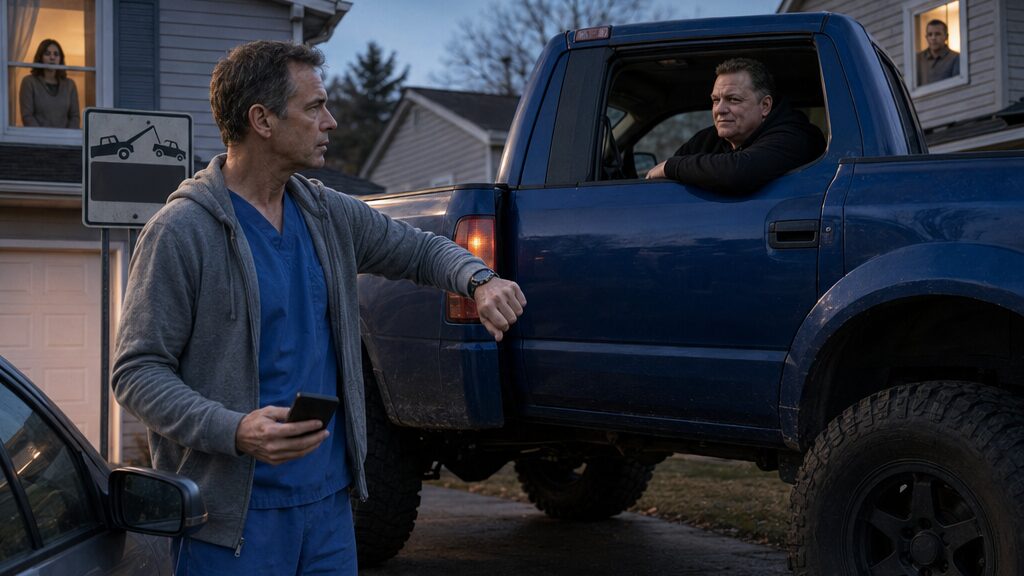
My Neighbor Called It Ten Minutes Until His Truck Cost Me My Standing at the Hospital
Chapter 1: The Blue Truck Was Back Before Sunrise
Dennis saw the blue truck before his alarm finished ringing.
Its roofline cut across the lower half of his bedroom window, too tall and too close, the polished hood reflecting the porch light in a hard blue stripe. For one confused second, he thought Steven had parked along the curb again.
Then Dennis saw the rear tire.
It sat squarely across the mouth of his driveway.
His alarm continued chirping on the nightstand. He silenced it, pulled on his scrub pants, and checked the time.
6:18 a.m.
He had forty-two minutes before the night charge nurse began handoff.
Dennis moved quickly through the house, buttoning his gray hoodie over his blue scrub top. His lunch was already packed. His coffee waited in a travel mug beside the sink. He had developed those habits during seventeen years of hospital shifts: remove decisions from the morning, leave nothing to chance.
Outside, chance had been parked on thirty-five-inch tires.
The truck belonged to Steven Martin next door. It was lifted high enough that the lower edge of the passenger door reached Dennis’s waist. The front half rested in Steven’s driveway, but the rear angled across Dennis’s entrance as if the two properties were parts of one broad parking lot.
Dennis stood beside his car and looked toward Steven’s dark house.
He had asked twice already.
The first time, Steven had waved from his porch and moved the truck after seven minutes.
The second time, he had said he was waiting for a contractor and needed “just ten minutes.”
Dennis had arrived late both mornings.
He crossed the wet strip of lawn between the houses and knocked. No answer. He knocked harder.
A light came on upstairs.
Dennis checked his watch.
6:24.
He knocked again.
At 6:29, Steven opened the door wearing sweatpants and a black T-shirt. He squinted as though Dennis had interrupted him in the middle of the night.
“Morning,” Dennis said. “I need to leave.”
Steven looked past him at the truck. “Yeah. Give me ten.”
“I don’t have ten.”
“It’ll be less than that.”
Dennis kept his voice even. “I have a shift handoff at seven.”
Steven rubbed the side of his face. “I’m waiting for a guy to pick up some cabinets. He said he’d be here early.”
“Then park in front of your house.”
“The curb’s full.”
There were two vehicles along Steven’s curb, both belonging to his household. One was Karen’s sedan. The other was a compact utility trailer with a faded tarp tied over it.
Dennis glanced at his watch again.
6:31.
“Please move it now.”
Steven stared at him for a moment, then gave a tired little laugh. “You hospital people really run everything by the second, don’t you?”
Dennis did not answer.
Steven found his keys on a table inside and walked toward the truck without hurrying. He climbed into the cab, started the engine, and let it idle long enough for the exhaust to drift across Dennis’s driveway.
By the time the truck cleared, it was 6:37.
Dennis backed out before Steven had fully closed his door.
The hospital sat twenty-three minutes away without traffic. At that hour, the road near the interstate was already thickening. Dennis watched the dashboard clock change from 6:43 to 6:44 while brake lights stacked ahead of him.
He called the unit.
The night-shift nurse answered.
“It’s Dennis.”
A pause. “You’re not here.”
“I know. I’m on the way.”
“We have a family waiting to speak with you about the transfer in twelve.”
Dennis tightened his hand around the steering wheel. “Start with the medication change and the oxygen orders. I’ll be there as soon as I can.”
“You said that Friday.”
The nurse did not sound angry. That was worse. She sounded tired.
Dennis arrived at 7:11.
He moved through the corridor at a controlled walk because running in a hospital made people look up. He passed the central desk, nodded to two nurses, and entered the handoff room with his bag still over one shoulder.
The night charge nurse had already begun.
Dennis took his seat without speaking. A patient’s family member stood near the wall, arms folded, watching him. The room smelled of coffee, printer paper, and the sharp citrus cleaner used on the counters.
The nurse finished the medication report, then slid the chart toward Dennis.
“The respiratory order changed at 6:42,” she said quietly. “I marked it.”
Dennis nodded. “Thank you.”
He took over the discussion, asked three questions, and caught a discrepancy between the transfer note and the current oxygen setting. The family member’s expression softened slightly when Dennis explained what would happen next.
By 7:35, the handoff was complete and the patient was stable.
That small success should have steadied him.
Instead, Laura Campbell was waiting outside the room.
She held a printed attendance sheet against a clipboard.
“Office,” she said.
Dennis followed her.
Laura closed the door but did not sit. She was in her early fifties, careful with language and rarely visibly impatient. That morning, she uncapped a red pen and placed the attendance sheet on the desk between them.
Two dates were already marked.
She circled the third.
“You’re one of my most reliable people,” she said. “That is why I’m asking you directly. What is happening?”
“My neighbor blocked my driveway.”
Laura looked at him without moving.
“He’s done it before,” Dennis added. “I’ve spoken to him.”
“And?”
“I thought it was handled.”
“You told me that last time.”
Dennis felt heat move up the back of his neck. “It should have been.”
Laura tapped the paper with the pen. “The hospital does not discipline people for having difficult neighbors. It disciplines them for missing assigned handoffs.”
“I understand.”
“Do you?”
Her tone remained low, but the question landed harder than an accusation.
Dennis looked at the circled dates. “Yes.”
“The next incident becomes formal. I need you to hear that as your supervisor, not as someone who knows your work.”
He nodded once.
Laura capped the pen. “Fix whatever is happening before it becomes something I can’t fix for you.”
At home that evening, the driveway was empty.
Dennis stood at its edge and looked at the faint mud marks left by Steven’s tires. They crossed the concrete in a shallow curve, as if someone had drawn a line through the space and decided it belonged to both houses.
He went inside, opened his laptop, and ordered a sign.
PRIVATE DRIVE
NO PARKING
TOW-AWAY ZONE
The sign arrived the next afternoon. Dennis mounted it on a metal post beside the mailbox, high enough to be seen over a hood and angled toward anyone entering from Steven’s side.
He checked it twice from the street.
It was not aggressive. It was clear.
Steven came outside while Dennis tightened the last bolt.
He stood near the property line with a mug in one hand.
“What’s that for?” he asked.
Dennis stepped back from the post. “To keep the driveway open.”
Steven read the sign slowly, though the letters were large enough to see from across the street.
Then he laughed.
Chapter 2: He Backed Across the Sign Anyway
Steven was looking directly at Dennis when he shifted the truck into reverse.
The backup lights flashed white in the dim morning. The engine gave a low mechanical growl, and the blue truck began rolling toward the driveway entrance.
Dennis stood beside his car in full scrubs, one hand resting on the roof. The new sign rose behind him.
“Steven.”
The truck kept moving.
Its rear wheel crossed the seam between the properties and stopped less than three feet from Dennis’s bumper.
Steven lowered the window.
“What?” he called.
Dennis walked toward the driver’s side. “You can see the sign.”
Steven leaned an elbow on the window frame. “I can read.”
“Then move the truck.”
“I’m loading tile.”
“At six thirty in the morning?”
“The crew gets here early.”
Dennis checked his watch.
6:27.
His phone vibrated in his pocket. The unit’s number glowed on the screen.
Steven noticed. “Work?”
Dennis answered without taking his eyes from him. “This is Dennis.”
The night-shift nurse spoke fast. A patient’s blood pressure had dropped after a medication adjustment, and the incoming team needed him present for the transfer discussion. Dennis listened, asked for the latest reading, and told her to keep the physician updated.
When he ended the call, Steven was still watching him.
“That was the hospital,” Dennis said. “I have a patient handoff waiting.”
Steven’s expression shifted for half a second, but not toward concern. It tightened, as if Dennis had introduced an unfair advantage into an ordinary argument.
“I said ten minutes.”
“You said that Monday.”
“And I moved it.”
“After nineteen minutes.”
Steven glanced toward his garage. The door remained closed. No workers were visible. No tile sat in the driveway.
Dennis pointed to the curb across the street. “Park there.”
“That’s not in front of my house.”
“It doesn’t block anyone.”
“You don’t own the apron.”
Dennis looked down at the concrete. “This driveway serves my garage.”
“The curb cut is shared.”
“No, it isn’t.”
Steven smiled. “You sure about that?”
Dennis had heard that tone before from family members demanding exceptions at the hospital. It was not confidence. It was pleasure in forcing someone else to prove the obvious.
He took out his phone.
Steven’s smile faded. “What are you doing?”
Dennis photographed the truck from the street, making sure the sign, rear tire, and entrance were visible. Then he raised his wrist beside the wheel and took another picture with the time displayed.
6:31.
“I’m documenting it.”
“For what?”
“I’m done debating what ten minutes means.”
Steven opened the door and climbed down from the cab. He was broader than Dennis and moved with the loose certainty of someone accustomed to occupying space without being challenged.
“You planning to turn this into some kind of case?”
“I’m planning to get to work.”
Steven glanced at the sign. “That thing isn’t approved.”
“It’s on my property.”
“We have rules about signage.”
“We also have rules about blocking access.”
Steven folded his arms. “I’m on the architectural committee, Dennis. I know what the rules are.”
There it was: not an explanation, but a warning dressed as information.
Dennis felt the old impulse to reduce the moment. He could have said he did not want trouble. He could have promised to remove the sign if Steven simply stopped. The words gathered automatically, familiar and humiliating.
Instead, he said, “Move the truck.”
Steven looked toward his house, then at Dennis’s phone.
Finally, he climbed back into the cab and pulled forward.
Dennis left at 6:36.
He arrived at the hospital four minutes late.
The handoff was still in progress, and the unstable patient had responded to treatment. Dennis entered quietly and took over without disrupting the nurse’s report. No one confronted him. No family member watched from the wall.
For most of the shift, he believed he had escaped another mark.
At 3:20, Laura caught him near the employee elevators.
“Do you have a minute?”
Dennis followed her into a small consultation room beside the unit.
She placed a form on the table.
The heading read WRITTEN ATTENDANCE COUNSELING.
“I was four minutes late.”
“You were absent when the handoff began.”
“The patient was stable when I arrived.”
“That is not the standard.”
Dennis stared at the form. “I documented why.”
“You documented your driveway.”
“I have photographs.”
Laura sat across from him. “Dennis, I am not saying you’re lying.”
The distinction sounded precise enough to be rehearsed.
“I’m saying I cannot manage staffing around a private dispute that keeps recurring.”
“It isn’t recurring because I’m allowing it.”
Laura’s eyes sharpened. “Then why is it still happening?”
Dennis opened his mouth and found no answer that did not make him sound as powerless as he felt.
Laura slid the form closer. “You may add a written response.”
He signed beneath the acknowledgment line.
On the drive home, he passed Steven’s truck parked entirely within Steven’s driveway. The garage door was still closed. A contractor’s van sat at the curb, leaving plenty of room for the truck across the street.
Dennis slowed but did not stop.
The following Thursday, he woke at 6:10 and saw no truck outside.
At 6:23, dressed and ready, he carried his coffee toward the garage. The driveway remained clear.
He allowed himself a breath of relief.
Then an engine started next door.
Steven’s truck rolled backward from his driveway and angled across Dennis’s entrance.
Dennis stepped outside.
Steven raised one hand through the open window as if greeting him.
“Seriously?” Dennis said.
“Delivery.”
“There is no delivery.”
“He’s late.”
“Then wait in your own driveway.”
Steven looked toward the tow-away sign. “You still haven’t taken that down.”
Dennis lifted his phone and began recording the time in his incident log.
Steven opened his door but remained seated. “You want to keep escalating this, that’s your choice.”
“I’m trying to leave my house.”
“And I’m using a shared curb apron for ten minutes.”
Dennis looked at his watch.
6:25.
At 6:41, Steven had still not moved.
At 6:49, Dennis called the unit.
At 6:57, he walked next door and knocked, but no one answered.
Steven had left the truck and gone inside.
Dennis stood on the porch with his phone in one hand and heard movement behind the door. A floorboard creaked. Someone was there.
He knocked again.
“Steven.”
Silence.
By the time the truck moved, forty minutes had passed.
Dennis arrived at the hospital at 7:29.
Laura was waiting at the central desk. She did not ask for an explanation.
The hospital human-resources representative joined them in a conference room before Dennis had removed his hoodie. The written counseling lay on the table beside a new form.
Laura spoke first.
“This is now a pattern of tardiness.”
Dennis looked at the words printed across the page.
Pattern of tardiness.
Not blocked driveway. Not repeated obstruction. Not a neighbor who had sat behind a closed door while a patient-care shift waited.
A pattern with his name on it.
He signed the acknowledgment because refusing would not change the time stamp.
That evening, Steven was washing the truck in his driveway. Soap ran from the oversized tires into the gutter.
Dennis stopped at the property line.
“You knew I was waiting this morning.”
Steven continued spraying the hood. “I told you the delivery guy was late.”
“You went inside and ignored me.”
Steven turned off the hose. “You’re making this personal.”
“It became personal when it affected my job.”
“That’s not on me.”
Dennis took out his phone, not to record him, but to enter the final delay in the log.
Steven watched him.
“You should talk to Catherine before you make a bigger mistake,” he said.
“Catherine who?”
“Catherine Ramirez. Community management.”
Dennis looked up.
Steven gave him the smallest hint of a smile.
“She already knows about the parking arrangement.”
Chapter 3: The Rule That Changed Depending on Who Asked
Catherine Ramirez called it a neighborly scheduling issue before Dennis had finished explaining it.
They sat across from each other in the management office near the entrance to the development. The room contained a model of the neighborhood beneath a clear plastic cover, shelves of binders, and framed photographs from community cleanup days.
Dennis placed his phone on the desk.
“It isn’t a scheduling issue,” he said. “I have to be able to leave my property.”
Catherine folded her hands. “I understand your frustration.”
“He blocks the entire driveway.”
“For how long?”
Dennis almost laughed.
“Sometimes ten minutes. Last Thursday, forty.”
Her eyebrows rose at the second number. “Do you have that documented?”
He opened the log.
The entries began three weeks earlier. Date, first observation, time moved, total delay, workplace effect. Beside several entries were photographs showing the blue truck, Dennis’s sign, and his watch.
Catherine scrolled without touching the phone.
“You’ve been very thorough.”
“I started being thorough after no one believed the explanation.”
“I didn’t say I don’t believe you.”
“No. You called it a scheduling issue.”
She leaned back. “The association generally encourages homeowners to resolve neighbor disputes directly before management becomes involved.”
“I did.”
“And Mr. Martin’s position is that the curb apron is shared.”
“It isn’t.”
Catherine glanced toward a file tray. “The governing documents are not especially clear on temporary vehicle placement near adjoining curb cuts.”
Dennis took out a copy of his property survey. “The driveway is entirely within my lot.”
“The concrete may be. The apron connects to a common roadway.”
“Does that give him the right to block my garage?”
“No.”
The word came quickly.
Dennis waited.
Catherine looked down at the survey. “No, it does not give him the right to prevent access.”
“Then put that in writing.”
Her expression changed.
Not refusal. Calculation.
“I can send a general reminder regarding driveway access.”
“To Steven?”
“To the community.”
“He is the only person blocking my driveway.”
“A community-wide reminder avoids escalating a dispute between two owners.”
Dennis understood then that she did not want a solution. She wanted a document that could be described as action without requiring anyone to admit fault.
“Steven told me you approved the arrangement.”
“I did not formally approve anyone blocking your driveway.”
“Did you approve it informally?”
Catherine turned the survey slightly on the desk, aligning it with the edge.
“He asked whether short-term loading near the curb was permissible.”
“And what did you say?”
“I said temporary loading is generally treated differently from parking.”
“He isn’t loading.”
“That was the information provided to me.”
Dennis opened a photograph taken the previous Thursday. The truck sat across the entrance. No workers, tools, boxes, or materials appeared anywhere in the frame.
“He left it there for forty minutes and went inside.”
Catherine studied the image.
“I’ll speak with him.”
“I want the answer in writing.”
“Dennis, formal notices create obligations on both sides.”
“What obligations?”
“Your sign, for one.”
He looked at her.
She continued carefully. “Exterior signage requires architectural approval.”
“The sign is there because the driveway is being blocked.”
“I understand the reason. That doesn’t necessarily exempt it from the design standards.”
“So you can cite my sign, but you can’t tell Steven not to block my driveway?”
“That is not what I said.”
“It is what you’re doing.”
Catherine’s mouth tightened. “I am trying to prevent this from becoming adversarial.”
Dennis thought of Laura circling his third late arrival. The human-resources representative sliding the form across the table. Steven standing behind the hose and smiling when he said Catherine’s name.
“It is already adversarial,” he said. “I’m the only one paying for it.”
Catherine promised a written response within three business days.
It arrived that afternoon.
The email confirmed that residents should not obstruct another owner’s vehicular access. It also advised Dennis to submit an application for any freestanding sign visible from the common roadway.
Steven’s name did not appear once.
Dennis replied asking whether the driveway apron was shared.
Catherine answered the next morning.
The paved driveway serving Dennis’s garage was privately controlled, she wrote, while roadway and curb areas remained common elements.
It was the clearest sentence she had given him.
Dennis printed it.
For several hours, the page felt like a victory.
Then he noticed the copied recipients beneath Catherine’s signature.
The HOA board president.
The architectural committee mailbox.
And Steven Martin.
Dennis read the address twice.
He searched the association website and opened the committee roster.
Steven’s name appeared second.
Architectural and Exterior Standards Committee.
A short description beneath the list explained that the committee reviewed sign applications, exterior modifications, and selected owner complaints before recommendations went to the board.
Dennis sat at his kitchen table while the meaning settled.
Steven had not merely known the rules.
He had access to the complaints about himself.
When Dennis returned from work that evening, Steven was standing beside the mailbox bank with another homeowner. Their conversation stopped when Dennis parked.
Steven waited until the other man walked away.
“You went formal,” he said.
“I asked management to confirm I control my driveway.”
“You copied half the association.”
“Catherine copied you.”
Steven shrugged. “Committee business.”
“You review complaints about your own conduct?”
“I don’t vote on personal matters.”
“But you see them.”
“Committee members see correspondence.”
Dennis held Catherine’s printed email at his side. “You knew every time I complained.”
“I knew you were trying to turn a minor inconvenience into an enforcement issue.”
“You blocked me for forty minutes.”
Steven looked toward the houses. “You could leave earlier.”
Dennis stared at him.
There it was again: the conversion of Steven’s action into Dennis’s failure.
“I already leave before sunrise.”
“Then build in ten minutes.”
Dennis stepped closer, though his voice stayed level. “You don’t get to assign part of my life to your truck.”
Steven’s jaw tightened. “And you don’t get to install whatever sign you want because you’re angry.”
“I installed it because you kept blocking access.”
“We have standards.”
“Standards you enforce when they help you.”
Steven pointed at the paper in Dennis’s hand. “Be careful making accusations you can’t prove.”
The next afternoon, a white envelope appeared beneath Dennis’s front door mat.
The association logo was printed in the corner.
NOTICE OF ARCHITECTURAL NONCOMPLIANCE.
Dennis read the first paragraph standing on his porch.
The tow-away sign had been reported as an unapproved exterior installation and a potential neighborhood nuisance. He had ten days to remove it or submit an application subject to committee review.
At the bottom of the second page, beneath the management signature, one sentence had been added in bold.
Failure to comply may result in daily fines.
Dennis looked across the property line.
Steven’s blue truck sat fully inside his own driveway.
For the first time in weeks, Dennis’s entrance was clear.
The sign beside it had become the violation.
Chapter 4: Midnight Rules and the First Tow Contract
At 12:17 a.m., Dennis found the sentence Catherine had not included in her email.
He read it once, then again, leaning closer to the laptop until the municipal code blurred at the edges.
Nothing in the section required HOA permission for an owner to protect access to an occupied private driveway. The rule concerned authorization, notice, signage, and the towing company’s license. It did not mention architectural committees. It did not say a neighborhood board could convert someone’s garage entrance into a loading zone.
Dennis reached for the printed violation notice beside the computer.
Ten days to remove the sign.
He looked from the notice to the code and felt something shift—not relief, exactly, but direction.
For weeks he had been asking people to agree that the obstruction was unreasonable. Steven had argued about the curb. Catherine had argued about procedure. Laura had reduced the result to attendance.
The code did not care whether anyone agreed.
It asked whether the requirements were met.
Dennis opened a fresh document and began a list.
Property control.
Compliant signage.
Tow authorization.
Licensed operator.
Photographic record.
He worked until nearly two in the morning, moving between the city website, the association rules, and the county’s consumer-protection page. Each answered question opened another.
The sign had to include the towing company’s name and telephone number.
The lettering had to meet a minimum height.
The notice had to be visible from the vehicle entrance.
The tow operator needed written authorization from the property owner or an approved standing agreement.
Dennis’s existing sign was clear but incomplete.
Catherine had not lied when she called it unapproved. She had simply allowed that fact to eclipse the reason it existed.
The distinction mattered.
At 8:40 the next morning, after sleeping less than four hours, Dennis stood at the municipal service counter with his survey, photographs, and printed code section in a folder.
The clerk read the address and traced the lot line with one finger.
“This driveway serves only your parcel?”
“Yes.”
“And you occupy the residence?”
“Yes.”
“Then the city doesn’t require association approval for the tow itself. We only regulate notice and towing practice.”
“What if the association prohibits the sign?”
The clerk gave him a tired look that suggested this was not the first time private rules had collided with public ones.
“They can enforce their design covenants. They cannot authorize somebody to trap your vehicle on private property.”
“So I can have the truck removed?”
“If you satisfy the ordinance and use a licensed company.”
Dennis nodded. “Can I get that in writing?”
The clerk pointed to the code in his folder. “That is the writing.”
Dennis almost smiled.
He called a towing company from the parking lot.
The dispatcher listened, asked for the address, then transferred him to a supervisor. Dennis explained the recurring obstruction, the HOA notice, and the municipal requirements.
“We can set up a private-property agreement,” the supervisor said. “But I need to see your sign and the access point.”
“I already have a sign.”
“Send me a picture.”
Dennis emailed the photograph before starting his car.
The answer arrived fifteen minutes later.
Not compliant.
The sign omitted the tow company’s contact information, stood several inches too low, and faced the wrong angle for a vehicle entering from Steven’s side.
Dennis stared at the message.
He had spent money on a sign that could earn him HOA fines but could not legally support a tow.
For a moment, the old embarrassment returned. He imagined Steven learning that Dennis had threatened enforcement without understanding the rules. He imagined Catherine forwarding another notice to the committee.
Then he opened his incident log.
Six minutes.
Nineteen.
Four.
Forty.
Ten minutes had never remained ten. It multiplied because every response had been temporary.
Dennis called the supervisor back.
“What does a compliant sign cost?”
The company could supply one for $235, including installation and the standing agreement setup. Dennis hesitated at the amount, then thought of the formal attendance counseling in his personnel file.
“Do it.”
The installer arrived the following afternoon while Dennis was home between shifts. He removed the original sign from the post, measured the setback, and installed a larger notice with the licensed company’s name and number printed beneath the warning.
Dennis photographed the completed installation from the street.
The tow supervisor walked the property with him and marked the driveway entrance on the agreement.
“You call when the vehicle is present,” he said. “We verify the plate and location. You sign the authorization unless you want the standing clause active.”
“What does the standing clause mean?”
“If the same vehicle returns and blocks the same private access, we can dispatch under the contract after you confirm by phone.”
Dennis read every page.
The operator waited without rushing him.
At the signature line, Dennis’s pen stopped.
Once he signed, the dispute changed. It would no longer be a threat exchanged over a property line. A truck would arrive. Someone would pay. Steven would not interpret that as a boundary; he would interpret it as an attack.
Dennis remembered another office years earlier, another complaint made while his mother’s care had been collapsing around him. He had raised his voice at a manager who had changed his schedule without notice. The facts had been on Dennis’s side. What people remembered was his anger.
Since then, he had treated calmness as protection.
He signed.
That evening, an email from Laura waited in his hospital account.
Final attendance review scheduled: Monday, 4:00 p.m.
Human resources would attend.
Dennis read the line twice.
He had three shifts before the review.
At home, he filed the towing agreement beside the property survey and placed copies of the photographs in chronological order. The kitchen clock read 11:58 by the time he closed the folder.
Two minutes later, the date changed.
Another day.
Another set of minutes somebody else could decide did not matter.
Dennis slept lightly and woke before the alarm.
At 6:14, his driveway was clear.
He dressed, packed his lunch, and poured coffee.
At 6:22, an engine rumbled next door.
Dennis walked to the front window.
The blue truck’s backup lights came on.
It rolled down Steven’s driveway, turned, and stopped across Dennis’s entrance beneath the new compliant sign.
Dennis looked at the truck.
Then he looked at the towing company’s number printed in black beneath it.
Chapter 5: The Receipt Did Not End the Fight
The tow operator asked the question twice.
“Are you authorizing removal of this vehicle?”
Dennis stood at the edge of his driveway with his phone pressed to his ear. The blue truck blocked the exit exactly as it had before, rear tire on Dennis’s concrete, elevated bed casting a shadow across the new sign.
Across the property line, Steven’s curtains remained closed.
Dennis checked his watch.
6:28.
“Yes,” he said.
The word felt smaller than he expected.
The dispatcher confirmed the plate number and address. A licensed operator was eight minutes away.
Dennis ended the call and stood in the cold with his keys in one hand. He could still cancel. Steven might come outside. He might move the truck before the tow vehicle arrived, leaving Dennis with another late departure and another morning spent explaining why he had not acted sooner.
At 6:33, Dennis knocked on Steven’s door.
He did not do it as a warning required by law. No further warning was required. He did it because some part of him still wanted Steven to choose differently before consequence arrived.
He heard footsteps inside.
The door did not open.
“Steven,” Dennis called. “The towing company is on the way.”
Silence.
Dennis waited.
A floorboard creaked behind the door.
Then Steven’s voice came through the wood.
“You tow it, you’ll regret it.”
Dennis’s hand dropped from the knocker.
A diesel engine turned onto the street.
The tow vehicle stopped beside the driveway at 6:37. Its amber lights flashed across the houses. One neighboring porch light came on, then another.
The operator stepped down with a clipboard and photographed the truck, the entrance, and the sign. He measured the truck’s position against the property line.
“Clear obstruction,” he said.
Steven opened his front door as the operator lowered the equipment.
He wore socks, sweatpants, and the same black T-shirt Dennis had seen weeks earlier. His face was flushed.
“What are you doing?”
The operator did not look up. “Removing a vehicle blocking private access.”
Steven turned to Dennis. “Cancel it.”
Dennis held his gaze. “Move it before he hooks it.”
“I’m telling you to cancel it.”
“I asked you to move it.”
“You had no right to call them.”
The operator straightened. “Sir, once equipment is engaged, release fees may apply. If you have the keys, now is the time.”
Steven looked from the operator to Dennis, calculating whether compliance would feel more humiliating than removal.
“You think this makes you look reasonable?” he said.
Dennis glanced at his watch.
6:40.
“I think it lets me go to work.”
Steven stepped toward the truck, but the operator raised a hand.
“Stay clear while I secure it.”
The choice had passed.
The metal arms slid beneath the blue truck’s rear tires. Chains tightened with sharp, deliberate clicks. Steven stood on the sidewalk, arms hanging loose at his sides.
Karen appeared behind him in a robe, her expression moving from confusion to recognition when she saw the truck lifted.
“Steven,” she said quietly.
He did not turn.
Dennis backed his car from the garage as soon as the tow vehicle cleared the entrance. No one applauded. The neighbors who had looked through windows disappeared behind their curtains.
At the corner, Dennis checked the dashboard.
6:48.
He reached the hospital at 6:50.
Ten minutes early.
The night charge nurse looked up when he entered the handoff room.
“You’re here.”
Dennis set down his bag. “I am.”
The unstable patient from the previous week had improved, but another transfer required careful review. Dennis listened without watching the clock. He asked about the new medication order, clarified the family’s concern, and caught a missed dietary restriction before the morning tray arrived.
Nothing dramatic happened.
That was the point.
The handoff ended safely because everyone who needed to be present was present.
Laura stood at the central desk when Dennis emerged.
She glanced at the wall clock, then at him.
“You’re early.”
“My driveway was clear.”
Laura studied him. “Did something change?”
“Yes.”
He did not explain further. Not yet.
For the first time in weeks, he moved through the shift without anticipating a meeting, a red circle, or a question about why he had not planned better.
The relief lasted until 4:12 that afternoon.
Steven was waiting on Dennis’s porch when he returned home.
Karen stood several feet behind him, arms folded. Steven held a crumpled receipt in one hand.
He thrust it forward as Dennis approached.
“Seven hundred fifteen dollars.”
Dennis stopped at the bottom step.
“The tow charge was supposed to be two hundred something,” Steven said. “They added storage, special equipment, and an after-hours release.”
Dennis looked at the paper but did not take it.
“You left it blocking my driveway.”
“For less than twenty minutes.”
“The truck was still there when the operator arrived.”
Steven shook the receipt. “You did this to make a point.”
“I did it so I could leave.”
“You could have called me.”
“I knocked.”
“You could have waited.”
Dennis felt the phrase settle between them.
Waited.
As if waiting were a neutral act. As if his time had no owner until Steven returned it.
“No,” Dennis said. “I couldn’t.”
Steven stepped closer. “I filed a harassment complaint with the association.”
Karen looked at him sharply. “You said you were going to appeal the tow.”
“I did both.”
Dennis looked from one to the other.
Steven continued. “You installed an unapproved sign, hired a company without board consent, and targeted a committee member over a shared access issue.”
“The driveway is not shared. Catherine confirmed that.”
“She confirmed the pavement is private. That doesn’t settle the apron.”
“The truck was on my pavement.”
“You think photographs prove everything?”
“They prove where you parked.”
Steven’s face tightened. “The board will decide whether you abused the rules.”
A white envelope lay beneath the receipt in his hand. Steven pulled it free and held it out.
Dennis took this one.
NOTICE OF HEARING.
The complaint accused him of intimidation, unauthorized signage, and improper commercial activity on association property. The hearing was scheduled for the following week.
The first tow had not ended the conflict.
It had given Steven a formal place to move it.
Dennis folded the notice once and slipped it into his scrub jacket.
“I won’t apologize for having the truck removed.”
Karen closed her eyes briefly.
Steven laughed without humor. “You will when the fines start.”
He walked back toward his house, still gripping the receipt.
Karen remained.
Dennis waited for her to follow.
Instead, she looked at the empty driveway and then at the closed garage beside their house.
“He should never have parked it there,” she said.
Dennis said nothing.
Karen lowered her voice.
“The truck was never supposed to be visible on our property in the first place.”
Chapter 6: The Garage Door He Would Not Open
“Please don’t mention the garage at the hearing.”
Karen stood beside Dennis’s mailbox before sunrise, arms wrapped tightly around herself. The blue truck was gone, retrieved from the tow yard and now parked somewhere beyond the neighborhood.
Dennis had not seen it for three days.
He held his lunch bag at his side. “Why?”
Karen looked toward her house. Every blind was closed.
“The conversion wasn’t approved.”
Dennis waited.
She glanced up and down the street before continuing. “Steven turned half the garage into an office. Then he expanded it. Cabinets, flooring, insulation. We were supposed to submit plans before construction.”
“And you didn’t.”
“He said it was interior work.”
“Then why can’t the truck stay in your driveway?”
Her mouth tightened. “Because the committee did a compliance drive last month. Vehicles are supposed to fit without extending over the sidewalk. His truck doesn’t, not with the trailer and my car.”
“So he moved it onto my driveway to keep it out of photographs.”
“He said it was temporary.”
Dennis almost answered with Steven’s phrase.
Ten minutes.
Karen must have seen it in his face.
“I know,” she said. “I should have stopped him.”
“Why didn’t you?”
“Because every time I asked what the plan was, he said he had it handled.”
The words landed with uncomfortable familiarity.
Dennis looked toward Steven’s closed garage door. “What happens if the board finds out?”
“Restoration costs. Possible daily fines. We already borrowed for the work.”
“That doesn’t explain why he kept blocking me after I told him about the hospital.”
“No.” Karen’s voice became firmer. “It doesn’t.”
She had not come to excuse him. That surprised Dennis more than the hidden conversion.
“He’s embarrassed,” she said. “The committee is the one place he feels like he knows more than everyone else. He thought if he admitted the garage problem, people would see the rest of it.”
“The debt?”
“The mistake.”
Dennis shifted the lunch bag in his hand. “Those are not the same thing.”
“To him they are.”
Karen looked toward the house again.
“I’m not asking you to lie. I’m asking you not to use it to destroy him.”
Dennis felt anger rise, quiet and exact.
“He put my job at risk to protect his pride.”
“I know.”
“He filed a harassment complaint.”
“I know.”
“And now you want me to protect him.”
Karen nodded once. “Yes.”
The honesty left him with nowhere easy to place his anger.
At the hospital that afternoon, Laura and the human-resources representative met Dennis in the same conference room where he had signed the counseling form.
Laura had his written response, but it was only four sentences long.
Repeated obstruction of private driveway. Matter now addressed through lawful towing arrangement. Supporting documentation available upon request.
Laura tapped the page.
“This says almost nothing.”
“I didn’t want to make excuses.”
“Evidence is not an excuse.”
Dennis looked at her.
She opened the attendance sheet. “How many times did this happen before the first late arrival you reported?”
He hesitated.
Laura noticed.
“How many?”
“Four.”
“And after that?”
Dennis took out his phone and opened the log.
Laura read the entries while the human-resources representative watched.
Six minutes. Nineteen. Four. Forty. Additional blocked departures where Dennis had built extra time into his morning and still arrived narrowly before shift.
Laura looked up. “Why didn’t you give me this?”
“I thought I could handle it.”
“You told me it was handled.”
“I thought it would be.”
“No.” Her voice stayed controlled. “You hoped it would disappear without requiring you to make anyone uncomfortable.”
Dennis stared at the table.
Laura turned the phone so the human-resources representative could see the photographs. “You minimized every incident.”
“I didn’t want this to sound like a feud.”
“So you let it sound like poor planning.”
The sentence cut deeper because it was true.
Dennis had believed restraint would preserve his dignity. Instead, it had allowed other people to name the problem for him.
Pattern of tardiness.
Neighborly scheduling issue.
Unauthorized sign.
Harassment.
Each label had filled the space where his full account should have been.
Laura closed the log.
“If these timestamps are verified, I will recommend that the disciplinary action be reconsidered.”
Dennis looked up.
“That does not erase your responsibility to communicate,” she added. “But it changes the context.”
“What do you need?”
“Photographs, the towing agreement, the municipal code, and the HOA correspondence. All of it. Not the version that makes you look calm. The accurate version.”
Dennis nodded.
When he returned home, Catherine’s car was parked at the curb.
She waited inside his living room with a leather folder on her lap. Dennis had not invited her in so much as stepped aside after she said the matter could be resolved before the hearing.
She placed a two-page agreement on the coffee table.
“The association is willing to withdraw the sign violation,” she said. “Steven will withdraw the harassment complaint. You agree not to pursue additional enforcement related to past parking incidents.”
“And the driveway?”
“We will issue a general access reminder.”
“To everyone.”
“Yes.”
“Without saying what happened.”
Catherine’s expression tightened. “The objective is compliance, not blame.”
Dennis read the agreement.
A confidentiality clause prohibited him from discussing committee communications, management decisions, or possible violations involving neighboring properties.
He looked up. “This includes Steven’s garage.”
Catherine did not answer immediately.
“So you know.”
“I know there may be an unapproved alteration.”
“And you were willing to fine my sign while ignoring that?”
“The matters are separate.”
“They became connected when he blocked my driveway to hide his truck.”
Catherine pressed her fingertips against the folder. “Dennis, if this proceeds publicly, the board will have to examine management’s handling, Steven’s committee role, your sign, the tow, and the garage. That could become expensive for everyone.”
“For everyone?”
“For the association. Which means the owners.”
There was the pressure beneath her caution. Not loyalty to Steven. Fear of exposing a system she had managed through informal exceptions until the exceptions collided.
“What happens to my complaint under this agreement?” Dennis asked.
“It is considered resolved.”
“My hospital record is not resolved.”
“That is outside our authority.”
“But your handling helped create it.”
Catherine’s eyes lowered for a moment.
“I should have issued a direct access notice earlier,” she said. “I believed informal intervention would prevent escalation.”
“It prevented a record.”
“I understand why you see it that way.”
“No. You understand why you need me not to say it at the hearing.”
Silence settled between them.
Dennis looked at the agreement again.
It offered everything he had once wanted: removal of the sign violation, withdrawal of Steven’s complaint, a clear driveway, an end to the daily confrontation.
All he had to do was let the official record remain incomplete.
He thought of Karen asking him not to destroy Steven. Of Laura telling him to provide the accurate version, not the calm one. Of every morning he had stood beside the blue truck and decided another explanation was safer than consequence.
Dennis pushed the agreement back across the table.
“I won’t sign this.”
Catherine’s shoulders lowered slightly. “Then the hearing proceeds.”
“Yes.”
“You should understand that the board may not rule entirely in your favor.”
“I’m not asking them to.”
“What are you asking for?”
“A rule that applies before someone’s job is at risk. A correction of the notice against me. And a record of how Steven’s complaint was handled while he sat on the committee.”
Catherine closed the folder.
“That will require an open session.”
“Then request one.”
She studied him as if waiting for the familiar retreat.
Dennis did not offer it.
Catherine stood. At the door, she paused.
“Once this is public, you cannot control what happens to Steven.”
Dennis looked across the street toward the closed garage.
“I can control what I ask for.”
That night, he emailed the board president.
He attached the incident log, photographs, survey, municipal code, towing agreement, Catherine’s correspondence, and the proposed settlement he had refused.
His final sentence was brief.
I request that the complaint and related enforcement failures be heard in open session.
He pressed send before he could turn restraint into silence again.
Chapter 7: Ten Minutes Became a Rule for Everyone
Steven was waiting outside the meeting room with a check in his hand.
Dennis stopped several feet away. Through the glass doors behind Steven, folding chairs faced a long table where the HOA board members were arranging binders and water bottles. Catherine stood near the projector, speaking quietly with the board president.
Steven held out the check.
“It covers the towing charge,” he said. “All of it.”
Dennis did not take it.
People passed them on their way into the room. Two homeowners slowed slightly before continuing. Steven lowered his voice.
“You withdraw the open-session request. I withdraw the complaint. Catherine clears the sign issue. We both walk away.”
“You already had that agreement drafted.”
“This one doesn’t include confidentiality.”
Dennis looked at the amount. Seven hundred fifteen dollars, written in Steven’s narrow block letters.
“And the driveway rule?”
Steven’s jaw shifted. “You have the towing contract.”
“That protects my driveway after you block it. It doesn’t address how the association handled the complaint.”
“You got what you wanted.”
Dennis thought of the human-resources form with pattern of tardiness printed across the top. Of the nights spent researching rules that management should have explained. Of Karen asking him not to use the garage to destroy her husband.
“I wanted to leave my house,” Dennis said. “That should not have required any of this.”
Steven glanced toward the meeting room. “You put the garage documents in the packet.”
“I included Catherine’s proposed agreement. It referenced an unapproved alteration.”
“You know what the board will do.”
“They’ll review it.”
“The restoration alone could cost us thousands.”
Dennis watched Steven fold the check once between his fingers.
For the first time, he did not look entitled. He looked tired, embarrassed, and frightened of a room where his own certainty would carry less weight.
Dennis understood the fear.
He did not mistake it for innocence.
“I’m not asking them to punish you beyond the rules,” he said.
“You’re still going in there.”
“Yes.”
Steven slipped the check into his pocket.
“That tells me everything.”
“No,” Dennis said. “It tells you I’m not selling the record back to you.”
The board president opened the doors and called the meeting to order.
Dennis took a seat at the front table. Steven sat opposite him. Catherine occupied the chair between the board and the homeowners, with three binders stacked in front of her.
The board president began with Steven’s harassment complaint.
Steven described the tow as retaliatory. He said Dennis had escalated a minor disagreement without allowing management to resolve it. He referred to the driveway entrance as a shared apron and the tow-away sign as confrontational.
He spoke calmly. If Dennis had heard only that version, he might have believed parts of it.
Then the board president turned to him.
Dennis placed his incident log on the table.
“I’m not asking the board to decide whether Steven and I like each other,” he said. “I’m asking whether a homeowner may repeatedly block another owner’s only vehicle exit after being told it interferes with hospital work.”
He distributed copies of the photographs.
The first showed the blue truck across the entrance.
The next included Dennis’s watch.
The next showed the compliant tow notice.
Each image had a date and time.
Dennis did not describe Steven’s expression or speculate about motives. He gave the board the sequence: requests, delays, workplace consequences, written complaints, Catherine’s acknowledgment that the driveway was privately controlled, and the notice issued against his sign.
The board president turned toward Catherine.
“Why was the access complaint not formally enforced?”
Catherine opened the top binder.
“Management initially treated the incidents as temporary loading.”
“Based on whose information?”
“Mr. Martin’s.”
“And the owner whose driveway was blocked?”
Catherine paused. “His photographs were received later.”
Dennis knew that was not the whole truth. His earliest email had described the obstruction clearly, though he had not yet attached images.
Catherine continued.
“I believed an informal resolution would prevent unnecessary escalation. That judgment was incorrect.”
The room became still.
Steven looked at her.
It was the first unqualified admission Dennis had heard from anyone involved.
Catherine slid a page toward the board.
“Our process allowed a committee member access to correspondence concerning his own conduct. Although he did not formally vote, that created an appearance of unequal treatment and discouraged direct enforcement.”
Steven leaned forward. “I never ordered management to ignore him.”
“No,” Catherine said. “But you represented the parking as approved loading after Dennis had objected.”
“I told you the apron was common.”
“The driveway pavement was not.”
The board president raised a hand before Steven could respond.
Dennis opened the final page of his log.
“I totaled the delays,” he said.
Steven gave a faint, disbelieving breath.
Dennis read the figure.
“One hundred and thirty-seven minutes that I could document. That does not include the mornings I left early enough to absorb the delay.”
A homeowner in the second row shifted in his chair.
Dennis looked at Steven.
“You kept calling each incident ten minutes. The problem was never one ten-minute delay. It was that you believed you could decide, every morning, which ten minutes of my life belonged to you.”
The sentence entered the room and remained there.
Dennis had not planned it. It did not sound like a speech. It sounded like the truth after everything ornamental had been removed.
The board president asked about the hospital consequences.
Dennis provided the written counseling and Laura’s letter confirming that the attendance review was being reconsidered in light of the documented access obstruction.
Steven looked down at the table.
Then the garage issue surfaced.
The board president referred to the settlement draft and asked why it contained confidentiality language covering neighboring-property violations.
Catherine answered carefully.
“Management was aware of a possible unapproved interior conversion at the Martin property. The vehicle-placement dispute appeared connected to the altered garage capacity.”
Karen sat in the back row. She did not look at Steven.
The board president asked Dennis whether he was seeking enhanced penalties because Steven had concealed the conversion.
“No.”
Steven looked up.
Dennis continued. “The garage should be handled under the same compliance process applied to anyone else. I’m not asking that he be removed from the committee. I’m asking that committee members be excluded from complaints involving themselves and that driveway access be enforced before an owner has to hire a tow company.”
One board member leaned toward her microphone.
“After everything that happened, you are not requesting his removal?”
“I’m requesting rules that don’t depend on whether the person involved has influence.”
Steven stared at him with an expression Dennis could not read.
The board withdrew into executive session for twenty-three minutes.
Dennis knew the exact time because he checked his watch when they left.
Then he noticed himself doing it and lowered his arm.
When the board returned, the president read the decisions without ceremony.
Steven’s harassment complaint was denied.
Dennis’s sign violation was voided because the compliant notice served a legitimate access-protection purpose.
The association would adopt an immediate policy prohibiting any vehicle from obstructing a private driveway or garage access, including for loading, without the owner’s express permission.
Management would create conflict-recusal procedures for board and committee members.
The garage conversion would enter the standard compliance process. Steven would receive time to submit plans or restore the space. No additional penalty would be imposed solely because the issue arose during the hearing.
Finally, the board directed management to provide Dennis with a written statement acknowledging that his access complaints had not been handled promptly.
There was no applause.
Pens moved across paper. Chairs creaked. The board president advanced to the next agenda item.
Dennis preferred it that way.
Outside the meeting room, Catherine approached him carrying one binder.
“I’ll have the acknowledgment letter to you tomorrow,” she said.
“Thank you.”
She nodded, then hesitated. “The general reminder was easier.”
“For management.”
“Yes.”
The admission held no request for forgiveness.
Dennis accepted it as far as it went.
Steven came through the doors after Karen. He stopped beside Dennis but kept his attention on the parking lot.
“I’ll submit the garage plans,” he said.
Dennis waited.
Steven rubbed one thumb over the folded edge of the check still in his pocket.
“I should have moved the truck when you asked.”
It was not an apology for the committee emails, the closed door, or the harassment complaint.
It was also more than Dennis had expected.
“Yes,” Dennis said. “You should have.”
A week later, Laura called him into her office.
The red-circled attendance sheet lay on her desk beside the HOA acknowledgment letter and the towing records. She had attached a formal addendum to the counseling notice.
The tardiness entries would remain as time records, but the disciplinary finding of a pattern caused by poor planning had been withdrawn. The final attendance review was closed.
Laura handed him the document.
“You were responsible for telling us sooner,” she said.
“I know.”
“And management was responsible for considering what you eventually provided.”
Dennis signed the corrected acknowledgment.
At the door, Laura said, “Calm is useful, Dennis. Silence isn’t always the same thing.”
He looked back at her.
“No,” he said. “It isn’t.”
One month after the hearing, Dennis stepped outside at 6:20 in his blue scrubs and gray hoodie.
The compliant tow sign remained beside the mailbox, but it no longer felt like a threat. It marked the edge of a space no one was pretending to misunderstand.
Across the property line, Steven stood beside the blue truck.
The garage door was open behind him. One side contained stacked cabinets and unfinished framing. The other had been cleared enough for Karen’s sedan. A printed permit folder rested on a workbench.
Steven had parked the truck along the street, fully beyond the driveway entrances.
Dennis walked toward his car.
“Morning,” Steven said.
“Morning.”
Steven glanced at the truck, then toward Dennis’s clear exit.
“I’ve got a contractor coming at seven.”
Dennis waited.
“He’ll park down by the mailboxes.”
“Good.”
That was all.
Dennis opened his garage and got into his car. He set his coffee in the cup holder, started the engine, and backed into the street without obstruction.
The dashboard clock read 6:24.
He normally checked it again at the stop sign, then at the entrance to the development, measuring each minute against the possibility that something outside his control would become his fault.
That morning, he checked the mirrors instead.
Steven remained beside his own driveway, waiting for the contractor in a space that belonged to him.
Dennis turned toward the hospital.
For the first time in weeks, he did not look at the clock twice.
The story has ended.