She Asked for Six Feet of My Yard, Then Learned Her Pool Was Built on Mine
Chapter 1: The Letter That Moved a Twelve-Year Boundary
The certified letter gave Susan Moore thirty days to surrender six feet of her backyard.
She read the sentence twice at the kitchen counter, then a third time with her glasses pushed higher on her nose. The envelope lay torn beside a cold mug of coffee. Beyond the sliding glass door, the white fence ran beneath the live oaks exactly where it had run since she bought the house twelve years earlier.
According to the letter, that fence was in the wrong place.
Susan set the page down carefully, as though a sudden movement might make the demand more official. Her dining table had disappeared beneath tax folders, extension requests, and a legal pad filled with numbers from a client who had called three times before eight that morning. It was the first week of April. She had slept fewer than four hours each night since Sunday.
The letter came from Patrick and Stephanie Young, the neighbors behind the fence.
It stated that a recent review of their property documents showed Susan’s fence encroaching approximately six feet into their lot. She was expected to relocate it at her own expense. Failure to comply could result in an HOA violation and referral to county code enforcement.
At the bottom, Patrick had signed his name above the words Licensed Real Estate Broker.
Susan looked outside again.
The fence was not beautiful. Sun had faded the boards from white to the color of old paper, and one slat near the back corner leaned slightly after a winter storm. But it had always felt solid. The first summer after she moved in, she had painted it herself, working in narrow sections before sunrise to avoid the heat. She had never thought of it as a claim. It was simply where her yard ended.
Now Patrick’s letter made it seem temporary.
Her phone buzzed beneath a stack of receipts. A client wanted to know why a depreciation schedule had not arrived.
Susan typed, I’ll send it by noon, then deleted the message. She had promised noon the previous day.
A knock sounded at the front door before she could decide what to write instead.
Patrick stood on the porch in a pale blue polo with his brokerage logo stitched over the chest. He held a rolled plan under one arm. Behind him, across the strip of lawn separating their driveways, Stephanie waited with her arms folded.
“Morning, Susan.” Patrick smiled as if he had come to discuss trimming a tree. “I figured you’d have questions.”
“I do.”
“Good. I’d rather handle this neighbor to neighbor.”
Susan glanced at the certified letter still visible through the kitchen doorway. “That seems like an unusual way to start.”
His smile tightened, though it did not disappear. “The letter protects everyone. Clear dates, clear expectations.”
She stepped onto the porch but did not invite him inside.
Patrick unrolled the plan against the porch column. It showed two rectangular lots, a house footprint, and the curved outline of his pool. A heavy line passed several feet inside Susan’s fence.
“There,” he said, tapping it. “That’s the true boundary. Your fence was probably installed from an old landscaping line instead of the recorded property line.”
“It was here when I bought the house.”
“That happens all the time.”
“Who surveyed it?”
Patrick paused for less than a second. “This is the site plan used for our pool approval.”
Susan leaned closer. The paper looked official from a distance. It had boxes, measurements, initials, and an HOA approval stamp. But she spent her working life reading forms people wanted other people to accept quickly. Her eyes moved automatically toward the places where authority should have been established.
There was no surveyor’s seal.
No license number.
No certification language.
Only a small notation near the bottom: Owner-provided dimensions.
“Is there a survey?” she asked.
“This plan passed architectural review.”
“That isn’t what I asked.”
Stephanie came closer from the driveway. “The pool was permitted. The HOA approved everything.”
Susan looked from her to Patrick. “Then showing me the survey should be simple.”
Patrick rolled the plan halfway closed.
“We’ve already spent a lot of money correcting the yard,” he said. “The fence is hurting the usable width and the property value. We’re trying to refinance this summer, and the discrepancy has to be cleaned up.”
There it was—not proof, but urgency.
Susan felt the familiar impulse to soften the moment before anyone accused her of being difficult. It had cost her before. Years earlier, at the accounting firm where she had worked before going independent, she had found an error in a senior partner’s report. She had raised it quietly, then apologized for raising it, then accepted the blame when the correction delayed a client presentation. The report had been fixed. The promotion had gone to someone else.
She crossed her arms, not to imitate Stephanie but to keep her hands still.
“I’m not moving anything until I see a licensed survey.”
Patrick stepped off the porch, then turned back.
“You really want to fight this?”
His voice remained low. That made the question worse. It suggested reasonableness on his side and instability on hers.
“I want to verify it.”
“You can call it whatever you like.” He tucked the rolled plan beneath his arm. “The HOA is already aware.”
Susan watched him walk back toward Stephanie. They spoke in low voices near the curb. Stephanie looked once at Susan’s house, then away.
For the rest of the morning, Susan tried to work.
She entered the same figure into a client return three times and deleted it three times. At eleven fifteen, bass from the Youngs’ backyard began pulsing through the fence. Patrick’s pool pump hummed beneath it. Through the kitchen window, Susan could see sunlight flashing on blue water beyond the white boards.
The pool had been completed the previous summer. She remembered concrete trucks arriving before seven, workers cutting through the side yard, Patrick apologizing for the noise with a bottle of wine she had never opened. At the time, she had been grateful that he seemed considerate enough to mention it.
Now she wondered what else had happened while she kept her blinds closed and worked.
At two, she opened the folder from her home purchase. The deed was there, along with closing papers and an old photocopy of the subdivision plat. The lines were faint, but one measurement along the rear boundary appeared inconsistent with Patrick’s plan.
She laid the two documents side by side.
Patrick’s plan moved the boundary, but it did not explain why.
Susan drafted an email asking the HOA for the complaint, the governing provision, and every document supporting the claimed line. She read it once, decided it sounded hostile, and saved it without sending.
At six thirty, she finally delivered the depreciation schedule to her client.
At six forty-two, an email arrived from Kathleen Perez, president of the HOA board.
The subject line read: NOTICE OF EXTERIOR COMPLIANCE INSPECTION.
Susan opened it.
The inspection was scheduled for eight the next morning. The message stated that the committee would evaluate the fence location and mark the area requiring correction.
Not investigate.
Not measure.
Mark the area requiring correction.
Susan looked through the glass door at the fence, pale beneath the porch light.
Patrick had not waited for her answer.
Chapter 2: Two Property Plans Cannot Both Be True
The inspector arrived carrying orange flags before Susan had finished reading the HOA notice a second time.
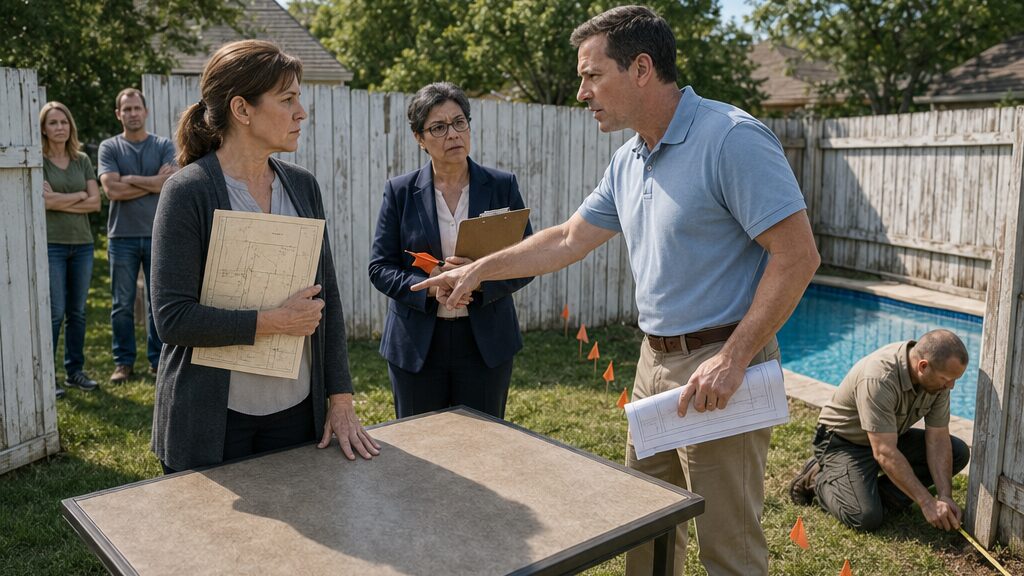
He came through the side gate at eight sharp with a clipboard, a tape measure, and Kathleen Perez beside him. Kathleen wore dark slacks and low shoes suitable for grass. Patrick and Stephanie followed from their yard through an opening near the pool equipment.
Two nearby homeowners had found reasons to be outside.
Susan could see one pretending to adjust a sprinkler across the alley. Another stood beside a trash bin that had already been emptied.
Kathleen offered Susan a professional smile.
“We’re only documenting conditions today.”
“Your email said you were marking the correction area.”
“We may place temporary indicators.”
“Based on what?”
Kathleen glanced toward Patrick.
He carried the same rolled plan from the previous morning.
“This is the approved site plan,” he said.
Susan had printed the subdivision plat from her closing folder and placed it inside a clear sleeve. She held it against her chest.
Kathleen looked at both documents. “The committee isn’t qualified to adjudicate competing surveys.”
“His isn’t a survey,” Susan said.
Patrick exhaled through his nose. “We’ve been over this.”
“No, you told me the HOA approved it. Approval doesn’t turn owner-provided dimensions into a boundary survey.”
The inspector bent near the fence and hooked the tape measure to a metal post. Patrick directed him toward a point in Susan’s yard.
“Six feet from the current line,” Patrick said. “That’s approximately where the boundary should be.”
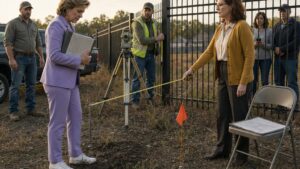
The inspector pulled the tape taut across the grass. The bright yellow strip cut diagonally from the white boards toward Susan’s crape myrtle. Kathleen began placing orange flags where Patrick indicated.
Susan felt heat climb into her face.
For one moment, she considered letting them finish. She could challenge the markings later, after everyone left, when she had organized the documents properly and found language no one could misinterpret.
Then one of the orange flags went into the soil beside the flower bed she had planted after her mother died.
“No,” Susan said.
The inspector stopped.
Patrick looked at Kathleen. “This is exactly the problem.”
Susan stepped between the tape and the next flag.
“You do not have permission to mark a replacement boundary on my property as if the issue has been decided.”
Kathleen’s expression cooled. “The HOA has inspection authority.”
“Inspection authority is not ownership.”
The words came out more firmly than Susan expected. The homeowner across the alley stopped touching the sprinkler.
Patrick unfolded his plan on the patio table. “This line was reviewed before construction. The pool passed county inspection. The setbacks were approved. You’re treating a routine correction like an attack.”
Susan placed her old plat beside his paper.
“Then explain why these lines are different.”
At first, the documents seemed too dissimilar to compare. Patrick’s plan was crisp and recently printed. Susan’s was a faded copy of a recorded subdivision plat crowded with lot numbers and bearings.
She used a pen cap to indicate the rear corners.
“This measurement on the recorded plat places the line along the fence,” she said. “Your plan shortens my lot and widens yours.”
Patrick tapped another notation. “You’re reading a subdivision dimension. That doesn’t account for field conditions.”
“Neither does your owner-provided sketch.”
Stephanie shifted near the pool gate. Her arms were folded again, but her certainty had thinned. “Patrick, where’s the actual survey from closing?”
“Our title packet used the legal description.”
“That’s not what she asked,” Susan said.
Patrick turned toward her. “You’re an accountant, Susan. Not a surveyor.”
“No. That is why I’m not pretending this is settled.”
The inspector, who had remained silent, crouched beside the bottom of the fence. He brushed away mulch and dead leaves with one gloved hand.
“There’s metal here,” he said.
Patrick’s head turned.
The inspector cleared more soil, revealing the rusted top of an iron pin directly beneath the fence line.
“Could be a monument,” he said. “Could be unrelated. I can’t certify it.”
Susan looked from the pin to Patrick’s plan. The tape still stretched across the yard, but now its path looked less like a measurement than an accusation that had missed its target.
“Photograph it,” she said.
Kathleen hesitated.
“For the inspection record,” Susan added. “Photograph the pin, both plans, and the tape position.”
Patrick rolled his shoulders back. “We don’t know what that piece of metal is.”
“Then the record should say that.”
The inspector took out his phone. He photographed the exposed pin, the fence post above it, and the two plans lying side by side.
Patrick reached for his paper.
Susan put her hand on the clear sleeve covering her plat. “Not yet. One more photograph showing both rear corners.”
His hand stopped.
For the first time since he came to her porch, he appeared less angry than uncertain.
Kathleen asked the inspector to take the picture.
When it was done, she removed the two flags nearest Susan’s flower bed but left the others in place.
“We will pause physical correction pending additional documentation,” she said.
Susan’s chest loosened slightly.
“Pause all enforcement,” she said.
“I can’t do that.”
“You just said the documents conflict.”
“I said the committee cannot resolve the conflict. The existing complaint remains open until a licensed survey is submitted.”
“By whom?”
“Either owner may commission one.”
Patrick folded his plan. “I’m not paying to prove what’s already approved.”
Kathleen’s gaze shifted briefly toward him, then back to Susan. “The notice provides fifteen days before the first fine is assessed.”
Susan stared at her. “You marked my yard using his sketch, found a possible boundary pin under my fence, and I’m still the one facing a fine?”
“We are following the process.”
The phrase landed with the dull weight of a locked door.
Susan wanted to say that a process built on an unverified claim was not neutral. Instead, she heard herself ask, “What exactly would stop the deadline?”
“A sealed boundary survey.”
“How long does that usually take?”
The inspector answered this time. “Depends who you hire. Two to four weeks is common.”
Patrick gave a small shrug, as though time itself had joined his side.
Susan gathered her plat and walked them toward the gate. She did not apologize for ending the inspection. That absence felt almost physical.
At the gate, Stephanie lingered.
“I don’t want this to become ugly,” she said quietly.
Susan looked at the orange flags left standing in her yard.
“It already became official before anyone checked whether it was true.”
Stephanie glanced toward Patrick, who was waiting beside the pool equipment. “He knows property.”
“So do records.”
After they left, Susan called three survey companies. The first could schedule her in five weeks. The second did not handle active disputes. The third receptionist placed her on hold, then returned with an opening ten days away because of a cancellation.
The cost was more than Susan had expected.
She gave her credit card number anyway.
At noon, she finally sent Kathleen the email she had drafted the day before. She removed none of the direct language. She requested the complaint, Patrick’s submitted documents, the architectural approval file, and all inspection photographs.
At three seventeen, a county vehicle pulled to the curb.
A code-enforcement officer stepped out carrying a plastic sleeve. Patrick stood in his driveway, speaking into his phone, but ended the call when he saw the officer approach Susan’s gate.
The officer attached a yellow preliminary notice to the white fence.
It stated that a complaint had been received regarding a potentially noncompliant structure. Susan had ten business days to provide evidence of lawful placement or face further action.
Patrick watched from across the property line no one had yet proved.
Chapter 3: The Records Office Kept an Older Truth
“The county has no record of the boundary shown on this plan.”
The records clerk said it without drama, one finger resting on Patrick’s site sketch beneath the glass partition.
Susan had arrived when the office opened, carrying her deed, the HOA file, the code notice, and a list of document numbers she had assembled after midnight. Her largest tax client expected a completed return by the end of the day. At nine twelve, the client had already left two voicemails.
Susan silenced her phone.
“Could the boundary have changed without appearing on the subdivision plat?” she asked.
“Through a recorded replat, lot-line adjustment, deed correction, easement, or court order.” The clerk turned toward the monitor. “But I’m not seeing any of those attached to either parcel.”
She searched under Susan’s address, Patrick’s address, both legal descriptions, and the subdivision name. The printer behind her began producing pages in uneven bursts.
Susan watched the stack grow.
The clerk slid a recorded plat across the counter. Unlike Susan’s faded closing copy, this version bore a file number and county stamp. The rear measurement matched her document.
Next came Susan’s deed, the prior owner’s deed, and the original development restrictions. None described a six-foot transfer. None granted Patrick’s property an easement across Susan’s yard.
“So his plan has no legal effect?” Susan asked.
“I can’t interpret legal effect.” The clerk tapped Patrick’s paper. “I can only tell you I don’t see this boundary configuration in the recorded land records.”
It was the kind of answer Susan respected: narrow, accurate, unwilling to pretend certainty beyond the evidence.
She photographed the file numbers and requested certified copies.
While the clerk prepared them, Susan opened the county permit portal on her phone. Patrick’s pool permit appeared under his address with inspection dates, contractor information, and a reference to an attachment labeled Owner Site Sketch—Revision B.
Revision B.
Susan searched the online packet twice. Revision A was missing.
“Can permit attachments be stored separately?” she asked.
“Different department,” the clerk said. “But the permit reference number should lead them to the archived file.”
Susan wrote it down.
Her phone rang again. This time she answered.
The client did not bother with a greeting. “You told me yesterday.”
“I know.”
“Our lender meeting is tomorrow morning.”
“I can have the return to you by six.”
“You said noon yesterday. Then end of day. I need to know whether I should send this to another accountant.”
Susan looked at the certified plat on the counter. Her instinct was to apologize until the client’s anger became manageable. Instead, she said, “The delay is mine, and you have a right to be frustrated. I can deliver by six today, or I can send the organized file to another preparer within the hour.”
Silence followed.
“Six,” the client said. “Not six fifteen.”
“Six.”
When the call ended, Susan felt no relief. The deadline was real, and she had created it by waiting too long to tell the truth about her workload. Avoiding one difficult conversation had nearly cost her the account.
The pattern was becoming harder to ignore.
At the permit office, a staff member retrieved the archived pool file after Susan showed identification and explained that she owned the adjoining parcel. The packet contained the approved sketch, setback calculations, inspection cards, and a short notation from the plan reviewer.
Setbacks verified per applicant-provided site dimensions.
There was no independent boundary verification.
Susan turned to the attachment list.
Revision A was referenced but absent from the public packet. A handwritten note beside the entry said: replaced by updated owner sketch before final review.
“Can I request the original?” she asked.
“You can submit an open-records request.”
“How long?”
“Usually ten business days, depending on review.”
Her code deadline would arrive first.
Susan submitted the request anyway.
Back home, she spread the certified documents across her dining table, pushing tax folders into unstable piles along the edge. She traced the recorded rear boundary with a transparent ruler. The line followed the measurements in her closing plat and intersected the same corners where the fence stood.
Not proof by itself, she reminded herself.
But no recorded document supported Patrick’s version.
At four thirty, she switched to the client return and worked without checking email. Numbers steadied her because they resisted confidence. A figure either reconciled or it did not.
She transmitted the return at five fifty-three.
At six eleven, the client replied with two words: Received. Thanks.
Susan sat back, exhausted enough that the room seemed to tilt.
An email from Kathleen waited beneath it. The HOA had provided the architectural file and the inspection photographs. Patrick’s original application described the site sketch as based on owner measurements and contractor layout. The approval letter included a condition Susan had not seen on his copy:
Approval does not verify property boundaries. Owner remains responsible for all encroachments.
Susan read the line aloud.
Patrick had presented HOA approval as proof of the boundary when the approval explicitly denied that function.
Still, one question bothered her. If Patrick’s sketch had been wrong from the beginning, why had it been revised before final review?
The surveyor, Gary Adams, arrived the following morning.
He was lean, gray at the temples, and uninterested in the neighborhood drama. He asked Susan to show him the recorded documents, then spent nearly an hour examining monuments at the front corners before moving toward the backyard.
Patrick came outside when Gary set up his equipment.
“You surveying both parcels?” he called over the fence.
“I’m locating my client’s boundary,” Gary said.
Patrick looked toward Susan. “You could have saved yourself the expense.”
Susan almost answered. Gary glanced at her, not as a warning exactly, but as a reminder that arguments did not establish coordinates.
She remained silent.
For two hours, Gary moved between the street, side yard, and rear fence. He uncovered the iron pin found during the HOA inspection, then located another monument near the opposite corner. He took measurements twice.
Near noon, he stood beside the pool fence and stared through the slats toward the water.
“Did they give you permission to enter their yard?” Susan asked.
“No.”
“Do you need it?”
“Not yet.”
The answer tightened something in her stomach.
Gary placed a temporary wooden stake several feet inside Susan’s yard, then removed it, checked his instrument, and placed it again closer to the white fence. He made no comment.
By late afternoon, he packed his tripod into the truck.
“When will you know?” Susan asked.
“I know where your fence is.”
“And?”
“I need to reconcile the pool permit dimensions and calculate the encroachment before I put anything in writing.”
The word stopped her.
“Encroachment?”
Gary closed the equipment case.
“I didn’t say whose.”
He drove away before Susan could press him.
At seven thirty that evening, while Susan was reviewing an amended return, her phone rang from an unfamiliar local number.
It was Gary.
“I completed the first field calculation,” he said. “Do not discuss the pool with Patrick, the HOA, or code enforcement yet.”
Susan stood so quickly her chair rolled backward into the wall.
“Why?”
“Because before anyone knows what the numbers show, I want the measurements checked independently.”
She looked through the dark glass door. Beyond the white fence, the underwater pool lights glowed blue.
“What did you find?”
Gary was silent for a beat.
“Something large enough that I don’t want to be wrong.”
Chapter 4: The Survey Flags Reached Past the Pool
Susan woke to an orange survey flag standing beside Patrick’s pool steps.
From her kitchen, the thin plastic marker looked impossibly bright against the pale concrete. It rose from a strip of landscaping on the Youngs’ side of the white fence, several feet beyond where Patrick claimed Susan’s property ended.
A second flag stood near a lounge chair.
A third appeared beside the pump enclosure.
Gary Adams was already in the backyard, checking his equipment against a point near Susan’s rear corner. He had arrived before seven with another surveyor, a second instrument, and none of the caution that had softened his movements during the first visit.
Susan stepped outside in slippers.
“You crossed the fence.”
“With written permission from the owner,” Gary said.
Susan looked toward the Youngs’ house. “Patrick gave it?”
“Stephanie did.”
The back door across the fence opened. Stephanie came outside wearing jeans and a gray sweatshirt, her hair pulled back without the polished care Susan was used to seeing. She did not wave.
Patrick followed a few seconds later, already dressed for work. His attention fixed on the orange flags.
“What are those doing there?”
Gary did not answer immediately. He adjusted the tripod, looked through the instrument, and signaled to his assistant near the pool.
Patrick turned to Stephanie. “You let them in?”
“They said they needed access.”
“They work for her.”
“They’re licensed surveyors.”
The distinction landed harder than Stephanie seemed to intend.
Patrick walked to the pool edge. “Nobody is driving anything into the deck.”
“They aren’t,” Gary said. “The flags mark calculated points in the soil. We’ll use removable chalk on the concrete.”
“Calculated from what?”
“Recorded monuments, deed calls, subdivision control points, and field measurements.”
Patrick gave a short laugh. “So you’re ignoring the permitted site plan.”
“I reviewed it.”
“And?”
Gary folded the legs of his instrument and faced both properties.
“I’ll discuss conclusions with my client when the report is complete.”
Patrick looked across the fence at Susan. “You’re enjoying this.”
The accusation surprised her. She was tired, behind on work, and aware that the code deadline was approaching. Enjoyment had no place in it.
“I asked you for a survey before you filed complaints.”
“You could have handled this without turning it into a production.”
Susan glanced at the orange line extending toward the pool. “I tried to handle it with a question.”
Gary asked everyone to remain clear while he completed the verification. For the next hour, the backyard filled with small, precise sounds: the click of a measuring rod, the scratch of chalk, the distant hum of traffic beyond the subdivision wall.
The chalk marks formed a line.
It began near the iron pin beneath Susan’s fence, crossed the narrow planting bed on Patrick’s side, passed through the outer edge of the pool deck, and continued toward the equipment enclosure.
The line did not merely approach the pool.
It cut across it.
Patrick stood with both hands on his hips. Stephanie had moved several steps away from him.
At nine thirty, Gary entered Susan’s kitchen with a folder and asked to use the table. He spread out a preliminary drawing, weighted the corners with her coffee mug and a stapler, then pointed to a heavy boundary line.
“Your fence tracks the recorded boundary,” he said. “There are minor variations along individual boards, but the posts are within standard construction tolerance.”
Susan lowered herself into a chair.
“So the fence is legal.”
“Based on the boundary work, it is not six feet inside their property.”
The small payoff arrived without triumph. Susan had imagined relief, perhaps anger dissolving all at once. Instead, she felt the shape of the next problem before Gary described it.
He moved his finger toward the pool outline.
“The northeast pool wall is approximately fourteen feet inside your parcel at the deepest point. Portions of the deck, drainage channel, and equipment access also cross the line.”
Susan stared at the drawing. “Fourteen?”
“Approximately. The sealed report will state the final measurements.”
The number seemed too large to fit inside the narrow space she had viewed through the fence for months.
“How did it pass inspection?”
Gary leaned back. “Inspectors confirm compliance with approved plans. They do not generally perform boundary surveys. If the approved plan is based on a wrong line, the inspection can be accurate to the plan and still wrong on the ground.”
Susan thought of the permit notation: applicant-provided site dimensions.
“Could your survey be challenged?”
“Any survey can be reviewed. That is why I brought a second crew member and checked against multiple control points.” Gary tapped the drawing. “The monuments agree. The deed calls agree. The recorded plat agrees. Your fence agrees.”
“And Patrick’s sketch?”
“Does not.”
By noon, Gary had placed temporary markers and emailed Susan a signed preliminary letter confirming the fence location. She forwarded it to code enforcement and Kathleen with the inspection photographs attached.
Kathleen replied within twenty minutes.
The HOA would suspend Susan’s fence enforcement pending review.
It was the first official acknowledgment that the complaint against her might be wrong. Susan read the sentence twice. Then she noticed the next paragraph.
The association could not accept responsibility for determining ownership, and Patrick’s approved architectural application remained valid until formally reconsidered.
Susan called Kathleen.
“You approved a pool using a line that doesn’t exist.”
“We approved the design as submitted.”
“Your own letter says approval doesn’t verify boundaries.”
“Exactly.”
“That protected the HOA, not me.”
Kathleen was silent for a moment. “Susan, I understand why you’re upset.”
“No. You understand that there is now a survey in the file.”
“We need counsel to review the process.”
“And while counsel reviews it, the pool stays on my land.”
“The HOA cannot order structural removal based solely on a preliminary letter.”
Susan looked out at the orange flags. “You were prepared to order my fence moved based on an unsealed sketch.”
Kathleen’s voice softened, which made the answer feel more careful rather than more humane.
“That is one of the issues we are reviewing.”
That evening, the HOA board convened an emergency meeting in the clubhouse. Susan brought the preliminary survey, recorded plat, deed, architectural file, and code notice in a banker’s box.
Patrick arrived with Stephanie and an attorney’s business card tucked into the front of his folder, though no attorney accompanied them.
Gary attended only long enough to explain his methods. He avoided conclusions beyond the measurements. When Patrick questioned whether the iron pins might have been moved, Gary described the independent control points and the matching deed distances.
“So you’re saying every approval was wrong?” Patrick asked.
“I’m saying the approved sketch does not match the recorded boundary.”
Kathleen requested that the statement be entered into the minutes.
Patrick’s face changed at that. The meeting was no longer a conversation between neighbors. It had become a record.
The HOA treasurer asked who had supplied the dimensions on the pool application.
Patrick looked down at the file. “The contractor prepared the layout.”
Kathleen opened the scanned application. “The certification is signed by the owner.”
“Because owners sign submissions. That doesn’t mean I measured it.”
Stephanie turned toward him. “You told me the contractor verified everything.”
“They did.”
“Then where is their survey?”
Patrick closed the folder.
The board voted to rescind Susan’s fence notice and refer the pool approval for legal review. Code enforcement, according to Kathleen, would inspect the encroachment after receiving the final sealed survey.
Susan should have felt victorious.
Instead, she watched Patrick gather his papers with shaking hands. The mistake reached beyond him now—to the contractor, the HOA, the permit reviewers, perhaps a lender or title company. Facts had made the line visible, but they had also revealed how many people had relied on its being somewhere else.
Outside the clubhouse, Susan carried her box toward the parking lot.
“Susan.”
Stephanie stood beneath the entry light. Patrick had gone ahead to their car.
Her earlier confidence was gone. She held her phone against her chest, gripping it with both hands.
“Did Patrick ever show you a measurement sheet from the contractor?” she asked.
“What measurement sheet?”
Stephanie looked toward the car before answering.
“The first one. Before they started digging.”
Chapter 5: The Warning Patrick Chose Not to Hear
Stephanie brought the folded measurement sheet to Susan’s kitchen at seven the next morning.
She had sealed it inside a clear food-storage bag, though the paper was dry. One edge was stained with red dirt, and a faded line ran across the center where it had been folded and carried.
“I found it in Patrick’s home-office cabinet,” she said. “Behind the refinancing documents.”
Susan placed the bag on the table without opening it.
“Does he know you have it?”
“No.”
“That matters.”
“I know.”
Stephanie sat opposite her but did not remove her coat. The kitchen remained dim except for the light over the stove. Beyond the glass door, the white fence divided the two yards as cleanly as ever, concealing most of the pool.
Susan slid the paper out.
It showed a rough pool layout, setbacks, and a handwritten note near the rear line:
Existing fence differs from calculated lot width. Verify boundary before excavation.
Below it, someone had written Proceed per owner direction—verification pending.
There was no signature beside the second line, only a date from three days before excavation began.
Susan read it again.
“Who wrote this?”
“The contractor’s project manager, I think. Patrick brought it home after a site meeting.”
“What did he tell you?”
“That an old fence post was throwing off their measurements and the official site plan controlled.”
“Did he say verification was pending?”
Stephanie’s gaze dropped to the paper. “No.”
Susan waited.
Stephanie rubbed her thumb along the edge of her phone. “We had already paid the nonrefundable deposit. The loan for the pool was tied to a renovation package. If construction stopped, the rate changed and we lost the seasonal schedule.”
“That explains pressure.”
“It doesn’t excuse this.”
“No.”
Stephanie looked up sharply, perhaps expecting Susan to soften the statement. Susan did not.
“I stood in your yard,” Stephanie said, “and acted like you were wasting everyone’s time.”
“You believed him.”
“I wanted to believe him. That isn’t the same as having no choice.”
The admission changed the memory of Stephanie’s folded arms. Susan had seen contempt. Perhaps some of it had been. But beneath it had also been dependence—the confidence of someone borrowing certainty from another person.
Patrick knocked on Susan’s front door before eight.
Stephanie closed her eyes once.
“He checked the cabinet.”
Susan left the measurement sheet on the table and opened the door.
Patrick did not step inside. His jaw was tight, but his voice remained controlled.
“Stephanie took a private project document.”
“She brought me a document about construction on my property.”
“It is not your property until the survey is resolved.”
“The preliminary survey is clear.”
“Preliminary.”
Stephanie appeared behind Susan.
“Tell her what happened at the site meeting,” she said.
Patrick looked past Susan. “Come home.”
“Tell her.”
“This is not the place.”
“It became the place when you filed a complaint against her fence.”
For several seconds, none of them moved.
Patrick finally looked at Susan. “The contractor found an inconsistency. They believed the fence was wrong.”
“The note says verify before excavation.”
“The project was scheduled. Crews were booked. We had financing deadlines.”
“So you ordered them to proceed.”
“I authorized work based on the approved plan.”
“Knowing the field measurements did not match.”
His eyes hardened. “Knowing there was a discrepancy that professionals believed would be resolved.”
“Later.”
“Yes, later.”
The word remained between them.
Patrick stepped closer to the threshold. “Do you understand what stopping that job would have cost? We had opened the yard. Equipment was on site. We had already replaced the roof and the air-conditioning system. The refinance was supposed to consolidate everything before the rate lock expired.”
Susan understood more than he wanted her to. She understood deadlines, sunk costs, and the way a person could begin treating an inconvenient fact as an attack.
“You had choices,” she said.
“So do you now.”
It sounded like a warning, but his face held fear more clearly than anger.
By noon, Susan and Stephanie were seated in the pool contractor’s office. Patrick had refused to come.
The contractor joined them in a conference room with the original project file. He studied the measurement sheet for a long moment before speaking.
“Our crew identified a width conflict between the owner sketch and the visible fence line.”
“Did you recommend a survey?” Susan asked.
“We recommended verification.”
“Why did work continue?”
The contractor turned to a signed change authorization. “The owner directed us to proceed according to the approved layout while verification was pending.”
“Which owner?”
He tapped Patrick’s signature.
Stephanie stared at it. “You never sent this to me.”
“Our contract listed him as primary contact.”
The contractor’s defensiveness was professional rather than hostile. He had warned them, but he had also kept building.
Susan asked, “Did your company ever verify the line?”
“No. Boundary certification was excluded from our scope.”
“And Revision A?”
The contractor produced the earlier sketch. It showed the fence, the calculated lot width, and a question mark at the rear corner. Revision B removed the fence line and used Patrick’s preferred dimensions.
“Who requested the revision?”
The contractor looked at the signature page again.
No one needed him to answer aloud.
For the first time, Susan could see the conflict in full. Patrick had not invented the problem from nothing. The old fence and his submitted dimensions had disagreed. The contractor had not claimed to know which was correct. The HOA had approved a design while disclaiming boundary responsibility. The county had inspected construction against that approved design.
At each stage, uncertainty had been passed forward.
Patrick’s responsibility was not that he knew the exact truth. It was that he encountered doubt, chose the version that protected his money, and later tried to force Susan to make the physical world conform to it.
The contractor then showed them the structural drawings.
“If the county orders immediate full removal,” he said, “it may not be limited to cutting back the deck. The pool wall, return lines, drainage channel, and equipment trench interact. Excavation near the rear grade could compromise drainage between both homes.”
Stephanie’s face drained of color. “What does that mean?”
“It means a careless demolition could send runoff toward either foundation. It requires engineering.”
The reversal Susan had imagined—Patrick receiving an order and the pool disappearing—became more complicated in an instant. Removing the encroachment could damage her own property. Litigation could take years. The Youngs could lose far more than the pool.
Susan felt anger resist the new information. Complexity seemed almost unfair after the simplicity of being right.
That afternoon, the county issued a formal encroachment notice based on Gary’s sealed survey.
The document confirmed that Susan’s fence conformed to the recorded boundary and that portions of the Youngs’ pool structure occupied her parcel without a recorded easement.
Three potential remedies were listed:
Removal and restoration.
Conveyance of the affected strip through a recorded lot-line adjustment.
A negotiated easement with engineering conditions and compensation.
The county gave Susan ten days to state which remedy she would pursue before enforcement moved toward removal proceedings.
She placed the notice beside the stained measurement sheet.
Ten days to decide whether justice meant destruction, sale, or permission.
Chapter 6: A Legal Victory Can Still Become a Cruel Choice
The demolition estimate was high enough to threaten the Youngs’ house.
Susan read the engineer’s summary in Kathleen’s office while Patrick sat across the table with his arms locked against his chest. Stephanie occupied the chair beside him, though the distance between their shoulders seemed deliberate.
Full removal and reconstruction could exceed the remaining equity Patrick had described during the contractor meeting. It would also require temporary removal of Susan’s fence, excavation across both yards, and redesign of the shared drainage path.
Patrick leaned forward.
“This is what I’ve been trying to explain. Demolition is irrational.”
Susan looked at the estimate. “You were trying to make me move my fence before anyone calculated this.”
“Because correcting the fence would have solved the practical problem.”
“It would have moved the paperwork problem onto me.”
“It would have created a clean line.”
“A false one.”
Kathleen raised a hand. “We need to keep this focused on remedies.”
Her conference table was crowded with documents: Gary’s survey, the engineering report, the contractor’s warning, HOA approvals, permit records, and three draft agreements. The volume of paper seemed absurd compared with the narrow strip of ground outside.
Kathleen placed the first draft before Susan.
It proposed a private license allowing the pool to remain for as long as the Youngs owned the property. Compensation was modest. The agreement would not be recorded.
Susan read the first page and pushed it back.
“No.”
Patrick’s chair creaked. “You haven’t even considered it.”
“I considered it before the meeting.”
Kathleen folded her hands. “A private license is inexpensive and fast.”
“And disappears when they sell?”
“It can be assigned.”
“Can be is not the same as will be.”
Kathleen’s gaze sharpened with reluctant approval. “That is correct.”
Patrick looked at her. “You drafted it.”
“I presented an option.”
Susan turned to the second agreement, a permanent easement permitting the existing pool encroachment. The compensation was higher, but the document gave the Youngs broad access rights for maintenance.
The third proposed selling the affected strip through a lot-line adjustment.
Each solution required Susan to surrender something permanent: ownership, control, or future flexibility.
She had spent years assuming that compromise meant giving up the part of a dispute other people valued most. It was how meetings ended sooner. It was how anger cooled. It was also how someone else’s urgency became her obligation.
“What do I need along that side of the yard?” she asked the engineer.
He unfolded a drainage plan. “The natural flow runs behind both houses toward the street inlet. The pool deck narrowed the swale. Your parcel currently carries part of the overflow during heavy rain.”
“If the pool remains?”
“You need permanent access to inspect and maintain the drainage channel. The deck should be cut back in two areas. The equipment enclosure should move. A retaining edge needs reconstruction.”
Susan traced the proposed access route. It followed the white fence, then passed through the disputed strip.
For the first time, the land was not merely six feet Patrick wanted or fourteen feet the survey restored. It had a function. It protected both houses from water that did not care which neighbor felt entitled.
She looked at the broad easement draft again.
“I’ll consider a limited easement,” she said. “Not this one.”
Patrick’s expression shifted. “You’ll let the pool stay?”
“Part of it, if the engineering works.”
Stephanie released a breath.
Susan continued. “The deck is cut back. The equipment moves. Drainage access remains mine. The easement is recorded, tied to the corrected survey, and narrow enough that it cannot be described as ownership.”
Patrick nodded too quickly. “Fine.”
“There will be compensation.”
“We can negotiate the number.”
“And a written statement correcting the HOA complaint.”
His nod stopped.
Susan looked directly at him. “You filed against my fence after receiving a warning that the measurements conflicted. The record needs to say that.”
“That is not part of a property remedy.”
“It is part of repairing what you did.”
Patrick turned toward Kathleen. “Is the board going to allow this?”
Kathleen did not answer immediately.
“The association acted on your complaint,” she said. “A factual correction would help the file.”
“A factual correction is one thing. She wants a confession.”
“I want the sequence stated accurately.”
Patrick stood.
“No. I’ll pay for engineering. I’ll pay reasonable compensation. I’ll sign an easement. I am not putting in writing that I knowingly built on her property, because I did not know that.”
“You knew there was doubt.”
“That is not the same thing.”
“No,” Susan said. “It is not. The statement can say exactly what you knew.”
Patrick gathered his copy of the estimate.
“You don’t want a solution. You want me humiliated.”
The old reflex rose in Susan—the urge to reassure him that she was not angry, that she understood his pressure, that perhaps the wording could disappear if everything else moved forward.
She let the silence remain.
“I want the official record to stop saying my fence was the problem,” she said.
Patrick left the room.
Stephanie stayed seated for several seconds, then followed without speaking.
Kathleen closed the conference-room door.
“He may choose litigation.”
“I know.”
“You could secure most of what you need without the statement.”
“Most.”
Kathleen studied her. “A recorded easement protects the land. Compensation addresses the use. Why does the admission matter?”
Susan looked at the white fence through the office window. From this angle, only the upper boards were visible above parked cars.
“Because he told the neighborhood I was refusing a routine correction. The HOA marked my yard before checking his evidence. Code enforcement posted my gate. If the file ends with a quiet agreement, the next person who reads it will think both sides were equally mistaken.”
Kathleen lowered her eyes to the documents.
“We were not equally careful,” she said.
It was not an apology, but it was the first time she had named the difference.
Over the next six days, Susan revised the remedy with the engineer and Gary. The new plan preserved most of the pool while reclaiming the drainage corridor and enough deck to restore physical access. The easement would be permanent, narrow, recorded, and prohibited from expanding. Compensation included the occupied land use, legal costs, survey expenses, and future drainage maintenance.
On the seventh day, Susan repaired the loose board near the rear corner.
She brought a hammer and two new screws into the yard, expecting the task to take five minutes. The old board resisted alignment until she pressed her shoulder against it and tightened the lower screw first.
The fence had once represented safety because it was already there.
Now it felt different.
It remained because she had checked where it belonged and decided it would stay.
On the eighth day, Kathleen called.
“Patrick accepts the physical correction and payment terms.”
“But not the statement.”
“No.”
“What does he offer instead?”
“A mutual acknowledgment that the parties relied on inconsistent documents.”
Susan laughed once, without humor. “I relied on the recorded plat.”
“I told him that.”
“And?”
“He says the wording must protect his professional license and refinancing.”
The hidden pressure had finally reached its plainest form. Patrick was willing to correct the structure as long as the correction looked like shared confusion rather than his choice.
Susan opened her laptop.
The HOA bylaws allowed a special hearing when an architectural approval created a boundary dispute affecting multiple owners. She had read the provision three times during the first week and avoided using it because a hearing would make everything public.
She completed the request form.
Attached Gary’s survey.
Attached the contractor’s warning sheet.
Attached Patrick’s unsigned settlement draft.
Then she wrote the agenda description in one sentence:
Review of enforcement action, conflicting boundary documents, and proposed recorded correction.
Before she could reconsider the tone, she sent it to Kathleen and copied Patrick and Stephanie.
The hearing was scheduled for the following Thursday.
For years, Susan had believed silence kept conflict contained.
Now the full file would be placed on the boardroom table where everyone could see which side of the fence each decision had been made on.
Chapter 7: The Boundary Hearing Where Silence Finally Cost More
Patrick began the hearing by asking the board to treat the survey as a negotiable opinion.
He stood at the end of the HOA clubhouse table with one hand resting on the back of an empty chair. Behind him, Kathleen had projected an enlarged copy of Gary’s plat onto the wall. The recorded boundary ran in a dark straight line through the pale outline of the Youngs’ pool deck.
“Surveys conflict all the time,” Patrick said. “That is why courts exist. We have an approved plan, a completed permit process, and years of reliance. Susan’s demand for a written admission goes beyond correcting any physical issue.”
Susan sat three chairs away with her documents arranged in a narrow stack.
The room was fuller than she expected. The HOA treasurer sat beside Kathleen. The two homeowners who had watched the inspection occupied chairs along the wall. Stephanie sat near the door rather than beside Patrick.
Kathleen looked toward Susan. “You may respond.”
Susan had written three pages of notes. Her hands were cold against them.
She could feel the old instinct urging her to begin with an apology. Sorry this has taken so much time. Sorry the board has been drawn into it. Sorry everyone is uncomfortable.
Instead, she placed the notes face down.
“The survey is not the only issue,” she said. “The issue is what happened after the measurements stopped agreeing.”
Patrick shook his head. “We have already covered this.”
“No. We have discussed the result. We have not corrected the record that created the result.”
She handed copies of the contractor’s first measurement sheet to the board. The paper moved around the table with soft, dry sounds.
Kathleen read the handwritten warning aloud.
“Existing fence differs from calculated lot width. Verify boundary before excavation.”
Patrick looked toward the homeowners along the wall.
“That is a contractor notation,” he said. “Not a legal determination.”
Susan nodded. “It was not proof that the fence was correct. It was proof that you had a reason to stop and check.”
“The project manager believed the fence was likely wrong.”
“Then why did Revision B remove it from the sketch?”
Patrick’s expression hardened. “Because visible fences are not legal boundaries.”
“That is true,” Susan said. “But neither are owner measurements.”
The room became still.
Patrick turned to Kathleen. “This is becoming an attack on my profession.”
Susan felt the invitation hidden inside the statement. If she continued, he could accuse her of trying to ruin his career. If she softened, the central fact would disappear again beneath everyone’s discomfort.
Kathleen folded her hands.
“Patrick, did you receive the discrepancy notice before excavation?”
“I received a field note.”
“Did you authorize construction to continue before verification?”
“I authorized construction according to the approved plan.”
“That is not the question.”
The voice came from Stephanie.
Patrick looked toward the door.
She had not raised her volume, but every person in the room turned toward her.
Stephanie stood and approached the table carrying the original measurement sheet. She placed it beside Patrick’s folder.
“You told me the contractor had verified the line,” she said. “You did not tell me they had asked for verification.”
Patrick’s face changed, not into anger at first, but something closer to disbelief.
“We discussed the schedule.”
“We discussed losing the deposit.”
“Exactly.”
“We did not discuss building while the boundary was unresolved.”
Patrick lowered his voice. “Stephanie, this is not helping.”
“I am not trying to help one side.”
“You are repeating her interpretation.”
“No. I am telling them what you told me.”
The surprise did not come from the paper. Susan had already seen the signature. It came from Stephanie refusing to lend Patrick her certainty a second time.
Patrick pulled out the chair and sat.
For several seconds, he stared at the projected plat.
“When the discrepancy came up,” he said, “the excavation crew was already committed. The contractor believed the fence had been placed informally. The HOA plan was approved. The county permit was active. Every professional signal said the project could continue.”
Gary, seated near the back as a technical resource, shifted but did not interrupt.
Patrick continued. “Was I supposed to shut down a six-figure project because an old fence did not match a tape measurement?”
Susan answered before Kathleen could.
“You were supposed to find out where your property ended.”
The words held no flourish. That made them land harder.
Patrick rubbed a hand across his jaw.
“And now you want language that says I knowingly encroached.”
“No.” Susan opened the latest draft and pointed to the disputed paragraph. “It says you received notice of conflicting measurements, authorized work before boundary verification, and later filed a complaint seeking removal of my fence.”
“That wording will be used against me.”
“It is the sequence.”
“It implies intent.”
“It states choices.”
Kathleen drew a slow breath.
“The association also needs to address its choices.”
Everyone looked at her.
She turned toward the treasurer, then back to Susan.
“The board issued a compliance notice before confirming that the complaining owner’s document established a legal boundary. We relied on architectural approval language while ignoring that the same approval expressly disclaimed boundary verification.”
Patrick looked up. “So now the HOA is admitting fault?”
“I am stating that our process was incomplete.”
Kathleen’s careful vocabulary remained, but the admission was clear enough. She asked that the minutes reflect the rescission of Susan’s fence violation and the board’s agreement to require sealed boundary documentation for future improvements within a specified distance of a lot line.
The treasurer seconded the motion.
It passed without applause.
Susan was grateful for that.
Patrick picked up the settlement draft.
“I will accept the correction plan,” he said. “The deck modification, drainage access, survey recording, and compensation. I will not sign that paragraph.”
Stephanie looked at him. “Then what are you asking Susan to sign?”
“The easement.”
“Giving us permanent rights on her land.”
“In exchange for payment.”
“And you still want the file to say this was mutual confusion.”
Patrick did not answer.
Susan watched him, and for the first time she could see the shape of his fear without mistaking it for innocence. He had built his identity around being the person who understood property, contracts, and risk. The written admission threatened that identity. But protecting it now required Susan to carry part of his responsibility.
She gathered the pages and replaced the disputed paragraph with a shorter version she had prepared that afternoon.
Patrick Young received written notice of a discrepancy between the existing fence and proposed pool dimensions before excavation. Construction proceeded before a licensed boundary survey was obtained. The subsequent complaint against Susan Moore’s fence was unsupported by the recorded boundary.
Susan slid the page across the table.
“No accusation about intent,” she said. “No statement that you knew the exact line. Only what the documents show.”
Patrick read it.
“This is punitive.”
“It is narrower than the truth I could argue.”
“You could destroy the pool.”
“I could begin that process.”
The homeowners along the wall remained silent. Susan did not look at them.
She looked only at Patrick.
“I am offering an easement that saves most of the structure. I am accepting less land back than the survey says is mine. I am taking on future access obligations. I am doing that because full removal would harm both properties and because Stephanie did not make your decision for you.”
Stephanie’s eyes dropped.
Susan continued. “But I will not sign an agreement that turns your warning into our shared mistake.”
Patrick looked at the clock above the clubhouse door.
Kathleen asked, “How long does the offer remain open?”
Susan had considered giving him another week. That would have felt reasonable. It would also have given him time to reshape the story again.
“Until midnight,” she said.
Patrick gave a quiet, incredulous laugh.
“And if I do not sign?”
“Tomorrow I instruct counsel to pursue removal and restoration under the county notice.”
“You said demolition could damage your property.”
“It could. That is why your refusal would be expensive for both of us.”
The room held the moral weight of that answer. Susan did not feel powerful. She felt exposed.
Patrick closed the folder.
“You have always acted like you wanted peace.”
Susan thought of the orange flags in her flower bed, the yellow notice on her gate, and the email she had nearly softened until it said nothing.
“I confused peace with making myself easier to ignore.”
Patrick left without signing.
Stephanie remained long enough to collect her copy of the correction plan. At the door, she stopped beside Susan.
“He may let the deadline pass just to prove you cannot force him.”
“I know.”
“He thinks backing down is the same as admitting he is incompetent.”
Susan looked at the projected boundary still glowing on the wall.
“Then he has until midnight to decide which matters more—the house or the version of himself he wants in the minutes.”
At eleven forty-seven that night, Susan sat at her kitchen table with her phone beside the unsigned agreement.
The white fence was invisible beyond the glass, but the pool lights cast a blue glow above it.
At eleven fifty-two, an email arrived from Patrick’s attorney.
The subject line contained only three words.
Executed Settlement Agreement.
Chapter 8: The Fence Stayed, but Its Meaning Changed
The concrete saws arrived three months later, but they did not come to destroy the entire pool.
Susan watched from her back steps as workers marked a narrow section of deck with chalk. Gary stood near the rear corner beside a new metal monument set flush with the soil. An engineer checked the drainage grade while the pool contractor walked the crew through the cut line.
The first saw started with a high mechanical whine.
White dust rose above the Youngs’ yard and drifted against the fence before the water hose pulled it down.
The settlement had taken weeks to record. Every clause had required another signature, another drawing, another review. The final easement allowed the pool wall to remain where removal would have created structural risk, but required the deck to be cut back, the equipment enclosure relocated, and the drainage corridor restored under Susan’s control.
The occupied area was precisely described.
No vague owner measurements.
No disappearing lines.
At the county recording office, Susan had signed beneath the corrected legal description while Patrick signed the factual acknowledgment on a separate page. He had not looked at her during either signature.
Stephanie had.
Afterward, Susan learned why the agreement had arrived eight minutes before midnight.
Stephanie had refused to sign the refinancing documents while the lender’s property description remained inconsistent with Gary’s survey. She would not secure new debt against a boundary she now knew was false.
Patrick could refuse Susan.
He could not complete the refinance without Stephanie.
The saw cut through the first section of deck. Workers lifted the broken concrete away in manageable pieces. Beneath it, the original grade sloped unevenly toward Susan’s yard, confirming the engineer’s concern about drainage.
The contractor rebuilt the channel with stone and reinforced edging. A narrow access gate was installed in the fence so Susan could inspect it after storms. The gate remained locked from her side.
By late afternoon, the pool looked smaller but not ruined.
The lounge chairs no longer fit along the rear edge. The equipment enclosure had moved closer to the house. An orange flag marked the final point where the permanent easement ended and Susan’s unrestricted property resumed.
Patrick stood near the patio, speaking with the contractor. He looked older than he had in April. Not broken. Not transformed into a different man. Simply reduced to the scale of the choices he had made.
When the crew left, he approached the fence gate.
Susan remained on her side.
“The drainage inspection passed,” he said.
“I received the report.”
“The recorder accepted the plat correction.”
“I received that too.”
He nodded.
For a moment, she thought he might apologize. She had imagined several versions over the previous months, though she no longer expected any of them.
Patrick rested one hand on the top of the gate.
“I should have obtained the survey before construction,” he said. “And before filing the complaint.”
The sentence was factual, almost identical to the acknowledgment he had signed. His voice contained no invitation for forgiveness.
Susan found that she did not need one.
“Yes,” she said.
His mouth tightened slightly.
“I did not set out to take your property.”
“I believe that.”
He looked surprised.
Susan continued. “You set out to protect your project. When the facts threatened it, you decided I should absorb the uncertainty.”
Patrick glanced toward the shortened pool deck.
“That is not how I saw it.”
“I know.”
He waited, perhaps expecting more. Susan had nothing else to give him.
Stephanie came outside carrying two glasses of water. She handed one to Patrick, then looked through the gate at Susan.
“The first heavy rain is supposed to come next week,” she said.
“I’ll check the channel.”
“So will we.”
Susan nodded.
That was as close to neighborliness as they had managed since the dispute began: not trust, not friendship, but a shared obligation stated plainly.
The compensation arrived by wire the following morning. It covered Gary’s survey, legal review, the value of the easement, and a maintenance reserve for the drainage corridor. Susan used part of it to replace the oldest fence posts while preserving the existing line.
She repainted the boards herself.
The work took three mornings. Sunlight warmed the wood beneath her brush, and white paint filled the cracks that had opened over twelve Texas summers. At the rear corner, she paused beside the new surveyed monument.
The original iron pin remained underground nearby, but the new marker carried a reference number tied to the recorded plat. Anyone who questioned the line now had somewhere official to begin.
Kathleen visited while Susan was tightening the repaired gate latch.
The HOA president carried a slim folder instead of a violation packet.
“The board adopted the new review policy,” she said. “Pools, additions, retaining walls, and permanent structures near lot lines will require sealed boundary documentation.”
“That should have been the policy already.”
“Yes.”
Kathleen did not defend the past.
She handed Susan a copy of the corrected HOA record. Patrick’s complaint had been closed as unsupported. Susan’s fence violation had been removed entirely rather than merely marked resolved. The board minutes included the association’s acknowledgment that enforcement began without sufficient boundary verification.
Susan read the language carefully.
“It is accurate,” she said.
Kathleen gave a brief nod. “I thought you would check.”
Several weeks later, a new member of the architectural committee came to inspect the drainage gate. He was younger than Susan expected and visibly nervous about stepping onto the disputed strip.
“Ms. Moore, I want to be certain I understand access,” he said. “The easement allows the pool wall to remain, but this corridor belongs to you?”
“Yes.”
“And the fence follows the recorded boundary?”
Susan pointed to the metal marker at the rear corner.
“The line is recorded now.”
The committee member photographed the marker, the gate, and the restored channel. He thanked her and returned to the street without placing a single flag.
Susan stood alone in the yard.
Through the boards, she could hear water moving in the Youngs’ pool. The sound no longer seemed like proof of their control. It was simply water held inside a structure whose limits had finally been named.
She closed the access gate and turned the lock.
The white fence had not moved.
But it was no longer a boundary Susan accepted because it had always been there.
It was a boundary she had examined, defended, and chosen to keep.
The story has ended.