They Sent a Bulldozer for Carolyn’s Garden, Then the Old Boundary Line Changed Everything
Chapter 1: The Bulldozer Stopped at the White Beehives
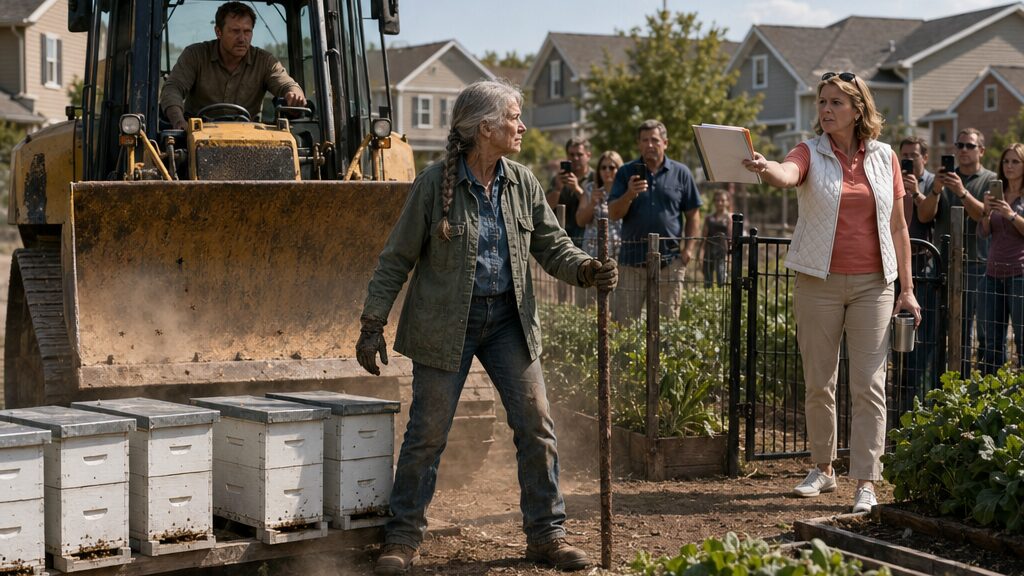
The bulldozer blade was less than twenty feet from the first beehive when Carolyn Baker stepped through the open gate and planted herself in its path.
The machine kept moving.
Its steel tracks pressed the gravel into the ground with a hard, grinding rhythm. Dust lifted around the yellow blade and drifted over the pepper beds. Behind Carolyn, six white hive boxes stood in a straight line beneath the locust trees, their entrances dark with bees.
She raised one gloved hand.
The operator leaned forward behind the glass. His mouth moved, but the engine swallowed the words. He looked toward the woman standing beside the access road, then back at Carolyn.
Margaret Wright did not wave him down.
She stood beyond the fence in a coral polo and white quilted vest, one hand wrapped around a stainless-steel tumbler. Two neighbors watched from the sidewalk. One held up a phone.
Carolyn moved three steps closer to the blade.
The bulldozer stopped.
The sudden silence felt larger than the noise had. Bees moved through it in slow, uneven loops.
The operator opened the cab door and climbed halfway down. He was broad-shouldered, sunburned, and younger than Carolyn had expected.
“Ma’am, you need to clear the work area.”
“This is not a work area.”
He glanced toward Margaret. “I have an authorization.”
“You have somebody’s authorization.”
Margaret came through the gate without asking. “Carolyn, this does not need to become dramatic.”
Carolyn looked at the machine, then at the phone recording from the sidewalk.
“It became dramatic when you brought a bulldozer.”
Margaret’s mouth tightened. “You received notice. Repeated notice.”
Carolyn knew the answer she should give. She should say she had asked for the covenant. She should say no one had shown her where the association’s authority began. Instead, an older anger rose first.
“You mailed paper to land you don’t own.”
Margaret gave the operator a small, apologetic smile, as though Carolyn were a difficult relative delaying everyone’s morning.
“The association has maintained this edge parcel for years. The agricultural structures are unapproved, the hives have generated safety complaints, and the fines remain unpaid.”
“They’re not structures. They’re beehives.”
“That distinction does not change the violation.”
Carolyn turned to the operator. “What’s your name?”
He hesitated. “Jason White.”
“Mr. White, do you have a survey?”
“I have a site plan.”
“A survey.”
He looked down at the clipboard tucked beneath his arm. “I have what the client provided.”
Carolyn walked to the nearest hive, keeping her body between the machine and the boxes. At the corner of the fence, half hidden by grass and years of soil, a rusted iron stake leaned toward the road.
She bent, brushed away the weeds, and closed her hand around it.
Margaret exhaled sharply. “That old marker has no bearing on the current association map.”
Carolyn kept her hand on the stake.
“Parcel 07-214-003B,” she said.
Jason stared at her.
“If your blade crosses this stake,” Carolyn continued, “you won’t be clearing association property. You’ll be trespassing on mine.”
A murmur moved along the sidewalk. The neighbor with the phone stepped closer.
Margaret did not look at them. “The parcel number in our system is different.”
“That is your problem.”
“It becomes your problem when you refuse lawful compliance.”
Carolyn looked at Jason. “Did she tell you the boundary was disputed?”
Margaret answered before he could. “It is not disputed.”
Jason climbed down the remaining steps. He set the clipboard on the bulldozer track and opened it.
The top page bore the association’s name, the contractor’s information, and a typed description: removal of unauthorized agricultural improvements, vegetation, fencing, and hive structures from common-edge parcel.
At the bottom was Margaret Wright’s signature.
Jason turned the sheet so Carolyn could see it.
“This is the work order,” he said. “There’s a map behind it.”
The printed map showed the subdivision streets in pale gray. A straight blue line ran along the rear lots, passed through Carolyn’s western beds, and continued directly across the row of hives.
Carolyn studied it longer than she intended.
The line was wrong. She knew it was wrong.
But she also knew why someone might believe it.
For twelve years, the HOA’s landscaping crew had mowed the strip outside her fence. For nine, its irrigation contractor had used the narrow access beside the shed. After her husband died, Carolyn had stopped correcting people when they called the strip association property. Let them cut the weeds, she had thought. Let them fix the pipe. It was one less thing she had to manage.
Margaret watched her face.
“You recognize the map,” she said.
“I recognize a mistake.”
Jason looked from the map to the rusted stake. “I’m not moving the machine until somebody verifies this.”
Margaret’s voice hardened. “You were hired to complete the removal today.”
“I was hired to work on property your association controls.”
“It does.”
“Then get me proof.”
The neighbor with the phone lowered it slightly. The other neighbor said, “Should somebody call the county?”
“The county offices are closed,” Margaret said. “This is an internal enforcement matter.”
Carolyn almost laughed. Instead, she heard the bees shifting inside the nearest box, a low living vibration beneath the lid.
A patrol vehicle turned onto the access road ten minutes later.
Margaret had called the sheriff’s department. She explained the matter first, standing beside the machine with the work authorization held neatly against her tumbler. Carolyn waited near the stake.
The deputy listened, then asked Carolyn whether she had a deed.
“In the house.”
“Survey?”
“Older than that subdivision.”
“Can you show me?”
“I can show you what I have. I can’t make a title determination for you.”
The deputy nodded. “Neither can I.”
Margaret folded her arms. “So she can simply block authorized work?”
“I’m saying this is a civil property dispute. Nobody moves heavy equipment across a contested line today.”
Carolyn felt the first release in her chest.
It did not last.
The deputy turned to her. “And you cannot stand in front of machinery again. If he had not seen you—”
“He saw me.”
“That is not the point.”
Jason closed the work folder and returned to the cab. He reversed carefully, drawing the bulldozer back from the hives until it rested outside the gate.
Margaret watched the machine retreat. Color had risen high along her cheeks, but when she spoke, her voice was measured again.
“You have forty-eight hours.”
Carolyn looked at her.
“Monday morning,” Margaret said. “Bring your records to the management office, pay the outstanding fines, and remove the hives voluntarily. Otherwise, the contractor returns after the association’s counsel confirms the map.”
“You sent him before counsel confirmed it?”
Margaret’s eyes moved briefly toward the neighbors.
“We have an established maintenance record,” she said. “Your refusal to cooperate does not erase that.”
She left through the gate. Jason gave Carolyn a troubled look before driving away.
The dust settled slowly across the vegetables.
Carolyn remained beside the iron stake until the road was empty. Then she pulled once at the marker.
It did not move.
She had not seen the original plat in years. She was no longer certain which cabinet held it, or whether her husband had taken it to the county during the drainage dispute before he died.
But she remembered the curve of the line.
It had never crossed the garden.
Chapter 2: Four Hundred Dollars for Every Week of Silence
Three unopened envelopes lay beneath a seed catalog on Carolyn’s kitchen counter.
She found them only because she was searching for the key to the steel filing cabinet in the mudroom. Each envelope carried the same return address: Cedar Grove Residential Association. Two had red bars printed above the window. The third said FINAL NOTICE.
Carolyn stood with the cabinet key in one hand and the envelopes in the other.
She had seen them before.
That was worse than forgetting them.
The first had arrived in April, when the peas were climbing and she had been replacing cracked frames in the oldest hive. She had opened it, read the words unapproved agricultural use, and set it aside after writing a request for the exact rule being cited.
The second came three weeks later. She had recognized the association logo and pushed it beneath the catalog without opening it.
The third arrived after Margaret telephoned and called her sweetheart.
Carolyn slit the envelopes with a paring knife.
The first notice demanded removal of “commercial crops, produce displays, livestock-supporting equipment, and insect colonies” from what it described as a common-edge parcel.
The second imposed a continuing fine of four hundred dollars per week.
The third stated that physical remediation could proceed at the owner’s expense.
Carolyn took the notices outside.
A basket of peppers sat on the porch table, red and green skins polished by the morning light. She laid the fine notice over them. The paper covered half the basket and left the words FOUR HUNDRED DOLLARS visible above the stems.
It looked absurd.
It also looked official.
She carried the papers to the fence line. The HOA’s printed map was attached to the final notice. The straight boundary passed through the western squash bed, cut behind the tool shed, and divided the beehives from the rest of the farm.
The map’s neatness disturbed her more than the threat. A clean line could make a lie look settled.
In the weeks before the bulldozer came, the pressure had arrived in pieces.
A man from the management company photographed the fence from the road. Margaret left a violation notice clipped to the mailbox. Two residents complained that bees were crossing into the pool area, although the pool sat nearly half a mile away. Someone reported roadside produce sales after Carolyn placed six baskets on a folding table one Saturday and accepted cash from neighbors who had asked for tomatoes.
Carolyn answered once.
She emailed the property manager asking for the recorded declaration that included her parcel. No one sent it. Instead, Margaret called.
“Sweetheart, people like you always think an old habit becomes a legal right.”
Carolyn had gripped the kitchen receiver until her knuckles hurt.
“People like me?”
“Longtime owners. Holdouts. I’m not insulting you. I’m telling you the neighborhood has changed.”
“The land hasn’t.”
“The governing expectations have.”
“Send me the rule.”
“You need to pull the plants from the common strip and relocate the hives. That is the reasonable solution.”
Carolyn had hung up before Margaret finished.
Now, seated at the same table, she saw what her silence had given them. Each unanswered notice had been entered as refusal. Each photograph had become evidence. Each week had added another four hundred dollars.
She opened the steel filing cabinet.
Property taxes filled one drawer. Insurance papers filled another. Her husband’s records were scattered through both, organized by a system that had made sense only to him: irrigation beside equipment warranties, plat references beside seed orders, handwritten measurements inside envelopes from the bank.
Carolyn worked until the light changed at the windows.
Near noon she found the old access agreement.
The document was short. Twelve years earlier, she and her husband had allowed the association’s contractor to enter a ten-foot strip along the eastern edge to repair an irrigation line serving three subdivision lots. The permission was limited to utility work and stated that it created no transfer of ownership.
Carolyn read the final clause twice.
Beneath it was her signature.
She remembered the day. Her husband had been recovering from surgery. The weeds along the road were shoulder high, the mower had broken, and the association manager had offered to keep the strip cut if the Bakers allowed the irrigation crew through when needed.
Carolyn had agreed because she was tired.
After her husband died, she had continued allowing it because the sound of the mower meant one task was being done without her.
She had never written another letter clarifying the boundary.
A quiet favor had become a maintenance history. The maintenance history had become a colored line on a management map. The line had become a bulldozer.
Carolyn sat back.
For the first time since Margaret entered the gate, anger did not protect her from embarrassment.
She had known the land was separate. She had assumed everyone else should know because the truth felt obvious to her. She had treated explanation as surrender.
At the bottom of the cabinet, beneath expired insurance policies, she found a narrow black notebook.
Her husband’s initials were pressed into the cover.
Inside were weather notes, hive counts, equipment serial numbers, and rows of parcel references written in a tight block hand. Several pages near the back were headed CEDAR GROVE.
Carolyn turned them carefully.
The subdivision plat number appeared beside a county book and page reference. Under it, her husband had written:
Exclusion parcel not carried into new digital index. Original curve follows drainage rise. Iron stake at hive corner still correct.
Below that was another note, darker and more heavily underlined:
Archive Box 19-C. Old agricultural filings. Do not rely on tax viewer.
Carolyn traced the words with her thumb.
He had known the digital records were wrong.
A later entry mentioned a conversation with the county mapping office. The clerk had promised to correct the index after the next system update. No correction letter appeared in the file.
Carolyn looked toward the window. Beyond the glass, the hive tops were visible over the garden fence.
She had blamed Margaret for acting on a bad map. Her husband had discovered the bad map years earlier, and Carolyn had inherited the knowledge along with the land.
She had done nothing with either.
The county offices would open at eight on Monday. The public records room had moved to the administration annex after the courthouse renovation, but old archive materials were still stored downstairs.
Carolyn copied the book number, page reference, and box code onto the back of the four-hundred-dollar notice.
Then she noticed one final line at the bottom of her husband’s page.
If Cedar Grove ever claims the west beds, show them the recorded exclusion—not the fence.
Carolyn closed the notebook.
The fence had never been the boundary.
And somewhere in a county archive box, the line her husband trusted was waiting to prove it.
Chapter 3: The Map That Cut Through Nobody’s Garden
“The parcel number you gave me does not exist.”
The county clerk said it without impatience, which made the words more unsettling.
Carolyn stood at the records counter with her husband’s notebook open beneath both hands. Behind the clerk, two monitors displayed tax maps in blue and gray. The administration annex smelled of copier heat and old carpet.
“Try the letter suffix,” Carolyn said. “Zero-zero-three-B.”
“I did.”
“It was active when the subdivision was recorded.”
The clerk turned one monitor slightly. A grid of current parcels filled the screen. Cedar Grove’s lots appeared in neat rectangles. At the western edge, a single shaded shape covered the access strip, Carolyn’s beds, and most of the farm.
The number attached to it belonged to the association.
Carolyn felt the same wrongness she had felt looking at Margaret’s map: a smooth digital certainty laid over complicated ground.
“My tax bill uses zero-zero-three,” she said.
“It does. Without the B.” The clerk pointed. “The current system treats your residence tract and this rear tract as one historical account, but the geometry here was consolidated during migration.”
“By whom?”
“The software migration was twenty years ago.”
“That is not a person.”
The clerk’s expression softened. “No, ma’am.”
She called someone from the mapping office.
Paul Martinez arrived carrying a legal pad and wearing an identification badge clipped to his belt. He listened while the clerk explained, then studied Carolyn’s notebook.
“Archive Box 19-C,” he read. “Where did you get this?”
“My husband.”
“Was he a surveyor?”
“He paid attention.”
Paul glanced at her, then at the screen. “These old suffix parcels were sometimes retired when records moved from paper maps. Usually the underlying deeds still control.”
“Usually?”
“I cannot give you a title opinion.”
“I didn’t ask for one.”
“You’re asking whether an HOA map is wrong.”
“I’m asking where the county put my land.”
Paul held her gaze for a moment. Then he took the notebook.
The archive room was in the basement beyond two locked doors. Carolyn waited upstairs while Paul submitted the retrieval request. Twenty minutes became forty. People came and went with birth-certificate forms, permit applications, and rolled plans.
At nine fifteen, Margaret sent an email to Carolyn’s phone.
The association’s counsel is reviewing your claims. Contractor access remains scheduled pending verification. Please provide any valid current survey before noon.
Carolyn read it twice.
The word current had been chosen carefully. Anything older could be dismissed before it was examined.
At nine thirty, Paul returned with a gray archival box and a microfilm reel.
“Your husband’s note was accurate,” he said. “But the box is not enough by itself.”
They took the reel to an old reader in a side room.
The first images were dark and blurred. Subdivision approvals flickered past: road grades, drainage easements, utility dedications. Paul advanced the film slowly, checking page numbers against the notebook.
Then a plat filled the screen.
Cedar Grove’s streets branched across what had once been open pasture. Its lots pressed against an irregular white space along the western edge. A red drafting line curved around that space, following a low rise before turning toward the road.
The line did not cross Carolyn’s garden.
It went around it.
Paul leaned closer. “There.”
Carolyn said nothing.
At the bottom of the plat, a typed exclusion described a separately owned agricultural parcel, reserved from the subdivision declaration and not subject to its private covenants unless later joined by recorded consent.
No later consent appeared in the index.
Paul printed the page. The first copy came out faint. He adjusted the machine and printed another, darker one.
Carolyn placed her husband’s notebook beside it. His hand-drawn curve matched the recorded line.
For one clean moment, relief moved through her so quickly that she had to sit down.
Margaret’s straight blue boundary was wrong. The association had been built around the farm, not over it. The hives, beds, shed, and western fence stood inside land the subdivision documents had expressly excluded.
“So the fines are invalid,” Carolyn said.
Paul did not answer immediately.
“The recorded declaration does not appear to include your agricultural parcel,” he said. “That is significant.”
“That means they have no jurisdiction.”
“It means their covenant enforcement claim is weak, possibly nonexistent. But there are other questions.”
Carolyn’s relief narrowed.
“What questions?”
He pointed to the eastern strip. “The association has maintained this area for more than a decade.”
“With permission.”
“Do you have that permission in writing?”
“Yes.”
“Good. Does it mention utilities?”
“Yes.”
“Also good. But if they claim broader access, it may still require legal interpretation.”
“They sent a bulldozer toward my hives.”
“I understand.”
“No. You understand a map.”
Paul removed his glasses. “Mrs. Baker, I am trying to keep one correct document from being treated as an answer to every problem. The county can certify what was recorded. We cannot decide a private easement dispute at this counter.”
Carolyn heard the restraint in his voice and disliked it because it was reasonable.
“What can you certify?”
“The plat. The exclusion page. The absence of recorded annexation in our index. I can also flag the parcel geometry for review.”
“And zoning?”
“That is separate.”
“Of course it is.”
Paul almost smiled. “Land records usually are.”
They returned to the counter. The clerk stamped the certified copies and pressed a raised seal into the corner. Carolyn paid for three sets.
Before leaving, she showed Paul a photograph she had taken Saturday. The rusted stake stood beside the white hives. In the background, the bulldozer blade hovered above the gravel.
Paul compared it with the curve on the plat.
“That stake may correspond to the corner,” he said. “May. You will need a licensed surveyor to establish it on the ground.”
“But it is not random.”
“No.”
That was enough for the moment.
In the parking lot, Carolyn placed the certified plat on the hood of her truck and laid the phone beside it. The old red curve and the photographed stake seemed to speak to each other across the years.
Her phone chimed.
The message had been sent not only to her but to the entire HOA board.
Margaret wrote that Carolyn had produced an obsolete historical drawing that did not reflect current maintenance boundaries, community safety obligations, or later access arrangements. She recommended that enforcement remain active until counsel completed its review.
Attached was the HOA’s digital map with its straight blue line cutting through the garden.
Carolyn read the final sentence.
Longstanding association maintenance may establish continuing rights regardless of the owner’s interpretation of older documents.
She looked again at her own signature on the access agreement in the folder beneath the plat.
Margaret’s map was wrong.
But Carolyn had given the association years of conduct it could now use to make the wrong line look real.
Chapter 4: Margaret’s Board Could Not Afford Another Failure
Sandra Allen placed Carolyn’s certified plat in the center of the conference table and tapped the curved red line with one finger.
“Why was a contractor sent before the title review was finished?”
Margaret Wright kept her eyes on the laptop in front of her. The HOA office occupied a converted room at the back of the clubhouse, with beige walls, filing cabinets, and one narrow window overlooking the pool. On the screen, the association’s digital map showed a straight blue boundary cutting through Carolyn’s garden.
“The review was substantially complete,” Margaret said.
“That is not what the attorney’s email says.”
One of the other board members shifted in his chair. The property manager stopped arranging papers and looked down.
Margaret lifted her tumbler, found it empty, and set it back without drinking.
“The contractor was sent to remove unapproved improvements from land the association has maintained for more than a decade.”
Sandra pushed the plat toward her. “And this says the land was excluded.”
“It says it was excluded when the subdivision was first recorded. It does not address later use, access, maintenance, safety obligations, or the fact that Mrs. Baker has operated commercial activity next to association property.”
“She sold tomatoes from a folding table.”
“She created traffic on a private road.”
“Three cars?”
“Seven, according to the complaint.”
Sandra leaned back. “You counted?”
“The residents counted.”
Margaret opened a folder. Inside were printed emails, photographs, and incident reports.
A child standing near Carolyn’s fence.
A line of two cars pulled partly onto the grass.
A resident’s swollen wrist with no proof that the sting had come from Carolyn’s bees.
A photograph of a delivery van blocking a mailbox.
“These are not invented concerns,” Margaret said. “A child reached through the fence toward one of the hive boxes in May. Another resident claims she was stung while walking near the common path. People are asking why the board enforces rules against sheds and trailers but ignores an agricultural operation.”
Sandra examined the photographs. “Those concerns may justify a conversation. They do not justify sending a bulldozer across an uncertain boundary.”
Margaret’s jaw tightened.
Two years earlier, a storm had flooded six homes on the lower street. Residents had complained about standing water for months. The previous board had delayed repairs while debating whether the drainage channel belonged to the county or the association.
The lawsuits nearly emptied the reserve account.
Margaret had run for president promising that no warning would sit unanswered again.
She pulled the drainage settlement from a lower drawer and laid it beside Carolyn’s plat.
“This is what hesitation cost,” she said.
Sandra read the total on the first page and went still.
“We lost the equivalent of four years of assessments because the board kept asking for more verification. Families had mold in their walls while everyone protected themselves with procedure.”
“That does not make every fast decision right.”
“No. It makes delay a decision too.”
For a moment, Sandra understood her.
Not the bulldozer. Not the fines. But the pressure beneath them.
Residents called Margaret at night when streetlights failed. They stopped her at the grocery store to complain about paint colors, loose dogs, fallen branches, and teenagers at the pool. They expected the board to prevent every inconvenience and blamed it when anything escaped control.
Margaret had become good at sounding certain because uncertainty made people louder.
The property manager cleared his throat.
“There is something else.”
He opened an email from the HOA attorney.
The message was short.
Counsel could not certify that the association possessed enforcement jurisdiction over Carolyn’s agricultural parcel. The recorded exclusion appeared valid. The maintenance history might support limited access rights, but no physical removal should proceed until a title professional reviewed the documents.
Sandra looked at the time stamp.
The email had arrived Friday afternoon.
The bulldozer had entered Carolyn’s gate Saturday morning.
“You had this before the contractor went out,” Sandra said.
Margaret folded her hands.
“The contractor had already been scheduled.”
“That was not my question.”
“The attorney said the matter required review. He did not say the association had no rights.”
“He said no physical removal should proceed.”
One of the other board members spoke for the first time. “Did the contractor see that email?”
“No,” Margaret said.
“Did we?”
Margaret looked toward the window.
Beyond the pool fence, the roofs of Cedar Grove rose in orderly rows. At the far edge, just visible between two houses, the tops of Carolyn’s locust trees broke the uniform line.
“I made a judgment call.”
Sandra closed the folder.
“You concealed a warning.”
“I prevented another board paralysis.”
“You authorized a machine to enter land we might not own.”
Margaret’s voice dropped. “And if a child had been badly stung while we spent three months discussing maps, you would be asking why I did nothing.”
The room fell quiet.
The photographs on the table did not disappear because Margaret had overreached. A child had been near the hives. Cars had blocked part of the road. Carolyn had ignored notices. There was a genuine problem beneath the wrong solution.
Sandra gathered the papers.
“We need an emergency hearing.”
“We need counsel’s review first.”
“We need both.”
Margaret looked at the other members. Their eyes moved away from hers.
The control she had built through certainty was beginning to fail in the same room where she had built it.
Later that evening, Sandra stood in her kitchen reading Carolyn’s certified exclusion again. Her husband had already gone upstairs. The house was quiet except for the refrigerator motor and the soft click of the ceiling fan.
Her phone rang.
Margaret did not greet her.
“If the fines disappear and the hives are moved, this can end without a public hearing.”
Sandra rested one hand on the counter.
“Have you spoken to Carolyn?”
“I’m going to.”
“You want her to give up the hives.”
“I want the immediate safety issue resolved.”
“And the boundary?”
“Counsel can correct the maps afterward.”
Sandra understood then that Margaret no longer believed the board’s map was certain.
The offer was not compromise. It was containment.
“You should tell the full board what the attorney wrote,” Sandra said.
“I will tell them when I have a solution.”
“That is not the same thing.”
Margaret ended the call.
Across the road, Carolyn’s kitchen light burned behind the old farmhouse windows.
Margaret stood in her own bright living room with the settlement draft open on her laptop. She deleted the phrase admission of error and replaced it with resolution made in the interest of community harmony.
Then she added one final condition.
All outstanding fines would be canceled if Carolyn removed the beehives and signed that the association had acted in good faith.
Chapter 5: The Offer That Would Save Everything Except the Truth
The settlement agreement did not ask Carolyn to admit that the HOA owned her land.
It asked her to say the HOA had been reasonable.
She read the sentence three times at her kitchen table.
In exchange for cancellation of all fines, suspension of enforcement, and withdrawal of contractor access, Carolyn would relocate the hives, cease roadside sales, and release the association from liability for actions taken in good faith.
Margaret sat across from her without removing her white vest.
“This gives you immediate certainty,” she said. “No more fines. No contractor. No legal expense.”
“And your map?”
“Will be reviewed.”
“Corrected?”
“If correction is warranted.”
Carolyn folded the agreement along its center line.
“You already know it is.”
Margaret’s hand tightened around her tumbler. “I know the records conflict.”
“The county plat does not conflict with anything recorded. It conflicts with your management map.”
“Longstanding use matters.”
“So does a warning from your attorney.”
Margaret’s eyes lifted sharply.
Carolyn had guessed, but the reaction confirmed it.
Neither woman spoke for several seconds.
At last Margaret said, “The board has responsibilities beyond your property line.”
“So do I.”
“A child reached toward those hives.”
“The fence was damaged after your landscaping crew backed into it.”
“That does not remove your duty to secure them.”
“No.”
The answer seemed to unsettle Margaret more than denial would have.
Carolyn looked through the window toward the western beds. The beehives stood beyond them in morning shadow. Her husband had placed the first two boxes there because the rise protected them from winter wind. Every spring, he had repainted the lids before the bees became active.
Relocating them would not destroy the farm.
Signing the paper might.
“You could keep the garden,” Margaret said. “Privately. This is not about taking everything from you.”
Carolyn heard the offer beneath the language: safety without truth, peace without correction.
“You sent a machine into my gate.”
“It stopped.”
“Because I stood in front of it.”
Margaret’s expression shifted, not toward remorse but fatigue.
“The residents do not see your history when they look across the fence,” she said. “They see unmanaged risk. You have not attended a meeting in eleven years. You do not answer notices. You sell produce beside a road used by families. You expect everyone to understand rules you have never explained.”
Carolyn let the words settle.
They were unfair.
They were not entirely false.
After Margaret left, the agreement remained on the table.
Carolyn carried her certified plat, the old access agreement, and her husband’s notebook to the county zoning desk. Paul Martinez read the land-use code and confirmed what the recorded documents already suggested: keeping crops and bees on the excluded agricultural parcel was lawful, subject to ordinary nuisance and safety rules.
Selling to the public was different.
“A farm stand needs administrative approval,” Paul said. “Parking plan, hours, insurance, sanitation if you add prepared goods.”
“I sold six baskets.”
“The code does not count sentiment. It counts use.”
“So proving the boundary does not settle that.”
“No.”
Carolyn almost resented him for the consistency.
“Can they make me remove the hives?”
“Not under their covenants if your parcel is outside the association. County regulations still apply. Keep the barriers maintained, post warnings, and document your hive management.”
Carolyn looked at the application packet he placed before her. It was thicker than Margaret’s settlement.
Rights, she was learning, did not remove obligations. They only determined who could impose them.
When she returned home, a pickup truck was parked outside the gate.
Jason White stood beside the rusted stake, holding a folded work order.
“I won’t keep you long,” he said.
Carolyn stopped several feet away. “You were told not to return.”
“I’m not here with the machine.”
He held out the paper.
“I reviewed the job file after Saturday. There’s something you should have.”
The work order contained the same typed authorization Carolyn had seen beside the bulldozer. At the bottom, beneath Margaret’s signature, someone had written in black ink:
Boundary disputed by adjacent owner. Client directs work to proceed using management map.
Carolyn read it twice.
“Who wrote this?”
“My dispatcher. After I called the office Friday.”
“You knew before you came?”
“I knew someone had raised a question. I was told the association had cleared it with counsel.”
“Did you ask to see that clearance?”
Jason looked toward the hives. “No.”
The admission held no excuse.
Carolyn turned the page. Attached behind it was the site-access sheet.
Her own signature appeared halfway down.
It dated from nine years earlier and authorized equipment passage along the eastern strip for irrigation repair and vegetation maintenance.
“You provided this?” she asked.
“The association included it to show access rights.”
“For utility work.”
“That is how I read it now.”
“But not Saturday.”
“Saturday, I read the summary.”
Carolyn felt heat rise behind her face. She wanted to separate his carelessness from hers, to place every mistake on the other side of the table.
Her signature would not allow it.
She had opened the gate for one purpose, then watched the arrangement expand without challenge. Crews entered to repair pipes, then to mow, then to trim brush. She had accepted the work because after her husband died, the eastern strip felt too large at the end of a day already filled with lifting boxes, checking hives, and carrying water.
She had never written new limits because writing them would have required admitting that she could not manage everything alone.
Jason looked at the rusted stake.
“Do you know whether that marker is still in the right place?”
“It matches the plat.”
“That is not what I asked.”
Carolyn crouched beside it.
Grass had grown around the iron, and years of mower blades had scarred one side. She pressed both hands into the earth and pulled. The stake shifted half an inch.
Her stomach tightened.
It had been leaning for years.
She fetched a narrow spade and the measurements from her husband’s notebook. Working from the fence corner and the old drainage rise, she reset the stake where the recorded distances placed it. The change was less than two feet, but it moved the line away from the hives and closer to the access strip the HOA had maintained.
Jason held the tape while she checked the distance again.
When they finished, the stake stood upright.
Carolyn placed the work order beside it and photographed both.
“I ignored their letters,” she said.
Jason glanced at her.
“I decided that because they were wrong, I did not have to answer. Then I let their crews use the land and expected everyone to understand the difference.”
“That doesn’t authorize a bulldozer.”
“No. But it helped put one here.”
Jason nodded once. “I should have stopped before I reached the gate.”
“You did stop.”
“After you stood in front of me.”
He left the original work order with her.
That afternoon, Carolyn scanned Margaret’s settlement, the certified plat, the access agreement, and Jason’s marked authorization. Then she wrote to the full HOA board.
She stated that she would not sign a good-faith release. She acknowledged ignoring notices and confirmed the limited access she had granted. She requested an open hearing to correct the association map, withdraw the fines, address the contractor authorization, and establish practical rules for safety and traffic.
Before sending it, she read the final paragraph aloud.
The facts should be considered together, including the ones that do not favor me.
She pressed Send.
Within eleven minutes, Sandra Allen replied.
The emergency hearing would be held Thursday evening, open to all association members.
Chapter 6: The Hearing Where Both Maps Had to Be Seen
Margaret began the hearing with a photograph of a child reaching through Carolyn’s fence.
The image filled the portable screen at the front of the clubhouse. The child’s fingers were extended toward a white beehive box beyond a bent section of wire. In the next photograph, two cars stood partly on the shoulder near the subdivision entrance. The third showed a delivery van blocking a mailbox.
“These concerns existed before the title dispute,” Margaret said. “The board’s duty to protect residents does not vanish because an owner produces an older map.”
Carolyn sat at the end of the front row with three folders on her lap.
The clubhouse was full but not crowded. Residents occupied folding chairs in uneven rows. No one applauded Margaret. No one heckled her. The room carried the tighter discomfort of neighbors who would still have to pass one another’s driveways afterward.
Sandra Allen sat with the other board members behind the long table. The HOA attorney occupied a chair at the far end, his legal pad still blank.
Margaret displayed the association’s digital map.
Its straight blue line crossed Carolyn’s western beds and placed the hives on the HOA side.
“This is the map management has relied on for years,” she said. “The association has mowed, irrigated, inspected, and maintained the edge area without objection.”
Carolyn heard the phrase without objection and felt its weight.
When Sandra called her name, she carried both maps to the table.
She placed the digital printout on the left and the certified county plat on the right.
The difference was visible even from the second row.
The blue line cut straight through the garden.
The recorded red line curved around it.
Carolyn did not begin with the bulldozer.
“I ignored the first notices,” she said.
Margaret looked up.
Carolyn continued before courage could harden back into pride.
“I received them. I believed they were wrong, and instead of correcting the record, I treated them as something beneath an answer.”
A resident near the aisle shifted.
“I also gave the association written permission to use the eastern strip for irrigation repair. After my husband died, I allowed mowing there because I could not keep up with all of it. I did not renew the agreement or explain its limits to later managers.”
Margaret’s fingers moved toward her tumbler, then stopped.
Carolyn laid the access document beside the maps.
“This is my signature. It permits utility access and vegetation maintenance. It does not transfer ownership, and it does not authorize removal of my garden or hives.”
The HOA attorney took the page and read the final clause.
Sandra asked, “Does the association dispute that language?”
The attorney answered before Margaret could.
“No. The agreement expressly preserves the Bakers’ title and limits the purpose of entry.”
A low whisper passed through the room.
Margaret leaned toward her microphone. “Longstanding conduct may still create additional rights.”
“It may,” the attorney said. “But I have not found a recorded annexation, covenant consent, or general easement covering the agricultural parcel.”
Carolyn handed him the certified exclusion page.
The small payoff she had imagined—someone declaring the HOA entirely wrong—did not arrive. Instead, the attorney examined each page and spoke with careful limits.
“The recorded plat excludes the parcel from the subdivision declaration. Based on the documents presently available, the association’s private covenants do not appear enforceable against that parcel.”
One board member asked, “What about the fines?”
“They should be suspended immediately and reviewed for withdrawal.”
Margaret’s face remained composed, but the color had drained from it.
She turned toward Carolyn. “That still leaves the safety complaints.”
“Yes,” Carolyn said.
The answer quieted the room.
She placed the photograph of the child beside the bent fence.
“The fence was struck by a landscaping vehicle in March. I repaired it after the picture was taken. I should have repaired it sooner.”
She set down a hive-management log showing inspection dates and barrier distances.
“The bees are lawful where they are. That does not excuse me from keeping children away from them.”
Next came a sketch of a roadside pull-off and a handwritten schedule for limited sales.
“The cars were mine to manage. I sold produce without applying for a farm-stand permit because I considered six baskets too small to matter. The county disagrees.”
A few residents smiled, but Carolyn did not.
“I am applying now.”
Margaret stared at the documents spreading across the table. Each admission Carolyn made removed one accusation while preserving the underlying concern. It left Margaret with less room to describe her as defiant or careless.
Sandra asked, “What happened before the contractor arrived?”
Carolyn placed Jason’s work order in front of the board.
The handwritten note was highlighted.
Boundary disputed by adjacent owner. Client directs work to proceed using management map.
The room became very still.
Margaret reached for the page. “This is a contractor’s internal notation.”
“It records his call,” Carolyn said.
“It does not establish what counsel advised.”
The HOA attorney finally wrote something on his pad.
Sandra looked at Margaret. “When did you receive counsel’s warning not to proceed with physical removal?”
Margaret did not answer immediately.
The residents in the chairs did not need the date yet. Her silence gave them the shape of it.
“Friday afternoon,” she said.
“The bulldozer arrived Saturday morning.”
“The contractor was already scheduled. I believed the maintenance history gave us sufficient authority to preserve safety.”
“Did you provide counsel’s warning to the board?”
“No.”
“Why?”
Margaret looked past Sandra toward the photographs on the screen.
“Because two years ago this association delayed a drainage repair until six homes flooded. We nearly lost the reserve fund. Every time this board hesitates, residents accuse us of negligence. Every time we act, someone says we exceeded our authority.”
Her voice remained controlled, but the strain beneath it was no longer hidden.
“I had complaints, an established maintenance record, an owner who would not respond, and a contractor prepared to remove what management identified as unauthorized structures. I chose action.”
Carolyn watched her.
There it was: not hatred of vegetables, not a simple appetite for power, but a fear of failing publicly again.
It did not excuse the choice.
It made the choice hers.
Sandra turned to the attorney. “Can the board withdraw the fines tonight?”
“Yes.”
“Can it acknowledge that the clearing authorization was improper?”
The attorney paused. “It can acknowledge that physical enforcement proceeded before jurisdiction was confirmed.”
One of the board members moved that all fines against Carolyn be withdrawn, that contractor charges not be assessed to her, and that the association fund repairs to any beds or fencing damaged during entry.
The motion passed four votes to one.
Margaret voted against it.
There was no cheering. A few residents exchanged looks. Someone in the back exhaled loudly.
Carolyn felt relief, but it did not feel like victory. The hives remained. The farm remained. Yet the photographs of cars and the child were still on the screen.
Sandra looked at her.
“What are you asking for next?”
Carolyn had prepared an answer about ownership. She folded it away.
“A surveyed line,” she said. “Marked clearly enough that no contractor or homeowner has to guess.”
She looked toward the residents.
“I will maintain the fence and hive barrier. I will carry liability insurance. I will not sell from the roadside without county approval. If a farm stand is permitted, I will limit the hours and manage parking on my side.”
Margaret’s expression sharpened. “You intend to expand commercial activity after all of this?”
“I intend to stop pretending that informal arrangements are harmless.”
The answer landed differently than Carolyn expected.
Sandra leaned forward.
“The board cannot authorize a business outside its jurisdiction,” she said. “But the association can negotiate access, traffic controls, and communication affecting its road.”
The attorney nodded. “A temporary operating agreement could be drafted without conceding authority over the parcel.”
Margaret gave a short, humorless breath. “You want her and me to write rules together.”
“I want both maps respected,” Sandra said.
She proposed a six-week trial arrangement, contingent on county approval: limited Saturday sales, off-road parking, a protected hive zone, proof of insurance, and a direct contact process for complaints. Carolyn would manage the operation. The HOA would correct its maps and stop treating her parcel as common property.
The board approved negotiations.
Outside the clubhouse, residents moved into the parking lot in small groups. Some avoided Carolyn. Two asked whether she would still have tomatoes in August. The mother of the child in the photograph quietly requested a stronger warning sign near the hives.
Carolyn wrote the request in her notebook.
Margaret emerged last.
For a moment, they stood beneath the clubhouse light with the folders between them.
“You made me admit the board was wrong in front of everyone,” Margaret said.
“You were wrong in front of everyone before you admitted it.”
Margaret looked toward the road leading past the farm.
“This market plan will fail if one car blocks the entrance.”
“Then I will move the car.”
“And if someone is stung?”
“I will document what happened and fix what is mine to fix.”
Margaret studied her, perhaps hearing the difference between that answer and Carolyn’s earlier silence.
Sandra opened the clubhouse door behind them.
“We meet tomorrow at ten,” she said. “Both of you.”
Margaret walked toward her car without answering.
Carolyn remained under the light, holding the certified plat against the old access agreement.
She had won the line on the map.
Now she had six weeks to prove that protecting it would not make everyone on the other side pay the price.
Chapter 7: Saturday Morning Beyond the Old Boundary Line
The first three cars arrived before Carolyn had finished tying the parking arrows to their stakes.
By eight fifteen, a fourth vehicle had stopped in the subdivision entrance with its hazard lights blinking. Another waited behind it. A minivan tried to turn around near the mailboxes and forced a resident to brake.
Carolyn stood inside the open farm gate with the county permit folded in her back pocket and watched the line begin to form.
Six weeks of meetings, diagrams, insurance certificates, and revisions had produced a plan precise enough to satisfy the county and fragile enough to fail in ten minutes.
“Close the entrance,” she called.
The two vendors carrying crates of peaches stopped.
One of them looked toward the road. “People are already here.”
“I can see them.”
Carolyn pulled the temporary chain across the gate.
A driver lowered his window. “The page said eight.”
“The market opens when the road is clear.”
Behind him, someone tapped a horn.
Carolyn walked past the new survey marker at the gate. The licensed surveyor had replaced the rusted iron stake with a bright capped pin and set three low posts along the curved boundary. A narrow strip of white paint connected them through the grass before bending away from the subdivision road.
On one side stood the produce tents.
On the other stood the association’s landscaped verge.
For the first time in years, the difference could be seen without opening a file.
Margaret Wright came down the sidewalk carrying a clipboard.
She wore no vest that morning, only a pale blouse and dark slacks. Her tumbler was absent. She stopped beside the line of cars and looked toward Carolyn.
“This is exactly what the residents warned about.”
Carolyn did not answer. She stepped into the road and raised both hands.
The first driver rolled forward.
“Back into the gravel pull-off,” Carolyn told him. “Then follow the cones to the field.”
“There’s no sign.”
Carolyn turned.
The temporary PARKING arrow pointed toward the subdivision instead of the field. Overnight wind had twisted the plastic stake nearly backward.
Margaret saw it at the same time.
She set down her clipboard, pulled the stake from the ground, and carried it twenty feet toward the farm entrance.
“Here,” she said. “Drivers need to see it before the turn.”
Together, they pressed it into the soil on Carolyn’s side of the marked line.
Neither thanked the other.
Once the arrow faced the right direction, Carolyn reopened the gate one car at a time. A volunteer directed vehicles into two mowed rows behind the orchard. The minivan cleared the mailboxes. The entrance opened again.
At eight thirty-seven, Carolyn removed the chain.
The first customers walked past tables of tomatoes, peppers, peaches, flowers, and jars of honey. Two white tents stood well inside the farm boundary. A rope barrier enclosed the hives beneath the locust trees, with yellow warning signs fixed at adult eye level and lower signs positioned where children could see them.
Carolyn had resisted the lower signs.
“They can read the big ones,” she had told Sandra during the planning meeting.
“Some of them are five.”
Carolyn installed the smaller signs the next morning.
By nine, the farm was full without feeling crowded. Families followed the marked path between the beds. A vendor weighed peaches on an old metal scale. Children carried paper-wrapped flowers. The hives remained quiet behind the barrier, bees lifting above the fence line before turning toward the clover field.
Carolyn moved constantly.
She checked the parking rows, restocked baskets, answered questions about the honey, and counted the number of people inside the gate. The permit allowed forty visitors at once. When the total reached thirty-eight, she stopped the next group at the entrance.
A man frowned at the chain. “There’s room.”
“The permit says forty.”
“We’re only buying tomatoes.”
“So are most people.”
Margaret stood across the road, writing something on her clipboard.
Carolyn felt the old irritation rise. For one moment she wanted to wave the man through simply because Margaret was watching.
Instead, she kept the chain closed.
Five customers left. Carolyn admitted five more.
At ten twenty, a child slipped beneath the rope near the hives.
Carolyn saw the yellow shirt first, then the small hand reaching toward a bee moving across a patch of clover.
She crossed the distance faster than she thought she could.
“Stop.”
The child froze.
A woman hurried after him, calling an apology. The boy turned, frightened more by Carolyn’s voice than by the bees.
Carolyn crouched several feet away.
“You did not do anything bad,” she said. “But this line is here because the bees need space, and so do you.”
She pointed to the painted bee path leading toward a viewing window set into an empty demonstration box.
“You can see how they build comb over there.”
The boy looked at the live hives, then at the display.
“Do they chase people?”
“Not when people respect where they live.”
His mother took his hand.
“The rope was open near the post,” she said.
Carolyn examined it. One knot had slipped.
Margaret had crossed the road and stood nearby.
Carolyn expected a citation, a warning, or at least the tightening of Margaret’s mouth.
Instead, Margaret held the post upright while Carolyn retied the rope with a double knot.
“We should use locking clips,” Margaret said.
“Yes.”
“I have some in the clubhouse storage room.”
“Bring six.”
Margaret returned twelve minutes later with a small box.
They replaced every knot.
The market continued.
Near noon, the county inspector arrived without warning. He checked the permit, the parking rows, the handwashing station, the hive barrier, and the insurance certificate displayed beneath clear plastic.
Carolyn walked beside him without arguing.
At the entrance, he measured the distance between the final parking cone and the subdivision road.
“Move this back another six feet next week,” he said.
Carolyn wrote it down.
He signed the inspection sheet and left.
Margaret had watched the entire visit from beneath a shade tree.
“Nothing to report?” Carolyn asked.
“Not today.”
The words should have sounded sharp. They did not.
At one, Carolyn rang the brass handbell beside the produce table. The permit allowed sales until one thirty, but the last new admission was at one. Customers began carrying bags and flowers toward the parking field.
Carolyn counted the remaining cars.
At one twenty-eight, one family was still choosing peaches.
At one twenty-nine, the father reached for another basket.
Carolyn covered it with a cloth.
“We are closed.”
He checked his phone. “It’s not one thirty yet.”
“It will be by the time I weigh them.”
He laughed, then accepted the two baskets he had already chosen.
At exactly one thirty, Carolyn closed the gate.
The white boundary line remained visible beneath it, curving away from the road toward the beehives. On Carolyn’s side, vendors folded tables and packed crates. On the association’s side, the street was clear.
She found Margaret watching from the upstairs window of the nearest house.
From that distance, Carolyn could not see her expression clearly. She could see a sheet of paper in Margaret’s hand.
A complaint form, perhaps. An incident report. One of the documents they had both spent months using as shields.
Margaret looked down at the empty road, the closed gate, and the final car turning out of the field.
Then she lowered the paper.
Carolyn turned back toward the farm.
The market had not restored the old quiet. Children had walked where only she and her husband once walked. Strangers now knew the shape of the beds, the taste of the tomatoes, and the location of the hives.
For years, Carolyn had believed keeping the land meant keeping everyone else outside it.
That morning had taught her something harder.
A boundary did not have to be a wall. It had to be visible, respected, and tended from both sides.
She lifted the parking sign from the soil and carried it inside the gate.
The story has ended.