They Locked the Only Alley to His Bakery, but the Old Flour Ledger Held More Than Delivery Records
Chapter 1: The Gate Was Locked Before the Ovens Cooled
The chain struck the truck’s front bumper with a hard metallic snap.
Robert heard it through his phone before Nicholas said a word.
“I’m in the alley,” Nicholas said. His voice was low and tight. “There’s a gate here.”
Robert stood beside the proofing racks with one hand still inside an oven mitt. Behind him, the morning baker slid trays of rolls toward the cooling table. The exhaust fans hummed. A timer began to chirp.
“What gate?”
“A steel one. Across the whole lane.”
Robert pulled off the mitt and walked toward the loading door. “Is it open?”
“The chain just hit the truck.”
That was answer enough.
At 5:58 a.m., the bakery should have been loading insulated crates for three restaurant stops. The first stop accepted deliveries only until 6:40. The second had a narrow loading window shared with a linen service. The third had ordered chilled pastry cream that could not sit in the truck indefinitely.
Robert pushed through the rear door and entered the alley.
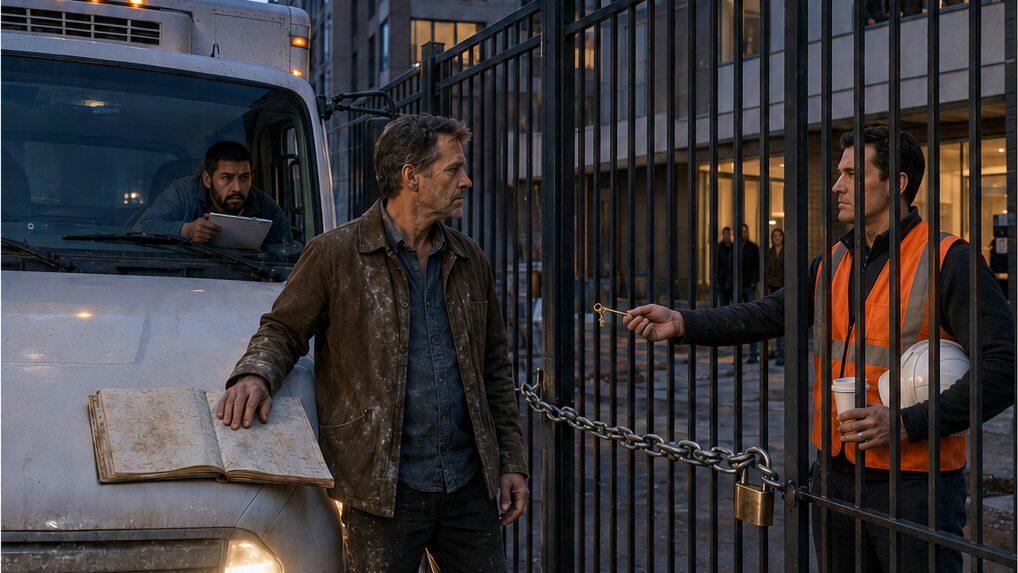
The refrigerated box truck idled twenty feet away, its headlights whitening the new steel bars. A thick chain looped through the center posts. The padlock was clean enough to reflect the truck’s beams.
Beyond it, construction lights glowed around the redevelopment site. Workers in reflective vests moved between stacks of lumber and a temporary office trailer. A few condominium windows above the alley were already lit.
Nicholas climbed down from the cab.
“They put it in overnight,” he said. “I came through here yesterday.”
Robert walked to the gate and wrapped his fingers around one of the bars. The metal was cold and freshly painted. A printed site-security notice had been wired to the center, but the wind had folded one corner over the text.
“Did anyone call you?”
Nicholas shook his head.
Robert looked toward the workers. “Who’s in charge?”
A man near the office trailer lifted a coffee cup without moving from where he leaned against a pickup. Jason White wore a clean orange vest over a quarter-zip sweater, his hard hat tucked under one arm. Robert had met him twice during preliminary work. Both times Jason had used the phrase temporary inconvenience.
Robert crossed to the gate.
“Jason.”
Jason took a slow drink before coming over.
“You installed this across my access.”
“We secured the site,” Jason said. “We had equipment stolen from another project last month.”
“My truck has to get through.”
“I understand. That’s why we made keys.”
Jason reached into his vest pocket and held up a brass key.
For one second Robert saw only the practical answer. Take it. Open the lock. Get the truck moving.
Then he saw the construction company’s logo stamped into the key tag.
“Who controls the lock?” Robert asked.
“We do. But you’ll have access.”
“Until you change it.”
“We’re not trying to stop your business.”
“You already did.”
Jason glanced at the truck as if it were parked badly rather than trapped. “You can coordinate delivery windows with my office. We have workers and residents using this alley now. We can’t have unrestricted traffic.”
“This is the only loading access to my building.”
“It’s a shared lane.”
Robert felt heat rise under his collar. “Shared does not mean you lock me out.”
Behind him, the truck’s refrigeration unit shifted pitch. A warning tone sounded from inside the cab.
Nicholas turned quickly. “Temperature alarm.”
Robert’s phone rang.
The restaurant purchasing manager’s name appeared on the screen.
He answered. “Robert Miller.”
“We’ve been waiting twenty-five minutes.”
“Our truck is blocked. I’m working on it.”
“We start service prep at seven.”
“I know.”
“You told me this route was reliable.”
“It is.”
There was a pause that made the lie visible.
“We’re canceling today’s order,” the manager said. “And I need to review the standing account.”
Robert looked at Jason through the bars.
“Give me fifteen minutes,” Robert said.
“We don’t have fifteen.”
The line ended.
Nicholas had opened the passenger door and was checking the temperature log. “We’re already above the preferred range.”
Jason held the key out again. “This solves the immediate problem.”
Robert stared at it.
If he took it, Jason could say access had been provided. If he accepted coordination as the new rule, every future delivery would depend on another company’s permission. But the rolls cooling inside did not care about legal distinctions. Neither did the restaurant that had just canceled.
Robert turned toward the bakery.
Ashley stood in the rear doorway, arms folded over her apron.
“What happened?” she asked.
“Gate.”
“I can see that.”
“We lost the first account.”
Her face changed, not dramatically, but enough. “For today?”
“They said they’re reviewing the contract.”
Ashley looked past him at the truck. “Then take the key.”
Robert did not answer.
He went inside, crossed the production floor, and unlocked the lower drawer beneath his desk. From under supplier statements and old payroll envelopes, he pulled out the flour ledger.
Its canvas cover had darkened at the corners from years of use. Flour had settled into the cloth grain. The first pages held batch weights and oven notes. Later sections tracked delivery departure times, route changes, spoilage, and missed pickups.
He carried it back outside and placed it on the truck’s hood.
Jason’s key lay in his open palm.
Robert opened the ledger to that morning’s date and wrote:
Gate locked across delivery alley. Truck arrival 5:55 a.m. Access denied.
He checked the truck dashboard through the windshield and added the time.
6:14 a.m.
“What are you doing?” Jason asked.
“Keeping the record.”
Robert photographed the clock, then the padlock, then the full width of the gate with the truck behind it.
“Nick, save the refrigeration log. Don’t reset anything.”
Nicholas looked at Jason, then at Robert. “Got it.”
Jason lowered his hand. “You’re choosing to let product sit when you have a key available.”
“I’m choosing not to accept permission for something I already have a right to use.”
“That right may be subject to site controls.”
“Then show me where it says you can lock it overnight.”
Jason’s expression hardened. “Do not cut the chain or enter around the barrier. Unauthorized entry will be treated as a security violation.”
The workers nearby had stopped pretending not to listen.
Robert closed the ledger.
He wanted to tell Jason exactly how many years that truck had used the alley. He wanted to list every Christmas morning, every storm, every restaurant that opened on time because his staff had been there first.
Instead, he picked up the ledger and said, “Send me that warning in writing.”
By 7:40, two more deliveries were missed. Nicholas rerouted what he could through the front street, but the curb was too narrow for safe loading, and a city bus blocked the lane twice. One refrigerated order had to be returned to the cooler. Another was written off.
Ashley reorganized the production schedule without asking permission. She sent the packaging assistant home an hour early, then came into Robert’s office carrying a clipboard.
“How long is this going to last?”
“It won’t.”
“That isn’t a time.”
“I have documents.”
“Where?”
Robert opened the file cabinet and pulled the folder marked ALLEY ACCESS.
It felt too light.
Inside was an old survey, two faded photographs, and a county recording receipt from eleven years earlier.
The recorded easement itself was gone.
Robert checked the folder again, as if paper might appear beneath paper.
Ashley watched him.
“You said you had documents.”
“I do.”
“You have a receipt.”
Robert held the county slip between two fingers. A recording number was stamped along the bottom.
Somewhere, a complete document still existed.
But not in his office. Not in the folder he had trusted for years. And not where he could put his hand on it before the next morning’s truck arrived.
Chapter 2: Eleven Years of Deliveries Written in Flour Dust
“The easement is not indexed under your bakery,” the municipal records clerk said.
Robert stood at the counter with the county receipt flattened beneath his palm.
“It was recorded with my property papers.”
“It references your property, but the burden is on the neighboring parcel.” The clerk turned her monitor slightly, though the screen showed only lines of codes Robert could not interpret. “That means the document is indexed there.”
“So you found it?”
“I found the recording number. Retrieval may take a little time.”
“How much?”
The clerk looked at the wall clock.
It was 10:47 a.m.
“Today, probably.”
Robert kept his hand on the receipt. “I need to file for emergency relief.”
“That would be through the court.”
“I know. I need the document first.”
“I understand.”
Her tone was not dismissive. That made it worse. She understood and still could not move faster than the system allowed.
Robert stepped away from the counter and called Sarah Lewis.
She answered on the third ring. “Tell me you found the recording number.”
“I found the number. They’re pulling the document.”
“Good.”
“They say today.”
“That’s better than no record.”
“My truck runs again tomorrow at six.”
“Then send me everything else now. Photos. Messages. Delivery logs. Any evidence of continuous use.”
Robert looked down at the flour ledger under his arm.
“I have eleven years.”
There was a brief silence.
“Bring it.”
When he returned to the bakery, Ashley was in the office.
Not at the door. Inside.
Three supplier invoices lay across Robert’s desk in a straight row. Each bore a red past-due stamp.
He stopped.
“You went through my drawer?”
“I went looking for the customer call list because you said you’d contact everyone.”
“I was going to.”
“You left without doing it.”
Robert set the ledger down. “I had to get the easement.”
“And I had to tell six people whether they should come in tomorrow.”
“They should.”
“With what hours?”
“The regular schedule.”
Ashley touched the top invoice. “We owe the flour supplier three weeks.”
“We’re current enough.”
“That is not a phrase.”
“The restaurant payments clear Thursday.”
“One of those restaurants just canceled.”
“For one morning.”
“They said they were reviewing the account.”
Robert took the invoices and stacked them. “I am handling it.”
Ashley gave a short laugh without humor. “You are hiding it.”
On the production floor, the mixer started with a deep mechanical thump. The sound filled the office for several seconds.
Robert looked through the glass at the morning baker pouring flour into the hopper. The employees moved with the certainty of people who believed tomorrow’s work already existed.
“I didn’t want them worried,” he said.
“They’re already worried. They saw a truck sit in the alley for two hours.”
“I can fix the access.”
“Access isn’t the only thing in this room.”
Robert slid the invoices into the drawer.
Ashley’s jaw tightened. “Don’t do that.”
“I need the customer list.”
“I called them.”
He looked up.
“I told them there was a temporary access disruption,” she said. “I did not promise times we can’t guarantee.”
“That could make them leave.”
“Finding out after their delivery doesn’t come makes them leave.”
She walked out before he could answer.
Robert opened the ledger.
At first, the pages were only what they had always been: numbers, shorthand, smudges. Two hundred sandwich rolls. Forty-eight croissants. Route A departed 5:52. Cooler running warm. Rear alley icy. Delay twelve minutes.
Then he began seeing a pattern.
For eleven years, almost every weekday carried a departure time between 5:40 and 6:10 a.m. Notes identified construction detours, snow removal, trash pickups, and temporary closures. In the margin beside one summer date, his father had written: Neighbor notified—keep lane clear before six.
Robert ran his thumb over the faded ink.
The ledger had never been intended as evidence. That gave it weight.
Sarah arrived shortly after noon, still wearing her court shoes and carrying a legal pad.
She opened the ledger at random, then another page, then another.
“These entries are contemporaneous?”
“Written the same day.”
“By you?”
“Mostly. Some by my father. Ashley started making production notes after he died.”
Sarah nodded. “This helps show continuous use and operational dependence. It does not replace the easement.”
“I know.”
“And it doesn’t prove every type of access is unrestricted.”
“I know that too.”
“Do you?”
Robert leaned back.
Sarah removed her glasses. “You are angry because someone locked a gate. The court will ask whether the lock was unreasonable under the document, not whether Jason White behaved badly.”
“He knew our schedule.”
“Can you prove that?”
“I told him.”
“When?”
“Two weeks ago. In the alley.”
“Anyone there?”
“A foreman. Maybe two workers.”
“Did you write it down?”
Robert looked at the ledger.
The page from that date held dough temperatures and a note about replacing a refrigerator gasket. The right-hand margin was blank.
His phone rang before he could answer.
The records clerk said, “Mr. Miller, we have your document.”
He and Sarah drove back together.
The easement copy arrived warm from the printer, twelve pages long, bearing the county stamp and signatures from a prior owner. Robert read the first paragraph twice before the language settled into meaning.
A perpetual right of ingress and egress for commercial loading, deliveries, service vehicles, employees, and invitees.
It extended to successors and assigns.
Robert exhaled.
Sarah pointed lower on the page. “That’s the good part.”
“There’s a bad part?”
“There’s always another part.”
On page seven, under maintenance and shared use, the document allowed reasonable coordination during repairs, emergencies, and safety operations, provided access was not materially obstructed.
Robert read the phrase again.
“Materially obstructed. They locked the whole gate.”
“Yes.”
“So we win.”
Sarah did not answer.
“What?”
“The company will say it offered a key. It may argue this was coordination, not denial.”
“The key came after the truck was trapped.”
“That matters.”
“They demanded scheduled hours.”
“That matters too.”
Robert felt the certainty that had been building narrow into something harder.
Sarah tapped the page. “The easement is strong. The ledger is useful. But if Jason can show advance notice, an agreed procedure, or a genuine safety restriction, the judge may order a compromise instead of full open access.”
“There was no agreement.”
“Was there a notice?”
Robert thought of an email from Jason’s office. Something about staging changes and delivery coordination. He had read it while standing over a failed batch of brioche. He remembered deciding it did not require a response.
“I got a schedule request.”
Sarah’s eyes stayed on him. “Did you answer it?”
“No.”
“Did you object in writing?”
“No.”
She folded the copy of the easement and placed it beside the flour ledger.
“Then the next question is not whether they warned you,” she said. “It is what their warning actually said—and what your silence allowed them to claim.”
Chapter 3: The Notice Hidden Inside a Friendly Schedule Request
Sarah placed Robert’s unanswered email beside Jason’s formal security plan.
The two documents told different stories using nearly the same words.
Jason’s email, sent twelve days earlier, was titled Upcoming Site Coordination. It asked Robert to provide delivery windows “so access controls may be implemented with minimal disruption.” It mentioned equipment theft, resident complaints, and insurance requirements.
It did not mention a locked steel gate.
Jason’s security plan, dated three days later, stated that neighboring commercial users had been notified and that controlled access procedures had been coordinated.
Robert read that sentence twice.
“They turned my silence into agreement.”
“They turned notice into coordination,” Sarah said. “Those are not the same thing. But you gave them room.”
“I was working.”
“That is not a legal response.”
“It wasn’t a legal question.”
“It became one.”
Robert looked away.
Through Sarah’s office window, traffic moved steadily past the courthouse square. Everything outside appeared to have ordinary access to where it was going.
Sarah slid a yellow pad toward him. “Write down the conversation you had with Jason. Exact location. Approximate time. Who might have heard it. What you said about the morning route.”
Robert began.
He remembered Jason standing near a stack of temporary fencing. He remembered saying the alley had to stay clear before seven. He remembered Jason nodding while looking at his phone.
What he did not remember was Jason promising anything.
“Did he say the gate would remain open?” Sarah asked.
“No.”
“Did he say there would be a gate?”
“No.”
“Did you ask?”
Robert stopped writing.
“No.”
Sarah sat back. “This is still a strong emergency case. But it is not as clean as you thought.”
By midafternoon, Robert and Sarah met Jason in the condominium lobby.
The redevelopment project occupied the building next door, but several units in the completed wing were already occupied. The lobby smelled of new carpet and drywall dust. A temporary sign directed residents around a covered section of floor.
Jason arrived with a binder and the site foreman.
Linda Moore joined them from the mailroom. Robert recognized her as the condominium association president, though they had only spoken twice before. She carried a folder marked RESIDENT SAFETY.
“I asked Linda to sit in,” Jason said. “The association has been receiving complaints about predawn truck noise and unsecured access.”
Linda gave Robert a small, guarded nod. “We’re trying to balance everyone’s use.”
“My use was balanced until yesterday,” Robert said.
Jason opened his binder. “The project increased risk. We have tools, materials, and residents moving through the same corridor.”
“You installed a locked barrier across a recorded commercial easement.”
“We provided a key.”
“After blocking the truck.”
“And we offered scheduled access going forward.”
Sarah spoke before Robert could. “A revocable key controlled by your company is not the same as unobstructed ingress and egress.”
Jason turned a page. “The easement allows reasonable safety coordination.”
“It prohibits material obstruction.”
“That is a matter of interpretation.”
Robert heard the phrase for what it was: not denial, not admission, but delay.
Linda looked between them. “I was told the bakery approved controlled morning access.”
Robert faced her. “I did not.”
Jason said, “You received notice.”
“That notice asked for delivery times. It did not say you would lock the alley.”
“We couldn’t finalize controls until the insurance review.”
“Then why does your plan say we coordinated?”
The site foreman shifted his weight.
Jason closed the binder halfway. “Because you were notified and did not object.”
Robert felt the argument trying to pull him into volume. He opened his mouth, then saw Sarah’s hand resting flat on the table.
He took out the flour ledger instead.
He opened to the date of Jason’s email. The page showed departure times, oven temperatures, and a note about a late cream delivery. The margin where he might have recorded an access agreement was blank.
“This book has eleven years of alley conditions,” Robert said. “Closures, delays, repairs, snow, trash pickup, everything that changed a route. There is no gate agreement because there was no gate discussion.”
Jason glanced at it. “Your private notes do not define site safety.”
“No. But your private plan does not create my consent.”
Linda’s expression changed slightly.
“What exactly were residents told?” Sarah asked her.
Linda tightened her grip on the folder. “That the gate would secure the construction area and preserve emergency access.”
Robert looked toward the glass lobby doors. Through them, the steel gate was visible at the far end of the alley.
“Preserve whose emergency access?” he asked.
Linda frowned. “The fire lane.”
The room went quiet.
Sarah turned to Jason. “The alley is designated for emergency entry?”
“It functions as one of several service corridors.”
“That was not disclosed in your filing.”
“There has been no filing.”
“There will be.”
Jason’s jaw tightened. “The gate has a fire-department override.”
“Did it yesterday morning?” Robert asked.
Jason did not answer immediately.
Linda opened her folder. “The association approved the concept because we were told emergency access would remain automatic.”
The site foreman looked at Jason.
That look mattered more than any admission.
Linda pulled out a printed email. “I need to check what was represented to us.”
Jason’s voice sharpened. “Linda, the system is compliant.”
“Then you won’t mind me checking.”
Robert had expected her to defend the gate. Instead, she was reading the email line by line, her mouth set in the way of someone discovering that her own caution had been used as cover.
“Can you send those communications to Sarah?” Robert asked.
Linda hesitated.
Residents passed through the lobby behind them. A woman carrying groceries slowed as she saw the group around the table.
Linda lowered her voice. “I will retrieve the association chain. But I am not agreeing that the bakery has unlimited use. We have real complaints.”
“About what?”
“Backup alarms. Idling. Drivers leaving the rear door open. One truck blocked the pedestrian path last month.”
Robert knew which morning she meant. Nicholas had waited four minutes while a linen van cleared the turn.
“We can address that,” he said.
“You should have addressed it before.”
The criticism landed because it was fair.
Robert had treated the alley as his routine because it had always worked. He had recorded delays, temperatures, and departure times, but not the complaints that came from people living above the route. He had assumed continued use would explain itself.
Sarah gathered the documents.
“We are filing for emergency relief today,” she said. “We’ll ask for unobstructed access and a temporary safety protocol.”
Jason looked at Robert. “You could avoid all of this by accepting the key.”
Robert closed the ledger. “You could avoid it by opening the gate.”
Jason’s phone vibrated. He checked the screen, then stepped away.
Linda remained at the table.
“I thought you had agreed,” she said.
“I thought telling him our delivery time was enough.”
“It usually isn’t, once committees and insurers get involved.”
Robert glanced at her folder. “Will you send the emails?”
“Yes. But I want the noise addressed in writing.”
“You’ll have it.”
Linda gave him a look that suggested she would believe that when she saw it.
Back at the bakery, Ashley had moved the next morning’s production schedule to a whiteboard. Half the planned items were crossed out.
“We’re cutting volume,” she said. “Until the truck can move.”
“We may have an emergency order tonight.”
“May?”
Robert set the easement copy beside the ledger.
Ashley read the first page, then the safety clause. “So they had some right to coordinate.”
“Not to lock us out.”
“That’s not what I asked.”
Robert met her eyes.
“No,” he said. “It isn’t.”
His phone rang.
The fire inspector introduced himself and said he had received conflicting information about the gate, emergency override, and designated service access.
“When can you inspect?” Robert asked.
“Tomorrow morning.”
“Before six?”
A pause.
“My first available time is eight-thirty.”
By then, the second delivery route would already be due to leave.
Robert looked through the rear window at the padlock hanging in the alley.
The legal question might be answered. The safety question might be answered too.
But neither authority was coming before the next truck.
Chapter 4: An Emergency Order Could Not Restore a Lost Morning
“The judge will read it tonight only if you sign this as a sworn statement.”
Sarah laid the loss summary across the filing counter and turned the final page toward Robert.
The courthouse had gone quiet around them. A clerk waited behind glass with one hand resting near the closing drawer. The statement listed the delayed truck, the canceled order, the spoiled pastry cream, Nicholas’s waiting time, and the labor Ashley had cut from the next shift.
At the bottom, beneath the signature line, was a sentence confirming that the figures were complete and truthful to the best of Robert’s knowledge.
“They’re estimates,” he said.
“Then mark them as estimates.”
“The restaurant hasn’t terminated the account.”
“Not yet.”
“And I don’t know whether the cream is a total loss.”
Sarah held out her pen. “Then don’t inflate it. But don’t minimize it either.”
Robert looked at the numbers. They seemed too small beside the feeling of the morning and too large beside the balance in the bakery’s checking account.
The clerk glanced at the wall clock.
Robert crossed out one figure, wrote a lower one, and signed.
Sarah gathered the statement, the easement, photographs of the gate, Nicholas’s refrigeration log, and copied pages from the flour ledger.
“You understand what we’re asking for?” she said as they approached the filing window. “Immediate unobstructed access. Not damages. Not a final ruling on every clause.”
“I understand.”
“If the judge grants it, the company can still challenge the scope later.”
“I understand.”
Sarah gave him a level look. “You keep saying that when what you mean is you don’t have time for the rest.”
The clerk stamped the packet.
Robert watched the date and time appear in blue ink. “Tonight, I don’t.”
Back at the bakery, the production floor was dim except for the mixing area. Ashley had sent the packaging assistant home and was scaling down the morning order sheet.
Nicholas stood beside the loading door with his jacket zipped and his route clipboard under one arm.
“You’re still here,” Robert said.
Nicholas did not smile. “We need to talk about tomorrow.”
“We’re filing for an order.”
“That isn’t a route plan.”
“The gate may be open.”
“And if it isn’t?”
Robert looked toward the alley window. The steel bars divided the view into narrow vertical strips.
“We load through the front.”
Nicholas shook his head. “Not with the truck. Not safely.”
“We’ll use hand carts.”
“For how many crates?”
“As many as we can.”
Nicholas put the clipboard on the worktable. “I sat there for two hours today.”
“You’ll be paid.”
“When?”
Robert answered too slowly.
Nicholas’s eyes dropped to the desk drawer where Ashley had found the invoices.
“I need delay pay in writing,” he said. “If I’m told to report and the truck can’t move, I get paid for the wait. I’m not taking that risk again on a promise.”
Robert felt the words as disloyalty before he recognized them as fear.
“You’ve worked here six years.”
“That’s why I know what happens when a restaurant refuses a delivery.”
“I have never missed your pay.”
“I didn’t say you had.”
The distinction left nowhere comfortable to stand.
Ashley set down her marker. “Write it.”
Robert looked at her.
“A one-page policy,” she said. “Report time, delay time, refrigeration checks, who decides whether the route is canceled.”
“We don’t need a policy for one gate.”
Nicholas picked up his clipboard. “Then you don’t need me tomorrow.”
He walked toward the front of the bakery.
“Nicholas.”
He stopped but did not turn.
Robert looked at Ashley. Her face held no victory, only exhaustion.
“Give me ten minutes,” Robert said.
The policy took twenty-three.
By the time Nicholas signed it, Sarah called.
“The judge granted temporary relief.”
Robert stood so quickly the chair rolled into the filing cabinet.
“Full access?”
“Immediate ingress and egress during normal delivery operations. The company may use reasonable safety personnel, but it cannot require prior approval or keep a locked barrier in place.”
Robert closed his eyes.
Across the room, Ashley had stopped writing. Nicholas watched him from beside the loading door.
“We got it,” Robert said.
No one cheered.
Sarah continued. “The sheriff’s office will serve it before dawn. I’m emailing the signed order now.”
A printer near the office wall woke and began feeding paper.
Robert took the pages while they were still warm.
At the bottom was the judge’s signature.
For nearly a minute, the bakery felt possible again.
Then the phone rang.
The restaurant purchasing manager did not bother with small talk.
“We’ve reviewed the route issue,” she said. “We’re terminating the standing pastry account effective immediately.”
“The order was granted. The alley will be open tomorrow.”
“Our kitchen can’t depend on a court order arriving between deliveries.”
“This was one morning.”
“It was the morning we needed you.”
Robert looked at the signed order in his hand.
“We’ve worked together eight years.”
“And I’m not saying never. I’m saying we need another supplier now.”
The line ended before he could answer.
Ashley watched him fold the order once, then flatten it again.
“They canceled,” she said.
He nodded.
The legal victory sat on the desk beside three past-due invoices.
At 5:40 the next morning, the sheriff’s deputy arrived in the alley with a copy of the order tucked beneath one arm. Sarah stood beside Robert near the loading door. Nicholas waited in the truck, engine running, the new delay policy clipped to his route board.
Jason came through the construction trailer door wearing a hard hat and carrying a tablet.
The deputy handed him the order.
Jason read the first page without expression.
“You’re required to provide unobstructed ingress and egress,” the deputy said.
“We are providing it.”
He turned his tablet toward them.
Mounted beside the gate was a new black keypad. The chain and brass padlock were gone, replaced by an electronic latch and a red emergency-release box.
Jason entered a code. The gate slid open six feet, then stopped.
“The bakery has a dedicated access code,” he said. “The system logs entry and exit for site security. It satisfies the order.”
Sarah stepped closer to the opening. The truck was wider than the cleared space.
“Open it fully,” she said.
“This is the approved operating width.”
Nicholas leaned out of the cab. “Not for this truck.”
Jason looked at the deputy. “The order prohibits a locked barrier. This is controlled access with emergency override.”
The deputy read the second page again.
Robert stared at the keypad’s green light.
The padlock was gone. The gate was technically open. And the truck still could not pass.
Chapter 5: The Association Emails Changed Who Had Been Misled
Nicholas entered the code a second time while the sheriff’s deputy watched.
The keypad flashed green.
The gate moved three inches, shuddered, and stopped.
A small display showed ACCESS COMPLETE.
Nicholas looked through the windshield at Robert. “Complete for what?”
Jason stepped toward the control box. “It needs to reset.”
“You said it was operational,” Sarah said.
“It was tested.”
“With this truck?” Robert asked.
“With site vehicles.”
The deputy looked at the narrow opening, then at the refrigerated box truck. “Can you override it?”
Jason removed a key ring from his belt and unlocked the control panel. He pressed two buttons. The gate rolled another foot before stopping again.
A construction worker appeared behind it, pushing a pallet jack across the track.
“Clear the lane,” Jason called.
The worker pulled the pallet back.
Jason tried once more. This time the gate opened fully, but only after nine minutes, three code attempts, and a manual override.
Nicholas checked the clock on the dashboard. “That’s not access. That’s an appointment with a machine.”
The deputy wrote something in a small notebook.
Jason’s voice remained controlled. “The system is new. There are commissioning issues.”
“The court order took effect last night,” Sarah said. “Your commissioning issues are now our obstruction.”
At eight-thirty, the fire inspector arrived. He tested the emergency-release box, measured the clear width, and asked for the gate’s approval records. Jason produced a binder thick with manufacturer specifications but thin on local sign-offs.
Linda Moore joined them carrying a stack of printed emails.
Several condominium residents stood near the lobby doors. They did not gather as a crowd so much as drift into positions where they could hear without admitting they were listening.
The fire inspector pointed toward the red release box. “This override requires a key.”
“Held by management and the construction office,” Jason said.
“And fire personnel?”
“We submitted the lock information.”
“Submitted is not the same as approved.”
Jason looked toward Linda. “The association authorized the security concept.”
Linda opened her folder. “Based on what we were told.”
The group moved into the condominium meeting room while Nicholas completed the delayed route. Robert kept the flour ledger under his arm.
Jason stood at one end of the table. Sarah sat beside Robert. The fire inspector remained near the door, reading the site plan.
Linda placed two emails side by side.
“This one went to the association board,” she said. “It says the bakery’s delivery requirements had been incorporated into the gate schedule.”
Robert looked at the date. Two days after Jason’s vague coordination request.
Linda lifted the second page. “This one says the neighboring commercial user supported controlled access during construction.”
“I never supported it,” Robert said.
Jason folded his arms. “You were notified. You did not object until installation.”
“That is not support,” Linda said.
Her tone had changed. The careful distance was gone.
Jason turned to her. “We were working under a compressed schedule. The gate was required by our insurer after the equipment theft.”
“At another project,” Sarah said.
“The insurer did not distinguish.”
Linda continued reading. “The board asked whether emergency access would remain automatic. Your response says yes.”
“It does.”
“The inspector just said it requires a management key.”
Jason glanced toward the fire inspector. “The final department hardware is pending.”
“So it was not automatic when you told us it was.”
No one raised a voice.
That made each sentence land harder.
Robert opened the flour ledger to the date he had spoken with Jason in the alley. He placed the page beside the email chain.
“I wrote down the delivery delay that morning,” he said. “And the warning I gave your foreman three days later.”
Jason looked at the entry.
Robert had forgotten it because it was not written in the blank margin Sarah had first examined. It appeared at the bottom of the next page, squeezed beneath the flour order:
Told construction: lane must remain open 5:30–7:00. No lock, no staging.
Linda read it aloud.
Jason’s face remained still, but the site foreman shifted beside the wall.
“You received this warning?” Sarah asked him.
Jason answered carefully. “I was aware the bakery preferred that window.”
“Required,” Robert said.
“Preferred,” Jason repeated. “We had to balance competing users.”
“Then why did you tell the residents we agreed?”
Jason looked at the table rather than at Linda. “Because I believed access through a code satisfied the concern.”
“That code didn’t move the gate,” Nicholas said from the doorway.
No one had heard him return.
He held up his route clipboard. “First stop refused the chilled order. We missed the window.”
Robert felt the new loss before he calculated it.
The fire inspector closed the site-plan binder.
“Until the override and clear-width issues are resolved, the gate remains fixed open,” he said. “No automated closure. No keyed emergency release as the only override.”
Jason stepped forward. “That leaves an active construction site unsecured.”
“Then post personnel.”
“That costs money.”
“So does blocking a designated access corridor.”
The inspector wrote the temporary order and handed copies to both sides.
For the first time, the gate stood open without Robert asking permission.
The relief lasted less than an hour.
Jason came into the bakery kitchen just after noon. He was alone and carried a plain envelope.
Ashley was portioning dough at the steel table. She looked at Robert but did not leave.
“I’d prefer to discuss this privately,” Jason said.
“She stays,” Robert replied.
Jason placed the envelope beside the flour ledger.
Inside was a proposed settlement.
The company would pay enough to cover the documented spoiled product, Nicholas’s delay time, and nearly three weeks of payroll. In exchange, Robert would accept controlled delivery hours between 5:30 and 6:30 a.m., use the electronic gate code, and agree not to disclose the settlement terms or allege intentional obstruction.
Sarah’s name did not appear anywhere.
“This is not an admission,” Jason said. “It’s a practical solution.”
“You want the gate closed again,” Robert said.
“Outside your approved hour.”
“And if a supplier is late?”
“You coordinate.”
“If the keypad fails?”
“You call the site office.”
“At five-thirty in the morning?”
“We can establish coverage.”
Ashley wiped flour from her hands and picked up the first page.
“How much?” she asked.
Robert told her.
Her fingers stopped moving.
The number would not restore the restaurant account. It would not erase the invoices. But it would cover payroll.
Jason watched Robert. “You can protect your people today. Or you can spend months arguing over language written eleven years ago.”
He left the agreement on the table and walked out.
Ashley read every page.
Robert waited for her to say it was unacceptable.
Instead, she looked at the payroll figure again.
“If we don’t take this,” she said, “what exactly are you asking us to risk?”
Chapter 6: The Key Would Save Payroll and Lock Everyone Else Out
Sarah slid two agreements across the mediation table.
The first was Jason’s confidential settlement, revised by the construction company’s attorneys. The payment would arrive within five business days.
The second preserved continuous access and established temporary traffic controls, but it left compensation unresolved and allowed the company to challenge the easement’s scope at a later hearing.
“One pays quickly,” Sarah said. “The other protects the route.”
Robert looked at Ashley and Nicholas seated beside him.
Across the table, Jason sat with an insurance representative and the site foreman. The brass key from the first morning rested near Jason’s legal pad.
The mediation room had no windows. Every sound seemed too close: paper sliding, a pen clicking, the air-conditioning vent ticking as it cooled.
Jason pointed to the first agreement. “You get certainty. We get predictable site control. The residents get reduced noise exposure.”
“And everyone who uses the alley after six-thirty?” Robert asked.
“Coordinates through management.”
“So the right becomes permission.”
“The right becomes orderly.”
Sarah touched the second agreement. “This one creates a monitored open-access period during normal bakery operations, emergency override without management approval, advance notice for temporary closures, and compensation talks after access is stabilized.”
The insurance representative shook his head. “Unrestricted commercial movement through an active site is not acceptable.”
“Then define the restriction,” Sarah said. “Don’t invent ownership through a keypad.”
Robert had spent the night calculating.
Payroll. Flour. Insurance. Fuel. Refrigeration service. His own mortgage transfer, which he had postponed twice.
The confidential payment would let him breathe. That fact embarrassed him more than the gate had.
Ashley spoke quietly. “Before we decide, they need to know.”
Robert knew who she meant.
The morning baker and packaging assistant were back at the bakery, working reduced production. The other employees believed the court order had solved the access problem. Robert had allowed them to believe it because hope improved a shift.
He turned to Nicholas.
“You asked for delay pay because you thought I might not be able to cover it.”
Nicholas met his eyes. “I asked because I didn’t know.”
Robert nodded.
Then he told them.
He told Ashley and Nicholas the actual checking balance. He listed the overdue invoices. He explained that losing the restaurant account had removed nearly a fifth of their weekly wholesale revenue. He told them he had already stopped paying himself in full.
Ashley stared at him.
“How long?” she asked.
“Two months.”
“You let me schedule overtime last week.”
“We needed the production.”
“You let me promise people regular hours.”
“I thought the restaurant payment would clear.”
“You thought,” she said. “And the rest of us worked inside what you didn’t say.”
Jason looked down at his papers.
Robert continued because stopping would turn the confession back into concealment.
“If we refuse the money, I may have to reduce hours. If the company challenges the easement, compensation could take months. I cannot guarantee that everyone stays whole.”
Nicholas folded his arms. “Can you guarantee it if you take the settlement?”
“For a few weeks.”
“And after that, we wait for a code every time somebody’s late.”
Ashley looked at the confidential agreement. “The gate becomes normal.”
“Yes.”
She sat back.
“I threatened to quit yesterday,” she said. “I was angry. I’m still angry. But I’d rather know the truth and lose four hours than be promised forty you can’t pay.”
Nicholas nodded once. “Same.”
Robert looked at them, uncertain whether the feeling in his chest was relief or shame.
The mediator called a break.
Jason asked Robert to remain.
When the others left, he closed the door.
“I knew the gate could become an issue,” Jason said.
Robert waited.
“We had a delivery penalty on the redevelopment loan. If the security package wasn’t installed by Monday, the owner started charging us daily.”
“You knew about the easement.”
“I knew there was recorded access. Counsel said the coordination clause gave us room.”
“Counsel told you to lock it?”
“No.”
The answer came too quickly.
Jason rubbed the edge of his legal pad. “I told the crew to install it because delaying meant reporting another missed milestone. This project already had two.”
“So you reported the gate finished.”
“Yes.”
“And told the residents we had agreed.”
“I believed the key would make the distinction irrelevant.”
“You needed it to be irrelevant.”
Jason looked up. For the first time since the alley confrontation, the confidence seemed less like arrogance than something held together by effort.
“If I admit we knowingly obstructed access, I’m off the project,” he said. “Maybe out of the company.”
“That is not my bakery’s debt.”
“No. But it is why I’m offering enough money to keep you operating.”
Robert picked up the brass key.
It was light, ordinary, and cut for a lock that no longer hung on the gate.
“You keep calling this access,” he said. “It only opens what you control.”
He returned to the mediation table and placed the key beside the unsigned confidential agreement.
When the others came back, Robert pushed the first agreement away.
“No confidentiality,” he said. “No delivery window that ends our right outside one hour. We’ll use trained spotters during construction. We’ll reduce backup alarms where safety allows. We’ll give regular schedules and notify you of changes. But the gate remains open during operating access, and the emergency override cannot depend on your office.”
The insurance representative began to object.
Robert raised one hand.
“We will document every entry. Every delay. Every complaint. The same way we documented eleven years of deliveries.”
He opened the flour ledger and turned it toward Ashley.
“Starting today, this does not stay in my desk.”
Ashley looked at the pages, then at him.
Sarah began writing revisions.
Jason’s attorney joined by speakerphone and rejected the proposal within ten minutes. The company reserved the right to challenge the easement and threatened to delay all compensation until final resolution.
Robert listened without interrupting.
When the call ended, Sarah said, “They may follow through.”
“I know.”
“You may get no payment for months.”
“I know.”
This time, he meant it.
Back at the bakery, Robert gathered the employees around the production table. He showed them the ledger, the unpaid invoices, the reduced-order sheet, and the temporary court order.
No one thanked him for his honesty.
The morning baker asked how many hours would be cut. The packaging assistant asked whether health coverage was safe. Ashley answered some questions before Robert could, using figures he had never previously shared.
By late afternoon, they had a two-week schedule.
Robert would take no salary. Ashley would manage production volume and customer notices. Nicholas would receive delay pay under the written policy. Everyone else would lose some hours, but no one would be dismissed immediately.
The plan was imperfect enough to be real.
As Robert closed the office, the restaurant purchasing manager called.
“We heard the alley is open,” she said.
“It is under a temporary order.”
“We’re not restoring the standing account.”
Robert gripped the phone more tightly.
“But we’ll consider one test delivery,” she continued. “Two weeks from Friday. Same product list. Same arrival window. One failure and we’re done.”
Robert looked through the rear window.
The steel gate stood open. Construction cones narrowed the lane, and a worker in a reflective vest guided a utility vehicle through.
“What time?” Robert asked.
“Six-ten. Not six-eleven.”
He wrote the date in the flour ledger.
For the first time, Ashley leaned over his shoulder and read it as he wrote.
The court had given them a route.
Now they had to prove they could still be trusted to use it.
Chapter 7: The First Truck Through Did Not Erase What the Gate Cost
The steel gate stood open, but Nicholas would not start the truck.
He sat behind the wheel with both hands resting at ten and two, watching the alley through the windshield. The engine idled. The refrigeration unit held its steady mechanical note. On the passenger seat, the route clipboard showed the test delivery in block letters.
6:10 A.M. ARRIVAL. NO EXCEPTIONS.
Robert stood beside the open driver’s door.
“We have nine minutes before departure,” he said.
Nicholas did not look at him. “Who has authority if that gate closes?”
“Ashley, me, and the site safety supervisor.”
“That isn’t what the protocol says.”
Robert took the folded agreement from his jacket pocket.
Two weeks of negotiations had turned the simple right to drive through an alley into six pages of procedures. The permanent agreement protected continuous commercial access during bakery operations. Temporary stoppages required advance notice. Emergency override could not depend on construction management approval. Any delay longer than three minutes triggered written documentation and paid driver time.
Robert read the relevant line aloud.
“Bakery operations manager, owner, or designated route coordinator may direct immediate reopening.”
Nicholas finally looked at him. “Who is the route coordinator?”
Robert glanced toward the loading door.
Ashley stood there with the flour ledger open against one forearm. She had already written the truck number, cooler temperature, departure target, and the names of the employees who checked the order.
“You are,” she said to Nicholas.
He studied her face.
“That in writing?”
Ashley turned the ledger around.
Under the morning’s entry, in her compact handwriting, she had added:
Nicholas Lopez—designated route coordinator for test delivery.
Nicholas looked at Robert.
Robert nodded. “You call it.”
The tension left Nicholas’s shoulders by a fraction. He checked the mirrors again.
“Then we leave at five fifty-nine.”
The bakery had spent the previous night preparing the order twice.
Ashley had rejected the first batch of croissants because the lamination showed uneven butter lines. The morning baker had remade them without argument. Robert had checked the chilled pastry cream at midnight, at two, and again at four-thirty until Ashley told him to stop opening the cooler.
The restaurant had restored nothing yet. This was one delivery, one chance to prove that the bakery could arrive at 6:10 with the correct temperature, quantity, and product quality.
No one said what failure would mean. They all knew.
At 5:59, Nicholas released the brake.
The truck rolled toward the alley.
Robert walked beside it for the first few yards, though there was no practical reason to do so. The gate remained fully open. Reflective cones marked the truck path, and a construction spotter stood near the turn.
The brass key Jason had first offered now hung unused on a hook inside the bakery office. The electronic keypad remained mounted beside the gate, but its screen was dark.
Ashley closed the ledger and followed Robert outside.
“Let him drive,” she said.
“I am letting him drive.”
“You’re walking next to the door.”
Robert stopped.
Nicholas continued without him.
The truck’s rear wheels passed the gate track cleanly. For a few seconds, the alley looked ordinary again.
Then a construction utility vehicle backed out from behind a stack of drywall and stopped across the truck’s turning path.
Nicholas hit the brake.
The refrigeration unit’s tone did not change, but Robert felt the first morning repeat itself in his body: the trapped truck, the lost minutes, the restaurant manager’s silence before canceling.
The construction spotter raised both hands.
The utility driver looked over his shoulder, confused.
Nicholas lowered his window. “Move the vehicle.”
The driver pointed toward the far side of the alley. “I’m unloading.”
“You’re blocking recorded access.”
“It’ll take two minutes.”
Nicholas checked the dashboard clock.
5:59 and thirty-eight seconds.
Robert stepped forward.
Before he could speak, Jason came out of the site trailer.
He wore no coffee cup this time.
“What happened?” he asked.
The spotter explained.
Jason looked at the utility vehicle, then at the truck, then at Nicholas.
“Move it now,” he told the driver.
“I’ve got material on the forks.”
“Set it down and clear the lane.”
The driver hesitated only long enough to make the choice visible. Then he lowered the load and pulled forward.
Jason walked to the truck’s window.
“You have clearance,” he said.
Nicholas did not thank him. He checked the mirrors and moved.
The truck turned onto the street at 6:00 exactly.
Robert watched until the rear lights disappeared.
Jason remained beside the open gate.
“The protocol works when everyone follows it,” he said.
Robert looked at the abandoned load sitting in the alley.
“It worked because you made someone move.”
“That is part of following it.”
It was the closest Jason had come to admitting what the dispute had always been about: not whether safety mattered, but who had the power to decide whose work stopped.
Jason glanced toward the bakery.
“I heard your compensation claim was approved in part.”
“Documented spoilage and delay time.”
“Not the restaurant account.”
“No.”
The redevelopment company had agreed to pay for the spoiled product, Nicholas’s documented waiting hours, and temporary traffic-control costs. It had not accepted responsibility for future revenue or reputational damage. Sarah had advised Robert that pursuing the rest could cost more than it returned.
Jason shifted his hard hat beneath one arm.
“I did not expect it to become this,” he said.
“You installed a gate.”
“I expected you to take the key.”
Robert thought of the first morning. The brass key in Jason’s palm. The alarm sounding from the truck. The part of him that had nearly accepted because the dough, employees, and customers could not wait for principle.
“You expected me to make your decision workable,” Robert said.
Jason looked toward the street where the truck had gone.
“Yes,” he said.
He did not apologize.
Robert had stopped expecting him to.
Inside the bakery, Ashley entered the departure time in the flour ledger and left a blank line beneath it for the arrival confirmation.
Robert reached for the book, then stopped.
“You keep it,” he said.
Ashley looked up. “For today?”
“For operations.”
The ledger had lived in his father’s hands, then in Robert’s desk. Its stains held years of decisions made by whoever believed he alone had to remember everything.
Ashley set it on the shared worktable instead of carrying it into the office.
At 6:08, Nicholas called.
Robert answered before the first ring finished.
“I’m at the loading entrance,” Nicholas said.
“Two minutes early.”
“They’re making me wait for the dock.”
Robert looked at the clock.
“Do they know it’s the test?”
“They know.”
A metal tray clattered in the kitchen. Everyone nearby stopped working.
At 6:09, Nicholas said, “Dock is clear.”
Robert heard the truck reverse alarm through the phone, then the hiss of the parking brake.
At 6:10, Nicholas said, “We’re in.”
No one celebrated.
Ashley released a breath and returned to the proofing schedule. The morning baker lifted the next tray. Robert stood with the phone against his ear while Nicholas checked temperatures and crate counts with the restaurant receiver.
There was still room for failure.
At 6:24, Nicholas called again.
“They accepted everything.”
Robert closed his eyes.
“Account restored?”
“Trial basis. Two deliveries a week for thirty days.”
It was less than half the former volume.
“Understood,” Robert said.
“The manager said not to be late Friday.”
“We won’t.”
Nicholas was quiet for a moment.
“Route coordinator says we need a backup driver named before then.”
Robert smiled despite himself. “Put it in the ledger.”
When the truck returned, Nicholas parked without incident. Ashley recorded the arrival time and cooler temperature. Beneath the entry, she wrote the next test date and left space for notes from anyone assigned to the route.
Robert spent the rest of the morning reviewing the reduced payroll schedule with the staff.
His own salary remained suspended. Two employees had fewer hours than before. The lost restaurant volume would take months to replace, if it was replaced at all. Nicholas’s trust had returned only far enough for written procedures. Ashley accepted the operations-manager role after making Robert agree that she would see bank balances, supplier aging reports, and customer risks before they became emergencies.
Linda stopped by near noon with a revised condominium notice.
It listed quiet-loading practices, resident complaint procedures, delivery hours, emergency override rules, and a direct number for Ashley rather than only Robert.
“I still expect the backup alarms addressed,” Linda said.
“We ordered a directional alarm,” Ashley replied.
Linda nodded. “That will help.”
She looked through the rear window at the open gate.
“The residents were wrong about some things.”
“So was I,” Robert said.
Linda studied him, perhaps deciding whether he meant the noise or something larger.
Then she folded her copy of the notice and left.
At the end of the shift, Robert went into his office.
The old hook beside the filing cabinet held the brass key. He removed it, turned it once in his hand, and placed it in the top drawer—not hidden, not displayed, simply kept.
He carried the flour ledger back toward his desk out of habit.
Ashley had already cleared a space for it on the shared operations table.
Beside it sat the route clipboard, the supplier calendar, the new access protocol, and a printed cash-flow sheet with figures Robert would once have locked away.
He set the ledger down.
The cover opened slightly under its own weight. Flour dust lifted from the edge and settled across the table.
Ashley entered the next morning’s departure time.
Nicholas added the name of the backup driver.
Robert wrote nothing.
For the first time in years, the bakery’s future was recorded where everyone responsible for it could see.
The story has ended.