The Scent of Command
Part I — The Summons
By the time Captain Adrien Vale was dragged through the palace at midnight, every man in the corridor already knew something had gone wrong. They only did not know what humiliation had occurred badly enough to pull a field commander off the war line and bring him home under guard.
He passed generals waiting beside maps, couriers soaked from sleet, aides clutching dispatch boxes with white knuckles. The whole palace smelled of wet wool, tallow smoke, and panic.
Then the doors opened, and they brought him not into the war room but into the Emperor’s private bath chamber.
Steam drifted beneath the chandeliers. Silver basins stood untouched on marble tables. Fresh linen lay folded in exact stacks no one had dared move. Two footmen stared at the floor as if prayer might save them. On a chair near the fire sat an uncorked crystal bottle no servant would ever have touched without permission.
Adrien stopped.
For one second, the years between this room and the front dissolved.
The Emperor stood half-dressed near the screen, shirt open at the throat, dark hair damp from a failed wash, fury gathered so tightly in his face it looked almost like illness. He had not changed much. Still compact. Still immaculate even in disorder. Still capable of making silence feel like treason.
His gaze landed on Adrien.
“Out,” he said.
No one moved.
He did not raise his voice. “I said out.”
The room emptied so quickly one servant nearly dropped a basin. Only Adrien remained.
The door shut. Steam hissed softly. Somewhere beyond the chamber walls, boots hammered over stone, and a bell rang once in the yard below.
Adrien stood at attention.
“Majesty.”
The Emperor looked at him with a hatred too precise to be simple anger. Shame lived inside it too, colder and sharper.
“They sent for you because Bernard collapsed,” he said. “And because no one in this palace can remember the order of ordinary tasks.”
Ordinary. Adrien looked at the untouched linen, the set razors, the untouched perfume bottle, and nearly laughed.
“Yes, Majesty.”
The Emperor’s mouth hardened. “Do not make me explain myself.”
“I would not.”
That, finally, loosened something. Not kindness. Recognition.
He stepped aside from the basin. “The water is wrong.”
Adrien crossed the room before he could think better of it. He dipped his fingers into the silver basin. Too cool. Someone had overcompensated for the Emperor’s temper and gone cautious.
He moved to the stove, added boiling water by increments, stirred with the ivory ladle, tested again with the inside of his wrist.
The old fluency was still there. That unsettled him more than if he had forgotten.
Behind him the Emperor said, “Your army is three hours from departure.”
Adrien did not turn. “I know.”
“The offensive proceeds at dawn.”
His hand tightened on the ladle.
The reports from the northern road had been bad all day. Bridges half-frozen. Supply wagons delayed. Scouts returning with gaps where certainty should have been. Men worn down to the bone after six days of forced advance. He had argued for delay before he was summoned. He had not expected to be brought here to warm bathwater.
“Yes, Majesty,” he said carefully.
The Emperor watched him. “You will remain until morning.”
As an order, it was simple. As meaning, it was a chain.
Adrien set the ladle aside. “If the army marches at dawn, I should be with my division.”
“You are where I require you.”
There it was. Not strategy. Not counsel. Service.
A smaller man might have looked ridiculous standing there in half-fastened trousers and a damp undershirt while the empire waited for orders. The Emperor never looked ridiculous. Even stripped down to inconvenience, he carried rank the way others carried a sword.
Adrien began unfolding the linen.
“How long has it been?” the Emperor asked.
“Three years.”
“And yet you remember.”
Adrien laid out the towels in their proper order. “Some duties stay in the hands.”
A pause. Then, very softly, “That is what I was afraid of.”
Adrien said nothing.
He knew the sequence. Bath first, but only after the mirrors were cleared of steam. Razor warmed, never cold. Shirt cuffs laid inside-out for turning. The cleanest linen nearest the skin. Gloves last. Scent last of all.
A kingdom’s worth of artillery could be waiting, and still this had to be done correctly.
“Why me?” Adrien asked before he could stop himself.
The Emperor gave a short, humorless breath. “Because I will not be seen unfinished.”
The words landed harder than a confession.
Adrien had once believed proximity to greatness was a kind of honor. In those years as aide-de-camp, he had learned the Emperor’s sleep habits, his tempers, the way he could recite troop numbers from memory while buttoning a cuff. He had also learned what no one said aloud: that the man who could decide the deaths of ten thousand soldiers could be undone by a badly folded collar, a stale coat, the wrong soap, the smell of old sweat caught in wool.
At first it had seemed a quirk.
Then it had become a system.
Now, with dawn coming and the city holding its breath, it felt like something worse.
Adrien lifted the crystal bottle from the chair just long enough to move it away from the heat. The rosemary-citrus scent seeped upward even through the stopper, clean and bright and wrong for a city bracing for blood.
The Emperor saw his hand pause on the glass.
“Yes,” he said. “That as well.”
Outside, a courier shouted for General Sorin Vallec.
Inside, steam slid up the mirrors and vanished.
Adrien set the bottle down very carefully and said the only thing a man could say when history had already become intimate.
“As you command.”
Part II — The Old Sequence
The bath chamber had once felt to Adrien like the hidden center of the empire.
Not because of luxury. Luxury was everywhere in the palace, though winter and war had starved it thin. It was because this room turned a man into an image, and the image marched out to move armies.
He poured the water. The Emperor stepped in without ceremony, as if both of them had agreed to pretend the last three years had not happened. Steam climbed his shoulders. The fire snapped. Adrien kept his eyes on his hands.
“Your people are nervous,” the Emperor said.
“My men are tired.”
“Tired men obey certainty.”
“Only for so long.”
The Emperor leaned back into the water. “Long enough is all command has ever meant.”
Adrien reached for the shaving cloths.
He had heard that tone before. Calm, polished, almost gentle. It was the tone the Emperor used when he had already made up his mind and wished everyone else to mistake inevitability for reason.
“You should postpone until midday,” Adrien said.
The Emperor closed his eyes. “I did not summon you for strategy.”
“No. You summoned me because the valet fell.”
A silence stretched.
When the Emperor opened his eyes, they were mild enough to be dangerous. “Careful.”
Adrien bowed his head once. “Majesty.”
That was how it had always gone between them. A line approached, sensed, and stepped away from just before blood.
He worked through the sequence. Towels heated and replaced before they cooled. Soap rinsed away completely. No trace left on the skin. The Emperor’s breathing steadied under the order of it. Adrien hated that he could feel it happening. Hated that his own hands still remembered how to bring it about.
Someone knocked once.
The Emperor did not answer. Adrien opened the inner door a fraction.
Mara Duret stood there in her dark physician’s coat, hair pinned back too tightly, a leather case under one arm. Her face gave away nothing except exhaustion.
“He refused broth,” she said quietly.
“He is bathing.”
“I can see that.”
Her eyes flicked over Adrien’s shoulder into the room, then back to him. Recognition passed between them—not surprise, exactly, but the acknowledgment of an old and unwelcome fact.
“So they called you,” she said.
“So they did.”
She lowered her voice further. “When you can step out, do.”
Before he could answer, another figure appeared in the corridor beyond her: broad shoulders, silver at the temples, ceremonial coat still immaculate at an hour when decent men looked ruined. General Sorin Vallec.
He did not like being made to wait.
“Captain Vale,” Sorin said, though the title sounded like an accusation. “I wondered whether the rumors were true.”
Adrien kept the door mostly shut. “General.”
“His Majesty requires privacy,” Sorin said. “And speed.”
“Then we are in agreement.”
Sorin’s gaze lingered on Adrien’s hands, on the steam behind him, on the fact of his presence in that room at all. It was a political gaze: measuring what could be used later.
“The offensive cannot absorb delay,” he said.
Adrien said, “Then perhaps it should not be built on one.”
Sorin smiled without warmth. “Still a soldier. Good. Do remember which duties are yours tonight.”
The corridor swallowed them both again, Mara with a last look that felt less like warning than appeal.
Adrien shut the door.
Inside, the Emperor had heard enough to be amused.
“Sorin hates any form of weakness he cannot salute,” he said.
“And yet he serves it when it is useful.”
That drew the smallest hint of a smile. “You have not softened at the front.”
“No.”
Adrien helped him from the bath. The linen around the Emperor’s shoulders was soft enough to seem obscene against the world beyond the walls. He dried him carefully, because carelessness in this room had never been forgiven.
“Do you know why officers stand straighter when I enter?” the Emperor asked.
Adrien reached for the warmed razor. “Fear.”
“No. Fear bends men inward. I mean the first second, before fear settles in. They straighten because order has entered the room.”
Adrien tested the blade with his thumb. “You think a polished boot can steady an army.”
“I know it can.”
The Emperor tilted his head back for the shave. Adrien laid the cloth at his throat and tried not to think about all the mornings years ago when this closeness had felt almost normal.
“A commander who smells of sweat and stale wool tells his men that chaos has already won,” the Emperor said. “A commander who arrives clean tells them the world can still be arranged.”
Adrien drew the first line of the razor down his cheek.
This was the most dangerous part. Not because of the blade. Because the room had narrowed now to skin, breath, and trust.
“And if the arrangement is false?” Adrien asked.
The Emperor did not flinch. “Then it is still useful.”
The words stayed in Adrien’s hand.
He finished the first side. Warm cloth. Second pass. No wasted motion.
He remembered being twenty-four and thinking the Emperor’s discipline was a kind of moral force. He remembered believing that if a man mastered himself so completely, his victories must mean something larger than appetite.
Three years at the front had burned that faith down to a colder thing. But not all the way. That was the danger. Not hatred. Attachment.
By the time the shave was finished, the Emperor looked more like himself and less like a man dragged from a private crisis. That was the alchemy of the room. It worked. That was why it was unforgivable.
A courier arrived before the shirt was buttoned.
This time the Emperor allowed the interruption. The man entered, mud-spattered to the knees, face white with cold. He knelt, presented a dispatch tube, and stared fixedly at the carpet.
The Emperor broke the seal and read.
Nothing changed in his face.
Adrien had spent enough time studying him to know that meant something had.
“What road?” he asked.
“The marsh approach, Majesty.”
“And the reserve?”
“Delayed.”
The Emperor nodded once. “Go.”
The courier hesitated. “Majesty—the scouts say the enemy is not where—”
“Go.”
The man left as if he had escaped an execution.
Adrien watched the folded paper in the Emperor’s hand.
“Bad?” he asked.
The Emperor set it aside. “Incomplete.”
“Convenient.”
“Common.”
He stood while Adrien fastened the collar.
“Majesty,” Adrien said, keeping his voice level. “If the line is uncertain and the reserve is delayed—”
“I know what the report says.”
That stopped him.
The Emperor met his eyes in the mirror. “Continue.”
Adrien obeyed. Because obedience was easier than understanding what that answer meant. Because the shirt still needed cuffs. Because the jacket still needed settling. Because somewhere beyond the chamber, dawn was advancing whether he liked it or not.
When he reached for the outer coat, he realized his own hands were no longer steady.
Part III — What Cleanliness Covers
Mara found him in the linen passage, where servants passed like ghosts carrying fresh shirts and hot water no one else was trusted to deliver.
“You look ill,” she said.
“I am standing in a palace at midnight dressing a man for a battle he should not fight.”
“Then you are healthier than the rest of us.”
She moved closer, keeping her body angled so anyone watching would think this was about medicine and not treason.
“It has worsened,” she said. “These last six months especially. The rituals. The intolerance.”
“To what?”
“To anything that reminds him he is flesh.” Her tired eyes held his. “Old fabric. Cold broth. Sour air. Sweat in a collar. He notices everything now.”
“He always noticed everything.”
“Not like this.”
A servant hurried by carrying folded undershirts in both arms. Mara waited until the footsteps faded.
“You were away when the fever wards opened after Valmere,” she said. “He inspected them once. Only once. Three men died while speaking to him. One vomited on the floor. The smell stayed in the corridor for days.”
Adrien said nothing.
Mara went on. “Since then, he has needed order with the ferocity of a man holding back a flood with his hands.”
“That sounds like sympathy.”
“It is diagnosis.”
“And your diagnosis is?”
“That if he cannot perform control, he feels he does not possess it.”
Adrien looked toward the chamber door.
“Many men in command feel that way.”
“Yes,” Mara said. “Most do not build a theology out of hot water and linen.”
She slipped a sealed packet from her sleeve.
“This came through the medical train because the courier thought I would have easier access.”
Adrien took it. Field wax. Northern command mark.
“You have read it?”
“I am not a fool.”
He broke the seal.
The report was brief, written in the clipped hand of an officer who had stopped hoping language could save him. Enemy artillery had shifted farther east than expected. The marsh route was worse than mapped. The exposed flank would take fire before the reserve could arrive. Advance at dawn under present assumptions: catastrophic probable losses.
Adrien read it twice.
“When did this arrive?”
“Twenty minutes ago.”
“And Sorin?”
“Knows enough to call it uncertainty.”
Of course he did.
Adrien folded the report. For one sharp second, the palace corridor seemed to tilt under him. His division was in that line. Men whose names he knew. Men who still joked in muddy camps because they had not yet learned how quickly the world could decide they were expendable.
“He has to see this,” Adrien said.
Mara’s expression did not change. “He has seen versions of it all evening.”
Adrien stared at her.
“You think no one has told him?” she said. “Adrien, this palace is drowning in information. That is not the same thing as truth mattering.”
He felt something cold move through him.
Sorin appeared at the end of the corridor as if conjured by the thought of him.
“Captain.”
Adrien did not bother hiding the packet. “General.”
Sorin’s gaze dropped to the seal, then lifted again. “A great many dramatic documents are born at night.”
“This one concerns men who may be dead by noon.”
“All campaigns concern that.”
Mara said flatly, “The flank will break.”
Sorin turned to her. “Physicians should confine themselves to bodies.”
She did not blink. “I am trying.”
His attention returned to Adrien. “You were summoned to steady His Majesty before command, not to infect him with battlefield panic.”
Adrien took one step closer. “Panic is what happens when men discover they have been marched into a lie.”
Sorin’s face did not move. “What men require from a sovereign in the hours before battle is not confession. It is shape.”
There it was again. The same faith dressed differently. The same belief that appearance was not surface but structure.
“He is not a statue,” Adrien said.
“No,” Sorin said. “He is something harder. A man required to look inevitable.”
The words sickened him because they were not entirely false.
Sorin’s voice lowered. “Listen to me carefully. If you embarrass him, if you interrupt the morning with anything that resembles hesitation, this army will feel it before the first trumpet sounds. Weakness travels faster than gun smoke.”
“And slaughter travels faster than pride.”
Sorin’s eyes sharpened. “You think this is about pride? This is about continuity. Armies survive because they can still imagine tomorrow. Strip certainty from the top, and you kill morale before the enemy has the courtesy to try.”
Mara said, “That is a polished way to describe sacrifice by vanity.”
Sorin almost smiled. “Call it what you like, doctor. The state is built from what men can bear to see.”
He left them with that, boots ringing over stone.
For a moment none of them spoke.
Then Mara said, very softly, “If you finish the ritual, you are not merely dressing him. You are helping him cross the last bridge.”
Adrien looked down at the report in his hand.
The paper was damp where his fingers had tightened on it.
In the chamber beyond the door, a servant struck flint for fresh candles. The brief hiss of the flame sounded like a fuse taking light.
Part IV — The Wound Beneath the Uniform
The most intimate part of the sequence had always come late, when the room quieted and the world narrowed to the distance between blade and throat.
This time it came after the report.
Adrien returned to find the Emperor seated before the mirror in his linen shirt, collar open, one sleeve fastened and the other undone. Dawn had not yet broken, but the black of the windows had begun to thin into iron.
“You were gone too long,” the Emperor said.
“A courier.”
“Yes.”
Adrien set the report on the dressing table between them.
The Emperor looked at the seal and said, “Later.”
“It concerns the dawn offensive.”
“It concerns every offensive. That is the nature of reports.”
Adrien did not move.
Something in the room shifted. Not rank. Not yet. But the Emperor’s face lost a degree of polish, enough to reveal the fatigue underneath.
“Finish,” he said.
Adrien reached for the comb instead.
He worked in silence, ordering damp hair, fastening the last cuff. The old closeness of the room grew unbearable. The Emperor watched him in the mirror.
“Do you remember Castevin?” he asked suddenly.
Adrien’s hand paused.
It had been a campaign fifteen years earlier, long before Adrien’s service, though every officer knew the story in pieces: mud swallowing cannon wheels, rain that turned tents into infected rags, fever faster than bullets.
“I know of it,” Adrien said.
The Emperor looked past his own reflection, as if the mirror had become weather.
“The rain lasted eleven days,” he said. “Nothing dried. Not leather, not straw, not blankets. Men began to smell wrong before they began to die. That was the first sign. Not the coughing. The smell.” His voice stayed calm, which made it worse. “Do you know what disorder is, Adrien? It is not noise. It is the hour when a camp ceases to smell like men under command and begins to smell like decay.”
Adrien did not answer.
“I walked the tents,” the Emperor went on. “Mud to the knees. Sour wool. blood gone sweet at the edges. Sheets that had not been changed because no one could change them. Officers pretending discipline still existed while fever took it out from under them.” He looked at his own hands. “By the time battle came, half the army had already been defeated by filth.”
The word hung in the warm air.
“So yes,” he said. “I dislike stale linen. I dislike old broth. I dislike collars worn twice and rooms that smell used. Men laugh at such things until they have watched a command rot from its edges inward.”
Adrien heard himself say, “And so you made cleanliness into law.”
The Emperor’s mouth gave the faintest twitch. “Not law. Habit.”
“Doctrine.”
That drew his eyes back up.
For the first time that night, what showed there was not anger. It was something rarer and more dangerous: a flash of naked recognition.
“Perhaps,” he said.
Adrien looked at him—not at the sovereign, not at the image, but at the man who had taken one campaign’s stench and built a life against ever smelling it again.
Compassion arrived before he wanted it. That was the worst part.
Because the wound was real. The doctrine was still monstrous.
The Emperor saw whatever changed in his face and said quietly, “Do not pity me. I am not confiding. I am explaining efficiency.”
Adrien let out a breath that almost became laughter. “Of course.”
“I have no use for men who appear to be losing the world before they have even entered it,” the Emperor said. “My officers know that when I arrive, I have mastered myself. That matters.”
“Enough to march men into bad ground?”
The room cooled.
There it was at last. Not hinted. Spoken.
Adrien picked up the report and placed it directly into the Emperor’s hand.
The Emperor unfolded it, read, refolded it.
No surprise. No crack in the expression. Nothing.
Adrien felt the floor drop away under him.
“You knew,” he said.
The Emperor set the report aside with the care one might grant an unimportant note. “I know the risks.”
“The flank may collapse.”
“Yes.”
“The reserve will not reach them.”
“Probably not.”
Adrien stared at him. “Then stop it.”
The Emperor stood. He was shorter than Adrien by a little, but in moments like this height belonged to no one else in the room.
“If I halt before dawn,” he said, “Sorin’s rivals smell weakness by breakfast. The staff begins to wonder what else I do not trust. The officers carry that uncertainty to the men. The men carry it into the field tomorrow and next week and next month. A retreat can save bodies and still break an army.”
“And an advance can save your image and bury ten thousand men.”
The Emperor’s jaw tightened.
“You think I do not understand cost because I require clean linen,” he said. “You mistake the form of my discipline for its substance.”
“No,” Adrien said. “I think you have taught yourself to call fear by cleaner names.”
For one terrible second, he thought the Emperor would strike him.
Instead he said, in a voice almost too quiet to hear, “Every man at the top does that. The only difference is whether he does it well enough that others survive him.”
Adrien could not speak.
That was the reversal. Not madness. Not vanity. Clarity.
The ritual had never been about preparing to choose wisely.
It was about preparing to wear the choice without visible fracture.
Outside, somewhere in the courtyard, cavalry drums began to test the dawn.
Part V — The Last Drop
By the time the first line of light appeared beyond the windows, only one act remained.
The uniform sat perfectly on the Emperor’s body. Dark coat. White breeches. Gloves waiting. Boots polished to a muted black shine. The room had become what it was always meant to be: a forge that left no soot on the metal.
The crystal bottle stood between Adrien and the end of the night.
Rosemary and citrus.
He had always thought the fragrance strange when he first served here. Too bright. Too alive. But that was the point. It cut through wool, leather, horse, smoke. It arrived before the Emperor’s voice did and made every room feel ordered by his entry.
The Emperor held out one hand for his gloves.
Adrien fitted them on.
Neither man mentioned what had already been said.
A knock at the outer door.
Sorin entered without waiting to be invited. His eyes swept the room in one practiced motion: coat fastened, collar true, gloves on, no visible disorder. Then he saw the uncapped bottle still untouched and stopped.
“Majesty,” he said. “The balcony in three minutes.”
“Then let them wait three.”
Sorin’s gaze shifted to Adrien. A warning. A calculation. He understood more than most about how much could hinge on what looked decorative to everyone else.
Mara appeared just behind him, summoned perhaps for appearances, perhaps because she refused to leave this moment unwitnessed.
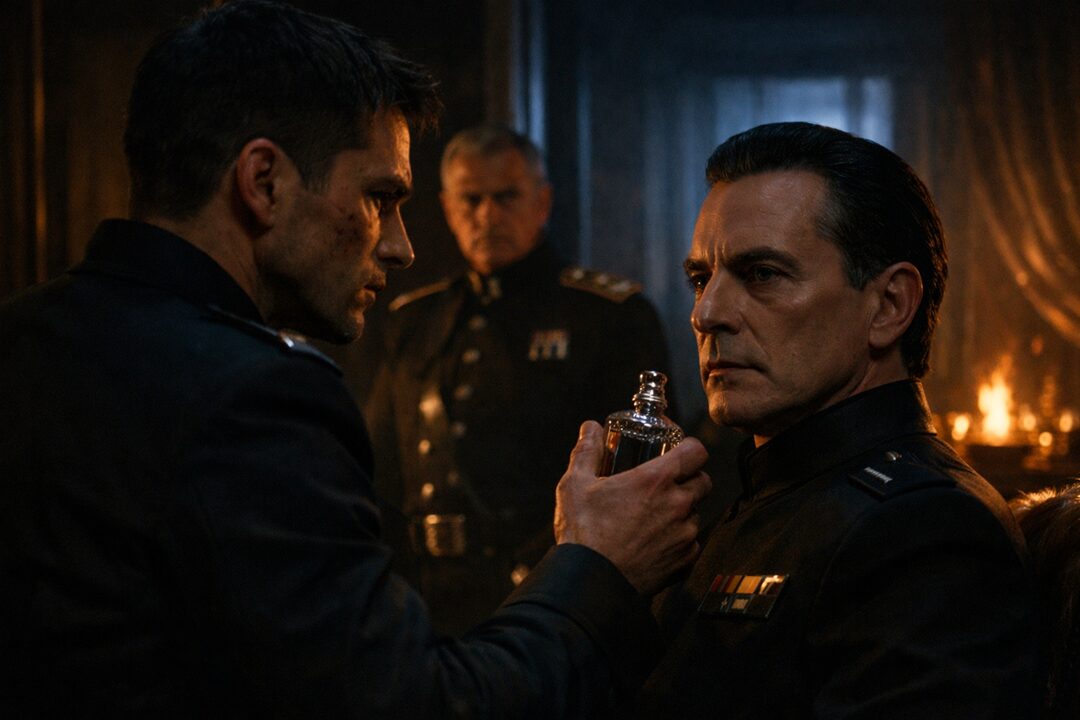
Adrien picked up the bottle.
The glass was cool. The scent rose clean and familiar and almost unbearable.
One drop at the wrist. One at the throat. A faint touch behind the ear. Never more than that. Never enough to announce itself as perfume. Only enough to become part of the air around him.
A sovereign’s final armor.
The drums outside steadied into rhythm.
The Emperor watched Adrien’s hand.
In all the years before, this had been the easiest motion of the sequence. The most invisible. The one no one thought mattered except those who knew better.
Adrien remembered his men in the marsh road. Boots sucking at mud. Faces gray with cold. Trusting a command they could not see.
He remembered Mara saying, If you finish the ritual, you are helping him cross the last bridge.
He remembered Sorin in the corridor: The state is built from what men can bear to see.
He remembered being young enough to think usefulness and loyalty were the same thing.
The bottle trembled once in his hand. Not enough for anyone but the Emperor to notice.
The Emperor’s expression changed by less than a breath.
He knew.
That was the cruelty of intimacy. The man closest to you required the least explanation when he betrayed you.
Adrien lowered the bottle.
“Captain,” Sorin said.
It was only one word. It sounded like a pistol being drawn.
Adrien set the stopper in place.
No scent touched the Emperor’s skin.
The room went so still even the fire seemed to hesitate.
The Emperor did not speak.
For the first time since Adrien had entered the chamber, he looked unfinished.
Not disordered. Not ridiculous. Something subtler and more fatal to power than either. Mortal. Human. A fraction less inevitable.
Sorin took one involuntary step forward. “Majesty—”
The Emperor lifted a gloved hand. Sorin stopped.
Then the Emperor did something Adrien had not prepared for. He went to the door anyway.
Not in panic. Not in collapse. But not in full possession of himself either.
That was enough.
On the balcony, the staff waited below in the yard, horses stamping, standards hanging heavy in the dawn damp. Adrien remained just inside the chamber doors, able to see the line of the Emperor’s back, the slight pause before he stepped into view.
He heard the murmur in the courtyard change.
Not loudly. No gasp. No public scene.
Just a ripple of uncertainty so slight another man might have missed it. Staff officers glancing twice instead of once. Sorin moving too fast to compensate. One adjutant leaning to another. The Emperor speaking with perfect control, yet arriving a beat late inside his own authority.
Adrien had never understood until that second how much command could depend on fractions.
Orders were repeated. Then repeated again.
A senior marshal asked for confirmation of the marsh approach.
Sorin snapped at him.
The Emperor answered himself, but the pause had already entered the machine.
A courier galloped into the yard before the final order could be carried out.
Mud up to the horse’s chest. Breath bursting white. Another dispatch tube lifted high like a wound being offered to God.
This one they opened immediately.
Sorin read first. His face whitened in a way rage could not conceal.
The eastern batteries had shifted farther than expected. The exposed flank was worse than reported. Proceeding at once would commit the lead divisions into crossfire before reserve deployment.
Too late for elegance. Too early for the dead.
The yard changed shape around the news. Not rebellion. Something colder. Recalculation.
The Emperor stood motionless while the paper moved from Sorin’s hand to his own.
He read.
Then, without turning, he said, “The dawn advance is postponed. The line holds position until second signal.”
No one moved for half a second, because men had already felt one version of history begin and now felt it stop.
Then the yard exploded into motion.
Different orders. Different runners. Different deaths.
Sorin turned so sharply his coat flared. His eyes found Adrien in the doorway at once.
He knew. Of course he knew.
But the Emperor knew first.
He turned from the balcony and came back into the chamber.
For one instant they stood alone again despite the noise beyond the walls. The empire rearranging itself around a silence between two men.
Adrien still held the unopened bottle.
The Emperor looked at it, then at him.
He did not ask why. He did not accuse. That would have made the moment smaller.
What passed across his face was not fury alone. It was injury made royal by control.
At last he said, “You chose your men.”
Adrien’s throat tightened.
“Yes.”
The Emperor gave one slow nod. It might have been condemnation. It might have been understanding. Those were not always opposites.
When he spoke again, his voice was perfectly steady.
“Then return to them.”
Part VI — The Corridor
By noon the city knew only that the offensive had been delayed for tactical revision.
By evening the palace knew more.
Not enough to say it plainly. Never that. Power preferred injury to remain elegantly unnamed. But servants changed their manner around Adrien. Officers who had once envied his old closeness now looked at him with the caution reserved for men who had touched a secret and survived badly.
No charge was brought.
No commendation either.
Sorin saw to that. Adrien’s orders were rewritten with immaculate vagueness: immediate return to the northern line, reassignment pending, direct palace access revoked. It was almost graceful. The sort of punishment meant to leave no mark except the one that mattered.
Mara found him in the outer court as he was fastening his riding gloves.
“They did not arrest you,” she said.
“No.”
“They may still.”
“They won’t.”
She studied his face. “How can you be sure?”
Adrien looked toward the high windows of the private wing.
“Because public punishment would require a story,” he said. “And there isn’t one he can afford to tell.”
For the first time that night, her severity broke. Not into relief. Into grief.
“You spared men,” she said.
“Perhaps.”
“That is not modesty. It is fear.”
“Yes.”
She touched his sleeve once, brief and unsentimental. A physician’s touch. A witness’s.
Then she left him to the horses and the cold.
Adrien mounted after dark.
He was almost through the inner corridor leading to the gate when the palace around him shifted. Guards straightened. A page flattened himself against the wall. Somewhere a door opened.
The Emperor came down the corridor alone except for one shadowing aide who remained several steps behind.
He was fully restored now.
Every line exact. Every button closed. Every fold obedient. The visible crack of dawn erased so completely Adrien might have doubted it had happened if not for the ache still lodged under his ribs.
He stepped aside and saluted.
The Emperor slowed as he passed.
For one suspended second Adrien thought he might stop.
He did not.
But as he drew level, the air between them carried a faint, unmistakable trace of rosemary and citrus.
Not much. Just enough.
Enough to say the ritual had been completed later by someone else, or by the Emperor’s own hand.
Enough to say what was broken would not be allowed to remain visible.
Enough to say I am restored, whether by myself or despite you.
Adrien kept his eyes forward.
The Emperor kept walking.
No farewell. No pardon. No accusation.
Only that scent, clean and bright and unbearable, lingering in the corridor after he was gone.
Adrien stood very still until the footsteps faded.
Then he let out a breath he had been holding since before dawn and rode back toward the front, where men were still alive who might not have been.
He did not know whether the delayed campaign would become a better one or merely a different mistake. He did not know whether the Emperor hated him, understood him, or had already placed the entire night into whatever locked chamber he used for things that could not be admitted and could not be forgotten.
He knew only this:
There are acts of loyalty that look like betrayal from the only place they matter.
And there are men so powerful the smallest private mercy shown to them can become public harm.
At the gate, the winter air cut clean through the last warmth of the palace.
Still, for miles after, he could not rid himself of the scent.