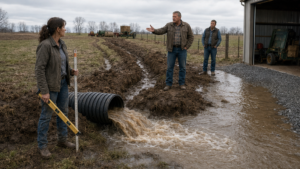
They Laughed While Ashley Repaired the Farm, but the Water Exposed What Everyone Had Hidden
Chapter 1: The Water Started Before Anyone Believed Her
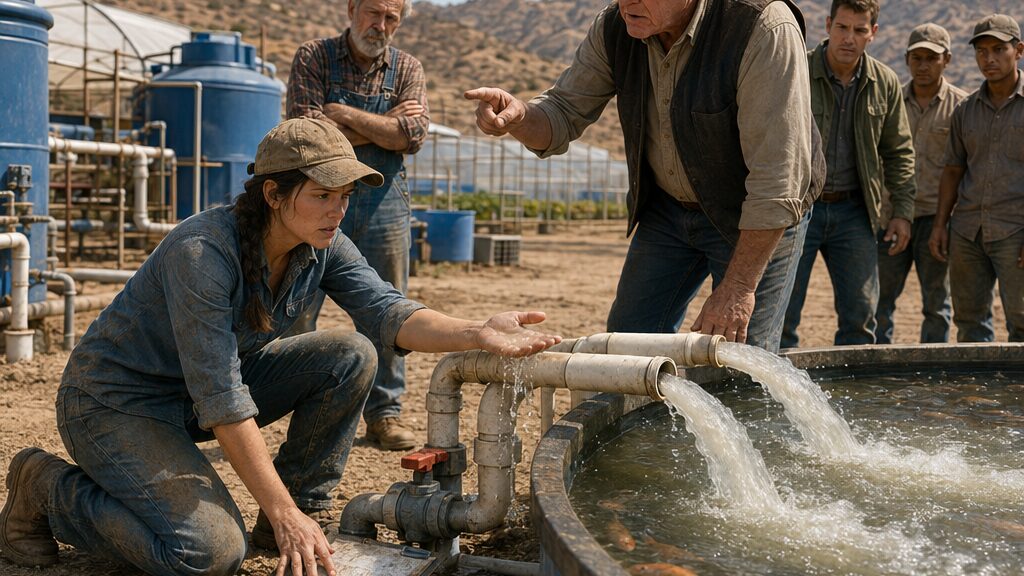
Ashley knelt beneath two dry PVC outlets while her father announced that this was her last attempt.
Michael Carter did not raise his voice. He never needed to. He stood behind her with his hands planted on his hips, his shadow cutting across the dirt-streaked clipboard beside her knee.
“We’ve lost half the morning,” he said. “If it doesn’t run now, I’m calling the contractor.”
The two seasonal workers waited beneath the packing awning. Scott Brown leaned against a blue filtration barrel as though he had come to watch a demonstration instead of a failure. Jerry Lee stood farther back, his arms folded loosely over his faded work shirt.
Ashley pressed two fingers against the pump housing. The motor vibrated, but the outlet pipes remained empty.
“It isn’t the pump,” she said.
Scott looked toward Michael. “That what the training says?”
Ashley kept her eyes on the fittings. She had learned years ago that answering Scott only gave him another surface to push against.
The largest circular tank sat three feet away. Tilapia moved slowly beneath water that had begun to lose its clear brown-green sheen. One fish broke the surface, opened its mouth, then sank.
“How long has the aeration been down?” Ashley asked.
Michael glanced at his watch. “Since before sunrise.”
“That isn’t a time.”
“Six hours. Maybe seven.”
Ashley looked up at him. “And you waited until I got here?”
“You said you knew this system.”
The sentence landed with the weight of an older accusation. She lowered her head before anyone could see it register.
A dissolved-oxygen meter lay on the tank rim. She dipped the probe and watched the numbers settle.
Too low.
The co-op truck was due the next morning for lettuce and herbs from the greenhouse beds. If circulation stayed down, the fish would suffer first. By evening, the root beds would begin warming and drying. By morning, the farm would miss its delivery and the neighboring growers would have to fill the gap.
Ashley loosened the union below the first blue barrel. A sour, stagnant smell escaped.
“Shut the intake,” she said.
Michael did not move.
“Which intake?”
“The red-handled valve by your left boot.”
He turned it with visible reluctance. The vibration in the pipe softened.
Ashley removed the pressure cap, checked the line, then tapped the housing three times with the rubber handle of her wrench. She waited, opened the bleed screw half a turn, and listened.
A faint whistle moved through the pipe.
Behind her, Jerry gave a short laugh.
Ashley froze.
Scott smiled. “Something funny?”
Jerry looked down and rubbed his jaw. “No.”
The laugh had been quiet, almost private, but Ashley knew that sound. Jerry used to make it when someone repeated a mistake he had already warned against. He had made the same sound seven years earlier, the week the old irrigation manifold ruptured and Michael told everyone Ashley had misread the pressure.
She tightened the screw harder than necessary.
“Open the intake one quarter,” she said.
Michael turned the handle.
“Stop.”
“It’s barely open.”
“That’s why I said stop.”
The motor pitch deepened. Ashley placed one hand against the outgoing line and the other against the return. The first trembled. The second stayed still.
Air lock.
She opened a lower drain, caught a burst of cloudy water in a plastic cup, then closed it again.
Scott pushed away from the barrel. “We don’t have time for samples.”
Ashley held the cup toward the sunlight. Fine debris drifted through it.
“We have less time if I send that through the root beds.”
Michael’s mouth tightened. “Can you make it run?”
“Yes.”
The answer came before she had decided whether it was true.
She shifted to the manifold beneath the twin outlets. The fitting was warm. She loosened the left coupling, bled trapped air, then repeated the sequence on the right. Tap, loosen, listen. It was the method her mother had taught her when Ashley was fourteen and too small to force the old valves.
Jerry laughed again, but this time the sound broke in the middle.
Ashley turned.
He was not looking at her. He was staring at her hands.
Michael stepped between them. “Finish it.”
Ashley wiped her palm on her jeans and reached for the main control valve.
“On my count,” she said. “Quarter turn only.”
Michael positioned himself beside the intake.
“One.”
The workers leaned forward.
“Two.”
A fish struck the surface behind her.
“Three.”
Michael opened the valve.
The pipes shuddered. For one breath, nothing happened. Then air exploded from the left outlet with a hollow cough. Water followed in a muddy burst. The right outlet spat twice, jerked, and released a second stream.
Both flows strengthened at once.
Water crashed into the circular tank, breaking the still surface into white turbulence. The workers stepped closer. Scott’s smile disappeared. Michael stared at the outlets as if he had been personally contradicted by them.
Ashley remained kneeling between the streams.
For a few seconds, the sound of moving water filled the entire yard.
“There,” Michael said. “That’s what we needed.”
He sounded relieved, but not grateful.
Ashley reached for the pressure gauge clipped to her belt. The needle climbed past the expected mark.
Then it kept climbing.
“Close it,” she said.
Michael did not hear her over the water.
“Close the intake.”
Scott pointed at the pipes. “It’s working.”
The needle entered the red band.
Ashley rose so quickly that the clipboard flipped into the dirt. She shoved past Michael and turned the intake herself. The streams weakened but did not stop. Pressure remained trapped somewhere beyond the meter.
“What did you do?” Michael demanded.
“I stopped the line from splitting.”
“It was running.”
“It was overpressurized.”
“You always find one more problem.”
Ashley stared at him. Water continued pouring behind her, bright in the hard sunlight, while the gauge trembled against its limit.
She collected another sample beneath the right outlet. The water was cloudier than before, with dark particles suspended near the bottom.
Jerry came closer. “That from the biofilter?”
“It shouldn’t be.”
Michael picked up the clipboard and slapped the dust from its back. “You got circulation. Check the beds and move on.”
Ashley took the clipboard from him. “The return pressure is bypassing something.”
“There is no bypass.”
She looked toward the pump shed. A section of newer pipe disappeared behind a plywood panel near the legal meter.
Michael followed her gaze.
“That’s the old fertilizer line,” he said.
“You said it was disconnected.”
“It is.”
Ashley crossed the yard. The plywood panel had been painted the same dull gray as the shed wall, but one screw showed fresh metal where a driver had recently turned it.
Michael caught up. “Leave it.”
She removed the screw.
“Ashley.”
The panel swung outward.
Behind it, a narrow PVC branch curved around the meter and rejoined the main circulation line. Its valve had been painted shut with red sealant, the kind used to show that regulated equipment had not been disturbed.
The paint was cracked.
Fresh wrench marks scored the metal stem beneath it.
Ashley touched one of them with her thumb.
Michael stood close enough that she could hear his breathing.
“You told me that line didn’t exist,” she said.
His eyes remained on the valve.
Behind them, the twin streams continued to fall into the tank, louder now than anything either of them could say.
Chapter 2: The Valve Nobody Was Supposed to Find
A tilapia surfaced beneath the restored flow and gasped as if the moving water contained no air at all.
Ashley watched it roll sideways, recover, and disappear beneath the turbulence. The twin outlets were still running, but the tank had begun to cloud. Waste that should have settled in the filtration barrels was circling back toward the fish.
She shut the main pump off.
The sudden silence brought Michael out of the shed.
“What are you doing?”
“Preventing a full tank loss.”
“You just fixed it.”
“I restored flow. I didn’t fix the system.”
He looked toward Scott and the workers, all of them close enough to hear. “Turn it back on.”
Ashley crouched by the hidden branch behind the plywood panel. The bypass left the circulation line before the legal meter, skirted the primary filter, then rejoined the return pipe downstream.
It was not an old fertilizer line.
It was a way to move unmetered water while avoiding the equipment meant to clean it.
She traced the fittings with her fingertips. The solvent joints were aged but intact. This had not been installed last week.
“How long?” she asked.
Michael folded his arms. “It was temporary.”
“How long?”
“We had a dry summer.”
“They’ve all been dry summers.”
Jerry moved into the pump shed doorway. He studied the branch without pretending he had never seen it.
Ashley looked at him. “You know what this is.”
Jerry glanced toward Michael.
“That answer is yes,” she said.
Scott stepped closer. “Whatever it is, can it get us through tomorrow’s pickup?”
Ashley stood. “No.”
Michael said, “She means she won’t.”
“I mean the biofilter is overloaded. That bypass is pulling water around the meter and forcing untreated return into the tanks.”
Scott’s face hardened. “So reduce the flow.”
“If I reduce it without cleaning the system, the oxygen drops again.”
“Then clean it.”
“That means shutting down sections for hours.”
“We don’t have hours.”
Ashley picked up the clipboard. “The fish do.”
Michael pointed toward the pump. “Turn it on at half.”
“No.”
The word surprised even her. For years she had imagined confronting him with evidence so complete that he would have no room to dismiss her. Instead, she had one cloudy water sample, a pressure spike, and a valve he had already called temporary.
It was enough.
She moved to the smallest tank, disconnected a clean reserve barrel, and raised it on stacked pallets with the help of one seasonal worker. A hose ran from the barrel to the tank’s aeration ring.
“What are you building?” the worker asked.
“A gravity line. It won’t circulate the whole system, but it will keep this tank alive while I isolate the others.”
Michael stood at the edge of the yard. “Nobody touches that plumbing unless I approve it.”
The worker released the barrel.
Ashley braced it with both hands. “Then approve it.”
Michael’s gaze moved from her to the watching men.
“Do it,” he said finally.
The worker lifted again.
By midafternoon, the smallest tank had stable oxygen. The largest remained marginal. Ashley flushed one filter barrel at a time into the drainage trench, watching thick brown water run over the dry soil.
She recorded every reading on the clipboard.
At the bottom of the maintenance sheet, dates ran backward through months of shortened notes: pressure low, filter cleaned, pump reset, meter checked.
One entry had been sliced away with a knife.
The cut was clean, taking half of the page beneath it.
Ashley held the sheet up.
“Where’s the rest?”
Michael did not look over. “Old paper tears.”
“That didn’t tear.”
“No idea, then.”
Jerry was tightening a hose clamp nearby. His hands stopped.
Ashley carried the clipboard to him. “What was written here?”
“Could’ve been anything.”
“You remember every fitting installed on this farm since I was ten.”
“That doesn’t mean I remember paper.”
She lowered her voice. “The bypass predates this log.”
Jerry resumed turning the clamp. “You should focus on the fish.”
“That’s what I’m doing.”
He looked at her then. There was no mockery in his face, only fatigue.
“You want my advice?” he asked.
“No.”
“Take it anyway. Keep that gravity line running. Flush the second filter. Don’t start pulling boards off walls when you don’t know what’s behind them.”
Ashley stared at him.
“You’re warning me about plumbing?”
“I’m warning you about weight.”
Before she could answer, Michael called both workers toward the greenhouse.
Ashley followed.
Inside, the rows nearest the circulation inlet were still damp. The far beds had begun to pale. Lettuce leaves curled at their edges beneath the trapped heat.
Michael addressed the workers, not her.
“We’ll run the main system after dark. Half pressure. Nobody discusses the shed line with anyone. It was a temporary repair and it’s being removed.”
Ashley said, “You can’t restart it.”
“This is my farm.”
“And those workers are standing beside contaminated tanks.”
Michael’s jaw shifted.
Scott entered behind them, phone in hand. “Co-op wants confirmation by six. If tomorrow’s load falls short, all of us take the penalty.”
Ashley looked at him. “Then tell them the truth.”
“That Carter Farm hired you to repair a system and you shut it down?”
“I didn’t install the bypass.”
“No, you just came back the day everything stopped working.”
The old accusation had changed clothes, nothing more.
Ashley waited for Michael to correct him.
Michael looked toward the failing beds.
“We’ll meet the load,” he said.
That evening, the heat loosened its grip on the greenhouse, but the farm did not cool. Ashley sat in the farmhouse office beneath a ceiling fan that clicked once every rotation. She had brought the clipboard, the cut maintenance sheet, and the pressure readings.
The file cabinet beside Michael’s desk held equipment manuals, loan notices, feed invoices, and county water statements. The folder for system modifications was nearly empty.
Michael stood in the doorway.
“You don’t have permission to search my files.”
“You asked me to repair equipment you didn’t accurately describe.”
“I told you what mattered.”
“You told me there was no bypass.”
He entered and closed the door. “We needed flow during the restrictions. The allocation wasn’t enough for fish and greenhouse production.”
“So you routed around the meter.”
“We borrowed capacity.”
“From whom?”
He looked away.
Ashley understood. “From the county allocation.”
“We paid every bill.”
“That isn’t the same thing.”
“Don’t give me regulations. I know what water costs.”
“You know what hiding water costs?”
His voice sharpened. “It kept this place open.”
Ashley placed the cut sheet on his desk. “What was on this entry?”
“I don’t know.”
“You’re more afraid of this paper than you are of losing fish.”
For the first time, something like fear moved across his face.
Then headlights swept across the office wall.
A white county vehicle stopped beside the farmhouse.
Michael went still.
A woman stepped out carrying a hard case and a document envelope. Her county badge caught the porch light.
Ashley recognized Amanda Wilson from regional compliance meetings.
Michael reached for the cut maintenance sheet, but Ashley placed her hand over it.
Amanda climbed the steps and knocked once before opening the screen door.
“Michael Carter?”
He did not answer immediately.
Amanda held up the envelope.
“I’m here regarding an unannounced agricultural water-use inspection.”
Chapter 3: The Inspection Michael Tried to Outrun
Amanda Wilson placed the repair certification on the hood of her county vehicle and held a pen toward Ashley.
“I need the technician responsible for today’s work to sign here.”
Morning light had only begun to reach the greenhouse roofs. Behind them, the pumps were silent. The gravity line dripped steadily into the smallest tank, each drop distinct in the still yard.
Ashley read the statement.
The system had been restored to safe operating condition. All water-routing equipment matched county records. No unapproved modification remained active.
Michael stood at her shoulder.
“Sign it,” he said quietly.
Amanda looked between them. “Is there a problem with the wording?”
Ashley kept reading, though she had already reached the bottom.
Michael said, “The repair was completed yesterday. We shut down overnight as a precaution.”
“That isn’t what I asked,” Amanda said.
Her voice was calm, almost flat. She had the manner of someone accustomed to being given partial answers and waiting until the silence became inconvenient.
Ashley set the pen down.
“I restored circulation,” she said. “The system is not safe to operate.”
Michael’s hand tightened against the hood.
Amanda opened her hard case. Inside were test bottles, seals, a portable meter, and a tablet.
“What remains unresolved?”
Ashley looked toward the pump shed.
Michael answered first. “A temporary line needs removal.”
Amanda’s attention shifted to him. “A temporary line shown on the approved diagram?”
“No.”
“Then I’ll need to see it.”
Scott Brown’s truck entered the drive before they reached the shed. Two neighboring growers followed in separate pickups. They had come expecting crates, not inspectors.
Scott climbed out and looked at the silent greenhouse.
“What happened?”
Michael said, “Routine check.”
Amanda continued toward the shed.
Scott caught Ashley’s arm lightly. “You shut it down again?”
She pulled free. “It never became safe.”
“You had water yesterday. Everybody saw it.”
“That was pressure, not safety.”
He glanced at the other growers. “The co-op cannot lose this order because you want to make a point.”
Ashley nearly told him to leave. Instead, she looked toward Michael.
Again, her father said nothing.
Scott turned to the growers. “She came back, touched the system, and now the county’s here.”
The sentence moved quickly through the yard. No one repeated it, but no one needed to. The workers heard. Jerry heard. Michael heard.
Ashley felt the familiar urge to let the evidence answer for her. The samples, the pressure chart, the hidden valve—eventually they would become undeniable.
But silence had never stayed empty around this family. Someone always filled it.
“The county is here because water has been routed around the legal meter,” Ashley said.
Every face turned toward Michael.
He stared at her as if she had broken something more valuable than the system.
Amanda stopped beside the plywood panel. “Show me.”
Ashley removed it.
Amanda photographed the bypass, checked the cracked inspection paint, and traced the pipe to where it rejoined the circulation line. She entered measurements into her tablet.
“How long has this been active?” she asked.
Michael replied, “Intermittently.”
“That isn’t a duration.”
“A few months.”
Jerry looked down.
Amanda checked the meter record, then walked the line toward the greenhouse intake. Her calculations took less than ten minutes.
“This branch can draw without registering through the primary meter,” she said. “Based on the pipe size and the farm’s reported production, a few months is unlikely.”
Michael’s face reddened. “You don’t know our operation.”
“I know your permitted allocation.”
She turned the tablet toward Ashley. Monthly draw estimates exceeded the reported figures by margins too large to explain as error.
Ashley studied the dates.
The pattern extended back nearly two years.
Amanda removed a bright closure tag from her case.
Michael stepped forward. “We have live stock.”
“That is why I am not ordering the tanks drained today. But full circulation remains suspended until the bypass is removed, the filters are inspected, and contamination risk is assessed.”
“You shut us down, the fish die.”
“You continued an unapproved modification, the fish were already at risk.”
Michael pointed at Ashley. “She’s the technician. She had it running.”
Amanda looked at Ashley. “Are you willing to certify the system?”
Michael picked up the clipboard from the barrel and shoved it toward her.
The gesture was small, but the yard seemed to narrow around it. The same clipboard had been beside her in the dirt when the water started. Now it stood between her and her father like a contract neither of them could pretend not to understand.
“Sign,” he said. “Then remove the line today.”
Ashley could feel every person waiting.
If she signed, the co-op load might leave. The workers might receive another week’s pay. Michael might call it proof that she had finally helped rather than complicated things.
The signature would also make the hidden line partly hers.
She closed the clipboard.
“No.”
Michael’s expression changed before his voice did.
“You’d let this farm fail over a form?”
“I won’t certify a lie.”
“I asked you to come home because we needed you.”
“You asked me because you needed my license.”
“That is not fair.”
Neither was what he had said untrue.
Ashley handed the clipboard to Amanda.
“My readings from yesterday are on the last two pages. Pressure exceeded safe range after the restart. The return sample showed untreated solids.”
Amanda reviewed the notes. “Who authorized the bypass?”
No one answered.
Scott looked toward the growers. “This is a family dispute. The rest of us shouldn’t lose our market because Ashley and Michael can’t settle old business.”
Amanda attached the closure tag to the main control.
“This is now an official suspension.”
The red tag clicked shut.
Michael’s shoulders lowered by a fraction. He did not look defeated. He looked betrayed.
“You always wanted to prove you were right,” he told Ashley.
She met his eyes. “Not like this.”
Amanda instructed the workers on emergency aeration and sample preservation. She gave Michael a list of required records and a noon deadline for system diagrams, meter statements, and maintenance logs.
By ten, the neighboring growers had left. Scott was the last to go.
At his truck, he told Ashley, “You may be correct. That doesn’t mean you did right by everyone.”
She watched him drive away without answering. The accusation found its place because part of it was true. She had waited for a perfect proof while the system worsened.
Inside the pump shed, Jerry removed the plywood panel and set it against the wall.
Ashley stood behind him.
“Amanda asked who authorized it.”
“I heard.”
“You looked at my father.”
Jerry crouched beside the branch line. “Looking isn’t a statement.”
“No. Silence is.”
He gave a tired breath. “You think speaking fixes what comes after?”
“I think not speaking already decided what came after.”
Jerry ran his thumb over the cracked red seal. His hands were thick, scarred, and steady.
“I installed it,” he said.
Ashley said nothing.
“Your father ordered it. First time was during the allocation cut. We were supposed to use it for one week.”
“How long did it stay?”
Jerry looked toward the open yard, where Michael stood alone beside the tagged control.
“Long enough that taking it out became harder than pretending it belonged.”
Ashley’s throat tightened. “Why did he order it?”
Jerry rose slowly.
“That isn’t the question you need to ask.”
“What is?”
He looked at her with an expression stripped of the humor she had once mistaken for contempt.
“Ask what he was protecting the first time he decided your name could carry the blame.”
Chapter 4: Jerry’s Laugh Had Never Meant What She Thought
Jerry placed the missing section of the maintenance log on the packing-shed workbench and kept two fingers on it, as if the paper might escape before Ashley decided whether to believe him.
The shed was empty except for stacked crates, a hanging scale, and the dull ticking of cooling metal from the equipment yard. Beyond the open doors, the county closure tag flashed red whenever the evening light moved through it.
Ashley did not reach for the page.
“You cut it out,” she said.
Jerry shook his head. “No.”
“You kept it.”
“That part’s true.”
The paper had been folded into quarters. Grease darkened its edges. One corner carried the same crescent-shaped tear left in the clipboard, making its place in the log undeniable.
Ashley unfolded it.
The original entry had been written seven years earlier. The date belonged to the week the old manifold ruptured—the failure Michael had described for years as the reason Ashley could not be trusted alone with the farm’s water system.
Beside the pressure readings were her initials.
A.T.C.
Ashley stared at them.
“I never used my middle initial on maintenance sheets.”
“I know.”
The handwriting imitated hers without matching it. The A leaned too far forward. The numbers were written with closed fours, while Ashley had always left hers open.
Below the initials, one sentence had been added:
Operator ignored repeated pressure fluctuation and continued circulation.
Ashley read it twice.
“You knew this was false.”
Jerry lowered himself onto an overturned crate. “I knew you shut the line down that afternoon.”
“I shut it down before I left for the supply house.”
“I remember.”
“When I came back, the manifold had split and Dad said I’d left the pump running.”
Jerry rubbed a hand across his mouth.
“He said you had.”
“You were there.”
“Yes.”
“You stood beside him.”
“Yes.”
The answers were too clean to argue with.
Ashley folded the paper once, then stopped herself and flattened it again. “Why did you laugh yesterday?”
Jerry looked toward the workbench wall, where rusted fittings hung from nails in careful rows.
“I wasn’t laughing at you.”
“That’s convenient.”
“I know how it looked.”
“You’ve had seven years to explain how it looked.”
He stood and crossed to a lower shelf. From behind a box of hose clamps, he brought out a small brass valve with a rusted red handle. It was too narrow for the current system and scarred from years of use.
Ashley recognized it before he set it down.
Her mother had mounted that valve on a board when Ashley was thirteen. She had used it to teach her how to hear trapped air in a line: tap, loosen, listen. Never force what pressure had already decided to break.
“You did her sequence,” Jerry said. “Yesterday, under those outlets.”
Ashley touched the handle. Rust stained her fingertip.
“So you laughed.”
“It came out wrong.” He looked embarrassed rather than defensive. “Your mother used to make that same face when Michael opened a valve too far. Like she was deciding whether to fix the pipe or hit him with the wrench.”
The memory arrived with unwelcome clarity: her mother kneeling in dust, one hand on the fitting, hiding a smile as Michael complained about lost time.
Ashley withdrew her hand.
“You recognized her in me and said nothing.”
Jerry nodded.
“That’s worse.”
“I expect it is.”
He did not ask her to forgive him. The absence of the request made it harder to dismiss him.
Ashley returned to the page. “Who wrote the entry?”
Jerry’s gaze dropped to the workbench.
“My father?”
“I didn’t see him write it.”
“That isn’t an answer.”
“He brought the report to me after the rupture. Asked whether the pressure numbers looked possible.”
“And you said?”
“I said they did.”
“Were they mine?”
“No.”
The shed seemed to contract around them.
Jerry sat again, slower this time. “The pump had been restarted after you left. Michael wanted the greenhouse irrigated before the lender’s field visit the next morning. We had a weak section in the manifold. Your mother had marked it for replacement before she died, but the part kept getting pushed.”
Ashley looked at the brass training valve.
Her mother had been gone eleven months when the rupture happened. Long enough for everyone to speak of her plans as if they were suggestions. Not long enough for Ashley to stop hearing her voice in the pump shed.
“Dad restarted it?”
Jerry nodded.
“Then blamed me.”
“He said the insurance company wouldn’t cover a known maintenance defect. Said the lender would call the operating note if they learned he had run it after a shutdown warning.”
Ashley’s fingers tightened around the edge of the bench.
“And you agreed.”
“I had two workers asking whether they’d be paid Friday. Feed due. Your father hadn’t slept much in months. I told myself it was one report.”
“It became my reason for leaving.”
“I know.”
“No. You know now because I’m standing here saying it. Back then you let everyone believe I walked away because I couldn’t take responsibility.”
Jerry’s face hardened, not against her but against the words.
“I was afraid the place would close.”
“So you protected the farm.”
“I protected jobs.”
“You protected yourself from losing one.”
He accepted that without protest.
A truck passed on the county road, headlights sliding across the shed wall and disappearing.
Ashley held up the forged page. “Why keep this?”
“Because I knew one day he might decide the lie was true.”
“And did he?”
Jerry looked toward the farmhouse. One office light burned behind the curtains.
“Your father doesn’t lie the way most people do,” he said. “He builds something around the truth until he can live inside it.”
Ashley thought of the bypass hidden behind painted plywood. A pipe built around a meter. A story built around her silence.
“Why show me now?”
“Because Amanda will ask for old records. Michael will give her whatever keeps the farm open. If that means the same story again, he’ll use it.”
Ashley slid the page into the clipboard beneath her current readings.
Jerry reached toward it, then let his hand fall.
“There’s more,” he said.
She waited.
“The bypass wasn’t the first thing we hid after the rupture.”
“What else?”
“Loan renewal records. Insurance correspondence. The maintenance report went into both.”
Ashley stared at him.
“Where?”
“County archives should have the filed equipment-loss statement. The bank kept its own copy.”
“The report with my name?”
Jerry nodded.
“And Dad knew it was false when he filed it.”
Jerry’s answer came barely above the ticking metal.
“Yes.”
The office light in the farmhouse went dark.
Ashley closed the clipboard.
For seven years, she had believed Michael’s worst failure was doubting her. The paper under her hand offered a colder possibility.
He had not doubted her at all.
He had known she was right and chosen her name because he believed she would carry the damage quietly.
Chapter 5: The Farm Had Survived by Using Her Silence
The county clerk slid a copied failure report beneath the glass partition, and Ashley found her signature on a document filed twelve days after she had left the state.
She checked the date again.
There was no mistake. By then she had been living in a rented room three hundred miles away, working temporary irrigation jobs and refusing every call from home.
The signature looked better than the initials in the maintenance log. Whoever had copied it had practiced.
“Is there an attached statement?” Ashley asked.
The clerk searched the file. “Insurance determination, lender notice, equipment replacement invoice. That’s everything scanned under this incident.”
Ashley read standing at the counter.
The report described operator error, ignored pressure fluctuations, and unauthorized continuation of pumping. It named Ashley as the technician on duty. Michael’s signature appeared beneath a declaration that the information was accurate to the best of his knowledge.
The insurance payment had covered most of the new manifold. A lender note showed that continued financing depended on the failure being accidental rather than deferred maintenance.
Ashley copied every page.
When she returned to the farm, the far greenhouse row had gone dry.
The plants nearest the doorway still held some color, but at the end of the line, lettuce leaves had collapsed against the growing beds. The silence inside was different without circulation. No water running beneath the channels. No low pump vibration. Only plastic sheeting shifting overhead and the brittle sound of a leaf breaking when Ashley touched it.
Michael stood at the dry inlet, trying to clear a narrow hose with a length of wire.
She placed the copied report on the bed between them.
He looked at the first page, then returned to the hose.
“Where did you get that?”
“The county.”
“You had no reason to dig through old claims.”
“My name is the reason.”
He pushed the wire deeper. “That failure was settled.”
“No. It was assigned.”
The wire caught. Michael twisted it until the hose split near the coupling.
He swore under his breath.
Ashley watched waterless residue crumble from the cut.
“You filed this after I left.”
“I filed what the insurance company required.”
“You signed that I caused the rupture.”
“You were responsible for the system.”
“I shut it down.”
“You left the property.”
“To buy the replacement pressure switch you told me to get.”
“You left during a failure.”
“The manifold failed after I left because you restarted the pump.”
Michael pulled the broken hose free and dropped it onto the gravel.
“Jerry has been talking.”
“Jerry gave me the page you cut from the maintenance log.”
Something closed in Michael’s expression.
“I didn’t cut anything.”
“Did you write the false entry?”
He stepped past her. “We have live crops drying while you conduct a trial.”
Ashley followed him toward the farmhouse office. “Did you forge my initials?”
“I made a correction based on what happened.”
“What happened is you ignored a known weak manifold because a lender was coming.”
Michael turned in the doorway. “What happened is your mother died, the farm lost its best season, and every bill came due at once.”
The words struck because he had never spoken of that year as grief. Only as numbers.
Inside the office, the ceiling fan clicked over stacks of notices. Michael opened the desk drawer and removed a letter bearing the bank’s logo.
“They froze the equipment line this morning,” he said. “Because the county reported the bypass.”
Ashley read the notice. No additional credit would be extended until the violation was resolved and collateral reviewed.
“You knew this could happen.”
“I knew what would happen if the farm missed that loan renewal seven years ago.”
“So you used me.”
“I used the explanation they would accept.”
“My name.”
“You were gone.”
“I left because you blamed me.”
“You were leaving anyway.”
Ashley stared at him. “You don’t know that.”
Michael sank into the desk chair. The anger in him did not vanish; it lost its structure.
“The insurer sent an investigator,” he said. “He found your notes about the pressure changes. If he found your mother’s replacement warning too, they would call it deferred maintenance. No payment. The lender would have ended the operating note.”
“So you changed my warning into negligence.”
“I kept the farm.”
“You kept the land.”
“That is the farm.”
“No. It isn’t.”
Michael looked toward the office window. Beyond it, the greenhouse roof shimmered in the heat.
“There were six people drawing checks then,” he said. “Feed deliveries. Your mother’s medical balance. The mortgage on the south field. You think I had a good choice?”
“You had an honest one.”
“Honesty does not make payroll.”
The sentence came without pride. That made it worse.
Ashley laid the forged report beside the bank notice.
“You could have told me later.”
“And what would that have changed?”
“It would have changed what I thought I had done.”
He looked at her then.
For years, Ashley had imagined this moment ending with an admission that restored the shape of the past. Instead, Michael’s face held only exhaustion and the stubborn belief that outcomes justified whatever had been placed beneath them.
“You were right about the manifold,” he said.
The words were quiet.
Ashley waited for more.
None came.
“You knew that then?”
“Yes.”
It was the vindication she had once wanted more than anything. It produced no relief.
Michael gathered the papers into a neat stack. “Now you know. Are the crops less dry?”
“No.”
“Are the fish safer?”
“No.”
“Then we can spend another hour deciding which of us suffered properly, or we can find a way to run water.”
Ashley took the stack from his hands.
“That’s how you did it,” she said. “Every time the truth got close, you put something alive in front of it.”
“Because something alive was always at risk.”
“And you made that everyone else’s permission to stay silent.”
A pounding came from outside.
One of the seasonal workers appeared in the doorway, breathing hard.
“The big tank,” he said. “Aerator quit.”
Ashley ran.
The smell reached her before the tank did—warm water, algae, and the heavy organic odor of fish under stress.
The backup aerator sat silent beside the largest tank. Its breaker had tripped. The surface, normally broken by bubbles, lay nearly flat.
Fish crowded near the top.
Jerry was already pulling at the electrical panel. “Motor’s burned hot.”
Ashley checked the dissolved-oxygen meter.
The reading fell while she watched.
“Portable units,” she said. “Move them from the reserve shed.”
“We only have two,” the worker said.
“Put both here.”
Michael reached for the main pump control. The red county tag blocked the switch.
“If we restart the bypass,” he said, “we can move enough water to hold them.”
Ashley looked into the tank.
A fish turned on its side beneath the surface.
Amanda’s suspension order was clipped to the control box. Breaking the tag would turn a violation into deliberate defiance. Leaving the tank still could cost most of the stock before portable units arrived.
Michael put his hand on the tagged switch.
Ashley caught his wrist.
“Don’t.”
“You have another way?”
She looked toward the gravity barrel, the dry greenhouse row, and the clipboard under her arm—the record of every warning she had delayed making public because she wanted proof without consequence.
A fish struck the side of the tank and floated back.
Then another surfaced beside it.
The first dead fish collected beneath the same outlets that had made everyone believe the farm was saved.
Chapter 6: Saving the Fish Meant Stopping the Farm
By midnight, the twin outlets were surrounded by dead fish.
They drifted in the weakest current, pale bellies turning beneath pipes that had poured like a victory only two days earlier. Ashley stood knee-deep in the tank with a net, lifting them out one at a time so the remaining water would not foul faster.
Michael had not touched the county tag again, but he stayed beside the control box.
“We can still restart for ten minutes,” he said.
“No.”
“Enough to exchange part of the tank.”
“The bypass sends untreated water back in.”
“It sends moving water.”
“It also overloads the filters.”
“They are dying now.”
Ashley dragged the net toward the rim. Jerry and one worker emptied it into a covered bin.
The other worker returned pulling two portable aerators on a handcart. Both machines were old, dented, and built for tanks half this size.
“Run separate cords,” Ashley said. “Different breakers.”
Jerry set the first diffuser. “Won’t cover the whole tank.”
“We’ll crowd the survivors toward the clean side.”
Michael pointed toward the drainage field. “Open the bottom drain and feed fresh water.”
“Fresh water from where?”
“The reserve line.”
“That line is part of the unmetered draw.”
He stared at her. “You care more about the tag than the stock.”
Ashley climbed out of the tank, boots spilling water onto the dirt.
“I care about not repeating the decision that put us here.”
“You think a county form killed those fish?”
“No. The bypass did. Your secrecy did.”
The words came easily until the next ones.
“And my delay did.”
Jerry looked at her.
Ashley wiped wet hair from her face. “I saw the pressure spike the first morning. I knew the system needed a full shutdown. I kept testing because I wanted to understand it before I reported anything.”
Michael said nothing.
“I wanted one repair nobody could argue with,” she continued. “I gave the contaminated flow more time.”
“You didn’t install the line,” Jerry said.
“I operated around it.”
The admission did not divide guilt evenly. It did remove the clean distance Ashley had kept between her decisions and everyone else’s.
She took out her phone.
Michael stepped toward her. “Who are you calling?”
“Amanda.”
“At midnight?”
“She gave us an emergency number.”
“You call her now, she’ll document a stock loss.”
“She should.”
“The insurer will see it.”
“Yes.”
“The bank will see it.”
“Yes.”
Michael’s face tightened as though each answer shut a door.
“You said you came to save the farm.”
“I came to fix the system.”
“What is the difference?”
Ashley looked at the dead fish beneath the outlets.
“This.”
Amanda answered on the fourth ring.
Ashley gave the readings, the aerator failure, the estimated loss, and the condition of the remaining stock. Then she told her about the false maintenance entry, the old insurance report, and Jerry’s admission that he had installed the bypass under Michael’s order.
Michael walked away before the call ended.
Amanda did not offer reassurance. She instructed Ashley to preserve water samples, photograph the control tag, document disposal, and avoid any unapproved intake.
“I can authorize emergency transfer to clean holding tanks,” she said. “No recirculation through the modified system.”
“We have three reserve tanks near the packing shed.”
“Metered fill only.”
“It will exceed today’s permitted draw.”
“I can issue a temporary livestock-protection allowance. It will be recorded against the farm.”
“Do it.”
Amanda paused. “Michael Carter will need to confirm.”
Ashley looked across the yard. Her father stood near the dry greenhouse, facing away.
“He won’t.”
“Then as the reporting technician, you may request it. That also places your account in the file.”
Ashley understood what Amanda meant. Her own delay, her temporary repair, all of it would sit beside Michael’s choices.
“Put my name on it,” she said.
The temporary authorization arrived by email six minutes later.
They worked until dawn.
The portable aerators bought enough time to move the strongest fish. Jerry rigged broad nets between the tank walls to guide them toward one side. The workers filled clean holding tanks through the metered line. Ashley monitored oxygen and temperature, writing every figure on the clipboard.
Michael returned without speaking and lifted fish with the rest of them.
At one point, a hose coupling burst loose and sprayed him across the chest. He shut the valve, replaced the clamp, and resumed work. No one laughed.
By sunrise, the largest tank held only the fish too weak to transfer. The reserve tanks churned with portable aeration. More than half the stock had survived.
The victory felt too narrow to name.
Amanda arrived after seven. She photographed the dead stock, checked the tag, and reviewed Ashley’s notes.
“You documented your initial restart,” she said.
“Yes.”
“And the pressure spike.”
“Yes.”
“Why didn’t you report the bypass immediately?”
Ashley could feel Michael listening from several yards away.
“I thought I could isolate the fault first.”
“You wanted certainty.”
“I wanted control.”
Amanda studied her for a moment, then wrote something on the inspection form.
“The county will assess the operation, not your intention.”
“I know.”
Michael approached. His shirt had dried stiff with tank water.
“How long until we can run again?” he asked.
Amanda closed her case. “Not under the existing configuration.”
“We remove the bypass today.”
“That is one requirement.”
“What else?”
“Full disclosure of unauthorized draw, filtration assessment, revised capacity plan, penalties, and a signed admission identifying who authorized and maintained the modification.”
Michael’s expression hardened.
“I’m not signing a confession drafted by the county.”
“It is a factual declaration.”
“It will go to the bank.”
“Yes.”
“And the insurer.”
“Likely.”
“Then you’re not offering a restart. You’re offering foreclosure with paperwork.”
Amanda did not react. “I am offering the only path through which this operation may legally circulate again.”
Michael turned toward Ashley. “You gave her everything.”
“I gave her what happened.”
“You gave her enough to end us.”
Ashley looked past him to the tanks, the still main pipes, and the greenhouse row that had gone dry while everyone protected the appearance of operation.
“No,” she said. “We did that before she arrived.”
Amanda removed a second document from her envelope.
“There may be a monitored restart option,” she said. “Reduced production, capped flow, independent readings, and removal of one greenhouse section from service.”
Michael stared at the paper without taking it.
“How reduced?”
“Approximately forty percent below your reported capacity.”
“That doesn’t support the loan.”
“It may support the remaining livestock and part of payroll while the financial issues are addressed.”
“And what do you need from me?”
Amanda held the document out.
“A full admission by noon tomorrow.”
Michael’s hand remained at his side.
Ashley saw the choice reach him, not as morality but as subtraction: authority, production, reputation, perhaps part of the land. Everything he had hidden to preserve would now survive only if he named what he had done.
He walked past Amanda toward the farmhouse.
At the porch, he stopped.
For a moment Ashley thought he might turn around.
Instead, he said, “Then there won’t be a restart.”
The screen door closed behind him.
Amanda placed the unsigned admission on Ashley’s clipboard.
“If he changes his mind,” she said, “the deadline is noon.”
Ashley looked at the farmhouse, then at the clean holding tanks where the surviving fish moved beneath hard-earned bubbles.
For the first time, saving the farm no longer meant making the water run.
It meant deciding whether the land could survive the man who still believed it belonged only to him.
Chapter 7: The Price of Keeping the Land Honest
Michael tore the unsigned admission form in half before Ashley finished explaining the reduced-flow plan.
The sound was small, but everyone in the farmhouse office heard it.
Amanda stood beside the filing cabinet with her tablet tucked against one arm. Jerry remained near the door. The two seasonal workers waited outside beneath the porch roof, close enough to see through the screen. Scott Brown sat at the end of the table with three neighboring growers behind him.
Michael placed the torn pieces beside Ashley’s clipboard.
“There,” he said. “Now nobody has to pretend this is an agreement.”
Ashley looked at the halves. The county language divided responsibility into plain lines: unauthorized modification, concealed draw, unreported operational risk.
Her revised pipe diagram lay beside it. Red marks showed the bypass removed. Blue arrows showed the legal route through smaller filtration capacity. Forty percent less flow. One greenhouse section closed. Reduced fish stock. Weekly readings sent directly to Amanda.
“It isn’t an agreement yet,” Ashley said. “It’s the only operating plan the county will consider.”
Scott leaned forward. “A plan that cuts the co-op’s volume before harvest.”
“A plan that keeps the system from killing what remains.”
“The rest of us built delivery schedules around Carter production.”
Ashley turned the clipboard toward him. “Then the rest of you should have asked how that production stayed so high during allocation cuts.”
The growers shifted.
Scott’s face changed first. “Be careful.”
Amanda looked at him. “Is there information about shared water use that has not been disclosed?”
“No.”
The answer came too fast.
Ashley had spent the early morning comparing meter estimates, co-op delivery records, and the dates of the deepest restrictions. Carter Farm’s reported output had stayed high enough to fill shortages from neighboring operations. Michael had not kept all the excess for himself.
“He let the co-op move produce under our allocation,” she said. “Didn’t he?”
Scott stood. “That is not what happened.”
“What happened?”
“We balanced loads.”
“With unreported water.”
“We kept contracts alive.”
Michael’s eyes remained on the torn form.
Scott pointed toward him. “You think he did this alone? When our wells dropped, his system carried greens for three farms. When the co-op truck came light, everyone paid. He kept the route.”
Amanda entered something into her tablet.
Scott saw it. “This meeting is off the record.”
“No,” Amanda said. “It is not.”
One grower quietly stepped away from the table.
Ashley understood the shape of the secret now. Michael had broken the rules for his farm, but not only his farm. The neighboring growers had accepted the benefit while leaving Carter Farm to carry the risk. Scott’s public concern for the community had always been partly fear that the records would widen beyond one property.
Michael finally spoke.
“You wanted the truth,” he said to Ashley. “There it is. Cut our production and you cut theirs.”
“They accepted water they knew wasn’t reported.”
“They accepted produce.”
“They accepted the result and avoided the question.”
“Like you did when you got the system running.”
The words landed cleanly because they were true.
Ashley rested both palms on the table.
“I should have reported the bypass when I found it,” she said. “I waited because I wanted to solve it first. That delay belongs in the file.”
Scott gave a humorless laugh. “So now confession makes you qualified to dismantle everyone else’s income?”
“No. The numbers do.”
She turned the revised plan toward the workers outside.
Under the lawful design, both seasonal positions could continue through the current cycle, though with fewer hours. The farm could maintain the surviving fish, half the lettuce beds, and the herb greenhouse. The south greenhouse would be disconnected. Co-op deliveries would shrink but not disappear.
Jerry studied the diagram.
“You sized the filter load for summer temperature?” he asked.
“Yes.”
“And if the reserve pump fails?”
“We isolate one tank instead of forcing the whole system.”
One of the workers opened the screen door. “That keeps both of us?”
“For now,” Ashley said. “Not full hours.”
The worker looked at Michael. “Better than no hours.”
Scott turned toward him. “You let them decide this and you lose your co-op position.”
Michael said nothing.
“You may lose the land anyway,” Scott continued. “The bank sees that admission, they will review everything.”
Ashley closed the clipboard.
“They’re already reviewing everything.”
Scott looked at her. “Then there is no reason to hand them more.”
“There is one.”
“What?”
“So the next person who signs a maintenance sheet knows what the pipes are actually doing.”
The room went quiet.
For years, Ashley had believed authority belonged to whoever could make the system run. Michael had taught her that. The bypass had been built from the same belief: movement first, consequences later.
She gathered the revised diagram, her readings, and Amanda’s unsigned plan.
“I have an offer from an irrigation contractor two counties over,” she said. “They need someone to oversee three agricultural systems.”
Michael looked up.
“I can lease my technical license through them and leave this afternoon. If I stay here, the farm operates under monitored flow, accurate records, and county oversight. No private changes. No missing pages.”
“You would walk away again,” Michael said.
“Yes.”
The word did not hurt the way it once had.
“I would rather leave honestly than remain as cover for another decision.”
Jerry stepped beside the table. “The revised layout will work.”
Scott stared at him. “You helped create the violation.”
“I did.”
“And now you want credit for fixing it?”
“No.”
Jerry looked at Amanda. “Put my statement in the record too.”
Michael’s face tightened. The room no longer arranged itself around his silence.
Amanda checked the time. “The admission deadline is in twenty-three minutes.”
Scott gathered his papers. “If Carter accepts this reduction, I will recommend removal from the co-op.”
One of the neighboring growers spoke from behind him.
“You recommend it, or you vote it?”
Scott turned.
The grower looked toward Ashley’s plan. “Reduced volume is still volume.”
The second grower nodded once.
Scott left without another word.
Amanda placed a fresh copy of the admission form on the table.
Michael stared at it for so long that the office fan completed dozens of its uneven clicks. Then he sat.
He read every line.
Ashley did not move closer. She did not explain the terms again. She had spent too much of her life believing that the right facts, presented perfectly, could force someone toward the right choice.
Michael signed at eleven fifty-four.
Amanda took the form and attached it to the restart plan.
The workers returned to the yard. Jerry carried out the revised diagram. The pressure in the room should have eased, but Michael remained seated.
Ashley picked up her clipboard.
“You called it Carter Farm in the county plan,” he said.
“That’s its legal name.”
“Don’t call it yours.”
She stopped.
His hand still rested near the pen, the signature wet beneath it.
“I signed because I won’t be the one who closes it,” he said. “That does not make this your farm.”
Ashley looked at the torn first form, then at the signed replacement.
“No,” she said. “It makes it a farm that can no longer belong to one person’s version of the truth.”
She left him in the office before he could answer.
Chapter 8: The Water Returned at a Slower, Honest Pace
Three months later, Ashley stood beneath the same twin outlets while Amanda watched the legal meter.
The rebuilt system made less noise than the old one. There was no violent shudder in the pipes, no pressure held beyond the gauge, no hidden branch disappearing behind painted plywood.
One greenhouse had been emptied and disconnected. Its dry beds remained under rolled plastic until the bank decided whether the structure would be sold. Carter Farm had lost part of its co-op share, more than half its fish stock, and the right to operate without outside monitoring.
It was still there.
Jerry waited beside the new filtration barrels. Michael stood at the intake valve. The two seasonal workers watched from the tank platform, both reduced to four-day schedules.
Amanda checked the tablet.
“Begin at twenty percent.”
Michael reached for the handle.
Ashley said, “I’ll call the increments.”
His hand stopped. Then he nodded.
“Twenty.”
He opened the valve.
Water moved into the main line with a low, controlled hum. The left outlet released a thin stream. The right coughed once and remained dry.
Michael looked toward Ashley.
Months earlier, he would have opened the intake farther. Ashley would have shoved past him. Both would have called the other reckless.
Now he removed his hand from the valve.
“Air pocket?” he asked.
“Probably.”
Jerry brought the wrench, but Ashley shook her head.
“Bleed screw first.”
Michael climbed onto the tank platform. Ashley joined him beneath the right outlet. He loosened the screw one quarter turn while she held the pressure gauge.
Air hissed through the fitting.
“Hold,” she said.
He held.
A clear thread of water appeared, broke, then returned.
“Another eighth.”
Michael adjusted it.
The right outlet began to flow.
Neither of them smiled. They watched the gauge settle at the number printed in the approved plan.
Amanda checked the meter. “Increase to thirty-five percent.”
The streams thickened, still narrower than the water that had once exploded into the tank. Beneath them, the surviving fish moved without crowding the surface.
Ashley dipped the oxygen probe.
Stable.
Jerry let out a breath. “Your mother would complain that we used too many fittings.”
Michael looked at him. “She complained when you used too few.”
For a second, the three of them occupied the same memory without trying to correct one another.
Amanda completed the final reading. “The monitored restart is approved. Weekly reports remain mandatory.”
Ashley nodded.
Michael stepped down from the platform and wiped his hands on his trousers.
“I can’t give you the apology you want,” he said.
The statement was so characteristic that Ashley almost laughed.
“You don’t know what apology I want.”
“I know it won’t change what happened.”
“No.”
“And I won’t say I would choose differently if the farm were facing the same closure.”
Ashley looked at the clear water falling at its lawful rate.
“Then don’t say you’re sorry.”
Michael’s jaw tightened.
“Say what you did. Every time it matters.”
He looked at the clipboard lying on the tank rim.
The old cover had been cleaned, but the scratches remained. Inside were new maintenance sheets printed with spaces for readings, modifications, authorizations, and signatures.
Michael picked it up.
The first entry waited blank.
Date. Flow rate. Pressure. Water quality. Work performed. Responsible persons.
He held the pen toward Ashley.
She took it, entered the readings, and wrote her name on the first signature line.
Then she handed the pen back.
Michael hesitated.
The water continued to run, neither abundant nor dramatic. Enough for the reduced tanks. Enough for the operating greenhouse. Enough, perhaps, to make payroll if nothing else failed.
He signed beneath her.
Ashley clipped the page into place.
Across the yard, one empty greenhouse reflected the afternoon light. Its silence remained part of the cost. So did the frozen credit line, the smaller deliveries, Jerry’s statement in the county file, and the distance between father and daughter that no repaired pipe could close.
Amanda drove away after sealing the meter record.
Jerry returned his tools to the shed. The workers began checking the root beds.
Michael stood beside the valve, waiting.
Ashley adjusted the flow down by one small increment. The gauge steadied.
“Leave it there,” she said.
Michael stepped back.
For the first time, he did not ask whether the system could carry more.
Ashley wrote the final setting on the clipboard beside both their names.
Above the tank, the twin streams continued at a slower, honest pace.
The story has ended.