When Ruth Opened Her Hand, the County Inspector Finally Saw What His Papers Had Erased
Chapter 1: The Man With the Clipboard Entered Her Rows
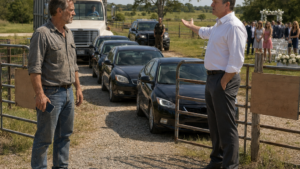
Jeffrey Martin stepped over the white row marker before Ruth could tell him not to.
The marker was only a length of painted wood driven into red earth, but Ruth had placed it herself at the beginning of planting season. It separated the certified watermelon rows from the narrow test strip beyond the drainage cut. Jeffrey’s polished shoe landed beside it, raising a small red cloud that settled over his cuff.
He carried a clipboard against his chest and a folded notice beneath one thumb.
“Mrs. Jackson?”
Ruth straightened slowly. The vines had kept her bent since sunrise, and the pull in her lower back resisted the change. She closed her right hand around the seeds she had been sorting and wiped her left palm against her stained apron.
“You’re already standing on my answer,” she said.
Jeffrey glanced down as though the ground might contain writing.
Behind Ruth, Andrew stopped loading crates into the green pickup. The wooden bed gave a hollow knock when he set one down too hard.
Jeffrey’s tie was loosened, but not enough to make him look as though he belonged in a field. He introduced himself, named the county agricultural services office, and asked whether the acreage before him was enrolled in the heritage-seed conservation program.
“You have the map,” Ruth said.
“I need your confirmation.”
“You crossed the marker to ask me where the marker is.”
His mouth tightened. “Is this the registered plot?”
“This side is.”
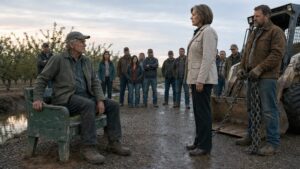
Jeffrey looked toward the road. Two neighboring growers had slowed their truck near the gate. They did not get out, but neither did they continue driving.
He unfolded the notice.
Ruth recognized the county seal before she saw the words beneath it.
“This is a formal compliance review,” he said. “Your crop certification is suspended pending verification of seed origin and planting boundaries.”
Andrew came forward. “Suspended on what grounds?”
Jeffrey shifted his attention to him. “And you are?”
“Her grandson.”
“He works here,” Ruth said. “That’s enough for today.”
Jeffrey turned the clipboard so they could see a printed photograph clipped beneath the inspection form. It showed Ruth’s truck beside the southern rows. Near the rear tire sat a bright commercial seed bag.
The picture had been taken from the road.
“The conservation agreement prohibits unreported commercial seed within the certified acreage,” Jeffrey said. “That bag was documented during yesterday’s preliminary site check.”
“You came onto the property yesterday?” Andrew asked.
“I photographed from the public right-of-way.”
Ruth studied the picture. The angle flattened the drainage cut and made the test strip appear to run directly into the main field.
“That bag wasn’t planted here,” she said.
“Then where was it planted?”
She looked past him toward the narrow strip beyond the ditch. The plants there were younger, their leaves a sharper green. She could have pointed. She could have explained the emergency order, the failed germination, the small test planting.
Instead, she felt the seeds pressed into her palm and heard her daughter’s voice from another season: Don’t let them speak of me like I didn’t know the work.
“Not in those rows,” Ruth said.
Jeffrey waited.
When she offered nothing more, he made a note.
A truck engine approached from the road. Tyler Clark pulled in behind the neighboring growers and parked beside Ruth’s pickup. He climbed down wearing a company shirt, his expression already apologetic.
The same bright bag from Jeffrey’s photograph stood upright in the truck bed.
Andrew stared at it. “Why did you bring that back?”
Tyler looked from him to Ruth. “Mrs. Jackson called about returning the unused portion.”
“I called three days ago,” Ruth said.
“I know. Route got changed.”
Jeffrey moved toward the bag. “Is that the same lot purchased for this property?”
Tyler hesitated. His eyes flicked to Ruth.
“It’s the remainder,” he said. “Emergency order. Small quantity.”
“How small?”
“Enough for under half an acre, depending on spacing.”
Jeffrey wrote again.
Andrew stepped between him and the truck. “You hear that? Under half an acre. She’s got nearly six planted.”
“Move,” Ruth said.
Andrew looked back at her.
“Move away from the man’s paper.”
His jaw worked, but he obeyed.
Jeffrey checked the lot number on the bag against something on his clipboard. “The issue isn’t merely quantity. The program requires disclosure of any commercial seed brought onto enrolled property.”
“The issue you named was substitution,” Ruth said.
“The review will determine intent.”
There it was—the word that turned an omission into a character judgment.
Ruth walked three rows inward. Jeffrey followed, careful now not to crush the vines. She pointed without opening her fist.
“Row one was planted May sixth after the north rain. Row two on the eighth. Rows three and four waited because the lower ground held water. Row seven lost twelve hills to beetles. Row nine came up thin on the west end because Andrew set the irrigation line too high.”
Andrew frowned but said nothing.
Ruth continued, naming dates, seed families, weak patches, and the places where she had replanted by hand. Jeffrey’s pen stopped moving.
“You keep written records of this?” he asked.
“I keep records.”
“Can I see them?”
“No.”
The answer surprised Andrew more than it surprised Jeffrey.
Jeffrey lowered the clipboard. “Mrs. Jackson, refusing access to required records may be treated as noncooperation.”
“Required records are not every paper inside my house.”
“The seed-origin ledger is specifically required.”
“I said I keep records.”
“But you won’t produce them.”
“Not standing in my field while two men at the road count how long I take to answer.”
The neighboring truck finally rolled forward, but slowly.
Jeffrey refolded the notice. “Effective immediately, no crop from the enrolled acreage may be represented or sold as certified heritage produce.”
Ruth felt the meaning before Andrew spoke it.
“The buyer comes Friday,” he said.
“Then the certification hold must be resolved before Friday,” Jeffrey replied.
“You know that’s impossible.”
“The hearing schedule is not mine to alter.”
Ruth looked at the melons beneath the leaves, some already striped dark and full. A week of delay would soften the earliest fruit. Two weeks would ruin enough to trouble the bank payment.
Jeffrey removed a county map from the back of his clipboard and held it against the breeze. A red boundary line ran over the printed field.
He placed one finger on the photograph, then on the map.
“According to the registered survey,” he said, “the place where that commercial bag was photographed is not beside the certified plot.”
His finger moved across the red line.
“It is inside it.”
Chapter 2: Three Kinds of Seed in One Open Hand
“Then tell me which one came from the bag.”
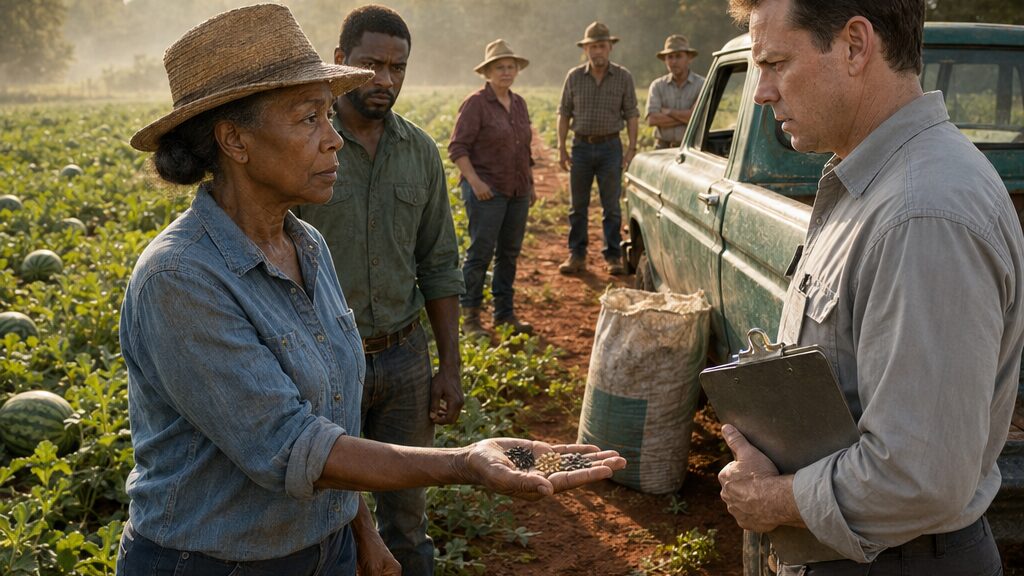
Ruth opened her fist.
Three kinds of seed rested against the brown lines of her palm. One group was broad and dark, one smaller with pale edges, and the third marked by a faint gray mottling. Dust clung beneath her nails. The morning heat had warmed the seeds against her skin.
Jeffrey looked at them, then at Ruth.
She held her hand between his clipboard and his face.
“You say commercial seed is in this field,” she said. “Pick it out.”
Tyler stood beside the pickup with both hands on the bright bag. Andrew remained near Ruth’s shoulder. At the road, the neighboring growers had finally climbed out of their truck.
Jeffrey did not reach for the seeds.
“I’m not conducting a visual seed identification.”
“You were conducting one well enough from the road yesterday.”
“I identified commercial packaging.”
“And from that, you identified my whole crop.”
“That is not what I said.”
“It is what your notice does.”
Jeffrey’s gaze settled on the seeds again. “Even if you can distinguish varieties, that doesn’t address whether unreported commercial stock entered the enrolled acreage.”
Ruth pointed with one finger to the broadest seeds. “These came from the north rows. Saved from last year’s late melons. Thick hull. They wait longer in cold ground.”
She touched the pale-edged group.
“These came from the middle rows. My husband’s people carried that line from Georgia before Andrew’s mother was born. It runs early, but it splits if the rain comes hard after ripening.”
Her finger paused over the mottled seeds.
“And these?”
Jeffrey asked the question despite himself.
“Southern strip. Planted after the ditch was cleared. Different leaf shape by the third week. Different runner length. Different need.”
“Commercial?” he asked.
Ruth closed her hand halfway. “I asked you.”
Tyler shifted the bag against his leg. The printed packaging crackled.
One of the neighboring growers took a step closer. “They don’t look much different to me.”
“They don’t need to,” Ruth said. “You’re not planting them.”
The man stopped.
Jeffrey turned to Tyler. “Can you identify your company’s seed from these samples?”
“Not reliably without the lot information and a proper comparison.”
“Then neither of you can prove these came from separate plots,” Jeffrey said.
Ruth walked to the end of the nearest row and crouched. Her knees complained, but she pressed two fingers into the soil and lifted a small root clump.
“North rows hold more clay,” she said. “See how it binds?”
She moved to the next section and scraped the ground with her boot. The dirt broke finer there.
“Middle rises two inches. Drains sooner.”
Then she pointed beyond the low cut where water still darkened the soil.
“That strip stays cool after noon. Commercial plants are there because I needed to know whether they could carry the lower ground without rotting.”
Jeffrey studied the field. For the first time, he seemed to see lines other than those printed on his map.
Andrew seized the moment.
“She just told you everything you need.”
“No,” Jeffrey said. “She told me she knows the field.”
His tone was quieter now, which made the next movement worse.
He lifted a page from beneath the photograph.
“This is the annual certification statement submitted six weeks ago.”
Ruth recognized her own signature before he turned it toward her.
The page was clean and white except for the county boxes, the program seal, and the dark line of her name.
Jeffrey read from the section above it. “‘I certify that no commercial, hybrid, treated, or otherwise nonregistered seed has been purchased, stored, introduced, or planted on enrolled property during the current growing cycle, except as disclosed in the attached supplemental record.’”
He looked at the bottom of the page.
“No supplemental record was attached.”
The neighboring growers no longer watched Jeffrey. They watched Ruth.
The seeds in her open palm suddenly felt too small.
Andrew said, “Maybe she filled out an older form.”
“The language has been unchanged for three years,” Jeffrey replied.
“You don’t know what happened in that office.”
“I know the form bears her signature.”
Ruth took the paper from him. Her name sat where she had written it at the county counter while the clerk waited for closing time. She remembered the hum of fluorescent lights and the pressure of the pen. She remembered pausing at the disclosure box.
She had checked no.
Jeffrey did not pull the form back.
“Did you purchase commercial seed during this growing cycle?” he asked.
Ruth handed him the page.
“You have Tyler standing beside the bag.”
“That isn’t an answer.”
“It is the answer you came for.”
“No. I came to determine whether the purchase was disclosed and where the seed was planted.”
She closed her fingers over the samples.
Andrew stepped closer. “Grandma.”
Ruth did not look at him.
Jeffrey returned the statement to his clipboard. “Your field knowledge is not in dispute.”
“It was five minutes ago.”
“I have not questioned your experience.”
“You stood in my rows and said the bag told you what I planted.”
“I said it created evidence requiring review.”
“And now that the field tells you something different?”
“Now there are conflicting facts.”
The restraint in his voice was beginning to strain. Ruth saw that he was not enjoying the scene. That did not make the suspension lighter.
Tyler cleared his throat. “For what it’s worth, the order was only four pounds.”
Jeffrey looked at him sharply. “Do you have an invoice?”
“At the office.”
“Lot destination?”
“This address.”
“Usage declaration?”
Tyler’s silence answered.
Andrew spread his hands. “Four pounds cannot plant six acres.”
“No,” Jeffrey said. “But the program violation does not require six acres. Storage alone can trigger review if it is unreported.”
Ruth watched Andrew’s anger lose direction. He had believed the small quantity would end the matter. Instead, the rules tightened around it.
Jeffrey placed the suspension notice on the hood of the green pickup and held out a pen.
“Your signature acknowledges receipt, not agreement.”
Ruth did not take it.
Andrew did.
She caught his wrist before the pen touched paper.
“Don’t sign my name.”
“I was signing mine as witness.”
“You are not my witness.”
His expression changed.
Jeffrey looked away, giving them a privacy the open field could not provide.
Ruth released Andrew’s wrist.
He lowered the pen. “I’m trying to help.”
“Then don’t stand in front of me like I’ve gone missing.”
The hurt in his face lasted only a second before anger covered it.
He walked to the truck, opened the passenger door, and reached beneath the seat. When he returned, he held a folded receipt stained at one corner with engine grease.
Ruth knew it before he opened it.
“I found this last night,” he said.
The date, quantity, lot number, and Ruth’s name were printed across the top.
Andrew looked at her, not Jeffrey.
“You hid it under the truck manual.”
Ruth’s closed fist tightened around the seeds.
“What else,” he asked, “did you decide I wasn’t allowed to know?”
Chapter 3: The Receipt Andrew Was Never Meant to Find
Andrew laid the receipt beside the county notice on the kitchen table.
The ceiling fan pushed both papers at their corners, making them lift and settle as though breathing against each other.
Ruth stood at the sink with her back to him. She washed red soil from her hands, though most of it had already dried into the creases.
“You went through my truck,” she said.
“I looked for the insurance card.”
“You found it?”
“Yes.”
“Then you should have stopped looking.”
Andrew stared at the back of her headscarf. “That’s what you have to say?”
She shut off the water. “You asked why I had the receipt. You know why. I bought seed.”
“You signed a form saying you didn’t.”
“The form is between me and the county.”
“The sales hold is between all of us.”
“There is no all of us on the note at the bank.”
He drew back as if she had struck the table.
Ruth dried her hands carefully. The kitchen smelled of coffee left too long on the burner and the faint sweetness of melons stacked beneath the back window.
Andrew flattened the receipt. “Four pounds.”
She said nothing.
“I checked the planting guide on Tyler’s company site. Four pounds wouldn’t cover half an acre at your spacing.”
“You didn’t need a website for that.”
“No. But I needed something you couldn’t tell me I remembered wrong.”
Ruth turned.
The unopened family ledger sat on the sideboard behind him. Its brown cover was warped from years in the seed room. A few loose seeds lay near its spine, spilled from her apron when she came inside.
Andrew followed her gaze.
“That the record Jeffrey asked for?”
“It’s a record.”
“Why didn’t you show it?”
“Because he asked as if everything in this house belonged to his clipboard.”
“He can shut down the crop.”
“He already did.”
“And you helped him.”
The words hung between them.
Ruth pulled out a chair but did not sit. “The saved seed failed in part of the lower trays.”
Andrew’s anger paused.
“How much?”
“Enough.”
“That isn’t a number.”
“Nearly half of what I set for the south ground.”
He looked toward the window, where the lower field lay beyond the shed. “So you bought commercial stock for the strip.”
“For a trial.”
“Why not report it?”
Ruth’s eyes went to the ledger again.
Andrew saw.
He crossed the room and reached for it. Ruth moved faster than he expected, placing her hand on the cover.
“Leave that.”
“It’s required.”
“It is not yours to open.”
“My mother kept it, didn’t she?”
Ruth’s fingers stiffened.
Andrew’s voice lowered. “That’s her handwriting on the labels in the seed room.”
“She kept some of it.”
“Then why are you acting like the book is dangerous?”
“Because you do not get to pull apart what you never stayed to carry.”
He stepped back.
For two years after his mother’s death, Andrew had worked construction three counties away. He sent money when he could and came home when Ruth called, which was seldom. He had returned for the season only after the bank’s first warning.
“You told me to go,” he said.
“I told you not to bury yourself here out of guilt.”
“And now you use leaving against me.”
“I said you did not carry it. That is fact.”
“So tell me.”
Ruth lifted her hand from the ledger. “The storage failed.”
“The cooler?”
“The records. The temperatures. Some lids weren’t sealed.”
“Who was handling them?”
She looked at him until he understood she would not answer.
His face changed slowly.
“My mother?”
Ruth picked up the loose seeds and placed them in a small dish.
“She was sick,” Andrew said.
Ruth’s hand stopped.
“She was already sick when she stored them.”
“She was working.”
“That isn’t what I asked.”
Ruth pushed the dish toward the center of the table. “The commercial seed went only into the test strip. Nothing in the certified rows came from that bag.”
“Then that clears you.”
“No. It clears the planting line. It does not clear the form.”
“Why protect a form over the farm?”
“I was not protecting a form.”
He looked at the ledger.
“You were protecting her.”
Ruth’s voice became flat. “Your mother did not ruin this farm.”
“I didn’t say she did.”
“People would.”
“Who?”
“People who like a simple reason. People who think sickness makes every mistake understandable until money is involved. Then they call it negligence.”
Andrew sat down. His anger had not left, but it had changed shape.
“She made one storage mistake.”
“You don’t know what she made.”
“Because you won’t let me.”
Ruth gripped the back of the chair.
The phone on the wall rang.
Neither moved at first. It rang again.
Ruth answered.
Christine Miller’s voice came through clearly enough for Andrew to hear the careful distance in it.
“I need to ask you something straight,” Christine said. “Did commercial seed enter the certified field?”
“No.”
“Can you prove that?”
“Yes.”
“Can you prove you reported the purchase?”
Ruth watched Andrew.
“No.”
Christine exhaled. “The produce buyer called the cooperative. They’re asking whether this affects the group contract.”
“It doesn’t.”
“They don’t know that.”
“You do.”
“I know you. That isn’t the same as having something I can place before the board.”
Ruth’s shoulders drew back. “So place my word.”
“The board chair won’t accept that.”
“Would you?”
Silence.
Christine answered honestly. “Not with the form and receipt looking the way they do.”
Ruth almost thanked her for not lying.
Andrew rose and took the phone gently from Ruth’s hand.
“The order was four pounds,” he said. “Too small for the certified acreage. It went into a test strip by the drainage cut.”
Ruth reached for the receiver. Andrew turned away.
“Who verified that?” Christine asked.
“No one yet. But the numbers prove it couldn’t cover the field.”
“They prove it couldn’t cover all of it.”
“That’s enough to slow the board down.”
“You should have called me before now.”
Andrew looked at Ruth. “I only found the receipt last night.”
Ruth took the phone back and hung it up.
“You had no right.”
“I gave her facts.”
“You gave her my trouble to carry into town.”
“It was already in town.”
“You made it speak in your voice.”
He stared at her. “You keep saying you’re protecting this family, but every time somebody reaches for the weight, you slap their hand away.”
Ruth gathered the county notice and the receipt.
“Where are you going?” he asked.
“To put these where you won’t search for them.”
His laugh was short and bitter.
The phone rang again before she reached the hallway.
This time, Christine did not wait for a greeting.
“The cooperative board is meeting tomorrow evening,” she said. “They’re voting on whether to suspend your membership until the county hearing.”
Ruth looked through the window at the loaded crates waiting beside the green truck.
Christine continued, softer now. “I thought you should hear it from me before the notice arrives.”
Ruth held the receiver tightly.
“Which way are you voting?” she asked.
Christine did not answer at once.
“That,” she said, “depends on what you decide the rest of us are allowed to know.”
Chapter 4: The Boundary Line That Moved After the Rain
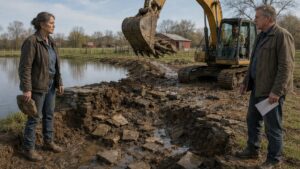
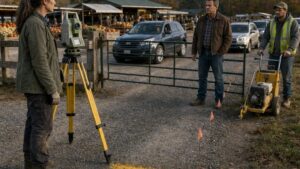
The extension specialist struck metal beneath six inches of red clay.
Jeffrey heard the shovel ring and turned from the drainage ditch. The sound was too clean to be stone.
“Here,” the specialist called.
He knelt and cleared the soil with his hands until a rusted iron stake appeared at an angle beneath a mat of grass roots. A strip of faded white paint clung to one side.
Ruth stood several yards away with her arms folded. Andrew remained beside her, holding a bundle of measuring flags. Neither looked pleased to see Jeffrey, though Ruth had allowed the inspection after the county issued a written request.
Jeffrey opened the survey map on his clipboard.
The original stake sat almost eight feet east of the painted wooden marker he had crossed two days earlier.
“That can’t be right,” he said.
The specialist set a measuring tape against the buried stake. “Metal doesn’t usually walk.”
Andrew gave a humorless laugh.
Ruth did not.
Jeffrey compared the position with the red boundary line on the map. If the buried stake was original, the drainage cut and most of the narrow test strip fell outside the enrolled acreage. The bright commercial seed bag in his photograph would have been beside that strip, not inside the certified field.
“Who installed the wooden marker?” he asked.
“I did,” Ruth said.
“When?”
“After the county crew cleared the ditch in March.”
“And why did you place it there?”
“Because the old stake was gone.”
“It wasn’t gone.”
“It was buried.”
Jeffrey looked toward the ditch. The bank had been cut down and rebuilt after spring flooding. Mud from the excavation had spread across the lower ground. A machine could easily have covered the iron marker while shifting the visible boundary stakes.
“Did the crew give you a revised field map?” he asked.
“They told me the ditch line would stay the boundary.”
“Who told you?”
“The man running the excavator.”
“That isn’t a county survey.”
“It was a county machine.”
The specialist stretched the tape toward the next surviving marker. The line passed cleanly along the northern edge of the test strip.
Andrew planted a flag at the measurement.
“There,” he said. “Commercial plants outside. Heritage rows inside.”
Jeffrey crouched near the first watermelon vine beyond the line. Ruth had described the difference in leaf shape, runner length, and soil response. Now, with the rows measured instead of flattened by the angle of his photograph, the separation was visible.
He took out his phone and pulled up the image from the preliminary visit.
The photograph had been taken from the road at a diagonal. The truck, bag, ditch, and first rows appeared almost stacked on top of one another. He had attached it to his report with the phrase probable introduction within enrolled acreage.
The phrase looked less certain in the field than it had beneath fluorescent office lights.
“You took that from over there,” Christine Miller said.
She had arrived to observe on behalf of the cooperative and stood at the road shoulder, one boot on the grass.
“Yes.”
“Then the truck blocked the ditch.”
Jeffrey looked again.
It had.
The specialist rose and brushed soil from his knees. “My preliminary finding is that the registered line follows the original iron markers. The temporary wooden marker was displaced after drainage work.”
“Meaning?” Andrew asked.
“Meaning most, possibly all, of this test strip sits outside the certified acreage.”
Andrew faced Jeffrey. “You froze the crop over a picture taken from the wrong angle.”
Jeffrey clipped the photograph back beneath the map. “The boundary finding addresses planting location. It does not address the undisclosed purchase.”
“You wrote that she substituted commercial seed,” Andrew said.
“I wrote that the evidence was consistent with possible substitution.”
“You told the cooperative there was a fraud review.”
Jeffrey’s jaw tightened. “The program entered audit status last quarter. We were instructed to notify affected partners when a certification hold could impact shared contracts.”
Christine stepped closer. “You notified us before checking the original markers.”
“I followed department procedure based on available evidence.”
“Available because you didn’t walk the line.”
Jeffrey looked toward Ruth.
She had not joined the argument. She crouched at the edge of the test strip and pressed her fingers into the soil. When she stood, three seeds rested in her palm.
She laid them on the county map, each over a different section of the printed field.
“Dark seed, north rows,” she said. “Pale edge, middle rise. Mottled one, test strip.”
The specialist collected samples from the corresponding plants and placed each in a separate envelope. The locations matched Ruth’s descriptions.
Jeffrey felt something in his first conclusion give way. Not collapse entirely, but loosen enough to expose the judgment beneath it.
Ruth had known exactly where the commercial seed went.
That made the inaccurate boundary accusation weaker.
It also made her failure to disclose harder to dismiss as confusion.
“Mrs. Jackson,” he said, “the invoice still matters.”
“I know what matters to your office.”
“You signed a statement saying no commercial seed had been purchased, stored, introduced, or planted on enrolled property.”
“The strip isn’t enrolled.”
“The form says on enrolled property, not only enrolled rows. The farm parcel receives program support.”
Ruth’s eyes narrowed. “Then your rule has two boundaries. One in the dirt and one in the sentence.”
“The disclosure requirement is broader than the planting restriction.”
“That ought to have been clear before a person signs it.”
“It is printed directly above the signature.”
Andrew started forward, but Ruth lifted one hand.
Jeffrey continued, more carefully. “The boundary evidence may remove the substitution allegation. It does not remove the reporting violation.”
Ruth closed her palm around the seeds.
Christine spoke from behind him. “What happens to the sales hold?”
“I can recommend narrowing it, but I cannot lift it before reviewing the full records.”
“What full records?” Ruth asked.
“The seed-origin ledger, storage logs, germination counts, and any prior-season inventory showing why the commercial order became necessary.”
The change in her was small. Her shoulders did not drop. Her face did not turn away. Only the hand holding the seeds tightened against her apron.
Jeffrey noticed.
So did Andrew.
“The commercial order was four pounds,” Jeffrey said. “That suggests replacement or testing, not broad substitution. But we need to establish what happened to the registered stock.”
Ruth’s voice was quiet. “You have established where I planted.”
“Not why the purchase was omitted.”
The specialist sealed the final sample envelope.
Jeffrey removed a formal records request from his folder and wrote the date across the top. He gave Ruth five business days to produce the previous season’s storage records.
She took the page without looking at it.
Jeffrey expected anger. Instead, she stared toward the farmhouse pantry window, where the old seed room sat behind a closed interior door.
“What are you protecting?” he asked.
Ruth folded the request once.
“That question,” she said, “is not printed on your form.”
At the cooperative office an hour later, Jeffrey revised the boundary section of his report. He removed “probable introduction” and replaced it with “commercial planting appears confined to noncertified test area pending final survey confirmation.”
He left the disclosure violation unchanged.
Before closing the file, he added one final request:
Complete seed-storage ledger and inventory records from the previous growing season.
When the county clerk read the line, she paused.
“Those are the records the first audit couldn’t locate, aren’t they?”
Jeffrey looked at Ruth’s file number.
“Yes.”
The clerk stamped the request.
The sound landed like the shovel striking buried iron.
Chapter 5: The Ledger Stopped Where Her Daughter’s Handwriting Ended
The key would not turn until Ruth pressed her shoulder against the seed-room door.
Wood scraped over the floor inside. The lock gave with a dry click, releasing air that smelled of dust, burlap, and old cedar.
Andrew stood behind her in the pantry. He had not spoken since Jeffrey delivered the records request.
Ruth switched on the bare bulb.
Shelves lined three walls. Glass jars held beans, corn, okra, squash, and watermelon seed arranged by year. Some labels were written in Ruth’s square hand. Others carried the narrower script of Andrew’s mother.
The bottom shelf held a dented tin with a blue lid.
Ruth had not opened it since the funeral.
She took it to the worktable and sat. Her fingers rested on the lid while Andrew remained by the doorway.
“You can wait outside,” she said.
“I’ve done enough of that.”
She looked up.
He did not say it angrily. That made it harder to dismiss.
Ruth turned the lid. The seal resisted, then broke with a soft sucking sound.
Inside lay several cloth packets and a layer of darkened seed. Some had split along the edges. Others bore pale patches where moisture had worked beneath the hull.
Andrew moved closer.
“That’s the failed stock?”
Ruth emptied a few seeds beside the ledger.
They made almost no sound.
“She checked the cooler every morning,” Ruth said. “Even when her hands shook.”
Andrew looked at the damaged seed. “Then what happened?”
“The power cut twice that summer. She moved the trays to the pantry. Put them back too soon.”
“Because she was sick.”
“Because she thought she could finish.”
Ruth pulled the ledger toward her and opened it.
The early pages were dense with planting dates, weather marks, germination rates, and notes about fruit shape. Halfway through the previous season, the handwriting changed. Andrew’s mother had taken over when Ruth’s eyesight was recovering from surgery.
The entries grew shorter.
June 3—cooler high in afternoon. Moved lower trays.
June 7—condensation on lids. Dried cloths.
June 11—check watermelon stock again.
Then the writing stopped in the middle of a line.
Ruth touched the unfinished sentence.
Andrew pulled out the chair opposite her. “You told me the records were complete.”
“I told the county I kept records.”
“That wasn’t what I said.”
Ruth closed the ledger halfway.
“The inventory after that point is mine.”
“Where?”
She gestured to the jars. “Here.”
“In your head.”
“I know every amount.”
“And if something happens to you?”
The question struck the room harder than either of them expected.
Ruth looked toward the shelves. For years, knowing had been the proof that she was still necessary. Each jar belonged to a season she could summon without paper. She remembered drought by the weight of seed in her palm, floods by the stains on labels, births and funerals by which rows had gone unweeded.
Andrew reached for the ledger.
This time she did not stop him.
He turned the unfinished page carefully. A folded scrap of paper slipped from the binding and fell to the floor.
Ruth froze.
Andrew picked it up.
The paper had been torn from a small notepad. His mother’s handwriting slanted across it.
Ma—
If the lower stock fails, write it down. Don’t turn it into a secret just because I was the one who missed the moisture. Seeds fail. People fail. The farm needs the truth more than it needs me remembered right.
The final word trailed as if the pen had weakened.
Andrew read it twice.
Ruth took the note from him, but not roughly. She remembered finding it near the ledger after the hospital called. She had read only the first lines before folding it away.
Or perhaps she had read all of it and kept only the meaning she could bear.
“She didn’t ask you to protect her,” Andrew said.
“She did before that.”
“What did she say?”
Ruth looked at the damaged seeds. “She said she didn’t want people talking like sickness made her careless.”
“That isn’t the same as hiding what happened.”
“She was frightened.”
“So were you.”
Ruth’s eyes lifted.
Andrew’s voice remained gentle. “You made her fear into a promise she didn’t ask you to keep.”
The truth of it arrived without drama. No sudden break, only the slow removal of a support Ruth had leaned against for too long.
She had told herself silence preserved her daughter’s dignity. It had also preserved Ruth’s belief that the family seed line remained unbroken, that loss had come from weather or markets or time—not from a mistake made inside their own walls.
She turned the note over. The back was blank.
“When the trays failed,” she said, “I threw out the worst before I counted them.”
Andrew waited.
“I knew the program required an exact loss record. I knew the commercial order needed disclosure. I thought I could rebuild the count after planting.”
“But you didn’t.”
“No.”
“Why?”
“Because then I would have to put her name beside the failure.”
Andrew looked around the room. “Her name is already beside everything else.”
Ruth followed his gaze to the labels. Her daughter had recorded strong germination, weak germination, pests, heat damage, and fruit that split before harvest. There was no perfection in the ledger. Only work.
The phone rang in the kitchen.
Ruth did not move.
It rang again, then stopped. A moment later, Andrew’s phone vibrated.
He read the message. “Christine says the cooperative vote is tomorrow, after the county hearing schedule is confirmed.”
“Let them vote.”
“They can drop us from the group contract.”
“I know.”
“The buyer won’t take the heritage crop without them.”
“I know.”
Andrew put down the phone. “Then we take the ledger to Jeffrey.”
Ruth closed the tin.
“No.”
His chair scraped back. “You just read what she wrote.”
“I said no to Jeffrey standing in this room and taking what he wants.”
“Then make copies.”
“The missing inventory still has no numbers.”
“We reconstruct them.”
“From what?”
“The purchase quantity. The planting trays. What survived. What went into each row. You remember it all.”
Ruth looked at the jars again.
He was asking her to turn memory into evidence. That meant accepting memory could be questioned, corrected, or inherited by someone else.
Andrew opened the ledger to a blank page and placed a pencil beside it.
“Start with the lower watermelon stock.”
Ruth remained still.
Then she pulled the chair closer.
For the next two hours, they counted jars, compared labels, matched planting dates, and estimated losses. Ruth refused to guess where she could not be certain. Andrew marked those lines incomplete rather than filling them with convenient numbers.
When they finished, the ledger did not absolve her. It showed the missing count, the failed stock, the emergency purchase, and the gap between what Ruth knew and what she had declared.
It also showed that four pounds could not have replaced six acres.
Dusk had darkened the pantry when Ruth returned the damaged seeds to the blue tin.
Andrew held his mother’s note.
“Are you taking that tomorrow?” he asked.
Ruth considered it.
“No.”
His face tightened.
“I am taking the truth it contains,” she said. “Her last private words do not belong to the county.”
Andrew nodded slowly.
Ruth gathered the ledger, the reconstructed inventory, the purchase receipt, and three labeled seed envelopes. She placed them in a worn canvas bag.
“I’ll speak at the hearing,” she said.
“We’ll speak.”
“No.”
He stared at her.
“You may sit behind me,” Ruth said. “You may answer if they ask you what you saw. But you will not stand between me and what I signed.”
“You think I’m trying to rescue you.”
“I think you are trying to carry the part that is mine because you’re afraid I’ll drop it.”
“Will you?”
Ruth fastened the bag.
“I already did.”
She turned off the seed-room light.
Tomorrow, she would pick it up where everyone could see.
Chapter 6: The Hearing Where No One Was Entirely Innocent
The phrase appeared in the second paragraph of Jeffrey’s report.
Intentional substitution of unregistered commercial stock.
Ruth read it twice before the hearing began.
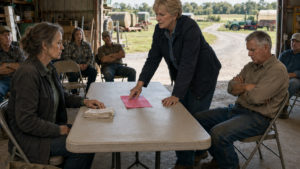
The agricultural services meeting room held twelve metal chairs, a long laminate table, and no window low enough to see the ground. Ruth sat at one end with the canvas bag by her feet. Andrew occupied the chair behind her. Christine sat near the cooperative board chair, her hands folded over a yellow legal pad.
Jeffrey arranged his documents across from Ruth.
His clipboard rested on top.
The county clerk called the meeting to order and explained that the hearing concerned Ruth Jackson’s suspended heritage certification, the commercial seed purchase, the mapped field boundary, and possible reporting violations.
Ruth kept her eyes on the report.
When the clerk invited preliminary corrections, she lifted the paper.
“Who chose these words?”
Jeffrey looked at the line she indicated. “I did.”
“Before or after you measured the field?”
“Before.”
“And after measuring?”
“I revised the boundary finding.”
“You revised the map section. These words remain.”
Jeffrey glanced toward the department representative seated beside him. “The purchase and nondisclosure still support an intent inquiry.”
“Intent to do what?”
“To introduce unregistered stock without required disclosure.”
“That is not the same as substituting my crop.”
“No,” he said. “It is not.”
The room shifted at his answer.
Ruth set the report down.
The department representative asked Jeffrey to summarize his inspection. He described the commercial bag photographed near the enrolled field, Ruth’s certification statement, the missing supplemental disclosure, and the initial map. He then explained that the original iron marker had been buried during county drainage work and that the commercial test strip appeared to fall outside the certified acreage.
“Do you still believe commercial seed was planted in the registered rows?” the representative asked.
“Current evidence does not support that conclusion.”
Ruth heard Christine’s pen stop.
“Then why was the cooperative informed of suspected fraud?” Ruth asked.
Jeffrey folded his hands. “Program guidance requires notification when a suspension may affect shared certification.”
“Did the guidance require the word fraud?”
“No.”
“Did it require you to send your conclusion before checking the buried marker?”
“No.”
Andrew moved behind her, but Ruth did not look back.
Jeffrey’s face had reddened. “The department had recently failed an external audit. We were instructed to act quickly on undisclosed commercial seed. The photograph, map, bag, and signed declaration appeared consistent.”
“Appeared.”
“Yes.”
“And when my field appeared different?”
“I requested additional evidence.”
“After stopping my sales.”
“Yes.”
The answer carried no apology, but neither did it hide behind procedure.
The department representative turned to Ruth. “Mrs. Jackson, do you dispute purchasing the commercial seed?”
“No.”
The room went very still.
Jeffrey reached toward the invoice, but Ruth removed her own copy from the canvas bag.
“I bought four pounds from Tyler Clark after part of my saved watermelon stock failed. I planted it on the lower test strip. I did not plant it in the certified rows.”
“Did you disclose the purchase?”
“No.”
Andrew’s breath caught behind her.
Ruth continued before anyone could fill the silence.
“I read the statement. I checked no. I signed my name. That was false.”
The board chair leaned toward Christine, but Christine did not turn.
The department representative asked, “Why did you do that?”
Ruth opened the ledger.
“My daughter kept part of our seed inventory while she was ill. Moisture damaged the lower stock. After she died, I did not complete the loss record. I bought replacement seed for a separate trial because I needed to know whether the lower ground could still produce.”
She laid the reconstructed inventory beside the ledger.
“I told myself the purchase did not belong on the form because the test strip was outside the certified rows. But the form asked about the property. I understood enough to know I should ask. I did not ask.”
“Why not?”
Ruth’s hand rested on the unfinished page.
“Because asking would have required me to show the missing record. I would have had to explain why it stopped.”
No one interrupted.
“I believed I was protecting my daughter from being remembered by one mistake,” Ruth said. “What I protected was my own pride.”
Jeffrey looked at her then—not at the ledger, not at the forms.
The department representative examined the inventory sheets. “These figures were reconstructed this week?”
“Yes.”
“So they are not contemporaneous records.”
“No.”
“Can they be independently verified?”
“Some can. Purchase quantity. Tray counts from supply orders. Planted row length. What cannot be verified is marked uncertain.”
Ruth removed three small envelopes and emptied their contents onto separate white cards. Dark seeds. Pale-edged seeds. Mottled seeds.
“These match samples from the north rows, middle rise, and test strip. The extension specialist sealed matching field samples.”
Jeffrey placed the specialist’s report beside them.
“The locations correspond,” he said.
The representative read several lines. “This supports separation of the commercial test planting.”
“It does,” Jeffrey said.
“Does it resolve the false declaration?”
“No.”
Ruth met his eyes. “It should not.”
Christine looked up from her notes.
The hearing moved through the remaining documents: Tyler’s invoice, the county drainage work order, photographs from the wrong road angle, and the revised survey. Each answered one question and sharpened another.
The county had accused too quickly.
Ruth had concealed deliberately.
Jeffrey had mistaken procedure for certainty.
Ruth had mistaken silence for dignity.
When the department representative asked whether Jeffrey wished to amend his recommendation, he removed the first page of his report.
“I withdraw the finding of intentional substitution,” he said. “The evidence does not support commercial stock within the certified rows.”
Ruth waited.
“I maintain the finding of nondisclosure and incomplete required records.”
The representative nodded. “Recommended sanction?”
Jeffrey looked toward the seeds on the table.
“Under the program rules, full reinstatement is not available this season after a material false declaration.”
Andrew whispered, “Then what was all this for?”
Ruth turned just enough for him to see her expression.
He fell silent.
Jeffrey continued. “Permanent removal is not necessary if the department accepts that the commercial planting was segregated and the violation did not contaminate the certified acreage.”
The cooperative board chair spoke. “Our buyer will not accept product under unresolved certification.”
“We understand that,” Christine said. “But the cooperative also needs a finding that the county’s fraud notice was premature.”
The department representative looked at Jeffrey.
He took a breath. “It was.”
The words were plain. No performance. No rescue.
Christine wrote something on her pad.
The representative reviewed the available sanctions: permanent decertification, suspension through the following season, or provisional status under enhanced monitoring.
“Mrs. Jackson,” she said, “your counsel—”
“I have none.”
“Then you should understand that the department may not simply erase a signed false declaration because the planting allegation proved incorrect.”
“I am not asking you to erase it.”
Andrew leaned forward.
Ruth placed both palms on the table.
“I will not accept permanent suspension for seed that never entered the registered rows. I will not ask for a special exemption from a rule I signed and broke.”
“What are you asking for?”
“A measured remedy.”
She slid a handwritten proposal across the table.
“Provisional recertification for the verified heritage rows. Separate marking of the test strip. Monthly inventory review through harvest. Joint inspection before next planting. Every seed purchase entered within forty-eight hours. Every boundary verified against iron markers, not road photographs.”
Jeffrey read the page.
Ruth continued. “The county corrects the substitution allegation in writing. I correct my records in writing. Neither side calls the other innocent.”
The department representative studied her. “Enhanced monitoring carries costs.”
“I know.”
“Delayed approval may reduce the market value of part of your crop.”
“I know.”
“And any further reporting failure would end your eligibility.”
“I know that too.”
The board chair whispered to Christine. Christine answered without lowering her voice.
“The cooperative can work with provisional certification if the buyer accepts segregated lots. But Ruth’s records would have to be available for review.”
Ruth looked at her.
“Available,” Christine said, “not taken from your house without notice.”
The distinction mattered.
Jeffrey set down the proposal. “I would add that future field verification include original survey markers whenever drainage or grading work has occurred.”
The department representative made a note.
For the first time since Jeffrey crossed her row, his clipboard no longer seemed like a weapon. It was still incomplete. It was also capable of correction—if someone forced the correction into it.
The representative called a brief recess.
No one left the room.
Andrew came to Ruth’s side. “You should have told me.”
“Yes.”
He waited, perhaps expecting explanation.
She gave none.
Not because the truth belonged only to her, but because yes was finally large enough.
The department representative returned with the clerk and resumed her seat.
“The department will issue a decision within seven calendar days,” she said. “Until then, the sales hold remains.”
The early melons would not wait seven days. Ruth felt the loss settle into numbers she did not need a ledger to calculate.
The representative gathered the documents.
“Mrs. Jackson, your proposed corrective plan will be entered into the record.”
Ruth closed the ledger but left the three seed groups on the table.
Jeffrey looked at them.
“What happens to those?” he asked.
“They become evidence when you name them that,” Ruth said. “They become next year when I do.”
Then she pushed the labeled cards toward the county clerk.
For once, opening her hand did not mean surrender.
It meant she had chosen what the papers would finally be required to hold.
Chapter 7: What the County Corrected and What It Could Not
The county restored Ruth’s certification with the word provisional stamped across the top.
Jeffrey read the decision before handing it over. The correction withdrawing the substitution allegation occupied one paragraph. The conditions filled two pages.
Monthly inventory reviews. Separate lot labels. Advance notice of commercial purchases. Joint verification of field boundaries before planting. A final inspection before the next season could receive full status.
Ruth read every line.
Across the county-office counter, Jeffrey waited without urging her toward the signature box.
“The fraud language?” she asked.
“Removed from the official file and the notice sent to the cooperative.”
“Removed or corrected?”
“Corrected. The original notice remains part of the record, with the withdrawal attached.”
Ruth looked up.
He did not pretend that paper could become unwritten.
“That will have to do,” she said.
“It is what the records allow.”
She signed beneath the monitoring conditions.
Jeffrey took the decision, added his signature, and pressed the county seal into the bottom corner. His clipboard lay beside him, thicker now with revised maps and amended findings.
“The field-verification procedure is changing,” he said. “Any property affected by drainage, grading, or road work will require physical confirmation of original markers.”
“That should have been the procedure already.”
“Yes.”
He said it without defense.
Ruth folded her copy and slipped it into the canvas bag beside the ledger. “You still froze the crop before you knew where the line was.”
“I know.”
“Some of those melons are past the buyer’s window.”
“I know that too.”
The admission did not repair the loss. It kept him from asking her to treat correction as generosity.
At the cooperative shed, Christine had gathered the board chair and the two neighboring growers. Crates stood stacked along the wall, marked with the farms that had filled them. Ruth’s section remained empty.
Christine read the county decision, then set it flat on the table.
“The cooperative can reinstate Ruth under provisional status,” she said. “The buyer will accept certified lots only after the county releases each shipment.”
One grower folded his arms. “That delays everybody.”
“Only Ruth’s lots,” Christine replied.
“And if another problem comes up?”
“Then the contract follows the same rules it follows for any member.”
The man glanced at Ruth. “She kept records from the county.”
Ruth answered before Christine could. “I did.”
He seemed unsettled by the lack of denial.
Christine tapped the second page. “The condition I’m recommending is that all seed inventories used for cooperative certification be available to the treasurer before planting and after harvest.”
Ruth’s mouth tightened.
“Available,” Christine said. “Not owned by us. Not carried off. But available.”
Andrew stood near the shed door. He did not speak for Ruth this time.
The board chair called the vote.
The motion passed, though one grower abstained.
Christine slid the decision toward Ruth. “The early harvest won’t qualify for the original contract price. The buyer says the delay pushed it out of the premium window.”
“How much lower?”
Christine told her.
Andrew looked down.
The difference would cover labor and fuel, but not the full loan payment.
“We can sell some at the roadside stand,” he said.
“And some to the diner distributor,” Christine added. “Not at heritage price.”
Ruth folded the cooperative decision beside the county’s.
Practical survival arrived without music, applause, or anybody feeling entirely satisfied.
That afternoon, they loaded the melons that remained firm enough for sale. Andrew marked each crate with the row, harvest date, and seed group. Ruth checked the first three, then stopped correcting the angle of his handwriting.
Jeffrey’s truck appeared at the gate before they finished.
He remained outside the rows.
“I brought the amended public notice,” he said.
Ruth wiped her hands on her apron and read it.
The county had found no evidence of commercial seed within the certified acreage. The prior reference to intentional substitution was withdrawn. A separate nondisclosure violation remained under corrective monitoring.
Plain enough to clear her name.
Plain enough to preserve her mistake.
She handed it back. “Post it where you posted the first one.”
“I already sent it to the cooperative and the buyer.”
“Then we’re done for today.”
Jeffrey nodded. His gaze moved toward the new flags marking the buried iron boundary.
“I should have walked the field before writing the conclusion.”
“Yes.”
He waited, perhaps for forgiveness.
Ruth gave him accuracy instead.
“You should have.”
When he left, Andrew closed the tailgate and leaned against the truck.
“Do you really mean to let me manage next season’s seed records?”
Ruth adjusted a label on the nearest crate.
“You said they shouldn’t stay in one person’s head.”
“That wasn’t the question.”
She looked across the rows. Some vines were already browning. Others still held green fruit beneath their leaves. The farm had survived the hearing, not the costs of it. Winter would require numbers sharper than memory.
“You can manage the first draft,” she said.
Andrew smiled once. “And the second?”
“That depends on how many mistakes you make in the first.”
His smile faded into something more careful.
“You’ll let me make them?”
Ruth picked up the ledger from the truck seat and held it between them.
“That,” she said, “is what I am still deciding.”
Chapter 8: The Seeds She Finally Placed Beside the Written Truth
The new row marker carried two planting codes.
R.J. was burned into one side of the wood. A.J. appeared beneath it in darker, less practiced letters.
Ruth stood over the marker while Andrew waited with the seed tin beneath his arm. Spring wind moved through the empty rows, lifting the corners of the fresh field map clipped to his board.
Inside the seed room, the ledger lay open to a clean page.
Andrew had entered the successful germination rates first. Beneath them, he had written the failures: split hulls, weak trays, two jars discarded after moisture reached the lids.
Ruth read the page without speaking.
“You skipped the lower stock count,” she said.
“I put it on the next line.”
“Wrong date.”
Andrew checked the jar label. “You’re right.”
She took the pencil, corrected the number, then held it a moment longer than necessary.
The old habit urged her to finish the page herself.
Instead, she placed the pencil in Andrew’s hand.
He wrote the corrected date.
Ruth opened the blue tin and poured several watermelon seeds into her palm. Dark, pale-edged, and mottled seeds rested together against the lines of her skin.
Once, she had opened that hand to prove an inspector wrong.
Now she lowered it over the ledger.
The seeds clicked softly onto the written page.
Andrew looked at them. “Which row gets the mottled line?”
“You tell me.”
“The lower test strip again. Past the iron marker. Separate inventory.”
“And the pale edge?”
“Middle rise, if the soil temperature holds.”
Ruth nodded.
Outside, the fields remained tied to debt, weather, buyers, and rules neither of them controlled. Provisional certification had not made the farm safe. It had only made another season possible.
Andrew closed the ledger after the ink dried.
Ruth did not reach to reopen it.
He sealed the seed tin and carried it toward the field, the ledger tucked beneath his other arm. At the doorway, he paused as if expecting her to take one of them back.
Ruth switched off the seed-room light.
“Don’t stand there losing the morning,” she said.
Andrew stepped outside.
Ruth followed him toward the rows, where both their codes waited on the same marker and the ground held no promise except what they were willing to record honestly.
The story has ended.