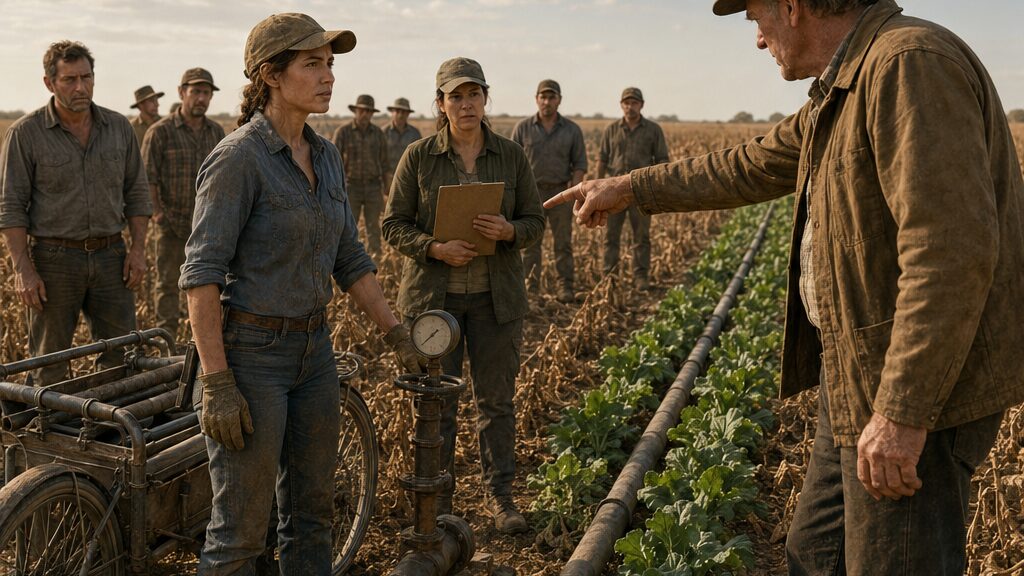
She Pulled Irrigation Pipe by Bicycle Until the Men Who Mocked Her Needed Her Field to Survive
Chapter 1: The Pipes Arrived Before Anyone Gave Permission
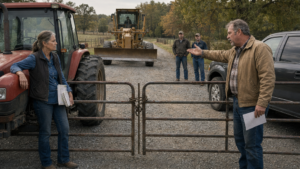
The bicycle trailer jammed under the cooperative gate with six farmers watching.
Ashley Harris heard the front wheel scrape metal, then the dry rattle of pipe sliding against pipe. One length of faded black tubing rolled sideways and struck the gatepost hard enough to make Gary Lee flinch.
Nobody stepped forward.
Thomas Wright stood nearest the pump shed with both hands resting on the top rail. His hat shadowed his eyes, but Ashley could see the line of his mouth.
“You planning to drag all that through the gate?” he asked.
Ashley set one boot against the ground and pulled the bicycle backward. The trailer did not move. Its wooden side had caught on the chain Thomas had looped lower than usual.
“I was,” she said.
A few men shifted their weight. One gave a soft breath that might have been a laugh.
The first week of drought restrictions had already turned the road shoulders pale. Dust lay across Ashley’s leased acreage in a fine layer that dulled every leaf. Beyond the gate, the cooperative pump sat silent until the afternoon allotment. Her vegetables had not received enough water in five days.
She unhooked the trailer, lifted its front corner, and twisted it free herself.
Thomas watched the pipes clatter onto the other side.
“What are they for?”
“You saw the proposal.”
“I saw three pages of numbers without an engineer’s seal.”
“It doesn’t need high pressure.”
“It needs approval.”
Ashley pulled the bicycle through and reattached the trailer. “The field needs water.”
“So do six other fields.”
“That’s why it uses less.”
Thomas moved from the rail and blocked the track toward the pump shed. He was not a large man, but age and habit had made the property seem arranged around him. His family had farmed the western section before Ashley’s father was born. He had chaired the water cooperative for eleven years, and every padlock, valve schedule, and meter key passed through his hands.
“You are a tenant,” he said. “You cannot alter a shared branch.”
“I’m not altering the main.”
“You mapped a connection to it.”
The words stopped her.
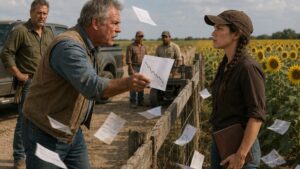
Thomas drew a folded sheet from his shirt pocket. It was a copy of Ashley’s hand-drawn field plan, marked with blue pencil. Her route from the pump shed to the unused east valve ran plainly across it.
Gary looked from the paper to her pipes. “You already dug?”
“No.”
“Then why mark the old valve?”
Ashley reached for the sheet, but Thomas folded it once more.
“Because she knows it exists,” he said. “And because she intended to use it whether we agreed or not.”
The men were no longer amused. Their eyes had sharpened.
Ashley gripped the bicycle handle. Three nights earlier she had found the valve cap beneath a mat of dried weeds, exactly where her father’s old notebook said it would be. The cooperative had abandoned the branch after a storm split the line years ago. The visible pipe had been removed, but the buried section remained.
She had tested only twelve feet of it using a hand pump and a storage tank.
That test bed was still green.
Thomas followed her gaze across the fence. A narrow row of squash leaves held their color against the gray-brown field. The difference was small but impossible to miss.
Gary stepped toward the fence. “How’s that row alive?”
“Stored rainwater,” Ashley said.
Thomas studied her.
She had not lied. Not exactly. The tank contained stored rainwater, but the low-pressure line had delivered it farther and more evenly than any hose she owned.
“You built a prototype,” Thomas said.
Ashley said nothing.
“With cooperative fittings?”
“Salvaged fittings.”
“From where?”
“The farm-supply yard.”
“Paid for?”
“Yes.”
“Rated?”
“Enough for six pounds.”
Thomas looked at the thin tubing and mismatched couplers. “The main runs above thirty.”
“Not if I step it down before the branch.”
“And when your reducer fails?”
“It won’t.”
That answer came too quickly. Ashley heard it herself.
Thomas’s expression changed—not triumph, exactly, but confirmation.
“You don’t get to wager everyone else’s water on ‘it won’t.’”
“You’ve been losing pressure for two years.”
Gary glanced at Thomas. “That true?”
“We lose some at peak demand.”
“More than some,” Ashley said. “The main drops eight pounds between the shed and the lower junction.”
Thomas’s face tightened. “How would you know?”
She had watched the gauge during her seasonal repair work. She had written down readings while replacing cracked washers and cleaning filters. Nobody had asked her to. Nobody had asked what she thought the numbers meant.
“I pay attention.”
Thomas stepped closer. “Paying attention does not give you authority.”
“No. But dry plants don’t care who has authority.”
Silence spread across the gate.
For one moment, Ashley thought Gary might speak for her. He stared at the green test row, rubbing his thumb along a split in the fence post. Then he looked toward his own acreage, where young pepper plants leaned beneath the heat.
Thomas walked into the pump shed. He returned with a yellow form fixed to a clipboard.
He wrote slowly, pressing hard enough that the pen scratched through the paper.
“A no-connection order,” he said. “Effective now. Any unauthorized use of the eastern valve will be treated as theft from the cooperative allotment.”
He held the form out.
Ashley did not take it.
Thomas clipped it to the bicycle basket.
“Move the pipes off cooperative property before noon.”
The men began to leave. None looked directly at her except Gary.
“You should have brought this to a vote,” he said quietly.
“I did.”
“You brought calculations.”
“That was the point.”
He shook his head. “People want to know what happens when something breaks.”
Ashley looked at Thomas locking the pump shed.
“They already know,” she said. “They just prefer breaks they’re used to.”
By noon, she had moved the pipes to the edge of her leased field. By dusk, the squash row had begun to curl.
She waited until every truck had left the county road.
The buried valve lay under a square of packed soil behind the old windbreak. Ashley dug with a short-handled spade until the iron cap appeared. Rust flaked beneath her glove. She fitted a wrench to the stem and paused.
Her father’s notebook had warned that the line was unstable past the second junction.
It had also recorded something Thomas had never mentioned: the old branch had once fed three fields using gravity and almost no pump pressure.
Ashley turned the wrench.
Deep beneath the soil, metal groaned.
Then water moved through the abandoned line.
Chapter 2: One Green Row Changed the Entire Argument
Three mornings later, the farmers found a strip of green cutting through Ashley’s field like someone had drawn it with a ruler.
The rest of the acreage remained dull and strained. Leaves curled inward along dry rows, and the exposed soil had split into narrow cracks. But beside the salvaged pipe, squash plants stood open and broad, their stems firm, their leaves dark enough to cast shadows.
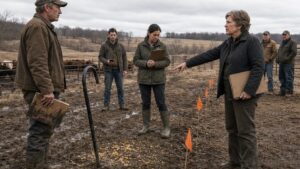
Thomas arrived before seven with Laura Garcia from the county extension office.
Ashley saw the county truck at the gate and knew at once that Thomas had decided not merely to stop her, but to prove her wrong in front of witnesses.
Gary came behind them. Two cooperative members followed, then another truck.
Thomas did not look at the bicycle trailer parked beside the shed. He looked at the green row.
“You opened the valve,” he said.
Ashley wiped her hands on her overalls. “You wanted to see what the system did.”
“I wanted you to obey the order.”
Laura stepped past them and crouched beside the nearest coupling. She was younger than Thomas, older than Ashley, with a canvas field bag and a pressure gauge clipped to her belt.
“You built the reducer?” she asked.
“I assembled it.”
“From used parts?”
“Some.”
Laura touched the joint, then followed the pipe with her eyes toward the far end of the field. “Where’s your discharge point?”
“Three hundred eighty feet.”
Thomas gave a short laugh. “With that tubing?”
Ashley looked at him. “Open the pump.”
“You’re in no position to give instructions.”
“Then keep guessing.”
The cooperative members shifted. Gary folded his arms, though his attention stayed on the plants rather than Ashley.
Thomas unlocked the shed.
He had expected the line to burst. Ashley could see it in the way he motioned everyone back before starting the pump. The motor kicked on with a hard metallic thump. The main gauge climbed.
Ashley knelt beside her reducer.
“Do not touch the branch valve,” Thomas said.
“It’s already set.”
“To what?”
“Quarter open.”
“You cannot know the flow from that.”
“I marked the stem.”
She turned the first small valve half a notch, waited for the tubing to stiffen, then opened the second. Water traveled through the line not with a violent surge but with a soft series of knocks as air cleared from the emitters.
Laura clipped her gauge into the near port.
“Five point eight,” she said.
Thomas looked down. “Impossible.”
Ashley walked toward the middle of the field. “Check again there.”
Laura followed, carrying the gauge. Thomas and the others trailed behind.
At the midpoint, the pressure read five point four.
At the far end, five point one.
Laura repeated the test.
Thomas looked along the pipe. “How much water?”
“Less than half the standard branch rate,” Ashley said.
“That green row could be from the storage tank.”
“It was. The first day.”
“And after?”
Ashley pointed to the soil. “Test it.”
Thomas did not move.
The group waited.
Finally he stepped over the pipe and knelt beside the farthest plant. He removed one glove, pressed his fingers into the top inch of dirt, and frowned. The surface was dry. Beneath it, the soil held together in a dark, cool clump.
He moved six feet away and tested again.
Then twelve.
The moisture remained even.
Gary crouched beside him. “My lower line doesn’t stay this wet ten yards from the riser.”
Thomas crushed the soil between his fingers.
Ashley stood above them, saying nothing.
The moment should have felt like victory. For three days she had imagined it: Thomas looking up, the men forced to admit the pipes were not junk, her father’s old notes proven useful after everyone had treated them as the stubborn scribbling of a failed farmer.
Instead, she noticed Laura walking back toward the reducer.
Laura stopped beside the main gauge and bent closer.
Thomas rose slowly. Dirt remained beneath his fingernails.
“The concept works,” Laura said.
No one spoke.
She looked toward Ashley. “At this flow.”
Gary’s eyes moved from the green field to the thin pipe. “Could it run more than one branch?”
“With zoning,” Ashley said. “Short cycles. Different times.”
Thomas rubbed the soil from his fingers onto his jeans. “You should have brought this data before the board.”
“I brought the calculations.”
“You did not bring a working trial.”
“You wouldn’t allow one.”
“You made sure that stopped mattering.”
The respect in the group was uneasy, but it was real. One cooperative member asked Ashley how much the fittings cost. Another wanted to know whether the system could be laid across uneven ground. Gary picked up a spare emitter from the bicycle trailer and rolled it between his fingers.
For the first time, they addressed their questions to her rather than through Thomas.
Ashley answered carefully. She explained the pressure reduction, the sequence, the spacing. Each response made Thomas quieter.
Then Laura called her name.
Ashley turned.
Laura stood beside the reducer with one finger resting on a faint red line scratched across the gauge face.
“This mark yours?”
Ashley walked back. “Yes.”
“It’s above twelve pounds.”
“It surged during priming.”
“When?”
“The first night.”
Thomas stepped closer. “How long?”
“A few seconds.”
Laura examined the coupling. “Long enough to deform the housing?”
“No.”
“You checked internally?”
Ashley did not answer.
Laura unscrewed the gauge fitting and found a narrow whitening along the plastic thread, the kind of stress mark that appeared before a crack.
Gary lowered the emitter.
Thomas looked at Ashley, and the soil-darkened hand that had confirmed her success closed at his side.
“You said it wouldn’t fail,” he said.
“It didn’t.”
“That isn’t the same as safe.”
“The surge came from trapped air. I corrected it.”
“You recorded it?”
Ashley looked toward the field. The pipe lay straight between the green plants, carrying water exactly as she had promised.
Laura’s voice softened, which made the question harder.
“Do you have the readings from that night?”
Ashley had them in a notebook beneath the seat of her bicycle. Every pressure jump, every adjustment, every minute the gauge had climbed too fast. She had intended to clean the page before showing anyone. She had intended to rerun the test until the first numbers no longer mattered.
“Yes,” she said.
“Let me see them.”
Thomas watched her.
The men who had doubted the pipe now waited to learn whether they had been wrong about her—or right for reasons they had not understood.
Ashley walked toward the bicycle, but stopped with her hand on the seat.
Laura remained beside the stressed fitting.
“Bring me the original readings,” she said. “Not the version you planned to show the board.”
Chapter 3: The Row That Failed Beside the One That Thrived
Gary Lee cut open a pepper stem with his pocketknife while Ashley’s green squash row stood fifty yards away.
The stem should have been pale and wet inside. Instead, the center had collapsed into a thin brown thread.
Gary held it out to her.
“You want to explain that?”
They stood in his lower field beneath a sunshade rigged from feed sacks. The nearest pepper plants drooped in uneven patches. Some were merely thirsty. Others had begun dropping blossoms onto the dry ground.
Thomas had called the inspection less than an hour after Laura reviewed Ashley’s notebook.
Ashley looked toward the shared junction. “When did the pressure fall?”
“Yesterday afternoon.”
“For how long?”
“Long enough.”
“I need a time.”
Gary folded the cut stem into his palm. “You need a time?”
“To compare it to my cycle.”
“You had a cycle you weren’t authorized to run.”
Thomas stood near the junction box with two cooperative members. Laura had attached gauges to both branches: Ashley’s improvised line and Gary’s standard riser.
The numbers were already telling a story Ashley did not want spoken aloud.
Laura pointed to the pressure chart she had drawn from meter records. “When Ashley’s branch opened, Gary’s lower line lost nine pounds.”
“It shouldn’t have,” Ashley said.
“But it did.”
“The main should hold both.”
Thomas’s jaw tightened. “The main was never approved for both.”
“It was built for three.”
“Thirty years ago.”
“Before you capped the east branch.”
“We capped it because the line became unreliable.”
“You never removed it.”
“That did not make it available.”
Gary stepped between them. “Did her pipe take my water or not?”
Laura answered. “Partly.”
The word landed harder than a direct accusation.
Ashley crouched beside Gary’s riser and turned the fitting by hand. “There’s sediment here.”
“There’s always sediment,” Gary said.
“It reduced your flow.”
“And your branch reduced the pressure.”
Ashley looked at Laura.
Laura nodded once. “Both are true.”
For two days, Ashley had held onto the fact that her low-pressure design worked. She had repeated it silently while Thomas issued a formal violation notice, while Gary stopped speaking to her, while cooperative members who had asked about emitter spacing began calling the system reckless.
Now the damaged peppers made the success feel smaller.
“I can correct it,” Ashley said.
Gary laughed without humor. “You can put blossoms back on?”
“No.”
“You can cover the lost set?”
“If the next cycle stabilizes—”
“There is no next cycle,” Thomas said.
Ashley stood. “You disconnect me now, my field goes down too.”
“You should have considered that before opening a prohibited line.”
“You saw the moisture test.”
“I also saw your twelve-pound surge.”
“It lasted seconds.”
“You hid it.”
Ashley felt the words strike because they were accurate.
She had hidden more than the number. On the first night, the old valve had stuck halfway open. Pressure had climbed faster than expected, and for nearly four minutes she had been unable to bring it down. She had closed the reducer, bled air through the far emitter, and altered the sequence. The next two nights had run clean.
She had told herself the correction mattered more than the mistake.
Laura opened Ashley’s notebook to the page with the original readings. “Your adjustment was technically sound.”
Thomas looked at her sharply.
Laura continued. “The low-pressure concept is still viable. But the first configuration was unstable, and Ashley knew that before she continued.”
Gary stared at Ashley. “You knew it could pull from my line?”
“I knew there was a risk during priming.”
“That’s not what I asked.”
Ashley looked at the rows behind him. The lowest plants had suffered first, exactly where pressure would fail earliest. She had noticed Gary’s weak flow the previous evening. She had assumed it came from the main line’s existing losses. She had not walked over to check.
“Yes,” she said. “I knew there was a risk.”
Gary looked away.
Thomas removed the meter key from his belt. “That ends it.”
He walked to the junction and unlocked the steel cover. Several farmers had gathered along the road, drawn by the trucks and the raised voices. Thomas worked in full view of them, closing the east valve and removing Ashley’s improvised coupling.
The thin pipe slackened across her field.
Water stopped moving.
Ashley watched the line soften between the plants. Three days earlier it had looked like evidence. Now it looked like a boundary she had crossed.
Thomas lifted the coupling for everyone to see.
“This branch is disconnected pending board review.”
Gary said nothing.
One of the cooperative members asked whether Ashley would be assessed for the lost crop. Thomas said the board would calculate damages. Another asked whether her lease allowed unauthorized utility changes. Thomas said the landowner would be notified.
Each answer took away another option.
Laura waited until the others had moved toward the trucks.
“You can still submit a revised design,” she said.
“To a board that just watched him hold my pipe up like stolen property?”
“You bypassed approval.”
“Because approval was never coming.”
“That may be true.” Laura closed the notebook. “It does not make your numbers optional.”
Ashley looked at Gary’s field. “How much can be saved?”
“If his line receives stable pressure tonight, most of it.”
“And mine?”
Laura did not answer immediately. “Your green section can hold for a day. Maybe two.”
Thomas drove away with Ashley’s coupling in the back of his truck.
By late afternoon, the county extension office had completed a temporary flow analysis. Laura pinned the results to a board in a small conference room where the air conditioner rattled.
Ashley stood over the chart.
The imbalance from her branch was clear. So was something else.
Even after Thomas had disconnected her system, the main pressure continued to fall between the pump shed and the lower junction.
Laura tapped the line with a pencil. “Your branch made Gary’s loss worse.”
“But it didn’t cause all of it.”
“No.”
“How much is disappearing?”
“Too much.”
“Meter error?”
“We checked.”
Ashley traced the pressure drop with one finger. The largest loss appeared beyond the eastern split, in a section that had no active branch.
“That line is closed,” she said.
“It’s supposed to be.”
Ashley thought of the old valve beneath the windbreak. She thought of the rust beneath the cap and the groan that had traveled through the buried metal when she opened it.
“What if the main isn’t holding past the junction?”
Laura studied the chart again.
Outside, a truck door slammed. Thomas entered the office carrying the removed coupling. His expression hardened when he saw the analysis.
Ashley pointed to the unexplained drop.
“You disconnected me three hours ago,” she said. “So where is the water going now?”
Thomas looked at the chart, then at Laura.
For the first time since the pipes arrived, he had no immediate answer.
From somewhere beyond the office windows came the low, steady sound of the cooperative pump still working against a line that should have been closed.
Chapter 4: The Leak Thomas Could No Longer Call Her Fault
Water surfaced in a field whose branch had been closed for nine years.
Ashley saw it first as a dark oval spreading beneath the brittle weeds east of the lower junction. By the time Laura parked the county truck beside the ditch, the oval had become a shallow pool. Mud pulsed at its center each time the cooperative pump cycled.
Thomas arrived carrying a shovel and the removed coupling from Ashley’s line.
He stopped when he saw the water.
“That branch is shut,” Gary said.
Thomas set the coupling in the truck bed. “It is.”
Ashley walked into the wet patch until mud covered the edges of her boots. “Then the main is bleeding underground.”
“Could be residual flow,” Thomas said.
“The pump has been running all afternoon.”
Laura crouched near the edge and pressed two fingers into the mud. “This is fresh.”
Thomas looked toward the pump shed, then toward the road where two cooperative members had already slowed their trucks to watch.
“We dig before we start guessing,” he said.
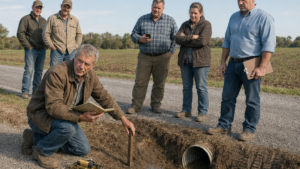
They opened the trench by hand because Thomas did not want heavy equipment near the old main. The soil was hard above the leak and soft beneath it, collapsing around their shovel blades. Ashley worked opposite Thomas without speaking. Each time they cleared another foot, water rose faster.
At three feet down, the main appeared.
The pipe was steel, not the newer plastic used elsewhere. Rust had eaten through the lower seam. Water hissed from a split no wider than Ashley’s thumb and cut a channel beneath the line.
Gary stared at it. “How long has that been leaking?”
Laura examined the mineral staining. “Not since yesterday.”
Thomas drove the shovel into the dirt and left it standing.
Ashley looked at him. “How long?”
He wiped mud from his hands. “We repaired that section before.”
“When?”
“Years ago.”
“With what?”
“A wrap and clamp.”
“That is not a repair.”
“It held.”
“Until it didn’t.”
Thomas’s gaze shifted toward the cooperative members gathering near the trench. “We are not doing this here.”
“You disconnected my branch in front of everyone.”
“Your branch caused a measurable loss.”
“And this caused more.”
Laura stood. “She’s right.”
The words pulled the remaining argument out of the air.
Laura calculated the leak from the pump readings and the pressure drop. Even at the lowest estimate, the main had been losing enough water each day to irrigate several acres. Ashley’s bypass had worsened Gary’s shortage, but it had not created the underlying failure.
The cooperative members began asking questions at once.
When had Thomas known the line was weak?
Why had no repair crew been called?
Why were they paying higher assessments if the main was still leaking?
Thomas answered the first two and ignored the third. He said the clamp had passed inspection. He said replacement estimates had been requested. He said the drought had increased pressure cycling beyond what anyone expected.
Ashley watched him choose each sentence as carefully as she had chosen which notebook pages to show.
Laura arranged for the pump to be shut down. The water in the trench slowed to a clear trickle.
Without the motor, the fields became unnaturally quiet.
Thomas picked up the coupling from his truck and handed it to Ashley.
She did not take it.
“What is this?”
“Yours.”
“You called it evidence.”
“It still is.”
“Of what?”
“That you broke the rules.”
Ashley looked at the split main beneath them. “And this?”
Thomas said nothing.
The cooperative records were stored in a back room of the pump shed behind metal shelves of filters and grease cans. Thomas unlocked the door reluctantly and stood in the opening until Laura told him the county needed maintenance history for the emergency report.
The room smelled of paper, hot dust, and old oil.
Ashley searched repair folders while Laura compared invoices against inspection dates. Thomas remained near the door, arms crossed.
The first estimate for full replacement had been issued four years earlier.
Ashley read it twice.
A second estimate appeared eighteen months later, higher by nearly a third. A third included a phased option that would have replaced the worst section first. Each had been marked postponed.
“Who postponed these?” Ashley asked.
“The board.”
Thomas’s signature appeared beneath every decision.
Laura pulled a cooperative ledger from the bottom shelf. “There wasn’t enough reserve.”
“There should have been,” Ashley said.
Thomas closed the door behind him. “Three farms stopped paying assessments after the last drought. Two more negotiated delays. We replaced a pump motor instead.”
“You told everyone the system was sound.”
“I said it was operating.”
“You rejected my design because it might expose the pressure loss.”
“I rejected it because it was unauthorized.”
“That is not the whole reason.”
Thomas looked older in the cramped room. Sweat had dried white along the brim of his hat.
“No,” he said. “It wasn’t.”
Laura continued turning pages, but more slowly now.
Thomas rested one hand on the filing cabinet. “If we had published these numbers, the lender would have frozen the cooperative account. Nobody would have bought seed on credit. Nobody would have renewed a lease tied to our water allocation.”
“So you hid the damage,” Ashley said.
“I delayed a replacement we could not pay for.”
“And kept the pump running harder against a broken line.”
“I kept water moving.”
“For some of us.”
“For all of you longer than it would have otherwise.”
Ashley wanted to reject that. She wanted Thomas’s confession to be clean enough to condemn him. Instead, she saw Gary’s damaged peppers, her own hidden surge reading, and the same frightened arithmetic running beneath both decisions.
Laura spread the newest flow chart across the table.
“If the cooperative keeps using full-pressure branches,” she said, “this main will fail again even after a temporary clamp.”
Thomas looked at Ashley’s coupling.
Her low-pressure system could not repair corroded steel. It could, however, reduce the strain.
Ashley traced the distribution lines. “Zone the acreage. Never run more than two sections at once. Step down before the lower junction.”
Thomas shook his head. “That means rebuilding every branch schedule.”
“Yes.”
“And buying regulators.”
“Some. We can reuse fittings.”
Gary leaned into the doorway. Mud dried on his boots.
“My peppers do not have time for a committee redesign.”
“No,” Ashley said. “They don’t.”
The county clerk arrived near dusk carrying an envelope sent by the agricultural lender. The cooperative’s emergency loss report had triggered an account review faster than Thomas expected.
He opened the letter at the pump shed table.
Nobody spoke while he read.
Thomas passed the page to Laura. She read the last paragraph aloud.
The cooperative had forty-eight hours to submit a credible survival plan, including repairs, revised water allocation, and proof that further losses would be controlled. Without it, the lender would suspend access to the operating credit used for fuel, seed, and emergency maintenance.
Gary sat down heavily.
Ashley looked at the trench outside, then at her coupling on the table.
Thomas placed both palms against the wood.
“You wanted the truth in the open,” he said.
Ashley met his eyes.
“It’s open now.”
The deadline printed at the bottom of the letter ended at five o’clock two days later.
Chapter 5: She Could Save Her Field or Share the Risk
Thomas was waiting beside Ashley’s bicycle before dawn.
He had set the removed coupling on the trailer and cleaned the mud from its threads. Behind him, the cooperative gate stood open.
Ashley stopped ten feet away.
“You returning property,” she asked, “or setting another trap?”
“I need your pressure maps.”
“You already took one.”
“I need all of them.”
She walked past him and checked the bicycle tires. “Laura has the notebook.”
“I need the maps you did not submit.”
Ashley’s hand paused on the rear wheel.
Thomas noticed.
“You mapped every abandoned branch,” he said. “Your father used to do the same thing. Draw a whole system before he touched one bolt.”
“My father lost his farm.”
“I remember.”
“You helped the board deny his extension.”
Thomas looked toward the field. “I also covered two of his assessments.”
Ashley straightened.
“He never told you,” Thomas said.
“He would have.”
“No. He would have called it a private loan and paid me back in repair work. He was proud in ways that cost him.”
The resemblance felt intentional, almost cruel.
Ashley lifted the coupling from the trailer. “Do not use him to make me cooperate.”
“I’m telling you why I waited too long on the main. I thought I could carry it until the next season. Your father thought the same way about his debt.”
“And that worked out for him?”
“No.”
Thomas’s answer was quiet enough to stop her anger from finding an easy target.
By seven, they were seated at Ashley’s kitchen table with Laura, Gary, and a spread of maps held flat by coffee mugs. Pipe measurements covered the backs of seed invoices. Valve schedules had been drawn on brown grocery paper.
Ashley proposed a loop that would divide the cooperative into low-pressure zones. Each farm would receive shorter, more frequent cycles. The damaged main would carry less force, and the unused east branch could be reactivated after inspection.
Thomas questioned every assumption.
“What happens if this regulator sticks?”
“We isolate that section.”
“With whose key?”
“Two keys. One held by the cooperative, one by the operator.”
“Who is the operator?”
Ashley looked at him. “Not decided.”
Gary leaned over the map. “You mean you.”
“I mean someone who records every adjustment.”
“Like you recorded the surge?”
The room went still.
Ashley did not look away. “Exactly like I recorded it. Not like I hid it.”
Gary sat back.
His anger had lost some of its heat, but not its weight. The lowest quarter-acre of peppers would not recover. His supply account was already past due.
“I am not signing anything that makes your experiment my risk,” he said.
“It is already your risk,” Laura replied. “The current system cannot maintain pressure.”
“That does not excuse what she did.”
“No,” Ashley said. “It doesn’t.”
Thomas shifted beside the table. “The cooperative can take responsibility for system failure.”
Gary pointed at Ashley. “And her bypass?”
Ashley folded her hands to keep from reaching for the papers. “Mine.”
The word cost more than she expected.
“I will accept liability for the portion Laura traces to my branch,” she continued. “Not the damage caused by the main leak. Mine.”
Gary studied her.
“How do you plan to pay it?”
“I don’t know yet.”
“That is not much of a plan.”
“No.”
Thomas looked at the map but said nothing.
Laura turned to the second page. “The phased redesign could save more water than the damaged crop is worth. The cooperative could credit Gary from those savings if the trial succeeds.”
Gary’s jaw tightened. “That sounds like charity dressed up as accounting.”
“It is compensation tied to documented loss,” Laura said.
Thomas tapped the eastern loop. “Before anyone signs, there is something else.”
Ashley expected another objection.
Instead, he drew a folder from his bag. Inside were copies of the pressure readings from her public test—the clean ones, the numbers that proved the low-flow line worked.
“These should have gone into the board record,” he said.
Laura looked at him. “They didn’t?”
Thomas shook his head.
Ashley felt the room narrow.
“You suppressed them.”
“I held them until I could review the surge.”
“You issued the shutdown before the review.”
“Yes.”
“Because of safety?”
Thomas looked at Gary, then at the unpaid invoices on the table.
“Because if your line worked,” he said, “the next question was why we had not adopted low-pressure zoning years ago. That would lead to the repair estimates.”
No one moved.
Thomas’s admission did not erase Ashley’s mistake. It did something more difficult: it placed his beside hers.
Gary rubbed a hand over his face. “So both of you hid numbers.”
Ashley looked at Thomas.
“Yes,” she said.
Thomas nodded once. “Yes.”
There was no apology. Not yet. Only the plain shape of what they had done.
By noon, pipe sections lay across the yard in a rough circle. Ashley rearranged the salvaged lengths into a common loop rather than a private branch. Thomas measured couplers. Laura marked where new regulators were required. Gary watched from the shade, unwilling to help but no longer leaving.
The proposal took six pages.
It included open logs, dual-key access, independent pressure checks, phased repairs, and a damage formula for Gary’s acreage. Ashley added a line requiring the operator to disclose any reading outside the approved range within one hour.
Thomas read it.
“You wrote this for yourself.”
“I wrote it because of myself.”
At four thirty, they carried the proposal to the cooperative shed. Members filled the narrow room and spilled outside. The lender representative waited by speakerphone while Laura summarized the emergency plan.
Questions came quickly.
Who would pay for the regulators?
What if the old east branch failed?
Why should a tenant farmer lead a cooperative trial?
Ashley answered the last question before Thomas could.
“She shouldn’t,” she said. “Not alone.”
The room quieted.
“I designed the loop. I also ran an unstable configuration without approval and failed to report the risk soon enough. If this trial goes forward, every reading is public to the members. Every valve decision can be challenged. If that is unacceptable, reject it.”
Thomas placed the hidden test results on the table.
“And the board failed to enter evidence supporting her design,” he said. “That failure was mine.”
Gary pushed through the doorway.
“I want the damage clause rewritten,” he said. “Not promised later.”
Ashley handed him a pen. “Write what you need.”
He did.
When the final page returned to her, the signature lines were empty.
The room waited.
Ashley had spent years believing that recognition would arrive when nobody could question her. Instead, it had arrived as a document built to make questioning permanent.
She signed first.
Chapter 6: The Second Test Had No Room for Pride
The pump started while every valve in the cooperative remained padlocked except the sequence Ashley had written on the board.
Twenty-three people stood along the main line.
No one laughed at the bicycle trailer now. It carried pressure gauges, replacement fittings, two regulators, and a ring of keys divided between Ashley and Thomas.
Laura checked her watch. “Zone one at six minutes.”
Ashley opened the first valve.
Water struck the main with a dull shudder. The repaired clamp held. Gauges at the pump shed and lower junction climbed together, then settled within the range marked in red on the board.
Thomas read the lower gauge aloud.
“Twenty-one.”
Ashley opened the first regulator by a quarter turn.
“Branch pressure?”
A cooperative member called back, “Six point two.”
Water entered the eastern loop.
The thin pipe lifted slightly from the dry soil and began feeding Ashley’s field, then Gary’s upper row. Instead of one green strip against brown acreage, the new layout divided flow across property lines.
Every adjustment was recorded.
Every number was repeated by someone other than Ashley.
At the six-minute mark, she closed zone one and opened zone two. The main pressure dipped, recovered, and held.
Gary walked beside his pepper rows, checking emitters with the same attention Thomas had once given Ashley’s soil. The upper plants received water first. Moisture spread slowly beneath them rather than flooding the furrows.
For an hour, the system behaved exactly as designed.
That was when the pressure at Gary’s lower row fell to three pounds.
“Hold the sequence,” Laura called.
Ashley looked at the pump gauge. It remained stable.
“Lower junction?” she asked.
“Fourteen and falling,” Thomas answered.
Gary pulled an emitter from the soil. It coughed air.
Ashley reached for her key.
“If I open the bypass, I can restore flow.”
Thomas blocked the lock with his hand. “That raises main pressure.”
“For less than a minute.”
“You said the same thing before.”
The words were not cruel. That made them harder.
Ashley looked at the board. Under the approved sequence, the lower zone would fail. Under her instinct, she could force water through and perhaps repeat the first mistake.
Twenty-three people watched her.
The old answer rose inside her: act before they can stop you; fix the result before anyone sees the risk.
She stepped back from the valve.
“Overrule me,” she told Thomas.
He stared at her.
“Isolate the lower section,” she said. “You know the old main better than I do.”
Thomas looked toward the fields, then at the junction map.
“Close Gary’s upper branch,” he called. “Open the relief at the east loop. Ashley, bleed the far end.”
They moved at once.
Ashley ran along the pipe, opened the far emitter, and released a burst of trapped air. Thomas adjusted the regulator in half-turns. The lower gauge climbed to five.
Gary’s emitters began flowing again.
The group let out a breath almost as one.
Thomas looked across the field at Ashley. For a moment, the same dirt-dark hand that had once tested her first green row rested on the shared valve wheel.
Then the ground jumped beneath him.
A sharp crack traveled through the buried main.
Water burst upward ten yards beyond the repaired clamp, throwing mud and rust-colored spray across the trench line.
“Pump off!” Laura shouted.
The motor wound down, but water continued pouring from the split.
The rupture was longer than the first. A section of corroded pipe had opened along its seam, collapsing beneath the reduced but changing load.
Gary stood ankle-deep in the spreading water. “That is the season.”
“No,” Ashley said.
She ran to the bicycle trailer.
The salvaged pipe was not rated to replace the main, but the longest sections could form a temporary surface bypass around the rupture. The loop would carry lower pressure only. It might hold if every active zone was reduced and no two opened together.
Thomas understood before she finished pulling the first length free.
“We need fifty feet.”
“Sixty-two.”
“We have fifty-eight.”
Ashley looked toward the original private branch lying beside her field. “Take the far section.”
“That cuts your last row.”
“It is closest.”
Thomas hesitated.
“Take it.”
The cooperative members began moving pipe. Gary dragged couplers from the trailer. Laura marked the bypass route and calculated the maximum flow.
No one waited for a chairman’s order.
They laid the surface line over packed ground, joined it to the main on either side of the rupture, and anchored the bends with sandbags and fence posts. Every fitting came from a different part of the cooperative: Ashley’s salvaged couplers, Gary’s spare clamps, Thomas’s repair stock.
The sun had moved west by the time they were ready.
Laura stood at the pump switch. “This either carries the reduced schedule or it opens every weak joint between here and the shed.”
Ashley knelt beside Thomas at the wet soil over the bypass connection. Mud covered both their hands.
“What pressure?” he asked.
“Start at twelve.”
“Too low for the final row.”
“Then we increase after every zone holds.”
Thomas looked at her. “And if I say stop?”
“We stop.”
He nodded.
Laura started the pump.
The bypass shivered. One joint leaked, then sealed when Gary tightened the clamp. Pressure climbed to twelve, then fourteen.
Ashley and Thomas walked the route together, pressing their hands into the soil near each active row. The water moved more slowly than before, but it moved.
Zone by zone, green plants darkened at their roots.
At Gary’s lower acreage, the emitters released thin, steady streams. He crouched and watched the soil absorb them.
“Final row,” Laura called.
It was Ashley’s weakest section, the one she had surrendered for the bypass. Plants there had curled nearly shut.
Thomas placed his hand on the last valve. “Open?”
Ashley checked the gauges. The system had no reserve. One trapped pocket of air or one slipping clamp could drop the whole loop.
She looked down the line. Every farmer stood beside a gauge, fitting, or valve. Nobody was waiting for her to perform alone.
“Open,” she said.
Thomas turned the wheel.
For several seconds, nothing happened.
Then the last emitter spat dust, coughed air, and released a narrow thread of water.
Another followed.
Then the entire final row began to drip.
Ashley knelt beside the first plant and pressed her fingers into the soil. The top remained hot and dry. Beneath it, moisture slowly gathered around her fingertips.
Thomas lowered himself beside her and tested the ground with his own hand.
Neither spoke.
Across the fields, water reached land that had been dry that morning, carried not by Ashley’s private line or Thomas’s authority, but by a patched loop everyone could inspect.
The temporary bypass held.
Whether it could hold the season was a question the fields would answer one day at a time.
Chapter 7: When the Green Reached Beyond Her Fence
Six weeks later, green rows crossed the property lines, and Gary Lee arrived at the cooperative meeting carrying a damage claim.
He placed the envelope on the table before anyone sat down.
The room had changed since the emergency vote. The pressure board still hung beside the door, but the handwritten trial numbers had been replaced by clean weekly charts. A key log rested beneath the pump schedule. Every adjustment carried two initials.
Ashley’s appeared often.
Gary took a chair near the window. “Before we talk about success,” he said, “we settle what failed.”
Nobody argued.
Outside, the temporary surface bypass lay beneath a white protective sleeve where it crossed the yard. The repaired network had survived the hottest part of the season, but not without cost. One clamp had needed replacement. Two fields had received reduced cycles during the first week. Gary’s lower pepper row had never recovered enough to meet its original contract.
The rest of his acreage had.
So had most of Ashley’s.
The green no longer stopped at her fence.
Thomas stood at the front of the room with the cooperative ledger beneath one hand. He had not worn his chairman’s jacket. His work shirt was stained at the shoulder from the morning repair shift.
Laura sat beside him with the final flow report.
“The trial reduced measured water loss by thirty-one percent after the rupture repair,” she said. “That includes the temporary bypass and revised zoning. It does not mean the system is permanent.”
A cooperative member asked how long the old main could last.
“No honest answer,” Laura said. “The worst section must still be replaced.”
Another asked whether the lender would continue operating credit.
Thomas opened the ledger. “Conditionally. We met the survival plan, but the account remains restricted.”
The room absorbed that without complaint. Survival had made everyone less interested in comfortable wording.
Gary tapped the envelope.
Ashley had read the damage estimate before the meeting. Laura had separated the losses into three parts: drought stress, main-line failure, and the pressure reduction caused by Ashley’s unauthorized branch. Only the last portion belonged directly to her.
It was smaller than Gary first claimed.
It was still more than Ashley could pay at once.
Thomas looked toward her. “Do you dispute the calculation?”
“No.”
Gary’s expression did not soften. “And the cooperative’s part?”
“The system loss comes from the repair reserve,” Thomas said.
“There is barely a reserve.”
“There is more than there was.”
Laura slid a second page across the table. The low-pressure schedule had reduced pumping costs enough to create modest savings. The lender had approved using part of those savings for documented crop losses rather than applying all of it to the account balance.
Gary read the page.
“You call this compensation?”
“Yes,” Laura said.
“It comes in three payments.”
“So the cooperative can keep buying fuel.”
Gary looked at Ashley. “And her part?”
Ashley placed a folded agreement beside his envelope.
“I pay over the same three dates.”
“With what money?”
“The management contract, if the board approves it.”
The room shifted.
Ashley had not known Thomas planned to place the contract on the agenda until that morning. She had assumed the work would remain temporary through harvest, performed because nobody else understood the revised sequence well enough to manage it.
Thomas opened another folder.
“The cooperative needs a system operator,” he said. “Not an engineer. Not a chairman. Someone responsible for schedules, logs, inspections, and reporting any reading outside range.”
One of the older members glanced at Ashley. “You recommending her?”
“Yes.”
“You shut down her line.”
“Yes.”
“She caused Gary’s loss.”
“Part of it.”
“And you still trust her with the valves?”
Thomas looked at Ashley rather than the member.
“I trust the rules we wrote because of what she did wrong,” he said. “And I trust the design because of what she did right.”
No one applauded.
Ashley was grateful for that.
Gary unfolded the proposed contract. “She pays me from the money we pay her.”
“She pays her assigned share,” Thomas said. “The cooperative pays its own.”
Gary looked at the savings report again. The arrangement was not charity. It did not restore his lost peppers or erase the weeks he had spent expecting another loan denial. It converted shared savings into responsibility.
He signed the damage agreement.
“Three dates,” he said to Ashley.
“Three dates.”
“If one is late—”
“It will be in the log.”
A faint expression crossed his face, not quite a smile.
“Everything goes in the log now.”
The board approved Ashley’s contract by a narrow vote.
The role came with less authority than she once imagined wanting. She could not alter a schedule alone. She could not open an unapproved branch. Every emergency action required review within twenty-four hours.
It also came with a key.
Thomas placed it on the table between them.
Ashley picked it up, then set it beside the public log rather than putting it in her pocket.
“There’s one more item,” Thomas said.
He removed his chairman’s key from its ring.
The room became still.
“I postponed repairs the members should have seen,” he said. “I suppressed trial data because it would have exposed those decisions. Keeping the water moving did not give me the right to hide the condition of the system.”
He placed the key beside Ashley’s.
“I resign as chair effective today.”
A cooperative member began to object, but Thomas raised a hand.
“I’m not leaving the repair crew.”
That produced the only sound resembling laughter, brief and tired.
After the meeting, Thomas carried replacement clamps to the truck while Ashley loaded regulators onto her bicycle trailer. The wooden sides had been reinforced, but one corner still bore the scrape from the morning it jammed beneath the gate.
Gary stopped beside her.
“My upper field made contract weight,” he said.
“I heard.”
“The lower one didn’t.”
“I know.”
He watched her secure the fittings. “Next season, I want the first trial section.”
Ashley looked at him.
“You volunteering your acreage?”
“I’m volunteering the part I can watch from my porch.”
“That sounds more like you.”
He nodded toward the damage agreement in her hand. “First payment is still due Friday.”
“It will be there.”
When he left, Thomas emerged from the shed carrying the first length of salvaged pipe Ashley had brought through the gate. Its surface was faded by sun and marked with old clamp lines.
“You keeping this?” he asked.
Ashley took one end.
Together they laid it on brackets beside the cooperative shed, beneath the pressure board and next to the public inspection log.
It was no longer connected to her private branch. It carried no water. Anyone entering the shed could see the stress marks, the patched fitting, and the red line scratched onto the old gauge mount.
Thomas ran a thumb over the worn surface.
“Looks worse in daylight,” he said.
“It always did.”
He glanced toward the fields. The cooperative loop moved in measured zones, each opening and closing according to a schedule visible from the road. Green rows reached across Ashley’s lease, Gary’s acreage, and the farms beyond.
“You were right about the pressure,” Thomas said.
Ashley looked at the pipe.
“Not about everything.”
“No.”
The word held no accusation now.
Thomas lifted a box of repair fittings and walked toward the trench crew.
Ashley remained beside the shed long enough to record the morning readings. She wrote every number, including one small fluctuation at the lower junction that she would have once corrected before anyone noticed.
Then she underlined it and added a time for inspection.
When she finished, she hooked the bicycle trailer to the rear wheel. Replacement fittings filled the wooden bed—not for one field, but for every branch on that day’s route.
The gate stood open.
Ashley pushed the bicycle through without touching either side.
The story has ended.