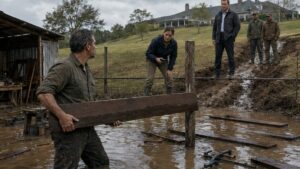
They Called Him a Trespasser Until the Missing Harvest Records Exposed Who Controlled the Farm
Chapter 1: The Man Sent to the Visitor Turnout
“Family guests use the turnout.”
Mark Wilson said it loudly enough for the first row of pickers to hear.
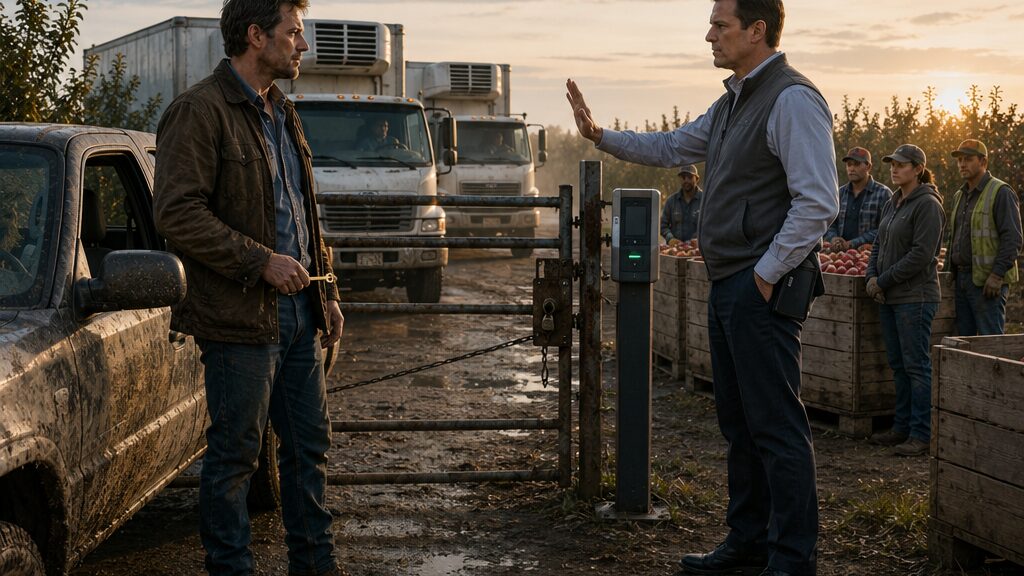
Thomas Carter sat behind the wheel of his mud-streaked pickup while two refrigerated trucks idled behind him, their engines filling the harvest lane with a low mechanical growl. Beyond the gate, workers in canvas sleeves moved empty field bins toward the eastern rows. Several had stopped to watch.
Mark stood beneath the new electronic entry post in a clean gray vest, one hand resting on a tablet. A plastic access placard hung from his belt.
Thomas lowered his window. “I need the north irrigation lane.”
“Commercial loading is active.” Mark nodded toward a gravel patch outside the fence. A white sign marked it as VISITOR TURNOUT. “Park there and check in at the office.”
“The pump motor failed before daylight.”
“I have a mechanic scheduled.”
“The mechanic is me.”
A few workers looked down. Someone near the bins gave a short, uncertain laugh.
Mark’s expression did not change. “That may have been how your family handled things before the management agreement. It isn’t how we handle them now.”
Thomas glanced past him. The electronic gate was new, installed beside the original pipe gate his father had welded forty years earlier. Mark’s company had added scanners, numbered placards, and a camera mounted high on a steel pole. The old gate remained chained open during business hours, mostly decorative.
Today it was closed.
“You’re holding two trucks,” Thomas said.
“You’re holding them.” Mark turned the tablet so Thomas could see a red bar across the screen. “No active credential.”
Thomas had received no notice that his credential had been canceled. He could have said so. He could have named the family trust, quoted the access covenant, or reminded Mark whose signature had authorized the management contract.
Instead, he shut off the engine.
The sudden silence made the truck queue feel more public.
Thomas stepped down wearing work boots, faded jeans, and the brown canvas jacket he used when mornings turned cold. Mark watched him approach the gate.
“You need to move the pickup,” Mark said.
“In a minute.”
Thomas reached into his jacket pocket and felt the smooth oval bow of the brass key. Its teeth had been worn bright long before Mark arrived at Carter Orchard.
He walked past the scanner to the old lock built into the inner gatepost.
Mark’s voice sharpened. “Do not tamper with company equipment.”
“This isn’t company equipment.”
Thomas inserted the key.
The lock resisted for half a turn, then opened with a dull click.
No one laughed the second time.
He pulled the gate inward just wide enough to move his truck from the loading lane. The first refrigerated driver leaned through his window, watching. Mark’s jaw tightened.
Thomas returned to the pickup, drove through, and stopped immediately inside the fence. He did not continue toward the pump road.
Mark followed him. “You’ve entered an active worksite without authorization.”
Thomas took a folded repair tag from the dashboard. “Put that in writing.”
“What?”
“The order denying me access. Include the date, the lane, and the reason.”
Mark studied him as if trying to decide whether the request was a threat. “You think an old key makes you exempt from safety rules?”
“No.”
“Then leave.”
Thomas held out the repair tag and a pen.
Mark did not take either.
Behind them, the packing-shed supervisor called for the trucks to move. The line had begun creeping through the open gate. Workers returned to their bins, though several still watched from the corners of their eyes.
Mark stepped close enough that Thomas could smell coffee on his breath.
“You appear here whenever you feel like it,” he said quietly. “You work on equipment without scheduling. You talk directly to crews after I’ve issued instructions. Then I have to explain to ownership why operations are disrupted.”
Thomas looked at him. “You’ve explained me to ownership?”
“I file weekly reports.”
“Then one more written report shouldn’t be difficult.”
For the first time, Mark hesitated.
Thomas knew the orchard’s numbers had improved during Mark’s first year. Waste declined. Packing schedules tightened. Buyers stopped complaining about inconsistent deliveries. Catherine had called the arrangement “professional management,” and Thomas had not argued because the farm had needed order.
But order had begun turning into permission.
Mark finally took the pen.
He wrote across the back of the repair tag in hard block letters: ACCESS DENIED DURING COMMERCIAL LOADING—UNREGISTERED FAMILY VISITOR. He added the date and signed his initials.
Thomas folded the paper once and placed it in his jacket.
“Move the truck outside,” Mark said.
“The pump is down.”
“I told you, I scheduled someone.”
“When?”
“This afternoon.”
“The east block will lose pressure by noon.”
“That is an operational decision.”
Thomas looked toward the rows. The first light had caught the tops of the apple trees, but beneath them the irrigation lines remained dark and still. Fruit close to harvest could tolerate a dry morning. The younger replacement trees near the slope could not.
He thought of saying that. Instead, he returned to the truck.
That silence felt different from the one at the gate. It no longer protected only him.
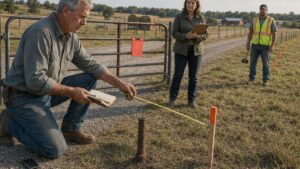
He backed out, parked in the visitor turnout, and walked the long way around the southern fence to the repair shed. The pedestrian easement there had never been incorporated into Mark’s new system.
By the time he reached the pump house, someone else was waiting: the equipment driver assigned to haul bins from the north rows. He was an older man with a sun-faded cap and both hands wrapped around a paper cup.
“They really sent you outside?” the driver asked.
Thomas crouched near the silent motor. “Looks that way.”
The driver watched him remove the inspection plate. “Mark says you’re Catherine’s brother.”
“I am.”
“Says you come around because you don’t trust hired management.”
Thomas loosened a burned terminal screw. “Sometimes I don’t.”
The driver gave a dry laugh, then looked toward the gate to make sure no one had followed.
“There’s an old county map in the shed office,” he said. “Been there since before Wilson’s people moved in. Carter name is printed across this whole strip.”
Thomas paused with the screwdriver in his hand.
The driver lowered his voice.
“Not Catherine’s name, either. Yours.”
Chapter 2: Fees Added to Land He Maintained
The brass key went into the lock, but the lock was no longer there.
A new chain had been looped through the irrigation-service gate and secured with a black combination padlock. Thomas stood on the county shoulder with his toolbox in one hand while the key hung uselessly from the other.
Beyond the fence, the service road ran straight toward the north pump house. The young trees on the slope had survived the earlier pressure loss, but the controller still failed intermittently. Thomas had returned before sunrise to replace it without disrupting the picking crews.
Mark had closed the only vehicle entrance.
A laminated notice had been wired to the chain.
BIOSECURITY CONTROL ZONE. AUTHORIZED PERSONNEL ONLY.
Thomas photographed the chain, the notice, and the date on his phone. Then he walked half a mile along the fence to the main gate.
The scanner rejected him again.
This time no trucks were waiting, and Mark was not present. A temporary gate attendant looked at Thomas’s name on a clipboard.
“You’re on restricted entry,” the attendant said.
“Under whose instruction?”
“Management.”
“What restriction?”
The attendant turned the clipboard toward himself. “Interference with scheduled operations.”
Thomas asked for a copy. The attendant refused without hostility, as if refusal were simply another box already checked.
Thomas left without arguing.
He reached the repair shed by crossing the neighboring farmer’s access strip and entering through a broken section of interior fence that Mark’s maintenance reports had listed as repaired twice.
For six days, he recorded every barrier placed between him and work he had performed for years. His fuel account was suspended. Tool-room access required a supervisor. Two seasonal mechanics were told they could no longer accept instructions from him. A replacement pump controller remained unopened in the shed because Mark’s contracted technician had not arrived.
Thomas kept copies.
At the farm office, Emily Garcia sat behind a desk crowded with freight bills and payroll envelopes. She wore reading glasses low on her nose and tapped one line on the monthly management statement.
“What is this?” Thomas asked.
“Apparently, you are.”
The charge read: BIOSECURITY ACCESS REVIEW—$60.
A second $60 entry appeared beneath it for ADMINISTRATIVE CREDENTIAL REISSUE.
“I never requested a credential.”
“I know.”
“And no one reviewed my access.”
“I know that too.”
Emily removed her glasses. “Mark’s office says these are standard compliance charges.”
“Are they in the management agreement?”
“No.”
“The operating covenant?”
“No.”
“The trust schedule?”
“No.”
She leaned back, studying him. “How long are you planning to let him do this?”
Thomas folded the statement along the edge of the charges.
“Until he does it clearly enough.”
“That sounds careful.” Emily’s voice remained mild. “It may also be convenient.”
He looked up.
“The field mechanics lost access to the north road yesterday,” she said. “The packing crew had to carry replacement belts from the main shed because their cart wasn’t on the approved vehicle list. Forty minutes across soft ground.”
“I didn’t know.”
“You didn’t ask.”
Thomas slid the statement into his folder.
Emily nodded toward it. “You have enough to prove he is overreaching.”
“Overreaching isn’t the same as intent.”
“Workers don’t get paid more because you’re waiting for intent.”
The sentence followed him out of the office.
At midday, the east sorting line stopped when a roller bearing seized. Thomas heard the metallic shriek from the repair shed. He carried the correct bearing toward the packing building, but a supervisor met him at the yellow floor line.
“You can leave it here,” the supervisor said.
“I can install it in ten minutes.”
“I was told you’re not cleared for production areas.”
The idle conveyor rattled as workers waited beside crates of fruit warming under the lights.
“How long for the approved mechanic?” Thomas asked.
“An hour. Maybe two.”
Thomas placed the bearing on the floor.
The supervisor looked embarrassed. “I don’t make the rule.”
“No,” Thomas said. “You carry it.”
He walked away before the words could become an argument.
That evening, Mark sent an operations notice to the trust attorney and copied Catherine. It described Thomas as a “persistent source of unscheduled interference” and claimed his presence had caused safety delays, unauthorized equipment handling, and confusion in the chain of command.
Attached was a request for authority to bill future disruptions directly to Thomas’s beneficiary account.
Thomas read it twice.
He could have replied to everyone. Instead, he printed the notice and placed it beside the written gate exclusion, the new fees, and photographs of the chained service road.
At nine, his phone rang.
Catherine’s name appeared on the screen.
He let it ring once before answering.
“What are you doing out there?” she asked.
Thomas leaned against the workbench. “Fixing what breaks.”
“That isn’t what Mark’s report says.”
“What does it say?”
“That you forced entry during commercial loading, bypassed safety controls, and interfered with paid staff.”
“He called me a visitor.”
“You aren’t management.”
“I’m not a visitor either.”
There was a pause.
Catherine’s voice lowered. “Mark says you’re trying to undermine the agreement because you never wanted him there.”
Thomas looked at the brass key beside his hand. It still fit the original gates, but each day there seemed to be fewer original gates left.
“When are you coming down?” he asked.
“I wasn’t planning to.”
“You should.”
“Why?”
He looked at the folder of notices. He had wanted a complete record before bringing Catherine into it. A record without emotion. A case that could not become another argument about their father, the trust, or which of them had abandoned what.
Now she was already inside the argument, carrying Mark’s version.
“Because,” Thomas said, “he isn’t only keeping me off the farm anymore.”
Chapter 3: The Trust Papers Neither Sibling Discussed
Catherine laid Mark’s report on the kitchen table as if it were a clean instrument.
Beside it, Thomas’s handwritten notes looked rough and defensive: dates, gate numbers, stalled equipment, worker delays, copies of charges, and photographs printed on ordinary office paper.
“This is what he sends me,” she said, touching the bound report. “Weekly yields. Labor costs. Rejection rates. Buyer schedules.”
Then she tapped Thomas’s folder.
“This is what you send me. Nothing.”
Thomas remained standing at the end of the table. The farmhouse kitchen had changed little since their father’s death. The cabinet near the sink still caught unless lifted by the handle. A pale square marked the wall where the old harvest calendar had hung.
“I asked you to come,” he said.
“After ten days.”
“I needed to know whether it was one bad decision or a pattern.”
“And in the meantime Mark tells me you’re obstructing harvest.”
“He denied me access to the irrigation road.”
“You are not an employee.”
“I maintain the pumps.”
“Because you decide to.”
Thomas pulled out the chair opposite her but did not sit. “Because the management contract excludes permanent systems from his maintenance scope. We did that to control costs.”
Catherine’s expression shifted slightly. She had not remembered that clause.
Thomas opened his folder and placed the old operating agreement on the table. The pages were copies, but his father’s initials remained visible beside each access provision.
“Section eight,” he said. “The working trustees retain unrestricted entry for land maintenance, water systems, structural repair, and inspection.”
Catherine read the paragraph.
“Working trustees,” she said. “That was you and Dad.”
“It became me after he died.”
Her eyes lifted. “No. The trust became joint.”
“The beneficial interest did.”
“Thomas.”
“The operating role passed to the successor named in the schedule.”
He removed another page.
Catherine read it more slowly. “You never showed me this.”
“It was in the trust packet.”
“There were two hundred pages in that packet, three days after the funeral.”
“You signed the acknowledgment.”
Her chair scraped against the floor as she stood. “That is exactly how Dad used to talk.”
Thomas went still.
Catherine walked to the sink, then turned back before reaching it.
“He would bury a decision in paper,” she said. “Then, when someone objected, he’d point to their signature and say they had agreed.”
“I didn’t write the trust.”
“No. You just learned how to hide inside it.”
The brass key lay on the table between the two sets of records. Thomas had placed it there without thinking. Catherine noticed it.
“You carry that everywhere?”
“It opens the original gates.”
“It opened them when we were children.”
“It opened them last week.”
“That doesn’t answer me.”
Thomas sat at last.
He had imagined this conversation many times, but never with Mark’s polished report between them. He had expected Catherine to be angry about the false fees or the access order. Instead, she was looking at him as if the older breach had finally found a document.
“Mark told me the harvest was at risk,” she said. “He said you were refusing the chain of command because you wanted control returned to the family.”
“I want him to follow the contract.”
“He says the contract does not work in practice. He says decisions take too long because every capital expense needs trust approval. He says you repair machinery without logging labor, which distorts his costs. He says I approve budgets from three hours away and you appear whenever something breaks, but neither of us will let him truly manage.”
Some of it was unfair.
Not all of it.
Thomas looked at Mark’s tables. Fruit loss had fallen. Delivery penalties had nearly disappeared. Mark had imposed discipline where the family had relied on memory, favors, and unpaid work.
Catherine sat again.
“I gave him expanded operating authority in June,” she said.
Thomas looked up sharply. “You did what?”
“He said he needed control of access and labor assignment to meet the buyer contract.”
“You cannot alter the management scope alone.”
“I didn’t alter the trust. I approved an operational addendum under the budget authority you left me.”
“I left you approval of expenditures.”
“And Mark’s attorney said that included temporary control measures.”
“Did our attorney review it?”
“No.”
Thomas stared at her.
Catherine folded her hands. “You were not answering my calls.”
“I was replacing the north well casing.”
“For three weeks?”
“I knew what you wanted to discuss.”
“The winter loan.”
“You wanted to mortgage the west block.”
“I wanted us to consider it.”
“You sent forms.”
“Because conversation with you becomes silence.”
Neither of them spoke.
The old refrigerator switched on with a hard mechanical hum.
Thomas opened Mark’s report and found the addendum referenced in a footnote. Catherine had authorized credentialing, restricted-zone controls, and exclusive direction of production personnel through the harvest period.
It did not cancel his covenant rights. But it explained why Mark believed he could treat every unplanned presence as interference.
“You gave him more authority than I knew,” Thomas said.
“You kept more authority than I knew.”
The symmetry did not absolve Mark. It made the ground beneath Thomas less level.
That afternoon they drove separately to the county records office. The land-record clerk retrieved the trust memorandum, easement maps, and operating schedules. Under fluorescent lights, Catherine read the successor clause again, this time beside the recorded map showing Thomas’s maintenance access across every orchard road.
“So he cannot bar you,” she said.
“No.”
“But you cannot direct his employees.”
“Not under the addendum.”
They were both right, which felt worse than either being wrong.
Outside, Catherine stopped on the courthouse steps.
“What are you trying to prove?” she asked.
“That he’s abusing authority.”
“To whom?”
Thomas did not answer quickly enough.
Catherine nodded as if the delay had answered for him. “You wanted a perfect case before telling me because then you would never have to ask whether you helped create it.”
She walked toward her car.
Thomas’s phone vibrated.
Emily had sent a photograph of two ledger pages from the packing shed. One showed harvested bin weights by block. The other showed packed and rejected volumes. Thomas enlarged the figures.
The totals did not reconcile.
He called her.
“I thought it was moisture loss,” Emily said. Her voice was tight. “Then I checked three more weeks.”
“How far off?”
“Too far.”
“Could fruit have been transferred between lots?”
“Not without shipping records.”
Thomas looked across the parking area. Catherine had reached her car but had not opened the door.
Emily continued. “The orchard harvested more premium-grade fruit than the trust accounts show it sold.”
“How much more?”
“I don’t know yet.”
“Who signed the pack-out corrections?”
A page turned on Emily’s end.
“Mark’s initials are on every one.”
Thomas raised his eyes toward Catherine.
She was watching him now.
“What is it?” she asked.
He held the phone away from his ear.
“The access fight may not be the reason he wanted me outside,” he said.
Catherine’s hand remained on the car door.
“What reason, then?”
Thomas looked again at the missing totals.
“Fruit,” he said. “A lot of it.”
Chapter 4: The Fruit That Vanished After Packing
“A full pallet cannot disappear between this page and the bank.”
Emily set the red harvest ledger beside the deposit register and flattened both with her palms. The packing shed office trembled each time the sorting line started beyond the wall. Through the glass, apples rolled under white inspection lights, turning in neat rows before workers separated bruised fruit from premium grade.
Thomas stood over the desk. On September fourteenth, Block Seven had produced forty-eight field bins. The receiving sheet showed them weighed, washed, graded, and packed. The ledger recorded twenty-four pallets of premium fruit leaving cold storage.
The sales account showed twenty-three.
“Could one have been downgraded later?” he asked.
“Then there would be a rejection adjustment.”
“Transferred to another buyer?”
“A transfer ticket.”
“Held overnight?”
“Cold-storage inventory.”
Emily pointed to an entry written in darker ink than the lines around it. A crate code had been changed from P1, premium grade, to P3, processing fruit. The correction bore Mark’s initials.
The processing buyer had never received it.
Thomas traced the altered code without touching the page. “How many?”
“Seven pallets I can prove. Possibly more.”
At wholesale prices, that was enough fruit to matter. Not enough to explain the entire farm’s losses, but enough that someone should have noticed.
Someone had.
Mark had made the correction himself.
Thomas looked through the office window. The old red ledger had belonged to his father, though nearly every page inside it had been replaced. The cover remained split at one corner and stained dark around the spine from decades of field dust and machine oil. Mark’s people had wanted to replace it with a digital system. The packing-shed supervisor had kept it because truck drivers still signed physical departures at the loading dock.
“What time did the missing pallet leave?” Thomas asked.
“It didn’t, according to the dock sheet.”
“Then it stayed here.”
Emily slid over a second page. “According to cold storage, it didn’t.”
The crate code had appeared again at 10:47 p.m., after the day crew left. Not as premium apples, but as mixed processing fruit loaded onto an unnumbered truck.
Thomas read the line twice.
“Who signed release?”
“No name. Just a mark.”
“That isn’t procedure.”
“No.”
The main office door opened before Thomas could ask another question.
Mark entered carrying a radio and a clipboard. His eyes moved from Emily to the open ledger, then to Thomas.
“That book is part of active operations,” he said.
“So are the missing pallets,” Thomas replied.
Mark closed the door behind him. “You are not authorized to audit pack-out.”
“Emily is.”
Emily kept her hands on the ledger. “I reconcile trust income.”
“You reconcile approved statements. Raw production records contain contractor information.”
“Fruit grown on trust land is not contractor information,” Thomas said.
Mark’s jaw worked once before he answered. “Do you understand what happens during peak harvest? Loads move. Grades change. Buyers reject shipments after hours. We sell what we can before it spoils.”
“Where is the sale?”
“If you had spent less time obstructing access and more time understanding commercial operations, you would know emergency transactions do not always settle immediately.”
Thomas turned the deposit register toward him. “This one is twelve days old.”
Mark did not look down.
“Who bought it?” Thomas asked.
“I would need to review the file.”
“Which file?”
“The broker file.”
“There is no broker code.”
Mark’s radio crackled. A voice from the line requested approval to hold a bin with excessive stem damage. Mark lifted the radio, gave a quick instruction, then clipped it back to his belt.
The movement was efficient. Familiar. He did not appear like a man who had lost control of the orchard.
That made Thomas more careful.
Mark faced Emily. “Close the ledger.”
Emily did not move. “Not until I copy the relevant pages.”
“You are exposing confidential buyer information.”
“There is no buyer information on the missing entry.”
Mark’s expression changed, not into fear but impatience. “Because it was a cash-priced salvage load.”
Thomas heard the sorting belts through the wall. “Cash paid to whom?”
“To the operation.”
“Which account?”
Mark looked at him. “You think because your name is on a trust schedule, you understand the decisions required to keep this place alive?”
“I asked which account.”
“I heard you.”
Mark pulled out the chair opposite Emily and sat. The anger in him seemed to settle rather than rise.
“Three weeks ago,” he said, “the operating account was short of payroll by thirty-eight thousand dollars. The main buyer delayed payment. The line repair took fourteen. Fuel invoices were due. Your sister would not approve another draw without updated projections, and you did not return calls.”
Thomas felt Catherine’s accusation from the farmhouse kitchen.
Conversation with you becomes silence.
Mark continued. “A broker offered immediate cash for mixed loads. Below contract price, but enough to bridge payroll.”
“Premium fruit was relabeled as processing fruit,” Emily said.
“Because the broker would not take it under the premium contract.”
“That makes no sense,” Thomas said. “Premium fruit is worth more.”
“Not when the premium buyer has capped intake and the fruit is already picked.”
“Then where is the cash?”
Mark stood.
“I will provide a reconciliation to the trust attorney.”
“When?”
“When the harvest is secured.”
“You altered the ledger.”
“I corrected a grading classification.”
“You loaded after hours without a truck number.”
“I moved perishable inventory.”
“You denied access to the one person who checks this shed after hours.”
Mark stepped toward him. “You were denied access because you ignore procedure.”
The sentence landed too neatly.
Thomas looked through the glass again. Beyond the sorting line, a roll-up door opened toward the rear loading apron. The new access system controlled the main gate and the north service lane. A truck arriving after dark could enter through the rear agricultural easement from the county road without passing the public gate, but only if someone unlocked it from inside.
Thomas remembered the chain, the restricted credential list, and the notice forbidding workers from taking instructions from him.
The rules had not merely pushed him away.
They had cleared the road.
Emily seemed to reach the same conclusion. “How many after-hours loads?”
Mark picked up the clipboard. “This discussion is over.”
Thomas moved between him and the door, not blocking it completely.
“Provide the broker name and deposit record by tomorrow.”
“You do not give me deadlines.”
“The trust does.”
“The trust gave me authority to manage harvest.”
“Not to conceal sales.”
Mark looked at him for a long moment. “Be careful what you call concealment before you understand what those sales paid for.”
He opened the door and left.
The next morning, Emily called the produce broker whose company code appeared on two earlier emergency sales. She put the phone on speaker.
The broker remembered Carter Orchard immediately.
“We had several mixed-grade pickups,” he said. “Late loads.”
“How many?” Emily asked.
“Would have to check.”
“Who arranged them?”
“Wilson’s office.”
“Where did payment go?”
There was a pause. Keyboard keys clicked faintly.
“Cashier’s checks for the first two. Then electronic transfer.”
“To Carter Orchard?”
Another pause.
“To the account listed on the invoice.”
“What account name?”
“I’m not comfortable giving that over the phone.”
Thomas leaned closer. “Did the invoices identify the Carter family trust?”
“No.”
“What did they identify?”
The broker exhaled. “Regional Harvest Services.”
Mark’s management company.
Emily wrote the name in the margin of her pad.
“How many deliveries?” she asked.
“Seven from your location since late August. Maybe eight.”
“At cash price?”
“Yes.”
“Premium fruit sold as mixed grade?”
“I bought sealed loads. I did not grade them.”
Thomas looked at the red ledger.
The altered codes were no longer isolated bookkeeping shortcuts. They were a route from family fruit to Mark’s company account.
Still, Mark’s payroll claim could be true.
Emily pulled the payroll summaries for the same weeks. The operating account had dipped dangerously low. A deposit from Regional Harvest Services appeared two days before one payroll run.
For eighteen thousand dollars.
Less than the estimated market value of the diverted fruit, but enough to cover most wages.
Thomas sat back.
“He put some of it in,” Emily said.
“Some.”
“He may have prevented a missed payroll.”
“And kept the rest somewhere else.”
They spent the afternoon matching loading dates, broker receipts, and labor records. Near sunset, Emily found the first answer.
The week of Mark’s emergency deposit, seasonal workers had still lost six hours each under a “weather and access interruption” adjustment.
Thomas read the payroll column.
There had been no weather interruption.
The access interruption had been the delay caused by Mark’s own credential rules.
He looked at the names reduced by the adjustment, then at the broker transfer.
Mark had used hidden sales to claim he saved payroll.
The workers had paid part of the shortage anyway.
Chapter 5: When Silence Began Costing Other People
“Why did the owner let him take those hours?”
The picker asked the question without raising her voice.
Thomas had come to the break area to inspect a leaking drinking-water line. He was crouched beside the spigot when she placed a folded pay stub on the bench above him. Three other workers stood nearby, not surrounding him, but not leaving either.
The deduction was listed as ACCESS DELAY—6.0 HOURS.
Thomas straightened. “Who told you I was the owner?”
“The packing-shed supervisor said your name is on the trust.”
“I’m one of the trustees.”
“That isn’t what I asked.”
The woman pointed toward the pay stub. “Mark said the road closures were necessary because somebody kept entering restricted areas. Then he docked us when the bins came late.”
Thomas wiped his hands on a rag.
“I’m reviewing it.”
“You knew the gates were wrong.”
“Yes.”
“You knew he was charging you.”
“Yes.”
“And you waited.”
The workers behind her stayed silent. That silence did not feel respectful. It felt like a space Thomas had forced them to stand inside.
“I was trying to document the pattern,” he said.
The picker folded the pay stub again. “We were the pattern.”
Thomas had no answer that improved what she had said.
He repaired the spigot after they returned to the rows. The leak had been small, a cracked washer inside the handle. His father used to say most losses began where people stopped looking because the first drop seemed too small to matter.
Thomas had believed he was looking.
He had only chosen where.
At the north service gate, the black chain still crossed the road. He took out the brass key, though there was no lock it could open. For several seconds he held it against the chain.
Then he put it back in his pocket.
He could cut the chain. The old easement gave him the right to enter for maintenance. But cutting it now would turn the argument back toward access, trespass, and procedure. Mark would use the act as proof of disruption before anyone examined the sales.
Thomas walked away from the gate.
At the farmhouse that evening, Catherine sat at the kitchen table with copies of the payroll records. The red ledger lay open beside her.
“You should have told them,” she said.
“I didn’t know about the deductions.”
“You knew Mark was applying the restrictions beyond you.”
“I knew repairs were being delayed.”
“And you kept gathering paper.”
“I needed proof that he was acting deliberately.”
Catherine looked up. “Why?”
“Because if I challenged him too early, he could call it a misunderstanding.”
“He did call it a misunderstanding.”
“Now he can’t.”
“Thomas, the workers do not care whether you win the cleanest possible argument.”
He pulled out a chair but remained standing behind it.
“I’m trying to protect the farm.”
“No. You’re trying to protect yourself from being wrong.”
The words struck harder because she did not sound angry.
Catherine closed the ledger. “Dad did this too. He would decide what everyone could bear, then keep the rest to himself. He called it protecting us.”
“I am not Dad.”
“You use the same silence.”
Thomas gripped the chair back. “He made decisions for people. I was waiting before making one.”
“You were making one every day you waited.”
He released the chair.
Outside, a truck passed on the county road, its tires humming across the pavement before the sound faded toward town.
Thomas sat.
“The first time I saw the false charge,” he said, “I thought Mark was testing whether I would fight him.”
Catherine waited.
“I wanted him to believe I wouldn’t.”
“So he would expose more.”
“Yes.”
“And did you consider what he might do to other people while you were proving how patient you could be?”
Thomas looked at the key on the table. He had set it there again, as if the house itself drew it from his pocket.
“No,” he said.
Catherine’s face changed slightly. Not forgiveness. Recognition, perhaps, because the answer had not been polished.
Thomas continued. “I also didn’t tell you because I knew the trust papers would bring us back here.”
“To this kitchen?”
“To Dad.”
“You mean to the part where you stayed and I left.”
“I didn’t say that.”
“You never have to.”
He looked at her.
Catherine folded her arms. “You think I abandoned the orchard. I think you used it to avoid building a life anywhere else. Mark saw both things and stepped into the space between them.”
That was the first time either of them had named his authority as something they had created together.
Thomas opened the payroll file.
“We can restore the hours immediately.”
“From what account?”
“The reserve.”
“The reserve barely covers the winter loan payment.”
“Then from my distribution.”
“And after that?”
He did not answer.
Catherine pulled another document from her bag. “Mark scheduled an emergency trust vote.”
She slid it across the table.
The notice accused Thomas of operational interference, unauthorized entry, intimidation of contracted staff, and conduct threatening completion of harvest. It requested temporary suspension of his working-trustee authority until an independent review.
The meeting was set for two days later in the packing-shed conference room. Mark had invited the trust attorney, Emily, the packing-shed supervisor, and two representatives from the harvest committee.
“He knows we found the sales,” Thomas said.
“Or he thinks you are about to remove him.”
“Will you vote for suspension?”
Catherine looked toward the dark window above the sink.
“Yesterday, I might have.”
Thomas absorbed that without protest.
“What changed?”
“The ledger.”
“The missing fruit?”
“That too.” She turned back. “But mostly the way you finally said you were wrong.”
He almost thanked her, then stopped. Her support was not something he should make sound granted.
“I need the full records before the meeting,” he said.
“You may not get them.”
“Then I’ll present what we have.”
“And the payroll?”
“I’ll present that too.”
“Including the delay?”
Thomas knew what she meant.
His delay.
His choice to keep watching after the damage had spread beyond him.
“Yes.”
Catherine studied him. “Mark will use it.”
“He should.”
The next morning, Thomas met the workers beside the break area before the picking crews divided by block. Mark was not there yet.
Thomas returned the deducted hours from his own pending distribution and told them the correction would appear on the next pay cycle. He did not explain the investigation. He did not ask them to support him.
The picker who had challenged him looked at the posted correction sheet.
“You knew enough to fix this yesterday,” she said.
“Yes.”
“Why didn’t you?”
“I wanted the rest of the numbers first.”
“That sounds like an answer for a meeting.”
“It probably is.”
She folded her arms.
Thomas looked at the workers. “The truthful answer is that I was afraid if I spoke before I had everything, Mark would make me look reckless. I let that matter more than what the delay was costing you.”
No one responded.
The picker took the correction sheet down, read it closely, then pinned it back.
“Will the gates open?” she asked.
“Not yet.”
“Then this isn’t fixed.”
“No.”
A pickup turned into the lane. Mark’s.
Thomas felt the brass key in his pocket but did not reach for it.
Mark parked near the office and walked toward them holding a stack of notices.
“I assumed I would find you here,” he said.
He handed Thomas the top sheet.
TEMPORARY REMOVAL FROM OPERATIONAL AREAS PENDING TRUST VOTE.
Mark had signed it. Catherine had not.
“You have until the meeting to remove personal tools from the repair shed,” Mark said.
Thomas folded the notice.
“The ledger will be there,” he said.
Mark’s eyes narrowed. “What ledger?”
“The one we’re opening in front of everyone.”
Chapter 6: The Ledger Opened Before Everyone
“Thomas Carter is now the greatest operational threat to this harvest.”
Mark stood at the end of the packing-shed conference table with one hand resting on a prepared binder. Behind him, through the interior window, the sorting line moved at half speed. The empty chair nearest the door belonged to Thomas, though no one had asked him to sit.
Catherine sat opposite the trust attorney. Emily had placed the red harvest ledger before her, closed. The packing-shed supervisor and two harvest representatives occupied the remaining chairs.
Mark continued in the calm tone he used for production briefings.
“In the past month, Thomas has bypassed access controls, entered restricted areas, instructed contracted personnel outside the approved chain of command, disrupted loading, and challenged decisions during the most financially sensitive period of the year.”
He opened the binder.
“I am requesting temporary suspension of his operational authority until harvest is complete.”
Thomas remained beside the door.
The trust attorney looked at him. “You will have time to respond.”
“I know.”
Mark turned a page. “No one disputes the family’s beneficial interest. But ownership does not equal operational competence.”
Thomas heard a faint shift in the room. Mark had finally acknowledged ownership, but only after converting it into irrelevance.
Mark displayed photographs of Thomas’s pickup inside the gate, the open inner lock, the toolbox beside the packing-floor line, and the chain notice at the north road.
Each image was accurate.
Together, they made Thomas appear exactly as Mark described him: irregular, unscheduled, unwilling to accept structure.
Mark finished with a chart showing improved yield recovery since his company took over.
“This orchard was losing money through informal practices,” he said. “I standardized access, labor, grading, and buyer fulfillment. The present disruption is not evidence that those controls failed. It is evidence that they were necessary.”
The trust attorney turned to Thomas.
Thomas walked to the table. He took the brass key from his pocket and placed it beside the closed red ledger.
The small sound of metal on wood stopped the movement of Mark’s pages.
“I entered through the old gate,” Thomas said, “because the trust covenant gives the working trustee permanent access for water, structures, and repair.”
He handed the attorney the recorded schedule.
“Mark denied that access in writing. He then charged the trust and my beneficiary account for reviewing and reissuing rights he had no authority to revoke.”
Mark spoke immediately. “Temporary safety controls were authorized under the operational addendum.”
Catherine said, “I authorized production controls. Not cancellation of recorded access.”
Mark looked at her. “Your approval did not include exceptions for unscheduled family intervention.”
Thomas placed the fabricated fees beside the covenant. “That is the access issue.”
He did not sit.
“It is not the whole issue.”
Emily opened the red ledger.
Thomas felt every instinct that had kept him quiet. Wait until the evidence is complete. Let the numbers speak. Do not expose weakness before the other man does.
He looked at the picker’s corrected pay stub in his folder.
“Before Emily presents the records,” he said, “I need to state something Mark will otherwise state for me.”
Catherine’s eyes stayed on him.
Thomas continued. “I knew the first access charge was false. I knew restrictions were delaying repair work. I chose not to challenge them immediately because I wanted to document whether Mark was making mistakes or building a deliberate system.”
Mark gave a short breath that almost became a laugh.
Thomas did not look at him.
“While I waited, workers lost hours. Equipment sat idle. My sister received reports I had not answered. I believed silence made my position stronger. It made the harm easier to continue.”
The packing-shed supervisor lowered his eyes.
The trust attorney asked, “Are you accepting responsibility for the operational delays?”
“For the part caused by my delay in speaking, yes.”
Mark leaned forward. “Then the suspension request stands on Thomas’s own admission.”
“No,” Catherine said.
It was the first time she had interrupted him.
Mark turned toward her.
Catherine rested one hand on the operating addendum. “His admission does not erase your obligations. It makes his evidence more credible because he isn’t pretending he did everything right.”
The room went quiet.
Emily rotated the ledger so everyone could see.
She walked them through the missing pallet first, then six more. Premium-grade fruit had been recoded as processing inventory after inspection. The after-hours release lines lacked truck numbers. Broker statements showed repeated purchases from Carter Orchard arranged through Regional Harvest Services.
Mark’s company.
The trust accounts showed no matching income for four transactions.
Mark did not deny the sales.
“They were emergency liquidations,” he said. “The premium buyer had capped intake. Fruit was already harvested. I moved inventory before it lost value.”
“Why did payment go through your company?” the trust attorney asked.
“Speed. The broker had us registered.”
“Why was it not reported?”
“It was being reconciled.”
“For how long?”
Mark’s mouth tightened. “The harvest is ongoing.”
Emily placed deposit records beside the ledger. “One transfer returned to the orchard operating account.”
Mark seized on it. “Exactly. Eighteen thousand dollars. Payroll would have failed without it.”
The harvest representatives exchanged a look.
Thomas had known the argument would matter. Hearing it aloud gave it weight.
Mark faced the room. “You want to talk about process while people are expecting checks. The main buyer delayed payment. The reserve was restricted. Catherine would not approve another draw without projections, and Thomas disappeared into repair work. I found liquidity.”
“You sold trust fruit through your own company,” Thomas said.
“I kept workers paid.”
Emily opened the payroll file.
“Not fully,” she said.
She showed the access-delay deductions, the reduced hours, and the payroll totals. Mark’s emergency deposit had prevented a missed pay cycle, but workers had still absorbed part of the shortfall. Meanwhile, the value of the diverted fruit exceeded the amount returned to the orchard.
The trust attorney asked the question Thomas had been waiting for.
“Where is the balance?”
Mark’s face hardened. “Held against contractor expenses.”
“What expenses?”
“Transport. Broker commissions. emergency handling. Risk.”
“Documented where?”
“I can produce them.”
“You were asked yesterday,” Emily said.
Mark looked at Thomas. “You think this place survives on old keys and moral purity? Your father ran costs through unpaid family labor. You repair machinery without billing time, then call my numbers dishonest because I cannot compete with free work. Catherine wants distributions. Buyers want volume. Workers want checks. Everyone wants the orchard preserved, but no one wants to price what preservation costs.”
No one interrupted him.
The anger in his words was not invented. Thomas knew the winter accounts. He knew how often the farm had survived because he did not bill his labor and because his father postponed repairs until breakdowns became emergencies.
Mark had diagnosed the weakness correctly.
Then he had used it.
“You stabilized parts of this operation,” Thomas said. “You reduced waste. You met delivery windows we had missed before.”
Mark seemed surprised by the acknowledgment.
Thomas continued. “That does not give you ownership of the difference between what the fruit earned and what you chose to report.”
“I was going to reconcile it after harvest.”
“You altered grades to hide the route.”
“To move the product.”
“You restricted access to the rear loading period.”
“To control the site.”
“You billed workers for delays caused by those controls.”
“To keep payroll solvent.”
“Each answer protects the next one.”
Mark pushed the binder away. “And what is your answer? Remove me two weeks before harvest ends and take over yourself?”
Thomas looked at the brass key.
That would have been the old answer. His father’s answer. Remove the failed manager, carry the keys, work until the books balanced, and tell everyone else what had been necessary afterward.
Thomas closed the folder.
“Under the trust’s termination clause, your operational authority ends today,” he said.
Mark stared at him.
The trust attorney spoke carefully. “Thomas, unilateral termination requires cause and notice.”
“The false access charges establish breach. The undisclosed sales and diverted payments establish cause. This meeting is notice.”
Catherine placed her signature beneath his on the termination form.
Mark looked from her to Thomas. “Then you are assuming management.”
“No,” Thomas said.
The answer unsettled the room more than the termination.
Mark frowned. “Someone has to run the orchard.”
“Yes.”
“Who?”
Thomas picked up the brass key but left the red ledger open.
“Not one person behind a closed door again.”
Mark’s radio crackled from his belt. The sorting line had stopped.
No one reached for it.
The story has not ended.
Chapter 7: The Gate Reopened Under New Rules
The workers arrived before sunrise and found the main gate locked.
No electronic scanner glowed beside it. Mark’s credential post had gone dark after his access was revoked, and no one had yet decided who possessed the temporary code. Three pickups waited on the shoulder. A bus carrying the picking crew idled behind them, its windows fogged by breath.
Thomas stood inside the fence with the brass key in his palm.
The original lock remained beneath the newer electronic latch. He could open it in seconds. Everyone outside appeared to know that. No one called to him.
The packing-shed supervisor approached from the office carrying a ring of management keys and a handwritten list.
“The trust attorney says we can resume under emergency authority,” he said. “But somebody has to sign the daily work orders.”
Thomas fitted the brass key into the old lock.
“Who signed them yesterday?” he asked.
“Mark.”
“And who checked them?”
The supervisor hesitated. “Mark.”
Thomas turned the key. The bolt withdrew with the same dull click it had made on the morning Mark called him a guest.
This time Thomas opened both sides of the gate.
The bus rolled through first. Pickers watched him from behind the glass, their faces unreadable in the dim light. Thomas held the gate until the final pickup passed, then left it secured open with the old steel hook.
He did not put the key back in his pocket.
By eight o’clock, the orchard office had become a temporary command room. Emily reconciled fuel accounts at one desk. The packing-shed supervisor rebuilt the loading schedule at another. Catherine stood beside a whiteboard listing decisions that could not wait: payroll, buyer deliveries, equipment repair, worker access, cold-storage inventory.
Thomas placed a proposed operating plan on the table.
“For the rest of harvest,” he said, “I handle water systems, machinery, and land access. The supervisor handles packing and crews. Emily reviews every sale before release. Catherine approves expenditures over five thousand.”
Catherine read the first page without sitting.
“Who breaks a tie?” she asked.
“We shouldn’t need one for two weeks.”
“That isn’t an answer.”
“The trust attorney can mediate.”
“After a delay?”
“Then I make the temporary call.”
Catherine looked up. “So the new system is still you deciding alone when it matters.”
“It is not the same.”
“It is cleaner on paper.”
Thomas felt the instinct to defend each safeguard. He had written the plan through most of the night, separating functions Mark had concentrated under one office. Nothing moved without two sets of eyes. Nothing except emergencies.
He had left emergencies with himself.
“The pump cannot wait for a committee,” he said.
“No. But a land decision is not always a pump.”
“I know the difference.”
“You believed you knew the difference before.”
Emily stopped typing but did not turn around.
Thomas looked at the whiteboard. Every urgent line seemed to ask for one accountable hand. The orchard had survived for generations because someone had always stepped forward when machinery failed, buyers delayed, or frost threatened. His father had used that necessity to justify deciding everything else.
Thomas picked up a pen.
“What do you want changed?”
Catherine pulled the plan closer.
“Emergency authority limited to immediate crop, safety, or equipment loss. Written explanation within twenty-four hours. No expense approval by the same person who orders the work. Worker-access changes reviewed by the supervisor and one trustee.”
“That may slow us down.”
“Yes.”
“Sometimes slowing down costs money.”
“So does speed without scrutiny.”
Thomas crossed out three lines.
By noon, the system had its first test. The premium buyer reduced the orchard’s remaining intake without warning. Six field bins already picked from the west block had nowhere to go, and the cold room was near capacity.
Under Mark, the response would have been immediate: call the secondary broker, move the fruit, settle the record later.
The produce broker offered a low but defensible price.
Thomas wanted to accept before the apples warmed.
Emily required a written invoice identifying the trust. The supervisor wanted transport costs included. Catherine asked whether delaying the west block by one day would damage fruit still on the trees.
They lost forty minutes answering questions.
The fruit did not spoil.
The final price was lower than Thomas wanted but higher than Mark’s recent cash sales. Payment went directly into the orchard account before the truck left. The driver signed both the digital release and the red ledger.
Thomas watched the supervisor write the truck number in the margin.
The ledger no longer looked like evidence from an old wrong. It looked like a promise that the next transaction would remain visible.
The trust attorney’s preliminary recovery estimate arrived that afternoon. Even if Mark’s company returned every unsupported charge and the balance of diverted sales, the money would not cover the orchard’s winter obligations. Legal review would take months. Some transport and broker expenses might prove legitimate. The final recovery could be less than half of what they claimed.
Catherine read the estimate in silence.
“We cannot keep all the acreage,” she said.
Thomas had known before she spoke.
The western slope needed irrigation replacement. The oldest southern rows produced less each year. Maintaining both would require another loan secured against land already carrying winter debt.
“We could defer the west system,” he said.
“And repeat this next season?”
“I can rebuild sections.”
“With unpaid labor.”
He looked at her.
Catherine softened her voice, though not the point. “That is how the numbers became dishonest before Mark ever touched them.”
Thomas walked to the window. Beyond the office, workers moved through rows that his grandfather had planted. Empty bins stood at regular intervals, pale against the dark earth.
Keeping the orchard intact had been the promise.
He had never asked whether intact meant healthy.
“We reduce the west block,” he said. “Lease part of it to the neighboring farmer. Replace the best rows over three years.”
“And the south?”
“Finish this harvest, then remove the least productive acreage.”
Catherine wrote it on the board.
The marker squeaked against the surface.
No one called the decision a victory.
During the final week of harvest, access rules were rewritten. Workers could report blocked equipment or unsafe delays directly to the supervisor and either trustee. Credential suspensions required a written reason and review by someone outside the management chain. Time lost because of farm-imposed restrictions could not be deducted from worker hours.
Emily created a sales register matching every pallet to a buyer, invoice, account deposit, and ledger signature. The old red book remained at the loading dock, but its entries were photographed each evening and stored with the digital records.
Thomas restored the north service gate. He removed the black chain and left the newer padlock on Mark’s former desk.
The picker who had challenged him arrived while he was adjusting the hinge.
“Does the key work again?” she asked.
Thomas held up the brass key. “It always worked. The chain was the problem.”
She looked at him for a moment. “Sometimes the person holding it is the problem.”
Thomas nodded. “That too.”
She tested the gate. It swung without dragging.
“Better,” she said, and returned to the rows.
After the last major shipment left, Catherine found Thomas in the orchard office studying the original brass key. Beside it lay a new duplicate, bright and sharp-edged.
He slid it across the desk.
Catherine did not pick it up.
“What is this?”
“Your gate key.”
“I had electronic access.”
“So did Mark.”
Her mouth tightened slightly.
Thomas added, “The original gates should open for both trustees.”
“That is not the same as sharing decisions.”
“No.”
“Or information.”
“No.”
She picked up the duplicate at last. “You do understand that giving me a key does not repair twenty years.”
“I do.”
“And I’m not moving back.”
“I know.”
“I will review the books. I will come for scheduled meetings. I will not become the version of this family you wanted me to be.”
Thomas closed his hand around the original key. “I’m trying to stop deciding what version everyone should be.”
Catherine turned the new key between her fingers. Its bright surface caught the office light.
“That would be new,” she said.
It was not forgiveness, but she placed the key on her own ring.
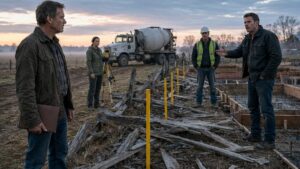
By early winter, the stripped rows looked longer than they had under leaves. Survey stakes marked the section planned for lease. The recovery claim against Mark’s company remained unresolved, and the orchard’s accounts still showed a narrow path through the cold months.
Thomas no longer repaired machinery without entering his hours, even when he chose not to draw immediate pay. Emily insisted the labor appear as a liability so the farm could no longer pretend survival cost nothing.
On the first morning of pruning season, Thomas arrived before the crew. The main gate stood open on the old steel hook.
Catherine was already in the office reviewing the monthly account. When Thomas passed the window, she raised one page to indicate a charge she wanted explained.
He held up a finger to show he would come inside after checking the pump.
She pointed at the clock.
He nodded.
The exchange was small, almost irritating, and more honest than their old silence.
Later, Catherine locked the orchard office and tested the door once. Thomas walked with her to the gate. She stopped beside the post where Mark’s dead scanner still waited to be removed.
“Are you closing it?” she asked.
Thomas looked down the county road. The morning crew would arrive before daylight.
“No,” he said. “They know when to come.”
He set the gate wide and secured it with the steel hook.
Catherine placed her duplicate key in her coat pocket. Then she drove away, leaving Thomas beside the open entrance.
The orchard behind him was smaller than the one he had promised to preserve. Its future was less certain, its records more complete, and its authority no longer hidden in one man’s pocket.
When the first crew headlights appeared along the road, Thomas stepped away from the gate so they would not have to ask permission to enter.
The story has ended.