The Soldier on the Gate
Part I — The Empty Perch
Captain Mara Vale reached the fortress before dawn, soaked through to the collar, and the first thing the sentry said was, “A soldier is missing, ma’am.”
Her hand went automatically to the sidearm she no longer carried.
“From which post?”
The young corporal swallowed. Rain shone on his helmet strap and ran off the end of his nose. “North Gate roster, ma’am.”
She looked past him at the inner wall, at the black iron perch bolted above the arch.
Empty.
The corporal lowered his voice, as if speaking too loudly might make the absence worse. “Ash, Raven First Class.”
For one sharp second, it almost made her laugh.
Then she saw the way the gate guards were standing—too still, too careful, like men waiting to be blamed for artillery. She saw the spare chain hanging from the perch. Saw the old droppings streaked down the stone. Saw the little brass plate screwed beneath it:
ASH — ATTACHED TO GARRISON COMMAND
The laugh died before it reached her throat.
The fortress rose behind the gate in wet tiers of stone and gun emplacements, half swallowed by fog. Mara had spent enough years inside walls like this to know when a place was tense in the wrong way. This wasn’t routine alarm. It was superstition trying to pass as discipline.
“Who signed the incident report?”
“Colonel Thane is waiting for you in command.”
Of course he was.
The corporal moved aside. Mara stepped under the arch, boots striking hollow on the stone. The smell hit her first—rain, old mortar, fuel oil, cold metal. Beneath it, a faint sour note of bird feed and feathers.
She had not wanted to come back here. Not to Ravaryn Fort, not to this border, not to the walls that had made heroes out of boys and then buried the bill. But she had been on suspension in the capital for nine days, officially for insubordination, unofficially for asking the wrong questions in a room that preferred clean reports to true ones. Then Colonel Soren Thane had sent for her.
Urgent return. Immediate investigative authority. Inspection-sensitive matter.
No explanation.
Now she had one.
A missing raven.
At the top of the inner stairs, a pair of soldiers fell silent as she passed. One of them muttered, not quite softly enough, “Told you they’d bring her.”
Bring her. As if she were a tool. As if she had not once grown up on these same wet stones, visiting her brother before she ever wore the uniform herself.
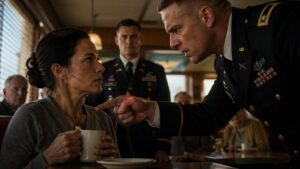
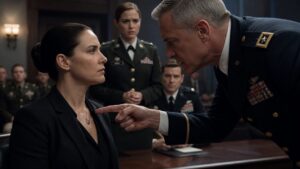
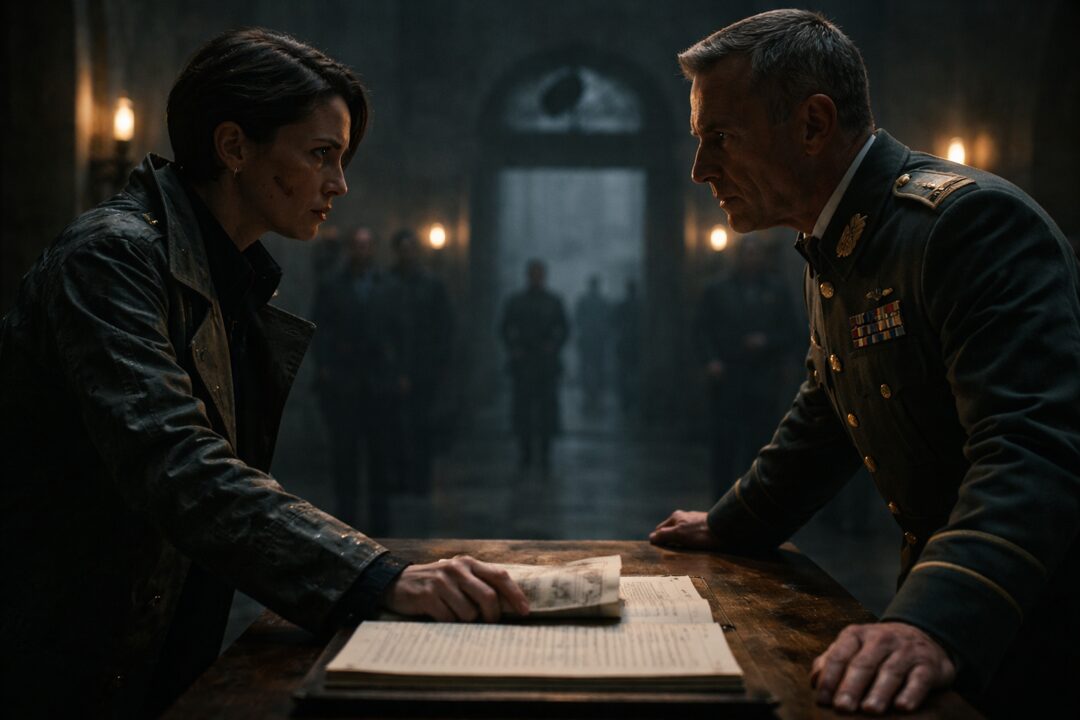
In the command chamber, the lamps were still lit though morning had begun to gray the narrow windows. Colonel Thane stood over the central map table in full dress coat, as immaculate as a gravestone. His left hand rested stiffly on the wood, the fingers never quite straight since the blast at Daran Crossing twelve years earlier.
He looked up once. “Captain.”
“Colonel.”
He dismissed the adjutant with a glance. The door shut. Rain tapped at the glass.
Thane slid a paper toward her.
Incident notation: Ash, Raven First Class. Absent from assigned perch at 0410. Prior irregularity noted: agitation. Recommendation pending temporary disciplinary removal for bad conduct if behavior persists.
Mara read the line twice.
“Bad conduct,” she said.
Thane’s face did not change. “It is the language used in prior cases.”
“Prior cases.”
“We maintain records.”
The fortress could turn anything into a ledger entry. A dead man. A lost battery. A bird.
She set the paper down. “Why am I here, exactly? You have handlers, guards, and half a battalion of men who know how to chase a raven with bread.”
“Because by sundown the ceasefire inspection team will be here to evaluate this post for transitional handover.”
That landed heavier than the paper had.
If the inspectors found disorder, or dishonesty, or signs that Ravaryn was being run on ghost stories instead of command structure, the fort could be stripped overnight. Personnel dispersed. Archive sealed. Narrative rewritten by people who had never heard the guns.
And above all of it was the old belief that if the gate raven left, the fortress would not stand.
Nobody sensible admitted believing that. But sensible men still touched the wall as they passed under the perch.
“Nobody outside this command circle is to know how serious this is,” Thane said. “Officially, Ash is being relocated for routine examination.”
“Unofficially?”
He met her eyes. “Unofficially, if the gate perch is empty when the delegation arrives, every rumor in this fort becomes evidence.”
Mara folded the report once, cleanly.
“And who suggested punishing the raven?”
“Sergeant Elias Rook noted the agitation.”
That name struck more quietly but harder.
Elias Rook had been a medic once. Then a burial officer. Then, somehow, the fortress’s keeper of ravens. Ravaryn had a way of giving damaged men ceremonial jobs and calling it continuity.
“I want access to the duty logs, feed records, maintenance records, tunnel works, and anyone who was on gate rotation in the last three days.”
“You’ll have them.”
“And if I find out this is not about a bird?”
Thane’s stiff hand pressed harder into the map table.
“Everything here is about more than it first appears,” he said.
It was the closest thing to honesty she had heard from him in years.
When she turned to leave, he said, “Captain.”
She stopped.
He looked past her, not at her. “This does not concern your brother.”
It was the wrong thing to say. They both knew it the moment it entered the room.
Mara opened the door.
“If it didn’t,” she said, “you wouldn’t have said it.”
Part II — The Handler
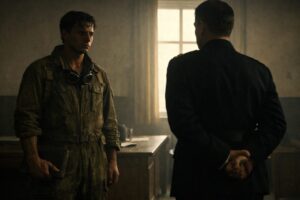
Sergeant Elias Rook kept the raven mews beneath the western parapet, in a low vaulted chamber that smelled of straw, medicine, and old rain. There were six iron stands, four occupied. The birds watched Mara with the flat, intelligent stillness of creatures that had learned human voices mattered.
Elias was cleaning a shallow dish when she entered.
He had aged into the kind of face war leaves behind when it has time to do careful work—creased around the mouth, pale scar down one thumb, eyes too tired to waste movement. His uniform was clean but never pressed, sleeves rolled despite regulations. He smelled faintly of carbolic, feathers, and damp wool.
He did not salute.
“Captain.”
“Sergeant.”
A raven on the nearest stand clicked its beak at her. Elias set the dish down. “You were sent to blame me.”
“I was sent to find Ash.”
“Same thing, usually.”
She held up the incident report. “You wrote that he was agitated and might require temporary disciplinary removal.”
Elias’s mouth tightened. “That line wasn’t for comedy.”
“Did it feel comic when you wrote it?”
“No.” He wiped his hands on a rag. “It felt like the only language command recognizes when something living refuses to behave like equipment.”
That was one answer. Too quick to be careless.
“Where is he?”
“If I knew, I’d have him.”
“Try again.”
Elias looked at the empty stand in the corner, larger than the others, its perch worn smooth. “He started circling the eastern wall three days ago. Wouldn’t settle. Wouldn’t eat properly unless I fed him by hand. At dusk he kept striking toward the excavation below the old battery.”
“The tunnel works.”
He nodded once.
“Why?”
“I don’t know.”
She watched him long enough for the silence to become a tool.
One of the birds hopped sideways and flared its wings. Somewhere above them boots crossed the stone. Elias kept his face still, but when she said the next name, something in him gave itself away.
“Jonas used to come in here, didn’t he?”
A pause. Too small for anyone else, maybe. Not for her.
“My brother,” she said. “He knew Ash.”
Elias looked down at the rag in his hands. “A lot of men knew the bird.”
“That’s not what I asked.”
He put the rag aside with absurd care. “No, Captain. It isn’t.”
There it was. Guarded, not denying.
She stepped deeper into the chamber. On a nail by the doorway hung a satchel of feed tags and duty slips. She took one down. The dates on Ash’s feeding schedule were neat until the last week, where two entries had been scratched out and rewritten.
“Who altered these?”
“Me.”
“Why?”
“Because the first times I wrote east wall perch I was told to mark gate rotation instead.”
“By whom?”
His silence answered that well enough.
Mara flipped through the slips. Repeated notes: restless at dusk. Repeated wing abrasions. Once, a line nearly inkless from erasure: returned carrying cloth.
She looked up. “What cloth?”
Elias’s jaw shifted.
“What cloth?”
He gave her nothing.
The anger rose fast, which annoyed her. She did not want him to matter. She especially did not want him to matter because Jonas had trusted him once.
Outside, a horn sounded from the lower yard. Shift change.
“Listen to me,” she said. “By evening a delegation will be here looking for signs this fort is stable enough to survive handover. Right now command is prepared to classify a raven as undisciplined to preserve appearances. If you are protecting that bird, say so.”
“I am.”
The bluntness of it stopped her.
“But not from what you think.”
He crossed to a small locker and opened it. Inside were ointments, bandages, a coil of thin wire, a pair of old leather gloves.
And a faded strip of dark cloth wrapped with red thread.
Mara didn’t touch it.
Jonas used red thread for everything. He wound it around cracked field compasses, signal rods, chipped canteens. Said it made objects look like they still belonged to someone.
“Where did you get that?”
Elias shut the locker.
“Ash brought it two nights ago.”
The room seemed to narrow.
“From the eastern works?”
“I think so.”
“You think so?”
“The labor crew reopened a breach into the old artillery corridor. Just a partial cut. They sealed it again after some subsidence.” He hesitated. “Since then Ash has been trying to get back there.”
“Trying to get back,” she repeated.
Elias looked at the empty stand. “He isn’t running from the fort, Captain.”
“Then what is he doing?”
His voice dropped, and for the first time the tiredness in it became something worse.
“Maybe he’s going where we left something.”
She stared at him.
“We?”
He looked at her then. Directly. No softness in it.
“Your brother died in the east battery,” he said. “That’s the truth nobody here likes to say with the walls listening.”
The force of it came not from surprise but from hearing it spoken aloud. Jonas had died in action. Jonas had held the line. Jonas had saved the retreat corridor. Jonas had been recommended posthumously for valor. She knew the official phrases so well she could have mouthed them in her sleep.
The east battery had been omitted from the clean versions.
“What are you not telling me?” she asked.
Elias did not answer.
That was when she understood that Ash was not the thing being hidden. Ash was the thing refusing to stay hidden.
Part III — What the Fortress Keeps
By midday the rumor had spread anyway.
Mara heard it in fragments as she moved through the fort. The gate raven had deserted. The gate raven had died. The gate raven had seen something in the reopened eastern corridor and would not return because the dead were stirring in the batteries.
The younger soldiers said it with half a grin and then glanced upward after, as if to make sure the wall wasn’t listening. The older ones did not grin at all.
In the records room, Mara pulled gate logs, feed schedules, maintenance slips, and inspection summaries until her fingers blackened with dust. The clerk on duty—a nervous lieutenant with a face too young for this place—kept asking whether any of it was “officially irregular.”
“Everything is officially irregular,” she said.
The north-gate log showed Ash present on all ceremonial checks until three nights ago.
The mews records showed eastward flight patterns erased and corrected.
The labor report for the tunnel breach had two signatures where one should have been and a closure time that contradicted the guard rotation.
And tucked in the back of an older binder she found what she had not known she was looking for: a personnel attachment order from nine years earlier.
ASH — provisional ceremonial integration pending command approval. Attached status authorized by Cdr. S. Thane.
Below it, in a different hand: Service distinction recognized in memorial function.
Memorial function.
For a long moment she just stood there with the paper.
Jonas had never told her about a bird. In his letters home he wrote about mud, failing batteries, bad tea, and one line every time: Still here. Don’t let Mother turn me into a saint before I’m dead.
He had known what forts did to memory even then.
Mara took the attachment order straight to Thane.
The colonel was in the upper gallery overlooking the parade yard, watching engineers repaint the inspection lines on the stone. Rain had thinned to mist. Beyond the walls, the border valley lay gray and empty.
She held up the document.
“You integrated him after Jonas died.”
Thane didn’t ask what she meant. “Yes.”
“Why?”
“He had become familiar to the men.”
“That is not an answer.”
“It is part of one.”
She stepped closer. “You made a raven a soldier.”
“I attached him ceremonially.”
“You gave him rank and records.”
“I gave the garrison something to hold.”
She almost laughed at that, but there was nothing funny left in her. “Because the man who mattered was less convenient?”
Thane’s face tightened, not with anger but with old endurance.
“Your brother found the bird during the siege,” he said. “A fledgling half frozen under a collapsed signal crate. He fed it scraps. Then he trained it.”
Mara said nothing.
“When the eastern batteries were cut off,” the colonel went on, “radio failed. Wire failed. Visibility failed. Jonas began sending marked strips with the bird between the lower wall and the reserve trench. Improvised, unofficial, effective.”
She remembered Jonas at nineteen, making whistles out of shell casings, teaching stray dogs to answer hand signals, tying red thread around a kitchen spoon because, in his words, Now it has character. Improvised, unofficial, effective.
“When he was killed,” Thane said, “the bird kept returning to the gate. Day after day. Same perch. Same hour. The men noticed. They needed…” He stopped.
“A story.”
“A form.”
The old soldier’s version of prayer.
Mara looked out at the yard. Troops moving in straight lines. Buckets of lime. Polished boots. Men making order on top of weather, fear, and old blood.
“You honored the bird because you could not account for the man.”
“No,” Thane said quietly. “I honored the bird because I could not bear the thought that the last thing of your brother left inside these walls would be treated as scavenger nuisance.”
It would have been easier if he had lied better.
“What order did Jonas die obeying?”
The colonel’s good hand came together behind his back.
“An order to hold the east battery until retreat was complete.”
“Was it still tenable?”
No answer.
“Colonel.”
“No.”
The word was almost inaudible.
There it was. Not the whole truth, but enough to poison the rest.
“Then you left him there.”
“I left a unit there,” Thane said. “Because if the battery failed ten minutes earlier, the lower corridor would have closed and we would have lost two hundred more.”
“Do not turn arithmetic into absolution.”
He looked at her then, fully. “There is no absolution in command, Captain. Only sequence. You decide which death comes first and spend the next twenty years pretending the order made sense.”
The brutality of that honesty nearly moved her. She hated that.
“And the final report?”
“Contained the defensible version.”
“Meaning the survivable one.”
“Yes.”
That was answer enough.
When she found Elias again, he was in the lower yard repairing a broken latch on an empty transport cage. He did not look surprised to see her.
“You knew,” she said.
“Yes.”
“How much?”
“Enough.”
“That is not a number.”
He kept working. “Enough to know Jonas kept Ash alive. Enough to know Ash carried more than scraps of cloth. Enough to know the east battery was cut off longer than command ever admitted.”
“And enough to stay quiet.”
At that, he finally looked up.
“Yes.”
The word landed hard because he refused to defend it.
She wanted to say something clean and righteous. Instead she said, “Why?”
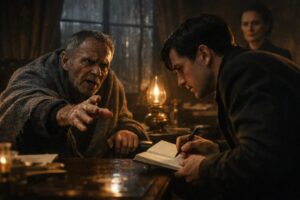
Elias set the latch aside. “Because after the siege there were too many graves and not enough names, and men were sleeping with rifles in their hands because if they put them down they heard voices. Because sometimes what keeps a fort standing is not truth first. Sometimes it’s sequence too.”
“Don’t quote him to me.”
“I’m not. I’m telling you why I failed.”
The yard noise seemed to recede.
He took the red-threaded cloth from his breast pocket and held it out. Up close, the fabric was stained, frayed, old beyond weather.
“He brought this from the breach,” Elias said. “There may be more.”
Mara took it. Her thumb brushed the red thread, rough as dried vein.
“Why didn’t you tell me the moment I walked in?”
“Because if there was nothing there except old debris and my own superstition, I would have dragged you back into your brother’s grave for nothing.”
She closed her hand around the cloth.
“And if there is something?”
Elias looked toward the eastern wall.
“Then Ash isn’t misbehaving,” he said. “He’s trying to finish a message.”
Part IV — The Eastern Battery
By late afternoon the mist had thickened again. The inspection delegation was due by dusk.
Mara got the tunnel key from the engineering office by invoking Thane’s authority and not waiting for permission to be confirmed. Elias met her at the eastern breach with a lantern, a pry bar, and the expression of a man who had already decided he would deserve whatever happened next.
The eastern wall was older than the rest of Ravaryn, black stone veined with damp, the old gun ports bricked up after the war. Below the collapsed battery, the labor crew had cut a fresh opening through mortar that was never meant to be disturbed. Timber braces stood inside like bad promises.
Ash was there.
He sat on a ledge above the breach, rain turning his feathers blue-black. In his beak hung another strip of cloth.
For a second Mara could not breathe.
The bird watched them with one dark eye, then dropped into the opening.
“Damn him,” Elias whispered, and there was almost affection in it.
They went in after him.
The corridor smelled of wet stone and packed earth. Water dripped in slow, hollow intervals. Mara kept one hand on the wall as the passage narrowed and turned. The lantern light shook over old artillery markings, faded numbers, rusted hooks where shells had once hung.
Then Ash appeared again ahead of them, hopping once along a fallen beam, waiting.
“He’s leading us,” Elias said.
“No,” Mara said automatically.
But the word had no confidence in it.
They reached the chamber beyond the first collapse just as a crack sounded somewhere overhead.
Elias swore. “Fast.”
The room had once been a signal post. She knew it before she fully saw it. The wall brackets. The split map board. The niche cut into the stone for field lamps.
And on the floor, half buried under rubble and silt, a tin dispatch canister with red thread still tied around its latch.
Jonas.
Mara dropped to her knees. The moment her fingers closed over the canister, the ceiling groaned.
“Captain—”
Stone came down in a spray behind them. Lantern light whipped. Dust filled her mouth. Elias threw himself sideways and yanked her against the wall as the corridor they had entered caved halfway shut.
For a few stunned seconds there was only coughing and the brutal fact of the blocked exit.
Mara pressed a sleeve over her nose.
“You all right?”
“Fine,” Elias said hoarsely. “You?”
She nodded and looked down.
Ash had flown to a broken beam near the ceiling. He was still holding the cloth strip.
Not panicked. Waiting.
Mara broke the canister seal with her thumb.
Inside was a packet of oilskin-wrapped notes, warped but legible in parts. A field map. A casualty list. A final transmission sheet in Jonas’s hand.
The sight of his writing hit harder than the collapse.
Not because it was beautiful. Jonas wrote like he fought—fast, slanted, practical, as if elegance were a form of delay.
She read the first clear line.
Battery will not hold beyond corridor clearance. Reclassification request false. Civilian convoy already gone. We are holding for report integrity, not tactical necessity. If this reaches command, do not let them call this chosen.
Mara stopped reading.
The whole chamber seemed to tilt.
Elias said nothing. He did not need to. The words did their own violence.
She read the line again. Then the last one, written harder, ink scarred into the paper.
If we disappear here, make it count as truth.
For years they had given Jonas a cleaner death. Noble delay. Necessary sacrifice. Heroic last stand.
He had seen the lie before he died and named it.
Mara shut her eyes once.
When she opened them, Ash dropped the cloth strip. It landed in the dust between her knees.
The red thread was the same.
Elias leaned against the wall, face gone gray in the lantern light.
“I found the report transfer order after the siege,” he said. “Not the message. Just the order. Reclassified. Sealed. I told myself if command had done it, maybe there was more context than I knew.”
“And was there?”
“No.” His voice broke on the word. “There was fear. There was survival. There was me not wanting to learn the exact shape of what we’d done.”
Mara folded the sheet with hands that did not feel like hers.
“He kept coming back,” she said.
“Yes.”
“All these years.”
Elias looked up at Ash. “Maybe for food. Maybe for the perch. Maybe because birds repeat what keeps them alive.”
“And maybe?”
“Maybe because some things don’t stay buried as cleanly as men do.”
They cleared the collapsed corridor with the pry bar, by leverage and rage and the willingness to bleed knuckles for a gap barely wide enough to crawl through. Mara kept the dispatch inside her coat. Elias carried the casualty slips and the map. When they finally dragged themselves into open air, the sky had darkened to evening slate.
The inspection convoy was already entering the outer gate.
Across the yard, soldiers were forming ranks.
And above the arch, on the iron perch where he had been missing all day, Ash had returned.
The whole garrison saw him at once. A visible exhale moved through the line like wind through wire.
Elias laughed once, a broken sound.
Mara looked at the raven, at the wet black shape against the stone, and understood the hardest part of it.
The fort had not been waiting for the bird because it loved absurdity.
It had been waiting for permission to keep believing something had stayed.
Part V — The Record
The inspection rite was scheduled for the moment the delegation crossed the inner yard.
Ravaryn loved procedure more when it was frightened.
Mara had just enough time to wash the dust from her face and not enough time to steady what was inside her. She entered the gate hall with the dispatch under her coat and found Colonel Thane already in formal position beside the registry stand.
On the smaller ceremonial perch at his side sat not Ash, but one of the reserve ravens from the mews, hooded, compliant, substitute-ready.
That told her more than any speech could have.
Thane saw the dirt on her sleeves, the torn cuff, Elias behind her carrying a packet wrapped in cloth.
His gaze hardened.
“You went into the breach.”
“Yes.”
“I gave no such order.”
“No,” Mara said. “You gave the ones that mattered years ago.”
The inspection delegation was approaching. Civil officers, two liaison commanders, one legal observer. Boots and polished brass and the kind of faces that preferred stable narratives.
Thane’s voice stayed level. “Whatever you think you found, this is not the moment.”
“This is the only moment.”
“If you expose an unverified wartime irregularity in front of them, you hand this fort to men who will carve it for symbolism before dawn.”
“And if I don’t, I become you.”
Something moved in his face then. Not anger. Worse. Recognition.
Behind them, soldiers were locking into formation. The gate hall amplified every small sound: buckle leather, rain tapping the arch, the scrape of the registry pen being laid ready.
Thane lowered his voice. “You think truth arrives clean. It doesn’t. It arrives with blast damage and bad timing. It kills the wrong people after the shooting ends.”
Mara almost said I know. She almost said Jonas knew too. Instead she drew the folded dispatch from inside her coat and set it on the registry stand between them.
“This reached command,” she said. “Or would have, if someone had not buried it.”
For the first time all day, Thane looked old.
Not weak. Not broken. Just old enough to show the cost of carrying one wrong decision until it calcified into doctrine.
“You do this here,” he said, “and the dead become argument.”
“They already are.”
The delegation entered.
The legal observer paused at the sight of the reserve bird. “Irregular substitution, Colonel?”
Thane opened his mouth.
Above them, from the actual gate perch, Ash gave a single rough call that cut straight through the hall.
Every head tilted up.
There he was. Wet, unhooded, watching.
Even the delegation seemed relieved without wanting to admit it.
Procedure moved. There was no stopping that now.
The formal clerk opened the registry ledger to the ceremonial page. The page was older than anyone present, lined with entries in iron-black ink. Attached ravens. Transfers. Deaths. Reassignments. Citations for disturbance. Notes of loss during bombardment. Institutional absurdity bound in leather and treated with reverence.
Colonel Thane was meant to read the formula.
“By standing custom,” the clerk began, “guardian soldier of the gate—”
“Request amendment,” Mara said.
The words were not loud. They did not need to be.
The whole hall went still.
The clerk looked horrified. Thane looked at her as if from a great distance.
“On what authority?” one of the liaison commanders asked.
Mara gave her rank, her investigative authority, and then—because anything less would have been cowardice—her name.
“Captain Mara Vale,” she said, “next of kin to Lieutenant Jonas Vale, eastern battery signals officer.”
A flicker went through the older faces present. The name still meant something here.
She placed the dispatch on the open ledger.
“Recovered from the reopened eastern battery breach at seventeen forty hours,” she said. “Field dispatch not entered into archival record. Supporting casualty slips and map confirmation attached.”
The legal observer stepped forward. Elias handed over the packet with hands that shook only once.
Colonel Thane said, very quietly, “Captain.”
It was a warning. A plea. An order too late to function.
Mara looked at the page. At the neat old entries where ravens had been punished for pecking buttons, biting visiting officials, abandoning inspection perches during storms. The tiny bureaucratic humiliations of an animal dragged into ceremony.
Then she looked up at Ash.
He was not tame. He was not obedient. He was old enough now that the feathers at his throat had dulled to charcoal.
The line came to her with the force of inevitability.
“Strike provisional disciplinary language,” she said. “Amend attached status of Ash, Raven First Class, to reflect return to station carrying unrecovered field dispatch related to eastern battery casualties.”
The clerk stared at her.
The legal observer said, “That is irregular.”
“Yes,” Mara said. “So was the burial of the record.”
No one moved.
Then Elias spoke, voice raw but clear. “I witnessed the recovery.”
The sound mattered. An NCO’s witness. Not eloquent. Binding.
Thane’s face had gone very still. He could stop this. He still outranked everyone in the room who mattered to the fort’s daily life.
He looked at the dispatch.
At the old bird.
At Mara.
And in the smallest motion imaginable, he moved his stiff hand away from the ledger.
It was not surrender. It was consent measured in grains.
The clerk dipped the pen.
Ink scratched.
Ash, Raven First Class — returned to assigned station bearing previously unrecovered field dispatch connected to eastern battery action. Disciplinary notation voided. Memorial function amended: witness to fallen.
There were no gasps. Ravaryn was too disciplined for that.
But something shifted. Not relief. Not absolution.
Space.
The legal observer began issuing procedural cautions. The liaison commander started asking about archival handling. The delegation did what institutions do when forced to absorb truth: they turned pain into process.
Mara barely heard them.
Colonel Thane was looking at the ledger as if it had become heavier under his eyes.
Finally he said, to no one and perhaps only to her, “That will stand now.”
It was the nearest thing to a confession he had left in him.
Ash ruffled once on the gate perch, then settled.
No salute. No bowing to ceremony.
Just a bird, choosing where to be.
Part VI — What Remains
The inspection did not fail.
It also did not pass clean.
By nightfall the delegation had filed provisional continuation orders, pending review of the newly recovered archival material. Ravaryn would remain in reduced operation through the season. After that, no one promised anything.
Soldiers called it a reprieve because soldiers will call any postponement a victory if they need to sleep.
Elias carried the dispatch to secured archive processing himself. Mara watched him go and knew that was his penance as much as his duty. He paused at the door and said, “Jonas would’ve hated the phrasing.”
She almost smiled.
“He hated all official phrasing.”
“Not all.” Elias looked back once. “He liked the word returned.”
When he was gone, the fortress became quieter in the way old places do after a public wound. Not peaceful. Just stripped of one layer of pretending.
Mara stood alone on the eastern wall at dusk.
The rain had stopped. Water still clung to the stone in black sheets. Beyond the parapet, the border valley lay under low cloud, roads hidden, guns silent for now. The fort behind her kept breathing through its pipes and lamps and watch rotations, stubborn as ever.
Jonas’s file would remain heroic. It would also now contain the line he wrote in the battery before he died. Not enough to repair him. Enough to stop the clean lie from owning him entirely.
That was all truth usually won in places like this. Not triumph. Permission.
A soft weight landed on the wall a few feet from her.
Ash.
Up close, he looked older than the day had allowed her to notice. One claw slightly turned. A pale nick through one wing feather. The throat feathers gone from lacquer-black to smoke.
He watched her. Not kindly. Not unkindly.
Just there.
“You caused a great deal of paperwork,” Mara said.
He clicked his beak once.
In the yard below, someone laughed—sharp, tired, alive. Somewhere else a door slammed. The fort had not changed. It had only been forced to admit one thing it had carried badly.
Mara rested her forearms on the wet stone.
For years she had thought the choice was between the lie and the wreckage. Between ceremony and honesty. Between love and accuracy.
It wasn’t.
The harder choice was to let the form remain and make it bear the weight it had once been designed to avoid.
She looked at the bird beside her.
Jonas had saved him under bombardment. Fed him. Taught him routes through smoke and ruined corridors. Then the fort had turned that accident into ritual because ritual was easier than grief with names attached.
And yet.
Not all of it had been false.
Men had touched the wall under Ash’s perch and felt less alone. That mattered too. Even damaged things can carry people. The cruelty begins when they are allowed to carry everything.
Below, the iron gate perch gleamed dark in the lamplight.
Ash looked at it, then back at her, as if the choice still belonged to him.
“Go on,” Mara said softly.
The raven launched into the damp air, circled once above the arch, and settled on the perch over the gate.
Not because the registry commanded it.
Not because the myth had won.
Because after all these years, this was still one of the places he knew.
Mara stood there until the last of the light went out of the valley.
Then she went back inside the fortress that had not told the truth in time, but had told it at last.