The Developer Called Her Marsh Worthless, Until the Ground Exposed What He Had Buried
Chapter 1: Forty Loads Where the Marsh Had Been
Rachel Hill heard the dump truck’s brakes before she saw the road.
The metallic shriek came through the kitchen window, followed by the low grind of gears and the heavy slap of a tailgate. Her coffee trembled in its cup. For one moment she stood motionless beside the sink, listening for the familiar morning sounds that should have followed—the bawling of Pamela White’s cattle beyond the south fence, the wingbeat of ducks lifting from the marsh, frogs working through the last mild days of October.
Instead, another truck reversed.
A warning alarm pulsed across the farm.
Rachel left the coffee untouched. She pulled on her field jacket, took the old soil auger from the mudroom, and drove the utility cart past the equipment shed toward the lower acreage.
The first thing she saw was the color.
Gray.
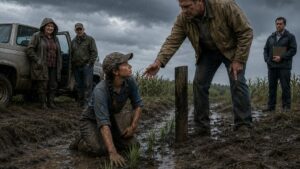
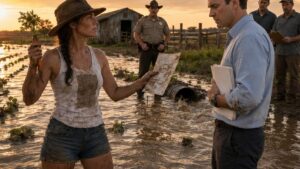
Not the silver-gray water that sometimes held the morning sky, but crushed stone and wet clay spread across the marsh in a broad, lifeless sheet. Cattails lay flattened beneath tire tracks. The shallow channel that curved toward the south pasture had disappeared under fresh fill. Pink survey flags stood in rows where sedges had grown two days earlier.
A dump truck raised its bed at the far end. Earth slid out in a rolling mass.
Rachel stopped the cart so abruptly the auger struck the floorboard.
Edward Nelson stood near a tracked excavator wearing khaki pants, a white pullover, and boots too clean for the ground beneath him. He was speaking to the operator when he noticed her. He lifted one hand, not in greeting but in the manner of a man asking traffic to wait.
Rachel crossed the fill slowly. Every step told her something. The surface had been compacted near the road but remained loose along the margin. One tire rut crossed the old fence line by nearly twelve feet.
“Shut it down,” she said.
The excavator operator looked toward Edward.
Edward removed his sunglasses. “Morning, Rachel.”
“Shut it down.”
“We’re within our parcel.”
“You’re not.”
Edward glanced at the row of pink flags. “Survey says otherwise.”
Rachel planted the auger beside her boot. Mud clung to the steel shaft from the last place she had tested near the channel. “Your flags are inside my recorded boundary.”
“We have county approval to begin site preparation.”
“For what?”
“Homes.”
The word landed strangely against the grinding machinery. Rachel looked across the filled basin and pictured roofs where water had spread each spring, driveways laid over the path muskrats used to reach the drainage ditch.
“You filled the marsh.”
Edward’s mouth tightened into a patient smile. “That swamp is worthless.”
The excavator operator lowered his eyes.
Edward gestured toward the flattened ground. “Mosquitoes, weeds, stagnant water. We’re putting in eight homes on lots people can afford. The county needs the tax base. Families need places to live.”
“Not here.”
“That remains to be determined.”
“It was determined years ago.”
He gave a short laugh. “Then you should have kept better paperwork.”
The words struck harder than the insult. Rachel looked at him, but he had already replaced his sunglasses.
She walked past him to the edge of the fill. The new material ended in a ragged slope above a strip of surviving ground. She knelt, pushed aside crushed stone, and set the auger point into the soil.
Edward followed. “You can take samples all morning. It won’t change the permit.”
“What permit?”
“The county authorized grading.”
“That is not a wetland permit.”
“It is the authorization my contractor was told to rely on.”
Rachel twisted the auger. The tool resisted through the fill, then slipped suddenly into softer earth. She turned it twice more and pulled.
A narrow core emerged. The upper inches were tan clay and aggregate. Beneath them lay dark organic material fading into gray soil marked with rusty orange streaks.
Hydric soil.
Still wet.
Water gathered in the spoon of the auger and fell beside Edward’s spotless boot.
He stepped back.
Rachel touched the gray layer with one finger. The marsh had been buried, not erased.
“How many loads?” she asked the driver nearest them.
The man looked at Edward.
“Don’t answer her,” Edward said.
Rachel stood. “I counted six trucks on the access road yesterday evening. I heard them after dark.”
“Construction schedules run late.”
“Before final review?”
Edward’s jaw shifted. “The review is administrative.”
A gust lifted one of the survey flags. Beneath the rattle of plastic, Rachel heard another truck approaching.
She took out her phone and photographed the soil core, the flags, the tire tracks, and the license plate on the departing dump truck. Edward watched her without speaking.
“You’re trespassing on an active site,” he said at last.
“I’m standing on Hill property.”
“That is disputed.”
“No. You need it to be disputed.”
His expression changed then—not much, but enough. The confidence remained, yet something beneath it had begun counting time.
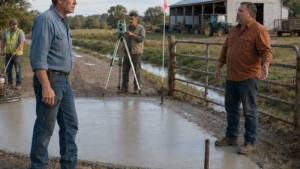
Rachel noticed fresh wooden forms near the upper edge of the site.
“You’re pouring concrete.”
“Footings.”
“On saturated ground.”
“The engineer approved the pad.”
“Did the engineer see what was under forty loads of fill?”
Edward stepped closer. “People like you believe every muddy ditch is sacred because it keeps anyone else from using land.”
“People like me?”
“People who already own more ground than they need.”
Rachel almost told him where the water went during spring storms, how the marsh slowed it before it reached Pamela’s pasture and the county road. She almost told him how many reports she had written, how often she had seen developers call a wetland useless until their basements filled.
Instead, she placed the soil core in a sample sleeve.
Correct evidence should have been enough. It always had been, at least in the field.
The utility cart’s engine sounded behind them. Linda Mitchell drove down from the farmhouse, one hand tight on the wheel. She parked beyond the fill and came toward Rachel without looking at Edward.
“What happened?” Linda asked.
“You tell me.”
Linda stopped.
Edward took a few steps away, giving them the courtesy of privacy while remaining close enough to hear.
Rachel held up the soil core. “He says the boundary is disputed.”
Linda folded her arms against the wind. “We talked about the lower acreage.”
“You talked to him?”
“He asked whether we would consider an offer.”
“We?”
“You don’t get to pretend I have no interest in this farm.”
“You authorized this?”
“No.” Linda looked toward the trucks. “I said I would discuss a sale. I didn’t say he could start.”
Edward spoke from behind them. “My understanding was that the family was open to resolving the line.”
Rachel turned. “A sale conversation is not permission to bury my marsh.”
“Our marsh,” Linda said quietly.
The correction cut cleanly.
Their mother’s final medical bills still sat in a folder in the farmhouse desk. Rachel knew the numbers. She had simply refused to place them beside the marsh in her mind, as though keeping the subjects separate changed what Linda had carried.
Edward stepped between them only with his voice. “Nobody is trying to steal anything. We’re proceeding under the county’s grading authorization. If the survey needs adjustment, we’ll adjust it.”
“Stop the work until it is reviewed,” Rachel said.
“I can’t do that.”
“You mean you won’t.”
“I have crews booked, materials scheduled, and buyers waiting. Every stopped day costs money.”
“That is your pressure, not my permission.”
For the first time, anger showed openly in his face. “You think I started this on a whim? My company has been building in this county for thirty years. My father kept half these contractors working through two recessions. I’m not shutting down because you found gray mud.”
Rachel looked from him to the foundation forms.
Then she raised her phone and called the county planning office. She reported active fill across a disputed boundary and requested an immediate site inspection. She gave the parcel numbers from memory.
Edward listened.
When she ended the call, he said, “You should know the county already reviewed our map.”
Rachel slid the phone into her pocket. “Then they can review it again.”
The first concrete truck appeared at the top of the farm road.
Its drum turned steadily as it descended toward the buried marsh.
Chapter 2: The Blue Line Under the Mud
The blue line was gone from the county’s online map.
Rachel enlarged the screen until the parcel boundaries blurred into square pixels. She reduced the image, changed layers, and reloaded the page. The marsh shading that had crossed the lower Hill acreage on her printed plat now stopped nearly sixty yards to the east, following the development boundary as neatly as if water had learned to obey a property transaction.
Behind her, sample sleeves covered the kitchen table.
Each held a section of gray soil labeled in Rachel’s narrow handwriting: date, time, depth, coordinates. Water had condensed inside two of the bags. Beside them lay photographs of dump trucks, survey stakes, tire paths, and the concrete forms Edward’s crew had filled before the county returned her call.
Linda entered carrying a box of old farm records.
“You’ve been up all night.”
“The map changed.”
Linda set down the box. “Maps get updated.”
“Wetlands do not move because someone uploads a new layer.”
“Maybe the old map was wrong.”
Rachel turned from the screen. “Do you remember the spring the county road washed out?”
“I remember Mother taking in three neighbors because their houses flooded.”
“This marsh held water for four days before it crossed the road. Pamela’s pasture would have been under another foot without it.”
Linda looked at the samples. “Then explain that to the county.”
“I will.”
“You could have explained it to me before yesterday.”
Rachel faced the screen again. “This is not about us.”
“That is exactly how you keep making it about us.”
Linda left the kitchen before Rachel answered.
By eight, Rachel was back at the marsh. Work had paused, but only because the county zoning administrator had ordered a twenty-four-hour hold while the boundary complaint was logged. The concrete footings remained. Pink flags moved in the wind around them.
Rachel photographed every truck track and measured from the surviving fence posts. Near the access road she found a scrap of delivery paper pressed into the mud. Most of the ink had run, but the date and truck number were legible.
The delivery was time-stamped two evenings before the county’s grading authorization.
She photographed it where it lay, then sealed it in a clear sleeve.
Pamela White watched from the adjoining pasture gate. Her cattle stood behind her in the trampled grass.
“You see trucks before Monday?” Rachel called.
Pamela glanced toward Edward’s site trailer. “I don’t keep watch on his road.”
“You heard them.”
“I hear trucks all harvest season.”
“They came past your lease entrance.”
Pamela’s hand tightened around the gate chain. “I need that access, Rachel. Edward owns the north lane now. If I get in the middle, he can make hauling feed miserable.”
“The blocked channel drains toward your pasture.”
“It hasn’t flooded.”
“Not yet.”
Pamela looked at the buried marsh, then away. “I’m sorry.”
Rachel understood the apology. It was not agreement. It was refusal dressed softly enough to preserve a relationship.
At the county offices, the lobby smelled of dust, copier heat, and wet coats. Scott Rivera met her at the records counter carrying a tablet and a paper file.
He had been twenty-four when Rachel trained him to distinguish iron concentrations from ordinary red clay. Now there was gray in his beard and a county badge clipped to his belt.
“You filed a federal notice too?” he asked.
“I filed a preliminary report with photographs. No jurisdictional request yet.”
“Good.”
Rachel studied him. “Why is that good?”
“Because if you make claims before we reconcile the county record, Nelson’s attorney will say you bypassed local review.”
“The trucks bypassed local review.”
“I know.”
“Do you?”
Scott lowered his voice. “I saw the delivery dates.”
That was the first small release of the day. Not victory, only confirmation that the evidence had entered someone else’s mind.
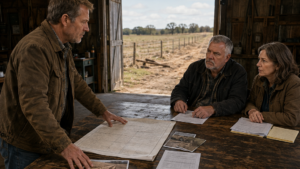
He led her to a side desk and opened the digital parcel file. Two maps appeared on the monitor. The current layer showed the wetland boundary bending around Edward’s planned lots. Rachel placed her retained plat beside it. Her version showed the blue hatching crossing three of them.
Scott leaned closer.
“You still make your sevens like that,” he said.
Rachel followed his finger to a handwritten field notation scanned into the county file. A hooked top line, a hard downward stroke.
Her notation.
“What is this?” she asked.
“An archived delineation draft from the old consulting company.”
“That company closed twelve years ago.”
“Records were transferred when the county digitized environmental files.”
Rachel scrolled through the scan. The title block carried the name of a subdivision proposed long before Edward purchased the neighboring parcel. The boundary line ended farther inside Hill land than the line on her retained final map.
At the bottom was her signature.
The room seemed to narrow around the monitor.
Scott watched her face. “Is it yours?”
Rachel did not answer immediately.
Eleven years in wetland delineation had taught her the cost of quick certainty. She had walked hundreds of fields with a soil book under one arm and a plant guide in the other. She had marked boundaries in August dust and February ice, explaining to landowners that a place did not need standing water to be a wetland.
She recognized the project number.
She recognized the date.
And she recognized the quiet dread that came with both.
“It is my handwriting,” she said.
“That is not what I asked.”
“It looks like a preliminary line.”
“Nelson submitted it with his grading package.”
“Why would he have it?”
“He says it came with the historical site records.”
Rachel stared at the signature.
Scott sat across from her. “The county cannot ignore a map signed by the person now contesting it.”
“It was not final.”
“Then show me the final field record.”
“I have the recorded plat.”
“You have a plat with broader hatching. You need the work papers that explain why the line changed.”
Rachel thought of the boxes in her attic, the old notebooks she had not opened since leaving the profession. She knew which project this was now. She also knew why the draft had survived in her memory when so many others had not.
“Give me a copy,” she said.
Scott printed the map.
As the paper emerged, the two blue boundaries lay visible at once: the one Rachel had preserved and the one carrying her own name.
“Rachel,” Scott said, “I’m not protecting Nelson. But I’m not protecting you either.”
“I didn’t ask you to.”
“No. You usually don’t ask anyone.”
She folded the copy before the last sheet finished printing.
At home, Linda’s car was in the drive. Rachel carried the samples through the mudroom and placed the new map beneath an old equipment invoice in the bottom drawer of the kitchen desk.
Linda appeared in the doorway. “What did the county say?”
“They confirmed the fill deliveries started early.”
“That helps.”
“Yes.”
“Anything else?”
Rachel closed the drawer. “They need more records.”
Linda looked at her for a moment longer than Rachel could comfortably meet.
That afternoon, Edward’s attorney emailed the county. Attached was the signed draft map. The message requested dismissal of Rachel’s boundary complaint and claimed she had personally established the line now being used for construction.
Scott forwarded the filing without comment.
Rachel opened it alone at the kitchen table, surrounded by gray soil cores that proved the ground was wet and a map that suggested she had once said otherwise.
Chapter 3: The Map With Her Own Name
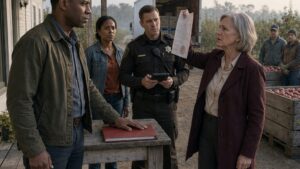
Edward unfolded Rachel’s map before the county zoning administrator finished introducing the site review.
He had mounted it on a clean foam board. Her signature appeared at the bottom in a white box, enlarged enough to be read from several yards away.
“This is not my interpretation,” he said. “It is hers.”
Rachel stood beside the filled marsh with the auger resting against her shoulder. Linda was ten feet behind her. Scott remained near the county vehicle, holding a field file against his coat.
Two neighboring farmers had come to watch. So had Pamela, though she stayed beside her truck. Edward’s excavator waited at the edge of the foundation pad, engine silent.
The zoning administrator adjusted her glasses. “Mr. Nelson, you will have time to present.”
“I’m presenting the basis on which my company relied.”
He turned the board slightly so everyone could see the boundary. The blue line curved away from the filled area, placing most of the planned lots outside the wetland.
Then he faced Rachel.
“Did you draw this?”
Wind snapped the pink flags between them.
Rachel could have said it was incomplete. She could have objected to the setting, the enlarged signature, or Edward’s choice to turn a technical review into a public accusation.
Instead she stepped closer to the board.
“Yes,” she said. “The line work is mine.”
Linda inhaled sharply behind her.
One of the farmers shifted his weight. Edward’s attorney, standing near the site trailer, lowered his pen to the notepad.
Edward gave the smallest nod, as though Rachel had finally agreed to the terms of her own defeat.
“And the signature?”
“Mine.”
The zoning administrator looked from the board to Rachel. “Then explain why your current complaint identifies a substantially different boundary.”
Rachel studied the map. The project number sat in the upper corner. The date was early June, seventeen years before. Leaf-out would have been complete. The surface-water indicators had been weak that season because of drought.
“It is a preliminary field draft,” she said.
Edward laughed once. “Convenient.”
Rachel ignored him. “The date is before the full soil transect was completed. The points on the south edge stop at station fourteen.”
Scott opened his file.
Rachel pointed to the map. “A final delineation for a site this size would include at least another six stations between the drainage swale and the farm boundary. They are not shown.”
“Were they performed?” the administrator asked.
“Yes.”
“Where is the record?”
“I do not yet have it.”
Edward spread his hands. “That is the problem. We have a signed map. She has a memory.”
“I have the soil.”
“You have mud from land disturbed by construction.”
Rachel lowered the auger from her shoulder.
Edward’s attorney stepped forward. “Any additional sampling should be conducted by an independent consultant.”
“It should,” Rachel said. “But first everyone here should see why the draft could not have been final.”
She walked past the map toward a place between the foundation pad and the old fence line. The fill had been compacted there by truck traffic. She set the auger tip beside a pink flag and pressed.
The first turn scraped against stone.
The second bit through clay.
On the fourth, the handle dropped several inches under her weight.
Edward crossed his arms. “This proves nothing about the historical condition.”
Rachel continued turning until she reached the depth marked on the old draft. Then she pulled the tool free.
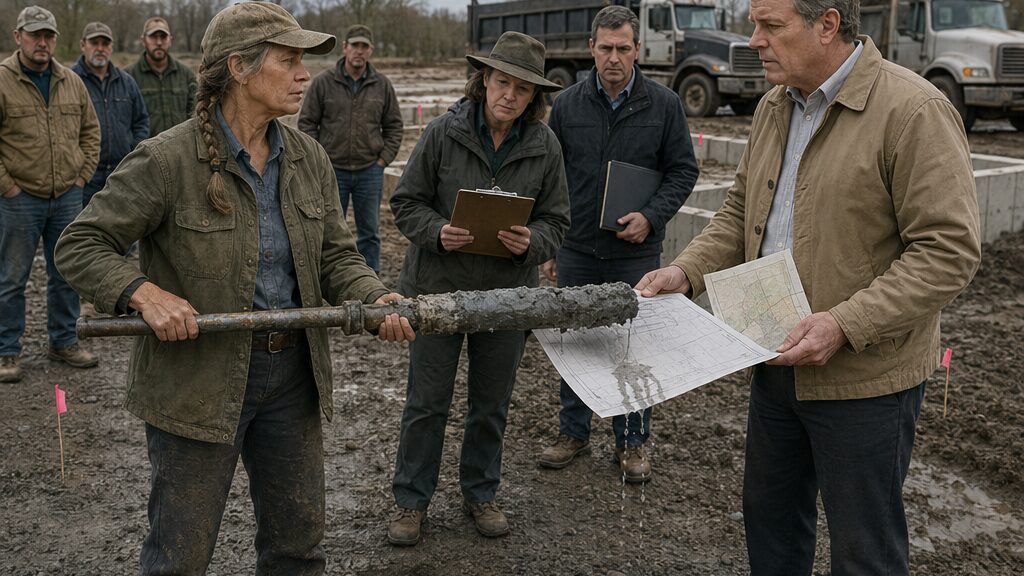
The core emerged in layers: crushed aggregate, brown fill, blackened organic soil, and beneath it a dense gray matrix streaked with orange.
Water gathered along the steel chamber.
Rachel carried it to the mounted map.
“This gray matrix forms under prolonged saturation,” she said. “The orange concentrations are iron moving through oxygen-poor soil. They do not form because a truck drove over the ground last week.”
Edward’s attorney said, “Again, she is interpreting her own sample.”
Rachel tipped the auger slightly.
Water slipped from the core and fell onto the lower corner of Edward’s mounted plan. It spread across the printed lot line and darkened the paper around Rachel’s enlarged signature.
Nobody spoke for several seconds.
The zoning administrator crouched beside the tool without touching it. “Depth?”
“Twenty-six inches from the current surface. Less before the fill.”
Scott stepped closer. “The draft notes indicate refusal at eighteen inches near station fourteen.”
Rachel looked at him. “Because station fourteen was placed on the slight rise. The missing transect continued west into the depression.”
The administrator stood. “Missing from where?”
“The copy you have.”
Edward’s expression hardened. “Or missing because it never existed.”
Rachel met his eyes. “You knew enough to find a seventeen-year-old draft. Did the file include the later field sheets?”
“I bought a property with a documented boundary.”
“That was not my question.”
“It is the only answer that matters.”
“No,” Rachel said. “The ground is the answer that matters.”
The words were quiet, but the silence around them gave the sentence weight.
Edward pointed toward the foundation forms. “This site was reviewed by an engineer. We have grading approval, utility coordination, and purchase deposits from families who cannot wait indefinitely while a former consultant disputes her own work.”
There it was—not only contempt, but urgency. Rachel saw the strain at the corners of his mouth, the faint tremor in the hand holding the map board. He had buyers. He had borrowed against their belief that houses would stand here.
The administrator asked, “When did you receive the historical map?”
“With the due-diligence archive.”
“Before or after the consultant’s field visit?”
Edward hesitated. “Before final site planning.”
Rachel noticed Scott write something down.
The attorney intervened. “My client relied on county records available to any purchaser.”
“And began filling before the grading authorization,” Rachel said.
Edward looked toward her. “Your family was discussing a sale.”
Linda stepped forward. “A conversation is not a conveyance.”
“You told me the lower ground had no agricultural value.”
“I said it couldn’t be planted.”
“You said Rachel would never agree because she was sentimental about water.”
Linda’s face changed.
Rachel felt the old instinct to close the scene, to cut away the personal facts and return everyone to measurable lines. But Edward had already made Linda’s private frustration part of the record.
The administrator raised one hand. “Enough. This review concerns jurisdiction, boundary history, and the scope of authorized work.”
She conferred with Scott beside the county vehicle. Edward spoke quietly with his attorney. The farmers drifted toward the exposed core, staring at it as though gray soil had become something unfamiliar.
Linda came beside Rachel.
“You signed it,” she said.
“It was a draft.”
“That is not what I asked you at the house.”
“I know.”
“You hid it.”
Rachel looked toward the water stain spreading across the mounted map. “Yes.”
Linda’s mouth tightened. “Why?”
“I need the final notes.”
“Why?”
Rachel could not answer without opening a door she had kept shut for seventeen years. Not here. Not yet.
The zoning administrator returned.
“Based on the conflicting documentation and field conditions observed today, the county is maintaining the stop order on fill placement,” she said.
Rachel heard Edward’s attorney exhale.
“However, the current grading authorization will remain valid for limited work on the previously poured upland footings and erosion controls. No additional expansion toward the disputed line is permitted pending records review and possible federal consultation.”
Edward nodded as though he had won.
In practical terms, he had been given room to continue.
The excavator operator restarted the engine.
Rachel looked at the exposed core. The soil had contradicted the map, but contradiction was not yet proof. Her expertise had opened the question while her own signature kept it from closing.
As the officials packed their files, Scott came to her.
“I checked the digital index,” he said quietly. “The field-log sequence jumps from page twelve to page seventeen.”
“Were the pages scanned badly?”
“They were never in the county packet.”
Rachel wiped the auger with a cloth. “The company archive may have retained them.”
“If it still exists.”
Edward’s workers began laying erosion fabric along the upper pad. The sound of the machine filled the space where the marsh water used to move.
At the farmhouse that evening, Linda placed an envelope on the kitchen table.
It bore Edward Nelson’s company name but no postage.
“He brought it to my office,” she said.
Inside was a purchase offer for Linda’s interest in the lower acreage. The amount was enough to clear the remaining farm debt and reimburse much of what she had paid during their mother’s illness.
A second document accompanied it.
Rachel read the first paragraph twice.
The agreement required both sisters to acknowledge that Rachel’s earlier delineation had established the lawful wetland boundary and that any current dispute resulted from her mistaken reinterpretation of historical conditions.
Edward was not only offering to buy the land.
He was asking Linda to sell him Rachel’s blame.
Chapter 4: What Rachel Left Out of the Report
Linda left Edward’s unsigned settlement in the center of the kitchen table as if it were something dead neither of them wanted to touch.
“You knew this could happen,” she said.
Rachel remained standing by the sink. The soil samples had been moved to the counter, but damp gray smears still marked the table where the bags had rested.
“I knew the draft existed.”
“That is not the same as telling me.”
“No.”
Linda tapped the second document. “He wants me to sign a statement saying you made a mistake. He wants our land, and he wants your name on the reason he deserves it.”
Rachel looked again at the offered amount. It would clear the operating loan, the remaining hospital bills, and the lien Linda had quietly covered with money from her own savings.
“You were considering the sale before this,” Rachel said.
“I was considering selling acreage that you kept calling unusable whenever the tax bill came.”
“It is unusable for crops.”
“But useful enough to fight over.”
“For water.”
Linda gave a brittle laugh. “You always say one word when there are ten underneath it.”
Rachel pulled out a chair but did not sit. “The marsh holds runoff. It protects the south pasture and the county road.”
“You could have explained that years ago.”
“You never asked.”
“I asked what we were going to do with the farm. That should have been enough.”
The accusation landed because it was true. Rachel had treated knowledge like property—something safest when kept under her own control. Linda had inherited half the consequences and almost none of the explanations.
Rachel opened the settlement again.
A clause near the end required them to release Edward’s company from claims related to grading, drainage, and historical wetland classifications. Another required Rachel to withdraw her complaints before payment.
Linda leaned over and pressed one finger to a paragraph Rachel had skimmed.
“Read that.”
The agreement stated that Rachel’s professional negligence had created uncertainty that Edward could not reasonably have anticipated.
“He planned to make you carry it,” Linda said. “Publicly.”
Rachel folded the papers. “Will you sign?”
Linda took the document from her, tore it once through the signature block, then again through the payment figure.
“No.”
The pieces fell between them.
It was not forgiveness. It was a line Linda had refused to cross.
They spent the morning in the attic.
Dust coated the rafters above boxes of farm ledgers, their mother’s canning jars, and Rachel’s field equipment from the consulting years. She found plant guides warped by humidity, old aerial photographs, and notebooks labeled by project number.
The notebook for Edward’s parcel was in a cracked plastic bin.
Pages one through twelve remained intact. Rachel’s younger handwriting ran across them in compressed lines: vegetation percentages, slope changes, soil colors, water marks on willow trunks. At station fourteen she had noted dry surface conditions over a depleted gray matrix.
Then the binding jumped to page seventeen.
The missing pages had been cut close to the spine.
Linda stood over her shoulder. “Did you remove them?”
“No.”
“You are sure?”
Rachel looked at the clean edges. “I would remember doing this.”
“That is not what I asked.”
Rachel closed the notebook.
Seventeen years earlier, her supervisor had sat across from her in a temporary office and moved the draft boundary with a red pencil. The client wanted three additional lots. The drought year made the wetland indicators easier to argue around. Rachel had objected, then accepted a second field visit scheduled after the shallow pools had dried.
She had told herself the final soil transect would correct the map.
It had.
But when the supervisor narrowed the conclusion again, Rachel had signed the cover letter and let the report leave.
Not the draft Edward now carried. A later report. A compromise dressed in technical caution.
“I let a boundary stand that should have been wider,” she said.
Linda lowered herself onto an old trunk. “Here?”
“On the earlier project west of this parcel. The drainage system connects.”
“Did houses flood?”
“Not immediately.”
“That was not my question.”
Rachel rubbed dust from the notebook cover. “A road flooded six years later. Two crawl spaces took water. I cannot prove my report caused it.”
“But you think it helped.”
“Yes.”
Linda looked toward the attic window, where the buried marsh was only a strip of gray beyond the barn roof.
“And you never told anyone.”
“No.”
A hard knocking came from downstairs.
Pamela stood at the back door with mud to her knees.
“The south pasture is taking water,” she said. “Not rainwater. It is coming through the fence line.”
They drove down in Linda’s car. The channel Edward had filled no longer carried runoff east across the marsh. Water had backed along the old contour, crossed beneath a sagging fence, and spread into Pamela’s grazing field. Two cattle stood crowded on the highest patch near the gate.
Pamela waded ahead of them, using a shovel as a staff.
“I moved the calves,” she said. “If it rises another six inches, I lose the hay stacked in the lower shed.”
Rachel crouched where the water entered. Beneath the surface, she felt the edge of compacted fill blocking the outlet.
“You saw the trucks,” Rachel said.
Pamela stared across the flooded grass. “Yes.”
“How many nights?”
“Three. Maybe four.”
“Will you put that in writing?”
Pamela’s face tightened. “Edward can close the north lane.”
“He can also drown this pasture.”
“I know that now.”
The answer was not a promise, but it was no longer a refusal.
Back at the farmhouse, Rachel spread old soil-core photographs beside the fresh samples. The same gray layers appeared in both, marked with the same orange staining. The ground had remembered what the files omitted.
Scott called near dusk.
“I found a transfer index from your old company,” he said. “Most project archives went to a storage contractor when the firm dissolved.”
“Does the archive still exist?”
“For another forty-eight hours.”
Rachel stood. “Why forty-eight?”
“The warehouse has been sold. Unclaimed boxes are scheduled for disposal Friday.”
“Can we access them?”
“Not without county authorization or the former receiver’s release.”
“Get one.”
“That may take longer than we have.”
“Then tell me where it is.”
Scott was silent.
“You are not entering a private warehouse without permission,” he said.
“I did not say I was.”
“You did not have to.”
Linda took the phone gently from Rachel’s hand.
“What can I do?” she asked Scott.
Rachel watched her sister listen, take down an address, and ask for the name of the records custodian.
When the call ended, Linda placed the missing-page notebook beside Edward’s torn settlement.
“We go through the front door,” she said.
“And if the front door is too slow?”
Linda met her eyes. “Then, for once, you tell them why it matters before you decide nobody will listen.”
Chapter 5: The Pages No One Filed
Rachel found her own handwriting inside a box labeled OFFICE SUPPLIES.
The warehouse clerk had given them one hour.
Rows of shelving rose beneath buzzing fluorescent lights, holding the remains of companies that no longer existed. Scott had secured a temporary county records review by arguing that the boxes might contain documents incorporated into a public land-use decision. The clerk remained nearby, watching them with the suspicion of someone who expected every old paper to become a lawsuit.
Linda opened cartons while Scott checked inventory codes.
Rachel nearly passed over the supply box. It contained staplers, dried markers, and survey flagging faded to pale pink. Beneath them lay a thin field folder with the project number written in her hand.
Pages thirteen through sixteen were clipped inside.
For several seconds she could not lift them.
Scott came beside her. “Are they complete?”
Rachel read the first line.
Station fifteen: depleted matrix beginning at fourteen inches. Oxidized root channels common. Saturation observed below surface.
Station sixteen extended farther west. Station seventeen recorded surface water in a shallow depression. The final sketch placed the wetland boundary across three of Edward’s planned lots.
At the bottom of page sixteen, Rachel had written a warning in block letters:
UNSUITABLE FOR STRUCTURAL FILL WITHOUT HYDROLOGIC REVIEW.
Linda read it over her shoulder. “He had this?”
“We do not know.”
Scott removed a second folder from the box. Inside was correspondence from the dissolved consulting company. One document recorded the transfer of historical site materials to Edward’s due-diligence consultant six months earlier.
Another was dated two weeks before the first dump trucks arrived.
The consultant’s letter warned that previous mapping was inconsistent and recommended a new wetland delineation before grading. It specifically referenced saturated soils and a likely westward extension of the jurisdictional boundary.
Edward had signed the receipt.
Scott sat back on his heels. “He was warned.”
Rachel should have felt vindicated. Instead she saw her original notes beneath the consultant’s letter and remembered the years when she had known enough to object but not enough to risk her position.
“Copy everything,” she said.
At the county office, the records occupied a long conference table. The zoning administrator compared the page numbers, paper stock, field coordinates, and ink sequence. Scott verified that the missing sheets matched the scanned notebook’s binding marks.
Edward arrived with his attorney before noon.
He looked tired. Mud stained the cuffs of his khakis, and the white pullover had been replaced by a dark work jacket.
“These records are seventeen years old,” his attorney said. “They do not supersede an issued grading authorization.”
“They establish that the map submitted with your client’s application was incomplete,” the administrator replied.
“The county accepted it.”
“The county did not receive these pages.”
Edward looked at Rachel. “Neither did I.”
Scott slid the consultant’s warning across the table.
Edward did not pick it up.
His attorney read it first. “This recommends further study. It does not determine jurisdiction.”
“It told you not to proceed,” Rachel said.
“It told me another consultant wanted another fee.”
“You signed the receipt.”
“I receive dozens of cautions on every project. Geotechnical, traffic, drainage, utilities. If construction stopped every time someone wrote the word possible, nothing would be built.”
“You began filling before the county authorization.”
“My father’s company had crews scheduled and a loan clock running. I had buyers who had already sold their homes. I believed the historical boundary.”
“You believed the page that let you build.”
His eyes hardened. “And you believed the wider one after your sister discussed selling to me.”
Linda shifted in her chair, but Rachel answered first.
“I believed the soil when I recorded it seventeen years ago.”
“Then why was your signed map narrower?”
The room went still.
Rachel could have explained the difference between a field draft and a final determination. She could have pointed again to the missing pages and Edward’s warning.
Instead, the older truth pressed against her silence.
“Not here,” she said.
Edward gave a humorless smile. “Exactly.”
The zoning administrator suspended all new concrete work and expansion toward the disputed area. Existing erosion controls and safety work could continue. Federal consultation would begin immediately.
It was a meaningful stop, but not a decision. Edward’s attorney made that clear before leaving.
“You have conflicting historical documents, an altered site, and a complainant with undisclosed involvement in the original process. This is not resolved.”
Outside, Linda caught Rachel by the sleeve.
“You almost told them.”
“I will.”
“When?”
“When I can explain it properly.”
“That is what you said about the marsh.”
Rachel pulled free. “A confession is not useful if it destroys the evidence.”
Linda stared at her. “You still think those are separate things.”
Rain began that evening and continued through the night.
By morning, a county vehicle blocked the development entrance. Rachel parked beside it and walked toward the foundation pad with Scott.
The first crack began near a corner footing. It ran across the concrete in a dark, uneven line, widened at the center, then continued toward a pink survey flag at the marsh edge.
Water stood in the crack.
Edward was already there. He crouched with one hand against the foundation, watching the level vial on a contractor’s tool.
“The pad settled,” Scott said.
Edward stood. “A surface crack.”
Rachel knelt and pressed two fingers to the concrete. One side sat slightly lower than the other.
“Differential settlement,” she said.
“The engineer will assess it.”
A second hairline fracture branched toward the forms.
Edward looked at the filled basin. For the first time, he did not call it worthless.
The physical proof did not settle jurisdiction. It did something more immediate: it made delay expensive.
Prospective homebuyers arrived before noon, a couple carrying a folder of floor plans. Edward intercepted them near the road. Rachel could not hear the full conversation, only the woman asking why work had stopped and whether their deposit was safe.
Edward’s shoulders lowered.
He had created the harm, but he was no longer the only person standing beneath it.
Scott’s phone rang. He listened, then handed it to Rachel.
The federal wetland inspector spoke without introduction.
“I have reviewed the county submission and the historical field materials. I am scheduling an on-site jurisdictional hearing.”
“When?”
“Next Thursday.”
Rachel looked at the cracked foundation, the water gathering beneath the pink flags, and Edward trying to reassure two people who had trusted him with their future home.
“There is something else you need to know,” Rachel said.
“Submit it before the hearing.”
“It is about the earlier report.”
“Then put it in writing.”
The call ended.
Rachel held the phone a moment longer.
Evidence had brought the inspector. Evidence could prove the buried marsh. But if she let the hearing proceed without the reason her own map had changed, Edward would use her silence as he had used the draft.
She handed the phone back to Scott.
“I need to amend my statement.”
“With what?”
“The part I left out.”
Chapter 6: When the Buried Water Returned
Water surfaced through the foundation crack before the federal inspector arrived.
It appeared first as a dark shine, then as a thin pulse that carried gray sediment onto the concrete. Rain had fallen for two days, not hard enough to flood undisturbed ground, but steadily enough to find every buried path beneath Edward’s fill.
Rachel placed the first pink flag beside the seep.
She had set six others along the line recorded in her recovered field notes. At each one, a fresh soil core rested in a labeled tray: gray matrix, orange concentrations, dark organic bands. The arrangement looked less like evidence than a cross-section of memory brought into daylight.
Edward watched from beneath the awning of the site trailer.
His attorney stood beside him. The two prospective buyers had returned, this time with a bank representative. Linda and Pamela waited near the old fence. Scott carried the complete county file.
The federal inspector walked directly to the crack.
“Was this pumped or excavated?” she asked.
“No,” Rachel said.
The inspector crouched and touched the sediment. “Where is the historic channel?”
Rachel pointed across the filled basin. “It entered near the willow stump, curved beneath this footing, and discharged toward Pamela White’s pasture.”
Pamela spoke from behind them. “Until they blocked it.”
The inspector looked at her. “You observed the filling?”
Pamela swallowed. “Three nights before the county approval. Trucks used the north lane. I did not report it.”
“Why?”
“I lease access from Mr. Nelson.”
Edward turned toward her. “I never threatened your access.”
“No,” Pamela said. “You did not have to.”
The inspector walked the flagged line. At the fourth marker, water had risen around the base of the plastic stem. At the fifth, the ground gave slightly under her boot despite the compacted fill.
Edward’s attorney began with the familiar argument: historical inconsistency, county reliance, altered conditions, disputed professional records. He spoke carefully, without exaggeration. Full removal, he said, would threaten the company, the buyers’ deposits, and several local contractors.
The inspector listened, then faced Rachel.
“You prepared the preliminary map submitted with the grading file?”
“Yes.”
“And the later field sheets?”
“Yes.”
“Explain the discrepancy.”
This was the point Rachel had avoided for seventeen years.
Rain ticked against the trailer roof. Beyond the foundation, Linda stood with her arms folded, waiting without rescue in her face.
Rachel opened her amended statement but did not read from it.
“The first map was drawn during a drought year before the western transect was complete,” she said. “The later fieldwork showed hydric soils and saturation farther west. My field notes supported the broader line.”
“Why was the narrower line retained in the consulting archive?”
“My supervisor wanted additional developable acreage for the client. He argued the indicators were marginal.”
“Did you agree?”
“No.”
“Did you sign the final report?”
Rachel felt every person at the site become still.
“Yes.”
Edward’s attorney looked toward the inspector.
Rachel continued before he could speak.
“I wrote objections into the field notes. I argued inside the office. Then I signed a cover letter attached to a conclusion narrower than the evidence supported.”
The inspector’s expression did not change. “Why?”
“I was afraid of losing my job. I told myself the language was cautious, not false. I told myself another agency would review it. When the project stalled, I let the matter disappear.”
Edward stepped from beneath the awning. “And now she wants to use her own misconduct to shut down my project.”
Rachel turned toward him. “My silence does not make your warning disappear.”
“It makes your certainty convenient.”
“Yes,” she said. “It does.”
The answer unsettled him more than denial would have.
Rachel pointed to the flagged cores. “That is why I am not asking anyone to accept my certainty. Compare the field descriptions. Test the soils independently. Trace the water. Review the consultant’s letter you received before filling.”
The inspector asked Scott for the records. He handed over the recovered pages, the delivery timestamps, and the signed warning receipt.
As she reviewed them, water continued to seep through the foundation crack.
The bank representative drew Edward aside. Their conversation remained low until one phrase carried through the rain.
“Environmental exposure changes the loan.”
Edward’s face drained.
The prospective buyers stood close together. The woman held the folder of floor plans against her chest.
“What happens to us?” she asked.
No one answered at once.
The inspector closed the file.
“My preliminary finding is that the filled area includes wetlands connected through surface and subsurface hydrology to regulated waters. The discharge occurred without the required authorization.”
Edward’s attorney said, “We request an after-the-fact permit and mitigation review.”
“That remains possible in limited circumstances,” the inspector said. “But structural fill over active wetland hydrology, combined with prior warning and work before local authorization, weighs heavily against retention.”
“How much removal?” Edward asked.
“Potentially all fill within the jurisdictional boundary.”
The buyer’s folder slipped slightly in her hands.
Edward stared at the foundation. “That ends the company.”
Rachel had imagined hearing those words and feeling satisfaction. Instead she saw the contractors’ trucks parked along the road, the buyers who had already sold their home, and Linda’s torn settlement still lying on the farmhouse table.
Justice could become another machine if nobody chose where it stopped.
“The wettest three lots cannot remain,” Rachel said.
Edward looked at her. “You do not decide that.”
“No. The ground already did.”
She walked to the large site plan weighted beneath the awning.
“The western upland is stable,” she said, indicating the higher portion of Edward’s parcel. “Two smaller lots could be relocated there if the county approves a revised layout. Remove the fill in phases, reopen the channel first, then restore the basin before spring runoff.”
The inspector studied the plan. “Who prepared this alternative?”
“I sketched it from the topographic survey.”
Edward gave a disbelieving laugh. “You are redesigning my development now?”
“I am showing you a way not to lose everything.”
“After filing federal complaints against me.”
“After you buried my land.”
The anger between them remained. It had not become respect, and it did not need to.
Rachel pointed to Pamela’s pasture. “The channel must be opened immediately. The remaining removal can be sequenced so sediment does not wash downstream. The upland redesign gives the buyers two viable sites, though not the houses they were promised.”
The bank representative asked for time to review the option.
Edward’s attorney requested a private conference. The inspector refused to delay the preliminary order but allowed one hour for the parties to discuss a restoration agreement.
Edward walked to the edge of the foundation alone.
Rachel followed only far enough to be heard.
“My father built houses through three downturns,” he said. “He died believing I would keep the company intact.”
“You cannot keep a company intact by pretending the ground is different.”
“You think admitting your mistake makes you better than me?”
“No.”
That answer stopped him.
Rachel looked at the water rising through the crack.
“It only means I am done asking someone else to carry it.”
Edward’s shoulders sagged. For a moment he looked less like a developer than a son standing inside a promise that had become too expensive to keep.
“If I sign,” he said, “I lose three lots, the foundation, and half the margin.”
“If you do not, federal enforcement can stop the entire project while penalties accumulate.”
“You have thought through every angle.”
“No. I failed to think through one angle seventeen years ago. That is why we are standing here.”
The inspector returned with two documents: an immediate stabilization directive and a proposed phased restoration order. Edward’s attorney read both. The bank representative confirmed that financing might continue only if the jurisdictional exposure was resolved and construction moved to verified upland.
The prospective buyers asked whether they could withdraw. Edward said their deposits would be returned, though the words seemed to cost him physically.
The inspector placed the restoration order on the hood of the county vehicle.
“Mr. Nelson, you may sign the negotiated order today, subject to final agency approval. Otherwise, I will refer the unauthorized discharge for immediate enforcement.”
Rainwater gathered along the edge of the paper.
Edward took the pen but did not lower it.
Behind him, the pink flags stood in shallow water along the line Rachel had drawn years before and failed to defend.
Now the line waited for his name.
Chapter 7: The Land They Could Not Make Dry
The excavators returned six months later, moving in the opposite direction.
Instead of pushing fill across the marsh, they lifted it out one bucket at a time.
Rachel stood beside the old fence line while the first load of gray clay and crushed stone dropped into a waiting truck. The sound was nearly identical to the morning she had discovered the marsh buried—diesel engines, steel tailgates, reversing alarms—but every machine now followed a restoration plan clipped inside the contractor’s cab.
Pink flags marked the removal limits.
Blue stakes identified the channel that had to be reopened first.
Edward had signed the negotiated restoration order after forty-three minutes beneath the site trailer awning. His lender had then refused to finance any construction within the disputed wetland boundary, leaving him with a choice between the upland redesign and the collapse of the entire project.
He had chosen the redesign.
The decision did not save everything.
The cracked foundation was demolished. Three lots disappeared from the plan. One pair of buyers withdrew and received their deposit only after Edward sold a company-owned equipment trailer. Several contractors waited months for payment. Federal penalties were reduced because he accepted responsibility and began restoration promptly, but they were not erased.
Edward’s company survived smaller than before.
So did the marsh.
The restoration contractor approached Rachel carrying a rolled plan.
“We found another layer of fabric beneath the north edge,” he said. “If we pull it today, the slope may slump before we stabilize it.”
Rachel looked toward the county inspector, then at the line of exposed soil. Dark organic material had appeared below the fill, compressed but intact.
“Leave the fabric until the coir logs are set,” she said. “Open another ten feet of channel first. Let the water spread before you take away the support.”
The contractor nodded and relayed the change.
Six months earlier, Rachel would have made the decision alone and expected everyone else to trust the precision of it. Now the inspector initialed the revision, Pamela confirmed where water had historically crossed into her pasture, and the contractor recorded the sequence.
Shared knowledge felt slower.
It was also harder to bury.
Edward arrived in an older pickup without his company logo. He parked near the road and watched workers break apart the last section of foundation.
“You are early,” Rachel said.
“I have a county meeting at ten.”
“So do I.”
He kept his hands in his jacket pockets. “The bank wants the revised upland plats recorded before releasing the next draw.”
“The soil report cleared them.”
“I know.”
His voice carried no challenge. It was not friendly either. Their relationship had settled into something more useful than either.
The excavator lifted a slab of cracked concrete. Water poured from the depression beneath it.
Edward watched the stream follow the reopened channel.
“My engineer says the foundation failure could have been corrected with piers,” he said.
“Possibly.”
“You still think it should never have been there.”
“Yes.”
He nodded once. “I thought you would enjoy being right more.”
Rachel looked at the workers separating concrete from soil.
“I have been right before,” she said. “It did not always help.”
Edward did not ask what she meant. He knew enough now.
At the county meeting, Linda waited beside a stack of documents.
She had worn the same dark coat she used for court appointments and hospital meetings. Rachel recognized it as armor.
The conservation agreement lay open on the table between them. It would place the restored marsh and its drainage corridor under permanent protection while leaving the higher farm acreage available for agriculture. Linda would remain a co-owner. Neither sister could alter the agreement without public review.
The county clerk pointed to the signature lines.
“Once recorded, this limits future development rights,” she said. “It may reduce the private sale value of the lower acreage.”
Linda glanced at Rachel. “I understand.”
“You may wish to consult separate counsel.”
“I already did.”
Rachel had not known that.
Linda picked up the pen.
For a moment, she held it above the page where the legal description curved around the marsh. Rachel remembered Edward’s purchase offer and the amount large enough to wipe away every farm debt. She remembered how easy it had been to call the lower land unusable when Linda asked what it contributed.
Linda signed.
The sound of the pen against paper was quieter than a dump truck, but it changed the land more permanently.
Rachel signed beside her.
Outside the meeting room, Linda handed her a copy.
“I am not doing this because the marsh matters more than the bills,” she said.
“I know.”
“I am doing it because we finally know what it does.”
Rachel folded the agreement carefully. “I should have told you.”
“Yes.”
There was no quick pardon in Linda’s voice.
Rachel accepted that too.
They drove back to the farm separately.
By afternoon, the restoration crew had reached the old channel. The excavator operator worked slowly, guided by elevation rods and Rachel’s recovered field notes. Each pass removed more compacted fill until a narrow depression appeared in the ground.
At first nothing happened.
Then water moved.
It did not rush or surge. A shallow sheet slipped from beneath the remaining fill, curved around the exposed organic soil, and entered the channel as though following a path it had memorized.
Pamela stood at the fence with her boots in the mud.
“That is where it used to run,” she said.
Rachel nodded.
Pamela had begun keeping a drainage log for the restoration monitoring team. She recorded rainfall, pasture water depth, and the time it took the channel to fall after storms. Her first entries were hesitant. By spring, they were as regular as Rachel’s old field notes.
Two young county technicians arrived carrying sample trays. Scott sent them to observe the soil profile before restoration grading covered it.
Rachel knelt beside the open face of earth.
“This color is not ordinary gray clay,” she told them. “Look for the depleted matrix and the concentrations around the root channels.”
One technician held up a small soil core.
Orange flecks marked the gray surface.
“What does it prove?” the technician asked.
“By itself, not enough,” Rachel said. “Never let one indicator carry the whole conclusion. Match it with hydrology, vegetation, landscape position, and the record of what the site does over time.”
Scott stood several feet away, listening.
Rachel handed the core back rather than keeping it.
The lesson continued until the restoration contractor called for the area to be covered. The young technicians labeled their samples and placed them in the county case.
Nothing remained solely in Rachel’s possession.
Near sunset, the crew removed the final pink construction flag. It stood at the western edge where Edward’s old plan had shown the corner of a house.
Rachel pulled it from the softened ground.
The plastic ribbon had faded almost white. For months the flags had meant possession, pressure, and lines drawn for profit. During restoration they had marked limits, channels, and places where machinery had to stop.
She carried the flag to the fence post.
Beside it waited a permanent restoration marker supplied by the county—plain aluminum, stamped with a site number and monitoring date. No grand language. No declaration of victory.
Rachel drove it into the soil with a small mallet.
Edward watched from his truck near the road. When she finished, he raised one hand through the open window.
Rachel returned the gesture.
The marsh was not healed.
Cattails had been planted, but many would fail before the next season. The exposed soil remained scarred by tire pressure. Pamela’s lower pasture still carried a band of dead grass from the flooding. Linda still checked every farm expense twice, and some conversations between the sisters ended before either found the right words.
There were no frogs that evening.
Rachel walked the reopened channel alone, stopping where the shallow water widened over the gray soil. The surface held pieces of grass, a willow leaf, and the reflection of the first clear sky they had seen in days.
She crouched and pressed two fingers into the bank.
The soil yielded, wet and cool.
For years, Rachel had believed that truth remained true whether anyone spoke it or not. The marsh had proved that much. Buried beneath truckloads of fill, altered maps, and concrete, the water had continued moving along its old path.
But truth left undefended could still be built over.
She stood and looked back toward the farmhouse. Linda was on the porch with the recorded conservation agreement tucked beneath one arm. Pamela closed the pasture gate. The young technicians loaded their labeled samples into a county vehicle.
No one applauded.
No one needed to.
Water remained in the channel where the maps said it would.
The story has ended.