While He Served Overseas, They Moved His Farm Boundary—But the Orange Stakes Remembered Everything
Chapter 1: The Excavator Was Already Inside His Orchard
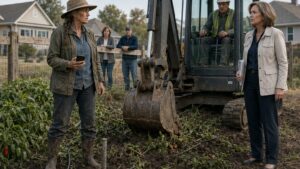
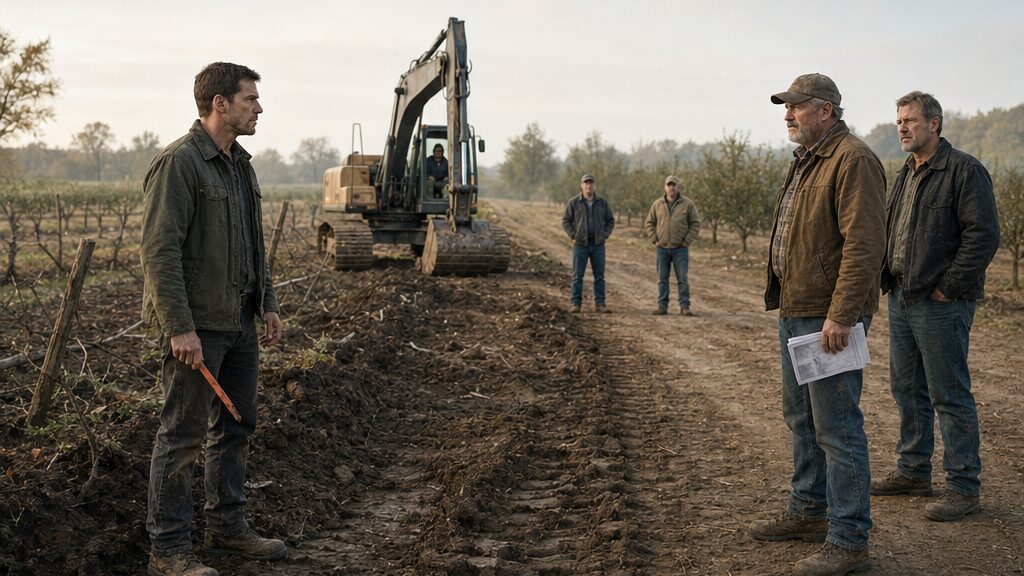
The excavator was parked where Anthony Carter’s first row of apple trees had stood.
Its bucket rested in the dirt like a closed fist. Mud filled the grooves of its tracks, and splintered fence boards lay pressed beneath one tread. Beyond it, a new lane cut across the lower edge of the orchard, broad enough for a tanker truck and pale with freshly exposed soil.
Anthony stopped beside his pickup and left the driver’s door open.
He had been home from deployment for less than twelve hours.
The orchard had been the first thing he wanted to see in daylight.
Now he could not make himself step farther.
Elizabeth stood near the farmhouse porch, both hands wrapped around a coffee mug she was no longer drinking from. She had warned him during the drive from the airport that the damage looked worse in person. He had assumed she meant the fence.
He counted the empty spaces automatically.
Eleven young trees gone.
The irrigation line severed.
Two hundred feet of woven-wire fence removed.
Every orange survey stake along the southern boundary missing.
A man in a canvas vest stood beside the widened lane with a clipboard tucked under one arm. Dennis Wilson watched Anthony cross the field, his expression careful but not apologetic.
Two neighboring farmers waited near a utility truck. Eric Mitchell was one of them. He gave Anthony a small nod, then looked down at his boots.
Dennis spoke first.
“Glad you made it back safe.”
Anthony stopped several yards away. “Where are my trees?”
Dennis glanced toward the open lane as though the answer were obvious.
“They were inside the access corridor.”
“There wasn’t an access corridor there.”
“There is now.”
The words settled between them.
Anthony looked beyond Dennis toward the broken ground. The lane followed the shape of his property for sixty yards, then bent around a drainage swale before reconnecting with the cooperative road. Tire marks showed that several heavy vehicles had already used it.
“When did you do this?”
“Two weeks ago.”
“Who authorized it?”
“The cooperative board.”
Anthony turned his eyes toward Eric. Eric’s jaw tightened.
Dennis continued before anyone else could speak. “We sent notices. More than one. You weren’t available, and the fire-access problem couldn’t keep waiting.”
“My wife was here.”
“Your wife doesn’t sit on the access committee.”
Elizabeth came off the porch.
“She told you not to touch the fence.”
Dennis shifted his clipboard. “She was informed that the cooperative had an easement.”
Anthony heard the old tone beneath the words: not anger, not quite. The tone of a man explaining a rule to someone he believed had failed to understand his place.
He walked toward the lane.
Dennis stepped sideways and blocked him.
“You need to leave the disturbed area alone until the county finishes reviewing it.”
Anthony stared at him.
“This is my orchard.”
“The access strip is under cooperative control now.”
One of the farmers behind Eric muttered that the lane had been too narrow for years. The other said nothing, but his folded arms made his position clear.
Anthony felt heat gather behind his ribs. On deployment, anger had been useful only when it could be directed into a task. Here it had nowhere to go except into Dennis’s face.
He breathed once through his nose.
Then he saw the orange.
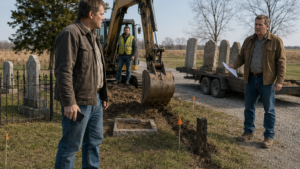
A broken survey stake protruded from beneath the excavator’s left track. Only four inches remained above the dirt.
Anthony stepped around Dennis.
“I told you not to disturb anything,” Dennis said.
Anthony kept walking.
The excavator operator, standing near the utility truck, shifted uneasily. Anthony crouched beside the tread and brushed away the loose soil with two fingers. The stake had snapped low, but a strip of fluorescent orange plastic still clung to the upper section.
He dug around it carefully until a small metal cap appeared beside the broken wood.
Rebecca Hill’s registration number was stamped into the surface.
Anthony lifted his head.
“Who pulled this?”
No one answered.
He freed the cap from the dirt and held it between his thumb and forefinger.
“This isn’t a garden marker,” he said. “It’s a recorded survey monument.”
Dennis gave a short breath that might have been a laugh.
“It marked the old line.”
“It marks the legal line.”
“The cooperative boundary supersedes it.”
Anthony stood slowly.
“A board vote doesn’t move a recorded boundary.”
“It does when there’s an easement.”
“Then you work inside the easement. You don’t remove monuments and invent a wider one.”
Dennis’s mouth tightened. “You weren’t here for the meetings, Anthony. We spent months trying to get that lane brought up to emergency standard.”
“And that gave you the right to bulldoze my orchard?”
“It gave us the responsibility to act before somebody died because a tanker couldn’t get through.”
That silenced the field for half a second.
Eric looked toward the road.
Anthony noticed it. So did Elizabeth.
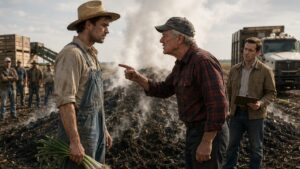
Dennis took a step closer. “You built that fence too far south. You planted inside the corridor. We corrected it.”
Anthony held up the survey cap.
“You destroyed a licensed monument.”
“You keep saying that like it changes the access agreement.”
“It changes who gets to decide where the line is.”
Dennis’s face reddened. “You think because you came home in uniform, everybody’s supposed to forget you ignored this problem?”
Anthony had changed into work clothes before sunrise. There was no uniform to point at, no rank visible on him, nothing except the close-cropped hair and the stiffness of a body still living several time zones away.
“I didn’t mention my service.”
“You didn’t have to.”
Elizabeth moved beside Anthony. “Don’t make this about that.”
Dennis looked at her, then at the men behind him. “This is about a landowner who refused three meeting requests and left everyone else to deal with an unsafe road.”
Anthony’s hand closed around the metal cap.
He remembered the envelopes. They had arrived during the final rush before mobilization—insurance forms, seed invoices, equipment repairs, Army paperwork, and three cooperative notices printed on pale green paper. He had read the first one, seen Dennis’s name at the bottom, and set it aside.
He had told Elizabeth the survey was recorded and there was nothing to discuss.
Now eleven trees were gone.
Eric finally spoke. “The lane was a problem, Anthony.”
Anthony looked at him. “Did you vote for this?”
Eric did not answer directly. “A fire engine nearly lost an axle back there last fall.”
“That wasn’t my property.”
“The choke point was.”
Dennis lifted his clipboard. “Every farm south of yours depends on this route when the main road floods. We couldn’t keep treating your fence like it mattered more than access.”
Anthony glanced at the empty row.
The trees had been thin when he planted them, each trunk no wider than his thumb. Elizabeth had tied strips of white cloth to the strongest branches so they could track the wind. The cloth was gone too.
He forced his eyes back to Dennis.
“You had Rebecca’s survey.”
“We had older documentation.”
“Did Rebecca approve moving the line?”
“She doesn’t govern cooperative easements.”
“That wasn’t my question.”
Dennis’s gaze flickered, the first break in his certainty.
Anthony placed the survey cap in his shirt pocket.
“I’m calling her.”
“You can call anyone you want,” Dennis said. “But you are not rebuilding that fence or replanting those trees until this is resolved.”
Anthony stepped closer, not threatening, merely refusing the distance Dennis had chosen for him.
“You came onto my land while I was gone. You ignored my wife. You tore out a recorded marker and destroyed an orchard row. You don’t get to stand in the hole you made and tell me what I’m allowed to touch.”
Behind Dennis, the excavator operator looked away.
Dennis drew a folded packet from beneath the clipboard.
“You want proof?”
He opened it and pulled out a photocopied document, yellowed around the margins despite the new white paper.
At the top was the name of the county agricultural access cooperative.
Near the bottom, beneath several lines of dense type, was a signature Anthony recognized from old seed ledgers and machinery receipts.
Jacob Carter.
His grandfather.
Dennis held the page out but did not release it.
“Your family granted this route fifty-three years ago,” he said. “You inherited the farm. You inherited the agreement.”
Anthony took the copy.
The signature looked real.
Chapter 2: The Agreement With the Missing Final Page
Elizabeth had saved every broken orange stake.
She laid them across the kitchen table beside the farm accounts, arranging them from longest to shortest as if the order might explain what had happened. Splinters, bent flagging wire, cracked plastic and three mud-caked metal caps formed a bright, damaged line between the calculator and a stack of unpaid invoices.
Anthony stood over them with Dennis’s photocopy in his hand.
“You went back out there after they left?”
“I went out while they were still working.”
He looked at her.
Elizabeth opened the cabinet above the refrigerator and removed a clear storage bag. Inside were bolts, fence staples, pieces of irrigation tubing and a folded business card from the excavation contractor.
“I picked up what I could without getting in front of the machine.”
“You shouldn’t have been anywhere near it.”
Her eyes hardened.
“What was I supposed to do? Wait inside because you weren’t here to tell me which pieces mattered?”
Anthony set the agreement on the table.
“That’s not what I meant.”
“It’s what you said.”
The kitchen seemed smaller than he remembered. Deployment had trained him to live in narrow spaces without feeling confined. This room had once felt open. Now the broken stakes occupied it like witnesses.
Elizabeth pulled out a chair. “Sit down.”
“I’m not tired.”
“You’ve been awake since yesterday.”
“I need to read this.”
“You’ve read the same page six times.”
Anthony sat.
The photocopy granted “continuous passage for emergency, agricultural, and cooperative service vehicles” along the southern boundary of Jacob Carter’s property. A width was listed, but the figure had been darkened by repeated copying. The language was broad enough to be dangerous.
He turned the page over.
Blank.
“Where’s the rest?”
“That’s all Dennis gave me too.”
“He said this was the agreement.”
“He said it was enough.”
Anthony studied the bottom edge. The final sentence ended with a comma.
It did not end with a period or signature block.
“This isn’t the final page.”
Elizabeth rubbed both palms over her face. “I told him that.”
“And?”
“He said the cooperative’s lawyer had the complete file.”
Anthony reached for his phone.
Elizabeth put her hand over it.
“Before you call him, you need to hear something.”
He waited.
“The notices didn’t stop after you left.”
“I know there were three.”
“There were five.”
Anthony looked up.
“Two came after you deployed. Dennis came by in person once. Eric came twice.”
“What did they want?”
“For me to agree to a temporary widening until you got back.”
“And you said no.”
“I said I couldn’t sign away part of the farm without you.”
“You were right.”
“That isn’t the whole answer.”
He pulled his hand from beneath hers.
“What is?”
“You had months before you left. You wouldn’t meet with them.”
“The survey was complete.”
“That’s not the same as meeting.”
“There was no legal reason to reopen the boundary.”
Elizabeth’s laugh held no humor. “That sentence is exactly why we’re here.”
Anthony rose too quickly, knocking one of the metal caps from the table. It struck the floor and spun under the refrigerator.
He crouched to retrieve it, but Elizabeth did not move to help.
“You think I caused this?” he asked.
“I think Dennis caused the damage. I think the board let him. And I think you decided being legally correct meant you never had to speak to anybody.”
Anthony found the cap beneath the appliance. Mud had dried inside the stamped letters.
“I had a mobilization date.”
“You also had a phone.”
He placed the cap back with the others, more carefully this time.
The next morning they drove to the county recorder’s office.
The county building sat behind the courthouse in a converted brick schoolhouse that smelled of paper dust and floor wax. A clerk led them to a public terminal, then disappeared into a records room when Anthony gave her the agreement number.
Elizabeth waited near the window while Anthony searched the digital index.
The document appeared under Jacob Carter’s name, recorded fifty-three years earlier. Four scanned pages were listed.
Dennis had given them three.
Anthony opened the final image.
The missing page contained the renewal terms.
The easement had been granted for an initial period of twenty-five years, with automatic ten-year renewals unless the cooperative stopped maintaining the route. A later notation referenced a county inspection and formal abandonment after a replacement gravel road was constructed.
The abandonment date was twelve years ago.
Anthony read it twice.
Then he leaned back.
“It expired.”
Elizabeth came behind him and read over his shoulder.
“Not just expired,” she said. “They closed it.”
The clerk returned carrying a thin physical file.
“There’s more,” she said. “This was attached to the abandonment notice.”
She handed Anthony a faded inspection report. The old lane had been removed from the cooperative’s official emergency map because drainage damage made it unreliable. The replacement route was supposed to follow the gravel road east of Eric Mitchell’s pasture.
Anthony felt something in him settle.
Dennis had not made a mistake.
He had used an agreement he knew—or should have known—was dead.
“Can we get certified copies?”
The clerk nodded. “There’s a fee per page.”
“I’ll take the full file.”
As she walked away, Elizabeth rested one hand against the desk.
“You were right about the easement.”
Anthony looked at the scanned page.
He had expected vindication to feel cleaner.
Instead he heard Dennis saying that a tanker could not get through.
The clerk returned with another folder.
“You may want these too,” she said. “They’re recent fire-access inspection records. Same parcel group.”
Anthony opened the top report.
Three deficiencies were marked in red.
The replacement gravel road had narrowed from erosion. A culvert near Eric’s pasture could not support a loaded tanker. Overgrown hedges blocked the western turn. The inspector had recommended a secondary emergency route before the dry season.
A handwritten note in the margin read: Carter south lane—historic option?
Elizabeth read it silently.
Anthony closed the folder.
The missing page proved Dennis had no right to bulldoze the orchard. The inspection report proved the problem Dennis described was real.
On the drive home, neither of them spoke for several miles.
At the intersection by the volunteer fire station, a pickup pulled out behind them and flashed its headlights. The volunteer fire chief followed them to the farm and parked beside Anthony’s truck.
He climbed out carrying a red binder.
“I heard you pulled the old easement file,” he said.
Anthony nodded.
“The agreement was abandoned.”
“I know.”
“Then Dennis had no authority.”
“No,” the chief said. “He didn’t.”
The answer came too quickly to be reassuring.
The chief opened the binder on the hood of Anthony’s truck and removed an incident report.
“Last January, an ambulance was dispatched to the Mitchell place. Main road was iced over. We tried the gravel access, but the culvert had shifted. They had to backtrack six miles.”
Anthony looked toward Eric’s pasture.
“How long did they lose?”
“Eleven minutes.”
“What happened?”
The chief hesitated.
“The patient survived. Barely.”
He tapped the report with one finger.
“What Dennis did to your land was wrong. But the access danger wasn’t invented.”
Chapter 3: What Elizabeth Watched From the Farmhouse Window
The first fence post cracked before Elizabeth saw the excavator.
The sound traveled through the farmhouse wall—a dry, violent snap followed by the rattle of wire dragged across frozen ground. She left the farm-stand receipts open on the desk and reached the kitchen window as the machine’s bucket pushed through the southern fence.
Dennis Wilson stood beside it with his phone raised.
For one stunned second, Elizabeth thought the operator had turned into the wrong field.
Then Dennis pointed toward the young apple trees.
The bucket lowered.
Elizabeth ran outside without a coat.
“Stop!”
The excavator operator looked toward Dennis. Dennis did not lower his phone.
“Shut it down,” Elizabeth shouted.
The machine idled, bucket suspended over the first tree.
Dennis walked toward her, still recording.
“We posted notice.”
“You don’t have permission.”
“The board authorized emergency access work.”
“Anthony owns that ground.”
“The cooperative holds the corridor.”
“No, it doesn’t.”
Dennis stopped several feet away. His phone remained aimed at her face.
“We’ve tried to resolve this for months.”
“You tried to make us move a surveyed fence.”
“We tried to keep a usable lane open.”
“The lane is east of Eric’s pasture.”
“It won’t carry a tanker.”
“That doesn’t make this yours.”
Behind Dennis, the excavator bucket closed around the trunk of the first apple tree. The tree bent almost to the ground before its roots tore free with a muffled rip.
Elizabeth moved toward the machine.
Dennis caught her forearm.
“Don’t go near operating equipment.”
She jerked free.
“Then turn it off.”
He released her and looked back at the operator.
“Continue.”
The tree dropped beside the track.
Elizabeth stared at it. A strip of white cloth was still tied to one branch, dirty from the soil.
She took out her phone.
If she could not stop them, she could record.
Dennis noticed.
“That’s fine,” he said. “Document the improvement.”
He turned his own camera toward the widened opening.
“For the record,” he said, his voice changing into the formal tone he used at cooperative meetings, “the board is restoring lawful emergency access after repeated noncompliance by the property owner.”
Elizabeth framed him through the screen with the broken fence behind him.
“Say who ordered it.”
Dennis looked directly into her phone.
“I did, as chair.”
The operator pulled the second tree.
Elizabeth held the camera steady.
Orange survey flagging fluttered near the bucket. The operator paused and leaned from the cab.
“There are stakes here.”
Dennis glanced at them. “Pull anything inside the corridor.”
“Those are registered monuments,” Elizabeth said.
“They’re wooden markers.”
“The metal caps aren’t.”
Dennis waved the operator forward.
One orange stake vanished beneath the track.
Then another.
Elizabeth recorded the machine number, the contractor logo on the cab and the license plate of the equipment trailer. She zoomed in when Dennis pointed toward the remaining fence line.
A pickup came fast down the cooperative road and stopped near the gate.
Eric Mitchell got out before the engine fully died.
“What are you doing?” he called.
Dennis lowered his phone at last. “Opening the lane.”
“The recorder hasn’t sent the file.”
“We have the agreement.”
“We have a copy.”
“We have enough.”
Eric looked at Elizabeth, then at the uprooted trees.
“Shut it down until we get the final page.”
Dennis’s face hardened. “You voted for emergency action.”
“I voted to clear the established corridor if the agreement checked out.”
“It checked out.”
“You don’t know that.”
The excavator continued idling.
For the first time, Elizabeth thought the work might stop.
Dennis walked close to Eric and spoke too quietly for her to hear. Eric answered with a sharp shake of his head. Dennis pointed toward the southern road, then toward the orchard, his movements growing harder.
Finally Eric looked at the operator.
“You hear me? Hold where you are.”
Dennis turned.
“I’m the board chair.”
“And I’m telling you the vote didn’t authorize moving monuments.”
Dennis lifted his phone again.
“We’re already committed. Leaving this half-open is more dangerous than finishing.”
Eric stared at him.
Then he looked toward Elizabeth.
“I’m sorry,” he said.
But he did not stand in front of the machine.
He walked back to his pickup and remained beside it while Dennis ordered the work to continue.
That was the moment Elizabeth understood how the orchard would be lost. Not because nobody knew it was wrong. Because each person had found a reason to let somebody else be responsible.
She recorded until her battery warning appeared.
By sunset, the fence was gone, eleven trees lay in a heap and the orange stakes had disappeared into churned soil. Dennis left before the contractor loaded the machine.
The operator approached the farmhouse alone.
He removed his cap and held out a business card.
“I just run the equipment,” he said.
“You were told those were survey monuments.”
His hand fell.
“I asked.”
“And then you kept going.”
He placed the card on the porch rail.
“The work order came through the cooperative. Dennis signed it.”
Elizabeth did not take the card until his truck had left.
Inside, she plugged in her phone and copied every video onto the farm computer, an external drive and a cloud folder Anthony did not know existed. She photographed the card, the trailer plate and every broken piece she could find before darkness covered the field.
Then she sat at the kitchen table and called her husband.
The connection took three attempts.
Anthony appeared in a gray-walled communications room under fluorescent light. His face was thinner than when he had left. Someone moved behind him carrying a folder, and a door opened and closed out of view.
“You okay?” he asked immediately.
Elizabeth had planned to tell him everything.
Instead she said, “There was work done near the south lane.”
His eyes sharpened. “What kind of work?”
“The cooperative widened it.”
“Did they touch the fence?”
She looked through the dark kitchen window. The orchard was invisible, but she could still hear the final posts cracking.
“Yes.”
“How much?”
“Enough that we’ll need Rebecca.”
Anthony glanced toward someone offscreen. “I have ten minutes.”
Elizabeth looked at the video thumbnail on her computer. Dennis’s face was frozen in the frame, smiling slightly as the first tree leaned behind him.
“Then we’ll handle the details when you can focus,” she said.
“I’m focused.”
“No. You’re working.”
“Elizabeth.”
“The house is fine. I’m fine. I saved everything.”
He was quiet.
“Did you call the sheriff?”
“They said it looked like a civil boundary dispute.”
“Call Rebecca.”
“I did. She’s out of county until Monday.”
“Don’t confront Dennis alone.”
The words made something in her close.
“He was already here.”
Anthony leaned closer to the screen. “What happened?”
A knock sounded on his side of the connection. He looked over his shoulder.
“I have to go.”
“Of course.”
His gaze returned to her. “We’ll fix it.”
Elizabeth wanted to ask who he meant by we.
The call ended before she could.
Two weeks later, in the farmhouse kitchen, Anthony watched the saved footage without speaking.
Elizabeth stood behind him while Dennis’s recorded voice filled the room.
“For the record, the board is restoring lawful emergency access…”
The excavator tore out the first tree.
Anthony’s shoulders did not move.
The second clip showed the orange stakes. The operator asked whether they should be removed. Dennis told him to pull anything inside the corridor.
The third showed Eric arriving and asking him to stop.
When the final clip ended, Anthony clicked back to the beginning.
“You told me they widened the lane.”
“They did.”
“You didn’t tell me Dennis directed it.”
“I told you I saved everything.”
“You didn’t tell me about the trees.”
Elizabeth crossed her arms.
“You had ten minutes.”
“I asked how much damage.”
“And then somebody knocked, and you had to go.”
“That wasn’t my choice.”
“Neither was standing here while they tore the place apart.”
Anthony pushed back from the desk.
“You should have sent the video.”
“You were in a place where you couldn’t do anything.”
“I could have called.”
“Who? The sheriff who called it civil? Rebecca, who was out of county? Dennis, who knew you were overseas and did it anyway?”
“You decided for me.”
“Yes.”
The answer stopped him.
Elizabeth stepped past him and paused the video on the frame where the first orange stake disappeared beneath the track.
“I decided you did not need to watch this from thousands of miles away when you couldn’t leave, couldn’t sleep and couldn’t protect anything here.”
“You didn’t trust me to handle it.”
“I didn’t trust the distance not to tear you in half.”
Anthony stood rigid beside the desk.
She had expected anger. His silence was worse.
“You think silence protects people,” she said. “You did it before you deployed. You ignored the meetings because you didn’t want to explain yourself. Then I did the same thing to you.”
“That isn’t the same.”
“No. Mine lasted two weeks. Yours lasted years.”
He looked at her.
Elizabeth reached for the mouse and opened a photograph taken after the machine left. Eleven uprooted trees lay beside the new lane, their roots exposed and tangled. White cloth strips still marked several branches.
Anthony’s face changed.
Only slightly, but she saw it.
He stepped closer to the screen.
“They took the whole row.”
“Yes.”
“You said they damaged some trees.”
“I couldn’t say it while you were there.”
His hand settled on the desk.
Elizabeth’s anger thinned, leaving exhaustion beneath it.
“That was the row we planted after the hospital,” she said. “The one we never explained to anyone.”
Chapter 4: The Row They Never Explained to Anyone
Rebecca found the surviving monument beneath the roots of an uprooted apple tree.
She had been probing the torn soil with a narrow steel rod when it struck metal. The sound was small and clean against the soft ground. Anthony heard it from twenty feet away and crossed the empty row before she called him.
Rebecca knelt beside the exposed root mass. Her work gloves were dark with mud.
“Here,” she said.
A bright strip of orange plastic showed beneath the roots, unbroken except where the tree had pressed it sideways. Rebecca cleared the soil with her fingers until the stake emerged. The metal cap was still fixed to its base.
Her registration number was visible.
Anthony crouched beside her.
“So they missed one.”
“They didn’t miss it.” Rebecca studied the crushed roots above the stake. “The bucket pulled the tree before it reached this deep.”
She photographed the monument in place, then took measurements from two reference points along the drainage swale. Her survey instrument stood on a tripod farther up the field, aimed across the widened lane.
Elizabeth remained near the farmhouse. Since the argument over the footage, she and Anthony had spoken mostly about practical things—insurance calls, contractor estimates, meals neither of them finished.
Rebecca loosened the stake carefully.
Anthony watched the orange surface rise from beneath the tree.
The first time he had seen it, the orchard row had still existed only as white paint marks and small holes in the ground. Rebecca had walked the boundary with him while Elizabeth followed carrying the bundle of stakes. They had driven each one together.
Anthony had told himself they were marking land.
He had not said what else they were marking.
Rebecca placed the recovered stake across her equipment case.
“The recorded line is where we put it,” she said. “No question.”
“I knew that.”
“I’m saying I can certify it again.”
Anthony looked at the widened lane.
“And Dennis?”
“He crossed it by as much as twenty-two feet in places.”
“He removed your monuments.”
“Yes.”
“Is that criminal?”
Rebecca removed one glove. “It can be. Intent matters. Proof matters. The county attorney decides what to pursue.”
“We have his recording.”
“I’ve seen it.”
Anthony turned toward her. “Elizabeth sent it?”
“She asked what needed preserving.”
He looked toward the farmhouse window.
Rebecca closed the equipment case. “She did everything right.”
“I didn’t say she didn’t.”
“You didn’t have to.”
Anthony stood.
Rebecca had known them for six years, long enough to recognize what he left unsaid and impatient enough not to pretend otherwise.
She carried the survey rod toward the southern edge of the lane.
“I need to show you something,” she said.
She positioned the rod at the lawful boundary and told Anthony to stand where the old fence had been. Then she walked backward across the lane, counting paces.
“The fire chief sent me the current apparatus dimensions,” she said. “Loaded tanker, mirrors extended, minimum turning clearance.”
She marked the outer edge with a can of temporary paint.
The space between the legal boundary and the drainage ditch was narrower than the excavated lane by several feet.
“A tanker can fit,” Anthony said.
“Straight through, maybe.”
“It’s a straight section.”
“Until the bend.”
She pointed toward the swale where the lane curved north.
“That turn radius is below current guidance. A smaller engine could make it. A full tanker would need to swing onto your side.”
“My side is the orchard.”
“I know.”
“So Dennis destroys it, and suddenly the destruction proves he needed it?”
“That’s not what I said.”
“It’s what the paint says.”
Rebecca let the silence sit between them.
Then she walked to the bend and placed the rod near the drainage ditch.
“If you restore the fence exactly where it was, the legal dispute becomes simple,” she said. “The access problem does not.”
Anthony looked at the recovered stake lying across the equipment case.
“I didn’t create the access problem.”
“No.”
“I’m not responsible for fixing it.”
“Legally? Maybe not.”
He turned on her.
Rebecca did not move.
“You want me to give them the land.”
“I want you to understand what winning your boundary case will and won’t accomplish.”
“The agreement expired.”
“Yes.”
“The road was abandoned.”
“Yes.”
“They had no authority.”
“Yes.”
“Then what part am I missing?”
Rebecca’s eyes moved toward the empty tree row.
“The part you never told anyone.”
Anthony’s jaw tightened.
She continued before he could stop her.
“Eleven young trees have a replacement value. The fence has a replacement value. Irrigation repair has a value. That’s what the insurer will see.”
“They destroyed more than lumber and saplings.”
“Then you have to say what.”
He looked away.
The ground where the trees had stood was uneven, each uprooted root ball leaving a shallow crater. A strip of white cloth lay half buried near his boot. He picked it up and rubbed the dirt between his fingers.
Elizabeth had torn the cloth from an old hospital blanket.
She had tied one strip to each tree.
After the loss, they had stopped talking about the room they had painted. They returned the unopened crib. Anthony stored the remaining boxes in the barn loft and never mentioned them again.
The following spring, Elizabeth had brought home eleven apple saplings from a farm auction. She said they should plant something that would require them to imagine another season.
Anthony had measured the row twice.
He had never told Dennis. He had never told Eric. He had never told Rebecca.
He had believed the meaning belonged to him and Elizabeth alone.
Now strangers had assigned the trees a price per unit.
Rebecca waited.
Anthony folded the strip of cloth into his palm.
“We planted them after we lost a baby,” he said.
The words sounded blunt in the open field.
Rebecca lowered her eyes.
“We weren’t trying to build a memorial,” he continued. “Not exactly. We needed something that would still be here the next year.”
He looked toward the farmhouse.
“Elizabeth tied these to the branches so we could see which trees survived the winter.”
Rebecca nodded once.
“That matters.”
“It doesn’t change the boundary.”
“No.”
“It doesn’t change the access measurements.”
“No.”
“Then why make me say it?”
“Because you’re asking for restoration, and nobody can restore what you refuse to name.”
Anthony opened his hand. The white cloth had left a damp line across his skin.
Rebecca returned to the survey instrument and adjusted its angle toward the east.
“There may be another route.”
She pointed beyond the drainage swale, across Eric Mitchell’s pasture.
The land rose gradually there before joining the county road. No sharp bend. No ditch. No orchard.
Anthony followed the line with his eyes.
“That crosses Eric’s place.”
“About three hundred yards.”
“He’ll never agree.”
“It would cost him grazing ground.”
“He’s already carrying too much debt.”
Rebecca looked at him. “You know that?”
“Everybody knows.”
“Then you know why he supported Dennis.”
Anthony watched cattle moving slowly behind Eric’s fence.
The alternate route could save the orchard and solve the access problem. It could also take productive land from a man whose margins were already thin.
Rebecca lifted the recovered orange stake from her equipment case and handed it to Anthony.
“This proves where your boundary belongs,” she said. “It doesn’t tell us where the new road should go.”
Anthony held the stake by its unbroken end.
Across the pasture, Eric stood beside a feed trough watching them.
He had seen Rebecca point.
Chapter 5: Dennis Wilson Finally Names the Fire
“The insurer may deny coverage for the demolition.”
Cynthia Lopez said it before anyone had settled into the folding chairs.
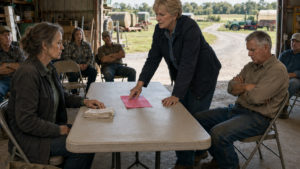
The cooperative’s equipment shed had been cleared for the emergency meeting, but the smell of diesel and old hay remained. A portable heater clicked near the wall. Maps, inspection reports and photographs covered a plywood table between the board members and Anthony.
Dennis sat at the head of the table.
For the first time since Anthony had returned, he was not wearing the cooperative vest. Without it, he looked older. His work shirt sagged at the shoulders, and his hands remained clasped tightly in front of him.
Cynthia opened a black folder.
“The policy covers negligent operations under specific conditions. It does not automatically cover knowing trespass, destruction of recorded monuments or actions taken outside board authority.”
Dennis leaned forward. “The board authorized emergency access.”
“The minutes authorize clearing within an established easement, contingent on verification.”
“We verified it.”
Cynthia slid a certified copy of the missing page across the table.
“No. You distributed an incomplete agreement.”
A murmur moved through the room.
Anthony sat beside Elizabeth. Rebecca stood near the wall with her survey case. Eric occupied the chair farthest from Dennis.
The recovered orange stake lay on the table among the documents.
Dennis’s eyes fixed on it.
“The corridor existed for decades,” he said.
“And was formally abandoned twelve years ago,” Cynthia replied. “The insurer will argue that the cooperative acted beyond the scope of both the agreement and the board vote.”
One of the neighboring farmers shifted in his chair. “What does that mean for us?”
“It means the direct damage claim may remain with the cooperative. It also means individual liability is possible for anyone who knowingly authorized work outside the approved terms.”
Everyone looked at Dennis.
He reached for the orange stake.
Anthony almost stopped him.
Dennis picked it up and turned it slowly. Mud remained in the grooves around Rebecca’s stamped number.
“I thought they were temporary markers,” he said.
“The operator asked about the metal caps,” Elizabeth said.
Dennis did not look at her.
Cynthia removed another document. “The recording confirms you instructed him to remove everything inside what you called the corridor.”
Dennis set the stake down.
“The lane had to be opened.”
“You keep saying that,” Anthony said. “It doesn’t answer why you hid the final page.”
Dennis finally met his eyes.
“I didn’t hide it.”
Eric’s chair scraped the concrete.
“Yes, you did.”
The room went still.
Dennis turned toward him.
Eric stared at the table. “The packet you gave us had three pages. I asked if the recorder had confirmed it. You said the old agreement carried forward.”
“It should have.”
“That wasn’t what I asked.”
Dennis’s voice sharpened. “You voted yes.”
“I voted to clear an existing easement if the paperwork checked out.”
“And then you stood there while they did it,” Anthony said.
Eric flinched, but nodded.
“I did.”
The admission carried more weight than an excuse would have.
He rubbed both hands over his knees.
“The culvert at my place is failing. I can’t finance the replacement this year. Maybe not next year either. If the main road floods, the south farms have no reliable route. Dennis said reopening the old lane was the fastest answer.”
“You knew the agreement might be expired,” Elizabeth said.
“I knew there was a question.”
“And that was enough?”
Eric looked at her. “No.”
Cynthia closed the folder.
“The current estimate for fence, irrigation and orchard restoration is substantial. Monument replacement, professional fees and loss-of-use claims add more. If the cooperative’s policy excludes the excavation, assessments may be required from all member farms.”
One of the farmers swore under his breath.
Another said, “That would bury half of us.”
Anthony watched Dennis.
The old man had picked up the stake again. His thumb moved over the orange plastic, tracing scratches left by the excavator.
“You could have waited one day for the recorder,” Anthony said.
Dennis’s hand stopped.
“We had already waited years.”
“You had no right.”
“I had a road that couldn’t carry a tanker.”
“You had other options.”
“Show me one that was ready.”
Anthony glanced toward Eric.
Dennis saw it.
“You mean his pasture?” he asked. “You think a man drowning in debt is going to surrender his best grazing strip because your trees matter more?”
The words landed harder because they were partly true.
Anthony leaned forward.
“You don’t get to decide what my trees matter.”
“No,” Dennis said. “Apparently I don’t.”
The anger left his voice so suddenly that the room changed with it.
He placed the stake down and stared at his hands.
“My brother’s barn burned twenty-one years ago.”
Nobody moved.
Dennis continued without looking up.
“The main tanker came from the west. A gate was chained. Not locked—just wrapped twice because somebody was tired of cattle pushing through. The driver lost time cutting it. Then the second truck sank at the shoulder.”
His thumb pressed into his palm.
“My brother went back inside for a hired hand he thought was still in there.”
Dennis swallowed.
“The hired hand had already gotten out through the rear.”
The heater clicked off. The silence afterward seemed larger than the shed.
“They found my brother by the side door,” Dennis said. “Another four or five minutes might not have changed anything. That’s what people told me.”
He looked at Anthony.
“I have spent twenty-one years hearing the word might.”
Anthony felt Elizabeth’s hand rest against the edge of his chair, not touching him, close enough that he noticed.
Dennis’s grief did not soften the widened lane. It did not stand the trees upright or restore the weeks Elizabeth had faced alone.
But it changed the shape of the man who had ordered them removed.
Cynthia spoke quietly.
“What happened to your brother does not authorize you to alter records.”
“I know that.”
“Did you know the agreement had expired?”
Dennis looked at Eric, then back at Anthony.
“I knew there had been an abandonment filing.”
A farmer near the wall exhaled sharply.
Dennis’s face tightened, but he did not retreat.
“I believed emergency need gave the board enough authority to reopen it.”
“Did the cooperative attorney tell you that?” Cynthia asked.
“No.”
“Did the county?”
“No.”
“Did Rebecca?”
Dennis glanced toward her.
“No.”
“Then whose judgment was that?”
Dennis touched the orange stake.
“Mine.”
The word sat plainly before them.
Not a mistake shared by history. Not an ambiguous vote. His choice.
Anthony had wanted that admission from the moment he saw the excavator. Now that he had it, satisfaction would not come.
Cynthia distributed a preliminary damages summary.
“If Mr. Carter pursues every available remedy and the insurer denies intentional acts, the cooperative may face an immediate assessment. Personal guarantees may also be required to secure any structured settlement.”
“What kind of guarantees?” Anthony asked.
Cynthia hesitated, then removed a separate packet.
“Mr. Wilson has offered agricultural acreage as collateral.”
Dennis looked up sharply. “That wasn’t for discussion yet.”
“It is if you expect Mr. Carter to delay enforcement.”
She slid the packet toward Anthony.
It described a lien against forty acres of Dennis Wilson’s cattle ground. If the cooperative failed to pay, Anthony could foreclose on the secured portion.
Anthony read the first page.
The acreage bordered the creek and included Dennis’s winter feeding lot.
Enough leverage to force payment.
Enough leverage to fracture Dennis’s farm.
Cynthia placed a pen beside the packet.
“This is the strongest security currently available,” she said. “If you accept it, we can begin drafting the settlement today.”
Anthony looked at the signature line.
Across the table, Dennis did not ask for mercy.
Chapter 6: The Boundary Anthony Refused to Win
Anthony carried the unsigned lien agreement into mediation in a plain manila folder.
It weighed almost nothing.
Still, he felt it against his ribs with every step through the county building.
Elizabeth walked beside him. She had not asked what he intended to do. That was deliberate. For years, Anthony had treated decisions as finished products he could present once every uncertainty had been removed. She was no longer willing to accept conclusions without being included in the risk.
Inside the mediation room, two maps had been mounted on foam boards.
One showed the original Carter boundary in black, the demolished route in red and the recorded monuments in orange.
The second showed Rebecca’s alternate emergency lane crossing Eric Mitchell’s pasture before joining the county road.
Eric stood near it with his arms folded.
Dennis sat at the table beside Cynthia. He looked as though he had not slept. The cooperative clerk placed a recorder between them and checked the red light.
Cynthia began with the lien.
“Mr. Carter, if you execute the security agreement, the cooperative will have ninety days to fund the initial restoration payment. Mr. Wilson’s acreage will secure the unpaid balance.”
Anthony opened the folder.
The signature page waited on top.
Dennis stared straight ahead.
Anthony thought of the missing orchard row. He thought of Elizabeth at the farmhouse window and Dennis telling the operator to continue. He thought of eleven minutes lost on an icy road and twenty-one years trapped inside the word might.
He took the agreement out.
Eric shifted his weight.
Before anyone spoke, Anthony tore the signature page from the packet.
The sound was sharp in the small room.
Cynthia frowned. “Mr. Carter—”
Anthony tore it once more and set the pieces on the table.
“I’m not taking Dennis’s farm.”
Dennis turned toward him.
“That does not mean I’m forgiving the demolition,” Anthony said. “It does not mean the cooperative gets a discount. It means I’m not solving an unlawful taking by positioning myself to take someone else’s land.”
Cynthia closed her pen.
“What are you proposing?”
Anthony removed a second packet from the folder and handed one copy to Elizabeth before giving the others around the table.
Elizabeth looked at him, surprised.
He had prepared the plan, but he did not begin explaining until she had opened it.
“The orchard boundary is restored exactly as Rebecca recorded it,” he said. “The cooperative pays for the fence, irrigation, survey work and replacement trees. Dennis personally pays the uninsured portion assigned to his decision.”
Dennis read without comment.
Anthony pointed toward the alternate-route map.
“The new emergency lane crosses the eastern edge of Eric’s pasture. It stays above the drainage line, meets tanker clearance and connects to the county road without the sharp turn.”
Eric’s mouth tightened. “That strip feeds thirty head in late summer.”
“I know.”
“You know what the bank has against this place?”
“Enough.”
Eric looked toward Rebecca. “Can it be narrower?”
She stepped to the map. “Not if you want two-way emergency clearance. But the shoulders can remain reinforced grass instead of gravel. Permanent loss would be less than the current drawing suggests.”
“That doesn’t fix the debt.”
Anthony turned to Cynthia.
“The cooperative refinances the culvert obligation and compensates Eric for the easement. The annual member assessment covers maintenance. No one farm carries the entire emergency-access burden.”
One of the farmers said, “Assessments still cost us.”
“So did pretending the road problem belonged to whoever was easiest to pressure,” Anthony replied.
The words came out harder than he intended.
Elizabeth looked at him.
He breathed and began again.
“I ignored the meetings. I believed the survey settled everything that mattered. It settled my boundary. It did not settle how fire equipment would reach the south farms.”
Dennis watched him closely.
Anthony continued.
“That was my failure. It does not excuse what was done. But I won’t stand here and act like I had no part in letting the problem harden.”
The admission left him exposed in a way anger never had.
Elizabeth turned the proposal page.
“Any agreement affecting the orchard needs both our signatures,” she said.
Cynthia glanced at Anthony.
He nodded. “Yes.”
Elizabeth laid her hand flat over the section governing future access.
“And no temporary widening, equipment crossing or boundary adjustment can be authorized without written consent from both landowners and survey verification.”
“Reasonable,” Cynthia said.
“Not just reasonable,” Elizabeth replied. “Required.”
Anthony felt the smallest shift between them. Not repair, not yet. But space where repair could begin.
Eric tapped the alternate map.
“If the cooperative restructures the culvert debt and pays for fencing along both sides of the lane, I’ll consider it.”
“Consider?” Dennis asked.
Eric met his eyes. “You don’t chair this discussion anymore.”
Dennis leaned back.
Cynthia turned several pages.
“There are additional conditions.”
Anthony spoke before she could list them.
“Dennis resigns as cooperative chair.”
No one looked surprised except Dennis.
Anthony continued.
“He cannot vote on the restoration contract, insurance negotiations or route approval. He pays the personal share identified in mediation. The cooperative adopts a rule requiring full recorded documents in every board packet.”
Dennis’s jaw moved.
“And if I refuse?”
Anthony looked at the torn lien signature page.
“Then I use every remedy I have.”
Dennis followed his gaze.
“You said you wouldn’t take my farm.”
“I said I’m giving you another way.”
The distinction filled the room.
Cynthia read through the figures. “The personal contribution is significant.”
“It should be,” Elizabeth said.
Dennis looked toward the map of Anthony’s orchard. Orange points marked the old survey locations. Red lines showed the excavation widening over them.
“What happens to the lane that’s already there?” he asked.
“It gets closed,” Anthony said. “Topsoil replaced. Trees replanted. Fence restored.”
“And emergency access during construction?”
“The existing county road, with temporary reinforcement at the culvert,” Rebecca said. “It can support limited use while the eastern route is built.”
Eric shook his head. “That costs money too.”
“The cooperative reserve covers part,” Cynthia said. “Insurance may cover the temporary safety work even if it excludes the demolition.”
For the first time, the pieces formed something larger than blame.
Not simple. Not cheap. But lawful.
Dennis remained silent so long that the clerk glanced at the recorder.
Finally he removed his reading glasses.
“My equipment sale would cover most of the personal share.”
Anthony had not known there would be a sale.
“What equipment?” Eric asked.
“The second baler. The small loader. Some of the hay tools.”
“You need the loader.”
“I needed a lot of things before I ordered that excavator.”
Dennis folded his glasses and set them on the table.
“I’ll resign.”
Cynthia made a note.
Dennis looked at Anthony.
“I’ll pay what mediation assigns.”
Anthony waited.
“But I want one condition.”
Elizabeth’s posture tightened.
Dennis pointed toward the alternate route.
“I mark it with you.”
Anthony said nothing.
Dennis’s voice remained steady, though his hands did not.
“I moved a boundary I had no right to move. I’m not asking to touch yours again. I’m asking to be there when the new route is set, so nobody can say later that I hid behind another board vote.”
The request was not an apology.
Anthony was not ready to offer forgiveness in exchange.
Still, it was the first thing Dennis had proposed that required him to stand inside the consequences rather than above them.
Rebecca opened her survey notebook.
“We can flag the preliminary line next week.”
Dennis looked only at Anthony.
“Will you come?”
Anthony glanced at Elizabeth.
She did not answer for him.
He closed the manila folder.
“I’ll come,” he said. “But you ask before you cross my boundary.”
Dennis nodded once.
This time, no one mistook the nod for permission already granted.
Chapter 7: The First Orange Stake Went Back Into the Ground
The excavator returned in early spring, but this time its bucket faced away from Anthony’s orchard.
It waited on Eric Mitchell’s pasture beside a line of temporary flags that crossed the slope toward the county road. The machine was smaller than the one that had torn out the trees, yet its engine carried the same low vibration through the soil.
Anthony felt it through his boots.
Rebecca stood at the restored southern boundary with her instrument leveled on its tripod. A bundle of new orange stakes lay beside her equipment case. The old surviving stake rested on top, its plastic scarred and faded, Rebecca’s registration number still visible beneath dried scratches.
Dennis waited on the far side of the fence opening.
He did not step through.
Four months had changed him. His cattle operation still ran, but the second baler and small loader were gone from the equipment yard. Eric had told Anthony that Dennis sold them before the mediation payment was due. He had also resigned from the cooperative without arguing over the wording of the minutes.
None of that had put the trees back.
Dennis lifted one hand.
“May I come across?”
The excavation crew stopped unloading pipe. Rebecca glanced toward Anthony but said nothing.
The question was simple. It should not have mattered as much as it did.
Anthony looked at the place where the old lane had cut into his ground. New topsoil had been spread there and packed lightly. The restored irrigation line ran beneath it. Eleven shallow planting holes waited in a straight row beside the rebuilt fence.
Elizabeth stood near the farm wagon with eleven young apple trees wrapped at the roots.
Anthony opened the temporary gate.
“You may.”
Dennis crossed carefully, closing the gate behind him.
He carried no clipboard.
Rebecca picked up the first new orange stake.
“We begin at the original southern monument,” she said. “Then we certify the restored line before anyone breaks ground on the eastern route.”
She placed the stake into the hole she had prepared beside the old cap. Anthony took the survey hammer from her.
The bright plastic looked almost too clean.
He raised the hammer and drove the stake into the earth.
The first strike rang across the field.
The second seated it firmly.
On the third, the orange top settled to the height Rebecca marked.
For months, the recovered stakes had meant damage: splintered wood on the kitchen table, mud inside stamped metal, proof that somebody had decided Anthony’s absence made his land negotiable.
This one stood upright.
Rebecca checked the coordinates and entered them into her field book.
“Boundary restored,” she said.
Elizabeth came to stand beside Anthony. She touched the top of the stake with two fingers, then looked along the waiting tree holes.
The excavation crew started work across Eric’s pasture. The bucket opened the first strip of soil along the approved route, well east of the orchard. Reinforced grass shoulders would run beside a narrower gravel center. Fencing would keep Eric’s cattle from wandering onto it, and the cooperative would maintain the culvert and surface under the new agreement.
It was not free land. It was paid access, surveyed and signed by everyone whose property carried the burden.
Eric watched the machine from his pasture gate.
“You sure that shoulder will hold in spring?” he asked Rebecca.
“If the base goes in at the specified depth.”
He looked toward the contractor.
“You heard her.”
The contractor raised a hand without stopping the machine.
Anthony almost smiled. Eric had become particular about written specifications since the mediation.
Elizabeth began cutting the root wrapping from the first apple tree.
Anthony joined her.
The sapling was shorter than the one that had stood there before, its branches thin and tightly budded. They lowered it into the first hole and spread the roots across the soil.
Dennis remained several steps away.
“You need another hand?” he asked.
Elizabeth looked at Anthony.
This time, the decision did not belong to either one alone.
She handed Dennis a shovel.
“Backfill from that side.”
Dennis took it.
They worked without discussing the lost row. Soil struck the roots in soft clumps. Anthony held the trunk straight while Elizabeth checked its depth. Dennis packed the outer edge with the back of his shovel, careful not to press too close.
When the tree stood on its own, Elizabeth tied a strip of white cloth to the strongest branch.
Dennis stopped moving.
Anthony saw recognition pass across his face. Dennis had watched the demolition through his phone. He had seen the cloth on the uprooted branches, even if he had not known what it meant.
“What are those for?” he asked.
Elizabeth tightened the knot.
“To see what makes it through winter.”
Dennis lowered his eyes.
They planted the second tree without further explanation.
By midday, the new emergency lane had reached the rise above the drainage line. The volunteer fire chief arrived in a tanker to test the preliminary width before gravel was laid. The truck moved slowly between the flags, cleared the turn and stopped near the county road without touching either shoulder.
The chief climbed down.
“That works.”
Eric released a breath and leaned against the fence.
The small payoff carried no applause. The crew returned to work. Rebecca adjusted one flag by six inches. Elizabeth opened a cooler and passed around sandwiches.
Anthony sat on the wagon tongue with his gloves between his knees.
The fire chief joined him.
“The cooperative needs a chair for the new land-access committee,” he said.
Anthony looked at him. “No.”
“You didn’t even let me finish.”
“I know what you were going to say.”
“You know the routes. You know the survey process. And nobody in the county is going to assume you’ll approve work without reading the whole file.”
Anthony glanced toward Elizabeth.
She was speaking with Rebecca beside the newly planted trees.
“A committee is how this started.”
“A committee that stopped asking hard questions.”
“I’m not interested in becoming Dennis.”
“Then don’t.”
The chief left the thought with him and returned to the tanker.
Later, as Rebecca prepared to mark the second boundary point, Dennis approached Anthony near the fence.
“I heard what he asked.”
Anthony picked up another orange stake.
“So did half the field.”
“You should do it.”
Anthony studied him. “You want me in your old chair?”
“No. It shouldn’t be the same chair.”
Dennis looked across the pasture where the excavator followed the lawful route.
“The committee should have a surveyor present. Written consent from every affected owner. Fire review before a vote. Maybe a chair doesn’t get to hold the records alone.”
“That sounds like something you could have proposed years ago.”
“Yes.”
Dennis did not defend himself.
Anthony turned the stake in his hand.
“Why didn’t you?”
Dennis watched the machine.
“Because I thought urgency made me the only person willing to act.”
“And now?”
“Now I know it made me the person willing to act alone.”
The answer did not erase anything. It did not ask Anthony to soften the truth.
That was why he could hear it.
Rebecca called them to the next point.
Anthony and Dennis walked there together, stopping on opposite sides of the marked line.
Rebecca checked her instrument and pressed a small indentation into the ground with her boot.
“Here.”
Anthony positioned the stake.
Dennis reached for the hammer, then stopped.
“May I?”
Anthony looked at his hand.
Months earlier, Dennis had treated the boundary as an obstacle to be shifted. Now he waited beside it, asking permission to help restore what he had broken.
Anthony handed him the hammer.
Dennis drove the stake badly on the first strike. It leaned toward the orchard.
Rebecca said, “Pull it and start again.”
Dennis did.
The second attempt went straight.
By late afternoon, all eleven apple trees stood beside the restored fence. White cloth moved from their branches in the light wind. The eastern emergency lane curved across Eric’s pasture toward the county road, visible but no longer cutting through Anthony’s ground.
Elizabeth came beside Anthony as the crew loaded its tools.
“You’re going to say yes to the committee,” she said.
He glanced at her. “You decided that for me?”
“No. I’m asking before I start filling out the paperwork.”
He laughed once, surprised by the sound.
Then he looked along the boundary.
“I’ll do it for one year.”
“With conditions.”
“With many conditions.”
“We’ll write them together.”
“Yes.”
Rebecca packed the old surviving stake into her case, preserving it as part of the final survey record. The new stakes remained in the ground, bright against the dark soil.
Anthony picked up the last one from the bundle.
It was not needed for the legal line. Rebecca had brought it as a spare.
He held it out to Dennis.
Dennis looked at it, uncertain.
Anthony pointed toward the beginning of the new access lane, where a marker was still needed to show the cooperative maintenance limit.
“That one belongs over there.”
Dennis accepted the stake.
Anthony took the hammer.
Together they walked toward the new route, neither man crossing a boundary without knowing exactly where it stood.
The story has ended.