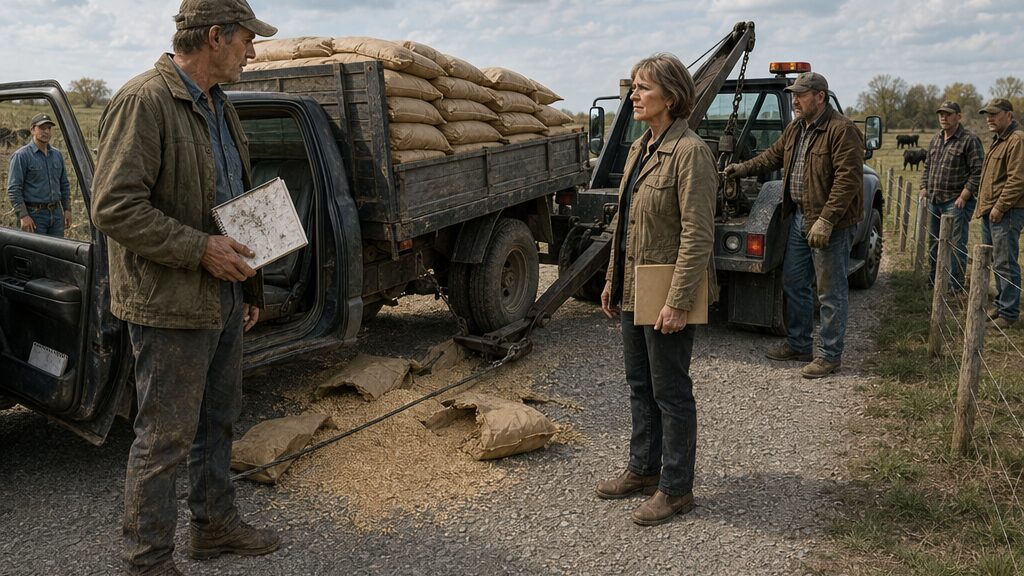
She Thought the County Could Seize His Farm Truck Until He Opened the Notebook He Had Kept for Three Years
Chapter 1: The Tow Cable Tightened Before Robert Said a Word
The steel cradle scraped under the rear axle of Robert Miller’s farm truck before he understood that Jack Harris intended to take it.
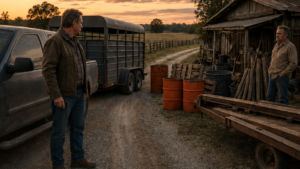
Robert stepped out from behind the feed trailer and stopped in the middle of the gravel road.
“Jack.”
Jack kept one knee on the ground. He pushed the cradle another few inches beneath the truck, then stood and brushed dust from his palms.
“Morning, Robert.”
“That truck isn’t going anywhere.”
Jack glanced toward Betty Clark instead of answering.
Betty stood twenty feet uphill beside her white pickup, one hand resting on the open door. Her clothes were too clean for the road, but Robert had seen her walk job sites in better shoes than most people wore to church. She had run the shared-road association for six years and spoke about the easement as though her family had poured it themselves.
“The vehicle is obstructing required clearance,” she said.
Robert looked at his truck.
Its right wheels sat on the packed shoulder beside his lower pasture gate. A feed-delivery truck had stopped beyond it, nose pointed toward his barn. There was enough room between Robert’s truck and the opposite ditch for a pickup to pass.
Maybe not a fire engine.
Maybe not two trucks side by side.
But that had never been the rule.
“Required by what?” Robert asked.
Betty folded her arms. “The road-access standard.”
“What standard?”
“The one everyone on this road agreed to follow.”
Robert’s jaw tightened.
Everyone was a useful word on a private road. It could mean seven landowners, four landowners, or Betty and whoever had stopped arguing first.
The feed-delivery driver leaned against his cab with a clipboard tucked under one arm. He looked as though he wanted to be anywhere else.
Robert pointed toward Jack’s rig.
“You called a tow truck while I’m unloading feed?”
“You were notified about keeping the easement clear.”
“I was told not to leave machinery in the traveled lane.”
“You’ve been warned about the shoulder too.”
“No.”
Betty’s expression barely changed.
Robert had known her long enough to recognize that look. It meant she had already decided the conversation was procedural.
Jack moved to the control lever on his tow truck.
Robert stepped closer, but stopped before touching anything.
“Jack, don’t lift it.”
Jack let out a breath. “I’ve got authorization.”
“From who?”
“The association.”
“Meaning Betty.”
“Meaning the association.”
The answer irritated Robert more than an argument would have.
Behind him, the feed driver started lowering another pallet.
Robert turned.
“Hold up.”
Too late.
The truck shifted slightly as Jack tested the lift. One of the stacked feed sacks on the open tailgate slipped, struck the edge, and tore.
A yellow stream of cracked corn spilled onto the gravel.
A second sack slid after it. Then another.
The driver lunged for the pallet, but a bag burst under his boot.
For several seconds, nobody spoke.
Corn rolled between the stones, collecting in the tire ruts and along the grass edge.
Robert stared at it.
He had paid for every sack. More importantly, he had cattle waiting on the delivery, and the southern pasture had already been eaten down shorter than he liked.
Betty looked at the mess, then at him.
“That’s unfortunate.”
Robert turned slowly.
“Unfortunate?”
“The truck should have been moved before unloading.”
“It was parked here because your contractor is blocking the turn into my gate.”
Jack looked over.
“That isn’t on me.”
Robert felt the familiar heat rise behind his ribs.
Years earlier, his father would have been shouting by now. He would have pointed at property corners, brought up old grudges, and reminded everyone whose grandfather had graded the first version of the road.
Robert had spent half his adult life trying not to become that man.
He bent, picked up the corner of the torn sack, and folded it inward to slow the spill.
Then he stood.
“Betty, show me the rule.”
“I don’t carry the association records in my pocket.”
“You quoted it.”
“I know the standard.”
“What’s the wording?”
She paused.
Only briefly.
“Vehicles and equipment must maintain unobstructed emergency and service access along the easement.”
Robert looked at the road again.
The wording sounded reasonable.
That was the problem.
It also sounded new.
For years, the posted notice at the mailboxes had said no permanent storage of machinery within the traveled portion of the road. Robert knew because he had copied the sentence once.
He had copied a great many things.
“Where does it say shoulder?” he asked.
Betty’s face hardened a fraction.
“Robert, this is exactly why we have rules. Everybody thinks their own truck is the exception.”
“I didn’t ask whether rules matter.”
Jack shifted beside the controls.
“You two want to sort this out, I can wait five minutes. After that I’ve got another call.”
Betty shook her head.
“No. Proceed.”
Robert looked at her.
“Betty.”
“You’ve had warnings.”
“Not for this.”
“You’ve had enough notice to understand the road must remain clear.”
The feed driver cleared his throat.
“I can back out if that helps.”
Robert glanced at the long delivery truck, then down the slope where Jack’s tow rig occupied most of the turnaround.
It would not help.
Not now.
Robert walked to the passenger side of his own truck.
Betty called after him.
“If you interfere with the tow, I’ll request a deputy.”
Robert opened the door.
“I’m not interfering.”
He leaned into the cab.
The seat smelled of dust, leather, and the faint oil scent that never left his work clothes. A pair of gloves lay on the floorboard. Receipts filled the center console. Under them sat a spiral notebook with a black cover bent nearly white at the corners.
Robert rested one hand on it.
He had started keeping notes after the first removal three years earlier.
Not because he planned to fight.
That was what he had told himself.
He wrote things down because people remembered arguments differently. Dates changed. Reasons changed. Amounts changed.
Ink did not.
Behind him, Jack’s hydraulic pump engaged with a low mechanical whine.
Robert lifted the notebook from the cab.
When he turned around, Betty’s eyes went directly to it.
For the first time that morning, she stopped looking certain.
Chapter 2: The Notebook Had Names Betty Did Not Expect
Robert opened the notebook to a page marked with a bent corner.
“April eighteenth,” he said. “Two years ago.”
Jack’s hand remained on the tow controls.
Betty stood beside her pickup.
Robert read without raising his voice.
“Brown cattle trailer removed from the east turnout. Owner charged three hundred seventy-five dollars. Reason given: blocked service access. Road was open on west side. No delivery scheduled.”
Betty’s eyes narrowed.
“You’ve been writing complaints about me?”
Robert looked down at the page.
“I’ve been writing down what happened.”
“That is your version.”
“Probably.”
He turned the notebook around enough for Jack to see the date.
“That’s why I wrote license numbers too.”
Jack did not move closer, but his attention shifted.
Robert turned another page.
“August second. Flatbed belonging to the widow at the north property. Towed from the grass shoulder while she was waiting on a tire replacement.”
Betty interrupted.
“That vehicle had been sitting there for two days.”
“Thirty-one hours.”
“That is more than a day.”
“It is.”
Robert kept his finger on the entry.
“Fee was nine hundred dollars after storage.”
Jack looked toward Betty.
She noticed.
“You are a contractor,” she said. “Not an association member.”
“I know what I am.”
“Then do your job.”
Jack rubbed his jaw.
“My job gets complicated when people start disputing authorization.”
Robert almost smiled, but did not.
He flipped forward.
“November seventh. Hay wagon ordered moved during rain. No tow completed because the ground was too soft.”
“That wagon was blocking the bend,” Betty said.
“Yes.”
The answer stopped her.
Robert looked at the page.
“It was blocking the bend.”
The feed driver had stepped closer now. He said nothing, but his eyes moved between them.
Robert continued.
“January twelfth last year. Pickup parked near the south gate during a medical call.”
Betty’s arms unfolded.
“That one almost prevented the ambulance from getting through.”
Robert nodded.
“It did.”
Jack looked at him.
“You wrote that down too?”
“I write down what happened.”
The road went quiet except for the idle of the tow truck and the soft rattle of cattle beyond the fence.
Betty’s expression changed.
Not to fear.
Not yet.
But her certainty had lost its smooth edge.
Robert tapped the page.
“I told the owner he was wrong. I helped move the truck before the ambulance came back out.”
Betty said, “So you admit the rules are necessary.”
“I admit access matters.”
“Then move your truck.”
“You’re trying to tow it.”
“Because you refused to comply.”
“You never asked me to move it.”
“I sent notices.”
“For leaving equipment in the traveled lane. Not for parking on the shoulder while unloading.”
She stepped closer.
“The road association has authority to maintain safe access.”
“Then show me where safe access became automatic towing.”
Betty stared at the notebook.
“This doesn’t prove anything except that you’ve spent three years collecting grievances.”
Robert closed it halfway.
“Maybe.”
He looked at Jack.
“But if you’re about to take my truck, I want the authorization in writing.”
Jack scratched the side of his neck.
“I got the call from Betty.”
“Written.”
Jack hesitated.
Betty’s voice sharpened.
“You do not need to indulge this.”
Jack turned toward her.
“I’m the one hauling the truck.”
“And you are under contract.”
“Yes. Under a contract I’d rather not explain to a judge because somebody decided a private-road rule means whatever they say that morning.”
The feed driver looked down, hiding a reaction.
Betty’s cheeks flushed.
Robert had never heard Jack challenge her before.
Jack walked back to the controls.
He lowered the cradle until the truck’s suspension settled.
“I’m pausing it.”
Betty stared at him.
“You cannot simply pause an authorized removal.”
“I can until I see the paperwork.”
“You’ve never required that before.”
Jack gave her a tired look.
“Maybe I should have.”
Robert felt no triumph.
Only space.
For ten minutes, the road had felt as if it belonged entirely to Betty’s decision. Now there was room for another question.
That was all.
Betty walked to her pickup and pulled a folder from behind the seat.
She removed a single sheet and held it toward Robert.
“This is your notice.”
He took it.
The paper ordered him to remove “all equipment, parked vehicles, stored materials, and other obstructions” from the easement corridor by five o’clock the following afternoon.
Robert read the line twice.
“Equipment?”
“That includes the baler parked beside your west fence.”
“That baler is on my property.”
“It sits partly within the easement corridor.”
“No, it doesn’t.”
“That will be determined if necessary.”
Robert looked up.
“So now this isn’t about my truck.”
“It was never only about your truck.”
There it was.
The larger thing.
Robert folded the notice.
Betty pointed toward his notebook.
“You have a day to move anything that interferes with access. After that, further enforcement will continue.”
She got into her pickup.
Jack watched her drive away before speaking.
“For what it’s worth, I’d move the truck myself.”
Robert looked at him.
“I was going to.”
Jack nodded toward the scattered feed.
“I’ll help you get those bags up.”
They recovered what they could. The feed driver found empty sacks in his cab, and together they shoveled corn from the cleanest part of the gravel.
By early afternoon the delivery was finished.
Robert moved his truck through the pasture gate.
The tow rig left empty.
It felt like a win until Robert walked into his kitchen and saw Betty’s notice beside the notebook.
Emily arrived twenty minutes later.
She worked in town and had come after Robert sent a three-word message: Road trouble again.
She read the notice first.
Then she opened the notebook.
“You kept all this?”
“Most of it.”
“Why didn’t you tell me?”
“You live forty minutes away.”
“That isn’t an answer.”
Robert filled two glasses at the sink.
Emily turned pages slowly.
Her irritation softened into concentration.
“There are names in here.”
“Initials mostly.”
“And amounts.”
“Yes.”
She stopped.
Robert saw the page before she spoke.
It was older than the others, the ink faded slightly.
Emily read the entry in silence.
Her face changed.
“What is this?”
Robert set the glasses down.
She pushed the notebook across the table.
The entry concerned the widow at the north property.
Three lines below the towing fee, Robert had written something else.
Spoke with her afterward. Told her not to fight it. Said paying would be cheaper than making trouble with the association.
Emily tapped the sentence.
“You told her to pay?”
Robert did not answer.
“You knew you thought the tow was wrong, and you told her to pay anyway?”
“I told her what I thought would end it.”
Emily stared at him.
“That isn’t the same thing.”
Robert looked at the notebook.
For three years he had treated those pages as proof of what other people had done.
He had never expected them to keep a record of him.
Chapter 3: Emily Found the Entry Her Father Never Mentioned
Emily left the notebook open between them.
“You told her to pay nine hundred dollars.”
Robert pulled out a chair but did not sit.
“I told her fighting Betty would cost more.”
“That isn’t what you wrote.”
“I remember the conversation.”
“So do you remember telling her she was probably right?”
Robert looked toward the kitchen window.
The gravel road was visible between the sycamores, pale and narrow in the afternoon light.
“I told her the tow looked wrong.”
“And then you told her not to challenge it.”
“She had just lost her husband. She was trying to keep that place running by herself.”
“That makes it worse.”
Robert turned.
“What did you want me to tell her? Hire a lawyer? Spend three months arguing over a trailer?”
Emily leaned back.
“I wanted you to tell her what you apparently already knew.”
“I didn’t know.”
“You knew enough to write it down.”
Robert felt the words land harder than he wanted.
He finally sat.
“That notebook wasn’t a case file.”
“What was it?”
“A record.”
“For what?”
He opened his mouth.
Nothing useful came out.
Emily closed the notebook.
“That’s what I thought.”
Robert stood again.
He hated being cornered in his own kitchen, but he hated more that she was not wrong.
“I was trying to keep things from getting worse.”
“For who?”
“For everybody.”
“No. For you.”
He looked at her sharply.
Emily did not retreat.
“You didn’t want another feud on this road.”
Robert’s hand tightened on the back of the chair.
“You don’t know what it was like when your grandfather was still here.”
“I know enough.”
“No, you don’t.”
His voice rose, then he forced it down.
His father had fought over everything: gates, fence posts, ditch water, hunting access, gravel bills. Some fights had been justified. Others had continued long after anyone remembered what started them.
At the feed store, people had stopped conversations when his father walked in.
At county meetings, somebody always expected him to object.
Robert had been twenty-seven when he first promised himself he would never live that way.
He had confused quiet with peace ever since.
Emily watched him.
“He made enemies.”
“Yes.”
“So you decided never to make anybody uncomfortable.”
“That isn’t fair.”
“Isn’t it?”
Robert looked away.
She softened slightly.
“I understand why you didn’t want to become him.”
He said nothing.
“But avoiding every fight doesn’t make you different from him. Sometimes it just leaves the fight for somebody else.”
The sentence stayed in the room.
Robert picked up the notebook and ran his thumb along the bent cover.
“She paid it,” he said.
Emily’s expression tightened.
“I know.”
“I drove her to get the trailer back.”
“And?”
“She thanked me.”
“For helping?”
“Yes.”
“That doesn’t mean you gave her good advice.”
Robert almost argued.
Instead he remembered the widow sitting beside him in his truck, hands folded over her purse, saying she could not afford another problem.
He had told himself he was protecting her.
Maybe he had protected himself from being asked to stand beside her.
Emily stood.
“If this road can shut down access whenever Betty decides a shoulder counts as obstruction, what happens next month?”
“It won’t.”
“You don’t know that.”
“I’ll deal with it.”
“You’ve been dealing with it for three years.”
Robert looked at her.
She took a breath.
“I need to know whether this place is workable.”
“What does that mean?”
“It means I own part of it too.”
The words hit differently from everything before them.
Robert’s wife had left Emily her share of the property. They rarely discussed it because nothing had required them to. The farm was Robert’s work, Emily’s childhood, and both of their responsibility on paper.
“You’re thinking about selling?”
“I’m thinking about not spending the next twenty years trapped in a road argument nobody fixes.”
“Selling your share fixes that?”
“For me, maybe.”
Robert pushed away from the table.
“You said you wanted to keep the farm in the family.”
“I do.”
“Then don’t talk like that.”
Emily’s face hardened.
“Then give me a reason not to.”
She left before supper.
Robert carried the notebook to the equipment shed.
He had intended to check the baler’s position against the fence line, but instead he sat on the wooden workbench and opened the book beneath the hanging shop light.
Page after page.
Dates.
Fees.
Weather.
License plates.
Times Betty had overreached.
Times she had not.
Then his own handwriting beside other people’s problems.
Paid rather than dispute.
Advised him to move it.
Told her association would make it expensive.
Not worth the fight.
Robert shut the notebook.
For the first time, the problem seemed larger than Betty’s authority.
He had spent years waiting for certainty before speaking.
Certainty had never come.
The next morning he drove to the equipment shed before sunrise and measured from the fence pins to the edge of the baler.
It sat clear of the traveled road.
Whether it sat inside the legal easement corridor was another question.
At seven-thirty, he called the county records office.
A clerk found the request he had submitted months earlier for historical easement documents.
“Someone from right-of-way is reviewing it,” she said.
“When?”
“I can’t promise a date.”
“I have an enforcement deadline this afternoon.”
“That may move it up.”
Robert almost laughed.
“May?”
“I’ll add the note.”
He hung up.
By nine, Betty’s white pickup rolled slowly past the pasture.
She did not stop.
Robert stood beside the baler and watched her disappear around the bend.
At ten-fifteen, his phone rang.
The display showed the county number.
“Robert Miller?”
“Yes.”
“This is Jonathan King with county right-of-way.”
Robert straightened.
“I’m looking at the easement record you requested.”
Robert glanced toward the road.
Jonathan continued.
“I think you and I need to sit down with the recorded map.”
“Does Betty have authority to tow from it?”
A pause.
“I didn’t say that.”
Robert waited.
Jonathan’s voice became more careful.
“But I did find two clauses you should see before you assume she has none.”
Chapter 4: The County Map Helped Betty More Than Robert Expected
Jonathan King circled two lines on the easement record and slid the paper across the county counter.
Robert did not touch it.
“What am I looking at?”
Jonathan tapped the first clause with the cap of his pen.
“Continuous passage for emergency, agricultural, utility, and service vehicles.”
Then the second.
“No owner may maintain an obstruction within the easement corridor that materially interferes with passage.”
Robert read both sentences twice.
“That doesn’t say Betty can tow anything she doesn’t like.”
“No.”
“It doesn’t say vehicles can’t stop on the shoulder.”
“No.”
“So what were you warning me about?”
Jonathan leaned back.
“You asked whether she had any authority. She does.”
Robert finally picked up the paper.
The recorded map was older than he was. Thin boundary lines crossed faded parcel numbers. The road itself was marked as a forty-foot easement even though the graveled surface was barely half that width in places.
Jonathan pointed toward Robert’s property.
“Your west fence is inside the easement corridor here.”
Robert stared at him.
“That fence has been there thirty years.”
“I believe you.”
“And the baler sits inside that fence.”
“Which may still put part of it inside the recorded easement.”
Robert felt the certainty he had carried into the building begin to thin.
He took his notebook from his jacket pocket and opened to the towing entries.
“What about these?”
Jonathan pulled the notebook closer.
For several minutes he said nothing.
He read the widow’s trailer entry.
The hay wagon.
The pickup during the medical call.
Robert watched his expression change almost imperceptibly.
Jonathan stopped at the ambulance entry.
“This one.”
“What about it?”
“You wrote that the vehicle reduced passage enough that an ambulance had difficulty.”
“Yes.”
“And you helped move it.”
“Yes.”
Jonathan turned another page.
“Here. A fertilizer spreader left overnight at the bend.”
“That one should have been moved.”
“So Betty wasn’t wrong every time.”
“I never said she was.”
Jonathan looked up.
“You came close.”
Robert leaned back.
It irritated him because it was true.
For three years, the notebook had become a quiet argument in Robert’s mind. Each entry had been another mark against Betty’s way of running the road.
But he had recorded the details honestly enough that the book resisted becoming the simple case he wanted.
Jonathan read several more pages.
“This helps you.”
Robert frowned.
“You just told me half of it helps Betty.”
“That’s why it helps you.”
Jonathan tapped the notebook.
“If this were twenty pages of Betty is wrong, Betty is wrong, Betty is wrong, I’d treat it like a neighbor dispute. You recorded dates, road conditions, measurements, even incidents where you agreed with her.”
“I wasn’t building evidence.”
“I can tell.”
Jonathan turned to the notice Betty had given Robert.
“Now this is different.”
Robert leaned forward.
Jonathan traced the sentence about automatic removal.
“I don’t see this authority in the recorded easement.”
“So the tow was improper.”
“I didn’t say that yet.”
Robert exhaled through his nose.
Jonathan continued.
“The association may have adopted separate rules. There may be agreements I haven’t seen. I’m not going to tell you something is invalid just because it isn’t in this document.”
“What about the fees?”
“That’s where I have more questions.”
Robert opened the notebook to several entries with amounts.
“Three seventy-five. Six hundred. Nine hundred.”
Jonathan wrote them down.
“Who collected them?”
“Tow company on some. Association on others.”
“Directly?”
“That’s what people told me.”
“Receipts?”
“I don’t have them.”
Jonathan stopped writing.
“Then right now you have notes about what people said they paid.”
Robert closed the notebook.
“You’re telling me I spent three years writing things down and it still isn’t enough.”
“I’m telling you writing something down does not automatically make every part provable.”
The irritation faded as quickly as it had come.
Robert knew that too.
Jonathan gathered the map sheets.
“I can review the easement language. I can determine whether the association is asserting powers that aren’t recorded. But if you’re asking the county to look into private penalties or improper charges, I need the paper trail.”
Robert looked at the pages in front of them.
For the first time since Jack had placed the tow cradle beneath his truck, Robert understood that stopping one tow would not settle anything.
Even proving Betty had exceeded one rule might not.
He drove home by way of the north section of the shared road.
At the bend near the widow’s property, he slowed.
The road narrowed there because drainage had eaten away part of the shoulder. A large truck approaching from the other direction would have almost nowhere to go.
Betty had complained about that section for years.
Robert had usually dismissed it as another excuse for control.
Now he looked at the ditch differently.
The following morning he walked the road with his notebook.
He measured the bend.
He checked where two trailers had been cited.
At one location, Betty’s complaint had been ridiculous. A pickup parked twelve feet off the traveled gravel could not reasonably have blocked anything.
At another, Robert had to admit a piece of machinery left where he had recorded it would have narrowed the turn badly.
The truth refused to line up neatly.
That afternoon, he spread copies of Betty’s old notices across his kitchen table.
Emily had not come back since their argument, but she had texted once.
Did the county call?
Robert had replied:
Yes. Complicated.
He placed notices in date order.
Most were warnings.
Then, roughly two years earlier, the language changed.
Administrative access fee.
Removal authorization.
Emergency-clearance assessment.
Robert pulled older pages from the notebook.
He checked dates.
Before that year, Betty complained, argued, and ordered things moved.
After that year, money appeared.
He sorted every notice he had.
The pattern became clearer.
The first fee notice came six weeks after the road had been rebuilt following a wet spring that washed gravel into the lower ditch.
Robert remembered the repair.
Three dump trucks.
A grader.
New culvert work.
And one association meeting he had skipped because a cow was calving.
He picked up his phone and called Jonathan.
“I found something.”
“What?”
“The fees all start the same year.”
“That alone doesn’t prove anything.”
“I know.”
Robert looked at the date at the top of the first notice.
“But they start right after the road repair.”
Jonathan was quiet.
“What repair?”
“The big one. Two years ago.”
“Do you have the association records from that year?”
“No.”
“Can you get them?”
Robert looked through the window toward the road.
Betty’s barn roof was visible beyond the trees on the neighboring ridge.
“I know who has them.”
Chapter 5: The Road Repair Bill Changed Every Rule Afterward
Betty did not deny the fees.
She opened a metal filing cabinet in the corner of her barn office and dropped a stack of unpaid invoices onto the desk between them.
“There,” she said. “That is what changed.”
Robert remained standing.
The office smelled of hay dust, printer toner, and old coffee. Through the open barn door, he could hear a gate chain knocking softly against a post.
He had brought his notebook.
For once, he left it closed.
Betty pushed the top invoice toward him.
“Read it.”
Robert looked at the amount.
Then the next one.
Gravel.
Culvert replacement.
Equipment rental.
Emergency grading.
The totals were higher than he remembered.
“A lot of people refused the assessment,” Betty said.
“I remember an assessment.”
“You didn’t come to the meeting.”
“I had livestock trouble.”
“You always have a reason.”
Robert looked at her.
She was not smiling.
There was no polished confidence from the towing scene now. She looked tired.
“How many refused?”
“Enough.”
“What happened?”
“I paid contractors before we had all the money because the road was becoming unusable.”
“You personally?”
“The association account covered what it could. I covered part of the rest.”
Robert studied her.
“You never told us that.”
“I sent notices.”
“You sent bills.”
“I shouldn’t have had to beg adults to understand that roads cost money.”
There it was again.
The part of Betty that always turned responsibility into obedience.
Robert pulled out a chair.
“Is that when you started charging access fees?”
“I started enforcing the obligations people had ignored.”
“That isn’t what I asked.”
Betty gathered the invoices into a straight stack.
“People would leave trailers in the road, rut the shoulders, block delivery access, then complain when maintenance costs increased.”
“So you decided towing would make them listen.”
“I decided consequences were necessary.”
“Were they adopted?”
Betty’s eyes moved toward him.
Robert waited.
“Were the towing rules adopted?” he asked again.
“The association already had authority to keep the easement open.”
“That isn’t the same thing.”
“You sound like the county now.”
“I talked to the county.”
“I assumed you had.”
Robert leaned back.
“You knew I would?”
“You’ve been carrying that notebook around for years, Robert.”
The words caught him.
“You knew about it?”
“I knew you wrote things down.”
“Since when?”
“Long enough.”
Betty looked toward the barn door.
“You think I didn’t notice you standing at the mailbox after meetings, copying dates? Or asking Jack what somebody paid?”
Robert’s fingers rested on the notebook cover.
“Then you knew people questioned the fees.”
“People question every bill.”
“Did they vote on the towing language?”
Betty did not answer.
Outside, a truck moved slowly along the gravel road.
Both of them waited for the sound to fade.
Finally she said, “No.”
Robert stared at her.
“No?”
“We discussed stricter enforcement.”
“That wasn’t my question.”
“I know.”
“You put language in notices that was never adopted.”
“The easement already required clear passage.”
“And private penalties?”
She looked away.
Robert felt anger return, but it no longer felt clean.
“Betty.”
“You weren’t there.”
“That doesn’t make a vote happen.”
“You weren’t there when the road nearly failed either.”
“I live on it.”
“You live on the upper section.”
Her voice sharpened.
“You know what happened that winter after the repair?”
Robert said nothing.
Betty opened another drawer and removed a photograph.
She slid it across the desk.
The image showed the lower bend under snow. A livestock trailer sat partly across the road.
Behind it, barely visible, was an emergency vehicle.
Robert recognized the location.
“The ambulance call,” he said.
“No. Different one.”
Robert looked up.
Betty’s face had changed.
“This was my sister.”
He had never heard that.
“She was staying with me after surgery. She collapsed in the kitchen.”
Robert glanced back at the photograph.
“The ambulance got through?”
“Eventually.”
“How long?”
“Eleven minutes from the bottom gate to my house.”
Robert said nothing.
“The driver of that trailer had left it there because he said he’d only be gone an hour.”
Betty’s voice lowered.
“She survived. Before you ask.”
Robert set the photograph down.
“So after that—”
“After that I stopped accepting everybody’s promise that they’d move something later.”
The room grew quiet.
Robert understood something he had resisted understanding.
Betty’s rules were not born entirely from greed or status.
Fear had been underneath them.
But fear had not given her the authority she claimed.
“You should have brought everyone back to the table,” he said.
“I tried.”
“No. You sent stronger notices.”
“Because meetings went nowhere.”
“So you made the decision yourself.”
Betty looked directly at him.
“Yes.”
The admission sat between them.
No excuse around it.
No careful wording.
Robert almost reached for the notebook.
Instead he kept his hands flat on his knees.
“Why the fees?”
“To recover costs.”
“From people whose vehicles had nothing to do with road damage?”
“From people using the road.”
“That isn’t the same thing.”
“No.”
It was the second clean admission.
Robert had expected denial.
Anger would have been easier.
Instead Betty looked like someone who had made one practical compromise, then another, until she could no longer remember exactly where authority ended and habit began.
“You knew the towing language wasn’t formally adopted,” Robert said.
“Yes.”
“And you kept using it.”
“Yes.”
“Even after people disputed it.”
Betty’s jaw tightened.
“Yes.”
Robert stood.
He picked up the notebook but did not open it.
“I’m giving all of this to Jonathan.”
“I assumed you would.”
He walked toward the door.
“Robert.”
He stopped.
Betty remained behind the desk.
“You’re acting like you stood outside this.”
He turned.
“What’s that supposed to mean?”
“You had an exemption.”
Robert frowned.
“What exemption?”
“Three winters ago. Your hay wagon sat inside the corridor for nearly a week.”
“I had a broken axle.”
“And I told Jack not to touch it.”
Robert remembered.
At the time, he had considered it neighborly common sense.
Betty continued.
“Two days later, another trailer was charged because it was blocking the lower turnout.”
Robert said nothing.
“You knew.”
“I knew my wagon wasn’t towed.”
“You knew hers was.”
The widow.
Robert felt the connection before Betty said anything else.
“You got the kindness you told her not to ask for.”
Robert’s grip tightened around the notebook.
Betty’s voice remained quiet.
“So when you tell Jonathan how I used the rules, make sure you tell him when the rules bent for you.”
Chapter 6: Robert Finally Put His Own Name Into the Record
Jonathan King placed three photocopied notebook pages beside Robert’s chair before the county review began.
“If you want,” he said quietly, “these can stay outside the initial submission.”
Robert looked down.
He knew the pages without reading them.
His broken hay wagon.
The widow’s trailer.
His own note advising her to pay rather than fight.
Across the small hearing room, Betty sat at the end of a folding table with a file box beside her.
Jack Harris sat two chairs away.
Emily had taken a seat behind Robert.
She had not told him what to do.
That made the decision harder.
Robert touched the first photocopy.
“Why leave them out?”
Jonathan kept his voice low.
“They are not necessary to establish whether certain fees and towing practices exceeded the written easement.”
“They matter.”
“They may complicate your complaint.”
Robert almost smiled.
“That seems to be what everybody keeps telling me about the truth.”
Jonathan studied him for a moment.
“Then I’ll include them.”
When the meeting began, Jonathan did not make a speech.
He laid out the recorded easement, association notices, maintenance invoices, towing records Jack had provided, and Robert’s notebook.
Two neighboring farmers sat along the wall.
The widow had declined to attend.
Robert understood why.
Jonathan started with the narrow question.
The easement permitted the association to protect passage.
It did not clearly authorize automatic towing by the chairperson.
It did not establish the private penalty schedule Betty had used.
The maintenance problem was real.
The enforcement process was not.
Betty listened without interrupting.
When Jonathan finished, she said, “If people had paid the assessment, none of those charges would have been necessary.”
Jonathan looked at her.
“Necessary and authorized are different questions.”
Betty’s mouth tightened.
Robert recognized the feeling.
He had made the same mistake in reverse.
Because Betty’s actions felt wrong, he had wanted every complaint she made to be wrong too.
Jonathan opened Robert’s notebook.
“Mr. Miller, you documented incidents for approximately three years?”
“Yes.”
“Why?”
Robert looked at the pages.
At first he gave the answer he had always used.
“People remembered things differently.”
Jonathan waited.
Robert glanced back at Emily.
She did not nod.
She did not rescue him.
He looked at Betty.
Then at the two pages Jonathan had offered to exclude.
“That’s not the whole reason.”
The room stayed still.
“I kept thinking somebody ought to write down what was happening.”
Jonathan said, “Why didn’t you bring the records forward earlier?”
There it was.
The question beneath all the others.
Robert rubbed his thumb along the worn notebook edge.
“My father fought with everybody on that road.”
One of the older farmers shifted in his chair.
Robert continued.
“He fought when he was right. He fought when he was wrong. After a while people stopped hearing the difference.”
His throat felt dry.
“I spent a long time trying not to become him.”
Emily looked down.
Robert opened the notebook himself.
“I thought staying quiet made me reasonable.”
He found the page.
“Three winters ago, my hay wagon broke an axle inside the easement corridor.”
Betty’s eyes moved toward him.
“She gave me time to repair it. No tow. No fee.”
Robert read the next entry.
“Two days later, a trailer belonging to the widow up the road was removed from the lower turnout.”
He stopped.
Nobody spoke.
“I told her not to challenge the fee.”
Jonathan asked, “Why?”
Robert looked at the handwriting.
“Because I thought fighting would cost her more.”
“Did you believe the charge was fair?”
“No.”
The word came out more quietly than he expected.
“Did you know your own equipment had been treated differently?”
“Yes.”
Emily breathed out behind him.
Robert continued before he could retreat.
“I wrote down every time I thought Betty stretched the rules. But I also wrote down the times she had a real reason.”
He turned several pages.
“Ambulance blocked. January twelfth.”
Another.
“Fertilizer spreader left at the bend overnight. Dangerous.”
Another.
“Delivery truck unable to pass because a trailer was parked wrong.”
He closed the book halfway.
“If you’re going to use my notes, use all of them.”
Jonathan said nothing for a moment.
Then he pulled the complete notebook toward the center of the table.
“All of them will be part of the record.”
Something in Robert loosened.
Not relief.
More like the end of hiding behind his own evidence.
Jonathan turned to Jack.
“Mr. Harris, when you attempted to remove Mr. Miller’s truck, what document authorized you?”
Jack shifted.
“Betty called.”
“Did you receive a written tow order?”
“No.”
“Did your contract state that the association chair could independently order removal of any vehicle located anywhere inside the easement corridor?”
Jack picked up a folder.
“I went through the contract after that day.”
“And?”
“There’s language about obstructing vehicles.”
“Automatic removal?”
“No.”
“Private penalty collection?”
Jack shook his head.
“No.”
Betty spoke.
“You had accepted those calls for two years.”
Jack looked at her.
“I did.”
“And collected fees.”
“When vehicles reached my yard, yes.”
“So do not pretend this was entirely my interpretation.”
Jack’s face reddened.
“I’m not.”
He glanced at Robert.
“I should have asked for better paperwork.”
The admission mattered because it did not solve everything.
No single villain carried the entire road on their back.
Jonathan reviewed the maintenance invoices next.
The unpaid costs were legitimate.
Several landowners still owed portions of approved road work.
That money did not disappear because Betty had exceeded her authority elsewhere.
One of the farmers objected.
“So we still have to pay?”
Jonathan answered evenly.
“If the assessment was properly adopted, yes.”
The farmer sat back, dissatisfied.
Robert understood him.
Justice felt less satisfying when it came with a bill.
Jonathan returned to the towing notices.
“Until a revised access agreement is adopted and authority is clarified, disputed vehicle removals under these association notices are suspended.”
Betty looked up sharply.
“What happens if someone blocks emergency access tomorrow?”
“Call the sheriff’s office or the appropriate emergency authority. Immediate hazards can still be addressed.”
“That will take longer.”
“Then the association needs lawful procedures that work faster.”
Betty looked toward Robert.
For a moment he expected accusation.
Instead she appeared tired again.
“You wanted the towing stopped,” she said.
Robert shook his head.
“No.”
Her eyebrows lifted.
“I wanted you to stop deciding alone.”
The words came without force.
That made them harder to dismiss.
Jonathan gathered the documents.
“The county will provide recommended easement language. The landowners will need to decide maintenance standards, temporary stopping rules, emergency clearance, and who may authorize enforcement.”
One of the farmers muttered, “That meeting will be pleasant.”
Nobody laughed.
Emily waited until the room began emptying before approaching Robert.
“You read the exemption.”
“Yes.”
“You didn’t have to.”
“Yes, I did.”
She studied him.
“That’s new.”
Robert slipped the notebook into his jacket.
Outside, Betty stood beside her pickup with her file box balanced against one hip.
Jack walked past her toward his tow truck.
She called after him.
“If there is another blocked vehicle?”
Jack stopped.
“Get me something in writing.”
Betty stared at him.
Then she nodded once.
Robert watched the exchange.
The old system had not collapsed dramatically.
No one had been led away.
Nobody applauded.
But something important had changed.
A phone call from Betty was no longer enough.
Jonathan came through the courthouse door behind them carrying the recorded easement.
“The temporary suspension is effective today,” he said.
Robert looked toward the road leading home.
For the first time in years, the next problem on that gravel road could not be solved by one person simply insisting that everyone else had already agreed.
Chapter 7: The Gravel Road Stayed Open Under Different Rules
The first feed truck under the temporary agreement stopped at the lower bend and waited.
Robert Miller saw it from the pasture gate and immediately understood why.
A pickup belonging to one of the neighboring farmers sat half on the gravel and half on the shoulder, close enough to the bend that the delivery driver was unwilling to squeeze past.
Six weeks earlier, Betty Clark would have called Jack Harris.
Six weeks earlier, Robert might have watched from his fence, written down the time, and waited to see what happened.
Instead, he walked toward the road.
The delivery driver lowered his window.
“Morning. I think I can make it, but I’d rather not take the ditch with ten tons behind me.”
“Don’t.”
Robert approached the parked pickup.
Nobody was inside.
He checked the windshield.
A paper card sat beneath the wiper.
TEMPORARY STOP — OWNER AT SOUTH FIELD — RETURNING BY 9:30.
Robert looked at his watch.
9:18.
The new agreement was not final yet, but the temporary rules were simple: emergency access stayed clear at all times; large deliveries received priority passage; short stops were allowed when the driver left a location and return time; nobody ordered a tow without written authority except law enforcement responding to an immediate hazard.
It was not elegant.
It was workable.
Robert called the number on the card.
The neighboring farmer answered on the second ring.
“You blocking the feed truck?” Robert asked.
A pause.
“Didn’t think I was.”
“You are.”
“I’ll be there in five.”
“Good.”
Robert hung up.
The delivery driver smiled slightly.
“That easy?”
“Today.”
Robert stepped back toward his gate.
Another vehicle appeared farther up the road.
Betty’s white pickup.
She slowed as she approached the stopped feed truck.
Robert watched her face through the windshield.
She saw the parked pickup.
Then the card.
Then Robert.
For a moment, old habits seemed to gather behind her expression.
She pulled onto the grass and got out.
“Who authorized that stop?”
Robert almost answered the way he once would have.
Not my problem.
Instead he said, “Owner left a card. He’s coming back.”
Betty checked her watch.
“That truck cannot sit there during a commercial delivery.”
“I know.”
“Then why is it still there?”
“Because I called him instead of calling a tow truck.”
Betty looked toward the feed driver.
“How long?”
“Five minutes, he said.”
She folded her arms.
The posture was familiar, but something about it had lost its old finality.
“We wrote twenty minutes maximum for temporary stops,” she said.
“We did.”
“And delivery traffic has priority.”
“Yes.”
“So he should have moved before this truck arrived.”
“Yes.”
Betty looked at Robert, almost suspicious of the agreement.
“You aren’t going to argue?”
“Not when you’re right.”
Her mouth tightened.
For half a second, he thought she might smile.
She did not.
The neighboring farmer arrived in an old utility vehicle less than four minutes later.
He moved the pickup without complaint.
The feed truck passed.
No one paid a fee.
No one called Jack.
Nothing dramatic happened.
Robert found that strangely satisfying.
By noon, six landowners had gathered at the long folding table set beside Robert’s equipment shed.
Jonathan King had provided recommended language from the county, but he had made one thing clear: the county would not run their road for them.
They had to agree.
That had proved harder than stopping the towing.
One farmer wanted a fixed annual maintenance charge based on acreage.
Another wanted charges based on road frontage.
Betty argued that heavy equipment users should pay more because they caused more wear.
Robert thought she had a point.
The same farmer who had complained about paying the old assessment disagreed loudly.
“My tractor weighs less than one of her cattle trailers.”
Betty looked toward him.
“And your fertilizer deliveries have cut the lower shoulder twice.”
“Prove it.”
Robert opened a new spiral notebook.
The cover was blue.
Clean.
No grease marks yet.
He wrote the date.
Then he looked up.
“Road-maintenance worker took pictures after both incidents.”
The farmer stared at him.
Robert added, “That doesn’t mean you pay for the whole road.”
Betty said, “But it means usage should matter.”
Robert nodded.
“It should.”
Betty looked at him again.
The surprise was smaller this time.
They worked through the afternoon.
No automatic towing.
Written authorization required.
Documented notice whenever practical.
Emergency hazards handled immediately.
Maintenance assessments separated from penalties.
Disputes reviewed by three landowners rather than one association chair.
The last provision took nearly an hour.
Betty opposed it first.
“If something needs a decision, three people may take three days.”
Robert replied, “Then write an emergency exception.”
“And everybody will claim their problem is an emergency.”
“Then define emergency.”
They did.
Blocked ambulance or fire access.
Immediate danger to people, livestock, utilities, or the road structure.
Not an ugly trailer.
Not a disagreement over a shoulder.
Not a chairperson losing patience.
By late afternoon the draft had pencil marks over every page.
Betty sat back and rubbed the bridge of her nose.
“I still think this is too slow.”
Robert closed the folder.
“It is slower.”
“That road does not care about procedure when a culvert washes out.”
“No.”
“And people still owe money.”
“I know.”
That part had become clear during the county review.
Several of the original maintenance assessments had been properly approved. Robert owed his share.
So did others.
Some of Betty’s later access charges were being reviewed for refunds, but the gravel, grading, and culvert work had actually happened.
Justice had not erased the bill.
Robert preferred it that way now.
Emily arrived while they were stacking chairs.
She carried two cardboard trays of coffee.
“You’re still speaking to each other,” she said.
“Barely,” Betty replied.
Emily handed her a cup.
Betty accepted it.
That small gesture would have been unimaginable six weeks earlier.
Emily followed Robert into the equipment shed.
The old black notebook sat on his workbench beside the new blue one.
She noticed both.
“You started another?”
“Yes.”
She picked up the new book.
On the first page Robert had written:
Shared Road Record.
Below it were columns for date, condition, action, cost, and person confirming.
Emily looked at him.
“Who keeps it?”
“Everybody.”
“That sounds dangerous.”
“It probably is.”
She smiled.
Then her expression became more serious.
“I talked to the attorney.”
Robert waited.
He knew what she meant.
Her ownership share.
The possibility of selling it.
“I’m not listing anything,” she said.
Robert kept his hands in his pockets.
“Because of the road agreement?”
“Partly.”
He nodded.
Emily set the notebook down.
“But if I stay involved, I stay involved.”
“What does that mean?”
“It means you don’t get to decide that something is too unpleasant to tell me.”
Robert looked at the old notebook.
“That seems fair.”
“And when there’s trouble, you call before you spend three years collecting evidence by yourself.”
He rubbed his jaw.
“That one might take practice.”
“I figured.”
She stepped toward the door, then stopped.
“Dad.”
Robert looked at her.
“I never wanted you to become Grandpa.”
“I know.”
“I just didn’t want you disappearing in the opposite direction either.”
She left him with that.
Robert stood alone for several moments.
Then he picked up the black notebook.
Its cover was soft at the corners from years of being carried in his truck.
It had begun as protection.
Then it became accusation.
Then evidence.
Finally, it had become something less comfortable: a record of where Robert himself had failed to act.
He did not throw it away.
He placed it on the shelf above the workbench.
Outside, an engine approached.
Robert walked back to the road.
Jack Harris’s tow truck came around the bend.
The same truck.
The same steel cradle visible behind the cab.
For an instant Robert felt his shoulders tighten.
Jack slowed beside the equipment shed.
“You call me?”
“No.”
“Betty did.”
Robert looked toward her.
She was standing near the table with the draft agreement in her hands.
Jack climbed down from the cab carrying a sheet of paper.
“Before anybody gets excited, I’m not towing anything.”
He handed the paper to Robert.
It was a revised service form.
Jack had added a blank requiring written authorization and the specific rule permitting removal.
“No signature, no tow,” Jack said.
Betty walked over.
“You added that yourself?”
“My insurance agent liked it.”
Betty read the form.
“You’re going to make emergencies harder.”
“I’ll tow for law enforcement in an emergency.”
“And association calls?”
Jack pointed at the signature line.
“Put it in writing.”
Betty gave the paper back.
“Fine.”
There was no apology.
Robert had stopped expecting one.
Jack returned to his truck and drove away.
A few weeks later, the county review produced its final recommendations.
Several disputed association charges were ordered back through the association’s own accounting process for refund or credit.
Not all of them.
Some were supported.
The widow received part of what she had paid.
Robert drove the notice to her himself.
She read it at her kitchen table and looked at him over the page.
“You didn’t have to come all this way.”
“Yes, I did.”
She studied him long enough that he wondered whether she remembered exactly what he had told her years earlier.
Then she said, “You were wrong back then.”
Robert nodded.
“Yes.”
“You told me to let it go.”
“Yes.”
She folded the notice.
“You trying to apologize?”
“I think I am.”
She considered that.
“Not very gracefully.”
“No.”
That made her laugh once.
It was enough.
By the beginning of the next month, the landowners signed the new road agreement.
Betty remained involved.
She did not remain in sole control.
She handled maintenance schedules because she was good at them.
Robert joined the three-person review group because, as Emily told him, he had finally learned the difference between keeping records and hiding behind them.
The first official entry in the new notebook concerned nothing dramatic.
Loose gravel at the lower bend.
Robert wrote the date.
Road-maintenance worker inspected.
Two loads required.
Cost estimate pending.
When he finished, habit made him start to close the book and put it in his jacket.
He stopped.
The neighboring farmer beside him held out a hand.
“My turn to keep it?”
Robert looked down at the blue cover.
For three years, the old notebook had belonged only to him.
His observations.
His suspicions.
His silence.
This one was supposed to be different.
He handed it over.
“Write down what you see.”
The farmer tucked it beneath his arm.
Down the hill, another feed truck turned onto the gravel road.
Nothing blocked its path.
Robert opened the pasture gate before it arrived.
The truck rolled through without stopping.
The gravel cracked beneath its tires, ordinary and loud.
Robert watched it pass, then looked up the road toward the neighboring farms.
The road still belonged to all of them.
That was exactly why none of them should have been allowed to rule it alone.
The story has ended.