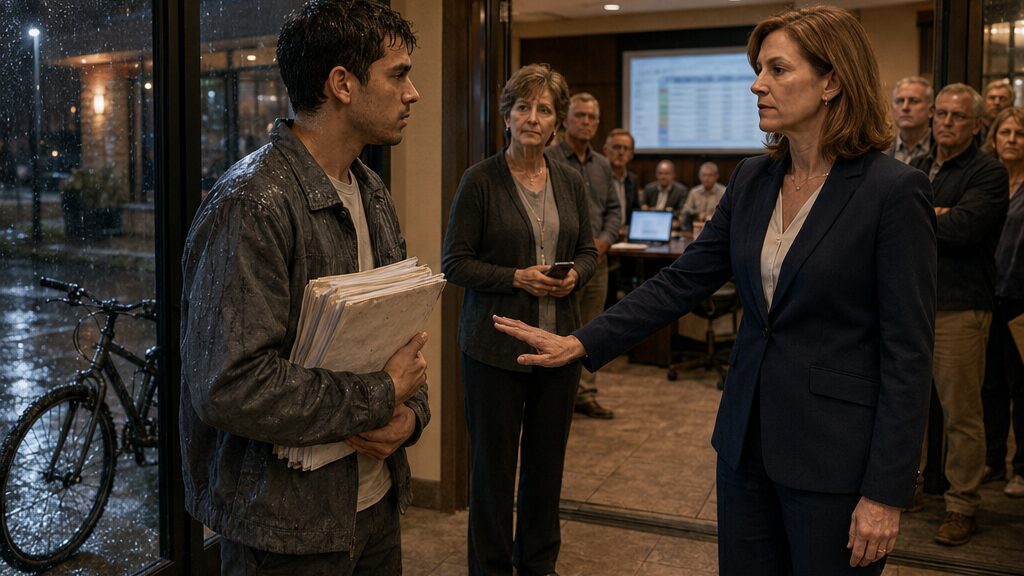
The HOA Mocked His Rusted Bicycle Until a Missing Reserve Check Put Everyone’s Character on Trial
Chapter 1: The Bicycle Beside the Clubhouse Nobody Respected
“Why is the bicycle kid handling reserve documents?”
Catherine Moore did not lower her voice.
The clubhouse lobby had gone quiet enough that Daniel Rivera could hear rainwater ticking from the hem of his jacket onto the tile. Through the glass doors behind him, his old bicycle leaned against the rack under a weak awning, its frame silvered with rain.
Daniel kept both hands around the stack of budget packets he had carried from the management office.
Catherine stood beside the conference-room entrance in a fitted navy blazer, one hand resting on a leather folder. Two homeowners waiting for the meeting glanced toward Daniel, then toward the bicycle outside.
“He’s staff,” Linda Carter said.
“Temporary staff,” Catherine corrected.
Daniel felt the word land exactly where she meant it to.
Kevin Harris appeared from the office hallway with his phone in one hand. “Daniel, did you make the copies?”
“They’re here.”
Kevin nodded without looking at him. “Good.”
Catherine gave a short laugh. “We’re about to discuss six figures in reserve expenses, and the person carrying the paperwork can’t afford a car.”
One homeowner looked away.
The other pretended to read the meeting agenda.
Daniel could have told her his car had died eight months earlier. He could have told her the transmission estimate had been nearly what he earned in two months between the HOA job and bartending. He could have told her the bicycle had cost him eighty dollars from a repair shop near his father’s place.
Instead, he said, “The packets are in agenda order.”
Catherine blinked, as if his refusal to defend himself were somehow impolite.
“Put them inside.”
Daniel walked past her.
His sneakers squeaked against the tile.
The reserve-budget meeting began twelve minutes later. Daniel took the small chair beside the wall, half behind a filing cabinet, where temporary staff were expected to sit unless someone needed a document.
Catherine controlled the room easily.
Insurance premiums were rising. The roof reserve was behind schedule. The parking structure would need another engineering review. There were questions about whether the board could postpone exterior painting for one more cycle.
Daniel listened while sorting maintenance invoices on his lap.
Numbers moved across the wall-mounted screen.
Catherine spoke about responsible stewardship, discipline, and “not creating panic where none was necessary.”
Then a figure caught Daniel’s eye.
He looked again.
The projected reserve schedule showed a year-end balance nearly forty thousand dollars lower than the supporting worksheet he had reconciled that afternoon.
He leaned forward.
The total in one column was being reduced twice.
Daniel waited until Catherine paused.
“Excuse me.”
Her mouth tightened.
“Yes?”
“The roof contribution is being subtracted twice.”
Silence.
Kevin finally looked up.
Catherine turned toward the screen. “No, it isn’t.”
Daniel felt heat climb into his face.
He could stop there.
Temporary staff did not correct treasurers in front of homeowners.
But if the number stayed, the board would make its next decision using the wrong balance.
“The formula in that cell includes the roof contribution,” he said. “Then the summary line subtracts it again.”
Catherine’s expression changed by barely a degree.
“Are you sure?”
Daniel stood and crossed to the laptop.
He did not touch it.
He pointed instead.
Kevin leaned closer, clicked the cell, then another.
The formula bar appeared.
Nobody spoke for several seconds.
Kevin cleared his throat. “He’s right.”
The reserve balance increased by $38,600 when he fixed it.
One of the homeowners exhaled.
“That changes the insurance discussion,” she said.
Catherine closed the spreadsheet.
“We would have caught it before anything was finalized.”
Daniel returned to his chair.
“I’m sure you would have,” he said.
It was the wrong answer.
He knew it as soon as Catherine looked at him.
Not disrespectful enough to punish.
Just sharp enough to remember.
After the meeting, she caught him gathering abandoned coffee cups.
“You embarrassed me.”
Daniel stacked two cups together. “I corrected a formula.”
“You could have brought it to Kevin privately.”
“The board was discussing the number.”
“That’s not the point.”
He looked at her.
For the first time that evening, the anger in him felt clean.
“Then what is?”
Catherine folded her arms.
“The point is knowing your role.”
Daniel almost laughed.
Instead, he carried the cups to the trash.
Outside, the rain had weakened to a mist.
His bicycle waited beneath the awning, water beading along the rusty chain.
Daniel unlocked it and checked his phone.
A message from the bar manager asked if he could cover until closing.
He typed yes before calculating what that meant.
Home after two.
Back at the clubhouse before eight.
Rent due Friday.
Minimum student-loan payment already late.
He put the phone away.
At twenty-six, Daniel had become skilled at measuring his life in small deficits: fourteen dollars short here, thirty-two dollars there, a utility bill moved three days, groceries delayed until the next shift.
He never told Donald about any of it.
His father still climbed ladders with paint buckets at sixty-one. If Daniel mentioned money, Donald would ask how much.
Then he would find it somehow.
Daniel would rather skip dinner.
“Daniel.”
He turned.
Linda Carter stood just inside the clubhouse doors.
She had been quiet through most of the meeting.
Now she held her phone toward the reserve spreadsheet still visible faintly on the conference-room screen.
Daniel realized she had taken a picture.
“Did you notice that formula today?” she asked.
“Yes.”
“Why didn’t you tell Kevin before the meeting?”
“I put a note on the reconciliation sheet.”
Linda’s eyes narrowed slightly. “And he missed it.”
Daniel shrugged.
“I guess.”
She studied him for a moment.
Not with Catherine’s suspicion.
That almost made him more uncomfortable.
“You bartend at night, don’t you?”
Daniel’s hand tightened around the bicycle key.
“Sometimes.”
“Kevin mentioned it.”
Of course he had.
Daniel braced for advice about professionalism or sleep or commitment.
Linda only said, “Tomorrow, I need the maintenance invoices reconciled against the reserve schedule before the insurance call.”
“I can do it in the morning.”
“No. I need you after the office closes. Too many people coming in and out during the day.”
Daniel glanced at his bike.
“I work tomorrow night.”
“What time?”
“Ten.”
Linda nodded. “Stay until nine-thirty. I’ll make sure you’re paid for the extra hours.”
Daniel stared at her.
The HOA position had been sold to him as temporary hourly support with no guarantee beyond the quarter. Extra time was usually something Kevin asked him to “flex.”
Linda seemed to understand what he was thinking.
“I said paid.”
From the conference room, Catherine called her name.
Linda turned, then looked back.
“And Daniel?”
“Yes?”
“Bring me the version of the spreadsheet you corrected. Not Catherine’s printed copy. Yours.”
Before he could ask why, she walked away.
Daniel stood outside beneath the awning with one hand on the handlebars.
Through the clubhouse glass, Catherine was speaking rapidly to Linda.
Kevin joined them.
All three glanced toward the reserve spreadsheet.
Then Linda looked directly at Daniel.
For the first time, he wondered whether correcting that one formula had shown her something Catherine had never intended anyone to see.
Chapter 2: Someone Replaced What Daniel Could Not Afford
The cable lock lay in two pieces on the concrete.
Daniel stared at it for several seconds before looking at the empty bicycle rack.
He checked the other side of the clubhouse.
Nothing.
The bicycle had been ugly enough that he had once assumed theft was impossible. Faded paint. Rust on the rear sprocket. A brake lever wrapped with black electrical tape.
Someone had still wanted it more than he had been able to protect it.
“Problem?”
The night security guard stood near the parking court.
“My bike.”
The guard looked toward the rack.
“Was that yours?”
Daniel held up the severed cable.
“Yeah.”
The guard winced. “I saw it earlier.”
“What time?”
“Maybe six.”
Daniel checked his phone.
7:18.
His shift at the bar began at ten.
The bar was more than four miles away. His apartment was another two miles in the opposite direction.
He opened a ride-share app.
Twenty-three dollars to the bar.
Another estimate for the ride home after closing was thirty-one.
Fifty-four dollars.
Before tips, some slow shifts barely paid him ninety.
He closed the app.
“Want me to file an incident report?” the guard asked.
Daniel looked at the empty rack.
“For an eighty-dollar bike?”
“You never know.”
“I know.”
He slipped the broken lock into his backpack.
Inside the management office, Linda was reviewing invoices at the conference table.
“You’re still here?” she asked.
“My ride disappeared.”
She looked up.
“What?”
“My bike got stolen.”
Linda set down her pen.
“From here?”
Daniel immediately regretted mentioning it.
“It’s fine.”
“That wasn’t what I asked.”
“From the rack.”
“When?”
“No idea.”
Linda stood.
“Did security check cameras?”
“Probably.”
“Probably?”
Daniel pulled his backpack over one shoulder. “I have to get to work.”
“Daniel.”
He stopped.
Linda’s expression had changed.
Not pity exactly.
Concern was close enough.
“I said it’s fine.”
He left before she could answer.
At the bar, he spent six hours opening beer bottles, wiping sticky counters, cutting limes, and pretending the arithmetic in his head was not getting worse.
Fifty-four dollars in transportation.
Rent short by one hundred forty.
The rear tire on his father’s work truck needed replacing, though Donald had not asked for money.
Student loan overdue.
By one in the morning, Daniel had reduced the next week to bus routes and missed sleep.
A coworker asked why he was so quiet.
“Bike got stolen.”
“That sucks.”
“Yeah.”
“You gonna get another?”
Daniel rinsed a glass.
“Eventually.”
He hated the word.
Eventually was what people said when money controlled the calendar.
At closing, he walked partway home to reduce the ride-share fare.
The next afternoon Donald called while Daniel was sorting pool-maintenance receipts.
“You sound tired.”
“I’m working.”
“You always say that like I called you at a beach.”
Daniel smiled despite himself.
In the background, he could hear a compressor.
“You painting today?”
“Trim job.”
“Thought your shoulder was bothering you.”
“It bothers me whether I work or not.”
That was Donald’s answer to everything physical.
Pain was a condition, not a decision.
Daniel almost told him about the bicycle.
He could already hear what would happen.
How much do you need?
I’ll send it Friday.
Don’t argue with me.
Instead, Daniel said, “You need that truck tire yet?”
“Truck’s fine.”
“That means yes.”
“That means worry about your own business.”
Daniel looked toward the clubhouse window.
Maybe that was where he had learned it.
Two Rivera men, each trying to protect the other by pretending not to need anything.
“Gotta go,” Daniel said.
“You eating?”
“Yes.”
It was a lie.
He had crackers in his backpack.
After the call, Daniel opened the bus schedule again.
The nearest route stopped running before his bar shift ended.
Kevin passed his desk.
“You good?”
“Fine.”
Kevin kept walking.
Daniel almost admired the efficiency of it.
By six, he had decided to buy another used bicycle after rent. That meant at least two weeks of expensive late-night transportation.
Unless he picked up extra bar shifts.
Unless the landlord waited.
Unless nothing else went wrong.
He left the office carrying a plastic bag of invoices for Linda.
Then he stopped.
A bicycle stood at the rack.
Not new.
Not expensive.
But far better than the one that had disappeared.
Dark frame. Good tires. Recently oiled chain. Working lights.
A small tag had been looped around the handlebar.
No name.
No note.
Only a maintenance inventory number handwritten on one side.
Daniel looked through the clubhouse windows.
Kevin was gone.
Linda’s office was dark.
Catherine crossed the far end of the parking court carrying groceries from her SUV. She saw Daniel standing beside the bicycle.
Her eyes moved from him to the frame.
“Management replacing personal property now?”
Daniel’s face hardened.
“I don’t know.”
“Well, somebody’s generous.”
She continued toward her building.
That one sentence spoiled the relief before he had allowed himself to feel it.
Daniel touched the handlebar.
He imagined Linda approving some reimbursement because she had decided the poor temporary employee required assistance.
He hated how much he needed it.
That was the worst part.
He unlocked the attached combination lock. The code had been written discreetly on the tag.
He considered leaving the bicycle where it was.
Pride was easiest when you could afford it.
Daniel could not.
He rode it to the bar.
The brakes worked perfectly.
The following night, after his shift at the HOA office officially ended, Daniel stayed to finish invoice reconciliation.
The building was nearly silent by eleven.
His replacement bicycle was visible beneath the parking-lot light.
Daniel entered the last vendor invoice and opened the accounting portal.
A menu appeared on the left side.
He stopped typing.
RESERVE ACCOUNTS.
He had seen the label before.
What he had never seen was the option beneath it.
TRANSFER FUNDS.
Daniel clicked once.
A new screen opened.
He stared at the available balance.
$617,284.32.
Below it was a routing field.
Editable.
Daniel moved the mouse away.
Then he noticed something worse.
The account owner shown in the permissions box was not Linda.
Not Catherine.
Not Kevin.
It was him.
Daniel Rivera.
Junior Administrative Access.
Full transfer permissions.
Chapter 3: The Reserve Account Opened Under His Name
Daniel closed the transfer window.
Then he opened it again.
The same permissions remained.
His name.
Full access.
More than six hundred thousand dollars.
For several seconds he simply listened to the building.
Air conditioner.
Refrigerator compressor in the clubhouse kitchen.
A distant elevator bell from the residential wing.
No footsteps.
No voices.
He clicked into the permissions page carefully, keeping both hands visible above the desk as if someone might later ask what he had touched.
The system showed checkmarks beside functions he had no reason to possess.
Create transfer.
Modify vendor routing.
Edit reserve allocation.
Approve draft.
View linked bank details.
Daniel’s mouth went dry.
He had spent the afternoon entering landscaping invoices and checking whether plumbers had included unit numbers.
Someone had effectively handed him the HOA’s financial keys.
His phone lit up beside the keyboard.
RENT REMINDER.
He turned it face down.
That somehow made the screen worse.
Daniel opened a harmless vendor record and selected edit.
A bank-routing field unlocked immediately.
He canceled.
Next he opened an old reserve transaction.
Editable.
Canceled again.
He was no accountant, but he knew enough from months of filing invoices to understand what the system would allow.
A person with these permissions could change where a legitimate reimbursement went.
Could create a vendor.
Could disguise a small transfer among hundreds of maintenance payments.
Could move money and hope nobody checked closely enough.
Daniel leaned back.
Outside the office window, the replacement bicycle stood beneath the security light.
He thought about Catherine’s voice.
The kid who can’t afford a car.
Then he thought about his rent.
Three days late after Friday.
Late fee after that.
His student loan had already slipped another month.
There were numbers that felt abstract because they were too large.
Six hundred seventeen thousand dollars was one of them.
There were other numbers Daniel could feel physically.
One hundred forty dollars short.
Fifty-four dollars in ride shares.
Eighty dollars for the stolen bicycle.
Those numbers lived in his chest.
He logged out.
For thirty seconds, relief came.
Then he logged back in.
The permissions were still there.
Daniel pulled a legal pad toward him and wrote the time.
11:07 p.m.
He did not copy account numbers.
He wrote only:
Unexpected full reserve access under my user.
Then he stopped.
Should he call Kevin?
Kevin was technically his supervisor.
Daniel picked up his phone.
He found Kevin’s contact.
Before calling, he remembered something.
Earlier that week, Kevin had asked him to print a user-access report after a software update.
Daniel had filed the report electronically.
He opened the document archive.
The system required no special financial permission for that.
He searched by date.
There.
The access log listed administrative events associated with the reserve module.
Most belonged to the bookkeeper.
Some to Kevin.
A few to Catherine.
Daniel filtered by his own username.
The elevated permission had been granted automatically during the update two days earlier.
That answered one question.
At least part of one.
It looked like a software mistake.
But then Daniel noticed another column.
LAST USED.
His access had never been used.
Kevin’s had.
Daniel narrowed the dates.
Three nights earlier.
1:04 a.m.
1:07 a.m.
1:12 a.m.
Daniel frowned.
Kevin had legitimate access to some accounting functions. That alone meant nothing.
He clicked the activity detail.
VIEW RESERVE ROUTING.
VIEW PERMISSIONS TABLE.
EXPORT ACCOUNT ACTIVITY.
Daniel sat very still.
The system error had not begun with him.
Kevin had seen it first.
Maybe Kevin had reported it.
Maybe IT had been slow.
Maybe there was an innocent explanation.
Daniel searched his email for system notices.
Nothing.
He searched the shared maintenance mailbox.
Nothing.
He searched the administrative incident folder where Kevin usually saved vendor and software problems.
Nothing.
Daniel looked again at the timestamp.
1:12 a.m.
Why had Kevin been exporting reserve activity after one in the morning?
He heard the outer clubhouse door open.
Daniel closed the log.
Footsteps crossed the lobby.
The night security guard appeared at the office entrance.
“You’re still here?”
“Finishing invoices.”
The guard looked toward the monitors.
“Kevin know?”
“Yeah.”
That was not exactly true.
Kevin knew Daniel had been asked to reconcile invoices.
He did not know Daniel was still there at eleven-fifteen.
Daniel hated the ease with which the answer came out.
The guard nodded.
“Lock the side door when you leave.”
“I will.”
After he disappeared, Daniel stared at the blank desktop.
His pulse had accelerated.
He opened the reserve module once more, but this time he did not touch any transaction.
Instead, he studied the structure.
Vendor reimbursements flowed through a draft queue before approval. Smaller amounts blended among utility payments, repair bills, pest-control invoices, landscaping reimbursements.
He imagined how easy it would be to create something plausible.
Not six hundred thousand.
Nothing dramatic.
Three thousand.
Five.
Enough for rent, debt, another vehicle eventually.
Money that would change his next six months and barely alter the reserve balance on the screen.
The thought frightened him because it arrived without effort.
Daniel stood.
He walked to the window.
His replacement bicycle waited outside.
For a moment, the humiliation from Monday returned with perfect clarity.
Catherine pointing toward him.
Homeowners watching.
Kevin barely looking up.
The kid who can’t afford a car.
Daniel had wanted, badly, for the universe to answer her.
Now the universe seemed to have offered the ugliest possible reply.
He could take money.
Then buy the symbol that would make people like Catherine stop asking questions.
A car.
Better clothes.
A life that looked less fragile.
He returned to the desk.
His phone showed another notification from his landlord.
He did not open it.
Instead, Daniel began writing down the permissions problem in neutral language.
Timestamp.
Affected user.
Functions exposed.
No sensitive account details.
He hesitated before sending anything.
If Kevin had already discovered the problem, reporting it might make Daniel look foolish.
Worse, if Kevin had intentionally left it alone, Daniel had no idea what he was stepping into.
He opened the audit log one final time.
Kevin Harris.
1:12 a.m.
EXPORT ACCOUNT ACTIVITY.
Daniel clicked the export metadata.
A small details box opened.
Download completed.
No incident ticket attached.
No security escalation number.
No system note.
Nothing showing that Kevin had tried to close the access.
Daniel stared at the screen.
The question had changed.
It was no longer why Daniel had financial permissions he should never have received.
Someone else had already stood in the same doorway.
Someone with four years at the management company.
Someone who knew exactly what those controls meant.
And instead of shutting the door, Kevin had taken something out of it.
Chapter 4: The Numbers Looked Like Theft Until They Did Not
The first suspicious transfer Daniel found was for $42,780.
It had left the reserve account on a Tuesday afternoon, passed through the HOA’s operating account, and disappeared from the reserve ledger under a category labeled building contingency.
Daniel stared at it long enough that the amount stopped looking like money and started looking like evidence.
He opened the supporting file.
No board approval.
No recorded vote.
No note from the bookkeeper.
Only the transfer itself and a reference number tied to an operating-account deposit.
Daniel felt his stomach tighten.
He searched the next month.
Another transfer.
Then another.
Smaller amounts, but the same pattern.
Reserve money moved into operating.
Operating funds paid out within days.
The transactions had been approved under Catherine Moore’s credentials.
Daniel sat back.
For most of Thursday night, he had tried to convince himself that Kevin’s late-night export could have been routine. Now the numbers seemed to answer the question for him.
They were moving money off the books.
He closed the reserve dashboard and opened the vendor archive.
If he was going to accuse anyone, even privately, he needed more than a pattern that looked bad.
The first operating payment tied to the $42,780 transfer had gone to the HOA’s insurance carrier.
Daniel frowned.
He opened the invoice.
The amount matched exactly.
The payment date had been two days before the old policy expired.
He searched the next reserve transfer.
That money had covered an engineering inspection of the parking structure and emergency concrete work around a cracked support column.
Another transfer paid for a temporary water-line repair after a leak beneath one of the buildings.
Daniel stared at the documents.
None of the recipients were fake.
None of the invoices looked invented.
The money was not disappearing.
It was being used.
That should have made him feel better.
It did not.
At noon Friday, Daniel carried a maintenance folder through the mechanical room beneath Building C and found the outside reserve-study consultant crouched beside a utility panel, measuring clearance around a bank of pipes.
The consultant glanced at Daniel’s badge.
“You with management?”
“Temporary administration.”
“Lucky you.”
Daniel almost smiled.
“What are you looking at?”
“Deferred replacements. Everything nobody wants to pay for until it fails.”
He tapped the clipboard against the pipe.
“Your association has an interesting year coming.”
Daniel hesitated.
“How interesting?”
The consultant straightened.
“That depends on the board.”
“Meaning?”
“Meaning the numbers don’t care how people feel about them.”
That answer stayed with Daniel after the consultant left.
Back upstairs, he searched the board minutes.
Insurance discussion.
Parking structure.
Water infrastructure.
All of it appeared in vague phrases.
No mention of transferring reserve money into operating.
No authorization for Catherine to move funds.
Daniel pulled the financial policy from the association archive.
Transfers above a specific threshold required two officers.
He checked the approval logs.
Catherine’s name appeared repeatedly.
A second authorization did not.
He closed the file.
So the payments were real.
The emergency was real.
The process was not.
That evening, he rode the replacement bicycle home with the answer bothering him more than the theft theory had.
A thief was simple.
A person who broke rules because she believed the rules stood between other people and financial disaster was harder.
At his apartment, Daniel put a frozen dinner in the microwave and called Donald.
His father answered on speaker over the sound of a paint roller scraping a tray.
“You working this late?”
“Touching up doors.”
“You ever go home?”
“You sound like your grandmother.”
Daniel leaned against the counter.
“Can I ask you something?”
“That sounds expensive.”
Daniel ignored it.
“If somebody uses money the wrong way but for the right reason, is it still wrong?”
The scraping stopped.
“That a philosophy question or a trouble question?”
“Neither.”
“Then it’s a trouble question.”
Daniel looked at the microwave timer.
Donald finally said, “Depends what you mean by wrong way.”
“Money was supposed to stay in one place. Somebody moved it somewhere else to pay something urgent.”
“Was it theirs?”
“No.”
“Did they tell whoever it belonged to?”
“No.”
“Then they made two decisions.”
Daniel frowned.
“What two?”
“To solve the problem. And to decide everybody else didn’t deserve to know how.”
The microwave beeped.
Daniel did not move.
Donald added, “First one might be understandable. Second one usually gets expensive.”
Saturday morning, Daniel returned to the clubhouse.
He told himself he was only finishing invoice reconciliation.
Instead, he opened every questionable transfer he had identified.
The pattern was consistent.
Urgent legitimate expense.
Reserve money shifted temporarily.
Operating account pays invoice.
Reserve transfer later partially reversed.
Nothing missing in the crude sense.
But balances shown in several monthly board packets had been snapshots taken before the money moved back.
The homeowners had been seeing cleaner numbers than reality.
Daniel opened Catherine’s email archive only where his normal administrative permissions allowed access to shared board correspondence.
He found discussions about insurance.
One line caught his eye in a message to Kevin.
If we show the true cash need before renewals settle, they’ll panic and force the assessment.
Daniel read it again.
Not steal.
Not profit.
Hide.
He went to the printed minutes.
The board had discussed “cash-flow flexibility.”
Not transfers.
Not altered timing.
Not exposure.
Daniel heard the management-office door open behind him.
He minimized the documents.
Kevin walked in carrying coffee.
“You work weekends now?”
“Catching up.”
Kevin glanced toward Daniel’s monitor.
“For who?”
“Linda wanted the maintenance reconciliation finished.”
Kevin set the coffee down.
“Then finish that.”
Daniel looked at him.
Kevin stopped.
“What?”
Daniel could ask about the permissions.
He could ask about the export.
Instead, pride and caution pulled him in opposite directions.
He chose a smaller question.
“Why were reserve funds moved through operating?”
Kevin’s face did not visibly change.
That was almost worse.
“What are you looking at?”
“Insurance payment. Structural inspection. Water repair.”
Kevin came around the desk.
“You shouldn’t be digging through reserve transactions.”
“My account opens them.”
“Then don’t open them.”
Daniel turned toward him.
“Why?”
“Because they’re not your responsibility.”
“That’s not an answer.”
Kevin lowered his voice.
“The association had a cash timing problem. Catherine handled it.”
“Without board authorization?”
Kevin exhaled through his nose.
“You’re looking at accounting mechanics without context.”
“Then give me context.”
“For what?”
“So I know whether I’m looking at a mistake or something I should report.”
The word report changed the room.
Kevin glanced toward the closed office door.
When he looked back, his expression had hardened.
“Daniel, there are owners in this community on fixed incomes. There are people already behind on dues. If the board had thrown a sudden four-figure special assessment at everybody before insurance settled, some of those people would have had to choose between paying the association and paying something else.”
Daniel said nothing.
Kevin continued.
“Was the process clean? No. Was anybody buying a boat with the money? Also no.”
“Why hide it?”
“Because panic costs money.”
“That’s convenient.”
“It’s experience.”
Kevin leaned closer.
“You think homeowners reward transparency when the transparent answer is that their building needs more money? They don’t. They call attorneys. They stop paying. They vote people out halfway through the repair.”
Daniel thought about Catherine’s humiliation of him.
It would have been easier if her bad choices came from simple greed.
“Did Linda know?”
Kevin picked up his coffee.
“Ask Linda.”
“And your export?”
Kevin froze for less than a second.
Daniel saw it.
“What export?”
“Three nights ago. One-twelve in the morning.”
Kevin’s eyes narrowed.
“You really have been going through the logs.”
“You had the same permissions problem.”
Kevin looked toward the monitor again.
Then he said, quietly, “Some numbers protect people better when they stay off the agenda.”
Daniel felt the last of his certainty disappear.
Kevin walked out before Daniel could answer.
The question was no longer whether the numbers were false.
The numbers were real.
The bills were real.
The fear behind them was real.
What Daniel did not know was who had decided that made secrecy acceptable.
Chapter 5: One Transfer Could Have Solved Everything
Daniel typed $3,600 into the reimbursement field.
Then he stopped.
The cursor blinked after the last zero.
Three months of rent.
Enough to clear the late balance, cover utilities, make the overdue loan payment, and leave a little room to breathe.
He had not invented a vendor.
Not yet.
He had not changed a routing number.
Not yet.
He had only opened a draft reimbursement and entered an amount.
That was what he told himself.
The clubhouse office was empty.
Saturday night had settled over the property. Through the dark window, the replacement bicycle stood chained to the rack beneath the same light that had illuminated the empty space after the first one disappeared.
Daniel looked back at the screen.
The system required a description.
He could write anything.
Emergency landscape reimbursement.
Temporary plumbing labor.
Resident damage credit.
He knew enough about the accounts now to make the entry look boring.
Boring was safer than clever.
He moved the cursor toward the vendor field.
Then his phone vibrated.
His landlord.
Daniel did not answer.
The call ended.
A voicemail notification appeared.
He could already guess the tone. Polite. Firm. No anger because anger was unnecessary when the lease was clear.
He opened his banking app.
The balance made him laugh once under his breath.
Not because anything was funny.
He had spent six weeks being treated as though poverty were a character flaw.
Now the association’s bad security had put a solution under his hands.
Nobody was in the room.
Kevin had already exported financial records without reporting the permissions flaw.
Catherine had moved reserve money without proper approval because she thought circumstances justified it.
Even Linda, as far as Daniel knew, might have approved some of it.
Everybody had a reason.
Why was Daniel supposed to be the only person without one?
He entered the vendor screen.
The bicycle outside caught the reflection of the monitor.
Daniel looked at it.
That bike irritated him almost as much as it had helped him.
Some anonymous person had seen his need.
He still hated that.
He hated owing anyone.
He hated imagining Catherine learning he had accepted a bicycle someone else paid for.
He hated the possibility that she had been right about one thing: that people with less money were forced into choices wealthier people never had to consider.
Daniel closed the transfer draft.
The amount remained saved as incomplete.
He stood and walked to the filing cabinets.
He needed distance from the screen.
The week’s maintenance invoices were piled in two folders. Daniel began sorting them by vendor, more to keep his hands occupied than because the work mattered.
Landscaping.
Pool chemicals.
Electrical.
Bike reimbursement.
He stopped.
The receipt was clipped behind a generic property-maintenance form.
Used bicycle purchase.
Front and rear safety lights.
Combination lock.
No HOA account number.
No reserve code.
The payment line showed personal card reimbursement not requested.
Daniel read the purchaser name.
Linda Carter.
For several seconds, he did not move.
He checked the form again.
There was no charge to the association.
No board reimbursement.
No maintenance expense.
Someone had placed the receipt in the file because the bicycle had been tagged as replacement property for tracking purposes, but the money had come from Linda.
Daniel sat down.
The memory of the day his bicycle disappeared returned in pieces.
Linda asking whether security had checked the cameras.
Daniel saying it was fine.
Daniel leaving before she could offer anything else.
The replacement showing up the next day without a message.
No announcement.
No conversation.
Not even a request for thanks.
He looked through the office window.
The bicycle was still there.
Catherine had used it as proof that Daniel did not belong.
Daniel had used it as proof that Linda pitied him.
Both of them had decided what the object meant without asking.
His phone vibrated again.
This time it was Donald.
Daniel let it ring twice before answering.
“You awake?” Donald asked.
“Yeah.”
“Just checking.”
“You don’t just check.”
A pause.
“Your landlord called?”
Daniel straightened.
“What?”
“I’m kidding.”
Daniel shut his eyes.
Donald laughed softly.
“You sound terrible.”
“I’m fine.”
There it was again.
The automatic lie.
Donald said, “You know you don’t get extra points for making everything harder alone.”
Daniel almost told him.
About the money on the screen.
About the $3,600 draft.
About how easy it would be.
Instead he said, “Did you ever take a job you knew you shouldn’t?”
“All the time.”
“I mean morally.”
“That word usually means you already know the answer.”
Daniel looked at Linda’s receipt.
Donald’s voice softened.
“Whatever it is, don’t make tomorrow’s problem out of tonight’s embarrassment.”
Daniel swallowed.
“Okay.”
When the call ended, Daniel returned to the computer.
He reopened the incomplete transfer.
$3,600.
He stared at the amount.
Then he deleted it.
He did not feel noble.
He felt angry.
At Catherine.
At Kevin.
At the landlord.
At himself for getting close enough to theft that deleting a number now felt like an achievement.
Daniel opened the permissions menu.
There was an option labeled SELF-REVOKE ELEVATED ACCESS.
His finger hovered over the mouse.
If he clicked it, he would lose the ability to examine the reserve account further.
He would also lose the temptation.
He selected it.
A warning appeared.
Daniel confirmed.
The reserve-transfer menu vanished.
He exhaled.
Then he opened a blank incident report.
He wrote the timeline carefully.
Unexpected elevation of permissions.
Functions accessible.
No transfers initiated.
User voluntarily removed elevated rights.
Prior audit activity indicating another management user had accessed and exported reserve records.
He included no accusation.
No claim of theft.
Only what he could prove.
When he reached the distribution field, he paused.
Kevin was his supervisor.
Catherine was treasurer.
Linda was president.
If he sent the report only to them, they could bury it.
If he sent it outside the HOA, he could trigger exactly the panic Catherine feared.
Daniel opened the reserve-review schedule.
The outside consultant’s email address was listed there.
He added it.
Then he stopped again.
His hand shook slightly.
Reporting the permissions flaw meant reporting the transfer history.
Reporting the transfer history meant exposing decisions that had, at least in part, kept people from a sudden assessment.
Daniel thought about the consultant’s sentence.
The numbers don’t care how people feel about them.
Maybe that was the problem.
People did.
They had rent.
Medication.
Mortgages.
Jobs.
Pride.
Fear.
Numbers were easy precisely because they did not have to live with consequences.
Daniel attached the access log and the relevant policy section.
Before sending, he opened Linda’s bicycle receipt one last time.
No reimbursement requested.
Quiet help.
No audience.
He realized then that gratitude was not the reason he needed to report the problem.
If Linda had bought him nothing, the access would still be wrong.
If Catherine had been kind to him, the concealed transfers would still require explanation.
If Kevin had remembered his name every day, the export would still matter.
Daniel had spent too much of his life letting how people treated him decide how much he trusted them.
He hit Send.
The message left at 11:48 p.m.
Immediately, regret flooded in.
There was no way to pull it back.
He forwarded a copy to Linda.
Then he shut down the computer.
Outside, he unlocked the bicycle.
For the first time, he did not think of it as charity.
He thought of it as one person choosing to help without needing to be seen doing it.
That did not make Linda right about everything.
It only made the truth harder.
Daniel rode home.
At 7:06 the next morning, his phone began vibrating on the nightstand.
Three missed calls from Kevin.
Two from Catherine.
One email from the outside reserve-study consultant confirming receipt.
And a message from Linda.
Do not respond to anyone until we meet.
Daniel read it twice.
Then another message arrived.
This one from Catherine.
You had no authority to send internal financial records outside management.
For the first time since discovering the reserve account, Daniel was no longer alone with the problem.
Now everyone knew he had opened the door.
Chapter 6: The Board Meeting Where Nobody Owned the Whole Truth
“A staff member created unnecessary panic over routine bookkeeping.”
Catherine Moore stood at the front of the clubhouse with both hands flat on the table.
Daniel sat along the wall where temporary staff usually sat.
Only tonight there were no empty chairs around him.
Homeowners filled the room.
More stood near the back doors.
The outside reserve-study consultant sat beside Linda with a closed folder. Kevin occupied the opposite side of the table, tie pulled tight, expression blank.
Catherine had not looked at Daniel once since he entered.
She continued.
“The association has not lost reserve funds. No money has been stolen. No vendor accounts have been compromised.”
A murmur moved through the room.
One homeowner raised a hand.
“Then why did we get an emergency notice about financial controls?”
“That notice was required because access permissions were broader than intended.”
“So somebody could move the money?”
Catherine paused.
Kevin spoke.
“Theoretically.”
The homeowner laughed without humor.
“That’s a yes.”
Daniel kept his hands together.
He had spent Sunday rehearsing explanations and deleting them.
By Monday afternoon he had decided on one rule.
Say only what he knew.
Not what he suspected.
Not what he wanted Catherine to be guilty of.
Only what could be proved.
Catherine glanced toward him at last.
“Daniel discovered access beyond his job classification. Instead of reporting through normal management channels, he distributed internal information externally.”
Linda said, “To the consultant already contracted to review our reserves.”
“That distinction doesn’t change the breach of protocol.”
Daniel looked at Catherine.
“You want me to answer that?”
She stiffened.
Linda nodded.
“Answer.”
Daniel stood.
Every person in the room seemed to notice his clothes.
Plain button-down shirt.
Dark work pants.
The same worn shoes he wore most days.
His bicycle key pressed into his pocket.
“I found full reserve-transfer access attached to my account,” he said. “I verified the permissions were real. I removed my own elevated access. I documented the issue and sent the audit log to the board president and the reserve consultant.”
Catherine said, “After accessing information outside your duties.”
“Yes.”
A murmur.
Daniel added, “The system let me access it.”
“That doesn’t mean you were authorized.”
“No.”
That answer seemed to surprise her.
Daniel continued.
“I’m not saying it did.”
Kevin shifted in his chair.
The outside consultant opened the folder.
Catherine said, “And the transfers you flagged were legitimate association expenses.”
Daniel looked at Linda.
She did not rescue him.
Good.
“They paid legitimate expenses,” Daniel said.
Catherine seized the sentence.
“Exactly.”
“But some reserve transfers were moved through operating without the approvals required by policy.”
The room changed.
A homeowner near the door said, “What transfers?”
Catherine’s face tightened.
Linda took over.
“Insurance. Structural inspection. Emergency water work.”
“How much?”
Linda gave the combined figure.
Several people reacted at once.
One resident stood.
“You moved reserve money without a vote?”
Catherine finally stepped away from the table.
“We were facing an insurance deadline. If the premium was not paid, coverage could have lapsed. The structural inspection could not wait. Neither could the water repair.”
“That isn’t what he asked,” another resident said.
Catherine looked toward the audience.
“You want the whole context? Fine.”
Her voice lost some of its polished control.
“At the time those bills came due, the operating account could not absorb them. The proper alternative was an emergency special assessment.”
The room quieted.
“How much?” someone asked.
Catherine named the estimated amount per unit.
A woman near the aisle covered her mouth.
Another homeowner shook his head.
“I couldn’t have paid that.”
Neither could I, Daniel thought.
Catherine looked around.
“That is what we were trying to prevent.”
For the first time that evening, Daniel understood why she had seemed almost offended by the idea that the transfers could be judged in isolation.
She was not imagining faceless account balances.
She was imagining this room.
Owners with mortgages.
Retirees.
Families already stretched thin.
One resident said, “So you moved the money temporarily.”
“Yes.”
“And didn’t tell us.”
Catherine hesitated.
“Yes.”
The answer landed harder than her explanations.
Kevin leaned toward his microphone.
“The amounts were restored as cash flow stabilized.”
“Not all immediately,” the consultant said.
Kevin looked at him.
The consultant continued.
“And some monthly reports were produced before restoration, which means homeowners received balances that did not reflect the temporary movement.”
Catherine’s jaw tightened.
“They reflected the ledger on the reporting date.”
Daniel almost admired the precision of the defense.
The homeowner near the aisle said, “That’s lawyer talk.”
“It’s accounting.”
“No,” Daniel said before he could stop himself. “It’s timing.”
Every face turned toward him.
Catherine stared.
Daniel forced himself to continue carefully.
“If money moved out, came back later, and the report was printed during the cleaner part of the cycle, the report could be technically accurate and still give the wrong impression.”
Catherine’s face reddened.
“You’re an administrative assistant.”
“I know.”
The words echoed Monday night.
The bicycle kid.
Temporary staff.
Know your role.
Daniel could have pressed harder.
Instead, he sat down.
The small restraint seemed to unsettle Catherine more than anger would have.
Linda folded her hands.
“Daniel is correct about the reporting effect.”
Catherine turned toward her.
“You knew why we did it.”
“I knew about the cash pressure.”
“You agreed we could not hit people with that assessment.”
“I agreed we needed another option.”
Catherine gave a short, disbelieving laugh.
“That is a convenient distinction now.”
Linda did not answer immediately.
That silence made Daniel look at her.
For the first time, Linda seemed less like the person controlling the room than someone waiting for the cost of her own decision to arrive.
A resident spoke from the back.
“What about the access problem?”
Kevin answered too quickly.
“Software configuration error.”
Daniel looked at him.
The outside consultant said, “The error gave elevated permissions to multiple accounts.”
“How long?”
Kevin hesitated.
Daniel knew the answer was coming toward him.
“Several days,” the consultant said.
“And management knew?”
Another silence.
Kevin adjusted his tie.
“I became aware that access settings were inconsistent.”
Daniel said, “You exported the reserve activity.”
Kevin looked directly at him.
“That was part of assessing the issue.”
“Why wasn’t there an incident ticket?”
Catherine cut in.
“This isn’t a personnel hearing.”
Daniel leaned back.
She was right.
He hated that she was right.
The meeting was becoming exactly what he had promised himself to avoid: accusation expanding faster than proof.
Linda lifted one hand.
“Enough.”
The room settled.
“We are going to conduct a formal review,” she said. “That includes the transfers, the reporting, the management-company response, and access controls.”
Catherine crossed her arms.
“Good.”
Linda looked at Daniel.
“And Daniel’s conduct.”
Daniel felt the words hit him.
Not because he thought he had done nothing questionable.
He had explored systems outside his role.
He had almost created a fraudulent transfer.
Nobody here knew that last part.
Maybe nobody ever would.
Linda continued.
“He accessed records he was not assigned to review. His reason matters. So does the control failure that made it possible.”
Daniel nodded once.
Fair.
Then the outside consultant asked, “When did the board first know the elevated permissions were active?”
Kevin looked toward Catherine.
Catherine looked toward Linda.
Daniel saw it happen.
A shift too small for most of the room to notice.
Linda removed her glasses.
“Before Daniel filed his report.”
Daniel stopped breathing for a moment.
Catherine looked at her sharply.
Kevin went still.
The consultant asked, “How long before?”
Linda did not answer immediately.
Daniel stared at her.
The bicycle receipt came back to him.
The quiet purchase.
The concern.
The instruction not to respond to anyone.
He had spent the entire weekend constructing a moral map in which Linda occupied the safest corner.
Now that corner moved.
“You knew?” Daniel asked.
Linda met his eyes.
“Yes.”
“And you didn’t close it?”
The room was silent.
Linda’s expression did not change.
“No.”
Daniel felt something colder than anger.
Catherine’s secrecy had made sense to him once he saw the fear beneath it.
Kevin’s avoidance had at least followed the shape of career self-preservation.
But Linda had known the door was open.
She had known people could walk through it.
And she had left it open.
Daniel leaned forward.
“Why?”
Linda looked at him across the crowded clubhouse.
No one else moved.
“Tell me,” Daniel said. “Why didn’t you close the access?”
Chapter 7: Trust Was Never Supposed to Become Surveillance
“Because I wanted to know who would tell me before I asked.”
Linda Carter said it without raising her voice.
That made the answer worse.
Daniel stared at her across the crowded clubhouse.
For a few seconds, nobody spoke.
Then Catherine turned toward Linda.
“You left the permissions active on purpose?”
Linda shook her head. “I did not create the error.”
“That isn’t what I asked.”
“I learned about it late Thursday evening.”
Daniel felt the timeline snap into place.
Late Thursday.
He had discovered the reserve-transfer controls that night.
Linda continued.
“The management company had already been notified that several users had inherited access levels they should not have had. I was told they were working on it.”
Kevin’s face tightened.
Linda looked at him.
“I was also told you had accessed the reserve activity.”
Every head in the room shifted toward Kevin.
He leaned toward the table.
“I was assessing exposure.”
“You exported records.”
“Yes.”
“And did not file an incident report.”
Kevin paused.
“No.”
Linda nodded once.
“That was when I made my mistake.”
Daniel almost laughed at the softness of the word.
Mistake.
Catherine had called her undisclosed transfers accounting mechanics.
Kevin had called secrecy experience.
Now Linda had a mistake.
Different words for decisions people had made while believing they were the only adults in the room.
Daniel said, “What exactly did you do?”
Linda met his eyes.
“I asked the management company not to contact individual users until the permissions were corrected centrally.”
“Why?”
“Because the reserve review was approaching, and I wanted to know whether anyone who saw the access would report it without being prompted.”
The clubhouse seemed to shrink.
Daniel felt the bicycle key inside his pocket.
He thought about Thursday night.
The rent reminder.
The empty office.
The transfer field.
Three thousand six hundred dollars.
Linda had not known what he was thinking.
But she had knowingly left him standing near an open door.
“How long?” he asked.
“A little under two hours after I learned your account was affected.”
“And during those two hours I could move money.”
“Yes.”
“That was your test?”
Linda flinched slightly.
“I thought of it as confirming who understood the responsibility.”
Daniel pushed his chair back and stood.
“No.”
Linda’s expression changed.
“No?”
“You don’t get to call that trust.”
A few homeowners looked between them.
Daniel had not planned to speak like this.
He had planned to remain careful.
Facts only.
But the facts had reached something personal now.
“You knew there was a control failure,” he said. “You knew people had access they shouldn’t have. You decided not to close mine immediately because you wanted to see what I would do.”
Linda did not interrupt.
Daniel continued.
“That isn’t trusting somebody with keys. That’s leaving a door open and watching to see if they walk through it.”
Catherine folded her arms.
For once, she looked almost relieved that someone else was under pressure.
Linda said, “You’re right.”
Daniel stopped.
He had expected defense.
An explanation.
Something about the Series B equivalent of the reserve review, insurance renewal, homeowner confidence, years of leadership experience.
Instead, Linda looked toward the consultant.
“Put my decision in the review.”
Catherine stared at her.
“You cannot be serious.”
“I am.”
“This board is already being accused of weak governance.”
Linda turned toward her.
“Then hiding another governance failure would be an unusual way to improve that.”
Catherine’s face hardened.
“You knew what I was trying to prevent.”
“I did.”
“And you let me carry all of this alone.”
“No,” Linda said. “I let you convince yourself that protecting homeowners meant they could not be trusted with difficult information.”
Catherine looked away.
Daniel saw something in her expression that had not been there during the earlier meeting.
Fatigue.
Not defeat.
Not shame exactly.
Just exhaustion.
One homeowner near the aisle spoke.
“My wife is on disability. That assessment would have wrecked us.”
Catherine looked at him.
“That is exactly what I was trying to avoid.”
“I believe you.”
She blinked.
The homeowner continued.
“But I still should have known what condition the finances were in.”
Catherine sat down.
For the first time since Daniel had met her, she seemed to have no immediate reply.
Kevin shifted in his chair.
“The management company can correct permissions immediately. We can produce a revised access matrix and—”
The outside consultant cut him off.
“That will happen. It does not resolve the late-night export.”
Kevin’s jaw tightened.
“I told you why I exported it.”
“You told us you were assessing exposure. What did you do with the file?”
Kevin looked toward Linda, then Catherine.
“I reviewed it.”
“Anywhere else?”
A pause.
Daniel felt the room lean toward him without anyone moving.
Kevin finally said, “I copied it to a personal encrypted drive.”
Catherine closed her eyes.
“Kevin.”
“For backup.”
The consultant asked, “Why not the incident folder?”
Kevin said nothing.
That silence answered enough.
Daniel understood then that Kevin had not necessarily planned to steal anything.
His motive was smaller and more recognizable.
He wanted protection.
A private copy of the record in case the financial controls became a scandal and the management company needed someone to blame.
Kevin had seen the open door and thought first about how to protect himself from the fire behind it.
Daniel had nearly thought about rent.
Catherine had thought about assessments.
Linda had thought about character.
Everybody had found a reason.
The difference was what they were willing to risk for it.
The meeting ended without applause.
No one demanded Catherine be dragged from the board.
No one shook Daniel’s hand in triumph.
The consultant collected records.
The board scheduled an emergency executive session.
Kevin was told not to access the accounting system until the management company completed its review.
Catherine remained seated after most homeowners left.
Daniel gathered nothing.
He had stopped being the assistant for the evening.
At the door, Linda caught up with him.
“Daniel.”
He turned.
She held no folder.
No keys.
Nothing between them.
“I owe you an apology.”
He looked at her.
“For buying the bicycle?”
Linda’s face tightened.
“No.”
“Good.”
He surprised himself with the answer.
She almost smiled, but did not.
“For making your behavior part of a test you never agreed to.”
Daniel looked through the glass.
The bicycle stood outside.
“I almost failed it.”
Linda went still.
He had not intended to say that.
Daniel looked away.
“What does that mean?”
“It means I’m not who you decided I was either.”
Linda waited.
Daniel did not tell her about the amount he entered.
Not yet.
That truth belonged somewhere else first.
He said only, “I was tempted.”
Linda nodded slowly.
“That doesn’t erase what you did.”
“It doesn’t make leaving the access open okay.”
“No.”
The answer came immediately.
Daniel looked back at her.
That mattered more than he wanted it to.
The next morning, he arrived at the management office expecting his badge not to work.
It did.
His accounting access did not.
Neither did Kevin’s.
The consultant had already begun reconstructing the permission history.
A stack of printed logs sat on the conference table.
Linda was there.
So was the management-company regional supervisor.
Daniel stopped at the doorway.
The supervisor gestured toward a chair.
“We’d like your help reconstructing what happened.”
Daniel remained standing.
“Everything?”
Linda understood first.
“Yes.”
“Including when you knew?”
“Yes.”
“And the instruction to leave the users alone?”
Linda nodded.
“Yes.”
The supervisor glanced between them.
“That may create additional exposure for the association.”
Daniel put his backpack on the floor.
“Then it belongs in the review.”
The room went quiet.
Linda reached for a pen.
“Agreed.”
Daniel sat down.
He did not feel grateful.
He did not feel vindicated.
He felt something steadier.
For the first time since Catherine had pointed at his bicycle, he was not asking anyone in the room to decide whether he belonged there.
He opened the access log.
“If you want me to help,” he said, “we start with everybody.”
Chapter 8: He Kept the Bicycle and Accepted the Keys
Three weeks later, Linda placed a small brass key on the conference table.
Daniel looked at it.
Then at her.
“What’s that?”
“Clubhouse office.”
The same hook on the wall behind her still held temporary staff fobs, maintenance keys, and two empty spaces where Kevin’s credentials had once hung.
Daniel did not pick up the key.
The formal review had taken nineteen days.
Long enough for rumors to become facts and facts to lose some of their drama.
Catherine resigned as treasurer but remained an ordinary homeowner. Her statement to the association had been brief. She acknowledged authorizing temporary reserve reallocations outside proper approval procedures and accepted responsibility for incomplete reporting.
No excuses.
No theatrical apology.
Kevin’s employer removed him from the property and opened its own internal employment review after confirming the private export and failure to escalate the permissions breach.
Linda remained board president only after disclosing, in writing, that she had delayed immediate user notification after learning of the access error.
The association adopted dual approval for reserve transfers.
User permissions were rebuilt from scratch.
Monthly reports now included temporary inter-account movements.
None of it made the HOA suddenly wise.
It only made certain shortcuts harder.
Daniel looked again at the key.
Linda said, “The regional supervisor approved a permanent position.”
“What position?”
“Resident operations and compliance coordinator.”
Daniel leaned back.
“That sounds expensive.”
“It sounds official.”
“That’s what worries me.”
Linda folded her hands.
“The pay is significantly higher than what you’re making now.”
“Benefits?”
“Yes.”
“Defined hours?”
“Yes.”
“Authority to stop a payment if the controls aren’t met?”
She paused.
“Yes.”
“Written?”
“It will be.”
Daniel nodded.
“Then lose coordinator.”
Linda blinked.
“What?”
“I don’t need a title that sounds bigger than the job.”
“What do you want it called?”
“Compliance and resident operations.”
“That is barely different.”
“It matters to me.”
Linda studied him.
Three weeks earlier, he would have heard that tone as judgment.
Now he recognized something else.
Negotiation.
He continued.
“And no informal approval chains. If I’m responsible for flagging something, I need it documented that I can flag board officers too.”
“You’re negotiating with the board president.”
“Yes.”
Linda’s mouth moved slightly.
“Good.”
She slid the key toward him.
Daniel picked it up this time.
It was lighter than he expected.
He placed it beside his bicycle key.
Two pieces of metal.
One had once represented everything Catherine thought he lacked.
The other represented something Daniel had nearly confused with status.
Responsibility did not feel like either.
It felt heavier because it could be refused.
That afternoon, he called Donald.
His father answered with the sound of a ladder shifting in the background.
“You working?”
“What else would I be doing?”
Daniel looked out the office window.
His replacement bicycle was chained below.
“I got offered a permanent job.”
Silence.
Then, “Good.”
“That’s it?”
“You want fireworks?”
Daniel smiled.
“No.”
“Benefits?”
“Yes.”
“Take it.”
“I did.”
Another pause.
Daniel rubbed his thumb over the new key.
“There’s something else.”
Donald waited.
Daniel could feel the old reflex rising.
Keep it simple.
Keep it private.
Do not make somebody worry about a problem already solved.
That instinct had protected his pride for years.
It had also kept everyone he loved standing outside locked doors.
“I almost stole money,” Daniel said.
The ladder noise stopped.
Donald did not speak for several seconds.
Daniel continued before he could retreat.
“The system gave me access to an account. I could have changed a reimbursement. I entered an amount.”
“You take it?”
“No.”
“You send it?”
“No.”
“Why are you telling me?”
Daniel looked down at the bicycle key.
“Because I keep acting like if I need something badly enough, nobody can know.”
Donald exhaled.
“You needed money.”
“Yeah.”
“You still didn’t take it.”
“I wanted to.”
“That part doesn’t shock me.”
Daniel frowned.
“It doesn’t?”
“No. Needing something makes stupid ideas sound practical.”
Daniel laughed once.
Donald said, “You think I never looked at a customer leaving cash on a kitchen counter when your mother and I were behind on something?”
Daniel had never heard him say anything like that.
“What did you do?”
“Painted the kitchen.”
Daniel smiled.
“That’s very profound.”
“I’m covered in primer, Daniel. Don’t ask for profound.”
Then his father’s voice changed.
“You should’ve told me you were in trouble.”
Daniel looked out the window.
“I know.”
“I would’ve helped.”
“I know.”
“And you would’ve hated it.”
“Probably.”
Donald laughed.
“Then we’re making progress.”
After the call, Daniel stayed in the office until five.
Not because anyone asked him to.
Because at five, his hours ended.
That difference mattered.
When he walked into the clubhouse lobby, Catherine was collecting mail from the wall of boxes.
They had not spoken privately since the meeting.
She saw the key in Daniel’s hand.
“So it’s official.”
“Looks like it.”
Her eyes moved toward the window.
The bicycle stood outside.
“You’re still riding that?”
Daniel followed her gaze.
“Yeah.”
“With the new salary?”
“Probably for a while.”
Catherine gave a small nod.
He expected a comment about buying a car.
It never came.
Instead, she said, “The insurance renewal cleared.”
“I heard.”
“No special assessment this quarter.”
“That’s good.”
“It is.”
She looked down at the envelopes in her hands.
Then she said, “I was trying to keep people from losing sleep over something they couldn’t control.”
Daniel thought about the homeowner whose wife was on disability.
“I know.”
Catherine looked at him.
“That doesn’t mean I handled it correctly.”
“No.”
Her expression tightened at his lack of comfort.
Then, surprisingly, she nodded.
“No,” she repeated.
Daniel moved toward the door.
“Daniel.”
He turned.
Catherine hesitated.
“I shouldn’t have said what I said about the bicycle.”
There was no audience.
No meeting.
No reason for him to accept the apology quickly.
He said, “No. You shouldn’t have.”
Catherine absorbed that too.
Then she gave a small, tired nod and returned to her mail.
Outside, the evening air still carried August heat from the pavement.
Daniel walked to the rack.
The bicycle was dusty now.
The frame had a fresh scratch near the pedal from where he had leaned it against a brick wall at the bar.
It looked less like a gift than it had three weeks earlier.
More like his.
He unlocked it.
Before leaving, he glanced back through the clubhouse doors.
Linda was inside, standing near the office.
She lifted one hand.
Daniel lifted his in return.
No speech.
No grand recognition.
No promise that everything had changed.
He put the new office key into his pocket beside the old bicycle key.
Then he swung one leg over the frame and pushed away from the curb.
For months, he had imagined success as the moment people stopped seeing the bicycle.
Now he understood that he did not need them to stop seeing it.
He only needed to stop seeing himself through their eyes.
The clubhouse lights came on behind him as he rode toward home.
This time, the bicycle was not evidence that he lacked something.
It was simply how he chose to leave.
The story has ended.