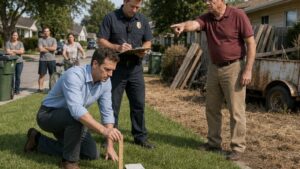
He Told the Gray-Shirted Neighbor to Use the Service Gate—Then the HOA Needed His Records
Chapter 1: The Man Beside the Gate Cabinet
“Contractors are supposed to come in through the service entrance.”
Stephen Wilson looked up from the open metal cabinet beside the clubhouse walkway.
The man speaking stood three feet away in a navy sport coat, one hand holding a phone and the other pointing toward the narrow driveway behind the clubhouse. Beyond him, two catering workers were carrying covered trays toward the patio, and homeowners were beginning to arrive for the annual meeting.
Stephen pushed his reading glasses higher on his nose.
“I’m not a contractor.”
Jason King glanced at the faded gray work shirt, Stephen’s scuffed shoes, and the worn canvas tool bag open on the concrete beside him.
“Whatever company you’re with, this area has to be cleared before six.”
Stephen turned back toward the cabinet.
Three low-voltage connectors sat separated in his hand. One had darkened slightly around the terminal. The pedestrian gate had been dropping communication with the control board for three weeks, always briefly enough that the contracted maintenance company could reset it and call the problem solved.
Today it had failed twice before lunch.
“Ashley asked me to look at it,” Stephen said.
Jason’s expression tightened.
“Ashley should know better.”
Stephen touched the meter lead to the terminal again.
The reading dipped.
There it was.
Not the power supply. Not the keypad. Not the gate motor.
The fault was farther upstream, where an old splice had been disturbed so many times the conductor barely held consistent contact.
He had seen the same kind of failure in office buildings before he retired. Sometimes a system could limp along for months while everyone replaced the wrong parts.
“Give me three minutes,” he said.
Jason looked toward the clubhouse doors.
A cluster of residents had stopped near the registration table. Some were watching.
“No. Close it up.”
Stephen remained crouched.
“If I close it now, there’s a fair chance the pedestrian gate drops offline again tonight.”
“Then the vendor can deal with it.”
“They were supposed to be here yesterday.”
Jason lowered his voice, but not enough.
“This is exactly the problem. People start doing little favors, nobody knows who touched what, and then when something breaks, the association gets blamed.”
Stephen looked at him then.
That was not entirely wrong.
What bothered him was the way Jason said people.
As though Stephen were not one of the homeowners whose dues paid for the gate, the landscaping, the clubhouse, and the management contract.
Jason noticed several more residents approaching and straightened his jacket.
“We have people paying over five hundred dollars a month in assessments,” he said. “They shouldn’t have to step around tools and exposed wiring when they come to an annual meeting.”
Stephen heard the shift.
The gate was no longer the problem.
Appearance was.
He looked down at his canvas bag. The fabric had faded almost white along the seams. Shirley had given it to him years ago after the handle on his old case tore loose in a parking garage.
He closed the meter.
“Three minutes would have told us whether this connection is the recurring fault.”
Jason gestured toward the cabinet door.
“And I’m telling you we’re done.”
For a few seconds Stephen considered saying what would have ended the embarrassment quickly.
I live on Hawthorne Court.
I’ve lived here fourteen years.
I rewired half the clubhouse lighting controls when the previous board couldn’t get a contractor out before the holiday party.
Instead, he slid a short insulated jumper into place, tightened the temporary connection, and attached a small handwritten label to it.
Then he closed the cabinet.
Jason watched him zip the tool bag.
“Thank you.”
Stephen stood.
“I hope it holds.”
Jason gave a thin smile.
“That’s what we pay professionals for.”
Stephen lifted the bag.
“I appreciate your patience.”
The words came out flatter than he intended.
He walked toward the parking lot.
Behind him, he heard Ashley Hernandez call Jason’s name.
Stephen kept going.
He had almost reached his truck when Ashley caught up.
She was still holding the clipboard she carried through every board meeting and vendor walk-through.
“Stephen.”
He stopped.
“I’m sorry.”
“You don’t need to apologize.”
“I asked you to check it.”
“I know.”
“I should’ve told Jason.”
Stephen looked back toward the patio. Jason stood near the clubhouse entrance talking to two board members.
“He assumed plenty without your help.”
Ashley glanced at the clipboard.
“I did tell him after you walked away.”
Stephen gave her a tired look.
“What did he say?”
Her mouth tightened.
“He asked why a homeowner was inside an electrical cabinet.”
“It’s twelve volts.”
“That won’t matter to insurance.”
That got Stephen’s attention.
Ashley shifted the clipboard under her arm.
“We received a risk-management letter last month. They asked for cleaner maintenance documentation on common systems. Gates, pool equipment, clubhouse electrical, all of it.”
Stephen stared at her.
“You never mentioned that.”
“I didn’t think this counted. You were just helping me identify the fault before the vendor came.”
“That’s still maintenance activity.”
“I know.”
The admission changed the weight of the conversation.
Stephen looked down at the bag in his hand.
He had spent years believing the quiet favors were harmless because nobody was paying him and he never touched anything he did not understand.
But harmless and undocumented were not the same thing.
Ashley glanced toward the clubhouse again.
“The vendor finally called. They can send a technician before the meeting starts.”
“Good.”
“I wrote down what happened.”
Stephen looked at the clipboard.
“What happened with Jason?”
“Everything.”
He nodded once.
“Make sure you write down that I installed a temporary jumper.”
“I did.”
“And why.”
“I did.”
He opened his truck door.
Ashley hesitated.
“Stephen, what was it doing?”
“The old splice is losing continuity. The jumper stabilizes the signal path. But it’s temporary.”
“So the gate might fail without it?”
Stephen looked back toward the clubhouse.
“Yes.”
By five forty-five, the parking lot was nearly full.
Stephen had changed shirts but not his mind about attending. He sat in the back row while William Davis called the meeting to order and Jason distributed copies of the compliance report.
Nothing was said about the gate.
At six twelve, Ashley’s phone vibrated on the table.
She read the message.
Then looked directly at Stephen.
Jason leaned over.
“What?”
Ashley turned the screen toward him.
Stephen could not read the message from the back row, but he saw Jason’s expression change.
After the meeting, Ashley found him near the exit.
“The technician removed your jumper.”
Stephen stopped.
“Why?”
She glanced toward Jason.
“He said it wasn’t an approved repair.”
Stephen’s jaw tightened.
“Did they replace the splice?”
Ashley shook her head.
“The technician reset the controller and closed the ticket.”
Stephen looked through the glass doors toward the pedestrian gate.
The green status light was glowing.
For the moment.
“What did the technician write about the connection?”
Ashley looked down at her clipboard.
“He wrote that the unauthorized modification had been removed.”
Stephen stared at the gate.
Nobody had repaired the failing conductor.
They had only removed the thing keeping it stable.
Chapter 2: What Ashley Wrote on the Clipboard
“The insurance carrier specifically mentioned undocumented electrical and access-control work.”
Stephen heard Jason’s voice before he reached the clubhouse office door.
He stopped in the hallway.
Jason was inside with Ashley and William Davis.
“So now we have a homeowner opening cabinets and changing wiring,” Jason continued. “If that gate hurts somebody, who do you think gets sued?”
Stephen stepped into the doorway.
“You could ask the homeowner.”
Jason turned.
For half a second, embarrassment crossed his face.
Then it disappeared.
William pushed an empty chair away from the conference table.
“Stephen, come in.”
Stephen stayed standing.
Ashley had her clipboard open.
His name was visible near the top of the page.
Jason folded his arms.
“My point isn’t personal.”
“It sounded personal outside.”
“I shouldn’t have assumed you were a contractor.”
“No.”
Jason waited.
Stephen did not rescue him from the silence.
Finally Jason said, “But the liability issue is still real.”
Ashley spoke before Stephen could answer.
“I asked Stephen to look at the gate.”
William frowned.
“You authorized him?”
“I asked him to identify why it kept dropping offline. I didn’t ask him to make a permanent repair.”
Jason pointed toward her clipboard.
“That distinction won’t mean much to an insurer.”
Stephen looked at Ashley.
“What exactly did the carrier say?”
She turned several pages and read from her notes rather than handing him the original letter.
“They want documented vendor responsibility, service dates, corrective actions, and clear authorization for anyone performing work on common-area systems.”
Stephen felt something inside him settle unpleasantly.
He had expected Jason’s justification to be mostly theater.
It wasn’t.
“How long have they been asking for that?”
“Since the renewal review.”
“Last month?”
Ashley nodded.
Stephen leaned against the doorframe.
“And you still called me.”
She looked ashamed.
“The vendor missed Tuesday. Then they missed Thursday. Residents were getting stuck outside the pedestrian gate. I needed to know whether we had a keypad problem or a controller problem before they showed up.”
“You wanted a diagnosis without putting my name on a work order.”
“Yes.”
Jason exhaled sharply.
“That’s exactly the kind of informal process we have to stop.”
Stephen turned toward him.
“And removing a stabilizing connection without repairing the underlying fault was what?”
Jason’s jaw moved.
“The vendor said the system was functioning after reset.”
“For how long?”
Nobody answered.
William rubbed one hand across his forehead.
“This is getting us nowhere.”
“No,” Stephen said. “It’s getting somewhere. It’s just not somewhere comfortable.”
William looked at him.
Stephen immediately regretted the sharpness.
He had spent years telling himself he disliked board politics because people talked too much and solved too little.
Yet here he was, angry because nobody had properly recorded the work he had willingly done without paperwork.
Ashley tapped the clipboard with her pen.
“I wrote down that I requested Stephen’s inspection. I wrote down what he found. I wrote down that Jason asked the contractor to remove the jumper.”
Jason looked at her.
“I asked them to restore the equipment to its approved configuration.”
“You knew they weren’t replacing the splice,” Stephen said.
“I knew there was no approved diagnosis yet.”
“That’s not the same thing.”
“No, but neither is a retired electrician doing unapproved repairs because he happens to know how.”
Stephen opened his mouth, then stopped.
The words landed because they contained enough truth to hurt.
William noticed.
“Stephen?”
Stephen looked toward the office window.
The gate was visible beyond the parking lot.
“I’ve worked on it before.”
Ashley lowered her pen.
Jason’s eyes narrowed.
“How many times?”
Stephen shrugged.
“Depends what you call worked on.”
“That’s not an answer.”
“I’ve reset the controller. Cleaned contacts. Re-seated a connector. Replaced a cracked weather seal once.”
“With authorization?”
“Usually Ashley knew.”
Ashley looked at the table.
Jason gave a humorless laugh.
“Usually.”
Stephen turned toward him.
“You want me to say it was sloppy? Fine. It was sloppy.”
The room went quiet.
“I knew what I was doing electrically,” Stephen continued. “That doesn’t mean the association knew who was responsible afterward.”
William sat back.
“That may be the first useful thing anybody has said tonight.”
Jason did not look satisfied.
But he no longer looked triumphant either.
William opened a folder.
“The larger problem is replacement.”
Stephen glanced at him.
“What replacement?”
William looked at Ashley.
She answered.
“The gate-control system is past its recommended service life.”
Stephen stared at her.
“How far past?”
“Enough.”
“Number.”
“Twelve years old.”
Stephen knew the model.
He also knew its expected service range.
William cleared his throat.
“We priced replacing both entry controllers and the pedestrian access hardware last year.”
“And?”
The HOA treasurer, seated at the far end of the table, slid a budget sheet forward.
William did not touch it.
“The reserve account can’t absorb it comfortably.”
Stephen frowned.
“This neighborhood isn’t exactly broke.”
“No,” William said. “But roofs on the clubhouse, pool resurfacing, storm drainage, and the perimeter wall all hit earlier than projected.”
Jason added, “And homeowners screamed about the last assessment increase.”
Stephen looked at him.
“So we kept resetting a dying gate because nobody wanted another vote.”
William’s face tightened.
“That’s an unfair simplification.”
“Is it wrong?”
William did not answer immediately.
That was answer enough.
For the first time, Stephen understood that the gate problem was not simply a bad vendor visit or an arrogant committee chair.
It was a habit.
Delay the expensive decision.
Patch the visible failure.
Move on before anyone became angry.
Stephen had helped make that habit possible.
Every time Ashley called and he quietly restored service, the emergency disappeared.
So did the pressure to replace the system.
He looked at his hands.
Jason noticed.
“You see the problem now?”
Stephen raised his eyes.
“Yes.”
Jason seemed surprised.
Stephen continued.
“You were still wrong outside.”
Jason’s expression hardened again.
“About how I spoke to you?”
“About deciding who I was before asking.”
A pause.
Jason looked away first.
The meeting resumed twenty minutes later.
Stephen sat in the back row again.
This time, every mention of vendor oversight sounded different.
He watched residents argue about landscaping bids, pool furniture, tree trimming, and whether the association should postpone repainting the clubhouse exterior.
William carefully avoided saying the word assessment.
Stephen understood why.
People liked accountability until accountability produced a number beside their own name.
At eight seventeen, the meeting adjourned.
Residents gathered their papers and drifted toward the exits.
Stephen was halfway across the lobby when someone outside pulled hard on the pedestrian gate.
Once.
Twice.
Then harder.
A woman standing on the exterior path raised both hands in frustration.
The keypad was dark.
Ashley looked at Stephen.
Jason looked at the gate.
Stephen did not move.
Jason said, “Can you just—”
Stephen shook his head.
“No.”
Jason stopped.
Stephen walked to the glass door and examined the dark keypad from inside.
“The vendor said it was repaired.”
Ashley’s face had gone pale.
Stephen watched the woman outside try her code again.
Nothing.
He looked at Jason.
“That’s what we need to figure out now.”
Chapter 3: The Repair That Was Never Repaired
Three invoices lay side by side on Stephen’s garage workbench.
Each claimed a different repair.
Each described the same failure.
He read the notes again.
Intermittent communication loss.
Controller reset.
System tested operational.
The dates were eight months apart.
Stephen pulled a spiral notebook from a drawer and found his own entries.
He had never called them maintenance records. They were simply notes—measurements, connector positions, voltage readings, dates Ashley had called, little diagrams drawn because he trusted pencil marks more than memory.
On the first invoice date, he had written:
Gate offline after rain. Green terminal oxidation. Cleaned. Re-seated.
On the second:
Dropped communication again. Same terminal warm.
On the third:
Vendor here yesterday. Fault returned. Signal unstable at old splice.
Stephen put the notebook beside the invoices.
The same fault had survived three completed service tickets.
His worn canvas tool bag sat zipped beneath the bench.
For once, he did not reach for it.
The next morning he met Ashley in the management office.
She had pulled the vendor file.
Stephen expected a thick folder.
It was thinner than it should have been.
“Where are the technician reports?”
“These are the reports.”
“These are invoices.”
Ashley frowned.
“The closeout notes are on the second pages.”
Stephen flipped through them.
Most were two or three lines.
Reset controller.
Tested operation.
No further issue observed.
He looked up.
“How long were they onsite?”
Ashley turned to her computer.
“I can check gate logs for service access.”
After several minutes, she began reading times.
“Twenty-eight minutes.”
“Which one?”
“March.”
“Next.”
“Thirty-four.”
“Next.”
“Nineteen.”
Stephen leaned back.
“To replace the communication module they billed you for?”
Ashley looked at the invoice.
“That says module replacement.”
“Did anyone see the old module?”
“I didn’t.”
“Did anyone see a new one installed?”
“No.”
Stephen rubbed his thumb over the edge of his notebook.
He was not ready to accuse the vendor of fraud. There were explanations. Preconfigured components. Misentered labor descriptions. Parts replaced offsite. Billing language copied from templates.
But physically, the control cabinet had not looked like a system receiving repeated major repairs.
The dust patterns had been too old.
The mounting screws had not been disturbed.
The same brittle splice had remained exactly where it had been.
Ashley watched him.
“What are you thinking?”
“I’m thinking the paperwork says more work was done than the cabinet ever showed.”
She became very still.
“That’s a serious claim.”
“It’s not a claim yet.”
He pushed the invoices toward her.
“It’s a question.”
Ashley looked at his notebook.
“You wrote all of this?”
“Whenever I touched it.”
“Why didn’t you give these to us?”
Stephen almost answered because nobody asked.
Instead he said, “Because I wasn’t treating them like association records.”
“That’s part of our problem.”
“I know.”
The admission was getting easier.
Not more comfortable.
Just easier.
Ashley turned another page.
“There were vendor visits you don’t have notes for.”
“There should be.”
“Why?”
“Because if they actually replaced some of these parts, the failure pattern should have changed.”
She looked toward the file cabinet.
Stephen added, “I need the oldest service records you still have.”
“How old?”
“Five years.”
Ashley laughed once, without humor.
“You think this goes back five years?”
“I don’t know.”
That afternoon they opened archive boxes in the clubhouse storage room.
Dust gathered along the cardboard seams.
The older records were worse.
Invoices without photographs.
Work orders without diagnostic measurements.
Repeated descriptions that sounded slightly different but ended the same way: system operational when technician departed.
Stephen built a timeline at home.
Date.
Reported symptom.
Vendor action.
His own intervention.
Weather.
Observed condition.
He hated how often his own initials appeared.
S.W.—cleaned contacts.
S.W.—re-seated connector.
S.W.—adjusted latch alignment.
S.W.—temporary bypass for failed sensor.
He had thought each entry represented a favor.
Together they represented something else.
A shadow maintenance program run out of one homeowner’s garage.
By noon the second day, Ashley called.
“I checked the vendor arrival logs.”
Stephen sat at his workbench.
“And?”
“Seven of the tickets marked as major corrective repairs were visits under forty minutes.”
Stephen closed his eyes.
“That doesn’t prove anything by itself.”
“I know.”
“Any parts delivery records?”
“Not attached.”
“Warranty claims?”
“None that I can find.”
A pause.
Then Ashley said, “Jason wants to know what we’re doing.”
Stephen gave a quiet laugh.
“He wants documentation now.”
“He’s scared.”
“So am I.”
Ashley was silent.
Stephen looked at the canvas tool bag under the bench.
He had spent years carrying it to the gate whenever the neighborhood needed him.
Now the bag looked less like proof of competence and more like evidence of how easy he had made it for everyone else to postpone responsibility.
“Send William the timeline,” Stephen said.
“Everything?”
“Everything.”
“Including your work?”
“Yes.”
Ashley hesitated.
“That could expose you.”
“It already happened.”
“What do you mean?”
“I opened the cabinet. I changed things. We can’t investigate everybody else by editing me out.”
For several seconds Ashley said nothing.
Then she replied, “I’ll send it.”
William called that evening.
Stephen was standing in the garage, comparing an old connector sketch to a photograph Ashley had found from a vendor visit.
The phone rang three times before he answered.
“Stephen.”
William sounded exhausted.
“I’ve been looking at the history you and Ashley put together.”
“It’s incomplete.”
“It’s complete enough to make me uncomfortable.”
“Good.”
William ignored that.
“We did have replacement proposals.”
Stephen stopped writing.
“When?”
“One two years ago. Another last year.”
“Full system?”
“Yes.”
Stephen slowly set down his pencil.
“What happened?”
“The first one came in after the drainage work ran over budget.”
“And the second?”
William took longer to answer.
“We postponed it.”
“Who’s we?”
“The board.”
Stephen looked at the row of service dates on his bench.
“How long?”
“We told ourselves one budget cycle.”
“And instead you kept paying service calls.”
“We thought repairs were extending the system’s life.”
“You had these invoices.”
“Yes.”
“You saw the same failures repeating?”
“Not laid out like this.”
Stephen pressed two fingers against his forehead.
That was the entire problem.
Nothing looked catastrophic one page at a time.
One reset.
One invoice.
One call to Stephen.
One temporary fix.
One meeting where replacement could wait until next year.
William spoke again.
“There was also pressure not to raise assessments.”
“From Jason?”
“From half the neighborhood.”
Stephen said nothing.
William continued.
“And we spent reserve money on other priorities.”
“What priorities?”
A pause.
“Clubhouse exterior work. Entrance landscaping. Pool furniture replacement. Some perimeter-wall repairs.”
Stephen stared at the photographs spread across his bench.
Appearance.
Comfort.
Things people could see.
The gate had kept opening often enough that its internal decay remained invisible.
Stephen glanced toward the zipped tool bag.
His own work had helped keep it invisible too.
William exhaled.
“I should have pushed harder.”
Stephen asked, “Did Jason know the full replacement had been postponed?”
Another pause.
“Yes.”
Stephen straightened.
“Both times?”
“Yes.”
Outside his garage, the neighborhood was quiet.
Somewhere beyond the houses, the pedestrian gate clicked open and then shut.
Still working.
For now.
Stephen looked at the timeline again.
The question was no longer whether the vendor had failed to repair the system.
The harder question was why so many people—including Stephen—had accepted temporary success as proof that nothing deeper had to change.
Chapter 4: Why Stephen Kept Coming Back
The folded paper fell from the bottom of Stephen’s tool bag when he lifted out a roll of electrical tape.
He knew the handwriting before he unfolded it.
Shirley’s letters leaned slightly to the right, neat at first and impatient toward the end.
You cannot become the whole maintenance department just because nobody else answers the phone.
Stephen sat down on the garage stool.
For a few seconds, the invoices, diagrams, and dates spread across the workbench stopped mattering.
He remembered exactly when she had written it.
Five years earlier, after the pedestrian gate failed during a cold March rain.
Shirley had gone out alone that afternoon. She had still insisted on doing that then, even after walking farther than a few blocks had started taking more effort.
Stephen had been replacing a kitchen faucet when his phone rang.
Her voice was controlled.
That was how he knew she was angry.
“The gate won’t open.”
“Use the vehicle entrance.”
“I’m on foot.”
“Call Ashley.”
“I did.”
Stephen had already been reaching for his keys.
When he arrived, Shirley was standing beneath the narrow overhang beside the keypad.
Her jacket was soaked from the shoulders down.
One hand gripped the metal railing.
She had been waiting almost fifty minutes.
Stephen remembered the look she gave him when he reached for the cabinet key Ashley had left with him after an earlier problem.
Not gratitude.
Frustration.
“At the gate?” she had said.
“At all of it.”
He had opened the cabinet anyway.
The problem that day was simple—a failed power supply.
He restored the gate temporarily before the vendor arrived.
That evening Shirley found him writing down the voltage reading.
“You like this too much,” she said.
“I like things working.”
“No. You like being the one who makes them work.”
He had laughed.
She had not.
Now, years later, Stephen held the folded note and understood why the memory felt different.
He had told himself he kept checking the gate because no resident should be stranded the way Shirley had been.
That was true.
It was simply not the entire truth.
Being useful had given him somewhere to put fear when her health worsened.
After she died, it had given him somewhere to put the silence.
A gate failure was solvable.
A loose connection could be tightened.
A bad relay could be replaced.
There were measurements for those things.
He folded the note and placed it beside his notebook instead of back in the bag.
A knock sounded at the open garage door.
Jason King stood on the driveway.
Stephen almost laughed at the timing.
“You selling something?”
Jason looked toward the workbench.
“No.”
“Then come in.”
Jason stepped into the garage but remained near the door.
He was dressed more casually than Stephen had ever seen him—polo shirt, jeans, no committee folder under his arm.
His eyes moved across the invoices.
“So Ashley sent everything.”
“She sent what we asked for.”
Jason nodded.
“I saw the timeline.”
Stephen waited.
Jason pointed toward the stool on the other side of the workbench.
“Can I?”
“It’s a free country.”
Jason sat.
For a while he said nothing.
Then he asked, “Did William tell you about the insurance letter?”
“Ashley did.”
“Not all of it.”
Stephen leaned back.
Jason rubbed his palms together.
“The carrier didn’t just ask for better documentation. They warned that another significant access-control incident could affect renewal terms if we couldn’t establish who had maintained the system.”
Stephen frowned.
“Why wasn’t that in the meeting packet?”
“Because we were trying to get clarification.”
“We?”
“William, Ashley, me.”
Stephen watched him carefully.
“And because you didn’t want homeowners hearing the word insurance before the budget discussion.”
Jason looked toward the driveway.
“Yes.”
The honesty surprised Stephen more than denial would have.
Jason continued.
“People are already furious about assessments. I’ve had neighbors tell me they’ll vote out every board member who supports another increase.”
“You’re not on the board.”
“Compliance chair gets blamed anyway.”
“That sounds difficult.”
Jason looked at him.
“You don’t have to make fun of me.”
“I’m not.”
That seemed to bother Jason more.
He stood and paced once along the garage opening.
“My house is worth most of what I’ve saved,” he said. “So is everybody else’s around here. When common areas look neglected, when gates don’t work, when insurance gets shaky, people notice.”
Stephen glanced at the invoices.
“So you kept the entrance landscaping pristine.”
Jason stiffened.
“That wasn’t my decision alone.”
“But you supported it.”
“Yes.”
“And replacement of the gate system?”
Jason took longer.
“I supported postponing it last year.”
Stephen nodded slowly.
There it was.
Not corruption.
Not conspiracy.
A choice.
A visible entrance instead of an invisible control board.
Jason sat again.
“I thought the vendor repairs were buying us time.”
“So did I.”
Jason looked up.
Stephen tapped his notebook.
“Every time I got it working, I told myself the same thing.”
“You weren’t spending association money.”
“No. I was spending something else.”
Jason glanced at Shirley’s folded note.
He did not ask.
Stephen appreciated that.
After a moment Jason said, “You know why I reacted the way I did outside the clubhouse.”
“Because I looked like a contractor?”
“Because I saw an open cabinet three hours before an annual meeting, after an insurance warning, and nobody had told me you were supposed to be there.”
“That explains why you stopped the work.”
Jason’s jaw tightened.
“It doesn’t explain the service-entrance comment.”
“No.”
“Or the dues comment.”
“No.”
Jason stared at the floor.
Stephen let the silence stand.
Finally Jason said, “I was trying to look in control.”
Stephen looked at the man across from him.
For the first time, Jason seemed less arrogant than cornered.
Not innocent.
Just smaller than the role he kept performing.
“You weren’t,” Stephen said.
“I know that now.”
Jason breathed out.
“There’s something else.”
Stephen waited.
“When the vendor called after the annual meeting, I told them to remove your jumper.”
“I know.”
“I didn’t just agree with it. I pushed for it.”
Stephen’s face remained still.
Jason continued quickly.
“They said they couldn’t certify equipment with an unauthorized modification installed. I told them to restore the system to standard configuration before closing the ticket.”
“Did you ask them if they were repairing the bad splice?”
“No.”
“Did you ask Ashley what I had found?”
“No.”
“Did you look at any previous service history?”
Jason shook his head.
Stephen looked at Shirley’s note again.
Years of frustration pressed against the back of his throat.
But the anger no longer had a simple target.
Jason had made the removal decision.
Ashley had called Stephen unofficially.
William had postponed replacement.
The vendor had reset and closed tickets.
And Stephen had repeatedly stepped in because fixing the immediate problem felt easier than making everyone confront the larger one.
Jason stood.
“I’ll own my part.”
Stephen raised his eyes.
“Privately?”
Jason hesitated.
That was answer enough.
“You should go,” Stephen said.
Jason nodded.
At the garage opening he stopped.
“I am sorry about how I treated you.”
Stephen did not tell him it was fine.
It wasn’t.
He said, “Thank you for saying it.”
Jason left.
Stephen remained at the workbench until the sound of his footsteps disappeared.
Then he unfolded Shirley’s note one more time.
The sentence looked almost embarrassingly obvious now.
You cannot become the whole maintenance department just because nobody else answers the phone.
Stephen placed it beneath the first page of his fault timeline.
For years he had treated the gate as something he had to protect from everyone else’s neglect.
Now the harder question was whether he could stop protecting the people responsible from the consequences of that neglect.
Chapter 5: When the Temporary Fix Was Removed
The first car leaned on its horn just as the rain began coming sideways.
Stephen heard it from his kitchen.
A second horn answered.
Then a third.
He looked through the front window toward the neighborhood entrance.
Red brake lights were stacking beyond the trees.
His phone rang.
Ashley.
“The main gate is down.”
Stephen closed his eyes.
“Both lanes?”
“Both. Vehicle readers aren’t communicating with the controller.”
“The vendor?”
“On the phone with me.”
“That wasn’t what I asked.”
“They’re forty-five minutes away.”
Another horn carried through the rain.
Stephen looked toward the chair beside the door.
His canvas tool bag sat underneath it.
For a moment his body moved before his mind did.
He picked it up.
Then stopped.
The memory of Shirley’s note came back with irritating clarity.
He took the bag anyway.
But he left it zipped.
At the main entrance, six cars were already backed onto the public road.
Ashley stood under an umbrella beside the control pedestal, phone pressed to her ear.
Jason was directing arriving residents toward the exit lane, which was also locked closed.
The special budget meeting was supposed to begin in twenty minutes.
Stephen stepped beneath the gatehouse awning.
Ashley saw the bag.
Relief crossed her face.
Then she seemed to remember their last conversation.
“The vendor says power-cycle the controller.”
“Did you?”
“Twice.”
“Manual release?”
Jason answered.
“The procedure in the binder doesn’t match this operator.”
Stephen looked at him.
“What?”
Jason held out a laminated instruction sheet.
Stephen read it.
The diagram showed an older gate motor.
“This was replaced years ago.”
Ashley stared at the page.
“That’s the emergency procedure they gave us.”
Stephen looked through the gate at the line of vehicles.
A child pressed both hands against a fogged rear window in one of the cars.
Rainwater ran off the edge of the awning in sheets.
Jason lowered his voice.
“Stephen.”
He knew what was coming before Jason said it.
“Can you just do what you did before?”
Stephen looked at him.
Jason glanced toward the bag.
“Just get us through tonight.”
The sentence sounded almost reasonable.
That was what made it dangerous.
Stephen could open the cabinet.
He could probably identify the failed communication path within minutes.
Maybe less.
Residents would drive through.
The meeting would start.
Everyone would be grateful.
And tomorrow the system would still belong to nobody.
He set the tool bag on a dry bench.
“No.”
Jason stared at him.
“People are stuck in traffic.”
“I can see that.”
“You know how to fix it.”
“I know how to touch it. That’s not the same thing anymore.”
Ashley ended her phone call.
“The technician says there should be a mechanical release inside the operator housing.”
“There is,” Stephen said.
“Can you show us?”
“Yes.”
Jason looked hopeful.
Stephen added, “Without changing wiring.”
They walked to the gate motor.
Stephen pointed through the rain toward the manual-release housing.
“The board has authority to put the gate into manual mode during access failure.”
Ashley looked at her binder.
“That is in the emergency policy.”
“Then do that.”
Jason hesitated.
“You’re sure?”
Stephen almost smiled.
“You wanted procedure.”
That landed.
Jason turned to Ashley.
“Document it.”
Ashley immediately opened her clipboard under the umbrella.
The three of them worked through the approved manual-access process.
Jason contacted two homeowners near the front of the line and asked them to help direct traffic.
Ashley recorded the time, the failure, the vendor call, and the authorization.
Stephen explained the physical release but kept his hands away from the electrical cabinet.
Within ten minutes, the first gate arm could be secured open.
Cars began moving.
A woman rolled down her window as she passed.
“What is going on?”
Jason stepped toward her.
“Access-control failure. We’re opening the gate manually.”
“Again?”
“Yes.”
“Then what are we paying for?”
Jason flinched.
Stephen heard the familiar word hidden inside the question.
Paying.
At the annual meeting Jason had used high dues as a reason Stephen’s tools should disappear.
Now the same dues were coming back toward him.
Another resident called through an open window.
“Wasn’t this just fixed?”
Ashley wrote something on the clipboard.
Jason looked at Stephen.
Stephen said nothing.
By the time the clubhouse meeting began, wet residents filled every chair.
Nobody cared about landscaping.
Nobody cared about pool furniture.
William stood at the front with the proposed budget on the screen behind him.
He got through two sentences.
A homeowner near the aisle raised a hand.
“Before you ask us for another dollar, explain the gate.”
Several voices agreed.
William looked toward Ashley.
She looked toward Stephen.
Stephen remained seated.
The vendor technician arrived fifteen minutes later, carrying a diagnostic case.
Residents watched him cross the lobby toward the entrance.
The atmosphere shifted.
A problem that had lived inside maintenance tickets was now visible to everyone.
After twenty minutes, the technician returned to the clubhouse.
William met him near the door.
Stephen could hear only pieces of the conversation.
Communication fault.
Old controller.
Need more testing.
Then William asked the question Stephen had been waiting for.
“Can you give us a complete history of what parts your company replaced on this system?”
The technician paused.
“I’d have to pull the account.”
Ashley said, “We already did.”
The room became quieter.
The technician looked at her.
“We have invoices.”
“We need diagnostic records and part serial numbers.”
“I don’t have those with me.”
Stephen watched William’s expression change.
Not certainty.
Understanding.
They were no longer discussing one failed gate.
The meeting dissolved into questions.
Some residents wanted the vendor fired immediately.
Others wanted to know why the board had not replaced the system.
One man demanded to see the reserve balance.
Another argued that the community should not pay for “management mistakes.”
The easy solution was beginning to form in the room: blame the vendor.
Stephen understood the appeal.
It would let everyone else remain innocent.
Jason came to him during a short recess.
“You were right not to touch it.”
Stephen looked at him.
“That sentence cost you something.”
Jason gave a tired smile.
“Probably.”
Across the room, Ashley was arranging copies of service invoices beside the board packet.
William approached.
“Stephen, people are asking for your timeline.”
Stephen looked toward the crowd.
His notes contained everything.
Including his own undocumented work.
“If I give it to them,” he said, “it goes in whole.”
William nodded.
“Understood.”
“No summary that makes the vendor look worse and us look better.”
William’s expression tightened.
“Stephen—”
“No.”
Jason stepped closer.
Stephen looked at both men.
“If you want me to speak tonight, Ashley includes every time I touched that system. Every informal request. Every reset. Every temporary repair. Everything.”
William glanced toward the room.
“That could create liability for the association.”
Stephen picked up his still-zipped tool bag.
“The liability already exists.”
Nobody answered.
Stephen continued.
“I’m done being the reason a problem disappears before anyone has to make a decision.”
William looked toward Jason.
Jason stared at the floor, then said quietly, “Put it all in.”
Stephen looked at him.
Jason raised his eyes.
“All of it.”
The recess ended.
Residents returned to their seats.
William walked toward the front of the room, carrying Stephen’s timeline.
Chapter 6: The Meeting That Could Not Continue
William Davis tried to restart the budget meeting three times.
Three times someone interrupted him.
“Why did the gate fail?”
“Who approved these repairs?”
“Are we paying twice for the same work?”
Finally William set down the gavel he rarely used.
“We are not going to vote on the budget yet.”
That silenced the room.
Stephen sat in the second row with his worn canvas tool bag at his feet.
William looked toward him.
“Stephen, would you come up here?”
Stephen lifted the bag.
Jason noticed.
So did Ashley.
It was the same bag that had sat open beside the gate when Jason told him contractors belonged at the service entrance.
Stephen placed it on the table beside Ashley’s clipboard.
Then he faced the room.
He had spent most of his life being comfortable around machines because machines did not care whether you spoke well.
People were different.
A room full of angry homeowners was much harder than a bad control board.
William handed him the timeline.
Stephen did not look at it.
“The gate system has a recurring communication fault,” he began. “That part is simple.”
Someone in the back called, “Then why can’t the contractor fix it?”
“Because that isn’t the whole problem.”
The room settled.
Stephen explained the old splice.
The repeated resets.
The short service visits.
The invoices describing replacements he could not reconcile with what he had physically seen in the cabinet.
He avoided accusations he could not prove.
“The records need an independent review,” he said. “That’s different from saying we already know exactly what the vendor did or didn’t do.”
The HOA treasurer asked, “But your timeline shows failures after completed repairs.”
“Yes.”
“Then they failed.”
“In part.”
Stephen turned one page.
“But so did we.”
A murmur passed through the room.
Jason looked toward him.
Stephen continued.
“The board received replacement proposals and postponed them.”
William nodded once.
“That is correct.”
“The management office asked me to look at the system more than once without putting me on a formal work order.”
Ashley spoke from behind the table.
“That is also correct.”
“And I agreed.”
The room quieted again.
Stephen saw confusion on several faces.
One homeowner said, “You were helping.”
“Yes.”
“So what did you do wrong?”
Stephen looked at his tool bag.
“I made a failing system easier to live with.”
The homeowner frowned.
Stephen explained.
He reset controllers.
Cleaned contacts.
Re-seated connectors.
Created temporary bypasses.
Each time, service returned.
Each time, the urgency disappeared.
“I thought I was solving problems,” he said. “Sometimes I was. Sometimes I was helping everybody avoid the larger one.”
Nobody interrupted now.
Stephen glanced toward William.
“When replacement became expensive, the board could point to a gate that was working that week.”
Then toward Ashley.
“When the vendor missed a visit, management could call me.”
Then toward himself.
“And I liked being able to fix it.”
The last sentence surprised the room more than anything about the invoices.
Stephen felt it surprise him too, even after admitting it privately.
“I told myself I did it because somebody needed to,” he said. “That was true. It was not the whole truth.”
He did not tell them everything about Shirley.
Not here.
But he told them enough.
“My wife once got stranded outside that pedestrian gate when walking had become difficult for her. After that, I took every failure personally.”
He paused.
“So whenever it broke, I went back.”
The room had lost its appetite for easy villains.
Stephen looked toward Jason.
“He stopped me from working on the gate before the annual meeting.”
Several residents turned.
Jason stood before Stephen could continue.
“I did.”
His voice was tighter than usual.
“I also directed the vendor to remove his temporary connection.”
Someone asked, “Why?”
Jason looked at the room.
“Because we had an insurance warning about undocumented maintenance and I wanted the equipment returned to approved configuration.”
Another homeowner called, “Without fixing it?”
Jason swallowed.
“Yes.”
“Did you know Stephen had identified the fault?”
“Not fully.”
“Did you ask?”
Jason looked at Stephen.
“No.”
The room reacted.
Jason raised one hand.
“I’m not asking anyone to excuse that. I made the decision because I was worried about liability and because I wanted the property to look controlled before the annual meeting.”
His mouth tightened.
“I confused looking controlled with being controlled.”
Stephen watched him sit.
There was no applause.
He was glad.
Applause would have made everything too simple.
William stepped forward.
“The replacement estimates are substantial.”
The HOA treasurer put a number on the screen.
The room erupted again.
Full replacement would require either a special assessment or postponing several planned common-area projects.
Pool deck improvements.
Decorative entrance lighting.
A section of clubhouse exterior work.
A homeowner near the aisle shook her head.
“So now we pay because the board ignored this?”
William answered.
“The board postponed it. Yes.”
Another voice said, “Then use reserves.”
The treasurer explained why reserves alone were insufficient.
A third resident blamed the vendor.
Someone else blamed management.
The room began dividing itself again.
Stephen picked up the microphone.
“You can spend the next hour deciding whose percentage of fault is biggest.”
The voices faded.
“That won’t open the gate.”
He pointed toward the service history on the screen.
“We need three things before anybody votes on replacement.”
William looked at him.
“An independent inspection. A complete vendor service record. And a maintenance log that belongs to the association, not to Ashley’s clipboard or my garage.”
Ashley nodded slowly.
Stephen continued.
“If the inspection says parts were billed and not replaced, deal with the vendor. If it says the system was simply kept alive too long, deal with that. But decide from facts.”
A resident asked, “And what do we do until then?”
“Use documented temporary procedures. Every intervention authorized. Every person identified. Every change recorded.”
Jason looked toward the canvas bag.
“So no more private fixes.”
Stephen met his eyes.
“No more private fixes.”
The sentence hurt more than he expected.
William called for a procedural vote.
Not on replacement.
On the investigation.
Independent inspection.
Full vendor record request.
Emergency maintenance documentation.
The motion passed easily.
The harder vote came next.
Would the board prepare a binding replacement proposal after the inspection, including a special assessment if necessary?
That discussion lasted nearly an hour.
Residents argued over money because money was real.
Stephen preferred that to pretending there was a painless answer.
Eventually the board approved the next step.
The inspection would happen within ten days.
A replacement vote would follow.
William gathered the papers.
Jason remained seated while most residents left.
Ashley closed her clipboard.
Stephen reached for his tool bag.
Jason said, “For what it’s worth, I’m going to resign as compliance chair before the replacement vote.”
Stephen looked at him.
“That’s your decision.”
“I thought you’d be happier.”
“I don’t need you punished.”
Jason studied him.
“What do you need?”
Stephen looked toward the dark windows.
Beyond them, the vehicle gate remained secured open manually.
“I need that thing to stop depending on whoever happens to know how to rescue it.”
Ashley placed Stephen’s timeline into a new binder.
On the cover she wrote a simple title:
Common Access Maintenance Record.
Stephen watched her slide the pages inside.
For years the history had lived in his notebook, his memory, his garage.
Now it belonged to the community.
William came back from the board table.
“The inspector can be here Monday.”
Stephen nodded.
“And after that?”
“Binding vote.”
William looked tired.
“No postponement this time.”
Stephen lifted the canvas bag.
It felt strangely heavy.
The problem was finally becoming official.
For the first time in years, that meant it was beginning to become less his.
Chapter 7: The Tool Bag Left in Plain Sight
Someone else had already opened the maintenance binder.
Stephen stopped in the clubhouse doorway.
A homeowner from the far end of Hawthorne Court stood at the new workbench with one finger running down the latest entry. Beside him sat a laminated checklist, the independent inspector’s final report, and a plastic tray holding gate keys that now had numbered tags instead of scraps of masking tape.
The homeowner looked up.
“Morning.”
“Morning.”
“You checking this too?”
Stephen glanced at the binder.
“No.”
The answer came more slowly than it should have.
Six weeks earlier, he would have walked straight to the cabinet before saying hello.
The homeowner tapped the page.
“Management wants two people to initial any access-control work now. I’m meeting the new contractor at nine.”
Stephen nodded.
“That’s a good rule.”
The man smiled.
“Apparently we have a lot of those now.”
Stephen looked through the open maintenance-room door toward the pedestrian gate.
The new controller enclosure was larger than the old one, with clean conduit runs and labeled terminal blocks behind a locked panel. The independent electrical inspector had confirmed what Stephen’s notes suggested: the old system had been well past its practical service life. Several repairs had extended operation without addressing the failing communication path, and some invoice descriptions could not be fully matched to installed components.
The board had terminated the old maintenance contract after reviewing the service history.
No dramatic confrontation followed.
The vendor disputed part of the board’s findings, credited several questionable charges, and moved on.
The bigger change happened inside the neighborhood.
The replacement vote passed.
Not comfortably.
Residents approved a smaller special assessment after agreeing to postpone decorative entrance lighting and part of the clubhouse exterior project. The pool furniture replacement disappeared from the year’s plan entirely.
People complained.
Then they paid.
Stephen had found that strangely reassuring.
Real solutions usually cost somebody something.
Ashley entered carrying her clipboard.
She stopped when she saw Stephen.
“You’re early.”
“I wasn’t sure what time you wanted me.”
“Nine.”
“It’s eight forty-seven.”
“That qualifies as early when you’re retired.”
Stephen looked at her clipboard.
The old one had been replaced.
“New?”
Ashley turned it over.
“The clip broke.”
He smiled.
“That thing survived more meetings than some board members.”
“Almost.”
She set it on the workbench.
Stephen glanced toward the homeowner reading the maintenance binder.
“He knows what he’s doing?”
“He volunteered for the facilities committee.”
“That wasn’t what I asked.”
Ashley smiled slightly.
“The contractor knows what he’s doing. The homeowner is here to observe and sign the record.”
Stephen nodded.
He had to remind himself not to inspect the binder.
Ashley noticed.
“You can look.”
“I know.”
“That’s different from needing to.”
He gave her a look.
“You’ve gotten comfortable.”
“I had six weeks of practice.”
The facilities committee had asked Stephen to serve as an advisor.
Not maintenance chair.
Not emergency contact.
Advisor.
He had nearly refused because the title sounded useless.
Then he understood why it mattered.
His job was to explain what he knew and let authorized people act on it.
That had proved harder than repairing anything himself.
On the first contractor visit, Stephen had stood three feet from the cabinet while a technician traced wiring.
Twice he had started to reach toward a terminal.
Twice he stopped.
The technician did not need rescuing.
Neither did the neighborhood.
Ashley opened the new binder.
“The final inspection notes came yesterday.”
“I saw the email.”
“They confirmed the manual-release procedures are current now.”
“Good.”
“And the spare battery is on a replacement schedule.”
“Better.”
Stephen rubbed the worn handle of his canvas tool bag.
He had brought it automatically.
The realization irritated him.
He had no tools to use that morning.
He was supposed to review the new preventive-maintenance schedule, nothing more.
Footsteps sounded behind them.
Jason King entered carrying a small envelope and a key.
He had resigned as compliance chair three days after the emergency meeting, just as he had said he would.
He still attended board meetings.
He simply sat among everyone else now.
Ashley looked between the two men.
“I need to meet the contractor outside.”
Stephen almost told her she did not have to leave.
She left anyway.
Jason stood across from the workbench.
“I found this when I cleaned out the compliance file.”
He placed the key on the table.
The old cabinet key.
Stephen recognized the small notch he had filed into one edge years ago so he could identify it by touch.
“I thought management had all of those.”
“They do now.”
Jason pushed it toward him.
“This one was still in my desk.”
Stephen picked it up.
For years, a copy had also lived inside his tool bag.
Ashley had eventually asked him to surrender it when the new maintenance policy took effect.
He had done so.
More reluctantly than he wanted to admit.
Jason glanced at the bag.
“Still carrying that thing.”
“Apparently.”
“I thought you’d get a new one.”
“Nothing wrong with it.”
Jason nodded.
For a moment neither spoke.
Then he said, “I owe you a better apology than the one in your garage.”
Stephen’s fingers closed around the key.
Jason continued before Stephen could interrupt.
“I was right to stop undocumented work. I was wrong about nearly everything else I brought into that moment.”
Stephen watched him.
“I looked at your shirt and your tools and decided you were somebody I could order around. Then when I found out you lived here, I still cared more about proving I had control than finding out what you knew.”
His voice remained steady.
“I’m sorry.”
Stephen turned the old key between his fingers.
He could have made Jason wait.
A small part of him wanted to.
Not because he needed revenge.
Because six weeks was not very long.
Humiliation had a longer service life than people liked to admit.
“I accept the apology,” Stephen said.
Jason nodded.
Stephen added, “That doesn’t make the way you treated me disappear.”
“I know.”
“And resigning doesn’t solve the gate.”
“I know that too.”
Stephen studied him.
Jason had finally learned to stop asking for immediate absolution.
That mattered.
Jason looked toward the maintenance binder.
“You think the new system will last?”
“If people maintain it.”
“That sounds like a warning.”
“It is.”
Jason gave a brief smile.
Then his face grew serious again.
“The special assessment hurt.”
“I know.”
“A few people are still blaming me.”
“A few are blaming William. A few are blaming Ashley. I’ve heard somebody blame the rain.”
Jason laughed despite himself.
“What about you?”
“Some blame me too.”
Jason frowned.
“For helping?”
“For helping badly.”
The distinction hung between them.
Stephen placed the old key in the numbered tray with the others.
“No private keys,” he said.
Jason nodded.
“No private keys.”
After Jason left, Stephen opened his tool bag.
The familiar contents were exactly where they belonged: meter, cutters, screwdrivers, tape, flashlight.
Beneath them lay Shirley’s folded note.
He took it out.
You cannot become the whole maintenance department just because nobody else answers the phone.
Stephen read it once.
Then folded it again.
This time he did not put it back in the bag.
He slipped it into his wallet.
Ashley returned with the contractor and the homeowner volunteer.
The contractor carried his own case.
His own meter.
His own tools.
Stephen looked at his canvas bag.
Then set it on the shared workbench.
Ashley noticed.
“You leaving that?”
“For now.”
“Someone might move it.”
Stephen looked toward the new maintenance binder, the numbered keys, the homeowner standing beside the contractor, and Ashley writing the start time on her clipboard.
“That’ll be fine.”
They walked outside together.
At the pedestrian path, a woman approached from the far side carrying two grocery bags.
For years Stephen had watched that gate as if every opening were his personal responsibility.
The woman entered her code.
The keypad chirped.
The latch released cleanly.
Stephen’s hand moved half an inch toward where his tool bag would normally have been.
Then stopped.
The woman pushed through without hesitation.
The gate closed behind her and locked with one quiet metallic click.
Nobody looked at Stephen.
Nobody needed to.
He stood there for another second, listening to the new controller settle back into silence.
Then he walked toward home with empty hands.
The story has ended.