My Neighbor Kept Sending Rideshares to My Fire Hydrant Until the HOA’s Own Map Exposed the Real Problem
Chapter 1: The Car Waiting Beside My Hydrant
The sedan was already there when I opened my garage Monday morning, idling across the lower edge of my driveway with its hazard lights blinking.
I stood behind my car with my work bag in one hand and stared at it.
The driver looked up from his phone, noticed me, then looked back down.
I walked to his window.
“Morning. I need to get out.”
He lowered the glass halfway. “Just picking somebody up.”
“Could you move forward a little?”
He glanced toward the house two doors down.
“Guy said he’s coming.”
“That’s fine. I still need to leave.”
The driver pulled forward perhaps six feet—just enough to clear the driveway—and stopped beside the red fire hydrant at the edge of my lawn.
A minute later Brian Thompson came down the sidewalk with a travel mug and climbed into the rear seat.
He saw me standing beside my car.
He gave me a small nod, the kind people use when they want acknowledgment without conversation.
The sedan left.
I was seven minutes late getting onto the main road.
Seven minutes was nothing. That was what Rebecca said when I mentioned it that evening.
“He probably put the wrong pickup spot in once,” she said.
“Probably.”
I wanted that explanation to be true.
Tuesday morning there was no car.
Wednesday afternoon, though, I came home early and found a white SUV sitting in nearly the same place.
The engine was running. Hazards blinking.
Its rear bumper reached into the edge of my driveway.
I parked across the street because I couldn’t turn cleanly into my own garage.
Brian came out a minute later.
“Brian.”
He slowed.
“Can you have them stop in front of your house?”
He looked at the SUV, then at me.
“They stop wherever the app tells them.”
“Then move the pickup pin.”
“I didn’t put it here.”
“Your rides keep ending up here.”
He gave a small shrug.
“It’s a public street, Benjamin.”
“I’m not saying it isn’t.”
“Then what are we talking about?”
“My driveway.”
The driver watched us through the windshield.
Brian’s expression tightened.
“You got in, didn’t you?”
“I parked across the street.”
“So you got home.”
It was such a small sentence that I almost laughed.
Instead I said, “Just ask them to stop at your house.”
Brian opened the rear door.
“I’ll see what I can do.”
The way he said it told me he intended to do nothing.
Thursday morning, the third vehicle arrived.
Different driver. Different car. Same curb.
This time I noticed something that bothered me more than the obstruction.
The car did not merely stop near my driveway.
It stopped in almost exactly the same position as the others.
Front tire near the hydrant.
Rear quarter angled toward my driveway apron.
Same five or six feet of curb.
I stood in the garage and watched the driver check his phone.
He pulled forward eight inches.
Then backward perhaps a foot.
Then stopped.
It looked less like a driver choosing a convenient spot than somebody trying to place a dot on a map.
Brian appeared several minutes later carrying a laptop bag.
I crossed the lawn before he reached the car.
“Did you change the pickup location?”
He stopped.
“No.”
“Why not?”
“Because I told you, Benjamin, I’m not telling drivers to block your driveway.”
“They’ve done it three times this week.”
“And I’m not driving the cars.”
“You’re ordering them.”
“That doesn’t make me responsible for where every stranger stops.”
His voice was calm, which irritated me more than if he had raised it.
I pointed at the curb.
“Why do they all stop there?”
Brian looked at the car.
“Ask them.”
“I’m asking you.”
“And I gave you an answer.”
He opened the door.
I heard myself say, “This is going to become a problem.”
Brian paused with one hand on the roof.
“It already is, apparently.”
Then he got in.
At work, I kept seeing that row of cars in my head.
Not the drivers. Not Brian.
The position.
By lunch I had opened an aerial map of our street on my phone. From above, our houses looked interchangeable—rectangles of roof, squares of lawn, pale strips of driveway.
Brian’s house was two lots down.
There was plenty of curb directly in front of it.
So why mine?
That evening I stood beside the hydrant with my hands on my hips.
Rebecca came outside carrying two glasses of iced tea.
“You’re staring at municipal infrastructure now?”
“I’m thinking.”
“That’s what worries me.”
I pointed toward the black seam in the pavement where the last SUV had stopped.
“Three different drivers.”
“I know.”
“Three different cars.”
“I know.”
“Same exact place.”
“Benjamin.”
“That means something.”
“It could mean the app uses the same pin.”
“Exactly.”
She handed me a glass.
“Then ask Brian to change the pin.”
“I did.”
“And?”
“You heard him yesterday.”
She took a drink.
“Then maybe call the rideshare company.”
“I don’t have his account.”
“Then let it go unless it happens again.”
I looked down at the hydrant.
Bright red paint. Silver cap. Fresh enough to stand out against the pale curb.
There was something about the spacing that felt wrong.
Not visually wrong.
Numerically wrong.
My job had trained me into an unfortunate habit: when something repeated, I stopped trusting impressions.
I wanted measurements.
I went into the garage and came back with a tape measure.
Rebecca watched from the porch.
“You are not measuring his Uber.”
“I’m measuring the curb.”
“That sentence is not better.”
I hooked the tape near the edge of the driveway and walked toward the hydrant.
Fourteen feet and several inches.
I checked again.
Then I measured from the hydrant toward the place where the front of the vehicles usually stopped.
Less than that.
I stood up slowly.
Rebecca had come closer.
“Well?”
“I don’t know yet.”
“Then why do you have that face?”
“What face?”
“The face you get when a spreadsheet has finally offended you personally.”
I almost smiled.
Instead I pulled the tape out again.
Fifteen feet extended beyond the place where every one of those cars had been waiting.
I looked from the number on the tape to the hydrant.
Then toward Brian’s house.
For the first time, the question wasn’t why his drivers kept stopping in front of my property.
It was whether they were allowed to stop there at all.
Chapter 2: Fifteen Feet Changes the Argument
The answer was on the city website by 6:20 Friday morning.
No vehicle was supposed to stand or park within fifteen feet of a fire hydrant except under specific emergency or traffic-control circumstances.
I read the sentence twice.
Then a third time.
Rebecca walked into the kitchen while I was still staring at my laptop.
“You found something.”
“It’s fifteen feet.”
“What is?”
“The clearance.”
She poured coffee.
“And the cars?”
“Inside it.”
She leaned against the counter.
“All of them?”
“The ones I measured from where they were stopping, yes.”
She considered that.
“So now what?”
That should have been the moment I slowed down.
Instead, being right felt like relief.
“I tell Brian.”
“You already told Brian not to use the spot.”
“Now I can tell him why.”
Brian answered his door wearing gym shorts and a faded T-shirt.
I kept my phone in my pocket. I did not want this to look like an ambush.
“I checked the city code.”
His eyes narrowed almost immediately.
“The hydrant clearance is fifteen feet.”
“Okay.”
“The cars are stopping inside it.”
“Then tell the drivers.”
“They’re your pickups.”
“They’re licensed drivers. They know parking laws better than I do.”
“They’re following your pin.”
“You don’t know that.”
“Then move the pin anyway.”
Brian gave me a tired look.
“Benjamin, I’m not rebuilding my morning routine because you measured a curb.”
“It’s not my rule.”
“No. But you’re the one standing on my porch at seven in the morning with it.”
That landed harder than I expected.
I said, “If somebody needs that hydrant—”
Brian sighed.
“Now we’re doing house fires?”
“I’m saying there’s a reason the rule exists.”
“And I’m saying people stop for two minutes.”
He stepped back.
“If a driver parks illegally, report the driver.”
Then he closed the door.
By Saturday, I had done exactly that.
Not out of anger, I told myself.
Out of process.
A gray sedan arrived at 9:12 that morning and stopped beside the hydrant.
I was already outside washing my car.
The driver looked toward Brian’s house, then settled in.
I walked to the curb.
“Just letting you know, you’re inside the hydrant clearance.”
He frowned.
“I’m picking somebody up.”
“I understand.”
He looked behind him.
“There’s no sign.”
“The hydrant is the marker.”
For a second I heard myself the way Brian probably heard me.
Pedantic. Territorial.
Then the driver pointed at his phone.
“This is where it sent me.”
I leaned closer but couldn’t make out more than the map shape.
Before I could ask, Brian came down the sidewalk.
“Seriously?” he said.
“I told the driver about the hydrant.”
Brian opened the door.
“You’re monitoring cars now?”
“I was washing mine.”
“Right.”
The driver pulled away once Brian was inside.
I took a photo of the empty curb afterward.
Then one of the hydrant.
Then one with the tape extended.
At the municipal website, the complaint form was surprisingly simple.
Location.
Approximate time.
Vehicle description.
Photo if available.
I filled it out.
My finger hovered over Submit.
Rebecca came into the room behind me.
“You’re really doing it?”
“It’s a parking complaint.”
“I know what it is.”
“He told me to report the driver.”
“That doesn’t mean he wanted you to.”
“No. It means even he agrees the driver is responsible.”
She looked at me for a long moment.
“That isn’t what he meant.”
I submitted it anyway.
The confirmation appeared almost immediately.
Complaint received.
A little square of satisfaction settled into place inside me.
Not celebration.
Order.
There was a rule. There was a violation. There was a process.
Things made sense again.
By Sunday afternoon, I had installed our existing porch camera at a slightly different angle so the lower portion of the driveway was visible.
I told myself it was practical. If a vehicle blocked us while we were away from the window, I would have a timestamp.
Rebecca stood below the ladder.
“Does that camera see Brian’s house?”
“Barely.”
“Can you point it down?”
“It needs the curb.”
“It needs our driveway.”
“The curb is where the obstruction happens.”
She folded her arms.
“Those are starting to sound like different projects.”
I climbed down.
“I’m not spying on anybody.”
“I didn’t say you were.”
“You were thinking it.”
“I’m thinking you’re enjoying having a system.”
I carried the ladder into the garage.
Before I could answer, a notification appeared on my phone.
Another vehicle had entered the camera frame.
A blue crossover.
Hazards blinking.
Same spot.
I walked outside with the city code open on my phone.
The driver lowered his window before I spoke.
“I know,” he said.
I stopped.
“You know?”
“Hydrant.”
“Then why stop here?”
He held up his phone.
“Pickup says here.”
“Whose pickup?”
He glanced toward Brian’s house.
I didn’t need the answer.
Brian emerged a minute later.
When he saw me, he actually laughed.
“Are you waiting for these now?”
“You heard him. The app sends them here.”
“So contact the app.”
“Or you could move the pickup pin.”
“I told you, I don’t control where they stop.”
“He just said the pickup says here.”
Brian’s jaw tightened.
“You need a hobby.”
The driver stared straight ahead.
I said, “You know the curb is inside fifteen feet.”
“I know you think it is.”
“I measured it.”
“Of course you did.”
He got into the car.
That afternoon I submitted a second complaint.
The confirmation gave me less satisfaction than the first one.
Still, I saved it.
Monday morning an email from the HOA arrived before I left for work.
It was from Sharon Lopez, our community manager.
The tone was formal, neutral, and somehow more irritating because of it.
She wrote that management had received concerns about a resident photographing vehicles and repositioning a residential camera toward portions of the common roadway. She reminded me that security equipment should be directed primarily toward my own property and should not be used in a way that could reasonably be perceived as monitoring neighbors or guests.
I read the message twice.
Then I forwarded it to Rebecca.
Her reply came almost immediately.
This is what I was worried about.
I typed back:
I’m documenting my driveway.
Then I deleted it.
At lunch, I wrote Sharon a careful response explaining the recurring obstruction, the hydrant, and the fifteen-foot rule.
I attached one photograph.
Not Brian.
Not a driver.
Just the red hydrant, the curb, and the tape.
Her answer arrived at 4:47.
Benjamin,
Thank you for the additional context. The curb location referenced in your photograph is currently identified by the association as an approved rideshare and short-term pickup location for residents in that section of the community. Management is not aware of any HOA restriction prohibiting brief passenger loading at that location.
Please refrain from confronting drivers or residents while we review your concerns.
Regards,
Sharon Lopez
I read the middle sentence again.
Approved rideshare and short-term pickup location.
I opened the city code in another window.
Fifteen feet from a fire hydrant.
Both rules sat on my screen at the same time.
One of them had to be wrong.
Or somebody had built an official pickup point in a place where nobody was legally supposed to stop.
Chapter 3: The Pickup Point Everyone Defended
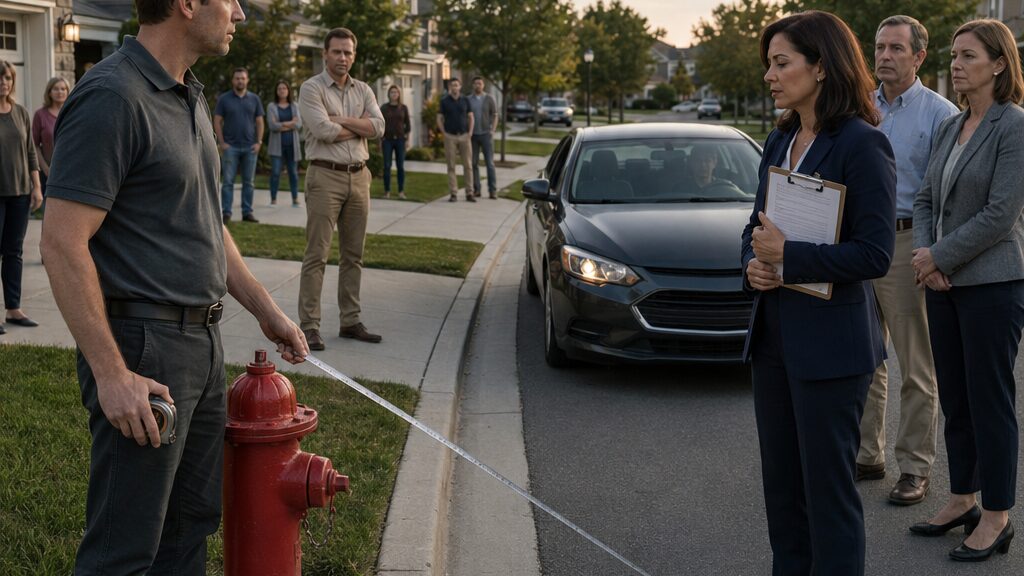
Sharon arrived Tuesday evening carrying a clipboard and the expression of someone who expected to spend ten minutes resolving a resident misunderstanding.
Two HOA board members came with her.
Brian stood near his driveway.
Three other neighbors had found reasons to be outside.
I understood immediately that this was no longer a private complaint.
Sharon stopped at the edge of my lawn.
“Benjamin, thank you for meeting us.”
“Sure.”
“I want to keep this simple.”
“So do I.”
She glanced toward my porch camera.
“We’ve reviewed the location. This is a public street maintained by the municipality, but the association has historically identified this curb as a preferred passenger-loading point because it reduces vehicle stacking near the entrance.”
“Preferred by who?”
“The association.”
“Does the city know?”
Her smile tightened.
“We’re not here to debate jurisdiction.”
“That’s the only part I’m asking about.”
One of the board members cleared his throat.
Sharon continued.
“The concern we received was that drivers and residents were being approached while using an established pickup area.”
Brian said, “That’s exactly the issue.”
I looked at him.
He didn’t look back.
Sharon said, “No one is disputing your right to access your driveway. But residents also cannot reserve curb space for their exclusive use.”
“I’m not reserving anything.”
“That is how this is beginning to be perceived.”
There it was.
Not safety.
Not access.
Perception.
I felt heat climbing into my face.
Rebecca, standing near our garage, caught my eye.
She didn’t shake her head.
She didn’t have to.
I went inside the garage and returned with the tape measure.
One of the neighbors across the street gave a quiet laugh.
I ignored it.
Sharon’s expression changed.
“Benjamin—”
“You said keep it simple.”
I hooked the end of the tape at the hydrant.
Then I walked along the curb.
Five feet.
Ten.
Fifteen.
I locked the tape.
The metal blade crossed the exact portion of curb where the rideshare vehicles routinely waited.
No speech was necessary.
I turned to Sharon.
“Show me where inside that distance a car can legally stand.”
She looked at the tape.
Then at the hydrant.
One board member stepped closer.
“Is it fifteen from the center or the edge?”
“City ordinance says within fifteen feet of a hydrant.”
Sharon said, “Brief loading may be treated differently from parking.”
“I checked.”
“You are not a code-enforcement officer.”
“No. I’m the guy whose driveway keeps getting blocked.”
Brian exhaled sharply.
“There. That’s what this is really about.”
I looked at him.
“What’s that supposed to mean?”
“You don’t care about the hydrant.”
“I care that there’s a rule.”
“You care that cars stop by your house.”
“Because they block my driveway.”
“For two minutes.”
“Sometimes ten.”
“Then go around them.”
“It’s my driveway.”
“And it’s everybody’s street.”
The watching neighbors had gone silent.
This was exactly what I had not wanted: two grown men arguing over twelve feet of curb while an audience pretended not to listen.
Sharon raised one hand.
“This is why we’re here. We need to lower the temperature.”
I almost laughed.
Then a dark rideshare sedan turned onto our street.
Nobody spoke.
The car slowed.
Passed Brian’s house.
Passed the first open stretch of curb.
Then stopped directly beside us.
Inside the tape.
Its hazards came on.
For one second, the scene was so perfectly timed that I wondered if somebody had arranged it.
The driver looked through the windshield at five adults standing around a measuring tape.
He cracked his window.
“Am I in somebody’s way?”
One board member looked down.
Brian rubbed his forehead.
I walked to the driver’s side but stopped several feet away.
“You’re picking someone up?”
“Yeah.”
“Can I ask why you stopped here?”
He pointed at the phone clipped beside his steering wheel.
“Pickup point.”
Brian said, “Exactly.”
I looked at the screen.
A small blue marker sat near the curb in front of my property.
Not Brian’s.
Mine.
Or close enough.
“Can I see that?”
The driver lifted the phone from its mount and held it toward me.
At the top was Brian’s pickup request.
Below it, a map.
The pin was not placed on Brian’s house.
It was anchored near the hydrant.
Sharon stepped closer.
“What app is that?”
The driver told her.
She stared at the screen.
Brian crossed his arms.
“I told you the drivers choose where the app sends them.”
“No,” I said quietly. “You told me they choose where they stop.”
He opened his mouth, then closed it.
The driver looked between us.
“Do you want me to move?”
“Yes,” Sharon and I said at the same time.
For the first time that evening, somebody laughed without malice.
The driver pulled thirty feet forward.
The board member who had asked about the measurement crouched near the hydrant.
“So the pin is actually here?”
“That’s what it showed,” I said.
Brian shook his head.
“I didn’t put it there.”
Sharon said, “Residents can sometimes adjust preferred pickup positions.”
“Sometimes,” Brian said. “Mine defaults there.”
“Why?”
“I assumed that was the neighborhood pickup point.”
Sharon’s face became noticeably still.
I saw it before anyone else did.
Recognition.
Not surprise.
Recognition.
“You knew there was a pickup point here,” I said.
“Of course. I just told you the association has used this location.”
“No. I mean a digital one.”
She looked at me.
“We’ve provided transportation guidance to several service providers over the years.”
“What does that mean?”
“It means the association has tried to reduce congestion near the entrance.”
“Did the HOA place that pin?”
“It may have originated from association mapping.”
The board member stood.
“May have?”
Sharon shifted the clipboard under her arm.
“The mapping predates my management tenure.”
That was the first sentence all evening that sounded rehearsed.
I looked back at the hydrant.
The tape was still stretched along the curb.
Fifteen feet of bright metal.
For three days I had treated it like proof that Brian was wrong.
Now the driver’s phone had added another fact.
Brian might be stubborn.
He might know the cars bothered me.
But the cars were not choosing my curb at random.
Someone had told the system that this was where they belonged.
One of the neighbors said, “So the HOA told drivers to stop by a hydrant?”
Sharon answered immediately.
“That has not been established.”
“The pin was right there.”
“The association map and a third-party platform are separate systems.”
I said, “Then show us the association map.”
Sharon looked at me.
“That isn’t necessary for a curbside inspection.”
“It is if the map created the pickup point.”
“We will review the records internally.”
“When?”
“Benjamin.”
“When was that map last updated?”
For the first time, Sharon did not have an answer ready.
Her eyes went briefly to the hydrant.
Then to the curb.
Then to the board members.
She closed the clipboard.
“I think we have enough for this evening.”
The board member nearest her frowned.
“Don’t we need to answer that?”
“We need to verify the source material before making assumptions.”
She turned toward the sidewalk.
“I’ll circulate a written follow-up.”
The inspection was over because Sharon said it was over.
But nobody moved immediately.
Brian looked at the tape.
I looked at Sharon walking toward her car.
Something in the argument had shifted.
I no longer wanted to know why Brian’s rides kept stopping in front of my house.
I wanted to know why Sharon had ended the conversation the moment I asked how old the map was.
Chapter 4: The Map Was Older Than the Hydrant
The map showed the hydrant in the wrong place.
Not a little wrong.
Several yards wrong.
I found it Thursday afternoon after spending two days trading emails with Sharon that said very little in increasingly formal language. She would not send me the association’s original transportation guidance. She would not suspend the pickup location. She would not say who had placed the digital pin.
What she did send was a PDF labeled as the current community access map.
I printed it at work.
Then I carried the page outside when I got home.
Rebecca stood at the kitchen window while I walked from the driveway to the hydrant, paper in one hand, tape measure in the other.
On the map, the red hydrant symbol sat farther down the block, almost in front of the property between Brian’s house and mine.
The actual hydrant was beside my driveway.
I checked the street numbers.
Checked the sidewalk joints.
Checked the curve where the road widened toward the neighborhood entrance.
The map was not distorted.
The hydrant had moved.
I went back inside.
Rebecca looked at the paper.
“So the map is old.”
“Or wrong.”
“Same result.”
“No. Wrong means somebody made a mistake. Old means somebody failed to update it.”
She studied my face.
“That distinction matters to you more than it should.”
“It matters if the HOA is still directing vehicles using it.”
I called the municipal utilities office the next morning.
A clerk confirmed that work had been done on our block several years earlier. A water-line replacement had required relocating one hydrant to improve spacing.
“Can you tell me when?”
She gave me a year.
I wrote it down.
Then I opened the date printed in tiny text at the bottom of the HOA map.
The map was older by fourteen months.
For a few seconds I simply stared at the two dates.
There it was.
Not a conspiracy.
Not Brian manipulating an app.
Not careless drivers independently picking the same curb.
A piece of outdated information had survived long enough to become a routine.
I expected the discovery to feel good.
Instead, I thought about the complaint confirmations stored on my phone.
Drivers I had reported.
Drivers who had been sent to that curb by a map they had no reason to distrust.
That evening, Rebecca found me sitting at the dining table with the photographs spread in front of me.
“You’re not submitting another one, are you?”
“No.”
She pulled out the chair across from me.
“That sounded painful.”
“I’m thinking.”
“You’ve been doing a lot of that around hydrants.”
I slid the map toward her.
“The city moved it after this was created.”
She followed my finger from the printed symbol to the current location.
“So Sharon has an old map.”
“Yes.”
“And the drivers are being sent to the old pickup area.”
“Yes.”
She looked at the photographs.
“How many complaints did you file?”
“Four.”
Her eyes lifted.
“Four?”
“Two were after they blocked the driveway.”
“That wasn’t my question.”
I leaned back.
“Four.”
“Did all four drivers know they were in a restricted zone?”
“I don’t know.”
“Did any of them choose that spot?”
“I don’t know.”
She let the silence sit.
I hated that.
“I wasn’t making up the violation.”
“I know.”
“The hydrant is there.”
“I can see the hydrant from our front window, Benjamin.”
“The city rule is clear.”
“I know that too.”
“What exactly are you saying?”
She folded the map.
“I’m saying you wanted someone to be wrong badly enough that you stopped asking who.”
That made me angry because it was close enough to the truth to be useful.
“I asked Brian.”
“You asked Brian to fix it.”
“He could have.”
“Maybe.”
“He knew it was happening.”
“Yes.”
“But these drivers didn’t.”
I looked down at the complaint confirmations.
Rebecca touched one corner of the page.
“You were right about the curb. That doesn’t mean you were right about every person standing on it.”
The next morning I requested a meeting at the HOA office.
Sharon agreed to fifteen minutes.
Her office was in a converted room behind the community clubhouse, with neutral furniture and three framed photographs of landscaped entrances.
I placed the map on her desk.
“The hydrant moved.”
She glanced down.
“We are reviewing that.”
“The map predates the relocation by fourteen months.”
“We are reviewing that too.”
“So suspend the pickup point.”
“I can’t make an operational change based on a resident’s interpretation of municipal records.”
“It isn’t interpretation.”
“Benjamin, transportation guidance affects the entire community.”
“It affects my driveway.”
“And changing it may push rideshare loading toward the main entrance, where we have already had congestion complaints.”
There was the first explanation that sounded human instead of procedural.
“You’re keeping a bad location because the alternative is inconvenient.”
“I’m keeping an established location until the board verifies the best alternative.”
“People are being directed to stop beside a hydrant.”
“For brief pickups.”
“The city doesn’t make that distinction the way you keep implying.”
Her jaw tightened.
“You have made your concern very clear.”
“And you knew there were complaints before mine.”
She paused.
I had guessed.
The pause told me I was close.
“What complaints?”
She leaned back.
“Delivery access. Vehicle stacking. Nothing identical to your situation.”
“How long ago?”
“That isn’t relevant.”
“It is if you knew the location caused problems.”
“The location reduced larger problems at the main entrance.”
“So you traded them.”
Her expression cooled again.
“We manage competing needs. That is what residential management is.”
I picked up the map.
Outside, I saw Brian walking toward the mailboxes.
I almost let him pass.
Then I said, “You knew they were being sent there.”
He stopped.
“I knew the app usually put the pickup there.”
“You told me the drivers chose.”
“They choose whether to stop.”
“That’s not the same thing.”
“No.”
It was the first time he had admitted even that much.
“Why didn’t you change it?”
Brian looked past me toward his house.
“Because it worked.”
“For you.”
“Yes.”
“At my driveway.”
“You could still get in and out most of the time.”
“Most?”
His mouth tightened.
“I knew it irritated you.”
“That’s not what I asked.”
He rubbed one hand across his jaw.
“You want me to say I kept using it because you made such a big deal about it?”
I said nothing.
He looked at me then.
“Fine. Partly.”
The admission landed harder than denial.
“So after you knew—”
“I was tired of being told where I could stand, where cars could stop, what I should change.”
“That’s called having neighbors.”
“And measuring tape apparently.”
I almost answered.
Then I noticed something I had ignored from the beginning.
Brian’s own car had barely moved in weeks.
It sat in his driveway under a thin layer of dust.
“You don’t drive much anymore.”
His expression changed.
Not defensive.
Closed.
“That has nothing to do with this.”
“You use rideshares almost every day.”
“Yes.”
“Why?”
He started walking away.
“Brian.”
He stopped without turning.
“You keep saying I should just drive myself.”
“I never said just.”
“You thought it.”
He faced me again.
“There’s a reason I don’t.”
Then he walked toward his house before I could ask what it was.
Chapter 5: The Reason Brian Would Not Drive
“You really think convenience is the only reason I use those cars?”
Brian asked it from his porch Saturday morning before I had even reached the steps.
I had gone over intending to talk about the pickup pin.
Instead, I stopped beside the railing.
“No.”
“That’s a recent development.”
“I noticed your car hasn’t moved.”
Brian looked toward the driveway.
The sedan was clean but dusty around the tires.
“My daughter asked me to stop driving for a while.”
I waited.
He sat in a porch chair and pointed at the other one.
I hesitated, then sat.
For the first time since this started, neither of us had a driver waiting nearby.
Brian rubbed his palms together.
“Last winter, I was driving her home after dinner. Phone buzzed. I looked down.”
His voice stayed level.
“Maybe two seconds.”
He stared at the sidewalk.
“When I looked up, I was halfway over the centerline.”
I said nothing.
“A pickup truck was coming the other way. He moved. I corrected. Nobody hit anybody.”
He swallowed once.
“My daughter didn’t say anything for about a minute.”
The red hydrant was visible down the street between two parked cars.
Brian followed my eyes.
“She asked me if I even realized what I had done.”
“Did you?”
“Not until she asked.”
He leaned back.
“I kept telling myself it wasn’t a crash. Nothing happened.”
“That sounds familiar.”
He gave me a sharp look.
I had not meant it cruelly.
But I did not take it back.
After a moment he nodded.
“Yeah.”
He continued.
“My daughter told me she wasn’t getting in a car with me again until I took one of those refresher courses and got checked out.”
“Checked out for what?”
“Reaction time. Vision. Whatever I need.”
“Did you?”
“I signed up.”
“When?”
“Next month.”
That surprised me.
“So you stopped driving voluntarily?”
“Mostly.”
“Because she asked?”
“Because she was right.”
There was no pride in the sentence.
Only discomfort.
Brian pointed at his car.
“I use it for the grocery store if I have to. Otherwise I take a ride.”
I tried to fit that man beside the one who had shrugged at me in his doorway.
They fit more easily than I wanted.
“You could have told me.”
He laughed once.
“What was I supposed to say? Sorry your driveway is blocked, I scared my daughter and now I don’t trust myself behind the wheel?”
“You could’ve said the rides mattered to you.”
“You could’ve asked before filing complaints.”
That stopped me.
“So you know about those.”
“Sharon told me.”
“Of course she did.”
“She said drivers were starting to complain about that pickup.”
“Because they were being sent to a restricted curb.”
“I know that now.”
I looked at him.
“Now?”
“After the tape-measure performance.”
“It wasn’t a performance.”
“Half the block was watching.”
“I didn’t invite them.”
“No. But you enjoyed being right.”
I started to answer.
Then Rebecca’s words came back to me.
You wanted someone to be wrong badly enough that you stopped asking who.
I looked down at my hands.
“Maybe I did.”
Brian seemed almost disappointed that I had agreed.
We sat there for several seconds.
Then I said, “You still knew the cars were blocking me.”
“Yes.”
“And you kept the pickup pin.”
His eyes shifted.
There it was.
“I tried moving it once.”
“Where?”
“Closer to my house.”
“And?”
“The app reset it the next time.”
“So you stopped trying.”
“At first.”
“What does that mean?”
“It means after you started coming over, I stopped caring.”
I looked at him.
“You deliberately left it there.”
“Yes.”
“Because I complained.”
“Because every time I opened my door, you were standing there with another rule.”
“That doesn’t justify it.”
“I didn’t say it did.”
His tone sharpened.
“I’m telling you the truth because apparently that’s what we’re doing now.”
I stood.
Brian stood too.
For a moment the old anger was back, simple and clean.
“You made it worse on purpose.”
“Yes.”
“And I reported drivers who were following a bad map.”
“Yes.”
We looked at each other.
Neither of us had much left to feel superior about.
Brian exhaled.
“I should’ve moved the pin again.”
“I should’ve checked the system before reporting everybody.”
“You still would’ve reported me.”
“You weren’t driving.”
That almost made him smile.
Almost.
My phone buzzed.
I pulled it out.
An email from Sharon.
The subject line was formal enough that I knew it was bad before I opened it.
Notice of Association Review.
I read the first paragraph.
Then again.
Brian watched my face.
“What?”
“The HOA says my conduct may constitute interference with approved community transportation access.”
“What does that mean?”
“Apparently photographing vehicles, confronting drivers, and repeated complaints may have created a hostile pickup environment.”
He stared.
“You’re kidding.”
“No.”
The email said the matter would be placed before the board at its next scheduled hearing. Possible outcomes included a warning, restrictions regarding camera orientation, and fines under nuisance or harassment provisions if the board found my conduct unreasonable.
I handed Brian the phone.
He read in silence.
Then he gave it back.
“I didn’t ask for that.”
“Did you complain?”
“I complained about you approaching drivers.”
“That’s enough.”
“I didn’t ask them to fine you.”
“No. Sharon figured that part out herself.”
Brian looked toward the street.
“What are you going to do?”
“I have the outdated map.”
“And your complaints.”
“And the hydrant record.”
His expression changed.
“You could bury them.”
“Who?”
“The HOA.”
“That’s not the point.”
“You sure?”
I did not answer.
Because four days earlier, I would have loved the idea.
Not money.
Not humiliation.
Just the satisfaction of putting every email, every measurement, every contradiction on a table and watching Sharon explain why none of it was her responsibility.
Brian leaned on the railing.
“If this turns into them blaming me for the pickup location—”
“I know.”
“You know what?”
“I know you don’t want to be the whole story.”
He looked at me.
For once, there was no argument in his face.
That evening, another email arrived.
This one contained the hearing packet.
My complaint history was attached.
Camera screenshots.
Two written statements from residents saying drivers had appeared uncomfortable when I approached them.
And a question for the board:
Had Benjamin Carter’s conduct exceeded reasonable protection of his property and become disruptive to community access?
Rebecca read the sentence over my shoulder.
“They’re putting you on trial for the problem you reported.”
“Pretty much.”
She pointed at the folder on the table where I had collected the old map, city records, photos, confirmations, and Sharon’s emails.
“You have enough to make them regret that.”
I looked at the folder.
That was the problem.
I did.
Chapter 6: The Hearing Where Winning Wasn’t Enough
Sharon began the hearing by putting my complaint history on the screen.
Four municipal reports.
Three photographs.
Two camera stills.
One email exchange that looked much worse when my sentences were separated from everything that had happened before them.
The clubhouse meeting room was nearly full.
Brian sat in the second row.
Rebecca sat beside him.
I was at the front table facing the HOA board.
Sharon clicked to the next slide.
“Our concern is not whether Mr. Carter experienced inconvenience,” she said. “The concern is proportionality.”
I almost smiled at the word.
Proportionality.
As though the hydrant had become irrelevant because I had reacted badly enough.
The board president looked at me.
“Mr. Carter, you’ll have time to respond.”
“I understand.”
Sharon continued.
She described complaints from drivers.
Residents who felt uncomfortable.
The camera angle.
My repeated interaction with Brian.
She never said I had invented the obstruction.
That was what made her presentation effective.
She did not need to.
She only needed to make the board believe that whatever had started this, I had become the larger problem.
When she finished, the president nodded toward me.
“You may respond.”
I opened the folder.
The stack was almost an inch thick.
For a second, I imagined going through every page.
Every timestamp.
Every contradiction.
I could have kept them there all night.
Instead I took out one photograph.
The hydrant.
The curb.
The tape extended fifteen feet.
I set it on the table.
“This is why I complained.”
Sharon said, “The board is aware of the hydrant.”
“I know.”
I took out the old association map.
“And this is why the drivers kept stopping there.”
One board member leaned forward.
I placed the city utility record beside it.
“The association map was created before the hydrant was relocated.”
The room changed.
Not dramatically.
No gasps.
Just chairs shifting.
People leaning.
The president picked up the record.
“Is this confirmed?”
“Yes.”
He looked at Sharon.
“Management?”
“We are still reviewing historical mapping.”
I said, “The utility work date is right there.”
Sharon’s mouth tightened.
“The question before the board tonight concerns Mr. Carter’s conduct.”
“That’s part of the question.”
“No, it is the scheduled matter.”
“Then schedule another one.”
The president raised a hand before Sharon could answer.
“Mr. Carter, continue.”
I looked at Brian.
Then at the folder.
“If you want to decide whether I went too far, you should. I filed complaints against drivers before I knew they were being directed to that curb.”
Rebecca’s eyes lifted.
I continued.
“I thought Brian was causing the whole problem. He wasn’t.”
Brian looked down.
“He knew the cars were blocking me. He kept using the pickup location after that. That part is his.”
A few heads turned toward him.
“But the location itself came from the association’s guidance.”
Sharon said, “That has not been conclusively established.”
I pulled out one email.
“You told me the curb was an approved pickup location.”
“For association purposes.”
“Then who approved it?”
Silence.
The president looked at her.
“Sharon?”
She folded her hands.
“The pickup guidance was created to reduce congestion near the clubhouse and main entrance.”
“So management approved it?”
“It predates my tenure in its original form.”
“Did you continue using it?”
“Yes.”
“After complaints?”
The question came from one of the board members.
Sharon looked at him.
“What complaints?”
“Benjamin asked you that earlier.”
For the first time, she looked genuinely cornered.
“There had been delivery-access concerns.”
“How many?”
“Several.”
“About that curb?”
“About vehicle circulation in that area.”
I said, “And you kept the designation.”
She looked at me.
“Because moving vehicles back toward the entrance created a different safety and congestion issue.”
There it was.
Not corruption.
Not malice.
A tradeoff.
A bad one, but still a tradeoff.
The president asked, “When did management learn the hydrant location did not match the map?”
Sharon paused.
“Recently.”
“How recently?”
She glanced at me.
“Before Mr. Carter’s site inspection.”
The room went still.
That mattered.
She had known enough to question the map before standing at my curb and defending the location.
One of the board members said, “Why wasn’t the pickup point suspended pending review?”
“Because we did not yet have an alternative.”
A woman near the back said, “So you left people stopping by a hydrant because moving them was inconvenient?”
The president immediately asked residents not to interrupt.
I could feel the room moving toward the moment I had wanted for weeks.
Sharon exposed.
Brian implicated.
Me vindicated.
All I needed to do was push.
The folder contained Brian’s ride screenshots that Sharon had included.
His repeated pickup activity.
His written admission that he had kept using the location.
I could ask the board to sanction him too.
Instead, I closed the folder.
“I’m not asking you to fine Brian.”
He looked at me.
Sharon blinked.
The president said, “Then what are you asking?”
“Fix the pickup map.”
I pointed to the hydrant photo.
“Stop sending people to a place the city says they shouldn’t stop.”
“What about your complaint against Mr. Thompson?”
“I don’t have one before this board.”
“He continued using the location after you objected.”
“Yes.”
“And you don’t want action?”
“I want the location corrected.”
Sharon said, “That may require eliminating multiple informal pickup points across the community.”
“Then review them.”
“There may be significant resident opposition.”
“Then explain why.”
She stared at me.
“You understand that moving all passenger loading toward common areas could increase walking distance for elderly or mobility-limited residents.”
That slowed me.
It was a real problem.
Not an excuse.
A consequence.
I looked at the board.
“Then create legal pickup locations that work for those residents. But don’t solve one inconvenience by putting cars where the city says they can’t stand.”
The board president leaned back.
One of the other members whispered to him.
Then he said, “We’re going into brief executive discussion.”
The room emptied into the clubhouse lobby.
People spoke around me in low voices.
Some agreed.
Some did not.
A man I barely knew said the pickup system had worked fine for years until I “made it an issue.”
I did not argue.
That surprised Rebecca more than anyone.
“You okay?” she asked.
“I think so.”
Brian stood a few feet away.
After a moment he said, “You could’ve asked them to hit me with a violation.”
“I know.”
“Why didn’t you?”
I looked through the glass doors toward the distant red hydrant.
“Because then I’d still have the same curb.”
The board called us back twenty minutes later.
The president read the decision carefully.
No fine would be issued against me that night.
The camera angle would be reviewed separately to ensure it remained primarily directed toward my property.
More importantly, the board ordered an immediate audit of all association-designated pickup and short-term loading locations against current municipal infrastructure and safety restrictions.
The disputed curb was suspended as a recommended pickup point effective immediately.
Sharon would coordinate temporary alternatives.
A murmur moved through the room.
Not approval.
Concern.
People were already asking where drivers would go.
The president raised his voice.
“The board understands this may cause temporary inconvenience.”
That was the price.
Not revenge.
Inconvenience.
Shared this time.
As the meeting broke up, Sharon gathered her papers.
I walked past her without stopping.
She said, “Benjamin.”
I turned.
“You got the review.”
“That’s what I asked for.”
“You also just changed how half this neighborhood gets picked up.”
“I know.”
For once, I did not add anything else.
Outside, Brian stood beside the sidewalk.
Neither of us spoke.
Behind us, the clubhouse doors opened and residents spilled into the parking lot, already debating which curbs would disappear from the map.
The problem was finally bigger than Brian and me.
And for the first time, that did not feel like winning.
It felt like responsibility.
Chapter 7: The Curb Finally Became Ordinary Again
The rideshare sedan slowed in front of my house, and for half a second I felt the old irritation rise before the driver accelerated again.
No hazard lights.
No brake lights lingering beside the hydrant.
No passenger stepping off Brian’s sidewalk.
The car continued toward the clubhouse.
I stood at the edge of my driveway holding a trash bin and watched it disappear around the curve.
It had been three weeks since the board hearing.
The association had completed its curb review faster than I expected and slower than half the neighborhood wanted. Temporary pickup locations had become permanent ones near the clubhouse and two other common areas where vehicles could pull completely out of the traffic lane.
The digital map had been updated.
The old pickup marker beside my property was gone.
So were several others.
That last part had made me surprisingly unpopular.
A neighbor across the street had stopped me two days after the new map went live.
“My mother has to walk almost another block now.”
“I know.”
“She’s seventy-eight.”
“I understand.”
“Do you?”
There had been a time when I would have explained everything.
The hydrant.
The city rule.
The outdated map.
The delivery complaints.
Sharon’s decision not to suspend the location.
I would have produced dates if necessary.
Instead I said, “The board is reviewing accessibility exceptions.”
The neighbor shook his head.
“This whole thing worked fine until you started complaining.”
Then he walked away.
I stood there with six different answers ready and used none of them.
Rebecca noticed.
“That was growth,” she said from the porch.
“I was conserving energy.”
“Sure.”
The red hydrant stood beside us.
For months, I had looked at it like evidence.
Now it looked like what it had probably always looked like to everyone else: a piece of municipal equipment painted bright red so nobody would miss it.
The HOA had also reviewed my porch camera.
Sharon sent a short notice confirming that its revised angle was acceptable because it primarily covered our driveway and front approach.
No fine.
No warning beyond the existing guidance.
Her message ended with a sentence about maintaining respectful shared use of community spaces.
I almost replied.
Rebecca saw me typing.
“No.”
“I’m just going to thank her.”
“You’re going to thank her in four paragraphs.”
I deleted the draft.
“Fine.”
“See? More growth.”
Sharon herself had become harder to read.
She was still community manager. The board had not fired her, and I had never expected them to.
At the next neighborhood notice, her name appeared beneath an explanation that the association had relied on outdated transportation guidance and was correcting its maps to align with current municipal infrastructure.
It was not an apology.
It was also more than I thought she would ever put in writing.
Brian had been quieter.
We had not spoken since the hearing.
His car still sat in the driveway most days.
Twice I saw him leave in a rideshare from the new common pickup area.
The first time, I happened to be getting the mail.
He walked past my house with his hands in his jacket pockets.
He saw me.
I saw him.
Neither of us stopped.
He continued uphill toward the clubhouse.
A sedan waited there legally, several hundred feet from my driveway.
I expected satisfaction.
What I felt instead was something closer to relief.
He had changed the pickup location.
Not because I was standing beside a tape measure.
Not because a driver had been reported.
Not because the board forced him personally.
He had simply changed it.
That mattered more than I wanted to admit.
A week later, I received a municipal email connected to one of my older complaints. No enforcement action would be taken because the circumstances could not be independently verified.
Months earlier, I would have been irritated.
I deleted it.
Rebecca looked over from the couch.
“What was that?”
“One of the parking complaints.”
“And?”
“Nothing.”
“You’re deleting it?”
“Yes.”
She narrowed her eyes.
“Who are you?”
I laughed.
The whole thing had become smaller.
That was the part nobody told you about solving a problem.
You spent so long imagining resolution as a dramatic moment—a ruling, an apology, somebody admitting you had been right—that ordinary peace could almost feel anticlimactic.
Then you remembered that ordinary was what you had wanted in the first place.
There were still consequences.
Some residents complained about longer walks.
One board member proposed creating a reservation system for residents with mobility limitations.
Delivery drivers occasionally stopped in places they shouldn’t.
People still parked badly.
The neighborhood did not become orderly because one map was corrected.
And Brian did not become my friend.
One Saturday morning, I was trimming a hedge near the front walk when I heard a car slow.
A rideshare vehicle stopped near the edge of my property.
My shoulders tightened automatically.
Then the driver rolled down the window.
“Pickup for Thompson?”
Before I could answer, Brian’s voice came from behind me.
“No.”
I turned.
He was walking up the sidewalk carrying a small backpack.
The driver pointed at his phone.
“It says around here.”
Brian came closer but did not step into the street.
“The pickup point is up by the clubhouse now.”
The driver looked uncertain.
“That’s what the map says?”
“It should.”
He pointed uphill.
“Keep going. You’ll see the loading area.”
The driver thanked him and pulled away.
Brian and I watched the car continue toward the clubhouse.
For a moment neither of us spoke.
Then he looked at the hedge.
“You’re cutting that side too short.”
I looked at him.
“You want to measure it?”
His mouth moved before he could stop it.
Not quite a smile.
Close.
“No.”
He started walking.
“Course starts Tuesday,” he said.
I knew what he meant.
“The driving refresher?”
He nodded.
“My daughter’s coming with me.”
“That’s good.”
“Yeah.”
He took another step, then stopped.
“I should’ve moved that pickup pin the first time you asked.”
There were a dozen things I could have said.
I should have checked the map first.
I should not have reported every driver.
You were still wrong.
So was I.
Instead I said, “Probably.”
Brian gave a quiet laugh.
“Still annoying.”
“So I’ve heard.”
He continued toward the clubhouse.
I went back to the hedge.
A few minutes later, I looked toward the curb.
Nothing was there.
No idling sedan.
No flashing hazards.
No tape measure stretched across the pavement.
Just the driveway, the sidewalk, and the red hydrant standing where the city had put it years ago.
For weeks I had wanted everyone to understand exactly why that fifteen-foot boundary mattered.
Now nobody was thinking about it.
That was how I knew it was finally working.
The story has ended.