They Called Him a Trespasser at His Own Pond, Then Learned Why the HOA Needed His Land
Chapter 1: The Morning They Told Him the Pond Wasn’t His
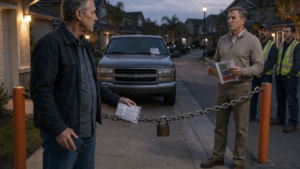
“You need to leave the property, Mr. Martin.”
Richard Martin looked from Pamela Roberts to the pond behind her.
For a moment, he thought he had misheard.
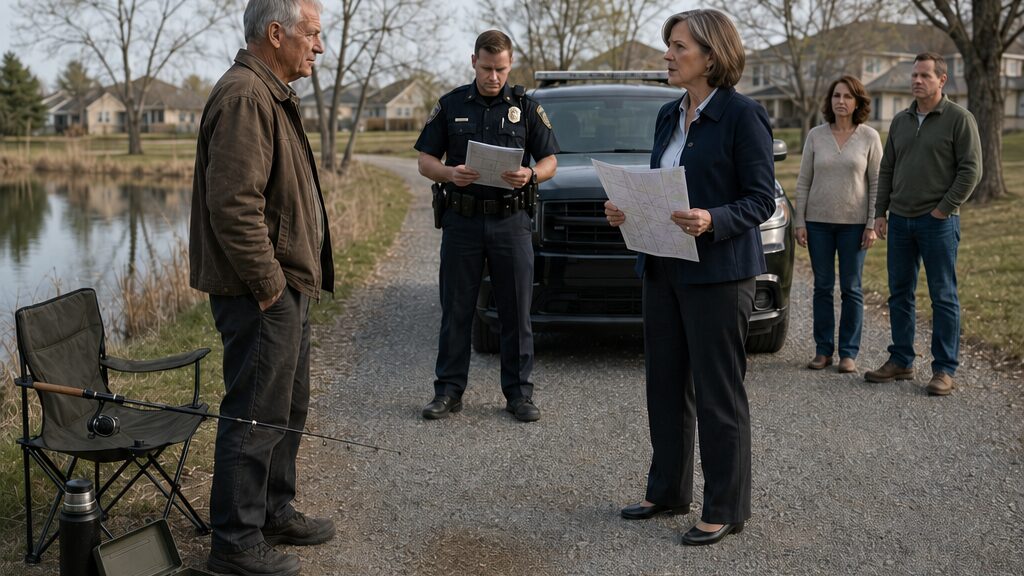
His folding chair sat six feet from the water. His black thermos rested beside it. Three old fishing lures lay in the shallow tray of his tackle box, their paint chipped from decades of use. His rod was still in his right hand, the line floating motionless on the surface.
Pamela stood in the middle of his gravel path with two neighbors behind her.
“This is HOA property,” she said. “You’ve already received notices.”
Richard glanced toward the tree line.
“I received envelopes.”
“You received violation notices.”
“I know what was in them.”
Pamela’s mouth tightened.
That was the problem with Richard’s silence. People often mistook it for uncertainty.
He had owned the 3.2 acres since 1983. He had fished this pond before Briar Creek Estates had streetlights, decorative entrance columns, or an association board. He knew where the property line crossed the slope because he had watched the survey crew set the corners himself.
But he had ignored Pamela’s letters.
The first called the pond an unapproved water feature.
The second demanded fencing.
The third threatened fines of two hundred dollars every week until he complied.
Richard had put each one in the same kitchen drawer.
His attorney had reviewed his deed years earlier. Richard had seen no reason to argue with people who could have checked the county records for themselves.
Now Pamela had come to him.
“You’re standing beyond the community boundary,” she said. “I’m asking you one last time to move.”
Richard slowly reeled in his line.
He rested the rod across the arms of the folding chair.
“What boundary are you using?”
Pamela opened a folder and held out a printed map.
Richard did not take it.
From where he stood, he could see a thick line running along the pond and then turning south.
“That one,” Pamela said.
Richard studied it.
“That isn’t my property survey.”
“It’s the association’s current site map.”
“That wasn’t my question.”
One of the neighbors shifted uncomfortably.
Pamela lowered the paper.
“You don’t get to dismiss association records because you don’t like them.”
Richard looked at the ground near the edge of the gravel.
Years of leaves and runoff had nearly buried the old iron pin.
He walked toward it, crouched slowly, and scraped dirt aside with the heel of his boot.
A rust-dark metal cap appeared.
“There.”
Pamela frowned.
“What is that supposed to prove?”
“Southwest corner marker.”
She gave a short breath through her nose.
“According to whom?”
“The surveyor who drove it there.”
“That was decades ago.”
“So was my deed.”
Pamela folded her arms.
Richard felt the familiar irritation rise in his chest. He had spent most of his adult life believing that if something was true and properly recorded, there was no reason to perform the truth for other people.
That belief had served him well in machine shops, job sites, tax offices, and family disagreements.
Standing beside his pond, it suddenly felt less reliable.
Pamela took out her phone.
“If you refuse to leave, I’ll have you removed.”
Richard stared at her.
“From my land?”
“From HOA land.”
He could have walked back to the house and brought the deed.
He could have called Daniel Lewis.
Instead, pride held him where he was.
“I’m not moving.”
Pamela tapped the screen.
The neighbor nearest her murmured something Richard could not hear.
Pamela turned away.
“Yes,” she said into the phone. “I need an officer. We have an unauthorized person refusing to leave association property.”
Richard’s jaw tightened.
He looked past her toward the houses beyond the trees. Curtains moved in two windows. Someone had stopped walking a dog at the end of the lane.
So this was no longer an envelope in a drawer.
It had become a story people could watch.
Eight minutes later, a county deputy’s vehicle rolled slowly down the gravel path.
The deputy stepped out, listened first to Pamela, then to Richard.
Richard kept his answers short.
“How long have you owned this parcel?”
“Since 1983.”
“The pond included?”
“Yes.”
“Survey available?”
“At the house.”
Pamela handed over her HOA map.
The deputy studied it, then looked toward the exposed iron marker.
“You know where the other corner is?”
Richard nodded.
They walked the line together.
At the far end, Richard found the second marker beneath honeysuckle and old leaves. The deputy compared the locations with the map on his tablet.
Pamela followed several steps behind.
When they returned to the pond, the deputy looked at her.
“This map doesn’t appear to establish association ownership of the pond.”
Pamela’s expression changed only slightly.
“It shows the drainage corridor.”
“That may be something different.”
Richard heard the words and felt a brief, hard satisfaction.
Then the deputy turned toward him.
“You said you have the deed?”
“In my kitchen.”
“I’d like to see it.”
He glanced at Pamela’s map again.
“And I want this too.”
Pamela hesitated before handing it over.
The deputy laid the HOA map on the hood of his vehicle and pointed to the thick line crossing south from the pond.
Richard stepped closer.
For the first time that morning, he noticed that the line did not stop at his property boundary.
It ran straight through his acreage.
The deputy looked from the map to Richard.
“If the association doesn’t own this land,” he said, “we need to figure out why their drainage map says they have access across it.”
Chapter 2: The Deed Proved Ownership but Opened a Bigger Problem
The deputy stood at Richard’s kitchen table with one hand on the 1983 deed and the other on Pamela’s HOA map.
“The pond is yours.”
Pamela said nothing.
Richard had expected those words to feel better.
They did, for about five seconds.
The county parcel record matched the deed. The shoreline fell inside Richard’s boundary. So did the gravel path where Pamela had accused him of trespassing.
The deputy tapped the old legal description.
“There isn’t much ambiguity here.”
Pamela’s face had gone pale around the mouth.
“The association map clearly shows—”
“It shows something,” the deputy said. “It just doesn’t show ownership.”
Richard leaned against the counter.
His old brass-colored fishing lure sat beside the deed where he had dropped it after emptying his jacket pocket.
Pamela noticed it.
Her eyes moved from the lure to the papers.
“You’ve been receiving our notices for weeks,” she said.
“I have.”
“And you never responded.”
“No.”
“Why?”
Richard looked at her.
“Because you were wrong.”
Pamela gave him a stare that made the kitchen feel smaller.
The deputy gathered his notes.
“This isn’t a trespass situation. Any continuing property disagreement is civil.”
He returned Pamela’s map but paused before letting it go.
“I’d have somebody explain that drainage corridor before you send anything else.”
After the vehicle left, Pamela remained on Richard’s porch.
“You could have answered the first letter.”
“You could have checked the deed before sending it.”
For once she had no immediate reply.
Then she looked toward the pond.
“We’re not finished with the drainage issue.”
Richard watched her walk back up the path.
That irritated him more than the accusation had.
By ten that morning, he had called Daniel Lewis.
Daniel had handled Richard’s property matters for almost twenty years. He listened without interrupting until Richard mentioned the thick drainage line on the HOA map.
Then he stopped him.
“Bring me everything.”
“The deed?”
“The deed, their notices, the map if you have a copy, anything tied to access.”
Richard frowned.
“You already checked the deed.”
“I checked ownership.”
“What’s the difference?”
“Possibly a large one.”
At the county records office, Daniel spread copies across a narrow table while a records clerk brought over older filings.
Richard recognized his original deed immediately: faded type, stamped dates, the legal description he had read enough times to know almost by memory.
Daniel worked through it more slowly.
“There,” he said.
Richard leaned closer.
A section near the back referred to a recorded drainage easement along the southern portion of the parcel.
Richard read it twice.
“The HOA has access?”
“Limited access.”
“To my property.”
“For drainage purposes.”
Richard sat back.
The satisfaction from the morning disappeared.
He remembered maintenance crews crossing the southern strip over the years. Usually a truck, sometimes two men clearing brush or checking a culvert. He had never objected because they stayed away from the pond and rarely remained longer than an hour.
“I thought that was county drainage.”
“So did I, based on what you told me.”
Daniel pulled another recorded document toward him.
The easement predated much of Briar Creek Estates. Its original purpose was to allow runoff from the developing neighborhood to reach a drainage channel that crossed Richard’s land before emptying farther downstream.
Pamela had been wrong about the pond.
But she had not invented the association’s connection to his acreage.
Richard stared through the office window.
“I’ve been telling her she has no rights here.”
“At the pond, you were correct.”
“But not everywhere.”
“No.”
That bothered him.
Not because Pamela had been partly right.
Because he had never bothered to learn the distinction.
Daniel continued reading.
Richard watched the lines of text instead of the man’s face.
After a while, Daniel stopped.
“What?”
Daniel traced one paragraph with his finger.
“This easement isn’t as broad as their site map makes it look.”
Richard leaned forward.
The legal language restricted access to maintenance, repair, inspection, and operation of specific drainage features. It did not grant general construction access, landscaping authority, control over the shoreline, or ownership.
“So they can maintain the drain.”
“Yes.”
“They can’t tell me where to fish.”
“No.”
“Can they build new drainage through here?”
Daniel did not answer immediately.
“That depends.”
“On what?”
“On what they’re building, where, and whether it fits the original easement.”
Richard looked down at the HOA map again.
The bold line was wider than the narrow corridor described in the old record.
“How long has their map looked like that?”
“That’s one question.”
Daniel turned back to the recorded easement.
“There are others.”
He pointed farther down the page.
The easement contained requirements Richard had forgotten completely: the holder had to maintain the drainage improvements, limit interference with the owner’s use of the land, repair damage caused by access, and keep activities within the described corridor.
Richard remembered tire ruts after storms.
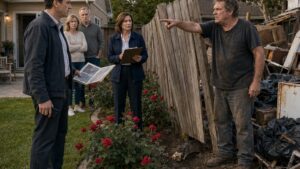
A damaged section of fence he had fixed himself.
Brush cut fifteen feet farther north than he thought necessary.
Small things he had dismissed because arguing seemed like more trouble than repairing them.
Daniel took out his phone.
“I want maintenance records.”
“From the HOA?”
“And plans for whatever they’re proposing.”
Richard picked up the old lure and rolled it between his fingers.
For forty-one years, fishing had been the uncomplicated part of owning the place. Sit down. Tie a knot. Cast. Wait.
He had thought the paperwork worked the same way: once recorded, finished forever.
Daniel kept reading.
Then his finger stopped again.
“What now?” Richard asked.
Daniel’s expression had changed.
“There’s a compliance condition.”
Richard waited.
Daniel turned the page so they could both read it.
“If they’ve failed maintenance or interfered outside the permitted use, they may not have the unrestricted access they think they have.”
Richard looked at the bold drainage line on Pamela’s map.
For the first time, the question was no longer whether Pamela had crossed his boundary.
It was how many times the HOA already had.
Chapter 3: The Notices Were About More Than a Fence
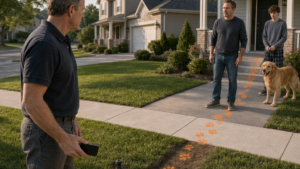
The orange survey stake had not been there the night before.
Richard saw it before he unfolded his chair.
It stood in the grass fifteen feet north of the old drainage corridor, bright enough in the predawn gray to look almost lit from within.
A second stake waited closer to the pond.
Then a third.
Richard set down his thermos without opening it.
He walked to the nearest stake and stared at the ribbon tied around the top.
No company name. No explanation.
Only a line of fresh orange markers crossing ground the deed did not give the HOA.
His fishing rod remained against the chair.
By seven-thirty, Pamela was answering her phone.
“Did you send surveyors onto my property?”
A pause.
“Good morning to you too, Richard.”
“Did you?”
“The association is conducting preliminary site work.”
“On my side of the line.”
“For the drainage project.”
“You don’t have general project access.”
“We have an easement.”
Richard looked at the orange stakes.
“Not where these are.”
Pamela exhaled slowly.
“This is exactly why we’ve been trying to get cooperation from you.”
Richard almost laughed.
“Calling me a trespasser was cooperation?”
“I admitted the ownership map needed clarification.”
“No, the deputy clarified it.”
Another pause.
Then Pamela’s voice hardened.
“We have homes that take water every time there’s a severe storm. We have a drainage system that was never designed for the number of houses feeding it now. I’m not going to let one boundary disagreement stop necessary work.”
Richard looked toward the subdivision roofs beyond the trees.
“One boundary disagreement?”
“You know what I mean.”
“I’m starting to.”
He ended the call.
That afternoon, another HOA envelope arrived.
The fencing demand remained.
So did the threatened weekly fine.
Richard carried the notice into the kitchen, opened the drawer where the others lay, and stopped.
For the first time, he did not put it inside.
He called Daniel.
“Still think I should ignore them?”
“No.”
Richard hated how quickly the answer came.
Daniel requested project records from the association and county. Richard, meanwhile, drove to the HOA office himself.
He had not been inside in years.
Carol Davis sat behind a table covered in budget sheets when he entered. She looked up sharply.
“Mr. Martin.”
“Richard.”
She removed her glasses.
“I heard about Tuesday.”
“I suppose everybody did.”
Her expression suggested that was true.
Richard placed the latest notice on the table.
“Why are they still sending these?”
Carol glanced toward the closed office door.
“The president handles enforcement.”
“You’re the treasurer.”
“Yes.”
“Then tell me why a fence around my pond matters to a drainage project.”
Carol’s fingers stopped on the calculator.
“It doesn’t. Not directly.”
“Then what does?”
She hesitated long enough for Richard to notice.
“The board has a capital vote scheduled in four days.”
“For what?”
“A drainage upgrade.”
Richard waited.
Carol finally pushed a project summary toward him.
The proposed work included a larger collection line, a rebuilt culvert, and new access for equipment along the southern edge of his acreage.
“How much?”
“The full project?”
“Yes.”
Carol named the figure.
Richard stared at her.
“Already bid?”
“Preliminary contractor pricing.”
“Using my land?”
“Using the recorded easement.”
Richard tapped the plan.
“This route is wider than the easement.”
Carol looked down.
“I’m not a surveyor.”
“But you approved a budget for it.”
“The board approved planning funds.”
“Same map Pamela brought to my pond?”
Carol did not answer.
That was answer enough.
Richard felt anger first.
Then something more useful.
Suspicion.
“When did you find out the ownership was disputed?”
Carol’s shoulders tightened.
“Pamela told us you were refusing access.”
“That wasn’t my question.”
“She said your tract had old records that needed cleaning up.”
“Before or after she called law enforcement?”
Carol looked toward the closed door again.
“Before.”
The room went still.
Richard lowered his voice.
“So she knew the records weren’t settled.”
“I said she knew they needed clarification.”
“And she told the deputy I was trespassing.”
Carol’s face changed.
Not defensive this time.
Tired.
“You think I’m defending that?”
“I don’t know what you’re defending.”
“The association’s finances.”
There it was.
Carol pulled another sheet from the stack.
“The reserve account is already carrying roof repairs, road resurfacing, and stormwater work we delayed twice. If this drainage project has to be redesigned from scratch, we don’t have a clean way to absorb it.”
Richard looked at the numbers without really reading them.
“So Pamela needs this project approved.”
“We all need some version of it approved.”
“And she needs my property to make the current version work.”
Carol did not correct him.
For the first time, Richard understood that Pamela’s urgency was not entirely manufactured.
There were actual drainage problems.
Actual homeowners downstream.
Actual money the association did not have.
That did not excuse the notices or the 911 call.
But it explained why Pamela had treated uncertainty like an enemy.
On his way home, Richard passed the orange stakes again.
They no longer looked like petty intimidation.
They looked like assumptions somebody had already priced into a contract.
Daniel called before dinner.
“I’ve got part of the maintenance history.”
Richard sat at the kitchen table.
“And?”
“Mostly inspection notes for the last few years. Not much proof of actual maintenance.”
“How far back?”
“I requested fifteen years.”
Richard looked toward the drawer containing the notices.
“How many years did they send?”
Daniel was quiet.
“That’s the problem.”
“What problem?”
“There are gaps. Long ones.”
Richard straightened.
“How long?”
“Several years with no maintenance records at all. And there are contractor references that suggest equipment entered outside the described corridor.”
Richard remembered crushed grass, deep tire tracks, cut brush, the fence section he had replaced himself.
Things he had chosen not to complain about.
Daniel continued.
“I need the final project plans before I say more. But if these records are accurate, the association may have been treating a narrow drainage easement like general-purpose access.”
Richard looked through the kitchen window toward the first orange stake near the pond.
For weeks, Pamela had acted as though he was the man refusing to follow the rules.
Now Daniel was telling him the HOA might have spent years building its plans on rules it had stopped following itself.
Chapter 4: The Board Meeting Where Silence Stopped Helping Him
Richard had not attended a Briar Creek Estates board meeting in more than six years.
That fact seemed to arrive before he did.
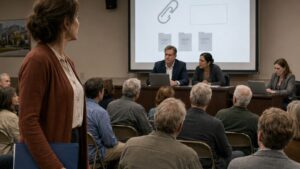
When he stepped into the clubhouse on Thursday evening, conversation near the folding tables thinned, then stopped. A few residents looked away. Others watched him openly.
Richard felt the old fishing lure in his jacket pocket and resisted the urge to turn around.
He had put it there without thinking.
Or perhaps he had known exactly why.
Pamela Roberts sat at the center of the board table with a stack of project folders arranged in front of her. Carol Davis was two seats down, glasses low on her nose.
A large drainage plan had been mounted on an easel.
The thick blue route cut across Richard’s parcel.
Pamela looked at him.
“Mr. Martin. I wasn’t aware you were attending.”
“Neither was I until yesterday.”
He took a chair near the aisle.
Pamela opened the meeting.
For twenty minutes Richard listened to roof reserves, landscaping contracts, and road repairs. Nobody mentioned his name.
Then Pamela stood beside the easel.
“We need to address the drainage improvement vote.”
Several residents shifted forward.
Pamela pointed to shaded sections on the map.
“During severe rain, these homes receive runoff the existing system can’t carry efficiently. We’ve delayed improvements before. We can’t responsibly delay again.”
A resident near the front said, “My backyard flooded twice last summer.”
Another added, “Water came within three feet of our patio door.”
Richard looked at the map.
Until that moment, the project had existed in his mind as orange stakes, violation notices, and Pamela’s certainty.
Now the shaded areas had houses inside them.
Pamela continued.
“The proposed route follows the association’s established drainage access.”
Richard raised his hand.
Pamela looked at him but continued talking.
He kept his hand up.
Finally she said, “Yes?”
“You mean the easement across my property.”
A few heads turned.
Pamela’s expression remained composed.
“Yes. The recorded drainage easement.”
“The one that’s twenty feet wide.”
She paused.
“The engineering plan requires sufficient temporary construction access.”
“That route is wider than twenty feet.”
“The contractor needs equipment clearance.”
“That isn’t what the deed grants.”
Pamela folded her hands.
“This is exactly the problem we’re facing. Necessary infrastructure is being delayed because one owner is refusing reasonable access.”
Richard felt heat rise into his face.
A week earlier, he would have stood up and left.
Let the deed speak for itself, he would have thought.
But he had already tried that.
The silence had not stayed empty. Pamela had filled it.
“I never refused drainage maintenance,” he said.
Pamela’s eyes narrowed slightly.
“You ignored every communication.”
“I ignored notices claiming my pond was an HOA water feature.”
“You ignored requests for cooperation.”
“You sent me a fence demand and threatened fines on land you don’t own.”
The room became very quiet.
One board member looked toward Pamela.
She answered evenly.
“The boundary information available to us was inconsistent.”
Richard heard Carol shift papers.
He looked at Pamela.
“You called the sheriff before checking it.”
“The situation appeared to involve unauthorized use.”
“My use. On my property.”
Pamela’s jaw tightened.
Then a resident in the second row spoke.
“Can we not turn this into another argument about the pond? Some of us are worried about flooding.”
Richard turned toward the voice.
The frustration there was genuine.
That mattered.
He looked back at the easel.
“What happens if this plan doesn’t go through?”
Carol answered before Pamela could.
“We redesign.”
“And?”
Carol glanced toward Pamela.
“And it costs more.”
“How much more?”
“We don’t have a final number.”
Pamela said, “Which is precisely why delaying the current project is irresponsible.”
Richard stayed focused on Carol.
“Can the reserve fund cover a redesign?”
Carol took off her glasses.
“Not comfortably.”
Pamela said her name quietly.
Carol ignored her.
“We have other scheduled work. If the drainage route changes substantially, we would likely postpone road resurfacing, raise assessments, or both.”
A murmur spread through the room.
Richard sat back.
For the first time, he understood why Pamela had been so determined to make his property fit her map.
The problem was not simply authority.
It was arithmetic.
The project had been built around the cheapest assumption.
His land.
His silence.
The existing easement.
Pamela returned to the presentation.
“The current design is the most practical path forward.”
Richard reached into his jacket pocket and closed his fingers around the old lure.
Its metal edge pressed into his palm.
“How long have you known my ownership was unresolved on your map?”
Pamela stopped.
“That question has already been addressed.”
“No. It hasn’t.”
A board member looked toward Carol.
Carol lowered her gaze.
Richard saw it.
“So the board knew.”
Pamela stepped away from the easel.
“We knew there were historical inconsistencies.”
“And you priced the project anyway.”
“We priced a project based on recorded drainage rights.”
“Rights you haven’t shown are broad enough for this.”
A few residents began whispering.
Pamela’s control slipped just enough for Richard to notice.
“You are not the only homeowner affected here.”
“I know.”
That answer surprised both of them.
Richard stood.
He looked at the shaded homes on the map.
“I’m not asking you to cancel anything tonight.”
Pamela waited.
“I’m asking for forty-eight hours.”
“For what?”
“For an independent review of what the easement actually allows, what maintenance was done, and whether this route stays inside it.”
Pamela shook her head.
“The vote has already been delayed.”
“Then delay it two more days.”
“We have contractor pricing that expires.”
“Then let it expire.”
A few people reacted sharply.
Richard looked around the room.
“I’m not asking anyone to trust me. I’m asking you to verify the land before you spend money crossing it.”
Pamela’s face hardened.
“The board will proceed with the scheduled vote.”
Carol turned toward her.
“Pamela—”
“No.”
The word landed harder than she intended.
Pamela looked down the table, then back at Richard.
“We cannot operate this association by reopening every settled issue because one owner objects.”
Richard slowly took his hand out of his pocket.
The lure remained inside.
For years he had believed refusing to participate kept other people from controlling his life.
Now he saw the cost.
When he left the clubhouse, Daniel was waiting for him outside with a folder under one arm.
“You got my message?”
Richard nodded.
“What did you find?”
Daniel looked through the glass doors at the board gathering around Pamela.
“Enough that they should not vote tonight.”
Richard glanced back.
“They’re doing it anyway.”
Daniel handed him the folder.
“Then tomorrow they may learn what happens when access they assumed was permanent isn’t.”
Chapter 5: The Clause Pamela Could Not Explain Away
The civil engineer crouched beside the drainage channel and pushed a measuring rod into the mud.
“This part is outside the recorded corridor.”
Richard looked at his boots.
Brown water had already worked into the seams.
“How far?”
“About eleven feet at the widest point.”
Daniel stood behind them holding copies of the deed and easement survey.
The engineer walked farther south.
A shallow rut curved around a clump of trees before returning toward the drainage line.
“Equipment’s been coming through here.”
Richard nodded.
“I’ve seen trucks.”
“For how long?”
“Years.”
“You object?”
Richard looked at the broken ground.
“No.”
Daniel gave him a brief glance.
That one word mattered more than Richard wanted it to.
He had spent years repairing small damage because complaining seemed petty.
A section of fence.
Ruts near the slope.
Brush cut too far back.
He had treated each incident as temporary inconvenience.
Together, they had become a pattern nobody had been forced to examine.
The engineer pointed toward a concrete box half-hidden by weeds.
“That structure should have a clear maintenance path.”
“It doesn’t,” Richard said.
“No.”
Sediment had collected along one side. Grass had grown through a cracked joint.
The engineer photographed it.
“If this has been inspected regularly, I’d want to see those reports.”
Daniel said, “We asked.”
“And?”
“Gaps.”
The engineer stood.
“How big?”
“Years.”
Richard rubbed mud from one boot against the other.
Pamela had not created all of this.
That realization irritated him because anger had been easier when she was responsible for everything.
The neglected channel predated her presidency.
So did the casual use of his land.
Pamela had inherited a mess.
Then she had chosen to solve it by pretending the boundaries were simpler than they were.
Back in Daniel’s office, the three of them spread the records across a conference table.
The engineer marked the known easement line in pencil.
The proposed construction route crossed beyond it in several places.
“The current design can’t be built entirely inside the original corridor,” he said.
“Could it be redesigned?” Richard asked.
“Yes.”
Daniel looked at him.
“At a cost.”
“How much?”
The engineer named a range.
Richard leaned back.
It was enough to explain Carol’s concern.
Not enough to excuse Pamela.
Daniel waited until the engineer left.
Then he opened the old easement document.
“There’s something we need to discuss.”
Richard folded his arms.
“That usually means I’m not going to like it.”
“You might like it too much.”
Daniel turned the page.
The easement required the holder to maintain the drainage works, repair property damage caused by access, and avoid unreasonable interference with the owner’s use.
Richard read the passage.
“What happens if they don’t?”
“The owner can demand cure.”
“And if they refuse?”
“Access can be suspended pending correction.”
Richard stared at him.
“Suspended.”
“Yes.”
“All of it?”
“Potentially.”
The word settled between them.
Richard imagined the orange survey stakes disappearing.
The contractor trucks turning around at his drive.
Pamela explaining to the board why the cheapest project route was suddenly unavailable.
For a moment, satisfaction came easily.
“Then file it.”
Daniel did not move.
“You asked what your rights are. I’m telling you.”
“I said file it.”
“And I’m telling you to understand what that means first.”
Richard’s chair creaked beneath him.
“They accused me of trespassing.”
“Yes.”
“They kept the fines after the deputy proved the pond is mine.”
“Yes.”
“They planned a project outside the easement.”
“Yes.”
“So what exactly am I supposed to wait for?”
Daniel closed the document.
“For you to decide whether your goal is to stop Pamela or fix the problem.”
Richard looked away.
“That sounds like the same thing.”
“It isn’t.”
Daniel pushed the engineer’s estimate across the table.
“If you suspend access immediately, their current project stops. They redesign. Assessments may rise. Delayed drainage work may stay delayed through another storm season.”
“That isn’t my fault.”
“No.”
Daniel let the answer stand.
Richard hated him a little for that.
Because Daniel had not accused him.
He had simply removed the excuse Richard wanted.
Later that afternoon, Carol met him outside the clubhouse.
She looked exhausted.
“The vote was postponed.”
Richard stopped.
“Pamela agreed?”
“No. The HOA attorney insisted after reviewing your letter.”
Richard had not known Daniel had already sent one.
Carol continued.
“I should tell you something.”
Richard waited.
“When Pamela took over, she inherited the reserve problem and the drainage complaints. Residents were angry. Every project had been studied to death and pushed another year.”
“That still doesn’t make my land hers.”
“I know.”
Carol looked toward the clubhouse windows.
“She thought if she showed hesitation, the board would lose the project again.”
“So she acted like there was none.”
“Yes.”
The admission came without defense.
Carol rubbed her thumb against the edge of her folder.
“I believed her longer than I should have.”
Richard heard the difference between that and an apology.
It was smaller.
Maybe more honest.
“What happens now?”
Carol looked at him.
“That depends on what you do.”
At dusk, Richard returned to the pond.
He sat in the folding chair but did not cast.
Mud had dried on his boots.
Across the water, one of the orange stakes leaned slightly where the ground had softened.
He thought of the flooded yards shown at the meeting.
Then he thought of Pamela standing on his path, calling him unauthorized.
A vehicle stopped near his drive.
Pamela walked down alone.
No folder.
No board members.
No phone in her hand.
She stopped several feet from his chair.
“I heard your attorney can suspend access.”
Richard looked at the pond.
“He says I can.”
Pamela swallowed.
“If you file that notice tomorrow, the project is finished.”
“The current project.”
“The affordable project.”
Richard finally looked at her.
“You should have thought about that before telling the sheriff I was trespassing.”
Pamela’s face tightened, but she did not argue.
For the first time since this began, she seemed less interested in winning than in what came next.
“I’m asking you not to file it.”
Richard rested his hands on his knees.
He had spent weeks wishing Pamela would understand that his permission mattered.
Now she did.
And he discovered that having the power to say no was much easier than deciding whether he should.
Chapter 6: He Could Break the Project or Rewrite the Rules
The suspension notice was signed.
Richard carried it into the emergency board meeting inside a plain manila folder.
He had not filed it.
That difference was invisible to everyone except him and Daniel.
Richard had left his fishing rod at home.
For forty-one years, most difficult mornings had ended at the pond. That morning he had walked past the chair without unfolding it.
Now he sat at the clubhouse table opposite Pamela.
Carol sat beside the HOA attorney.
Several board members lined the remaining seats.
Daniel placed a second document beside Richard’s folder.
Pamela noticed it.
“What is that?”
Richard answered.
“Another option.”
The HOA attorney adjusted his glasses.
“Before we discuss proposals, there is information the board needs in the record.”
Pamela looked toward him.
He opened a packet.
“We reviewed correspondence concerning the Martin parcel from before the law-enforcement incident.”
Richard watched Pamela’s posture change.
Barely.
But enough.
Carol reached for a set of minutes.
“Three weeks before the trespass complaint,” she said, “counsel advised that ownership near the pond should be independently verified before enforcement.”
A board member turned toward Pamela.
“You knew?”
Pamela’s face flushed.
“I knew counsel wanted additional verification.”
“That’s not what you told us.”
“I told you the historical records were inconsistent.”
Carol shook her head.
“You told us Mr. Martin was refusing access to association property.”
Pamela looked at Richard.
He did not rescue her from the silence.
She drew a breath.
“The drainage project was already under pressure. We had residents demanding action, contractor pricing expiring, reserve numbers getting worse every month. Every time we paused, people accused this board of doing nothing.”
“That explains the deadline,” Carol said. “It doesn’t explain the police call.”
Pamela’s eyes dropped.
“No.”
It was the first time Richard had heard her say the word without attaching anything to it.
No explanation.
No counterargument.
No authority behind it.
The HOA attorney continued.
“The association’s original easement is valid. However, the current project exceeds its recorded footprint, and maintenance compliance is incomplete.”
A board member asked, “Can Richard shut it down?”
The attorney glanced toward Richard.
“He can demand cure and suspend access if the violations remain unresolved.”
Every face at the table turned toward him.
Richard opened the manila folder.
“This is the notice.”
Pamela stared at the signed page.
“If I file it,” Richard said, “nobody enters the easement until the maintenance problems and unauthorized use are corrected.”
Nobody spoke.
Richard had imagined this moment more than once.
In some versions, Pamela looked frightened.
In others, embarrassed.
He had imagined feeling victorious.
Instead, he felt the weight of every person waiting for him to decide what happened to land he had wanted everyone to leave alone.
He slid the suspension notice to one side.
Then he pulled Daniel’s second document forward.
“This is what I’m offering instead.”
Pamela looked confused.
Daniel passed copies around.
Richard kept his hands flat on the table.
“The fines disappear. All of them.”
Carol nodded.
“The board can do that.”
“The association records the pond, shoreline, and gravel path as private property. No more maps suggesting otherwise.”
Another nod.
“You pay for an independent survey and permanent boundary markers.”
Carol wrote it down.
“You repair the drainage channel, the fence damage, and the areas where equipment went outside the corridor.”
Pamela said, “And the project?”
Richard looked at her.
“The old easement goes away.”
The room shifted.
Pamela sat straighter.
“That’s effectively the same as suspension.”
“No.”
Richard tapped the second document.
“You get a replacement.”
The HOA attorney began reading faster.
Richard continued.
“Narrow route. Exact width. Drainage work only. Temporary construction access by written schedule. Restoration required after equipment leaves. No general entry. No claim over the pond.”
A board member asked, “What does that do to the cost?”
Carol looked at the numbers Daniel had attached.
“More than the current plan. Less than a full redesign.”
“How much more?”
She gave the estimate.
The room went quiet again.
It was painful.
But survivable.
Pamela stared at Richard.
“You could have demanded much more.”
“Yes.”
“Why aren’t you?”
Richard thought about the question.
Because the neighbors had not called the deputy.
Because water did not care who had been rude at a meeting.
Because he had spent years believing that refusing to engage kept his hands clean, when sometimes it only left decisions to people more willing to make them badly.
“I want my land respected,” he said. “I don’t need everybody else punished to prove it’s mine.”
Pamela looked down at the table.
Richard turned to the board.
“I also want one more thing.”
Carol waited.
“When property questions come up again, you verify them before enforcement. Not after.”
“That can be adopted as policy,” the HOA attorney said.
Richard nodded.
“Then put it in writing.”
Pamela finally spoke.
“And if the board refuses?”
Richard touched the manila folder.
“Then I file this before the county office closes.”
There was no threat in his voice.
That made it clearer.
The board recessed for fifteen minutes.
Richard waited outside on the clubhouse porch with Daniel.
“You surprised me,” Daniel said.
“You told me not to enjoy the first option too much.”
“I didn’t think you listened.”
“I usually don’t.”
Daniel smiled.
Through the glass doors, Richard could see Carol speaking firmly to two board members. Pamela sat alone at the table.
When the meeting resumed, Carol made the motion.
Rescind all violations against Richard Martin.
Fund an independent survey.
Accept responsibility for easement repairs.
Authorize negotiation of the replacement access agreement based on Richard’s terms.
Adopt verification procedures before future property enforcement.
Then another board member added a separate motion concerning Pamela’s presidency.
Pamela closed her eyes for a moment.
Richard looked away.
He did not need to watch that part closely.
Carol called for the vote on Richard’s agreement first.
Hands began to rise around the table.
Richard left the signed suspension notice unopened beside him.
For the first time in weeks, the question was no longer whether the HOA could cross his land.
It was whether they were finally willing to cross it on terms that admitted whose land it was.
Chapter 7: The Pond Stayed Quiet After the Board Changed
The drainage crew arrived at seven-twelve on a Tuesday morning and stopped exactly where Richard had told them to stop.
That mattered more to him than he expected.
A small excavator rolled down the marked access route, staying between the new survey stakes. Two workers followed on foot. Neither cut across the pond bank. Neither parked on the gravel path beside Richard’s chair.
One of them raised a hand.
“Morning.”
Richard nodded back.
His rod was already in the water.
For the first time in weeks, the orange ribbons near the pond were gone.
They had been replaced by permanent boundary markers set after the independent survey. Small metal caps sat nearly flush with the ground, plain and difficult to notice unless someone knew where to look.
Richard knew.
He had watched every one of them go in.
The HOA had accepted the replacement access agreement three weeks earlier.
The violation notices disappeared from Richard’s account. The fencing demand was withdrawn. The association paid for the survey, repaired the damaged section of fence, and funded restoration where maintenance trucks had strayed outside the old corridor.
The drainage project survived, though not unchanged.
The contractor narrowed the route, adjusted the staging area, and moved one section farther from the pond.
The extra cost was unpleasant.
It was not catastrophic.
Carol had called it “the price of finally measuring before assuming.”
Richard had not disagreed.
Pamela was no longer president.
The board removed her from the position at the same emergency session where Richard’s terms passed, though she remained an owner in the neighborhood and still had every right to attend meetings.
Richard had seen her once since then, driving past the end of his gravel lane.
Neither of them waved.
He was comfortable with that.
The excavator bucket scraped mud from the neglected channel.
Richard watched for a minute, then returned his attention to the water.
He opened his tackle box.
The three old lures lay in their usual row.
He selected the smallest one, its paint worn almost silver along one side, and tied it carefully to the line.
Forty-one years of mornings had left the knot in his fingers even when stiffness slowed everything else.
A vehicle door closed behind him.
Richard turned.
Carol Davis was walking down the path with a cardboard tube under one arm.
“No clipboard?” he asked.
She smiled.
“I’m trying to improve my reputation.”
Richard reeled in.
Carol stopped beside the chair but did not sit.
“The final survey was recorded yesterday.”
She removed a rolled map from the tube.
Richard studied it while she held the bottom corners against the breeze.
The pond boundary was clean now.
So was the twenty-foot drainage corridor.
The temporary construction-access area appeared separately, with an expiration date and restoration requirements.
No thick blue line swallowing half his acreage.
No ambiguity where the gravel path belonged.
Richard touched the place on the map where Pamela had stood and told him to leave.
“Looks different.”
“It is different.”
Carol rolled the map halfway closed.
“The attorney said the old site map is being removed from the association records.”
“Good.”
“And the board approved the property-verification policy.”
Richard looked at her.
“That fast?”
“Turns out people become enthusiastic about verification after paying for an unnecessary survey dispute.”
Richard gave a quiet grunt that might have been a laugh.
Carol hesitated.
“There’s something else.”
She handed him an envelope.
Richard stared at it.
“Not another violation.”
“No.”
He opened it.
Inside was an invitation to the next property and infrastructure committee meeting.
Richard read it twice.
Then he looked at Carol.
“You’re joking.”
“I argued against calling it a committee. Sounded too official.”
“And yet.”
“And yet.”
Richard folded the paper.
“I’m not joining an HOA committee.”
“You don’t live in the HOA.”
“Even better reason.”
Carol smiled, but she did not take the invitation back.
“We’re asking you to attend. Not join.”
“Why?”
“Because you know where half the old drainage pieces are.”
“So does a map.”
Carol looked toward the newly exposed channel.
“We’ve established maps have limitations.”
Richard could not argue with that.
A worker farther down the corridor called for a measurement.
The crew paused while the civil engineer checked the marked line before allowing the excavator forward.
Richard noticed the pause.
Nobody simply assumed.
Carol noticed him watching.
“Pamela wasn’t wrong about everything,” she said.
Richard’s expression hardened slightly.
Carol continued before he answered.
“The drainage problem was real. The reserve problem was real. I should have pushed harder when the property questions came up.”
Richard looked at the pond.
“You’re telling me this because?”
“Because it’s easier to blame one person and pretend the rest of us had nothing to do with it.”
Richard let the words sit.
He remembered every unopened envelope in his kitchen drawer.
Every meeting he had skipped.
Every time he had decided that being right meant he did not have to explain himself.
“No,” he said. “It wasn’t just her.”
Carol looked surprised.
Richard folded the invitation and put it into his jacket pocket.
“I could’ve answered the first letter.”
“That wouldn’t have made the map correct.”
“No.”
“But?”
“Might’ve stopped things before somebody called the sheriff.”
Carol nodded.
Neither of them called it forgiveness.
Neither needed to.
She handed him the final survey.
“I thought you’d want a copy.”
Richard looked at the rolled paper.
Then at his chair.
“Put it underneath.”
Carol frowned.
“Underneath what?”
“The chair.”
She laughed softly and slid the map beneath the folded edge of the canvas seat, protected inside its tube.
“See you Thursday?” she asked.
Richard picked up his rod.
“I didn’t say that.”
“You put the invitation in your pocket.”
“I put lots of things in pockets.”
Carol started back toward the road.
At the top of the path she turned.
“Thursday. Six-thirty.”
Richard shook his head.
She kept walking.
The drainage crew moved farther south, following the exact route Richard had approved.
Their machines made noise, but the pond itself remained still.
Richard cast the old lure beyond the reeds.
It landed with a small, familiar sound.
Behind him, beneath his chair, the corrected map rested where the violation notices never had.
Within reach.
Not because he expected another fight.
Because he had finally learned that knowing where the line was mattered less if nobody was willing to show up and point to it.
Richard settled back in the chair and watched the line straighten across the water.
Thursday at six-thirty was still two days away.
He already knew he would be there.
The story has ended.