They Called His Backyard Strip a Gray Zone Until the HOA Trash Came Back to Its Door
Chapter 1: The Trash That Wasn’t Supposed to Be His
The broken lawn chair had not been there the night before.
Michael Anderson stopped halfway across his backyard, one gloved hand still wrapped around the handle of his pruning shears. Beyond the low hedge at the rear of his property, three black trash bags leaned against the chair’s bent aluminum frame. One of the bags had split near the knot. Paper plates and damp cardboard showed through the opening.
Michael stared at the pile for several seconds.
The narrow strip behind his yard had always looked like leftover ground. Grass, hedge roots, a shallow drainage dip, then the paved service lane behind the neighborhood clubhouse. Delivery vans used the lane. Landscapers sometimes parked there. The HOA’s trash enclosure stood farther down, partially screened by a wooden fence.
But the strip itself was his.
At least Michael had always understood that it was.
He stepped closer without touching anything.
Near the hedge sat a crushed red soda can.
That bothered him more than the chair.
He had seen the same can two days earlier and picked it up. Or he thought he had. Michael disliked uncertainty almost as much as litter. For thirty-two years he had supervised maintenance crews in public buildings, and uncertainty usually meant someone had failed to check something properly.
He pulled out his phone and took several photographs.
The first trash had seemed ordinary enough.
Ten days earlier, he had found a cup lid near the hedge. Then a fast-food wrapper. Two days later, a tied black bag appeared where the grass met the service lane.
Michael had moved that one to the HOA dumpster without complaint.
The next time there were two.
He had told himself the wind might have pushed them there, though he knew perfectly well that wind did not tie garbage bags and place them neatly side by side.
Now there was furniture.
He crouched near the lawn chair. One leg was snapped. A faded sticker clung to the underside of the seat. The three bags had been arranged beside it with enough care that nobody could reasonably call the pile accidental.
Michael opened the photos on his phone.
The previous evening, while photographing a section of fence he planned to repair, he had accidentally captured the same stretch of grass.
Clean.
The timestamp read 7:18 p.m.
The current time was 7:06 a.m.
Less than twelve hours.
Michael stood.
Across the service lane, the clubhouse kitchen door was closed. The HOA’s waste enclosure sat thirty yards away.
He carried his phone inside instead of moving the trash.
His first instinct was to call Barbara Roberts immediately. His second was to wait until he could explain it without sounding angry.
He chose the second.
By nine-thirty, Barbara was in the HOA office beside the clubhouse. Michael found her behind a desk covered with folders, invoices, and a coffee mug balanced on a stack of meeting agendas.
Barbara looked up when he entered.
“Morning, Michael.”
“I need to show you something.”
He placed his phone on the desk.
Barbara studied the first photograph, then swiped to the next.
“That’s behind your hedge?”
“On my property.”
Her finger stopped.
“Well.” She looked again. “That whole area back there has always been a little unclear.”
“It isn’t unclear to me.”
“I mean operationally.”
Michael disliked the word immediately.
Barbara pushed the phone back toward him.
“The service lane, the clubhouse area, your rear strip—there’s a lot happening in a small space. Landscapers, vendors, trash pickup. It’s something of a gray zone.”
Michael looked at her.
“A broken chair is a gray zone?”
“That’s not what I said.”
“Those bags were put there overnight.”
“And I’ll speak to the waste company.”
“Good.”
Barbara leaned back slightly.
“But Michael, I’d rather not turn this into a property dispute before we know what happened.”
He felt the old familiar pressure behind his ribs: the impulse to list measurements, dates, maintenance records, anything that could make his position unarguable.
Instead he said, “I’m telling you what happened.”
“I understand what you believe happened.”
The distinction was small.
It landed hard.
Michael picked up his phone.
Barbara’s expression softened just enough to become more irritating.
“I’ll handle it.”
He left without answering.
At home, he stood at his kitchen window looking toward the hedge.
The trash was still there.
For most of the afternoon he resisted going outside. He told himself Barbara had said she would handle it. Calling again would make him look exactly as she seemed to think he was—territorial, particular, difficult.
By four, nobody had come.
Michael carried the broken chair and bags to the HOA enclosure himself.
He did it carefully, wearing gloves.
When he returned, the crushed soda can was still beside the hedge.
He picked it up, rinsed the dirt from it at the outdoor faucet, then placed it on the corner of his workbench instead of throwing it away.
He could not have said why.
The next morning, a new black bag sat in nearly the same place.
Michael did not move it.
He photographed it.
That evening, another appeared.
The following day there were three.
They were not scattered. They were not windblown. They formed a loose row just inside the grass beside the paved lane.
Michael went to the hedge and looked down the boundary the way he had hundreds of times while mowing.
There was no fence along that part. No painted line. No sign.
Just grass merging into grass.
For the first time in years, he wondered whether he had been assuming too much.
Barbara’s phrase returned to him.
Gray zone.
Michael went inside, opened the filing cabinet in his study, and pulled out the folder containing the closing documents from when he had purchased the house.
He spread the deed and survey across the dining table.
At first the small numbers blurred together.
Then he found the rear boundary notation.
Michael reached for his reading glasses.
Fourteen feet.
He checked it again.
The line did not stop at the hedge.
It extended well beyond it, toward the service curb.
Michael sat very still.
If the survey meant what he thought it meant, the trash was not sitting near his property.
It was sitting squarely on it.
Chapter 2: Fourteen Feet Beyond the Service Curb
The tape measure crossed the curb and kept going.
Michael stood with one boot pressed against the metal end of the tape where the rear corner pin should have been. The yellow blade stretched across the grass, past the hedge, over the shallow drainage dip, and toward the paved service lane.
Ten feet.
Twelve.
Fourteen.
The mark landed several feet beyond the place Barbara had casually treated as the edge of his yard.
Michael locked the tape.
For a moment he simply looked at the number.
Then he measured it again.
He had spent too many years correcting maintenance reports written by people who measured once and guessed the rest.
The second measurement matched.
So did the third.
The black bags sat inside the line.
Not near it.
Inside it.
Michael photographed the tape from several angles, careful to include fixed landmarks—the hedge corner, the curb, the drainage grate.
By eight-thirty he was back in the HOA office.
Barbara was standing beside a filing cabinet when he entered.
“I checked the survey.”
She closed the drawer. “Michael—”
“Fourteen feet beyond the rear line shown on the lot plan.”
He placed a photocopy on her desk.
Barbara looked down.
Her face did not change much, but she stopped reaching for her coffee.
“This is an old survey.”
“It’s the recorded survey from my closing.”
“I’m not saying it’s wrong.”
“You said the strip was unclear.”
“I said it functions as a gray zone.”
“Land doesn’t change ownership because it’s convenient to function differently.”
Barbara exhaled.
“Please don’t make this adversarial.”
Michael almost laughed.
Instead he folded his hands behind his back.
“I’m asking the HOA to stop putting trash on my property.”
“We don’t know the HOA is putting it there.”
“Then find out who is.”
“I already told you I’d contact the vendor.”
“When?”
Barbara’s eyes hardened slightly.
“When I have something useful to tell you.”
Michael knew that tone. He had used versions of it himself with contractors who demanded answers before he had them.
He also knew what it meant to be on the receiving end.
He picked up the photocopy.
“All right.”
That answer seemed to surprise her.
He left.
But instead of going home, Michael drove to the municipal records office.
The clerk behind the counter asked for his address, parcel number, and identification. Michael supplied all three.
“I’m trying to verify a rear boundary.”
“You having a neighbor issue?”
“Possibly.”
The clerk gave him a sympathetic look that suggested the word possibly had fooled nobody.
Several minutes later, a parcel map appeared on the monitor.
Michael leaned closer.
His lot was an awkward shape, mostly ordinary except for the narrow tail running behind the clubhouse service area.
There it was.
The same line.
The clerk printed the parcel record.
“County record and your survey agree,” the clerk said. “If you need a legal boundary determination, that’s a surveyor question. But the recorded parcel is what you’re seeing here.”
Michael nodded.
He did not feel triumphant.
He felt relieved.
That unsettled him.
Barbara’s “gray zone” comment had gotten under his skin enough that some part of him had begun wondering whether he had spent years mowing land that was not actually his.
Now the uncertainty was gone.
What replaced it was worse.
At home he spread the survey, municipal printout, and his own measurements across the table.
They all told the same story.
The line was real.
The trash was over it.
Michael wrote the date on a legal pad.
Then he stopped.
His first instinct was to send Barbara copies immediately, highlighted and annotated.
Instead he closed the folder.
He had already told her.
He would see whether she acted.
By late afternoon, the black bags were gone.
Michael noticed from the kitchen window.
He walked outside and checked the strip.
Clean.
For the first time in more than a week, the grass behind the hedge looked like grass again.
He should have felt satisfied.
Instead he found himself scanning the service lane.
A waste truck had probably collected the bags. Or Barbara had sent someone.
Either way, perhaps the point had been understood.
Michael returned to his workshop and set the parcel printout beneath a paperweight.
The crushed soda can still sat near the vise.
He looked at it, then turned away.
The next morning, at 6:42, Michael opened his back door and saw a mattress box leaning against the hedge.
Beside it sat two bulging black bags.
He stopped on the threshold.
The mattress box had not blown there.
Neither had the bags.
He walked to the edge of the grass and checked the ground.
Fresh tire tracks showed in the soft soil near the service lane.
Michael took out his phone.
Photograph one: full area.
Photograph two: mattress box.
Photograph three: bags.
Photograph four: tire tracks.
Then he photographed the fourteen-foot measurement again.
At nine, he emailed Barbara copies of the recorded parcel map and the survey.
His message was four sentences.
The disputed strip is part of my recorded parcel. I have confirmed the rear boundary with municipal records. New waste was placed there this morning after our conversation yesterday. Please have it removed and confirm that the HOA and its contractors will not use my property for storage or disposal.
Barbara replied forty-three minutes later.
Michael read the message twice.
She thanked him for the information.
She said the board would “review the boundary question.”
Boundary question.
Not boundary.
Question.
Michael set his phone down.
He could have called.
He could have walked across the lane and demanded that she look at the map with him.
Instead he opened a new folder on his computer.
He named it REAR PROPERTY.
Inside, he created subfolders for photographs, records, correspondence, and dates.
For the rest of the day, he said nothing.
By evening the mattress box was gone.
The bags remained.
Michael photographed them again before sunset.
The next morning, a third bag had appeared.
He did not touch any of them.
That was the moment his approach changed.
Until then, every piece of trash had been a nuisance.
From that morning forward, every piece became evidence.
Chapter 3: When the Gray Zone Became Official
The next pile arrived before the city had even opened Michael’s complaint.
Five black bags appeared overnight, along with a cracked plastic storage bin and two flattened cardboard boxes.
Michael stood behind the hedge at 7:03 a.m. with his phone in one hand and the previous day’s photographs open on the screen.
Yesterday: three bags.
Today: five, plus the bin and boxes.
Someone had added to the pile after he had formally notified the HOA of the boundary.
That changed the meaning.
He photographed each item separately.
Then he photographed the entire strip from the curb.
At his kitchen table, Michael uploaded the images into dated folders. He added the deed, recorded parcel map, his email to Barbara, and her response saying the board would review the “boundary question.”
He stared at that phrase longer than necessary.
His old maintenance crews used to complain that Michael documented everything.
He had never considered it criticism.
At ten, he drove to municipal code enforcement.
The inspector who met him at the counter did not react dramatically to the photographs. That reassured Michael more than sympathy would have.
The inspector looked first at the deed.
Then the parcel map.
Then the images.
“You’re saying none of this is yours?”
“Correct.”
“And it keeps appearing from this side?”
“The HOA service lane is here.”
Michael pointed.
“Have you seen anyone place it?”
“No.”
“Camera footage?”
“No.”
“Any acknowledgment from the association that they’re using the area?”
Michael hesitated.
“Not directly.”
The inspector looked again at Barbara’s email.
“Has anyone specifically authorized the waste company to use your strip?”
“That’s what I’d like to know.”
The inspector nodded.
“That matters.”
Michael frowned. “Why?”
“Because right now you can show repeated waste placement on property recorded to you. You can show the association has been notified. What you can’t show yet is who is making the decision.”
Michael disliked the word yet.
It implied more work.
The inspector opened a case anyway.
The sound of the keyboard was oddly satisfying.
A case number appeared on the screen.
For the first time since the crushed soda can, the dispute existed somewhere outside Michael’s house and Barbara’s office.
The inspector explained that the city would issue notice to the registered HOA address concerning the accumulation of waste and the property complaint. Ownership questions could still require civil clarification if challenged, but the waste issue itself was enough for inspection.
Michael accepted the printed case number.
“Should I move the bags?”
“Document first. Don’t create a second problem trying to solve the first.”
Michael gave a brief nod.
It was exactly the kind of advice he would have given someone else.
By the time he returned home, an email from the HOA was waiting.
It had been sent to the neighborhood distribution list.
Barbara’s name appeared at the bottom.
The message did not mention Michael by name.
It did not need to.
Residents were informed that a homeowner had contacted municipal authorities regarding a “rear common-service boundary concern” that the board believed could have been handled internally. Barbara asked everyone to avoid interfering with vendors while the issue was being reviewed.
Michael read the message standing at his kitchen counter.
His jaw tightened.
Rear common-service boundary concern.
He went outside.
Across the lane, two neighbors were talking beside the clubhouse entrance. One glanced toward him, then looked away.
Michael had lived there long enough to know that news inside an HOA did not travel through official email alone.
By lunchtime, Daniel Perez knocked on his front door.
Daniel was carrying nothing, which meant he had come to talk rather than deliver a board document.
“I figured I’d ask you directly,” Daniel said.
Michael stepped onto the porch but did not invite him inside.
“Ask what?”
“Whether this city thing is really necessary.”
Michael looked toward the backyard.
“Did Barbara send you?”
“No.”
The answer came quickly enough to be believable.
Daniel lowered his voice.
“She thinks we could have resolved it without bringing enforcement into it.”
“I tried.”
“I know you talked to her.”
“I showed her the property issue. More trash appeared afterward.”
Daniel rubbed a hand over his chin.
“I don’t know anything about that part.”
“That’s the problem.”
Daniel studied him for a moment.
“People are worried this turns into fines.”
Michael almost said, Then they should stop putting trash on my land.
The sentence was already formed.
He swallowed it.
“People should be worried about why the trash is there.”
Daniel nodded without agreeing.
“That’s fair.”
But his expression said the conversation had not reassured him.
After Daniel left, Michael went to the rear strip.
The five bags were still there.
The cracked plastic bin caught the afternoon light.
For the first time, the mess no longer felt merely insulting. It had become public in a different way. Barbara had taken a private property dispute and described it to the neighborhood as Michael’s unnecessary escalation.
He had an official case number.
And somehow he felt more isolated than before.
The city inspector visited the following morning.
Michael walked the property with him, showing the survey and the line he had measured from the rear corner.
The inspector photographed the bags and service lane.
At the curb, he stopped.
“If the association disputes the parcel, that can get complicated.”
“They’ve been given the record.”
“I understand.”
The inspector looked toward the clubhouse.
“But somebody knows why this waste keeps ending up here.”
Michael followed his gaze.
The HOA enclosure had space inside it.
Not much, but space.
That bothered him.
If this were simply overflow, why place the bags on his strip instead of beside the enclosure?
The inspector handed Michael a copy of the notice.
The HOA would receive formal written notification.
It was a small victory.
Barbara could no longer call the matter imaginary.
That afternoon the five bags disappeared.
Michael checked the strip twice before dinner.
Nothing returned.
The next morning, the grass remained empty.
The morning after that, still empty.
Michael began to think the notice had worked.
He did not email Barbara.
He did not call Daniel.
He told himself there was no reason to.
On the third morning, he opened the back door just after six and smelled garbage before he saw it.
Michael stepped outside.
His narrow strip had nearly vanished beneath black plastic.
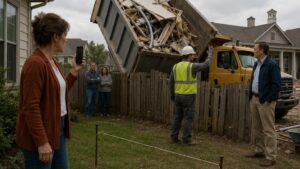
There were at least a dozen bags. The cracked storage bin had returned. A broken shelf leaned against the hedge. The old lawn chair was back too, its bent frame lying on top like a marker.
Michael stood motionless.
Then he looked across the service lane toward the clubhouse.
This was no misunderstanding now.
Someone had made a choice.
Chapter 4: The Morning the Trash Came Back
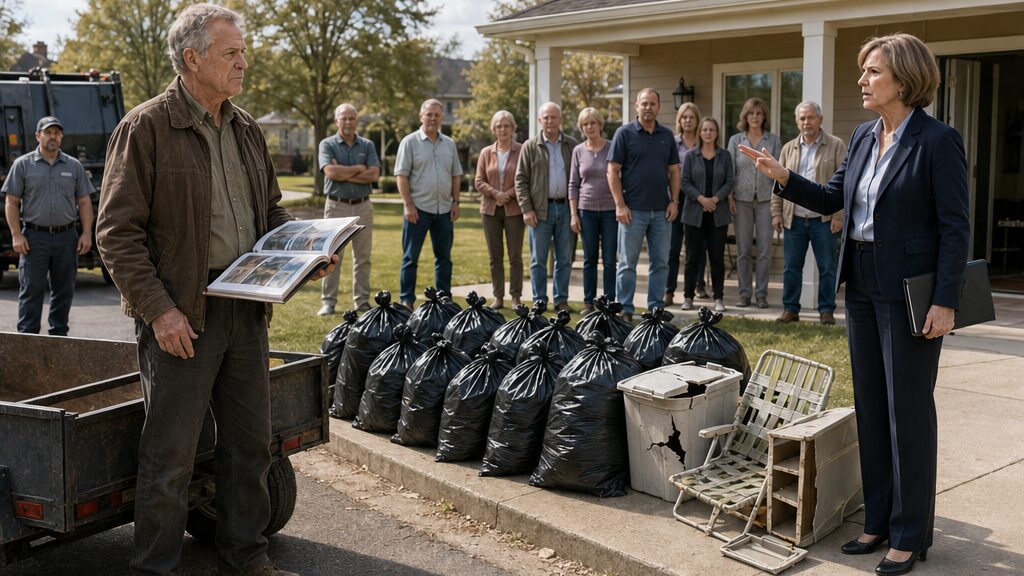
By eight Saturday morning, twelve black bags stood in a neat row beside the HOA clubhouse.
The broken lawn chair sat at the end like punctuation.
Michael Anderson backed the rented utility trailer into a marked space beside the collection pad, shut off the engine, and remained behind the wheel for several seconds.
He had finished moving the last bag before seven.
Nothing blocked the entrance. Nothing touched the clubhouse doors. He had kept every item inside the HOA’s designated common collection area, exactly where the neighborhood’s own waste was supposed to go.
He had also photographed everything before he moved it.
Still, looking at the row now, Michael understood how it would appear.
Angry.
Public.
Deliberate.
All three were true.
He climbed out as the first residents arrived for the Saturday landscaping meeting.
One slowed beside the bags.
Another stared at the broken chair.
A third looked directly at Michael.
Within minutes, the quiet collection pad had become the most interesting place in the neighborhood.
Barbara Roberts appeared through the clubhouse doors carrying a folder.
She stopped.
Her eyes moved from the trash to the trailer, then to Michael.
“What did you do?”
Michael closed the trailer gate.
“I moved material off my property.”
“You dumped garbage at the clubhouse.”
“I placed it on the association’s collection pad.”
Barbara walked toward him.
Her voice stayed controlled, but several residents had already gathered within hearing distance.
“You cannot make a private dispute everybody else’s problem.”
Michael almost answered immediately.
Instead he opened the plastic file box on the trailer seat.
Barbara saw it and shook her head.
“No. Michael, I’m not doing this with another stack of papers.”
“You accused me of bringing my garbage here.”
“Look around.”
“I am.”
He pulled out the first photograph.
It showed five black bags, the cracked storage bin, and the rear strip beside his hedge.
The timestamp was visible in the corner.
He placed a second photograph beside it.
Then a third.
The lawn chair appeared.
The same bent leg.
The same faded mark beneath the seat.
Barbara glanced at the photographs but did not take them.
Michael pointed toward the row on the pad.
“Bag one. Bag two. Bag three.”
One resident stepped closer.
Michael continued.
“Storage bin. Shelf. Chair.”
Barbara’s face tightened.
“You moved all of it yourself?”
“Yes.”
“After the city told you not to create another problem?”
The question landed harder than Michael expected.
The inspector had warned him.
Document first. Don’t create a second problem trying to solve the first.
Michael had documented.
But he had also decided, without waiting for confirmation, that documentation made the next step defensible.
“That material was on my deeded property.”
“That isn’t the only issue now.”
Barbara looked toward the residents.
“This is common property. We have rules against unauthorized dumping.”
A few people shifted.
Michael felt his brief satisfaction disappear.
He had imagined Barbara seeing the pile and finally understanding what she had allowed to become normal.
Instead she had found a new rule.
He opened the parcel map.
“The association was notified that this material was being placed across this line.”
Barbara did not look down.
“And now the association has a separate problem because you transported it.”
“It originated with your service operation.”
“You don’t know that.”
“I know where I found it.”
“That isn’t the same thing.”
For the first time, Michael raised his voice slightly.
“It appeared beside your service lane after I told you the strip belonged to me.”
“And that still doesn’t establish who put it there.”
Michael stopped.
She was right about that narrow point.
He hated that she was right.
A resident near the clubhouse door asked, “Is all of this really from behind his house?”
Michael answered without looking away from Barbara.
“Yes.”
Barbara said, “According to Michael.”
He bent, pulled a printed sheet from the box, and handed it to the resident instead.
It was a contact sheet of photographs, each image dated.
The resident studied the page.
The tension changed.
Not dramatically.
Nobody applauded. Nobody took Michael’s side in some sweeping public reversal.
But the trash stopped looking like an unexplained act of revenge.
It began looking like evidence.
Another neighbor asked, “Why was it back there in the first place?”
Barbara answered first.
“We are still reviewing that.”
Michael looked at her.
“You’ve been reviewing it for more than a week.”
“And you have now complicated that review.”
She turned toward him.
“I will be recommending a nuisance violation.”
The words drew a small silence.
Michael had expected anger.
He had not expected an official threat.
Barbara continued quietly.
“You don’t get to decide that because you believe someone wronged you, the common area becomes your disposal site.”
Michael looked at the bags.
For the first time since dawn, they no longer looked satisfying.
They looked expensive.
A mistake could still be justified and remain a mistake.
He closed the file box.
“If you issue something, send it in writing.”
Barbara gave a short nod.
“I intend to.”
The landscaping meeting went forward twenty minutes late.
Michael stayed outside.
He did not attend.
He loaded the empty straps into the trailer and tried to decide whether to move the trash again. That would look worse. Leaving it would support Barbara’s accusation.
He had trapped himself between two versions of the same pile.
A waste truck entered the service lane shortly before ten.
The driver slowed when he saw the bags.
A worker stepped down from the passenger side and walked toward the collection pad.
Michael recognized him.
He had seen the same worker near the HOA enclosure earlier that month.
The worker looked at the broken chair.
Then at Michael.
“You guys finally moved this stuff?”
Michael straightened.
“What do you mean, finally?”
The worker pointed toward the rear strip.
“From back there.”
“You knew it was there?”
The worker frowned as though Michael had asked an odd question.
“That’s where they told us to leave overflow.”
Michael felt something inside him become very still.
“Who told you?”
The worker glanced toward the clubhouse.
“I don’t know names. We get site notes.”
Michael stepped closer.
“Site notes from whom?”
“Association contact. Management. Whoever handles the account.”
The worker seemed to notice Michael’s expression.
“Look, we weren’t just tossing stuff wherever. We were told that strip was ours to use.”
Behind them, Barbara stood just inside the clubhouse doorway.
Michael could not tell how much she had heard.
But for the first time, the question was no longer whether the dumping had been accidental.
Someone had given permission.
Chapter 5: The Shortcut Behind the HOA Budget
The waste contractor’s supervisor did not sound defensive.
That bothered Michael more than denial would have.
“We had it listed as secondary overflow,” the supervisor said over the phone Monday morning. “Rear service area, west side.”
Michael sat at his dining table with the parcel map open beneath his hand.
“West side is my property.”
“I’m not disputing that.”
“Then why was your crew told to use it?”
A pause.
“Because that was the site instruction.”
“From the HOA?”
“From the account contact.”
“Who?”
“I’m not going to give you internal account notes over the phone.”
Michael’s grip tightened around the pen.
“You put waste on my land.”
“Our crew followed the service instructions attached to the account.”
The distinction was practiced.
Michael recognized it immediately.
Not our decision.
Not our responsibility.
Just instructions.
“Was it recent?”
Another pause.
“The overflow note was added when the service schedule changed.”
Michael wrote the sentence down.
“When?”
“I’d have to check.”
“When did the schedule change?”
The supervisor hesitated, then gave him the month.
Three months earlier.
Michael looked toward the rear window.
The first crushed soda can had appeared weeks after that.
“When the schedule changed,” Michael said, “did pickups become less frequent?”
“I can discuss that with the account holder.”
Then the conversation was over.
Michael did not call Barbara.
That surprised even him.
For days he had imagined finally proving that the HOA was responsible. Now he had confirmation that the waste crew had not invented the arrangement, and the answer felt less satisfying than expected.
Someone had made a practical decision.
The ugliness had come afterward.
He found Daniel Perez near the clubhouse that afternoon.
Daniel was checking something inside the locked utility cabinet.
“We need to talk.”
Daniel looked over.
“About Saturday?”
“About the waste contract.”
That changed his face.
Only slightly.
But Michael saw it.
“You know about the service change.”
Daniel closed the cabinet.
“I’m the treasurer.”
“How much did the HOA cut?”
Daniel looked toward the clubhouse office before answering.
“It wasn’t a cut exactly.”
Michael waited.
Daniel exhaled.
“We changed vendors.”
“And reduced pickups.”
“Yes.”
“Why?”
“Because the previous contract jumped twenty-eight percent.”
Michael said nothing.
Daniel continued.
“We had reserves committed to the pool repairs. Insurance went up. Landscaping went up. We were looking at either changing waste service or increasing assessments again.”
“So the board picked a cheaper contract.”
“The board picked a contract we thought would work.”
“And when it didn’t?”
Daniel’s eyes moved away.
“That’s where things got messy.”
Michael felt his anger sharpen.
“Messy means somebody told the contractor to use my property.”
“I didn’t.”
“I didn’t ask whether you did.”
Daniel rubbed his forehead.
“The first overflow problem happened after a clubhouse event. The enclosure filled. The truck wouldn’t take loose material outside the container. Someone suggested staging it behind the service lane until the next pickup.”
“On my strip.”
“I don’t think anybody realized it was your strip.”
“At first.”
Daniel looked at him.
Michael let the words hang.
“At first,” he repeated.
Daniel’s silence answered more than Michael expected.
“You knew later.”
“I knew you were disputing it.”
“I gave Barbara the deed.”
“I saw the email summary. Not the deed.”
Michael laughed once without humor.
“Email summary.”
“Michael, I’m not defending what happened.”
“You did on my porch.”
“I said I didn’t want fines.”
“That isn’t the same as not defending it.”
Daniel accepted that.
For several seconds neither man spoke.
Then Daniel said, “You should understand what Barbara is looking at.”
Michael almost walked away.
Instead he waited.
“She campaigned last year on stabilizing dues. People were angry after the insurance increase. Retirees were angry. Young families were angry. Everybody wanted the same services for less money.”
“That doesn’t make my property free.”
“I know.”
“Does she?”
Daniel’s expression tightened.
“You need to ask her.”
That evening, Barbara called Michael.
Not emailed.
Called.
“I understand you spoke with the contractor.”
“I did.”
“And Daniel.”
“Yes.”
“You’re making your own investigation now?”
Michael stared at the crushed soda can on his workbench.
“No. I’m finding out why garbage kept appearing on my land after I told you it was mine.”
Barbara was silent.
“Can we talk in the office?”
“I’ve already been in the office.”
“Privately.”
Michael nearly refused.
His folders were easier.
His photographs did not interrupt him or redefine what he meant.
But he heard something different in Barbara’s voice.
Not apology.
Pressure.
“I’ll come over.”
Twenty minutes later, Barbara closed the office door behind him.
No board members.
No residents.
No folders stacked theatrically between them.
She remained standing.
“The waste arrangement was supposed to be temporary.”
Michael said nothing.
“The new vendor would not collect loose overflow unless we added another weekly pickup.”
“You used my property instead.”
“We used a rear staging area.”
“After I gave you the boundary record?”
Barbara looked directly at him.
That was the question.
Not whether the practice had started innocently.
Whether she had allowed it to continue after she knew.
“I knew there was a reasonable possibility you were right.”
Michael felt his face grow hot.
“A reasonable possibility.”
“I had not had the association survey reviewed.”
“You had my recorded parcel map.”
“I had documents from you.”
“From the city.”
Barbara’s voice hardened.
“And I had a service problem affecting more than a hundred homes.”
There it was.
Not denial.
Justification.
“If I restored the old pickup frequency immediately, we would have exceeded the waste line in the budget. If I called a special assessment over garbage, after what residents already paid this year, I would have been the person who failed to manage the contract.”
Michael stared at her.
“You were worried about your position.”
“I was worried about the neighborhood.”
“Both can be true.”
Barbara did not answer.
The silence changed something for Michael.
Until that moment, it had been easier to think of her as arrogant.
Arrogance was simple.
This was not.
She had made a cheap operational compromise, probably believing it would last days.
Then he challenged it.
And after that, admitting the mistake carried a personal cost.
That was where inconvenience became choice.
“You could have told me.”
Barbara looked toward the window.
“And said what? That the board signed a contract that didn’t provide enough capacity? That dues might need to go up again?”
“Yes.”
“You think people respond calmly to that?”
“I think you decided for them.”
Barbara’s jaw tightened.
“And you decided to pile trash at the clubhouse.”
Michael had no answer ready.
He looked down.
“That was my decision.”
“And now I have residents asking why they’re paying an HOA that can’t manage waste, a city case, and photographs circulating from Saturday.”
Michael’s eyes lifted.
“I didn’t circulate them.”
“I know.”
The admission surprised him.
Barbara sat down.
For the first time since the dispute began, she looked tired rather than authoritative.
“If we correct this contract the easy way,” she said, “the numbers don’t work.”
“How bad?”
Barbara gave him the figure.
It was not catastrophic.
But spread across the neighborhood, it meant another increase after a year of increases.
Enough to make people angry.
Enough for Barbara to fear the meeting where she would have to explain it.
Michael looked at the closed office door.
The conflict had changed shape.
He had wanted proof that Barbara was wrong.
Now he had it.
What he did not yet know was what he wanted to do with it.
Chapter 6: The Meeting Where Michael Finally Spoke
Michael’s name appeared on the agenda under “Nuisance Enforcement Review.”
His property complaint appeared two items later.
He noticed the order before he sat down.
Barbara Roberts was already at the front table. Daniel Perez sat beside her with a calculator, budget sheets, and a legal pad.
Nearly every folding chair in the clubhouse meeting room was occupied.
Michael chose one in the second row.
He carried a single folder.
No file box.
No stack of binders.
Barbara called the meeting to order.
Routine items came first.
Minutes.
Landscaping.
Pool maintenance.
Michael barely heard them.
When Barbara reached the nuisance item, she looked directly at him.
“We need to address the unauthorized relocation of discarded material onto association common property.”
A low murmur moved through the room.
Michael did not move.
Barbara summarized what had happened Saturday.
Her language was careful.
The waste had been transported.
The collection pad had been used without authorization.
Residents had expressed concern.
No mention yet of where the material had come from.
When she finished, Barbara asked whether Michael wanted to respond.
He stood.
For a second his hand moved toward the folder.
Then stopped.
“Yes,” he said. “I moved it.”
The room quieted.
Barbara looked slightly surprised.
Michael continued.
“I moved every bag, the broken shelf, the storage bin, and the lawn chair from the strip behind my property to the HOA collection pad.”
One board member asked, “So you admit you dumped it?”
“I admit I moved it.”
“Without permission?”
“Yes.”
Michael heard a chair creak behind him.
He could feel the argument trying to organize itself inside his head.
The city case number.
Dates.
Photographs.
Parcel records.
He had brought all of them.
But none of them changed what he had just said.
“I thought making the problem visible would force the association to deal with it,” he continued. “It was provocative. I knew that.”
Barbara’s expression shifted.
Not much.
Enough.
“I also documented every item before moving it because every item had been placed on my property first.”
Now Michael opened the folder.
He removed one sheet.
A simple site diagram.
No thick packet.
He placed it on the table.
“This is the line.”
He drew his finger along the rear boundary.
“Fourteen feet.”
Daniel looked down.
Several residents leaned forward.
Michael took out a single page of photographs showing the bags and broken chair on his strip.
“The contractor has confirmed its crews were instructed to use the area as overflow after the HOA changed waste service.”
The murmur returned.
Barbara raised a hand.
“We need to be precise. The original overflow arrangement was established before the boundary dispute was clear.”
Michael looked at her.
“That’s true.”
The answer surprised the room more than accusation would have.
Michael continued.
“At first, the board may not have understood whose strip it was.”
Barbara held his gaze.
“But later?” a resident asked.
Nobody answered immediately.
Daniel looked down at his budget sheets.
Michael could have filled the silence.
He could have repeated Barbara’s private admission.
Instead he waited.
Barbara finally said, “After Michael raised the issue, I did not immediately terminate the overflow instruction.”
There it was.
No document.
No witness.
Her own voice.
Someone in the back asked, “Why?”
Barbara’s fingers tightened around her pen.
“Because the current waste contract is not providing enough capacity at the frequency we purchased.”
Another resident said, “Then change the contract.”
Daniel spoke for the first time.
“That costs money.”
The room shifted.
He explained the increase.
Not dramatically.
Just arithmetic.
Insurance had risen.
Pool repairs had consumed reserves.
Restoring collection frequency would require either reallocating funds or increasing dues.
The atmosphere changed almost at once.
Michael could feel sympathy dividing.
A resident near the aisle said, “So we’re doing all this over a strip of grass because nobody wants another ten or fifteen dollars on the bill?”
Michael turned toward the voice.
For several weeks, that sentence would have sent him straight into his documents.
Instead he said, “No.”
The room quieted.
“We’re here because the board solved a budget problem by using property it didn’t own.”
The resident started to answer.
Michael raised one hand.
“And because when I was told I was wrong, I stopped talking and started collecting proof.”
He glanced at Barbara.
“That made me precise. It did not make me easy to deal with.”
Daniel looked at him.
Barbara did too.
Michael felt strangely exposed without the shelter of being unquestionably right.
“I should not have moved the trash the way I did without finishing the city process,” he said. “That gave the board another problem instead of only solving mine.”
Barbara’s posture eased by a fraction.
“But that does not make the original arrangement acceptable.”
This time nobody interrupted.
Michael returned his finger to the site diagram.
“The line doesn’t move because the budget is tight.”
He looked at the residents.
“And the budget doesn’t disappear because the line is real.”
The room stayed quiet.
That was different from winning.
Michael realized he preferred it.
Barbara asked, “What are you asking the board to do?”
Weeks earlier, he would have said, Stop using my land.
Now that was not enough.
He had thought about the question since leaving her office.
“Two things.”
Barbara waited.
“First, written recognition that this fourteen-foot strip is not common property and will not be used by vendors, landscapers, or the association for storage, staging, or disposal.”
Daniel made a note.
“Second, correct the waste arrangement instead of shifting the overflow somewhere convenient.”
A board member asked, “Meaning restore the old contract?”
“Not necessarily. Add a pickup. Reduce bulky disposal days. Change the enclosure schedule. I don’t care which solution you use as long as it stays on HOA property.”
Barbara looked at Daniel.
Daniel turned several budget pages.
“We have options,” he said reluctantly. “None are free.”
“Nothing was free,” Michael said. “You were just charging the cost to me.”
No one applauded.
A few residents looked uncomfortable.
That was enough.
Barbara folded her hands.
“What about the city complaint?”
“If the board adopts those two conditions, corrects the overflow issue, and reimburses my documented cleanup and trailer expense, I will tell code enforcement the association has taken corrective action.”
Barbara studied him.
“And the nuisance issue?”
Michael met her eyes.
“I’ve admitted what I did. The board can decide whether punishing me helps fix the problem.”
Daniel stopped writing.
Barbara looked around the room.
The argument had reached the point she had been avoiding from the beginning.
Not whether Michael was difficult.
Not whether the line was inconvenient.
Whether the neighborhood was willing to pay the actual price of keeping its own waste on its own side.
Barbara drew the agenda toward her.
“All right,” she said. “Then we vote on it tonight.”
Chapter 7: What Stayed on the Other Side
The new waste truck slowed at the rear service lane, and Michael Anderson stopped what he was doing.
He had been tightening a loose hinge on the gate beside his workshop when the diesel engine became audible behind the hedge. For the past month, that sound had been enough to pull his attention toward the fourteen-foot strip.
This time he stayed where he was.
Mostly.
He set the screwdriver on the workbench and walked to the back of the yard.
The HOA’s new collection pad had been enlarged by several feet. A second enclosed container stood beside the first, and a smaller fenced area had been designated for bulky items awaiting scheduled pickup.
None of it touched Michael’s property.
The truck backed toward the pad.
Its rear wheels stopped on HOA pavement.
Two workers stepped down. One rolled the container forward while the other checked the latch.
Neither crossed the service curb.
Michael watched the entire sequence.
He told himself he was only verifying the first pickup under the revised contract.
The truth was less flattering.
He was waiting for somebody to make a mistake.
No one did.
The container lifted.
Trash disappeared into the truck.
The worker returned it to the enclosure and closed the gate.
Then the truck pulled away.
That was all.
No confrontation.
No black bags.
No documents.
No one saying gray zone.
Michael remained behind the hedge after the engine noise faded.
He had imagined this moment more than once during the dispute.
In those versions, compliance felt dramatic.
Instead it looked ordinary.
He found that he preferred ordinary.
The board vote a month earlier had not been unanimous.
Two members had opposed increasing waste service. Several residents had objected to any increase in association costs. One had suggested Michael simply sell the fourteen-foot strip to the HOA and end the problem permanently.
Michael had refused.
Not because the strip was especially valuable.
Because selling it after weeks of being told it barely mattered would have felt like agreeing with the premise that ownership was negotiable whenever a line became inconvenient.
The compromise had eventually been practical.
The HOA changed the pickup schedule rather than fully restoring the old contract. Bulky-item collection was limited to specific days. The enclosure was reorganized. Some landscaping money was shifted to cover part of the increased cost.
Residents still paid slightly more.
Nobody liked that.
But they voted for it.
The board also issued a written property acknowledgment.
Michael kept a copy in his filing cabinet.
He had read it twice.
That was enough.
The HOA reimbursed the trailer rental and the documented disposal supplies. The municipal inspector closed the waste portion of the case after confirming corrective action.
Barbara withdrew the proposed nuisance violation.
She did not apologize.
For the first week, that irritated Michael more than he wanted to admit.
He had caught himself imagining what an apology should sound like.
Not dramatic.
Just direct.
I knew there was a problem, and I should have stopped it.
But Barbara never said those words.
Instead, three days after the new collection system began, she appeared near the service lane while Michael was replacing a sprinkler head.
She stopped on the HOA side of the curb.
Michael noticed that first.
“The second container seems to be helping,” she said.
“So far.”
Barbara looked toward the empty strip.
The grass there was uneven where bags and furniture had sat for weeks. Michael had reseeded the worst patches.
“The board recorded the boundary acknowledgment with the property files.”
“I received a copy.”
“I figured you had.”
Neither of them spoke for a moment.
Barbara folded her arms.
“I still think moving the trash to the clubhouse was a bad decision.”
Michael rested one hand on the shovel.
“It was.”
She looked at him.
He had surprised her.
He had surprised himself the first time he admitted it at the meeting too.
Michael continued.
“I also think allowing it to stay on my land after you knew there was a boundary problem was a bad decision.”
Barbara gave a small nod.
“Yes.”
There was no explanation after it.
No budget.
No vendor.
No residents.
Just yes.
It was not the apology Michael had rehearsed for her.
It was enough to make rehearsing one feel unnecessary.
Barbara glanced at the strip again.
“You know, when this started, I honestly thought it would be temporary.”
“I believe you.”
That surprised her more.
Michael pushed the shovel blade into the soil beside the sprinkler head.
“The temporary part wasn’t what bothered me most.”
“What was?”
“That once I objected, it became easier to treat me as the problem than admit the shortcut was wrong.”
Barbara looked down at the service curb.
“That wasn’t entirely about you.”
“I know that now.”
Her mouth tightened slightly.
“My name was attached to a lot of promises about keeping costs under control.”
“And mine was attached to that parcel.”
Barbara gave him a tired half-smile.
“I suppose those were both expensive pieces of paper.”
Michael almost smiled back.
Almost.
She turned toward the clubhouse.
Before leaving, she stopped.
“For what it’s worth, I don’t call it the gray zone anymore.”
Michael looked at the fourteen feet of grass.
“No?”
“No.”
Then she walked away.
The conversation changed nothing legally.
It changed something else.
Michael stopped checking the strip every morning.
At first he checked every other morning.
Then twice a week.
Eventually, he began noticing the absence of trash only when he happened to be working outside.
The line still mattered.
It simply stopped demanding his attention.
A few weeks later, Michael was reorganizing his workbench when he found the crushed soda can.
It had been sitting behind a box of drill bits.
The metal was faded now. One side had been flattened almost completely. A thin ring of dirt remained around the bottom despite the rinse he had given it weeks earlier.
Michael picked it up.
He remembered exactly where he had found it.
At the time, it had seemed insulting because it was so small.
A trivial thing left where it did not belong.
Then there had been a bag.
Then two.
Then a chair.
Then an entire habit built on the assumption that if nobody objected strongly enough, convenience could become permission.
Michael turned the can over in his hand.
He had kept it because he thought he might need it.
Evidence.
That had become his answer to almost everything.
Photograph it.
Measure it.
Date it.
File it.
Those habits had protected him.
They had also given him somewhere to retreat whenever talking felt less certain than proving.
Michael opened the trash bin beneath the bench.
For a second, he hesitated.
Then he dropped the can inside.
It struck the bottom with a light metallic sound.
Michael closed the lid.
Outside, the strip behind the hedge was empty.
The boundary remained exactly where it had always been, fourteen feet beyond the place people once assumed it ended.
Nothing marked it except the survey points and the habits that now respected them.
Michael walked back outside, picked up his screwdriver, and returned to the loose gate hinge.
Across the service lane, the HOA collection enclosure stood shut.
On his side of the line, there was only grass.
That was enough.
The story has ended.