They Tore Down His Old Farm Wall Before Sunrise—Then the First Hard Rain Exposed What It Had Been Protecting
Chapter 1: The Wall Came Down Before the Sun Reached the Pasture
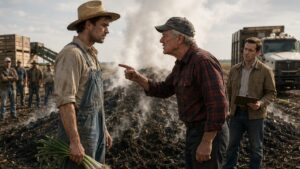
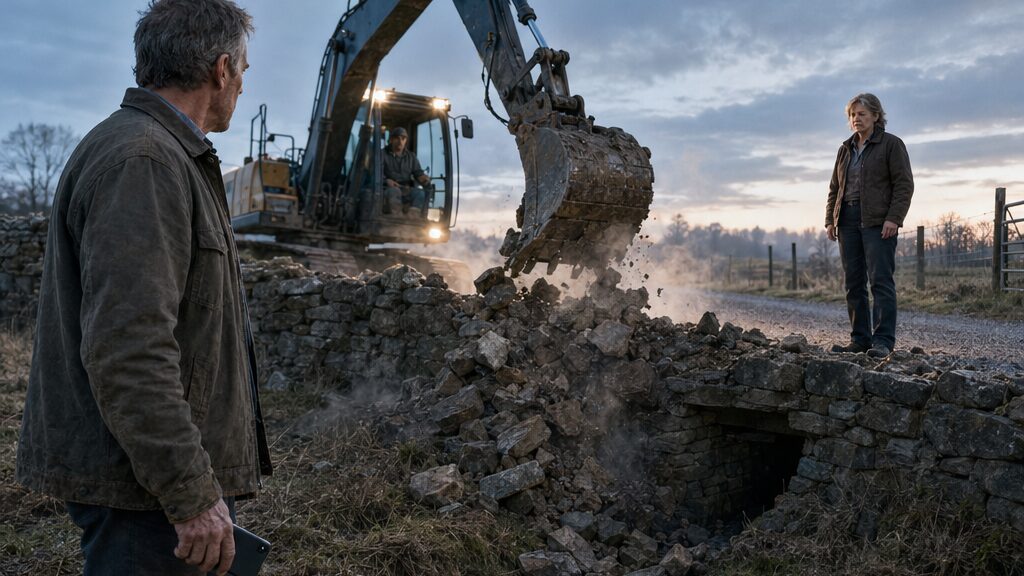
The excavator bucket hit the wall before Jonathan Harris reached the bottom of the lane.
Stone cracked against steel in the gray light before sunrise. A section of fieldstone that had stood longer than Jonathan had been alive folded inward, and three heavy rocks rolled into the pasture grass.
Jonathan stopped his truck crooked across the gravel, left the door open, and walked toward the machine.
The operator saw him and lifted the bucket.
“Shut it down.”
The diesel engine dropped to an idle.
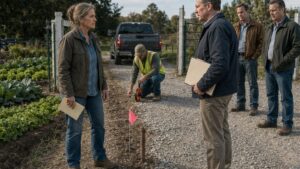
Cynthia Roberts stood beside a pickup near the lane, coffee in one hand and a fluorescent vest pulled over her jacket. Two cooperative board members were farther back near a trailer loaded with culvert pipe.
Jonathan looked from Cynthia to the broken wall.
“What are you doing?”
Cynthia lowered the cup. “The lane widening.”
“You’re on my ground.”
“The cooperative approved the work.”
“You approved digging the ditch. You didn’t approve tearing down my wall.”
Her expression tightened. “It was discussed for weeks.”
Jonathan stepped over a fallen stone. Fresh dirt showed beneath it, dark against the pale, weathered face.
“That wall isn’t in the lane.”
“It pinches the lane down every time someone brings equipment through here.”
“So you tear it out before daylight?”
“The contractor starts early.”
Jonathan stared at her.
Behind Cynthia, one board member looked away.
“How much have you taken down?”
“About forty feet.”
Jonathan’s jaw locked.
His father had reset sections of that wall every spring after frost heave. Not because it looked good. His father had never cared much how anything looked if it worked.
Jonathan had been twelve the first time he carried stone beside him.
He remembered being told only one thing.
Keep the lower side tight.
At the time, Jonathan had assumed his father meant cattle.
He had never asked why the wall curved gently away from the lane instead of following the property line straight.
The excavator operator leaned out of the cab. “You want me sitting here?”
“Yes,” Jonathan said.
Cynthia stepped forward. “Jonathan, the cooperative voted.”
“You don’t get to vote away my property.”
“We have maintenance rights along this corridor.”
“For the lane.”
“And drainage.”
Jonathan looked at the shallow ditch beside the gravel. It was dry except for a few damp leaves.
Cynthia continued.
“We’ve had washouts three times in four years. Bigger equipment can barely clear this turn. Everyone agreed the wall needed to go.”
“Everyone?”
“Everyone who came to the meeting.”
There it was.
Jonathan looked at her.
She knew.
“You sent the notices.”
“Yes.”
“And I didn’t come.”
“No.”
He hated how much satisfaction the plain answer gave her.
He had received the envelopes. One in April, another in May, then a certified letter he had left unopened on the kitchen counter for almost a week.
The cooperative had argued with his father about the same lane twenty years earlier. After his father died, Jonathan decided he had heard enough from committees about land they had not worked.
He told himself missing meetings was refusing nonsense.
Standing beside forty feet of broken stone, it suddenly looked more like surrendering the room.
Cynthia pointed toward the wall.
“We could not keep paying to repair the lane while one owner refused to cooperate.”
“So you decided cooperation meant sending an excavator.”
“I decided the vote meant something.”
Jonathan almost answered.
Instead, he heard a rock shift.
A wide foundation stone, loosened by the bucket, tipped from the broken face. It rolled once and settled flat in the mud.
Something pale showed beneath it.
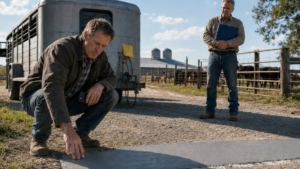
Jonathan crouched.
Cynthia stopped talking.
At the base of the wall was a narrow opening lined on both sides with flat stone. Not a hole made by animals. Not a gap from collapse. The sides were too even, the top capped by a single slab.
Jonathan scraped dirt away with his glove.
The opening ran beneath the wall toward the pasture.
“What is that?” one of the board members asked.
Jonathan did not answer.
He pulled out his phone and took several photographs.
Cynthia stepped closer. “Probably an old field drain.”
“Probably?”
He moved to the fallen foundation stone.
Part of its weathered face had been buried for decades. Dirt came away under his thumb and revealed shallow tool marks.
Jonathan stared at the date.
His father had bought the farm in the early seventies.
That meant the wall was older than him, older than his father’s ownership, and older than the present road cooperative.
Cynthia saw the date.
“It doesn’t change where it sits.”
Jonathan stood.
“No. But it changes whether anybody here knew what they were tearing out.”
Her face stiffened again. “We did not authorize damage to drainage infrastructure.”
“You just told me you authorized the wall.”
“The wall. Not whatever that is.”
Jonathan looked from the stone-lined opening to the shallow grassed swale farther down his pasture.
Something in his memory shifted.
His father walking that slope after hard rain.
His father pushing a shovel into the grass where there seemed to be nothing to fix.
His father telling him never to pile hay bales along that low strip.
Jonathan had always thought it was habit.
He called Samuel Thompson.
Samuel answered on the fourth ring.
“You’re up early.”
“I need you at my place.”
“That sounds expensive.”
“Bring your survey gear.”
A pause.
“What happened?”
“They took out part of the wall along the cooperative lane.”
“Who did?”
“The cooperative.”
Samuel was quiet for a second.
Jonathan added, “There’s a stone-lined opening underneath it.”
“What kind?”
“About eighteen inches wide. Flat cap. Runs through the wall.”
Another pause.
“Don’t let them touch anything else.”
Jonathan looked at Cynthia.
“That part’s handled.”
Samuel arrived less than an hour later with a tripod, receiver pole, and an old canvas field bag Jonathan had seen him carry since before retirement.
He walked past Cynthia without taking sides and crouched beside the opening.
He measured its width, sighted along the wall, then walked thirty yards into the pasture.
Jonathan followed.
Samuel stopped where the ground barely dipped.
“You mow this differently?”
“No.”
“You sure?”
Jonathan looked.
The grass was thicker in a broad, nearly invisible sweep curving downhill.
Samuel returned to the wall and stood beside the exposed outlet.
“This isn’t random masonry.”
“You know what it is?”
“Not yet.”
Cynthia folded her arms. “Then we’re all guessing.”
Samuel glanced at her.
“No. We’re past guessing.”
He tapped one of the flat side stones with the end of his measuring rod.
“Somebody built this to carry water through a controlled point. And the wall follows the same grade.”
Jonathan felt his anger settle into something colder.
Samuel looked along the broken stones toward the untouched section.
“This geometry is engineered.”
Jonathan looked at the date carved into the fallen stone.
“What record would show that?”
Samuel picked up his field bag.
“That’s what we need to find before it rains.”
Chapter 2: The Survey Line Did Not Match Cynthia’s Story
Samuel’s first survey flag went into the ground six feet away from where Cynthia said the drainage corridor ran.
Jonathan watched him place a second farther down the pasture.
Then a third.
The flags formed a shallow arc.
So did the old wall.
Cynthia had stayed for the first measurements, but after the excavator left, she drove away with the other board members. Before leaving, she told Jonathan the cooperative’s attorney would provide the maintenance agreement.
Jonathan told her Samuel would provide the measurements.
Neither wished the other a good morning.
By ten o’clock, Samuel had enough points to make Jonathan uneasy.
“The present ditch is here,” Samuel said, tracing a line on his tablet.
Jonathan nodded.
“And your old wall is here.”
A second line curved across the screen.
They did not run parallel.
Instead, the wall angled gently away from the lane, crossed the contour of the slope, then turned toward the low grassed channel Jonathan’s father had always kept clear.
Samuel zoomed out.
“That’s deliberate.”
“For drainage?”
“Looks like it.”
Jonathan stared toward the pasture.
All those years, he had thought of the wall as one of his father’s stubborn old things. Something retained because removing it would cost money and because his father disliked changing anything that still stood.
Now it seemed possible his father had been maintaining somebody else’s design.
Samuel drove two steel pins into temporary reference points and packed his equipment.
“County records.”
Jonathan frowned. “You think they’ll have anything this old?”
“If it involved runoff between parcels, maybe.”
The county records office occupied one wing of a squat brick building beside the courthouse. The clerk at the counter listened to Samuel explain the location and disappeared into a back room.
Jonathan expected a deed.
Instead, the clerk returned with a box.
Inside were photocopied plats, easement references, drainage sketches, and soil-conservation plans from several decades.
Samuel worked through them slowly.
Jonathan did not.
The longer Samuel paused over each page, the more impatient Jonathan became.
“Well?”
“I’m reading.”
“You’ve been reading fifteen minutes.”
“That’s how records work.”
Jonathan leaned back.
Samuel pulled one sheet free.
It was faded enough that several labels had almost vanished. But the shape was familiar.
A curved line crossed what was now Jonathan’s pasture.
Beside it were two words.
Contour diversion.
Jonathan leaned closer.
Samuel followed the line with one finger.
“It begins above your lane.”
“Where?”
“Old parcel boundary. Before the road was widened.”
He traced farther downhill.
“And it ends here.”
The line widened into a hatched area.
Jonathan recognized the shape.
“The grass channel.”
Samuel nodded.
A note in the margin referred to an overflow structure and downstream protection.
Jonathan felt a small, grim satisfaction.
“There.”
Samuel did not respond.
“There it is,” Jonathan repeated. “They tore out a drainage structure.”
“Maybe.”
Jonathan stared at him.
“Samuel.”
“Don’t get ahead of the paper.”
Samuel turned the sheet over and found a reference number.
The clerk brought another file.
This one contained a recorded agreement from before Jonathan’s father bought the farm.
Several farms uphill had contributed labor and materials to create an erosion-control system after repeated storm damage. The wall was not described as a wall. It was referred to as a stabilizing structure adjacent to a diversion channel.
And it served lower parcels.
Jonathan sat still.
Samuel read the language twice.
“Lower properties were supposed to benefit from controlled overflow during major rain events.”
“So Cynthia had no right.”
Samuel looked at him.
“I did not say that.”
“You just read it.”
“I read what this structure did.”
Samuel turned several pages.
“Here’s the problem.”
A later document created the rural road-and-drainage cooperative.
Its maintenance rights included the lane shoulder, roadside ditch, culverts, and certain shared drainage features.
Jonathan’s satisfaction disappeared.
“They can maintain it?”
“Possibly.”
“Maintain isn’t demolish.”
“Probably not.”
“Probably?”
Samuel closed the file.
“You want certainty before the facts are finished again?”
Jonathan looked away.
That landed harder than he wanted it to.
The clerk provided copies, and they returned to the farm in the early afternoon.
Samuel laid the old contour map on the hood of his truck beside the exposed stone outlet.
The comparison was unmistakable.
The faded line on the page matched the wall’s curve.
The little symbol marking the overflow point lined up within a few feet of the stone opening the excavator had uncovered.
Jonathan took a photograph of the map beside the broken masonry.
For the first time since sunrise, he felt the humiliation loosen.
The wall had not been pointless.
His father had not been stubborn for nothing.
Then Samuel said, “Your father didn’t build it.”
Jonathan looked up.
“The date already told us that.”
“I mean he wasn’t the only one maintaining it either.”
Samuel pointed to an old maintenance notation. Several parcel numbers were listed beside inspection responsibilities.
One corresponded to Jonathan’s farm.
Two belonged to properties downhill.
Another was now part of Cynthia’s acreage.
Jonathan read the entries again.
“So everybody forgot.”
“Looks that way.”
“Except Dad.”
“Maybe.”
Jonathan did not like the word.
Samuel folded the copy.
“What?”
“You’re turning him into the only man who understood it.”
“He did understand it.”
“Then why didn’t he put it in writing for you?”
Jonathan said nothing.
Samuel softened his voice.
“Old farmers knew systems by walking them. That doesn’t mean they explained them.”
Jonathan looked at the grassed channel.
He remembered following his father after storms, hearing instructions without reasons.
Clear that.
Don’t stack there.
Keep the lower stones tight.
Jonathan had obeyed until he became old enough to decide some rules belonged to dead men and did not need explanation.
A truck came slowly up the lane.
Cynthia stopped beside them but did not get out.
“I sent the cooperative agreement to your email.”
Samuel nodded.
“We found the older drainage records.”
Jonathan watched her face.
That confidence from the morning flickered.
“What do they say?”
“The wall appears tied to a contour diversion system protecting lower parcels.”
Cynthia looked toward the broken section.
“For certain?”
“We’re still reviewing authority.”
She gripped the steering wheel.
“The contractor was told to remove obstruction inside the maintenance area.”
Jonathan stepped closer.
“You keep calling it obstruction.”
“Because every combine that comes through that turn has to crawl past it.”
“You could have waited for a survey.”
“And you could have answered a letter.”
Silence.
Samuel looked between them.
Cynthia continued.
“The lane washed out twice last spring. We spent money we don’t have. People wanted it fixed.”
“You wanted the wall gone.”
“I wanted access.”
“And you got it.”
She looked past him toward the rubble.
Her voice lowered.
“I did not know about the diversion.”
For a moment Jonathan nearly accepted that as the first crack in her certainty.
Then she added, “But that still doesn’t mean we had no authority to modify it.”
Samuel answered before Jonathan could.
“That’s what the county drainage office will have to determine.”
Cynthia’s eyes narrowed.
“You called them?”
“I’m going to.”
She exhaled through her nose and drove on.
Jonathan watched her truck disappear beyond the bend.
“She’s scared,” he said.
Samuel packed the map into its sleeve.
“She has reason to be.”
“Good.”
Samuel looked at him.
Jonathan did not apologize.
His phone buzzed.
A weather alert filled the screen.
Heavy thunderstorms were expected within forty-eight hours, with several inches of rain possible in a short period.
Samuel read it over his shoulder.
“How much water did that old diversion carry?”
Jonathan looked toward the wall.
“I don’t know.”
“That’s the part that bothers me.”
Jonathan glanced at him.
Samuel folded his arms.
“The records can tell us what somebody intended in 1968. They can’t tell us what happens now that forty feet of it is lying in your pasture.”
Chapter 3: The Old Drainage Plan Had One Missing Owner
Cynthia placed three unopened envelopes in front of Jonathan at the cooperative meeting.
His name was typed on each one.
The oldest had been postmarked five months earlier.
Jonathan did not touch them.
The meeting room was little more than a converted office attached to an equipment shed, with folding chairs, a scarred table, and a bulletin board covered in road-maintenance schedules.
Cynthia sat opposite him.
Samuel was beside the window with the drainage maps rolled under one arm.
“You said you weren’t notified,” Cynthia said.
“I said nobody told me you planned to tear down the wall.”
“The first letter requested a site meeting.”
Jonathan looked at the envelope.
“The second asked for information about the wall and drainage.”
He knew what was coming before she picked up the third.
“The certified letter said the cooperative would vote on lane widening if you didn’t respond.”
Jonathan leaned back.
One board member shifted in his chair.
Cynthia did not sound triumphant.
That made it worse.
“I sent them,” she said. “You ignored them.”
Jonathan finally picked up the first envelope.
“I get a lot of paper from this cooperative.”
“That isn’t an answer.”
“No.”
The room stayed quiet.
Samuel unrolled one of the old plans.
“We can argue about notice later. We need to deal with function now.”
Cynthia turned toward him.
“What exactly have you confirmed?”
“The wall corresponds to a contour diversion built before the road cooperative existed. It appears intended to intercept runoff from the upper slope and move overflow toward the grassed waterway.”
“Appears?”
“The original structure is damaged. I’m not going to pretend I can certify every detail from a forty-year-old maintenance note.”
Jonathan’s irritation rose.
“You already matched it.”
“I matched the location.”
“You matched the outlet.”
“Yes.”
“Then say what it is.”
Samuel looked directly at him.
“I’m saying what I can prove.”
Jonathan recognized the tone. Samuel had used it with landowners for decades, usually when they wanted a surveyor to turn confidence into evidence.
Cynthia tapped the table.
“Did Jonathan know?”
Samuel did not answer immediately.
Jonathan’s stomach tightened.
Cynthia saw it.
“That matters.”
“The structure sits on his land,” Samuel said carefully.
“That wasn’t my question.”
Samuel glanced at Jonathan.
“You told me your father maintained the lower stones after hard rains.”
Jonathan said nothing.
“And you knew he kept the grassed channel open.”
“Yes.”
“Did you know why?”
“Not exactly.”
Cynthia leaned forward.
“Not exactly?”
Jonathan looked at her.
“My father didn’t write manuals. He told you what needed doing.”
“You farmed beside him for thirty years.”
“Which doesn’t mean he explained every ditch.”
Cynthia picked up the second envelope.
“This asked whether the wall served a drainage purpose.”
Jonathan remembered seeing that sentence through the envelope window after he finally opened it.
He had put the paper under a stack of cattle invoices.
Not because he did not know anything.
Because the request had come from the cooperative.
Because twenty years earlier, when his father objected to widening the lane, two board members had called him unreasonable in a meeting Jonathan attended.
His father had left without speaking to anyone.
Jonathan had never forgotten it.
After the funeral, the cooperative sent condolences and then, six weeks later, a notice about brush clearance.
Jonathan had decided then that they could manage their paperwork without him.
Cynthia watched him.
“You knew enough to answer.”
Jonathan’s voice hardened.
“I knew the wall had been there longer than any of you had been voting on it.”
“That wasn’t what we asked.”
“And you didn’t wait.”
“No.”
There it was again.
Her responsibility did not vanish because his pride had helped build the conditions around it.
That realization irritated him more than any accusation.
Samuel spread another map.
“Look at this.”
The board members leaned closer.
The modern lane ditch appeared in blue. The older contour diversion ran in a different direction.
Cynthia pointed.
“So the present ditch replaced it?”
“No,” Samuel said. “That may be the assumption that caused the problem.”
He placed a second sheet beside it.
“The road ditch handles ordinary runoff near the lane. The older diversion intercepts water from farther upslope during heavier events.”
Jonathan stared at the map.
Two systems.
Not one old system replaced by a new one.
Two systems meant to work together.
Cynthia’s expression changed.
“How sure are you?”
“Enough that I would not have removed the wall without engineering review.”
One board member muttered something under his breath.
Cynthia turned on him.
“You voted for it.”
“I voted for widening the lane.”
“So did everyone else.”
“Not for flooding somebody.”
“No one voted for flooding anybody.”
The room sharpened.
Jonathan watched Cynthia grip a pen until her knuckles whitened.
For the first time, he saw what had been underneath her certainty.
Pressure.
Not just annoyance with him.
The cooperative had spent thousands repairing washouts. Two smaller landowners had complained they could barely afford another special assessment. A local contractor had warned that newer equipment needed more turning room.
Cynthia had been trying to fix something.
She had simply decided that Jonathan was the one person standing in the way.
That did not excuse the excavator.
But it changed the shape of the conflict.
Samuel tapped the lower end of the map.
“These properties are most exposed if overflow crosses the old wall line.”
One was Debra Lewis’s horse property.
Another belonged to a small cattle operation.
The third was a narrow parcel with a house and machine shed near the creek.
Cynthia looked at Jonathan.
“Did your father ever tell you what happened before the wall was built?”
“No.”
“Anything about flooding?”
“No.”
Samuel folded his hands.
“What did he tell you?”
Jonathan hesitated.
The old instructions sounded almost foolish when spoken aloud.
“Keep the lower stones tight.”
Samuel waited.
“Don’t block the grass channel.”
“And?”
Jonathan looked toward the window.
“After a hard rain, he walked the whole slope before breakfast.”
“Why?”
“I never asked.”
Silence returned.
Jonathan had wanted the records to prove that everyone else was careless.
Instead they were proving that he had inherited knowledge in fragments and then guarded those fragments as if refusing to explain them made him faithful to his father.
Cynthia gathered the envelopes.
“I should have waited for the survey.”
Jonathan looked at her.
It was the closest thing to an admission she had offered.
Then she added, “But you should have answered me.”
He nearly rejected it out of habit.
Instead he said, “Yes.”
The word sat badly in his mouth.
Samuel began rolling the maps.
“We need temporary protection before the storm.”
Cynthia nodded. “What kind?”
“I need to inspect the upper slope again.”
Jonathan stood.
“I’ll show you where Dad used to clear after big rain.”
Cynthia watched him.
“So you do remember something.”
Jonathan faced her.
“I remember pieces.”
His phone rang.
Debra Lewis.
He almost let it go to voicemail. They had spoken maybe twice in the last year.
He answered.
“Jonathan?”
Her voice was sharp and breathless.
“Yes.”
“Something’s wrong up here.”
He stood straighter.
“What?”
“I’ve got muddy water running across the top paddock.”
Samuel stopped packing.
Jonathan turned toward him.
Debra continued.
“It’s coming from your direction.”
“How much?”
“More every minute.”
Jonathan walked to the window.
Beyond the equipment shed, the western sky had gone dark.
The main storm was not supposed to arrive until that night.
“What’s it doing near the barn?”
“Nothing yet.”
Yet.
Jonathan looked at the rolled drainage map under Samuel’s arm.
Then at Cynthia.
Debra’s voice tightened.
“Jonathan, I need to know whether this is because of that wall.”
He looked toward the direction of his farm, where forty feet of stone no longer stood.
“I don’t know,” he said.
For the first time since the excavator arrived, the truth frightened him more than being right.
Chapter 4: When the Rain Came, Every Property Line Disappeared
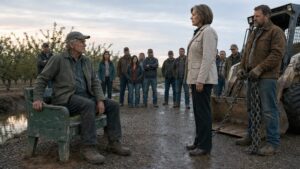
By the time Jonathan reached the pasture, brown water was already cutting through the gap where the wall had stood.
It did not spread evenly.
It gathered.
Water from the upper slope slid toward the broken section, accelerated across exposed soil, then poured through the missing forty feet in a narrow, fast-moving sheet.
Samuel stopped beside him.
“There.”
Jonathan followed his pointing hand.
The old stone-lined outlet had once forced the water through a controlled opening. Now the whole demolished section had become an opening.
Cynthia’s pickup arrived behind them, followed by one of the cooperative board members.
Debra called again before Cynthia had shut her door.
“It’s worse.”
Jonathan put the phone to his ear.
“How close?”
“Top fence is underwater in two places. The horses are down by the barn.”
“Move them inside.”
“I’m trying.”
A flash lit the western sky.
The storm had arrived early and harder than forecast.
Jonathan ended the call.
Cynthia stood beside the rubble, rain darkening her jacket.
“Can we put the stones back?”
Samuel shook his head.
“Not in running water.”
“Sandbags?”
“Not enough of them, and not fast enough.”
Another surge swept loose dirt from beneath a fallen stone.
Jonathan stepped farther upslope.
Rain hammered the pasture so hard that the grass seemed to flatten under it.
For years he had walked this field without seeing its shape.
Now the water drew every contour for him.
A shallow depression gathered runoff above the old wall. The wall had intercepted it, sending part through the stone outlet while excess water followed the curve toward the broad grassed channel.
Without the wall, gravity had chosen a straighter route.
Straight toward Debra’s ground.
Jonathan felt something cold move through him that had nothing to do with the rain.
He remembered his father in a yellow slicker, pushing a shovel through tall grass along that lower swale.
Jonathan had been irritated because cattle needed feeding.
His father had pointed at the channel and said, Keep this open even when it looks like nothing.
At the time, there had been no water in it.
Jonathan finally understood.
“He wasn’t maintaining the wall,” Jonathan said.
Samuel looked at him.
“What?”
“He was maintaining the path.”
Jonathan pointed.
“From the upper pasture, through the outlet, then across there.”
Samuel followed the line.
“Yes.”
“The whole thing worked together.”
“Yes.”
Jonathan closed his eyes for half a second.
His father had explained it.
Not with a drawing.
With work.
Jonathan had simply stopped listening once the work became his.
Cynthia stepped closer.
“Can we reopen the grass channel?”
“Not from here.”
“Why?”
“Water’s already bypassing it.”
Samuel crouched and scooped mud from the flow.
“If you want to catch this now, you need to intercept it higher up.”
Jonathan looked toward his hayfield.
The ground rose gently before dropping toward the demolished wall.
He saw it then.
Not a permanent fix.
A temporary one.
He could cut a shallow berm along the upper edge of the field and force the runoff sideways toward the old grassed channel before it reached the breach.
Samuel seemed to read his face.
“What are you thinking?”
Jonathan pointed across the hay.
“Cut from the north fence to that low shoulder.”
Samuel studied it.
“Maybe.”
Cynthia looked between them.
“Maybe what?”
“An emergency diversion.”
“Do it.”
Jonathan looked at her.
She stopped.
It was the first time she seemed to realize she was giving instructions on his land again.
“What would it take?” she asked instead.
Jonathan kept looking at the hayfield.
Second cutting had been less than a week away.
The stand was thick and nearly waist high in places. Enough feed to matter through winter.
To make a diversion deep enough, he would have to destroy a long strip of it and scrape through the topsoil.
Cynthia followed his eyes.
“The hay?”
“Yes.”
“How much?”
“Enough.”
Samuel said, “If he cuts along that contour, we may be able to turn the runoff into the grass channel.”
“May?”
“We’re working in a storm.”
The board member spoke for the first time.
“What happens if we wait?”
Jonathan looked downhill.
Debra’s barn roof was just visible beyond a row of trees.
Water was already moving toward it.
He could hear his own anger clearly.
Let them see.
Let the water explain what the wall did.
Let Cynthia stand in front of every neighbor and explain why the excavator was there before dawn.
For one ugly second, the thought felt almost fair.
Then his phone rang again.
Debra.
He answered.
“I’ve got them inside,” she said. “But water’s crossing the drive now.”
Jonathan heard metal banging behind her.
A gate.
A frightened horse.
Debra’s breath.
“My hay is stacked in the lower side of the barn.”
“How much?”
“Most of winter.”
Jonathan looked at his own field.
Cynthia said quietly, “Jonathan.”
He raised a hand.
Debra continued.
“Tell me if I need to start moving it.”
“You need to start.”
Silence.
Then, “Is this from your place?”
Jonathan watched water rip through the gap.
“Yes.”
Debra inhaled.
“I knew it.”
“It’s not that simple.”
“It’s coming off your hill.”
“Yes.”
He could have told her about Cynthia.
About the cooperative vote.
About the wall.
Instead he said, “Move what you can. I’m trying to turn it.”
He hung up.
Cynthia stared at him.
“She blames you.”
“Right now the water doesn’t care.”
He started toward the equipment shed.
Cynthia followed.
“What do you need?”
“Nothing from you yet.”
“Jonathan.”
He turned.
Rain ran from the brim of his cap.
“If we stop that water, we argue later.”
Cynthia nodded once.
No defense.
No explanation.
Just a nod.
Jonathan climbed into his tractor and started the engine.
The headlights cut across the rain.
He drove toward the upper hayfield, raised the rear blade, and stopped at the edge of his best stand.
The crop waved under the storm.
For a moment he saw the winter bales already stacked in his own barn.
Then he saw Debra’s horses pressed against stalls while water crossed her drive.
His father’s voice came back without sentiment.
Never let your water become somebody else’s problem.
Jonathan lowered the blade.
The first pass tore green hay from the earth and rolled black soil into a ridge.
He drove slowly, following the contour by memory and by the water’s movement.
Samuel walked ahead with a flashlight, signaling left or right.
Cynthia stayed near the lower side, clearing loose debris where the old grass channel began.
Jonathan made another pass.
Then another.
The berm took shape.
Water struck it and hesitated.
For several seconds, nothing changed.
Then part of the runoff turned.
It moved sideways.
Toward the grass channel.
Samuel lifted both arms.
“It’s taking it!”
Jonathan kept driving.
More water shifted.
The flow through the demolished wall weakened.
Not stopped.
But weakened.
Jonathan looked downhill.
In the tractor lights, the new earthen ridge cut directly through his hayfield like a dark wound.
He did not feel vindicated.
He felt late.
Chapter 5: Jonathan Cut His Own Field to Save Theirs
The tractor blade bit into Jonathan’s best hay strip just after midnight.
Each pass deepened the diversion and buried more crop beneath wet soil.
The first section worked.
The second failed.
Water reached a shallow low spot near the center of the berm, found the weakness, and broke through in a muddy stream.
Samuel shouted from the field.
“Stop!”
Jonathan braked.
The redirected flow immediately began cutting a new channel downslope.
Cynthia was already running toward it with a shovel.
Jonathan climbed down.
“Don’t stand in the cut.”
“I can close it.”
“Not from below.”
She backed away as the water widened the opening.
Samuel reached them.
“We need material.”
Jonathan looked toward the lane.
“The stone.”
Cynthia understood.
They went to the demolished wall.
Fallen fieldstones lay half buried in mud where the excavator had pushed them aside.
Jonathan loaded the largest manageable rocks into the tractor bucket.
Cynthia and Samuel dragged smaller ones toward the weak point.
For the next twenty minutes there was no argument about meetings, authority, notices, or who had been right.
Only weight.
Water.
Mud.
Jonathan dumped stone into the break, then packed soil behind it with the tractor tires.
The flow struck the patch.
For a moment it shivered through gaps between the stones.
Then it turned.
The berm held.
Cynthia stood ankle-deep in mud and watched water move sideways toward the grass channel.
“That’s what the wall did.”
Jonathan shut off the tractor.
“Part of it.”
She looked downhill.
“I thought it trapped water against the lane.”
“It probably did during small rains.”
“And during this?”
“It moved the dangerous part somewhere safer.”
Cynthia wiped rain from her face.
“No one told us that.”
Jonathan looked at her.
“I didn’t.”
She met his eyes.
For once, neither of them tried to use the admission as a weapon.
Samuel called from farther downslope.
“Jonathan!”
They followed him to the lower end of the channel.
Water now moved through the grassed corridor in a broad sheet rather than a narrow torrent.
But it had already been running the wrong way for nearly an hour.
Debra’s barn sat in darkness except for two bright work lights.
Jonathan could see water pooled around one side.
His phone rang.
He answered.
“Where are you?”
Debra sounded exhausted.
“Upper field.”
“The water slowed.”
Jonathan looked at the berm.
“Good.”
“It still got inside.”
He closed his eyes.
“How bad?”
“Lower aisle. Hay room. Maybe the tack area.”
“The horses?”
“Dry.”
That mattered.
Not enough, but it mattered.
“I’m coming down.”
He drove the tractor while Cynthia followed in her pickup.
Samuel stayed behind to watch the emergency diversion.
At Debra’s property, muddy water covered part of the drive. Straw and leaves had collected against the fence.
Debra stood in the barn doorway in rubber boots and a raincoat.
She looked at Jonathan first.
Then Cynthia.
“What happened?”
Jonathan stepped from the tractor.
“The wall was part of an old diversion.”
Debra stared at him.
“The wall they tore out?”
“Yes.”
Her eyes moved to Cynthia.
“You tore it out?”
Cynthia did not dodge.
“I authorized the work.”
Debra laughed once, without humor.
“You authorized water into my barn?”
“No.”
“But that’s what happened.”
“Yes.”
The simplicity of Cynthia’s answer seemed to take some of the force out of Debra’s anger.
Not all.
She pointed into the barn.
“Come look.”
Water had covered several inches of the lower aisle.
Bales on the bottom row of the hay stack were dark with moisture. Boxes of supplies floated against a stall wall.
Jonathan stepped inside.
Debra watched him.
“You said the water came from your place.”
“It did.”
“And you knew about the wall?”
Jonathan looked at the wet floor.
“Not enough.”
“That’s not an answer.”
He turned.
“I knew my father maintained it. I knew he kept the channel clear. I didn’t know the full system until Samuel found the records.”
Debra crossed her arms.
“But you knew enough to think it mattered.”
“Yes.”
Cynthia spoke.
“And I knew enough to know we should have surveyed before we removed it.”
Debra looked between them.
“So everybody knew just enough to ruin my barn.”
No one answered.
A horse struck the inside of a stall once, hard.
Debra turned toward the sound and immediately softened.
“It’s okay.”
The horse settled.
That small gesture cut through Jonathan harder than the accusation.
People could argue about authority later.
Animals still needed dry bedding.
Hay still needed moving.
He walked toward the ruined stack.
“We can save the upper rows.”
Debra frowned.
“What?”
“Get pallets. Anything that keeps them off the floor.”
“You don’t have to—”
“Yes.”
Cynthia took off her wet jacket.
“I’ll help.”
Debra looked at her for a long moment.
Then she pointed.
“Pallets are behind the machine shed.”
They worked until nearly dawn.
Jonathan and Cynthia moved hay. Debra checked horses and carried supplies to higher shelves. One of the lower landowners arrived and helped push water toward the doors with a floor squeegee.
Nobody discussed blame again.
It was too physical for that.
By four-thirty the rain weakened.
Jonathan returned to the upper pasture.
The emergency berm still held.
Water moved through the grass channel in a way he had never seen clearly before.
His father’s old instructions were visible now.
Every low spot.
Every cleared strip.
Every stone placed with the flat face inward.
The wall had never been one thing.
It was a piece of a larger arrangement, and the arrangement had depended on people remembering why it existed.
Cynthia stood beside the fallen foundation stone marked 1968.
“I’m going to resign.”
Jonathan looked at her.
“From the chair.”
“You don’t have to decide that tonight.”
“I made the call.”
“The board voted.”
“I brought them the proposal.”
“You didn’t operate the excavator.”
“That makes you feel better?”
“No.”
“Me neither.”
Jonathan looked at the emergency berm across his damaged hayfield.
“You resign before we know what happened, everyone gets to pretend it was one bad chairwoman.”
Cynthia’s expression tightened.
“You think I’m trying to escape?”
“I think it would be convenient.”
She stared at him.
Then she nodded slowly.
“That sounds like something you would know about.”
Jonathan almost snapped back.
Then stopped.
Because she was right.
He had spent years escaping meetings by calling it principle.
Headlights appeared on the lane.
A county truck moved slowly toward them.
The drainage inspector stepped out wearing a rain shell and carrying a clipboard.
He looked first at the broken wall.
Then the new earthen berm.
Then at the muddy water still moving through the grass channel.
“Which one of you is Jonathan Harris?”
Jonathan raised a hand.
The inspector nodded toward the wall.
“I received a report that a shared drainage structure was altered yesterday.”
Cynthia stepped forward.
“I’m chair of the cooperative.”
The inspector looked at her.
“Who authorized the demolition?”
For a second, Jonathan expected Cynthia to point toward the board.
Or the contractor.
Or the maintenance agreement.
She did none of those things.
“I did.”
The inspector opened his clipboard.
“All right.”
He looked at the washed slope.
“Then we have a lot to discuss.”
Chapter 6: The Permit Question Was Easier Than the Blame
The county inspector placed the stop-work notice beside the cooperative’s contractor invoice and flattened both papers with his palm.
No one spoke.
The cooperative meeting room felt smaller than it had three days earlier.
Jonathan sat beside Samuel.
Debra sat near the end of the table with photographs of her barn and a folder from her insurance adjuster.
Cynthia stood rather than taking the chair at the head.
The inspector tapped the notice.
“The cooperative had authority to maintain the road corridor.”
One board member leaned forward.
“That’s what we’ve been saying.”
The inspector continued.
“Maintenance authority is not blanket authority to remove a mapped drainage-control feature.”
The man leaned back.
The inspector turned to the old contour plan Samuel had provided.
“The difficulty is that this feature was poorly documented in current county mapping. That does not eliminate its recorded function.”
Cynthia asked, “Did we need a permit?”
“For widening the existing gravel lane, not necessarily. For altering drainage in a way that changes discharge onto lower parcels, yes. At minimum you needed review.”
“So the permit question is settled.”
“Yes.”
Jonathan watched her face.
She did not argue.
The inspector looked around the table.
“The blame question is not my department.”
That proved harder.
One board member blamed the contractor for not recognizing the stone outlet.
The contractor had already sent a written response stating he had been instructed to remove the wall within the marked work zone.
Another blamed Cynthia for pushing the widening proposal too quickly.
A third reminded everyone that the vote had been unanimous among members present.
Debra opened her folder.
“My insurance company says they’ll cover some interior damage, but not all the hay.”
She slid an estimate onto the table.
“And they want to know whether they should pursue the cooperative.”
Silence followed.
Jonathan knew what everyone wanted.
A person.
One name to put on the mistake.
Cynthia seemed to know it too.
During a recess, she found Jonathan outside beside the equipment shed.
“You were right,” she said.
He leaned against the wall.
“About what?”
“The structure.”
“That doesn’t make everything else simple.”
“No.”
She looked toward the parking area.
“I told the board I’ll take responsibility for authorizing the work.”
“You should.”
“I mean all of it.”
Jonathan studied her.
“What does that mean?”
“They’re talking about removing me as chair. If I say I exceeded what they approved, the cooperative may be able to separate my decision from the vote.”
Jonathan straightened.
“Did you exceed it?”
Cynthia hesitated.
“The vote authorized removal of obstructions necessary for widening.”
“That’s not what I asked.”
She looked annoyed.
Then tired.
“I interpreted that to include the wall.”
“And everyone knew you did.”
“Most of them.”
“So you want to take all the blame.”
“I made the final call.”
Jonathan looked through the open door at the board members inside.
A week earlier, he would have enjoyed watching Cynthia carry the whole thing.
He imagined the cooperative minutes stating that one overconfident chair had caused the problem.
It would make him clean too.
Victim on one side.
Villain on the other.
He had wanted that version.
But the unopened letters were still in his truck.
“No.”
Cynthia frowned.
“No what?”
“I’m not helping you turn this into one bad decision by one person.”
Her face hardened.
“I’m trying to accept responsibility.”
“Then accept your part.”
“I am.”
“Not everybody else’s.”
She stared at him.
Jonathan continued.
“The board voted. The contractor followed the plan. I ignored the letters. Nobody checked the old records. You pushed too hard. I stayed quiet too long.”
Cynthia folded her arms.
“That doesn’t make your silence equal to ordering an excavator.”
“I didn’t say equal.”
He looked toward the wet fields.
“But it mattered.”
When they returned inside, the argument started again.
This time Jonathan interrupted.
“I knew the wall mattered.”
The room quieted.
Debra looked at him.
Jonathan kept his hands on the table.
“I did not know the complete drainage design. Samuel’s right about that. But I knew my father maintained the lower stones after hard rains, and I knew he kept the grassed channel open.”
One board member asked, “Why didn’t you tell us?”
Jonathan looked at the unopened envelopes Cynthia had brought again.
“Because I was angry.”
No one moved.
“My father fought with this cooperative about that lane. After he died, I decided I was done explaining my farm to committees.”
He looked at Cynthia.
“That was pride.”
Cynthia lowered her eyes.
Jonathan continued.
“It does not excuse removing the wall without a review.”
“No,” the inspector said.
“But pretending I had no part in the misunderstanding won’t fix anything either.”
Debra closed her insurance folder.
“So what does fix it?”
Samuel unrolled a fresh sheet.
“We rebuild the drainage function.”
One board member said, “The old wall?”
“Not necessarily.”
Jonathan looked at the drawing.
Samuel had sketched a wider lane, a reinforced diversion, and a broader overflow channel.
Cynthia leaned closer.
“You can keep the equipment clearance?”
“Yes.”
“And protect the lower parcels?”
“If it’s designed properly.”
Another member pointed at the cost column.
“That’s more than restoring the wall.”
Samuel nodded.
“It’s also easier to inspect.”
The inspector added, “And this time it goes through review.”
Debra asked, “Who pays?”
No one liked the answer.
The cooperative’s insurer would cover part of the property damage but disputed portions tied to unauthorized drainage alteration. The cooperative would likely need reserves and a special assessment for the remainder.
Jonathan’s own hayfield loss was not fully covered either.
Cynthia looked around the table.
“We caused the physical change.”
One member corrected her.
“The cooperative did.”
She nodded.
“The cooperative did.”
That mattered.
Jonathan felt it.
Not absolution.
Not victory.
A shift from people defending themselves toward naming the thing honestly.
Samuel tapped the proposed design.
“We also need access for inspection.”
Jonathan looked at him.
“Across my pasture?”
“Part of it.”
“No.”
Samuel did not flinch.
“Then in twenty years somebody forgets again.”
Jonathan’s first instinct came fast.
My ground.
My field.
My wall.
Then he looked at the photographs of Debra’s barn.
Property lines had not stopped the water.
He exhaled.
“How much access?”
“We can define it.”
Jonathan studied the plan.
The old wall could be rebuilt exactly where it had stood.
He could insist on that.
Stone for stone.
A monument to being right.
Instead he took Samuel’s pencil.
“What if the lane widens here?”
He marked a curve away from the original wall line.
Samuel watched.
“And the diversion starts farther upslope.”
Jonathan drew another line.
Cynthia stepped beside him.
“That gives the larger equipment the turning room.”
“Yes.”
“And the lower channel?”
“Keep it open permanently.”
Debra looked at him.
“With shared inspection?”
Jonathan stared at the pencil mark crossing his land.
Then nodded.
“With shared inspection.”
The inspector folded the stop-work notice.
“Bring me an engineered version of that.”
Cynthia looked at Jonathan.
“You’d agree to rebuild differently?”
He set the pencil down.
“I don’t want the old wall back just so I can point at it.”
The room stayed quiet.
Jonathan looked at Samuel’s sketch.
“I want the water to go where it’s supposed to go.”
For the first time since the excavator struck stone before sunrise, the question in the room was no longer who had won.
It was whether they could build something none of them would have to misunderstand again.
Chapter 7: The New Wall Would Not Belong to One Man
The first replacement stone was set six feet away from where Jonathan expected it.
He stood beside the lane with his hands in his jacket pockets while the excavator operator lowered the block onto a compacted gravel base.
“Hold it,” Jonathan said.
The operator stopped.
Samuel looked up from the plans.
Jonathan pointed toward the old wall line, still visible as a pale scar through the pasture.
“That’s not where it was.”
“No,” Samuel said.
Jonathan knew the answer before asking.
“Why?”
Samuel walked over and spread the approved drawing across the hood of his truck.
The redesigned diversion curved farther upslope before crossing toward the grassed waterway. The new alignment left enough room for wider equipment to make the turn without rubbing tires against stone.
“This is what you proposed,” Samuel said.
“I proposed moving the diversion.”
“You also proposed widening the turn.”
Jonathan looked at the new foundation.
He had imagined the rebuild often during the weeks of meetings, estimates, insurance calls, and county review.
Some part of him had still expected the old shape to return.
Stone where stone had been.
A clean correction.
Instead, the first piece already looked wrong.
Or different.
Cynthia approached carrying a clipboard.
“The contractor needs your signature for the inspection-access boundary.”
Jonathan glanced at it.
“That’s today?”
“Before they finish the upper section.”
He took the paper but did not sign.
The agreement granted the cooperative permanent access to a narrow strip crossing his pasture so the diversion, outlet, and grassed channel could be inspected twice a year and after major storms.
Jonathan had argued over every foot.
He had reduced the width.
Changed the entrance point.
Required notice except during emergencies.
But it was still access across his land.
He looked at Cynthia.
“You’re enjoying this.”
“No.”
“You look like you are.”
“I look like someone who has spent three weeks arguing with an insurance company.”
That was true.
The cooperative had accepted responsibility for the unauthorized alteration. Reserves covered part of the repair. A special assessment covered another portion. The insurer agreed to portions of Debra’s damage and some losses on the other lower parcels, but not everything.
Nobody emerged untouched.
Jonathan lost hay and topsoil.
Debra lost feed and supplies.
The cooperative lost money it had planned to use on road work.
Cynthia lost something less measurable.
At the previous meeting, she announced she would step down as chair after the construction agreement was complete.
Jonathan had expected relief.
Instead, the decision bothered him.
“You still planning to resign?”
“Yes.”
“Why wait?”
“Because walking out in the middle would be easier.”
Jonathan looked at her.
She gave him a tired half-smile.
“You said something like that once.”
“I remember.”
Cynthia pointed toward the signature line.
“You don’t have to like shared inspection.”
“I don’t.”
“You could still refuse.”
“And then Samuel spends the next twenty years reminding me why that’s stupid.”
Samuel, several yards away, called, “I heard that.”
Jonathan signed.
Cynthia took the clipboard.
“Thank you.”
“Don’t make it sentimental.”
“I wasn’t.”
The excavator resumed.
The new stonework rose slowly over the following days.
It did not resemble the old wall closely enough to satisfy Jonathan’s memory.
The original stones were irregular and dark, fitted together through generations of small repairs. The new structure used some salvaged fieldstone on its visible face but hid reinforced drainage material behind it.
At the center was a wider outlet designed to be cleaned without dismantling anything.
Above it, the diversion berm swept through the pasture on a deliberate curve.
Jonathan stood with Samuel one afternoon while workers shaped the grade.
“Dad would hate that pipe.”
Samuel looked into the new outlet.
“Probably.”
“He’d say stone worked fine.”
“Stone did work fine.”
“So why change it?”
Samuel raised an eyebrow.
“You want me to answer that?”
Jonathan almost smiled.
“No.”
The old design had worked while people understood it.
That had been the weakness.
The new system made its purpose visible.
Inspection markers showed where water entered and left. The county recorded the revised drainage plan with every affected parcel. Maintenance responsibility no longer lived in one farmer’s memory.
Samuel pointed toward the widened lane.
A grain truck came slowly around the turn and cleared the rebuilt wall without stopping.
Jonathan watched it pass.
“You gave them their access,” Samuel said.
“I gave them six feet.”
“Six feet was the argument.”
Jonathan considered that.
Cynthia had not been wrong about the lane.
That remained difficult to admit.
The bend had been too narrow for modern equipment. Washouts had cost the cooperative money. Smaller operators had been paying assessments they could barely absorb.
The mistake had not been wanting change.
The mistake had been assuming the old thing served no purpose.
Jonathan walked toward the grassed channel.
Debra was standing near the lower fence.
She had come to inspect the work before the final county approval.
“How’s the barn?” Jonathan asked.
“Dry.”
“The hay?”
“Replaced most of it.”
“Insurance?”
She made a face.
“Don’t ruin a good afternoon.”
Jonathan nodded.
Debra looked toward the new diversion.
“I blamed you that first night.”
“I remember.”
“I still think you should’ve answered those letters.”
“So do I.”
She looked surprised by the answer.
Jonathan pushed a loose stone away from the channel with his boot.
“My father knew where every drop on this hill was supposed to go.”
“Did he teach you?”
“He tried.”
Debra waited.
Jonathan added, “I thought remembering what he did was the same as understanding it.”
She looked toward the new outlet.
“And now?”
“Now it’s written down.”
“That sounds less poetic.”
“It’s also harder to forget.”
Debra smiled.
“I’ll take harder to forget.”
The county inspector approved the system two days later.
At the final cooperative meeting, Cynthia sat at the side of the table instead of the head.
Her resignation letter was already filed.
One board member thanked her for staying through the repair.
Another said they would elect a new chair the following month.
There was no applause.
Jonathan was glad.
Applause would have made the whole thing too easy.
Cynthia had made a serious mistake. She had also spent weeks helping repair it.
Jonathan had ignored every invitation to participate until the argument arrived at his fence with an excavator.
Both things remained true.
When the meeting ended, Cynthia caught him near the door.
“The new chair will probably bother you more than I did.”
“That seems unlikely.”
“You’ll go to meetings?”
Jonathan opened the door.
“Some.”
“That’s not a commitment.”
“It’s the most you’re getting.”
She nodded.
“Fair.”
He started to leave.
“Jonathan.”
He turned.
Cynthia hesitated.
“I am sorry about the wall.”
He looked through the open doorway toward the distant fields.
“I know.”
Not forgiveness.
Not dismissal.
Enough.
Several weeks later, the first hard rain after construction came in during the afternoon.
Jonathan heard it striking the metal roof of his barn and put down the wrench he was using.
For years, rain had meant checking cattle, gates, and low crossings.
Now he added something else.
He drove to the pasture.
The rebuilt stonework was dark with water.
Runoff moved across the upper slope.
Jonathan followed it on foot.
The water reached the new diversion and turned.
Not violently.
Not dramatically.
It simply followed the grade.
Through the reinforced outlet.
Across the broad grassed channel.
Away from the lower properties.
Jonathan stood in the rain and watched.
A pickup stopped on the lane.
Cynthia stepped out but stayed on the other side of the fence.
“Working?”
Jonathan nodded.
“So far.”
She looked downhill.
Debra’s paddock was wet but clear.
No muddy sheet crossed the fence.
No water moved toward the barn.
Cynthia put her hands into her coat pockets.
“Your father’s wall did the same thing?”
“More or less.”
“This one looks different.”
“It is.”
He walked along the stonework.
Several stones from the old wall had been set into the visible face.
Jonathan found the one he had asked the contractor to preserve.
The date was still shallow and crooked.
But now it sat beside a small county inspection marker.
Old memory and new responsibility within arm’s reach of each other.
Cynthia noticed him looking.
“You kept the date.”
“It belonged here.”
She nodded toward the widened lane.
“So does the extra six feet.”
Jonathan gave her a look.
“Don’t push it.”
She smiled once and returned to her truck.
Jonathan remained beside the wall.
Water kept moving.
It did not know where his property ended.
It did not know which stones were old, which were new, who had voted, who had ignored the letters, who had paid the assessment, or who had been right first.
It only followed the path they had finally agreed to maintain.
Jonathan placed one hand on the damp stone marked 1968.
For most of his life, he had thought stewardship meant keeping what had been handed to him.
Now he understood that sometimes it meant changing it carefully enough that the next person would know why it mattered.
Below him, the water passed through the channel and never crossed Debra’s field.
The story has ended.