My Neighbor Poured Concrete Over My Property Line, Then Told Me to Prove It
Chapter 1: The New Concrete Crossed a Line Nobody Could Ignore
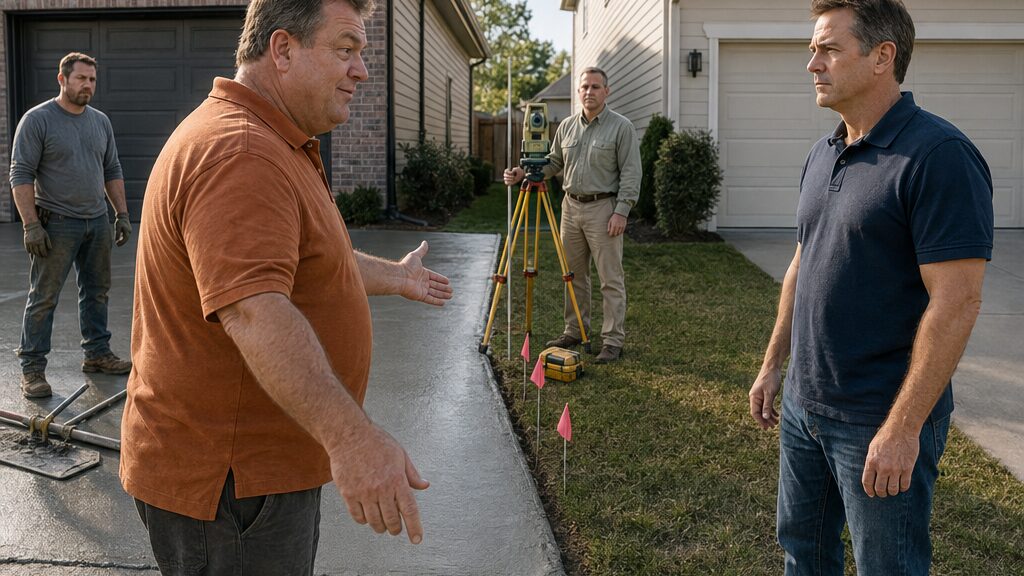
The first thing Daniel Carter noticed was that the grass strip beside his driveway was gone.
He stopped halfway out of his side door, coffee still in one hand, and stared at a wide band of wet gray concrete where a narrow edge of lawn had been the night before.
A contractor stood bent over the fresh slab, drawing a long finishing tool toward himself. Beyond him, a concrete mixer idled near Frank Nelson’s driveway.
Daniel set the coffee on the porch rail.
“Hold on.”
The contractor looked up.
Daniel stepped off the porch and crossed the lawn, keeping his shoes away from the fresh pour. Frank stood on the other side of the slab in a faded work shirt, one hand resting near his hip as if he had been supervising all morning.
Daniel pointed at the new edge.
“That comes over too far.”
Frank glanced down. “What does?”
“The concrete.”
The new apron widened Frank’s driveway toward Daniel’s side. The old dividing edge had never been perfectly dramatic. There was no fence, no painted stripe, no decorative wall. Just two driveways, a shallow strip of grass, and years of mowing that Daniel knew almost by muscle memory.
He had edged that strip every spring for more than a decade.
Now part of it was under concrete.
Frank looked from Daniel to the contractor.
“We followed the same line that’s always been here.”
“No, you didn’t.”
Daniel crouched at the corner closest to the street. The old worn edge of his asphalt disappeared beneath the wet slab. He estimated the overrun at about a foot, maybe a little more.
He stood again.
“I’m serious, Frank. Stop them for a minute.”
Frank’s expression tightened.
“They’re almost done.”
“That’s the point. It’s still wet.”
The contractor shifted his weight but said nothing.
Daniel pointed farther down the slab. “This isn’t just at the corner. It keeps going.”
Frank walked two steps along the new concrete, looking down with exaggerated patience.
“Looks fine to me.”
Daniel stared at him.
“That strip is part of my lot.”
“You think it is.”
“I know where my driveway ends.”
Frank gave a small laugh. “Apparently not.”
The comment hit harder than Daniel expected.
For years, he and Frank had occupied the ordinary middle ground of suburban neighborliness. They waved. They talked about lawn equipment. Frank had once helped Daniel push a dead riding mower into the garage. Daniel had collected a package from Frank’s porch while the Nelsons were away.
They were not friends, but they had never been enemies.
Daniel looked again at the smooth wet concrete.
“Just pause the work.”
Frank shook his head.
“I’m not stopping a crew because you suddenly decided there’s a problem.”
Daniel felt the familiar tightening in his chest that came whenever somebody treated an informal boundary as if it were meaningless.
Years earlier, his father had lost several thousand dollars over a shared access agreement that had existed only as handshakes and assumptions. Daniel remembered the months of arguments afterward, and his father repeating the same sentence at the kitchen table.
I should’ve gotten it in writing.
Daniel had promised himself he would never make the same mistake.
But he also knew memory was not measurement.
He pulled out his phone.
Frank’s eyes narrowed. “What are you doing?”
“Taking pictures.”
“For what?”
“So there’s a record of where the concrete is while it’s still fresh.”
Frank let out another short laugh.
“This is getting ridiculous.”
Daniel photographed the corner, then the length of the slab, then the spot where the old asphalt edge vanished beneath it. He included the neighboring garage, the drain grate near the curb, and several fixed reference points.
The contractor resumed smoothing the surface.
Daniel looked at him. “You’re going to keep pouring?”
The contractor hesitated.
Frank answered for him. “Yes.”
“Even after I’ve told you I believe it’s on my property?”
Frank’s face changed slightly then—not anger exactly, but a harder form of certainty.
“You believe a lot of things, Daniel.”
The contractor looked away.
Daniel lowered his phone.
“Who marked the boundary?”
Frank shrugged. “It’s obvious.”
“That wasn’t my question.”
“The contractor followed the existing line.”
“What existing line?”
“The same one everyone’s used for years.”
Daniel looked toward the narrow side strip. Tire wear had flattened part of the grass over time, mostly from delivery vans and Frank backing a trailer around his garage. Daniel had complained once or twice, but never formally.
Frank pointed toward that worn path.
“There. That edge.”
“That’s tire wear.”
“It’s been treated like part of my drive since before you bought your place.”
Daniel shook his head. “Driving over grass doesn’t change ownership.”
Frank’s mouth tightened.
Neither man spoke for several seconds.
The only sound was the scrape of the finishing tool moving over concrete.
Daniel realized then that the argument was no longer about whether Frank could see the edge.
Frank simply did not consider Daniel’s objection important enough to stop the work.
That realization cooled something in him.
He took three more photographs.
Then he stepped back.
“All right.”
Frank seemed almost disappointed by the lack of another argument.
Daniel looked at the slab once more.
“I’ll get it checked.”
Frank spread one hand.
“Go ahead.”
By noon, the concrete had begun to lose its wet shine.
Daniel spent part of the afternoon searching through the documents from his house purchase. He found a closing survey from years earlier, but it was too small and too general to settle a sixteen-inch dispute with confidence.
He enlarged it on his computer.
The lot line appeared where he remembered it.
But appearance was not proof.
That bothered him more than Frank’s attitude.
Daniel went outside near sunset.
The new slab had hardened enough that the contractor’s tools were gone. A faint seam ran between Daniel’s older pavement and Frank’s bright new concrete.
From a distance, it looked almost clean.
Almost reasonable.
Daniel stood with his hands in his pockets, looking at the place where grass had been that morning.
Frank came out to move his pickup.
He saw Daniel staring.
“You still on this?”
Daniel turned.
“I’m hiring a surveyor.”
Frank stopped beside the truck.
“For fourteen inches?”
“If it’s mine.”
Frank shook his head.
“You’re going to spend hundreds of dollars because you don’t like where my driveway ends?”
Daniel said nothing.
Frank opened the truck door, then paused.
“If you think that concrete is on your property, prove it.”
He climbed inside and shut the door.
Daniel watched the truck back down the driveway.
Then he looked at the new seam again.
For the first time that day, he was no longer estimating.
Chapter 2: The Survey Flags Changed the Argument Overnight
Four days later, Matthew Roberts drove a narrow steel probe into the ground beside Frank Nelson’s new concrete.
The metallic tap carried farther than Daniel expected.
Frank heard it from inside his garage.
He came out before Matthew had finished setting up his equipment.
“What’s all this?”
Matthew straightened.
“Boundary survey.”
Frank looked at Daniel.
“You actually hired somebody.”
Daniel kept his hands in his pockets. “You told me to prove it.”
Frank’s jaw shifted.
Matthew unfolded a tripod near the street and checked his notes.
“I’ll need clear access along the side line.”
Frank pointed at the new apron.
“You’re not putting holes in my concrete.”
“I don’t need to.”
Matthew’s voice was calm and flat.
“I’m locating recorded monuments and calculating the property line.”
Frank looked as though he wanted to argue with the terminology itself.
Daniel resisted the urge to fill the silence.
That was harder than he expected.
For four days, he had imagined this moment in different versions. In some of them, the surveyor confirmed Daniel immediately and Frank had nothing to say. In others, the line landed exactly where Frank claimed and Daniel had to swallow the entire confrontation.
He had barely slept the night before.
Matthew worked without offering either man reassurance.
He located one recorded point near the front corner, took measurements, then moved toward the rear.
Frank followed him.
“You know the previous owners always used this as my side.”
Matthew did not look up from his equipment.
“I’m not evaluating use.”
“I’m just telling you there’s history here.”
“I’m locating the deed line.”
Frank glanced at Daniel.
Daniel kept quiet.
A half hour later, Matthew placed the first bright survey flag in the grass near the curb.
The flag stood several inches inside the edge of Frank’s new concrete.
Daniel stared at it.
Frank folded his arms.
“That doesn’t look right.”
Matthew checked the instrument again.
Then he placed a second flag farther back.
That one was even more striking.
The plastic stem touched the concrete itself.
Frank stepped closer.
“What are you saying?”
Matthew raised one hand.
“I’m not saying anything yet. I’m still working.”
The contractor who had poured the slab arrived unexpectedly to pick up a form board left near Frank’s garage. He slowed when he saw the equipment.
Frank called to him.
“Come here a second.”
The contractor approached reluctantly.
Frank pointed toward the flags.
“He’s saying your slab is over the property line.”
Matthew finally looked up.
“I haven’t given a final result.”
Frank gestured toward Daniel.
“He’s been claiming this since Saturday.”
Daniel felt heat move up his neck.
“Because it looked wrong.”
Frank turned toward the contractor.
“We followed the old edge, right?”
The contractor rubbed one palm across the back of his neck.
“We followed the layout you gave us.”
Frank’s face changed.
“I showed you the existing line.”
“You showed me where you wanted the apron.”
Daniel looked between them.
Frank said, “You told me it was fine.”
“I told you if the boundary mattered that close, a survey would settle it.”
The words landed differently than anything Matthew had measured.
Frank stared at the contractor.
“You never said I needed one.”
“I said I wasn’t a surveyor.”
Daniel opened his mouth, then stopped himself.
He could feel the argument trying to pull him back in.
Matthew moved farther down the property line.
Another measurement.
Another marker.
Another flag.
By the time he reached the rear portion of the slab, the pattern was impossible to dismiss.
The line did not merely clip one corner.
It ran inside the new concrete for a substantial distance.
Matthew returned to the front with a small field book.
“Based on the monuments and the recorded plat, the concrete is across the Carter line.”
Frank looked at him.
“How much?”
Matthew checked his notes.
“Maximum encroachment is about sixteen inches.”
Daniel blinked.
He had estimated fourteen.
Matthew continued.
“Length is approximately twenty-two feet.”
Frank’s arms slowly dropped.
Daniel looked down the driveway. Sixteen inches suddenly seemed much larger when carried for twenty-two feet.
Matthew indicated the area with his pen.
“Roughly speaking, you’ve got close to thirty square feet of the Carter parcel under the apron.”
The contractor exhaled under his breath.
Daniel felt something loosen in his chest.
For four days he had wanted this confirmation.
Now that he had it, he did not feel triumphant.
He felt steady.
Frank looked at him.
“Well. There you go.”
Daniel waited.
Frank did not apologize.
Instead he turned back to Matthew.
“I want a copy of everything.”
“You can order one.”
“I’m one of the affected owners.”
“I understand.”
Frank pointed at the flags.
“And those stay?”
“For now.”
Frank gave Daniel a flat look.
Daniel said, “I didn’t put them there.”
“You paid for them.”
“I paid to know where the line is.”
The contractor quietly picked up the form board and walked away.
Matthew began packing his equipment.
Daniel followed him toward the curb.
“So that settles it?”
Matthew glanced at him.
“It settles where the recorded boundary is.”
Daniel heard the distinction.
“What doesn’t it settle?”
Matthew pulled out a copy of the subdivision plat and unfolded it across the hood of his truck.
A series of thin lines crossed the drawing.
He tapped one near Daniel’s side boundary.
“What’s this?”
Daniel leaned closer.
“Drainage?”
“Looks like a drainage easement.”
Frank had walked up behind them.
“So?”
Matthew traced the notation.
“I need to check the recorded language.”
Frank said, “The HOA handles drainage.”
“Maybe.”
Matthew folded the plat.
Daniel felt his earlier relief slipping away.
“Does that affect the concrete?”
Matthew looked toward the slab.
“Possibly.”
Frank scoffed.
“Come on.”
Matthew remained calm.
“I’m not giving either of you an opinion until I read the recorded easement.”
Daniel asked, “How long?”
“I can pull it this afternoon.”
Frank shook his head.
“This keeps getting bigger because he wants it bigger.”
Daniel turned toward him.
“You told me to prove the line.”
“And you did. Fine. We can talk about the edge.”
Matthew closed the truck door.
“Don’t talk about a remedy yet.”
Both men looked at him.
Matthew held the folded plat in one hand.
“If that easement says what I think it may say, the property line might not be the only issue.”
Daniel glanced at the bright flags running beside the new slab.
Ten minutes earlier, they had looked like victory.
Now they looked like warnings.
Matthew got into his truck.
Before closing the door, he looked at Daniel.
“Don’t send a demand letter yet.”
Daniel frowned.
“Why?”
“Let me verify the easement first.”
He drove away, leaving Daniel and Frank on opposite sides of a concrete strip that had suddenly become more complicated than either of them had expected.
Chapter 3: The HOA Records Made the Problem Bigger
The recorded plat put the drainage easement directly beneath Frank’s new concrete.
Daniel found the notation the following Monday at the county records counter, where a clerk enlarged the subdivision map on a monitor and pointed to a narrow corridor running along the side lot line.
“Eighteen inches,” the clerk said.
“On which side?”
“According to this recording, the restricted area follows the boundary here.”
Daniel leaned closer.
The line was unmistakable.
The concrete encroachment Matthew had measured was already a problem.
The easement made it a different kind of problem.
Matthew had emailed Daniel two days earlier with careful wording. The recorded drainage restriction limited permanent improvements within the corridor unless separately approved. Matthew had emphasized that he was not interpreting municipal code or HOA enforcement authority.
That caution forced Daniel to do something he disliked.
Keep digging.
He drove from the county office to the HOA management office with copies of the survey, the plat, and photographs of the concrete.
Rachel Adams met him in a small conference room near the front desk.
She was already holding a folder when he sat down.
“I’ve reviewed what you sent.”
Daniel placed Matthew’s survey on the table.
“Then you know the concrete is on my lot.”
Rachel did not touch the paper.
“The association doesn’t adjudicate private boundary ownership.”
“There’s a recorded survey.”
“I understand.”
“And an easement.”
“That part may involve the association.”
Daniel leaned back.
“So the property line is private, but the drainage line is suddenly yours?”
Rachel’s expression tightened slightly.
“I didn’t say that.”
“It sounds like what you’re saying.”
“I’m saying we have different responsibilities.”
Daniel knew the sentence was probably true.
He disliked it anyway.
Rachel opened her folder.
“The association maintains certain drainage features. The city has jurisdiction over others. Private property boundaries are generally between owners unless a covenant issue is involved.”
Frank had said almost the same thing in simpler language: not my problem.
Daniel pushed the plat toward her.
“This concrete sits in the restricted corridor.”
Rachel studied it.
“Yes.”
“So what happens?”
“We determine whether approval was required and whether approval was issued.”
“And if it wasn’t?”
“We determine what enforcement options apply.”
Daniel looked at her.
“That sounds like a lot of determining.”
Rachel met his eyes.
“That’s because I’m not going to promise you an outcome before we check the records.”
The answer irritated him partly because it was reasonable.
Rachel stood.
“Give me a minute.”
She left the room.
Daniel looked through the glass wall toward the reception area. A landscaping notice was pinned to a board beside a community pool schedule.
Everything about the office suggested predictability.
Forms.
Rules.
Procedures.
Yet somehow a sixteen-inch strip between two houses had already produced three different versions of responsibility.
Rachel returned carrying a larger binder.
“I found something you need to see.”
She opened to a landscaping diagram from years earlier.
The map was not a legal plat.
It was a maintenance sketch showing mowing zones, drainage access, and common landscaping edges.
Daniel immediately saw the problem.
Along the side of his property and Frank’s, the maintenance shading extended across the narrow strip that now contained part of the concrete apron.
Frank arrived fifteen minutes later after Rachel called him.
He entered the conference room with visible impatience.
“What is this about?”
Rachel turned the diagram toward him.
Frank looked at it.
Then he looked at Daniel.
“That’s what I’ve been telling you.”
Daniel’s stomach tightened.
“No. You told me the property was yours.”
“I told you that strip has always been treated as my side.”
Rachel raised a hand.
“This document does not establish ownership.”
Frank tapped the shaded area.
“But it shows what the association treated as common maintenance.”
“Historically,” Rachel said.
“Exactly.”
Daniel looked closer.
The sketch was dated more than a decade earlier.
“Does this override the recorded plat?”
“No,” Rachel said.
Frank leaned back.
“But it explains why I thought the existing edge was accepted.”
Daniel turned to him.
“You poured permanent concrete without checking.”
Frank’s expression hardened.
“I expanded a driveway along a line that’s been used forever.”
“Used isn’t owned.”
“There you go again.”
Rachel interrupted.
“The point is that the association may have contributed to confusion by using an imprecise maintenance diagram.”
Daniel looked at her.
“Contributed to confusion?”
“Yes.”
“The county record isn’t confusing.”
“The county record is not what residents usually receive when they ask where landscaping maintenance ends.”
Frank gave Daniel a look that said exactly.
Daniel hated that look.
It felt too much like the ground shifting beneath a case he had believed was becoming simpler.
He gathered his papers.
“I’m checking the permit.”
Frank laughed once.
“Of course you are.”
Daniel stopped.
“What does that mean?”
“It means you’ve proved the line. Now you’re looking for the next thing.”
Daniel stared at him.
For a moment, he had no answer.
Because part of him knew Frank was right.
Not about the concrete.
About Daniel.
The line had been proven.
But proving it had not produced the acknowledgment Daniel wanted.
So he had kept going.
He left the HOA office more unsettled than when he entered.
At the city building department, the permit file took less than ten minutes to locate.
The clerk placed several scanned pages on the screen.
The contractor had obtained approval for a residential driveway modification.
Daniel read each page.
Site sketch.
Drainage notation.
Standard conditions.
Then he found the missing piece.
“No boundary survey?”
The clerk shook her head.
“Not in this file.”
“Was one required?”
“Not necessarily for every driveway permit.”
Daniel pointed to the side setback area.
“What about work this close to a recorded property line?”
The clerk leaned toward the screen.
“If the improvement affects an easement or crosses ownership, that’s different.”
“So the permit doesn’t authorize that.”
“The permit authorizes work represented in the application.”
Daniel looked at the contractor’s sketch.
The new apron was drawn entirely on Frank’s parcel.
No encroachment.
No disputed strip.
No survey.
The permit had not created the mistake.
It had simply assumed the submitted drawing was accurate.
Daniel photographed the file number and requested copies.
By the time he returned home, Frank’s pickup was parked partly over the newly placed survey flags.
One flag had been flattened beneath the front tire.
Daniel stood at the curb, staring at it.
Whether Frank had done it deliberately or simply parked the way he always had, Daniel could not tell.
That uncertainty bothered him more than certainty would have.
Rachel called just before dinner.
“I spoke with the association attorney.”
Daniel leaned against his kitchen counter.
“And?”
“We’re reviewing the drainage restriction.”
“What does that mean?”
“It means we may need the city involved.”
Daniel waited.
Rachel continued.
“There’s something else.”
He looked through the window toward the seam between the driveways.
“What?”
“The association’s old maintenance diagram should never have been used as a substitute for boundary information.”
Daniel said nothing.
Rachel’s voice softened slightly.
“If Frank relied on it, that doesn’t make the concrete his. But it may explain why he thought the area was less clear than you did.”
Daniel watched Frank come out of his garage and move the pickup.
The crushed survey flag slowly lifted halfway upright.
Rachel said, “Daniel?”
“I’m here.”
“We may have contributed to the misunderstanding.”
Daniel looked at the concrete, the bent flag, and the old strip of land that had somehow become a test of everyone’s certainty.
The survey had answered who owned it.
It had not yet answered the harder question.
Whether Frank had made an honest mistake—or knew enough to stop and chose not to.
Chapter 4: The Certified Letter Did Not End Anything
“Not gonna happen.”
Daniel read the message twice before setting his phone on the kitchen counter.
Three words. No explanation. No question. No attempt to discuss the survey, the easement, the permit file, or the certified letter Daniel knew Frank had signed for two days earlier.
The letter had been simple. It included Matthew’s survey, copies of the relevant plat pages, photographs of the encroachment, and a request that Frank remove the concrete from Daniel’s property within thirty days at his own expense.
Daniel had rewritten it four times before mailing it.
He had taken out the angry sentences.
He had removed the phrase knowingly encroached because he could not prove what Frank had known before the pour.
He had even deleted a paragraph about legal costs after deciding it sounded like a threat.
What remained was factual.
Frank’s reply was not.
Daniel picked up the phone again.
Not gonna happen.
He took a screenshot and saved it in the folder with the photographs.
The action felt efficient. Clean. Necessary.
It also gave him a small, unpleasant satisfaction.
That bothered him.
By the evening, Frank’s pickup was parked so close to the disputed edge that its passenger-side tires hid most of the concrete seam. One of Matthew’s flags had disappeared entirely.
Daniel stood in his garage doorway looking at the truck.
He could have walked next door.
Instead, he took another photograph.
Two nights later, Rachel Adams called an HOA meeting involving both homeowners.
The conference room felt smaller with Frank in it.
Rachel sat at the end of the table with the survey, the old landscaping diagram, and a copy of the subdivision covenants arranged in front of her.
Frank sat opposite Daniel.
Neither man greeted the other.
Rachel began without ceremony.
“The association has reviewed the records available to us. The survey establishes the recorded lot line. The older maintenance diagram does not change that.”
Daniel watched Frank.
Frank said nothing.
Rachel continued. “The drainage issue is still being reviewed with the city. In the meantime, the association would like to avoid escalating this into litigation if a practical agreement is possible.”
Daniel leaned back.
“What practical agreement?”
Rachel looked at both of them.
“Mediation.”
Frank gave a small shrug.
“I’m willing.”
Daniel turned toward him.
“You’re willing to remove it?”
Frank’s mouth tightened. “That’s not what I said.”
Rachel raised a hand.
“Let’s not start there.”
“That is the issue,” Daniel said.
“The issue,” Rachel replied, “is how to resolve the encroachment and the drainage concern with the least unnecessary damage.”
Daniel heard the phrase least unnecessary damage and disliked it immediately.
“It’s already damaged.”
Frank looked at him.
“My driveway is damaged if I cut it apart.”
“It’s on my property.”
“Sixteen inches.”
“Sixteen inches of my property.”
Frank exhaled sharply.
Rachel opened another document.
“One possibility would be a temporary joint-use agreement while the drainage question is resolved.”
Daniel stared at her.
“You mean leave the concrete there.”
“For a defined period.”
“And I sign something saying he can use it.”
“It would preserve everyone’s rights while—”
“No.”
Rachel stopped.
Frank leaned back in his chair.
“See?”
Daniel turned toward him. “See what?”
“You don’t want a solution.”
“I want you off my property.”
“You want me to say you won.”
Daniel felt the sentence land somewhere too close to the truth.
He ignored that feeling.
“I want you to acknowledge the survey.”
“I’ve acknowledged the survey.”
“No, you keep saying the old diagram made you think the strip was yours.”
Frank looked at Rachel.
“Because it did.”
Rachel said, “Those are separate questions.”
Daniel shook his head.
“They’re not separate if he’s refusing to fix it.”
Frank pushed his chair back slightly.
“You know what this costs?”
Daniel looked at him.
Frank pointed toward the survey.
“You spent what, four hundred dollars proving that line?”
“Four hundred twenty.”
“Fine. You think that’s expensive? Try having concrete cut, hauled away, reformed, and sealed.”
“That’s not my bill.”
Frank’s jaw tightened.
“I already paid for the pour.”
“You chose to pour it.”
“I chose to improve my driveway.”
“On my land.”
Rachel interrupted again.
“Frank, was the contractor told where the property line was?”
Frank’s eyes shifted.
“He followed the existing edge.”
“That’s not what she asked,” Daniel said.
Frank ignored him.
Rachel waited.
Finally Frank said, “I showed him where the drive had always been used.”
Daniel remembered the contractor’s words from survey day.
We followed the layout you gave us.
He leaned forward.
“And when he told you a survey would settle it?”
Frank looked at him.
“He didn’t tell me I had to get one.”
Daniel almost laughed.
The difference between those two statements was so narrow it felt deliberate.
Rachel closed the folder.
“This is exactly why mediation may help.”
Daniel said, “What would I be mediating? Whether I own what the survey says I own?”
“No. Cost, timing, access, drainage remediation.”
Frank looked at him.
“I’d sign something saying your lot line is where the survey puts it.”
Daniel waited.
Frank continued.
“And you let the apron stay temporarily while we figure out the city side.”
It was almost what Daniel had wanted.
Almost.
But Frank had not said the thing Daniel had spent two weeks waiting to hear.
I was wrong.
Daniel asked, “And you pay to remove it afterward?”
Frank looked away.
“We figure that out.”
“No.”
Rachel’s expression changed.
“Daniel.”
“No.”
He knew he was speaking too quickly now.
Frank said, “There it is.”
Daniel turned toward him.
“You poured it. You ignored me. You told me to prove it. I proved it.”
“And I’m offering something.”
“You’re offering to keep using my property while we negotiate whether you should pay to stop using it.”
Frank’s face reddened.
“I’m offering not to spend thousands of dollars tearing apart a driveway before anybody knows exactly what the city will require.”
For the first time, Daniel heard something beneath the defensiveness.
Fear.
Not fear of losing an argument.
Fear of the bill.
Daniel should have noticed it sooner.
Instead, he heard his father’s voice from years earlier.
I should’ve gotten it in writing.
Daniel looked at Rachel.
“I’m not signing temporary permission.”
Rachel was quiet for a moment.
“All right.”
Frank pushed his chair fully back.
“Then I guess we’re done.”
He stood.
Daniel did not stop him.
After Frank left, Rachel remained seated.
“You know refusing temporary use doesn’t strengthen the property line. It’s already established.”
Daniel looked at the closed door.
“I know.”
“Then why refuse?”
Daniel gathered his papers.
“Because he still thinks this is something he gets to bargain over.”
Rachel studied him.
“Maybe. Or maybe he’s trying to avoid a bill he can’t handle.”
Daniel paused.
“That doesn’t make it mine.”
“No.”
Rachel’s voice stayed even.
“But those can both be true.”
Daniel carried the folder home.
He told himself Rachel’s comment did not matter.
The survey mattered.
The easement mattered.
The permit mattered.
Facts mattered.
At nine thirty, his doorbell rang.
When Daniel opened the door, Christine Nelson stood on the porch alone.
She wore a light sweater despite the mild evening and held one hand against the railing before stepping closer.
Daniel had seen her less often over the past year. He had noticed she moved more carefully than she used to, but they had never discussed it.
“Is Frank here?” Daniel asked.
“No.”
She glanced toward her house.
“He thinks I’m taking out the trash.”
Daniel waited.
Christine looked embarrassed by the secrecy.
“I need to tell you something.”
Daniel opened the storm door wider.
She shook her head.
“Not inside.”
Her eyes moved toward Frank’s house again.
“Tomorrow evening. Our back porch. He’ll be out.”
Daniel felt a new kind of unease.
“What is this about?”
Christine looked down toward the driveway, where Frank’s truck still covered most of the concrete seam.
Then she looked back at Daniel.
“He knew he was supposed to check first.”
Chapter 5: Christine Explained Why Frank Rushed the Pour
“He knew he was supposed to check first.”
Christine repeated the sentence the following evening before Daniel had even settled into the chair across from her.
The Nelsons’ back porch faced the narrow strip between the houses. From where Daniel sat, he could see the edge of the new concrete disappearing toward the driveway.
Christine rested both hands around a glass of water.
Daniel said, “Check what?”
“The property line.”
He stayed quiet.
She looked toward the yard.
“The contractor told him.”
Daniel felt his jaw tighten.
“When?”
“Before the pour.”
“That’s not what Frank said.”
“I know.”
Christine’s voice carried no accusation. That made it worse.
Daniel leaned forward.
“What exactly did the contractor tell him?”
“He said because they were widening toward your side, they should verify the line. Frank asked what that would cost and how long it would take.”
Daniel remembered the contractor during the survey.
I said I wasn’t a surveyor.
Christine continued.
“They were already behind.”
“Behind what?”
She looked at her hands.
“My appointment.”
Daniel waited.
Christine shifted in the chair, moving carefully.
“I’m having more trouble getting in and out of the passenger side when the truck is close to the garage.”
Daniel glanced toward the driveway.
The added apron suddenly made visual sense in a way it had not before.
More width.
More room to open a door.
A flatter approach.
Christine noticed him understanding.
“That’s what the widening was for.”
Daniel said nothing.
He had spent weeks picturing Frank’s motive as simple expansion. More driveway. More convenience. More of everything.
Christine went on.
“I didn’t ask him to take anybody’s land.”
“I know.”
“No, I need you to understand that.”
Her voice sharpened for the first time.
“Frank keeps saying he was doing it for me. He was. But that doesn’t mean I told him to ignore the line.”
Daniel leaned back.
“What happened when the contractor mentioned the survey?”
Christine gave a tired half smile.
“Frank asked how long.”
“And?”
“He was told it might delay the job.”
“How much?”
“A few days. Maybe more, depending on scheduling.”
Daniel looked toward the concrete.
“That’s it?”
“There was money too.”
Christine rubbed her thumb slowly across the side of the glass.
“The original estimate had already gone up. Drainage work, base material, another load of concrete. Frank had started worrying that if they paused, the contractor would move the crew to another job and come back at a higher price.”
“So he told them to pour.”
“Yes.”
“Knowing the line wasn’t verified.”
Christine looked at him.
“Yes.”
The answer should have felt like victory.
It did not.
It felt heavy.
Daniel stood and walked to the porch edge.
A faint line in the concrete caught the evening light. The seam looked different from this side. Not like an invasion. More like a decision that had hardened before anyone wanted to reconsider it.
Christine came closer.
She moved slowly, one hand brushing the railing.
At the edge of the porch, she pointed toward the slab with the toe of her shoe.
“He thought the old worn path meant the risk was small.”
Daniel looked at her.
“Did he think the land was his?”
Christine hesitated.
“He thought nobody would care enough to make it a problem.”
That answer was more honest than anything Frank had said.
Daniel looked down.
“So he knew it might not be his.”
“I think he knew he didn’t know.”
There it was.
Not deliberate theft.
Not an innocent mistake.
Something in between.
A shortcut taken because the person taking it assumed the uncertainty would fall on someone else.
Daniel felt anger rise again, but it had changed shape.
“He told me I was making this bigger than it was.”
Christine nodded.
“He tells himself that when he’s scared.”
“Scared of what?”
“Money, mostly.”
She gave a small humorless laugh.
“And looking foolish.”
Daniel almost smiled despite himself.
“That one I noticed.”
Christine looked toward the Nelson house.
“Frank retired earlier than he planned. We’ve had expenses. He won’t talk about them because talking makes them real.”
Daniel thought of Frank at the HOA meeting, saying, You know what this costs?
“He could have told me.”
“Would it have changed anything?”
Daniel opened his mouth.
Then stopped.
Would it?
The property line would still be the property line.
But perhaps the first conversation would not have turned into a contest.
Christine seemed to read the hesitation.
“I’m not asking you to let him keep it.”
“Then what are you asking?”
“I’m asking you not to let him use me as the reason.”
She stepped down from the porch onto the grass.
Daniel moved automatically as if to offer a hand, then stopped when she managed the step herself.
Christine walked toward the seam.
Her shoe followed it for several feet.
“This was supposed to make things easier.”
She looked down at the concrete.
“Now every time I see it, I know two men are angry at each other because Frank decided my problem gave him permission to rush.”
Daniel said, “I’m not angry because of you.”
“I know.”
She turned.
“But he is embarrassed because of me, and that’s close enough for him to confuse the two.”
Daniel let the words settle.
For weeks, he had wanted proof that Frank was wrong.
Now he had it in a form no document could provide.
Frank had been warned.
He had taken the risk anyway.
And he had done it under pressure Daniel could understand.
Understanding did not erase responsibility.
But it made punishment feel different.
Christine walked back toward the porch.
“Please don’t tell him I said all of this before tomorrow.”
“What happens tomorrow?”
She stopped.
“You don’t know?”
Daniel shook his head.
Christine frowned.
“The city inspector.”
Daniel pulled out his phone.
There was an email he had not opened, sent late that afternoon by Rachel.
He tapped it.
The city had scheduled a site review for eight thirty the next morning regarding the drainage easement and the permit conditions.
Daniel read the message twice.
Christine watched his face.
“He thinks you pushed for it.”
“I sent the records.”
“That means yes, in his mind.”
Daniel put the phone away.
He felt the familiar urge to organize the next steps immediately.
Photographs.
Survey.
Permit.
Plat.
Timeline.
He had everything.
Enough to make the inspector’s visit very uncomfortable for Frank.
Maybe enough to trigger formal enforcement.
Christine said quietly, “He’s going to come out swinging tomorrow.”
Daniel looked at her.
“You’re warning me?”
“I’m telling you not to mistake volume for certainty.”
She returned to her chair.
Daniel stayed near the seam.
For the first time since the concrete had been poured, he imagined the dispute ending without Frank being humiliated.
The thought felt almost like surrender.
That reaction told him more about himself than he wanted to know.
He said goodnight and walked home.
At his kitchen table, Daniel opened the folder containing every photograph, message, plat page, and permit record.
He began arranging them for the inspector.
Then he stopped.
On top was Frank’s three-word text.
Not gonna happen.
Daniel stared at it.
He moved it to the bottom of the stack.
At eight fourteen the next morning, a white city vehicle turned into the subdivision.
Daniel saw it through the window.
Across the property line, Frank stepped out of his garage at almost the same moment.
Neither man waved.
The inspector parked at the curb, opened the rear door, and lifted out a measuring rod.
Chapter 6: The Stop-Work Notice Finally Changed Frank’s Tone
The remediation notice appeared on Frank’s project six days later.
Daniel saw the bright paper from his kitchen window before he saw Frank.
It had been secured inside a clear weather sleeve near the garage, close enough to the driveway that anyone walking up could see it was official even without reading the details.
Frank came outside carrying the envelope that had accompanied it.
He stood beside the slab for nearly a minute.
Then he looked directly at Daniel’s house.
Daniel stepped away from the window.
The city inspection had been quieter than either man expected.
The inspector had measured the slab, reviewed Matthew’s survey, checked the easement location, and compared the installed concrete with the submitted permit sketch.
Frank had argued that the permit had been approved.
The inspector had answered that the permit applied to the work shown in the application, not to improvements outside the represented parcel or inside a restricted drainage area.
Daniel had said almost nothing.
That silence had taken effort.
Now the result was official.
The city required correction of the encroaching section and restoration of the restricted drainage margin. Failure to begin remediation within the stated period could trigger additional enforcement and fines.
Daniel had imagined this moment too.
He expected relief.
Instead he felt the same steadiness he had felt when Matthew placed the second survey flag.
The problem had moved beyond argument.
That should have been enough.
Frank knocked on Daniel’s door that afternoon.
Daniel opened it but did not invite him inside.
Frank held a folded copy of the notice.
“You happy?”
Daniel looked at him.
“No.”
Frank gave a sharp laugh.
“Could’ve fooled me.”
“What do you want?”
Frank looked past Daniel toward the kitchen.
“To fix it.”
Daniel waited.
Frank rubbed the edge of the paper between his fingers.
“The contractor can cut back the overage.”
“That’s what I asked for.”
“He has to bring a crew back. Saw, disposal, reseal, forming. It’s not cheap.”
Daniel said nothing.
Frank looked at him.
“I’ll split it.”
“No.”
The answer came too quickly.
Frank’s eyes hardened.
“Half.”
“You poured it.”
“And your HOA gave us a diagram showing that strip like common maintenance.”
“It didn’t show ownership.”
“It showed enough to create confusion.”
“The contractor told you to verify the line.”
Frank went still.
For the first time since the dispute began, Daniel saw surprise rather than irritation.
“Who told you that?”
Daniel did not answer.
Frank’s face changed again.
“Christine.”
Daniel said, “It doesn’t matter who told me.”
“It matters to me.”
“The contractor said the same thing in front of both of us.”
“Not the same way.”
Daniel stepped onto the porch and closed the door behind him.
“Frank, I’m not paying half to remove concrete from my property.”
Frank looked toward the slab.
“What if the HOA contributes?”
“That’s between you and them.”
“So you get everything.”
Daniel frowned.
“What does that mean?”
“You get your line. You get the concrete cut. You get the city notice. And everybody else gets the bill.”
Daniel felt anger spark.
“You made the decision.”
“I made a decision based on what that strip had looked like for fifteen years.”
“You made a decision knowing you hadn’t checked.”
Frank looked away.
There it was again.
The point where he could admit it.
He still did not.
Daniel almost pushed.
He could have said Christine told me everything.
Could have forced Frank to acknowledge the warning.
Could have listed the exact sequence of mistakes until there was nowhere left for him to hide.
Instead he heard Christine’s voice.
Don’t mistake volume for certainty.
Daniel said, “What exactly is the contractor proposing?”
Frank looked back at him, suspicious of the change.
“A narrow cut along the surveyed line. Remove the strip. Reseal the edge.”
“And the easement?”
“He says if they pull it back to the line and restore the base beside it, the city will accept that.”
Daniel said, “I want that in writing.”
Frank’s mouth tightened.
“Of course you do.”
“Yes.”
Frank shook his head, but the anger had lost some of its energy.
“I’ll get it.”
The next day Rachel asked both men to come to the HOA office.
This time, she did not begin with mediation.
She slid a revised maintenance diagram across the table.
“The association is correcting the old map.”
Frank stared at it.
Rachel continued.
“We’re also adding a requirement that exterior improvements proposed within a specified distance of side lot lines include either a current survey or verified boundary documentation.”
Daniel looked at her.
“So the HOA accepts the old diagram was a problem.”
Rachel chose her words carefully.
“We accept that it was too easy to misinterpret.”
Frank leaned back.
“That sounds like lawyer language.”
“It is lawyer-reviewed language.”
Frank gave a humorless laugh.
Rachel looked at him.
“The association is not accepting responsibility for your encroachment.”
“Of course not.”
“But we are acknowledging that the maintenance material should have been clearer.”
Daniel expected satisfaction.
Instead he felt some of the pressure leave the room.
Rachel turned toward him.
“The city has indicated the drainage issue can be remediated by cutting the slab back to the surveyed boundary and restoring the affected strip. There is no requirement to demolish the entire apron.”
Frank looked at Daniel.
“That’s what I offered.”
“No,” Daniel said. “You offered half.”
Frank’s jaw tightened.
Rachel kept going.
“If the work is completed and passes inspection, additional association enforcement would likely be unnecessary.”
Daniel heard the opening in the sentence.
Additional enforcement.
He had options.
He could insist the HOA pursue every available violation.
He could press for reimbursement of the survey cost.
He could continue documenting Frank’s parking.
He could ask an attorney about damages.
He could make the dispute last much longer than the physical repair.
Frank seemed to understand the same thing.
“What do you want?” he asked.
The room became still.
Daniel looked at him.
For weeks, he had wanted to hear that question.
Now that it came, he found the answer had changed.
“I want the concrete off my property.”
Frank waited.
“I want the edge resealed correctly.”
Frank nodded once.
“And I want the drainage strip restored so the city closes the issue.”
“That’s it?”
Daniel looked down at the survey.
A red pencil line had been drawn over Matthew’s boundary measurements. The contractor planned to use it as the saw line.
The same exact line Frank had once told Daniel to prove.
Daniel said, “That’s what fixes the problem.”
Rachel watched him.
Frank did too.
Daniel knew both were waiting for something else.
Survey reimbursement.
HOA penalty.
Written apology.
Admission of fault.
He could still ask.
Part of him wanted to.
Not because he needed the money.
Because he wanted the words.
You were right.
He thought again of his father at the kitchen table, angry not only about lost money but about having trusted a handshake.
Daniel had spent years turning that memory into a rule: prove everything.
Somewhere in the last month, the rule had changed.
It had become: make them admit you proved it.
That was not the same thing.
Frank broke the silence.
“I’ll pay the contractor.”
Daniel looked up.
“All of it?”
“Yes.”
Rachel said, “And the association will coordinate with the city on the final drainage inspection.”
Frank stared at the table.
“I want the complaint closed when it’s done.”
Daniel answered carefully.
“When the concrete is cut to the surveyed line, the edge is sealed, and the city confirms the drainage issue is corrected, I’ll support closing it.”
Frank looked at him.
“You’ll support it?”
“I won’t pursue more.”
Something passed across Frank’s face.
Relief, maybe.
Or embarrassment.
He stood.
“All right.”
The meeting ended without a handshake.
Three days later, Daniel came home to find a thin painted line running down the edge of Frank’s concrete.
It matched Matthew’s survey flags exactly.
The contractor had marked the cut.
Frank stood near the garage watching Daniel look at it.
Neither man spoke for several seconds.
Finally Frank said, “Crew comes Monday.”
Daniel nodded.
Frank glanced at the line.
“I still think the HOA map was a mess.”
“It was.”
Frank seemed surprised Daniel agreed.
Daniel added, “You still should’ve checked.”
Frank looked at him.
For a moment Daniel thought he might finally say it.
Instead Frank looked away.
“Monday,” he repeated.
Then he went inside.
Daniel remained by the driveway.
The painted saw line was brighter than the old seam had ever been.
It no longer looked like a challenge.
It looked like a decision.
On Monday, the concrete would be cut back exactly to the line Frank had once told him to prove.
What happened after that was less certain.
Chapter 7: The Clean Cut Left Both Houses Where They Belonged
The concrete saw started at eight twelve Monday morning.
Daniel heard the motor catch before he reached the driveway.
By the time he stepped outside, the contractor had positioned the blade over the painted line that followed Matthew Roberts’s survey marks. A thin stream of water ran ahead of the saw, darkening the concrete.
Frank stood beside the garage with his arms folded.
Christine watched from the porch.
Nobody spoke.
The blade touched the slab.
The sound was sharper than Daniel expected.
For weeks, the concrete had been an argument made solid. It had represented every conversation Frank had dismissed, every photograph Daniel had taken, every record he had pulled, every sentence he had wanted Frank to admit.
Now the saw moved steadily through it.
No argument.
No interpretation.
Just the line.
Daniel watched the contractor guide the machine down the twenty-two-foot stretch. The cut followed the exact path of the survey flags that had once seemed almost absurdly bright against the lawn.
Frank glanced at Daniel.
“You want to measure behind him too?”
A month earlier, the remark would have irritated Daniel.
Now he only said, “Matthew already did.”
Frank looked away.
The contractor continued.
Once the cut was complete, the crew broke the narrow encroaching section into manageable pieces. The concrete came away in chunks, revealing compacted base material and the edge of Daniel’s property underneath.
Daniel had expected the exposed strip to feel reclaimed.
Instead it looked ordinary.
Dirt.
Stone.
Grass roots.
A thin scar where the slab had been.
The city inspector arrived before noon.
He checked the cut line against the survey documentation and inspected the drainage corridor after the contractor removed excess base material and restored the grade.
Rachel Adams arrived shortly afterward with an HOA management representative.
Frank’s expression tightened when he saw them.
“Whole committee coming to watch now?”
Rachel ignored the tone.
“We’re documenting completion.”
Frank muttered something under his breath.
Christine came down from the porch slowly.
She stood near the edge of the grass, well away from the work.
The contractor cleaned the cut face and prepared it for sealing.
Daniel watched him brush away gray slurry.
Rachel stepped beside Daniel.
“The board approved the revised project guidance.”
Daniel looked at her.
“For boundaries?”
“For exterior work near side lot lines and recorded easements.”
She held a folder against her side.
“Current survey or verified boundary documentation if the work is close enough to create uncertainty.”
Daniel nodded.
“And the old maintenance sketch?”
“Replaced.”
Frank heard them.
He looked over.
“So everybody gets new paperwork because of me.”
Rachel said, “Because the old paperwork was unclear.”
Frank gave her a skeptical look.
“That almost sounded like the HOA admitting something.”
Rachel allowed herself a small smile.
“Don’t get carried away.”
Christine smiled too.
Even Frank’s mouth moved slightly before he looked back at the driveway.
The tension did not disappear.
It simply stopped filling the entire space.
The contractor finished sealing the edge.
For the first time since the pour, the boundary was physically visible without survey flags.
A straight dark line separated Frank’s corrected concrete from Daniel’s side.
Frank stared at it.
“That’s really all it was.”
Daniel looked at him.
“All what was?”
“That strip.”
Daniel followed his gaze.
Sixteen inches.
A little more in some places, less in others.
Not much to look at.
Enough to create everything that had followed.
Frank shook his head.
“I should’ve stopped the crew.”
Daniel said nothing.
Frank rubbed his hands together once, as if removing dust that was not there.
“When you came out that morning.”
Daniel looked at him more carefully.
Frank kept his eyes on the cut.
“I should’ve stopped them and checked.”
The sentence arrived without ceremony.
No apology attached.
No audience gathered around waiting for it.
Daniel had imagined some version of those words dozens of times.
He thought they would feel larger.
Instead they felt exactly the right size.
Daniel said, “Yeah.”
Frank nodded once.
“I didn’t think it would turn into all this.”
“I didn’t either.”
Frank looked toward Christine.
Then back at Daniel.
“I thought the old path was close enough. I thought the contractor was covering himself. And I thought if I paused the job, I’d lose the crew and pay more later.”
Daniel waited.
Frank exhaled.
“Mostly, I didn’t want to admit I wasn’t sure.”
There it was.
The part no survey could measure.
Daniel understood it because he had been guilty of something close to it himself.
Not about the property line.
About what he wanted from the dispute.
He had told himself he wanted restoration.
For a while, he had wanted submission.
He had wanted Frank to stand in the exact place Daniel had been forced to stand and acknowledge that certainty had consequences.
Daniel looked at the repaired edge.
“You were responsible for checking.”
“I know.”
Frank’s voice was quiet.
Daniel nodded.
“And I probably could’ve stopped trying to make you say that sooner.”
Frank looked at him.
“That your apology?”
“No.”
Frank gave a short laugh.
“Good. Mine wasn’t either.”
For the first time in weeks, Daniel laughed too.
It lasted only a second.
But it changed something.
Later that week, the HOA held a scheduled neighborhood meeting.
The driveway dispute occupied less than fifteen minutes.
Rachel explained the updated approval requirements and the corrected maintenance diagrams. She did not identify either man as the reason for the change.
A nearby homeowner asked whether somebody had violated a lot line.
Rachel said, “We identified a process gap and corrected it.”
Daniel saw Frank glance at him from across the room.
Daniel could have spoken.
He could have described the entire sequence.
The fresh concrete.
The photographs.
The survey.
The easement.
The permit.
The refusal.
The city notice.
He could have made everyone understand who had been right from the beginning.
Instead he stayed seated.
The property line no longer needed an audience.
After the meeting, Rachel stopped him near the door.
“You could request reimbursement for the survey through mediation.”
Daniel looked at her.
“From Frank?”
“Potentially.”
He considered it.
Four hundred twenty dollars had mattered when he paid it.
It still mattered.
But the survey had given him exactly what he purchased: certainty.
Frank had paid for the concrete correction.
The HOA had fixed its guidance.
The city had closed the drainage issue after inspection.
Daniel shook his head.
“I’m done.”
Rachel studied him for a moment.
“Done done?”
“As long as nobody pours anything else.”
She smiled.
“That seems reasonable.”
The next weeks were awkward.
Frank no longer wandered over to comment on Daniel’s yard work.
Daniel no longer asked whether Frank wanted help moving heavy things into the garage.
They waved occasionally.
Some days they did not.
The old casual relationship had not returned.
Daniel gradually stopped expecting it to.
One Saturday morning, he came outside carrying a bag of grass seed for the restored strip beside the driveway.
Christine was near the passenger side of their truck.
Frank had parked farther from the garage wall now, using the widened portion that remained entirely within his property.
Christine had enough room to open the door fully.
Daniel noticed.
So did Frank.
Frank nodded toward the bag.
“Need a hand?”
Daniel looked at him.
The question was ordinary.
That made it harder than any formal negotiation had been.
“I’ve got it.”
Frank nodded.
Then Daniel added, “But you can hold the spreader if you want.”
Frank stared at him for half a second.
“Yeah. All right.”
They worked without discussing the dispute.
Frank held the spreader.
Daniel raked seed into the exposed soil beside the newly sealed edge.
Christine watched from the porch with a cup in her hands.
When they finished, Frank looked down at the repaired strip.
“Grass’ll cover most of that.”
“The seam stays.”
“Probably.”
Daniel rested the rake against his shoulder.
“That’s fine.”
Frank looked at him.
Daniel meant it.
The line no longer felt like an insult.
It was simply a boundary.
Something both men could see.
Something neither had to pretend was somewhere else.
Later that afternoon, Daniel backed his vehicle out of the garage and parked near the side edge.
Frank’s truck sat next door.
For the first time since the new concrete had been poured, both vehicles rested fully within their own properties with clear space between them.
No flags.
No official notices.
No measuring equipment.
Just two driveways and one straight repaired seam running between them.
Daniel stood for a moment looking at it.
He had proven where the line belonged.
What took longer was learning that proving it had never required pushing Frank past it in return.
The story has ended.