My HOA Treated My Garage Like Free Storage Until I Put a Price on Every Day
Chapter 1: The Mower That Wasn’t Mine
The first thing Joseph Baker saw when he raised his garage door was a commercial aerator sitting where the front half of his car was supposed to go.
He stopped with one hand still on the remote.
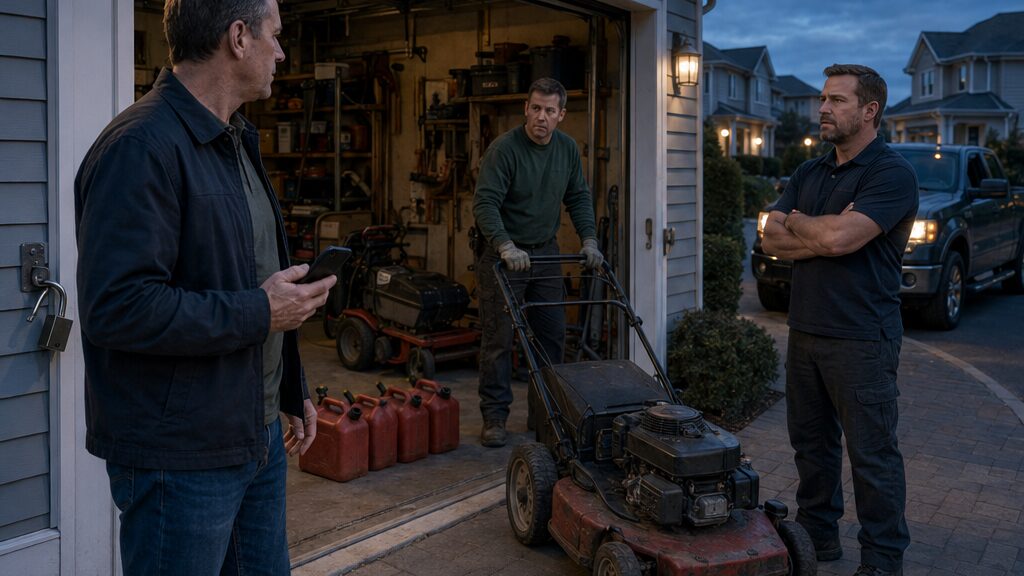
Behind the aerator stood two walk-behind mowers, three backpack blowers, a pressure washer, and the tongue of a black utility trailer angled through the side bay. Dried grass clung to the mower decks. Mud had fallen in half-moons across the concrete floor.
None of it belonged to him.
Joseph looked toward the service lane behind his property. A landscaping truck rolled slowly past the hedge, its amber light blinking. The logo on the door belonged to Gregory Clark’s company—the same company that maintained the common lawns, entrance beds, and clubhouse grounds for the homeowners association.
Joseph stepped inside.
The heavy padlock that normally hung through the latch on the side door was open. It dangled from the hasp like someone had started a job and forgotten to finish it.
“Morning.”
Joseph turned.
One of Gregory’s crew members was coming up the driveway carrying a gas trimmer. He nodded toward the garage as casually as if Joseph were another employee.
“You guys missing something?” Joseph asked.
The worker slowed. “Just dropping this one back.”
“Back where?”
The man looked from Joseph to the open garage.
“In here.”
Joseph waited.
The worker shifted the trimmer to his other hand. “Gregory said this garage was available.”
“My garage?”
The man’s expression changed by half an inch.
“That’s what I was told.”
Joseph looked at the machines again.
“How long have you been putting equipment in here?”
“I don’t know. I’m not the one who handles that.”
“Since when?”
The worker rubbed his thumb along the trimmer handle. “A while.”
Joseph hated that answer more than he expected.
Not because it was rude. It wasn’t. The worker seemed honestly confused that there was a problem.
Joseph pulled out his phone and called Gregory.
The call went to voicemail.
He sent a message instead.
There’s landscaping equipment stored in my garage. I didn’t authorize this. Call me.
The crew member remained beside the driveway.
“Should I leave this out here?” he asked.
“Yes.”
Joseph’s answer came faster than he intended.
The man placed the trimmer beside the trailer, gave Joseph another cautious nod, and walked toward the truck.
Joseph stood in the garage trying to remember the last time he had opened the side bay.
He usually entered from the house. His car occupied the main bay, and the second side had gradually become storage—workbench, ladder, boxes of tile left from a bathroom renovation. He had not needed the side door in weeks.
That fact irritated him almost as much as the equipment.
How could people have been using his garage without him noticing?
Then he remembered the storm.
Three months earlier, a hard line of thunderstorms had torn branches down across the neighborhood. One tree near the pool had split and fallen over the maintenance path. Gregory’s crews had worked until dark clearing limbs and hauling debris.
Gregory had knocked on Joseph’s door that evening.
“Can I tuck two mowers inside your garage overnight?” he had asked. “Trailer tire blew, and I don’t want them sitting out in this mess.”
Joseph had looked at the rain, then at Gregory’s soaked polo.
“Sure. Just tonight.”
The next morning the equipment had been gone.
Joseph had thought nothing more about it.
Until now.
His phone rang.
Gregory.
Joseph answered. “Why is your equipment in my garage?”
There was a pause.
“Morning to you too.”
“Gregory.”
“All right. Yeah. The guys have been keeping some smaller equipment there.”
“Why?”
“Because it’s close to the service lane. It saves them loading and unloading everything every day.”
“That doesn’t answer why it’s in my garage.”
Another pause.
“I thought we had an understanding.”
“We had one night after a storm.”
“It became useful after that.”
Joseph stared at the open padlock.
“Useful to whom?”
“Joseph, come on. It’s not like we’re hurting anything.”
“That garage is part of my property.”
“I know whose garage it is.”
“Then why didn’t you ask?”
Gregory exhaled loudly enough for Joseph to hear it.
“I thought I already had.”
There it was.
Not an apology. Not exactly a denial either.
Just a different version of what had happened.
Joseph looked at the machines, then at the mud tracked across his floor.
“Get it out today.”
“Today’s packed.”
“Then tomorrow.”
“I’ll talk to the crew.”
“That’s not the same as saying you’ll remove it.”
“Joseph, I said I’ll handle it.”
The call ended before Joseph could decide whether the conversation had accomplished anything.
He spent the next hour moving equipment just far enough to get his car out.
He did not touch the trailer.
By eight-thirty, two crews had passed along the service lane. Nobody entered the garage.
At ten, Gregory drove by in his pickup and lifted two fingers from the steering wheel. Joseph was standing near the mailbox. Gregory did not stop.
Joseph almost waved him down.
Almost.
Instead, he told himself Gregory knew the situation now. There was no point creating a scene in front of neighbors.
That was how Joseph handled most disagreements in the subdivision.
Quietly.
Two years earlier he had challenged the HOA over drainage work that sent runoff toward his side yard. He had been correct about the grading plan, but for months afterward he had been “the guy who fought the board” whenever someone mentioned him at a meeting.
He had no interest in becoming that person again.
By evening, one mower was gone.
The aerator remained.
So did both blowers and the trailer.
Joseph locked the side door with his own padlock.
He stood there a moment after clicking it shut.
Then he noticed the small lockbox mounted beneath the eave.
He had installed it years earlier for contractors. A spare side-door key was kept inside.
Joseph opened the box.
The key was there.
That should have reassured him.
Instead, he wondered whether Gregory knew the code.
He went inside and opened the motion-camera app on his phone.
The camera covered the side yard, garage entrance, and part of the service lane. Joseph rarely checked the recordings unless a delivery went missing.
He scrolled backward.
Sunday.
At 5:37 a.m., a worker entered the garage.
Saturday.
5:44 a.m. Two workers rolled a mower out.
Friday.
5:31 a.m.
Thursday.
5:52.
Joseph stopped scrolling.
Then he went back another week.
And another.
Little gray thumbnails filled the screen—men in work shirts, mowers, blowers, the utility trailer, headlights cutting through the darkness before sunrise.
This had not started yesterday.
Joseph kept scrolling until the date reached back beyond the beginning of the month.
He counted thirteen mornings before he stopped.
The garage door in the final thumbnail was open wide.
Gregory himself stood beside it.
Chapter 2: Seventy-Two Hours Should Have Been Enough
Joseph taped the notice to the utility trailer at seven-ten Tuesday morning.
He had rewritten it three times before printing it.
The first version sounded angry.
The second sounded like something prepared for litigation.
The final version contained only what mattered: the equipment was on private property without current permission, authorization for storage was withdrawn, and all company property had to be removed within seventy-two hours.
He signed and dated it.
Then he photographed the notice where it sat beneath the trailer latch.
No threats.
No fee.
No lawyer.
Joseph wanted the problem gone, not enlarged.
At seven-twenty-six, Gregory called.
“You really put a notice on my trailer?”
“Yes.”
“You could’ve called me.”
“I did.”
“I told you I was handling it.”
“There’s still equipment in my garage.”
“You gave me one business day.”
“I gave you yesterday. Now I’m giving you three more.”
Gregory was quiet.
Joseph could hear machinery in the background.
“Why are you making this formal?”
“Because informal is how my garage became your storage room.”
“That’s not fair.”
Joseph almost laughed, but the irritation behind it stopped him.
“What part isn’t fair?”
“You let us use it.”
“For one night.”
“That’s how it started.”
Joseph gripped the phone tighter.
“That sentence is exactly the problem.”
Gregory lowered his voice.
“You know what the association’s paying me. You know I keep costs down for this neighborhood. The crews need somewhere secure to stage equipment.”
“That does not make my garage common property.”
“Nobody said it did.”
“You’re acting like it does.”
“I’m saying we’ve been doing this for months and you never objected.”
Joseph looked through the kitchen window toward the garage.
There was the argument he had feared.
Not that he had given permanent permission.
That he had failed to object soon enough.
“I’m objecting now.”
“And I said I’d take care of it.”
“Within seventy-two hours.”
Gregory muttered something Joseph did not catch.
Then he said, “Fine.”
The line went dead.
Joseph wrote down the time of the call.
The act embarrassed him.
He worked in commercial property administration. He documented disputes for a living. Dates, notices, access rights, lease language—those things were ordinary at work.
At home, writing down a neighbor’s phone call made him feel petty.
He closed the notebook.
By Wednesday afternoon, the aerator disappeared.
One blower remained.
The utility trailer remained.
On Thursday morning, Joseph watched a crew member remove two string trimmers and return with a mower forty minutes later.
He stepped outside.
“Everything is supposed to be leaving,” Joseph said.
The worker stopped halfway down the driveway.
“Gregory told us we could still stage here until Friday.”
“Nothing should be coming back in.”
The worker gave an apologetic shrug.
“I just go where I’m told.”
Joseph believed him.
That was what made the situation harder.
He sent Gregory another message.
Removing one machine and replacing it with another is not removal. Deadline remains Friday at 7:10 a.m.
The reply came twelve minutes later.
You know the HOA has always known about this arrangement.
Joseph read it twice.
Then a third time.
The wording changed the shape of the problem.
If Gregory was claiming the association knew, Joseph needed to understand what “knew” meant.
He emailed Melissa Rivera, the HOA president.
Melissa replied before lunch.
I was under the impression you and Gregory had a private neighbor-to-neighbor arrangement regarding temporary equipment storage. If that has changed, I suggest the two of you resolve it directly.
Joseph called her.
“Who gave you that impression?”
“Gregory mentioned it months ago.”
“What did he say?”
“That you had offered him use of the garage when needed.”
Joseph leaned back in his chair.
“I offered him one night after the storm.”
Melissa hesitated.
“That’s not how I understood it.”
“Did the board approve using my property?”
“I don’t think anyone thought board approval was necessary if you’d volunteered it.”
“I didn’t.”
“Then you need to tell Gregory.”
“I have.”
“Okay.”
“He’s still using it.”
Another pause.
Melissa’s tone became careful.
“Joseph, I don’t want this turning into an HOA issue if it’s fundamentally a misunderstanding between neighbors.”
“He’s the vice president of the HOA.”
“He’s also the landscaping contractor. Those are separate roles.”
“Then why did he tell me the HOA knows about the arrangement?”
“I can’t speak for what he meant.”
Joseph looked at Gregory’s text.
“He made the association part of it.”
“Send me whatever you have,” Melissa said. “I’ll look at it.”
It was more than she had offered at first, but it did not feel like progress.
Joseph forwarded the messages and the seventy-two-hour notice.
Friday morning came.
At 7:05, Joseph walked to the garage.
The trailer was gone.
So were the mowers.
For the first time all week, the concrete floor looked mostly empty.
Joseph felt a brief, almost foolish relief.
Five minutes early.
Fine.
He could live with that.
He took down the notice, folded it, and put it on his workbench.
Then he noticed four red plastic containers lined neatly beneath the shelving unit.
Fuel cans.
They had not been there the night before.
Joseph stared at them.
Each was capped. No visible spill. No obvious emergency.
But somebody had moved them into his garage while removing the equipment.
He checked the camera.
At 6:18 that morning, a crew member rolled the trailer out.
At 6:24, another worker carried in two fuel cans.
Then two more.
Joseph watched the clip twice.
At 7:32, he called Gregory.
No answer.
At 7:41, he sent a photograph.
Your equipment deadline expired at 7:10. Why did your crew put fuel in my garage this morning?
Gregory did not respond until nearly ten.
They needed somewhere secure for the cans. I’ll get them later.
Joseph stared at the message.
Later.
The same word that had carried the entire arrangement from one night to several months.
At 10:06, Joseph opened the lockbox beneath the eave.
The spare key was still inside.
He removed it.
Then he changed the code.
For the first time since the argument began, he stopped wondering whether Gregory had misunderstood him.
The only question left was whether Gregory believed Joseph would actually do anything about it.
Chapter 3: Before Sunrise, They Came Back
At 5:42 Monday morning, Joseph watched a man enter his garage with a key that should no longer have worked.
He was standing in the shadow of his kitchen, phone in hand, looking at the live motion-camera feed.
The side door opened.
A landscaping worker stepped inside.
Another followed him.
Joseph looked toward the lockbox through the dark window.
He had changed the code Friday.
The key in the box had been removed.
Yet the door was open.
Joseph pulled on jeans and shoes and went outside.
The air still held the coolness of night. Truck headlights washed across the service lane behind the hedges. One mower was already halfway out of the garage.
The heavy padlock hung open from the hasp.
Four red fuel cans stood against the wall.
“Stop for a second,” Joseph said.
Both workers froze.
The older one killed the mower engine.
Joseph held up his phone.
“What key did you use?”
The younger worker looked at the other man.
“Gregory gave us one.”
“Where is it?”
The older worker reached into his pocket and produced a brass key.
Joseph recognized it immediately.
Years earlier, when Gregory had helped him repair a fence panel after a windstorm, Joseph had handed him a spare because they were moving tools through the garage.
Joseph had forgotten it existed.
Apparently Gregory had not.
“Give it to me.”
The man hesitated. “You’ll have to talk to Gregory.”
“I am the property owner.”
“I know, but it’s company equipment.”
“The key.”
The worker finally placed it in Joseph’s palm.
Joseph put it in his pocket.
He did not tell the workers to leave.
Instead, he opened the camera on his phone.
First photograph: the commercial mower halfway through the side door.
Second: the aerator that had returned sometime over the weekend.
Third: two backpack blowers.
Fourth: four fuel cans.
Fifth: the utility trailer, parked beyond the service lane.
The younger worker watched him.
“You calling somebody?”
“No.”
Joseph crouched and photographed the serial plate on the mower.
The older worker frowned.
“What are you doing?”
“Making a record.”
“For what?”
Joseph stood.
“For exactly what is using my property and when.”
The workers exchanged a glance.
“You want us to take it?” the younger one asked.
“I have wanted it removed for a week.”
“So we’re taking it.”
“You’re taking out what you need for today. Are you bringing anything back?”
Neither answered.
Joseph looked at them.
“Are you?”
“Gregory told us to keep staging here.”
“That permission ended.”
The older man scratched at his jaw. “He said the HOA needs this location.”
“The HOA doesn’t own this garage.”
A pickup turned into the lane.
Gregory.
He parked beside the trailer and got out before the engine had fully settled.
“What’s going on?”
Joseph held up the brass key.
“You still had a copy.”
Gregory looked at it.
“You gave me that.”
“Years ago.”
“You never asked for it back.”
“I told you to stop using my garage.”
Gregory glanced at his workers.
“Load the mower.”
Joseph stepped aside.
That seemed to surprise Gregory more than resistance would have.
“You’re letting them take it?”
“It belongs to you.”
Gregory watched Joseph photograph the aerator.
“What’s with the pictures?”
“I’m documenting the equipment.”
“You’ve already got cameras.”
“The cameras show access. These show inventory.”
Gregory’s eyes narrowed.
“Inventory?”
Joseph photographed the blowers.
“Correct.”
“For what?”
Joseph lowered the phone.
“I spend most of my working week dealing with commercial occupancy. When someone uses space, there are ways to establish how much space, how long, and for what purpose.”
Gregory stared at him.
Joseph had never discussed his work with him beyond saying he was in property management.
The younger worker lifted one of the blowers and carried it outside.
Gregory stepped closer.
“So now you’re trying to turn your garage into some kind of lease?”
“No.”
“Because we never signed one.”
“I know.”
“Then whatever little calculation you’re thinking about doesn’t mean anything.”
“I haven’t told you what I’m thinking about.”
Gregory’s jaw tightened.
“You don’t need to.”
For the first time since the problem started, Joseph felt the balance of the conversation shift.
Not because Gregory was afraid.
Because Gregory finally understood Joseph was no longer asking him to be considerate.
He was establishing facts.
Gregory pointed toward the service lane.
“This neighborhood has almost twenty acres of common landscaping. Entrance medians. Clubhouse. Retention ponds. Walking paths. My crews need access before residents start driving through.”
“That explains your schedule.”
“It explains why this location matters.”
“No. It explains why it matters to you.”
“It matters to the HOA.”
Joseph slipped the brass key into his pocket.
“Show me where the HOA has the right to use my garage.”
Gregory exhaled.
“You’re being technical.”
“Yes.”
“After months of being fine with it.”
“I wasn’t fine with something I didn’t know was happening.”
“You saw the guys around here.”
“I saw landscapers working in the neighborhood.”
“You knew we staged from this lane.”
“Staging from the lane isn’t storage inside my property.”
Gregory looked toward the workers. One of them had stopped pretending not to listen.
“Finish loading what we need,” Gregory said.
Joseph immediately raised a hand.
“No. Not ‘what we need.’ Everything leaves.”
“We can’t move all of it right now.”
“Why?”
“We don’t have room on the trailer.”
Joseph almost responded sharply.
Instead, he took another photograph.
Gregory stared at the phone.
“You really want to make enemies over a few mowers?”
The words landed harder than Joseph expected.
They carried the old threat without stating it: neighbors remembered trouble.
Board members remembered complaints.
People who lived ten houses apart had long memories.
Joseph thought of the drainage dispute. The looks at meetings. The jokes about him reading every rule.
For a second, the familiar instinct returned.
Ease it down.
Give Gregory the day.
Avoid making this bigger.
Then Joseph looked at the open padlock.
He had issued a written deadline.
Gregory had ignored it.
He had removed the spare key.
Gregory had used another one.
The ambiguity was gone.
“Everything leaves today,” Joseph said.
Gregory’s face changed.
Not dramatically.
Just enough.
“All right,” he said. “Then don’t interfere with the crews while they’re doing HOA work.”
“This is not HOA property.”
“I’m not talking about the garage.”
“You just told me this location was necessary to the HOA.”
Gregory looked away toward the truck.
“We’ll sort it out.”
“No. We’ve been ‘sorting it out’ for a week.”
Gregory took a step toward him.
“What exactly do you want?”
“I want your equipment off my property.”
“That’s it?”
Joseph looked at the machinery, the fuel cans, the open door, the workers who had arrived before sunrise because someone had told them they were entitled to be there.
“For now.”
Gregory heard the last two words.
His expression hardened.
By seven-thirty, two mowers and the blowers were gone. The aerator remained because the trailer could not take it with the other equipment. Gregory promised another truck would come before noon.
Joseph did not argue.
He photographed the remaining machine.
At eight-fifteen he began a spreadsheet.
Date.
Time.
Equipment.
Entry.
Exit.
He went through the camera history one clip at a time.
Five twenty-nine.
Five forty-three.
Six eleven.
Some mornings the garage was open for six minutes.
Other mornings workers stayed twenty or thirty.
He found entries on weekends.
He found Gregory himself carrying a blower inside at 8:17 one evening.
He found the utility trailer parked half inside the garage during a rainstorm.
By late morning, Joseph had documented nineteen separate mornings of access.
His phone buzzed.
An email from the HOA property manager.
Subject: Contractor Access and Community Operations.
Joseph opened it.
The language was polite, formal, and strangely impersonal.
It stated that residents were expected not to obstruct authorized vendors performing association services in designated common areas and service corridors. It reminded homeowners that interference with contractors could affect maintenance obligations and potentially violate association rules.
Joseph read it slowly.
Then again.
Nobody had accused him of blocking a common area.
Nobody had asked him what happened that morning.
Yet somehow, before the aerator had even been removed, an official HOA warning had reached his inbox.
Joseph scrolled to the bottom.
Melissa Rivera was copied.
So was Gregory Clark.
Joseph looked toward the garage.
The aerator was still sitting inside.
Then he looked back at Gregory’s name on the email.
For the first time, the dispute no longer felt like one neighbor taking advantage of another.
Someone had moved it onto official letterhead.
Chapter 4: The Board Never Approved My Garage
“The board never voted on your garage.”
Melissa Rivera said it quietly, as though lowering her voice could make the sentence less important.
Joseph sat across from her in the small HOA clubhouse conference room with the contractor-access warning printed in front of him. Gregory Clark occupied the chair near the end of the table. Two board members sat between them, both studying their copies of the agenda rather than looking at anyone.
Joseph leaned forward.
“Then why did I receive this?”
Melissa looked at the warning.
“The property manager sent it after Gregory reported a contractor-access problem.”
“What access problem?”
Gregory answered before she could.
“My crew was being delayed.”
“On my property.”
“Near the service corridor.”
“In my garage.”
Gregory sighed.
“We’ve done this already.”
“No,” Joseph said. “We’ve argued about whether I ever gave you permission. I’m asking why the HOA sent me an official warning about access to a building the HOA does not own.”
Melissa opened a folder.
“That’s what I’m trying to clarify.”
She had spent the morning going through board minutes, landscaping agreements, archived emails, and property maps.
There was no recorded vote authorizing storage on Joseph’s lot.
No license agreement.
No temporary-use agreement.
No easement covering the garage.
Nothing in the landscaping contract identified Joseph’s property as a staging site.
Gregory folded his arms.
“It wasn’t a board arrangement. It was Joseph’s arrangement with me.”
Joseph looked at him.
“Then why bring the HOA into it when I ended it?”
Gregory’s face tightened.
“I didn’t bring the HOA into anything. I said your actions were interfering with crews doing association work.”
“They were standing inside my garage.”
“They were trying to remove equipment.”
“At five forty-two in the morning with a spare key you never returned.”
One board member looked up.
Melissa turned toward Gregory.
“You had a key?”
Gregory hesitated just long enough to answer the question before he spoke.
“He gave it to me.”
“For a fence repair years ago,” Joseph said. “I had forgotten you still had it.”
Gregory stared at him.
“You never requested it back.”
“I requested that you stop entering the garage.”
Melissa closed the folder.
“All right.”
The room went quiet.
Joseph had attended enough meetings to recognize that particular tone. It meant the issue had just changed categories.
Melissa looked at Gregory.
“From this point forward, nobody from your company enters Joseph’s property unless he gives explicit permission.”
Gregory shifted in his chair.
“The equipment is already being moved.”
“The remaining aerator?”
“Gone yesterday afternoon.”
Joseph knew that. He had watched it leave.
For the first time in weeks, his garage was empty of Gregory’s machinery.
He should have felt satisfied.
Instead, his eyes went back to the warning letter.
“I want that withdrawn.”
Melissa nodded.
“That’s reasonable.”
Gregory looked at her.
“Hold on.”
“The letter assumes contractor-access rights that apparently don’t exist on his lot,” Melissa said. “We cannot leave that uncorrected.”
Gregory shook his head.
“This is getting ridiculous.”
Joseph said nothing.
That irritated Gregory more.
“You let us use the place for months.”
Joseph almost answered immediately.
Then he stopped.
There was truth buried inside the accusation.
Not permission.
But silence.
He had seen Gregory’s crews along the service lane. He had noticed trucks idling near the hedge. Once, weeks earlier, he had heard a mower start behind his garage before dawn and assumed it had been unloaded nearby.
He could have checked.
He could have asked.
He had not.
That did not grant Gregory rights.
But it did explain how Gregory had convinced himself the arrangement was harmless.
Joseph said, “I allowed one night. After that, I didn’t know the full extent of what you were doing. When I found out, I told you to stop.”
Gregory leaned back.
“You make it sound like we broke into Fort Knox.”
“No. I make it sound like you used somebody else’s building for your business.”
Before Gregory could answer, the HOA attorney arrived.
The attorney had been asked to attend only the second half of the meeting. Melissa handed over the folder and summarized the dispute without embellishment.
The attorney listened, flipping through the contractor agreement.
Then one detail stopped the conversation.
“Fuel?”
Joseph looked up.
“What?”
The attorney tapped a copy of Joseph’s photograph.
“These are gasoline containers?”
“Yes.”
“How many?”
“Four.”
“Stored inside the detached garage?”
“Yes.”
“For how long?”
“I don’t know exactly. At least several days.”
The attorney turned to Gregory.
“Were those company containers?”
Gregory’s expression changed.
“Yes.”
The attorney put down the photograph.
“Has anyone checked the association’s insurance requirements for contractor fuel storage?”
Melissa frowned.
“No.”
“Or county requirements?”
“No.”
Gregory leaned forward.
“They were standard five-gallon cans. We’re not talking about drums.”
“I understand,” the attorney said. “I’m not saying there was automatically a violation. I’m saying the moment the association was notified that a contractor was storing fuel on privately owned property while performing association work, this stopped being only a neighbor dispute.”
That sentence settled differently over the table than anything Joseph had said.
The attorney continued.
“If there had been a fire or spill, the first questions would have been who owned the property, who controlled the activity, who knew about it, and under whose contract the company was operating.”
Joseph felt a cold tightness under his ribs.
“Could it come back on me?”
The attorney looked at him carefully.
“Potentially. Facts would matter. Permission would matter. Knowledge would matter. Insurance language would matter.”
Knowledge.
Joseph thought about his own silence again.
Melissa said, “We need an inspection.”
Gregory rubbed his forehead.
“You’re calling the county over four gas cans?”
“We’re verifying exposure,” the attorney said.
Two days later, a county fire inspector walked through Joseph’s garage.
By then the fuel cans were gone.
The inspector photographed the room, measured distances from the water heater, checked ventilation, and asked Joseph when he first learned fuel was being stored there.
Joseph answered with dates.
Not guesses.
The seventy-two-hour notice.
The camera footage.
The morning the cans were carried in.
The inspector did not declare disaster. He did not issue dramatic citations. He simply explained that commercial fuel storage inside a residential accessory structure could create compliance and insurance concerns depending on quantity, container type, location, and use.
That was enough.
The garage had been useful to Gregory because it was free.
It had been invisible to the HOA because nobody had formally described what was happening.
Once described precisely, it stopped looking small.
That evening, Joseph sat at his home-office desk with the padlock key beside his keyboard.
He opened the HOA documents Melissa had sent.
No authorization.
No easement.
No agreement.
Nothing gave Gregory’s company a right to occupy the building.
The vindication should have felt cleaner.
Instead, Joseph kept returning to one question.
If the arrangement had been unauthorized, when had Gregory stopped believing it was a favor and started believing it was an entitlement?
His email chimed.
The message was from the association’s insurance representative.
Please provide all dates of known contractor access, approximate equipment quantities stored on-site, photographs, notices, and any communications concerning permission or withdrawal of permission.
Joseph stared at the request.
Dates.
Equipment quantities.
Access records.
He had all of them.
But the final question on the list was the one that held him still.
Please indicate when you first became aware that the storage was ongoing.
Joseph placed his hand over the padlock key.
For the first time, the paperwork was not asking only what Gregory had done.
It was asking what Joseph had known, and when he had chosen to say nothing.
Chapter 5: What Forty-Seven Days Were Worth
Joseph counted forty-seven days.
Not forty-seven days since the storm.
Not forty-seven days since Gregory first used the garage.
Forty-seven days he could support with actual records.
He had the camera history open on one monitor and a spreadsheet on the other.
Each confirmed date received its own row.
Equipment observed.
Arrival time.
Departure time.
Overnight storage when visible.
Fuel containers.
Trailer.
Mowers.
Aerator.
Blowers.
Joseph ignored days where the footage was unclear. He ignored assumptions. He ignored what crew members might have done beyond the camera’s view.
That was how he handled occupancy disputes at work.
Evidence first.
Argument second.
By ten in the morning, he had a clean log.
Then he opened a second spreadsheet.
Joseph managed commercial leases and occupancy agreements for a regional real-estate firm. His work involved warehouses, small industrial suites, temporary storage, loading access, overflow space, and every awkward situation that arose when businesses used more property than their agreements permitted.
At work, nobody found that interesting until something went wrong.
Gregory had never asked for details.
Most neighbors thought Joseph “worked in real estate.”
That suited him.
Now he searched recent commercial storage rates within driving distance of the subdivision.
He called one facility.
“What would you charge for secure indoor storage of commercial landscaping equipment?”
The manager asked what kind.
Joseph described the approximate footprint.
The figure was higher than he expected.
He called another.
Then a third.
He separated enclosed storage from open-yard parking. He discounted the premium services his garage did not provide. He removed access fees he could not reasonably justify.
By noon, the numbers sat in front of him.
Joseph stared at the total.
It was substantial enough to hurt.
For several seconds he felt something close to satisfaction.
Gregory had treated the garage as though it had no value because Joseph was not charging him.
The spreadsheet proved otherwise.
Joseph printed the calculation.
He did not label it a fine.
He did not add a penalty for irritation, inconvenience, or early-morning access.
He called it what it was: a storage-use claim based on documented commercial occupancy.
The distinction mattered to him.
He drove to one of the facilities whose rate he had used as a comparison.
Rows of contractor trailers sat behind controlled gates. Landscapers, electricians, and maintenance companies rented bays almost identical in usable footprint to his garage.
A facility employee showed him a standard enclosed unit.
Concrete floor.
Locked access.
Dry storage.
Joseph stood inside and thought of his own garage.
Gregory had avoided paying for something businesses normally bought.
That was the point.
When Joseph got home, Benjamin Lewis was trimming a hedge between their driveways.
Benjamin killed the trimmer when he saw the papers under Joseph’s arm.
“You two still fighting?”
“Apparently.”
Benjamin wiped his forehead.
“I saw the landscaping trailer disappear.”
“It’s all out.”
“So you won.”
Joseph looked at the folder.
“Not exactly.”
Benjamin nodded toward it.
“What’s that?”
“A calculation.”
“That sounds dangerous coming from you.”
Joseph gave him a thin smile.
Benjamin had lived next door for six years. He was one of the few people in the subdivision who could tease Joseph about paperwork without making it sound like criticism.
“I figured out what the storage was worth.”
Benjamin stopped smiling.
“You’re billing Gregory?”
“I’m documenting the value.”
“That’s a yes.”
“It’s a commercial company using private enclosed space.”
Benjamin leaned the trimmer against the hedge.
“How much?”
Joseph hesitated, then told him.
Benjamin whistled softly.
“That’s not pocket change.”
“No.”
“Can he pay it?”
“That isn’t the first question.”
“Maybe not for you.”
Joseph looked at him.
Benjamin glanced toward Gregory’s house several doors down.
“You know he’s having trouble, right?”
“What kind of trouble?”
“Business.”
Joseph waited.
Benjamin lowered his voice.
“My brother-in-law asked Gregory for a quote last month. Gregory told him he wasn’t taking private jobs because he was trying to keep his crews fully scheduled under the HOA contract.”
“So?”
“So he underbid that contract.”
Joseph frowned.
“How do you know?”
“Gregory told me.”
“When?”
“Back in spring. He was complaining about fuel, insurance, payroll. Said he priced the HOA job too low because he thought getting the subdivision would lead to homeowner work.”
Joseph thought of the commercial-storage facility.
Benjamin continued.
“He’s not going broke tomorrow. But he’s tighter than he lets on.”
“That doesn’t make my garage his.”
“I didn’t say it did.”
“Then what are you saying?”
Benjamin looked at him evenly.
“I’m saying there’s a difference between getting paid for what someone took from you and enjoying the chance to make them hurt.”
Joseph’s jaw tightened.
“I’m not enjoying it.”
Benjamin glanced at the folder.
“You sure?”
Joseph did not answer.
That bothered him for the rest of the afternoon.
He returned to the spreadsheet.
The calculation was defensible.
That did not mean every defensible number had to become a demand.
He removed a line item for administrative time.
Then another for after-hours access.
He kept only storage value tied to documented occupancy.
The total dropped.
Still significant.
Still real.
At four-thirty, he emailed the claim to Melissa, Gregory, and the HOA attorney.
The message contained three paragraphs.
It explained the methodology.
Attached the access log.
Included comparable commercial rates.
Requested discussion before any formal collection effort.
Joseph hit send.
Then he locked the garage.
The padlock clicked shut.
For the first time, the sound did not feel like anger.
It felt like a line.
An hour later, Gregory called.
Joseph let it ring once before answering.
“You sent me an invoice.”
“A storage claim.”
“You’re charging me for forty-seven days.”
“I’m valuing forty-seven documented days.”
“This is insane.”
“The rates are attached.”
“I don’t care about the rates.”
“You should.”
“We never had a rental agreement.”
“I know.”
“Then you don’t get to invent one after the fact.”
“I’m not inventing a lease.”
“Looks like one.”
Joseph sat at the kitchen table.
“Gregory, businesses pay to store equipment. You used enclosed private space for your business after I told you to stop.”
“And before that?”
“That’s more complicated.”
“Exactly.”
Gregory’s voice sharpened.
“You let it happen. You benefited from us doing the neighborhood work. You knew my crews were back there.”
“I knew crews worked in the neighborhood. I did not authorize continuing storage.”
“You’re splitting hairs.”
“No. I’m finally identifying them.”
Gregory went quiet.
Then, more softly, he said, “You know what this could do to me?”
Joseph looked at the invoice.
“I know what the number is.”
“That isn’t what I asked.”
Joseph had no answer he trusted.
Gregory continued.
“You think I kept equipment there because I enjoyed sneaking into your garage?”
“I don’t know why you did it.”
“No. You don’t.”
“Then tell me.”
Another silence.
“I’m not doing this over the phone.”
Joseph heard the fatigue beneath the anger.
“Fine.”
“Tomorrow evening.”
“Where?”
“Your place.”
Joseph almost suggested the clubhouse instead.
Paperwork liked neutral rooms.
People did not always.
“Six-thirty,” he said.
Gregory agreed.
Before hanging up, he said, “Don’t send anything else to the board until we talk.”
Joseph stared at the blank screen after the call ended.
The request sounded almost like a threat.
But not quite.
There had been something else in Gregory’s voice.
Fear.
Joseph looked through the window toward the empty garage.
For forty-seven days, he had wondered why Gregory thought free storage was worth risking a neighbor’s trust.
Tomorrow, he might finally find out what Gregory believed he had been protecting.
Chapter 6: The Favor Gregory Couldn’t Afford to Lose
Gregory arrived at six twenty-eight and placed a brass key on Joseph’s workbench without saying hello.
Joseph recognized it immediately.
The old spare.
The one Gregory had used to enter the garage after the lockbox code changed.
For a few seconds, neither man spoke.
Then Gregory said, “That’s the last copy.”
Joseph picked it up.
“You sure?”
“Yes.”
He slid it into his pocket.
Gregory looked around the empty garage.
Without the mowers and trailer, the room seemed larger than Joseph remembered.
“You always had this much space?”
Joseph almost laughed.
“That’s what happens when nobody else’s equipment is in it.”
Gregory gave a tired nod.
He wore work pants and a faded company polo instead of the cleaner black shirt he usually wore to board meetings.
Joseph gestured toward the driveway.
They moved outside.
Gregory leaned against his pickup.
“You want the truth?”
“Yes.”
“I thought I could make the HOA contract work.”
Joseph waited.
Gregory looked down the street.
“When the old landscaper raised their price, everybody on the board complained. Dues had already gone up. People were angry. I said my company could do it cheaper.”
“How much cheaper?”
“Too much.”
Joseph understood immediately.
“You underbid.”
Gregory nodded.
“I thought I’d make it up with private work in the neighborhood. Fertilizer, tree trimming, irrigation repairs. Once people saw us out here, we’d pick up side jobs.”
“But you didn’t.”
“Not enough.”
A car passed, and both men paused until it turned the corner.
Gregory continued.
“My storage yard is twelve miles away. Every morning I was paying crews to drive there, load, come here, unload, then reverse it at night.”
“So my garage saved you labor.”
“And fuel. And yard space.”
Joseph folded his arms.
“That sounds exactly like commercial value.”
“I know.”
The admission caught him off guard.
Gregory looked at the driveway.
“I know now.”
“Now?”
Gregory rubbed the back of his neck.
“At first it really was the storm. Then one of the guys asked if they could leave two machines another night. I said yes because I figured you wouldn’t care.”
“You never asked.”
“I know.”
“Then it became every week.”
“Yeah.”
“And when I gave you the seventy-two-hour notice?”
Gregory said nothing.
Joseph watched him.
“That’s the part I need you to answer.”
Gregory’s face tightened.
“I knew.”
“Knew what?”
“That you were done with it.”
The words were quiet.
Joseph felt something in him settle.
Not triumph.
Certainty.
Gregory continued before Joseph could respond.
“I was mad. I thought you were suddenly acting like I’d been stealing from you after months of helping the neighborhood. I figured if I gave it a few days, you’d cool off.”
“So you ignored it.”
“Yes.”
“And told your crew to keep staging here.”
“Yes.”
“And when I changed the lockbox code, you gave them the old key.”
Gregory looked at him.
“Yes.”
Joseph turned away.
For weeks, he had argued against ambiguity.
Now Gregory had removed it himself.
The favor had become a conscious violation.
That should have made the invoice easier to enforce.
Instead, Joseph felt tired.
Gregory said, “I’m not asking you to pretend I handled it right.”
“What are you asking?”
“To not put me under over this.”
Joseph faced him.
“You used my property to keep your costs down.”
“I did.”
“After I told you to stop.”
“Yes.”
“So what would you call fair?”
Gregory looked toward his truck.
“I can pay something.”
“How much?”
“Not your number.”
“That isn’t an answer.”
“I’ve got payroll Friday.”
Joseph said nothing.
Gregory’s voice hardened slightly, less from anger than embarrassment.
“I have six employees. Two have kids. One just moved into a full-time position because I told him this HOA contract was stable. If I write you a check for that amount tomorrow, I’m using payroll money.”
“You’re telling me your company has no reserve?”
“I’m telling you margins are thin.”
“You’re vice president of the HOA and owner of its contractor.”
“I recuse myself from contract votes.”
“That does not erase the appearance.”
“I know.”
Again, that answer.
Not defiance.
Recognition arriving late.
Joseph leaned against the workbench.
“I spent years thinking staying quiet was the same as being reasonable.”
Gregory frowned.
“What?”
“I should have asked questions the first time I saw your crews near this garage. I should have made the storm favor explicit in writing.”
“So this is partly on you?”
Joseph looked at him.
“Do not mistake that for me excusing what you did after the notice.”
“I’m not.”
“I created room for misunderstanding. You chose to keep using that room after there wasn’t any misunderstanding left.”
Gregory nodded once.
“That’s fair.”
The next evening, Melissa called Joseph before a scheduled HOA meeting.
“I’ve seen the claim,” she said.
“And?”
“The attorney says parts of it are arguable.”
“I expected that.”
“The insurance carrier is also asking whether the association contributed to the situation by treating Gregory’s company as if it had access rights.”
Joseph sat at his dining table.
“Did it?”
Melissa sighed.
“I sent you the contractor-access warning without verifying where the access occurred. That was a mistake.”
Joseph had not expected her to say it so plainly.
She continued.
“But I need you to understand something. If Gregory has to absorb the full demand immediately, he may walk away from the contract.”
“That’s his decision.”
“It becomes everyone’s problem if we have to replace him mid-season.”
“So homeowners should subsidize unauthorized storage?”
“No.”
“Then what are you asking me?”
“I’m asking whether your goal is reimbursement or punishment.”
Joseph disliked the question because Benjamin had asked essentially the same thing.
“I’m not seeking punishment.”
“Then give us room to separate the legitimate value from the anger.”
After the call, Joseph went to the clubhouse.
Gregory was already there.
Melissa sat at the head of the table with the HOA attorney. The other board members had not yet arrived.
Joseph placed a one-page proposal in front of them.
Gregory read it first.
His eyes moved slowly.
Joseph had reduced the demand to documented commercial storage value only. No punitive surcharge. No administrative fee. No speculative damages.
Payment could be divided.
The HOA could contribute if its insurer accepted responsibility for prolonging the dispute after Joseph’s notice.
In return, Gregory’s company would remove all remaining access devices, acknowledge that the storm permission had been temporary, acknowledge that use continued after written permission was withdrawn, and agree never to enter private homeowner property for contractor operations without written consent.
Gregory looked up.
“You want me to sign that I was wrong.”
“I want the record to say what happened.”
“Same thing.”
“No.”
Joseph tapped the proposal.
“It says I gave you temporary permission. It also says I failed to object earlier because I didn’t understand how often the garage was being used. I’m not writing myself out of the story.”
Gregory read the paragraph again.
Melissa did too.
Joseph continued.
“But it also says the ambiguity ended when I gave you the seventy-two-hour notice. After that, you kept using the garage knowingly.”
Gregory’s jaw tightened.
The attorney said nothing.
Finally Gregory asked, “If I sign this, you’ll accept the reduced claim?”
“If the board and insurer agree to the payment structure.”
“And you won’t try to get my landscaping contract canceled?”
Joseph looked at him.
“That was never one of my conditions.”
Gregory seemed surprised.
“I assumed—”
“That’s been the problem from the beginning,” Joseph said. “Everybody keeps assuming.”
The words sat between them.
Melissa folded her hands.
“There’s another issue. Gregory’s position as vice president.”
Gregory looked toward her.
“What about it?”
“We need a firewall between governance and contractor operations. Whatever happens with the storage claim, the board cannot have another situation where a contractor complaint and board authority blur together.”
Gregory’s face went still.
Joseph realized the settlement might cost him something the invoice never could.
Status.
Gregory picked up the proposal.
“I need until tomorrow.”
Joseph shook his head.
“No.”
Gregory looked up sharply.
“You gave yourself days to calculate this.”
“I gave you months of silence, then seventy-two hours, then another week of argument. I’m done leaving boundaries vague.”
Melissa watched him.
Joseph pushed a pen across the table.
“I’m not asking you to sign tonight. I’m asking you to decide tonight whether these are the terms we negotiate from.”
Gregory stared at the pen.
Then at Joseph.
For once, Joseph did not fill the silence with another explanation.
He let the boundary stand where he had put it.
Chapter 7: The Lock Meant Something Different Now
Gregory stood before the HOA board and said, “Before we vote on anything involving my company, I’m stepping out of my role as vice president for this matter.”
No one spoke for a moment.
Joseph sat along the wall with the same folder he had carried through every meeting, but the room felt different now. Two weeks earlier, Gregory had used his board position and his contractor role almost interchangeably. Tonight, he had separated them before anyone asked.
Melissa Rivera nodded.
“That will be reflected in the minutes.”
Gregory moved from the board table to an empty chair near the back.
It was a small physical shift.
It changed the room anyway.
The HOA attorney distributed the final settlement draft. The insurance representative had agreed that the association bore part of the responsibility because its contractor-access warning had extended the dispute after Joseph had clearly withdrawn permission. The carrier would contribute to a negotiated storage reimbursement rather than contest every day and every machine.
Gregory’s company would pay the remaining portion in installments.
Joseph would release the broader claim.
The board would adopt a new contractor-access policy.
No private garage, driveway, side yard, shed, fenced lot, or other homeowner-controlled property could be used for staging, storage, access, or equipment parking without written permission from the owner.
Joseph read the language once more.
It was not dramatic.
That was precisely why he trusted it.
One of the board members looked toward him.
“Are you satisfied with the revised amount?”
Joseph glanced at the calculation attached to the settlement.
The number was lower than his original claim.
It did not include administrative time.
It did not include an after-hours premium.
It did not try to punish Gregory for the old key, the ignored deadline, or the HOA warning.
It covered documented commercial occupation.
Nothing more.
“Yes,” Joseph said.
Gregory looked at him from across the room.
The board member frowned slightly.
“You’re giving up a considerable portion.”
“I’m giving up amounts I could argue about.”
“Why?”
Joseph rested his hand on the folder.
“Because I don’t need the settlement to prove I’m angry.”
The room went still.
He had not planned to say that.
Melissa watched him.
Joseph continued.
“I needed the equipment out. I needed the record corrected. I needed the association to acknowledge that private property doesn’t become available because a contractor finds it convenient.”
He looked toward Gregory.
“And I needed the use after my written notice treated differently from whatever ambiguity existed before it.”
Gregory gave one slow nod.
That mattered more to Joseph than he expected.
The attorney pointed to the acknowledgment section.
Gregory had already signed it.
The document stated that Joseph had allowed temporary storage after the storm.
It also stated that no continuing written agreement existed.
Most importantly, it stated that Gregory understood permission had been withdrawn when he received Joseph’s seventy-two-hour notice and that his company continued to access and use the garage afterward.
There was no excuse hidden in the language.
No statement that Joseph had misunderstood.
No claim that the HOA had authorized the garage.
Gregory had signed his name beneath all of it.
The vote on the settlement passed without celebration.
Then came the contractor policy.
Melissa read the new rule aloud.
Gregory did not vote.
When it passed, one of the board members asked whether Gregory could continue serving as vice president while his company held the landscaping contract.
Melissa looked toward him.
Gregory answered for himself.
“I’ve been thinking about that.”
Joseph saw his hands tighten together.
“I don’t think I should.”
The board member leaned forward.
“You’re resigning?”
“As vice president.”
Gregory looked briefly toward Joseph, then back at the table.
“My company will still honor the landscaping contract if the board wants us to. But the overlap created a problem. Even if I thought I was acting as a contractor, Joseph got an HOA warning with my name copied on it.”
Melissa said, “You understand resignation isn’t required under the settlement.”
“I know.”
“Then why do it?”
Gregory took a breath.
“Because it should’ve been clearer where one role ended and the other started.”
Joseph lowered his eyes to the folder.
He recognized the sentence.
Not the wording.
The lesson.
For weeks, Joseph had wanted Gregory to admit that familiarity was not permission.
Now Gregory was acknowledging another kind of boundary.
A professional one.
The board accepted his resignation.
There was no applause.
No public humiliation.
Nobody demanded a speech.
The meeting continued to ordinary business—irrigation repairs, pool maintenance, a damaged streetlight near the entrance.
Joseph found the normality strangely comforting.
When the meeting ended, Gregory waited near the clubhouse door.
Joseph expected him to leave first.
Instead, Gregory said, “You got what you wanted.”
The old irritation was still there, but muted.
Joseph adjusted the folder under his arm.
“Most of it.”
Gregory raised an eyebrow.
“What didn’t you get?”
“Forty-seven days back.”
Gregory almost smiled.
“Neither did I.”
They walked toward the parking lot.
Gregory stopped beside his truck.
“The first installment goes out Friday.”
“I saw the schedule.”
“My accountant hates you.”
“I can live with that.”
Gregory gave a short laugh, then became serious again.
“I still think your original number was brutal.”
“It was based on real rates.”
“I know.”
“That doesn’t mean I needed every dollar of it.”
Gregory looked at him.
“That surprised me.”
Joseph unlocked his car but did not open the door.
“It surprised me too.”
Gregory leaned against his truck.
“I thought you were trying to make an example out of me.”
“For a while, maybe I was.”
The admission came more easily than Joseph expected.
Gregory studied him.
Joseph continued.
“When I found that old key in your crew member’s hand, I wanted the invoice to hurt.”
Gregory looked down.
“Fair.”
“No. Understandable maybe. Not necessarily fair.”
The parking lot lights clicked on.
Joseph said, “Benjamin asked me whether I wanted reimbursement or punishment. I didn’t like the question.”
“Because you knew the answer?”
“Because I wasn’t sure.”
Gregory nodded.
“You know what I didn’t like?”
“What?”
“When you said the ambiguity ended with the notice.”
Joseph waited.
Gregory rubbed a thumb along the edge of his truck key.
“Because I knew you were right.”
That was the cleanest apology Gregory had given him.
It was also the one Joseph believed.
Three days later, Joseph installed a new padlock on the garage.
The old one still worked.
He replaced it anyway.
He wanted one lock, one key, one clear rule.
Benjamin wandered over while Joseph tightened the hasp.
“New security system?”
“New lock.”
“Looks exactly like the old one.”
“It’s not.”
Benjamin nodded solemnly.
“Very philosophical.”
Joseph ignored him.
He tested the key.
The shackle opened smoothly.
Benjamin looked inside the empty garage.
“So what are you going to do with all this space?”
“Park my car.”
“Wild.”
Joseph smiled.
For months, the garage had been filled with other people’s priorities.
Now it held his ladder, his workbench, two shelves of paint, and nothing that required explanation.
The motion camera still faced the side door.
Joseph had considered taking it down.
Instead, he changed its notification settings.
No more alerts for every movement along the service lane.
Only entries onto his property.
He did not want to spend the rest of his life watching for the next boundary violation.
That would have been another way of letting the dispute occupy the garage.
The landscaping company continued servicing the neighborhood.
The first week after the settlement, crews arrived from Gregory’s commercial yard in two trailers instead of staging near Joseph’s property.
They started a little later.
The common areas still got cut.
The entrance beds still got edged.
Nothing collapsed because Joseph’s garage was no longer available.
That fact satisfied him more than the payment schedule.
A month later, Gregory was working near the retention pond when Joseph passed him on an evening walk.
They nodded.
That was all.
Another week passed before Gregory stopped at Joseph’s driveway.
Joseph was standing at the workbench with the garage door open.
Gregory remained outside.
He did not cross the threshold.
That small restraint was so obvious Joseph almost laughed.
“You planning to stand there all day?” he asked.
“I’ve learned to wait for permission.”
Joseph looked at him.
Gregory held up two paper coffee cups.
“Peace offering.”
Joseph stepped outside.
Gregory handed him one.
They stood on opposite sides of the narrow strip where Joseph’s driveway met the service lane.
For a while, neither spoke.
Then Gregory glanced toward the new padlock hanging from the latch.
“Only one key?”
“One.”
“Probably smart.”
Joseph took a sip.
“You ever find storage?”
“Industrial place off the highway.”
“How much?”
Gregory told him.
Joseph raised an eyebrow.
“That’s almost exactly the rate I used.”
“I know.”
“You checked.”
“The day after you sent the invoice.”
Joseph smiled into the coffee.
Gregory shook his head.
“That was the worst part.”
“The bill?”
“Realizing you hadn’t made the number up.”
Joseph laughed.
Gregory did too.
The sound did not erase what had happened.
Joseph did not want it to.
Repair was not the same as pretending there had been no damage.
Gregory looked toward the garage.
“I should’ve asked again after the storm.”
“Yes.”
“And after you gave me the notice, I should’ve stopped.”
“Yes.”
Gregory frowned.
“You could make this less painful.”
Joseph looked at him.
“I should’ve said something sooner too.”
Gregory’s expression shifted.
Joseph continued before pride could stop him.
“I saw enough that I should’ve asked what was happening. I didn’t because I didn’t want another neighborhood fight.”
“That part I didn’t know.”
“I thought staying quiet made me reasonable.”
Gregory looked down at his cup.
“Sometimes it just makes people think you’re okay with things.”
“I know.”
There was no need to argue over which mistake was larger.
They both knew where the line had finally become unmistakable.
The written notice.
Everything before it contained assumptions.
Everything after it contained choices.
Gregory finished his coffee.
“I should get going.”
Joseph nodded.
Gregory walked toward the service lane, then stopped.
“For what it’s worth, the new policy is annoying.”
Joseph smiled.
“Good.”
Gregory pointed at him.
“There he is.”
He continued toward his truck.
Joseph went back into the garage.
He placed the empty coffee cup on the workbench and looked at the padlock.
Months earlier, that same kind of lock had hung open while strangers rolled commercial equipment through his property.
Later, closing it had felt like retaliation.
Now it was simply a boundary.
Joseph pulled the garage door down, stepped outside, and fitted the padlock through the latch.
The metal clicked.
Gregory was still beside his truck across the service lane.
Joseph reached into the garage refrigerator through the side door before locking it and took out the second coffee he had bought that morning.
He held it up.
Gregory looked confused.
“Thought yours was empty.”
“It is.”
Joseph walked to the edge of his driveway and handed him the cup.
Gregory took it.
Neither man crossed the property line.
Neither needed to.
Joseph returned to the garage, closed the side door, and put the only key in his pocket.
The story has ended.