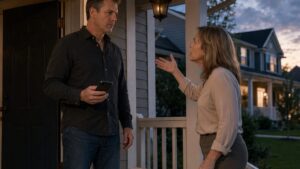
When the HOA Challenged His Old Fence, the Survey Line Led Straight Through Their Playground
Chapter 1: The Survey Flags Did Not Stop at His Fence
The excavator bucket was already under the first fence post when Jack Hall saw the orange survey flag on the other side of it.
He raised one hand.
“Hold it.”
The operator either didn’t hear him or had been told not to. The hydraulic arm lifted. Old cedar groaned, dirt broke loose around the post, and a section of fence Jack had repaired with his father twenty-three years earlier tilted toward the machine.
Jack stepped no closer. At sixty-nine, he knew the difference between anger and stupidity.
Instead, he pulled his phone from his jacket pocket and started recording.
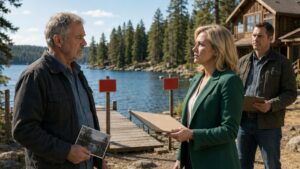
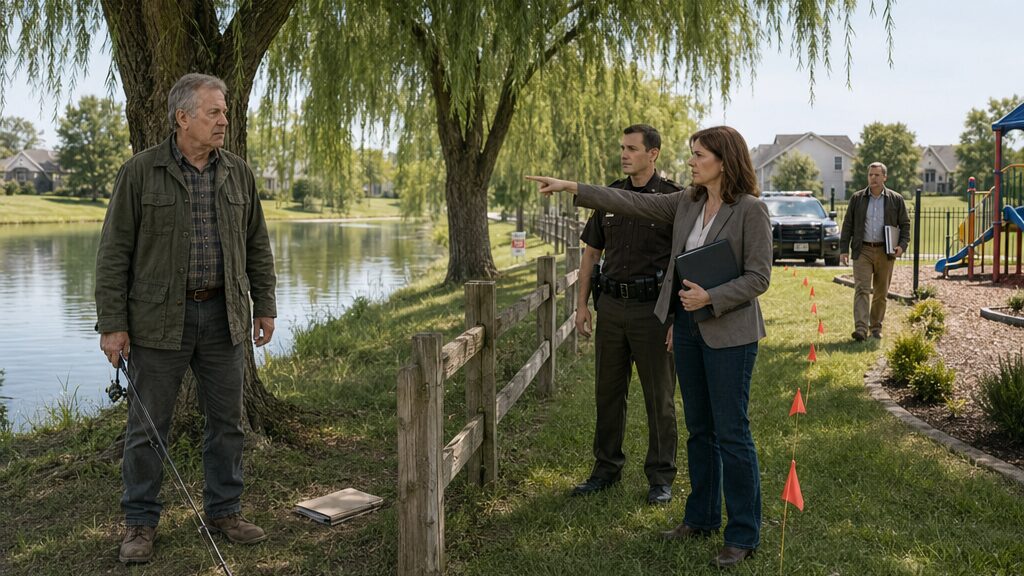
Beyond the machine, three willow trees stood along the pond’s eastern edge, their early spring branches hanging pale and bare over the water. Jack’s grandfather had planted them before Jack was old enough to remember their trunks being thinner than his wrists.
Now bright survey flags ran past them.
Not along the fence.
Past it.
Jack lowered the phone slightly and followed the flags with his eyes.
One stood six feet east of the fence. Another was farther out in the grass. The third was planted in the neatly mulched border beside the HOA playground.
That made him forget the excavator for a moment.
Laura Scott was approaching from the paved pedestrian path with a clipboard tucked under her arm. She wore the expression Jack had come to recognize over the last several months: brisk, prepared, already halfway through the next thing.
“You need to stop this work,” Jack said.
Laura glanced at his phone. “The contractor is correcting an encroachment.”
“You’re removing my fence.”
“We gave you written notice twice.”
“You gave me paper saying you thought the fence was wrong.”
“The board’s map is clear.”
Jack pointed toward the playground.
“Then why is your survey flag over there?”
Laura stopped.
The operator finally cut the engine. The sudden absence of diesel noise made the pond seem unnaturally quiet.
Jack walked along his side of the disturbed fence, not crossing into the work area. He kept the phone recording. The flags formed a loose diagonal through the grass, bypassing the cedar fence as though it were irrelevant.
Laura followed his gesture.
For the first time that morning, the certainty in her face changed.
Only slightly.
“That isn’t necessarily the final boundary,” she said.
“It’s your survey crew.”
“It’s a preliminary layout.”
One of the surveyors looked down at his equipment and wisely said nothing.
Jack almost smiled.
He had spent six months being told he was the one who did not understand lines.
It had started with a white envelope tucked into his mailbox.
The association had recently elected Laura president, and soon after that the notices had begun appearing throughout the neighborhood—trash containers visible from the street, faded mailbox paint, basketball hoops, shrubs extending over sidewalks. None of that had concerned Jack. His 4.2 acres had existed before the subdivision, and his house was not part of the association.
Then Laura’s attention had reached the eastern edge of his property.
The first letter said the cedar fence appeared to intrude into HOA common area.
Jack had read it at his kitchen counter, snorted once, and put it beside the grocery circulars.
The second letter was firmer.
It referred to “unauthorized private use” near the pond and requested that he contact the board.
He had not.
That had been his mistake, though he did not yet know how expensive a mistake it might become.
Jack looked again at the orange flags.
His grandfather had never called the fence a boundary. He had called the willows the edge.
Jack remembered that now with uncomfortable clarity.
When Jack was a boy, his grandfather would point with the handle of a shovel and say, “Keep east of the trees when you mow. That side isn’t ours to fuss with.”
Except the subdivision had not existed then. There had been pasture, scrub, and a dirt track.
The cedar fence had come much later.
Jack had always treated the two as nearly the same thing.
Nearly, he was beginning to understand, could cause trouble.
Laura stepped toward the survey crew. “Pause removal until we confirm these offsets.”
The excavator operator climbed down and leaned against the machine.
Jack said, “You were willing to pull the fence before confirming them.”
Laura turned.
“We relied on the association property plan.”
“And now?”
“Now we verify.”
Jack looked toward the playground. A child’s red plastic shovel lay abandoned near the sandbox. One orange flag stood beyond the mulched bed, close enough to the play area that nobody could pretend the discrepancy was a few inches.
Laura noticed him looking.
“The HOA has maintained that area for decades,” she said.
“That doesn’t tell me who owns it.”
“It matters.”
“Maybe.”
The word irritated her more than an argument would have.
She opened her clipboard and removed a sheet.
“You’ve been using the pond edge beyond the recognized HOA boundary.”
“I’ve been using my pond.”
“That is what’s disputed.”
“Since when?”
“Since the association began reviewing its common-property records.”
Jack laughed once, but there was no humor in it.
“I’ve sat under those willows every Saturday morning since before half those houses were built.”
“Length of use does not establish ownership.”
That landed because Jack knew she was right about the principle, even if he believed she was wrong about the land.
He stopped recording.
For years, the property had required no defense. He cut the grass. Cleared storm branches. Repaired the fence. In summer he trimmed weeds around the pond. On Saturday mornings, barring rain or ice, he brought a metal cup of coffee and an old fishing rod down to the water.
Nobody had ever asked him to prove why.
That history felt enormous to him.
To a survey instrument, it meant nothing.
Laura held out the paper.
Jack did not take it immediately.
“What is it?”
“Notice that until the boundary determination is complete, the association considers use beyond your fence unauthorized.”
He stared at her.
“You’re telling me not to walk beside my own pond.”
“I’m telling you the board’s position.”
“Those flags just crossed your playground.”
“They crossed landscaping adjacent to it.”
“Convenient distinction.”
Her mouth tightened.
“Mr. Hall, I’m trying to resolve years of sloppy records. The board has liability responsibilities. We can’t ignore an apparent encroachment because something has been done a certain way for a long time.”
Jack finally took the notice.
That answer was more reasonable than he wanted it to be.
It also made him angrier.
Because Laura was not backing away.
She had seen the same flags he had, and instead of admitting the HOA might have claimed too much, she had changed the argument from certainty to procedure.
Behind her, the surveyor moved one of his poles and checked another reading.
Jack looked from the instrument to the middle willow, then farther east to the playground.
The fence suddenly seemed less important.
For months the HOA had been asking whether Jack’s fence stood too far onto their property.
The orange flags suggested a different question.
What if his fence had been standing too far inside his own?
Laura tapped the notice with one finger.
“Until this is resolved, I strongly suggest you stay on your side of the recognized line.”
Jack looked at the cedar post hanging crooked from the excavator bucket.
Then at the survey flag beside the playground.
“I think,” he said quietly, “we’re about to find out whose recognized line that actually is.”
Chapter 2: Forty Years Beside the Same Three Willows
Jack found the deed folder exactly where his father had told him never to lose it.
Top shelf of the hall closet.
Behind a tin box of tax receipts.
Wrapped in a grocery bag that had yellowed at the folds.
For years Jack had remembered the instruction more clearly than the documents themselves.
Now he carried the folder to the kitchen table and stared at it as if it belonged to somebody else.
The HOA notice lay beside it.
He opened the folder.
Property tax statements came first, then an old mortgage release, then photocopies of plats he had not looked at in decades. The oldest paper smelled faintly of dust and cardboard.
His father had handled these things.
Before him, his grandfather had.
Jack had handled trees, fences, pumps, shingles, drainage ditches, and anything that could be repaired with tools.
Paperwork had always seemed like what people kept because they did not trust the ground beneath their own feet.
That opinion felt less impressive now.
He unfolded the old plat.
The parcel outline was unmistakable: 4.2 acres, irregular along the eastern side, wider around the pond than the current cedar fence suggested.
Jack leaned closer.
He fetched reading glasses from the counter and traced the line with one finger.
The fence was not drawn.
The pond was.
And near its eastern edge, three hand-marked circles appeared beside a faint note in his father’s handwriting.
Willows.
Jack sat back.
Memory came not as a sentimental picture but as a command.
Keep east of the trees when you mow.
He had been thirteen or fourteen, pushing an old mower that stalled whenever the grass got too thick. His grandfather had walked ahead carrying a shovel.
At the time the land east of the willows had been rough and mostly useless. Years later, when developers bought the adjoining acreage, survey stakes appeared. Roads followed. Then houses. Then the playground. Then the paved walking connection between two sections of the subdivision.
The fence came after most of that.
Jack remembered helping his father set the posts.
“Give ourselves room,” his father had said. “No reason to build right on a line.”
Jack closed his eyes.
There it was.
A fact he should have remembered before telling Laura the fence proved anything.
The fence had never been the boundary.
It had been convenience.
He got up and walked down to the pond with the plat folded in his coat pocket.
The excavator was gone. The damaged post had been left leaning against the fence. Orange flags remained in the grass, bright against the dull green of early spring.
Jack stood beside the first willow.
Its trunk had grown wide enough that he could not have wrapped both arms around it.
He stepped east.
The nearest survey flag stood well beyond the fence.
Then another.
And another.
The alignment made more sense now.
The old plat put the property edge beyond the cedar fence, closer to where his grandfather had treated the line.
Jack felt a brief surge of satisfaction.
Then it faded.
Laura had been wrong to send a machine before the survey was settled.
But she had been right about one thing.
The fence proved nothing.
Neither did forty years of fishing.
He returned to the house and spread the documents across the kitchen table.
Near noon, he found a notation in the deed description.
Subject to easements and restrictions of record.
That by itself meant little. Most land carried something—utility rights, drainage, access.
Jack searched deeper into the folder.
A later photocopy contained a parcel reference and an instrument number written in the margin.
He remembered seeing people use the path for years. Parents pushing strollers. Teenagers on bicycles. Older couples walking in the evenings. The route ran from one neighborhood section to another along the eastern side of his acreage before turning away toward the subdivision.
Jack had never thought much about why it was permitted.
His father had.
Some arrangement with the developer, Jack vaguely recalled.
“People need a way through.”
That was the phrase his father had used.
Jack could hear it now.
He had been in his twenties and uninterested in property instruments. The developer wanted some kind of access. His father had dealt with it.
Jack had assumed whatever was signed concerned the path and nothing more.
Now that assumption mattered.
His phone rang.
Laura.
He watched it ring twice before answering.
“Hall.”
“Mr. Hall, the survey company is preparing its preliminary report.”
“And?”
“There are discrepancies.”
Jack looked at the old plat.
“I noticed.”
“The board is reviewing them.”
“Does that mean you’re withdrawing the notice?”
“No.”
He exhaled through his nose.
“Then what exactly are you calling about?”
“To ask again that you attend a meeting before this becomes more complicated.”
The invitation irritated him because he heard an accusation inside it.
“You sent me two letters and an excavator.”
“The contractor should not have begun removal before final confirmation. I’ve already addressed that.”
“With me?”
“With the contractor.”
“That wasn’t my question.”
Silence.
Then Laura said, “The fence issue is only part of this.”
Jack’s eyes moved to the instrument number.
“What’s the other part?”
“The association has long treated the pond-side corridor as common-access property.”
“Common access or common property?”
Another pause.
“They are related.”
“They’re not the same words.”
Her voice became more careful.
“The board has records supporting its position.”
“What records?”
“I’d rather review them in a formal meeting.”
Jack looked through the kitchen window toward the willows.
A month earlier he would have refused automatically.
He almost did again.
Meetings meant binders and people repeating themselves until everybody was tired enough to call it agreement.
But the instrument number on the paper stopped him.
“I’ll let you know,” he said.
“That’s what you said after the first notice.”
Jack stiffened.
“And you decided silence meant you were right.”
“I decided the board still had responsibilities.”
When the call ended, Jack remained at the table.
He disliked Laura’s certainty.
He disliked something else more: the possibility that his own refusal to engage had helped harden that certainty into official action.
He picked up the oldest plat again.
A narrow notation ran along the eastern portion of the parcel. The reproduction was too faint to read fully, but one phrase remained visible.
Access easement.
Jack rubbed his thumb over the page, though the words were only ink.
His father had never given the HOA the pond. Jack was sure of that.
But “sure” had become a dangerous word.
At the bottom of the notation was the same instrument number he had found elsewhere.
Whatever rights the subdivision possessed had been written down decades ago.
And Jack had spent decades never bothering to read them.
Chapter 3: The Trespass Call That Changed the Argument
The first sheriff’s cruiser stopped at Jack’s gate while his fishing line was still in the water.
The second pulled in behind it.
Jack set his metal coffee cup on the ground and stood, rod in hand, watching two deputies step out.
Laura Scott got out of a separate car near the playground entrance.
That told him enough.
He reeled in slowly.
The older deputy met him near the gate.
“Mr. Hall?”
“That’s me.”
“We received a complaint about a property dispute.”
Laura was already walking toward them with a document folder pressed against her side.
“It isn’t simply a dispute,” she said. “He has continued occupying HOA property after written notice.”
Jack looked at her.
“Occupying?”
“The pond corridor and common-access area.”
The younger deputy glanced from Laura to Jack.
“Ma’am, let us get the basics first.”
Laura stopped talking, though not comfortably.
Jack laid his fishing rod against the fence.
The orange survey flags were still visible beyond it, extending toward the playground landscaping.
The older deputy asked, “Do you have ownership documents?”
“In the house.”
“Could you get them?”
A week earlier Jack might have answered, You can look it up yourself.
That instinct rose now.
He swallowed it.
“Give me a minute.”
He returned carrying the deed folder, the old plat, and the preliminary survey sheet delivered two days earlier.
Laura watched him place them on the hood of the cruiser.
“This,” she said, opening her own folder, “is the association property plan.”
Jack recognized the colored map from her notices.
The older deputy studied both sets.
“Neither of us is a surveyor,” he said. “We’re not deciding title out here.”
“I understand,” Laura replied, “but he has been notified that he is entering HOA property.”
Jack pointed toward the pond.
“I walked thirty yards from my house to water my grandfather dug.”
Laura said, “History isn’t the issue.”
“No. The line is.”
He tapped the survey sheet.
The deputy looked at the bright flags.
“Are those related to this survey?”
“Yes,” Jack said.
Laura answered at the same time. “Preliminary markers.”
The deputy looked at her.
“Do they represent a possible parcel boundary?”
“They represent field measurements that still require interpretation.”
Jack almost interrupted.
Then he remembered why they were here.
Not to win an argument.
To establish what could actually be proved.
The deputies spent the next several minutes comparing parcel numbers, map references, and the county information available through their system. Jack answered questions. When he did not know something, he said so.
That surprised Laura more than anything.
At one point the younger deputy walked with Jack toward the middle willow.
The survey flag stood several yards beyond the cedar fence.
“Your fence is back there,” the deputy said.
“My father built it inside the line, apparently.”
“You always know that?”
Jack hesitated.
“No.”
It cost him something to admit it.
“My grandfather treated the willows as the edge. I forgot the fence was built later for convenience.”
The deputy nodded toward the playground.
“And the flags keep going.”
“Yes.”
Behind them Laura was speaking quietly to the other deputy.
Jack caught only fragments.
Maintenance.
Common area.
Liability.
Thirty years.
They returned.
The older deputy held Laura’s site plan in one hand and Jack’s survey in the other.
“Ms. Scott, do you have a deed showing this strip was conveyed to the association?”
Laura opened her folder.
“We have the recorded development plan and long-standing maintenance records.”
“That wasn’t my question.”
Her jaw tightened.
“The association has rights over the corridor.”
“What kind of rights?”
“Access and common use.”
“Ownership?”
Laura looked down at the papers.
“The association has treated it as common property since before I joined the board.”
The deputy waited.
Jack could see the moment the question changed.
Until then Laura had spoken as though “HOA property” was a fact everyone else needed to catch up with.
Now she was being asked for the document that made it a fact.
She pulled out another page.
“There is an easement.”
Jack’s attention sharpened.
The word from his own deed folder.
The older deputy read the heading.
“An easement isn’t necessarily ownership.”
“It establishes the association’s legal interest.”
“Maybe. But we’re talking about a trespass complaint.”
Laura’s face reddened slightly.
“He was specifically instructed not to enter the disputed area.”
“By the HOA.”
“Yes.”
“On the basis that the HOA owns it.”
“That remains our position.”
The deputy handed her map back.
“What I’m seeing here doesn’t give me probable cause to treat Mr. Hall as a trespasser on this strip. The county parcel information is broadly consistent with his survey, and your own survey flags appear to extend beyond his fence.”
Laura immediately said, “HOA regulations prohibit private encroachment on common facilities.”
The deputy’s tone remained calm.
“Association rules don’t determine who holds title to land outside the association’s ownership.”
Jack said nothing.
That silence was harder than he expected.
For months he had imagined what vindication would feel like. He thought it would be sharp. Satisfying.
Instead, standing beneath the middle willow with two deputies and Laura staring at competing papers, he mostly felt tired.
The younger deputy added, “This looks civil. Until ownership and easement scope are sorted out, nobody here should be moving fences or making unilateral changes.”
Jack looked at Laura.
The excavator had already made hers.
She knew it.
“I’ll document the contractor damage,” she said.
It was not an apology.
But it was the first time she had called it damage.
The older deputy returned Jack’s deed.
“We’re not ruling on the property dispute. We’re saying we’re not removing you from here based on what we’ve been shown.”
“I understand.”
Laura closed her folder.
For several seconds, nobody moved.
Then another man approached from the pedestrian path.
Robert Lewis, the property-management liaison Jack had seen once at a board meeting years earlier, carried a thick binder under one arm.
“Laura,” he called.
She turned.
Robert slowed when he noticed the deputies.
“I pulled the easement file.”
Laura’s posture stiffened.
“Good.”
“Not exactly.”
Jack watched him open the binder.
Robert took out two sheets and laid them side by side on the cruiser hood.
One was the colored HOA site plan.
The other was an older recorded drawing.
Even at a glance, the lines were different.
Robert pointed at the narrow strip on the older sheet.
“This is the access instrument.”
Laura leaned closer.
Then he tapped the broader shaded area on the newer map.
“This is what we’ve been treating as common property.”
“What’s the difference?”
Robert looked at Jack before answering.
“That’s what I’m trying to tell you.”
He placed one finger on the old line and another on the newer one.
“They don’t describe the same thing.”
Chapter 4: The Path Everyone Used but Nobody Owned
The county recorder’s clerk held up a thin document between two fingers and said, “This is the one your current HOA packet doesn’t have.”
Jack leaned closer across the counter.
The paper was older than the colored site plans Laura had been carrying around. Its margins were crowded with recording stamps, and a legal description ran down the page in narrow type.
Robert Lewis stood beside Jack with his binder open.
Laura stood on the other side of him.
Nobody spoke for several seconds.
The clerk slid the instrument into a protective sleeve and pointed to the recording number.
“Matches the reference in Mr. Hall’s deed.”
Jack recognized it immediately.
The same number he had found at his kitchen table.
Robert said, “Can we get a certified copy?”
“Of course.”
Laura was reading over Jack’s shoulder.
“What exactly does it grant?”
The clerk looked at her.
“I can give you the recorded document. I can’t interpret legal rights for you.”
Jack almost smiled.
It was the cleanest answer anybody had given since the trouble started.
Outside the recorder’s office, Robert spread copies across the hood of his car.
The older instrument described a pedestrian access easement crossing a narrow portion of Jack’s eastern parcel.
Not ownership.
Not common property.
Access.
The route began near the southern edge, followed a specified course northward, then turned east toward what eventually became the second section of the subdivision.
Jack read the description twice.
Near the middle was a reference to a course passing west of the willow line then existing on the parcel.
He looked up.
“The trees.”
Robert nodded.
“Looks like they were used as a field reference.”
Laura crossed her arms.
“The route still exists in roughly that location.”
“Roughly,” Jack said.
There was that word again.
Robert placed the current HOA site plan beside the recorded drawing.
On the modern plan, a broad shaded area around the path, playground landscaping, and pond-side strip was marked as association common property.
On the recorded instrument, there was only a narrow corridor.
Jack tapped the difference.
“Where did all this extra land come from?”
Robert did not answer immediately.
He flipped through copies from the HOA archive.
“I’ve been trying to find that out.”
He produced three site plans from different years.
The oldest showed the easement as a thin corridor.
A later one showed a wider shaded band.
The newest treated the entire band as common property.
Laura said, “Those plans were inherited from prior boards.”
“I know,” Robert said.
“Then this predates us.”
“Yes.”
Jack watched Robert’s finger move through the years.
The change had not happened in one dramatic stroke. There was no page where someone had crossed out Jack Hall and written HOA.
Instead, the error had grown quietly.
A draftsman simplified a line.
A management company copied the simplification.
A later landscaping plan shaded the whole area.
Another board relied on the landscaping plan.
Eventually nobody remembered there had ever been a difference.
Jack felt some of his anger change shape.
He had imagined somebody taking his land deliberately.
This was worse in a quieter way.
Nobody needed to steal it if enough people copied the same mistake.
Laura looked at Robert.
“So the association never owned the corridor?”
“The recorded documents I’ve found do not show ownership.”
“But it has rights there.”
“A pedestrian easement, yes.”
Jack said, “Not a pond.”
Robert shook his head.
“Not that I can see.”
“Not the fence strip.”
“No.”
“Not the playground edge.”
Robert hesitated.
“Possibly not.”
Laura turned sharply.
“What does that mean?”
“It means we need the survey tied to the legal description.”
Two days later they walked the route with the licensed survey crew.
This time Jack paid attention to every measurement.
The easement corridor was narrower than the paved path in several places.
Near the pond, it wandered farther east than the HOA’s current pavement.
Near the playground, the landscaping had expanded westward over the recorded boundary.
Jack stood beneath the first willow while a surveyor drove a temporary stake into the ground.
The current path edge crossed outside the permitted corridor by several feet.
A landscaped retaining border did too.
Laura stared at the stakes.
“How long has it been like this?”
Robert said, “The paving appears newer than the original route.”
Jack remembered construction trucks years earlier. He had not objected.
He had assumed they were improving what they already had.
Again, assumption.
Again, silence.
He found that increasingly difficult to ignore.
That evening, Robert came to Jack’s kitchen table with copies of the plans.
Laura did not come.
Jack poured coffee but did not offer anything else.
Robert spread the maps carefully.
“I should have caught this earlier.”
Jack looked at him.
“You supplied the map she used.”
“Yes.”
“You knew the records were messy.”
“I knew they were old. That’s not the same as knowing this specific designation was wrong.”
“You didn’t check.”
Robert met his eyes.
“No.”
Jack appreciated the answer more than an excuse.
Robert pointed to the progression of plans.
“This is how it happened. The easement was shown as a corridor. Then a site plan used a broader maintenance area. Later somebody labeled that maintenance area as common. After enough years, every contractor and board member treated the label like title.”
Jack ran one finger along the recorded line.
“So everybody maintained what they thought belonged to them.”
“Pretty much.”
“And because I never complained—”
“They assumed you agreed.”
Jack leaned back.
There it was.
His part.
He had seen crews trimming farther west. He had seen asphalt widened. He had seen mulch beds creep toward the pond.
Every time, he had told himself it was easier not to deal with the HOA.
He had confused avoiding conflict with preventing it.
Robert gathered two pages.
“There’s one more issue.”
Jack waited.
“The widening may exceed the easement enough that the association needs either your consent, a corrected agreement, or a relocation.”
“How much of it?”
Robert looked toward the window, where the tops of the willows were visible beyond the yard.
“Enough that this isn’t just about your fence anymore.”
The following morning the surveyor called Jack from the playground edge.
Jack walked down.
Three new stakes had been placed.
One stood inside the mulch bed.
Another stood beside a playground border.
The third landed directly along the newer paved section of the pedestrian route.
The surveyor pointed.
“This is the recorded easement limit.”
Jack stared at the asphalt beyond it.
“How far out are they?”
“Varies. Several feet here. More around the landscaping.”
“And the playground?”
“The equipment itself appears clear.”
Jack exhaled.
“But the border?”
“Part of the landscaped edge is on your parcel. The newer path improvements are the bigger issue.”
Jack looked back toward the three willows.
For years, he had thought the HOA was pushing him off his own land.
Now he knew the truth was more complicated.
They had a right to cross.
They just did not own what they crossed.
And somewhere along the way, they had built beyond even the rights they actually possessed.
Chapter 5: Closing the Trail Would Hurt More Than Laura
The first family reached the pedestrian connection at seven-thirty Saturday morning and stopped in front of Jack’s temporary barrier.
Two survey stakes stood on either side of the path.
Between them, Jack had tied bright boundary ribbon and hung a plain notice directing pedestrians to use the street route until the property issue was resolved.
He had not enjoyed putting it there.
He had done it anyway.
Negotiations with the HOA had stalled for nearly two weeks.
Laura wanted temporary continued use while the board reviewed its options.
Jack wanted written acknowledgment that the disputed pavement sat on his property before anyone kept using it.
Neither side moved.
So Jack closed the portion outside the recorded easement.
By eight, people had begun arriving in both directions.
Walkers turned around.
A man with a dog muttered something Jack could not hear.
A woman pushing a stroller stood reading the notice for almost a minute before backing away.
Jack watched from near the pond.
At first, he told himself this was necessary.
People needed to understand that access was not ownership.
The board needed pressure.
By nine, that justification felt less clean.
Catherine Nelson appeared from the northern side of the path with a child walking beside her.
Jack knew her by sight. She had passed his pond for years, usually on weekend mornings. Sometimes she waved. Sometimes Jack did.
Today she stopped at the ribbon.
Then she looked directly at him.
“Mr. Hall?”
Jack walked closer.
“Morning.”
“Is this your doing?”
“Yes.”
She glanced at the stakes.
“I thought the police said you owned the land.”
“They said they weren’t removing me. The survey did the rest.”
“So why close the path?”
“Because part of it isn’t inside the easement.”
Catherine looked from him to the ribbon.
“I don’t know what that means.”
“It means the HOA paved farther onto my land than it had permission to.”
She nodded slowly.
“Okay.”
Jack expected the argument to end there.
It did not.
“My kid takes this route to the other section every weekend,” she said. “A lot of us do.”
“There’s a street route.”
“That adds almost a mile.”
“I didn’t build it wrong.”
“No.”
Her answer came quickly.
That took some wind out of him.
Catherine continued, “I’m not saying you did.”
Jack folded his arms.
“Then what are you saying?”
“That Laura made a mess and now everybody else is walking around it.”
He looked at the child beside her, then away.
“The board has had two weeks.”
“And you want them uncomfortable.”
“I want them to stop treating my land like theirs.”
“I get that.”
Her tone was not soft.
“But my family didn’t send an excavator to your fence.”
Jack felt the words hit harder than Laura’s notices ever had.
He looked at the ribbon.
Catherine did not ask him to remove it.
That made it worse.
She simply turned around and led the child back toward the houses.
Jack stood there after they disappeared.
Around noon, Robert arrived with an engineer.
They walked the route from the playground to the southern connection.
The engineer took measurements, studied drainage slopes, and looked repeatedly toward a low retaining section near the street.
“If you relocate entirely off Mr. Hall’s parcel,” he said, “you’ll need more than new pavement.”
Laura had joined them by then.
“What else?”
“Drainage work. Possibly retaining structure. You’d have to maintain grade without sending runoff toward neighboring lots. There’s also the existing utility corridor.”
Robert asked, “Ballpark?”
The engineer did not answer immediately.
“Depends on design and permitting.”
“Ballpark.”
“Seven figures.”
Laura stared at him.
“How far into seven?”
“Could be over a million. Easily, if the retaining and drainage scope expands.”
Jack felt no triumph.
He had imagined this moment differently too.
He had imagined Laura hearing a large number and finally understanding what her certainty had cost.
Instead he saw Robert close his eyes for a second.
He saw Laura calculate reserves, assessments, homeowners.
He thought of Catherine turning around with her child.
The engineer kept talking about slope and construction access.
Jack barely heard him.
His leverage had become real.
That evening he walked along the closed path.
The ribbon fluttered between the stakes.
Near the middle willow, someone had left a small bicycle tire mark in the dirt where they had turned around.
Jack touched the stake.
His father had agreed to let people through.
Not because he had been forced.
Because, as Jack finally remembered clearly, the second section of houses would otherwise have been cut off from the park and first section on foot.
People need a way through.
Jack had spent years treating that sentence like background noise.
Now it sounded like a responsibility.
A car door closed behind him.
Laura.
She approached without clipboard or binder.
That alone made him wary.
“What do you want?”
“To talk without the board.”
Jack said nothing.
She stopped several feet away.
For once, she looked toward the willows before looking at him.
“I saw an older site map before I called the sheriff.”
Jack remained still.
“How old?”
“I don’t know. Twenty-something years. Maybe more.”
“What did it show?”
“A narrower shaded area.”
His jaw tightened.
“You knew.”
“I knew there was a discrepancy.”
“You told the deputies I was trespassing.”
“I believed the current plan was controlling.”
“You believed what was convenient.”
Her face hardened, then softened again.
“I believed the board needed to act.”
“That’s not the same thing.”
“No.”
The admission surprised him.
Jack looked toward the closed trail.
“When did you see the older map?”
“The night before I called.”
He turned back to her.
“And you didn’t mention it.”
“I thought it was outdated.”
“Did you ask Robert?”
“No.”
“Did you ask the surveyor?”
“No.”
“Did you ask me?”
Laura looked away.
“No.”
Jack waited.
She said, “I had spent six months telling residents that we were going to stop ignoring rules because they were inconvenient. Every time we enforced something, somebody said the previous board had let it go. I was tired of hearing that history excused everything.”
Jack’s anger remained, but it was no longer simple.
“You were afraid backing down would make you look wrong.”
“I was afraid it would make the board look incompetent.”
“You made sure of that.”
Laura absorbed the sentence without replying.
After a while she said, “Yes.”
Jack looked at the ribbon stretching across the path.
For the first time, the question was no longer whether Laura had known enough to slow down.
She had.
The question was why she had chosen not to.
And now that she had finally answered that, Jack had to decide what he was willing to do with the power her mistake had handed him.
Chapter 6: What Laura Knew Before She Called the Sheriff
“I knew the map was older,” Laura told the board. “I did not know it was wrong.”
The room went silent.
Jack sat at the far end of the conference table with the survey copies stacked in front of him.
Robert sat two chairs away.
A board member shifted uncomfortably.
Laura continued.
“The current site plan had been used for years. The maintenance contracts followed it. Insurance schedules followed it. Every board packet I inherited treated the corridor as association property.”
Robert looked up.
“But you knew enough to know the ownership question was unresolved.”
Laura’s eyes moved toward him.
“I knew the maps were inconsistent.”
“That is an unresolved ownership question.”
She pressed her lips together.
Jack watched without satisfaction.
A month earlier, he would have wanted this scene.
Laura cornered by her own records.
The board forced to listen.
Robert contradicting her.
Now it felt less like victory than an autopsy.
One board member asked, “Why call law enforcement?”
Laura answered after a pause.
“Because the board had issued notices and Mr. Hall continued using the area.”
Jack said, “My pond.”
“Yes.”
“My land.”
“We know that now.”
“You had reason to question it then.”
She looked directly at him.
“Yes.”
The honesty quieted him.
A folder lay open beside Laura. Inside was a faded site photograph from years earlier.
Robert slid it toward Jack.
The old image showed the pond edge before the newer landscaping had been installed.
Three willow trees were clearly visible.
Even from above, their line was unmistakable.
Jack touched the corner of the photograph.
His father would have understood it immediately.
The thought hurt more than he expected.
One board member said, “We need to discuss exposure.”
Another replied, “We need to discuss access.”
The conversation quickly became numbers.
Restoration of Jack’s fence.
Survey expenses.
Removal or relocation of pavement.
Engineering.
Legal review.
Potential assessments.
Jack listened while people converted the last month into columns.
Then one board member turned to him.
“What are you asking for?”
Jack had prepared an answer.
His attorney had suggested the strongest position: demand abandonment of the disputed access, restoration of the parcel, and compensation for damages.
It was defensible.
It was clean.
It was also no longer what Jack wanted.
Before he could speak, Laura said, “The association should not surrender the easement.”
Jack looked at her.
“There it is.”
“I’m not denying what happened.”
“You’re protecting the same thing again.”
“I’m protecting access used by hundreds of residents.”
“So was my father.”
The room quieted.
Laura frowned slightly.
Jack tapped the old instrument.
“He agreed to this because the development needed a walking connection. He didn’t give away the pond. He didn’t give away the trees. He gave people a way through.”
Robert nodded.
“That’s what the instrument says.”
Jack looked around the table.
“And somewhere along the way, everybody stopped seeing the difference.”
Nobody argued.
A board member asked, “Then what do you want?”
Jack did not answer immediately.
He thought of Catherine.
The child beside her.
The bicycle mark in the dirt.
He thought of the excavator lifting his fence post while Laura stood with a clipboard.
Then he thought of himself ignoring the first notice because paperwork irritated him.
Different mistakes.
Different weight.
But both had allowed assumptions to grow.
“I want the property line corrected everywhere,” Jack said. “County records, HOA plans, contractor maps. All of it.”
Robert made a note.
“I want the fence restored at the association’s expense.”
Another note.
“I want the landscaping that crossed onto my property removed or relocated.”
Laura nodded once.
“And the path?” she asked.
Jack looked at her.
“That depends.”
“On what?”
“On whether you’re asking for ownership or permission.”
Her expression changed.
“Permission.”
It was the first time she had used the word.
Jack leaned back.
“Then we can talk.”
The board took a recess.
Jack walked outside.
The meeting room overlooked part of the pedestrian connection. From the window he could see the closed section in the distance and the tops of the willow trees beyond it.
Laura came outside a minute later.
She stood beside the railing.
“I handled it badly,” she said.
Jack kept looking toward the trees.
“You handled it like being uncertain was worse than being wrong.”
She gave a small, humorless laugh.
“That sounds accurate.”
“Why?”
Laura rested both hands on the railing.
“The last board left a mess. Missing records. Deferred repairs. Rules enforced against some people and ignored for others. I ran because I was tired of watching everything become an exception.”
“So you decided nothing could be.”
“I decided consistency would fix it.”
“And when the old map didn’t fit?”
“I told myself old maps were exactly what we were trying to replace.”
Jack turned toward her.
“You replaced the question before you answered it.”
She nodded.
Neither spoke for a moment.
Then Laura said, “If the board agrees to your conditions, would you reopen the route?”
“Not the route as it is.”
Her shoulders tightened.
“What does that mean?”
“It means I’m not signing something that leaves the same confusion for whoever owns my place after me.”
“My place.”
The words sounded different now.
Not a declaration.
A responsibility.
Jack continued.
“The easement gets defined properly. Narrow enough that everybody knows what it is. The pavement gets moved inside it. Maintenance limits go in writing. Nobody expands it without my consent.”
“That will cost money.”
“So will the other option.”
Laura stared toward the path.
“You know the board may fight.”
“I know.”
“And your attorney thinks you should demand abandonment.”
Jack looked at her.
“How do you know that?”
“Robert mentioned it.”
Jack shook his head.
“Robert talks too much.”
For the first time in weeks, Laura almost smiled.
It vanished quickly.
“What changed your mind?”
Jack thought about giving her no answer.
Then he remembered what silence had already cost.
“My father agreed to let people through,” he said. “I spent years thinking keeping his promise meant never changing anything.”
Laura waited.
“I was wrong.”
They returned to the meeting.
The board reconvened with a settlement framework authorizing immediate negotiation before litigation.
Jack’s attorney joined by phone.
When Jack described the proposed corridor correction, the attorney was quiet for a few seconds.
“You understand you may have leverage to demand complete abandonment of the disputed improvements.”
“I understand.”
“And you’re choosing not to.”
“I’m choosing not to give away the land.”
“That’s different.”
“Yes.”
Laura sat across from him.
The board’s original position had been that the HOA owned the corridor.
His attorney’s strongest position was that the HOA should lose it.
Jack looked at the old photograph of the three willows between those two extremes.
“No,” he said. “Those are both somebody else’s answer.”
He pulled the survey toward him and placed one finger beside the recorded corridor.
“This is mine.”
Chapter 7: The Boundary They Finally Put on Paper
The excavator returned one month later.
This time Jack Hall was the man who had authorized it.
He stood beside the pond with a rolled survey in one hand and watched the operator lower the bucket near the section of asphalt that had crossed outside the newly agreed corridor. The machine looked almost identical to the one that had lifted his cedar fence post weeks earlier.
The sound was identical too.
Hydraulics hissed. Diesel rattled. Steel touched earth.
But nobody moved until Jack nodded.
“Go ahead.”
The bucket bit beneath the edge of the pavement.
Laura Scott stood twenty yards away with Robert Lewis and two board members. None of them carried the old colored site plan anymore.
That map had been formally withdrawn.
The replacement documents were waiting for final recording: Jack’s parcel boundary, the HOA’s pedestrian easement, maintenance limits, drainage responsibilities, and a narrow relocated section designed to keep every permanent improvement inside the defined corridor.
It had taken four meetings, two revisions from the surveyor, an engineer’s drainage plan, and more arguments than Jack cared to remember.
The final agreement was only twelve pages.
Jack had read every one.
That alone would have amused his father.
The excavator peeled back another strip of pavement.
Laura came closer.
“Your attorney approved the final language?”
“He approved it yesterday.”
“And the survey exhibit?”
“I approved that.”
She nodded.
That distinction mattered now.
The old arrangement had survived because nobody could say where permission ended and ownership began.
The new one left very little to memory.
Permanent monuments would mark Jack’s parcel independently of the willow trees. The pedestrian easement would follow a narrower course farther east around the pond. The HOA could maintain pavement, drainage, and low landscaping inside that corridor, but it could not widen, add structures, or move the route without the landowner’s written consent.
Jack would retain every underlying ownership right.
The HOA would pay for restoring his fence and the lawn damaged during the original removal.
It would also correct every association map and contractor plan that had mislabeled his land as common property.
Laura had resisted one condition longer than any other.
Public acknowledgment.
Not an apology written by lawyers.
A statement to residents explaining that historical HOA maps had overstated the association’s ownership and that the board had acted before verifying the discrepancy.
Jack had insisted.
“You told people I was using their land,” he had said during the final meeting. “They deserve to hear that it wasn’t theirs.”
Laura had eventually agreed.
Now a small group of residents stood beyond the work area while the board updated them about the project. Jack could not hear every word over the excavator, but he saw Catherine Nelson among them.
Laura faced the residents without her old clipboard.
“The association’s prior site plans did not accurately distinguish between an easement and private ownership,” she said when the machine paused. “That error affected our handling of the Hall property dispute.”
Nobody applauded.
Jack was glad.
Some residents looked irritated. Others simply listened.
A man asked how much the correction would cost.
Laura gave him the current estimate.
It was substantial, though far below the price of building an entirely new connection.
Another resident asked whether assessments would rise.
“The board is reviewing the budget,” Laura said. “Some costs will come from reserves.”
Her voice remained steady.
Jack knew that was not easy for her.
He also knew ease was no longer the standard.
The excavator operator waved him over.
“We’re ready to cut the new grade.”
Jack walked to the survey stakes.
The relocated route curved inside the agreed easement, avoiding the willow roots and leaving a wider private strip between the path and pond.
The engineer had rejected Jack’s first preferred alignment because it would have interfered with drainage.
Jack had disliked that answer.
Then, for once, he had listened before arguing.
Now he could see why.
The new route looked less direct but cleaner.
“Stay outside the blue stakes,” Jack told the operator.
“That’s the plan.”
“No improvising.”
The operator smiled faintly. “I’ve heard about that.”
Jack did not smile back until the man turned away.
By afternoon, the old pavement had been removed from Jack’s private strip. Fresh base material curved through the approved corridor.
A fencing crew worked behind the excavator.
The new cedar line would no longer pretend to be the legal boundary. It would simply be a fence.
That distinction, after everything, pleased Jack more than he expected.
Near the middle willow, a surveyor set a permanent monument flush with the ground.
Jack watched him measure twice before fixing it.
“You want to see the coordinates?” the surveyor asked.
“Yes.”
Jack took the sheet and read them.
Weeks earlier he would have trusted the man and walked away.
Now he checked the number against his copy.
Correct.
The surveyor noticed.
“Doing your homework these days?”
“Late learner.”
“Still counts.”
Toward evening, the workers packed up.
Temporary ribbon remained across the path because the new surface needed another day of finishing. Jack walked the route with Robert.
Robert pointed toward the fresh boundary markers.
“Every digital plan has been corrected too.”
“All of them?”
“The management system, maintenance map, insurance exhibit, contractor packet.”
Jack raised an eyebrow.
Robert sighed.
“Yes. I checked.”
“Good.”
They reached the restored fence section.
The original damaged post was gone, replaced by new cedar.
Robert said, “For what it’s worth, I’m changing how we verify property maps before enforcement notices go out.”
Jack looked at him.
“That sounds like paperwork.”
“It is.”
“Terrible stuff.”
Robert laughed.
Jack did too.
Across the pond, Laura was alone beside the temporary barrier.
Jack walked over.
She glanced at the new path.
“I thought you’d enjoy watching the old pavement come out more.”
“I did.”
“You didn’t look like it.”
Jack put his hands in his jacket pockets.
“I wanted the mistake fixed. Watching machines tear things up stopped being interesting pretty fast.”
Laura nodded.
“The residents were less angry than I expected.”
“They’re still paying for it.”
“Yes.”
There was no defense in her voice.
Jack looked toward the three willows.
The permanent markers were barely visible near them.
For most of his life, those trees had been enough.
His grandfather had known where the land ended because he had worked it. His father had remembered because he had negotiated the access.
Jack had inherited the memories but not the habit of explaining them.
That would not happen again.
Laura said, “The recorder confirmed the agreement?”
Jack took an envelope from his pocket.
“Filed this morning.”
She looked at it, then at him.
“So tomorrow?”
“If the contractor finishes.”
The next afternoon, the surface cured enough for pedestrian use.
Jack walked to the gate section beside the restored fence.
Catherine waited on the far side with several residents.
He removed the temporary chain, swung the gate open, and stepped back.
Nobody made a speech.
Catherine simply said, “Thank you.”
Jack looked down the newly defined path.
“It’s where it’s supposed to be now.”
Then the first walkers passed through.
They stayed inside the new corridor.
And for the first time in decades, nobody had to guess what the land beneath their feet meant.
Chapter 8: Saturday Morning Under the Three Willows
Jack heard footsteps behind him just as his fishing line touched the pond.
For an instant, his shoulders tightened.
The reaction annoyed him.
He had spent too many Saturdays listening for engines, survey crews, raised voices, or somebody coming down the path with another envelope.
But these footsteps did not turn toward the water.
They followed the new pedestrian route.
Exactly where they were supposed to.
Jack settled back into his folding chair beneath the middle willow.
His metal cup sat beside one exposed root.
Coffee steamed faintly in the cool morning air.
Several weeks had passed since the revised easement was recorded. The grass along the construction area had begun filling in. The new fence was still brighter than the older cedar, but time would take care of that.
The permanent boundary monument near the willow would not change color much.
Jack could see its small metal center if he leaned to the right.
He had checked it more times than necessary.
The first week after the trail reopened, he kept expecting another problem.
A maintenance crew crossing the wrong line.
A resident cutting through toward the pond.
A landscaper planting outside the corridor.
Nothing happened.
The corrected contractor maps worked.
So did the stakes.
So, apparently, did words written carefully enough.
Jack reeled in and cast again.
A bicycle passed behind him.
Then a couple walking a dog.
They remained on the path.
Nobody waved.
Nobody needed to.
That was another thing Jack had begun to appreciate.
Respect did not always arrive as an apology.
Sometimes it looked like somebody simply staying where they had agreed to stay.
A few minutes later, Catherine Nelson came down the path.
Jack recognized her steps before he looked.
She was alone this time.
When she reached the point nearest the pond, she slowed.
The old route had angled closer to the water there. For years people had drifted toward the willow shade without thinking about whether they had crossed anything.
The new route curved several yards east.
Catherine stopped where the pavement turned.
“Morning,” she called.
“Morning.”
She looked toward the pond.
“Any luck?”
“Fish are winning.”
“They usually do.”
Jack smiled.
Catherine remained on the path.
The distance between them was not large, but Jack noticed it.
Weeks earlier she had stood at his ribbon and accused him, fairly, of making residents carry the board’s mistake.
Now there was no ribbon.
Only the actual boundary and her decision to respect it.
“You could come over,” Jack said.
She glanced toward the marker.
“That an invitation?”
“Yes.”
“Then maybe another morning.”
Jack nodded.
He understood exactly what she meant.
Catherine continued walking.
Jack watched until the path curved beyond the trees.
The encounter lasted less than a minute.
It meant more to him than Laura’s formal acknowledgment at the board meeting.
After a while, another figure appeared.
Laura.
She was walking alone, hands in the pockets of a light jacket.
Jack watched her approach the curve.
Like Catherine, she stayed on the pavement.
She stopped near the middle willow.
“Morning.”
“Laura.”
Her eyes moved briefly toward the new marker.
“The updated homeowner packets went out yesterday.”
“So Robert told me.”
“You checking his work?”
“Absolutely.”
That drew a small smile.
She looked toward the restored fence.
“The board approved the new verification policy too. Any future boundary enforcement requires recorded-document review before notice.”
Jack raised his cup.
“More paperwork.”
“I thought you’d be pleased.”
“I’m learning to tolerate it.”
Laura looked out across the pond.
For a few seconds neither spoke.
The argument between them had never become friendship.
Jack did not expect it to.
There were things an agreement could repair and things it could only stop from getting worse.
Laura had admitted what she had done.
She had corrected the records.
She had stood in front of her neighbors and said the board had been wrong.
Jack respected that.
He also remembered the sheriff’s vehicles at his gate.
Both facts could remain true.
Laura said, “I drove past here the first week after the path reopened.”
“And?”
“I realized I’d never actually looked at the pond.”
Jack glanced at her.
“You were too busy deciding who owned it.”
She accepted that without flinching.
“Probably.”
He looked at the empty chair beside him.
For a moment he considered inviting her over.
He did not.
Not yet.
“Have a good walk,” he said.
“You too.”
“I’m sitting.”
Laura nodded toward the fishing rod.
“Then have a productive sit.”
She continued along the path.
Jack watched her go.
His line moved.
He picked up the rod, waited, then reeled.
Nothing.
He laughed quietly and cast again.
The pond looked almost exactly as it had before any of this began.
That was deceptive.
The fence was different.
The path was different.
Jack was different.
For years he had believed stewardship meant keeping things unchanged.
His father’s promise about the pond and trees had become, in Jack’s mind, an instruction to resist anything that touched them.
But his father had also allowed a path across the property because people needed a way through.
Both choices had come from the same place.
Protect what is yours.
Be careful what you give.
And when you give something, make sure everyone understands what was actually given.
Jack wished he had understood that sooner.
He also knew wishing did not repair records.
Actions did.
That lesson had cost him a fence, several ugly weeks, and more meetings than he wanted to count.
It had cost Laura more.
The association would spend money correcting pavement, drainage, landscaping, and maps. Residents would remember why.
But nobody had lost the path.
Nobody had lost the pond.
And nobody could honestly call access ownership anymore.
Jack took a drink of coffee.
Behind him came the ordinary rhythm of Saturday morning—shoes on pavement, bicycle tires, a dog collar jingling once.
The sounds passed without entering his yard.
He looked up into the branches of the three willows.
His grandfather had planted them as young trees.
His father had treated them as landmarks.
Jack had nearly asked them to carry a legal burden no tree should have to carry.
Now the permanent marker lay beyond the roots, fixed to the surveyed line instead of memory.
The willows could go back to being trees.
Jack set his metal cup beside the same old root where he had placed it for years.
Beyond it, small and unremarkable in the grass, the new boundary marker caught a thin piece of morning light.
He picked up his fishing rod.
Then he cast toward the center of the pond.
The story has ended.