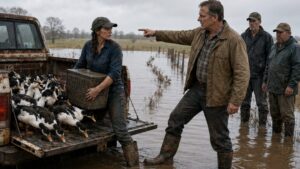
They Took Away His Farm Access, Then Learned Their Entire Harvest Route Crossed His Land
Chapter 1: The Morning They Locked George Out
George Miller knew something was wrong before he shut off the engine.
A new steel chain looped through the rusted iron gate at the end of his farm lane. The gate had sagged on the same stone post since he was a teenager. George had welded its lower hinge twice, replaced the latch once, and opened it so many mornings that his hand could find the handle in darkness.
Now a bright brass padlock hung where his hand should have gone.
Behind him, the diesel tractor idled with a loaded hay wagon. Twenty square bales were stacked chest-high and strapped for delivery. The county road lay less than a hundred yards beyond the gate.
George climbed down.
A white paper sleeve had been wired to the bars. He pulled it free, opened it, and read the first two lines twice.
His access through the agricultural road cooperative’s western gate had been suspended pending compliance review.
George looked through the bars.
On the other side, the gravel lane curved past the cooperative equipment shed, then joined the county road. He had used that route for thirty years.
A pickup rolled toward him from the shed.
Virginia Roberts stepped out before the truck fully settled.
She wore clean work pants, a pale button-down, and boots that had probably seen mud but none that morning. Three cooperative board members stood near the shed behind her. Two neighboring farmers had stopped beside a fertilizer spreader.
Too many people for a conversation that could have been handled by phone.
George folded the notice.
“Morning,” Virginia said.
He held up the chain.
“What is this?”
“You received the warnings.”
“I received complaints.”
“They were warnings.”
“Not the same thing.”
Virginia’s mouth tightened. “Your livestock trailer blocked the lane twice last month. Your hay wagon crossed the center crown during wet conditions. And we had another report Thursday that a delivery truck had to back nearly two hundred feet because you were loading beside the gate.”
George glanced toward the watching men.
“Who filed that one?”
“That isn’t relevant.”
“It is if it isn’t true.”
Virginia took a folder from under her arm.
George felt the first pull of anger, hot and familiar, but he kept his hands loose at his sides.
Years earlier his father had told him that anger was useful only if you could decide where to put it. George had never been particularly good at the second part, so he had learned silence instead.
Virginia opened the folder.
“The board voted yesterday evening.”
One of the farmers near the shed looked down.
George stared at Virginia. “Voted on my access without me there?”
“You were notified about the meeting.”
“I was baling until ten.”
“That doesn’t invalidate the vote.”
She handed him another sheet.
“The suspension stands until your equipment complies with the lane-use rules.”
“My equipment complies with county limits.”
“This isn’t the county road.”
George looked at the gravel beneath Virginia’s boots.
“No,” he said quietly. “It isn’t.”
She mistook the answer for surrender.
“You can use the north route until this is resolved.”
George almost laughed.
The north route added nearly six miles, crossed a low-water culvert, and required a turn too tight for his full hay wagon unless he backed into a field entrance first.
“You know what that does to a loaded wagon.”
“You have another route.”
“I have another route in February. Not in hay season.”
Virginia’s expression hardened.
“The cooperative can’t make exceptions because a route is inconvenient.”
Behind George, the tractor coughed at idle.
He felt every set of eyes on him.
Virginia lowered her voice, which somehow made the scene more public.
“George, nobody is trying to make this personal.”
He looked at the chain again.
“You put a lock on a gate I’ve used since before this cooperative had a name.”
“The gate controls cooperative access.”
“That so?”
“Yes.”
George lifted his eyes past her.
A grain truck came down the connector from the east, rattling over the washboard gravel. It turned south behind the equipment shed, crossed the narrow strip beside George’s lower hayfield, then disappeared toward the county road.
George watched its rear tires throw pale dust across grass he mowed twice a year.
Another cooperative truck followed.
Something shifted in his mind.
Not anger this time.
Geometry.
The southern bend had always bothered him because it made no sense as a road. Instead of following the old fence line, it cut diagonally across the low corner of the Miller acreage before straightening beyond the drainage ditch.
His father had once called it “the neighbor cut.”
George had never asked why.
Virginia followed his gaze.
“You’ll need to move your tractor,” she said. “You’re blocking the approach.”
George turned back toward her.
“For who?”
“George.”
He let the silence sit.
Then he climbed onto the tractor and backed the hay wagon away from the chained gate.
Several people visibly relaxed.
Virginia closed her folder.
“I’ll send you the compliance checklist Monday.”
George nodded once.
He drove the wagon back toward the barn.
The long way to the county road would cost fuel, time, and probably two deliveries before noon.
But that was no longer what occupied him.
He kept seeing the grain truck crossing the southern strip.
At the farmhouse, Rachel Anderson was sitting at the kitchen table with a calculator, invoices, and a mug of coffee gone cold.
She looked up when he entered.
“You’re back early.”
“They chained the gate.”
Her hand stopped over the calculator.
“They did what?”
“Board vote.”
Rachel pushed her chair back. “Can they do that?”
George removed his cap.
“They think they can.”
“That isn’t an answer.”
“It’s the one I have.”
She watched him cross the room toward the small office that had once belonged to his father.
“Dad.”
George opened the bottom drawer of the old metal desk.
Inside were seed invoices, insurance policies, machinery manuals, tax receipts, and folded maps held together with brittle rubber bands.
Rachel appeared in the doorway.
“What are you looking for?”
George pulled out an old county plat, yellowed at the folds.
“The reason that road bends.”
Chapter 2: The Line Beneath the Gravel Road
The line was exactly where George remembered it—and nowhere near where the cooperative acted as though it was.
He spread the county plat over the kitchen table and flattened one corner with the sugar bowl.
Rachel leaned over his shoulder.
The map was old enough that several parcels still carried numbers instead of current owners’ names. The Miller property boundary ran south from the farmhouse acreage, followed the drainage ditch, then made a shallow angle toward the county road.
The cooperative connector crossed that angle.
Not alongside it.
Across it.
Rachel traced the printed boundary with one finger.
“That can’t be right.”
George said nothing.
She looked at him. “You knew?”
“I knew the field went farther south than the fence.”
“That isn’t what I asked.”
George folded his arms.
“I knew Dad always said the corner was ours.”
Rachel stared at the map again.
The gravel road cut through nearly the full width of the triangular strip.
“How much land?”
“Not much.”
“That road doesn’t need much.”
George took the plat from her and carried it outside.
The morning had warmed. Dust hung over the connector whenever a truck passed.
He walked the old fence line slowly.
The iron gate stood to his right, still chained. From George’s side, it looked different than it had an hour earlier. Not like an entrance being denied to him.
Like a boundary someone else had decided they controlled.
He paced south.
Near the ditch, the fence turned.
The road did not.
It continued diagonally over the grass edge, crossed the property line shown on the plat, and bent toward the equipment shed.
George crouched beside a weathered steel survey pin half-hidden beneath weeds.
He had seen it hundreds of times.
He had never considered what it marked.
Rachel stopped beside him.
“That pin match the map?”
“Looks like it.”
“Looks like?”
“I’m a farmer, not a surveyor.”
She gave him a pointed glance. “Good. Keep remembering that.”
George stood.
A loaded pickup towing a stock trailer passed them on the connector. Its tires crossed within twenty feet of the survey pin.
Rachel watched it go.
“If this is yours, why would Grandpa let everybody use it?”
George brushed dirt from his hands.
“Because people needed through.”
“That simple?”
“Used to be.”
They returned to the farmhouse and spent two hours going through the filing cabinet.
They found purchase agreements, fertilizer bills, old loan papers, tax statements, farm program forms, and three different surveys.
They did not find an easement.
Rachel sat cross-legged on the office floor, surrounded by folders.
“There should be something.”
“Maybe there is at the courthouse.”
“If the cooperative has a recorded easement, wouldn’t it show in our title work?”
“Depends how old it is.”
Rachel lifted a folder.
“This one goes back twenty-three years.”
George took it.
Nothing.
Another title packet from a refinance showed the same parcel description and no obvious right-of-way across the southern strip.
George felt satisfaction rise, clean and sharp.
Virginia had locked him out of a road crossing his own property.
The absurdity of it almost made him smile.
Then Rachel reached behind the desk and pulled out a thin envelope.
“Here.”
Inside were two letters from the cooperative.
Recent ones.
George recognized Virginia’s signature without reading the first page.
Rachel did.
Her eyes moved down the sheet.
Then she looked up.
“You never answered this?”
George leaned against the desk.
“It was a proposal.”
“It was a request to formalize use of the connector.”
“I know what it was.”
“She sent it twice.”
“I saw them.”
Rachel laid both letters flat.
“So when you told me this morning you didn’t know anything about the road arrangement—”
“I said I didn’t know what was recorded.”
“That’s not the same thing.”
“No.”
Her expression changed.
Not anger exactly.
Disappointment.
George disliked it more.
“What did you think she was trying to do?” Rachel asked.
“Get me to sign away permanent access.”
“Did you ask?”
“The language said perpetual right-of-way.”
“That sounds like something worth answering.”
“It sounded like something worth not signing.”
“You could have said no.”
“I did.”
“You ignored it.”
George looked toward the window.
Rachel gathered the letters.
“This is what you always do.”
“What?”
“You decide silence means nobody gets to move you.”
He turned back.
“Sometimes it works.”
“Until somebody puts a chain on your gate.”
The words landed harder than he wanted them to.
George took the old plat outside again.
By noon, he had the pickup parked beside the disputed strip. He compared the road, the drainage ditch, the survey pin, and the map until the shape became undeniable.
The connector was not merely close to his property.
It appeared to run through it.
He stopped at the mailbox on his way back and pulled out the latest property tax statement.
The acreage figure included the southern strip.
He checked the parcel number.
Same number as the plat.
Rachel stood on the porch when he returned.
“Well?”
“We’ve been paying taxes on it.”
“That proves the parcel is ours. It doesn’t prove nobody has access rights.”
George knew she was right.
He wished she were not.
He went inside and called the county records office.
A clerk answered after several transfers.
George gave the parcel number and explained that he needed archived deeds, easements, road agreements, and any recorded right-of-way affecting the southern boundary.
The clerk typed for a while.
“I can see current indexing,” she said. “Nothing obvious under the cooperative name.”
George looked at Rachel.
“But?”
“But older records aren’t all searchable electronically. There may be handwritten references in the deed books.”
“How old?”
“Could be forty years. Could be older.”
George looked at the plat.
His father had bought the neighboring strip before George finished high school.
“Can somebody check?”
“We can pull the archive Monday morning.”
“I need more than a copy.”
“You need someone to interpret the parcel history?”
“Yes.”
“I can flag it for Jason Davis in survey records.”
George wrote the name on the back of Virginia’s letter.
The clerk paused.
“One more thing. If people have been using that road a long time, recorded documents may not be the whole question.”
George’s satisfaction faded a little.
“What does that mean?”
“It means Jason can tell you what the records show. He can’t tell you what a court would decide.”
George hung up.
Rachel was still watching him.
“You were hoping there’d be one piece of paper that made you completely right.”
George folded the plat along its old creases.
“I was hoping there’d be one piece of paper that made them completely wrong.”
Monday suddenly felt farther away than two days.
Chapter 3: Point to the Easement, Virginia
The feed truck stopped fifty yards from George’s tractor and leaned on its horn.
George did not move.
His tractor sat broadside across the gravel connector with a loaded hay wagon behind it. The rusted iron gate stood open toward his own field, but the road beyond it was blocked.
By seven fifteen Monday morning, three vehicles were waiting.
By seven thirty, there were six.
A livestock trailer had pulled onto the shoulder. A feed delivery driver stood beside his cab with both hands on his hips. Dust floated above the line of trucks.
George remained beside the tractor hood.
The county plat was folded in his shirt pocket.
He had slept poorly.
Every time he closed his eyes, he saw Virginia’s chain.
At seven forty-two, her pickup came fast around the eastern bend.
She parked crooked beside the gate and got out before shutting off the engine.
“What are you doing?”
George looked at the trucks.
“Waiting.”
“For what?”
“For somebody to show me something.”
Virginia’s eyes moved to the hay wagon.
“Move it.”
“No.”
The feed driver looked away as if suddenly interested in his tires.
Virginia stepped closer.
“You cannot block cooperative traffic because you’re angry about a suspension.”
George took the plat from his pocket.
“I’m not blocking my access.”
“You’re blocking everybody’s access.”
“That’s what I’m trying to understand.”
“You know exactly what you’re doing.”
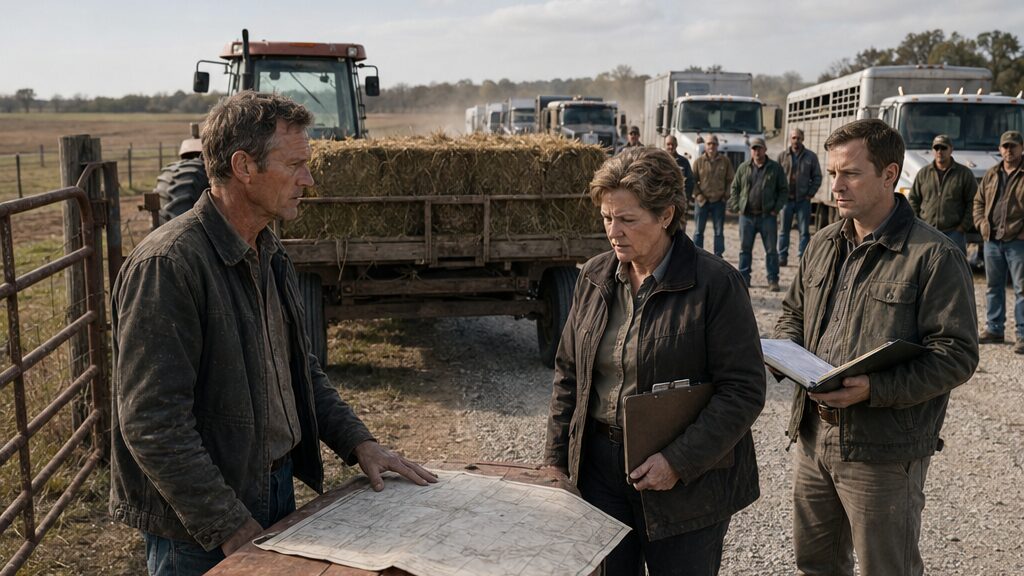
George unfolded the map across the dusty tractor hood.
Virginia glanced at it, then back at him.
“What is that supposed to prove?”
“Maybe nothing.”
He smoothed the paper with both hands.
“Point to the easement.”
Virginia stared at him.
“Excuse me?”
“The recorded easement that gives the cooperative the right to run this road through my parcel.”
A neighboring farmer had climbed down from his pickup. Another stood near the livestock trailer. Nobody spoke.
Virginia lowered her voice.
“George, move the tractor.”
“Show me the easement.”
“This road has been used by the cooperative for decades.”
“That wasn’t my question.”
Her jaw tightened.
“The cooperative maintains it.”
“You gravel it.”
“We grade it. We clear snow. We insure the shared lanes.”
“Good.”
George tapped the plat.
“Now show me where I gave you this strip.”
For the first time, Virginia looked carefully at the map.
Her finger followed the connector.
Then stopped.
George saw the change before she said anything.
Not fear.
Calculation.
“You’re reading an old plat,” she said.
“County parcel hasn’t moved.”
“You’re not a surveyor.”
“No.”
“Neither am I.”
“Then we agree on something.”
A truck horn sounded again.
Virginia turned sharply.
“Enough.”
She walked toward the waiting feed truck and told the driver to hold position.
George heard irritation in the man’s reply but not the words.
A county vehicle appeared behind the traffic line twenty minutes later.
Jason Davis left it parked near the ditch and walked the final distance carrying a map tube, clipboard, and tablet.
He looked at the blocked connector, then at George.
“I’m guessing this is the Miller parcel.”
Virginia crossed her arms.
“This is an unauthorized obstruction.”
Jason nodded without committing to the statement.
“I’m here to look at records and physical references. That’s all.”
George liked him immediately for refusing everybody’s preferred version.
Jason spread a current parcel map beside George’s older plat.
He walked to the steel survey pin near the ditch, checked another marker farther west, then returned.
“The mapped boundary is generally consistent with what Mr. Miller is showing.”
Virginia’s face tightened.
“Generally?”
“I’m not establishing a new survey today.”
“Does the road cross his parcel or not?”
Jason looked toward the connector.
“According to the recorded parcel geometry, a portion of this connector appears to cross the Miller property.”
The silence afterward was deeper than George expected.
The feed truck idled.
A cow shifted inside the waiting livestock trailer.
Virginia pointed toward the equipment shed.
“We have maintained this lane for years.”
Jason nodded. “I can see that.”
“That means something.”
“It may.”
George looked at him.
“What does that mean?”
“It means ownership and right of use aren’t always the same question.”
The satisfaction George had carried since Saturday began to drain.
Jason returned to his tablet.
“I didn’t find a separately indexed permanent easement under the cooperative name.”
Virginia spoke quickly.
“There were agreements before the cooperative incorporated.”
“That’s possible.”
George pointed to the map.
“Recorded?”
“I’m still checking.”
“So until you find one—”
Jason held up a hand.
“Don’t finish that sentence based on what I’ve said.”
George stopped.
Jason looked directly at him.
“If this road has been openly used with owner permission for decades, there may be legal issues beyond what appears on a modern index. I’m not telling you they have an easement. I’m telling you that absence of one document does not automatically make every other question disappear.”
Virginia looked at George.
The alarm in her expression had eased.
Not into confidence.
Into something more dangerous: hope.
George folded his arms.
“You telling me I have to leave it open?”
“No.”
“You telling me I can close it?”
“No.”
Virginia exhaled sharply. “Then what exactly are you telling us?”
“That I can tell you what county records contain. I cannot decide private legal rights on the side of a gravel road.”
The livestock hauler stepped forward.
“I’ve got animals in this trailer.”
George looked at the cattle shifting behind the slats.
That was the first consequence that did not feel abstract.
He moved his tractor enough to create a narrow passage.
“Livestock and feed through,” he said. “Everybody else waits.”
Virginia looked at him.
“That isn’t your decision to make.”
George met her eyes.
“Today it is.”
But the words did not feel as satisfying as he had imagined.
Jason returned to his county vehicle and retrieved a thin folder.
“I pulled older deed references this morning.”
George watched him open it.
“There’s nothing labeled as a permanent easement in the current chain. But there is a cross-reference from an older deed book.”
Virginia stepped nearer.
“To what?”
Jason ran his finger down a photocopied index page.
“Handwritten notation. Looks like it was entered when George’s father held the parcel.”
George felt the back of his neck tighten.
“What does it say?”
Jason squinted.
“Not much here. Just a reference number and a phrase.”
He looked at George.
“‘Access by permission of owner.’”
George stared at him.
Virginia said nothing.
Jason closed the folder.
“I’ll need the original book to tell you what that permission actually covered.”
George looked at the open gate, the waiting trucks, and the road his father had apparently allowed them to use.
For the first time since finding the chain Saturday morning, he no longer wondered whether the cooperative had overlooked something.
He wondered what his father had promised.
Chapter 4: What His Father Never Put in Writing
“Permission by owner.”
The words were still on the photocopy Wednesday morning when Jason Davis slid the original deed book across the county records table.
George did not touch it immediately.
The book was thick, clothbound, and worn pale at the corners. A county clerk had already opened it to the marked page. Jason pointed to a narrow handwritten entry squeezed beneath a property transfer recorded more than three decades earlier.
“There,” he said.
George leaned closer.
The ink had faded brown.
The notation described access across the southern portion of the Miller parcel for neighboring agricultural traffic. It did not use the word easement. It did not grant ownership. It did not describe a permanent width.
At the bottom, in a different hand, were four words.
Permission by owner only.
George read them twice.
“So it was his.”
“The land?” Jason asked. “According to this record, yes.”
“The permission.”
Jason nodded cautiously. “It appears your father allowed access.”
“And he could end it.”
Jason sat back.
“That’s where you keep trying to make me say more than the records say.”
George looked at him.
Jason tapped the page.
“This tells us what somebody intended at the time. It doesn’t tell us every agreement made afterward. It doesn’t tell us how long people relied on the route, what improvements were made with the owner’s knowledge, or what arguments somebody could raise now.”
George’s jaw tightened.
“But there’s no permanent easement.”
“Not one I’ve found.”
That should have felt like victory.
Instead, George stared at his father’s name.
His father had never mentioned the notation.
He had talked about the road, certainly. Complained when gravel washed into the ditch. Grumbled when neighbors drove too fast. Once, after a heavy rain, he had spent half a Sunday rebuilding the shoulder beside the iron gate.
George suddenly remembered being sixteen and holding a fence staple between his teeth while his father reset the gatepost.
“Why don’t we just move the gate?” George had asked.
His father had wiped sweat from his forehead.
“Because folks need through.”
“Then why not give them the road?”
His father had stopped hammering.
“Using a thing and owning a right to it aren’t the same.”
At sixteen, George had thought it was just another one of his father’s sayings.
Now it sounded like a warning that had taken thirty-five years to arrive.
Jason turned another page.
“There’s also correspondence noted later.”
George looked up.
“What correspondence?”
“Not recorded as an easement. Just referenced in the file. Your father objected to permanent right-of-way language when the cooperative’s predecessor tried to formalize the route.”
George’s stomach tightened.
“He refused?”
“Looks that way.”
“Why?”
Jason shrugged. “Records don’t usually tell you why people feel something.”
George almost smiled despite himself.
On the drive home, he took the long route past the north culvert.
A hay truck had stopped before the narrow crossing. The driver backed twice before making the turn.
George watched from his pickup.
The inconvenience he had lived with for four days now belonged to other people too.
At the farmhouse, Rachel was sitting at the kitchen table with the two cooperative letters in front of her.
She did not ask what Jason had found.
She looked at George’s face and knew enough.
“What did Grandpa do?”
“He let them use it.”
Rachel waited.
“He refused a permanent easement.”
“Why?”
“Because he didn’t want the farm cut.”
“That what the paperwork says?”
“No.”
“Then how do you know?”
George removed his cap.
“Because I knew him.”
Rachel leaned back.
“That answer is exactly why we’re here.”
George looked at her sharply.
She pushed one of Virginia’s letters across the table.
“I called the cooperative office.”
“You did what?”
“I asked for copies of everything they sent us.”
“Rachel.”
“They sent three notices.”
George stared at her.
“I found two.”
“There was a third. Email.”
“I don’t use that account.”
“You gave them the address.”
“For invoices.”
“That doesn’t make messages disappear.”
She tapped the page.
“They asked you twice to meet about formalizing the connector, and once about changing the gate schedule during harvest traffic.”
George pulled out a chair but did not sit.
“I wasn’t signing away a strip of land.”
“You didn’t have to.”
“They wanted perpetual access.”
“Then you could have written three words. ‘I won’t agree.’”
“I figured not answering said that.”
Rachel’s expression hardened.
“No. It said you weren’t willing to talk.”
George looked toward the window.
The iron gate was visible beyond the lower field, a dark horizontal line against the pale gravel.
“You taking her side now?”
Rachel stood.
“I’m taking the farm’s side.”
“That’s what I’ve been doing.”
“Are you?”
The question stopped him.
Rachel gathered the letters.
“We lost one hay delivery Monday. We moved another through the north route. Fuel’s up, labor’s late, and the vet supplier called this morning asking whether they should reroute next week.”
“That’s temporary.”
“For us.”
She looked toward the road.
“What about everybody else?”
George’s voice went flat.
“They watched her chain me out.”
“Some of them did.”
“They let it happen.”
“And now you get to make every farmer who uses that road pay for it?”
George pushed his chair back.
“That road is on our land.”
“Yes.”
She held his gaze.
“And Grandpa still let people use it.”
The truth in that irritated him more than an accusation would have.
Later that afternoon, George walked down to the gate alone.
He put one hand on the top rail.
The iron was rough beneath his palm.
He remembered his father repairing it instead of removing it.
Not surrendering the boundary.
Maintaining it.
That distinction mattered.
So did another.
His father had left George the land, but he had also left him an arrangement built almost entirely on memory and restraint.
George had spent years preserving the first while inheriting the second without questioning it.
A vehicle slowed on the county road.
Virginia’s pickup.
She did not turn into the connector.
She stopped at the shoulder.
For several seconds neither of them moved.
Then she got out.
No folder.
No board members.
No audience.
“I heard Jason found the old notation,” she said.
George kept his hand on the gate.
“He did.”
Virginia nodded.
“I’d like to talk.”
“You’ve done plenty of that.”
“I said talk. Not hold a meeting.”
George studied her.
“What about?”
“The road.”
“You mean my road?”
Her face tightened, but she let the words pass.
“Tomorrow. Cooperative shed. Just you and me.”
George looked past her toward the equipment building.
The last time she had called him there, people had been waiting to watch him lose something.
“What changed?”
Virginia opened her truck door.
“The fact that if we don’t settle this ourselves, other people are going to start making decisions for both of us.”
Then she got back inside and drove away.
Chapter 5: The Price of Being Technically Right
The veterinary supplier did not even try the gate.
George watched the white service truck slow at the connector, pause beside the temporary barrier, then reverse toward the county road.
He lifted a hand.
The driver shook his head through the windshield and pointed toward the north route.
George stood beside the rusted gate with the key in his pocket.
For the first time, keeping the road restricted felt less like leverage and more like watching a tool damage the wrong thing.
A neighboring farmer had calves due that week.
The supplier was not Virginia.
The calves were not the board.
George unlocked the gate.
He pulled the barrier aside and waved the truck through before it could disappear.
The driver stopped beside him.
“Thought this was closed.”
“Livestock service can pass.”
“That posted somewhere?”
“Not yet.”
The driver looked toward the line of gravel.
“Might want to make that clear.”
George almost said people ought to ask.
The words reached his throat and stopped there.
“Yeah,” he said. “I might.”
At ten, he walked into the cooperative equipment shed.
Virginia was already there.
No board members sat behind her. No folding chairs had been arranged for spectators.
Only two mugs of coffee rested on an old workbench between them.
George did not take one.
Virginia noticed.
“Suit yourself.”
“What did you mean yesterday?”
She folded her arms.
“The board is split.”
“About locking me out?”
“About what happens next.”
George leaned against the edge of the workbench.
“One side wants to negotiate. The other wants counsel to look at forced access, condemnation options, whatever they can find.”
George’s face hardened.
“Over land you don’t own.”
“Over a route seven farms now depend on.”
“That dependence didn’t bother you when you chained my gate.”
Virginia looked down at her coffee.
“No.”
The answer surprised him.
She lifted her eyes again.
“It should have.”
George waited.
“But you weren’t the only one I was thinking about.”
“There it is.”
“No, listen.”
He nearly walked away.
Virginia opened a drawer beneath the workbench and took out a folder.
George’s body tightened automatically.
This time she did not push it at him.
She opened it herself.
“Three months ago, one of the hay wagons met a milk tanker at the narrow curve south of your field.”
George remembered hearing about a near miss.
Nobody had told him details.
Virginia continued.
“The wagon dropped a tire off the shoulder. The tanker crossed the center crown. Nobody hit anybody.”
“So?”
“So our carrier investigated.”
George said nothing.
“They asked why agricultural equipment wider than the signed lane guidelines was being routed through there.”
“My wagon isn’t wider than county limits.”
“I know.”
“Then what’s the problem?”
“The cooperative policy isn’t the county’s.”
George laughed once without humor.
“So you wrote narrower rules.”
“We wrote rules our carrier would accept.”
The irritation in her voice sounded different now.
Tired.
“If we had another incident after they warned us, they could raise rates beyond what three of the smaller farms can afford. Or refuse renewal.”
George looked at the folder.
“Why didn’t you say that Saturday?”
“I tried before Saturday.”
He glanced at her.
Virginia did not soften it.
“I sent you letters.”
George’s mouth tightened.
“You sent me a perpetual access agreement.”
“I sent you a draft.”
“You wanted a permanent right through my land.”
“I wanted something our insurer could point to showing the lane had defined users, maintenance obligations, and enforceable rules.”
“You could’ve called.”
“I did.”
George remembered two missed numbers he had assumed were cooperative reminders.
Virginia looked at him steadily.
“You weren’t interested until I made it impossible to ignore me.”
The admission carried enough truth to sting.
Then she added, “That doesn’t excuse what I did.”
George said nothing.
“I put the suspension to a vote knowing you were baling. I knew you probably wouldn’t come. I thought if the board backed me publicly, you’d finally sign something.”
“So you embarrassed me on purpose.”
“Yes.”
The word hung between them.
Virginia looked toward the open shed doors.
“I was angry. You kept acting like every attempt to put anything on paper was somebody trying to steal from you.”
“Maybe because the paper said perpetual.”
“And maybe because every time someone asks you a question you don’t like, you disappear behind that fence.”
George straightened.
“You don’t know me well enough to say that.”
“No. I know the road problem well enough.”
A truck rattled somewhere outside.
George looked through the doorway toward the connector.
“You still chained me out.”
Virginia nodded.
“And you blocked everybody else.”
Neither spoke for several seconds.
That was the shape of it.
Her mistake did not erase his.
His ownership did not erase hers.
George picked up the unused coffee, tasted it, and found it nearly cold.
“What does the board want?”
“Some want a permanent easement.”
“No.”
“I know.”
“Do you?”
“I do now.”
George set the mug down.
“Others?”
“Guaranteed emergency access. Weight limits. Seasonal windows. Shared gravel and drainage costs.”
“That sounds closer.”
Virginia studied him.
“You willing to put it in writing?”
The question irritated him on instinct.
He felt the familiar refusal rise.
Then he thought of Rachel laying the ignored letters across the kitchen table.
He looked toward the gate.
“Not today.”
Virginia exhaled.
“George—”
“I said not today. I didn’t say no.”
That changed her expression.
Only slightly.
But enough.
When George left the shed, two neighboring farmers were standing beside a pickup near the lane.
One of them called out.
“Board says they may petition the county if this keeps up.”
George stopped.
“Board say that, or you?”
“Folks can’t run harvest around one man’s argument.”
George looked at the road.
“They’ve been running harvest over one man’s land.”
The farmer shook his head.
“That’s exactly the kind of answer that got us here.”
George had no reply ready.
He drove home.
Rachel was balancing fuel receipts when he entered.
He placed Virginia’s insurance summary on the table.
Rachel read the first page.
“So she wasn’t making up the liability issue.”
“No.”
“Doesn’t make the lock right.”
“No.”
Rachel looked up.
“What are you going to do?”
George walked to the window.
At the gate, he had replaced the full barrier with a movable chain and a temporary opening wide enough for livestock service and emergency vehicles.
It looked less satisfying than the blockade.
It also looked more like something he could live with.
“I’m not giving them an easement they can widen whenever they want.”
“Okay.”
“I’m not letting them turn that strip into cooperative property by habit.”
“Okay.”
“I’m not pretending none of them need through.”
Rachel waited.
George turned.
“Get me the last two years of gravel expenses on the south strip.”
Her eyebrows rose.
“And the drainage work.”
“What for?”
“I’m going to make them an offer before somebody files something neither side can take back.”
Chapter 6: The Agreement Across the Tractor Hood
George arrived Monday with paper instead of machinery.
The tractor was parked beside the rusted iron gate, not across the connector. Its hood still carried a pale rectangle where the county plat had lain during the confrontation a week earlier.
This time George placed a typed agreement there.
Virginia approached from the cooperative side with two board members behind her.
Rachel stood near George’s pickup with a folder of invoices.
Jason Davis had agreed to attend only long enough to confirm the parcel description.
George looked at the gathering and almost smiled.
Same road.
Same gate.
Different reason for everyone to be standing there.
Virginia picked up the agreement.
“Limited agricultural access license,” she read.
“Not an easement.”
“I noticed.”
“Ownership stays with the Miller parcel.”
“I noticed that too.”
George folded his arms.
“Seasonal access from first cutting through fall harvest. Emergency passage year-round. Livestock and veterinary traffic anytime with reasonable notice when possible.”
Virginia continued down the page.
“Vehicle weight restrictions.”
“Based on road conditions.”
“Who decides road conditions?”
“Both of us.”
“That’ll work beautifully.”
Rachel cleared her throat.
George ignored the sarcasm.
“Then propose a better mechanism.”
Virginia read farther.
“Cooperative pays sixty percent of gravel and drainage maintenance?”
“You account for most through-traffic.”
“We’ve been paying almost all of it already.”
“Then writing it down shouldn’t hurt.”
One of the board members muttered something under his breath.
Virginia lifted a hand without looking at him.
“Keep going.”
She reached the next section.
Her eyes stopped.
“No.”
George knew which clause she had found.
“No widening, relocating, paving, utility installation, or expansion of the connector without written consent of the parcel owner.”
“Absolutely not.”
“Then we’re done.”
Virginia looked up.
“We can’t operate a shared route with no ability to improve it.”
“You can maintain it.”
“What if equipment changes?”
“What if you decide ten years from now that two lanes would be convenient?”
“That’s not what I’m saying.”
“It’s what I’m preventing.”
Virginia placed the agreement flat on the tractor hood.
“George, if the road washes out, we need to repair it.”
“That’s maintenance.”
“If drainage standards change?”
“Maintenance.”
“If the county requires widening for emergency access?”
George hesitated.
There it was.
Not greed.
Not control.
A legitimate problem he had not solved.
Rachel opened her folder.
“We separated emergency compliance changes in the second draft.”
George looked at her.
“You did?”
“You told me to make this workable.”
She pulled out another page.
Virginia almost smiled.
George did not.
Rachel handed it over.
“Any legally required safety modification can be proposed, but it needs the narrowest reasonable footprint and written acknowledgment that ownership doesn’t transfer.”
Jason read the paragraph.
“That’s clearer.”
Virginia looked at George.
“You knew she added this?”
“I do now.”
One of the board members laughed quietly.
The tension loosened for half a second.
Virginia read the new clause twice.
“Better.”
“Not permission to widen it for convenience.”
“No.”
“Not permission to pave it.”
“No.”
“Not permanent rights beyond what’s written here.”
Virginia looked at him.
“No.”
George felt something inside him resist anyway.
Years of instinct told him not to trust the answer until it was nailed down.
So he tapped the document.
“Then sign that.”
Virginia did not.
Instead, she turned to another page.
“Harvest windows.”
“What about them?”
“Six in the morning to eight at night?”
“That’s enough.”
“Not during corn harvest.”
“You don’t grow corn.”
“Two members do.”
George looked at the eastern fields.
“Six to ten during designated harvest weeks.”
Virginia nodded.
“Weight limits?”
“Suspended only if the road is dry and both sides agree.”
“Maintenance?”
“Sixty-forty.”
“Fifty-fifty.”
“Your traffic is heavier.”
“Your farm benefits too.”
George considered it.
“Fifty-five, forty-five.”
Virginia extended her hand halfway, caught herself, and returned it to the paper.
“Fine.”
For the next forty minutes they worked line by line.
It was slower than anger.
Less satisfying in places.
More difficult in others.
Every sentence forced George to say what he meant instead of assuming everybody already knew.
At last Virginia reached the emergency-access provision.
She frowned.
“This says livestock emergency, medical emergency, and fire response.”
“That’s what emergency means.”
“What about utility failure?”
George looked at the gate.
A winter ice storm two years earlier had knocked power out to several barns east of his property. Repair trucks had used the connector all night.
He had forgotten that.
Virginia had not.
“Add it,” he said.
“And road closure for emergency repair can’t require advance permission.”
“Notice as soon as practical.”
“Agreed.”
Rachel wrote the changes.
Jason checked the parcel description against the county record.
“This describes the affected strip without changing the underlying boundary,” he said.
George nodded.
“That’s the point.”
Jason rolled up his map.
“Then my part is done.”
He looked at both of them.
“What happens with this agreement after today is yours.”
It was exactly what George needed to hear.
No county official would save him.
No hidden document would make the decision simple.
The land was his.
The choice was also his.
Virginia signed first.
She used the tractor hood as a desk.
The same hood where George had asked her to point to the easement now held a document recognizing there wasn’t one.
She passed the pen to him.
George looked at the signature line.
For one uncomfortable moment, his father’s refusal seemed to stand beside him.
Do not give them the road.
George understood now that the warning had never required silence.
He signed.
Rachel took the pages before the wind could lift them.
One board member asked, “So the gate stays?”
George looked at the rusted iron bars.
“Yes.”
Virginia looked at him.
“With cooperative access.”
“Under the agreement.”
“Under the agreement,” she repeated.
The distinction remained.
So did the road.
Virginia started toward her pickup, then stopped.
“There’s one more thing.”
George waited.
“The suspension on your gate access is rescinded.”
He felt the old anger move, but it no longer had anywhere useful to go.
“Should’ve happened sooner.”
“Yes.”
No apology beyond that.
No audience demanding one.
George found he preferred it.
Virginia held out the new key that matched the cooperative-side latch.
George took it.
Then he opened the iron gate.
For the first time in more than a week, nothing blocked either direction.
A feed truck waiting down the connector eased forward.
George stepped aside.
Virginia did the same.
The truck passed between them, tires crunching over gravel that belonged to George and served people beyond him.
Rachel tucked the signed agreement into her folder.
“Where do you want the original kept?”
George looked at the old county plat lying beneath it.
“In the fire cabinet.”
“Not the desk drawer?”
“No.”
Rachel waited.
George closed the gate after the truck passed, but he did not lock it.
“And make two copies,” he said. “One for us. One for the cooperative.”
Virginia heard him.
Their eyes met across the bars.
Neither smiled.
But neither looked away.
Chapter 7: The Gate Stayed, but Everything Changed
The first loaded hay truck under the new agreement stopped at the gate even though it was already open.
George Miller heard the diesel idle from the lower field and looked up from the baler.
For three weeks, every vehicle using the southern connector had either hurried through before somebody could object or approached it as though expecting another argument.
This driver simply waited.
George shut down the tractor and walked over.
The new latch gleamed against the old rusted iron.
Nothing else about the gate looked improved. One lower rail still carried the dent from a stock trailer years earlier. The western hinge still leaned slightly toward the ditch. Orange rust had spread beneath the spot where Virginia’s chain had rubbed away the old paint.
George had considered replacing the whole thing.
He had decided not to.
The driver lowered his window.
“Morning. First load for the east fields.”
George glanced at the truck.
The load was within the agreed limit. Ground conditions were dry. Harvest hours had begun fifteen minutes earlier.
“You’re good.”
The driver pointed toward the gate.
“Wanted to make sure.”
George opened it wider.
The truck rolled through.
Its tires pressed into fresh gravel that the cooperative had delivered the previous Friday.
Not all of it, either.
For the first time in George’s memory, the invoice had been divided exactly according to the written maintenance terms.
Fifty-five percent cooperative.
Forty-five percent Miller farm.
Rachel had placed the paid copy in the fire cabinet beside the signed access agreement.
George watched the truck disappear around the bend.
Three weeks earlier, the sight would have tightened something in him.
Now it merely looked like a truck using a road under terms everybody understood.
That difference was smaller than victory and more useful.
By midmorning, harvest traffic had settled into a steady rhythm.
Hay wagons crossed west.
A feed truck came east.
Nobody blocked the narrow curve because the cooperative had installed a simple radio-call procedure for oversized loads. Nobody needed to guess who would back up or who had priority.
George disliked admitting how well it worked.
Rachel had no such difficulty.
She appeared at the lower field carrying two bottles of water and handed one to him.
“Three weeks without anybody threatening anybody.”
“High standard.”
“I thought so.”
George drank.
Rachel looked at the connector.
“They paid the drainage invoice too.”
“I saw.”
“On time.”
“I saw that too.”
“You could sound impressed.”
“I could.”
She smiled.
George capped the bottle.
Beyond the gate, a grader sat near the ditch where runoff had been eating the shoulder for years.
The cooperative had hired the work.
George had approved the repair in writing the previous afternoon.
That part still felt strange.
A form on the kitchen table.
A description of work.
A line showing who paid what.
His signature beneath it.
Years earlier he would have called the whole process unnecessary.
Now he understood that unnecessary paperwork and necessary clarity were not the same thing.
A pickup slowed beside the gate.
Virginia Roberts was driving.
She stopped.
George expected her to continue after seeing the gate open.
She did not.
She got out and walked toward him.
Rachel looked from Virginia to George.
“I need to check invoices.”
“You were already checking invoices.”
“I suddenly need to check them somewhere else.”
She headed toward the farmhouse.
Virginia watched her go.
“She always that subtle?”
“No.”
Virginia looked at the field.
“Good first cutting.”
“Could’ve been better.”
“It always could.”
For several seconds they stood without speaking.
The last time they had been alone near that gate, Virginia had asked for a meeting because people were talking about court petitions and forced access.
Now the only sound was the baler ticking as its metal cooled.
Virginia nodded toward the grader.
“They’re widening the drainage cut four inches on the south side.”
George looked at her.
“Four?”
“That’s what your approval says.”
“It says repair within the existing drainage footprint.”
“It does.”
“Then why are you telling me?”
Virginia shrugged.
“Figured asking was better than assuming.”
George studied her.
The sentence was casual.
The change behind it was not.
He walked to the gate.
A cooperative hay wagon was approaching from the east.
Virginia stopped beside him.
The wagon slowed.
The driver did not move forward.
Virginia looked at the open gate, then at George.
“Can you let him through?”
George almost said, It’s open.
Instead he understood what she was doing.
She was asking.
Not because she needed his physical help.
Because the agreement said access existed through permission defined in writing, not through ownership surrendered by habit.
George put his hand on the old iron rail.
“Yeah.”
He swung the gate fully open.
Virginia stepped back.
The hay wagon passed.
The driver lifted two fingers from the steering wheel.
George returned the gesture.
No applause.
No watching board.
No satisfaction on Virginia’s face at having won, and none on George’s at having made her ask.
Only a working road between working farms.
When the wagon was gone, Virginia touched the new latch.
“Fence contractor did decent work.”
“He wanted to replace the gate.”
“Probably should’ve.”
“No.”
Virginia looked at him.
George ran his thumb over the rust.
“My father fixed this thing half his life.”
“Sentimental?”
“Don’t spread that around.”
She almost smiled.
Then her expression settled.
“I handled Saturday wrong.”
George looked toward the field.
“You did.”
“I thought public pressure would force an answer.”
“It did.”
“That doesn’t make it right.”
“No.”
She waited.
George knew she was giving him room to say something back.
He did not want to.
The old reflex was there: let silence do the work.
Then he remembered Rachel at the kitchen table.
You decide silence means nobody gets to move you.
George rubbed a hand across the gate rail.
“I handled the months before Saturday wrong.”
Virginia said nothing.
“I thought not answering was an answer.”
“It usually isn’t.”
“I know that now.”
She nodded once.
It was not forgiveness.
It did not need to be.
Virginia returned to her pickup.
Before getting inside, she looked back.
“Board meets Thursday.”
George groaned.
“You’re invited.”
“That supposed to improve things?”
“It means if we’re changing road rules, you should probably be in the room.”
George considered it.
“What time?”
“Seven.”
“I’ll be there.”
Virginia drove away.
That evening, Rachel spread the latest farm accounts across the kitchen table.
George entered carrying the folded county plat.
Not the old yellowed one.
Jason Davis had provided an updated copy showing the current parcel geometry and the narrow licensed access strip shaded along the southern boundary.
Rachel moved her calculator aside.
“What’s that?”
“Current plat.”
“I have a digital copy.”
“I know.”
George laid it in front of her.
She unfolded it.
The connector was still there.
So was the Miller boundary.
Neither line had swallowed the other.
George placed a key beside the map.
“The signed agreement is in the fire cabinet.”
“I know.”
“Second shelf.”
“I put it there.”
“Original parcel records are behind it.”
Rachel looked up.
“You telling me this because?”
“Because someday I don’t want you standing at that gate wondering what I meant.”
The room went quiet.
Rachel looked back at the map.
George did too.
His father had protected the farm with memory, stubbornness, and a four-word notation in an old deed book.
It had worked for one generation.
Barely.
George had spent years believing loyalty to that method was the same as loyalty to the land.
Now the arrangement sat in plain language inside a steel cabinet.
Who could use the road.
When.
For what.
Who maintained it.
What could never be widened without consent.
What happened in emergencies.
And, most importantly, whose land remained whose.
Rachel folded the plat carefully.
“You want me to keep this?”
“Yes.”
She took the key.
Outside, another truck approached the connector.
George could hear the engine slow before the gate.
He walked onto the porch.
The rusted iron gate remained where it had always been, dark against the pale gravel.
It had once meant that George belonged there.
Then someone had chained it and made it mean exclusion.
For a few angry days, George had turned it into leverage.
Now it meant something less dramatic.
A boundary.
A responsibility.
A place where one person’s rights met another person’s needs and neither had to pretend the other did not exist.
The truck waited.
George walked down the lane.
This time, he knew exactly why he was opening the gate.
The story has ended.