He Kicked Out the Boundary Stakes, Then Learned Whose Farm He Had Built Across
Chapter 1: The Excavator Bucket Stopped Above the Orange Line
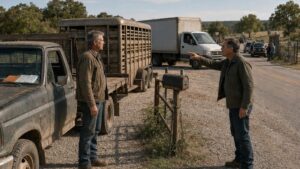
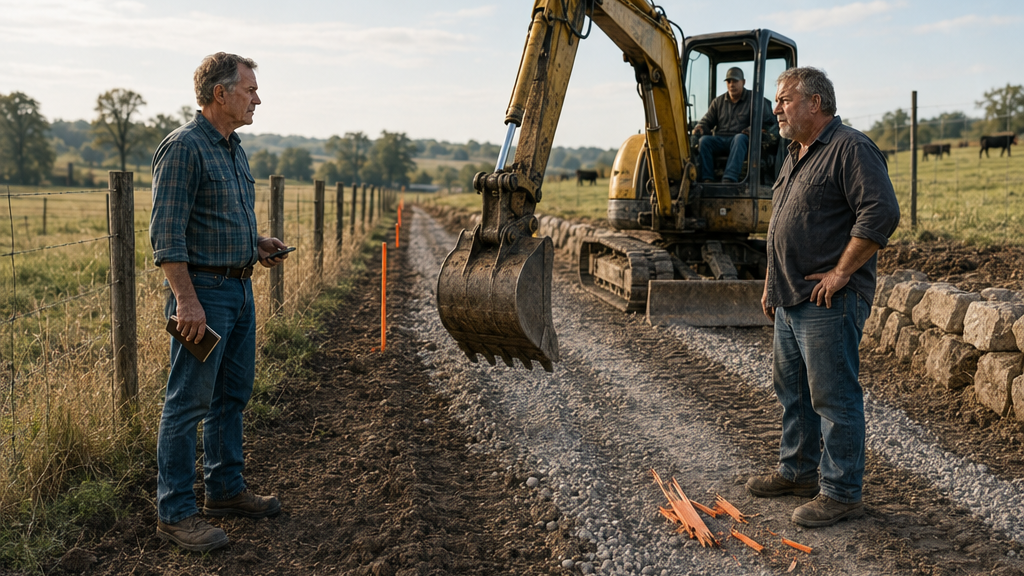
The excavator bucket stopped less than a foot above James Martin’s orange survey stake.
James stood in the gravel lane with one hand raised, palm out. Beyond the bucket, Thomas Clark leaned forward inside the cab, his broad shoulders filling the glass.
“Don’t cross that stake.”
The diesel engine idled between them.
Thomas pushed the cab door open. “That stick isn’t a property line.”
“No,” James said. “It marks one.”
The lane ran between James’s hayfield fence and the lower edge of Thomas’s cattle pasture. It had been narrow for as long as James could remember—wide enough for a pickup, tight for a loaded hay wagon. Over the weekend, while James had been helping Benjamin repair a baler on the north side of the farm, Thomas had brought in gravel, reshaped the bank, and built a low retaining berm to carry the lane around a wet depression.
The work looked good from a distance.
That was part of the problem.
Fresh gravel had been packed smooth. The ditch had a clean fall. Stone along the berm looked deliberate and permanent.
It was also, by James’s reckoning, nearly two feet onto Martin land.
James had planted three orange-topped stakes that morning using the old boundary references he knew by memory. One stood near the cedar fence. One sat halfway down the new grade. The third was now directly beneath Thomas’s excavator bucket.
Thomas climbed out.
“You came down here before breakfast and started sticking flags in my road.”
“Not your road.”
Thomas gave a short laugh. “There. That’s what I mean.”
James looked past him toward the berm. “You moved the edge.”
“I fixed drainage.”
“You moved the edge while you fixed it.”
“By what? Eighteen inches?”
“Closer to two feet in places.”
Thomas stared at him as if James had just complained about a bent nail.
“You going to shut down my cattle trucks over two feet of weeds?”
James’s jaw tightened. “It’s hay ground.”
“You don’t cut that strip.”
“That doesn’t make it yours.”
The excavator operator, who had been standing beside the machine, shifted his weight and looked toward Thomas for instruction.
Thomas pointed down the lane. “Keep dressing the gravel.”
James stepped between the machine and the nearest stake.
The operator did not move.
Thomas’s face darkened. “James.”
“I’m asking you to stop until the line is verified.”
“And I’m telling you I already paid for this work.”
“That’s between you and whoever you hired.”
Thomas walked toward the orange stake. “This is the problem with you survey people. You think every mark in the dirt is sacred.”
James watched him come.
Thomas planted his boot beside the stake.
“You want me to believe this little piece of wood decides where I can drive?”
“It doesn’t decide anything.”
Thomas kicked it.
The stake snapped near the ground and disappeared sideways into the gravel.
For a second nobody spoke.
The operator looked away.
James felt something hot move through his chest, but he did not step forward. He pulled his phone from his shirt pocket instead.
Thomas frowned. “What are you doing?”
James took one photograph of the broken stake.
Then another showing Thomas’s boot beside it.
Then a wider photograph that included the berm, the excavator, and the remaining orange marker farther uphill.
Thomas shook his head. “You serious?”
James crouched, picked up the splintered top, and laid it beside the hole. From his back pocket he pulled a small field notebook and wrote down the time.
“Very.”
Thomas folded his arms. “There. Now there’s no stake. Prove where the line is.”
James looked at him.
It was not the challenge itself that bothered him. He had heard versions of it for most of his adult life—from developers, heirs, farmers, homeowners, and men who believed a property line became negotiable if they spoke loudly enough.
What bothered him was how familiar the moment felt.
A man standing on disputed ground.
A line dismissed because it was inconvenient.
A permanent improvement made first, permission considered later.
James closed the notebook.
“The stake marks the line,” he said. “It doesn’t create it.”
Thomas glanced toward the operator. “We’re wasting daylight.”
“If that bucket crosses onto my side before this is resolved, I’ll document that too.”
Thomas took two steps closer. “Sue me, then.”
“I didn’t say anything about suing you.”
“You don’t have to. I know where this goes.”
James almost answered, but stopped.
There had been a time when Thomas would have called before moving so much as a fence brace near the line. They had traded hay during a dry summer. James had loaned him a stock trailer once. Thomas had helped Benjamin pull a tractor out of a flooded lower field.
That history was the only reason James had walked down there himself instead of calling an attorney first.
Thomas looked at the remaining stakes.
“You put another one in my gravel, I’ll pull it too.”
James studied him for a moment.
“Then don’t touch anything until tomorrow.”
“Why tomorrow?”
“So you can be certain.”
Thomas’s expression changed slightly, but not enough to become caution.
“I’m already certain.”
James nodded. “That makes one of us.”
He turned and walked back toward his pickup.
Behind him, Thomas called, “Work starts again at noon unless you bring me something better than an old fence line.”
James did not look back.
At the farmhouse, Benjamin was loading mineral tubs into the bed of a truck when James pulled in.
“That finished already?” Benjamin asked.
“No.”
One word was enough to make Benjamin stop.
James went past him into the equipment shed. Along the back wall stood a steel cabinet that had not been opened in months. He moved two boxes of hydraulic fittings, found the key on his ring, and unlocked it.
Inside sat an old hard-shell survey case.
Dust lined the hinges.
James lifted it out and set it on the workbench.
Benjamin had followed him inside.
“I thought you were done with that stuff.”
“I mostly am.”
James opened the latches.
Inside were a prism pole, notebooks, flagging tape, measuring tools, and the compact field equipment he had kept after selling most of his professional gear.
Benjamin looked from the case to his father.
“What exactly did Thomas do?”
James took out a worn folder.
“Enough that I want to know the line before he moves one more bucket of gravel.”
Benjamin glanced toward the open shed door and the distant lane.
“And you don’t already know?”
James unfolded the first sheet.
“I know.”
He smoothed the old plat flat beneath his hand.
“I want Thomas to know.”
Chapter 2: The Old Plat Was Not the Weak Evidence
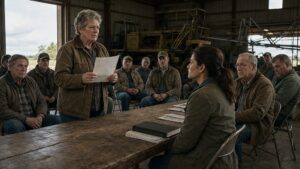
James did not call Thomas.
He carried the survey case into the farmhouse, cleared half the kitchen table, and began laying out records in the order he trusted them.
The oldest plat was a county copy, its paper yellowed at the folds. Another sheet showed a later fence adjustment. A third contained field notes from work James himself had done years earlier when a neighboring parcel changed hands.
Benjamin stood at the counter drinking coffee.
“You kept all this?”
“I keep records.”
“You keep everything.”
James ignored that.
He placed his phone beside the papers and opened the photographs from the lane. Forty-one images by the time he finished counting: gravel placement, the berm, equipment tracks, the original stakes, the broken stake, the excavator position, and the relationship between the new grade and the cedar fence.
Benjamin leaned over the table.
“Forty-one?”
“Forty-one.”
“That seems excessive.”
“It seemed excessive when Thomas kicked the first stake.”
James took a pencil and marked two reference points on the plat.
The boundary had never depended on the fence. The cedar posts wandered several inches in places, just as old farm fences often did. What mattered were the recorded calls tied to permanent references beyond the disturbed lane.
Benjamin watched his father calculate.
“So how far over?”
“I won’t know exactly until I run it again.”
“You said you knew.”
“I know where the line is supposed to be.”
James looked up.
“That’s different from proving where Thomas put his berm relative to it.”
Benjamin sat across from him. “You really think he moved it two feet?”
“In one section, yes.”
“And if it’s eighteen inches?”
James returned to the plat.
“It’s still on us.”
Benjamin let out a breath. “Dad, I’m not saying he should get to take it.”
“You’re getting ready to.”
“I’m saying we have to live beside him after this.”
James’s pencil stopped.
“So does he.”
The answer came harder than James intended.
Benjamin leaned back.
“There it is.”
“What?”
“That thing you do where every disagreement turns into a test of whether somebody can push you.”
James folded one of the photographs beneath the plat.
“This isn’t about somebody pushing me.”
“Then what is it about?”
“Property.”
Benjamin waited.
James did not continue.
By noon, he had reconstructed the boundary well enough for his own satisfaction. Using the recorded bearings and distances, plus measurements to surviving reference points, he plotted the line across a scaled sketch of the lane.
The result was worse than he had expected.
At the widest point, the outer edge of Thomas’s new grade was roughly twenty-two inches over.
The retaining berm itself crossed the line for a shorter stretch.
James sat back.
Benjamin looked over his shoulder.
“That’s it?”
“That’s enough.”
“I meant—that’s the whole encroachment?”
James tapped the drawing. “Permanent stone here. Compacted base here. The widened driving surface here.”
Benjamin rubbed his jaw. “Thomas probably looked at the old fence and thought he had room.”
“He didn’t ask.”
“No.”
“He didn’t survey.”
“No.”
“He built anyway.”
Benjamin’s silence irritated James more than an argument would have.
“You still think I should let it go.”
“I think you should decide what you actually need fixed.”
James turned toward him.
Benjamin continued before he could interrupt.
“If the line is right, prove it. Fine. But after that, what? Make him tear out the whole thing? Start a lawsuit? Stop cattle trucks? What are we trying to accomplish?”
James gathered the photographs into a stack.
“We’re trying to keep our land.”
“Two feet of it.”
James looked at him sharply.
Benjamin immediately shook his head. “I know how that sounds.”
“No. You don’t.”
Something in James’s voice ended the exchange.
He carried the survey case back to the shed.
In the late afternoon he drove to the lane alone. Thomas’s machinery was parked, but the fresh gravel showed that another section had been dressed after James left.
Not much.
Six or eight feet.
Still enough.
James stood beside the place where the stake had been broken and measured back from the surviving reference.
He drove a new orange stake into the exact position.
Then he stepped away.
Nothing magical happened.
The earth did not change.
The berm did not move.
The stake simply stood where the other one had stood.
That was the point.
Thomas appeared near the cattle lot and walked over.
“You put it back.”
“I replaced it.”
Thomas looked down. “According to that old map?”
“Recorded plat.”
“From when?”
“Nineteen ninety-four.”
Thomas laughed once. “That thing’s older than half the equipment on this farm.”
“Age doesn’t move a recorded boundary.”
Thomas pointed toward the fence. “Everybody has treated that fence as the line for years.”
“No. Everybody has treated the fence as a fence.”
“You expect me to believe you can walk out here with a thirty-year-old paper and tell me my new lane is wrong?”
James looked at the berm.
“Yes.”
Thomas’s mouth tightened. “Prove it with someone besides yourself.”
James nodded.
That caught Thomas off guard.
“I will.”
“What?”
“I’ll have an independent crew here tomorrow morning.”
Thomas studied him.
“You really want to spend money on this?”
“Yes.”
“For two feet?”
James met his eyes. “You keep saying that like the number makes the ownership disappear.”
Thomas turned away.
James packed his tools slowly.
Back in the shed, he reached for a lower drawer to put away the spare flagging tape. Something jammed behind it. He tugged harder, and a thin black notebook slid forward and dropped onto the concrete floor.
He knew it before he picked it up.
His father’s handwriting was still visible on the faded strip of masking tape across the cover.
James had not opened that notebook in years.
He sat on the edge of the workbench and turned several pages.
Feed calculations.
Fence repairs.
Hay yields.
Then a dated entry stopped him.
East lane—let Clark family keep using strip. No paper. Easier than fighting over it.
James read the line twice.
Below it, written months later in darker pencil, was another sentence.
Should have put it in writing.
Chapter 3: Every Inch Was Correct and Nothing Was Simple
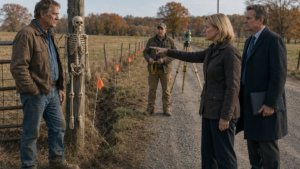
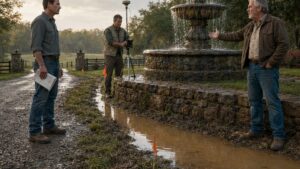
The independent survey instrument was set directly in line with Thomas’s new berm.
James noticed that before the crew chief said anything.
The tripod stood on stable ground near the hayfield, its legs pressed into packed soil. Farther down the lane, another crew member held a prism pole near the cedar fence while orange flagging snapped lightly from newly set points.
Thomas stood beside his pickup with his arms crossed.
Benjamin had come too.
Nobody spoke much while the crew worked.
That suited James.
Measurements were cleaner than arguments.
The crew chief checked the instrument, called for another shot, then walked toward the lane with a tablet in hand. He stopped beside the first new stake and looked toward James.
“Your reconstructed position was close.”
“How close?”
“Less than half an inch at this point.”
Thomas uncrossed his arms.
The crew chief moved downhill.
“At the berm, the encroachment increases.”
He stepped onto the new gravel and pointed.
“Twenty-one inches here. Twenty-three at the widest shoulder. The stone toe crosses for about eighteen feet before it tapers back.”
Thomas stared at the line of orange stakes.
They were almost painfully straight now.
No crooked fence.
No guessed edge.
No argument about where James had pushed a stick into the dirt.
The crew had established the boundary independently from recorded references.
James felt the satisfaction he had expected.
It lasted perhaps five seconds.
Then the crew chief walked farther downhill and crouched beside the ditch.
“You’ve got another issue.”
Thomas looked at him. “What issue?”
The crew chief pointed along the grade.
“This shoulder is carrying water away from the lane.”
“I know,” Thomas said. “That’s why I built it.”
The crew chief followed the ditch with his eyes.
“If you remove the berm and cut the lane back immediately, runoff will likely return toward the low point.”
James stepped closer.
The low point sat almost exactly where the two farms’ access routes approached one another.
“How much water?”
“Depends on the storm.”
“Enough to wash the lane?”
“Could.”
Thomas gave James a look that was too controlled to be triumph.
“I told you.”
James ignored him.
The surveyor continued. “The old drainage pattern appears to spread water across this corner. The new grade concentrates it, but it also pushes it into the ditch.”
“Which crosses my side farther down,” James said.
“Yes.”
“And if the stone comes out?”
“You may get ponding back across the access.”
Benjamin looked toward the cattle pasture.
“So fixing the encroachment could flood both approaches?”
“I wouldn’t say flood without doing drainage calculations,” the crew chief said. “But you could create a problem by removing one part without redesigning the whole thing.”
Thomas rubbed a hand over his face.
James watched him.
The encroachment had been proven.
That should have simplified everything.
Instead, the line of orange stakes now separated two truths.
Thomas had crossed the boundary.
Thomas’s grade was also doing useful work.
James walked the length of the berm while the crew finished marking points. At each stake he could see exactly how much of his land had been taken into the improvement.
Twenty inches.
Twenty-three.
Nineteen.
Then less.
Small distances when measured with a boot.
Larger when filled with crushed stone and packed under machinery.
Thomas approached after the crew moved away.
“You happy now?”
“No.”
“But you were right.”
“That’s not the same thing.”
Thomas looked toward the ditch.
James expected another argument. Instead Thomas said, “I had trucks getting stuck twice a week.”
James said nothing.
“Feed truck nearly slid into the lower fence last month. Cattle trailer dug ruts so deep I had to pull it out with the tractor.”
“You could have called me.”
“I knew what you’d say.”
James turned toward him.
Thomas looked tired rather than angry now.
“That strip wasn’t being used.”
“That isn’t permission.”
“I know.”
The words came quietly enough that James almost missed them.
Thomas shoved his hands into his jacket pockets.
“My lender wants the herd numbers up before winter. More cattle means more feed. More feed means more trucks. I had one window to get the lane fixed before the contractor moved to another job.”
“So you built first.”
“Yes.”
“Because you thought I might say no.”
Thomas looked at the orange stakes.
“Yes.”
Benjamin shifted several yards away but did not come closer.
James felt the admission settle differently than he expected.
It did not excuse anything.
If anything, it made Thomas more responsible. He had not made an innocent mistake. He had suspected there was a boundary problem and chosen speed over consent.
Yet the reason was no longer simply arrogance.
Fear had been involved.
Debt.
Weather.
Livestock.
The quiet arithmetic that could turn one muddy lane into a threat to an entire season.
Thomas kicked lightly at loose gravel—not a stake this time.
“You want it gone, I guess.”
James looked down the ditch.
“I want it off my land.”
“That means gone.”
“Maybe.”
Thomas frowned.
James hated the uncertainty in his own answer.
For two days he had imagined proof as the end of the argument. Once the line was established, Thomas would have nowhere to stand except wrong.
Now the line was established, and Thomas was wrong.
But removing the berm immediately could put water back across James’s own hay access and leave Thomas without a reliable route for cattle trucks.
The survey crew began packing equipment.
The crew chief handed James a preliminary field sketch.
“Formal drawing will follow.”
James thanked him.
Thomas looked at the paper but did not ask to see it.
He did not need to.
The orange stakes already said enough.
James walked back toward his truck.
Thomas called after him.
“James.”
He stopped.
“I should’ve asked.”
James waited.
Thomas swallowed.
“But if I’d asked, you would’ve said no.”
The answer rose instantly.
Yes.
James nearly said it.
Instead he looked toward the old cedar fence, beyond the fresh stakes, toward another narrow strip of ground farther up the farm.
A strip his father had once allowed another family to use without paperwork because fighting had seemed foolish.
A strip that had never felt entirely theirs again.
Thomas’s voice came from behind him.
“I didn’t have time to lose the lane.”
James turned.
“You had time to ask.”
Then he got into his truck.
As he drove away, the survey crew’s orange stakes receded in the mirror, perfectly straight through the disturbed ground.
For the first time since the dispute began, James knew exactly where the boundary was.
He was less certain what should happen on either side of it.
Chapter 4: The Two Feet Carried an Older Family Debt
Benjamin set the black notebook on the kitchen table between them.
“Why did you keep this from me?”
James looked at it, then at his son.
“I didn’t keep it from you.”
“You hid it in a drawer under twenty years of junk.”
“That isn’t the same thing.”
Benjamin pulled out a chair but did not sit. The morning work had already started without them. Through the window James could see the feed wagon moving toward the lower pasture, driven by a farmhand who normally would have been waiting on one of them for instructions.
The notebook sat open to the page James had found two nights earlier.
East lane—let Clark family keep using strip. No paper. Easier than fighting over it.
And below it:
Should have put it in writing.
Benjamin tapped the page.
“You’ve been acting like somebody stole that land from Grandpa.”
James said nothing.
“Looks like he let them use it.”
“He did.”
“Then why have you talked about it my whole life like he got pushed off it?”
James pushed his coffee aside.
“Because that’s how it ended.”
“That isn’t what I asked.”
The words landed harder than Benjamin raised them.
James stood and carried his mug to the sink even though it was still half full. He rinsed it longer than necessary.
His father had been sixty-seven when he agreed to let the neighboring family widen the upper lane. There had been no lawyer. No recorded license. No survey attached to the arrangement. Just two men standing at a fence talking about trucks, mud, and a few feet of ground nobody was using.
For years, nothing happened.
Then the neighbor sold.
The next owner saw a lane that had been used openly for more than a decade and treated the arrangement as permanent. Arguments followed. Lawyers followed. James remembered his father sitting at this same table, older than he had seemed the year before, saying he wished he had been less worried about appearing difficult.
James had remembered the regret.
He had forgotten the generosity that came first.
“He thought he was helping,” James said.
Benjamin finally sat.
“And was he wrong?”
“He was wrong not to protect it.”
“That’s not the same question.”
James turned from the sink.
Benjamin’s expression was tired rather than confrontational.
“Dad, I’m trying to understand why Thomas moving twenty-three inches has you acting like the farm is about to disappear.”
“He built on land that isn’t his.”
“I know.”
“He knew I might object.”
“I know.”
“He did it anyway.”
“I know.”
James spread his hands. “Then what are we arguing about?”
“We’re arguing about what happens next.”
That silenced him.
Benjamin pulled the notebook closer.
“Grandpa made one kind of mistake. He gave somebody permission without defining it. You’re about to make the opposite one.”
James frowned.
“Refusing anything because you’re scared permission itself means losing control.”
James felt his shoulders stiffen.
“I’m not scared.”
Benjamin looked at him for a long moment.
“All right.”
The restraint in that answer irritated James more than accusation would have.
He grabbed his jacket from the chair.
“Where are you going?”
“To check the upper fence.”
“That fence has been standing thirty years.”
“So?”
Benjamin closed the notebook.
“Exactly.”
James walked out before he answered.
At the old fence line, one orange flag from the new survey could be seen far below through the bare lower branches. The color looked almost unnatural against the muted pasture.
James rested one hand on a cedar post.
His father had set some of these posts.
Not all. James had replaced enough over the years that memory and lumber had become mixed.
He had spent much of his working life explaining to people that fences were not boundaries, stakes were not ownership, and possession was not the same as permission.
Yet he had turned his father’s regret into something nearly as inaccurate.
He had told himself the older man had been weak.
That he had failed to defend what was his.
The notebook offered a less comfortable version.
His father had made a neighborly choice.
Then failed to put limits around it.
James heard a truck behind him.
Sarah Davis stepped out carrying a slim folder.
“I tried your phone.”
“It’s in the house.”
“Benjamin said I’d find you up here.”
James glanced at the folder.
“What is it?”
“An option.”
“I already know the options.”
“No. You know removal and litigation.”
“I know settlement too.”
Sarah nodded. “Then you know settlements don’t all mean selling land.”
James looked toward the surveyed lane.
She opened the folder against the hood of her truck.
“Temporary use license. Recorded notice. Exact survey references. Monthly payment. Maintenance obligations. No ownership interest. No claim created by use. Revocable under defined conditions.”
James’s eyes stopped on the first page.
Sarah continued.
“You could give Thomas time to redesign the drainage without conceding one square foot.”
“No.”
She looked up.
“I haven’t explained the safeguards.”
“I heard enough.”
“James.”
“No permanent structure on my land.”
“It doesn’t have to be permanent.”
“He already treated it like his.”
“And this would make clear that it isn’t.”
James closed the folder with his hand.
“You want me to reward him.”
“I want you to choose the remedy instead of letting your anger choose it.”
His hand stayed on the folder.
Sarah’s voice remained level.
“You have the stronger position now. That means you can demand removal. It also means you can define temporary use so tightly he can’t mistake permission for ownership.”
James thought of the notebook.
No paper. Easier than fighting over it.
His father had chosen ease and trusted memory.
Thomas had chosen speed and trusted intimidation.
James wanted neither.
But the idea of signing any document that allowed Thomas’s berm to remain felt too close to giving ground.
“Prepare the removal demand,” he said.
Sarah studied him.
“Are you sure?”
“Yes.”
“Even if the drainage report says immediate removal could hurt your access too?”
James’s jaw tightened.
“Prepare it.”
Sarah slid the folder back beneath her arm.
“You asked me to protect your land.”
“That’s what I’m telling you to do.”
“No,” she said. “You’re telling me how you want to feel while I do it.”
James looked at her sharply.
She did not soften the statement.
“I’ll draft the removal demand.”
She got into her truck.
James watched it disappear down the lane.
When he returned to the farmhouse, Benjamin had left the old notebook open on the table.
Beside it lay the independent survey sketch.
One page showed a voluntary permission that had never been defined.
The other showed an unwanted encroachment defined to the inch.
James stood between them.
For the first time, he wondered whether he had spent years learning the wrong lesson from his father’s mistake.
Chapter 5: Winning the Survey Did Not Settle the Land
Sarah placed two documents on her desk.
“One makes him remove it,” she said. “The other makes him pay to use it temporarily.”
James did not touch either one.
Outside her office window, pickup trucks moved along the county road, most of them mud-streaked from farms farther out. It was Friday afternoon. James had already spent half the day checking cattle, repairing a gate latch, and trying not to think about the appointment.
Sarah pushed the first document toward him.
“Removal demand. It gives Thomas a deadline to restore the boundary and address any damage.”
Then the second.
“Temporary license. No transfer of ownership. No easement. No adverse claim by continued use. Fixed payment. Maintenance obligations. Drainage redesign deadline.”
James looked at the second document longer than he meant to.
“What amount?”
“I left it blank.”
“Why?”
“Because the point isn’t the amount.”
He looked up.
“That sounds like lawyer talk.”
“It’s property talk. The payment establishes that his continued use is with permission, under terms. You aren’t pretending nothing happened.”
James leaned back.
“And if he refuses?”
“Then the removal demand is ready.”
Sarah folded her hands.
“The survey gives you leverage. It doesn’t make the practical problem disappear.”
James knew which practical problem she meant.
Two days of additional evaluation had confirmed what the survey crew suspected. The widened grade carried water efficiently away from the low lane. Removing the berm without replacing the drainage could send runoff back across the shared approach during a hard storm.
Sarah turned a page toward him.
“Thomas’s attorney sent financial documents supporting the claim that his operation is under pressure.”
James frowned.
“I didn’t ask to see his books.”
“You don’t need to. I’m not asking you to pity him. I’m telling you the pressure is real.”
She summarized it instead.
Thomas had increased herd numbers after restructuring a farm loan. The lender expected certain production targets before winter. Feed deliveries had already increased. A cattle trailer had become stuck twice in the old lane, once blocking access for nearly an hour.
None of it gave Thomas the right to build over the boundary.
But none of it was invented either.
James closed the folder.
“He still could’ve asked.”
“Yes.”
“He still knew I might say no.”
“Yes.”
“He still kicked out the stake.”
“Yes.”
Sarah waited.
James disliked how little satisfaction there was in being correct.
On the drive home he turned down the lower lane instead of taking the direct route to the farmhouse.
Thomas was beside the cattle loading area repairing a hinge.
The row of orange stakes remained untouched.
James stopped his pickup.
Thomas looked up but did not approach until James got out.
“Lawyer send you something?” Thomas asked.
“Two somethings.”
Thomas wiped his hands on a rag.
“Removal?”
“One.”
“And the other?”
“Temporary use.”
Thomas looked toward the lane.
“How temporary?”
“That hasn’t been decided.”
Thomas gave a humorless laugh. “So you get rent forever.”
“No.”
“Then what?”
“Time for you to redesign the drainage on your side.”
Thomas shook his head.
“You think I can afford to rebuild that whole grade twice?”
“You afforded to build it once without permission.”
Thomas’s eyes hardened.
For a moment James thought they were about to return to the first morning—same resentment, same refusal.
Instead Thomas dropped the rag onto the truck bed.
“I knew you’d probably say no.”
James remained still.
Thomas looked directly at him.
“That’s why I didn’t ask.”
The admission was cleaner now than it had been by the survey stakes.
“I figured if the work was already done, you’d complain, we’d measure it, and then you’d decide tearing it out wasn’t worth the trouble.”
James felt something settle coldly inside him.
“So you counted on me giving in.”
“I counted on you being practical.”
“No. You counted on making the decision expensive to undo.”
Thomas looked away.
“That too.”
There was no apology in it.
But there was no bluff either.
James had expected motive to make the wrongdoing easier to understand.
Instead it made the choice harder to forgive.
Thomas leaned against the truck.
“You think I’m proud of that?”
“I don’t know what you’re proud of.”
“I’m trying to keep a farm running.”
“So am I.”
“I had three feed deliveries turned away last month because the drivers wouldn’t risk that lane after rain.”
“You could’ve come to me.”
“And if you said no?”
“Then you would’ve had your answer.”
Thomas laughed once, bitterly.
“That’s easy when your answer doesn’t put the bank on the phone.”
James stared at him.
Thomas continued more quietly.
“I was scared, all right? There. You wanted the truth.”
James had not wanted that truth.
Anger was simpler when the other man had nothing behind it.
Thomas picked up the rag again.
“Doesn’t mean I was right.”
James glanced at the loading chute. Fresh hoof marks covered the dirt. A trailer sat backed near the gate, ready for use.
Thomas followed his eyes.
“Monday morning, I’ve got cattle moving out.”
“And?”
“If you block that lane or start removal before then, I’ve got a problem.”
“That sounds like a threat.”
“It isn’t.”
Thomas paused.
“It’s me asking now.”
The difference came late.
But it came.
James returned to his truck without answering.
Benjamin was replacing a hydraulic hose when James reached the equipment shed.
“Sarah give you the papers?”
James nodded.
“Which one are you signing?”
“I haven’t decided.”
Benjamin tightened the fitting, then wiped his hands.
“If you make him tear it out, I’ll back you.”
James looked at him.
Benjamin went on.
“If you license it temporarily, I’ll back you.”
“That’s helpful.”
“I’m not choosing for you.”
“You’ve had plenty to say so far.”
“Yes.”
Benjamin set the wrench down.
“Because I thought you were fighting Thomas. Now I think you’re fighting Grandpa.”
James stared at him.
Benjamin’s voice stayed low.
“If you choose removal because that’s best for this farm, fine. If you choose it because you need to prove you’re not your father, that’s different.”
James almost answered sharply.
Instead he looked through the shed door.
Far down the lane, the orange survey stakes formed a thin bright line through gravel and grass.
They had started as proof.
Now they looked more like a question.
That evening James spread both drafts across the kitchen table.
The removal demand on the left.
The temporary license on the right.
His father’s notebook between them.
He read every page of both documents twice.
Then he left them exactly where they were.
Before turning out the kitchen light, James called Sarah.
“Don’t file either one.”
There was a pause.
“What do you want me to do?”
“Nothing tonight.”
“James—”
“Leave both drafts open.”
He looked down at the notebook.
“I want to decide what protects the farm.”
Chapter 6: James Drew a Line That Could Bend Without Disappearing
James crossed out the demolition paragraph himself.
Sarah watched from across the equipment-shed table.
“You’re sure?”
“No.”
She raised an eyebrow.
James put down the pen.
“I’m sure I don’t want that version.”
The shed smelled of machine oil, hay dust, and old timber. Through the open doors, the surveyed lane was visible in the distance. Orange stakes marked the disputed strip exactly as they had since the independent crew left.
Benjamin stood near the workbench.
Thomas sat opposite James with his attorney’s folder closed in front of him.
James slid the draft toward Sarah.
“Temporary use only.”
Thomas exhaled.
“For how long?”
“Long enough to redesign the drainage. Not long enough to forget whose ground it is.”
Thomas’s attorney began to speak, but Thomas raised a hand.
“What are the terms?”
James had spent most of Sunday drafting them in plain language before asking Sarah to make them legally workable.
He turned the map so everyone could see.
“The licensed strip starts here.”
His finger touched the first survey coordinate.
“Runs along the widened shoulder. Ends here, where your grade returns to your side.”
Thomas looked at the orange points marked on the map.
James continued.
“No ownership interest. No easement. No permanent right of access created by use. You maintain the drainage while the license exists.”
Thomas nodded slowly.
“Payment?”
James named a monthly amount.
Thomas’s expression tightened.
“That much?”
“You’re using land you built across without permission.”
“I could lease an acre for less.”
“You aren’t leasing an acre.”
James tapped the map.
“You’re paying for permission to keep a structure exactly where you put it after being told the boundary was disputed.”
Thomas sat back.
“That’s punishment.”
“No.”
James kept his voice even.
“Punishment would be making you remove it Monday morning whether it washes both lanes out or not.”
Silence filled the shed.
Sarah watched James but did not intervene.
He moved to the next provision.
“You have until the end of the season to submit a drainage redesign that stays entirely on your parcel. Construction deadline follows once the plan is agreed.”
“Agreed by who?” Thomas asked.
“By qualified people, not by either one of us guessing.”
Thomas gave him a hard look.
“And if I’m one day late?”
“The license has default terms. Sarah wrote them.”
Sarah turned the appropriate page.
Thomas did not read it yet.
Instead he looked at James.
“And after I finish the permanent drainage?”
“The temporary license ends.”
“No renewal?”
“Not automatically.”
Thomas frowned.
“So I pay you, build my own replacement, and at the end I own nothing here.”
James leaned back.
“You own what you owned before you crossed the line.”
Thomas’s attorney lowered her eyes to the document.
Benjamin shifted against the workbench.
Thomas stared at the map for several seconds.
“I thought the payment was buying the strip.”
“No.”
“Then what am I buying?”
“Time.”
James let the word sit there.
“Time to fix your mistake without creating another problem.”
Thomas pushed the map away slightly.
“That’s a lot of money for time.”
“It was free before you decided first and asked later.”
Thomas’s jaw worked.
James could see the old anger gathering.
Then Benjamin spoke.
“Dad.”
James looked toward him.
Benjamin nodded toward the last page.
James understood.
There was one provision he had insisted on that morning and had almost removed twice.
He turned the document.
“This part matters.”
Thomas read it.
His face changed.
“No.”
James said nothing.
Thomas looked up.
“You want me to admit fault to contractors?”
“I want the record clear.”
“The agreement already says the structure crosses the surveyed boundary.”
“This isn’t about the survey.”
Thomas pushed the paper down.
“You want me standing out there telling everybody I ordered work where I shouldn’t have.”
“You did.”
“My attorney can acknowledge it.”
“You kicked out a marked stake in front of your operator and told the crew to keep working.”
Thomas’s face reddened.
James continued.
“Benjamin saw what happened afterward. The contractors saw you treat the boundary like it didn’t matter. If we’re going to leave the work in place temporarily, nobody working that lane gets to believe you won.”
Thomas stood.
“This is humiliation.”
James stood too, but kept both hands flat on the table.
“No. It’s responsibility.”
Thomas stared at him.
“You want an apology.”
“I don’t need one.”
“Sounds like you do.”
James thought of his father’s notebook.
He thought of how easy it had been to make Thomas into the only stubborn man in the dispute.
Then he shook his head.
“What I need is for nobody to mistake permission for ownership.”
Thomas’s anger faltered slightly.
James turned the map again.
“These coordinates stay in the agreement. The permanent pins stay in place. The orange markers can stay until your redesign is complete. Every contractor who works that lane gets told the licensed area is Martin property.”
Thomas looked toward the open shed doors.
“And if I refuse?”
James glanced at the crossed-out demolition paragraph.
Sarah had brought a clean copy of the removal demand too. It sat at the far end of the table.
“Then we use the other document.”
Thomas followed his gaze.
For the first time, the choice between them looked balanced rather than threatening.
James could make Thomas remove the work.
He had the survey.
He had photographs.
He had the legal position.
But he no longer needed removal to prove any of that.
The certainty surprised him.
Sarah slid the agreement back toward Thomas.
“Read the full draft before deciding.”
Thomas remained standing.
“Can the amount change?”
James said, “We can discuss the amount.”
“And the redesign deadline?”
“If there’s a legitimate engineering delay.”
Thomas looked at him suspiciously.
“You’d allow that?”
“If it’s documented.”
Benjamin gave a faint breath that might have been amusement.
Thomas noticed.
“What?”
“Nothing,” Benjamin said.
Thomas looked back at James.
“You really do want everything written down.”
“Yes.”
“Because of me?”
James looked toward the old black notebook resting on a shelf near the workbench.
“No.”
Thomas followed his eyes but could not know what it meant.
James did not explain.
That part belonged to him.
They spent another hour working through details.
Payment date.
Maintenance.
Liability for future damage.
Access for inspection.
No expansion beyond the surveyed strip.
No storage of equipment on James’s side.
No claim arising from permissive use.
Each provision narrowed uncertainty.
By the time they finished, the agreement no longer felt to James like giving Thomas two feet.
It felt like putting a fence around permission itself.
Thomas closed the folder.
“I’m not signing today.”
James nodded.
Sarah looked at Thomas. “Then when?”
“Tomorrow morning.”
James said, “That’s fine.”
Thomas stood by the shed door for a moment.
“What happens if I decide I’d rather tear it all out?”
“Then we schedule it properly and solve the drainage first.”
Thomas looked almost annoyed that the answer was reasonable.
He walked toward his truck.
At the door, he stopped.
“One night.”
James nodded again.
Thomas left carrying a copy of the agreement.
When the truck disappeared, Benjamin came to the table and looked down at the map.
“You crossed out demolition.”
“Yes.”
“Grandpa would’ve liked that.”
James shook his head.
“I’m not doing it for him.”
Benjamin considered that.
Then he smiled faintly.
“Good.”
James collected the papers.
Outside, the orange stakes stood along the lane exactly where the survey crew had placed them.
They had not moved.
The land had not moved.
Only James’s understanding of what defending it required had changed.
Still, one thing remained beyond his control.
Thomas had until morning to decide whether he could sign a document admitting that the line he once kicked aside had been there all along.
Chapter 7: The Stakes Stayed Because Both Men Finally Understood Them
Thomas arrived without the excavator.
That was the first thing James noticed.
No machinery. No contractor’s truck. No engine noise hanging over the lane.
Just Thomas’s pickup rolling slowly past the first orange stake before stopping beside the equipment shed.
He got out carrying the agreement in one hand.
James was already outside with Benjamin, checking the new permanent boundary markers the survey crew had installed two days earlier. Small metal caps sat nearly flush with the ground at the critical points. Temporary orange flags still rose above them so nobody driving the lane could claim not to see where the line ran.
Thomas walked toward them.
He did not look at Benjamin first.
He looked at James.
“I signed it.”
James held out his hand.
Thomas gave him the folder.
James opened to the final page.
The signatures were there. So was the acknowledgment that Thomas had authorized the original grading before receiving James’s permission and that continued use of the disputed strip existed only under the recorded temporary license.
James read the page once.
Then again.
Not because he doubted what it said.
Because months of argument could hide inside a few clean paragraphs if a man stopped paying attention.
Thomas shifted his weight.
“The first payment was sent this morning.”
James closed the folder.
“All right.”
“That it?”
“What else do you want?”
Thomas looked almost offended by the question.
“I don’t know. You’ve wanted plenty so far.”
James glanced toward the orange line.
“I wanted the boundary recognized.”
“It is.”
“And the use documented.”
“It is.”
Thomas nodded toward the papers.
“So that’s it.”
James considered correcting him.
It was not it.
Not entirely.
The agreement solved the land problem. It did not restore the morning before Thomas had kicked the stake. It did not erase the weeks when each man had assumed the worst motive in the other.
But James had spent enough time demanding exact definitions.
He did not need to force one onto whatever remained between them.
“That’s it for today,” he said.
Thomas let out a breath.
They walked toward the lane together.
The widening was still obvious. Gravel crossed onto James’s side where the temporary license allowed it. The retaining stone remained in place. Water from the upper pasture flowed through the ditch instead of spreading across the approach.
Nothing looked dramatically different from the morning the dispute began.
Only the meaning had changed.
Benjamin carried a measuring rod and stopped at one of the permanent markers.
“This one stays exposed?”
James crouched beside it.
“Keep it visible until the redesign is finished.”
Thomas frowned. “I thought permanent pins usually sit low.”
“They do.”
James pointed to the orange stake beside it.
“The pin proves the point. The flag helps people avoid running over it.”
Thomas looked at the stake.
This was not the one he had broken. That piece of wood still lay in James’s survey case, dirt embedded in the splintered end.
But the resemblance was close enough.
Thomas nudged the fresh stake upright with his boot.
James watched him.
Thomas noticed.
“What?”
“Nothing.”
Thomas looked down.
The flag leaned slightly.
He bent, gripped the stake with both hands, and pushed it firmly back into the soil.
“There.”
Benjamin turned away, hiding something that might have been a smile.
Thomas saw that too.
“I know,” he said.
Benjamin looked back. “Know what?”
“I know what that looks like.”
James almost laughed.
He did not.
But the tension in his shoulders eased.
Thomas stood and dusted dirt from his palms.
“I told the fence contractor yesterday.”
James waited.
“And the excavator operator. Both of them.”
“Told them what?”
“That the berm crossed the Martin line because I ordered the work before I had permission.”
Benjamin glanced at James.
Thomas continued.
“I also told them the licensed strip stays marked until the new drainage is done.”
James nodded once.
That acknowledgment had been the hardest provision for Thomas to accept.
Now there was no audience for it except three men standing beside gravel.
It mattered anyway.
A week later, Thomas’s permanent redesign began farther inside his own pasture.
The solution was less elegant than the original grade. It required a longer ditch and a buried culvert. The work cost Thomas more than it would have if he had planned correctly before moving dirt.
James did not enjoy that.
He did not feel sorry for him either.
The consequence simply belonged where it belonged.
During construction, the temporary lane remained open. Feed trucks crossed it. One cattle trailer used it after an afternoon rain without sinking into the shoulder.
Each use passed over Martin land legally.
That distinction was invisible from the cab of a truck.
To James, it was the entire difference.
One afternoon Thomas found him standing beside the berm.
“You sure you don’t want me to tear this section out now?”
James looked toward the new culvert trench on Thomas’s side.
“Not yet.”
Thomas seemed surprised.
“The new ditch’s almost ready.”
“Almost isn’t ready.”
“If I remove it this week, I can finish everything at once.”
“And if we get heavy rain before the culvert is tied in?”
Thomas looked downhill.
“Water comes back through here.”
“Exactly.”
“So you want my stuff left on your land.”
“For another week.”
Thomas shook his head.
“Never thought I’d hear that.”
James looked at him.
“You keep thinking the dirt is the issue.”
“What’s the issue, then?”
James considered the answer.
A year earlier he might have said ownership.
A month earlier he would have said the exact surveyed line.
Both were true.
Neither was complete.
“The choice,” he said.
Thomas waited.
James pointed toward the licensed strip.
“When you built that, I had no choice in it.”
Then toward the agreement folder sitting in his pickup.
“Now I do.”
Thomas looked at the berm for a while.
“That simple?”
“No.”
James walked away from the ditch.
“But simple enough.”
By the end of the month, Thomas’s new drainage line was functioning entirely inside his parcel.
The temporary retaining section came out slowly under conditions both men had agreed to. No dramatic demolition. No crowd. No confrontation.
Stone was lifted.
Gravel was pulled back.
The shoulder narrowed.
The surveyed boundary emerged again as ordinary ground between two working farms.
The orange flags remained until the final load of material was gone.
On the last afternoon, Benjamin joined James at the lane.
Thomas had already left.
Only one temporary stake remained beside the permanent marker.
Benjamin looked toward the repaired grade.
“You keeping that flag?”
“No reason to.”
“You kept the broken one.”
James glanced at him.
Benjamin knew more than James had thought.
“Different reason.”
Benjamin nodded.
They stood together in the quiet lane.
After a while, James said, “There’s something I want you to have.”
They walked back to the equipment shed.
James opened the steel cabinet and took out his father’s black notebook.
He held it for several seconds before handing it over.
Benjamin accepted it carefully.
“You sure?”
“Yes.”
“What do you want me to do with it?”
“Read it differently than I did.”
Benjamin looked at the worn cover.
James continued.
“Your grandfather wasn’t weak because he let somebody use that strip.”
Benjamin said nothing.
“He was trying to help a neighbor.”
James rested one hand on the workbench.
“The mistake was believing goodwill didn’t need boundaries.”
Benjamin opened the notebook to the old entry.
No paper. Easier than fighting over it.
Should have put it in writing.
Benjamin ran his thumb along the page.
“So what do we learn from Thomas?”
James looked through the open shed door toward the lane.
“That paper doesn’t replace goodwill either.”
Benjamin smiled slightly.
“You finally sound complicated.”
“I was hoping age would make me simpler.”
“Doesn’t seem to be working.”
James took the recorded survey from the workbench and placed it inside a protective folder.
“That stays here.”
“Not giving me everything?”
“Not yet.”
He carried the survey to the farmhouse and put it in the farm safe.
The next morning, James drove the hay wagon through the lower lane.
At the place where Thomas’s berm had crossed onto Martin property, the ground had been restored. The permanent survey marker sat low beside the grass.
Thomas was repairing fencing across the pasture.
He raised one hand.
James raised his.
Neither man stopped working.
Behind James, in the equipment shed, Benjamin now had the old notebook.
Ahead of him, the boundary remained exactly where it had always been.
The line had never needed defending because it was fragile.
It needed defending because permission meant nothing if it could be taken instead of asked for.
James drove on.
The orange stakes were gone.
The boundary stayed.
The story has ended.