When the Farm Road Was Locked for a Private Event, One Inspector Had to Choose What His Job Was Worth
Chapter 1: The Morning Margaret Found Her Farm Road Chained
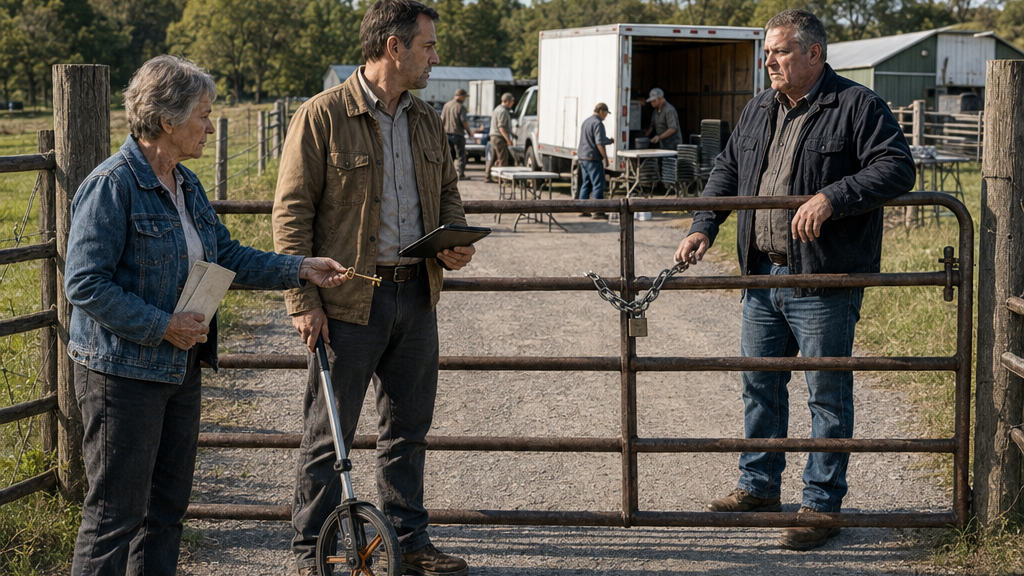
The chain across the farm road was new.
Daniel Wright knew that before he even shut off his county truck. The galvanized links were too bright, the brass-colored padlock too clean, and the heavy metal gate had never before been secured during daylight.
An older woman stood beside it with one hand wrapped around a small key.
Margaret Nelson.
She lifted the key when Daniel approached, as if the problem might explain itself.
“It used to open that gate.”
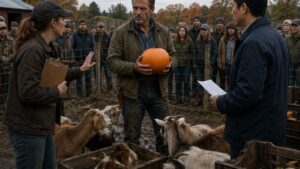
Beyond the fence, workers unloaded folding chairs from an enclosed trailer. A temporary tent stood beside the cooperative’s equipment shed. Two men rolled sections of portable flooring toward the gravel loading area.
Daniel looked from the activity to Margaret.
“What happened?”
“Raymond changed the lock.”
She held a folded paper against her coat with her other hand.
Before Daniel could answer, Raymond King came down the gravel lane from inside the yard.
He moved quickly for a man carrying the confidence of someone who expected everybody else to move first.
“Daniel.” Raymond spread his hands. “Glad you’re here. You can straighten this out.”
Margaret gave a short, humorless laugh.
“That’s what I’m hoping.”
Raymond stopped beside the gate.
“This is a cooperative event. Private today. We’ve got contractors setting up, food service coming in, and close to four hundred people expected tonight. We can’t have farm traffic cutting through.”
Margaret’s fingers tightened around the old key.
Daniel examined the chain without touching it.
“How long is the closure?”
“Today.”
“And notice went out?”
Raymond hesitated only slightly.
“To members.”
“I didn’t get anything,” Margaret said.
Raymond looked at her rather than Daniel.
“You don’t use the cooperative like you used to.”
Her expression changed.
Daniel recognized the shift immediately. It was the moment when a property disagreement stopped being about measurements and became about who somebody believed had the right to belong.
He kept his voice level.
“Margaret, what were you trying to access?”
“The gathering shed.”
Raymond exhaled sharply.
“That’s part of the event footprint.”
Margaret unfolded the paper she had been holding.
It was not a complaint form.
It was a memorial program.
Daniel caught only a photograph of a gray-haired man before Margaret folded it again.
“My husband’s service is tomorrow,” she said. “We were bringing tables in this morning. Our neighbors were helping.”
Daniel looked beyond the gate. The cooperative shed sat perhaps two hundred yards down the lane, beyond the machinery lot.
Raymond shook his head.
“I already told her we can work something out another weekend.”
“Another weekend?” Margaret said.
“We’ve rented the site.”
“You rented my road?”
“No one rented your road.”
“My husband drove that road for forty-three years.”
Raymond turned toward Daniel.
“This is exactly why I called you. She thinks historical use equals ownership.”
Daniel disliked the phrasing. Not because it was necessarily wrong, but because Raymond had already decided what the dispute meant.
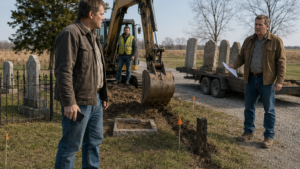
Daniel walked to the gatepost.
A faded county marker remained bolted to it, almost hidden beneath an old vine. He brushed the leaves aside and photographed it with his tablet.
Raymond noticed.
“You don’t need to start a case.”
“I haven’t.”
“Good.”
Daniel looked down the lane again. A caterer’s truck was backing toward the shed. Orange cones narrowed one shoulder.
“Is the road completely closed?”
“To through traffic.”
“What about emergency access?”
“The gate opens.”
Margaret raised her useless key.
“For him.”
Raymond’s jaw hardened.
Daniel felt his phone vibrate.
Carolyn Green.
He stepped toward his truck and answered quietly.
“What have you got?” she asked.
“Shared-road dispute at the cooperative. New lock. Private event tonight.”
Carolyn paused.
“Temporary?”
“That’s what Raymond says.”
“Then treat it as temporary unless you see a safety issue.”
Daniel glanced at Margaret.
She stood beside the gate staring through it, not at Raymond, not at him.
Carolyn continued.
“We do not need an enforcement fight with the cooperative in the middle of harvest season. Verify access, document it, get everybody through the weekend.”
Daniel knew what she meant.
Solve it without making it exist permanently.
His annual review was three weeks away. The senior inspector position had been vacant since spring. Nobody had promised it to him, but Carolyn had used phrases like strong candidate and good timing often enough that Daniel had allowed himself to believe the next few weeks mattered.
“I’ll check the record,” he said.
“Good. Keep it small.”
The call ended.
When he returned to the gate, Raymond was speaking to one of the contractors.
“We need the service trailer inside by eleven.”
Daniel looked at his watch.
“You have four hundred people coming?”
“Just under.”
“For a cooperative banquet?”
“Fundraiser. Harvest dinner. Sponsors, vendors, families.”
“And you’re charging admission?”
Raymond gave him an impatient look.
“We’re trying to keep this place operating.”
That answer caught Daniel more than the defensiveness.
Margaret stepped closer.
“I’m not asking him to shut down your dinner.”
Raymond looked at her.
“You’re asking me to open an active event site.”
“I’m asking to use the road I’ve always used.”
Daniel crouched beside the gatepost. On the ground, almost covered by gravel, was an old iron survey pin.
That was enough to make him stop treating the dispute as simple.
He entered a note into his tablet.
Historical access marker present. Ownership/easement status to verify.
Raymond saw the screen.
“You know whose land this is.”
“I know whose tax parcel this is,” Daniel said.
“That ought to be enough.”
“It isn’t always.”
Margaret looked at Daniel for the first time with something other than frustration.
Not trust exactly.
But attention.
Daniel straightened.
“I’m going to the records office. Until I know what the recorded access says, don’t make any changes to the gate.”
Raymond pointed toward the workers.
“Daniel, the changes are already made.”
“Then don’t make any more.”
Raymond lowered his voice.
“You’re making this bigger than it is.”
Daniel almost answered that Raymond had put the chain there.
Instead, he picked up his tablet.
Margaret opened her palm.
The old key lay across it, worn nearly smooth around the teeth.
“My husband cut that key himself,” she said.
Daniel glanced toward her.
“For this lock?”
“For the lock before this one. And the one before that.”
Raymond sighed.
“Margaret—”
“No.” She kept looking at Daniel. “You want to know why we always had a key?”
Daniel waited.
She pointed down the gravel road.
“My husband helped build that road.”
Chapter 2: The Easement Nobody Had Needed to Mention
The easement language was exactly where Raymond had said it would not be.
Daniel found it in a scanned plat recorded more than thirty years earlier, attached to a parcel transfer that predated the cooperative’s current structure.
The county clerk enlarged the image on her monitor.
“There.”
Daniel leaned closer.
A narrow hatched strip followed the gravel lane from the county road through the cooperative property and toward three adjoining farms.
The handwritten notation had been typed into the later index:
Shared agricultural ingress and egress; access not to be unreasonably obstructed.
Daniel read it twice.
“Anything newer that releases it?”
“Nothing I can see.”
“Modification?”
The clerk searched again.
“No.”
Daniel placed Margaret’s old key on the counter beside the printed survey map. It looked insignificant there.
The clerk tapped another line.
“There’s emergency-access language too.”
Daniel followed her finger.
The right-of-way was wider than the existing traveled surface, designed to keep the corridor available for fire equipment and farm machinery.
That complicated things immediately.
He called the volunteer fire chief from the records office parking lot.
The chief answered on the fourth ring.
Daniel described the gate and temporary event setup.
“How wide at the cones?” the chief asked.
“Maybe fourteen feet. Less where the service trailer is staged.”
“For a brush truck, probably manageable. Tanker, depends. If that gate sticks or somebody parks wrong, no.”
“Would you call it obstructed?”
“I’d call it something I wouldn’t want to discover at two in the morning.”
Daniel wrote the sentence down without attributing it verbatim.
By the time he returned to the property, Margaret was waiting near the edge of her hay field.
The road crossed the cooperative ground beyond the fence, then curved along her lower pasture.
Daniel spread the copied plat across the hood of his truck.
Margaret put the old key beside it.
“You found something.”
“Yes.”
She did not smile.
Daniel pointed to the shaded corridor.
“This easement crosses the cooperative parcel. Agricultural access. Emergency access. It doesn’t give you ownership of their yard, but they can’t simply block the lane whenever they want.”
Margaret studied the map.
“My husband knew that.”
“Did he ever mention the document?”
“He mentioned promises.”
Daniel looked at her.
“That’s not the same thing.”
“No.” She touched the edge of the map. “Documents usually show up after people stop keeping promises.”
Daniel had heard property disputes summarized many ways. He had never heard that one.
A pickup slowed on the county road. The driver looked toward them, then continued.
Margaret noticed.
“By tonight everybody will say I called the county to shut the cooperative down.”
“Did you?”
“I called because Raymond told me I could rent the gathering shed next month.”
Her mouth tightened.
“I buried my husband six days ago.”
Daniel said nothing.
She picked up the memorial program but did not open it.
“We chose tomorrow because that shed is where he had coffee every Saturday for twenty years. People know how to get there. Some of them are too old to walk from my house.”
Daniel folded the plat.
“I can establish that you have access rights. That doesn’t automatically settle use of the shed.”
“I know.”
Her answer surprised him.
“I’m not asking you to invent a right I don’t have.”
That sentence followed him back to his truck.
It was easier when complainants wanted too much. Easier when the law gave him room to say no to everyone equally.
His tablet showed three prior inspection files associated with the cooperative.
Daniel opened the oldest.
Temporary equipment staging—no action.
The next:
Seasonal loading obstruction; resolved informally.
Then:
Gate closure during auction event; access restored same day.
His initials were on all three.
He sat motionless.
He remembered each one.
In one case, a combine had been blocking the lane for less than two hours during soybean harvest. In another, trailers had crowded the shoulder during a livestock auction. He had spoken to Raymond, waited until traffic moved again, and closed the complaints without formal violations.
At the time, it had seemed reasonable.
Practical.
Nobody had been trapped. Nobody had missed a memorial.
But the files contained no written limits. No condition stating that the lane could never be locked. No instruction requiring notice to easement holders.
Daniel had treated discretion as if everyone understood where it ended.
Raymond apparently had learned a different lesson.
Daniel returned to the gate.
Workers now carried crates toward a portable bar near the equipment shed. White tablecloths covered rows of tables.
Raymond stood talking to an event contractor.
When he saw Daniel, he excused himself.
“Well?”
Daniel held up the plat.
“There’s a recorded easement.”
Raymond’s expression did not change.
“For farm access.”
“Yes.”
“Margaret isn’t hauling cattle.”
“It also says ingress and egress.”
“For the benefiting parcels.”
“She owns one.”
Raymond rubbed his jaw.
“Fine. I’ll open it when she needs through.”
“She needed through three hours ago.”
“We were setting up.”
Daniel looked toward the cones.
“And you’re restricting emergency width.”
“That’s temporary.”
“Temporary still counts.”
Something sharpened behind Raymond’s eyes.
“You seem pretty certain today.”
Daniel did not answer.
Raymond stepped closer to the truck.
“Did you pull your own files?”
There it was.
Daniel looked at him.
Raymond reached into a folder tucked beneath his arm.
“I did.”
He handed Daniel photocopies.
Daniel recognized his initials before he read the dates.
Raymond tapped the first page.
“Equipment auction. Gate closed.”
Second page.
“Harvest staging. Road obstructed.”
Third.
“County note: resolved informally.”
Margaret had walked up behind Daniel.
She could see the pages.
Raymond looked from her to Daniel.
“You inspected every one of these.”
Daniel felt the old key in his shirt pocket where Margaret had asked him to hold it while she folded the map.
Raymond lowered his voice.
“You didn’t call them violations then.”
Margaret’s gaze moved to Daniel.
“What is he talking about?”
Daniel could have said the circumstances were different.
They were.
He could have said no prior closure had been this extensive.
True.
He could have explained that enforcement depended on duration, impact, notice, safety.
Also true.
But Raymond was holding something simpler than those distinctions.
A pattern.
Daniel took the copies.
“I need to review these.”
Raymond gave a thin smile.
“You already did. You signed them.”
Chapter 3: He Knew Exactly Which Rule Daniel Had Ignored
Raymond laid Daniel’s old inspection notes across the cooperative office table like cards in a hand he had been waiting years to play.
The room smelled of machine oil and burnt coffee. Through the open office door, banquet workers moved between the equipment shed and the gravel lane.
Daniel remained standing.
Margaret stood near the doorway.
Raymond tapped one report.
“Two years ago. Auction trailers blocked the lane for most of an afternoon.”
“Traffic could still pass.”
“Barely.”
“Emergency access was maintained.”
Raymond moved to the next.
“Last fall. Grain trucks.”
“No locked gate.”
“But obstruction.”
Daniel felt the argument narrowing around him.
Not because Raymond was entirely right.
Because he was right enough.
Raymond leaned back.
“You came out. You looked. You told us to clear it when we were done. Nobody got cited.”
Daniel said, “That doesn’t authorize you to lock an easement.”
“No. It tells me how this county has handled temporary disruptions for years.”
Margaret looked at Daniel.
“You knew they did this?”
“I knew there had been short-term access problems.”
“And you never made them put anything in writing?”
Daniel hesitated.
That was answer enough.
Margaret took the old gate key from his pocket when he offered it back.
Her fingers closed around it.
“You told me you were checking whether I belonged on that road.”
“I was checking the legal status.”
“You already knew they closed it.”
“Not like this.”
Raymond gave a quiet laugh.
Margaret turned toward him.
“Don’t.”
He stopped.
Daniel looked at the spare gate key hanging from a nail behind Raymond’s desk.
The new one.
Bright metal on a red plastic tag.
One man now possessed the object that decided who passed and who waited.
Daniel’s phone buzzed.
Carolyn.
He answered inside the office.
“I saw your preliminary notes,” she said.
“I haven’t filed a violation.”
“Good.”
“There’s a recorded easement. And emergency-access concerns.”
“How serious?”
“Correctable.”
“Then correct them.”
Daniel glanced at Raymond.
“He locked out an easement holder.”
“Today?”
“Yes.”
“Daniel, you have documented three prior closures as informal resolutions.”
He said nothing.
Carolyn’s voice became quieter.
“I’m not accusing you of anything. I’m telling you what this becomes if you reverse course without a very clear distinction.”
“There is a clear distinction.”
“Then write it carefully.”
Raymond watched Daniel’s face.
Carolyn continued.
“And understand the timing. Your senior review is coming up. A politically messy enforcement case where your own prior files are involved will get attention.”
Daniel stepped outside.
“Are you telling me not to enforce it?”
“I’m telling you not to turn a solvable access dispute into a countywide precedent because you’re angry about one manager.”
“I’m not angry.”
“Good. Stay that way.”
The call ended.
When Daniel went back inside, Margaret was gone.
He found her at the gate.
She was putting the folded memorial program into her truck.
“Margaret.”
She shut the door harder than necessary.
“I owe you an explanation.”
“You owe me the truth.”
Daniel nodded.
“I let temporary closures go before.”
“Why?”
“Because they ended quickly. Because harvest work gets messy. Because writing citations can sometimes make people dig in instead of fixing the problem.”
“And because it was easier.”
He looked at her.
“Yes.”
She seemed almost disappointed that he agreed.
Daniel continued.
“I thought I was using judgment.”
“Maybe you were.”
“That doesn’t mean I used enough.”
Margaret stared through the gate.
“My husband used to say a gate tells you what a person thinks of his neighbors.”
Daniel glanced at the chain.
“What did he mean?”
“If it swings easy, you expect people. If it stays locked, you expect trouble.”
She got into her truck.
“Are you going home?”
“I’m moving the memorial tables to my barn.”
“Margaret—”
She closed the door.
“I asked for help because I thought this was new.”
The truck pulled away.
Daniel stood alone beside the gate.
That hurt more than Raymond’s papers.
He returned to his county truck and opened every cooperative file on his tablet.
He read them without defending himself.
His past notes were technically defensible. None of the earlier events exactly matched the present situation.
But something else was equally clear.
He had never required a written access protocol because it would have meant confronting a cooperative everyone depended on.
He had called that restraint.
Raymond had called it permission.
A service truck approached from the county road and stopped at the locked gate.
The driver honked.
Raymond came from the yard, unlocked the chain, let the truck through, then secured the gate again.
Daniel watched the entire sequence.
Only Raymond had control.
That was the point.
Daniel took his measuring wheel from the truck.
Raymond saw him.
“What are you doing?”
“Inspection.”
“I thought we settled this.”
“We clarified my earlier files.”
“That’s what I mean.”
Daniel measured the clear width between the event cones.
Then the gate opening.
Then the narrowed section beside a parked refrigeration trailer.
Raymond followed him.
“Daniel.”
Daniel photographed the measurements with his county tablet.
The system automatically logged time and location.
Raymond’s voice hardened.
“You really want to put this in the database?”
Daniel photographed the locked chain.
“Why wouldn’t I?”
“Because once you flag it, planning has to review it. Fire may review it. The cooperative board gets dragged in. Every temporary closure in this district becomes somebody’s complaint.”
Daniel entered the measurements.
Raymond stepped closer.
“And because Carolyn is deciding who gets that senior position.”
Daniel stopped typing.
Raymond had hit the exact place he intended to hit.
“You think I don’t know how counties work?” Raymond said. “You think I don’t know what happens to employees who create problems their supervisors told them to solve quietly?”
Daniel looked at him.
“This road isn’t yours to close alone.”
“For one day.”
“You changed the lock.”
“To control event traffic.”
“You denied a recorded user access.”
“She can get through if she asks.”
Daniel looked toward the gate.
“That’s not shared access. That’s permission.”
Raymond’s mouth tightened.
Behind him, several workers had stopped pretending not to listen.
Daniel lowered his voice.
“Move the refrigeration trailer twenty feet. Restore emergency width. Open the gate.”
“And destroy the event setup?”
“No.”
“Then what exactly do you want?”
For years Daniel would have answered with a compromise before he had established the violation.
That habit rose automatically.
He could hear himself saying: Keep one side clear and we’ll revisit Monday.
He almost said it.
Then he thought of Margaret asking whether he already knew.
Daniel touched the screen.
A warning appeared:
Submit formal field violation?
Once submitted, the entry would become part of the county case record.
Raymond saw the prompt.
“Think.”
Daniel did.
He thought about his review.
About Carolyn.
About his mortgage.
About eleven years of being known as the inspector who could usually settle things without embarrassing anybody.
Then he thought about the old gate key that no longer opened the gate it had opened for decades.
He pressed submit.
The tablet confirmed the upload.
Raymond stared at him.
Daniel’s pulse hammered, but his voice remained steady.
“Restricted recorded access. Emergency corridor obstruction. Formal review initiated.”
For several seconds, Raymond said nothing.
Then he nodded slowly.
“You just made your own files part of this.”
“I know.”
“And when they ask why this one suddenly mattered?”
Daniel looked toward the road where Margaret’s truck had disappeared.
“I’ll answer.”
His tablet chimed again.
Case record created.
There was no taking it back now.
Chapter 4: The Banquet Was Paying for More Than Dinner
By six that evening, Daniel had enough authority to stop the banquet.
That was the problem.
The formal violation sat in the county system with his name attached to it. The fire-access issue remained unresolved. The gate was still controlled by Raymond alone. Under the strictest reading of county procedure, Daniel could issue a temporary stop-use order and force the contractors to dismantle everything before the first guest arrived.
He was standing beside the loading yard preparing that order when a neighboring cattle farmer pulled up in an old pickup and asked him not to.
“You shut them down tonight,” the farmer said, “I lose my fuel account Monday.”
Daniel lowered the tablet.
“What does tonight have to do with your fuel account?”
The farmer looked toward the cooperative office.
“You better ask Raymond.”
Ten minutes later, Daniel sat across from Raymond at the same desk where his old inspection reports had been displayed.
This time Raymond did not put anything between them except a thin ledger and a stack of invoices.
“You wanted the whole story,” he said. “Here it is.”
Daniel opened the ledger.
Insurance premiums.
Bulk diesel purchases.
Equipment maintenance.
Property taxes.
A repair bill for the cooperative’s grain auger.
The numbers were not catastrophic individually. Together, they showed a business with almost no room left.
Daniel looked up.
“The banquet pays for this?”
“It helps.”
“How much?”
“Enough that losing it hurts.”
“That isn’t an answer.”
Raymond stared at him for a moment, then turned the ledger around and pointed to a column.
Daniel calculated silently.
The expected proceeds would not save the cooperative. But they would cover several months of the insurance increase and preserve the bulk-fuel discount through the end of the season.
Raymond leaned back.
“Three farms are already late on service accounts. One family had a tractor transmission go out two weeks before cutting. We carried them.”
“That doesn’t give you the right to block the easement.”
“I know what it gives me.”
“What?”
“A reason not to let this place die because one widow wants a room on the wrong weekend.”
Daniel closed the ledger.
The sentence hung between them.
Raymond seemed to hear it after he had said it.
His expression changed slightly.
Not regret.
Recognition.
“She shouldn’t have been treated that way,” he said.
“But she was.”
“Yes.”
“By you.”
Raymond looked toward the office window.
Outside, contractors strung lights along the edge of the loading yard. Families would begin arriving within an hour.
Daniel noticed the new gate key on the wall.
“You knew about the easement.”
Raymond did not answer.
“Raymond.”
“I knew there was access language.”
“That’s not what you told me this morning.”
“I said the cooperative owned the land.”
“You said there wasn’t an easement.”
“I said there wasn’t one that stopped temporary operational control.”
Daniel studied him.
“So you knew.”
Raymond rubbed both hands across his face.
“Yes.”
The admission should have made Daniel’s decision easier.
Instead, it made everything worse.
Because Raymond was not confused.
He had weighed the restriction against the cooperative’s financial pressure and decided the restriction could be ignored.
Daniel pushed back his chair.
“Then this wasn’t a mistake.”
“No.”
“At least we agree on something.”
Raymond stood too.
“You think I enjoyed changing that lock?”
“I don’t know.”
“I had vendors paying for exclusivity. Food trucks needed controlled access. Sponsors wanted the yard clear. Half the people coming tonight wrote checks because we promised them an actual event, not tractors rolling between their tables.”
“You could have notified the easement holders.”
“And if Margaret said no?”
“You negotiate.”
“I did.”
“You told her to rent the shed next month.”
Raymond looked away.
Daniel picked up his tablet.
“I can close the event.”
“I know.”
“I probably should.”
Raymond reached toward the wall, lifted the bright spare key from its nail, and placed it on the desk.
“Then do it.”
Daniel did not move.
Raymond continued.
“Close it. Make me send everybody home. Monday morning you can explain to the cattle farmer why his fuel bill jumps. You can explain to the family with the broken tractor why we don’t have the money to float their repair. You can tell everybody you protected the principle.”
Daniel felt irritation rise.
“You don’t get to make me responsible for choices you made.”
“No. I’m telling you the choices are real.”
That was harder to dismiss.
Daniel walked outside with the key in his hand.
The refrigeration trailer had been moved. The emergency corridor was now wide enough for a tanker. Raymond had complied with that part without argument.
Daniel photographed the corrected width.
A small payoff.
A practical correction.
But the locked gate remained.
He could still shut everything down.
His phone vibrated.
Carolyn.
He let it ring once before answering.
“I saw the formal violation,” she said.
“I assumed you would.”
“You also uploaded fire-access measurements.”
“Yes.”
“Is the emergency issue corrected?”
“Mostly.”
“Then think carefully before you escalate the land-use portion tonight.”
Daniel looked through the gate at the lights.
“Because of my review?”
“Because this cooperative matters to people who have nothing to do with Raymond’s decision.”
Her tone was controlled, but not soft.
Daniel said, “That sounds like an argument for letting them do whatever they want.”
“No. It is an argument for understanding consequences.”
For the first time all day, he could not tell whether Carolyn was protecting the county, protecting him, protecting the cooperative, or all three.
“I’ll call you back,” he said.
He drove to Margaret’s farm.
She was in the barn with two folding tables and several boxes of paper cups. The memorial program sat on a bale of hay.
Daniel told her what he had learned.
The finances.
The fuel accounts.
The repair assistance.
The banquet revenue.
Margaret listened without interrupting.
When he finished, Daniel said, “I can stop the event.”
She looked at him.
“Tonight?”
“Yes.”
“And what happens to the cooperative?”
“They’ll lose the revenue.”
“How much?”
“Enough to hurt.”
Margaret looked down at the folded program.
Daniel expected anger.
Instead, she said, “Then don’t destroy it.”
He stared at her.
“Margaret, Raymond knew about the easement.”
“I figured he did.”
“He changed the lock anyway.”
“I know.”
“He denied you access to your husband’s memorial.”
“I was there.”
“I can stop this.”
She finally looked up.
“I didn’t ask you to burn the barn because somebody stole my shovel.”
Daniel said nothing.
Margaret picked up the memorial program.
“I want my road back,” she said. “I want Raymond to stop acting like a shared gate belongs to whoever has the newest padlock.”
She folded the paper once more.
“But I do not want three families losing what they need because he was too proud to ask them for help.”
Daniel looked back toward the cooperative lights glowing beyond the field.
For the first time since he had pressed submit, enforcement no longer looked like the same thing as justice.
Chapter 5: Margaret Refused the Victory Everyone Expected Her to Want
Margaret refused to sign the shutdown request before Daniel had finished explaining it.
“No.”
He kept the form on the kitchen table.
“You haven’t read it.”
“I heard enough.”
Sunday morning light came through the farmhouse window and fell across the old gate key, the memorial program, and Daniel’s unsigned emergency-use recommendation.
Margaret poured coffee into two mismatched mugs.
“If I sign that, what happens?”
“The county can suspend event and commercial use of the cooperative yard pending review.”
“Starting today.”
“Yes.”
“The banquet is tonight.”
“Yes.”
She slid one mug toward him.
“Then no.”
Daniel had spent most of the night building the cleanest enforcement path he could find. The recommendation would restore access immediately, preserve the record, and prevent Raymond from using the same argument again.
It had seemed responsible at two in the morning.
Now Margaret looked at it as if he had misunderstood the problem completely.
“You said you wanted your access restored.”
“I do.”
“This does that.”
“It does more than that.”
Daniel rubbed his eyes.
“Sometimes enforcement does.”
“That’s exactly what Raymond told himself.”
The comparison landed harder than she probably intended.
Margaret sat across from him.
“You both think the person holding the authority gets to decide how much damage is acceptable.”
Daniel looked at the form.
“That’s not fair.”
“No.”
She took a sip of coffee.
“But it isn’t entirely wrong either.”
For a while, the refrigerator was the only sound in the room.
Then Margaret reached for the folded memorial program.
This time she opened it.
The photograph showed her husband leaning against an old tractor, one boot on the axle, smiling at someone outside the frame.
Daniel had seen hundreds of memorial photographs. This one did not look selected for dignity. It looked selected because it was true.
“He hated meetings,” Margaret said.
Daniel waited.
“But he never missed a cooperative workday.”
She pointed through the kitchen window toward the distant lane.
“When that road washed out twenty-seven years ago, the county said they couldn’t get to it for weeks. The cooperative didn’t have money. So he took our loader down there.”
“He built the road?”
“Not alone.”
She gave Daniel a look.
“Nobody builds anything alone out here, no matter what they tell you later.”
She described neighbors bringing gravel in farm trucks, one family lending a grader, another feeding everyone from coolers. The cooperative had been close to failing then too.
Her husband had spent three days repairing the lane.
When the gate was installed years later, duplicate keys had been cut for the properties that depended on the road.
“That key was never about the lock,” Margaret said.
Daniel looked at the worn metal between them.
“What was it about?”
“Knowing you didn’t have to ask.”
He understood then why Raymond’s offer to open the gate whenever Margaret requested access had been insufficient.
Permission was not the same as a right.
Margaret touched the edge of the memorial program.
“My husband would have been furious about what Raymond did.”
Daniel almost smiled.
“Sounds like him.”
“You never met him.”
“I’ve met enough farmers.”
She gave him the faintest smile back.
Then it disappeared.
“He also would have been furious with me if I shut down the cooperative over his memorial.”
Daniel leaned back.
“So what do you want?”
“I told you.”
“The road open.”
“Yes.”
“The memorial in the gathering shed.”
“If possible.”
“And Raymond prevented from controlling access alone.”
“Yes.”
Daniel considered the banquet layout he had photographed.
The event did not actually require the gathering shed.
Most of the tables were in the loading yard and adjacent equipment building. The private vendors had expanded into the shared corridor because it was convenient.
“What if the banquet moved entirely to the west yard?”
Margaret frowned.
“Can they?”
“Probably. It would mean moving the bar, some tables, and the service entrance.”
“Would the road stay open?”
“Yes.”
“The shed?”
“Separated from the event.”
Margaret looked toward the window.
“And tonight?”
“Tonight they lose some convenience. Maybe some vendor space. Not the whole event.”
She nodded once.
“Then make them move.”
The directness almost made Daniel laugh.
Instead, he pulled the county map from his folder.
They spent twenty minutes going over the physical layout.
The more he looked, the clearer the remedy became.
Not closure.
Conditions.
Open the easement corridor immediately.
Move commercial event activity outside it.
Keep the emergency width unobstructed.
Separate the gathering shed from paid event use until the permit question was resolved.
Require a written key and access protocol before any future closure.
Margaret watched him write.
“You think Raymond will agree?”
“No.”
“Carolyn?”
“Also no.”
“Good.”
Daniel looked up.
Margaret shrugged.
“Probably means you finally found the middle.”
He packed his folder.
At the door, she called after him.
“Daniel.”
He turned.
She placed the old key on top of the memorial program.
“My husband never cared who owned the gate.”
Daniel waited.
“He cared who got a key.”
That sentence stayed with him all the way back to the county office.
By noon, Daniel had drafted a conditional-use correction instead of a shutdown order.
It protected the easement.
Preserved emergency access.
Allowed the cooperative to keep operating.
Restricted commercial use of the shared corridor.
Required documented access procedures.
And included one provision Daniel knew both Raymond and Carolyn would hate:
A formal administrative review of prior county handling—including Daniel’s own.
He read the last line twice.
Then he saved the draft.
There would be no clean way forward now.
Only an honest one.
Chapter 6: The County Record Became Harder to Bury Than Daniel
Carolyn Green read Daniel’s proposed correction order standing beside his truck in the cooperative yard.
When she reached the last page, she looked up.
“You included yourself.”
“Yes.”
“You did not need to do that.”
“Yes, I did.”
“No, Daniel. You needed to document the present violation. You did not need to write an invitation for administration to review three years of your discretion.”
“They’re already relevant.”
“Because Raymond made them relevant.”
“Because I did.”
Carolyn closed the folder.
It was Sunday afternoon. The banquet contractors had returned, but nobody was moving tables yet. Daniel’s temporary hold on the disputed corridor remained in effect while the county decided what came next.
Raymond stood fifty yards away beside the equipment shed.
Carolyn lowered her voice.
“You can still classify the earlier cases as distinguishable temporary conditions.”
“They were distinguishable.”
“Then say that.”
“I did.”
“And stop there.”
Daniel looked toward the gate.
The chain hung loose now but remained threaded through the metal bars. Raymond had opened it that morning after Daniel issued an interim access instruction, yet he had kept the padlock in his possession.
Carolyn followed Daniel’s gaze.
“You’ve got compliance.”
“For today.”
“What more do you want?”
“A system that doesn’t depend on whether Raymond feels cooperative.”
Carolyn handed the folder back.
“You’re turning this into policy.”
“It should have been policy years ago.”
“That is not your decision alone.”
“No. But documenting why we need one is.”
For a moment, neither spoke.
Then Carolyn said, “Your senior review is Wednesday.”
Daniel had known the date.
Hearing it aloud changed the air between them.
“I know.”
“I was prepared to recommend you.”
He looked at her.
“Was?”
“I’m telling you what this report does. It creates questions about your prior enforcement decisions and it puts this office into a dispute with a cooperative that half the county considers essential.”
Daniel felt the old reflex rise.
Adjust the wording.
Narrow the finding.
Solve the visible problem and let the rest disappear into professional discretion.
Carolyn saw the hesitation.
“One final chance,” she said. “Downgrade the access violation to corrected-on-site. Keep the fire-lane finding. Require a future access agreement informally. Nobody has to pretend nothing happened.”
“And the lock?”
“Removed.”
“The commercial use?”
“Relocated.”
“My earlier files?”
“Unrelated unless somebody appeals.”
It was the easiest defensible answer he had heard all weekend.
That frightened him more than Raymond’s threats.
Because he could live with it.
He could explain it.
He could probably get promoted with it.
Raymond approached before Daniel answered.
“Are we done?”
Carolyn looked at Daniel.
Daniel said, “The west-yard relocation works.”
Raymond’s shoulders dropped slightly.
“The event can continue?”
“Conditionally.”
“Fine.”
“The shared corridor stays open. The gathering shed remains outside the paid event footprint. No parking in the emergency lane.”
“Fine.”
“And we need a written access protocol.”
Raymond’s expression tightened.
“We can draft one Monday.”
“Not just you.”
“I said we.”
“Easement holders get keys.”
Raymond looked toward Margaret’s farm.
“That part can be discussed.”
“No.”
Daniel’s voice was quiet.
“That part is not a discussion.”
Raymond turned to Carolyn.
“Is he issuing policy now?”
Carolyn said nothing.
Daniel opened his tablet.
“The recorded right of access already exists. The key procedure is how you stop interfering with it.”
Raymond stared at him.
“You realize what happens if you submit all of this.”
Daniel did not answer.
Raymond stepped closer.
“You think the board is going to thank you because you found a compromise?”
“This isn’t about thanks.”
“No. It’s about your job.”
Carolyn said, “Raymond.”
But he continued.
“You flag prior county handling, you drag Daniel’s own inspections into review. You drag your office into review. You make every farm lane with an informal arrangement somebody’s legal question.”
Daniel said, “Maybe some of them should be.”
Raymond laughed once, without humor.
“You know what? Fine. Do it.”
He pulled the new gate key from his pocket and held it up.
“This is what you wanted?”
Daniel looked at the key.
“No.”
Raymond lowered his hand.
“I want you not to be the only person who has one.”
The workers nearby had grown quiet.
Daniel disliked the audience. He had never wanted confrontation to become performance.
He stepped away from them and walked to the gate.
Then he began documenting.
First photograph: the chain loosened but still present.
Timestamp.
GPS coordinates.
Second: restored emergency width.
Third: refrigeration trailer relocated.
Fourth: commercial bar equipment moved outside the easement boundary.
Fifth: entrance to the gathering shed cleared.
Each image uploaded directly to the county case.
Raymond followed.
“You really have to put all of that in?”
“Yes.”
“Why?”
“Because tomorrow nobody should have to remember what happened.”
Daniel measured the open corridor again.
He entered the numbers.
Carolyn stood beside his truck, arms crossed.
Daniel reached the final section of the report.
Corrective action recommendation.
He selected conditional operation.
The banquet could proceed.
Raymond read over his shoulder.
“You’re not closing us?”
“No.”
For the first time since Saturday morning, Raymond looked genuinely uncertain.
Daniel continued.
“You move the remaining tables. Keep this lane clear. The shed stays available for Margaret’s memorial. Monday, the cooperative submits an access plan. No future lock change without keys issued to recorded users.”
Raymond looked toward the lights waiting to be switched on in the west yard.
“That’ll cost us.”
“Yes.”
“But not tonight.”
“No.”
Something in Raymond’s face eased.
Then Daniel reached the disclosure section.
Raymond saw the text.
Prior informal enforcement actions may have contributed to inconsistent expectations regarding temporary closures.
Raymond’s expression hardened again.
“You’re putting that in?”
“Yes.”
“That isn’t necessary.”
Carolyn walked closer.
Daniel said, “It is for me.”
Raymond shook his head.
“You’re throwing away your advancement over wording.”
“No.”
Daniel looked at the old inspection dates displayed beneath his disclosure.
“I’m acknowledging why this got this far.”
Raymond pointed toward the tablet.
“You can still delete that paragraph.”
Daniel thought of Margaret standing outside the locked gate with a key that no longer mattered.
He thought of every time he had written resolved informally and driven away satisfied because nobody had yelled.
Maybe some of those had been good decisions.
Maybe most had.
But professional judgment had become a hiding place when he stopped asking who bore the cost of keeping things quiet.
He pressed submit.
A confirmation window appeared.
Daniel read it before accepting.
Formal record cannot be altered after submission without administrative amendment.
He touched confirm.
The tablet chimed.
Carolyn looked away.
Raymond did not.
“You just ended your promotion.”
Daniel slid the tablet back into its case.
“Maybe.”
“That’s all you have to say?”
Daniel looked toward the west yard where contractors had begun moving tables.
“No.”
He pointed at the gate key still in Raymond’s hand.
“I need that.”
Raymond stared at him.
“The key?”
“Until the access protocol is filed.”
“You’re confiscating it?”
“I’m taking control of the lock so no one person controls the easement overnight.”
For several seconds, Raymond did not move.
Then he dropped the key into Daniel’s palm.
The metal was warm.
Daniel unlocked the chain, pulled it completely free from the gate, and placed both lock and key in an evidence bag.
The gate swung open wider than it had all weekend.
A truck from one of the neighboring farms came through slowly. The driver lifted two fingers from the steering wheel but did not stop.
No applause.
No celebration.
Just traffic moving where traffic had a recorded right to move.
Behind Daniel, Carolyn said, “Send me the full report.”
“I just did.”
Her phone buzzed almost immediately.
So did his.
Administrative review initiated.
Daniel read the notice once.
Then another message arrived beneath it.
Senior inspector recommendation: deferred pending review.
He stared at the words.
Raymond saw his face.
“Was I wrong?”
Daniel put the phone away.
“No.”
Raymond seemed almost disappointed.
Daniel looked through the open gate toward Margaret’s farm.
“But neither was the easement.”
The banquet lights came on in the west yard.
The shared road remained open.
And for the first time in years, Daniel had written a report that did not leave anyone else to guess where his judgment ended.
Chapter 7: The Gate Opened, but Nobody Walked Away Unchanged
The first thing Daniel noticed when he returned three weeks later was that the chain was gone.
Not hanging from the post.
Not looped loosely through the bars.
Gone.
The gate stood open across the gravel lane, its two sections pushed back against the fence as a feed truck rolled through without slowing.
Daniel parked his county truck near the shoulder.
He had not been assigned to the cooperative inspection that morning. Officially, he was there to verify the corrective-access plan after administrative approval.
Unofficially, he had wondered whether the gate would actually be open when nobody knew he was coming.
It was.
A weatherproof lockbox had been mounted to the inside post. Beneath it was a laminated access procedure listing emergency contacts, closure-notification requirements, and the recorded properties entitled to uninterrupted ingress and egress.
Nobody had written Raymond’s name larger than anybody else’s.
Daniel photographed it.
His tablet logged the location automatically.
The sound still tightened something in his chest.
Three weeks earlier, that same confirmation tone had marked the moment his senior recommendation was deferred.
The administrative review had not accused him of misconduct. His previous informal resolutions had been judged defensible but poorly documented. The written finding used phrases Daniel had come to dislike: inconsistent procedural clarity, insufficient prospective conditions, corrective coaching recommended.
His promotion remained postponed.
Not denied.
Carolyn had told him that distinction mattered.
Daniel was no longer sure how much.
“You checking whether we learned to read?”
Raymond stood near the equipment shed.
He looked tired.
Not defeated. Just smaller somehow without the gate key in his pocket.
Daniel lowered the tablet.
“Checking whether the plan matches the site.”
“It does.”
“I’ll decide that.”
Raymond nodded.
“Fair enough.”
That was new.
They walked the lane together.
The west yard had been restriped for event parking. Permanent markers now kept vehicles clear of the emergency corridor. The commercial permit had been amended so future events could use the cooperative buildings without occupying the shared road.
Nothing dramatic.
Paint.
Keys.
Paperwork.
Space left open where space was supposed to remain open.
Raymond stopped beside the lockbox.
“We made twelve duplicates.”
“Twelve?”
“Recorded users, emergency services, cooperative operations. Two spares sealed in the office.”
Daniel checked the list.
Margaret Nelson was near the top.
“You gave hers to her?”
Raymond looked toward the gathering shed.
“Was waiting.”
Daniel followed his gaze.
Several vehicles were parked beyond the gate.
Not banquet traffic.
Older pickups. A sedan. Two farm trucks.
People carried covered dishes toward the shed.
Daniel looked at his watch.
“The memorial?”
“Today.”
He had known Margaret rescheduled it. He had not known the time.
Raymond pulled something from his jacket pocket.
A new brass key on a plain metal ring.
“Administrative plan says she receives it directly.”
“It doesn’t say you have to deliver it.”
“I know.”
Daniel studied him.
Raymond shrugged.
“Doesn’t mean I shouldn’t.”
They found Margaret outside the gathering shed arranging folding chairs.
She saw Daniel first.
“You here to measure something?”
“Probably.”
“That sounds like government.”
He smiled.
Then she noticed Raymond.
Her hands stopped on the back of a chair.
Raymond did not approach quickly.
For once, he seemed unsure whether he had permission.
He held out the key.
“This is yours.”
Margaret looked at it without reaching.
“You change the lock again?”
“No.”
“That’s improvement.”
Raymond almost smiled.
“Key works on the gate lockbox and the shed service door. Same access as the written plan.”
Margaret finally took it.
She turned the small brass key between her fingers.
“Everybody gets one?”
“Everybody with recorded access.”
“Not because you decided?”
“No.”
The answer was quiet.
Margaret slipped the key onto the ring with her old one.
The two pieces of metal clicked together.
Daniel watched her compare them: one worn almost smooth from decades of use, the other sharp-edged and bright.
Raymond cleared his throat.
“I should have handled that Saturday differently.”
Margaret looked at him.
Daniel waited.
Raymond seemed to struggle with whatever came next.
Finally he said, “I had no right to make that decision alone.”
It was not an apology.
Not exactly.
Margaret appeared to notice that too.
“You had no right to make it at all.”
Raymond nodded once.
“No.”
Behind them, someone opened the gathering shed doors. Voices drifted out.
Raymond glanced toward the people carrying food inside.
“The cooperative’s still going to need events.”
“I know,” Margaret said.
“And we’re still going to have traffic problems sometimes.”
“I know that too.”
“So this plan won’t make everybody happy.”
Margaret held up the new key.
“Wasn’t expecting happiness.”
For the first time, Raymond gave an actual smile.
Brief.
Tired.
But real.
He stepped aside.
Margaret turned to Daniel.
“What happened with your promotion?”
He had expected the question eventually.
“Deferred.”
Her expression tightened.
“Because of this?”
“Because of several things.”
“That means yes.”
“It means they’re reviewing how I handled earlier cases.”
Margaret looked down at the keys.
“I’m sorry.”
Daniel surprised himself by shaking his head.
“I’m not.”
She studied him.
“That sounds noble.”
“It isn’t.”
He looked toward the gate.
“I wanted the promotion. Still do.”
“Then why aren’t you sorry?”
Daniel thought about it.
“Because now if I get it, I’ll know what kind of inspector they’re promoting.”
Margaret said nothing for a moment.
Then she nodded toward the shed.
“You planning to stand out here inspecting gravel all afternoon?”
“I wasn’t invited.”
“You are now.”
Daniel hesitated.
He was still on county time.
Margaret saw him glance at the truck.
“Five minutes.”
Raymond stepped away.
“I should go.”
Margaret looked at him.
There was a pause long enough for him to understand he had not been asked to stay.
But there was no anger in it.
Not anymore.
“Raymond.”
He stopped.
She pointed toward a table near the shed doors.
“There’s coffee.”
He looked at her.
“That all?”
“That’s what I’m offering.”
Raymond nodded.
“Coffee’s enough.”
Inside the gathering shed, a photograph of Margaret’s husband rested beside the folded memorial programs.
It was the same photograph Daniel had seen weeks earlier: the older man leaning against the tractor with one boot on the axle.
There were no speeches yet.
People moved chairs, opened casserole dishes, complained quietly about where somebody had parked.
Ordinary things.
Daniel stood near the doorway.
Margaret came beside him.
“He would’ve hated all this fuss.”
“The memorial?”
“The road.”
Daniel looked toward the open gate.
A late-arriving pickup turned in from the county road.
Nobody stopped it.
Nobody had to find Raymond.
Nobody had to ask permission.
Margaret rubbed the old key with her thumb.
“For years I thought this meant the gate was ours.”
Daniel looked at her.
She held up both keys.
“I had it backward.”
“How?”
“The gate doesn’t belong to everybody just because everybody has a key.”
She slipped them into her pocket.
“Everybody gets a key because the road belongs to more than one person.”
Outside, Raymond held the shed door for an older farmer carrying a tray.
The farmer walked through without acknowledging the gesture.
Raymond let the door swing shut behind him.
Daniel did not know whether Raymond would still be managing the cooperative five years from now.
He did not know whether his own promotion would come back next month, next year, or never.
The administrative review had corrected procedures. It had not repaired pride.
Maybe that was too much to ask from paperwork.
Margaret stepped outside.
“Come on.”
She walked toward the gate.
Daniel followed.
At the entrance she stopped beside the new lockbox, removed her new key, and opened it.
She checked the mechanism once, then closed it again.
The old key remained on the same ring.
Useless now, technically.
She had kept it anyway.
A truck approached slowly from the county road.
Margaret pushed the gate wider before it arrived.
The driver passed through and lifted a hand.
She lifted hers back.
Then she stood beside the open gate while people continued arriving for her husband’s memorial, each vehicle moving down the shared gravel road without stopping to ask who was in charge.
The story has ended.