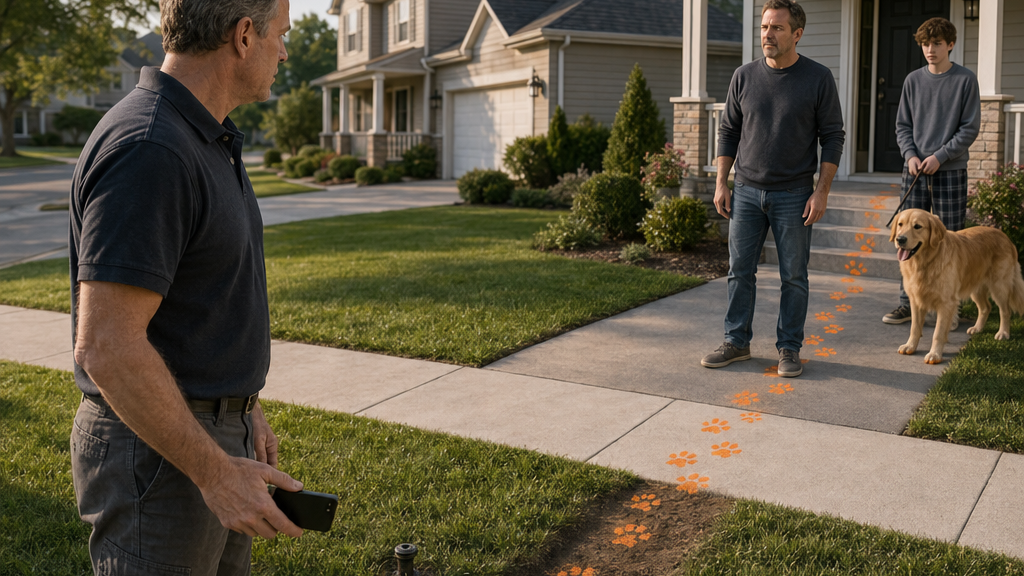
His Neighbor Called the Dead Lawn “Nothing”—Then the Orange Pawprints Reached the HOA Meeting
Chapter 1: The Brown Line Through Jack’s Perfect Lawn
The patch had not been there the night before.
Jack Miller knew that because he had stood in the same spot at seven-thirty the previous evening, hose in one hand, checking the edge where the lawn met the sidewalk. The grass had been dark, dense, and even enough that the mowing stripes remained visible after sunset.
Now, just after six in the morning, a pale brown oval interrupted the green.
Jack crouched and pressed two fingers into the blades.
Dry at the tips. Soft underneath.
He looked toward the sprinkler head three feet away. No pooling water. No broken nozzle. No obvious fungus.
“Wonderful,” he muttered.
He had spent most of spring getting the front yard back into shape after a rough winter. He had aerated it himself, overseeded thin sections, adjusted the irrigation schedule twice, and sharpened the mower blade because the old edge had begun tearing rather than cutting.
People in the neighborhood occasionally joked about his lawn.
Jack never minded.
He liked things maintained.
There was a difference between caring about appearances and caring about work, though he suspected most people did not bother making it.
By Wednesday, there were three brown spots.
By Friday, there were five.
He took photographs.
Not because he was planning a case against anyone. At least that was what he told himself.
He wanted to compare the damage from one day to the next.
Saturday morning, he carried a cup of coffee outside and stood at the top of his driveway studying the yard.
Something about the pattern bothered him.
The spots were not random.
One began near the sidewalk. Another sat roughly four feet beyond it. The next was farther up the slope, then another near the maple tree, then one close to the narrow strip separating his property from Ryan Mitchell’s.
Jack walked backward toward the street.
From there, he finally saw it.
The damage formed a line.
Not perfectly straight, but close enough.
A route.
He set his coffee on the porch rail and walked it again.
Sidewalk.
Front third of the lawn.
Maple tree.
Sprinkler.
Property edge.
Ryan’s yard.
Jack stopped.
Ryan lived next door with his teenage son and a golden retriever that seemed permanently delighted by existence. The dog was friendly enough. Jack had scratched its ears more than once when Ryan walked it past the house.
But lately, Jack remembered seeing it loose.
Not often.
Or at least he had not thought it was often.
He went inside, pulled up the photographs from the previous days, and swiped between them.
The pattern became clearer.
Each new damaged patch filled in another section of the same path.
Jack enlarged one photograph.
Near the sprinkler head, the grass looked pressed down.
He went back outside.
The soil around the sprinkler was still damp from the irrigation cycle.
Jack knelt.
There, beside the plastic rim, was a depression.
Four rounded toe marks.
A broad center pad.
He stared at it for several seconds.
Then he sat back on his heels.
“Come on.”
He took out his phone and photographed it from above.
Then from the side.
Then once more with his hand beside the impression for scale.
He immediately disliked that last photograph.
It looked too deliberate.
Too much like evidence.
Jack stood and brushed dirt from his knees.
The rational thing was to talk to Ryan.
Nothing had happened yet that required more than that.
Still, instead of walking next door, Jack spent the next twenty minutes inspecting the grass.
He found another flattened section beneath the maple.
Then a yellowed patch near the edge of the driveway.
Then something else: faint impressions where the soil met the concrete.
A repeated crossing.
Jack felt irritation rising, but underneath it was something more uncomfortable.
Satisfaction.
Not because the lawn was damaged.
Because the pattern made sense now.
He had been right to think the spots were connected.
That feeling bothered him enough that he put his phone away.
On Sunday afternoon, he reseeded the worst patch and marked the area with two small landscaping flags.
By Monday morning, one flag was tilted.
The soil was disturbed.
Jack straightened it and said nothing.
For two more days, he watched.
He never saw the dog.
Then Thursday evening, as he finished edging the driveway, he heard the quick metallic jingle of a collar.
Jack looked up.
The golden retriever came trotting from Ryan’s side yard as if following a road only it could see.
It crossed the narrow strip between the houses, entered Jack’s lawn beside the maple, passed directly over two of the brown patches, curved around the sprinkler head, and continued toward the sidewalk.
Jack stood motionless with the edger still in his hand.
The dog never looked at him.
At the sidewalk, it turned toward Ryan’s driveway and disappeared behind a parked SUV.
The entire trip lasted perhaps twelve seconds.
Jack switched off the edger.
The sudden silence felt sharper than the machine noise had.
He looked down the route.
Brown grass.
Pressed blades.
The damp paw impression near the sprinkler.
Then Ryan’s property.
For the first time, Jack did not wonder what was damaging his lawn.
He wondered what Ryan was going to say when he showed him.
Chapter 2: Ryan Laughs Off the First Warning
Jack caught Ryan Saturday morning before he could retreat inside.
Ryan stood on his front porch in gym shorts and an old college sweatshirt, one hand wrapped around a coffee mug.
Jack was already halfway across the grass.
“Ryan.”
Ryan looked up.
“Morning.”
“You have a second?”
Something in Jack’s tone must have registered, because Ryan lowered the mug slightly.
“Sure.”
Jack did not begin with the dog.
He pointed toward his own lawn.
“Come look at something.”
Ryan glanced toward the yard but did not move.
“What?”
“The grass.”
Ryan gave a short laugh.
“You need landscaping advice from me now?”
“No. I need you to look at the line.”
That got him off the porch.
They walked to Jack’s side of the property.
Jack stood near the first brown patch and pointed toward the maple.
“Here. Then there. Then past the sprinkler.”
Ryan followed the direction with his eyes.
Jack continued.
“It runs straight across the lawn.”
“Okay.”
“And I watched your dog take that exact route Thursday.”
Ryan looked at him.
“My dog?”
“Yes.”
“The dog is killing your grass?”
“I’m saying he’s crossing here repeatedly.”
Ryan took a sip of coffee.
“Dogs walk on grass, Jack.”
“That’s not really the point.”
“What is the point?”
“The point is he’s coming onto my property often enough to make a trail.”
Ryan looked again at the damaged sections.
For half a second, Jack thought he might simply say he would keep the dog contained.
Instead, Ryan shrugged.
“I don’t know what caused that.”
Jack felt something tighten in his jaw.
“I found paw prints.”
“Lots of dogs around here.”
“I watched yours do it.”
“Once.”
Jack paused.
Ryan noticed.
“That’s what I thought.”
“I’ve got photographs of the damage from several days.”
“Of grass.”
“Yes.”
“Not the dog.”
Jack said nothing.
Ryan lifted the mug slightly, almost apologetically.
“Look, I’m not trying to be difficult. He gets out sometimes.”
There it was.
Jack focused on the admission.
“So you know he gets out.”
“Sometimes. My son opens the side gate, somebody forgets to latch it, whatever. He makes a lap and comes back.”
“And crosses my yard.”
“Maybe.”
“Ryan.”
“What?”
Jack pointed at the brown line.
“That is not ‘maybe.’”
Ryan’s expression changed.
Not angry yet.
Defensive.
“You’re acting like he dug up your flower beds.”
“I’m not.”
“You’re showing me a couple dead spots like I’m supposed to write you a check.”
“I didn’t ask you for money.”
“Then what are you asking?”
“Keep your dog off my lawn.”
Ryan stared at him.
Then he let out a quiet breath through his nose.
“Man, you’ve got to relax.”
Jack looked toward the porch.
The retriever was standing behind the glass storm door now, tail moving hard enough to bump the frame.
Ryan followed his gaze.
“He’s harmless.”
“I didn’t say he wasn’t.”
“Then this is about grass.”
“It’s about my property.”
Ryan shook his head.
That small motion irritated Jack more than if he had raised his voice.
“Your property,” Ryan repeated.
“Yes.”
“You hear yourself?”
Jack did.
And for one uncomfortable moment, he also heard how he sounded.
Precise.
Possessive.
Like someone drawing invisible lines nobody else could see.
But the brown line was visible.
That mattered.
Ryan started back toward the porch.
Jack called after him.
“So what do you want me to do? Wait until I catch him every day?”
Ryan turned.
“If you’re going to accuse my dog of ruining the whole yard, yeah. You should probably have something better than brown grass.”
“My whole yard isn’t ruined.”
Ryan spread one hand.
“Exactly.”
The conversation ended there.
Not formally.
Ryan simply climbed the porch steps, opened the storm door, guided the dog back with his knee, and disappeared inside.
Jack remained at the property line.
His first instinct was to photograph the conversation’s setting—the patches, Ryan’s porch, the dog behind the door.
He stopped himself.
That would be ridiculous.
He went home instead.
For the rest of the morning, he worked in the garage and replayed the exchange despite trying not to.
Ryan had admitted the dog got loose.
Ryan had seen the damage.
And still, somehow, Jack had walked away feeling like the unreasonable one.
By late afternoon, he opened the neighborhood association website.
He had avoided involving the HOA for a reason.
Jack had lived in the subdivision long enough to know that once a neighbor disagreement entered the management system, it stopped belonging entirely to the neighbors.
Emails accumulated.
Language stiffened.
People who had never seen the problem began interpreting it.
Still, there had to be some basic rule about animals.
He opened the governing documents.
The search function returned too many references for “pet.”
He narrowed it to “control.”
There.
A section requiring household pets outside enclosed areas to remain under the owner’s control and prohibiting repeated entry onto another owner’s lot.
Jack read it twice.
Then once more.
He could already hear Ryan.
That doesn’t apply.
It’s a dog crossing grass.
You’re making this bigger than it is.
Jack clicked the association’s complaint form.
He filled in his name.
Ryan’s address.
The date.
Then he stopped at the box labeled DESCRIPTION.
For nearly a minute, the cursor blinked.
Jack had gone next door because he wanted to keep this between two neighbors.
Ryan had told him to bring better proof.
Jack began typing.
Chapter 3: The HOA Wants a Quieter Problem
The reply arrived at 8:12 Monday morning.
Jack read the first sentence twice.
This appears, at present, to be a neighbor-to-neighbor matter.
The message came from Karen Wright, the HOA board president, with Michelle Green from the management company copied underneath.
Jack leaned back from the kitchen table.
He had attached six photographs.
Dates.
A close-up of the paw impression.
A wider shot showing the damaged route.
He had even kept the wording neutral.
No accusations about intent.
No demand for a fine.
Only a request that the pet-control provision be enforced.
Karen’s email continued.
The association encouraged residents to resolve minor interpersonal concerns directly whenever possible.
Jack stopped reading.
He had done that.
He clicked Reply, then forced himself not to type the first sentence that came to mind.
Instead he wrote:
I spoke directly with Ryan Mitchell on Saturday. He acknowledged that his dog sometimes gets loose but disputed that the dog is responsible for the repeated damage.
He attached the rule again.
Twenty minutes later, Michelle called.
Her voice was professional, measured, and slightly weary.
“I’ve reviewed what you sent.”
“And?”
“The photographs establish lawn damage.”
Jack waited.
“But?”
“They don’t establish which animal caused it.”
“I have the paw print.”
“You have a paw print.”
“I also saw Ryan’s dog cross.”
“Once?”
Jack disliked how quickly the conversation began sounding like Ryan’s.
“Yes. Once directly.”
Michelle paused.
“I’m not saying you’re wrong.”
“It sounds like you are.”
“I’m saying if the association issues a formal violation, we need something we can defend if the homeowner challenges it.”
Jack looked through the kitchen window toward the lawn.
The brown line was easier to see now.
“What would count?”
“Repeated dated photographs. Video, if it can be collected from your property. Something showing an ongoing pattern rather than one observation.”
“So I need to prove the same dog keeps doing it.”
“If you want formal enforcement, stronger documentation would help.”
Jack almost laughed.
Ryan had told him the same thing.
Better proof.
Everyone wanted better proof.
Nobody wanted to deal with the thing the proof was supposed to prove.
That afternoon, Karen sent another message.
It was shorter.
She reminded Jack that residents should not place traps, repellents, chemicals, or substances in common-access areas that could endanger pets or children.
Jack stared at the screen.
He had not proposed doing any of those things.
The warning felt less like guidance than suspicion.
He typed a response, deleted it, and closed the laptop.
The next morning, he took another photograph.
Same location.
Same angle.
The maple trunk lined up along the left edge.
The driveway on the right.
Brown strip through the center.
He did it again the following morning.
Then again.
At the end of the week, he printed the photographs and laid them across the kitchen table in chronological order.
From a distance, they looked nearly identical.
Closer, the progression was obvious.
The route was becoming more defined.
Grass along the center had flattened.
The edges yellowed.
A thin path was emerging through a lawn that had once been uniform.
Jack felt that familiar satisfaction again.
The satisfaction of order appearing inside confusion.
He did not like that he liked it.
On Friday, he called animal control.
The officer who returned the call was practical.
“If the dog is loose and entering private property repeatedly, documentation matters,” the officer said. “Date, time, location. If there’s property damage, document that separately.”
“I’ve done that.”
“Then keep doing it.”
“What proves it’s the same dog?”
“Clear photos or video would help.”
Jack looked at his folder.
“Would tracks count?”
“Tracks help. They don’t necessarily identify the animal.”
Again.
Almost proof.
Not enough.
The officer added, “And don’t put anything down that could injure or contaminate the animal. People get creative and make their own situation worse.”
Jack said he understood.
When the call ended, he wrote three words on the top page of his folder:
DATE. TIME. ROUTE.
He began paying attention to the neighborhood’s morning rhythm.
Ryan left early several days a week.
The retriever appeared most often before seven.
Sometimes Jack heard a gate latch.
Sometimes only the collar tags.
Twice, he saw movement through the front blinds but reached the window too late.
The dog seemed to cross quickly, almost automatically.
That was the part that interested him most.
It did not wander.
It followed a route.
The same route.
By the next Wednesday, Jack had stopped thinking about whether the dog crossed.
He was thinking about how to make the crossing visible.
Not dangerous.
Not confrontational.
Visible.
The answer came from an unlikely place.
He was at the lawn-care supplier picking up seed for the damaged sections when he noticed a shelf near the back marked for field layout and temporary surface marking.
Most of the products were ordinary spray paint.
Then he saw a small container of bright orange washable tracking powder used for identifying foot traffic through turf during maintenance work.
Jack picked it up.
He read the label carefully.
Temporary.
Non-staining on established grass when used as directed.
Washable.
He turned the container over and read it again.
The lawn-care supplier glanced over from the counter.
“Trying to trace something?”
Jack looked at the fluorescent orange material through the translucent container.
“Yes,” he said.
For the first time since the brown line had appeared, he knew exactly what evidence was missing.
Now he only needed the dog to come back.
Chapter 4: Orange Pawprints Across the Driveway
At 6:15 Thursday morning, the golden retriever stepped onto Jack Miller’s lawn exactly where Jack had predicted.
Jack was standing inside his darkened living room with his phone already in his hand.
The dog paused near the maple, nose lowered, tail swinging lazily. Then it moved forward.
One paw landed in the narrow section Jack had treated before dawn.
Then another.
Jack leaned closer to the window.
For a second, nothing happened.
Then the dog crossed the damp concrete edging beside the sprinkler.
A bright orange pawprint appeared.
Jack stopped breathing.
Another print landed three feet ahead.
Then another.
The marks were imperfect—some sharp, some smudged—but unmistakable against the pale sidewalk.
He raised his phone.
The dog continued along the path it had apparently walked dozens of times before, moving through Jack’s yard with the confidence of an animal following routine rather than making a choice.
Jack photographed the first prints.
Then the next.
He did not open the door.
He did not call the dog.
He did not call Ryan.
He simply followed from inside, moving from the living-room window to the front door as the retriever reached the sidewalk.
The orange powder Jack had used was temporary and washable, the same kind sold for tracking traffic across turf during maintenance. He had tested a small amount on his own grass the night before and rinsed it away.
He had still slept badly.
At three in the morning, he had nearly abandoned the plan.
At five-forty, he went outside anyway.
Now the evidence was writing itself across the ground.
The retriever turned toward Ryan’s driveway.
Jack opened the front door quietly.
The dog crossed the concrete.
Orange prints appeared behind it.
One.
Two.
Three.
A crooked row of color led away from Jack’s lawn.
Jack stepped onto his porch and took another photograph.
For weeks the route had existed only as brown grass, flattened blades, and arguments.
Now it was visible.
He felt an almost embarrassing rush of triumph.
Ryan had wanted proof.
Karen had wanted proof.
Michelle had wanted something defensible.
There it was.
The retriever crossed halfway up Ryan’s driveway.
Jack moved to the edge of his own property, careful not to follow.
The orange tracks continued.
He framed the shot so that the damaged strip of lawn remained visible behind him and Ryan’s house appeared at the other end.
It was better than anything he had imagined.
Too good, almost.
Then Jack heard a voice.
“Hey. Come back.”
The voice was thin and strained.
Jack lowered the phone.
Ryan’s teenage son appeared from the narrow side yard, moving quickly but trying not to run.
The boy wore pajama pants and a sweatshirt. His hair was flattened on one side. One hand held a leash.
“Come here,” he called again.
The retriever looked over its shoulder, tail wagging, then continued toward the porch.
The boy stopped when he noticed Jack.
His expression changed immediately.
Not annoyance.
Fear.
“I’m sorry.”
Jack had prepared himself for Ryan.
He had imagined the shrug. The coffee mug. The dismissive smile.
He had not imagined this.
The boy hurried after the dog.
“I had him,” he said. “The gate didn’t catch.”
Jack looked at the leash in his hand.
“You’re the one taking him out in the morning?”
The boy hesitated.
“Sometimes.”
“How often?”
Another hesitation.
“My dad leaves early.”
The dog reached Ryan’s welcome mat.
It turned in a circle.
Four orange pawprints stamped themselves around the edge of the mat.
The sight should have been satisfying.
Instead, Jack looked at the boy.
“Does your dad know he gets loose?”
The boy swallowed.
“Yeah.”
That answer restored some of Jack’s anger.
But not all of it.
The boy clipped the leash onto the dog’s collar.
“I try to catch him before he goes over there.”
“Before he comes over to my yard.”
“Yeah.”
“Why didn’t your dad just tell me that?”
The boy looked toward the house.
“I don’t know.”
Jack suspected he did.
The front door opened.
Ryan stepped out.
He looked first at his son.
Then at the dog.
Then down.
The orange tracks were impossible to miss.
His eyes followed them from the welcome mat across the driveway, over the sidewalk, and back toward Jack’s lawn.
For several seconds, nobody said anything.
Ryan’s face hardened.
“What is that?”
Jack kept his voice level.
“Washable tracking powder.”
“You put something on my dog?”
“I put it on my grass.”
Ryan stepped down from the porch.
“What is it?”
“Temporary marking powder. I checked the label. It’s non-toxic when used as directed and washes off.”
“You checked the label.”
“Yes.”
Ryan looked at the orange marks again.
His son stood beside the retriever, holding the leash close.
Jack could see the scene changing in Ryan’s mind.
Not whether the dog crossed.
That question was finished.
Now the question was what Jack had done to prove it.
Ryan said, “You’ve got to be kidding me.”
“You told me I needed better proof.”
“So you set this up?”
“I documented a route.”
“You set this up.”
Jack felt himself stiffen.
“I didn’t make your dog cross my property.”
“No, you just waited for him.”
“Yes.”
The word came out colder than Jack intended.
Ryan stared at him.
The boy quietly led the dog inside.
The door closed.
Jack and Ryan remained on opposite sides of the property line.
Jack raised his phone slightly.
“I’ve got photographs.”
“I’m sure you do.”
Ryan turned away.
Jack almost called after him.
Almost said that this could have been avoided.
Almost reminded him of Saturday.
Instead he watched Ryan kneel beside the porch and wipe one of the orange marks with his thumb.
It smeared immediately.
Ryan looked at the color on his skin.
Then at Jack.
He said nothing.
Jack went inside.
He transferred the photographs to his computer before breakfast.
He created a folder.
He labeled each image with the time.
6:15.
6:16.
6:17.
He stopped when he reached the photograph showing Ryan’s son with the leash.
Jack stared at it.
The boy’s face was visible.
So was the panic in it.
Jack cropped him out.
Then he sat back.
That was when the knock came.
Jack opened the door.
Ryan stood there holding a white towel stained with bright orange paw marks.
He lifted it between them.
“Now,” Ryan said, “we’re going to talk about what you think you proved.”
Chapter 5: Proof Creates a Bigger Dispute
Ryan did not deny that the dog had crossed Jack’s lawn.
That surprised Jack more than an argument would have.
Ryan held up the stained towel and said, “You proved he walked over there. Fine.”
Jack stood inside the doorway.
“That’s what you said I couldn’t prove.”
“No. You said he was ruining your lawn.”
“He’s using the exact damaged route.”
“That doesn’t mean every brown spot came from him.”
Jack stared at him.
For two weeks, Ryan had questioned whether the dog was crossing at all.
Now that the route was impossible to deny, the argument had simply moved.
“You’re changing the standard.”
Ryan shook the towel once.
“And you’re acting like this is normal.”
“What?”
“This.” Ryan gestured toward Jack’s house, the lawn, the photographs he could not see but seemed to know existed. “Waiting at six in the morning with some orange powder so you can catch my dog.”
“I didn’t catch your dog.”
“You know what I mean.”
Jack did.
That irritated him because Ryan’s point contained just enough truth to be uncomfortable.
“I spoke to you first.”
“And I told you he gets loose sometimes.”
“You also told me I couldn’t prove it was him.”
“I told you I didn’t believe he was destroying your yard.”
“The route runs right through the damage.”
Ryan lowered the towel.
“My son is supposed to walk him before school.”
Jack said nothing.
Ryan looked toward his own house.
“I leave before six most mornings now.”
There was no apology in his voice, but the defensiveness had changed.
“My schedule got moved around. He’s been handling the dog.”
“He’s a kid.”
“He’s sixteen.”
“He looked scared this morning.”
Ryan’s eyes came back to Jack.
“Because he knew you were watching.”
Jack felt the accusation land.
“I wasn’t watching him.”
“He doesn’t know that.”
For a moment neither spoke.
Then Ryan said, more quietly, “He’s having a hard enough time keeping up with school and everything at the house. I don’t need him thinking the neighbor is collecting evidence on him.”
Jack looked toward the kitchen where his printed photographs were stacked.
“I cropped him out.”
Ryan blinked.
“What?”
“The photo. He was in one. I cropped him out.”
Some of the tension left Ryan’s face, though not much.
“I appreciate that.”
It was the first thing either man had said in days that sounded remotely like cooperation.
Then Ryan added, “But this still went too far.”
Jack’s jaw tightened.
“The dog is still crossing my yard.”
“And I said I’ll deal with it.”
“When?”
Ryan stepped back.
“There. That’s exactly what I’m talking about.”
“What?”
“You don’t want me to deal with it. You want me to admit you were right.”
Jack almost answered immediately.
The fact that he did not disturbed him.
Ryan saw the pause.
He gave a short, tired nod and walked home.
By nine-thirty, Jack had sent the photographs to Michelle Green.
He included five images.
Not the one with Ryan’s son.
The clearest showed the orange trail beginning in Jack’s lawn, crossing the sidewalk, continuing over Ryan’s driveway, and ending at the porch.
Michelle replied before noon.
Thank you. This establishes repeated entry more clearly. I will review with the board.
Karen responded forty minutes later.
Her message focused almost entirely on the powder.
Jack sent the product information.
Then the receipt.
Then a photograph of the label.
By late afternoon, he realized what he was doing.
Each question produced another attachment.
Each doubt produced another piece of proof.
He had become very good at being impossible to dismiss.
The realization did not make him stop.
Rain came that night.
By morning, most of the orange had vanished from the concrete, though faint marks remained near the edge of Ryan’s driveway.
The grass still held a light orange cast in two places.
Jack stood over one of them.
The color no longer looked triumphant.
It looked like residue from an argument.
Three days later, Michelle called.
“I’ve been checking previous pet complaints.”
Jack straightened at the kitchen table.
“And?”
“There are inconsistencies.”
“What kind?”
“Two prior complaints involving loose dogs were handled informally.”
Jack waited.
“No notices?”
“Not that I can find.”
“So Karen was right about treating these as neighbor issues.”
“Sometimes.”
Michelle’s tone warned him there was more.
“What does sometimes mean?”
“It means there were other cases.”
Jack looked at the printed photograph of the orange trail.
“Other cases that got violations?”
“Yes.”
“How many?”
“I’m still reviewing.”
“Michelle.”
A pause.
“At least one.”
Jack leaned forward.
“So the rule does apply.”
“The rule exists. The question is how the board has been administering it.”
“That sounds like the same thing with extra words.”
“No, Jack. It isn’t.”
She sounded tired now.
“The HOA can use discretion. What it cannot do well is use discretion without a consistent reason.”
“Was Ryan given an exception?”
“I haven’t found anything showing a previous complaint against Ryan.”
“Then why is Karen trying so hard not to issue one now?”
“I don’t know yet.”
Later that afternoon, Karen emailed both Jack and Ryan.
Her proposal was simple.
Ryan would verbally agree to keep the dog under control.
Jack would accept that commitment.
No violation notice would be issued.
The complaint would be closed.
Jack read it twice.
He should have been pleased.
That was what he had originally wanted.
Keep the dog off the lawn.
Repair the damage.
Move on.
Instead, the proposal irritated him.
Not because it was inadequate.
Because after all the photographs, the calls, the rule language, and the orange trail, it felt as if nothing had been acknowledged except that Ryan should “try harder.”
Jack typed:
What standard is being applied here?
He stared at the sentence.
Then added:
Would this same resolution be offered to every homeowner under the same circumstances?
He sent it.
Ryan copied him on a reply twenty minutes later.
Fine with me. I’ll keep him contained.
Jack read the message and felt no satisfaction.
That was when he understood the dispute had shifted.
It was no longer primarily about Ryan.
That evening, Michelle called from her personal number.
Her voice was lower than usual.
“I probably shouldn’t be discussing an incomplete records review.”
Jack said nothing.
“But you asked whether the same standard has been applied to everyone.”
“Yes.”
“I found an older file.”
Jack waited.
Michelle continued.
“One homeowner was issued a monetary violation after a single documented off-leash incident.”
Jack looked toward the window.
Across the wet lawn, the old brown route was still visible.
“How quickly?”
“Forty-eight hours.”
Jack slowly sat down.
“And Ryan gets a verbal promise.”
“I’m not saying that’s the final outcome.”
“But somebody else got fined after one incident.”
“Yes.”
“Why?”
“I haven’t finished reading the file.”
Jack looked at the orange photographs on his table.
For the first time, they no longer seemed like evidence against a dog.
They seemed like evidence against a system.
“Find out,” he said.
Chapter 6: The Rule Was Never Applied Evenly
The old violation file contained one photograph.
One.
Jack stared at the scanned image on Michelle’s tablet.
A medium-sized dog stood near a community mailbox without a leash. There was no damaged property. No repeated trail. No sequence of dated photographs.
Below the image was the enforcement record.
Complaint received Monday.
Notice issued Wednesday.
Fine assessed after the cure period.
Jack looked at Michelle.
“This was enough?”
“At the time.”
They were sitting in the small conference room at the management office two weeks after the orange-pawprint morning. Karen Wright sat across from them with a binder closed in front of her.
Ryan was not there.
This was a records work session, not the formal hearing.
Karen folded her hands.
“That case is exactly why we changed how we handle these situations.”
Jack turned toward her.
“Changed it where?”
“In practice.”
“Not in the written policy.”
“No.”
“So some people got fined under the rule, and other people got conversations.”
Karen’s expression tightened.
“You’re reducing several years of board decisions to one sentence.”
“Because it fits in one sentence.”
Michelle glanced at him.
Jack knew the look.
He had crossed from precise into sharp.
He did not apologize.
Karen opened her binder.
“That prior case became a disaster.”
Jack waited.
“The homeowner believed she was being targeted. Other residents agreed. We had complaints about selective enforcement, accusations between board members, months of emails. People were taking pictures of each other’s yards, each other’s pets, garbage cans, cars.”
“That doesn’t answer why you stopped enforcing the rule evenly.”
“It explains why I stopped treating every neighbor complaint like a courtroom filing.”
Jack sat back.
For the first time, Karen did not sound dismissive.
She sounded exhausted.
She turned toward Michelle.
“People live beside each other. If management formalizes every irritation, you don’t create harmony. You create files.”
Jack looked down at the old violation.
“And if you decide which rules matter depending on who complains?”
Karen met his eyes.
“That’s not what I said.”
“It’s what happened.”
“No. What happened is that we tried informal resolution when we thought informal resolution could work.”
“And who decides that?”
“The board.”
“Based on what?”
Karen’s silence lasted half a second too long.
Jack noticed.
Michelle noticed too.
“That,” Michelle said carefully, “is the problem.”
Karen looked at her.
Michelle continued.
“There isn’t a written threshold. No defined evidence standard. No distinction between a first incident and repeated entry. No consistent record of why one matter became formal and another didn’t.”
Karen closed the binder again.
Jack had expected this moment to feel better.
He had imagined discovering that the HOA was wrong and experiencing the clean satisfaction of a solved equation.
Instead, Karen’s explanation complicated everything.
She had not secretly protected Ryan.
She had not ignored the rule because she liked him.
She had watched a previous enforcement fight poison the neighborhood and responded by moving too far in the opposite direction.
Flexible enforcement had become inconsistent enforcement.
Jack could understand how it happened.
He still could not accept it.
His phone buzzed.
A message from Ryan.
I’ll pay for the damaged section. Have a landscaper quote it. But I’m not agreeing to an HOA violation over this.
Jack read it twice.
Karen watched him.
“Ryan?”
“Yes.”
“What did he say?”
Jack placed the phone on the table.
“He’ll pay for the lawn.”
Karen gave a small nod.
“That sounds like progress.”
“He refuses a violation.”
“Does the violation matter if the problem gets fixed?”
Two weeks earlier, Jack would have answered yes without hesitation.
Now he looked at the old file on Michelle’s tablet.
“That depends.”
Karen sighed.
“On what?”
“On whether the next person gets the same option.”
The room went quiet.
Michelle leaned back.
“That’s a better question.”
Jack did not enjoy hearing it described that way.
A better question implied there had been a worse one.
He knew what the worse question had been.
How do I make them admit I’m right?
He had spent weeks answering it.
The photographs.
The timestamps.
The calls.
The powder.
He could identify the dog’s route down to the minute.
But none of that answered what should happen once everybody stopped denying the route existed.
Karen slid the old file away.
“I don’t want to go back to automatic fines.”
“I’m not asking you to.”
“You filed a formal complaint.”
“Yes.”
“You requested enforcement.”
“Because nobody would acknowledge the problem.”
“And now?”
Jack looked at her.
“Now I know the problem is bigger than my grass.”
Karen’s face hardened slightly.
“That sounds dramatic.”
“No. It sounds inconvenient.”
Michelle looked down, hiding what might have been the beginning of a smile.
Karen did not.
“The board will hold the hearing next Tuesday,” she said. “Ryan can attend. You can present whatever documentation you think is relevant.”
Jack glanced at the stack of photographs he had brought.
The orange trail sat on top.
For days he had thought of that photograph as the final answer.
He understood now that it was only the strongest question.
That evening, a landscaping contractor inspected the damaged strip.
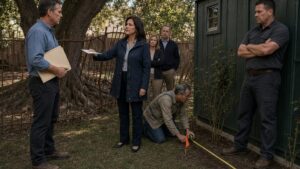
He measured the route from the sidewalk to the side yard and gave Jack two options: patch individual areas or remove the most damaged section and reseed it properly.
“Either way,” the contractor said, “you’ll see the repair for a while.”
“How long?”
“Depends on growth. Couple months before it blends. Maybe longer.”
Jack looked at the thin brown line.
He disliked that answer.
Part of him wanted the yard restored immediately, as though a perfect surface could erase the argument.
The contractor tapped the soil with the toe of his boot.
“Grass doesn’t care who’s right. Takes the time it takes.”
Jack almost laughed.
That night, he prepared for the hearing.
He arranged the photographs chronologically.
He printed the pet-control provision.
He printed Karen’s initial response.
He printed the prior violation record Michelle had authorized for the meeting.
Then he opened a blank document.
At the top, he typed:
Requested Remedy.
Jack stopped.
A month ago the answer would have been easy.
Enforce the rule.
Issue the violation.
Require reimbursement.
Make Ryan responsible.
Now Ryan had already offered reimbursement.
The dog had not crossed Jack’s yard in eleven days.
Ryan’s son had begun walking it on a leash.
The visible problem was already shrinking.
But the unfairness in the records remained.
Jack looked at the orange photograph again.
The tracks seemed almost absurd now, bright little marks crossing two properties because two grown men had been unable to agree on what counted as obvious.
He removed his original request for the maximum allowable penalty.
Then he sat staring at the empty line beneath Requested Remedy.
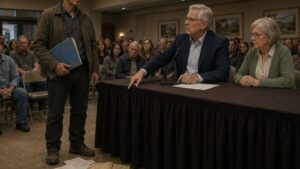
At the hearing the following Tuesday, Karen called the matter to order.
Ryan sat three chairs away.
Michelle had the records open beside her.
Jack’s photographs rested in front of him, the orange-pawprint image on top.
Karen reviewed the complaint, the prior discussions, and Ryan’s offer to pay for repairs.
Then she looked directly at Jack.
“All right,” she said. “You’ve asked us to enforce the rule. We’ve acknowledged the inconsistency in how similar matters have been handled.”
She placed both hands on the table.
“What, specifically, do you want us to do?”
Jack looked at Ryan.
Then at the old violation file.
Then at the orange trail leading all the way to a neighbor’s door.
For the first time since the grass began dying, proving what had happened was no longer the difficult part.
Deciding what should happen next was.
Chapter 7: The Trail Ends at a Different Kind of Boundary
Karen’s question remained on the table between them.
“What, specifically, do you want us to do?”
Jack had prepared three pages of notes.
He did not look at them.
Ryan sat several chairs away, shoulders tight, hands clasped between his knees. Michelle had the association records open beside her. Near Jack’s elbow lay the photograph that had once seemed capable of ending the entire dispute: bright orange pawprints crossing green grass, continuing over concrete, and leading directly to Ryan’s front porch.
A month earlier, Jack would have known exactly what to request.
A formal violation.
The maximum fine permitted after notice.
Full reimbursement for the damaged lawn.
An official record proving that Ryan had been wrong.
Now everyone in the room already knew Ryan had been wrong about the crossings.
And somehow that no longer seemed like enough of an answer.
Jack slid the photograph toward the middle of the table.
“I want the rule to mean the same thing at every house.”
Karen’s expression changed.
“That’s not a remedy for your complaint.”
“I think it is.”
Ryan looked up.
Jack continued.
“If someone reports a loose dog once, there should be one response. If it keeps happening, there should be another. If there’s actual property damage, that should be handled separately.”
Karen folded her arms.
“You’re proposing policy now?”
“I’m saying I don’t want somebody fined after one incident while somebody else gets three informal conversations because the board thinks that feels friendlier.”
Michelle glanced at Karen.
“That is essentially the gap we identified.”
Karen did not answer immediately.
Jack could see resistance in her face, but not the old dismissiveness.
She looked tired.
“What happens,” she asked, “when the written process creates an outcome nobody thinks is reasonable?”
“Then write a reasonable process.”
Ryan shifted in his chair.
Jack turned toward him.
“And I don’t need the maximum fine.”
Ryan’s eyebrows lifted slightly.
Karen looked at Jack’s notes.
“You requested formal enforcement.”
“I did.”
“Are you withdrawing that?”
Jack hesitated.
This was the point where the old instinct returned.
He had the evidence.
The rule.
The inconsistent records.
He could force the issue.
For once, nobody could tell him he was imagining a problem.
He looked at the orange photograph.
Then he remembered Ryan’s son standing in pajama pants with a leash in his hand, apologizing before Jack had even said anything.
“I’m withdrawing the request for the maximum penalty,” Jack said. “Not the complaint.”
Ryan exhaled.
Jack continued before the relief could become a misunderstanding.
“I want the complaint recorded as substantiated. The dog crossed repeatedly. Ryan already acknowledged that. But if he repairs the damage and keeps the dog contained, I don’t see what another fine fixes.”
Ryan stared at him for a moment.
Then said, “I already told you I’d pay for the grass.”
“I know.”
“I got a quote too.”
That surprised Jack.
Ryan reached into a folder beside his chair and removed a sheet.
“The contractor suggested a side run from the back gate to the patio. Six-foot section along the house, enclosed. My son could let him out without opening the gate that faces your yard.”
He slid the estimate across the table.
Jack looked at the diagram.
The proposed run followed Ryan’s side yard but stopped well short of the property line.
It was practical.
Unremarkable.
Exactly the sort of solution they might have reached during the first conversation if neither man had become invested in winning it.
“You’re actually doing this?” Jack asked.
Ryan gave him a tired look.
“I don’t want to have this conversation again either.”
For the first time, Jack nearly smiled.
He stopped short of it.
Michelle pulled a blank legal pad closer.
“What if the resolution separates three issues?”
Karen looked at her.
“Go ahead.”
“First incident: documented reminder unless there’s immediate damage or safety concern. Repeated documented entry: formal notice. Verified property damage: owner-to-owner reimbursement or association enforcement if unresolved.”
Jack nodded.
“And the same evidence standard for everyone.”
Michelle wrote it down.
Karen tapped one finger against her binder.
“I don’t want residents turning into surveillance officers.”
“Neither do I,” Jack said.
Ryan looked pointedly at the orange photograph.
Jack accepted that without defending himself.
“So put that in too,” he said. “Documentation has to be reasonable. No harassment. No following people around. No recording through windows. Keep it to the property involved.”
Karen’s finger stopped moving.
That suggestion seemed to reach her differently.
She looked at Jack for several seconds.
“You understand that cuts both ways.”
“Yes.”
Jack did understand.
A month earlier, he might not have.
The meeting did not end with applause.
No one apologized dramatically.
Karen asked Michelle to draft the procedure for board review. The HOA secretary noted Ryan’s admission that the dog had repeatedly entered Jack’s property. Ryan agreed in writing to pay the reasonable portion of the lawn repair and complete the side-yard enclosure.
Karen declined to issue an immediate monetary penalty.
Jack accepted that.
It felt strange.
Not victorious.
Cleaner than victory, perhaps.
Outside the meeting room, Ryan caught up with him.
“Jack.”
Jack turned.
Ryan stood with his keys in one hand.
“My son thought you were trying to get us kicked out or something.”
Jack frowned.
“Over a dog?”
“He’s sixteen. Sixteen-year-olds are not famous for understanding HOA procedure.”
Jack looked down.
“I wasn’t trying to get anybody kicked out.”
“I know.”
Ryan hesitated.
“I should’ve dealt with it the first time you came over.”
Jack could have said yes.
Instead he said, “I probably could’ve told you what I was doing before I filed everything.”
Ryan gave a brief laugh.
“That orange stuff was still ridiculous.”
Jack looked at him.
“It worked.”
“That’s the problem with you.”
Jack waited.
Ryan’s expression softened just enough to remove the insult.
“You’re really happy when something works.”
Jack considered denying it.
He did not.
“Sometimes too happy.”
Ryan nodded.
“That I believe.”
Three weeks later, the damaged strip still had not disappeared.
Jack had wanted it gone quickly.
The landscaping contractor had warned him otherwise.
New seed had taken, but the repaired section remained lighter than the surrounding turf. From certain angles, Jack could still see the old path from the sidewalk toward the maple.
He stopped checking it every morning.
That surprised him more than anything.
Ryan’s side-yard run went up on a Saturday. Nothing elaborate—posts, dark fencing, a secured gate near the patio.
Jack watched part of the installation from his driveway without offering advice.
That required effort.
By the following week, Michelle circulated the proposed pet-enforcement procedure.
It contained defined steps.
Written evidence standards.
A distinction between isolated incidents and repeated violations.
A separate process for verified property damage.
Karen added language allowing documented discretion when circumstances differed, but requiring the reason to be recorded.
Jack read that section twice.
Then left it alone.
One evening, he was pulling weeds near the maple when he heard the familiar jingle of the golden retriever’s collar.
He looked up.
The dog was beside Ryan near the driveway, leash clipped on.
Ryan stopped to speak with another neighbor.
The leash loosened.
The retriever drifted toward Jack’s lawn.
Jack straightened.
For a moment, the old route seemed to exist again.
Maple.
Sprinkler.
Sidewalk.
An invisible road the dog knew by memory.
It reached the property edge.
Stopped.
Ryan noticed and shortened the leash.
“Come on.”
The dog looked toward Jack.
Its tail wagged once.
Then it turned back toward Ryan.
Jack looked down at the repaired grass.
The thin brown line had almost closed.
Not completely.
Perhaps it would remain visible for another month.
He found that he no longer minded.
Inside his house, in a folder with the HOA correspondence, Jack still had the photograph of the orange pawprints.
He had once imagined framing it as proof that nobody could dismiss him.
Instead, he left it filed beside the new enforcement procedure.
One showed where the problem had gone.
The other showed where it had finally led.
The story has ended.