The HOA Painted Parking Spaces Beside His Barn—Then the Boundary They Ignored Became Everyone’s Problem
Chapter 1: The Yellow Lines Beside the Barn
Frank Carter stopped with one hand on the barn door.
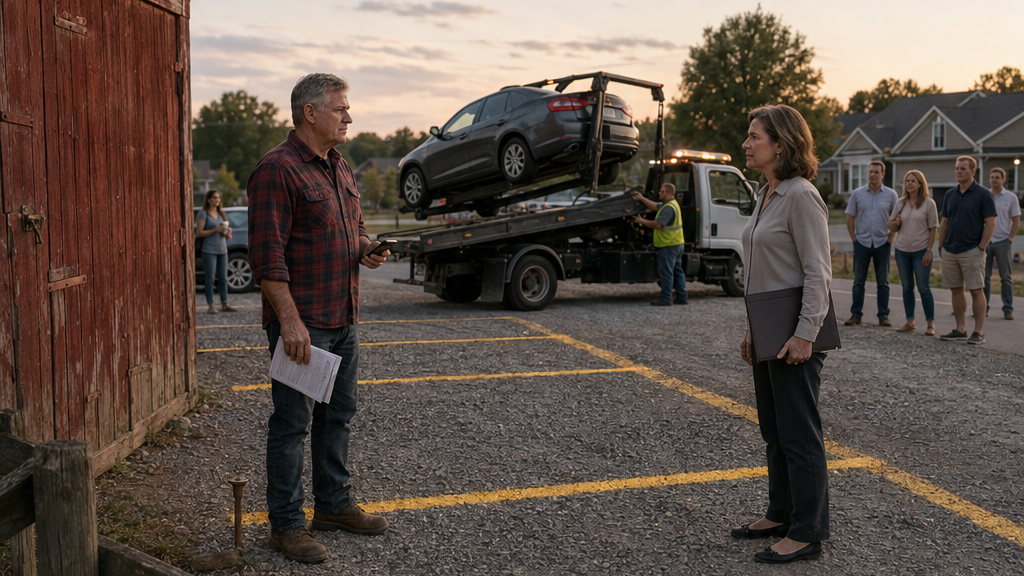
Six bright yellow rectangles cut across the gravel beside his red barn.
For several seconds he simply looked at them.
The night before, that patch had been gray stone, tire marks, and weeds pushing up along the fence. Now the lines were so fresh they seemed almost wet, unnaturally bright against the crushed limestone. Whoever had painted them had worked neatly. Each stall ran parallel to the barn, with enough room for a full-size pickup.
Frank stepped outside.
A small sign had been fixed to one of the fence posts near the entrance. He walked toward it slowly, as though moving too fast might make the scene real.
RIDGEWOOD COMMONS GUEST PARKING.
Below that were smaller words about approved overflow use and neighborhood events.
Frank read the sign twice.
Then he looked past it toward the subdivision.
The closest Ridgewood Commons house stood beyond a line of young maples and privacy fencing. His property had been here before most of those houses. Two-point-three acres, a barn, a shallow pasture, a garden he had mostly given up on, and a gravel apron wide enough for trailers and feed deliveries. The subdivision had grown along one side of it until his fence looked less like a farm boundary and more like the edge of somebody else’s backyard.
He took out his phone.
The first picture showed all six spaces.
The second caught the sign and the barn together.
Then he photographed the fence corner.
Near the base of the oldest post, partly hidden beneath gravel and grass, was a metal survey pin. Frank crouched and scraped dirt away with his thumb until the dull cap showed.
The nearest yellow line ended well inside it.
That changed his anger.
Until then he had been trying to imagine an explanation involving a confused contractor or a temporary marking crew. But nobody had guessed where to put those spaces. Somebody had measured them. Somebody had placed a sign.
He went inside the barn office and pulled the property folder from a steel cabinet.
The survey was folded along the same old creases. Frank opened it across the desk and traced the line from the road to the rear corner of the parcel.
The gravel lay inside his deed.
It always had.
His phone buzzed.
A neighbor from Ridgewood Commons had sent him a picture.
“Guess they finally fixed the parking problem,” the message said.
Attached was a screenshot of an email.
Frank enlarged it.
Residents were being advised that newly designated guest parking was now available beside the Carter barn for meetings, weekend gatherings, and temporary overflow.
He read it carefully.
No request.
No mention of temporary permission.
No language suggesting the HOA was waiting for approval.
The message treated the lot as if the question had already been settled.
Frank searched his inbox.
Nothing.
He checked spam.
Nothing.
Then he searched the sender’s name.
Catherine Roberts.
That made him sit back.
Catherine was the Ridgewood Commons HOA president. They had spoken dozens of times over the years—usually at the fence, sometimes near the entrance when delivery trucks blocked one another. She had his number. She had once called him at dinner because a landscaping trailer needed ten minutes to turn around on his gravel.
She knew how to reach him.
Frank called the neighbor who had sent the screenshot.
“You got this last night?”
“About eight-thirty.”
“Everybody did?”
“I assume so. People were talking about it this morning.”
“Did it say anything about asking me?”
There was a short pause.
“I figured they already had.”
Frank looked through the barn window toward the yellow spaces.
“Yeah,” he said. “So did they.”
He ended the call and walked outside again.
A car slowed on the county road.
For one uneasy second Frank thought somebody might already be trying the new spaces. But the driver kept going.
He stood near the fence post and looked down at the survey pin.
That little piece of metal had been there since before Ridgewood Commons had a clubhouse, before the HOA had a president, before Frank had learned most of the residents’ names. Nothing about it had changed.
Only people’s assumptions had.
His first instinct was to call Catherine immediately.
He even opened her number.
Then he stopped.
Frank knew himself well enough to understand what would happen if he called while looking at those yellow lines. He would start controlled. Catherine would explain. He would hear something in her tone he disliked. Then the conversation would become about attitude instead of land.
He put the phone away.
He photographed every stall from both directions.
He measured the distance from the fence to the first stripe.
He photographed the sign screws, the disturbed gravel beneath the post, the survey pin, the barn wall, and the entrance from the road.
By the time he finished, his anger had become quieter.
That was usually when people underestimated him.
Around noon he drove to the county records office with the survey folder on the passenger seat.
The clerk helped him pull the recorded deed and parcel map. Nothing in either document showed an easement for Ridgewood Commons. There was no shared parking designation, no common-use strip, no recorded access agreement.
Frank asked for copies anyway.
On the drive home, he tried to remember every time somebody from the subdivision had used that gravel.
There had been plenty.
A moving truck once.
A landscaper.
Cars during a holiday party.
Maybe seven or eight vehicles during a neighborhood cleanup.
But those had been favors.
Hadn’t they?
When he turned into his driveway, the new sign faced him like an answer he had never agreed to.
He parked beside the barn and opened the community email again.
This time he read all the way to the bottom.
There, beneath the parking instructions and a reminder about the upcoming monthly meeting, was a short administrative line.
“Parking designation authorized by HOA President Catherine Roberts.”
Frank stared at her name.
He no longer wondered whether Ridgewood Commons had made a mistake.
He wondered whether Catherine believed she had stopped needing his permission.
Chapter 2: What Frank Had Allowed Before
The message was five years old.
Frank found it at 2:17 that afternoon after searching his phone for the words parking, barn, gravel, and Ridgewood.
Catherine had written, “We may have six or seven cars during tonight’s committee meeting. Would it be all right if they use the gravel by your barn?”
Frank’s reply had been four words.
“Fine for tonight. Thanks.”
He read it again.
Then he found another.
A Christmas gathering three years earlier.
“Could two vehicles use your side lot for a couple hours?”
His answer:
“Sure.”
Then one from the previous spring, after a storm had made the clubhouse shoulder muddy.
“No problem. Just keep the gate clear.”
Frank set the phone down on the desk.
The yellow lines were visible through the office window.
For most of the morning, he had been thinking about the situation in clean categories: his property, their paint; his deed, their sign; his consent, their failure to ask.
The old messages did not change the deed.
But they changed the story.
Frank leaned back and rubbed his jaw.
He had never charged anyone. Never written conditions beyond whatever seemed necessary at the time. Most of the requests had been small, temporary, and polite.
That had mattered to him.
When Ridgewood Commons first expanded toward his acreage, Frank had made a point of not becoming the man who complained every time somebody’s tire touched his gravel. He had seen neighbors turn property lines into blood feuds over less. He wanted none of that.
So he waved through delivery vans.
He let teenagers turn around near the barn.
He allowed parking when Catherine asked.
And because nobody caused damage, he never felt the need to make a rule out of it.
Now he wondered whether his refusal to make rules had become one.
He walked the fence line again.
Under the fresh paint were older tire tracks, some deep, some barely visible.
One set curved toward the barn, then out toward the road. Another stopped where a pickup had probably sat for an evening. The gravel itself carried years of small permissions.
Frank hated that realization.
It gave Catherine an explanation.
Not authority.
But an explanation.
His phone rang.
This time it was Michael Harris, the HOA treasurer.
Frank knew Michael mostly by sight: gray hair, careful shirts, the kind of man who checked invoices twice and waved without stopping.
“I heard you were asking about the parking area,” Michael said.
“I was asking about my parking area.”
There was a pause.
“Right.”
“Did the board vote on it?”
“I’d rather Catherine answer that.”
“That means no.”
“I didn’t say that.”
“You didn’t have to.”
Michael exhaled.
“There’s been a lot of pressure about parking. You know that.”
“I know there’s been parking pressure on your side of the fence.”
“I understand why you’re upset.”
Frank looked at the yellow lines again.
“Do you?”
Another pause.
Michael said, “I thought Catherine had handled permission.”
That was the first thing anyone from the HOA had said that sounded useful.
“You thought she called me?”
“I assumed there was an arrangement.”
“What kind?”
“Something based on prior use.”
Frank let that sit.
“Prior use when you asked.”
“Yes.”
“That’s different from painting spaces.”
“I’m not arguing with you.”
“No. You’re telling me what you believed.”
Michael went quiet.
Then he said, “The meeting tomorrow night is going to be crowded.”
Frank’s eyes narrowed.
“What meeting?”
“Monthly board meeting. Parking is one of the agenda items.”
Frank opened the HOA email again.
There it was, farther down than he had noticed that morning.
Thursday, 6:00 p.m.
Overflow parking available beside Carter barn.
“How crowded?”
“Could be thirty people. Maybe more.”
“And you’re planning for them to park here?”
“I’m telling you what was sent out.”
Frank ended the call without saying goodbye.
He walked outside and stood inside the first yellow stall.
From there he could see the clubhouse roof between two houses.
Tomorrow evening dozens of residents might drive down the road, see the sign, and park exactly where the HOA had told them to park.
They would not think they were trespassing.
That bothered him more than he expected.
He went back inside and searched through old emails.
Near the bottom of a thread from two years earlier, he found something else.
Catherine had written after a large event:
“We should probably put something simple in writing for future overflow use so nobody gets confused.”
Frank remembered the conversation now.
She had raised it at the fence a few days later. Nothing formal, she had said. Just a one-page understanding about temporary parking.
Frank had dismissed it.
“No need to turn being neighbors into paperwork,” he had told her.
At the time, he had thought the comment generous.
Now it sounded careless.
He sat with that for a while.
Then he pulled out the deed again.
The legal boundary had not moved because he had been accommodating.
The survey still placed the gravel inside his parcel.
Kindness was not an easement.
But kindness repeated often enough could become expectation.
And expectation, if nobody challenged it, could become confidence.
Frank finally called Catherine.
She did not answer.
He left no voicemail.
Instead, he sent one message.
“We need to discuss the parking spaces installed on my property.”
Ten minutes passed.
Then twenty.
No response.
At four-thirty he called a surveyor he had used years earlier and asked one question: whether the existing pin and recorded survey were enough to establish the gravel area clearly.
The surveyor told him the documents appeared consistent but offered to confirm the corner in person the next morning.
Frank agreed.
After that he called a towing company he had used once when an abandoned vehicle blocked his lower gate.
The dispatcher listened while he explained the situation.
“You own the parcel?”
“Yes.”
“You have documentation?”
“Yes.”
“You’ve notified whoever is directing people there?”
“I sent the HOA president a message.”
The dispatcher explained what the company would need before accepting any authorization and warned him that towing rules and notice requirements had to be handled correctly.
Frank took notes.
He did not schedule anything yet.
At sunset Catherine finally replied.
“I’m tied up tonight. We can discuss this after tomorrow’s meeting. The parking arrangement is based on longstanding community use, and I’m confident we can clear up any concerns.”
Frank read the sentence twice.
Longstanding community use.
Not permission.
Use.
That choice of word bothered him more than the delay.
He looked through the window at six fluorescent rectangles fading into the dusk.
Then his phone buzzed again.
A Ridgewood resident had forwarded the meeting reminder.
The first line was about attendance.
The second told residents where to park.
“Primary overflow parking: designated spaces beside the Carter barn.”
Frank lowered the phone.
By this time tomorrow, every yellow space might be full.
Chapter 3: Twelve Cars During One Board Meeting
The first car arrived at 5:21.
Frank watched from beside the barn as a white sedan slowed, turned off the road, and rolled onto the gravel.
The driver followed the yellow lines perfectly.
Her front tire stopped less than three feet from the survey pin.
She got out carrying a folder and a stainless-steel tumbler.
Frank stepped toward her.
“Evening.”
She smiled.
“Hi.”
“You here for the HOA meeting?”
“Yes.”
She glanced toward the clubhouse.
“I thought I was early.”
Frank looked at the car.
“Who told you to park here?”
“The email.”
No hesitation.
No embarrassment.
She pulled out her phone and showed him the message as if helping him find the right entrance.
“See? Overflow parking.”
Frank read the same words he had already seen.
“Did anybody tell you this was private property?”
Her smile disappeared.
“No.”
Frank nodded.
“All right.”
She looked from him to the barn.
“Am I not supposed to be here?”
For half a second he almost told her to move.
That would have been the easy answer.
But then another vehicle turned onto the road behind her.
Then another.
Frank stepped aside.
“I’m dealing with the HOA,” he said.
The woman hesitated, then headed toward the meeting.
Within twenty minutes, every painted stall held a car.
Then drivers began fitting vehicles along the edge of the gravel beyond the lines.
Frank photographed each plate and each parking position.
Nobody acted sneaky.
That was the worst part.
People locked their cars, checked the meeting email, and walked toward the clubhouse carrying notebooks and coffee.
One man even thanked Frank.
“Nice of you to open this up,” he said.
Frank did not answer.
At 5:48 the surveyor’s temporary confirmation marker was still visible near the fence corner, exactly where it had been placed that morning. The gravel, including every painted stall, lay inside Frank’s parcel.
He had copies of the survey.
Copies of the deed.
Photographs showing the installed sign.
The HOA email.
His unanswered message to Catherine from the previous afternoon.
And the towing authorization documents the dispatcher had required.
At 5:56, Frank called.
“We’re ready if you want us,” the dispatcher said.
Frank looked toward the clubhouse.
Through the trees he could see people filing inside.
He thought about the woman with the tumbler.
The man who had thanked him.
None of them had painted the lines.
“Send the trucks,” Frank said.
The first one arrived after six.
Its amber lights flashed against the barn siding as it turned onto the gravel.
Frank felt his heartbeat change.
He had imagined this moment all afternoon.
In the version in his head, it felt clean.
The truck would arrive. The HOA would understand. The spaces would be cleared. The point would be made.
Reality was louder.
Hydraulics hissed.
Chains clanked.
Gravel snapped beneath the tow truck’s rear tires.
The driver checked Frank’s paperwork before touching the first car.
“You’re authorizing removal?”
“Yes.”
“From this parcel?”
“Yes.”
Frank pointed to the survey line.
The driver nodded and went to work.
The white sedan rose first.
As its front wheels lifted from the yellow stall, Frank experienced a brief, unmistakable satisfaction.
There.
That was what a boundary looked like when somebody finally respected it.
Then he remembered the woman showing him the email.
The truck pulled away.
A second tow vehicle moved in.
By 6:20, three cars were gone.
Nobody from the meeting had noticed yet.
Frank stood behind the fence with his arms folded while the process continued.
At 6:31, the clubhouse door opened.
A man hurried outside, looked toward the gravel, then stopped.
He took out his phone.
Thirty seconds later, another person came through the door.
Then four more.
The meeting had discovered the parking lot.
People began walking quickly toward Frank’s property.
“What is happening?”
“Where’s my SUV?”
“They’re towing the cars.”
“Who called them?”
Frank stepped toward the entrance.
“I did.”
The group went quiet.
A woman near the front stared at him.
“Why?”
“This is private property.”
She pointed at the sign.
“The HOA told us to park here.”
“I know.”
“Then why are you towing us?”
That question landed harder than Frank expected.
“Because the HOA didn’t have permission to designate this lot.”
“That’s between you and them.”
“Yes,” Frank said.
She looked toward the road, where another tow truck was leaving with a vehicle.
“It doesn’t feel like it.”
More residents arrived from the meeting.
Some were angry. Some confused. One man immediately started calling the tow company. Another photographed the sign.
Frank refused to argue about ownership individually.
“If your vehicle was removed, speak with the HOA and the towing company.”
“That’s convenient,” someone said.
Frank’s jaw tightened.
“No. Convenient was painting my land without asking.”
The sentence silenced the nearest group, but it did not make anyone happier.
At 6:42 Catherine appeared.
She came down the road fast, still holding a meeting folder.
“What did you do?”
Frank looked at her.
“I enforced my property line.”
“You towed residents’ cars?”
“You told them to park here.”
“We had an established arrangement.”
“No. You had previous permission.”
“For years.”
“When you asked.”
Catherine looked past him.
By then another car was being loaded.
“Stop the towing.”
Frank said nothing.
“Frank.”
“You painted six spaces on my land.”
“We marked an area the community has used repeatedly.”
“You put up a sign.”
“Because residents needed clarity.”
“You gave them clarity about something you didn’t own.”
Catherine’s face tightened.
“We can resolve the property question.”
“You should have resolved it before sending people here.”
Behind them, another resident called out that her car was already gone.
Catherine turned toward the group.
“Everyone, please give us a moment.”
Nobody moved.
Frank watched her expression change.
This was no longer a board issue inside a meeting room. Every decision had become visible at once: the yellow paint, the sign, the confused residents, the tow trucks.
Catherine lowered her voice.
“You could have called me.”
“I did.”
“Yesterday afternoon.”
“You answered after sunset and told me we’d discuss it after the meeting.”
“I didn’t think you were going to do this.”
Frank almost laughed.
Instead he said, “And I didn’t think you were going to stripe my property.”
By 6:48, twelve vehicles had been removed or were already committed to removal.
The towing company would not reverse vehicles that had left the property without authorization from the impound office.
Residents began calculating what retrieval would cost.
One person said the lot was nearly twenty minutes away.
Another had already been quoted a release charge.
The anger shifted.
Not entirely toward Frank.
Not entirely toward Catherine.
It spread between them.
That was when Frank understood the part he had not anticipated.
He had wanted a boundary dispute.
Now he had twelve separate consequences.
Twelve people who had followed official instructions.
Twelve rides to an impound lot.
Twelve bills.
The yellow spaces were empty again before the meeting officially ended.
The sight should have felt like victory.
Instead, under the tow-truck lights, the lot looked stripped.
Frank went inside the barn after the last truck left.
His phone had filled with messages.
Some were from residents.
Some demanded reimbursement.
Some asked whether the HOA had lied to them.
One simply said, “You should have warned us.”
Frank sat at the desk without answering.
At 7:02, Catherine texted.
He expected a threat.
Maybe a lawyer.
Maybe a demand that he refund everyone.
Instead the message contained six words.
“Did you tow all of them?”
Frank stared at it.
He typed yes.
Deleted it.
Typed twelve.
Deleted that too.
Then he looked through the office window at the empty yellow rectangles.
For the first time since discovering them, he was no longer wondering whether Catherine had crossed his boundary.
He was wondering what she had believed that boundary meant.
Chapter 4: The Parking Problem the Board Created
The woman from the white sedan was standing at Frank’s gate before nine the next morning.
She held her phone in one hand and a towing receipt in the other.
Frank recognized her stainless-steel tumbler before he recognized her face.
“I’m not here to yell at you,” she said.
That surprised him enough that he opened the gate.
She stepped onto the gravel and held out her phone.
“This is what they sent us.”
Frank had already seen the Ridgewood Commons email, but not this version. The message had been forwarded to residents twice—once as the original announcement, then again as a meeting reminder.
The wording was unmistakable.
Newly designated overflow parking was available beside the Carter barn.
Residents were directed to use the marked spaces.
There was no warning that the land was privately owned. No suggestion that permission was temporary. No request to confirm anything with Frank.
The woman tapped the screen.
“I parked exactly where this told me.”
“I know.”
“My husband had to leave work and drive me to the impound lot.”
Frank looked at the receipt.
Two hundred eighty-five dollars.
“I’m sorry you got caught in it.”
Her expression hardened slightly.
“That’s not quite the same as saying you’re sorry you had my car towed.”
Frank almost answered too quickly.
He stopped himself.
“No,” he said. “It isn’t.”
She folded the receipt.
“I think the HOA should pay me back.”
“So do I.”
That seemed to take some of the fight out of her.
She glanced at the yellow lines.
“Then maybe tell them that.”
After she left, Frank stood beside the first stall and looked at the tire impressions pressed into the gravel.
Yesterday they had looked like evidence of trespass.
Now they looked like evidence of instruction.
By noon, three more residents had contacted him. Two were angry. One wanted only a copy of whatever proved the lot was his because she intended to demand reimbursement from Ridgewood Commons.
Frank sent her the recorded parcel map with the address information redacted.
Then he drove to the county records office again.
The clerk remembered him.
“Back already?”
“Different question.”
He asked for any recorded easement, access agreement, shared-use designation, or plat notation involving Ridgewood Commons and the strip beside his barn.
The search produced nothing.
But Frank did not leave immediately.
He asked to see the subdivision plats.
The clerk brought up several filings from different stages of the development.
Frank studied them at the public counter.
The older plat showed an irregular piece of HOA-controlled common ground near the clubhouse. On a later plan, part of that ground had been redesigned with landscaping, a widened walking path, and a small recreation area.
The earlier version included enough open surface for overflow vehicles.
The newer one did not.
Frank stared at the plans.
The parking shortage had not simply appeared.
Somebody had traded parking capacity for something else.
His phone vibrated.
Michael Harris.
Frank answered.
“I’m at the records office.”
“That saves me a trip,” Michael said.
“What am I looking for?”
A long silence followed.
Then Michael said, “The common-area redesign.”
Frank looked down at the plans.
“So you knew.”
“I knew we lost overflow space.”
“And nobody replaced it.”
“We thought street parking would absorb most of it.”
“Did it?”
“No.”
Michael’s voice sounded tired rather than defensive.
“There have been complaints for more than a year. Fire access. Driveways blocked. Guests on lawns. Catherine’s been hearing it every month.”
“So she solved it with my land.”
“I thought she had your permission.”
“You keep saying that.”
“Because it’s true.”
Frank tapped the edge of the plat.
“Did the board vote to designate my lot?”
“No formal vote.”
“Was there an easement?”
“Not that I can find.”
“Written agreement?”
“No.”
Frank let him sit with the answers.
Michael finally said, “We handled this badly.”
“That’s one way to put it.”
“I’m not excusing it.”
“Then what are you doing?”
“Trying to figure out how we got here before lawyers figure it out for us.”
That afternoon, Michael sent Frank several excerpts from old meeting minutes.
Most dealt with ordinary association business.
Landscaping.
Pool repairs.
Drainage.
The common-area redesign.
Then Frank found his own name.
Two years earlier, after a crowded seasonal event, Catherine had reported that temporary overflow parking beside Frank’s barn had worked well. The minutes noted that she suggested obtaining a simple written agreement for future occasional use.
The next line made Frank sit still.
“Owner declined formal agreement, preferring informal neighbor accommodation.”
He read it again.
There it was.
Not hidden.
Not altered.
His own mistake summarized in one dry sentence.
He remembered standing by the fence when Catherine had suggested paperwork.
He had laughed.
“We don’t need a contract every time somebody parks for two hours.”
At the time, he had been proud of being reasonable.
Now that same choice had given everyone room to remember the arrangement differently.
Frank printed the page and laid it beside the current parcel map.
Neither document gave the HOA ownership.
Neither created an easement.
But one explained how Catherine might have convinced herself that she was extending an existing custom instead of inventing a new right.
Late that afternoon Catherine finally called.
Frank answered from his kitchen table.
“I assume you’ve been talking to residents,” she said.
“They’ve been talking to me.”
“We’re trying to deal with reimbursement requests.”
“You should reimburse them.”
“We’re reviewing responsibility.”
“You told them where to park.”
“And you authorized towing without giving individual drivers notice.”
“They were on my land.”
“Because we directed them there.”
Frank leaned back.
For the first time, Catherine sounded less like an official defending a decision and more like someone trapped inside it.
“You knew I’d allowed parking before,” Frank said.
“Yes.”
“Did you believe that meant you could paint spaces?”
“I believed we had an established arrangement.”
“An arrangement you never put in writing.”
“You’re the one who didn’t want it in writing.”
That hit cleanly because it was true.
Frank looked at the old meeting minutes on the table.
“You still should have called.”
“Yes,” Catherine said.
The answer came so quickly he almost missed it.
Then she added, “And you could have warned those people before towing them.”
Neither spoke for several seconds.
They had finally reached the part of the argument where both could point to something the other should have done.
An email arrived while they were still on the phone.
Frank opened it.
The sender was Mark Adams.
The subject line identified him as counsel for Ridgewood Commons.
The message requested that Frank preserve all records related to the towing, boundary, prior parking permissions, and communications with the association.
Near the bottom, Mark described the incident as arising from what appeared to be a “mutual misunderstanding concerning longstanding use.”
Frank read that phrase twice.
Mutual misunderstanding.
The yellow lines outside his window suddenly looked less like paint and more like the beginning of an argument about who had misunderstood whom.
Chapter 5: The Price of Being Technically Right
Ruth Wilson did not look up from the towing receipts when she asked Frank the question.
“Do you want your land back, or do you want everyone to know you won?”
Frank sat across from her desk.
“I already have my land.”
Ruth raised her eyes.
“Then why are we here?”
He slid Mark Adams’s email toward her.
“Because they’re trying to turn this into mutual confusion.”
“Maybe some of it was.”
“They painted my property.”
“Yes.”
“They installed a sign.”
“Yes.”
“They sent people there without asking me.”
“Yes.”
Ruth folded her hands.
“And five years of messages show you repeatedly let those same people use the area when asked.”
“That doesn’t give them a right.”
“I didn’t say it did.”
Frank disliked how calmly she spoke.
He had hired Ruth because she was careful, but careful felt irritating when he wanted certainty.
She moved the receipts into a neat stack.
“Twelve vehicles. Most of the owners appear to have received explicit instructions from the HOA. That matters.”
“They were still trespassing.”
“Possibly without knowing it.”
Frank looked toward the office window.
“What was I supposed to do? Stand out there and negotiate with every driver?”
“You had choices.”
“I made one.”
“You did.”
Ruth let the silence stretch.
“That’s why I’m asking what you want now.”
Frank had arrived prepared to demand restoration costs, legal fees, a written acknowledgment of his property rights, and enough additional money to make the board remember what it had done.
Ruth had drafted something close to that.
The preliminary damage estimate for removing paint, regrading portions of the gravel, and restoring the entrance came to roughly forty-eight hundred dollars.
Frank liked the number because it was concrete.
Ruth seemed less interested in the number than in what would happen after it.
“If we pursue maximum damages and make the towing part of the fight,” she said, “this can last.”
“How long?”
“Long enough for everybody involved to become certain they’re the victim.”
Frank said nothing.
Ruth turned her monitor toward him.
Several messages from Ridgewood residents had been forwarded through the association’s counsel.
Most demanded reimbursement from the HOA.
One said Frank should never have allowed towing.
Another said the HOA had put residents in an impossible position.
A third was short:
“We followed written instructions from our association. Ridgewood Commons should pay the release fees.”
Frank read that one twice.
“They’re not blaming me?”
“Some are. Most seem more interested in getting their money back.”
Ruth clicked another document.
“These are portions of the board correspondence Mark provided.”
Frank leaned forward.
One message was from Catherine, sent the morning after the towing.
She argued that the association should reimburse residents who had relied on the parking notice.
Another board member objected, saying paying everyone would look like an admission of wrongdoing.
Catherine replied:
“They followed our direction. Whatever dispute exists with Mr. Carter should not be shifted onto them.”
Frank sat back.
“That doesn’t sound like someone trying to make me the villain,” Ruth said.
“She still caused it.”
“Yes.”
“She still assumed she could use the land.”
“Yes.”
Ruth closed the file.
“People can be wrong without being simple.”
Frank looked away.
The gravel lot had been regraded slightly where the tow trucks turned. Tire scars cut through several yellow lines now. From his kitchen window they no longer looked neat or official. They looked worn, interrupted.
Like the story everyone had been telling about them.
When Frank returned home that afternoon, he walked to the fence corner.
His boot scraped over one stripe, exposing gray stone beneath the paint.
For years he had believed avoiding formal boundaries kept things friendly.
He saw now that what he had really avoided was the discomfort of saying no before he was angry.
Catherine had asked for written clarity once.
He had dismissed it.
Then she had taken his informality farther than he ever intended.
Both things could be true.
That did not excuse her.
It did change what he wanted from her.
The next morning Ruth called.
“The association’s insurer is asking questions.”
“Good.”
“Not necessarily.”
Frank waited.
“They want to know whether the towing was reasonable after you saw that residents were relying on HOA instructions.”
Frank felt his shoulders tighten.
“Was it legal?”
“That is not the only question insurers ask.”
“So now I’m responsible because they lied to people?”
“I’m saying your ownership claim is strong. I’m also saying every extra issue gives Mark leverage to prolong this.”
Frank looked at the yellow spaces.
“What would you do?”
“I would stop trying to win every argument.”
That irritated him enough that he laughed once.
Ruth continued.
“I would decide what has to be true when this is over.”
Frank did not answer.
“What has to be true?” she asked again.
He looked toward the survey pin.
“The HOA has no right to that gravel.”
“Good.”
“They fix what they painted.”
“Good.”
“The people who followed their email don’t eat the towing fees.”
Ruth was quiet.
Frank continued.
“And next time the board wants to use somebody else’s property, they get permission before they announce anything.”
“That sounds different from the demand we drafted.”
“It is.”
That evening Frank sat at the barn desk with Ruth’s proposed letter printed in front of him.
The first version demanded the full property damage amount, legal costs, removal of all signage, and an acknowledgment of ownership.
Frank crossed out two paragraphs.
He added one requiring reimbursement of reasonable towing and release costs to affected residents.
He added another requiring a formal policy for obtaining written permission before the HOA designated privately owned land for community use.
Then he changed the most important sentence.
The draft had said the association would discontinue parking on the Carter parcel.
Frank replaced it.
“The association acknowledges that no easement, shared-use right, parking right, or continuing community privilege exists over the gravel area.”
He read the sentence several times.
That was what he wanted.
Not revenge.
Not an apology at a meeting.
Clarity.
He called Ruth.
“I’m changing the demand.”
“I assumed you might.”
“I’ll take less on the gravel damage if they reimburse the residents.”
A pause.
“And?”
“And I want the boundary language permanent.”
“Now we’re negotiating something useful.”
Frank looked at the scratched yellow line under the barn light.
“For once,” he said, “I want everybody to know exactly where the line is.”
Chapter 6: No Shared Right to This Ground
Frank rejected the proposed settlement before he reached the second page.
Across the mediation-room table, Mark Adams stopped speaking.
Catherine looked from Frank to the document.
Ruth did not move.
“What is the issue?” Mark asked.
Frank pointed to one sentence.
It described the gravel lot as “temporarily unavailable for Ridgewood Commons overflow parking.”
“That.”
Mark glanced down.
“What about it?”
“My property isn’t temporarily unavailable to you.”
“It’s settlement language.”
“It’s bad settlement language.”
Mark’s expression tightened.
“The intention is to confirm that the association will cease using the area.”
“For now.”
“That isn’t what it says.”
“That is exactly what it says.”
Frank pushed the document back.
“I’m not signing something that makes it sound like Ridgewood Commons already has a right that’s merely being suspended.”
Catherine rubbed two fingers against her forehead.
They had been in the room forty minutes.
The HOA had agreed in principle to remove the sign, restore the gravel, and reimburse affected residents. The remaining dispute was the part Frank cared about most.
Whether this would be treated as one bad parking incident or a correction of assumed authority.
Mark looked at Ruth.
“Can we revise the wording?”
“Probably,” Ruth said. “But Frank’s point isn’t cosmetic.”
Michael Harris sat at the far end of the table with a binder open in front of him.
He had attended at the board’s request.
Until then he had said almost nothing.
Now he cleared his throat.
“There’s another reason we should fix the language.”
Catherine looked at him.
Michael opened the binder.
“I reviewed the parcels along the entire west boundary.”
Mark’s face changed slightly.
“Why?”
“Because this isn’t the only place where HOA landscaping, drainage maintenance, or event traffic touches privately owned property.”
Frank looked at him.
Michael continued.
“We’ve been operating on assumptions in several places. Nothing this dramatic. But assumptions.”
Catherine sat back.
“So you want to turn one dispute into a policy review.”
“I want to prevent the next dispute.”
Michael looked toward Frank.
“He’s right about one thing. If we don’t have a recorded right or written permission, we shouldn’t describe private property as association space.”
Mark closed the proposed agreement.
“All right.”
It was the first sign of movement.
They broke for twenty minutes.
Frank stepped outside with Ruth.
The mediation office occupied a plain commercial building not far from Ridgewood Commons. Cars moved steadily along the road. Nobody passing would have guessed that inside, six yellow parking spaces had turned into pages of legal language.
“You did not need Michael to say that,” Ruth told him.
“No.”
“But it helps.”
Frank nodded.
“Don’t get greedy now.”
He looked at her.
“I’m not.”
“Good. Because this is where people ruin good settlements trying to squeeze out one final admission.”
Frank thought of the twelve residents walking out of the meeting to empty spaces.
“I want the land fixed.”
“Yes.”
“I want their money back.”
“Yes.”
“And I want the association to say it has no right to use the gravel unless I give one.”
“That’s achievable.”
“I don’t need Catherine to say she knew she was wrong.”
Ruth studied him.
“That is different from where you were last week.”
Frank looked toward the parking lot.
“Last week I wanted her to feel what I felt.”
“And now?”
“Now I want it not to happen again.”
When they returned, Mark had revised the language.
The new paragraph was closer.
Ridgewood Commons acknowledged that it held no recorded easement, parking entitlement, or shared-use right over the gravel area within Frank Carter’s parcel.
Frank read it slowly.
Then he pointed to another line.
“This part says prior community use is recognized.”
“It occurred,” Mark said.
“I’m not denying that.”
“Then why remove it?”
“Because I don’t want somebody ten years from now reading this and deciding the old use created something.”
Mark looked at Ruth.
Ruth said, “We can describe prior use as permissive and revocable.”
Michael nodded.
“That’s accurate.”
Catherine finally spoke.
“It was permissive.”
The room went quiet.
Frank turned toward her.
She was looking at the table rather than at him.
“I should have asked,” she said.
Mark shifted slightly, but Catherine continued.
“I believed we had enough history to continue using the area. I believed the striping was formalizing something already accepted.”
Frank said nothing.
Catherine met his eyes.
“I approved the contractor before getting explicit permission from you.”
There it was.
Not a dramatic confession.
Not the admission Frank had imagined during the first angry morning beside the barn.
Something smaller and more useful.
A person stating precisely what she had done.
“Why?” Frank asked.
Catherine glanced at Michael’s binder.
“Because we created our own problem.”
Michael looked down.
“The redesign?”
She nodded.
“We lost parking when we changed the common area. Residents complained. The streets were getting worse during meetings. People were asking why the board had spent money on landscaping and a recreation area but hadn’t planned for guests.”
“So you used the cheapest available space.”
Catherine’s mouth tightened.
“Yes.”
“My space.”
“Yes.”
“And you told yourself I had already agreed.”
She hesitated.
Then nodded.
Frank felt no satisfaction in the answer.
Only recognition.
She had not believed she owned his land.
She had believed the difference between asking and assuming had become unimportant.
That was exactly the difference Frank had failed to protect for years.
Catherine added, “The residents should not have paid for our mistake.”
Frank looked at her.
“You argued for reimbursement.”
“Yes.”
“Even after I towed them.”
“They followed our instructions.”
Frank let out a slow breath.
“So did I,” he said.
Catherine frowned.
“What?”
“I followed my own rules. Documents. Property line. Tow authorization. I didn’t stop to think about who was actually sitting in those cars.”
“No one was sitting in them.”
“You know what I mean.”
For the first time that day, the room softened.
Not much.
Enough.
They returned to the numbers.
The HOA would reimburse documented towing and release charges for residents who had parked in reliance on the official notice. It would pay for removal of the yellow paint, repair displaced gravel, and remove the sign.
Frank agreed to reduce the property-damage portion of his demand rather than pursue every claimed cost.
In return, the association would adopt a written procedure requiring documented owner consent before privately held land could be advertised or designated for association use.
Most importantly, the agreement would state that no prior permissive use created a continuing parking right, easement, license, or shared community interest in Frank’s parcel.
Mark printed the revised pages.
They reviewed them line by line.
At the bottom of the acknowledgment, Catherine signed first.
Then Michael.
Then Frank.
Beside the paperwork, Ruth placed one of Frank’s photographs from the first morning.
The image showed the red barn, six perfect yellow rectangles, and the old survey pin near the fence.
Frank looked from the picture to the signed acknowledgment.
The metal pin had never moved.
Everything else had.
Two days later, a contractor arrived to remove the paint.
Frank stood near the barn while equipment scraped and treated the marked gravel.
The lines faded unevenly.
Some disappeared quickly.
Others left pale shadows beneath the disturbed stone.
Catherine arrived before the crew finished.
She stayed on the road side of the fence.
“They’re processing the resident reimbursements,” she said.
“Good.”
“The board approved the new property-use policy.”
Frank nodded.
“And Michael wants a boundary review anywhere common maintenance touches private parcels.”
“Probably smart.”
Catherine looked toward the half-erased parking spaces.
“I suppose we should have done that years ago.”
“Probably.”
She gave him a tired look.
“You could make this easier.”
“I could.”
“But you’re not going to.”
“Not today.”
For a moment, something almost like amusement passed between them.
Then Catherine looked down at the survey pin.
“There’s something I still don’t understand.”
Frank waited.
She stepped no closer.
“You were always clear that this was your land. I knew that.”
Frank’s expression tightened slightly.
“Then why paint it?”
“That isn’t what I mean.”
She folded her arms.
“Why didn’t you ever just tell me no?”
Frank looked at her.
Catherine continued before he could answer.
“Years ago. When I suggested putting the parking arrangement in writing. You didn’t say you never wanted us using it. You said paperwork was unnecessary. Every time we asked after that, you usually said yes.”
Frank glanced toward the gravel.
“That didn’t give you permission to stop asking.”
“No.”
Her answer was immediate.
“It didn’t.”
She looked directly at him.
“But why did you make me guess where the line was until you were angry enough to make sure nobody could miss it?”
The contractor’s machine passed over the nearest stripe.
Yellow dust disappeared into gray gravel.
Frank had an answer ready.
Because it was his land.
Because Catherine should have known better.
Because permission was not ownership.
All of those answers were true.
None answered her question.
Catherine waited on the opposite side of the fence.
For once, Frank had no document he could point to.
And no one else to blame for the part that belonged to him.
Chapter 7: Where the Paint Used to Be
The last yellow stripe disappeared after three days of rain.
Frank noticed it when he stepped out of the barn with a feed bucket in one hand and nearly walked past the spot without recognizing it.
For weeks, even after the contractor had treated the gravel, pale yellow shadows had remained between the stones. He had started measuring time by them. First six bright stalls. Then broken lines. Then stains. Then almost nothing.
That morning there was only wet gray gravel and the old survey pin near the fence.
Frank set the bucket down.
A pickup slowed on the road.
For an instant, habit tightened something in his chest.
The truck kept going.
He picked up the bucket and carried it toward the pasture.
The settlement had been completed two weeks earlier. Ridgewood Commons had reimbursed the residents who submitted towing and release receipts. The association had paid for the gravel restoration and removed the parking sign. Its new property-use policy required written owner permission before any privately held parcel could be advertised, marked, maintained, or used for association purposes.
Michael had sent Frank a copy after the board approved it.
Frank had read every word.
Then, instead of filing it immediately with the other documents, he left it on his kitchen table for several days.
That surprised him.
For a month, documents had felt like weapons. Deeds. Plats. meeting minutes. receipts. notices. settlement drafts.
Now the most important one did not need to be carried around.
The boundary existed whether he was angry or not.
Around ten, Frank heard equipment somewhere inside Ridgewood Commons.
Not lawn equipment.
Something heavier.
He walked toward the road and saw a compact work truck near the entrance to the HOA common area. Beyond it, several workers were measuring a strip of ground that had once been part of the landscaped edge.
Michael had told him the board was reconsidering its parking plan.
Frank had assumed that meant another committee.
Instead, survey flags now marked a narrow section of association-owned property between the clubhouse and the recreation path.
Michael spotted him from across the road and raised a hand.
Frank crossed to the shoulder but did not enter the work area.
“Looks expensive,” he said.
Michael smiled.
“Cheaper than twelve tow bills.”
Frank almost smiled back.
“How many spaces?”
“Eight. Maybe nine if drainage lets us.”
“Enough?”
“For regular meetings. Bigger events will need planning.”
“That sounds terrible.”
Michael laughed once.
“Yes. Apparently planning is the new strategy.”
Frank looked at the flags.
The new area was smaller than his gravel lot and less convenient. Guests would have to walk farther to the clubhouse.
That seemed appropriate.
Convenience had caused enough trouble.
Michael lowered his voice.
“Catherine pushed this through.”
Frank looked at him.
“I thought the board wanted it.”
“The board wanted parking. Catherine insisted it stay entirely on association property.”
Frank said nothing.
Michael watched the workers for a moment.
“She caught some heat.”
“For the money?”
“For admitting how the other plan happened.”
Frank glanced toward the clubhouse.
“How much?”
“Enough.”
Michael did not elaborate, and Frank did not ask.
That was another thing he was learning.
Not every piece of discomfort had to become evidence.
Before he went back across the road, Michael said, “The reimbursement checks cleared.”
“All of them?”
“Everyone who submitted one.”
Frank nodded.
“Good.”
He meant it.
That afternoon, the first real test came.
Catherine drove up alone and stopped before turning onto Frank’s gravel.
She lowered her window.
“Do you have a minute?”
Frank was replacing a loose board on the fence.
He set down the hammer.
“Depends.”
“There’s a contractor coming tomorrow to inspect the drainage line behind the common area.”
Frank waited.
“Their truck is too long to turn around near the clubhouse without backing into the walking path.”
Still he waited.
Catherine looked toward the barn lot.
“I’m asking whether they can use your gravel to turn around once when they arrive and once when they leave.”
The request was so ordinary that it felt strange.
Frank wiped his hand on his jeans.
“What time?”
“Between nine and ten in the morning. They expect to leave before two.”
“How big is the truck?”
“Utility body. No trailer.”
“No parking?”
“No parking.”
“No materials left here?”
“No.”
“And if they’re not gone by two?”
“They call me, and I call you.”
Frank looked at the clean gravel.
Several weeks earlier, the idea of allowing any Ridgewood vehicle onto it again would have felt like surrender.
Now Catherine was sitting in her car on the road, waiting.
Not assuming.
Waiting.
“All right,” he said. “Nine to two. Turnaround only.”
She nodded.
“I’ll text you that.”
“Do that.”
For a moment neither moved.
Then Catherine said, “Thank you.”
Frank picked up his hammer.
“You asked.”
The next morning the contractor arrived at 9:17.
The driver stopped at the entrance.
Frank pointed toward the open gravel.
“Pull in. Swing wide. Stay clear of the barn door.”
The truck turned without touching the fence.
At 1:26 it returned, used the same space, and left.
Nothing happened.
No argument.
No documentation beyond Catherine’s text.
No resentment.
Frank stood beside the barn after the truck disappeared and realized how much effort he had spent over the years avoiding exactly that kind of simple clarity.
He had thought rules created distance.
Sometimes they prevented it.
A few days later, he found the survey pin loose.
The paint-removal equipment and subsequent rain had softened the gravel around it. The metal marker tilted slightly toward the road.
Frank crouched with a small mallet and a measuring tape.
He checked the reference point against his survey before touching anything.
The pin itself was not something he intended to relocate; he only wanted the visible marker beside it reset so machinery would not disturb the corner again.
He drove a narrow stake into the gravel a few inches back from the surveyed point.
One strike.
Then another.
A shadow fell across the ground.
Frank looked up.
Catherine stood on the road side of the fence.
She carried a folder under one arm.
Months earlier, she would have stepped onto the gravel to talk.
This time she stopped before the marker.
Frank noticed.
So did she.
Neither mentioned it.
“I brought you the final copy of the parking policy,” she said.
“Michael emailed it.”
“I know.”
She held up the folder.
“This one has the recorded acknowledgment attached.”
Frank stood.
Catherine extended the folder but remained where she was.
Frank walked the few steps to take it.
The signed acknowledgment was clipped behind the policy.
No shared-use right.
No parking entitlement.
No continuing license created by prior permissive use.
The language was plain now.
Frank closed the folder.
Catherine glanced at the small stake.
“Is that the line?”
“The actual survey pin is underneath. That marks it so nobody runs over it.”
She nodded.
For several seconds, they listened to a mower somewhere inside Ridgewood Commons.
Then Catherine said, “I thought about what I asked you at mediation.”
Frank knew exactly which question she meant.
“Why I never told you no.”
“Yes.”
He leaned against the fence post.
“I thought saying no early would make me difficult.”
Catherine waited.
“So I kept saying yes when it didn’t cost me much. Then when something did cost me, I expected everybody to know there had been a limit all along.”
“That sounds uncomfortable.”
“It is.”
She looked toward the barn.
“I did the opposite.”
Frank raised an eyebrow.
“I kept hearing yes and decided I didn’t need to ask anymore.”
“That was more expensive.”
A small smile crossed her face.
“Much.”
Frank looked down at the marker.
“I wasn’t wrong about the land.”
“No.”
“And you weren’t entitled to paint it.”
“No.”
“But I should’ve made the difference between a favor and a standing arrangement clear before I got mad.”
Catherine nodded.
“And I should have known that a favor still requires the person giving it.”
That was as close to an apology as either of them needed.
A vehicle approached from inside the subdivision.
Catherine stepped slightly toward the shoulder to let it pass.
Her shoe came near the gravel.
She looked down.
The little marker stood between them.
She stopped on her side.
Then she looked back at Frank.
“Board meeting Thursday,” she said. “We have our own parking now.”
“I saw.”
“You’re welcome to come.”
Frank considered that.
“No.”
Catherine laughed.
“That was clear.”
“Getting better at it.”
She turned to leave.
Frank opened the folder one more time.
The acknowledgment was still there.
The boundary had not moved.
The difference was that neither of them needed to pretend it was invisible anymore.
Behind him, the barn door stood open. Ahead, Catherine walked back toward Ridgewood Commons without crossing the gravel.
Frank set the folder on the fence rail, picked up his mallet, and gave the marker one final careful tap.
Then he stopped.
The story has ended.