The HOA Locked Samuel Out of His Family’s Boat Ramp—Then His Grandfather’s Old Records Changed the Entire Fight
Chapter 1: The Keycard Turned Red at the Ramp
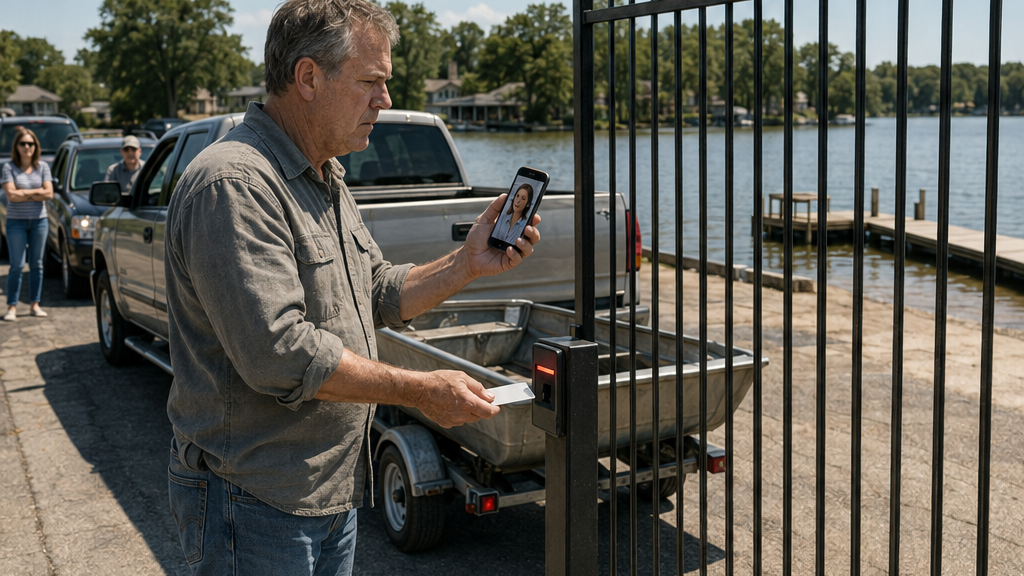
The reader flashed red before Samuel Hall had even taken his hand away.
He stared at it, then at the steel gate, as if one of them had made a mistake that might correct itself out of embarrassment.
Behind his truck, the little aluminum fishing boat sat on its trailer with two rods strapped along the gunwale and a blue cooler wedged beneath the bench seat. Another vehicle had already turned into the access lane behind him. Samuel could see the driver waiting through his side mirror.
He touched the card to the reader again.
Red.
A short electronic chirp sounded almost cheerful.
“What the hell?”
He tried once more, slower this time.
Red.
The concrete ramp beyond the gate sloped toward the lake exactly as it had for most of his life. The dock cleats had been replaced twice, the rails once, and the shoreline had changed after storms, but Samuel could still point to a dark seam in the concrete where his grandfather Anthony had stopped one pour and started the next.
Samuel had launched his first boat there before he was old enough to drive the truck pulling it.
Now a card reader the size of his palm was telling him he did not belong.
A horn tapped behind him.
Samuel stepped away from the gate and raised one hand without turning around.
He called the number printed on the small management sticker beside the keypad.
A woman answered on the third ring.
“Lakeview community management, this is Jessica.”
“This is Samuel Hall. My ramp card isn’t working.”
There was a pause filled with keyboard clicks.
“Address?”
He gave it.
More clicking.
“Yes, Mr. Hall. Your lake-access credential has been suspended.”
Samuel looked through the bars of the gate.
“Suspended for what?”
“I have a notation that your access status is under verification.”
“My access status?”
“That’s what the account says.”
“I’ve been using this ramp for thirty years.”
“I understand.”
“No, I don’t think you do.”
The waiting driver behind him got out now. Samuel recognized him only vaguely, one of the homeowners from the newer section. The man stayed by his SUV, pretending not to listen.
Jessica said, “The association requested documentation for any nonstandard access rights last month.”
Samuel’s jaw tightened.
He remembered the email. A broad message about badge updates, insurance compliance, vehicle stickers, and “legacy access arrangements.” He had skimmed it, muttered something about people who had been in the neighborhood six months telling him how to reach the lake, and closed it.
“I’m not asking for special access,” Samuel said. “My family has had that ramp since before half these houses were here.”
“I can only go by the current records.”
“My grandfather helped build it.”
Another pause.
Then Jessica said, carefully, “Family history and recorded access rights aren’t necessarily the same thing.”
The sentence landed harder than Samuel expected.
He felt heat rising behind his ears.
“You’re telling me Anthony Hall poured that concrete, installed those first cleats, sat through the original association meetings, and now some database says his family can’t get through the gate?”
The man behind him looked away.
Jessica’s voice remained even.
“I’m telling you the current association file does not show an active exception attached to your parcel.”
Samuel almost answered immediately.
Then he noticed two more vehicles entering the lane.
People were watching now.
He could hear his own voice starting to sharpen, and suddenly he heard Anthony’s old warning from the repair shop: if you’re mad enough to shout, you’re usually mad enough to miss something.
Samuel stopped.
He looked at the red reader again.
“What authority did they use to suspend it?”
“I’m sorry?”
“Send me the rule. The vote. Whatever authorized you to shut this card off.”
“I can send the account notation.”
“Send everything you’re relying on.”
Jessica hesitated.
Samuel caught it.
“What?”
“It may take me some time to assemble.”
“Why?”
“The historical records transferred to us weren’t complete.”
Samuel straightened.
The anger did not leave. It changed shape.
“You just said the current file doesn’t show my right.”
“That’s correct.”
“And now you’re saying the historical files aren’t complete.”
“The records conversion is ongoing.”
Samuel took his phone away from his ear, photographed the red reader, then the locked gate, then his truck and boat sitting in the access lane. He took a wider photograph that showed the ramp beyond the bars.
Jessica said, “Mr. Hall?”
“I’m here.”
“If you have documentation, you can submit it for review.”
Samuel looked toward the lake.
“If you don’t have complete records, what exactly did you review before locking me out?”
There was silence long enough to answer the question without answering it.
Finally Jessica said, “The suspension was requested by the board.”
“Who?”
“I can’t speak for individual board members.”
“Was it Karen Campbell?”
Another pause.
“I’ll email you the notation.”
Samuel ended the call.
The man behind him approached cautiously.
“Everything okay?”
“No.”
Samuel moved his truck far enough to clear the lane. The other homeowners used their cards one by one.
Green light.
Beep.
Gate open.
Each time it closed again, Samuel sat behind the wheel with his boat still hitched behind him.
He did not try to follow anyone through.
By the time he reached home, Jessica’s email had arrived.
The notation was short. Access suspended pending verification of legal entitlement outside standard HOA amenity privileges. Board authorization attached.
Samuel opened the attachment.
Karen Campbell’s name was at the bottom.
He read it twice.
Karen had lived three streets over for nearly twenty years. She had borrowed Anthony’s post-hole digger once. She had eaten fish caught from Samuel’s boat at a neighborhood cookout.
He called her.
She answered sounding tired rather than surprised.
“Samuel.”
“You signed this.”
“Yes.”
“On what basis?”
“On the basis that we’re applying the same access requirements to everybody.”
“You know my family’s history with that ramp.”
“I do.”
“Then what are we doing?”
Karen sighed.
“We’re trying to stop managing property rights by memory and handshakes.”
“That ramp isn’t an HOA favor.”
“Then document that.”
Samuel gripped the phone.
“You locked me out first and asked questions later.”
“We asked for documentation weeks ago.”
“I shouldn’t have to prove something everybody here already knows.”
“That,” Karen said, “is exactly the problem.”
Samuel went quiet.
Karen continued, softer now.
“The board meets Thursday. If you have documents establishing a separate right, submit them before then. We’ll review them.”
“And until then?”
“The suspension stays.”
Samuel ended the call before his temper returned.
That evening he opened the email again.
Below Karen’s signature was the deadline: Wednesday, five o’clock.
Samuel printed the message and placed it on his kitchen table.
His wife glanced at it, then at him.
“You have the deed paperwork somewhere, don’t you?”
“Of course I do.”
He said it too quickly.
In the garage, he pulled open the steel filing cabinet where he kept property taxes, insurance renewals, closing papers, and maintenance receipts.
Anthony had kept papers differently.
Old coffee cans. Envelopes tied with string. Folded plats in drawers meant for tools.
And, Samuel suddenly remembered, a gray metal box that everyone in the family used to joke contained every piece of paper Anthony had ever refused to throw away.
Samuel looked back toward the house.
For the first time that day, the locked gate was no longer the question.
The question was whether he had anything stronger than a memory.
Chapter 2: Everyone Remembered the Ramp Differently
Samuel found the deed within ten minutes.
What he did not find was the boat ramp.
He sat at the workbench beneath the garage window with the closing packet spread beneath both hands. The legal description identified his lot, the shoreline boundary, the subdivision plat, utility easements, and several restrictions written in language dense enough to make simple property sound theoretical.
Samuel read it again.
Then a third time.
Nothing plainly said that the Hall family had a permanent right to the launch.
His wife stood in the doorway.
“Well?”
“It references the original plat.”
“That’s good?”
“It’s not what I expected.”
She came closer.
Samuel tapped the page.
“I thought it would just say it.”
“Say what?”
“That the ramp access stays with the property.”
She looked over his shoulder.
“Did Grandpa Anthony ever show you paperwork saying that?”
Samuel leaned back.
“He didn’t need to.”
Her expression changed just enough to irritate him.
“What?”
“Nothing.”
“No, go ahead.”
“I was going to say that might be the part Karen is using against you.”
Samuel closed the packet.
“Karen knows better.”
“Knowing your grandfather built something isn’t the same as knowing what was recorded.”
That was almost the same thing Jessica had said.
Samuel stood and began searching another drawer.
Anthony had helped build the original lakeside facilities when the development was still half dirt roads and open lots. Samuel remembered being seven or eight, carrying washers in a coffee can while Anthony bolted hardware into the dock.
Anthony had been broad-shouldered then, usually sunburned across the back of his neck. He believed work explained itself. If he repaired something for a neighbor, he rarely mentioned it afterward. If an agreement mattered, though, he wrote on whatever was nearby—receipts, envelopes, scraps of lumber.
Samuel had spent most of his life interpreting that certainty as ownership.
That afternoon he walked down the street to speak with one of the few longtime neighbors who had lived there when Anthony was still active in the association.
The older man listened from a porch chair.
“Oh, your grandfather fought about that ramp more than once.”
Samuel felt immediate relief.
“About keeping the access?”
“Something like that.”
“What exactly?”
The neighbor frowned toward the lake.
“I remember him using the words reserved access.”
Samuel waited.
“That’s it?”
“It was thirty-some years ago.”
“Was it in the bylaws?”
“Could’ve been.”
“The deed?”
“Could’ve been that too.”
Samuel laughed once without humor.
The neighbor lifted both palms.
“Anthony knew. I didn’t.”
On the walk home Samuel understood how thin neighborhood memory became when anyone tried to make it precise.
Everyone remembered his grandfather building the ramp.
Nobody remembered exactly what that meant legally.
His boat still sat hitched to the truck beside the garage.
The sight of it made him angry again.
Brian Lee was standing near the mailbox across the street when Samuel came back.
Brian served as HOA treasurer and had voted for the access review.
Samuel considered walking past him.
Brian did not allow it.
“I heard about Saturday.”
“Then you heard enough.”
“I heard you blocked the lane for ten minutes.”
“My card stopped working.”
“I know.”
Samuel stopped.
Brian shoved his hands into his pockets.
“For what it’s worth, I told Karen we should’ve given people more notice.”
“More notice before taking something that isn’t yours?”
Brian’s expression tightened.
“This is why nobody can talk to you about it.”
Samuel stepped closer.
“Talk to me about what?”
“From the board’s side, you’re asking us to accept a special access claim because your grandfather was here first.”
“My grandfather built that ramp.”
“I know.”
“Then why are you saying special access like I walked in last week and demanded a private dock?”
“Because the records we were shown don’t identify yours as private.”
Samuel almost said, Everybody knows.
The phrase reached his mouth and stopped there.
Brian watched him.
“If you’ve got documentation, bring it Thursday.”
“And if I don’t?”
Brian looked toward the boat.
“Then I think the board is going to treat it as an amenity like everybody else’s.”
Samuel stared at him.
It was the first time the possibility felt real.
Not fair. Not right.
Real.
Back in the garage, he searched until sunset.
Boxes of tax returns.
Anthony’s old tackle catalogs.
Manuals for motors Samuel no longer owned.
A cigar box full of brass screws.
No gray strongbox.
His adult daughter called while he was kneeling beside a shelf.
“You still going out this weekend?”
“Probably not.”
“Ramp trouble?”
He paused.
“How’d you hear?”
“Mom.”
Samuel leaned against the workbench.
“I’m handling it.”
“I know.”
She had the same tone her mother used when she thought he was being stubborn.
He changed the subject.
After the call, Samuel remained in the garage alone.
He opened the deed again.
For years, he had thought of the ramp as something inherited so completely that paperwork seemed almost insulting.
Now he realized that was exactly how a right could become vulnerable: everyone knew, until the people who knew were gone.
His wife came out carrying two cups of coffee.
“You’re looking in the wrong place.”
Samuel glanced up.
“The box?”
She nodded.
“I remembered when you moved Anthony’s workbench after we cleared his house.”
Samuel stood.
“I kept the drawers.”
“Not the drawers.”
She pointed toward the back of the property.
“The old storage shed. You put the bottom shelf from his bench in there because you said the wood was too good to throw away.”
Samuel looked past her through the garage door.
The shed had not been properly cleaned in years.
His wife said, “That metal box used to sit underneath it.”
Samuel set down the coffee.
For the first time since the reader turned red, he did not think about Karen, the board, or the gate.
He thought about a rusted gray box nobody had opened since Anthony was alive.
Chapter 3: The Box Under the Workbench
The padlock on the strongbox broke before the box opened.
Samuel twisted the old key too hard and felt the metal give inside the lock. He muttered under his breath, carried the box from the storage shed to the garage, and worked a flat screwdriver beneath the latch until rust flaked onto the floor.
His wife stood beside the workbench.
“You could take your time.”
“I’ve been taking my time for thirty years.”
The latch snapped loose.
The lid lifted with a dry metallic scrape.
Inside were envelopes, rolled maps, carbon copies, old tax receipts, correspondence from contractors, and folders whose edges had yellowed almost brown. The smell was dust, paper, and machine oil.
Samuel stared.
His wife reached toward the top envelope.
He stopped her.
Then immediately felt ridiculous.
“Sorry.”
She smiled faintly.
“Your evidence.”
He removed the papers himself.
Anthony’s handwriting appeared everywhere.
Dates in the corners.
Names beside measurements.
Short notes written in block letters.
Samuel found the original subdivision plat first. Then early association meeting notices. Receipts for concrete and dock hardware. A faded photograph showed Anthony standing beside the unfinished ramp with two other men, one boot resting on a bag of cement.
Samuel held the photograph longer than he meant to.
“That’s the summer he broke his wrist,” he said.
His wife looked closer.
“I thought that was later.”
“No. He kept working with the brace.”
Samuel placed the picture aside.
The memory warmed him for only a moment before the deadline returned.
He kept searching.
Near the bottom lay a stapled packet titled with the old association’s original corporate name.
The date was more than three decades old.
Samuel read the first page, then the second.
“Listen to this.”
His wife leaned against the bench.
He read a section about maintenance obligations around the shoreline, then another about common-use facilities.
“Anything?”
“Not yet.”
Page three contained signatures.
Anthony Hall’s name appeared near the bottom.
Samuel touched it.
He had seen that signature on birthday cards, checks, repair invoices.
Here it sat among the people who had organized the early association.
Samuel felt the old certainty return.
“There.”
His wife did not answer.
“What?”
“That proves he was involved.”
“It proves more than involved.”
“It doesn’t prove the ramp.”
Samuel frowned, but she was right.
He turned the page.
Halfway down page four, a paragraph stopped him.
Reserved access.
He read the line again.
Then from the beginning.
Certain shoreline access rights created before final association conveyance were described as easements reserved to specified parcels, surviving later transfer unless formally released.
Samuel’s pulse quickened.
The language was more complicated than he wanted it to be, but the meaning seemed obvious.
He traced the paragraph with his finger.
“This is it.”
“Does it say our lot?”
“Not here.”
“What does it reference?”
Samuel looked farther down.
An exhibit.
A plat notation.
A recording number.
He found another page containing a list of parcel numbers, but the numbering system predated the current lot designations.
He grabbed his closing packet and tried to compare them.
Nothing matched cleanly.
“Damn it.”
His wife sat opposite him.
“But it’s something.”
“It’s the thing.”
“You don’t know that yet.”
Samuel pushed back from the table.
The last forty-eight hours had been one long sequence of people telling him what he did not know.
Jessica did not know.
Karen did not know.
Brian did not know.
Now his own wife was saying it.
He almost snapped at her.
Instead he looked again at Anthony’s signature.
By Monday morning, Samuel was sitting across from Elizabeth Rivera in a small law office above a pharmacy downtown.
She read quietly.
Too quietly.
Samuel had brought the charter, the old plat, his current deed, and photographs of the locked gate. He had expected Elizabeth to reach the same conclusion he had reached Sunday night.
Instead she turned pages back and forth.
Finally she said, “This is promising.”
Samuel waited.
“That’s all?”
“It’s more than you had Saturday.”
“It says reserved easement.”
“It does.”
“And surviving transfer.”
“It appears to.”
“Then why are we talking like I found a grocery receipt?”
Elizabeth folded her hands.
“Because this document doesn’t, by itself, prove that the easement attached to your current parcel.”
Samuel leaned back.
“My grandfather’s name is on it.”
“Your grandfather’s signature proves he signed it.”
“He owned the property.”
“Then we establish the chain.”
Samuel shook his head.
“This is exactly what the HOA is doing. Everybody wants me to prove something that was settled before I was grown.”
Elizabeth’s expression remained calm.
“You hired me because the HOA assumed its current database told the whole story.”
Samuel said nothing.
“If I make the same mistake with your grandfather’s box,” she continued, “I’m not helping you.”
That quieted him.
Elizabeth turned page four toward him.
“This clause matters. A lot. But we need the referenced exhibit, the recording history, and the chain from the original parcel to yours. If those line up, then you have something much stronger than tradition.”
“And if they don’t?”
“Then we find out what you actually have before Thursday.”
Samuel looked down at the old paper.
The night before, page four had felt like victory.
Now it felt like a door that might open onto another locked gate.
Elizabeth circled the recording number with a pencil.
“Did you find this document in the county records?”
“No.”
“Was it in your closing file?”
“No.”
“HOA archive?”
“Not that they showed me.”
She typed the number into a county database.
No result appeared.
Samuel felt his stomach tighten.
Elizabeth changed the search parameters.
Still nothing.
Then she looked at the format of the number again.
“This is old.”
“How old?”
“Old enough that it may not be indexed under the current system.”
She picked up the phone and called the county recording office.
Samuel listened to one side of a short conversation involving book numbers, archived plats, and pre-digital references.
Elizabeth wrote something on a legal pad.
When she hung up, her expression had changed.
“What?”
“The clerk says that reference points to an archived recording that was never fully imaged into the public online system.”
Samuel stared at her.
“Can we get it?”
“They’re pulling it.”
“When?”
“Tomorrow morning.”
She slid the charter back toward him.
Samuel looked at Anthony’s signature, then the penciled circle around the old recording number.
The strongbox had not proved he was right.
Not yet.
It had pointed to a record Samuel had never seen—and apparently neither had the people who locked him out.
Chapter 4: The Record That Was Missing From the Screen
The county clerk laid a photocopy on the counter and said, “This is the one your attorney asked us to pull.”
Samuel Hall did not touch it at first.
The document was narrower than the modern records Elizabeth Rivera had printed the day before, its type uneven and slightly blurred from an older reproduction process. In the upper corner sat the same recording reference Anthony’s charter had pointed them toward.
Samuel checked the number twice.
“That’s it?”
“That’s what the book and page reference leads to.”
Elizabeth stood beside him, already reading.
Samuel watched her face instead of the paper.
She had warned him not to treat the strongbox like a winning lottery ticket. She had repeated that an old association document could describe an intended arrangement without proving that the right survived later transfers.
Now her expression changed by degrees.
Not triumph.
Attention.
She turned the page.
“Here.”
Samuel leaned closer.
The recording described several shoreline rights established before the association received control of the common waterfront. One was tied to an original parcel number Samuel recognized from Anthony’s papers.
Elizabeth pulled the old subdivision plat from her folder.
The parcel numbers aligned.
Samuel felt his shoulders loosen.
“So that’s my lot.”
“That’s the predecessor parcel.”
“Which became mine.”
“Let’s finish the chain.”
He almost protested.
Then he stopped himself.
They spent nearly an hour moving through transfers.
Anthony to Samuel’s parents.
A boundary adjustment.
A later deed that changed the legal description without expressly repeating every older easement.
Then the conveyance to Samuel.
Each time Samuel thought they had reached the end, Elizabeth checked another reference.
The clerk brought out one more archived image.
Then another.
None contained a release.
None extinguished the right.
By the time Elizabeth finally capped her pen, Samuel had stopped asking whether they were done.
She tapped the chain of documents.
“This is what I wanted.”
Samuel looked at her.
“The easement?”
“The continuity.”
She pointed to the oldest recorded instrument.
“This created the access right.”
Then to the later deeds.
“These transfers carry the parcel forward without a release or termination. The legal descriptions change, but the burden and benefit don’t simply disappear because someone shortened a summary.”
Samuel stared at the papers.
For three days, everyone had asked him to prove something he had resented being asked to prove.
Now the proof felt different from what he had imagined.
It was not one sentence under Anthony’s signature.
It was a chain.
If even one piece had broken, his certainty might have meant nothing.
Elizabeth slid the copies into a folder.
“You appear to have a durable recorded easement.”
Samuel exhaled.
For the first time since Saturday, he allowed himself to picture the gate opening.
Then Elizabeth said, “But I want to see the association’s current plat package.”
Samuel looked at her.
“Why?”
“Because Jessica said their current records showed no exception. I want to know what they were looking at.”
The answer came that afternoon.
Jessica emailed the documents management had inherited when Lakeview Property Solutions took over. The packet included a clean digital map of the lakefront, common areas shaded in blue, lot boundaries in black, utility corridors marked in gray.
Samuel’s parcel was there.
The ramp was there.
His easement was not.
Elizabeth placed the digital map beside Anthony’s older plat.
“See this reference?”
Samuel pointed.
A notation on the old version connected the Hall parcel to the access corridor.
On the newer summary, the notation was gone.
“Somebody removed it?”
“Not necessarily.”
Samuel frowned.
“You just showed me it disappeared.”
“I showed you the later summary doesn’t contain it. That’s not the same as proving someone deliberately removed it.”
He hated how often she was right about distinctions.
“So what happened?”
“Could be a conversion omission. Could be an abbreviated map. Could be somebody treated recorded rights as unnecessary detail when they recreated the association file.”
Samuel looked at the clean digital image.
It appeared more authoritative than Anthony’s stained paper.
That bothered him.
A person looking only at the newer version would have no reason to know anything was missing.
Elizabeth searched the management packet.
Near the bottom sat a document labeled historical records status.
She opened it.
The message had been sent months before Lakeview began its access-card review.
Samuel read the first paragraph.
Several pre-digital instruments remained unmatched to current parcel summaries. Historical easements and shoreline exceptions required archival verification before final reconciliation.
Samuel read it again.
“They knew?”
“Someone knew the conversion wasn’t complete.”
“And they still shut the card off.”
Elizabeth did not answer immediately.
“Who received this?”
The distribution line included Jessica, Lakeview’s transition team, and the HOA board president.
Karen Campbell.
Samuel felt the old anger return hard enough that he stood.
“She knew.”
“We know she received the warning.”
“She signed the suspension.”
“We know that too.”
Samuel paced once across Elizabeth’s office.
“She sat there telling me rules had to be based on records.”
“They should be.”
“She knew the records were incomplete.”
“That is now a fair question to ask.”
Samuel turned toward her.
“A question?”
“Yes.”
He almost laughed.
“What else could explain it?”
“Pressure. Misunderstanding. Advice from counsel. An assumption the warning didn’t apply to your parcel. Or she read it and made a bad decision anyway.”
Samuel picked up the copy.
He wanted the simple version.
Karen knew.
Karen ignored it.
Karen was wrong.
But Elizabeth was asking him to prove motive with the same care she had required him to prove ownership.
Samuel looked at Anthony’s old plat.
The strongbox papers no longer seemed magical.
Their value came from fitting other records that existed outside the family.
“Can we use this Thursday?”
“We can ask the board to restore access immediately.”
“And if they don’t?”
“Then the situation changes.”
On Tuesday evening, Samuel found Brian Lee trimming a hedge beside his driveway.
Brian shut off the trimmer when Samuel approached.
“I heard you found something.”
“More than something.”
Brian wiped his forehead with his sleeve.
Samuel handed him a copy of the recorded easement.
Brian read the first page.
Then the second.
His face tightened.
“Has Karen seen this?”
“She will.”
Brian returned the pages.
“If this is what Elizabeth says it is, I don’t see how the suspension stands.”
Samuel studied him.
“You voted for it.”
“I voted based on the file we were given.”
“You could’ve asked whether the file was complete.”
Brian’s jaw shifted.
“So could you when they asked for your documents.”
The comment landed.
Samuel could have argued.
Instead he folded the papers.
Brian said, “I’m not saying those are equal.”
“No.”
“But neither of us read much past what we wanted to believe.”
Samuel disliked the sentence because part of it belonged to him.
Before he left, Brian asked, “Did Lakeview know about the missing records?”
Samuel paused.
“The transition team did.”
Brian looked toward his house.
“And Karen?”
Samuel handed him the warning notice.
Brian read the distribution line.
His face changed.
“When was this sent?”
“Three months ago.”
Brian read it again.
Samuel took the paper back.
That night Elizabeth emailed him the enforcement authorization.
Karen’s electronic signature showed the exact time and date.
Beneath it sat a certification that the suspension was based on the association’s verified property-access records.
Samuel compared the date to the records warning.
The warning had come eleven weeks earlier.
Karen had not merely signed after the archive problem was known.
She had certified that the records were verified.
Chapter 5: Karen Had a Reason, but Not an Excuse
Karen Campbell opened Thursday’s board meeting by placing an accident report in front of Samuel.
He had expected her to start with his easement.
Instead she said, “Before we discuss your access, you need to understand why the board changed the system.”
Samuel glanced at Elizabeth.
She gave no reaction.
The meeting room occupied one side of the management office, with folding tables arranged in a rectangle. Brian Lee sat two chairs down from Karen. Jessica Green had a laptop open beside a stack of Lakeview files. Two other board members sat opposite Samuel.
Karen pushed the report toward him.
Seven months earlier, a guest had fallen from the lower dock while helping launch a boat. The injury had not been catastrophic, but it had produced a claim, an insurance investigation, and a warning about uncontrolled access.
Karen continued.
“We had residents lending cards to guests. Contractors using the gate after hours. Boats registered to people who didn’t live here. The insurer asked us who had authority to use the facilities.”
Samuel said, “I’m not a guest.”
“I know that.”
“Then this doesn’t answer what you did.”
“It explains why we stopped accepting ‘everybody knows’ as an access policy.”
That phrase struck closer than Samuel wanted.
Karen slid another document across.
The association’s liability premium had risen sharply after renewal.
“We were told to document who had what rights,” she said. “Not who remembered what from twenty years ago.”
Samuel looked at the premium increase.
For the first time, he saw something besides officiousness in Karen’s decisions.
Fear had a number attached to it.
Every owner would pay part of it.
Elizabeth spoke.
“Uniform procedures are reasonable. Suspending a recorded property right without completing the review is a separate issue.”
Karen’s expression hardened.
“We didn’t know it was recorded.”
Samuel reached into his folder.
“You knew the records weren’t complete.”
He placed the archival warning on the table.
Jessica stopped typing.
Karen looked at the page.
She did not pretend she had never seen it.
“That notice applied to the transition generally.”
“It specifically says historical easements.”
“There were hundreds of documents being reconciled.”
“And you certified the access records were verified.”
Karen looked at him.
“Based on the information management had matched at the time.”
Jessica shifted in her chair.
Samuel noticed.
“So whose decision was it?”
Karen answered before Jessica could.
“Mine.”
The room went still.
Samuel had expected deflection.
Karen gave him none.
“I recommended the suspensions,” she continued. “The board approved the policy, but I authorized the individual holds where documentation wasn’t in the active file.”
“Even though you knew the active file might be missing documents.”
“I believed people claiming separate rights would provide them when asked.”
Samuel felt his temper rise.
“So you locked the gate and made homeowners prove you were wrong.”
“I made owners substantiate exceptions.”
“My easement isn’t an exception to your rule. Your rule is subject to my easement.”
Karen looked away for the first time.
HOA counsel, seated near the end of the table, asked to see the county recording.
Elizabeth handed over the complete chain.
While counsel read, Brian opened the archival warning.
“How much of this did the board get?” he asked.
Karen looked at him.
“The transition report was summarized at the March meeting.”
“That’s not what I asked.”
Samuel watched Brian’s face.
The treasurer who had lectured him about paperwork on Sunday now sounded different.
Jessica answered quietly.
“I provided the full transition packet to the board president. The board packet contained an executive summary.”
Brian turned toward Karen.
“Did the executive summary say historical easements were still unmatched?”
Karen hesitated.
“It said reconciliation remained ongoing.”
Brian opened his copy.
“No. It says ‘minor archival cleanup remains.’”
Jessica looked uncomfortable.
“I didn’t write the board summary.”
Karen did.
Nobody needed to say it.
Samuel felt an unexpected disappointment settle beneath his anger.
Not because Karen had become innocent.
Because the truth was less satisfying than a villain.
She had been afraid of liability. She had wanted a clean system. She had received an inconvenient warning and compressed it into language that made the problem look smaller.
Then she had acted as if the simplified version were complete.
HOA counsel finished reading.
“We should pause enforcement against the Hall parcel.”
Karen said, “Pending review.”
Counsel shook his head.
“No. We have notice now of a recorded instrument with a plausible continuous chain. Continuing the suspension after today increases the association’s exposure.”
Samuel heard the distinction clearly.
Before today, Karen could argue mistake.
After today, keeping him locked out became a choice.
Karen folded her hands.
“What exactly is Mr. Hall asking for?”
Samuel had rehearsed an answer full of everything the previous week had cost him.
Cancelled plans.
Trailer storage.
Attorney time.
Humiliation at the gate.
He looked at Elizabeth.
She did not speak for him.
“First, restore the access,” Samuel said. “Second, correct the association records.”
Karen said, “We can issue a temporary card while counsel reviews.”
“Not temporary.”
“Samuel, the underlying documents still need formal review.”
“They’ve been recorded for decades.”
“And we need a process.”
He almost snapped that process was what had gotten them there.
Instead he said, “Then use one. But the starting assumption can’t be that your database outranks the county record.”
Brian nodded once.
Karen saw it.
Something in her expression tightened.
“Any reimbursement request would need documentation.”
“I have it.”
“And I’m not agreeing to damages.”
“I didn’t ask you to.”
“Not yet.”
Samuel understood then that she had been preparing for a different version of him—the angry homeowner who wanted a public apology, a large check, perhaps her resignation.
He was angry enough to want some of those things.
But he also saw the premium sheet still lying between them.
Every dollar the board wasted defending the wrong decision came partly from neighbors who had made none of it.
HOA counsel cleared his throat.
“I suggest the parties discuss interim restoration before this escalates.”
Karen looked at Samuel.
“We’ll reactivate your card tomorrow.”
Samuel waited.
“Provided,” she continued, “we can resolve this with a mutual release.”
Elizabeth leaned slightly forward.
“What would he be releasing?”
“Claims related to the suspension.”
Samuel stared at Karen.
“So I get back what you had no right to take, but only if I promise never to hold the association responsible for taking it.”
Karen’s voice stayed controlled.
“I’m trying to prevent legal fees from becoming the next problem.”
Brian looked down at the table.
Samuel understood her logic.
He even understood why, from her seat, it might sound responsible.
That did not make it acceptable.
The meeting ended without agreement.
In the hallway, Jessica caught Samuel before he left.
“I’m sorry about Saturday.”
Samuel looked at her.
“You told me what the computer showed.”
“Yes.”
“And the computer was incomplete.”
“Yes.”
She closed her laptop bag.
“I should have said that more clearly.”
Samuel nodded.
It was not absolution, but it was something.
At home that night, an email arrived from HOA counsel.
The subject line read Proposed Interim Resolution.
The association would restore Samuel’s access immediately.
In exchange, Samuel would release the HOA, board, and management company from claims arising from the suspension and acknowledge that the dispute had been resolved.
His wife read the document over his shoulder.
“You could be back on the water Saturday.”
Samuel looked through the kitchen window toward the dark shape of his boat beside the garage.
One signature and the red light would turn green again.
One signature would also let the board call the whole thing a misunderstanding that had already been fixed.
Samuel scrolled to the release language.
Karen had finally offered him the key.
The price was silence.
Chapter 6: He Refused the Easy Keycard
The replacement keycard arrived by overnight envelope before Samuel answered the settlement offer.
He found it Thursday morning leaning against the front door.
Inside was a new white card and a one-page instruction sheet.
Activation pending executed resolution.
Samuel carried the envelope into the kitchen and set it beside the coffee maker.
He did not remove the card from its plastic sleeve.
His wife glanced at it.
“That’s cruel.”
“What?”
“Sending the thing before you can use it.”
Samuel looked at the card.
“No. It’s smart.”
It made the solution feel finished.
All he had to do was sign.
By ten o’clock, he was in Elizabeth Rivera’s office.
She read the proposed release and marked three paragraphs.
“They’re offering exactly what Karen described.”
“My access back.”
“And broad waiver language.”
Samuel sat opposite her.
“What could I reasonably claim?”
Elizabeth studied him.
“Do you want the legal answer or the number you’re hoping I’ll say?”
He almost smiled.
“The legal answer.”
“You have documented attorney fees, direct costs associated with the denial, and potentially other provable losses depending on duration and conduct. But litigation adds expense fast. For you and for them.”
“I don’t want to spend a year fighting over a boat ramp I’m supposed to be able to use.”
“Then decide what you actually need.”
Samuel looked at the replacement card in its envelope.
Two days earlier he would have said he needed Karen to admit she was wrong.
On Saturday, he might have wanted her embarrassed in front of every person who watched his card fail.
Now neither felt large enough.
“I need the record fixed.”
Elizabeth nodded.
“And not just my access turned back on. The map. The parcel file. Whatever they use the next time management changes.”
“That can be negotiated.”
“And I want my actual costs covered.”
“Reasonable.”
Samuel paused.
“Something else.”
Elizabeth waited.
“If their old records missed mine, how do we know mine is the only one?”
That question changed the meeting.
Jessica provided an inventory later that afternoon.
Most historical exceptions had been reconciled, but several older shoreline and utility references remained unresolved. None were automatically equivalent to Samuel’s easement. Some might have expired. Some might have been incorporated into later plats.
But Samuel’s missing notation was not the only gap.
He read the list twice.
The dispute had started with his gate.
Now he saw the flaw in the process itself: the board had treated an unfinished archive as if absence from the new system meant absence of a right.
That evening Brian came to Samuel’s garage.
He stood beside the unused boat and stared at the unopened card envelope on the workbench.
“You’re really not activating it?”
“Can’t unless I sign.”
Brian rubbed a hand over his chin.
“Legal bills are already climbing.”
“How bad?”
“Bad enough that if this goes much further, everybody gets to help pay for it.”
Samuel leaned against the boat trailer.
“You saying I should sign?”
“I’m saying I wish all of us had slowed down two weeks ago.”
That was not the answer Samuel expected.
Brian looked toward the street before continuing.
“I went back through the meeting packet. I voted based on Karen’s summary.”
“You already told me.”
“I didn’t read the transition report myself.”
Samuel said nothing.
Brian gave a humorless laugh.
“I spend half the year telling people they need receipts for every reimbursement request, and I voted on a property-rights policy from a two-paragraph summary.”
Samuel thought of his own unopened emails.
“You weren’t the only one who didn’t read something.”
Brian looked at him.
“What do you want now?”
Samuel pointed toward the card.
“Not that.”
“Then what?”
“A corrected record. Actual costs. And a rule that says if somebody claims a recorded property right, nobody shuts it off until the title question gets checked.”
Brian frowned.
“That could slow enforcement.”
“Good.”
“It could also let people make bogus claims to buy time.”
Samuel considered that.
“Then give the review a deadline. Five business days. Ten. Whatever makes sense.”
Brian’s expression shifted.
“You’ve thought about this.”
“I’ve had time. My boat hasn’t moved.”
Brian smiled despite himself.
The next morning, Karen emailed the neighborhood board update.
She did not name Samuel directly.
The message said an access issue involving historical documentation had been “substantially resolved,” but final paperwork remained outstanding because one owner had declined immediate reinstatement under the association’s proposed terms.
Samuel read it twice.
Then a third time.
His first reaction was fury.
His refusal had been converted into the reason the dispute continued.
He called Elizabeth.
“She’s telling people I’m keeping this alive.”
“Is anything in the statement literally false?”
Samuel hated the question.
“I declined their terms.”
“Correct.”
“Because the terms require a release.”
“Also correct.”
“So what do I do?”
“Decide whether you want to win an argument about the email or solve the underlying problem.”
Samuel walked into the garage while she spoke.
The strongbox sat open on the workbench.
The new keycard lay beside it.
Old paper.
New plastic.
Two different ways of deciding who could pass through the same gate.
Samuel looked at Anthony’s charter copy.
“I want to change the proposal.”
“How?”
“Drop anything we can’t document.”
“Meaning?”
“No big damages number. No demand that Karen resign. No public apology.”
Elizabeth was quiet.
Samuel continued.
“They reimburse the direct costs and reasonable legal fees. They correct my parcel records. They file whatever confirmation needs to be filed so the easement is obvious in the future.”
“And the policy?”
“Title review before disputed property rights get suspended.”
“That will be the hardest piece.”
“I know.”
Elizabeth said, “Why does it matter that much to you?”
Samuel looked at the strongbox.
“Because if I sign for my card and walk away, the only lesson is that I happened to have better paperwork.”
He thought of the list Jessica had sent.
“I want the next person to get a review before they get a red light.”
Later that afternoon, Elizabeth sent the revised terms.
The board did not answer immediately.
Instead, Karen called Samuel directly.
“You realize you’re asking us to limit enforcement authority.”
“I’m asking you to check whether you have authority before you use it.”
“We have hundreds of owners.”
“And county records exist for all of them.”
“This creates administrative burden.”
Samuel glanced at the unopened card.
“So did locking me out.”
Karen went silent.
When she spoke again, her voice was lower.
“You could have your access today.”
“I know.”
“I’m trying to understand why you’re refusing something you spent all week demanding.”
Samuel rested one hand on the strongbox lid.
“Because a working card isn’t the same as a corrected right.”
Karen did not respond.
He continued.
“If I sell the house five years from now, I don’t want the next owner standing at that gate trying to explain who Anthony Hall was.”
The line seemed to stop her.
Samuel heard papers moving on her end.
Finally Karen said, “That goes beyond your family.”
“Exactly.”
After the call, Samuel contacted Elizabeth again.
“Add one thing.”
“What?”
“The recognition has to follow the parcel, not me personally.”
“That is what the easement already appears to do.”
“I know. I want the association’s records to say it clearly.”
Elizabeth paused.
“Because you may sell?”
“Someday.”
“And you don’t want the next owner depending on your name.”
Samuel looked at Anthony’s handwriting inside the strongbox.
For most of the week he had treated those papers as proof that his grandfather had left him something.
Now he began to see the harder question.
What was Samuel going to leave clear for whoever came after him?
“Write it so nobody has to remember us,” he said.
Chapter 7: The Papers Were Never Meant as a Weapon
Samuel found Anthony’s note because one corner of it had stuck to the back of the easement copy.
He was sorting the strongbox papers Saturday morning, preparing cleaner copies for Elizabeth, when the thin sheet pulled free and fluttered onto the workbench.
It was not a legal document.
No seal. No recording number. No formal heading.
Just Anthony Hall’s block handwriting on yellowed paper.
Samuel recognized the first line immediately.
If we don’t put these things down clear, somebody’s children will fight over what we meant.
Samuel stopped reading.
The unopened replacement keycard sat six inches away in its plastic sleeve.
He picked up the note again.
Anthony had apparently written it after one of the early association meetings. He mentioned the ramp, two utility crossings, and a shoreline boundary neighbors had argued about because the original developer had relied too heavily on verbal understandings.
Near the bottom, he had written another sentence.
A handshake is fine until the people who shook hands are gone.
Samuel lowered himself onto the stool.
All week, he had remembered Anthony as the man who never surrendered ground.
That memory was not false.
Anthony could be stubborn enough to argue over a fence post for an hour.
But Samuel had mistaken stubbornness for the whole lesson.
Anthony had saved the papers because he did not trust memory to carry obligations safely through generations.
The strongbox had not been ammunition waiting for Samuel.
It had been maintenance.
His wife came into the garage carrying folded towels.
“What is it?”
Samuel handed her the page.
She read quietly.
Then she looked at the card.
“That changes things.”
“Yeah.”
“You still angry?”
“Very.”
She smiled faintly.
“At least that part’s familiar.”
Samuel folded the note carefully and slipped it into a clear sleeve.
On Monday, mediation began in a conference room chosen by HOA counsel.
Karen sat across from Samuel with Jessica beside her. Brian occupied the chair at the end of the table, technically there as treasurer rather than as Samuel’s ally.
Elizabeth placed Samuel’s revised proposal between them.
The demands were narrower than the first discussion had suggested.
Reimbursement for documented direct losses.
Reasonable legal fees.
Formal correction of the Hall parcel record.
Written recognition that the easement ran with the parcel rather than with Samuel personally.
And a review policy requiring the association to pause suspension of a disputed property right long enough to verify title records.
Karen read the final item twice.
“I still have a problem with this.”
Samuel said, “Which part?”
“You’re making the association prove a negative every time somebody claims an old right.”
Elizabeth answered, “The proposed language doesn’t say that.”
Karen looked at her.
“It creates a delay.”
“It creates a review.”
Brian leaned forward.
“How long?”
Elizabeth pointed to the draft.
“Up to ten business days unless an immediate safety condition exists.”
Karen shook her head.
“A lot can happen in ten days.”
Samuel looked at her.
“So can a lot happen when you’re wrong.”
Karen’s eyes met his.
For a moment he thought the room would slide back into the same argument they had been having from the beginning.
Then Brian spoke.
“I think we should adopt it.”
Karen turned toward him.
“You do?”
“We’ve already spent more investigating Samuel’s easement after the suspension than we would have spent checking it first.”
“That’s one case.”
Brian opened his folder.
“No. Jessica gave us the historical exception inventory.”
Jessica looked down.
Brian continued.
“We still have several entries that aren’t reconciled. Maybe none of them become disputes. But if one does, I don’t want us using an incomplete map as proof that nothing else exists.”
Karen’s face hardened.
“You voted for the policy.”
“I did.”
“So did the others.”
“I know.”
Brian did not retreat.
“That’s why I’m saying this.”
Samuel watched him carefully.
A week earlier, Brian had been the neighbor most willing to describe Samuel’s access as a special privilege.
Now he was challenging the board in a room where admitting the mistake would make his own vote look careless.
That mattered more to Samuel than easy agreement would have.
Karen turned a page.
“I’ll agree to restoration. I’ll agree to the parcel correction. I’m willing to discuss reimbursement.”
“But not the process,” Samuel said.
“I will not sign language stating the board acted improperly.”
“There’s no sentence in there saying you acted improperly.”
“It’s implied.”
Samuel almost answered sharply.
Instead he remembered Anthony’s note.
Somebody’s children will fight over what we meant.
He reached into his folder and removed a copy.
“I found this Saturday.”
Karen glanced at it without taking it.
“What is it?”
“Something my grandfather wrote when the original property agreements were being sorted out.”
“I don’t see how that’s legally relevant.”
“It isn’t.”
That made her look at him.
Samuel placed it on the table anyway.
“I spent the first few days of this thinking the point was that Anthony built the ramp, so everybody should’ve known better.”
Karen said nothing.
“I was wrong about that part.”
Brian looked up.
Samuel continued.
“You shouldn’t have to run an HOA by stories about who built what thirty years ago. That’s exactly why records matter.”
Karen’s eyes moved to the note.
“But if your records are incomplete,” Samuel said, “you also don’t get to pretend they’re complete because it makes enforcement easier.”
The room stayed quiet.
“I don’t need you humiliated,” he said. “I need the next owner of my house not to have this argument.”
Karen finally picked up Anthony’s note.
She read it.
Her expression gave Samuel nothing.
After several seconds she set it back down.
“I can support a title-review procedure,” she said, “if counsel drafts language that preserves emergency safety authority.”
Elizabeth nodded.
“That’s workable.”
“But I will not characterize the original suspension as intentional misconduct.”
Samuel looked at her.
“I didn’t ask you to.”
Karen seemed almost suspicious of that.
Perhaps she had expected him to push until she had to choose between surrender and litigation.
A month earlier, Samuel might have enjoyed that choice.
Now it seemed wasteful.
They spent another hour on wording.
By the end, nearly everything had a path toward agreement except one point: how the association would formally describe the reason Samuel’s access had been suspended.
Karen wanted the minutes to say the matter arose from incomplete documentation supplied during management transition.
Samuel wanted the record to say the association had acted before historical verification was complete.
The difference was one sentence.
It was also the difference between an unfortunate database problem and a defective decision.
Karen closed her folder.
“I can’t take your wording to the board.”
Samuel placed both hands on the table.
“Then we’re not done.”
“You have your access.”
“No.”
“You will.”
“That isn’t the same thing.”
Karen looked tired.
“What exactly do you still want from me, Samuel?”
He glanced at Anthony’s note.
“Not an apology.”
Then he looked back at her.
“A record that tells the truth clearly enough that nobody has to fight over what we meant.”
Samuel gathered his papers.
The keycard remained unopened at home.
And until the association corrected its own record—not merely his access—he intended to leave it that way.
Chapter 8: The Gate Opened, but That Wasn’t the Victory
Karen Campbell had to read the disputed sentence aloud herself.
The revised meeting minutes sat before her at the next full HOA meeting, several weeks after Samuel’s keycard first flashed red.
She adjusted her glasses and read in the same controlled voice she used for budgets and maintenance motions.
“Historical verification of the Hall parcel’s recorded easement had not been completed before access suspension was authorized.”
Nobody applauded.
Samuel was grateful for that.
Karen continued.
“The association recognizes the recorded shoreline access easement benefiting the Hall parcel and will amend its property records accordingly.”
Samuel sat beside Elizabeth near the back of the room.
His wife was not there. Neither was his daughter.
He had asked them not to come.
This had never needed an audience.
Brian raised the next motion.
The association would reimburse Samuel’s documented expenses and agreed legal fees connected to establishing the existing easement. The final amount was meaningful but ordinary—nothing resembling the extravagant damages Samuel had once imagined while sitting furious behind the locked gate.
Elizabeth had told him he had arguments for pushing farther.
Samuel had declined.
He wanted what he could document.
Nothing padded.
Nothing designed to hurt.
The board approved the reimbursement.
Then came the harder vote.
Brian read the proposed title-review procedure.
When a homeowner asserted an existing recorded property right inconsistent with the association’s current administrative records, enforcement affecting that claimed right would pause for up to ten business days while available title and county records were checked, unless an immediate safety condition required temporary action.
Karen had negotiated that last clause carefully.
Samuel had agreed to it.
Authority needed limits.
Limits also needed enough room for real emergencies.
One board member voted against the policy.
Another hesitated before voting yes.
Brian voted yes.
Karen waited until the others had finished.
Then she said, “Yes.”
The motion passed.
Samuel felt less satisfaction than he had expected.
What he felt instead was release.
A week earlier, he had imagined victory as Karen being forced to admit she had been wrong.
Now the more important thing was that the rule no longer depended on whether the next person confronting the HOA was as stubborn as he was, had an attorney, or happened to inherit a strongbox full of papers.
After the meeting, Karen caught him near the door.
“Samuel.”
He stopped.
She held his replacement card.
Not the one mailed to his house. A newly activated card with the corrected parcel classification already entered into Lakeview’s system.
“I thought Jessica could mail it,” Karen said. “But that seemed a little ridiculous at this point.”
Samuel took it.
“Probably.”
Karen looked toward the meeting room.
“I still think we needed to tighten access.”
“I know.”
“And I still think people should provide documentation when they claim exceptions.”
“So do I.”
That surprised her.
Samuel slipped the card into his wallet.
“I should’ve answered the first request instead of deciding everybody ought to know my family’s history.”
Karen nodded once.
Then he added, “You still shouldn’t have shut it off before you knew what your own records were missing.”
“I know.”
There was no dramatic apology in her voice.
Just a sentence she had resisted for weeks.
It was enough.
Karen remained HOA president, though the new procedure required title disputes to be reviewed with management and counsel rather than approved by the president alone.
Samuel thought that was better than driving her out.
She had made a bad decision under real pressure.
The correction ought to make the next decision better, not merely replace the person making it.
That Saturday morning, Samuel backed his boat down the familiar access lane.
For the first time in weeks, nothing blocked him.
He stopped beside the reader.
The concrete ramp waited beyond the steel gate.
The seam Anthony had poured decades earlier was still visible.
Samuel took the new card from his wallet.
For a moment he remembered the first Saturday: the red flash, the car behind him, Jessica’s voice through the phone, his own anger spreading hot enough that he had nearly made the entire dispute about disrespect.
He touched the card to the reader.
Green.
The latch released with a mechanical click.
Samuel did not smile.
He simply drove through.
At the bottom of the ramp, he backed the trailer until the boat began to float.
His adult daughter was waiting beside the dock.
“You made it,” she said.
“Barely.”
“You said nine.”
“It’s nine-oh-three.”
“That’s barely.”
Samuel climbed from the truck holding an envelope.
Before they launched, he handed it to her.
She looked inside.
“What’s this?”
“A recorded copy of the easement.”
She laughed.
“You brought property records fishing?”
“I brought you property records fishing.”
“That’s worse.”
Samuel leaned against the truck.
“Keep it.”
Her smile faded when she realized he was serious.
“I have a copy at home.”
“I know.”
“And Elizabeth has one.”
“I know.”
“And the HOA has corrected theirs.”
“That’s the point.”
Samuel looked toward the ramp.
“When your great-grandfather kept those papers, I thought it was because he didn’t trust anybody.”
“Didn’t he?”
“Probably not much.”
She laughed.
Samuel continued.
“But I found something he wrote. He wasn’t keeping records so he could win arguments after he was gone.”
His daughter looked down at the envelope.
“He was trying to stop the arguments.”
Samuel nodded.
Across the parking area, the gate opened for another homeowner.
Green light.
A vehicle rolled through.
For decades Samuel had thought legacy meant keeping possession of what Anthony had left him.
The dock.
The ramp.
The access.
The right to say, My family was here first.
He understood it differently now.
A right that lived only in one person’s memory was fragile.
A promise nobody bothered to record could become somebody else’s dispute.
Anthony had left Samuel more than access to the lake. He had left a trail clear enough to follow when memory failed.
Samuel had nearly done the opposite.
He had assumed familiarity was permanence.
He would not make that mistake again.
His daughter slipped the envelope carefully into the truck’s glove compartment.
“Good enough?”
“No.”
Samuel looked at her.
“When we get home, put it with your papers.”
She shook her head.
“You really know how to make fishing exciting.”
“Wait until I explain the plat.”
“Boat. Now.”
Samuel laughed and released the winch strap.
The boat drifted free.
Later, while his daughter held the line from the dock, Samuel returned to the truck for one last thing.
Not the strongbox.
That no longer lived beneath an old workbench.
The original documents had been placed in archival sleeves, with copies stored separately and the county references labeled clearly. The metal box itself remained in the garage, empty except for Anthony’s handwritten note.
Samuel had considered putting everything back exactly where he had found it.
He decided that would miss the point.
The papers had spent decades waiting for someone to need them.
Now they had done their job.
He stepped onto the boat.
His daughter untied the line.
As they idled away, Samuel looked back once.
The gate was almost invisible from the water.
The reader beside it was smaller still.
For weeks, that little red light had seemed capable of erasing thirty years.
It never had that power.
But neither did Samuel’s anger, his family name, or the fact that Anthony had once poured the concrete with his own hands.
What protected the right was simpler and less dramatic.
Someone had taken the time to make it clear.
Samuel reached into the glove compartment before they left the no-wake zone and tapped the envelope.
“Don’t forget that.”
His daughter rolled her eyes.
“I won’t.”
He believed her.
Then he pushed the throttle forward, and the old ramp receded behind them—not as something his family had won back, but as something they had finally learned how to leave in better order than they found it.
The story has ended.