The HOA Paved Over His Irrigation Line—Then Their Own Water Stopped Flowing
Chapter 1: The Morning His Garden Went Dry
Raymond Harris knew something was wrong before he reached the first row of tomatoes.
The sprinkler nearest the shed was turning normally, throwing a clean silver arc across the beans. Twenty yards farther north, the next head coughed twice and dribbled water into the dirt. Beyond that, three more stood motionless.
Raymond stopped in the path.
The pump was running.
He could hear it through the open shed door, a steady electric hum he had listened to for years. The pressure should have been enough to carry water all the way to the orchard.
Instead, half his garden was drying in the morning sun.
He crossed the rows quickly, boots pressing dark prints into damp soil near the working heads and pale dust near the dead ones. At sixty-seven, he no longer moved fast unless something deserved it. This did.
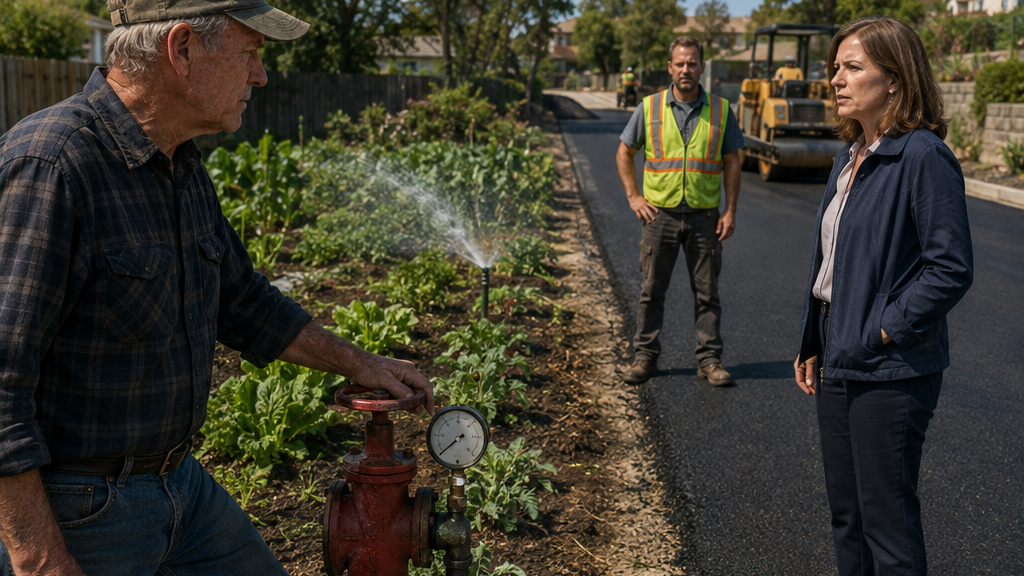
At the valve box along the northern edge of his property, he pulled the lid free.
The red-handled shutoff valve sat where it always had. Beside it, the pressure gauge trembled far below its normal mark.
Raymond stared at the needle.
“Come on,” he muttered.
He checked the filter. Clean.
He checked the pump intake. Clear.
Then he walked the buried line north.
Twenty-four years of maintaining the property had taught him where every important thing lay, even when grass and time covered the evidence. The main irrigation line ran past the orchard, along the edge of the old fence, and then beneath the narrow strip separating his land from the newer section of the subdivision.
That strip looked different now.
Black asphalt cut across it.
Raymond stopped so abruptly that dust lifted around his boots.
The HOA’s new maintenance lane had been graded the day before. He had heard machines until late afternoon, but he had stayed away. The association had been talking about drainage and emergency access for months. He had received letters. He had thrown most of them into a drawer after glancing at the first paragraph.
Their road, he had thought.
Their project.
Their problem.
But the pavement in front of him did not remain on association property.
It crossed the route of his irrigation line.
Fresh blacktop extended roughly thirty feet across the narrow corridor, smooth except for tire marks near the shoulder. A roller and small excavator were parked farther down the lane. Two crew members were unloading equipment.
Raymond stepped off the grass and crouched at the edge of the pavement.
The soil beside it was still loose from grading. Heavy tire impressions ran directly over the place where his pipe disappeared beneath the road base.
He pressed his fingers into the dirt.
Fresh.
One of the workers noticed him.
“Morning,” the man called.
Raymond stood. “Who marked utilities out here?”
The worker looked toward the equipment.
“You’d have to talk to Brian.”
“Where’s Brian?”
“Should be here soon.”
Raymond looked back toward his garden.
The dead sprinkler heads were visible beyond the orchard.
He took out his phone and photographed the asphalt, the tire impressions, the shoulder, then walked back to the red valve and photographed the pressure gauge.
By then, a white SUV had turned into the subdivision lane.
Deborah Mitchell stepped out.
Raymond had known Deborah for more than ten years. They had never been friends, but there had been a time when they waved from their vehicles and exchanged two sentences at the mailbox without feeling required to defend anything.
That time had passed somewhere between the second drainage assessment and Raymond’s decision to stop attending HOA meetings.
Deborah walked toward him carrying a folder.
“What happened?” she asked.
“You tell me.”
He pointed toward the asphalt.
“My pressure dropped this morning. That road is sitting over my irrigation line.”
Her expression tightened, but not with surprise.
“The access lane was approved by the board.”
“I didn’t ask who approved the lane.”
“Raymond—”
“I asked why it’s over my line.”
Deborah looked toward the pavement.
“The engineering plan showed the old utility corridor. We were told the branch through here wasn’t in active service.”
“By who?”
“The project team.”
“That’s not an answer.”
She exhaled.
“The association has authority to maintain this access area.”
“Maybe it does.”
Raymond pointed toward the red valve.
“But it doesn’t own what’s under my land.”
A pickup arrived behind Deborah’s SUV. Brian Anderson stepped out wearing work boots and a reflective vest.
Deborah lifted a hand toward him.
“Brian, we have an issue.”
Brian came over, looked at Raymond, then at the valve box.
“What kind?”
“My irrigation pressure disappeared after you graded that road.”
Brian crouched beside the gauge.
“How deep is your line?”
“Depends on where you are.”
“Material?”
“PVC through this section.”
Brian glanced toward the asphalt.
“That should’ve been on the locate.”
“It wasn’t abandoned.”
“I didn’t say it was.”
“You paved over it.”
Brian stood.
“We built from the authorization package we received.”
Raymond looked from Brian to Deborah.
There it was again.
Authorization.
A word everyone seemed willing to use without telling him who had authorized what.
He returned to the garden and shut down the irrigation cycle before the pump could strain against whatever blockage or break existed downstream.
By ten o’clock, the upper tomato rows had already begun to curl slightly at the edges.
Raymond carried buckets to the youngest plants, working by hand. Sweat ran down his back. Every trip past the house made the new road visible through the trees.
Black, clean, official-looking.
It irritated him more each time.
Inside after lunch, he opened the drawer where he kept the HOA mail he rarely answered.
Meeting notices.
Drainage diagrams.
A request for access.
Another request for a site walkthrough.
He pushed them aside.
Underneath was an older file from the purchase of the property.
Raymond unfolded the faded plat across the kitchen table.
His late wife had once marked the irrigation route on a photocopy in blue pencil. He recognized her handwriting beside the orchard.
He had not looked at it in years.
His finger followed the northern line until it reached a shaded strip running along the property boundary.
A notation sat beside it in small type.
UTILITY EASEMENT.
Recorded.
Raymond leaned closer.
The document referenced an older instrument filed with the county and included a condition regarding alteration inside the corridor.
He read the paragraph twice.
Then a third time.
Written consent of the property owner.
Raymond looked through the kitchen window toward the fresh road.
For the first time that morning, his anger went completely quiet.
If that language was still in force, the question was no longer whether Deborah believed the HOA had permission.
The question was who had decided Raymond’s permission did not matter.
Chapter 2: The Easement Nobody Had Cleared
“The easement is still active.”
Raymond held the phone tighter against his ear.
The county utility records clerk had taken less than ten minutes to find it.
“You’re sure?”
“Yes, sir. I’m looking at the recorded instrument now.”
Raymond stood at his kitchen table with the faded plat spread beneath one hand.
“Any release?”
“Not that I see.”
“Modification?”
“No.”
He looked out the window again.
The paving crew had not resumed work over the disputed section, but equipment still occupied the lane.
“What does the instrument say about construction inside the corridor?”
There was a pause while the clerk read.
“It says alterations or permanent improvements affecting access to the utility line require written approval from the burdened parcel owner.”
Raymond straightened.
“Burdened parcel owner meaning me.”
“If you’re the current owner of the parcel identified here, yes.”
He thanked her, wrote down the recording reference, and asked how to obtain a certified copy.
When he hung up, the feeling that came over him was not satisfaction.
It was worse.
Until then, he had allowed for the possibility that the road had simply been put in the wrong place because somebody had missed an old pipe.
Now there was a recorded restriction.
A restriction somebody should have checked.
Raymond photographed the plat beside the image of his pressure gauge and emailed both to Susan Lee, the property manager.
He called her immediately afterward.
Susan answered on the third ring.
“I just sent you something.”
“I see it.”
“Open the attachment.”
A few seconds passed.
“All right.”
“That easement is active. County confirmed it.”
Susan did not answer immediately.
Raymond could hear keyboard clicks.
“What are you looking for?”
“The construction file.”
“Look for my signature.”
Another pause.
“That’s what I’m doing.”
Raymond waited.
Susan finally said, “I have the board authorization.”
“That isn’t my signature.”
“I know.”
“The contractor agreement?”
“Yes.”
“Engineering drawing?”
“Yes.”
“My written consent?”
Silence.
Raymond looked at the plat.
“Susan?”
“I don’t see one.”
That should have felt like victory.
Instead, Raymond felt the problem widening.
“Then why did they pave?”
“I need to talk to Deborah.”
“Talk to whoever you want. Nobody touches that section until we know what happened.”
“I can ask the contractor to hold work in the corridor.”
“No. You tell them.”
Susan’s tone sharpened slightly.
“I’m trying to help you, Raymond.”
He knew it.
He also knew he was speaking to her as if she had been driving the roller herself.
He lowered his voice.
“Fine. Please tell them.”
“I will.”
By early afternoon, a licensed irrigation contractor arrived and walked the line with Raymond.
He checked the pump, valves, pressure differential, and accessible joints.
“Upstream’s fine,” he said.
Raymond nodded toward the road.
“That’s what I figured.”
“Could be a crushed pipe. Could be a separation at a joint. If the road base compacted directly over PVC without protection, either one is possible.”
“Can you prove where?”
“Not without isolating sections and pressure-testing.”
Raymond watched him connect a gauge.
The numbers held steady on the house side and fell sharply toward the paved crossing.
The contractor pointed toward the asphalt.
“Whatever happened, it’s in that direction.”
There was the small answer Raymond needed.
His pump had not failed.
His valves had not failed.
The road had changed something.
He sent the test results to Susan.
An hour later Deborah called.
“I understand you contacted the county.”
“I did.”
“You could have called me first.”
Raymond almost laughed.
“You paved over my irrigation line.”
“The entire project can’t stop because we have one disputed section.”
“One disputed section is the section sitting over my pipe.”
“We have drainage work scheduled. We have crews booked. We have residents who’ve had water standing behind their fences every heavy rain for two years.”
“I didn’t cause that.”
“I didn’t say you did.”
“You’re talking like I should accept this because somebody else has a drainage problem.”
“I’m saying there are more interests here than yours.”
Raymond looked through the window toward the northern rows.
Some of the tomato plants were still dry.
“And there are interests here you didn’t bother to check.”
Deborah went quiet.
Then she said, “We are stopping direct work over your easement until this is reviewed. We are not suspending the rest of the project.”
“That’s your choice.”
“It is.”
The line clicked dead.
Raymond stood holding the phone.
For years he had told himself HOA arguments all followed the same pattern: committees, letters, rule citations, then somebody talking about the good of the community whenever an individual objected.
That belief had made ignoring them easy.
Now he wondered how many details had been decided while he was refusing to listen.
The thought irritated him because it sounded too much like surrender.
Late in the afternoon Brian walked up from the construction lane.
This time he was not wearing his reflective vest.
He carried a rolled plan and looked less defensive than he had that morning.
“I checked our compaction logs,” he said.
Raymond waited.
Brian opened the plan on the hood of his pickup.
“The road base over your corridor got compacted to spec.”
“That supposed to reassure me?”
“No.”
Brian tapped the sheet.
“If your line is where you say it is, and if it didn’t have a sleeve, we may have put a lot more load over it than it was designed for.”
“How much more?”
“Enough that I don’t want anybody pressurizing that section until we know.”
Raymond looked toward the valve box.
“It’s still connected.”
Brian’s face changed.
“You’re feeding it now?”
“Low pressure. I’ve been trying to keep the upper rows alive.”
“Don’t.”
The word came quickly.
Brian rolled the plans back up.
“If it’s crushed, pressure can turn a small break into a washout under the road base. Then we’ve got pavement settling on top of it.”
Raymond felt the day’s argument suddenly become physical in a new way.
Not paperwork.
Not authority.
A pipe under fresh asphalt, possibly broken and still carrying water.
Brian looked at the road.
“We need to isolate it tomorrow morning.”
Raymond followed his gaze.
The HOA had paved over an active line without his consent.
Now the same road might be hiding the damage so completely that the only safe move was to shut the line down altogether.
Chapter 3: One Red Valve Stopped the Work
“Do not put full pressure into that line.”
The irrigation contractor said it before he had even finished closing his truck door Friday morning.
Raymond was waiting beside the valve box.
Brian stood near the asphalt with two crew members. Deborah had arrived five minutes earlier, carrying coffee and the expression of someone who expected a difficult meeting but still believed a schedule could be salvaged.
The contractor knelt beside the red valve and attached a pressure gauge.
“We’ll isolate the north branch,” he said. “Then test from the upstream side.”
Deborah looked toward the equipment farther down the lane.
“How long?”
“Depends on what we find.”
“We have drainage excavation scheduled this morning.”
Raymond said nothing.
The contractor opened the system slightly.
The gauge climbed, hesitated, then dropped.
He tried again.
Same result.
He stood.
“There’s significant loss past this valve.”
Brian folded his arms.
“Can you tell whether it’s a break?”
“Not without excavation.”
Deborah turned to Raymond.
“Can we keep enough water running for testing while the crew works outside this section?”
The question might have sounded reasonable the day before.
Now Raymond heard something else in it: another attempt to continue first and settle details later.
“No.”
Her mouth tightened.
“Raymond.”
“The contractor just said the line needs to be isolated.”
“I heard him.”
“Then we’re done discussing whether I’m going to keep feeding a damaged pipe.”
Deborah glanced toward the workers.
“This project affects thirty-eight homes.”
“And this line affects my property.”
“There it is.”
“What?”
“That’s exactly the problem. Everything stops at your property line with you.”
Raymond felt the old reflex rise.
The one that had kept him out of meetings.
The one that had taught him to end conversations before somebody could turn a request into an obligation.
He almost answered sharply.
Instead, he took out his phone.
He photographed the pressure gauge.
Then he photographed the asphalt.
Then he called the county office and left a message documenting that a licensed contractor had recommended emergency isolation of the damaged line.
When he finished, he looked at the irrigation contractor.
“Do it.”
The contractor shook his head.
“Your valve.”
Raymond understood.
His property.
His system.
His decision.
He knelt.
The red handle was warm from the sun.
For years it had been nothing more than equipment. He had turned it before freezes, repairs, filter changes, and winter shutdowns. His wife had once painted the handle red because she said every important shutoff should be visible in a hurry.
Raymond wrapped his hand around it and turned.
One quarter turn.
Then another.
The faint vibration inside the pipe weakened.
The gauge fell toward zero.
Behind him, someone shouted.
Raymond looked up.
One of Brian’s crew members was standing beside a temporary water tank near the contractor staging area.
“The hose just died.”
Brian turned.
“What?”
The worker lifted the line.
It sagged in his hands.
“No pressure.”
Brian walked over quickly and checked the connection.
Deborah stared after him.
Raymond remained crouched beside the valve.
Brian followed the temporary line past the equipment toward a newer connection box near the common landscaping strip.
Then he looked back at Raymond.
“Open that valve a little.”
“No.”
“I’m trying to verify something.”
“You can verify it without pressurizing a damaged section.”
Brian called to the worker.
“Check the tank inlet.”
The worker did.
“Nothing.”
Deborah frowned.
“What does that mean?”
Brian did not answer immediately.
He walked back toward Raymond.
“Where does your line go after this crossing?”
“My line?”
“Yes.”
“It runs north.”
“To where?”
“It used to serve two parcels before the subdivision expansion.”
Brian looked toward the new landscaping.
“You have a map?”
Raymond slowly stood.
“What are you telling me?”
“I’m telling you our temporary site water appears to be downstream of your shutoff.”
Deborah stepped closer.
“That’s impossible. We’re connected to association water.”
Brian looked at her.
“I’m telling you what happened. He closed his valve. We lost pressure.”
For several seconds, nobody spoke.
The crew’s equipment still ran. A compact loader idled near a stack of drainage pipe. But the entire scene felt as if something larger than water had stopped moving.
Deborah looked at Raymond.
“You knew this would happen.”
“No.”
“You shut down the project supply.”
“I shut down my damaged irrigation line after a licensed contractor told me it wasn’t safe to keep it pressurized.”
“And suddenly our water disappears.”
“That sounds like a question for whoever connected your water.”
Her face reddened.
“You’re enjoying this.”
Raymond looked past her at the dry hose.
He wanted to say yes.
A small, ugly part of him did enjoy seeing certainty disappear from her face.
But then he looked toward his garden, where plants were already paying for the same shutoff.
“No,” he said. “I’m not.”
The contractor pointed at the gauge.
“He can’t safely reopen this until we know what’s under that pavement.”
Brian nodded reluctantly.
“We’ll bring in independent water and suspend work that depends on this connection.”
Deborah stared at him.
“You told me utilities were cleared.”
“I told you I built from the clearance package I was given.”
“And I was told this branch was obsolete.”
Raymond looked from one to the other.
That word again.
Told.
Everyone had been told something.
Nobody seemed able to say by whom.
By noon, the worksite had changed.
The drainage crew continued a limited amount of dry work, but the temporary hose remained limp. The water tank was being repositioned for outside delivery. Two workers stood beside the staging trailer waiting on instructions.
Raymond returned to the house feeling less victorious than he expected.
The red valve was closed.
His garden was without normal irrigation.
The HOA project had lost water.
Whatever connection existed between the two was now impossible to dismiss.
His phone rang.
Susan Lee.
“I found something,” she said.
Raymond sat down at the kitchen table.
“What?”
“An older plat attachment. It wasn’t in the current project folder. It was scanned with the subdivision utility records.”
He pulled the faded plat closer.
“What does it say?”
“There’s a shared-use notation tied to the line along your northern boundary.”
Raymond stopped.
“Shared how?”
“I’m still reading it.”
“With who?”
“The original parcel owner and the association’s predecessor entity.”
Raymond looked toward the window.
The red valve was barely visible beyond the garden.
For the first time, the possibility occurred to him that the HOA might not have simply taken something that belonged to him.
It might have inherited a right he had forgotten existed.
Susan continued.
“But Raymond, there’s another part.”
“What part?”
“The shared-use language doesn’t look like it gave anyone authority to relocate or cover the line.”
He leaned back.
“So what did it give them?”
“That,” Susan said, “is what I think we need to sit down and figure out.”
Raymond stared at the faded map, at the blue pencil line his wife had drawn years earlier, and at the county notation running beside it.
The argument had begun with a road crossing his property.
Now the closed red valve had revealed something harder.
The line beneath that road might belong to Raymond.
But the water moving through it had never been his alone.
Chapter 4: The Agreement Changed Both Sides
The first sentence of the old agreement irritated Raymond more than anything Deborah had said to him all week.
The association had a right to receive water through the northern utility line.
Not ownership of the line.
Not authority to move it.
But a recorded right to use it.
Raymond sat at the far end of the HOA meeting table Friday afternoon while Susan Lee placed enlarged copies of the old document in front of everyone. Deborah sat opposite him. Brian Anderson remained near the wall, arms folded, his work boots still dusty from the lane.
Susan touched the first page.
“This agreement predates the current association. It was created when the original parcel was divided.”
Raymond read the relevant paragraph again.
The language was dry and old-fashioned, but its meaning was clear enough. Water could pass through the line to serve two adjacent parcels. Maintenance access had to remain available. Neither party could materially alter the corridor without coordination.
Deborah leaned forward.
“So the association does have rights.”
“Limited rights,” Susan said.
Raymond looked at Deborah. “Not the right to pave over it.”
“I didn’t say that.”
“You’ve been saying some version of it since yesterday.”
Deborah closed the folder in front of her.
“I said the association had authority in the access area. I was wrong about how far that authority extended.”
It was not an apology.
But it was the first sentence Raymond had heard from her that did not try to make the mistake smaller.
Susan turned another page.
“The current HOA inherited the service right. Raymond’s parcel retained control over the line and the protected corridor. Any alteration affecting access or function requires written owner approval.”
Brian spoke from the wall.
“Which we didn’t have.”
Deborah looked at him.
“You had the project package.”
“I did. It didn’t include owner consent.”
“You didn’t ask for it.”
“I assumed legal clearance was complete.”
“And I assumed your utility review would catch anything active.”
Susan raised one hand.
“This is exactly why we need to stop talking about assumptions.”
The room went still.
Raymond almost smiled.
Almost.
Instead, he looked at the faded map.
For two days he had wanted a clean answer: they were wrong, he was right.
The agreement refused to give him one.
The line was his responsibility, but other properties legitimately depended on it. The red valve in his yard controlled water that did not stop being important at his boundary.
Deborah tapped the agreement.
“If this service right has existed all these years, why did no one know the line was active?”
Raymond looked up.
“I knew.”
“You knew it served the association?”
“I knew it used to serve the parcels north of me.”
“That isn’t the same thing.”
“No.”
Susan glanced between them.
“There were attempts to clarify it.”
Raymond heard something in her tone.
“What does that mean?”
Susan opened a second folder.
“I went back through the project correspondence.”
She removed three letters.
Raymond recognized his own address through the clear windows in the envelopes.
Deborah pushed them toward him.
“We asked for a site walkthrough.”
Raymond did not touch them.
“I get a lot of HOA mail.”
“The first one was sent in March,” Deborah said. “The second in April. The third was certified.”
“I know how mail works.”
“Did you read them?”
Raymond looked at her.
He remembered the drawer.
The unopened envelopes.
The irritation he felt whenever the HOA logo appeared in the corner.
“I read enough.”
“That’s not what I asked.”
The words landed harder than he expected.
Brian shifted near the wall.
Susan said quietly, “The requests specifically asked you to identify any private irrigation or buried utility infrastructure near the proposed lane.”
Raymond picked up the top letter.
He read the first paragraph.
Then the second.
The sentence was there.
Please contact management to arrange an on-site walkthrough to identify any privately maintained infrastructure within or adjacent to the project corridor.
He set the page down.
Deborah did not look triumphant.
That made it worse.
“You could have told us,” she said.
Raymond’s jaw tightened.
“You could have checked the recorded easement.”
“Yes.”
The answer came immediately.
She did not argue.
“Yes, we could have.”
Raymond looked down at the letter again.
His late wife used to answer every notice that came to the house, even the foolish ones. She said silence had a way of becoming agreement in other people’s minds.
After she died, Raymond had stopped giving committees that much of himself.
He told himself they could write if something mattered.
Apparently they had.
Three times.
“I still didn’t authorize pavement,” he said.
“No,” Susan replied. “You didn’t.”
The distinction mattered.
But it no longer felt as comfortable.
They spent the next hour separating two issues that everyone had allowed to become one.
The association possessed a legitimate right to receive water through the line.
Raymond retained control of the physical infrastructure on his parcel.
The HOA could maintain its lawful connection.
It could not materially alter Raymond’s protected corridor without consent.
Raymond could isolate the line for necessary repairs.
He could not permanently cut off legitimate shared service merely to punish the association.
The language made everyone less powerful than they had believed.
By Saturday morning, temporary water had been delivered to the contractor staging area. Raymond hand-watered the most stressed tomato rows while the red valve remained closed.
Deborah appeared at his fence just before noon.
She did not carry a folder.
“I wanted to see the line.”
Raymond straightened.
“You finally asking?”
“Yes.”
For a moment he considered telling her to call management and schedule it properly.
Then he heard how ridiculous that would sound.
He opened the gate.
They walked the corridor from the valve box to the edge of the fresh pavement.
Raymond pointed out the old route markers, the orchard branch, and the place where the pipe crossed beneath the new road.
Deborah listened.
When they reached the asphalt, she said, “You know, if you had walked this with us in March, Brian probably would have rerouted the lane.”
Raymond stared at the pavement.
“Probably.”
“You could say I’m right.”
“I could.”
She gave him a tired look.
“You make everything difficult.”
Raymond turned toward her.
“And you make being in charge sound like permission.”
Neither spoke for several seconds.
Then Deborah nodded once.
“Fair.”
It was the closest thing to peace they had managed.
It lasted until Sunday evening.
Susan called Raymond at home.
“I found the internal review note.”
“What note?”
“The utility review. The one attached to the final construction authorization.”
Raymond sat upright.
“What does it say?”
Susan hesitated.
“It flags the easement as unresolved.”
Raymond felt the uncomfortable guilt from the unanswered letters recede just enough to make room for something colder.
“Who saw it?”
Another pause.
“Deborah did.”
Raymond looked through the window toward the closed red valve.
“When?”
“Before the paving authorization.”
The agreement had shown Raymond that he was not blameless.
Now Susan had found proof that Deborah had known the question was still open.
And she had told the crew to pave anyway.
Chapter 5: Why Deborah Chose the Shortcut
“I knew the easement had not been cleared.”
Deborah said it before the emergency board meeting was formally called to order Monday morning.
No one interrupted her.
Raymond sat along one side of the small meeting room with the enlarged photograph of his red valve clipped into the board packet in front of him. Across from him sat Deborah, Susan, the HOA treasurer, and two board members.
Deborah kept both hands flat on the table.
“The utility note said ownership and alteration rights required verification.”
The treasurer frowned.
“And you authorized paving?”
“Yes.”
Raymond watched her.
He had spent most of Sunday evening imagining excuses.
I misunderstood.
I never saw it.
Susan failed to tell me.
The contractor should have caught it.
Deborah used none of them.
One board member leaned forward.
“Why?”
Deborah looked toward the stack of financial papers beside her.
“Because we were out of time.”
Raymond said, “That doesn’t make the easement disappear.”
“No.”
“Then explain it.”
She drew a sheet from the stack and slid it into the center of the table.
“Our common-area insurance renewal is due next month. The carrier inspected the north drainage route after the spring storms.”
Susan added, “Three rear lots had standing water against fencing after the last heavy rain.”
The treasurer said, “And emergency access along the northern strip was specifically identified in the risk review.”
Raymond had heard complaints about the flooding. He had dismissed most of them as another reason the HOA wanted to spend money.
Deborah continued.
“The carrier wanted corrective work underway before renewal. Not planned. Underway.”
“So you rushed it.”
“I made a decision.”
“You gambled with my property.”
Her mouth tightened.
“Yes.”
The simple answer removed some of the satisfaction Raymond had expected.
Deborah pushed another document forward.
“If we delayed the contractor again, we lost the slot until after storm season. If the carrier imposed conditions or declined part of the common-area coverage, the board would have had to call another assessment.”
One of the board members muttered, “Which residents were already threatening to fight.”
Deborah looked at Raymond.
“You haven’t been at the meetings. People are angry about the drainage. They’re angry about dues. They’re angry about the insurance increase. Every month I told them we were getting closer to fixing it.”
“You could have told them the easement wasn’t cleared.”
“I should have.”
“Why didn’t you?”
For the first time, Deborah looked away.
“Because I had spent six months telling everyone I could get the project done.”
The answer changed the room.
Not insurance.
Not drainage.
Not contractor scheduling.
Pride.
Raymond recognized it because he knew what it felt like.
Deborah continued more quietly.
“I thought the risk was manageable. The engineering map labeled the line old. You hadn’t responded to any walkthrough request. I convinced myself the notation was a paperwork problem.”
“And when Brian asked whether to proceed?”
“I told him to proceed.”
Nobody spoke.
Raymond looked down at the photograph of the red valve.
For days, he had pictured Deborah’s decision as something almost contemptuous: his property rights weighed against an HOA schedule, then discarded.
The truth was less satisfying.
She had been afraid of failure.
Afraid of another flooded season.
Afraid of an insurance problem.
Afraid residents would decide she had promised something she could not deliver.
Then she had let that fear become authority.
Raymond understood it.
That did not excuse it.
Susan broke the silence.
“We need to discuss next steps.”
The HOA treasurer asked, “Where are we on the damaged line?”
“Unknown until excavation,” Brian said from the back of the room. “Pressure testing tells us there’s significant loss. We need access beneath the road.”
“Can we patch from the shoulder?”
“Maybe, if the break is right at the edge. I don’t think it is.”
Raymond looked at him.
“What makes you think that?”
“The compaction readings.”
Brian placed a diagram on the table.
“The lowest pressure corresponds to the center portion of the crossing.”
Deborah rubbed her forehead.
“What does that mean for the road?”
“It means we may have to cut it.”
“How much?”
“Enough to expose the line safely.”
Raymond said, “And sleeve it this time.”
Brian nodded.
“If we’re rebuilding it, yes.”
A knock came at the meeting-room door.
The county inspector entered carrying a thin folder.
He had visited Raymond’s property earlier that morning after the county received documentation of the easement conflict and possible utility damage.
“I won’t keep you,” he said. “I’m here because the county has completed the preliminary field review.”
Deborah straightened.
“Is the project shut down?”
“Work outside the affected corridor can continue if it doesn’t interfere with the utility investigation. Work on the disputed lane section is on hold.”
He placed the notice on the table.
The words were formal and unemotional.
That made them heavier.
Deborah read it.
“How long?”
“Until the line is exposed, inspected, and there’s an approved restoration plan.”
The treasurer asked, “Who determines responsibility?”
“Not me.”
The inspector looked at Brian.
“But I can tell you what I saw. The paved crossing currently prevents reasonable access to infrastructure protected by a recorded easement.”
Raymond felt something inside him settle.
Not triumph.
Confirmation.
He had spent days being treated as if his objection was one difficult man’s interpretation of a neighborhood project.
Now the county had put the problem in writing.
The inspector continued.
“And depending on what excavation shows, the crossing may require complete removal and reconstruction.”
Deborah looked up.
“Complete?”
“The affected section, yes.”
Brian exhaled slowly.
“That could be substantial.”
After the inspector left, no one spoke for several moments.
Then the treasurer asked the question everyone had avoided.
“What are we talking about financially?”
Brian looked at the diagram.
“If it’s one broken joint and limited pavement replacement, manageable.”
“And if it isn’t?”
“We won’t know until we open it.”
Raymond collected his papers.
Deborah looked at him.
“You’re leaving?”
“You’ve got decisions to make.”
“So do you.”
He stopped.
She nodded toward the red-valve photograph.
“The shared service is still off.”
“The damaged section is still unsafe.”
“I know.”
There was no accusation in her voice now.
That bothered him more than one would have.
He left the meeting with the county notice folded in his pocket.
Outside, the access lane looked exactly as it had Friday: smooth black pavement, neat shoulders, clean drainage cuts.
A finished project to anyone passing by.
But Raymond now knew the finish was an illusion.
Somewhere beneath that new asphalt, the old line remained crushed or broken.
And if the inspector was right, the HOA might have to tear open nearly everything it had rushed to complete.
Chapter 6: The Road Had to Come Back Up
The excavator bucket broke through asphalt less than six days after the roller had smoothed it.
Raymond stood behind the temporary safety line and watched a jagged slab of black pavement lift into the air.
It landed in the dump trailer with a heavy crack.
Brian Anderson looked at Raymond from the edge of the trench.
“Still think this was going to be a shoulder patch?”
Raymond said, “I never did.”
Brian gave him a look that suggested he had earned that one.
The crew removed the pavement in sections, then dug carefully through the compacted stone base.
Raymond could see each layer of the road exposed in reverse: asphalt, aggregate, packed soil, then the darker earth where his irrigation corridor had existed long before the subdivision lane.
The red valve forty yards away remained closed.
The pressure gauge sat at zero.
When the pipe finally appeared, Brian crouched inside the trench with the irrigation contractor.
A length of white PVC had flattened along one side. A joint several feet farther down had partially separated.
The contractor wiped soil away.
“There’s your pressure loss.”
Raymond stared at the distorted pipe.
“That from compaction?”
Brian answered before the contractor could.
“Most likely.”
He climbed out of the trench and removed his gloves.
“We should’ve field-verified the crossing.”
Raymond looked at him.
Brian shrugged without defensiveness.
“I had an authorization package and utility sheet. I trusted them. But I walked this project three times. I should’ve asked why an easement corridor had no physical verification.”
“That would’ve saved everyone some trouble.”
“Yes.”
It was the first admission from someone involved in the work that did not include a reason afterward.
By midday, the original idea of replacing a short section had disappeared.
The irrigation contractor wanted the entire road crossing sleeved so future maintenance could be performed without destroying pavement. The county inspector wanted accessible endpoints outside the paved surface. Brian said the drainage base would have to be rebuilt where excavation disturbed compaction.
Then there was asphalt restoration.
Shoulder restoration.
Testing.
Temporary water.
Traffic control.
Susan arrived carrying the latest estimate.
Raymond saw the expression on her face before she handed it to Deborah.
“How bad?” Deborah asked.
Susan told her.
Deborah closed her eyes for a second.
The number had moved well into tens of thousands of dollars.
“And that’s before final paving?”
“Yes.”
The HOA treasurer, standing beside her, said, “We can submit part through the contractor’s liability coverage.”
Brian nodded.
“My carrier already has notice.”
“And the rest?”
“Association insurance may address some project restoration,” Susan said. “The reserve will likely cover the balance until responsibility is allocated.”
Raymond listened.
Nobody suggested billing him.
That mattered more than he expected.
Deborah looked across the trench.
“What about the plants?”
Raymond thought she meant his garden.
Then she pointed beyond the lane.
The HOA’s new common-area landscaping had begun to show stress.
Young shrubs along the northern entrance sagged in the heat. Fresh sod near the drainage swale had lost its bright green color.
“The temporary tanker should cover it,” Susan said.
“It isn’t,” Deborah replied. “They’re prioritizing contractor use and the new trees.”
Raymond looked toward the closed valve.
There was the shared connection again.
For years, the water had crossed boundaries without anyone thinking much about it.
Now every dry patch of grass seemed to show where those boundaries were.
The excavation continued through the afternoon.
The damaged PVC was removed. A heavier replacement section was installed inside a protective sleeve. Access points were positioned beyond both sides of the pavement.
Raymond inspected everything with the irrigation contractor before allowing the trench to be backfilled.
Brian did not object.
“Anything else?” he asked.
Raymond pointed toward the drainage side.
“I want the line marked before stone goes back.”
Brian nodded to a crew member.
“Do it.”
The simplicity of the exchange surprised Raymond.
A week earlier, every sentence between them had sounded like a challenge.
Now the road was open, responsibility was visible, and there was little left to posture about.
Near sunset, Deborah approached the valve box.
She stayed outside the fence until Raymond walked over.
“Repair looks good,” she said.
“So far.”
“County still wants pressure testing tomorrow?”
“Yes.”
She nodded.
Behind her, the common landscaping along the lane looked tired.
“I need to ask you something.”
Raymond waited.
“We may have another three or four days before the final agreement on costs and long-term access is signed.”
“That sounds possible.”
“Our tanker arrangement isn’t keeping up.”
“That sounds like an HOA problem.”
Deborah looked at him.
A week earlier she might have fought the sentence.
This time she accepted it.
“It is.”
Raymond folded his arms.
“What are you asking?”
“A temporary restoration of shared service once the repaired line passes testing.”
“Before the agreement is signed.”
“Yes.”
“No.”
Deborah glanced toward the valve.
“Raymond.”
“You authorized pavement before the paperwork was settled. I’m not turning the water back on because somebody tells me we’ll straighten out the documents afterward.”
“That’s not what I’m asking.”
“It sounds exactly like it.”
“I’m asking for a written temporary agreement.”
That stopped him.
Deborah continued.
“Limited service. No alteration rights. No waiver of your claims. No waiver of the association’s existing service rights. Ends automatically when the permanent agreement is executed.”
Raymond studied her.
“You came prepared.”
“I learned something this week.”
He almost laughed.
Instead, he looked down at the red valve.
For several days, it had been his strongest piece of leverage.
Nobody could pave over the argument while it remained closed.
But now the broken pipe had been removed.
The county had intervened.
The HOA had acknowledged the easement.
Brian had acknowledged the field-verification failure.
The remaining dispute was becoming financial and procedural.
Meanwhile, plants on both sides of the boundary needed water.
Deborah said, “Susan can send the temporary language tonight.”
“You want an answer tonight?”
“I want you to read it tonight.”
Raymond looked toward his garden.
The tomato rows had survived on temporary watering, but only barely.
Beyond the lane, the HOA shrubs drooped in the same heat.
For the first time since the pressure gauge fell, the shutoff no longer separated the person who caused the problem from the people living with its consequences.
It simply kept everyone dry.
Raymond rested one hand on the red handle.
“Send me the document.”
Deborah nodded.
“And Raymond?”
“What?”
“I’m not asking you to trust me.”
He looked at her.
“Good.”
“I’m asking you to decide what you need in writing.”
She walked back toward the lane.
Raymond remained beside the valve.
He had spent years believing the safest boundary was the one no one could cross.
Now the repaired pipe beneath the torn-up road had left him with a harder question.
If the paperwork protected his rights before the larger dispute was settled, would keeping the valve closed still be protection?
Or would it become the same kind of stubborn certainty that had helped put the road there in the first place?
Chapter 7: He Opened the Valve Before They Apologized
By Wednesday morning, the new shrubs along the HOA entrance had begun turning brown at the tips.
Raymond noticed them while carrying a bucket toward his tomato rows.
The repaired irrigation line had passed its first pressure test the afternoon before, but the red valve remained closed. Susan’s temporary-service agreement had arrived by email at 9:14 that night. Raymond had printed it, marked three sentences in pen, and left it on the kitchen table until morning.
Beyond his fence, a tanker truck stood beside the common landscaping while a maintenance worker dragged a hose between young trees.
On Raymond’s side, the garden looked tired too.
The tomatoes had survived, but the upper rows had lost some leaves. The orchard had gone longer without a proper soaking than he liked.
Everything connected to the old line was waiting on paper.
Raymond went inside and read the agreement again.
Temporary restoration of shared water service.
No alteration of the easement.
No admission that Raymond had surrendered any claim.
No expansion of the HOA’s existing service rights.
Automatic expiration when the permanent repair and access agreement was signed.
He had added one condition of his own: any future work within the protected corridor required direct written confirmation from the affected property owner before equipment entered the site.
Susan had accepted it.
Deborah had accepted it.
Brian’s insurer had received notice.
The county had approved pressure testing.
There was no practical reason left to keep the valve closed.
Raymond still did not touch it.
At ten, Deborah appeared at the gate.
She stopped outside rather than letting herself through.
“I heard the test passed.”
“It did.”
“And Susan sent the revised language.”
“She did.”
“Anything else you need changed?”
Raymond looked toward the lane.
Fresh stone filled the repaired trench, but final asphalt would not be laid until the county completed another inspection.
“You in a hurry?”
“Yes.”
“At least you’re consistent.”
Deborah gave a tired half smile.
“The new landscaping is going to cost us more if we lose it.”
“That sounds familiar.”
“I know.”
Raymond expected her to ask him again.
She did not.
Instead she said, “The board approved the temporary agreement this morning. Whenever you’re ready.”
Then she turned back toward the road.
“Deborah.”
She stopped.
“You planning to apologize?”
For several seconds she looked at him without answering.
“I’m planning to say something at the final meeting.”
“That wasn’t my question.”
“No.”
The answer surprised him.
She looked back toward the lane.
“I don’t want to apologize just because I need you to open a valve. That would make it another transaction.”
Raymond studied her.
“So you’re waiting?”
“I’m trying not to make one more decision because I’m afraid of what happens if I don’t get what I want immediately.”
That landed closer than he liked.
Deborah walked away.
Raymond remained by the gate.
For nearly a week, he had wanted her to understand what she had done. Now she finally seemed to.
And somehow that made his own decision harder.
He went back inside and signed the temporary agreement.
Twenty minutes later Susan arrived with the association’s signed copy. She checked both pages, then handed Raymond the original.
“You keep this one.”
He folded it once.
“All right.”
Susan glanced toward the valve box.
“Do you want the irrigation contractor here?”
“No.”
“You’re sure?”
“I know how to open my own valve.”
Outside, the red handle waited exactly where it had through the whole dispute.
Raymond crouched beside it.
The paint was chipped near one edge. His wife had put that paint there years ago after searching too long for the shutoff during a winter leak.
Make the important thing obvious, she had told him.
He had thought she meant the valve.
Now he was not so sure.
Deborah stood near the lane with Susan but did not come closer.
Brian was farther down the road checking the rebuilt drainage base.
Raymond placed one hand on the red handle.
For a moment he remembered how it had felt to close it Friday morning.
The dead contractor hose.
Deborah’s disbelief.
The sudden realization that the line everyone had treated as an inconvenience controlled something they needed.
Closing it had given Raymond power.
Opening it required something else.
He turned the handle.
Slowly.
Water moved inside the pipe with a low vibration.
The gauge rose.
Twenty pounds.
Thirty.
Forty.
Raymond paused and checked the repaired crossing.
No visible loss.
He opened the valve fully.
A few seconds later, the sprinklers in his upper garden coughed to life.
Water struck dry leaves, darkened the soil, and rolled from the tomato plants in bright drops.
Across the lane, a maintenance worker shouted toward Susan.
“Pressure’s back.”
The common-area irrigation heads rose one after another.
No one applauded.
Raymond was grateful for that.
Deborah simply looked across the distance between them and nodded.
He nodded back.
The final HOA meeting took place two evenings later.
This time Raymond attended without being summoned.
The repair estimate, insurance correspondence, contractor liability claim, and reserve allocation occupied most of the table. The final cost would not fall in one place. Brian’s insurer was covering the damaged pipe and part of the excavation. The HOA’s project coverage would handle eligible restoration. Association reserves would absorb the remaining road and drainage work until final allocations were settled.
Raymond would pay none of it.
The treasurer made that point twice.
One of the neighboring homeowners asked why the association had ever begun work without resolving the easement.
The room became quiet.
Deborah answered.
“Because I authorized it.”
She did not mention Raymond’s unanswered letters first.
She did not mention the insurance deadline first.
She explained those things afterward.
“I believed the infrastructure issue was probably obsolete,” she said. “I had reasons for believing that. I also had a written warning that it had not been verified. I chose the schedule over verification. That was my decision.”
Raymond watched the people around the table.
Nobody cheered for him.
Nobody demanded Deborah resign.
A neighbor asked whether the flooding work would still be completed.
Another asked whether dues would increase.
The HOA treasurer explained the reserve impact.
It was ordinary, uncomfortable accountability.
Raymond found he preferred it.
Then Deborah looked at him.
“You also received requests for a site walkthrough.”
Every head turned.
Raymond could have resented her for saying it.
Instead he said, “Three of them.”
“And?”
“I ignored them.”
Someone near the back shifted in a chair.
Raymond continued.
“I figured if the HOA wanted something, it was probably going to do what it wanted whether I answered or not.”
Deborah said nothing.
“I was wrong about that part.”
The admission felt stranger than the victory had.
“If I’d walked the corridor with them in March, there’s a good chance the pipe would’ve been marked before Brian ever brought a machine out there.”
Brian nodded from the wall.
“There is.”
Raymond looked around the room.
“That still wouldn’t have given anyone permission to pave over it. But silence didn’t protect anything either.”
Susan slid a final document onto the table.
The revised infrastructure procedure was short.
Before any HOA project affected a recorded easement, private utility corridor, or privately maintained shared service, management would verify the original record, identify the responsible owner, and obtain direct written confirmation before construction authorization.
No assumption based on an unanswered general notice would count as approval.
No contractor package would be considered complete without that verification.
The board voted.
The rule passed.
Afterward, residents left in small groups.
Raymond gathered his papers.
Deborah stayed behind.
“I owe you the apology now,” she said.
Raymond looked at her.
“Yes.”
She almost smiled.
“I was hoping you’d make that easier.”
“No reason to start now.”
She nodded.
“I should not have authorized that work with the easement unresolved. I knew there was a question and convinced myself it was only paperwork. It wasn’t. I put your property at risk.”
Raymond waited.
“And I’m sorry.”
He folded the final agreement and slipped it into his folder.
“All right.”
“That’s it?”
“What did you expect?”
“I don’t know.”
“Neither do I.”
They walked outside together.
At the edge of the lot, the repaired lane cut past Raymond’s property. The new asphalt over the crossing was darker than the older section around it, a visible rectangle where the road had been opened and rebuilt.
Deborah stopped.
“I don’t imagine you’ll start coming to every meeting.”
“No.”
“Quarterly?”
“Don’t push it.”
She laughed once.
Then she headed toward her car.
Raymond walked home.
The garden irrigation had already shut off for the evening. The soil around the tomatoes was dark and damp. Beyond the fence, the HOA shrubs stood upright again.
He stopped at the valve box and lifted the lid.
The red handle was open.
Nothing dramatic about it now.
Just water moving where it was supposed to move.
Raymond left the lid up for a moment and looked toward the rebuilt road.
His boundary had not disappeared because he had cooperated.
If anything, it was clearer than before.
There was a recorded easement.
There was a written agreement.
There was a new procedure requiring somebody to ask before crossing it again.
But there was something else too.
The same line that watered his garden crossed beneath the road and continued toward people he had spent years pretending had nothing to do with him.
Raymond lowered the lid over the red valve.
The important thing, he realized, was not making a boundary impossible to cross.
It was making sure everyone knew exactly where it was—and what had to happen before anyone crossed it.
The story has ended.