The New HOA President Ordered an Old Neighbor Out—Then His Own Property File Changed the Meeting
Chapter 1: The Man Brandon Said Did Not Belong
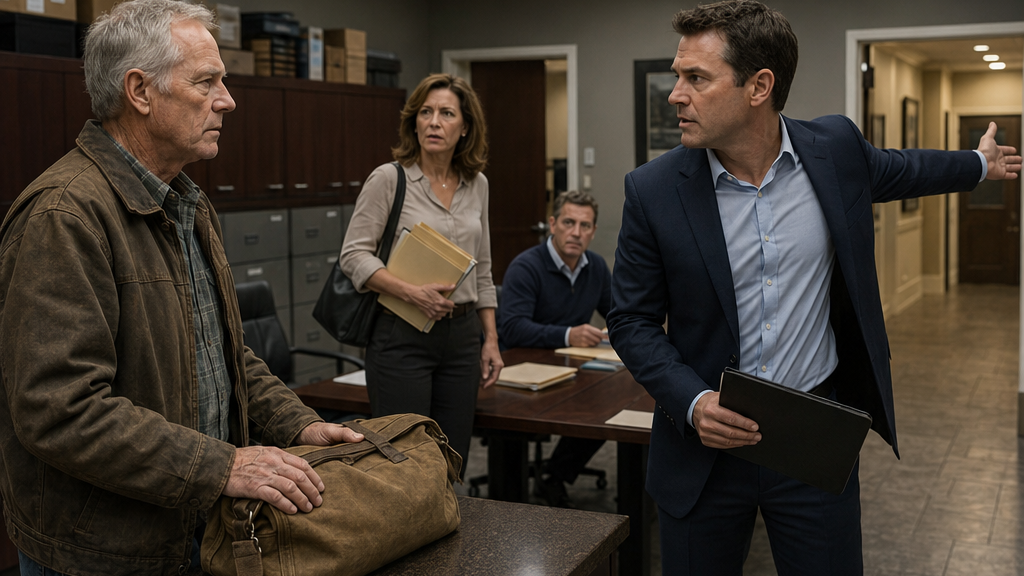
Brandon Moore pointed at the clubhouse door before Robert Hall had even taken his hand off the strap of the old canvas bag.
“This is a board work session,” Brandon said. “You can’t just walk into the records room.”
Robert set the bag on the counter between them.
The brass zipper had gone dull years ago. One corner was darkened from rain that had soaked through during a drainage inspection long before Brandon owned a house in the neighborhood.
“I’m not here for the work session,” Robert said.
Behind Brandon, three board members stopped arranging folders around the long conference table. One of them glanced toward the hallway as though expecting someone from management to appear.
Brandon straightened the cuffs of his white shirt.
“Then you need to wait outside.”
Robert looked past him at the cabinet against the wall. The lower drawer had been replaced since the last time he had stood in that room. The old metal label holders were gone. So were the gray binders that used to sit on the top shelf.
“I’m waiting for Janet.”
“You can wait in the lobby.”
Robert rested both hands beside the bag.
“I’ll wait here.”
The words were quiet enough that Brandon blinked, as if he had expected resistance and received something harder to push against.
A board member shifted in his chair.
Brandon lowered his voice.
“Mr. Hall, this isn’t personal. We’ve had problems with residents walking into restricted meetings and demanding access to internal files. I’m trying to put some order around that.”
Robert nodded once.
“That sounds reasonable.”
Brandon’s expression loosened for half a second.
“Good.”
“Which plat are you using for the greenbelt closure?”
The room changed.
Not dramatically. No one gasped. No one dropped a folder.
But the board member nearest the window stopped turning pages.
Brandon said, “Excuse me?”
“The pedestrian gate behind the west lots. Which recorded plat are you relying on?”
Brandon’s jaw tightened.
“We’re not discussing that with residents during a work session.”
“I’m not asking you to discuss it. I’m asking for the recording reference.”
“The board has already reviewed the issue.”
Robert looked at him.
“That wasn’t my question.”
Brandon leaned one hand against the counter.
“The path crosses association property. We have the authority to control association property.”
“Sometimes.”
That single word irritated Brandon more than an argument would have.
“Sometimes?”
“Depends what was recorded with it.”
Brandon gave a short laugh and looked toward the board, inviting them into the absurdity of the exchange.
“This is exactly what I mean. We’re trying to run the association on actual governing documents, not on somebody’s memory of how things used to be.”
Robert’s fingers stayed flat on the counter.
“Good.”
Brandon turned back to him.
“Then we agree.”
“We do.”
Robert nodded toward the file cabinet.
“So which document?”
Before Brandon could answer, footsteps sounded in the hallway.
Janet Roberts entered carrying a laptop bag and a stack of printed agendas. She stopped when she saw Robert.
Then she looked at Brandon.
“What’s going on?”
Brandon stepped away from the counter.
“Mr. Hall came into the records room during the work session.”
“I came before it started,” Robert said.
Janet checked the wall clock.
There were still six minutes before the scheduled time.
Brandon noticed her looking.
“That’s not the point.”
“No,” Janet said carefully. “Probably not.”
She put her folders down.
Robert had known Janet for only a few years. She worked for the management company that had taken over after the previous firm merged with a larger regional operation. She was competent, usually cautious, and had once called Robert because an old storm-drain diagram in the association files showed a pipe that no contractor could find.
She looked at the canvas bag.
“You brought records?”
“Maybe.”
Brandon folded his arms.
“You two already discussed this?”
“No,” Janet said.
Robert said nothing.
Janet opened her laptop.
“What exactly are you looking for?”
“The original west-phase plat.”
“We have it scanned.”
“Maybe.”
Brandon exhaled sharply.
“There it is again.”
Janet ignored him.
“Do you know the recording number?”
Robert gave it to her.
Not just the cabinet reference.
The book and page.
He had not spoken those numbers aloud in years.
Janet typed them into the search field, then paused.
“You remember that?”
Robert looked toward the dark windows at the rear of the clubhouse.
“I remember enough.”
One of the older board members frowned.
“Were you on the board back then?”
Robert looked at him.
“Before there was much of one.”
Janet’s gaze sharpened.
She clicked through another screen.
“Robert Hall,” she said slowly. “You were on the original homeowner transition committee.”
Brandon turned toward her.
“What?”
“First organizational records after developer control started winding down.”
Robert disliked the way everyone looked at him after that.
It was the same reason he had stopped attending annual meetings unless he absolutely had to. A name on old paper could turn into a story faster than the truth could keep up.
“I signed minutes,” Robert said. “That doesn’t make me special.”
Janet studied the screen.
“It makes you older than our digital archive.”
One board member smiled despite himself.
Brandon did not.
“So you helped set things up thirty years ago. Fine. That still doesn’t give you access to a closed meeting.”
“I didn’t ask for access.”
“You’re standing in the room.”
“I came for a record.”
“And I’m telling you the board has already dealt with the path issue.”
Robert’s eyes went to the printed packet on the conference table.
At the top of the first page, in bold type, he could see enough of the agenda item to understand what Brandon intended.
Greenbelt access control.
Liability exposure.
Gate modification.
Robert felt something old and unpleasant move through him.
Not fear.
Recognition.
He had once written agenda language like that himself.
Janet followed his gaze.
“The board is considering restricting the gate until we confirm responsibility for the path,” she said.
“Restricting?”
“Locking it,” Brandon said. “Temporarily.”
“When?”
“Friday.”
Robert looked at him.
Brandon’s posture hardened as if the date itself were proof of authority.
“We’ve had complaints about after-hours use, maintenance questions, and potential liability. This isn’t arbitrary.”
“Who complained?”
“That’s not relevant.”
“It usually is.”
Brandon’s face reddened.
“Mr. Hall, I’m done with this conversation.”
Robert reached for the strap of his bag.
For one moment, Brandon appeared satisfied.
Then Robert said, “If you lock it before you read the source plat, you may create a bigger problem than the one you think you’re fixing.”
Brandon stepped aside and held the door open.
“Then I guess we’ll find out Friday.”
Robert picked up the bag.
As he passed Janet, she said quietly, “I’ll pull the oldest scan tonight.”
Robert stopped.
“Don’t stop at the scan.”
Janet looked at him.
“What does that mean?”
But Brandon had already walked toward the conference table.
“Let’s get started.”
Robert went into the hallway.
Behind him, chairs scraped across the floor.
Then Brandon’s voice carried through the open door.
“First item. The west greenbelt pedestrian gate will be locked Friday pending formal review.”
Robert tightened his hand around the worn canvas strap.
Friday was three days away.
And if the document he remembered still meant what he thought it meant, Brandon Moore was about to put a lock on something the association had never been free to close.
Chapter 2: The Path Everyone Had Stopped Questioning
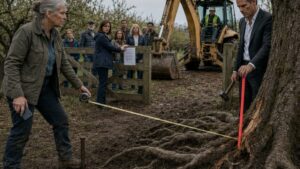
The contractor’s orange paint was still wet when Robert reached the greenbelt gate Wednesday morning.
A bright line crossed the bottom hinge post.
Another mark ran along the asphalt path and ended beside a small flag pushed into the grass.
Robert stood ten feet away and looked at it without moving.
The gate had been there almost as long as the houses.
It was nothing impressive—black steel, shoulder-high, narrow enough for pedestrians and bicycles. Beyond it, the path curved between a drainage swale and a row of mature trees before connecting the older west phase to the clubhouse and pool.
People had stopped noticing it years ago.
That was the problem with things that worked.
They became invisible.
A landscaping contractor was measuring the post.
“You Robert Hall?” the man asked.
Robert looked over.
“Why?”
“President said you might come by.”
That told him more than the man intended.
Robert took out his phone.
The contractor raised both hands.
“Hey, I’m just marking. Nobody’s locking anything today.”
“I know.”
Robert photographed the paint, the hinge, the path, and the small metal cap at the edge of the concrete.
The contractor watched him.
“You know something I don’t?”
“Probably.”
The man laughed.
“Story of my job.”
Robert crouched beside the concrete.
The metal cap was scratched but still visible. Survey point. West phase.
He reached into the canvas bag and pulled out a folded sheet protected inside a cracked plastic sleeve.
The paper had once been white.
Now it was the color of weak tea.
The contractor leaned closer.
“What’s that?”
“Maintenance sketch.”
“Official?”
“No.”
That answer seemed to surprise him.
Robert opened it carefully.
The map had been drawn by hand before the association hired its first professional management company. Drainage lines in blue ink. Fence limits in black. A dotted route showing the path. Near the gate, Robert had written a date beside a note about replacing a washed-out gravel shoulder.
The handwriting was his.
Twenty-eight years younger.
A voice behind him said, “You kept that?”
Robert did not need to turn.
Rachel Lewis came down the path carrying a travel mug.
“I keep too much.”
“That part hasn’t changed.”
Rachel stopped beside him and looked at the orange paint.
Her mouth tightened.
“So Brandon’s actually doing it.”
“He says Friday.”
“And you told him?”
“I asked what plat he was using.”
“That isn’t the same thing.”
Robert refolded the map.
Rachel watched him slide it back into the bag.
“You still do that.”
“Do what?”
“Answer the question you wish people had asked.”
He stood.
The contractor returned to measuring.
Rachel lowered her voice.
“You could have told him Tuesday night that you helped organize the first homeowner committee.”
“Janet told him.”
“Yes. After he tried to throw you out.”
“I wasn’t there for a biography.”
Rachel’s expression hardened.
“No. You were there to be right quietly.”
Robert looked at her.
They had known each other since the west phase still smelled like new lumber and clay. Rachel had served as board secretary for years, first because nobody else wanted the job and later because she was good at remembering who had promised what.
She had also been present the night Robert stopped coming.
He turned back toward the gate.
“This path was maintained by the association.”
“I know.”
“From the beginning.”
“I know that too.”
“The developer built it as part of the west-phase access plan.”
Rachel took a sip from her cup.
“Maybe.”
Robert looked at her.
“Maybe?”
“Maintenance isn’t the same as legal obligation. You taught me that.”
He said nothing.
She continued.
“You were the one who used to say memory was dangerous. If it mattered, put it in writing. If it wasn’t in writing, don’t pretend tradition makes it binding.”
“That was different.”
Rachel gave him a flat look.
“Was it?”
The contractor drove another marker into the grass.
The small hammer strike carried down the path.
Robert felt the sound in his chest.
He had come expecting to be angry with Brandon.
Rachel had managed, within five minutes, to make that anger less comfortable.
He opened the bag again.
Under the maintenance sketch were copies of old invoices. Gate hardware. Asphalt patching. Drainage clearing. Association checks reimbursing work on the path over several years.
Robert handed two pages to Rachel.
She read them.
“These help.”
“They show the association treated it as ours to maintain.”
“They show the association paid for maintenance.”
“That’s what I said.”
“No, Robert. You said it like it settled the question.”
He took the papers back.
“You sound like Brandon.”
“Maybe Brandon sounds like you.”
That landed harder than he expected.
Rachel glanced toward the contractor and lowered her voice.
“He’s wrong to rush this. He’s wrong to act like nobody before him knew anything. But his basic point isn’t crazy. We have half the neighborhood running on old habits nobody can explain.”
“That doesn’t justify locking a gate.”
“No.”
“Then what are we arguing about?”
“You.”
Robert’s face went still.
Rachel sighed.
“You disappeared from all of this and then spent years complaining that nobody remembers how things were supposed to work.”
“I didn’t complain.”
“That’s worse.”
He looked away.
Two residents came through the gate from the west phase. One slowed when she saw the orange paint.
“Are they really locking this?”
The contractor looked at Robert.
Robert said, “Friday is what the board announced.”
The resident frowned.
“My mother uses this to get to the pool. She doesn’t drive anymore.”
Robert nodded.
“I know.”
After she walked on, Rachel said, “That’s why you should have stayed involved.”
Robert’s jaw tightened.
“You know why I didn’t.”
“Yes.”
The word sat between them.
He closed the bag.
Rachel looked toward the old trees.
“People think you left because the newer board members wouldn’t listen to you.”
“I never said that.”
“You never corrected it either.”
Robert’s hand stayed on the zipper.
Rachel’s voice softened, but not enough to make the next words easier.
“You left after the Miller case, Robert. Not because nobody listened.”
The contractor’s hammer struck another stake.
Robert looked at the orange line on the gate and, for the first time since Tuesday night, felt less certain that Brandon Moore was the only man in the neighborhood hiding behind rules.
Chapter 3: The Old Decision Robert Never Defended
Robert found his signature before he found the minutes.
It was at the bottom of a yellowed vote sheet, three names below a motion requiring a homeowner to replace an entire section of retaining wall within thirty days.
Robert Hall.
The signature was clean, dark, and impatient.
He sat at his kitchen table with the canvas bag open on the chair beside him.
For twenty years, he had remembered the meeting as an argument about standards.
The paper remembered it differently.
The homeowner had asked for six months.
The board had given thirty days.
Rachel’s old handwritten note was clipped behind the vote.
Widowed last winter. Contractor estimate higher than expected. Requests temporary stabilization through spring.
Robert read it twice.
Then a third time.
He remembered the house.
He remembered the failing timber wall near the sidewalk.
He remembered standing in the clubhouse saying that if the board made one exception, they would spend the next five years explaining why every other owner deserved one too.
He had been forty-two and certain that consistency was the same thing as fairness.
The woman had replaced the wall.
She had also sold the house that summer.
Robert had told himself those two events were unrelated.
Rachel had never agreed.
A knock sounded at the front door.
Robert left the papers spread across the table.
Rachel stood on the porch when he opened it.
“You found it.”
He stepped aside.
She came in and saw the vote sheet.
For a moment neither of them spoke.
Finally Robert said, “Thirty days.”
Rachel set her travel mug on the counter.
“You argued against sixty.”
“I remember.”
“Do you?”
He looked at her.
She pulled out a chair.
Robert sat across from her.
“I thought the wall was dangerous.”
“It was.”
“I thought delaying it created liability.”
“It did.”
He waited.
Rachel leaned forward.
“That’s what made it hard, Robert. You weren’t wrong about everything.”
He looked down at his signature.
“Just the part that mattered.”
“No. You were wrong about believing the only two choices were enforcement or chaos.”
Outside, a lawn mower started somewhere down the block.
Robert stared at the paper.
“I didn’t make her sell.”
“No.”
“You think I did.”
“I think the board made her life harder when she was already drowning.”
Robert leaned back.
“And I was the loudest person saying the rule had to mean the same thing for everyone.”
Rachel nodded.
He heard Brandon’s voice from Tuesday.
We’re trying to run the association on actual governing documents.
Not on somebody’s memory.
Robert rubbed his thumb along the edge of the vote sheet.
“What happened after she moved?”
Rachel’s expression changed.
“You know.”
“I know what I remember.”
“The board got criticized. You got defensive. Then you stopped running for anything.”
“I finished my term.”
“Yes. And after that you became the man who always knew what the board was doing wrong but never came to meetings.”
Robert looked toward the open bag.
That accusation would once have made him angry.
Now it sounded precise.
“I thought staying out of it was better.”
“For who?”
He did not answer.
Rachel stood and walked to the kitchen window.
“You’re right about Brandon rushing the gate.”
Robert said nothing.
“You’re probably right that the old plat matters.”
Still nothing.
“But you don’t get to make him into some new species of fool. I sat in meetings with you when you sounded exactly like him.”
Robert looked back at the vote sheet.
“Rules are rules.”
Rachel turned.
“What?”
“That’s what I used to say.”
She gave a small, tired nod.
“Yes.”
A phone vibrated on the table.
Robert glanced at the screen.
An association email.
He opened it.
The message was from Brandon.
Residents,
Due to questions raised regarding the west greenbelt pedestrian gate, the board wishes to clarify that the temporary closure is being undertaken as a risk-management measure while access and maintenance responsibilities are reviewed. The association has an obligation to address potential insurance exposure and cannot rely on undocumented historical practices.
Robert stopped reading.
Rachel watched his face.
“What?”
He turned the phone toward her.
She read the message.
“Undocumented historical practices,” she said.
Robert almost laughed.
Not because it was funny.
Because twenty-five years earlier he might have written the exact sentence.
Rachel handed the phone back.
“He has a point about one thing.”
“The liability language?”
“The association shouldn’t rely on a map in your canvas bag.”
“I know.”
That answer surprised both of them.
Robert gathered the old vote sheet and slid it into a folder.
Rachel watched.
“What are you doing?”
“Separating private records from source records.”
“You finally decided there’s a difference?”
“There always was.”
“No. You just finally decided it matters.”
He let that pass.
At four thirty, Rachel left.
By six, Robert had sorted the bag into three stacks.
Personal notes.
Association copies.
Items that needed independent verification.
The old hand-drawn map went into the first stack.
Paid invoices went into the second.
The vote sheet stayed by itself.
At seven twelve, his phone rang.
Janet.
Robert answered.
“I was about to call you.”
“Then you’re going to like this less.”
He sat down.
“What happened?”
“I spoke with our insurance broker.”
Robert waited.
Janet continued.
“They don’t have any directive requiring us to close the west gate.”
His eyes narrowed.
“Did Brandon say they did?”
“His email says insurance exposure. That’s not technically the same thing.”
“No.”
“But I asked directly whether the carrier had identified the path as a coverage problem.”
“And?”
“They haven’t.”
Robert looked at the papers spread across the kitchen table.
“So where did the risk language come from?”
“Possibly general advice. Possibly Brandon. I don’t know yet.”
Robert leaned back.
Janet hesitated.
“There’s something else.”
“What?”
“I pulled the scanned governing files.”
“And?”
“I found the west-phase plat.”
Robert’s fingers tightened around the phone.
“Which version?”
“That’s the issue.”
He sat forward.
“What issue?”
“The scan we have in the management system doesn’t show anything about a pedestrian easement.”
Robert said nothing.
Janet mistook the silence.
“I’m not saying you’re wrong.”
“I know.”
“I’m saying if you have something different, I need to see it.”
“You need the recorded source.”
“Yes.”
Robert looked toward the canvas bag.
For years he had treated the contents as protection against people forgetting.
Now he saw the other side of it.
If the only complete history lived in a retired man’s closet, the history was already broken.
“Tomorrow morning,” he said.
“Can you come to the management office?”
“Yes.”
Janet exhaled.
“Good. Because right now Brandon is saying the current file supports the closure.”
Robert looked at his old signature on the vote sheet.
Once, he had trusted whatever paper happened to be in front of him because it made uncertainty easier to manage.
Now someone else was doing the same thing.
“Janet.”
“Yes?”
“If insurance didn’t require the closure, and your scan doesn’t show the easement, what exactly is Brandon relying on?”
There was a pause.
“That,” Janet said, “is what I’m trying to find out.”
Chapter 4: The Missing Page in the HOA Files
Janet turned her monitor toward Robert before he had taken off his coat.
“This is where it stops.”
The scanned plat filled most of the screen. The image was gray at the edges, darker where the original paper had been folded. Lot lines, drainage areas, and road widths were visible if Robert leaned close enough.
At the lower right corner, a page notation read three of four.
But the digital file ended there.
Robert put the canvas bag on the chair beside him.
“There should be another sheet.”
“That’s what I thought.”
Janet clicked back to the management system. The file name identified the document as the complete west-phase plat.
“Uploaded fourteen years ago,” she said. “Migrated twice since then.”
“No one checked the page count?”
“I didn’t.”
Robert looked at her.
She met his eyes.
“I’m not going to pretend otherwise.”
That answer took some of the edge off him.
Janet opened another folder.
“I checked our older archive drive. Same three pages.”
“What about the paper files?”
“Most of them were sent off-site when the previous management company closed.”
“Most?”
“We have transition binders. Not original county copies.”
Robert opened his bag.
For years he had packed documents into it according to a private logic that made perfect sense to him and almost no one else. Drainage maps beside old budgets. Meeting minutes folded around contractor invoices. Photocopies with handwritten notes in margins.
He removed the hand-drawn maintenance map.
Then a thin folder.
Then another.
Janet watched the pile grow.
“You really kept all of this at home?”
“Copies.”
“That isn’t what I asked.”
Robert stopped.
“No.”
Janet sat back.
“Robert, if your point is that the association forgot its history, you might want to consider that you had part of the history in a hall closet.”
He almost told her the records had been available to anyone willing to ask.
Then he heard Rachel’s voice.
You became the man who always knew what the board was doing wrong but never came to meetings.
He looked down at the bag.
“That’s fair.”
Janet seemed surprised.
Robert slid a photocopy across the desk.
“This isn’t proof.”
She examined it.
A faint line crossed the west greenbelt. Beside it, nearly lost in the copy, was a note referencing pedestrian access and maintenance.
Janet leaned closer.
“Where did you get this?”
“County copy. Years ago.”
“You’re sure?”
“No.”
She looked up.
Robert tapped the page.
“I’m sure that’s what I wrote on the back. I’m not asking you to trust me. I’m asking you to pull the source.”
Janet picked up her phone.
“The county recorder has online indexing, but old subdivision plats aren’t always fully imaged.”
“Then we go there.”
She checked the clock.
“They close at four thirty.”
“It’s nine fifteen.”
A faint smile touched her face.
“You retirees are dangerous.”
“Only before lunch.”
They found the index online first.
The subdivision name appeared under a development company that no longer existed. The west-phase plat had the same book and page reference Robert had recited Tuesday night.
Four sheets.
Janet stared at the entry.
“Four.”
Robert nodded.
The confirmation should have felt satisfying.
Instead it made him uneasy.
A missing page was not a victory. It was a failure that had waited quietly for someone to depend on the incomplete version.
Janet printed the index.
“Let’s not get ahead of ourselves. We still don’t know what sheet four says.”
Robert closed the bag.
“Good.”
She looked at him.
“That’s a different answer from the one I expected.”
“So is this a different morning.”
At the county recorder’s office, a clerk directed them to an image terminal used for older plats. The scan there was clearer than the association copy.
Sheets one through three matched.
Then Janet opened sheet four.
Neither of them spoke.
The missing page showed the greenbelt corridor in full.
A narrow line followed the pedestrian path from the west lots toward the common facilities. Near the gate, a block of recorded language identified a nonexclusive pedestrian access easement benefiting designated lots and assigned routine maintenance of the corridor to the homeowners association.
Janet read the provision twice.
“So the association maintains it.”
“Yes.”
“And there’s recorded access.”
“Yes.”
“But this doesn’t necessarily mean the board can never regulate the gate.”
“No.”
She turned toward him.
“You’re not going to say ‘I told you so’?”
“Would it change the document?”
“No.”
“Then no.”
That quiet answer cost him more than Janet knew.
A younger Robert would have enjoyed the moment.
A younger Robert would have brought the page into the next meeting like a weapon and waited for someone to challenge him.
Janet requested a certified copy.
While the clerk prepared it, Robert looked through the image again.
The faded plat no longer felt like proof that he remembered better than everyone else.
It looked like a map of obligations the community had failed to carry forward.
Janet tapped one line.
“The language is older than our current covenants.”
“That doesn’t automatically make it stronger in every respect.”
She glanced at him.
“You really have changed your tune.”
“I’m trying.”
Her phone rang.
She answered.
“Hi, Brandon.”
Robert moved a few feet away, but the office was too quiet not to hear her side.
“Yes, we found the source plat.”
Pause.
“No, the association scan wasn’t complete.”
Longer pause.
“There is recorded pedestrian-access language.”
Janet’s expression tightened.
“I understand.”
She listened again.
“I’m not making a legal conclusion. I’m telling you what the plat says.”
Another pause.
“Yes, the later covenants still matter.”
Janet looked at Robert.
“No, I don’t think we should install a lock tomorrow until we reconcile them.”
Her mouth tightened further.
“All right.”
She ended the call.
“He thinks later board authority still allows reasonable access controls.”
“It might.”
“He wants counsel to review it.”
“That’s what he should do.”
Janet folded her arms.
“You’re making it very difficult for me to decide which one of you is being unreasonable.”
Robert looked toward the clerk’s counter.
“Good.”
She nearly smiled.
The certified copy came back stamped and sealed.
Janet slipped it into a protective sleeve.
“Your copy helped us find it,” she said. “But I’m glad this is what we’re taking back.”
“So am I.”
They returned to the management office shortly after lunch.
Janet laid out the source plat, current covenants, board policies, and the proposed gate-control memo.
Robert opened his bag fully.
For the first time, he did not keep his papers angled toward himself.
He arranged them beside Janet’s files.
Old maintenance invoices.
Meeting notes.
Developer correspondence.
Not proof by themselves, but context.
Janet picked up one invoice.
“Association-paid gate repair.”
“Nineteen ninety-eight.”
Another.
“Path resurfacing.”
“Two thousand three.”
She shook her head.
“We should have had these.”
“Yes.”
“So why didn’t we?”
Robert looked at the bag.
“Because I thought keeping copies was the same thing as preserving history.”
Janet waited.
“And?”
“It isn’t.”
Before she could respond, the office door opened.
Brandon walked in carrying a thin binder.
His face was composed, but his movements were clipped.
“I spoke with a board member,” he said. “We’re not conceding that an old plat removes the board’s regulatory authority.”
Janet said, “Nobody said it did.”
Brandon placed the binder on the table.
“The current declaration gives the board control over common-area safety.”
Robert looked at him.
“Then we read both.”
Brandon’s eyes moved toward the spread of old records.
“This is exactly the problem. We can’t govern based on boxes of somebody’s personal papers.”
Robert nodded.
“I agree.”
That stopped him.
Brandon looked from Robert to Janet.
Janet said, “We’re verifying everything against recorded or association sources.”
“Good.”
Brandon opened the binder.
“Then the later covenants should control.”
“Maybe,” Janet said. “But we need to reconcile them.”
Brandon’s irritation returned.
“Every delay makes the board look like it doesn’t know what it’s doing.”
Robert said, “Doing the wrong thing faster won’t help.”
Brandon stared at him.
For a moment Robert thought the argument would begin again.
Instead Brandon closed the binder.
“Fine. Emergency meeting tomorrow night.”
After he left, Janet rubbed her forehead.
“I need every document that touches this path.”
Robert started putting his own copies back into order.
Janet turned to her computer.
A minute later she stopped typing.
“What?”
She did not answer.
She clicked into the homeowner portal, then into the closing-document archive maintained by the management company.
“Brandon bought his house last year, right?”
“Yes.”
Janet opened a file.
The title page was ordinary.
Settlement disclosures.
Association acknowledgment.
Recorded-document references.
Then she leaned closer to the screen.
Robert saw her expression change.
“What is it?”
Janet rotated the monitor.
In Brandon Moore’s own closing packet, beneath the subdivision legal description, was the recording reference to the west-phase plat.
The exact book.
The exact page.
The same four-sheet instrument now sitting certified on Janet’s desk.
She looked at Robert.
“He had the reference the day he bought the house.”
Robert stared at Brandon’s name above it.
The question was no longer whether the plat existed.
It was whether Brandon had ignored a document tied to his own property—or never understood what he had been given.
Chapter 5: The Document Brandon Already Had
Janet placed Brandon’s closing packet on the conference table beside the certified plat.
She did it without ceremony.
That made the comparison harder to escape.
Brandon arrived three minutes late, closed the door behind him, and looked first at Janet, then at Robert.
“What is this?”
“Your closing documents,” Janet said.
“I know what they are.”
“Good.”
She slid the acknowledgment page toward him.
“Then look at the recorded-document section.”
Brandon remained standing.
Robert sat at the far end of the table with the canvas bag closed beside his chair.
He had deliberately left it that way.
Nothing inside it mattered as much as the two official documents already on the table.
Brandon read the line.
His expression barely changed.
“So?”
Janet pushed the certified plat beside it.
“The recording reference in your purchase packet points to this.”
“I understand how references work.”
“Then you understand this wasn’t some obscure paper Robert produced from his garage.”
Brandon’s eyes shifted toward Robert.
Robert said nothing.
That seemed to bother him more.
Brandon sat.
“My closing packet is hundreds of pages.”
Janet nodded.
“Yes.”
“Most buyers don’t personally retrieve every referenced plat.”
“No.”
“So what exactly are you trying to prove?”
Janet answered carefully.
“I’m not trying to prove anything about you. I’m trying to establish the document history before the board acts.”
Brandon tapped the certified copy.
“The plat creates access. Fine. The current declaration still gives the board authority over safety and common-area operations.”
Robert said, “Possibly.”
Brandon looked at him sharply.
“You keep saying that.”
“Because it’s true.”
“I thought you came here to stop the gate closure.”
“I did.”
“Then why aren’t you claiming this settles it?”
“Because it doesn’t.”
Brandon leaned back.
For the first time since Tuesday, he looked less angry than uncertain.
Janet opened the declaration.
“The issue is whether the board can impose the proposed lock without materially interfering with recorded access rights. Counsel needs to answer that.”
Brandon said, “And in the meantime?”
“We leave the gate as it is.”
His jaw tightened.
“So we announce to the entire neighborhood that the board acted without reviewing everything.”
Janet did not answer immediately.
Brandon continued.
“I ran because people were tired of this association being sloppy. No consistent enforcement. Missing files. Maintenance done because somebody remembers doing it that way twenty years ago. Residents complain that no one can give a straight answer.”
Robert listened.
The frustration was real.
That made it more uncomfortable.
Brandon looked at him.
“You think I’m some idiot who walked in and decided I knew everything.”
“I think you decided too quickly.”
“And you’ve been sitting on records for years.”
Robert felt the hit land.
Janet looked between them.
Brandon continued.
“How many times did management ask older residents for historical material?”
Robert said, “A few.”
“And how much did you give them?”
“Not enough.”
Brandon blinked.
He had clearly expected a defense.
Robert folded his hands.
“I kept copies. I assumed that meant the information wasn’t lost.”
“That’s convenient.”
“No. It was arrogant.”
Janet looked at Robert.
He kept his eyes on Brandon.
“I thought if the board needed something badly enough, somebody would ask the right question. That was a good way to stay out of meetings and still believe I knew better than the people in them.”
Brandon’s anger lost some of its shape.
But not all.
“That doesn’t change what happened Tuesday.”
“No.”
“You walked into a restricted room.”
“Before the session started.”
“You knew what I meant.”
“Yes.”
Brandon rubbed a hand across his mouth.
Janet said, “There’s a bigger issue than Tuesday.”
She pointed to his closing packet.
“Did you review this reference before recommending the closure?”
Brandon looked down.
Silence stretched.
“No.”
Janet waited.
He exhaled.
“I reviewed the association summary. It identified the greenbelt as common property under board control.”
“Did you know the source plat was referenced here?”
“I knew there were plats. I didn’t pull this one.”
“Why?”
Brandon looked irritated again, but now the irritation seemed directed partly at himself.
“Because the management file said complete.”
Janet’s expression tightened.
“So did I.”
That changed the room.
Until then, Brandon had been the person who failed to read deeply enough.
Now Janet had admitted that the system itself encouraged the same mistake.
She tapped the incomplete scan.
“We all relied on this.”
Robert looked at the canvas bag.
“All of us relied on something incomplete.”
Brandon stood and walked to the window.
Outside, the clubhouse parking lot was beginning to fill with residents using the pool and mail kiosk.
“If we reverse the decision publicly,” he said, “every enforcement issue from the last year becomes an invitation to challenge the board.”
Robert said, “Maybe some should be challenged.”
Brandon turned.
“That’s easy for you to say. You’re not responsible for keeping the association functioning.”
The words stung because Robert had once believed the exact same thing about residents who questioned him.
Brandon continued.
“People want consistency until consistency applies to them. They want transparency until you send them twelve pages to read. They want the board to act, then complain when it does.”
Robert nodded slowly.
“That’s true.”
Brandon stared at him.
“But?”
“But that still doesn’t make the wrong record right.”
Janet closed the declaration.
“We need an emergency meeting tonight. The gate contractor has already been told not to install the lock.”
Brandon’s face tightened.
“You did that without a board vote?”
“I paused work pending document review under the management contract. I can do that.”
He looked away.
For several seconds nobody spoke.
Robert could feel the easiest version of the moment sitting within reach.
He could point to Brandon’s own closing packet.
He could remind him of Tuesday night.
He could say the man who tried to throw him out had not even read the documents attached to his own home.
It would be accurate.
It would also be useless.
Brandon returned to the table.
“What are you going to ask for tonight?”
Robert looked at him.
“Why?”
“Because half the neighborhood already knows about this. People are talking about removing officers.”
Robert had heard nothing of that.
But he could imagine it.
A mistake turned into a side.
A side turned into a campaign.
Then nobody cared about the gate anymore.
Janet said, “Robert?”
He looked at the certified plat.
Then at his closed bag.
“I’ll speak.”
Brandon’s expression hardened.
Robert continued.
“I’m going to ask the board to suspend the closure until the records are reconciled.”
“And?”
“A full review of old source documents affecting access and maintenance.”
Brandon gave a humorless laugh.
“So basically an audit of everything we’ve done.”
“Not everything.”
“Close enough.”
Robert shook his head.
“No.”
Brandon looked at him.
“I’m not asking them to remove you.”
Silence.
Even Janet seemed surprised.
Brandon’s eyes narrowed.
“Why not?”
Robert thought about the vote sheet in his kitchen.
About thirty days.
About a woman who had needed six months.
“Because being wrong once isn’t the same as being useless.”
Brandon looked at him for a long moment.
Robert stood and lifted the canvas bag.
“And because I’ve been on the other side of that table.”
He left before Brandon could ask what he meant.
By the time Robert reached the parking lot, he knew the emergency meeting would not be about whether he could embarrass Brandon.
It would be about whether he was willing to tell the room why he had stopped believing he deserved to sit at that table himself.
Chapter 6: The Meeting Robert Could Have Used for Revenge
By seven o’clock, every folding chair in the clubhouse was occupied.
People stood along the back wall.
Others crowded near the doorway.
Robert had not seen that many residents at an HOA meeting in years.
The canvas bag rested against his shoe.
Across the room, Brandon sat behind the board table with Janet and the other board members.
His posture was straight.
Too straight.
Whispers moved through the room whenever someone looked toward Robert.
He caught fragments.
Original committee.
Missing plat.
Tried to throw him out.
His own closing papers.
That last part had traveled fastest.
Brandon opened the meeting.
“This emergency session is to address the proposed west greenbelt gate restriction and newly identified historical records.”
Someone from the back said, “Newly identified to who?”
A few people laughed.
Brandon’s face tightened.
Robert looked at the floor.
That was how these things started.
Not with facts.
With the first moment humiliation became entertainment.
Janet summarized the record issue.
The management system contained only three of four plat sheets. The county’s recorded version contained a pedestrian-access easement and an association maintenance obligation. The proposed lock had been paused pending review.
A resident raised a hand without waiting to be recognized.
“So the board didn’t check?”
Brandon said, “The board relied on the governing file provided through management.”
“And your own closing documents?”
The room stirred.
Brandon’s eyes flicked toward Robert.
Robert had not told anyone.
Someone else had.
Brandon said, “My purchase documents referenced the plat. I did not personally retrieve every referenced instrument at closing.”
A man near the aisle shook his head.
“But you were ready to lock everybody else out.”
Another voice followed.
“You should resign.”
Then another.
“Whole board should.”
Robert saw Brandon’s hand close around his pen.
There it was.
The moment Robert could have taken.
He could have stayed silent and let the room punish Brandon for him.
For three days he had imagined wanting exactly that.
Instead, he stood.
The room quieted faster than he expected.
Brandon looked at him.
Robert picked up the canvas bag and placed it on the front table.
The sound was soft.
Still, everyone heard it.
“I brought something tonight,” Robert said.
A woman in the second row leaned forward.
Robert unzipped the bag.
He removed the old maintenance map, copied invoices, early committee minutes, and the faded vote sheet he had found Wednesday.
He placed the vote sheet on top.
“This isn’t about Brandon first.”
Several people exchanged glances.
Robert looked toward Rachel.
She stood near the wall with her arms folded.
He continued.
“Years ago, I served on this board. Before some of you lived here. Before professional management. Before most of these files were scanned.”
A resident said, “That’s why you knew about the easement.”
“Partly.”
Robert rested his fingertips on the old vote sheet.
“I also knew something else about how boards make mistakes.”
The room remained still.
“There was a homeowner with a failing retaining wall. She asked the board for extra time to replace it. Her husband had died. The cost was more than she expected.”
Robert paused.
Rachel did not look away.
“I argued against giving her that time.”
No one spoke.
“I said the rule had to apply equally. I said allowing an exception would make every future case harder.”
Brandon’s expression changed.
Not relief.
Recognition.
Robert looked down at the signature.
“She replaced the wall. Then she sold the house.”
A woman near the front asked, “Did the board force her out?”
“No.”
Robert answered immediately.
“That would be too easy a story. We enforced a rule under circumstances where we had discretion and chose not to use much of it. I don’t know every reason she moved.”
He looked around the room.
“But I know I made her situation harder.”
Someone shifted a chair.
Robert continued.
“After that, I finished my term and stopped serving. I told myself I was done with board politics.”
Rachel’s face softened slightly.
“I kept records. I kept maps. I kept copies of things I thought people might forget.”
He touched the canvas bag.
“And whenever the board got something wrong, I told myself I had been wise to stay out of it.”
The room was silent enough for the air-conditioning vent to be heard.
“That wasn’t wisdom.”
Robert looked at Brandon.
“It was another kind of pride.”
Brandon’s pen was no longer clenched in his hand.
Robert went on.
“Brandon was wrong to move toward locking the gate before checking the source plat. He was wrong to treat questions like interference. And he was wrong Tuesday night when he told me I didn’t belong in that room.”
Brandon looked down.
“But the management file was incomplete. Janet relied on it too. And people like me had historical material sitting in our houses instead of making sure the association had it.”
A resident raised a hand.
“So nobody’s responsible?”
“I didn’t say that.”
Robert’s voice sharpened.
“Responsibility doesn’t disappear because more than one person contributed to a problem.”
He turned toward the board.
“The closure should be suspended.”
One board member nodded.
“The source plat and later covenants should be reviewed together before any new gate restriction is adopted.”
Another nod.
“And I think we should go further.”
Brandon looked at him warily.
Robert opened the canvas bag wider.
“For years, this association has operated partly on scanned summaries, partly on old practices, and partly on what longtime residents remember. That’s not good enough.”
Rachel’s eyebrows lifted.
Robert continued.
“I’m asking for a source-document review of old access routes, maintenance obligations, and similar recorded restrictions before the board changes how they’re handled.”
A resident called out, “How long would that take?”
Janet answered.
“Several weeks at minimum. Longer if we find discrepancies.”
Brandon said quietly, “And until then?”
“Existing arrangements stay in place unless there’s an immediate safety issue,” Robert said.
Brandon looked at him.
“You’re asking us to freeze every questionable rule.”
“I’m asking you not to change old rights based on incomplete files.”
Someone in the back said, “And Brandon stays president?”
The question struck the room like a thrown object.
Robert looked toward Brandon.
Brandon’s face was controlled, but his eyes were tired.
Robert remembered himself at forty-two, standing behind another board table, convinced that admitting uncertainty would destroy authority.
He turned toward the resident.
“That’s not my decision.”
“You said you wouldn’t ask for removal.”
“I won’t.”
“Why?”
Robert looked at the vote sheet.
“Because if every bad decision required a new person, none of us would stay long enough to learn anything.”
A few people murmured.
Not approval.
Thought.
That was enough.
Brandon finally spoke.
“I moved too fast.”
The room quieted again.
He looked toward Janet.
“I relied on the management summary because I thought the bigger risk was continuing informal practices without documentation.”
He turned toward Robert.
“I still think that risk is real.”
“So do I.”
Brandon nodded once.
“But I treated an incomplete file like a complete answer.”
Robert said nothing.
“And Tuesday, I handled you badly.”
Several residents shifted, waiting for something larger.
Robert gave them nothing.
“Okay.”
Brandon blinked.
That single word seemed to unsettle the room more than an apology speech would have.
Janet brought the discussion back to procedure.
A motion was made to suspend the west gate closure.
It passed unanimously.
A second motion directed management to obtain certified source documents for older access, maintenance, and easement issues and compare them against the current digital archive.
It also passed.
The final provision required any future enforcement or access change based on historical property rights to cite the underlying recorded or governing source, not merely a management summary.
This time, one board member hesitated before voting.
Then raised a hand.
Passed.
The residents did not cheer.
Robert was grateful.
People simply began talking in smaller voices, asking practical questions about records, costs, and timing.
Janet gathered the certified plat.
Robert started repacking the bag.
Then stopped.
He looked at the early committee minutes.
The old invoices.
The maintenance map.
For decades, putting them back in the bag had been automatic.
This time he pushed them toward Janet.
“These are copies.”
She looked at him.
“I want them scanned into the archive.”
“All of them?”
“The association ones.”
He held back the old vote sheet.
That belonged somewhere else.
Janet gathered the records carefully.
Brandon remained at the table after most residents had left.
Robert lifted the now-lighter bag.
Brandon said, “You could’ve buried me tonight.”
Robert looked at him.
“No.”
Brandon gave a tired smile.
“You know what I mean.”
“Yes.”
Robert slipped the strap over his shoulder.
“That’s why I didn’t.”
He walked toward the door.
Behind him, Janet called to the remaining board members.
“We start the source-document audit Monday.”
Robert stepped into the hallway.
The west gate would stay open.
But the larger decision had already been made.
The neighborhood would no longer be allowed to trust memory, summaries, or confidence alone.
And neither would he.
Chapter 7: What the Old Map Was Really For
The new sign beside the pedestrian gate was smaller than Robert expected.
No warning language.
No threatening block letters.
Just a clean association notice explaining that the west greenbelt path remained open under a documented access procedure while maintenance responsibility followed the recorded plat and current governing documents.
Robert stood in front of it with the canvas bag hanging from one shoulder.
Behind him, the gate clicked shut after a woman pushed through with a stroller.
Six weeks earlier, orange contractor paint had marked the same post for a lock.
Now the paint had been scrubbed away.
Robert ran a thumb across the faint stain that remained.
“Still checking our work?”
Brandon’s voice came from the path.
Robert turned.
Brandon wore jeans and a quarter-zip instead of the clothes he favored for meetings. He carried a folder under one arm.
“I was reading.”
“You’ve read that sign three times.”
“Then whoever wrote it should be proud.”
Brandon stopped beside him.
For several seconds they looked through the gate toward the clubhouse.
The relationship between them had not become easy.
It had become more precise.
There was less guessing.
That helped.
Brandon held up the folder.
“Janet found two more.”
“Two more what?”
“Old obligations that weren’t in the digital summaries.”
Robert’s expression tightened.
“What kind?”
“One drainage maintenance agreement behind the north lots. One landscape buffer the association has been paying for without the current board knowing why.”
Robert nodded slowly.
“That explains the invoices.”
“You knew?”
“I knew we paid for the buffer years ago.”
Brandon gave him a sideways look.
“Of course you did.”
“I didn’t know whether we still had to.”
“That’s the part I’m learning to ask now.”
Robert looked at him.
Brandon’s tone carried no joke.
The audit had found enough errors to make everyone uncomfortable.
Not disasters.
Nothing dramatic enough for the evening news or a lawsuit headline.
Just years of small institutional drift.
A scanned exhibit missing from one folder.
An outdated maintenance summary copied into a later packet.
A board resolution treated as permanent even though it had expired.
A recurring contractor task nobody could trace back to its original authorization until Janet found handwritten references in old minutes.
The errors had accumulated because each generation of board members assumed the last one had transferred everything correctly.
Robert had once assumed the same thing in the opposite direction.
He had believed memory could fill the gaps.
The audit proved neither assumption was safe.
Brandon opened the folder.
“Janet wants you to look at this before the records committee meets.”
Robert did not take it.
“I’m not on the committee.”
“You’ve attended every meeting.”
“As a resident.”
“You’ve corrected half our indexing.”
“As a resident.”
Brandon closed the folder.
“Fine.”
They started walking toward the clubhouse.
A few houses beyond the greenbelt were visible through the trees. Someone was repairing a sprinkler head. A bicycle lay on a front lawn.
Ordinary things.
Robert had spent years telling himself that ordinary communities did not need people like him hovering around meetings.
Now he understood that ordinary communities needed memory precisely because nothing looked urgent until a gate was being locked or a wall was being enforced or a file turned out to be missing a page.
At the clubhouse, Janet had converted one of the storage cabinets into a temporary archive.
Labels separated certified plats, recorded easements, board resolutions, historical maintenance records, and scanned correspondence.
Robert’s old papers sat in archival sleeves rather than the bent folders he had carried for decades.
Rachel stood at the cabinet with Janet.
She looked over when Robert entered.
“You brought the bag.”
“Habit.”
Rachel smiled.
“It looks lighter.”
“It is.”
Janet closed a drawer.
“Nearly everything you gave us is scanned now.”
“Nearly?”
She pointed at the bag.
“You still have the original hand-drawn maintenance map.”
Robert touched the strap.
“That’s not official.”
“No,” Janet said. “But it’s useful context.”
Brandon set his folder on the table.
“We found the drainage agreement.”
Janet nodded.
“I saw.”
Rachel looked at Robert.
“You know what this means.”
“That your filing system has improved?”
“It means they’re going to ask you to join the board.”
Robert looked at Brandon.
Brandon did not bother pretending otherwise.
“We have an open seat next quarter.”
“No.”
The answer came so quickly that Janet laughed.
Brandon frowned.
“You didn’t even think about it.”
“I thought about it the last six weeks.”
“And?”
“And I don’t want the job.”
Brandon leaned against the table.
“You know more about this association than anybody.”
“That’s not a qualification by itself.”
“It’s more than some people bring.”
Robert looked at him.
“That sentence caused trouble the last time.”
Brandon caught himself.
Then nodded.
“Fair.”
Robert removed the canvas bag from his shoulder and placed it on the table.
“I’ll help with the records committee.”
Rachel’s eyebrows lifted.
“Temporarily?”
“Temporarily.”
“For how long?”
“Until the source files are reconciled and indexed.”
Janet said, “That could take months.”
“I’m retired.”
Brandon almost smiled.
Robert continued.
“But I’m not deciding policy. I’m not becoming the unofficial second president. And if I say, ‘I remember it this way,’ somebody has to ask me where it’s written.”
Rachel said, “I volunteer.”
“I assumed you would.”
Brandon opened the archive cabinet.
The current board had adopted the new records procedure two weeks earlier.
Any future change involving historical access, maintenance duties, or recorded property rights had to identify the source instrument reviewed.
Not a summary.
Not an old email.
Not a resident’s memory.
The actual source.
Brandon had remained president.
Some homeowners had objected.
A few still wanted him gone.
But the board had chosen correction over removal, and Brandon had stopped treating every challenge as a referendum on his competence.
He still moved faster than Robert preferred.
Robert still waited longer than Brandon preferred.
Now they tended to meet somewhere between those instincts.
Janet handed Robert a protective sleeve.
“For the map.”
He opened the canvas bag.
There was very little left inside.
The old vote sheet from the retaining-wall case remained in a private folder at home. Robert had decided that guilt did not become community history simply because it mattered to him.
But the faded subdivision plat copy was there.
So was the hand-drawn maintenance map.
He removed both.
The old map unfolded across the table.
Blue drainage lines.
Black fence marks.
The dotted pedestrian route.
His younger handwriting beside repairs nobody remembered anymore.
Brandon studied it.
“This used to be how you tracked everything?”
“We didn’t have a portal.”
Rachel said, “We barely had a working copier.”
Janet pointed to the dotted path.
“This note helped us find three old invoices.”
Robert nodded.
For decades he had treated the map as evidence that he remembered.
Now its value seemed different.
It showed where to look.
That was all.
A map was not authority.
It was a way to keep people from getting lost.
Robert folded the faded plat once along its old crease.
His hand paused above the open canvas bag.
The motion felt automatic.
Put it back.
Take it home.
Keep it safe.
He looked at the archive cabinet.
Then at Janet.
“Which drawer?”
She opened the one marked Recorded Plats and Historical References.
Robert placed the faded copy inside.
Janet slid the hand-drawn map into a separate archival sleeve and filed it behind the corresponding source record.
The drawer closed with a soft metal click.
Robert lifted the canvas bag.
For the first time in years, it felt almost empty.
Brandon glanced at it.
“You sure you want to leave those here?”
Robert looked at the cabinet.
“Yes.”
Outside, someone pushed open the west gate.
Its latch clicked.
Then released.
Then closed again exactly as it was supposed to.
Robert slipped the nearly weightless strap over his shoulder.
The old records no longer belonged to the man who remembered them best.
They belonged where the next person could find them before confidence became certainty and certainty became a lock.
The story has ended.