They Came to Cut Her Farm Windbreak at Dawn—Then She Recognized Every Contractor on the Cooperative’s Payroll
Chapter 1: The Brush Crew Arrived Before Sunrise
The chipper was already running when Anna Carter reached the gate.
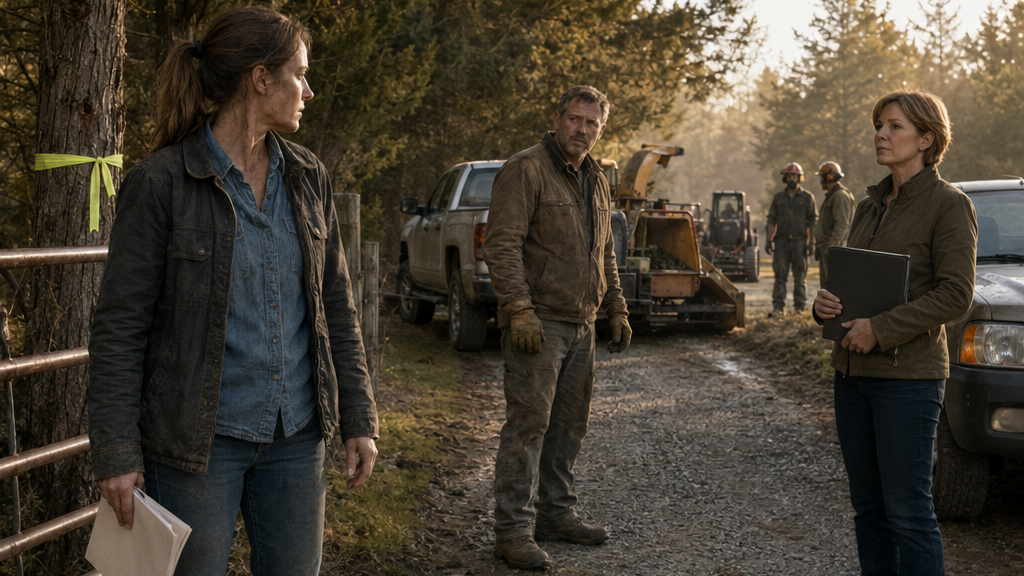
Its diesel engine shook the cold morning air, and a fluorescent orange ribbon snapped from the trunk of the oldest cedar in her windbreak. Beyond it, two men were unloading saws while another backed a compact brush cutter toward the drainage ditch.
Anna stopped in the middle of the gravel lane.
“Turn that machine off.”
The operator looked toward the pickup parked beside the gate but kept backing.
Anna stepped closer, not into his path, but far enough that he could see her clearly.
“I said turn it off.”
This time the machine stopped.
The sudden quiet made the place feel wrong. For twenty-three years that row of cedar, spruce, and hedge had been the first thing she saw from the farmhouse kitchen. Her father had planted most of it after a winter storm flattened the old windbreak. The trees slowed snow across the lane, shaded cattle in late summer, and hid the equipment shed from the county road.
Now nearly a dozen trunks carried orange ribbon.
A man came around the pickup holding a clipboard.
Anna recognized him before he spoke.
“Ronald?”
Ronald Clark removed his work gloves one finger at a time.
His expression told her he had hoped not to be the one standing there when she came outside.
“Morning, Anna.”
She looked past him at the chipper.
“You’re cutting my windbreak?”
“Cooperative job.”
“You knew whose place this was.”
“I knew after I got here.”
“You’ve been here before.”
“Not from this side.”
That answer irritated her more than an argument would have.
Ronald owned a small brush-clearing and fencing company. For four years Anna had prepared his quarterly books, reconciled his equipment loans, tracked fuel expenses, and reminded him when customers were thirty days late. She knew when he bought new saw chains and when his insurance renewed.
She also knew what he charged.
Ronald handed her the clipboard.
“Cynthia said you’d been notified.”
The work order carried the name of the Cedar Ridge Road and Drainage Cooperative across the top. Below it was a description of vegetation removal along the shared easement: clearing, hauling, ditch access, debris disposal.
The total made Anna read it twice.
$7,840.
She looked at Ronald.
“How much did you quote?”
He did not answer immediately.
Behind him, one worker suddenly became very interested in tightening a strap on the chipper.
Anna lowered the clipboard.
“Ronald.”
“Anna, I’m here to do the job.”
“That isn’t what I asked.”
A truck approached from the county road.
Anna knew the white pickup before it turned in.
Cynthia Lewis parked without blocking the crew and stepped out carrying a thick folder under one arm. She wore work boots, dark jeans, and a canvas jacket zipped to the throat. Nothing about her looked hurried despite the hour.
“Good,” Cynthia said. “Everyone’s here.”
Anna held up the work order.
“You scheduled this before sunrise?”
“We scheduled it for six-thirty. They got here early.”
“You scheduled it before my objection was heard.”
“Your objection was received.”
“That isn’t the same thing.”
Cynthia walked to the ditch and pointed toward the flagged trees.
“The cooperative gave you twenty-one days to clear vegetation inside the maintenance easement. You requested additional time. You received seven days. That expired yesterday.”
“Yesterday afternoon.”
“A deadline doesn’t become optional after lunch.”
Anna felt the familiar pressure behind her teeth—the urge to say everything she had swallowed during two years of cooperative notices.
Her father’s voice came instead.
Don’t become the difficult landowner, Annie. Roads and water mean neighbors whether you like them or not.
She hated that she could still hear him.
Cynthia opened her folder and removed a signed authorization.
“The board approved contractor access. We have a drainage inspection coming. That ditch needs to be reachable by equipment.”
“That row was here before the cooperative.”
“The easement was recorded before some of those trees were mature.”
Anna looked toward Ronald again.
He avoided her eyes.
She returned to the amount on the work order.
Seven thousand eight hundred forty dollars.
Three months earlier, Ronald had asked Anna to enter an estimate for cooperative roadside clearing into his books because he was bidding several jobs at once.
She remembered the number because she had teased him about forgetting to charge for disposal.
It had not been anywhere near $7,840.
“Ronald,” she said, “the estimate you gave them was two thousand one hundred and change.”
His face changed.
Cynthia’s did not.
Anna tapped the page.
“So why does their work order list almost four times that?”
One of the workers stopped beside the trailer.
Ronald glanced at Cynthia.
“It covers more than today’s cut.”
“What else?”
“Other maintenance.”
“Whose?”
Cynthia stepped between them without physically blocking either person.
“This is a cooperative accounting matter, Anna.”
“Apparently it’s also Ronald’s accounting matter.”
“It includes bundled work.”
Anna looked at Ronald.
“Did you invoice seven thousand eight hundred forty dollars?”
His silence lasted only a few seconds.
It was enough.
Cynthia closed her folder.
“Ronald, give us a minute.”
“No,” Anna said. “Actually, don’t.”
Cynthia’s eyes narrowed.
Anna heard herself speaking more sharply than she intended.
“I keep his books. If that money was paid to his company, I would have reconciled the deposit.”
Ronald rubbed his jaw.
“Anna.”
“Was it?”
“No.”
The two workers looked away.
Cynthia took a breath through her nose.
“That total includes work involving multiple contractors.”
“Then why is Ronald’s company listed as the primary vendor?”
“Because he coordinated this section.”
Ronald said quietly, “I didn’t coordinate anybody.”
For the first time, Cynthia looked genuinely annoyed with him.
Anna noticed it.
Not guilt. Not fear.
Annoyance.
That distinction mattered.
She handed the work order back.
“Nobody cuts anything today.”
Cynthia gave a small, humorless laugh.
“You don’t have authority to stop cooperative maintenance inside the easement.”
“No. But Ronald has authority to decline a job when his customer is disputing what his company supposedly billed.”
Ronald stared at the ground.
Anna said, “Do you want me to call your insurance agent and ask whether you’re covered to proceed while ownership and billing are disputed?”
That did it.
Ronald turned toward the workers.
“Load it back up.”
Cynthia’s voice hardened.
“Ronald.”
“I can come back after this gets sorted.”
“We have authorization.”
“And I have a business.”
The workers began securing equipment.
Anna should have felt victorious.
Instead, the work order bothered her more than the orange ribbons did.
She followed Cynthia to the white pickup.
“I want the supporting invoices.”
“You can submit a records request.”
“I will.”
“All of them?”
Anna looked toward the marked trees.
“Three years.”
That finally earned a pause.
Cynthia studied her for a second, then opened the rear door of her truck and pulled out another packet.
“You may want to read the cooperative rules before you imply anything.”
Anna accepted it.
“I know how to read numbers.”
“That isn’t the same as understanding why they’re there.”
Cynthia drove away ten minutes later.
The crew followed.
Only the ribbons remained.
Anna carried the packet into her converted garage office and set it beside her coffee. She expected maintenance policy, easement maps, perhaps meeting minutes.
Instead, clipped behind the authorization were copies of recent contractor summaries.
She recognized Ronald’s business first.
Then another name she handled.
Then a third.
Anna sat down.
All three companies had done work for the cooperative.
All three totals looked wrong.
Chapter 2: The Numbers Behind the Gravel Road
The first payment Anna checked was for $6,300.
Ronald’s bank deposit for the corresponding month was $1,960.
She stared at the two figures until the difference stopped looking like an error and started looking like a question.
At eight-fifteen, she called Ronald.
“You busy?”
A pause.
“Depends what this is about.”
“The cooperative.”
“Then yes.”
Anna leaned back.
“I’m not trying to put you in the middle.”
“You did that at six-thirty this morning.”
“I asked whether you got paid what their paperwork says.”
“In front of my crew.”
“You wouldn’t answer me.”
“Because Cynthia sends me work.”
Anna closed her eyes.
That was fair.
“I should’ve pulled you aside.”
“Yes.”
“I’m sorry.”
Ronald said nothing.
Anna turned to her monitor.
“I have a payment summary showing sixty-three hundred dollars under your company for roadside clearing last October.”
“No.”
“No what?”
“No way. Biggest cooperative check I got last fall was nineteen-sixty. I remember because I used it toward the chipper tire.”
“You never received another payment tied to that job?”
“Not that I know of.”
“Could they have paid another contractor under your work order?”
“Maybe. Cynthia combines stuff sometimes.”
That was the first sentence all day that gave Anna pause.
“Combines how?”
“Say I clear brush, somebody else hauls spoil, somebody grades the ditch. She’ll call the whole thing one maintenance package.”
“Under one vendor?”
“Sometimes.”
“Why?”
“I don’t know. Ask George.”
George Taylor answered from his cattle lot with wind hammering the phone.
When Anna told him she wanted access to three years of cooperative financial records, he sighed.
“I heard about this morning.”
“News travels fast.”
“Three pickups and a chipper leaving your place before seven will do that.”
“I need the ledger, bank statements, vendor invoices, and board approvals.”
“For the windbreak?”
“For the cooperative.”
Another pause.
“Anna, be careful.”
“With what?”
“With turning a property disagreement into an accusation.”
“I haven’t accused anyone.”
“Ronald says you used the word skimming.”
She went still.
She had.
Not to Cynthia.
To Ronald, after the crew left, while anger was still buzzing in her hands.
“If the cooperative says it paid his company sixty-three hundred and his books show nineteen-sixty, what would you call that?”
“I’d call it something I’d verify before saying skimming.”
Anna felt heat rise into her face although no one could see her.
George continued.
“You’re entitled to records. Come by after lunch.”
The cooperative office occupied one end of an old equipment shed near the junction of two gravel lanes. It held a metal desk, filing cabinets, folding chairs, a coffeemaker, and more paper than Anna expected from an organization with fewer than forty members.
George unlocked the cabinets.
“I’m staying while you look.”
“Fine.”
“You don’t remove originals.”
“I wasn’t planning to.”
“And if you find something you don’t understand—”
“I ask.”
He nodded.
“That would help.”
For two hours Anna worked without speaking.
She built a spreadsheet by year, vendor, invoice date, payment amount, and description. Dirt marked the bottom corners of several original invoices. Some had handwritten notes from Cynthia. Others bore George’s initials.
Ronald was not the only familiar name.
A fencing contractor whose books Anna handled had received $2,400 for a spring repair. The cooperative ledger showed $5,900 against a nearly identical description.
A hauling operator had deposited $3,100 over two jobs. The annual maintenance summary attributed more than $8,000 to his company.
Anna’s pulse quickened.
“This isn’t one job.”
George came around the desk.
“What?”
She rotated the laptop toward him.
“Three vendors. Same pattern.”
He studied the rows.
“I told you. Cynthia bundles projects.”
“These are recorded under specific vendors.”
“Because one contractor can be the lead.”
“Then where are the subcontractor payments?”
“In other entries.”
“Show me.”
George pulled a ledger closer.
For twenty minutes, he did.
A $5,900 fencing entry included the fence contractor, gravel delivery, and rental of a skid steer. Anna found separate supporting invoices paper-clipped behind the summary.
Her certainty weakened.
The hauling discrepancy also had a partial explanation: two neighboring ditch jobs had been approved as one maintenance package even though the annual report named only the hauling operator.
She sat back.
“So the annual summaries are sloppy.”
“I’d say condensed.”
“I’d say misleading.”
“You’d probably be right.”
That surprised her.
George folded his arms.
“Cynthia hates long reports. Members complain if she gives them ten pages, complain if she gives them two.”
“That doesn’t justify putting money under the wrong vendor.”
“No. But it’s not proof somebody pocketed it.”
Anna looked at her spreadsheet.
Rows that had appeared damning an hour earlier now separated into three categories: explained, partly explained, and still wrong.
The third category remained larger than she liked.
She worked until sunset pressed orange light through the dirty office window.
George left once to check cattle and returned with two gas-station sandwiches.
“Peace offering,” he said.
“For telling me I’m reckless?”
“For not telling you you’re entirely wrong.”
Anna gave him a tired look.
Near seven, she found an entry she had not been searching for.
The ledger showed repeated transfers labeled infrastructure contingency.
Not expenses.
Transfers.
She traced the account number into the bank statements.
Money from several maintenance packages had been moved into it over nearly three years.
“What account is this?”
George leaned over.
His chewing slowed.
“Reserve.”
“What reserve?”
“The cooperative has a reserve.”
“Not this one.”
He took the statement from her.
Anna opened the annual member reports saved on the office computer.
Operating account.
Road maintenance fund.
Drainage assessment account.
No infrastructure contingency reserve.
She checked the previous year.
Nothing.
Then the year before that.
Nothing.
The account balance at the most recent statement was just under twenty-two thousand dollars.
George had stopped eating.
“Have you seen this account before?”
His answer came too slowly.
“I’ve seen transfers.”
“That isn’t what I asked.”
“No.”
“You’re the treasurer.”
“I know what my title is.”
“Who authorized it?”
George looked again at the account number as if recognition might come with another reading.
Then he reached for the binder containing board resolutions.
Neither of them spoke while he began turning pages.
Chapter 3: A Hidden Account Changes the Accusation
The money Anna had thought was missing was sitting less than twelve miles from her farm.
Nobody had bought a boat with it. Nobody had transferred it overseas. Nobody had even moved it out of the cooperative’s banking institution.
It was simply in an account most members did not know existed.
That should have made Anna feel better.
Instead, it made her accusation to Ronald feel worse.
By the following morning, she and George had traced nearly seventeen thousand dollars of the questionable differences into the infrastructure contingency account. Several transactions were inelegant, poorly described, and impossible to understand from the member reports, but the money had not vanished.
Anna stared at her notes.
“I said she was skimming.”
George looked up from a stack of photocopies.
“You said you thought somebody might be.”
“I said it to Ronald like I already knew.”
“Then fix that part.”
She disliked how simple he made it sound.
Ronald answered on the third call.
Anna did not begin with numbers.
“I owe you a correction.”
“That sounds expensive.”
“I was wrong about at least part of it.”
Silence.
“The cooperative has a separate reserve account. A lot of the difference I saw went there.”
“A reserve for what?”
“That’s what I’m figuring out.”
“So Cynthia isn’t stealing?”
“I don’t have evidence she took anything personally.”
“That’s different from what you said yesterday.”
“I know.”
Ronald exhaled.
“I nearly called two customers last night because I thought if this got around, somebody was going to say I was in on it.”
Anna closed her eyes.
“I shouldn’t have put you there.”
“No.”
“I’m sorry.”
This time he let the apology sit.
“I’ll send you copies of every cooperative invoice I’ve got,” he said finally. “But don’t use my name like I’ve accused Cynthia of anything.”
“I won’t.”
After the call, Anna drove the lower cooperative road with copies of the ledger on the passenger seat.
She had spent years treating numbers as cleaner than conversation. Numbers did not get defensive. They did not remember old grudges or worry about losing work.
But numbers could be labeled badly.
Numbers could also be made to imply something that had never happened.
Near the lowest stretch of road, a county drainage technician waited beside a culvert with a measuring rod.
George had arranged the meeting after Anna asked whether Cynthia’s repeated drainage warnings were exaggerated.
The technician did not take long to answer.
He walked Anna downstream and pointed to the ditch.
“See that shoulder?”
Anna nodded.
“Undercut.”
He pushed the rod into wet soil near the pipe outlet.
“If you get another high-volume rain while this ditch is restricted, water backs across the road instead of leaving cleanly.”
“How much restriction?”
“Depends where. Trees aren’t automatically a problem. Roots can stabilize soil. But woody growth inside the maintenance corridor can keep equipment from reaching a failure.”
Anna pictured the orange ribbons on her windbreak.
“So Cynthia isn’t inventing the access issue.”
“I don’t know Cynthia’s paperwork. I can tell you this road has a drainage issue.”
He showed her photographs from the previous two wet seasons.
One image showed water crossing the gravel lane in a brown sheet.
Another showed a shoulder collapsed into the ditch.
A third showed hay bales stacked as a temporary barrier around a culvert.
Anna recognized the bend.
She had driven through there after the storm but had never seen it at peak flooding.
“How bad was it?”
“Bad enough that one more foot would’ve closed this access entirely.”
Several farms beyond that point depended on the road.
One belonged to an older cooperative member who rarely drove at night. Another kept cattle on both sides of the drainage line.
Anna looked toward the culvert.
For the first time, Cynthia’s urgency had a physical shape.
It did not excuse dawn crews or hidden accounts.
But it wasn’t imaginary.
That afternoon Anna returned to the cooperative office and reorganized her spreadsheet.
She added a new column.
Explained purpose.
Another.
Properly authorized.
The results were uncomfortable.
Much of the money had gone where Cynthia apparently believed it needed to go.
That did not mean she had been allowed to move it.
George found meeting minutes showing no vote to establish the contingency account.
Anna found no member notice approving transfers into it.
They found emergency expenditures that had been reported only after the work was completed.
“Cynthia kept the road open,” George said quietly.
“She also kept the members from knowing what it cost.”
“You were at those meetings.”
“So were you.”
He did not answer.
Anna knew why.
She had attended only when something affected her directly.
Most years she signed the annual proxy, paid the assessment, read the two-page summary, and returned to her own work.
She had disliked Cynthia’s style without participating enough to challenge it.
That realization did not absolve Cynthia.
It did remove some of Anna’s comfort.
The next day she drove past three neighboring farms checking maintenance locations against the ledger. Most of the work existed. Gravel had been placed. Ditches had been reshaped. Culverts had been cleared.
The hidden reserve had funded real problems.
Then she found the transfer that did not fit.
It was recorded eighteen months earlier.
$3,250 transferred into infrastructure contingency.
Source description: north ditch excavation and spoil hauling.
Anna checked the map.
She checked the maintenance photographs.
She checked contractor records.
No north ditch excavation had occurred that month.
She called the hauling operator.
“Do you remember working the north ditch near the old equipment shed eighteen months ago?”
“No.”
“Any excavation there?”
“Not me.”
“Did you invoice the cooperative for one?”
“I’d remember three grand.”
Anna returned to the office.
George pulled the supporting file.
Inside was a payment authorization bearing a contractor reference number.
No contractor invoice was attached.
Only the authorization.
Anna looked at the signature line.
Cynthia Lewis.
Below it was George Taylor’s signature as treasurer.
George frowned.
“I don’t remember this job.”
Anna pointed to the reference number.
“Because I don’t think there was one.”
The supposedly simple story had changed again.
The money was not stolen.
The drainage danger was real.
But somebody had created paperwork for work that apparently never happened in order to move $3,250 into an account the members had never approved.
Chapter 4: Why Cynthia Stopped Asking Permission
Cynthia Lewis did not answer Anna’s questions in the cooperative office.
Instead, she said, “Get your boots.”
Anna looked at the unsigned contractor authorization between them.
“For what?”
“You want to know why that account exists? Come see what happens when we wait for everybody to agree.”
Twenty minutes later Cynthia’s pickup rolled down the lower cooperative road. Anna followed in her own truck until Cynthia stopped beside a section where the gravel narrowed between a pasture fence and a drainage ditch.
Cynthia climbed out.
“This is the part I worry about.”
At first Anna saw nothing dramatic. Gravel. Fence posts. A muddy ditch carrying a thin stream.
Then Cynthia walked down the shoulder and kicked loose a fist-sized piece of dirt.
Half the bank beneath it was gone.
Anna crouched.
Water had carved under the road edge, leaving a dark hollow beneath the gravel.
“That wasn’t there last year,” Anna said.
“It was smaller.”
Cynthia pointed downstream.
“Come on.”
They followed the ditch around the bend. Cottonwood roots clung to exposed earth. A crushed culvert lay beside the bank, replaced by a newer pipe farther down.
Cynthia stopped there.
“Two springs ago, that culvert plugged during the storm.”
Anna remembered the rain. Everyone did.
“The one that flooded Taylor’s south pasture?”
“That was later.”
Cynthia pulled her phone from her jacket and showed Anna a photograph.
Brown water covered the road entirely.
Another image showed gravel scattered into the pasture.
A third showed a stock trailer stopped on the far side.
“We had cattle needing to move,” Cynthia said. “One member beyond the washout was seventy-eight and living alone. The ambulance route was nearly cut off. George had calves on the wrong side of the road.”
Anna looked at the image longer than she meant to.
“Why wasn’t this in the annual report?”
“It was.”
“It said storm repair.”
“That was storm repair.”
“It didn’t say the road was nearly closed.”
Cynthia slipped the phone away.
“Because the meeting after that storm was three hours of people asking why we spent twelve thousand dollars without getting three bids.”
“That is a fair question.”
“There was water over the road.”
“It’s still a fair question.”
Cynthia turned toward her.
“And if I had waited three days for bids?”
Anna didn’t answer.
“That’s the problem,” Cynthia said. “Everybody wants procedure until procedure costs them access.”
“So you opened another account.”
“I started holding money back.”
“Without a vote.”
Cynthia’s jaw tightened.
“We had talked about an emergency reserve for years.”
“Talking is not approving.”
“No. It isn’t.”
The admission was so plain Anna almost missed it.
Cynthia looked down the ditch.
“After that storm, I proposed a special assessment. Seven hundred dollars per member over two years.”
“I remember.”
“Do you remember what happened?”
Anna did.
Arguments. Folding chairs scraping across concrete. One farmer saying he had just replaced a transmission. Another asking why members uphill should pay for drainage below them. Anna herself had voted against the assessment.
She had forgotten that part until now.
“I voted no,” she said.
“You and twenty-three others.”
“You should have accepted the vote.”
“And when the next culvert failed?”
“You bring it back.”
“I did.”
Anna looked at her.
“Twice?”
“Twice.”
Cynthia’s voice stayed level, but something underneath it had changed.
“The second time, somebody told me if I wanted more money so badly, I should pay it myself.”
Anna remembered that too.
Not the speaker.
Only Cynthia standing behind the folding table while everyone else complained.
“So you decided the members didn’t need to know.”
“I decided we needed enough cash to keep a road open without begging thirty-eight people every time a pipe collapsed.”
“That isn’t your decision.”
“No.”
Again, no excuse.
Just the answer.
They walked back toward the trucks.
Near the road, the exposed roots of several volunteer trees crossed the ditch bank.
Cynthia stopped.
“That’s why I marked your windbreak.”
“My trees aren’t down here.”
“No, but the same equipment needs access. Your easement corridor is narrowing every year.”
“Then you survey it and talk to me before sending a chipper.”
“I sent three notices.”
“You sent instructions.”
Cynthia gave her a tired look.
“You never answered the first two.”
Anna started to respond, then stopped.
That was also true.
She had opened the letters, seen Cynthia’s signature, and put them under a stack of invoices because she had been tired of being told what she could do with land her family had worked for decades.
By the time she answered the third notice, the deadline had become the issue.
Not the ditch.
Cynthia leaned against the pickup.
“You think I like being the person everybody calls when water crosses the road?”
“I think you like controlling the answer.”
Cynthia considered that.
“Maybe I started to.”
The honesty unsettled Anna more than denial would have.
“Did you create fake invoices?”
Cynthia’s expression closed.
“I created maintenance packages.”
“That isn’t what I asked.”
“You’re looking at transactions without understanding the jobs.”
“I found one for north ditch excavation. No excavation happened.”
Cynthia looked toward the lower road.
“How much?”
“Thirty-two fifty.”
No visible shock.
No surprise.
“You remember it,” Anna said.
“I remember a lot of transfers.”
“That specific one?”
Cynthia pushed away from the truck.
“Talk to George.”
“I already did.”
“Then you know he signed them.”
“He says he doesn’t remember that job.”
“He signed every transfer.”
Something in the certainty of her answer bothered Anna.
Not because Cynthia claimed George approved them.
Because she seemed certain the signatures would protect her.
Anna left without arguing further.
She found George near his cattle lot before noon, repairing a gate latch.
When she repeated Cynthia’s words, he set the wrench down.
“She said I signed every transfer?”
“Yes.”
“I probably did.”
“You told me you didn’t remember the north ditch one.”
“I don’t.”
“Can we look again?”
They returned to the office.
George pulled the authorization from the file.
He stared at his signature.
“That’s mine.”
Anna pointed to the contractor reference number.
“Do you remember seeing that line?”
“No.”
“Could you have signed a stack?”
“Yes.”
“How many at once?”
“Sometimes six or eight.”
Anna moved the authorization under the desk lamp.
George leaned closer.
There were two different ink colors.
His signature was blue.
The contractor reference number and job description were black.
“That proves nothing,” Anna said.
“No.”
George ran his thumb just above the page without touching it.
Then he turned the sheet over.
“I always write the date beside my signature.”
Anna looked.
A blue date sat under George’s name.
The job description above had been typed.
George frowned.
“I signed this on March third.”
Anna checked the ledger.
The supposed north ditch excavation was dated March seventeenth.
George stared at the page.
“I couldn’t have approved a job description two weeks before the job existed.”
Chapter 5: The Invoice That Never Bought Any Work
Ronald Clark arrived at Anna’s office Saturday morning carrying a grease-stained accordion folder.
He dropped it on her desk.
“I found the original.”
Anna opened the folder.
Inside were fuel receipts, equipment rental slips, old estimates, and folded copies of invoices Ronald had apparently stored with no system beyond chronology and luck.
He pulled one page free.
“There.”
Anna recognized it instantly.
The estimate she had entered into his books months earlier.
Brush clearing along cooperative easement. Chipping. Disposal. One day labor.
Total: $2,140.
Anna laid the cooperative copy beside it.
$7,840.
Ronald whistled quietly.
“That’s not mine.”
“Your company name is on it.”
“Name, yes. Invoice, no.”
Anna pointed lower.
A second line item appeared beneath the clearing work.
Drainage access preparation and spoil removal: $3,250.
Another line referenced equipment coordination.
“You didn’t submit these?”
“No.”
“Did you do any of it?”
“I did brush work on two sections that month. That’s it.”
Anna pulled the older north ditch authorization from her stack.
Same amount.
$3,250.
Her stomach tightened.
“Ronald, look at this.”
He read both pages.
“That number again.”
“Exactly.”
He sat down.
Anna compared fonts, dates, descriptions.
The false north ditch job had moved $3,250 into the hidden reserve eighteen months earlier.
Now the same amount appeared inside the package attached to her windbreak work.
Not proof by itself.
But no longer random.
“Did Cynthia ever ask you to put extra work on an invoice?”
Ronald rubbed his palms across his jeans.
“Depends what you mean.”
“I mean exactly that.”
He looked toward the window.
Outside, Anna’s damaged line of orange ribbons was visible beyond the garage.
Finally Ronald said, “Last year she asked me to submit one combined number.”
“For what?”
“Roadside clearing, ditch access, hauling.”
“Did you do the hauling?”
“No.”
“Who did?”
“Different guy.”
“Did you coordinate him?”
“No.”
“Then why was it under your invoice?”
“She said the cooperative needed one package for the board.”
Anna waited.
Ronald looked irritated now, though she could not tell whether at Cynthia or himself.
“She told me I’d still only bill my part. Said she would handle the rest internally.”
“So you knew the paperwork shown to the cooperative wouldn’t match what you received.”
“I knew the summary wouldn’t.”
“That matters.”
“I know.”
“Why agree?”
His answer came quickly.
“Because the cooperative gives me work.”
There it was again.
Not a conspiracy.
Dependence.
“If Cynthia stopped calling me,” Ronald said, “I’d lose twenty, maybe thirty thousand in a decent year. Fence lines, storm cleanup, brush. I’ve got two employees and an equipment note.”
Anna looked at the original estimate.
“You could have told George.”
“And tell the treasurer his chairwoman was playing games with invoices? Then what?”
“You’d have done the right thing.”
Ronald’s eyes hardened.
“Easy thing to say when it isn’t your payroll.”
Anna felt the rebuke land.
She thought of her own father’s warning about difficult landowners.
Different fear.
Same silence.
“I’m not calling you dishonest,” she said.
“You did two days ago.”
“I was wrong to do that.”
Ronald looked away.
After a moment he pushed the original estimate toward her.
“Keep the copy.”
“I need you to verify it at the meeting.”
His head came up.
“No.”
“Ronald.”
“I gave you paperwork.”
“They’ll say I misunderstood it.”
“Then let them.”
“You know I didn’t.”
“I also know I have work booked with this cooperative through fall.”
Anna folded her hands.
For years she had believed that if she presented clean enough numbers, people would naturally do what the numbers required.
Ronald’s face told her otherwise.
Numbers could prove a discrepancy.
They could not pay his employees if he lost customers.
“I won’t force you,” she said.
“You can’t.”
“No.”
He watched her, suspicious of the easy answer.
“But I’m not hiding your original estimate either.”
Ronald nodded slowly.
“Fair.”
After he left, Anna spent most of the afternoon tracing the $3,250 pattern.
She found three instances where real contractor work had been bundled with unexplained additions. Two additions matched legitimate expenses elsewhere in the cooperative records.
One did not.
The north ditch transfer remained unsupported.
Then she found a handwritten note clipped behind a maintenance packet.
Move balance to contingency before year-end.
Initials: C.L.
Anna did not celebrate.
She scanned it.
Then she placed it with the original estimate, cooperative version, bank transfer, and meeting minutes showing no authorization for the reserve.
For the first time, the evidence formed a narrow claim she could defend without guessing.
Cynthia had not necessarily stolen money.
But she had altered how maintenance work was represented, moved money into an undisclosed account, and used contractor names to make those transfers look like ordinary expenses.
Anna drove to the cooperative equipment shed before dusk.
George was already there.
She laid the documents across the folding table.
He read them one at a time.
When he finished, he sat down.
“I signed some of these.”
“Yes.”
“I should’ve checked.”
“Yes.”
He looked at her.
“You don’t have to enjoy saying it.”
“I don’t.”
“That sounded like you did.”
Anna almost smiled.
Almost.
George tapped Ronald’s original estimate.
“Will he come?”
“I don’t know.”
“Without him, Cynthia will say this was standard bundling.”
“She can say it.”
“You need more than paper.”
“No. I need paper that proves exactly what I’m claiming.”
George studied her.
“You’ve changed your tune.”
“I accused her of skimming before I knew where the money went.”
“You planning to admit that?”
“Yes.”
“In front of everybody?”
Anna looked at the documents.
Her father’s voice returned again.
Don’t become the difficult landowner.
For years she had interpreted that as stay quiet.
Maybe he had meant something else.
Maybe difficult and dishonest were not opposites.
Maybe keeping peace could become its own kind of avoidance.
“I’ll admit what I got wrong,” she said. “Then I’ll show what remains wrong after the correction.”
George leaned back.
“That may actually work.”
Anna drafted the formal request that evening.
Special meeting.
Financial controls.
Unauthorized reserve transfers.
Contractor billing discrepancies.
Easement enforcement procedure.
She read it twice before sending it to George and the board.
Then she sent Cynthia a copy.
The response arrived twelve minutes later.
One sentence.
I will attend and answer the record.
Anna stared at the words.
Not deny.
Not explain.
Answer the record.
She closed the email and looked out toward the windbreak.
The orange ribbons were still tied to the trees.
Chapter 6: The Meeting Where One Number Was Enough
Cynthia Lewis opened the special meeting by looking directly at Anna and asking, “Are we here because of cooperative finances, or because you don’t want your trees cut?”
No greeting.
No procedural preface beyond the required roll call.
Nearly every folding chair in the equipment shed was occupied.
Anna sat at the end of the table with a ledger, copies of bank statements, Ronald’s original estimate, and one cedar branch she had cut from a flagged tree after the dawn confrontation.
She had not planned to bring the branch.
Then she decided the meeting should remember where the numbers started.
“Both,” Anna said.
A few people shifted.
Cynthia folded her hands.
“Then let’s be clear about that.”
“I intend to be.”
George sat between them, looking as though he regretted every decision that had led him to becoming treasurer.
Cynthia addressed the room.
“The cooperative has a recorded maintenance easement along Anna’s property. Vegetation has restricted equipment access. Notices were issued. An extension was granted. The work was authorized.”
Anna did not interrupt.
Cynthia continued.
“After that enforcement action, Anna began reviewing cooperative accounts and has suggested money may have been improperly handled.”
“Suggested more than that,” someone said from the back.
Anna recognized the truth in it.
She stood.
“I did.”
The room quieted.
“I told one contractor I thought the cooperative might be skimming money.”
Cynthia’s eyes narrowed slightly.
Anna continued.
“That statement was premature.”
George looked up.
Several members exchanged glances.
“I found payment totals that did not match what contractors actually received. I assumed the difference might have been taken. I was wrong about that. Most of the money I questioned is still cooperative money.”
Cynthia leaned back.
For a second, Anna could almost see the argument Cynthia had prepared losing its shape.
“The account is an emergency reserve,” Anna said. “I found no evidence Cynthia personally took money from it.”
A voice near the rear muttered, “Then why are we here?”
Anna picked up Ronald’s original estimate.
“Because finding out I was wrong about theft did not make the accounting right.”
She placed the page on the table.
“This is the estimate Ronald Clark submitted for the clearing work involving my property. Two thousand one hundred forty dollars.”
Then she placed the cooperative work authorization beside it.
“This is the amount represented in the cooperative package. Seven thousand eight hundred forty dollars.”
Cynthia spoke immediately.
“Bundled maintenance.”
“Yes.”
Anna pointed to the second line item.
“Thirty-two hundred fifty dollars for drainage access preparation and spoil removal.”
“A coordinated cost.”
“Performed by whom?”
Cynthia did not answer.
Anna looked around the room.
“I’m not asking about seven thousand dollars. I’m asking about one number.”
She tapped the page.
“Three thousand two hundred fifty.”
Cynthia’s mouth tightened.
Anna placed the older transfer authorization beside it.
“The same amount was transferred eighteen months earlier for north ditch excavation.”
George spoke quietly.
“No excavation occurred on that date.”
Cynthia turned to him.
“You signed the authorization.”
“I signed a transfer form on March third.”
“The work was planned.”
“The job description is dated March seventeenth.”
That changed the room.
Not loudly.
No one gasped.
But chairs stopped moving.
Anna slid copies toward the nearest members.
“The contractor reference on the old transfer does not correspond to an invoice. There is no supporting bill for that job.”
Cynthia looked at George.
“You know exactly why the reserve exists.”
“I know now,” George said.
“You knew we needed one.”
“That isn’t the same thing.”
Cynthia stood.
The controlled stillness Anna associated with her began to crack—not into panic, but into anger.
“Fine. You want the reason?”
She looked around the shed.
“Two years ago this cooperative nearly lost the lower access road. We had water across gravel, an elderly member beyond the washout, cattle needing to move, and no approved emergency reserve because every time I proposed one, this membership voted it down.”
No one interrupted.
“You wanted roads maintained,” Cynthia said. “You wanted ditches cleared. You wanted culverts replaced. You also wanted assessments held flat.”
A farmer near the wall said, “So you hid money?”
“I retained maintenance funds.”
“Without telling us.”
“Yes.”
The word landed harder than a denial would have.
Cynthia looked toward Anna.
“I bundled projects. I moved unused portions into contingency. When a job came in under the approved maintenance amount, I kept the difference available for infrastructure.”
“Did you create work descriptions for jobs that didn’t happen?” Anna asked.
Cynthia hesitated.
“That was the easiest way to keep the bookkeeping inside approved categories.”
Anna felt something in herself settle.
There it was.
Not theft.
Not confusion.
Choice.
“You made false records.”
“I made usable records.”
“No.”
Anna’s voice remained quiet.
“You made records that kept people from knowing what you were doing.”
Cynthia’s face flushed.
“And what would you have done? Called another meeting while the road washed out?”
“If it was an emergency, spend emergency money and report it as emergency money.”
“We didn’t have emergency money.”
“Because the members wouldn’t approve it.”
“Exactly.”
“That still doesn’t make their no into your yes.”
Silence followed.
Anna looked at the people around the room.
Then she picked up the cedar branch.
“This started because Cynthia sent a crew to my farm after I missed a deadline. I was angry. I still am. But the easement issue is not fake. The drainage risk is real. A county technician confirmed that.”
Cynthia’s expression changed slightly.
Anna continued.
“And I ignored two notices because I was tired of Cynthia telling me what to do. That helped turn a maintenance disagreement into a dawn confrontation.”
She set the branch beside the ledger.
“I was wrong about some things. Cynthia was right about some things. None of that changes the record.”
George spoke next.
“I signed transfers without reviewing the supporting documents.”
Cynthia looked at him.
“You’re really going to put this all on me?”
“No.”
George shook his head.
“I’m putting my part on me.”
That seemed to take more fight out of Cynthia than any accusation Anna had made.
A cooperative member near the front asked, “How much is in the reserve?”
“Just under twenty-two thousand,” George said.
“Any missing?”
“Not that we’ve found.”
“Then what happens now?”
Cynthia answered before anyone else could.
“I resign.”
The room stirred.
She reached for her folder.
“Effective tonight.”
Anna said, “No.”
Cynthia turned.
“You wanted accountability.”
“I do.”
“You have it.”
“No. We have a resignation.”
Cynthia stared at her.
Anna pushed the ledger toward the center of the table.
“If you walk out tonight, we still have bad records. We still have no approved emergency policy. We still have a road that needs work. We still don’t have a clear easement procedure. George still signed things he didn’t read. The rest of us still voted against reserves and then expected repairs anyway.”
Someone at the back said, “So what are you asking for?”
“An independent review. Every transfer into that reserve. Every contractor package. Then we decide what has to be reclassified, what requires repayment, and what controls replace this system.”
Cynthia laughed once, without humor.
“You want me to stay while you audit me.”
“I want you to answer questions while the cooperative audits itself.”
“And after that?”
Anna looked at the cedar branch beside the ledger.
“After that, we fix the road.”
She met Cynthia’s eyes.
“And then we fix what happened at my gate.”
Chapter 7: The New Line of Trees Beside the Ditch
The first machine to return to Anna Carter’s gate carried young trees instead of a chipper.
She heard the diesel engine before she saw the trailer. For one sharp second, her body reacted as if the dawn confrontation were starting again.
Then the truck rounded the bend.
Rows of five-foot cedars stood tied upright against the trailer rails, their root balls wrapped in burlap.
Anna stepped out of the farm office and watched the truck stop beside the windbreak.
Ronald Clark climbed down.
“No saws today,” he said.
“I noticed.”
He pointed toward the trailer.
“Thirty-six cedars. Cooperative order.”
Anna looked at the remaining mature trees. Most of the fluorescent ribbons had been removed, but several still fluttered from trunks where the surveyed maintenance corridor crossed the old planting line.
“Not there,” she said.
Ronald nodded toward two wooden stakes set farther back from the ditch.
“That’s the new line.”
Three weeks had passed since the special meeting.
They had not been quiet weeks.
An independent accountant hired by the cooperative had reviewed every transfer into the contingency account, every contractor package attached to those transfers, and three years of maintenance records.
The findings satisfied almost no one completely.
That was partly why Anna trusted them.
No money had been traced to Cynthia personally.
There was no evidence she had bought anything for herself, paid relatives, or diverted funds outside cooperative use.
But fourteen transfers had been made without proper member authorization. Several maintenance summaries had described work inaccurately. Three contractor packages included costs that were never actually billed by the named contractor. The contingency reserve had been deliberately kept outside the annual summaries.
The report used restrained language.
Unauthorized.
Improperly classified.
Inadequately supported.
Anna thought those phrases looked small on paper compared with what they had done to people.
Ronald had worried his company would be branded dishonest.
George had discovered how often his signature had functioned as permission without scrutiny.
Cynthia had spent years convincing herself that a necessary outcome could excuse a false description.
And Anna had learned how quickly righteous suspicion could outrun proof.
Ronald untied the first cedar.
“You want these unloaded?”
“Wait.”
Anna walked toward the ditch.
A survey crew had marked the legal maintenance corridor two days earlier. The line ran closer to the old windbreak than Anna had hoped.
Seven mature trees would have to come out.
She had argued against it at first.
Then the county drainage technician returned with elevation measurements and showed her what the new ditch profile required.
Keeping every tree exactly where her father had planted it would leave too little room for equipment and would constrict the section where water already backed toward the road.
She had stared at the map for a long time before saying yes.
Not because Cynthia had been right to send a crew.
Because the ditch still had to work.
Anna touched the bark of the largest marked cedar.
Ronald waited several yards away.
“You ready?” he asked.
“No.”
He gave her a small nod.
“Fair enough.”
“But do it.”
The crew removed the seven trees one at a time.
Anna stayed outside.
She did not watch every cut, but she did not go back into the office either.
When the largest cedar came down, the sound was softer than she expected. Branches folded against the grass instead of crashing.
Ronald walked over afterward.
“We can save some straight sections if you want.”
“For what?”
“Fence braces. Posts. Whatever.”
Anna looked at the trunk.
“Yes. Save them.”
By noon the old line had gaps in it.
For the first time, Anna could see the ditch clearly from the lane.
She disliked the openness.
She also understood it.
That evening, the cooperative met again in the equipment shed.
No one sat in the same places they had during the confrontation.
Cynthia attended from a folding chair along the wall rather than from the head of the table.
She had resigned as chair after the audit was completed.
Not immediately.
Anna had insisted on that.
Cynthia had remained long enough to answer the accountant’s questions, reconstruct transfers, and identify every maintenance package she had altered.
When the review ended, she stepped down.
George remained treasurer only after agreeing that another member would countersign every payment and review monthly statements.
The new financial rules took less than ten minutes to explain.
Two signatures for expenditures over a set threshold.
Separate contractor invoices retained with every payment package.
Emergency spending allowed only under a written policy, with member disclosure afterward.
Reserve balances included in every annual report.
No vendor name used for costs the vendor had not actually billed.
Then came the harder vote.
Drainage repairs.
The accountant’s review had not changed the road.
The lower shoulder was still undercut.
The culvert still needed improvement.
The ditch beside Anna’s property still required access.
The proposal required a new assessment.
Five hundred eighty dollars per member over two years.
The same room that had once rejected Cynthia’s emergency reserve proposals became restless.
A farmer near the back raised his hand.
“Can we use the twenty-two thousand already sitting there?”
“Part of it,” George said. “After the accounting corrections.”
“Then why do we need more?”
“Because the actual repair estimate is higher than the reserve.”
Someone muttered that assessments never went down.
Another member asked whether the road could wait another year.
Anna saw Cynthia look at the floor.
Three years earlier, this was the moment she would have pushed.
Now she said nothing.
Anna raised her hand.
George nodded to her.
“I voted against the last assessment.”
Several people looked toward her.
“I thought Cynthia was asking for more money because she always thought the cooperative needed more control.”
Cynthia glanced up.
Anna continued.
“I was wrong about the condition of the lower road. I saw it myself. The drainage work is real.”
A member across the room said, “And we’re supposed to trust the numbers now?”
“No.”
The room went quiet.
Anna looked at him.
“We’re supposed to verify them.”
She pointed to the repair packet on the table.
“Three bids. Written scope. Separate drainage and road costs. County review attached. We should read it and decide.”
There was no applause.
There was an hour of questions.
That felt healthier.
The assessment passed by four votes.
The financial controls passed without opposition.
The cooperative also approved a written easement procedure requiring direct notice, a survey when boundaries were disputed, and a hearing before non-emergency vegetation removal.
When the meeting ended, Cynthia approached Anna near the door.
“You got your hearing rule.”
“We all did.”
Cynthia looked toward George gathering papers.
“I used to think meetings like this were why nothing got done.”
“Sometimes they are.”
“That doesn’t sound like much of a defense for democracy.”
Anna almost smiled.
“It isn’t meant to.”
Cynthia slipped her hands into her jacket pockets.
“The road would have washed out eventually.”
“I know.”
“I still think that.”
“I know.”
“And I still think those trees were too close.”
Anna looked at her.
“That wasn’t the part you needed to apologize for.”
Cynthia nodded once.
“No.”
They left it there.
The next morning, Ronald’s crew began planting.
The new trees sat farther from the ditch, following the surveyed line rather than the old one.
Anna worked beside them for part of the day, cutting burlap and holding trunks straight while soil was packed around the roots.
By late afternoon, Cynthia’s pickup stopped at the gate.
She got out carrying a long measuring tape.
Anna wiped dirt from her gloves.
“What’s that for?”
“The last three trees.”
“You checking my compliance already?”
Cynthia’s mouth tightened, then unexpectedly softened.
“I thought we could avoid doing this twice.”
Anna looked at the tape.
Then at the wooden stakes.
“Good idea.”
They walked the line together.
Cynthia held one end of the tape at the edge of the surveyed maintenance corridor.
Anna carried the other toward the next planting hole.
“Another foot,” Cynthia said.
Anna stepped back.
“There?”
“Six inches more.”
“You always did like exact numbers.”
Cynthia looked at her.
“I could say the same.”
Anna moved the stake six inches.
Neither woman mentioned the dawn when a work order had seemed more important than a conversation.
Neither mentioned the hidden account.
They did not need to.
The young cedars stood between them and the road, thin enough that sunlight passed freely through their branches.
It would take years before they became a true windbreak.
Anna was surprised to find that she did not mind.
The old trees had represented something she thought she had to defend exactly as it was.
The new line meant something different.
Not surrender.
Not victory.
A boundary measured openly, with both people standing where they could see it.
Cynthia pulled the tape tight.
“Right there.”
Anna pushed the final stake into the soil.
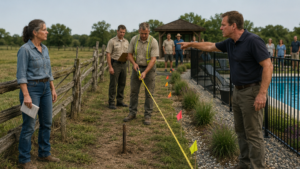
The story has ended.