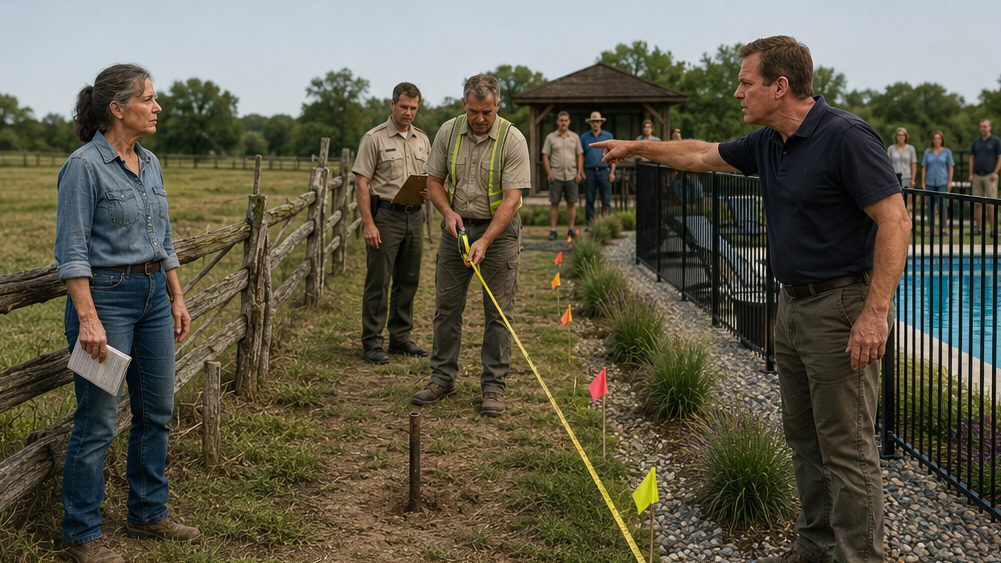
They Ordered Her to Move an Old Farm Fence—Then the Survey Put Their Pool Fourteen Feet Inside Her Pasture
Chapter 1: The Notice Nailed to an Old Cedar Post
Ruth Harris saw the white paper before she saw the broken staple.
It had been fastened to the cedar post beside her lower pasture gate, just above the place where cattle had polished the wood smooth with their shoulders. The paper looked absurdly clean against a post that had gone silver with age.
She shut off the utility vehicle and climbed down.
NOTICE OF VIOLATION was printed across the top.
Ruth read the first paragraph twice.
She was being directed to relocate or remove a section of livestock fence within thirty days.
For several seconds she simply stood there, one hand resting on the post.
The fence had been there before Gary Williams bought the acreage next door. It had been there before Gary’s pool, before his pavilion, before the fresh gravel parking area that now filled with SUVs almost every weekend.
Parts of it had been replaced over the years, but the line itself had not changed as far as Ruth knew.
Her husband had repaired those posts.
His father had repaired some of them before that.
A truck door slammed across the fence.
Gary came down the slope from his property wearing work pants and a clean polo shirt. Beyond him, blue water flashed through the black metal enclosure around the pool.
“You got it, then,” he said.
Ruth looked at the paper.
“You knew about this?”
“I filed it.”
There was no apology in his voice. Not much satisfaction, either. He sounded like a man stating that he’d paid a bill.
Ruth folded the notice once.
“You filed a county complaint against my cattle fence?”
“I tried talking to you.”
“You asked me to move it.”
“I asked you to figure out where the line was.”
“You told me where you thought it was.”
Gary glanced toward the fence. “Because that’s where everything says it is.”
“What everything?”
“The paperwork from when we bought. The contractor’s layout. The setback measurements.”
Ruth looked through the wire.
Gary and Kimberly had bought the former pasture tract three years earlier. At first Ruth had been relieved. They cleaned up the collapsed shed, hauled away old equipment, and repaired the driveway.
Then came the renovation.
The small house became a large rental property. A pavilion went up. Then a pool. Then a broad gravel area where guests parked on Fridays.
Ruth had disliked the noise but had kept it to herself.
Neighbors did things differently now.
That was what she had told herself.
Gary pointed toward the cedar posts.
“The pool was permitted off the property line. Your fence is too far over.”
“My fence was here before your pool.”
“That doesn’t make it the boundary.”
The words irritated Ruth precisely because they contained something she did not want to consider.
Two years earlier, before construction started, Gary had offered to split the cost of a survey.
Ruth had refused.
The boundary was obvious, she’d told him.
The fence was the boundary.
Her husband had known every corner of the place.
Gary had let it drop.
Until now.
“County officer’s coming this week,” he said.
Ruth looked at him.
“You’ve already got a deadline running, so I’d rather not turn it into a fight.”
“You filed a violation notice on me.”
“I filed because I couldn’t get anywhere with you.”
Beyond his shoulder, the pool sat only a short distance from the fence. New stone bordered one side. A row of young ornamental grasses softened the black enclosure.
The old cedar posts looked crooked beside all that straight construction.
Ruth hated that she suddenly noticed it.
Gary lowered his voice.
“If the fence stays where it is, my setback isn’t right.”
There it was.
Not the appearance. Not cattle leaning against wire. Not some abstract concern about property values.
His pool depended on the line.
Ruth held out the notice.
“And your answer is that I tear down my fence?”
“My answer is that the fence gets put where it belongs.”
“Then you’d better be very certain where that is.”
Gary’s jaw tightened.
“I am.”
Ruth folded the paper again and tucked it into the pocket of her work shirt.
“I’m not moving one post because you tell me to.”
“The county may tell you.”
“Then the county can tell me.”
She started back toward the utility vehicle.
“Ruth.”
She stopped.
Gary stayed on his side of the wire.
“You could’ve avoided this if you’d agreed to the survey when I asked.”
That landed harder than she wanted him to see.
Ruth climbed into the vehicle without answering.
At the farmhouse she put the notice on the kitchen table and ignored it for nearly an hour.
She checked water, moved a mineral tub, and looked over a cow that had been favoring one back leg.
But the white page followed her everywhere.
By noon she was in the small room off the kitchen where farm records lived in metal cabinets and old banker boxes.
She found tax statements first.
Then deeds.
Then an envelope with the plat from the transfer into her and her husband’s names.
The paper had been folded so long the creases felt soft.
Ruth spread it beneath a lamp.
The parcel was represented by straight black lines, bearings, distances, and references to monuments she had not thought about in years.
She found the side adjoining Gary’s land.
Then she read the distance.
She looked toward the window.
From the desk she could see part of the fence running toward the lower pasture.
Ruth reached for a farm notebook and began adding lengths between posts from memory, then stopped.
Memory was exactly what Gary was challenging.
She took the plat outside.
At the first corner she paced slowly along the fence, counting steps.
At one point the fence bent around an old oak stump.
Farther down it curved slightly toward Gary’s property before straightening again.
Ruth stood still.
Her husband had replaced that stretch after a storm.
She remembered helping him carry posts.
She remembered asking whether he wanted a string line.
He had laughed and said the old post holes would tell them where everything belonged.
At the time, that had been enough.
Back at the kitchen table, Ruth placed a ruler against the plat.
The recorded line was straight.
Her fence was not.
And when she compared the written distance with the rough length she had just walked, the numbers refused to settle into the certainty she’d carried for twenty years.
For the first time since finding the notice, Ruth stopped wondering how Gary could be so wrong.
She began wondering whether part of him might be right.
Chapter 2: The Party Lights Across the Pasture
At eleven forty-seven Saturday night, Ruth could see blue light pulsing against the ceiling of her bedroom.
It came through the window in slow flashes from Gary’s pool pavilion.
Music traveled differently across pasture after dark. The bass seemed to find the ground and come through the house itself.
Ruth sat up.
Outside, laughter rose and fell.
She could see figures moving behind the black pool fence, drinks in their hands, somebody carrying an inflatable raft shaped like a flamingo.
The white violation notice was still on her kitchen table downstairs.
Twenty-four days remained on the deadline.
Ruth considered calling the county.
Her hand actually reached for the phone.
Then she stopped.
If she complained about the party now, Gary would say she was retaliating.
Maybe she was.
She set the phone down.
By Sunday morning the music was gone, but plastic cups had appeared near the edge of Gary’s gravel parking area. One had blown through the wire into Ruth’s pasture.
She picked it up on the way to feed.
Gary came outside while she was closing the gate.
“Morning.”
Ruth held up the cup.
“One of yours.”
He took it.
“Guests.”
“Your guests.”
“I’ll remind them.”
She waited for him to mention the fence.
He did not.
That irritated her more than if he had.
Monday morning, a county vehicle pulled into Ruth’s drive.
The code-enforcement officer stepped out carrying a clipboard and a tablet.
“I’m here about a reported fence violation.”
Ruth nodded toward the kitchen.
“I know who reported it.”
Inside, she put the notice, her deed, and the old plat on the table.
The officer examined the documents without pretending to understand more than they showed.
“Your neighbor says the fence encroaches onto his parcel.”
“Did he tell you it has been there longer than he’s owned the place?”
“He did.”
“And did he tell you his pool is the reason this suddenly matters?”
The officer looked up.
“He submitted a site sketch indicating a setback conflict.”
“So he did report me.”
“Yes.”
Hearing it from someone else changed the weight of it.
Gary had admitted it himself, but Ruth had still imagined some contractor or county clerk had pushed him toward the complaint.
No.
Gary had signed his name.
The officer walked the fence with her.
He took photographs of several cedar posts, the woven livestock wire, and the pool beyond it.
At one bend he stopped.
“This isn’t a straight fence.”
“No.”
“Do you know why?”
“Trees. Storm repairs. Cattle. Forty years.”
He glanced toward Gary’s property.
“A fence and a legal property line aren’t automatically the same thing.”
Ruth felt heat rise in her neck.
“I’m learning everybody likes telling me that.”
“I’m not deciding ownership.”
“Then what are you deciding?”
“Right now? Whether there’s enough information to establish a violation.”
“And is there?”
“Not yet.”
It was the first thing anyone official had said that felt useful.
The officer closed the tablet cover.
“If the boundary is disputed, we need better evidence than a fence and a contractor sketch.”
Ruth watched him return to his vehicle.
Gary appeared before the county truck reached the road.
He carried a large folded sheet.
“Since he’s here, you might as well look at this.”
Ruth did not cross the fence.
Gary opened the paper against a post.
It was a site layout showing his house, pool, pavilion, parking area, and a line labeled as the property boundary.
A dimension ran from that line to the pool enclosure.
Ruth studied it.
“Who drew this?”
“Pool contractor had it in the permit package.”
“Based on what survey?”
“Based on the purchase documents.”
“That’s not what I asked.”
Gary exhaled.
“Ruth, the contractor isn’t going to build a pool without checking.”
She looked at the sheet again.
The line on the sketch was perfectly straight.
Her actual fence was plainly visible ten feet away, bending around the old stump.
“If that is the property line,” she said, “why were you telling me my fence is the line last week?”
“I said your fence is over.”
“You said everything showed where the boundary was.”
“It does.”
“Then which one did your setback use? My fence or that line?”
Gary’s patience thinned.
“The point is, your fence doesn’t belong where it is.”
“That isn’t an answer.”
He folded the sheet sharply.
“You had a chance to survey this before we built.”
“So did you.”
“We relied on the documents we had.”
“And I’m going to find the documents I have.”
Gary stared at her.
“You’ve got twenty-three days.”
Ruth almost answered.
Instead she turned away.
The county records office occupied the ground floor of a low brick building thirty minutes from the farm.
Ruth arrived before lunch Tuesday with parcel numbers written on an index card.
The records clerk helped her pull the deed history and recorded plats for both properties.
Most of it was familiar.
Then Ruth asked for the newest survey on record.
The clerk searched.
“This one.”
She rotated the monitor.
Ruth checked the date.
It was old.
“There’s nothing newer?”
“Not recorded.”
“Not for the Williams parcel?”
“Nothing I’m seeing.”
Ruth leaned closer.
Gary had bought the land three years earlier.
The survey displayed on the screen was more than a decade old.
“Could somebody have had a survey done and not recorded it?”
“Certainly.”
“But there’s nothing here showing one.”
“Correct.”
Ruth took copies of the relevant pages.
Before she left, she stopped at the counter.
“If somebody applied for a pool permit, what would they use to show the property line?”
“Depends on what was submitted.”
“Would the county verify the actual boundary?”
The clerk shook her head.
“Not necessarily. Permitting isn’t a boundary survey.”
Outside, Ruth sat in her truck with the copied records beside her.
Gary’s certainty no longer bothered her in the same way.
Now it interested her.
He had built a pool, a pavilion, fencing, and parking improvements without any newer recorded survey than the one Ruth was holding.
She looked at the copy again.
The question had changed.
It was no longer whether Gary’s paperwork proved Ruth’s fence was wrong.
It was what, exactly, Gary had relied on when he put hundreds of thousands of dollars beside a line nobody seemed to have formally checked.
Chapter 3: The Line Neither Neighbor Wanted
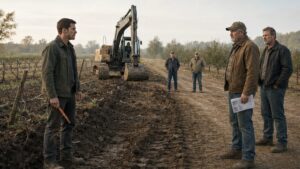
Dennis Baker’s shovel struck metal eight feet from Ruth’s fence.
The sound was small—a clean scrape beneath packed earth—but everybody heard it.
Dennis crouched and cleared another inch of soil with his hand.
“There.”
A rust-darkened iron pin emerged from the dirt.
Ruth stared at it.
The nearest cedar post stood several long steps away.
Gary smiled.
Not broadly.
That made it worse.
Dennis set his equipment case down and checked the pin against his notes.
“You sure that’s the monument?” Gary asked.
Dennis did not look up.
“I’ll tell you what I’m sure of when I’m finished.”
The county officer had returned because the complaint deadline was still open, though he stayed back near the gravel drive. On Gary’s side, four weekend guests lingered around the pavilion despite Kimberly trying twice to coax them inside.
Ruth could feel their attention.
A surveying mistake in an empty pasture would have been easier.
This felt like a public examination of something she had spent years treating as unquestionable.
Dennis set the receiver over the iron pin.
He walked toward the far corner, checking positions against the recorded calls.
Ruth followed at a distance.
The old fence wandered beside them.
At first the difference was small.
Then the gap widened.
At the oak stump, the fence curved sharply enough that Ruth no longer needed equipment to understand the problem.
Gary folded his arms.
“I told you.”
Ruth kept watching Dennis.
Gary took one step closer to the fence.
“You see it now?”
She looked at the crooked cedar posts.
She remembered her husband setting replacements after the storm, tamping dirt around them with the blunt end of a digging bar.
Those old post holes had been good enough for cattle.
Apparently they had never been proof of ownership.
“I see the fence isn’t straight,” she said.
“It isn’t on the line.”
“We don’t know that yet.”
“We’ve got the pin.”
Dennis turned around.
“We’ve got one monument that matches one call. That’s what we’ve got.”
Gary raised his hands.
“Fine. Finish.”
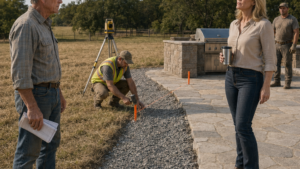
Dennis stretched a bright tape along a temporary line while his equipment established the second point.
He placed the first survey flag in Ruth’s grass.
Then another.
The flags cut a straight course that ignored the old cedar fence completely.
By the fourth flag, the line had crossed from one side of the fence to the other.
Ruth felt something inside her go quiet.
For days she had prepared herself to prove Gary wrong.
She had not prepared herself to be wrong first.
The county officer approached.
“Mrs. Harris, if this ends up being the boundary, part of your fence is on the Williams parcel.”
Ruth looked at the officer, then at Gary.
Gary’s face had changed into the expression of a man who had just received confirmation from an authority he trusted.
“So the notice stands,” he said.
Dennis straightened.
“I haven’t established the whole line.”
“But you’ve established enough.”
“No.”
Gary gestured toward the nearest flag.
“Her fence is over.”
Dennis’s voice stayed flat.
“Mr. Williams, if you want a survey done badly, hire somebody else.”
Kimberly stepped down from the pavilion.
“Gary.”
He ignored her.
Ruth looked at Dennis.
“Keep going.”
Gary gave a short laugh.
“You’re really going to drag this out?”
Ruth met his eyes.
“If my fence is wrong, I’ll say it’s wrong.”
He looked surprised.
“So say it.”
She glanced at the flags.
“My fence is not the legal boundary.”
Nobody spoke.
The admission hurt less once it was outside her.
Ruth pointed toward Dennis.
“Now let him find where the legal boundary is.”
The satisfaction on Gary’s face lasted another ten minutes.
Dennis moved toward the pool.
The straight line marked by the flags passed through a strip of ornamental grass Gary and Kimberly had planted the previous spring.
Then it reached the gravel beside the pool enclosure.
Gary stepped forward.
“That can’t be right.”
Dennis checked the receiver.
Nobody answered him.
He shifted position, took another reading, and placed a flag at the edge of the gravel.
The next calculated point lay beyond the black metal fence.
Inside the landscaped pool area.
Gary came closer.
“Your equipment’s off.”
Dennis looked at him.
“It’s not.”
“The contractor had this laid out.”
“Then I’ll be interested in seeing what he used.”
Gary pointed back toward Ruth’s cedar fence.
“You just proved her fence was on my side.”
“I proved her fence isn’t the boundary.”
“Same thing.”
“No.”
Dennis walked along the calculated line.
Ruth followed.
The line did something none of them had expected.
It crossed the old fence once, then continued past it toward Gary’s property at an angle slightly different from the contractor’s site sketch.
The ornamental grasses Gary had planted were on Ruth’s side of the line.
So was part of the gravel.
The pool enclosure stood ahead.
One of Gary’s guests quietly took his drink and went inside.
Kimberly crossed her arms.
Not defensively now.
She was staring at the flags.
Dennis reached the black metal enclosure.
He checked the point again.
“This section of fence is across the calculated line.”
Gary stepped beside him.
“By how much?”
“I don’t have the final dimension yet.”
“A foot?”
Dennis ignored the guess.
“Two?”
“Gary,” Kimberly said.
He turned.
“What?”
“Let him work.”
Gary looked at Ruth.
“This is ridiculous.”
Ruth almost enjoyed the change in his voice.
Almost.
But then she remembered how certain she had been about the cedar fence less than an hour earlier.
Certainty had embarrassed one of them already.
She did not intend to make the same mistake twice.
“Nobody needs to guess,” she said.
Gary gave her a hard look.
“Easy for you to say now.”
“It wasn’t easy ten minutes ago.”
That silenced him.
Dennis opened the pool gate only after Gary unlocked it.
Inside, he walked past two lounge chairs and placed another temporary marker near the edge of the hardscape.
The pool water was bright and perfectly still.
Ruth had seen it from her pasture dozens of times.
She had never imagined she might be standing on her own parcel while looking down into it.
Dennis took another measurement.
Then another.
Gary hovered behind him.
The county officer had come as far as the gate but did not enter.
“This is still preliminary,” he said.
Gary snapped, “I know.”
Dennis carried the line farther.
It crossed the gravel entertainment area and approached the corner of the pool deck.
Kimberly’s face had gone pale.
“What happens if that’s the boundary?” she asked.
The officer answered carefully.
“First you establish ownership. Then you determine what’s affected.”
“What about the permit?”
“That’s separate.”
Gary turned toward him.
“The permit was approved.”
“Approval doesn’t establish private property ownership.”
The same principle Ruth had been forced to hear about her fence now came back across the line.
A fence wasn’t automatically a boundary.
Apparently, neither was a permit drawing.
Dennis stopped near the far side of the landscaped strip.
He drove a temporary wooden stake into the ground.
The hammer struck once.
Twice.
Three times.
The sound carried across both properties.
Gary watched the stake.
“What’s that?”
“A point on the calculated boundary.”
“That’s inside my pool enclosure.”
“Yes.”
“How far?”
“I’ll give you the certified measurement after I finish the fieldwork.”
Gary looked from the stake to Ruth.
His confidence had not vanished.
Not completely.
But for the first time since the notice had appeared on her cedar post, Ruth saw doubt enter it.
Dennis packed one instrument and moved toward the next setup.
Ruth stayed beside the bright flag he had placed inside Gary’s landscaped pool enclosure.
That morning, she’d arrived expecting a survey to defend an old fence.
Instead it had proved the fence wrong.
Now the same straight line had passed through the argument, through Gary’s contractor sketch, through the ornamental grass, and deep inside the place Gary had been most certain belonged entirely to him.
The only thing nobody yet knew was how deep.
Chapter 4: Fourteen Feet Past the Iron Pin
Dennis wrote the number in pencil before he said it aloud.
Ruth watched his hand move across the certified sketch on her kitchen table.
Fourteen feet, two inches.
The number sat beside the widest point where the calculated boundary crossed into Gary and Kimberly’s pool enclosure.
Ruth read it once.
Then again.
“That’s the maximum?” she asked.
Dennis nodded. “At the deepest point of the encroachment.”
He placed a finger on the drawing.
“This corner of the pool enclosure is over. Part of the hardscape is over. This portion of the gravel entertainment area is over. The pool shell itself appears to stay on the Williams parcel, but I won’t certify structural setbacks. That’s for the county and whoever reviews the permit.”
Ruth looked at the thin black line representing the legal boundary.
It cut through the polished arrangement Gary had spent two summers building.
Fourteen feet did not sound like much in a pasture.
A tractor crossed fourteen feet without Ruth thinking about it.
A cow could stand across fourteen feet nose to tail with room left over.
On a pool site, it was enormous.
Dennis slid another sheet toward her.
“And your fence?”
Ruth asked even though she already knew.
“Off the boundary in both directions. Here, you’re a few feet onto Williams. Farther down, the fence crosses back and sits inside your parcel.”
“So I was wrong.”
“About the fence being the legal line? Yes.”
He did not soften it.
Ruth appreciated that, though it still stung.
Dennis tapped the sketch again.
“But the fence being wrong doesn’t move the deed line. It just means somebody followed old fence posts instead of the recorded boundary.”
Ruth stared through the kitchen window toward the lower pasture.
From there, the cedar fence looked exactly as it had the week before.
Only now it meant something different.
For years it had represented certainty.
Now it represented habit.
She folded her hands.
“What happens next?”
“That’s not my part.”
“I know.”
“You’ll need to decide what you want to do with the survey. If the county asks me whether I stand behind it, I do.”
After Dennis left, Ruth stayed at the kitchen table with the certified survey, the old plat, and Gary’s contractor sketch arranged in three separate stacks.
She should have felt triumphant.
Gary had given her thirty days to move an old fence because he claimed it was interfering with his property.
Instead, his new construction reached fourteen feet onto hers.
But satisfaction did not arrive cleanly.
Ruth kept thinking about the iron pin eight feet away from the cedar post.
She had been certain too.
That mattered.
At the county records office, she asked for copies of the pool permit package.
The clerk located the file and handed Ruth a set of reproduced pages.
The application included a site plan.
Ruth laid Dennis’s survey beside it.
The difference was immediate.
Gary’s permit drawing showed a straight boundary running beyond the pool enclosure. Dennis’s certified survey put that same legal boundary inside it.
Ruth pointed between the two.
“Where did this line come from?”
The clerk looked at the application.
“We’d only know what the applicant submitted.”
“Does the county certify this line when it issues a permit?”
“No.”
“So approval means the pool met the plan they were given.”
“Generally.”
“Not that the line itself was surveyed.”
“Correct.”
Ruth felt the same quiet shift she’d experienced when the code officer told her a fence was not automatically a boundary.
A permit was not automatically one either.
“Can I see what they listed as supporting property documentation?”
The clerk went back through the file.
A seller sketch was attached.
It was not a formal survey.
The paper showed the house, acreage, driveway, and approximate boundary lines. Near one corner, handwritten dimensions had been copied onto the later contractor site plan.
Ruth recognized one of them from Gary’s presentation at the fence.
The number did not appear anywhere on her recorded plat.
“Is this enough for a building permit?”
The clerk gave her a cautious look.
“That’s a question for the permit office.”
Ruth nodded.
She had learned something over the past week: officials became precise when property ownership entered the conversation.
Nobody wanted to say more than their office could prove.
She understood why now.
Back at the farm, Ruth spread the documents across the equipment-shed desk.
She drew no conclusions in ink.
She made columns.
Recorded deed.
Recorded plat.
Dennis’s field measurements.
Gary’s seller sketch.
Permit site plan.
She marked each place the documents agreed.
Then each place they did not.
At four fifteen, the county code officer returned her call.
“I’ve got a certified survey now,” Ruth said.
There was a pause.
“Does it resolve the boundary?”
“It resolves it enough for the surveyor to put his seal on it.”
“And the fence?”
“My fence is wrong.”
The officer sounded surprised.
“Wrong how?”
“It wanders. Part of it is on their side. Part of it is on mine.”
Another pause.
“And the Williams improvements?”
Ruth looked at Dennis’s sketch.
“The maximum encroachment shown is fourteen feet, two inches.”
This silence lasted longer.
“Into your parcel?”
“Yes.”
“Permanent structure?”
“Pool enclosure and hardscape. Some gravel. The pool shell itself may stay on their side.”
“Send me the survey.”
Ruth’s hand rested on the mouse.
She had already scanned it.
“Before I do, I want to know what happens.”
“I can’t promise an outcome.”
“I’m not asking you to.”
“If the submitted permit plan conflicts with a certified boundary survey, permit staff may need to review the approved setback. Separately, an encroachment onto private property is something the owners have to resolve.”
“So you’re not coming out with a bulldozer.”
The officer laughed once.
“No.”
“Good.”
She ended the call without sending the attachment.
Not yet.
Ruth went outside.
Bright flags still crossed the grass between the crooked cedar fence and Gary’s property.
They looked temporary and flimsy, but Ruth trusted them more than she had trusted the heavy posts a week earlier.
On the other side, the Williams place was quiet.
No guests.
No music.
Kimberly stood near the pavilion with her phone to her ear.
Gary was not visible.
Ruth walked to the flag closest to the fence.
From there she could see exactly how absurd the dispute had become.
Her cedar fence leaned onto Gary’s parcel in one section.
Thirty yards away, Gary’s landscaped pool area pushed much farther onto hers.
Neither person had owned the truth they claimed.
Ruth’s phone buzzed.
It was a message from Dennis.
The finalized survey packet had been filed electronically with his office records. He reminded her again that the county might request verification directly from him.
Ruth looked at the email she had drafted to code enforcement.
The certified survey was attached.
So were the relevant deed and plat pages.
Her finger hovered above Send.
A vehicle turned into the farm drive.
Not Gary’s truck.
Kimberly’s SUV.
It stopped beside the equipment shed.
Kimberly got out alone.
She had none of the stiff posture she’d worn beside Gary during the survey. Her arms hung at her sides.
Ruth stepped away from the desk.
Kimberly saw the documents through the open door.
“You haven’t sent it yet, have you?”
Ruth said nothing.
Kimberly came closer but stopped short of entering.
“The survey.”
“What about it?”
“Have you sent it to the county?”
“Not yet.”
Kimberly closed her eyes for half a second.
“Then please don’t.”
Ruth looked at her.
“Why?”
Kimberly glanced toward the boundary, where the bright flags ran straight through the afternoon grass.
“Because there’s something Gary didn’t tell you.”
Chapter 5: What Gary Already Suspected
“Gary wasn’t as certain as he acted.”
Kimberly said it from the doorway of Ruth’s equipment shed.
Ruth did not invite her farther inside.
The survey lay open on the desk between them.
“What does that mean?”
Kimberly looked down at it.
“It means the contractor had trouble reconciling the stakes.”
“What stakes?”
“The ones they used before excavation.”
Ruth waited.
Kimberly rubbed her thumb along the edge of her phone.
“When we started the pool, they had the seller sketch. Gary gave them the dimensions from the purchase packet. They marked the area. Then one of the contractor’s people said the corner didn’t make sense.”
“Didn’t make sense how?”
“He couldn’t get the old visible markers and the sketch to agree.”
Ruth felt her jaw tighten.
“Before the pool was built?”
“Before the final layout.”
“And Gary knew?”
“Yes.”
The word entered the shed quietly.
Ruth looked at the certified survey again.
Fourteen feet, two inches.
“Did the contractor tell him to get a survey?”
Kimberly hesitated.
“Not exactly like that.”
“How exactly?”
“He said if Gary wanted the property line certified, we’d need a licensed surveyor. He said their layout wasn’t a boundary survey.”
Ruth leaned back against the desk.
“And Gary built anyway.”
“We both did.”
That answer made Ruth look up.
Kimberly did not step away from it.
“We thought the seller information was good enough. The old fence looked inconsistent. Gary thought that supported the sketch.”
“He thought my fence was wrong.”
“Yes.”
“So he decided everything else must be right.”
Kimberly pressed her lips together.
“Pretty much.”
Ruth almost laughed.
Instead she looked toward the open shed door.
Outside, the old cedar line bent through the pasture exactly where it had always bent.
“I did the same thing,” she said.
Kimberly frowned.
“You didn’t build a pool.”
“No. I told him the fence was the line because my husband said it was.”
“That’s different.”
“Not enough.”
Ruth remembered Gary’s offer two years earlier.
Split a survey.
Settle it before construction.
She had refused because she believed asking a surveyor to confirm the boundary somehow insulted the people who had kept the farm before her.
Now the thought embarrassed her.
Kimberly moved one step inside.
“We should’ve done it then.”
“Yes.”
“But Gary wasn’t trying to take your land.”
“I didn’t say he was.”
“He thinks you do.”
“What I think is that he filed a violation against me after he knew there was a question.”
Kimberly looked away.
That was the part she could not excuse.
Ruth folded the survey closed.
“Why are you here?”
Kimberly’s answer took time.
“The rental.”
“What about it?”
“We financed the renovation.”
Ruth said nothing.
“Not just the pool. The house. Pavilion. Septic upgrades. Furniture. Everything. We put more into it than we planned.”
“That’s between you and the bank.”
“I know.”
“Then why tell me?”
“Because June through August carries the year.”
Ruth understood before Kimberly finished.
Weekend bookings.
Families.
Small gatherings.
The pool was not simply an expensive backyard addition. It was the centerpiece of what Gary and Kimberly were selling.
“If the county shuts the pool down,” Kimberly said, “we’ll have cancellations.”
“Maybe.”
“We will.”
“And you want me to pretend the survey doesn’t exist until September.”
“No.”
Kimberly said it quickly.
Then, quieter, “I want time.”
“For what?”
“To figure out what can be fixed.”
Ruth studied her.
During the first confrontation Kimberly had stood beside Gary with her arms folded, a posture that had looked like contempt from across the fence.
Ruth saw something else in it now.
Fear, perhaps.
Not innocence.
But fear.
“Did you know Gary filed the complaint?”
“Yes.”
“Did you agree with it?”
Kimberly looked toward the floor.
“I told him it was a bad idea.”
“That’s not what I asked.”
“No. I didn’t agree.”
“But you stood beside him.”
“He’s my husband.”
Ruth gave a small nod.
There were answers that explained a choice without clearing it.
Kimberly looked at the survey packet.
“He thought if the county forced you to move the fence, it would settle the issue without us having to reopen everything.”
There it was.
The deeper offense.
Not that Gary knew the exact legal line.
He had not.
He knew enough to doubt.
And instead of resolving the doubt, he had tried to turn Ruth’s confidence against her.
“He wanted my fence declared wrong before anybody asked whether his pool was right.”
Kimberly said nothing.
Ruth’s anger returned, but it felt different now.
Less hot.
More exact.
She walked to the shed opening.
The bright flags crossed the pasture.
“I should’ve agreed to that survey two years ago.”
Kimberly came beside her.
“Maybe.”
Ruth looked at her.
“Don’t make it easier for me.”
“I’m not trying to.”
“Gary asked. I said no. I thought paying somebody to tell me where my own land ended was ridiculous.”
Kimberly gave a tired half smile.
“And Gary thought a seller sketch was almost the same thing.”
“Looks like both of us were expensive kinds of stubborn.”
Kimberly’s smile disappeared.
“Ours might be more expensive.”
For the first time, Ruth felt the full weight of the choice in front of her.
She could send the survey immediately.
She had every right to.
Gary had used county enforcement against her.
He had kept pushing after the contractor warned him the line was uncertain.
He had stood in front of guests and demanded she admit her fence was wrong.
She had admitted it.
Now the line demanded something from him too.
“I’ll give you until tomorrow morning,” Ruth said.
Kimberly looked relieved too quickly.
“To do what?”
“Talk to Gary. Tell him no more guests use the pool until we decide what happens.”
Kimberly’s face tightened.
“Ruth—”
“That’s the strip that’s confirmed to cross my parcel. I’m not going to keep pretending I don’t know that.”
“We have people checking in Friday.”
“Then you’ve got two days.”
“He won’t agree.”
“Then tomorrow morning I send everything.”
Kimberly nodded slowly.
“I’ll talk to him.”
She left without asking for more.
At eight thirty that evening, Ruth’s phone rang.
Gary.
She answered.
“You sent Kimberly over here to shut down my business?”
“No. Kimberly came by herself.”
“She says you’re threatening to report the pool.”
“I’m not threatening anything.”
“You know what a county review will do.”
“No, I don’t. Neither do you.”
“Ruth, the pool itself isn’t over the line.”
“Part of the enclosure is. Part of the hardscape is. Dennis measured it.”
“And your fence is on my property.”
“In places, yes.”
Gary went silent.
Ruth continued.
“I said that in front of you.”
“Then move it.”
“I will move whatever is mine to correct.”
That silence was different.
Gary had not expected the answer.
“Then we’re done,” he said.
“No. We’re not.”
“Why not?”
“Because your improvements are over too.”
His voice hardened.
“We’ve got bookings.”
“I know.”
“Kimberly told you our finances?”
“Enough.”
“That’s nobody’s business.”
“Then don’t make it the reason I have to leave your construction on my land.”
Gary exhaled sharply.
“I am not canceling the weekend.”
Ruth closed her eyes.
There had still been a path where Gary paused voluntarily, where the survey became a problem the two households solved before another official touched it.
He was closing that path himself.
“Gary.”
“What?”
“You asked the county to enforce the line when you thought it hurt me.”
“This isn’t the same.”
“It is exactly the same.”
“No, it’s not. Your fence can be moved in a day.”
“And that’s why the rule mattered when it was mine.”
He did not answer.
Ruth looked through the farmhouse window toward the distant pool pavilion.
“You’ve got until morning.”
“Do whatever you’re going to do.”
The call ended.
The next morning Ruth opened the rental listing on her laptop.
The coming weekend no longer showed available.
Booked.
Gary had not suspended anything.
He had filled the pool weekend instead.
Ruth opened the email to county enforcement and attached the certified survey.
Chapter 6: The Complaint Comes Back Across the Line
Ruth placed Gary’s original fence complaint on top of the survey packet before sliding both across the county counter.
The code officer recognized the document.
“That’s the one we opened on your fence.”
“I know.”
“And this is the certified survey?”
“Yes.”
He turned to the page Dennis had marked.
His finger stopped at the fourteen-foot dimension.
Ruth watched his expression change, though only slightly.
“You’re asking us to enforce an encroachment?”
“I’m asking you to review the permit against the certified boundary.”
“Private encroachment and code compliance aren’t exactly the same.”
“I know.”
That surprised him.
Ruth pointed to her own fence line.
“I’m correcting this too.”
The officer followed her finger.
“Your surveyor shows part of your livestock fence across the boundary.”
“He does.”
“And you’re not disputing it?”
“No.”
He sat back.
“What outcome are you asking for?”
Ruth had considered that question all night.
She could have said removal.
She could have demanded every piece of Gary’s work leave her acreage immediately.
Instead she said, “One line. Same line for both of us.”
The officer studied her for a moment, then gathered the documents.
“I’ll send this to permit review.”
By Thursday morning, two county vehicles were parked beside Gary’s property.
Ruth stayed in her pasture.
She had cattle to move and refused to stand near the fence waiting for Gary’s trouble to arrive.
Still, she heard voices.
She saw the permit official measuring from one of Dennis’s flagged points.
Gary stood beside him.
Kimberly remained near the pavilion.
At one point Gary gestured toward Ruth’s cedar fence.
The official looked at it, then looked back at the certified survey.
Ruth almost smiled.
The old argument no longer worked.
That afternoon the code officer called.
“The fence complaint against you is being held pending correction to the surveyed line.”
“All right.”
“And permit staff has reopened the Williams pool review.”
Ruth set down the feed invoice she’d been checking.
“What does that mean?”
“The affected pool area can’t be used while they verify setback and enclosure compliance.”
“The whole pool?”
“For now, access to the affected enclosure is suspended.”
Ruth looked toward Gary’s property.
A laminated notice had been fixed to the pool gate.
No dramatic red tape.
No crowd.
Just a county notice and a locked gate.
The same kind of ordinary procedural pressure Gary had expected Ruth to obey.
“How long?” she asked.
“Depends on what correction plan they submit.”
“Is that because I asked?”
“It’s because the certified survey conflicts with the permit site plan.”
Ruth thanked him and ended the call.
The satisfaction she had expected still did not come.
Instead she thought about Friday.
Guests had been scheduled to arrive.
Kimberly’s warning about summer debt had been real.
By evening, the rental parking area remained empty.
At six twenty, Gary walked across the pasture entrance carrying a folder.
He stopped on Ruth’s side of the gate.
“Can we talk?”
The swagger Dennis’s survey had cracked was almost gone.
Not entirely.
Gary still held himself stiffly, as though posture alone might keep the situation from costing more than he could afford.
Ruth nodded toward the equipment shed.
Inside, Gary laid the folder on the desk.
“I’ll buy the strip.”
Ruth looked at him.
“What strip?”
“The encroached area.”
“No.”
“You haven’t even heard the number.”
“I don’t need the number.”
Gary opened the folder anyway.
There was a typed offer and a rough drawing.
“We’d pay for the acreage. More than market. You sign a permanent easement or boundary adjustment. Pool stays. We solve it.”
Ruth studied the drawing.
It carved a narrow wedge from her pasture and attached it functionally to Gary’s pool property.
For a moment, she imagined how little difference the missing grass would make to the cattle.
Fourteen feet at the widest point.
A sliver on a farm.
Gary seemed to read the hesitation.
“You’d never use it.”
Ruth looked up.
“That’s what everybody says about somebody else’s land.”
“I’m offering to pay.”
“This isn’t about whether you can afford fourteen feet.”
His expression tightened.
“What is it about, then?”
Ruth folded the drawing.
“Whether every time somebody builds first and checks later, the person next door is supposed to sell.”
“I tried to check.”
“You tried halfway.”
“So did you.”
The words struck cleanly because they were true.
Ruth let them stand.
“Yes,” she said.
Gary blinked.
“I should’ve agreed to the survey when you asked.”
He seemed almost disappointed she had not fought him.
Ruth continued.
“But when your contractor told you the stakes didn’t reconcile, you kept building.”
Gary looked toward the open shed door.
“Kimberly told you.”
“Yes.”
“She had no right.”
“That sounds like a conversation for your house.”
Gary rubbed his forehead.
“You think I was trying to steal land?”
“No.”
“Then what do you think?”
Ruth considered him.
“I think you got too far into the project to want an answer that could stop it.”
His hand dropped.
For once, he did not deny it.
“We had excavation scheduled. Deposits. Rental dates opening. The contractor said the sketch was probably fine.”
“Probably.”
“Yes.”
“And then you filed against my fence.”
Gary’s face hardened again.
“Because your fence was wrong.”
“So was your assumption.”
He looked at the floor.
Outside, a cow bumped the metal gate and made it rattle.
Gary closed the folder.
“If I move everything they’re talking about, it’s not just a fence panel. It’s hardscape. Landscaping. The enclosure. Then they may change the setback calculation.”
“I know.”
“We could lose the pool for the season.”
“I know.”
“You don’t sound bothered.”
Ruth leaned back against the desk.
“I was bothered when you gave me thirty days.”
Gary met her eyes.
For a second the old confrontation returned between them.
Then Ruth pushed his offer back across the desk.
“I’m not taking this.”
“What do you want?”
“A correction plan.”
“Meaning?”
“You fix what has to be fixed. I fix my fence. Dennis sets permanent pins. We record the line so nobody’s children or buyers have this argument again.”
Gary gave a humorless laugh.
“Easy for you. Your correction costs posts and wire.”
Ruth did not answer immediately.
He was right.
Fairness did not mean equal expense.
Gary’s mistake cost more because he had built more on top of it.
That fact was not revenge, but pretending otherwise would be dishonest.
“I’m not asking the county to punish you beyond what they require,” she said. “I’m not calling your guests. I’m not posting signs. I’m not trying to shut down your business permanently.”
“But you’re refusing an easement.”
“Yes.”
“Why?”
Ruth looked past him toward the cedar fence.
“Because I spent twenty years believing that fence was sacred just because my husband put it there. I was wrong.”
Gary frowned, not seeing where she was going.
“I’m not replacing one bad assumption with another. The survey says where the land ends. That’s what I’m keeping.”
Gary gathered the papers.
At the door he stopped.
“What if the county says we can keep some landscaping there?”
“Then we talk about a temporary license if it doesn’t interfere with the pasture.”
He turned.
“You’re willing to negotiate that?”
“Landscaping isn’t a pool enclosure.”
The first trace of relief crossed his face.
Then suspicion followed it.
“What do you want in return?”
“The permanent boundary recorded. Survey costs divided in a way we agree to. Your hard improvements off my parcel. My fence off yours.”
Gary looked down at his rejected offer.
“You’ve thought about this.”
“I’ve had reason.”
He left without agreeing.
Two days later, the county sent both properties a written summary.
Ruth’s fence violation remained subject to correction along the certified line.
Gary’s permit review required a revised site plan before the pool enclosure could reopen.
The rules had not switched sides.
That was what made them hard to argue with.
They were applying to both.
On Monday, Gary called again.
His voice was flatter.
“The county says the enclosure has to move.”
Ruth waited.
“And the hardscape?”
“Part of it.”
“I’m sorry.”
He gave a short, incredulous breath.
“No, you’re not.”
“I can be sorry it’s expensive and still expect it corrected.”
Gary did not answer.
After a moment he said, “I’m not signing anything until I know exactly what you’re asking.”
“Then we meet at the line.”
“With lawyers?”
“No.”
“County?”
“No.”
“Who?”
“You. Kimberly. Me. Dennis if we need measurements. One rural access-association board member if we want somebody neutral about fence maintenance.”
Gary was silent.
Ruth added, “One meeting. After that, if we can’t settle it, we do everything through formal channels.”
“When?”
“Thursday morning.”
Another pause.
“Fine.”
Ruth ended the call.
She walked down to the lower pasture before supper.
Several bright flags had begun to lean from wind and cattle curiosity. The cedar fence still curved around the old stump as if nothing had changed.
Soon part of it would come down.
Ruth once would have experienced that as surrender.
Now she saw something different.
The fence had done its job when its job was keeping cattle in.
It had failed only when people asked it to prove something it had never been built to prove.
On Thursday, she would meet Gary at the surveyed line.
For the first time since the notice appeared on the cedar post, neither of them would be able to bring a fence, a sketch, a permit, or family memory and call it the truth.
They would have to decide what to do with the truth they finally shared.
Chapter 7: The Fence Moved, but the Farm Did Not
Gary arrived at the boundary meeting without the folder he’d carried into Ruth’s equipment shed and without the rigid confidence he’d worn the morning Dennis uncovered the iron pin.
He came on foot from the pool side.
Kimberly walked beside him.
Dennis was already setting his tripod near the lower corner, and a member of the rural access association stood near Ruth’s gate with a legal pad tucked under one arm.
Ruth noticed Gary looking at the bright survey flags before he looked at her.
Six weeks had changed the place.
Part of the black pool enclosure had been removed. A section of hardscape had been cut back, leaving a clean raw edge where finished stone had once extended toward the pasture. The ornamental grasses nearest the boundary had been dug up and temporarily heeled into soil farther inside Gary’s parcel.
The pool itself remained.
But the property around it no longer pretended the disagreement had never existed.
Dennis pointed toward two temporary stakes.
“County accepted the revised site plan based on this line. What we’re settling today is what stays, what moves, and how the boundary gets recorded.”
Gary nodded.
No argument.
Ruth almost missed the resistance.
It had been easier to know what to do when Gary fought every fact.
Dennis unfolded the corrected survey.
“The enclosure is being relocated entirely onto the Williams parcel. The required hardscape removal is already underway. There’s a narrow strip of landscaping here that can technically remain without affecting the corrected setback.”
He traced the strip.
“That’s the piece we discussed licensing rather than conveying.”
Gary looked at Ruth.
“Temporary license.”
“Temporary,” she said.
“Renewable?”
“If it still works for the pasture.”
Kimberly spoke for the first time.
“And if it doesn’t?”
“Then you move the landscaping.”
Gary gave a small nod.
“Fair.”
The word surprised Ruth.
Six weeks earlier, Gary had wanted to buy the land outright.
Now he was discussing ornamental grass like a man who understood that permission was not ownership.
Dennis shifted to the next page.
“Now the Harris fence.”
Everyone turned toward the cedar posts.
The old line looked worse with permanent measurement beside it.
One stretch leaned into Gary’s parcel. Another fell several feet inside Ruth’s own land. Near the stump, it curved for no legal reason except that somebody long ago had preferred digging around roots instead of through them.
Ruth ran her fingers over the nearest post.
Her husband had set that one.
She could still recognize the slight notch near the top where he’d rested a pair of fencing pliers.
Dennis said, “The easiest correction is to rebuild the disputed section along the surveyed boundary.”
Gary glanced at Ruth.
“And who’s paying for that?”
“I am.”
His head turned fully toward her.
Ruth continued before he could respond.
“My fence. My correction.”
“You don’t have to do all of it.”
“Yes, I do.”
The association member looked between them but stayed silent.
Gary rubbed the back of his neck.
“I figured you’d make me pay half.”
“You didn’t put my fence in the wrong place.”
“No. But this whole thing—”
“This whole thing has enough separate mistakes without combining them.”
Ruth looked at the crooked line.
“I spent a long time telling myself those posts couldn’t be wrong because my husband put them there.”
Kimberly lowered her eyes.
Ruth continued, more quietly.
“He was building a cattle fence. He wasn’t conducting a survey.”
Saying it no longer felt like disloyalty.
That was the change she had not expected.
For weeks after Dennis found the iron pin, Ruth had felt as if correcting the fence would erase something her husband had done.
Now she understood the opposite.
Keeping an inaccurate fence simply because he had touched it reduced his work to a mistake he had never claimed was anything else.
He had needed cattle contained.
The fence had done that.
The legal boundary was another matter.
Gary looked toward the removed pool enclosure.
“Would’ve been nice if we’d both figured that out before I poured concrete.”
Ruth met his eyes.
“Yes.”
There was no useful answer beyond that.
Dennis began walking the line.
At each permanent point, he replaced temporary evidence with something meant to last: an iron pin driven to the required depth, capped and referenced in the final survey.
The bright flags had looked accusatory when they first appeared.
Now, one by one, they came out of the ground.
At the far corner, Gary stopped Dennis.
“That one puts the new fence closer to my drive than I thought.”
Dennis checked the drawing.
“It puts it where the boundary is.”
Gary stared at the pin.
For a moment Ruth saw the old impulse gathering—the instinct to argue with whatever answer cost him something.
Then he exhaled.
“All right.”
That small surrender mattered more than an apology would have.
The association member read through the proposed maintenance agreement.
Both properties would acknowledge the certified survey.
Neither party would treat an existing fence, planting, gravel edge, or future improvement as evidence of ownership contrary to the recorded line.
The temporary landscaping license could be withdrawn if Ruth needed the strip for livestock access or fence maintenance.
Gary and Kimberly would bear the cost of correcting their pool enclosure and hardscape.
Ruth would pay to rebuild her livestock fence.
Survey and recording expenses would be divided under the settlement they had negotiated.
Gary read the final page twice.
“There’s no language here saying I admit I intentionally encroached.”
“No,” Ruth said.
“Because I didn’t.”
“I know.”
He looked up sharply, as if he had expected an accusation.
Ruth folded her copy.
“I never thought you woke up one morning planning to take fourteen feet of my pasture.”
Gary’s expression loosened.
“But you knew enough to stop and check,” she said.
“And you didn’t.”
The looseness disappeared, but he nodded.
“That’s true.”
Kimberly touched his arm.
Gary looked toward the pool.
“When the contractor said the stakes didn’t match, I’d already signed half the contracts.”
Nobody interrupted.
“I told myself the seller sketch had to be right. Then every dollar we spent made me more certain.”
He gave a short laugh without humor.
“Funny how that works.”
Ruth understood it more than she wanted to.
Every year she had trusted the cedar fence had made questioning it feel more insulting.
Gary’s mistake had cost more money.
Hers had cost less.
But both had grown from the same habit: treating familiarity as proof.
The association member handed them the signature pages.
Ruth signed first.
Gary signed after her.
Kimberly added her signature where required.
Dennis gathered the documents.
“Once this is recorded, anybody pulling the parcel records should see the corrected boundary reference.”
Gary looked at Ruth.
“So nobody gets to do this again.”
“That’s the idea.”
Work began on Ruth’s fence the following Monday.
She did not hire someone to tear the entire thing out.
Most of the old posts away from the disputed stretch remained useful.
But along the shared line, the crooked cedar sections came down.
Ruth pulled staples from the first post herself.
The wire loosened with a metallic snap.
For a moment she stood holding it.
Then she laid it carefully in the grass.
The post with her husband’s plier mark came last.
She dug around it rather than yanking it out with the tractor.
The base was dark with age.
When it finally came free, Ruth brushed soil from the wood.
She did not put it back into the fence.
She carried it to the equipment shed and leaned it inside near the old tools.
A memory did not need to remain a property marker to remain hers.
The new cedar line went in straight.
Not straight according to Ruth’s eye.
Not straight according to Gary’s contractor sketch.
Straight between Dennis’s permanent pins.
Across the boundary, workers rebuilt the black pool enclosure inside Gary’s parcel. The cut hardscape was finished with a smaller border. The ornamental grasses remained under the temporary license, though several had been moved farther from the fence.
Gary lost much of the peak rental season.
Ruth knew because the parking area stayed mostly empty for several weekends.
She never asked how much it cost him.
He never told her.
One afternoon in late July, Ruth found him standing near the new fence while she checked a mineral feeder.
He rested one hand on the top rail.
“Looks better.”
She glanced along the straight cedar posts.
“It does.”
“I hated the old one.”
“I know.”
He gave her a sideways look.
“I hated it for the wrong reason, apparently.”
Ruth almost smiled.
“You weren’t entirely wrong.”
“That’s not as comforting as you’d think.”
“No.”
He looked toward the pool.
The corrected enclosure was finished now.
County approval had come through two days earlier.
“You ever think about taking the money?” he asked.
“The easement offer?”
“Yeah.”
“No.”
He nodded as though he had expected that.
“Would’ve been cheaper.”
“For you.”
“For everybody.”
Ruth shook her head.
“Not for whoever owns this place after me.”
Gary looked across the pasture.
Cattle grazed near the lower swale, indifferent to deeds, permits, surveys, and pride.
“I should’ve stopped when the contractor said the stakes didn’t match.”
Ruth checked the feeder latch.
“I should’ve agreed to the survey when you first asked.”
He looked at her.
That was as close to an apology as either of them had managed.
It was enough.
By August, the last bright survey flag had disappeared.
Only the permanent pins remained, low and unremarkable in the ground.
Ruth preferred them that way.
The important things did not always need to announce themselves.
One evening she walked the rebuilt fence from the gate to the far corner.
The cattle moved slowly behind her, clipping grass along the line.
On Gary’s side, the pool lights came on.
There were guests again, but fewer than before. Music carried softly across the property, low enough that Ruth could hear the cattle breathing nearby.
At the old oak stump, she stopped.
The previous fence had curved around it.
The new fence passed several feet away, following the surveyed line.
For decades Ruth had looked at that bend and seen proof that the land belonged exactly where the posts said it did.
Now she saw something gentler.
A man had once needed a fence.
There had been a stump in his way.
So he had gone around it.
That was all.
Ruth rested her hand on a new cedar post.
Across the boundary, Gary closed the pool gate behind a guest.
He looked toward her.
Neither waved.
Neither needed to.
Between them stood one straight fence, built on permanent pins, separating two properties without asking either owner to surrender what was actually theirs.
Behind Ruth, cattle grazed quietly inside the pasture.
The fence had moved.
The farm had not.
The story has ended.